3710. Chemical National Bank (Chicago, IL)

Bank Information

Episode Type
Run → Suspension → Closure
Bank Type
national
Bank ID
4666
Charter Number
4666
Start Date
May 8, 1893
Location
Chicago, Illinois (41.850, -87.650)

Metadata

Model
gpt-5-mini
Short Digest
237be359c13bba04

Response Measures

Accommodated withdrawals, Capital injected, Full suspension, Books examined

Receivership Details

Depositor recovery rate
100.0%
Date receivership started
1893-07-21
Date receivership terminated
1900-05-02
OCC cause of failure
Fraud
Share of assets assessed as good
47.0%
Share of assets assessed as doubtful
30.3%
Share of assets assessed as worthless
22.7%

Description

Multiple contemporaneous articles (May 8–12, 1893) report heavy runs leading the Chemical National Bank (Chicago) to suspend (World's Fair branch and downtown). Bank examiner took charge; officers turned receivables to Equitable Trust. There was an attempted/resumed reopening in mid-June 1893 (reports conflict), but by July 1893 reorganizers/committee concluded resumption impracticable and a receiver was appointed. Classification: run → suspension → eventual closure/receivership.

Events (6)

1. December 15, 1891 Chartered
Source
historical_nic
2. May 8, 1893 Run
Cause
Bank Specific Adverse Info
Cause Details
Extraordinary heavy withdrawals over preceding days (runs), exacerbated by suits involving correspondent/debtor (Sioux City Loan & Trust) and poor loans/management; rumors also circulated.
Measures
Officers turned receivables (bills) to Equitable Trust Company to secure World's Fair branch deposits; bank examiner (James D. Sturgiss/Sturges) assumed charge; doors closed and payments suspended.
Newspaper Excerpt
Heavy runs of Saturday and Monday were the cause of suspension
Source
newspapers
3. May 8, 1893 Suspension
Cause
Bank Specific Adverse Info
Cause Details
Directors suspended after inability to satisfy Clearing House committee and inability to meet heavy withdrawals; poor loans/management cited and a suit by Sioux City Loan & Trust aggravated withdrawals.
Newspaper Excerpt
The business of the Chemical National Bank of Chicago is suspended and I am in possession in the interest of the controller
Source
newspapers
4. June 15, 1893 Reopening
Newspaper Excerpt
At a meeting of the stockholders of the Chemical National Bank yesterday it was decided to resume business. Steps were taken toward reorganization (June 15, 1893). The request of the Chemical bank of Chicago to resume has been refused (earlier reports vary). Heavier reporting indicates resumption attempts in June but later abandonment in July 1893.)
Source
newspapers
5. July 1, 1893* Receivership
Newspaper Excerpt
Last July Comptroller Eckels appointed him receiver of the Chemical National bank; committee decided resumption of business is not practicable (July 1893).
Source
newspapers
6. July 21, 1893 Receivership
Source
historical_nic

Newspaper Articles (25)

Article from Evening Star, May 9, 1893

Click image to open full size in new tab

Article Text

STATE FUNDS TIED UP Closing of the bank on the Exposition Grounds. SPANISH EMBASSY HERE PROPOSED American Ladies Presented to Queen Victoria. WORLD'S FAIR BANK CLOSED. Uneasiness Felt by Some of the Depositors. WORLD'S FAIR GROUNDS, CHICAGO, May 9.Among the exhibits at the exposition today was a national bank under suspension. The exhibit was not an attractive or pleasing one in the eyes of the foreigners who had their money on deposit. but the fears of not getting it back were unfounded, The world's fair branch of the Chemical National Bank of Chicago, now in the hands of its doors the second Uncle Sam, floor usually opened D, on of pavilion administration building, at 9 o'clock The news to into directors known had decided go that liquidation the bank was to most of the English-speak= ing before the hour arrived. depositors They long had banking read in the morning papers that ample securities had been turned over to the Equitable Trust Company to cover the money on deposit at the exposition branch, but they thought it would be a good idea to drop into the bank this morning and see if they could get a little money to pay current expenses. Among the earliest callers was National and State Commissioner John B. Thatcher of New York. The state funds of the world's fair expenses on deposit in the bank were in late name, although he is not treasurer. The commissioner smiled and said he wasn't concerned about the safety of the state's money intrusted to him, but he intended to present a check for $9,749. which was all New York had on deposit. just a a formality to show that he had done his duty, When Mr. Thatcher handed the check to Paying Teller Jareus that gentleman replied that the bank was not open. So the commissioner waited for something to tur up. H. H. Kern.o of the Kansas commissioners, who is also superintendent of the state building. was anxious about the $1,100 of state money, and he talked dubiously about getting it out quickly, if at all. He presented a check for 8475, but did not get the cash He deposited 81,100 Saturday and felt a little blue. The chances a if the bank doesn't pay it," said the commissioner, "that I will have to make it good. The Kansas people are peculiar that way. The fund of $65,000 is nearly exhausted, and I doubt if we shall have money enough to pay all our bills if I do get this $1,100. THE BANK CLOSED. The doors of the Chemical National Bank in this city did not open for business this morning. This notice was posted on the door of the bank: "The business of the Chemical Bank of is suspended and I am in Chicago, the interest National possession in of controller of the currency. JAMES D. STURGISS, National Bank Examiner. A statement of assets and liabilities of the bank will probably be given out this afternoon. THE BRANCH CLOSED. At 9:25 came a telephone message from Cashier Baden at the down-town office of the suspended bank to close the doors of the exposition branch. This was done and soon there was a line of anxious, complaining depositors, some representing themselves and others states or concerns. They wanted to get in close to the paying teller's window. but he talked to those who understood English in a reassuring was and some went away. The paying teller said he would have paid the checks presented before the doors were closed, but he had not the combination to the vault. Treasurer Seaberger of the exposition was an early caller. He said he had a small account with the bank. but was confident every depositor would be paid in full and quickly. The question of a successor to the Chemical National Bank at the fair is one to be decided by the directory at its next meeting. The United States government national mission. Missouri board and other commoney the bank. The Chemical $10,000 for its ing Bank business paid in privilege states National of have doin the world's fair always done a good of the bank people will and troubles foreigners has begin business. when grounds, The the from the midway plaisance villages, or no English and learn of the able bank who speak has natures. little suspension. have excit- The a good deal of their money in large and small accounts, and the depositors will want it back in a hurry. LARGE ATTENDANCE After the first open night the attendance this morning was large, considering the thousands came night. Their visit who their appetite last only whetted for more. and the weather. barring the standing breeze the lake. was favorable for another big dav. Among the early visitors were the Vermont officials and members of the Press Association of that state, who came to take part in the dedication of the Vermont building tomorrow. The party WHR: Gov. Fuller, Lieut. Gov. Stanban, Secretary of State Congressman Grout, ex-Gova. Diland lingham, Brownell, Farnham Pingree.
Article from New-York Tribune, May 9, 1893

Click image to open full size in new tab

Article Text

A WORLD'S FAIR BANK SUSPENDS. THE CHEMICAL NATIONAL OF CHICAGO CLOSES ITS DOORS-ITS DEPOSITS AMOUNT TO $1,400,000. Chicago, May 8.-The Chemical National Bank of this city, which established a branch at Jackson Park, where the World's Fair concessionatres have been depositing their cash, closed Its doors to-day. It is hoped that the assets will satisfy the liabilities, but nothing definite In this respect could be discovered by National Bank Examiner Sturges to-night. who was asked to take charge of the affairs of the institution. The bank was not a member of the Clearing House, but at a late hour made application to the Clearing House Committee for help. Being unable to satisfy the committee as to its solvency. the committee decided to render no assistance. There was nothing left to do but to suspend. The bank has turned over to the Equitable Trust Company of this city bills receivable to the face value of $147,000 to secure deposits at its World's Fair branch amounting to $104, 000. Beyond repeating that the "breathing spell" needed had not been vouchsafed, President Curry was indisposed to discuss the failure. "One thing is certain," he said, "neither our customers nor any other bank is going to get hurt. Our lcans may be slow, but they are sound." An officer of the National Bank of Illinois, through which the Chemical cleared, said to-night that the deposits in the Chemical up to date would aggregate about #1,400,000. The Chemical National Bank something more than a year ago assumed the business of the Chicago Chemical Bank, which was a State Institution. The Chicago Chemical Bank was established three years ago. with offices at No. 85 Dearborn-st. Adlai T. Ewing was president of the bank. When the Institution was merged in the Chicago National Chemical Bank. J. O. Curry, president of the Merchants' National Bank of Aurora, became president of the new bank. E. C. Veasey was first vice-president. Subsequently Mr. Veasey dropped out and Mr. Ewing took his place as first vice-president. The branch of the bank located at the World's Fair Grounds, which has the exclusive privilege of the banking basiness at the World's Fair, has been thoroughly secured. it is said, by the officers and directors of the main branch. The capital stock of the bank is $1,000,000.


Article from The Helena Independent, May 10, 1893

Click image to open full size in new tab

Article Text

THE MARKETS. STOCKS. NEW YORK. May 9.-Bar silver. 83%. Copper->teady; lake $11.00. Lead-Weaker: domestic, $8.85 The stock market was erratic in movements throughout the day. There were sharp rallies at intervals. but the tendonor of prices in the main was downward, owing to reports that the government crop report to-morrow would be most favorable. and the collapse of the Chemical National bank, of Chicago, which lod to ramors affecting the credit of other financial ins.itutions of that city. The deoline at the start was equal to 3% in National Cordage. 21/2 in Eugar, and 1/6 to 2 per cent in the remainder of the list. Befor the expiration of the first half hour Sugar suddenly rose from 87% to 91 and a sharp rally ensued in sympathy, but National Cordage rumors and reports. which were subsequently denied, that application had been made for n receiver for the whisky trust, planged the market once more into depression. National Cordage preferred dropped 22 poin's, common 3%, Whisky 31/6. General Electric 34. American Eugar 1% Northern Pacific preferred 2%, Rock Island 21/2. Oruaha 21. Lackawanna 21, and Cotton Oil 61/4. Losses in the remainder of the list were 1/2 to 2 per cent. During the last fifteen minutes of business, a rally of 1/4 to 1 1/2 per cent occurred and the market left off steadier. Governments-Dull.


Article from The Herald, May 10, 1893

Click image to open full size in new tab

Article Text

NOT A BAD FAILURE. The Chemical National Bank will Pay Dollar for Dollar. CHICAGO, May 9.-As soon as the news of trouble in the affairs of the Chemical National bank became known at the world's fair grounds, this morning, anxious crowde gathered around the branch of the bank, which is the official bank of the world's fair, and located in the administration building. The bank doors, however, were tightly closed, and nobody could learn anything as to the prospects of getting money, though simultaneously with the notice of the difficulty in which the bank was placed, it was said the depositors in the branch had been fully served. It was a quiet crowd, most of the depositors being Americans, but some foreign depositors animadverted somewhat severely on the exposition management for giving official sanction to the bank which they took for a guarantee. The cashier of the branch had gone to the main bank to consult with the afficials, and till he returned no one at the branch could get any information. It appears that some foreigners deposited in the main bank down town, which complicates matters. As anticipated, the main bank also closed doors. The capital of the bank is $1,000,000. It has deposits something over $900,000. The bank is not a member of the clearing house. The failure had no effect in financial circles. Poor judgment in making loans and the monetary stringency are the cause of the failure. Bank Examiner Sturges said it is not e bad failure, but from what he knows 80 far thinks it is a complete one, to the point that resumption of business is not at all likely, He gave assurance that the depositors would not lose anything. President Curry said the depositors would receive 100 cents on the dollar, and within four or five days could be paid at least one-third of their claims. Heavy runs of Saturday and Monday were the cause of suspension; had they had two days more they would have tided over the difficulty. The general opinion among financial men is that the trouble came through bad management and poor investments. The world's fair directors have made ample provision for the payment of all the foreign commissioners and foreign exhibitors who had deposted funds in the world's fair branch of the bank. They will be paid in full and at once from the assests of the bank. In addie tion to this 30 Chicago men, representy ing as may millions of capital, have pert sonally guaranteed the payment of all President Higinbotham of the local t world's fair directory, and President e Palmer of the national commission de0 clare the management has done nothing to make the world's fair responsible for the debts of the Chemical National bank. WASHINGTON, May 9.-The failure of the Chemical National bank of Chicago was not unexpected here, in view of the recent report of the examiner.


Article from The Morning News, May 10, 1893

Click image to open full size in new tab

Article Text

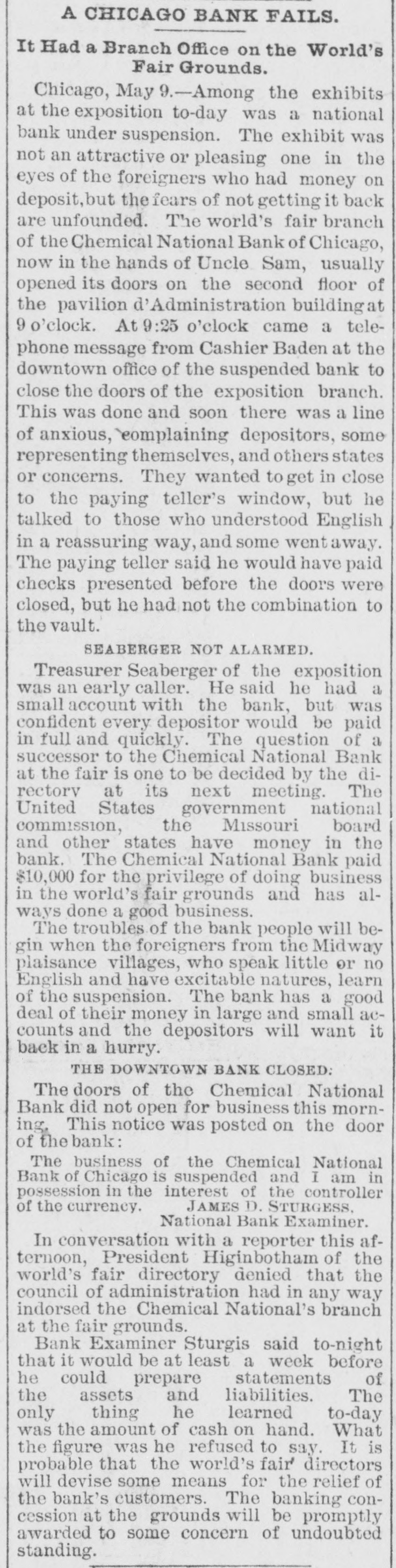
A CHICAGO BANK FAILS. It Had a Branch Office on the World's Fair Grounds. Chicago, May 9.-Among the exhibits at the exposition to-day was a national bank under suspension. The exhibit was not an attractive or pleasing one in the eyes of the foreigners who had money on deposit, but the fears of not getting it back are unfounded. The world's fair branch of the Chemical National Bank of Chicago, now in the hands of Uncle Sam, usually opened its doors on the second floor of the pavilion d'Administration building at 9 o'clock. At 9:25 o'clock came a telephone message from Cashier Baden at the downtown office of the suspended bank to close the doors of the exposition branch. This was done and soon there was a line of anxious, `complaining depositors, some representing themselves, and others states or concerns. They wanted to get in close to the paying teller's window, but he talked to those who understood English in a reassuring way, and some went away. The paying teller said he would have paid checks presented before the doors were closed, but he had not the combination to the vault. SEABERGER NOT ALARMED. Treasurer Seaberger of the exposition was an early caller. He said he had a small account with the bank, but was confident every depositor would be paid in full and quickly. The question of a successor to the Chemical National Bank at the fair is one to be decided by the directory at its next meeting. The United States government national commission, the Missouri board and other states have money in the bank. The Chemical National Bank paid $10,000 for the privilege of doing business in the world's fair grounds and has always done a good business. The troubles of the bank people will begin when the foreigners from the Midway plaisance villages, who speak little or no English and have excitable natures, learn of the suspension. The bank has a good deal of their money in large and small accounts and the depositors will want it back in a hurry. THE DOWNTOWN BANK CLOSED: The doors of the Chemical National Bank did not open for business this morning, This notice was posted on the door of the bank: The business of the Chemical National Bank of Chicago is suspended and I am in possession in the interest of the controller JAMES D. STURGESS, of the currency. National Bank Examiner. In conversation with a reporter this afternoon, President Higinbotham of the world's fair directory denied that the council of administration had in any way indorsed the Chemical National's branch at the fair grounds. Bank Examiner Sturgis said to-night that it would be at least a week before of he could prepare statements the assets and liabilities. The only thing he learned to-day was the amount of cash on hand. What the figure was he refused to say. It is probable that the world's fair directors will devise some means for the relief of the bank's customers. The banking concession at the grounds will be promptly awarded to some concern of undoubted standing.


Article from The Wilmington Daily Republican, May 10, 1893

Click image to open full size in new tab

Article Text

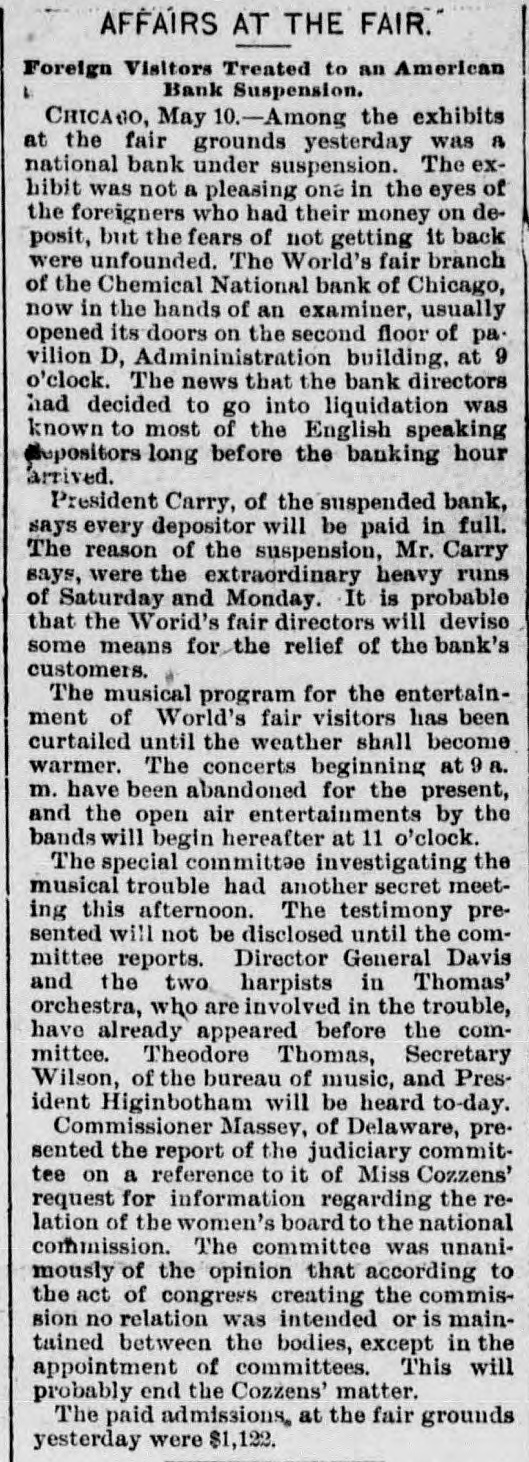
AFFAIRS AT THE FAIR. Foreign Visitors Treated to an American Bank Suspension. CHICAGO, May 10.-Among the exhibits at the fair grounds yesterday was a national bank under suspension. The exhibit was not a pleasing one in the eyes of the foreigners who had their money on deposit, but the fears of not getting it back were unfounded. The World's fair branch of the Chemical National bank of Chicago, now in the hands of an examiner, usually opened its doors on the second floor of pavilion D, Administration building, at 9 o'clock. The news that the bank directors had decided to go into liquidation was known to most of the English speaking depositors long before the banking hour arrived. President Carry, of the suspended bank, says every depositor will be paid in full. The reason of the suspension, Mr. Carry says, were the extraordinary heavy runs of Saturday and Monday. It is probable that the Worid's fair directors will deviso some means for the relief of the bank's customers. The musical program for the entertainment of World's fair visitors has been curtailed until the weather shall become warmer. The concerts beginning at a. m. have been abandoned for the present, and the open air entertainments by the bands will begin hereafter at 11 o'clock. The special committee investigating the musical trouble had another secret meeting this afternoon. The testimony presented will not be disclosed until the committee reports. Director General Davis and the two harpists in Thomas' orchestra, who are involved in the trouble, have already appeared before the committee. Theodore Thomas, Secretary Wilson, of the bureau of music, and President Higinbotham will be heard to-day. Commissioner Massey, of Delaware, presented the report of the judiciary committee on a reference to it of Miss Cozzens' request for information regarding the relation of the women's board to the national commission. The committee was unanimously of the opinion that according to the act of congress creating the commission no relation was intended or is maintained between the bodies, except in the appointment of committees. This will probably end the Cozzens' matter. The paid admissions, at the fair grounds yesterday were $1,122.


Article from The Morning Call, May 10, 1893

Click image to open full size in new tab

Article Text

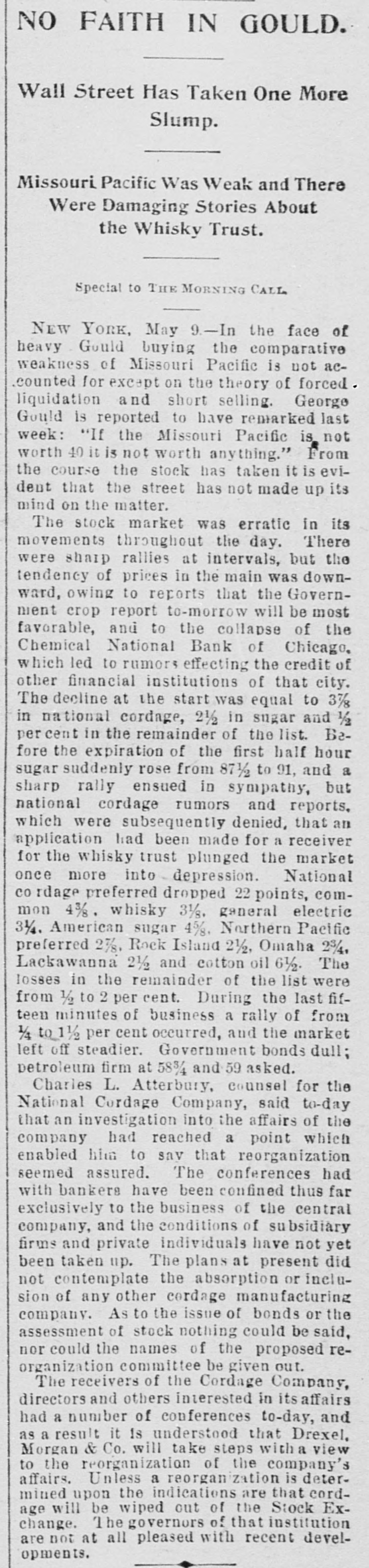
NO FAITH IN GOULD. Wall Street Has Taken One More Slump. Missouri Pacific Was Weak and There Were Damaging Stories About the Whisky Trust. Special to THE MORNING CALL NEW YORK, May 9.-In the face of heavy Gould buying the comparative weakness of Missouri Pacific is not accounted for except on the theory of forced. liquidation and short selling. George Gould is reported to have remarked last week: "If the Missouri Pacific is not worth 40 it is not worth anything." From the course the stock has taken it is evident that the street has not made up its mind on the matter. The stock market was erratic in its movements throughout the day. There were sharp rallies at intervals, but the tendency of prices in the main was downward, owing to reports that the Governnient crop report to-morrow will be most favorable, and to the collapse of the Chemical National Bank of Chicago, which led to rumors effecting the credit of other financial institutions of that city. The decline at the start was equal to 3% in national cordage, 21/2 in sugar and 1/3 percent in the remainder of the list. Before the expiration of the first half hour sugar suddenly rose from 87 1/2 to 91, and a sharp rally ensued in sympathy, but national cordage rumors and reports. which were subsequently denied, that an application had been made for a receiver for the whisky trust plunged the market once more into - depression. National cordage preferred dropped 22 points, common 43/8. whisky 31/8. general electric 31/4. American sugar 45, Northern Pacific preferred 2% Rock Island 2 1/2, Omaha 23/4, Lackawanna 2 1/2 and cotton oil 6 1/2. The losses in the remainder of the list were from 1/2 to 2 per cent. During the last fifteen minutes of business a rally of from 1/4 to 1 1/2 per cent occurred, and the market left off steadier. Government bonds dull; petroleum firm at 583/4 and 59 asked. Charles L. Atterbury, counsel for the National Cordage Company, said to-day that an investigation into the affairs of the company had reached a point which enabled him to sav that reorganization seemed assured. The conferences had with bankers have been confined thus far exclusively to the business of the central company, and the conditions of subsidiary firms and private individuals have not yet been taken up. The plans at present did not contemplate the absorption or inclusion of any other cordage manufacturing company. As to the issue of bonds or the assessment of stock nothing could be said, nor could the names of the proposed reorganization committee be given out. The receivers of the Cordage Company, directors and others interested in its affairs had a number of conferences to-day, and as a result it is understood that Drexel, Morgan & Co. will take steps with view to the reorganization of the company's affairs. Unless a reorganization is determined upon the indications are that cordage will be wiped out of the Stock Exchange. The governors of that institution are not at all pleased with recent developments.


Article from The Salt Lake Herald, May 10, 1893

Click image to open full size in new tab

Article Text

An Anxious Crowd Gather at the World's Fair Branch, THE SIOUX CITY FAILURES. Liabilities of the Union Loan and Trust Company $8,000,000. Comptroller of Currency Eckles Will Have Banks Examined Semi Annually - No Two Successive Examinations by the Same Man. 9.-As soon as of in the affairs CHICAGO, the trouble May of the the Chemi- news cal National bank became known on the World's fair grounds this morning, an crowd gathered the which is anxious branch of bank, around the located official the in bank of the World's fair and is the building. were tightly however, administration closed, and The nobody doors, could learn anything as to the prospects of getting money, though simultaneously with notice of the the is it was bank the placed difficulty said the in deposit- secured. which ors in the branch had been fully It was a quiet crowd, most of the depositors being American, but some of the foreign depositors animadverted management somewhat severely on the exposition for giving official sanction to a bank which they took for a guarantee. had deposited with the bank of money Most of the foreigners and their letters credit were honored at that institution. As soon as it became generally known that the bank was closed a crowd gathered the doors pafor the tiently around appearance and of waited Cashier Brayton. That gentleman did not put in an appearance, having been summoned down town to consult with officials of the bank. Strenuous efforts were made by the deto get in but the clerks kept the doors for a time but it was prevailed positors when locked. Considerable stated things that excitement the quieted bank to in full. comexpected down positors, however, pay refused Some them to of from be the out deforted, as a great many of of town had no means to replenish their exchequer at short notice. At a meeting of the national commission ais afternoon the matter was brought up by Commissioner Gammon of Oklahoma, who offered a resolution reciting the fact of the failure and asking the appointment of a committee of six to investigate the matter and report as to the advisability of permitting the bank to resume business on the grounds. Several disseating voices were heard to the effect that the commission had no to the but number were it had. After a right an investigate equal lengthy debate affairs of the positive the resolu- bank tion was adopted and the committee appointed. As anticipated the main bank has closed. The capital of the bank is $1,000,000. It has deposits amounting to something over $900,000. It is expected the depositors will be paid in full. The bank was not a member of the clearing house. The failure had no effect in financial circles. Poor judgment in making loans and the monetary stringency are the causes of the failure. President Bigginbotham of the local World's fair directory and President Palmer, of the national commission, declare that the management has done nothing to make the World's fair responsible for the debt of the Chemical National bank. A telegram from Washington says: The failure of the Chemical National bank, Chicago, was not unexpected here in view of the recent report of the examiner. Bank Examiner Sturgis said it is not a bad failure, but from what he knows so far he thinks it is a complete one, and to such a point that a resumption of business is not at all likely. He gave assurance that depositors would not lose anything. President Curry said depositors would receive one hundred cents on the dollar, and that within four or five days they would be paid at least one-third of their claims. The heavy runs of Saturday and Monday were the cause of the suspension. Had they had two days more they would have tided over the difficulty. The general opinion among financial men is that the trouble came through bad management and poor investments. The World's fair directors have made ample provision for the payment of all foreign commissioners and foreign exhibitors who had deposited funds in the World's fair branch of the bank. They will be paid in full at once from the assets of the bank. In addition to this thirty Chicago men representing as many millions of capital have personally guaranteed the payment of all moneys due foreigners.


Article from The Wheeling Daily Intelligencer, May 10, 1893

Click image to open full size in new tab

Article Text

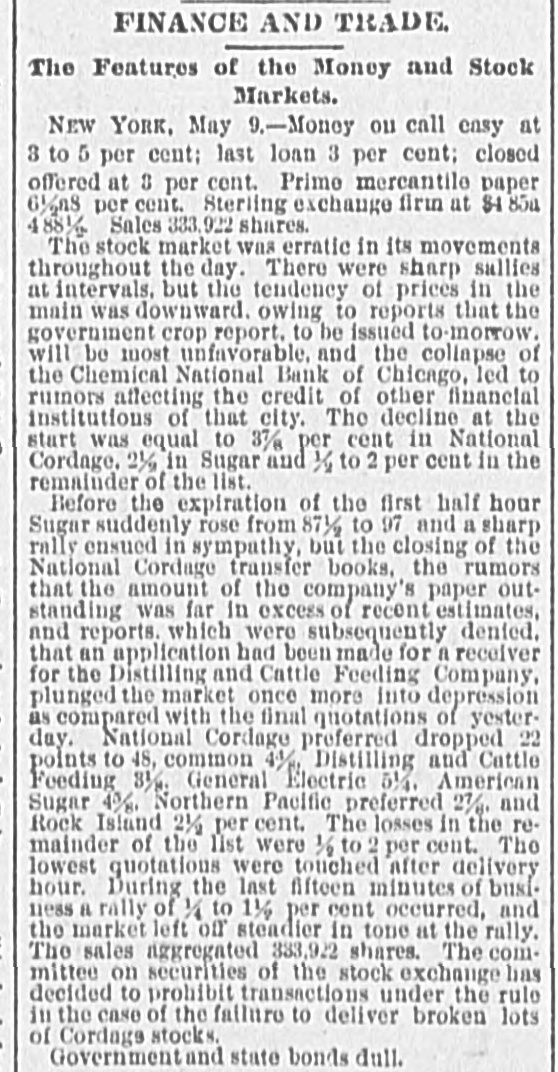
FINANCE AND TRADE. The Features of the Money and Stock Markets. NEW YORK, May 9.-Money ou call easy at 3 to 5 per cent; last loan 3 per cent; closed offered at 8 per cent. Prime mercantile paper 61/n8 per cent. Sterling exchange firm at $4 854 488% Sales 333,922 shares. The stock market was erratic in its movements throughout the day. There were sharp sallies at intervals. but the tendency of prices in the main was downward. owing to reports that the government crop report. to be issued to-morrow. will be most unfavorable, and the collapse of the Chemical National Bank of Chicago, led to rumors affecting the credit of other financial institutions of that city. The decline at the start was equal to 3% per cent in National Cordage. 21/6 in Sugar and 1/2 to 2 per cent in the remainder of the list. Before the expiration of the first half hour Sugar suddenly rose from 871/2 to 97 and a sharp rally ensued in sympathy, but the closing of the National Cordage transfer books, the rumors that the amount of the company's paper outstanding was far in excess of recont estimates, and reports. which were subsequently denied. that an application had been made for n receiver for the Distilling and Cattle Feeding Company, plunged the market once more into depression as compared with the final quotations of yesterday. National Cordage preferred dropped 22 points to 48, common 41/4, Distilling and Cattle Feeding 31/1. General Electric 514. American Sugar 40/8. Northern Pacific preferred 27/15. and Rock Island 21/2 per cent. The losses in the remainder of the list were 1/2 to 2 per cent. The lowest quotations were touched after delivery hour. During the last fifteen minutes of business a rally of 1/4 to 11/2 per cent occurred, and the market left off steadier in tone at the rully. The sales aggregated 333,922 shares. The committee on securities of the stock exchange has decided to prohibit transactions under the rule ill the case of the failure to deliver broken lots of Cordage stocks. Governmentand state bonds dull.


Article from The Wilmington Daily Republican, May 11, 1893

Click image to open full size in new tab

Article Text

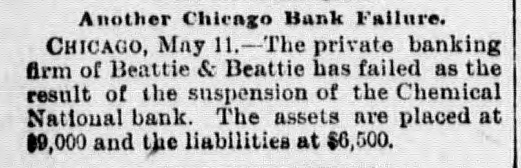
Another Chicago Bank Failure. CHICAGO, May 11.-The private banking firm of Beattie & Beattie has failed as the result of the suspension of the Chemical National bank. The assets are placed at 89,000 and the liabilities at $6,500.


Article from The Wichita Daily Eagle, May 12, 1893

Click image to open full size in new tab

Article Text

CHICAGO, May 11-Tue tional bank of this city suspended today The bank had offices in the Insurance exchange. The deposits are $1,400,000 and the capital $1,000,000. Rumors that the institution was in trouble have been current for the last week. It did business with small country banks, and was not in of esteem with the other banking concerns the city. Bank Examiner Sturgis assumed charge of the bank shortly after total the suspension was announced. The assets of the bank are placed at $2,250,000 the liabilities at $1,500,000. There run on the of the Chemical National, closing been and a constant bank since and close that the is what determined the directors to the doors. The Columbia was not a member of the clearing house. Lyman,J. Gage says that it made application for memberbut. after an examination affairs, it was ship of the a bank's year ago, statement denied. Presi- that dent Wiggins has issued a all the depositers will be paid in full. The president said that the immediate cause of the failure was the bringing of and & suit against it by the Sioux City Loan Trust company, which failed a few days The Sioux City concern at the time ago. of its collapse had $35,000 deposited in this the Columbia bank. When a draft for amount was presented the Columbia people refused payment, claiming that they had loans outstanding against the Sioux City company which equaled the amount the of the latter's deposit. The news of suit caused a run on the Chicago institution, which they were unable to stand. INDIANAPOLIS, Ind., May 11.-The Capital National bank suspended this morn- the inz. The statement is given out that saspension was caused by the suspension of the Chemical National bank of Chicago, which banked owed the Capital National large sum of money. The bank also H carried a large amount of the Premier Steel company's paper. The latter concern Friwent into the hands of a receiver last The bank is the depository for the a of building associations, of the suspension announcement day. number and came as a great shock to the people. A statement issued by the officers of fall- the Capital National bank states that the Chemiis due to the suspension of the cal ure National bank of Chicago, with which it had a deposit of $79,000. The statement liabilities further that the assets and says of the bank at the close of yesterday's business were $1,465,962 each. The officers the of the bank think that the affairs of be bank are in such shape that they can settled up without injury to the business interests of Indianapolis. The bank was not a member of the clearing house. None of the other banks here feel that there is any cause whatever for alarm regarding financial matters. WILMINGTON, Del., May 11.-R. R. Robinson & Co., bankers and brokers, of this city, failed today. The liabilities are at estimated at $300,000 and the assets $100,000. DeHaven and Townsend of Philadelphia the principal creditors. Their claims of amount are to about $60,000. The causes the failure, as explained by the firm, the are follows: The indorsement of notes, decline as in the stock market, carrying the stocks for customers and protecting stocks of customers without being taken protected by them. The sheriff has The charge of all the property of the firm. The failure has been expected for weeks. outstandinclude real property and in assets accounts. The firm was organized and ing and consists of H. C. Robinson his 1848, J. Norris Robinson. It is thought that son, the firm ultimately will be put on foot again. SIOUX CITY, Ia., May 11.-A receiver today appointed for the Sioux stock- City was works. on application of the Engine The assets of the company are at piaced holders. at $231,000 and the liabilities to the The failure is charged Sioux $200,000. City National bank, which failed to give credit for $35,000. Assignee Hubbard of the Union Trust Loan Trust company, the Hedges filed an and and D. Hedges, today schedcompany of the values of the assets Union estimate uled in the three assignments. The at $1,Loan company's assets are placed of $1,against an original estimare at $7,351,574, The liabilities are placed origin468,038. The assets of D. Hedges, down to 000,000. placed at $2,247,000. are cut at ally and the liabilities are placed $307,577, The Hedges Trust company's $1,022,000. estimated at $475,000 originally, discrepanassets, cut down to $183,018. The the are in both the latter cases lie between cies face value of securities and the assignee's estimate of their value.


Article from The Madison Daily Leader, May 12, 1893

Click image to open full size in new tab

Article Text

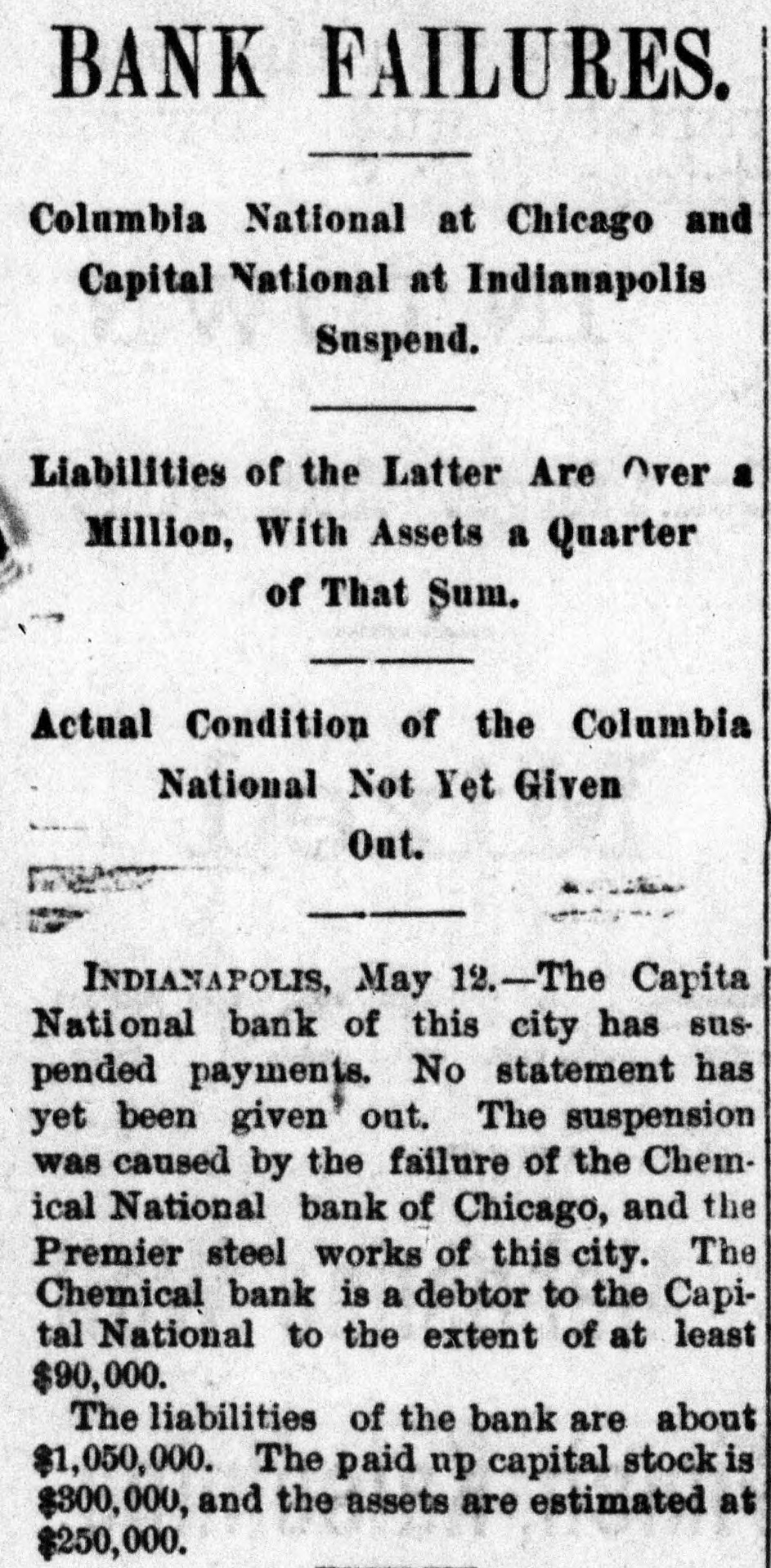
BANK FAILURES. Columbia National at Chicago and Capital National at Indianapolis Suspend. Liabilities of the Latter Are Over a Million, With Assets a Quarter of That Sum. Actual Condition of the Columbia National Not Yet Given Out. ab INDIANAPOLIS, May 12.-The Capita National bank of this city has suspended payments. No statement has yet been given out. The suspension was caused by the failure of the Chemical National bank of Chicago, and the Premier steel works of this city. The Chemical bank is a debtor to the Capital National to the extent of at least $90,000. The liabilities of the bank are about $1,050,000. The paid up capital stock is $300,000, and the assets are estimated at $250,000.


Article from Macon Beacon, May 13, 1893

Click image to open full size in new tab

Article Text

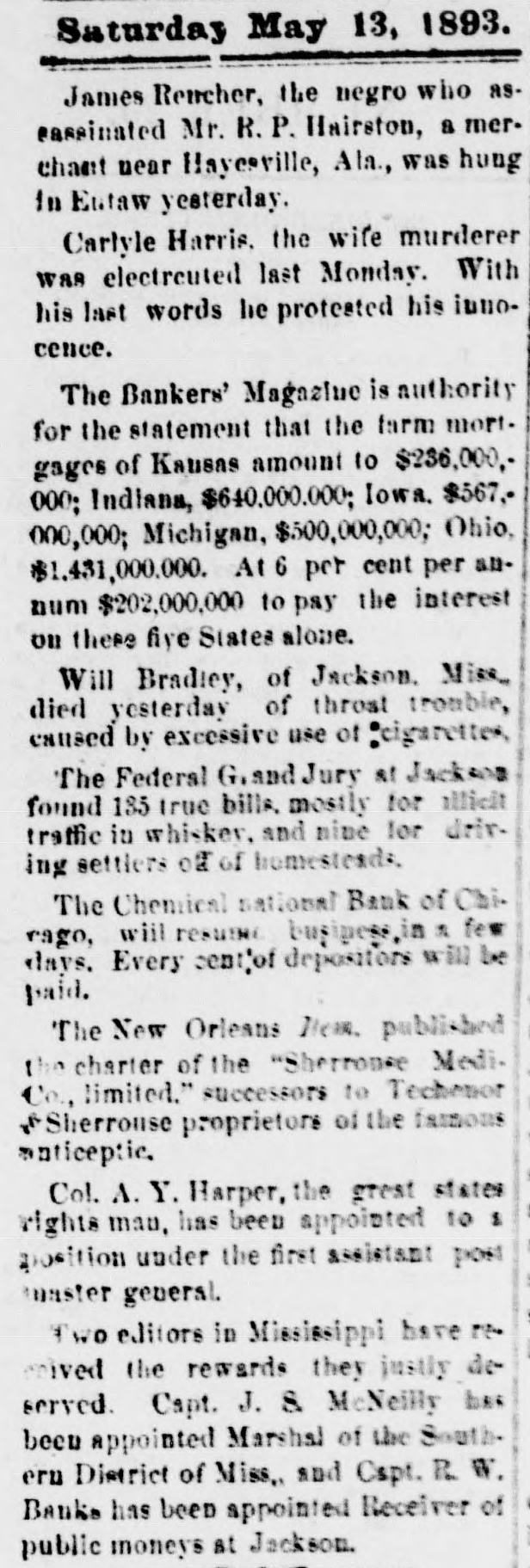
Saturday May 13, 1893. James Rencher, the negro who assassinated Mr. R. P. Hairston, a merchant near Hayesville, Ala., was hung in Eutaw yesterday. Carlyle Harris, the wife murderer was electrcuted last Monday. With his last words he protested his innocence. The Bankers' Magazine is authority for the statement that the farm mortgages of Kausas amount to $236,000,000; Indiana, $640.000.000; Iowa. $567,000,000; Michigan, $500,000,000; Ohio, $1,431,000.000. At 6 per cent per annum $202,000,000 to pay the interest on these fiye States alone. Will Bradley, of Jackson, Miss., died yesterday of throat trouble, caused by excessive use of cigarettes, The Federal Grand Jury at Jackson found 185 true bills, mostly for illicit traffic in whiskey, and nine for driving settlers off of homesteads. The Chemical national Bank of Chicago, wiil resume business in a few days. Every cent of depositors will be paid. The New Orleans Item, published the charter of the "Sherronse Medi-Co., limited," successors to Techenor & Sherrouse proprietors of the famous anticeptic, Col. A. Y. Harper, the great states rights man, has been appointed to a position under the first assistant post master general. Two editors in Mississippi have received the rewards they justly deserved. Capt. J. S. McNeilly has been appointed Marshal of the Southern District of Miss., and Capt. R. W. Bauks has been appointed Receiver of public moneys at Jackson.


Article from The Evening Herald, May 13, 1893

Click image to open full size in new tab

Article Text

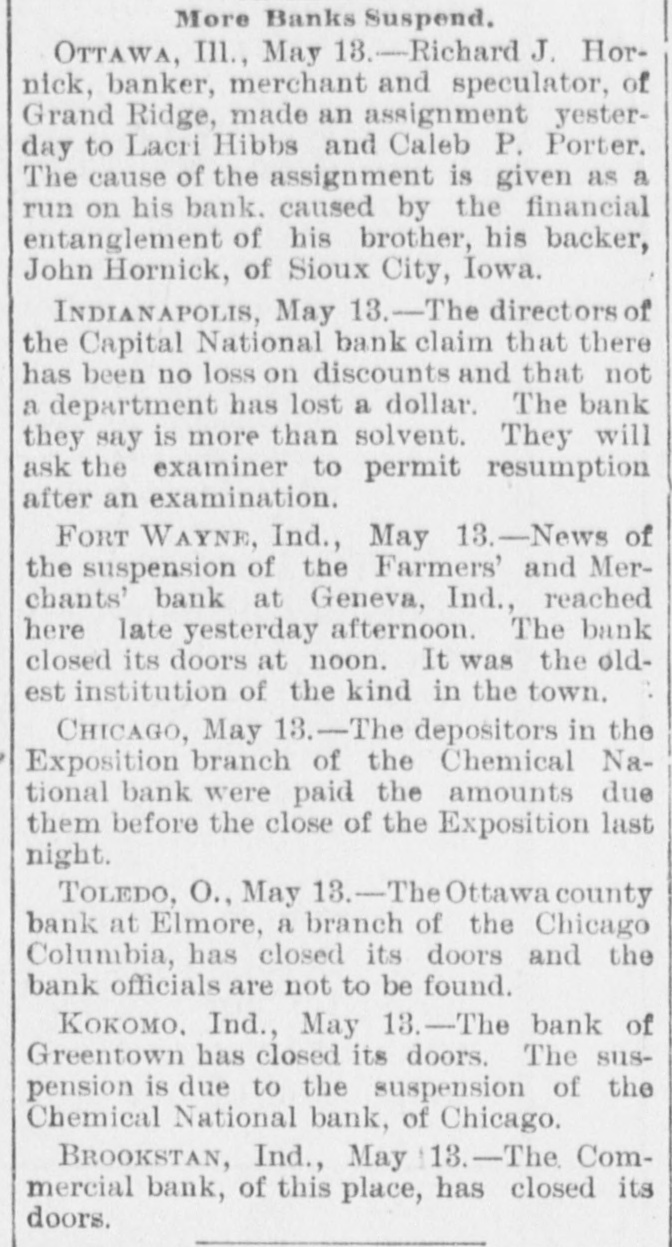
More Banks Suspend. OTTAWA, III., May .-Richard J. Hornick, banker, merchant and speculator, of Grand Ridge, made an assignment yesterday to Lacri Hibbs and Caleb P. Porter. The cause of the assignment is given as a run on his bank. caused by the financial entanglement of his brother, his backer, John Hornick, of Sioux City, Iowa. INDIANAPOLIS May 13.-The directors of the Capital National bank claim that there has been no loss on discounts and that not a department has lost a dollar. The bank they say is more than solvent. They will ask the examiner to permit resumption after an examination. FORT WAYNE, Ind., May .-News of the suspension of the Farmers' and Merchants' bank at Geneva, Ind., reached here late yesterday afternoon. The bank closed its doors at noon. It was the oldest institution of the kind in the town. CHICAGO, May 13.-The depositors in the Exposition branch of the Chemical National bank were paid the amounts due them before the close of the Exposition last night. TOLEDO, O., May 13.-The - Ottawa county bank at Elmore, a branch of the Chicago Columbia, has closed its doors and the bank officials are not to be found. KOKOMO, Ind., May 13. - The bank of Greentown has closed its doors. The suspension is due to the suspension of the Chemical National bank, of Chicago. BROOKSTAN, Ind., May 1 13.-The Commercial bank, of this place, has closed its doors.


Article from The Hawaiian Star, May 17, 1893

Click image to open full size in new tab

Article Text

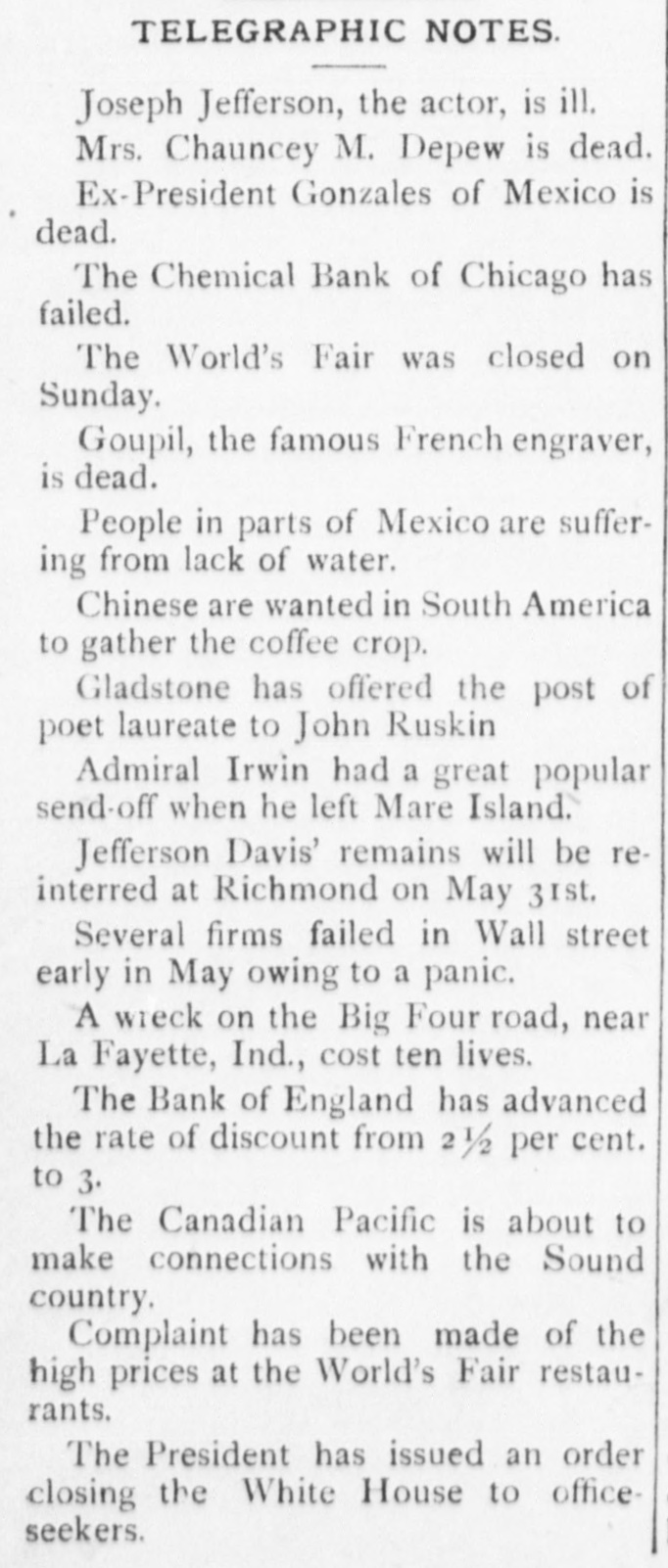
TELEGRAPHIC NOTES Joseph Jefferson, the actor, is ill. Mrs. Chauncey M. Depew is dead. Ex-President Gonzales of Mexico is dead. The Chemical Bank of Chicago has failed. The World's Fair was closed on Sunday. Goupil, the famous French engraver, is dead. People in parts of Mexico are suffering from lack of water. Chinese are wanted in South America to gather the coffee crop. Gladstone has offered the post of poet laureate to John Ruskin Admiral Irwin had a great popular send-off when he left Mare Island. Jefferson Davis' remains will be reinterred at Richmond on May 3 1st. Several firms failed in Wall street early in May owing to a panic. A wreck on the Big Four road, near La Fayette, Ind., cost ten lives. The Bank of England has advanced the rate of discount from 2 1/2 per cent. to 3. The Canadian Pacific is about to make connections with the Sound country. Complaint has been made of the high prices at the World's Fair restaurants. The President has issued an order closing the White House to officeseekers.


Article from The Weekly Union Times, May 19, 1893

Click image to open full size in new tab

Article Text

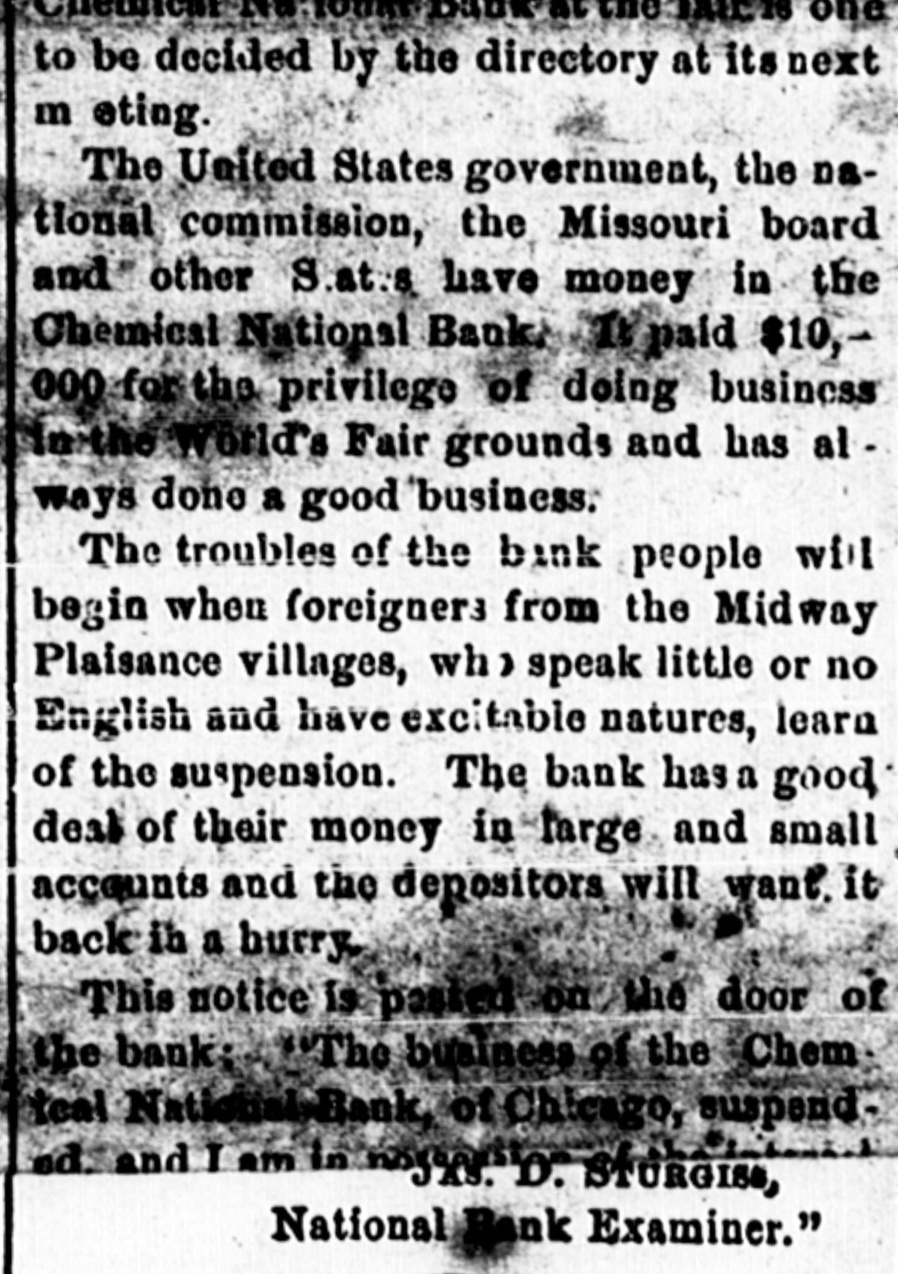
to be decided by the directory at its next m eting. The United States government, the national commission, the Missouri board and other S.at.s have money in the Chemical National Bank n paid $10,000 for the privilege of doing business farthe World's Fair grounds and has al ways done a good business. The troubles of the bink people will begin when foreigners from the Midway Plaisance villages, who speak little or no English and have excitable natures, learn of the suspension. The bank has a good deal of their money in large and small accounts and the depositors will want. it back in a burry This notice is pasted on the door of the bank: "The business of the Chem teal Nat Bank, of Chicago, suspended and I am in D. STURGISS, National Bank Examiner."


Article from New-York Tribune, June 3, 1893

Click image to open full size in new tab

Article Text

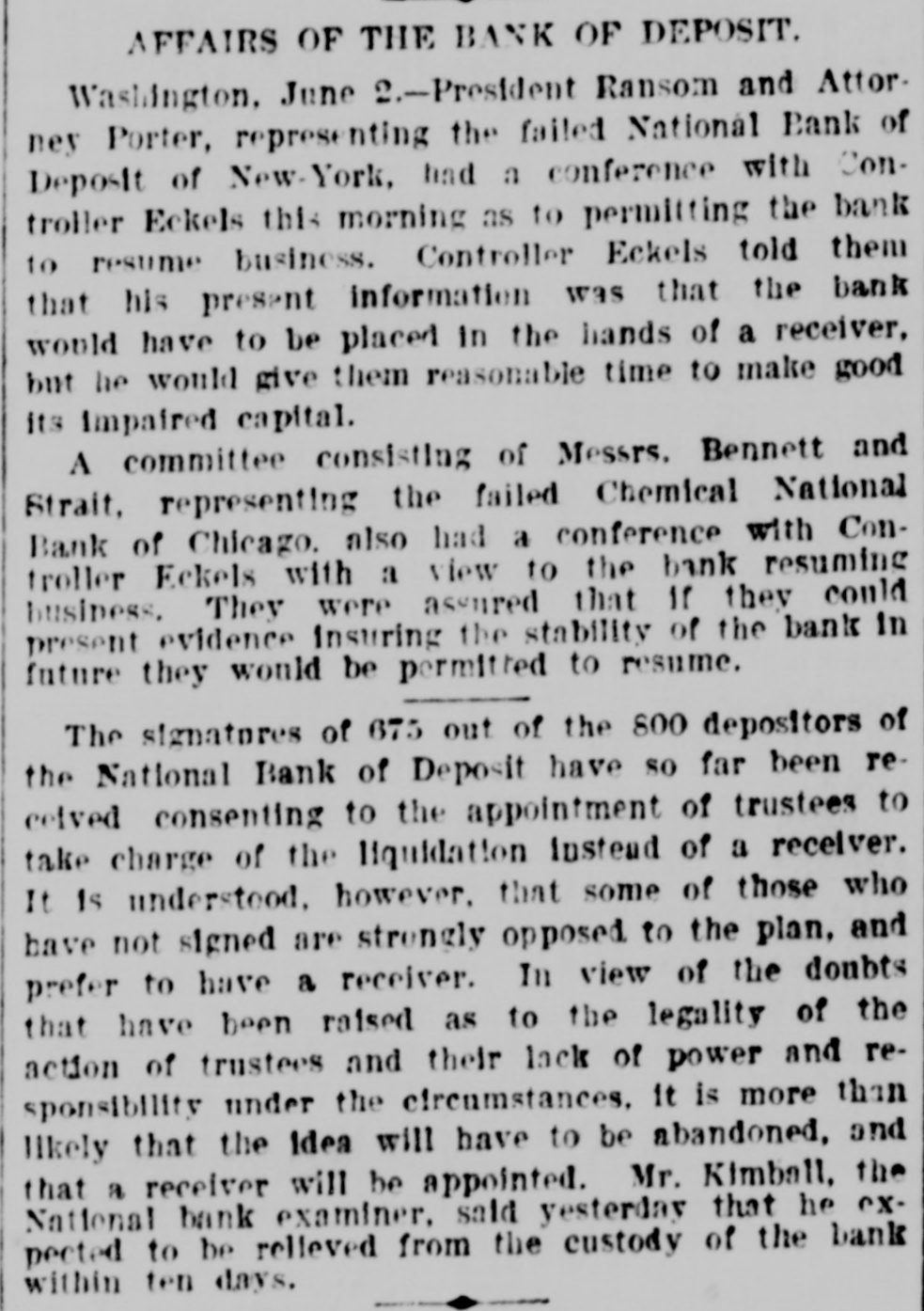
AFFAIRS OF THE BANK OF DEPOSIT. Washington. June 2.-President Ransom and Attorney Porter, representing the failed National Bank of Deposit of New-York, had a conference with Controller Eckels this morning as to permitting the bank to resume business. Controller Eckels told them that his present information was that the bank would have to be placed in the hands of a receiver, but he would give them reasonable time to make good its impaired capital. A committee consisting of Messrs. Bennett and Strait, representing the failed Chemical National Bank of Chicago. also had a conference with Controller Eckels with a view to the bank resuming business. They were assured that If they could present evidence insuring the stability of the bank in future they would be permitted to resume. The signatures of 675 out of the 800 depositors of the National Bank of Deposit have so far been recelved consenting to the appointment of trustees to take charge of the liquidation instead of a receiver. It is understood. however, that some of those who have not signed are strongly opposed to the plan, and prefer to have a receiver. In view of the doubts that have been raised as to the legality of the action of trustees and their lack of power and responsibility under the circumstances, it is more than likely that the Idea will have to be abandoned, and that a receiver will be appointed. Mr. Kimball, the National bank examiner. said yesterday that he expected to be relieved from the custody of the bank within ten days.


Article from The Worthington Advance, June 8, 1893

Click image to open full size in new tab

Article Text

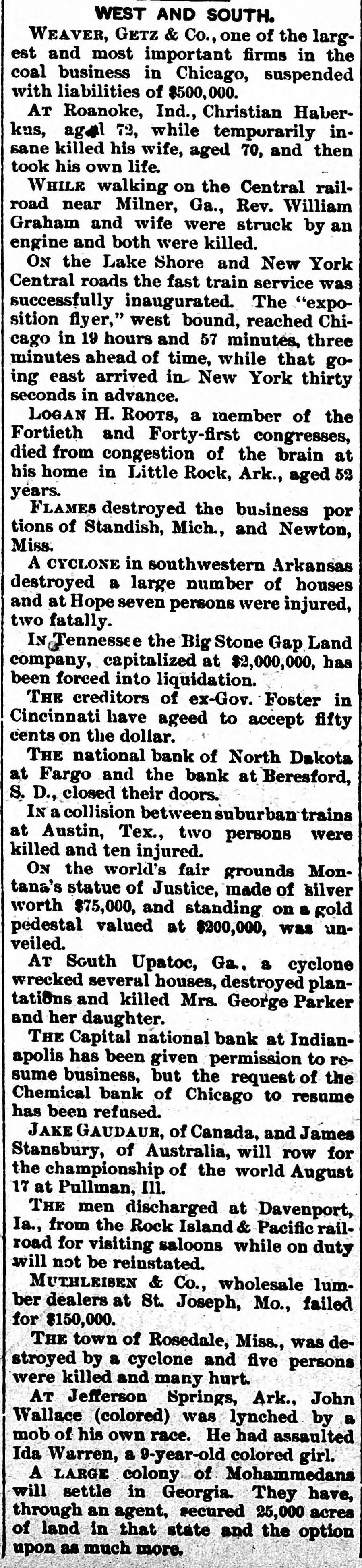
WEST AND SOUTH. WEAVER, GETZ & Co., one of the largest and most important firms in the coal business in Chicago, suspended with liabilities of $500,000. AT Roanoke, Ind., Christian Haberkus, ag41 72, while temporarily insane killed his wife, aged 70, and then took his own life. WHILE walking on the Central railroad near Milner, Ga., Rev. William Graham and wife were struck by an engine and both were killed. ON the Lake Shore and New York Central roads the fast train service was successfully inaugurated. The "exposition flyer," west bound, reached Chicago in 19 hours and 57 minutes, three minutes ahead of time, while that going east arrived in New York thirty seconds in advance. LOGAN H. ROOTS, a member of the Fortieth and Forty-first congresses, died from congestion of the brain at his home in Little Rock, Ark., aged 52 years. FLAMES destroyed the business por tions of Standish, Mich., and Newton, Miss. A CYCLONE in southwestern Arkansas destroyed a large number of houses and at Hope seven persons were injured, two fatally. IN Tennessee the Big Stone Gap Land company, capitalized at $2,000,000, has been forced into liquidation. THE creditors of ex-Gov. Foster in Cincinnati have ageed to accept fifty cents on the dollar. THE national bank of North Dakota at Fargo and the bank at Beresford, S. D., closed their doors. IN a collision between suburban trains at Austin, Tex., two persons were killed and ten injured. ON the world's fair grounds Montana's statue of Justice, made of silver worth $75,000, and standing on a gold pedestal valued at $200,000, was unveiled. AT South Upatoc, Ga., a cyclone wrecked several houses, destroyed plantations and killed Mrs. George Parker and her daughter. THE Capital national bank at Indianapolis has been given permission to resume business, but the request of the Chemical bank of Chicago to resume has been refused. JAKE GAUDAUR, of Canada, and James Stansbury, of Australia, will row for the championship of the world August 17 at Pullman, Ill. THE men discharged at Davenport, Ia., from the Rock Island & Pacific railroad for visiting saloons while on duty will not be reinstated. MUTHLEISEN & Co., wholesale lumber dealers at St. Joseph, Mo., failed for $150,000. THE town of Rosedale, Miss., was destroyed by a cyclone and five persons were killed and many hurt. AT Jefferson Springs, Ark., John Wallace (colored) was lynched by a mob of his own race. He had assaulted Ida Warren, a 9-year-old colored girl. A LARGE colony of Mohammedans will settle in Georgia. They have, through an agent, secured 25,000 acres of land in that state and the option upon as much more.


Article from The Sun, June 16, 1893

Click image to open full size in new tab

Article Text

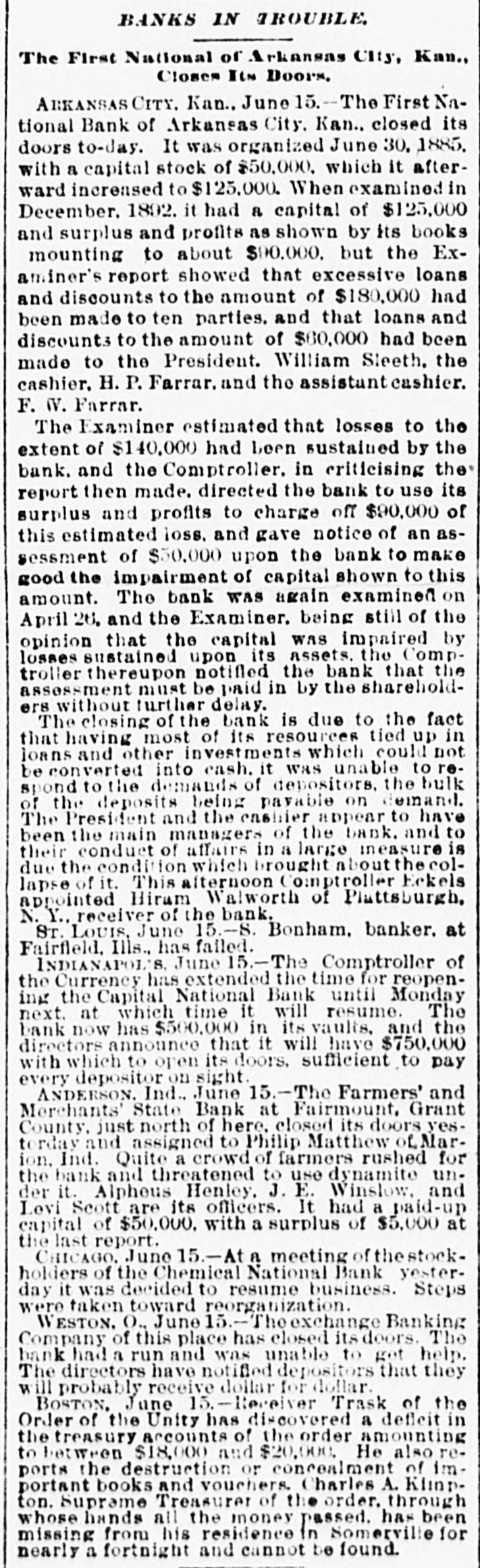
BANKS IN TROUBLE. The First National of Arkansas City, Kan., Closes Its Doors. ARKANSAS CITY. Kan.. June 15.--The First National Bank of Arkansas City. Kan.. closed its doors to-day. It was organized June 30. 1885. with a capital stock of $50,000. which it afterward increased to $125,000. When examined in December. 1892. it had a capital of $125,000 and surplus and profits as shown by its books mounting to about $90,000. but the Examiner's report showed that excessive loans and discounts to the amount of $180,000 had been made to ten parties. and that loans and discounts to the amount of $60,000 had been made to the President. William Steeth. the cashier. H. P. Farrar. and the assistant cashier. F. W. Farrar. The Examiner estimated that losses to the extent of $140,000 had been sustained by the bank. and the Comptroller. in criticising the report then made. directed the bank to use its surplus and profits to charge off $90,000 of this estimated loss. and gave notice of an assessment of $50,000 upon the bank to make good the impairment of capital shown to this amount. The bank WAS again examined on April 20. and the Examiner. being still of the opinion that the capital was impaired by losses sustained upon its Assets. the Comptroller thereupon notifled the bank that the assessment must be paid in by the shareholders without further delay. The closing of the bank is due to the fact that having most of its resources tied up in loans and other investments which could not be converted into cash. it was unable to respond to the demands of depositors, the bulk of the deposits being payable on demand. The President and the cashier appear to have been the main managers of the bank. and to their conduct of affairs in a large measure is due the condition which brought about the collapse of it. This afternoon Comptroller Eckels appointed Hiram Walworth of Plattsburgh, N.Y., receiver of the bank. ST. LOUIS, June 15.-8. Bonham. banker. at Fairfield. Ills., has failed. INDIANAPOL'S June 15.-The Comptroller of the Currency has extended the time for reopening the Capital National Bank until Monday next. at which time it will resume. The bank now has $500.00 in its vaults, and the directors announce that it will have $750,000 with which to open its doors. sufficient to pay every depositor on sight. ANDERSON. Ind.. June 5.-The Farmers' and Merchants State Bank at Fairmount, Grant County, just north of here. closed its doors yestorday and assigned to Philip Matthew of Marion. Ind. Quite a crowd of farmers rushed for the bank and threatened to use dynamite under it. Alpheus Henley. J. E. Winslow, and Lovi Scott are its officers. It had a paid-up capital of $50,000. with a surplus of $5,000 at the last report. CHICAGO. June 15.-Atn meeting of thestockholders of the Chemical National Bank yesterday it was decided to resume business. Steps were taken toward reorganization WESTON. O., June exchange Banking Company of this place has closed its doors. The bank had a run and was unable to get help. The directors have notified depositors that they will probably receive dollar for dollar. BOSTON. June 15.-Receiver Trask of the Order of the Unity has discovered a defleit in the treasury accounts of the order amounting to between $18,000 and $20,000. He also reports the destruction or concealment of important books and vouchers. Charles A. Klinnton. Suprame Treasurer of the order. through whose hands all the money passed. has been missing from his residence in Somerville for nearly a fortnight and cannot be found.


Article from St. Paul Daily Globe, July 19, 1893

Click image to open full size in new tab

Article Text

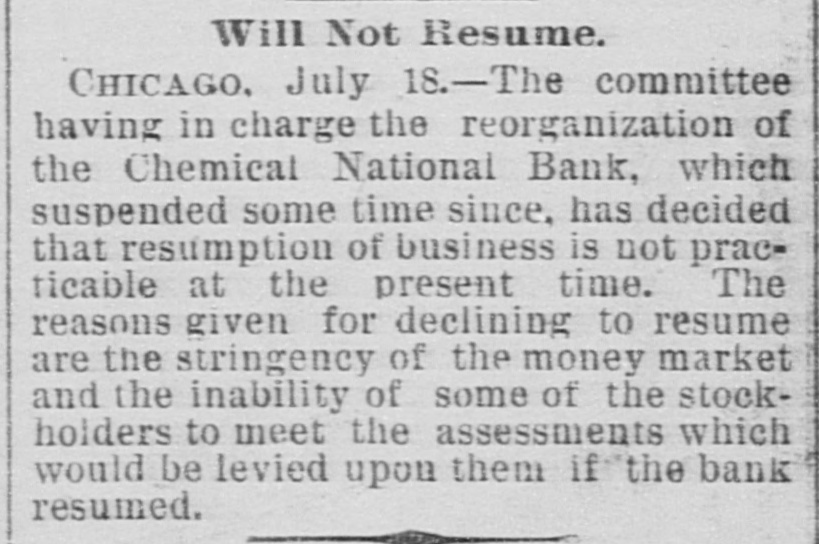
Will Not Resume. CHICAGO, July 18.-The - committee having in charge the reorganization of the Chemical National Bank, which suspended some time since, has decided that resumption of business is not practicable at the present time. The reasons given for declining to resume are the stringency of the money market and the inability of some of the stockholders to meet the assessments which would be levied upon them if the bank resumed.


Article from The Middleburgh Post, July 20, 1893

Click image to open full size in new tab

Article Text

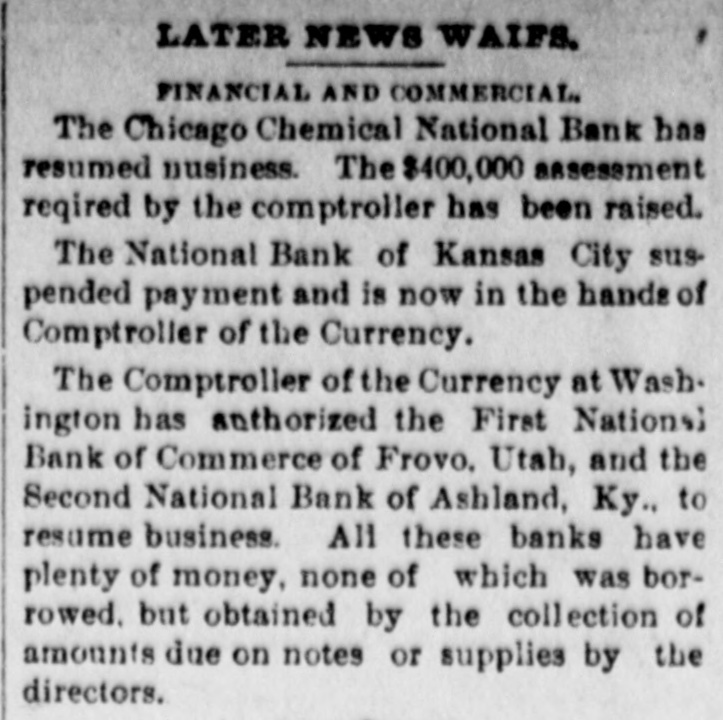
LATER NEWS WAIFS. FINANCIAL AND COMMERCIAL. The Chicago Chemical National Bank has resumed nusiness. The $400,000 assessment reqired by the comptroller has been raised. The National Bank of Kansas City suspended payment and is now in the hands of Comptroller of the Currency. The Comptroller of the Currency at Wash. ington has authorized the First National Bank of Commerce of Frovo. Utah, and the Second National Bank of Ashland, Ky., to resume business. All these banks have plenty of money, none of which was borrowed. but obtained by the collection of amounts due on notes or supplies by the directors.


Article from Chicago Eagle, December 30, 1893

Click image to open full size in new tab

Article Text

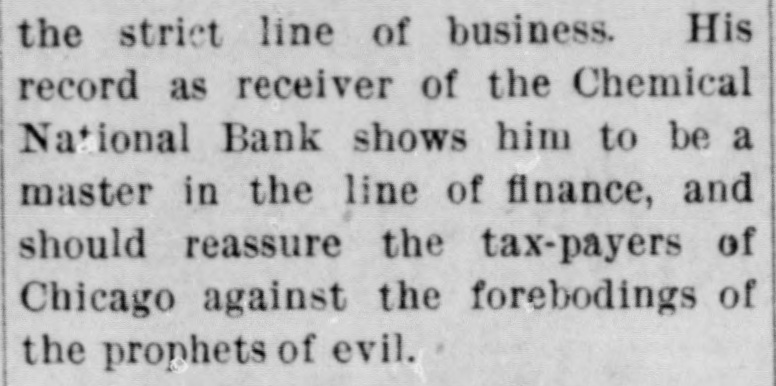
the strict line of business. His record as receiver of the Chemical National Bank shows him to be a master in the line of finance, and should reassure the tax-payers of Chicago against the forebodings of the prophets of evil.


Article from Bismarck Weekly Tribune, January 5, 1894

Click image to open full size in new tab

Article Text

nexed to Chicago, and for five years he was treasurer of the school board of Hyde Park and Calumet. In 1889, when the annexa-tion fever was epidemic, Mr. Hopkins was chairman of the annexation committee and the success of the movement was largely attributed to his endeavors. Since that time he has been influential in Democratic councils. He was a delegate to the last Democratic national convention and chairman of the Chicago campaign committee during the canvass. He has been president of the Cook County Democracy for several years and is a member of the Iroquois club, the "silk stocking" Democratic organization. Last July Comptroller Eckels appointed him receiver of the Chemical National bank. Mr. Hopkins is a well to do man. His money is all invested in his business, where it has been made. The only real estate he owns is the lot in Kensington on which his store stands.


Article from The Pacific Commercial Advertiser, February 8, 1894

Click image to open full size in new tab

Article Text

dling lumber for the Pullman Car company. He was rapidly promoted, however, first to timekeeper and then to paymaster. After he had held the latter position for about five years he resigned and went into business for himself, organizing the Arcade Trading company. The firm did a general merchandising business in Pullman for a year and then changed its name to the Secord-Hopkins company and moved to Kensington, where it now has the largest retail store in Chicago south of Twenty-second street. As early as 1883 Mr. Hopkins took an interest in the politics of Hyde Park, not then annexed. In 1885 he was elected treasurer of the village. Three years later he aspired to the position of delegate from his district to the Democratic national convention, being defeated by A. W. Green after a contest which won the admiration of local Democratic leaders, who hastened to make a friend of the young man. Since that time he has been influential in Democratic counsels and has figured on important committees. Last year he was chairman of the local campaign committee. He is the president of the Cook County Democracy and a member of the Iroquois club, the "silk stocking" Democratic organization. Rain or shine, he never fails to turn out with the Cook County Marching club. Although liberal in his views, he does not use tobacco or liquor. Three years ago he was a candidate for the Democratic nomination for sheriff and was defeated by Frank Lawler. President Cleveland knew Hopkins as a boy in Buffalo and cordially welcomed him to the White House. Last July Comptroller Eckels appointed Hopkins receiver of the Chemical National bank, the appointment being construed as an expression of confidence on the part of the administration.


Article from The Wadsworth Dispatch, March 7, 1894

Click image to open full size in new tab

Article Text

dling lumber for the Pullman Car company. He was rapidly promoted, however, first to timekeeper and then to paymaster. After he had held the latter position for about five years he resigned and went into business for himself, organizing the Arcade Trading company. The firm did a general merchandising business in Pullman for a year and then changed its name to the Secord-Hopkins company and moved to Kensington, where it now has the largest retail store in Chicago south of Twenty-second street. As early as 1883 Mr. Hopkins took an interest in the politics of Hyde Park. not then annexed. In 1885 he was elected treasurer of the village. Three years later he aspired to the position of delegate from his district to the Democratic national convention, being defeated by A. W. Green after a contest which won the admiration of local Democratic leaders, who hastened to make a friend of the young man. Since that time he has been influential in Democratic counsels and has figured on important committees. Last year he was chairman of the local campaign committee. He is the president of the Cook County Democracy and a member of the Iroquois club, the "silk stocking" Democratic organization. Rain or shine, he never fails to turn out with the Cook County Marching club. Although liberal in his views, he does not use tobacco or liquor: Three years ago he was a candidate for the Democratic nomination for sheriff and was defeated by Frank Lawler. President Cleveland knew Hopkins as a boy in Buffalo and cordially welcomed him to the White House. Last July Comptroller Eckels appointed Hopkins receiver of the Chemical National bank, the appointment being construed as an expression of confidence on the part of the administration.