3700. Central National Bank (Chicago, IL)

Bank Information

Episode Type
Run → Suspension → Closure
Bank Type
national
Bank ID
2047
Charter Number
2047
Start Date
November 22, 1877
Location
Chicago, Illinois (41.850, -87.650)

Metadata

Model
gpt-5-mini
Short Digest
ec977044306e181d

Response Measures

Borrowed from banks or large institutions, Fed/other loan, Full suspension, Books examined

Receivership Details

Depositor recovery rate
65.6%
Date receivership started
1877-12-01
Date receivership terminated
1892-02-23
OCC cause of failure
Losses
Share of assets assessed as good
32.2%
Share of assets assessed as doubtful
33.0%
Share of assets assessed as worthless
34.9%

Description

Multiple contemporary papers report a slight run followed by the bank's closing on Nov 23, 1877 and decision to go into liquidation. A receiver is later referenced (Otis R. Glover) and legal actions follow. OCR errors in some articles corrected (e.g., Endicott spelling). Classification: a run occurred, bank suspended/closed and went into liquidation (permanent closure).

Events (5)

1. September 18, 1872 Chartered
Source
historical_nic
2. November 22, 1877 Run
Cause
Rumor Or Misinformation
Cause Details
Newspapers describe a slight run and earlier rumors of unsoundness and heavy withdrawals since October; contagion from other bank failures noted in coverage.
Newspaper Excerpt
The bank experienced a slight run yesterday, and since October 1st ... some $200,000 have been drawn out.
Source
newspapers
3. November 23, 1877 Suspension
Cause
Bank Specific Adverse Info
Cause Details
Directors and stockholders voted to close and liquidate after sustained withdrawals, losses on poor-quality paper, and inability to withstand clearing-house/clearing pressures (borrowed on call and drawn down).
Newspaper Excerpt
The Central National Bank closed its doors this morning, and will go into liquidation. This action was consequent upon a determination at a meeting of the directors and stockholders last evening.
Source
newspapers
4. November 27, 1877 Receivership
Newspaper Excerpt
Mr. A. H. Burley and the officers of the institution were busily engaged ... examining the assets of the concern, and scheduling them for the use of the Receiver, when he shall take possession. (later articles identify Otis R. Glover as receiver).
Source
newspapers
5. December 1, 1877 Receivership
Source
historical_nic

Newspaper Articles (22)

Article from Chicago Daily Tribune, April 1, 1877

Click image to open full size in new tab

Article Text

National Bank here closed its doors at 1 o'clock to-day. Rumors of unsoundness caused depositors to withdraw their money freely the past few days, yet the suspension created some consternation. The bank suffered from the panic of 1873, and in 1875 instituted a suit against the Woodworth Carret Company for nearly one-million, and was defeated. Suspension followed. but the bank again resumed, and struggled along till the present quarterly statement, rendered Jan. of showed tne resources to be $675,000 and liabilities the same figure. PHILADELPHIA, March 31.-P. T. Wiltbank & Co., stock brokers, suspended to-day. Liabilities not known. NEW YORK, March 31.-The suspension of George D. Monroe was reported to the Stock Exchange, and a small amount of stocks for his account sold out under the rule.


Article from Daily Press and Dakotaian, November 23, 1877

Click image to open full size in new tab

Article Text

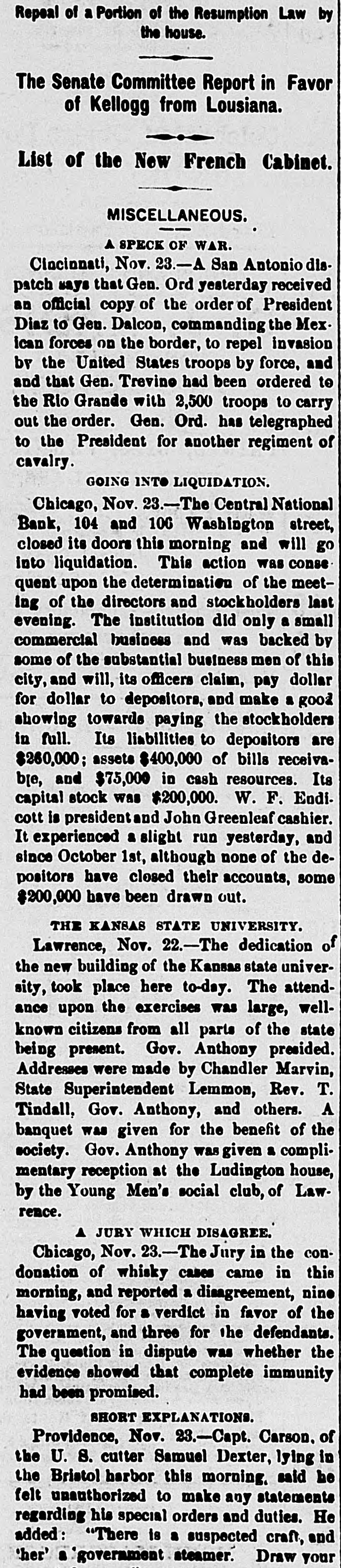
Repeal of a Portion of the Resumption Law by the house. The Senate Committee Report in Favor of Kellogg from Lousiana. List of the New French Cabinet. MISCELLANEOUS. A SPECK OF WAR. Clacionati, Nov. 23.-A San Antonio dispatch ways that Gen. Ord yesterday received an official copy of the order of President Diaz to Gen. Dalcon, commanding the Mex. ican forces on the border, to repel invasion by the United States troops by force, and and that Gen. Trevino had been ordered to the Rio Grande with 2,500 troops to carry out the order. Gen. Ord. has telegraphed to the President for another regiment of cavalry. GOING INTO LIQUIDATION. Chicago, Nov. 23.-The Central National Bank, 104 and 106 Washington street, closed its doors this morning and will go into liquidation. This action was conse quent upon the determination of the meeting of the directors and stockholders last evening. The institution did only a small commercial business and was backed by some of the substantial business men of this city, and will, its officers claim, pay dollar for dollar to depositors, and make a good showing towards paying the stockholders in full. Its liabilities to depositors are $260,000; assets $400,000 of bills receivabie, and $75,000 in cash resources. Its capital stock was $200,000. W. F. Eudicott is president and John Greenleaf cashier. It experienced a slight run yesterday, and since October 1st, although none of the depositors have closed their accounts, some $200,000 have been drawn out. THE KANSAS STATE UNIVERSITY. Lawrence, Nov. 22.-The dedication of the new building of the Kansas state university, took place here to-day. The attendance upon the exercises was large, wellknown citizens from all parts of the state being present. Gov. Anthony presided. Addresses were made by Chandler Marvin, State Superintendent Lemmon, Rev. T. Tindall, Gov. Anthony, and others. A banquet was given for the benefit of the society. Gov. Anthony was given a complimentary reception at the Ludington house, by the Young Men's social club, of Law. rence. A JURY WHICH DISAGREE. Chicago, Nov. 23.-The Jury in the condonation of whisky cases came in this morning, and reported a disagreement, nine having voted for a verdict in favor of the government, and three for the defendants. The question in dispute was whether the evidence showed that complete immunity had been promised. SHORT EXPLANATIONS. Providence, Nov. 23.-Capt. Carson. of the U. 8. cutter Samuel Dexter, lying in the Bristol harbor this morning. said he felt unauthorized to make any statements regarding his special orders and duties. He added: "There is a suspected craft, and 'her' a government steamer. Draw your


Article from The Cincinnati Daily Star, November 23, 1877

Click image to open full size in new tab

Article Text

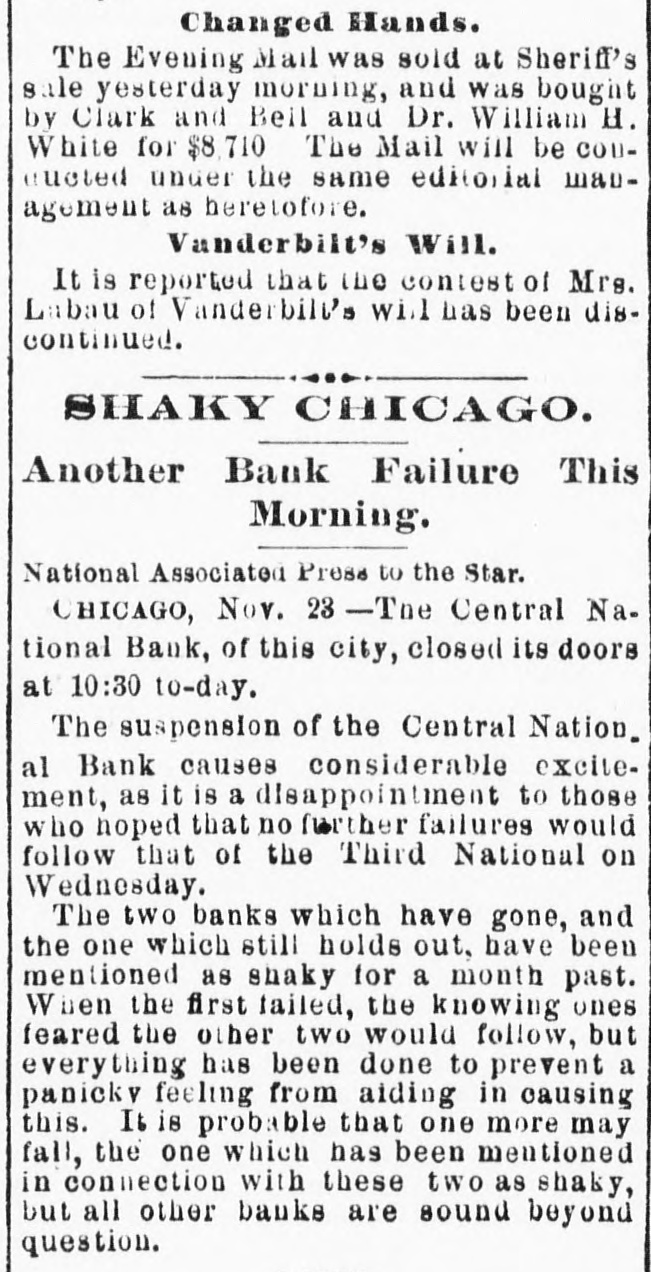
Changed Hands. The Evening Mail was sold at Sheriff's sale yesterday morning, and was bought by Clark and Bell and Dr. William H. White for $8.710 The Mail will be coneucted under the same editorial management as heretofore. Vanderbilt's Will. It is reported that the contest of Mrs. Labau of Vanderbill's will has been discontinued. SHAKY CHICAGO. Another Bank Failure This Morning. National Associated Press to the Star. CHICAGO, Nov. 23 -The Central National Bank, of this city, closed its doors at 10:30 to-day. The suspension of the Central Nation. al Bank causes considerable excite. ment, as it is a disappointment to those who hoped that no further failures would follow that of the Third National on Wednesday. The two banks which have gone, and the one which still holds out, have been mentioned as snaky for a month past. When the first tailed, the knowing ones feared the other two would follow, but everything has been done to prevent a panicky feeling from aiding in causing this. It is probable that one more may fall, the one which has been mentioned in connection with these two as shaky, but all other banks are sound beyond question.


Article from New-York Tribune, November 24, 1877

Click image to open full size in new tab

Article Text

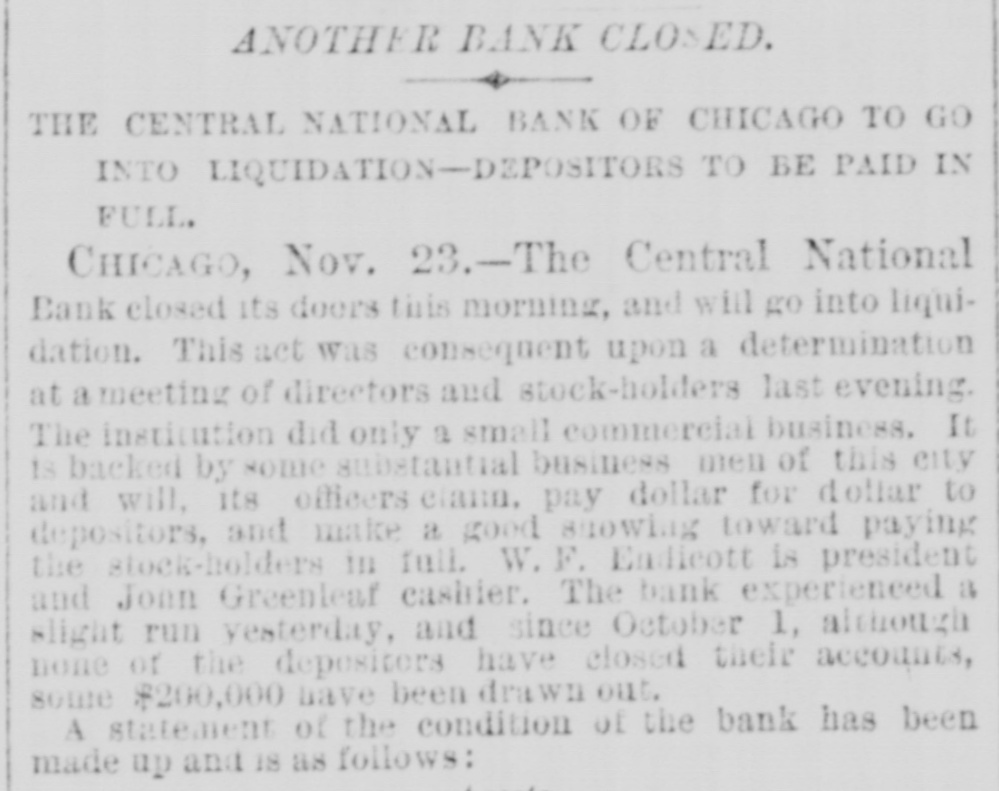
ANOTHE R BANK CLOSED. THE CENTRAL NATIONAL BANK OF CHICAGO TO GO INTO LIQUIDATION-DEPOSITORS TO BE PAID IN FULL. CHICAGO, Nov. 23.-The Central National Bank closed its doors this morning, and will go into liquidation. This act was consequent upon a determination at a meeting of directors and stock-holders last evening. The institution did only a small commercial business. It is backed by some substantial business men of this city and will, its officers claim. pay dollar for dollar to depositors, and make a good stowing toward paying the stock-holders in full. W. F. Endicott is president and John Greenleaf cashier. The bank experienced a slight run yesterday, and since October 1, although none of the depositors have closed their accounts, some $200,000 have been drawn out. A statement of the condition of the bank has been made up and 18 as follows:


Article from The New York Herald, November 24, 1877

Click image to open full size in new tab

Article Text

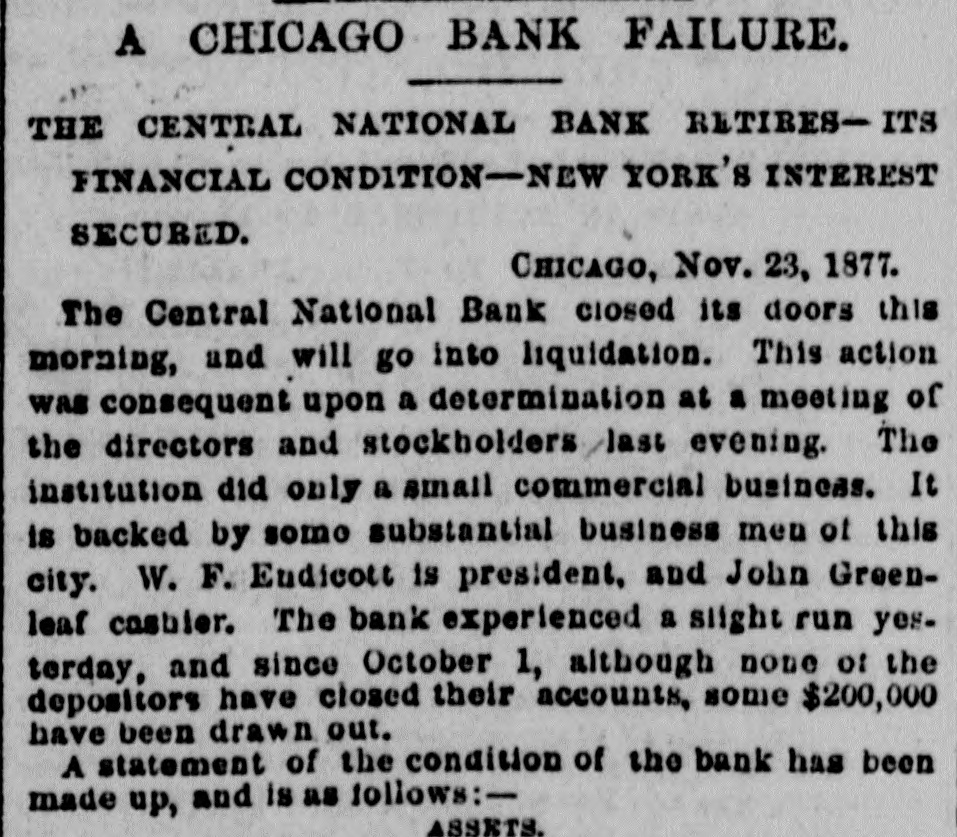
A CHICAGO BANK FAILURE. THE CENTRAL NATIONAL BANK RETIRES- ITS FINANCIAL CONDITION-NEW YORK'S INTEREST SECURED. CHICAGO, Nov. 23, 1877. The Central National Bank closed its doors this morning, and will go into liquidation. This action was consequent upon a determination at a meeting of the directors and stockholders last evening. The institution did only a small commercial business. It is backed by somo substantial business men of this city. W. F. Endicott is president, and John Greenleaf cashier. The bank experienced a slight run yesterday, and since October 1, although none of the depositors have closed their accounts, some $200,000 have been drawn out. A statement of the condition of the bank has been made up, and is as follows:ASSETS.


Article from Chicago Daily Tribune, November 24, 1877

Click image to open full size in new tab

Article Text

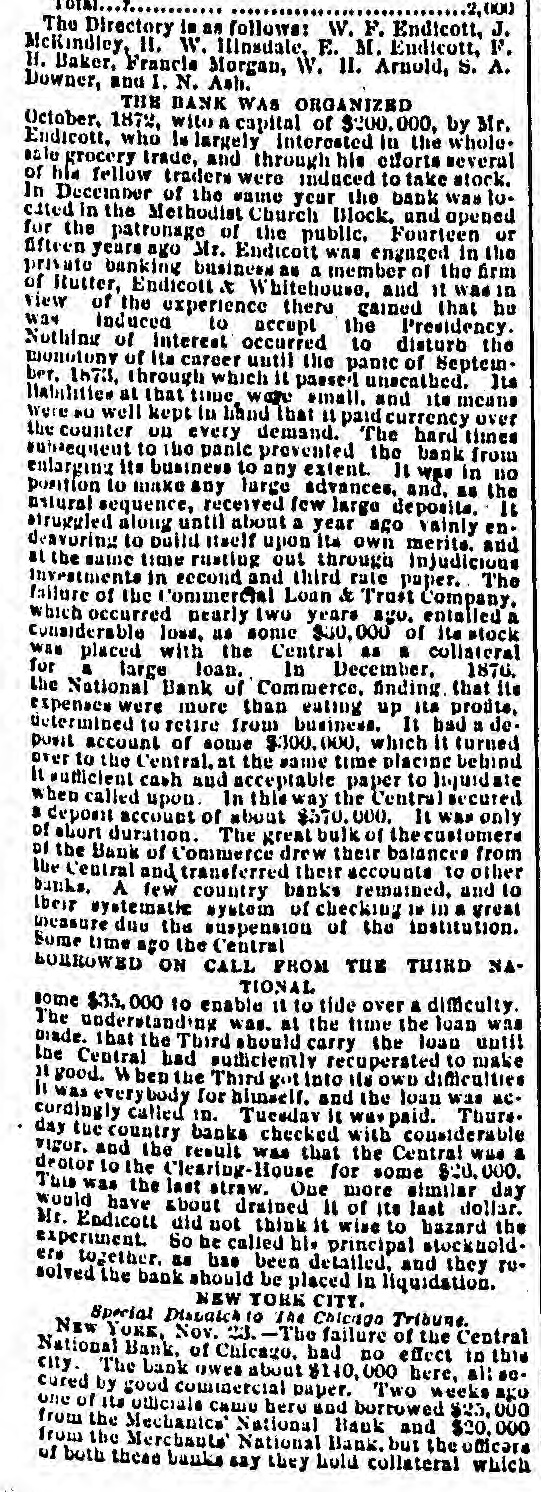
2,000 The Directory is as follows: W. F. Endicott, J. McKindley, II. W. Illnsdate, E. M. Endicott, F. H. Baker, Francis Morgan, W. 11. Arnold, S. A. Downer, and 1. N. Ash. THE BANK WAS ORGANIZED October, 1872, wite A capital of $200,000, by Mr. Endicott, who la largely interested in the wholesale grocery trade, and through his efforts several of his fellow traders were induced to take stock. In December of the same your the bank was tocited in the Methodist Church Block. and opened for the patronage of the public. Fourteen or fifteen years ago Mr. Endicott was enguged in the private banking business as a member of the firm of Butter, Endicott & Whitehouse, and it was in view of the experience there gained that he was Induced to accept the Presidency. Nothing of interest occurred to disturb the monotony of Its career until the panic of September. 1673, through which it passed unscathed. Its liabilities at that time. ware small, and its means Were su well kept in hand that 11 paid currency over the counter on every demand. The hard times subjequent to the panic provented the bank from enlarging its business to any extent. It was in no position to make any large advances, and, as the natural sequence, received few large deposits. It struggled along until about a year ago vainly en. deavoring to build itself upon its own merits. and at the same time rusting out through Injudicious investments in second and third rate paper. The failure of the Commercial Loan & Trust Company. which occurred nearly two years ago, entalled a considerable loss, as some $30,000 of its stock was placed with the Central as a collateral for & large loan. In December, 1876. the National Bank of Commerce. finding. that its expenses were more than eating up its prodits, determined to retire from business. It bad a de. Dont account of some $300,000, which it turned over to the Central. at the same time placine behind It sufficient cash and acceptable paper to Injuid ate when called upon. In this way the Central secured $ deposit account of about $570,000. It was only of short duration. The great bulk of the customers of the Bank of Commerce drew their balances from the Central and transferred their accounts to other bunks. A few country banks remained, and to lbeir #ystematic system of checking IF ID a great measure due the suspension of the institution. Some time ago the Central BORROWED ON CALL PROM THE THIRD NATIONAL some $35,000 to enable 11 to tide over & difficulty. The understanding was. at the time the loan was orade. that the Third should carry the loan until the Central bad sufficiently recuperated to make " good. W ben the Third got into its OWD difficulties It was everybody for himself. and the loan was MC. cordingly called in. Tuesday It was paid. Thurs. day tue country banks checked with considerable vigor. and the result was that the Central was a deotor to the Clearing-House for some $20,000. This was the last straw. One more similar day would have about drained It of its last dollar. Mr. Endicott did not think it wise to bazard the experiment. So be called his principal stockholdere together. as has been detailed, and they rusolved the bank should be placed in liquidation. NEW YORK CITY. Special Distatch to The Chicago Tribune. NEW YORK, Nov. 23. The failure of the Central National Bank, of Chicago, had no effect to this city. The bank owes about $140,000 here, all se. cured by good commercial baper. Two weeks ago one of its officials Came bero and borrowed $25,000 from the Mechanics' National Bank and $20,000 from the Merchants' National Bank. but the officers of both these banks say they hold collateral which


Article from Chicago Daily Tribune, November 27, 1877

Click image to open full size in new tab

Article Text

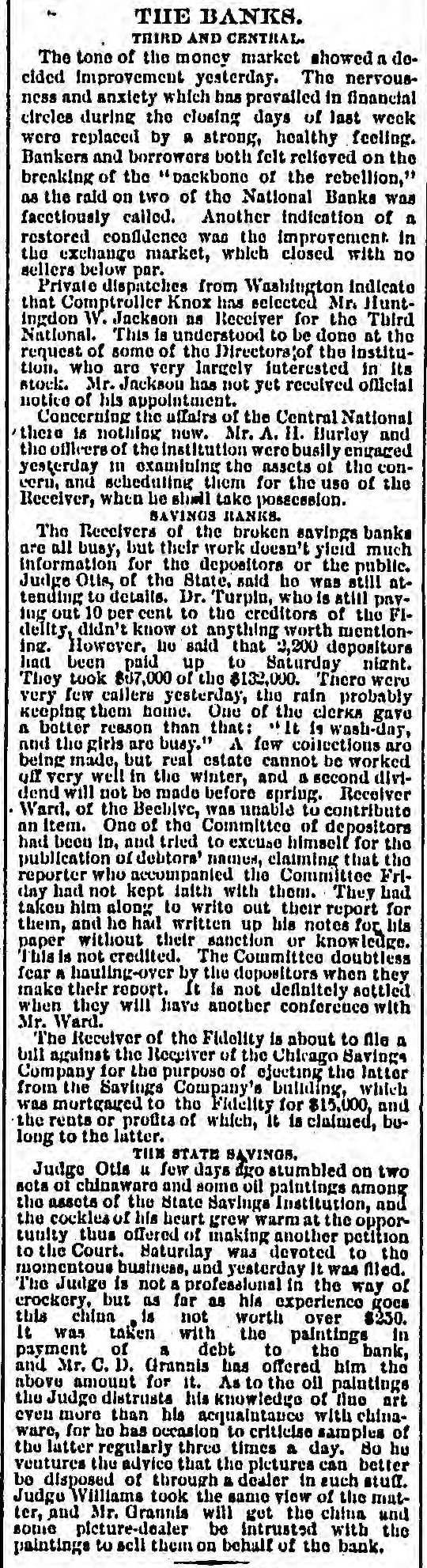
THE BANKS. THIRD AND CENTRAL. The tone of the money market showed a deelded Improvement yesterday. The nervousness and anxiety which has provailed in financial circles during the closing days of last week were replaced by a strong, healthy feeling. Bankers and borrowers both felt relieved on the breaking of the "packbone of the rebellion," as the raid on two of the National Banks was facetiously called. Another indication of a restored confldence was the improvement In the exchange market, which closed with no sellers below par. Private dispatches from Washington indicate that Comptroller Knox has selected Mr. Huntingdon W. Jackson as Receiver for the Third National. This la understood to be done at the request of some of the Directors;of the Institution. who are very largely interested in its stock. Mr. Jackson has not yet received official notice of his appointment. Concerning the ullairs of the Central National there is nothing new. Mr. A. H. Burley and the officers of the institution were busily engaged yesterday in examining the assets of the concero, and scheduling them for the use of the Receiver, when be shall take possession. SAVINGS RANKS. The Receivers of the broken savings banks are all busy, but their work doesn't yleid much information for the depositors or the public. Judge Othe, of the State, said he was still attending to details. Dr. Turpin, who is still paytug out 10 per cent to the creditors of the FIdelity, didn't know of anything worth mentioning. However. no said that 2,200 depositors had been paid up to Saturday night. They took $67,000 of the $132,000. There were very few callers yesterday, the rain probably keeping them home. One of the clerks gave a botter reason than that: It is wash-day, and the girls are busy." A few collections are being made, but real estate cannot be worked off very well in the winter, and a second dividend will not be made before spring. Receiver Ward. of the Bechive, was unable to contribute an Item. One of the Committee of depositors had been In, and tried to excuse himself for the publication of debtors' names, claiming that the reporter who accompanied the Committee Frlday had not kept inith with them. They had taken him along to write out their report for them, and he had written up his notes for his paper without their sanction or knowledge. This is not credited. The Committee doubtless fear A hauling-over by the depositors when they make their report. It is not definitely sottled when they will have another conference with Mr. Ward. The Receiver of the Fidelity is about to file A bill against the Receiver of the Chicago Savings Company for the purpose of ejecting the Intter from the Savings Company's building, which was mortgaged to the Fidelity for $15,000, and the rents or profits of which, It is claimed, belong to the latter. THE STATE SAVINGS. Judge Otis # few days ago stumbled on two acts of chinaware and some oil paintings among the assets of the State Savings Institution, and the cockles of his heart grew warm at the opportunity thus offered of making another petition to the Court. Saturday was devoted to the momentous business, and yesterday It was filed. The Judge is not & professional in the way of crockery, but as for as his experience goes this china is not worth over $250. It was taken with the paintings In payment of a debt to the bank, and Mr. C. D. Grannis has offered him the above amount for it. As to the oil paintings the Judge distrusts his knowledge of flue art even more than his acquaintance with chinaware, for he has occasion to criticlse samples of the latter regularly three times a day. Bo he ventures the advice that the pictures can better be disposed of through a dealer in such stuff. Judge Williams took the same view of the matter, and Mr. Grannis will get the china and some picture-dealer be intrusted with the paintings to sell them on behalf of the bank.


Article from Ottumwa Weekly Courier, November 28, 1877

Click image to open full size in new tab

Article Text

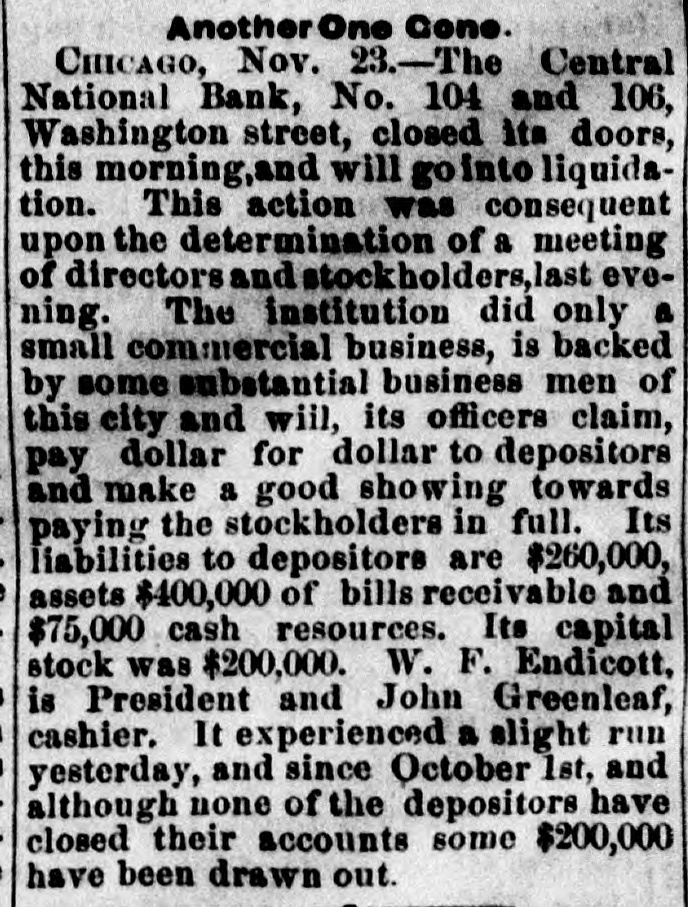
Another One Gone. CHICAGO, Nov. 23.-The Central National Bank, No. 104 and 106, Washington street, closed its doors, this morning,and will gointo liquidation. This action was consequent upon the determination of a meeting of directors and stockholders, last evening. The institution did only a small commercial business, is backed by some substantial business men of this city and will, its officers claim, pay dollar for dollar to depositors and make a good showing towards paying the stockholders in full. Its liabilities to depositors are $260,000, assets $400,000 of bills receivable and $75,000 cash resources. Its capital stock was $200,000. W. F. Endicott, is President and John Greenleaf, cashier. It experienced a slight run yesterday, and since October 1st, and although none of the depositors have closed their accounts some $200,000 have been drawn out.


Article from Chicago Daily Tribune, November 29, 1877

Click image to open full size in new tab

Article Text

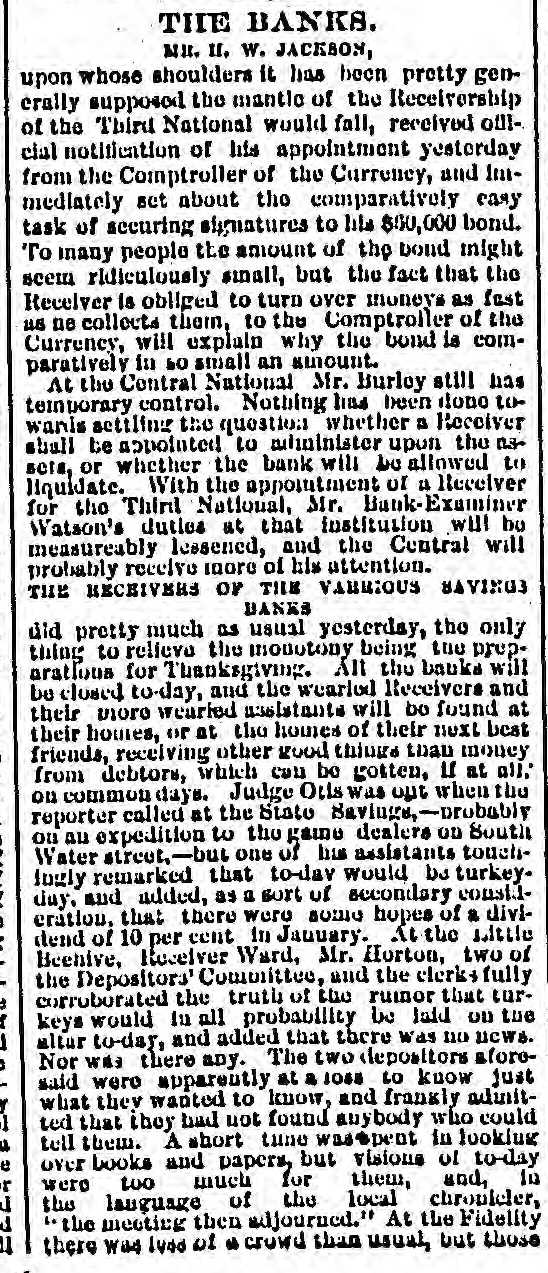
THE BANKS. MIL II. W. JACKSON, upon whose shoulders it has been pretty generally supposed the mantic of the Receivership of the Third National would fall, received oillcial notification of lits appointment yesterday from the Comptroller of the Currency, and Inmediately set about the comparatively easy task of securing signatures to lile $50,000 bond. 'Γo many people the amount of the bond might seem ridiculously small, but the fact that the Receiver is obliged to turn over moneys as fast us ne collects them, to the Comptroller of the Currency, will explain why the bond is comparatively in 60 small an amount. At the Central National Mr. Burley still has temporary control. Nothing has been done towards acttling the question whether a Receiver shall be appointed to administer upon the nssets, or whether the bank will be allowed to liquidate. With the appointment of a Receiver for the Third National, Mr. Bank-Examiner Watson's duties at that institution will be measureably lessened, and the Central will probably receive more of his attention. THE RECEIVERS OF THE VARRIOUS SAVINGS BANKS did pretty much as usual yesterday, the only thing to relieve the monotony being the prep. arations for Thanksgiving. All the banks will be closed to-day, and the wearled Receivers and their more wearled assistants will be found at their homes, or at the houses of their next best friends, receiving other good things than money from debtors, which can be gotten, If at all,' on common days. Judge Otis was out when the reporter called at the State Savings,-probably on au expedition to the game dealers on South Water street,-but one of has assistants touchlogly remarked that to-day would be turkeyday, and added, as a sort of secondary consideration, that there were some hopes of a dividend of 10 per cent in January. At the Little Beenive, Receiver Ward, Mr. Horton, two of the Depositors' Combittee, and the clerks fully corroborated the truth of the rumor that turkeys would in all probability be laid on the altur to-day, and added that there was no ucws. Nor was there any. The two depositors aforesaid were apparently at a 1088 to know just what they wanted to know, and frankly admitted that they had not found anybody who could tell them. A short time wasspent in looking over books and papers, but visions of to-day were too much for them, and, in the language of the local chronicler, " the meeting then adjourned." At the Fidelity there Was lyde of . crowd than usual, but those


Article from American Citizen, December 1, 1877

Click image to open full size in new tab

Article Text

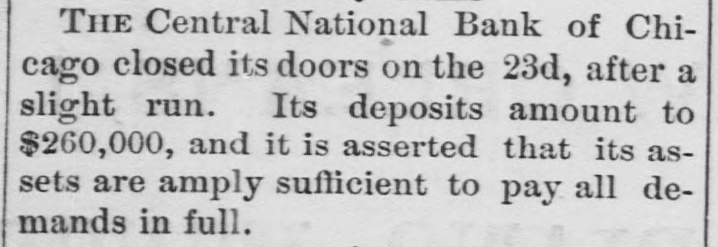
THE Central National Bank of Chicago closed its doors on the 23d, after a slight run. Its deposits amount to $260,000, and it is asserted that its assets are amply sufficient to pay all demands in full.


Article from The Donaldsonville Chief, December 1, 1877

Click image to open full size in new tab

Article Text

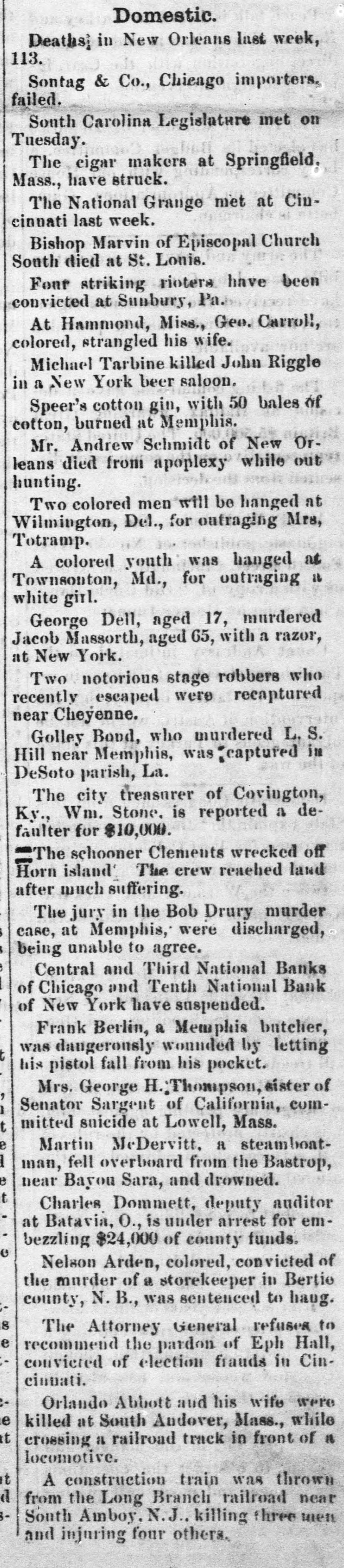
Domestic. Deaths in New Orleans last week, 113. Sontag & Co., Chieago importers. failed. South Carolina Legislature met on Tuesday. The eigar makers at Springfield. Mass., have struck. The National Grange met at Ciucinuati last week. Bishop Marvin of Episcopal Church South died at St. Lonis. Four striking rioters have been convicted at Sumbury, Pa At Hammond, Miss., Geo. Carroll, colored, strangled his wife. Michael Tarbine killed John Riggle in a New York beer saloon. Speer's cotton gin, with 50 bales of cotton, burned at Memphis. Mr. Andrew Schmidt of New Orleans died from apoplexy while out hunting. Two colored men will be hanged at Wilmington, Del., for outraging Mrs, Totramp. A colored youth was hanged at Townsonton, Md., for outraging it white girl. George Dell, aged 17, murdered Jacob Massorth, aged 65, with a razor, at New York. Two notorious stage robbers who recently escaped were recaptured near Cheyenne. Golley Bond, who murdered L. S. Hill near Memphis, was ;captured in DeSoto parish, La. The city treasurer of Covington, Ky., Wm. Stone. is reported a defaulter for $10,000. =The schooner Clements wrecked off Horn island The crew reached land after much suffering. The jury in the Bob Drury murder case, at Memphis, were discharged, being unable to agree. Central and Third National Banks of Chicago and Tenth National Bank of New York have suspended. Frank Berlin, a Memphis butcher, was dangerously wounded by letting t his pistol fall from his pocket. Mrs. George H.Thompson, sister of 9 I Senator Sargent of California, committed suicide at Lowell, Mass. t e Martin McDervitt, a steamboatI man, fell overboard from the Bastrop, e near Bayou Sara, and drowned. t Charles Dommett, deputy auditor at Batavia, O., is under arrest for embezzling $24,000 of county funds. 0 Nelson Arden, colored, convicted of the murder of a storekeeper in Bertie county, N. B., was sentenced to haug. 8 The Attorney General refuses to e recommend the pardon of Eph Hall, convicted of election frauds in Cincinuati. Orlando Abbott and his wife were e killed at South Andover, Mass., while t crossing a railroad track in front of n locomotive. t A construction train was thrown d from the Long Branch railroad near South Amboy, N.J., killing three men and injuring four others.


Article from Chicago Daily Tribune, December 2, 1877

Click image to open full size in new tab

Article Text

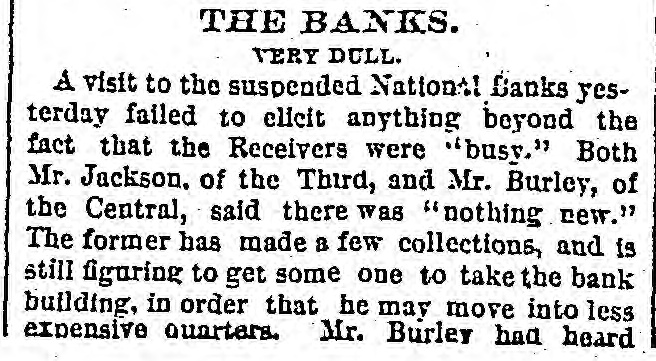
THE BANKS. VERY DULL. A visit to the suspended National Banks yesterday failed to elicit anything beyond the fact that the Receivers were "busy." Both Mr. Jackson. of the Third, and Mr. Burley, of the Central, said there was "nothing new." The former has made a few collections, and is still figuring to get some one to take the bank building, in order that he may move into less expensive Quarters. Mr. Burley had heard


Article from The Jasper Weekly Courier, December 7, 1877

Click image to open full size in new tab

Article Text

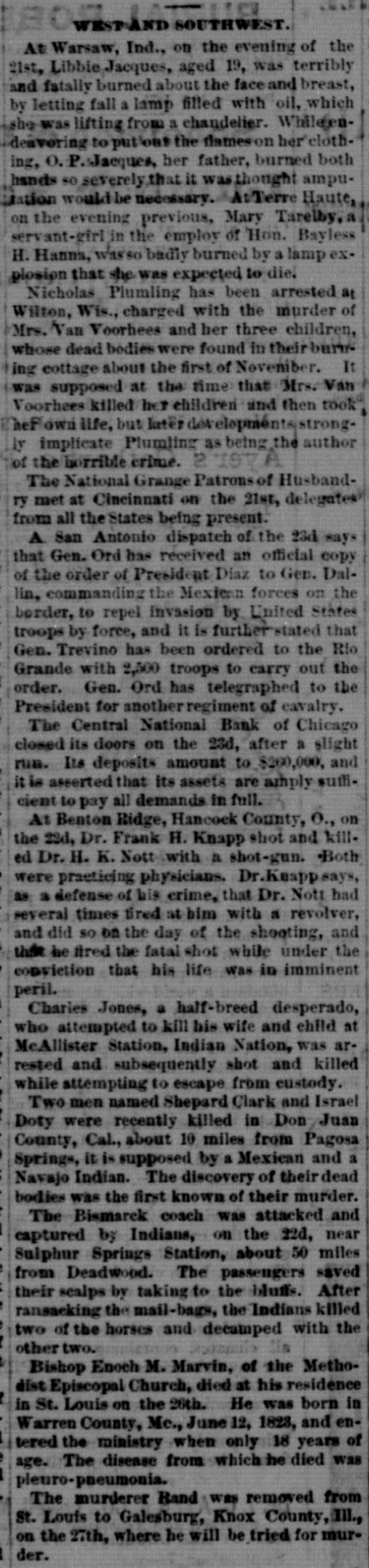
WEST-AND SOUTHWEST. At Warsaw, Ind., on the evening of the 21st, Libbie Jacques, aged 19, was terribly and fatally burned about the face and breast, by letting fall a lamp filled with oil, which she was lifting from a chandelier. Whilerendeavoring to putions the flameson her clothing, O. P.sJacques, her father, burned both hands so severely that it wasthought amputation would be necessary. AtTerre Haute, on the evening previous, Mary Tarelby, a servant-girl in the employ of Hon. Bayless H. Hanna, wasso badly burned by a lamp explosion that she was expected to die. Nicholas Plumling has been arrested at Wilton, Wis., charged with the murder of Mrs. Van Voorhees and her three children, whose dead bodies were found in their burning cottage about the first of Noveniber. It was supposed at the time that Mrs. Van Voorhees killed her children and then took heflown life, but later dévelopménts(strongly implicate Plumling as being the author of the horrible crime. 2797A The National Grange Patrons of Husbandry met at Cincinnati on the 21st, delegates from all the States being present. A San Antonio dispatch of the 23d says that Gen. Ord has received an official copy of the order of President Diaz to Gen. Dallin, commanding the Mexican forces on the border, to repel invasion by United States troops by force, and it is further'stated that Gen. Trevino has been ordered to the Rio Grande with 2,500 troops to carry out the order. Gen. Ord has telegraphed to the President for another regiment of eavalry. The Central National Bank of Chicago closed its doors on the 23d, after a slight run. Its deposits amount to $260,000, and it is asserted that its assets are amply sufficient to pay all demands in full. At Benton Ridge, Hancock County, O., on the 22d, Dr. Frank H. Knapp shot and killed Dr. H. K. Nott with a shot-gun. Both were practicing physicians. Dr.Keappsays, as a defense of his crime, that Dr. Nott had several times tired at bim with a revolver, and did so on the day of the shooting, and that he fired the fatal shot while under the conviction that his life was in imminent peril. Charles Jones, a half-breed desperado, who attempted to kill his wife and child at McAllister Station, Indian Nation, was arrested and subsequently shot and killed while attempting to escape from eustody. Two men named Shepard Clark and Israel Doty were recently killed in Don Juan County, Cal., about 10 miles from Pagosa Springs, it is supposed by a Mexican and a Navajo Indian. The discovery of their dead bodies was the first known of their murder. The Bismarek coach was attacked and captured by Indians, on the 22d, near Sulphur Springs Station, about 50 miles from Deadwood. The passengers saved their scalps by taking to the blutfs. After ransacking the mail-bags, the Indians killed two of the horses and decamped with the other two. Bishop Enoch M. Marvin, of the Methodist Episcopal Church, died at his residence in St. Louis on the 26th. He was born in Warren County, Me., June 12, 1823, and entered the ministry when only 18 years of age. The disease from which he died was pleuro-pneumonia. The murderer Band was removed from St. Louis to Galesburg, Knox County, III., on the 27th, where he will be tried for murder.


Article from The Carbon Advocate, December 8, 1877

Click image to open full size in new tab

Article Text

underhis wife applying for a divorce- and a pistol. to separate soul and body,with sadly took he could not have been so very to his But earnest because he gave fair notice the matin and they, after thinking took his ter neighbors, over, decided to interfere, and away. weapon the most serious result of Coolbaugh's National But was the failure of the Third once death old institution which was the Bank, prosperous, an but was badly hit decided by very and the panic. Its directors fire weeks ago to settle up affairs, trusting their some that time that they would get back Mr. at capital and lose only the surplus. to take Coolbaugh had made arrangements but his of the bank and liquidate it, and sudden charge death put an end to that scheme banks found impossibte to get other $1, it was give any help. So it shut up, owing worth 000,000 to and with assets nominally two$1,800,000 but really worth only about is the thirds of that. But back of all this personal responsibility of the stockholders but one of whom are good,amounting the million all and a half. It is possible that better bank might have lived if it had had unmanagement, but the President had an estate happy mania for dabbling in real speculations, and by persisting in holding to dirt which had ceased to have any the on brought himself and the bank to stuff value, ground. He has turned over a lot of kind secure his indebtedness, but it is that of of to property which may not be disposed difor Among the stockholders and the rectors years. are Mr. George M. Pullman of Sleeping Car Company, and Mr. Tribune. Joseph Medill editor and proprietor of the It had been SO long expected that this the bank would go up that there was not failure consternation which an unexpected would have had, but nevertheless the smash had its results. The Central National Bank, comparatively small concern with a capital a of $200,000 gave up the ghost Friday morning. It had been carried by the Third months and fell when the support its It will doubtless pay was for some removed. that all it depositors, the chief trouble being did not do enough business to make it profitable to keep the institution alive. One or two is other National Banks are shaky but it hoped that they will manage to pull through. A suit on a life-insurance policy, ,in volving some interesting points, has just been begun Milagainst the Northwestern Montreal, of waukee. A year and a half ago a wealthy resident of this city took out a policy for $15,000 in the Company, paying the first At the end of he was called on and year's months, premium. asked the twelve for failed the premium for the next year. This he he to pay. Nearly two months elapsed and be= was taken very ill. About half an hour his clerk called office, and tendered premCompany's fore he died around the at The the ium. The agent declined to accept it. weeping heirs and wife, though feeling intensely over the death of their beloved father and husband, yet did not feel inclined to lose $15,000 and checked their lamentations long enough to send the book-keeper of the deceased-he had been dead half hour then-on another trip to the officers of the Company, to again offer the premium, again make an effort to revive that lapsed policy. But the agent knew something concerning Mr. Store's condition and peremptorily refused to take the money and hence the suit. The deceased was a sharp business man, and it is possible that he would have so with the business-like conof his children as to duct been pleased have pardoned them for their apparent absence of all-abover his loss. sorbing grief Possibly the Company will presently propose to compromise for a few thousands, and that will be the end of the suit. A marriage of rather a romantic nature took place here a couple of weeks ago. western man was in town for the purpose disposing of a lot of mining property which he owns in the Black Hills. While here he into his head to get a wife. He had once before, in took been it married Denver. He had seen a pretty girl running a sewing in a shop, had and machine marched She in asked her if she would have him. consented they were wedded, and in six months she got a Utah divorce. But he was not discouraged by this, and went to a clairvoyant, and asked her to tell him where to find the woman whom Providence had selected as his wife. If she put him on the right track, he would give her $10,000. So she advised him to go to: certain large shirt and among the manufactory, girls He employed t there, there he would find his fate. and asked the proprietors, to let him look through their establishment. They consented, and he went into the sewing room,where a dozen or more girls were employed. he Presently one of them struck his eye went up to her and said, "I did not come here to look at the place, I came to find you. I want to be my wife. I can give you I have been once, good references. you married but have been divorced, and have a copy of the decree, so that is all right." She looked ( at him, saw that he was not badly dressed, and was reasonably good-looking, and said, "Yes, will marry you." They were wed-


Article from New-York Tribune, December 19, 1877

Click image to open full size in new tab

Article Text

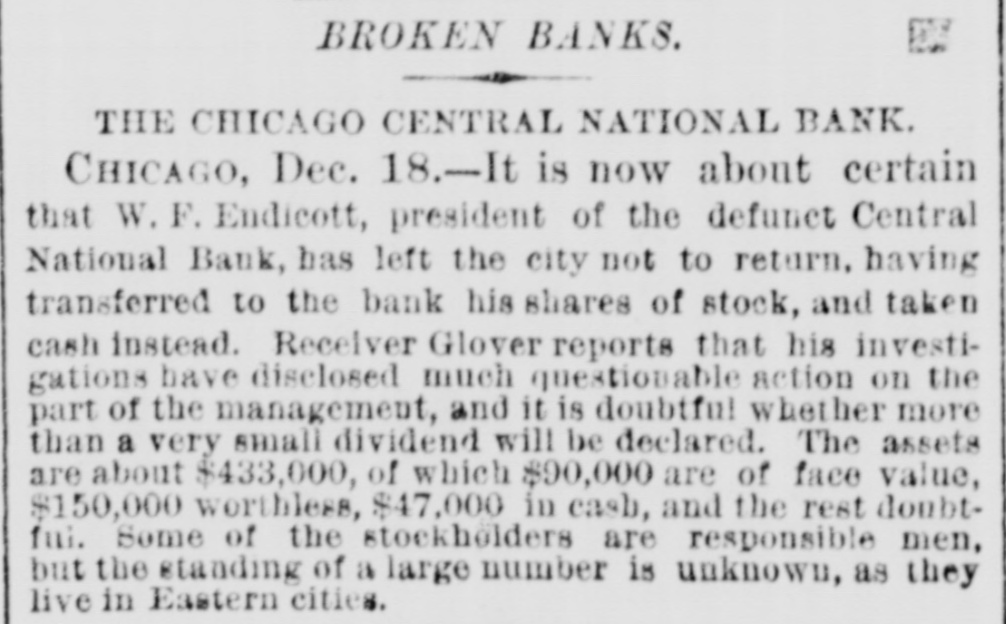
BROKEN BANKS. THE CHICAGO CENTRAL NATIONAL BANK. CHICAGO, Dec. 18.-It is now about certain that W. F. Endicott, president of the defunct Central National Bank, has left the city not to return, having transferred to the bank his shares of stock, and taken cash instead. Receiver Glover reports that his investigations have disclosed much questionable action on the part of the management, and it is doubtful whether more than a very small dividend will be declared. The assets are about $433,000, of which $90,000 are of face value, $150,000 worthless, $47,000 in cash, and the rest doubtful. Some of the stockhölders are responsible men, but the standing of a large number is unknown, as they live in Eastern cities.


Article from The Leavenworth Weekly Times, December 20, 1877

Click image to open full size in new tab

Article Text

ing sent, and for no greater number of men than are now serving in that department and assigned to it. ALL OFFICERS of the army in position to know anything about the existing troubles in Texas, or the views of either of the governments, are satisfied there is no possible ground for warlike preparations. Two Important Bailroad Cases that are Attracting the Attention of Chicago Bondholders. Caicago, December 17.-The records in two IMPORTANT RAILROAD CASES were to-day reported in the United States Circuit court here. One is a suit brought by the United States Rolling Stock Company, and the other against the Chicago Pekin & Southwestern railroad Company in Grundy county, last June, upon which E. F. Kunckley, the former president of the road was_appointed receiver. THE OTHER is a suit brought by the Farmer's Loan & Trust Company, of New York City, against the same road as trustee in a mortgage on this road to secure $700,000 bonded indebtedness. These cases have been removed to the U.S. Court under an act of Congress by theChicago & Illinois River Railroad Company,a party to thesuits. This last named, company attempted to get a removal of Receiver Hinckley by the state court that appointed him a few days ago, making some VERY GRAVE CHARGES. The application was however not heard by the state court and the case was thereupon transferred to the jurisdiction of Judge Drummond. The record alleges that the receiver had paid out, up to November 1st. 1877, from the time of his appointment, $49,000, more than one-third of his gross receipts, to cancel notesheld by the Farmers Loan & Trust Company and another bank on which Hinckley was guaranter, though during this time NOT A DOLLAR of interest due on the bonded debt, which was secured on the road, was paid. The action of the United States Court will be looked for with interest by the bondholders. Chicago Report. CHICAGO, December 18.-Capt. Blain commanding the United States troops at El Paso, Texas, telegraphs under date of 17th inst., that nothing new has occurred at San Elazario up to that time, but one man named Ellis belonging to the Texas rangers had been killed. The advance of the United States troops, en route San Elazario from parts in New Mexico was hourly expected. What the General Passenger Agents Think. CHICAGO, December 18.-A special committee appointed by the last National associationof General Railway Passenger Agents and representing the views of a large body of the passenger agents throughout the country, met here to-day and reported in favor of discontinuing all excursion rate tickets in the United States at all seasons of the year; also favoring a ticket uniform as to time, limit and forms of making for all railroads in the country. Left for the City's Good. CHICAGO, December 18.-It is considered certain that W. F. Endersoll, President of the defunct Central National Bank, has left the city for good; having transferred to the bank his stock and taken cash instead. Receiver Genner reports that his investigations have disclosed considerable crookedness on the part of the management, and it is extremely doubtful if more than a comparatively small dividend will be declared. The assets are about $433,000, of which $90,000 are worth par, $150,000 doubtful, $47,000 is in cash, and the rest is doubtful. Some of the stock holders are responsible men, but the standing of a large numberof them is unknown as they live in eastern cities. Butter and Cheese Exhibition. CHICAGO, December 18.-The American Dairy Exhibition opened to-day with a grand display of butter and cheese and a numerous attendance of visitors, representing all the dairy states and Canada. The exhibition is pronounced a decided success, and beyond all anticipation. There are about two thousand parcels and more are promised to-morrow. After the convention opened this morning President Hewes made a reception speech and President Smith, of the Northwestern Dairymen Association replied. Addresses were made in the afternoon by Judge J. S. Wilcox, Elgin, III., and Hon. J. H. Clough, who congratulated the association upon its success. Col. R. M. Littler, of Iowa, secretary of the National Association, addressed the con ention on the growth and development of the dairy interests. He gave many interesting facts and statistics. The hall was filled with a


Article from New-York Tribune, December 20, 1877

Click image to open full size in new tab

Article Text

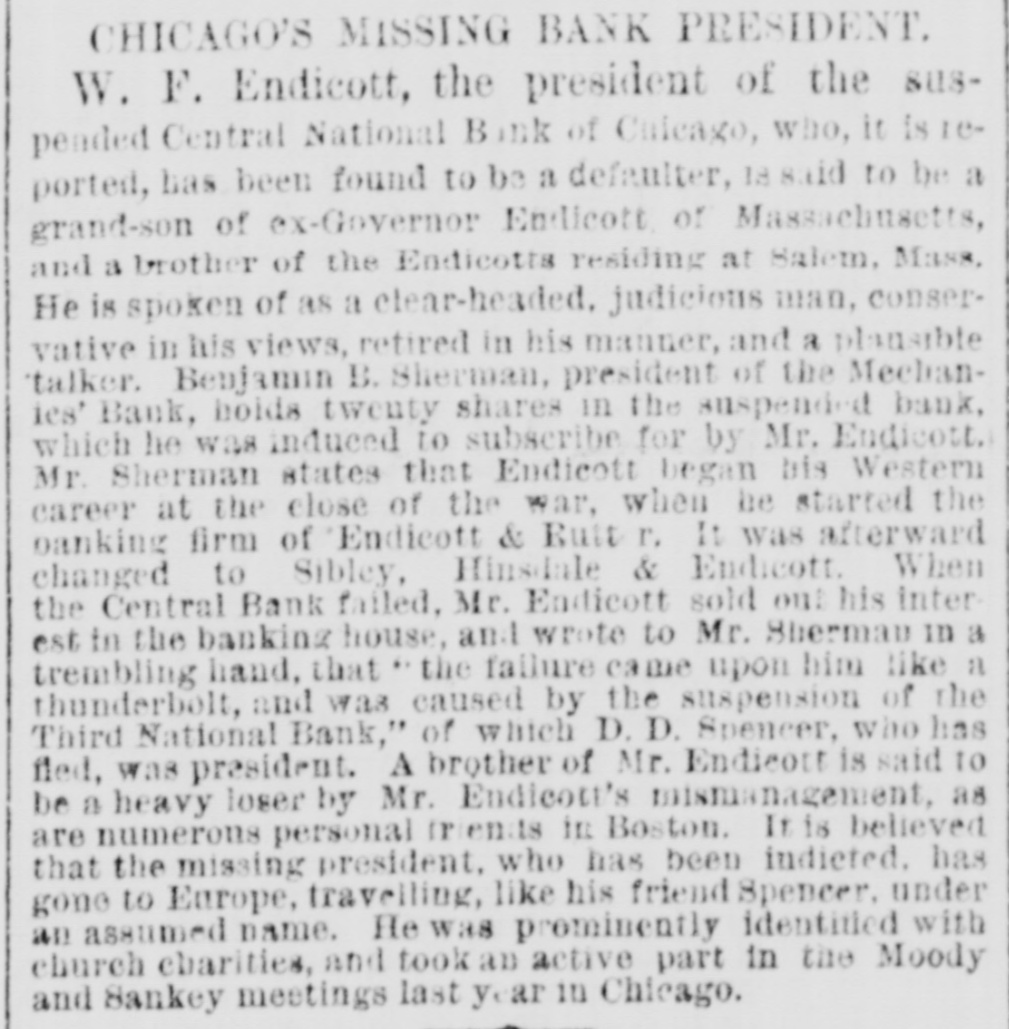
CHICAGO'S MISSING BANK president. W. F. Endicott, the president of the suspended Central National Bank of Chicago, who, it is 10ported, has been found to be a defanlter, 18 said to be a grand-son of ex-Governor Endicott of Massachusetts, and a brother of the Endicotts residing at Salem, Mass. He is spoken of as a clear-headed. judicious man, conservative in his views, retired in his manner, and a plausible talker. Benjamin B. Sherman, president of the Mechanies' Bank, holds twenty shares in the suspended bank, which he was induced to subscribe for by Mr. Endicott. Mr. Sherman states that Endicott began bis Western career at the close of the war, when be started the oanking firm of Endicott & Rutt r, It was afterward changed to Sibley, Hinsdale & Endicott. When the Central Bank failed, Mr. Endicott sold out his Interest in the banking house, and wrote to Mr. Sherman in a trembling hand, that the failure came upon him like a thunderbolt, and was caused by the suspension of the Third National Bank," of which D. D. Spencer, who has fled, was president. A brother of Mr. Endicott is said to be a heavy loser by Mr. Endicott's mismanagement, as are numerous personal ir ends in Boston. It is believed that the missing president, who has been indieted. has gone to Europe, travelling, like his friend Spencer, under an assumed name. He was prominently identified with church charities, and took an active part in the Moody and Sankey meetings last year in Chicago.


Article from Chicago Daily Tribune, December 23, 1877

Click image to open full size in new tab

Article Text

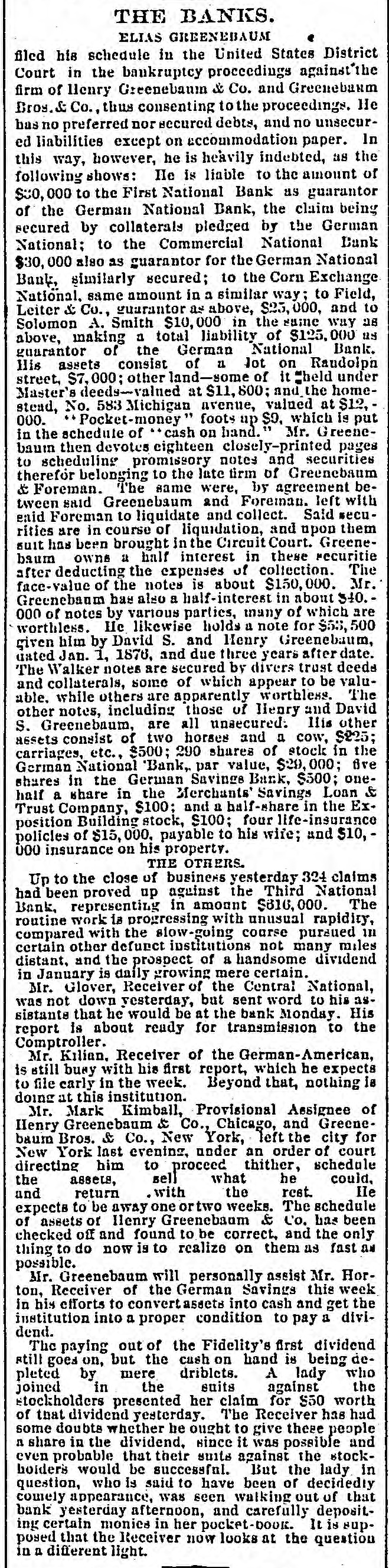
THE BANKS. ELIAS GREENEBAUM filed his schedule in the United States District Court in the bankruptcy proceedings against'the firm of llenry Greenebaum & Co. and Greenebaum Bros. & Co., thus consenting to the proceedings. He has no preferred nor secured debts, and no unsecured liabilities except on accommodation paper. In this way, however, he is heavily indebted, as the following shows: He is liable to the amount of $30, to the First National Bank as guarantor of the German National Bank, the claim being secured by collaterals pledged by the German National; to the Commercial National Bank $30, also as guarantor for the German National Bank, similarly secured; to the Corn Exchange National. same amount in a similar way; to Field, Leiter & Co., guarantor as above, $25,000, and to Solomon A. Smith $10,000 in the same way as above, making a total liability of $125. us guarantor of the German National Bank. Ilis assets consist of a lot on Raudolph street, $7,000; other land-some of it "held under Master's deeds-valued at $11, 800; and the homestead, No. 583 Michigan avenue, valued at $12, 000. Pocket-money foots up $9, which is put in the schedule of *cash on hand. Mr. Greenebaum then devotes eighteen closely-printed pages to scheduling promissory notes and securities therefor belonging to the late tirm of Greenebaum & Foreman. The same were, by agreement between said Greenebaum and Foreman. left with eaid Foreman to liquidate and collect. Sald securities are in course of liquidation, and upon them suit has been brought in the Circuit Court. Greenebaum owns a half interest in these recuritie after deducting the expenses of collection. The face-value of the notes is about $150,000. Mr. Greenebaum has also a half-interest in about $40.000 of notes by various parties, many of which are worthless. He likewise holds a note for $53, 500 given him by David S. and Henry Greenebaum, dated Jan. 1, 1876, and due three years after date. The Walker notes are secured by divers trust deeds and collaterals, some of which appear to be valuable. while others are apparently worthless. The other notes, including those of lienry and David S. Greenebaum, are all unsecured: Ilis other assets consist of two horses and a cow, $225; carriages, etc., $500; 290 shares of stock in the German National "Bank, par value, $29, 000; five shares in the German Savings Bank, $500; onehalf a share in the Merchants' Savings Loan & Trust Company, $100; and a half-share in the Exposition Building stock, S100; four life-insurance policles of $15,000. payable to his wife; and $10, 000 insurance on his property. THE OTHERS. Up to the close of business yesterday 324 claims had been proved up against the Third National Bank, representing in amount $616,000. The routine work is progressing with unusual rapidity, compared with the slow-going course pursued III certain other defunct institutions not many miles distant, and the prospect of a handsome dividend in January is daily growing mere certain. Mr. Glover, Receiver of the Central National, was not down vesterday, but sent word to his assistants that he would be at the bank Monday. His report is about ready for transmission to the Comptroller. Mr. Kilian. Receiver of the German-American, is still busy with his first report, which he expects to file early in the week. Beyond that, nothing is doing at this institution. Mr. Mark Kimball, Provisional Assignee of Henry Greenebaum to Co., Chicago, and Greenebaum Bros. & Co., New York, left the city for New York Inst evening, under an order of court directing him to proceed thither, schedule the assets, sell what he could, Ile rest. the and return ,with expects to be away one or two weeks. The schedule of assets or llenry Greenebaum & Co. has been checked off and found to be correct, and the only thing to do now is to realize on them as fast as possible. Mr. Greenebaum will personally assist Mr. Horton, Receiver of the German Savings this week in his efforts to convert assets into cash and get the institution into a proper condition to pay a dividend. The paying out of the Fidelity's first dividend still goes on, but the cash on hand is being depleted by mere driblets. A lady who joined in the suits against the stockholders presented her claim for $50 worth of that dividend yesterday. The Receiver has had some doubts whether he ought to give these people a share in the dividend, since it was possible and even probable that their suits against the stockbolders would be successful. But the lady in question, who is said to have been of decidedly comely appearance, was seen walking out of that bank yesterday afternoon, and carefully depositing certain monies in her pocket-book. It is supposed that the Receiver now looks at the question in a different light.


Article from The Redwood Gazette, January 3, 1878

Click image to open full size in new tab

Article Text

EPITOME OF THE WEEK. Condensed Telegraphic News. CURRENT paragraphs. Henry M. Stanley, the African explorer, reached Aden, Arabia, on the 23d. The Springfield (III.) Savings Bank has suspended. Liabilities to depositorsabout $175,000. The United States Supreme Court adjourned, on the 21st, to meet again, on the 7th of January. The Woman's National Suffrage Association will meet in Washington, D. c., on the 7th of January. The calling together of the British Parliament is considered in St. Petersburg as tantamount to a declaration of war. Flora Temple, the famous trotting mare. died recently, on a farm near Philadelphia, in the thirty-third year of her age. A call has been issued for a Democratic State Convention, to meet at Indianapolis, Ind., on the 20th of February next. John Van Hoesen, the reputed ringleader of the Albany (N. Y.) railroad rioters in July last, has been found guilty, and sentenced to seven years' imprisonment. Rev. G. F. Seymour was, on the 19th, elected Bishop of the Episcopal Diocese of Springfield, III. Bishop Seymour is a brother of Horatio Seymour, of New York. John A. Joyce, convicted at St. Louis of conspiring to defraud the Government of taxes on distilled spirits, has been fully and unconditionally pardoned by the President. T. S. Lambert, President of the American Popular Life Insurance Company, of New York. has been found guilty of swearing to false statements in regard to the condition of the company. Two hundred delegates to the National Reform Convention, to secure the ex press acknowledgment of God in the Constitution of the United States, assembled at Rochester. N. Y., on the 18th. The Legislature of South Carolina has ratified. by over a two-thirds vote, the amendment to the State Constitution levying an annual tax of two mills upon all the taxable property in the State, for the support of free schools. The United States Treasury held, on the 22d, $346,277,550 to secure the National Bank circulation. and $13,988,000 to secure the public deposits. National Bank circulation outstanding: Currency notes, $320,253,763; gold notes, $1,432,120. A few nights since the children of Mrs. Catherine Ryan, of Randolph, Mass., were suffocated by coal gas, and also Mary E. Burry, who was spending the night with them. Mrs. Syan herself was alive when discovered, but was not expected to recover. Thomas Rooney's house at West Point. N. Y., was burtied, a few days ago, and two children. aged;three and five years. perished in the flames. They were locked in the house during the absence of their parents, and were found, lifeless and charred, clasped in each other's arms. W. F. Endicott, President of the late . Central National Bank of Chicago, is found to be a defaulter and has left that city for parts unknown. It seems that, like Spencer, he unloaded by selling to the bank his capital stock for cash, leaving behind worthless notes. It was thought. on the 18th, that stockholders would realize nothing and depositors in the suspended concern little. A boy named Willie Hopkins, ten years old. was recently abducted from his home at Braddock's Fields, near Pittsburgh, Pa., by a man supposed to be a tramp. He is said to be a pretty boy, with full face, light complexion and hair, and rather stoutly built. The abductor is a tall man, with face pitted with small-pox. The parents of the boy are in great distress over his disappearance, the mother being almost insane from grief. The troubles in El Paso County, Tex., are said to have grown out of a dispute as to the ownership of extensive salt mines in that section, at which the people of the surrounding country have obtained salt from time
Article from New-York Tribune, January 23, 1878

Click image to open full size in new tab

Article Text

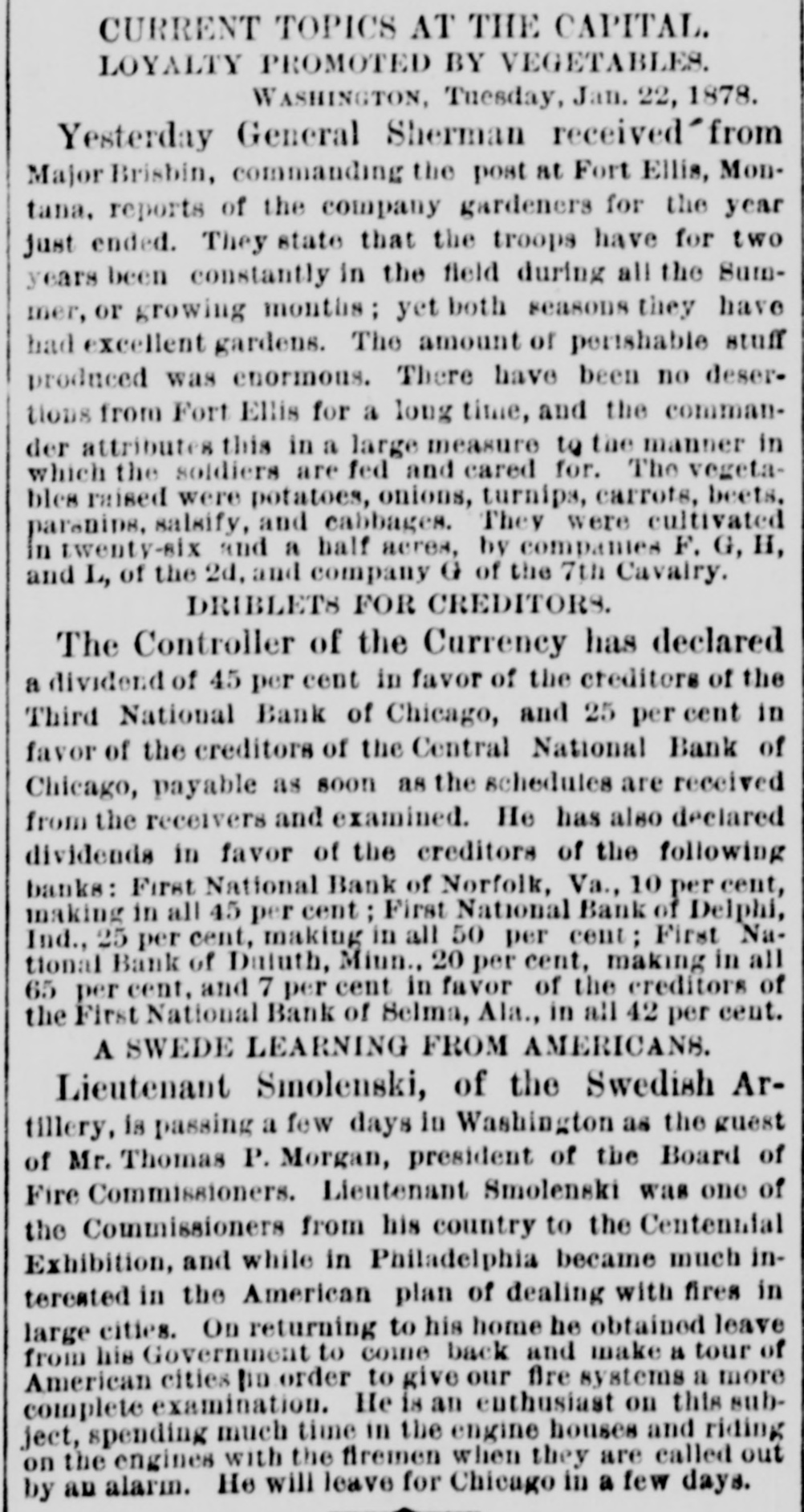
CURRENT TOPICS AT THE CAPITAL. LOYALTY PROMOTED BY VEGETABLES. WASHINGTON, Tuesday, Jan. 22, 1878. Yesterday General Sherman received from Major Brisbin, commanding the post at Fort Ellis, Montana, reports of the company gardeners for the year just ended. They state that the troops have for two years been constantly in the field during all the Summer, or growing months; yet both seasons they have had excellent gardens. The amount of perishable stuff produced was enormous. There have been no desertions from Fort Ellis for a long time, and the commander attributes this in a large measure to the manner in which the soldiers are fed and cared for. The vegetables raised were potatoes, onions, turnips, carrots, beets, parsnins, salsify, and cabbages. They were cultivated in twenty-six and a half acres, by companies F. G, H, and L, of the 2d, and company G of the 7th Cavalry. DRIBLETS FOR CREDITORS. The Controller of the Currency has declared a dividend of 45 per cent in favor of the creditors of the Third National Bank of Chicago, and 25 per cent in favor of the creditors of the Central National Bank of Chicago, payable as soon as the schedules are received from the receivers and examined. He has also declared dividends in favor of the creditors of the following banks: First National Bank of Norfolk, Va., 10 per cent, making in all 45 per cent; First National Bank of Delphi, Ind., 25 per cent, making in all 50 per cent; First National Bank of Duluth, Miun., 20 per cent, making in all 65 per cent, and 7 per cent in favor of the creditors of the First National Bank of Selma, Ala., in all 42 per cent. A SWEDE LEARNING FROM AMERICANS. Lieutenant Smolenski, of the Swedish Artillery, is passing a few days in Washington as the guest of Mr. Thomas P. Morgan, president of the Board of Fire Commissioners. Lieutenant Smolenski was one of the Commissioners from his country to the Centennial Exhibition, and while in Philadelphia became much interested in the American plan of dealing with fires in large cities. On returning to his home he obtained leave from his Government to come back and make a tour of American cities 110 order to give our Are systems a more complete examination. He is an enthusiast on this subject, spending much time in the engine houses and riding on the engines with the firemen when they are called out by an alarm. He will leave for Chicago in a few days.


Article from Daily Press and Dakotaian, January 24, 1878

Click image to open full size in new tab

Article Text

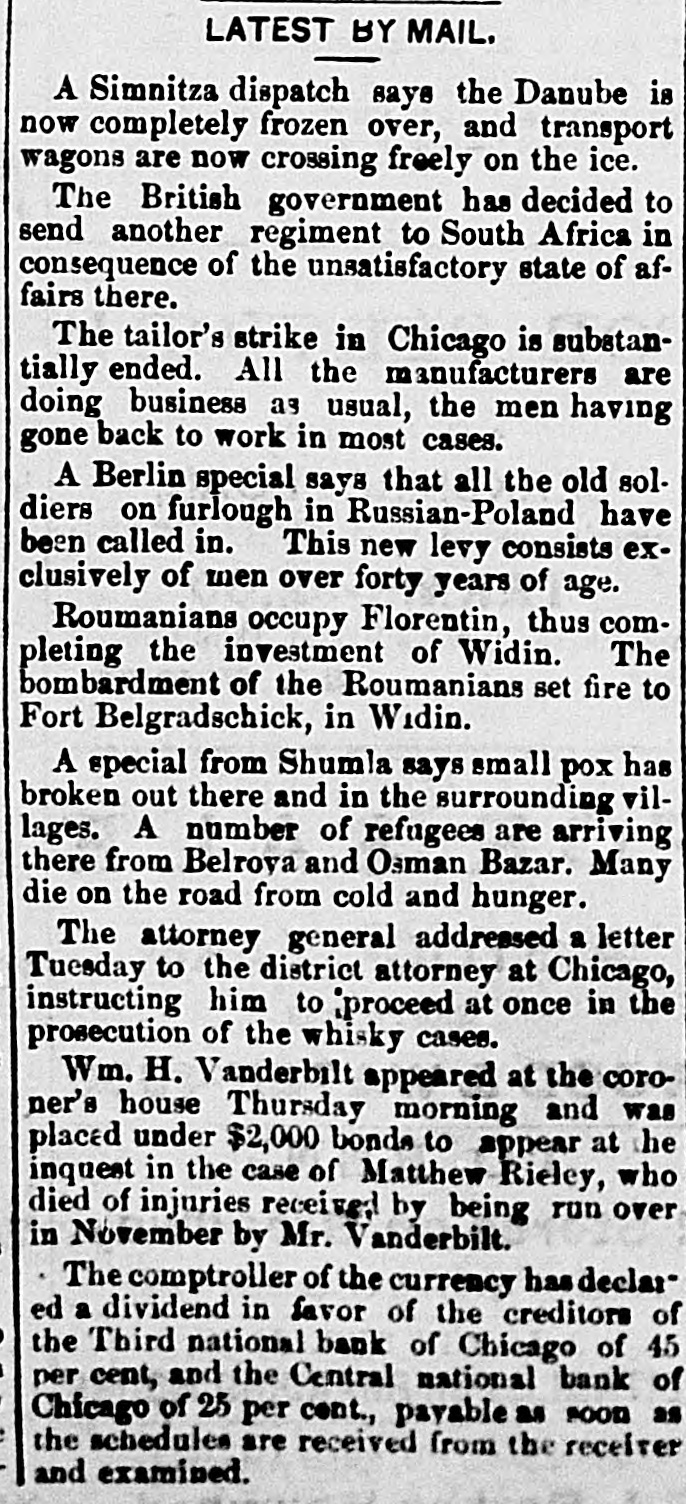
LATEST BY MAIL. A Simnitza dispatch says the Danube is now completely frozen over, and transport wagons are now crossing freely on the ice. The British government has decided to send another regiment to South Africa in consequence of the unsatisfactory state of affairs there. The tailor's strike in Chicago is substantially ended. All the manufacturers are doing business as usual, the men having gone back to work in most cases. A Berlin special says that all the old soldiers on furlough in Russian-Poland have been called in. This new levy consists exclusively of men over forty years of age. Roumanians occupy Florentin, thus completing the investment of Widin. The bombardment of the Roumanians set fire to Fort Belgradschick, in Widin. A special from Shumla says small pox has broken out there and in the surrounding villages. A number of refugees are arriving there from Belroya and Osman Bazar. Many die on the road from cold and hunger. The attorney general addressed a letter Tuesday to the district attorney at Chicago, instructing him to proceed at once in the prosecution of the whisky cases. Wm. H. Vanderbilt appeared at the coroner's house Thursday morning and was placed under $2,000 bonds to appear at the inquest in the case of Matthew Rieley, who died of injuries received by being run over in November by Mr. Vanderbilt. The comptroller of the currency has declared a dividend in favor of the creditors of the Third national bank of Chicago of 45 per cent, and the Central national bank of Chicago of 25 per cent., payable as soon as the schedules are received from the receiver and examined.


Article from The New York Herald, March 20, 1878

Click image to open full size in new tab

Article Text

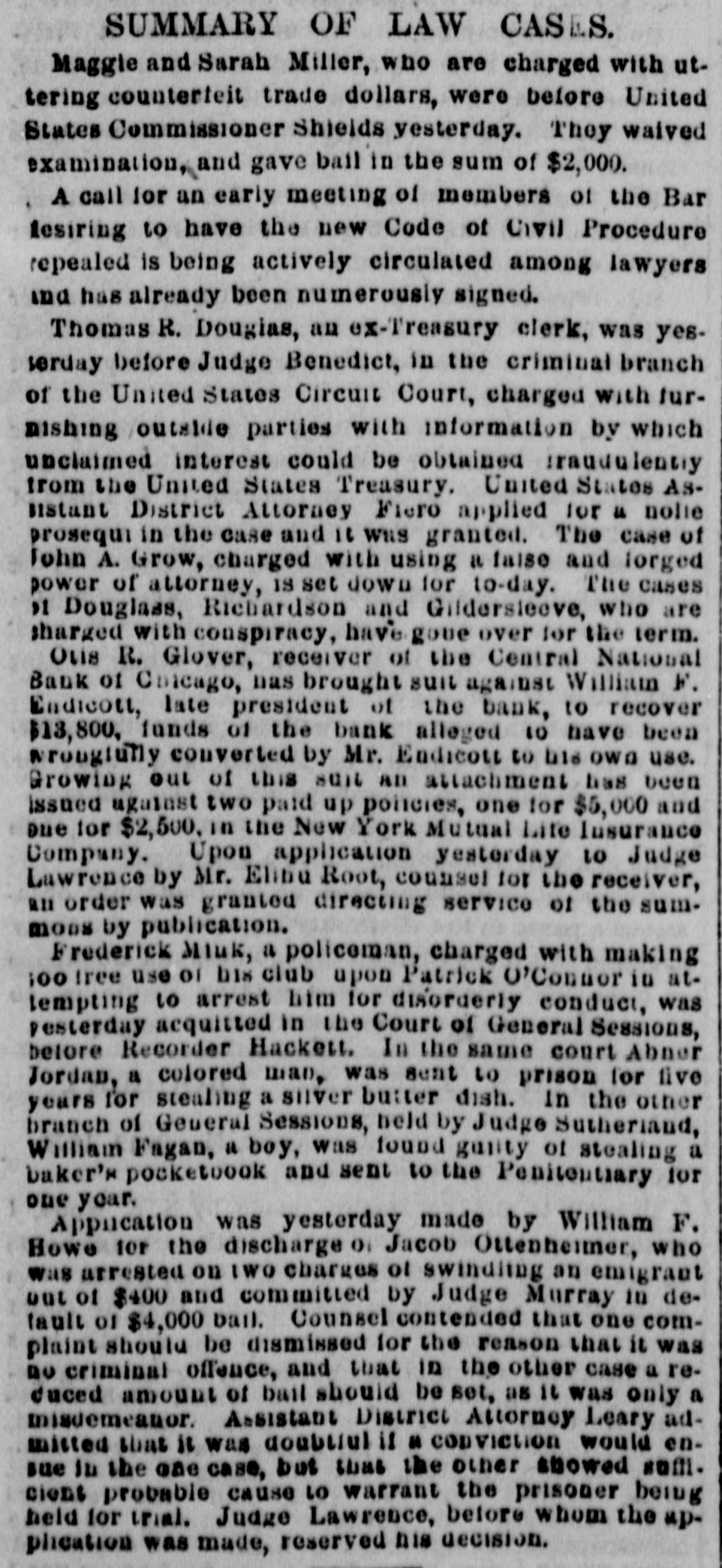
SUMMARY OF LAW CASES. Maggie and Sarah Miller, who are charged with uttering counterfeit trade dollars, were before United States Commissioner Shields yesterday. They waived examination, and gave bail in the sum of $2,000. A call for an early meeting of members of the Bar desiring to have the new Code of Civil Procedure repealed is being actively circulated among lawyers and has already been numerously signed. Thomas R. Dougias, an ex-Treasury clerk, was yesterday before Judge Benedict, in the criminal branch of the United States Circuit Court, charged with furmishing outside parties with information by which unclaimed interest could be obtained !raudulently from the United States Treasury. United States AsBistant District Attorney Fiero applied for a nolie prosequi in the case and it WHS granted. The case of John A. Grow, charged with using a false and lorged power of attorney, IS set down for to-day. The cases " Douglass, Richardson and Gildersleeve, who are sharged with conspiracy, have goue over for the term. Otis R. Glover, receiver of the Central National Bank of Chicago, nas brought suit against William F. Endicott, late president of the bank, to recover $13,800, funds of the bank alleged to have been wrongfully converted by Mr. Endicott to bis own use. Growing out of this suit an attachment has been issued against two paid up poiicies, one for $5,000 and Due for $2,500, in the New York Mutual Life Insurance Company. Upon application yesterday to Judge Lawrence by Mr. Elibu Root, counsel for the receiver, all order was granted directing service of the summons by publication. Frederick Mink, a policeman, charged with making 100 tree use of bis club upon Patrick O'Connor in attempting to arrest him for disorderly conduct, was vesterday acquitted in the Court of General Sessions, before Recorder Hackett. In the same court Abner Jordan, a colored man, was sent to prison for five years for stealing a silver butter dish. in the other branch of General Sessions, held by Judge Sutheriand, William Fagan, a boy, was found guilty of stealing a baker's pocketoook and sent to the Penitentiary for one year. Application was yesterday made by William F. Howe for the discharge 0: Jacob Ottenheimer, who was arrested on two charges ot swindiing an emigrant out of $400 and committed by Judge Murray in default of $4,000 bail. Counsel contended that one complaint should be dismissed for the reason that it was no criminal offence, and that in the other case a reduced amount of bail should be set, as it was only a misdemeanor. Assistant District Attorney Leary admitted that it was doubtiul if a conviction would ensue in the one case, but that the other showed sofficient probable cause to warrant the prisoner being held for trial. Judge Lawrence, before whom the application was made, reserved his decision.