A run on the savings department began Oct 30, 1905; bank met demands, ordered funds from Chicago, and $300,000 arrival Nov 1–2 checked the run. Article describing a woman circulating a no funds check provides a concrete misinformation trigger, so this is a run only (bank remained open and resumed normal business).
Events (1)
1.October 30, 1905Run
Cause
Rumor Or Misinformation
Cause Details
A woman circulated a check stamped No funds, telling others the bank had no funds, which precipitated withdrawals.
Random Run
Yes
Random Run Snippet
Woman circulated check marked No funds, precipitating run
Measures
Paid depositors without 60 days' notice; large amounts ordered from Chicago; $300,000 in currency arrived and checked the run.
Newspaper Excerpt
Bloomington, Ill., Oct. 30.-A run on the savings department of the Corn Belt Bank was commenced at noon today. All demands are being met in full.
Source
newspapers
Newspaper Articles (14)
1.October 30, 1905Evening Times-RepublicanMarshalltown, IA
Click image to open full size in new tab
Article Text
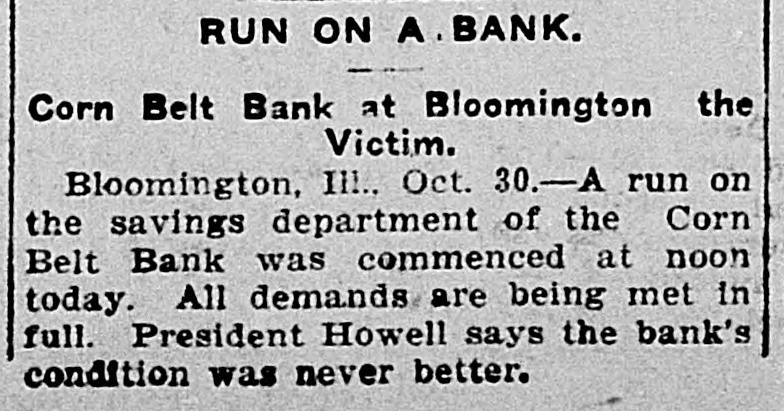
RUN ON A a BANK. Corn Belt Bank at Bloomington the Victim. Bloomington, Ill.. Oct. 30.-A run on the savings department of the Corn Belt Bank was commenced at noon today. All demands are being met in full. President Howell says the bank's condition was never better.
2.October 30, 1905The Topeka State JournalTopeka, KS
Click image to open full size in new tab
Article Text
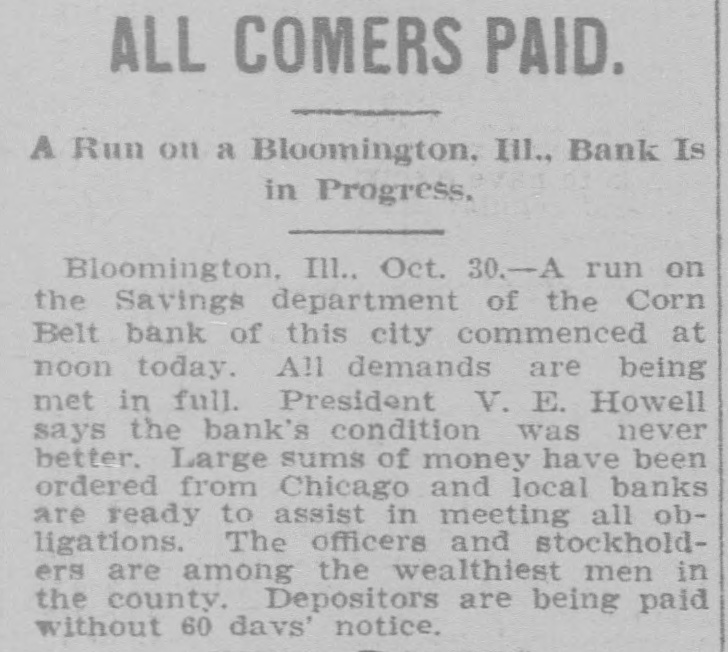
ALL COMERS PAID. A Run on a Bloomington, III., Bank Is in Progress, Bloomington, Ill., Oct. 30.-A run on the Savings department of the Corn Belt bank of this city commenced at noon today. All demands are being met in full. President V. E. Howell says the bank's condition was never better. Large sums of money have been ordered from Chicago and local banks are ready to assist in meeting all obligations. The officers and stockholders are among the wealthiest men in the county. Depositors are being paid without 60 davs' notice.
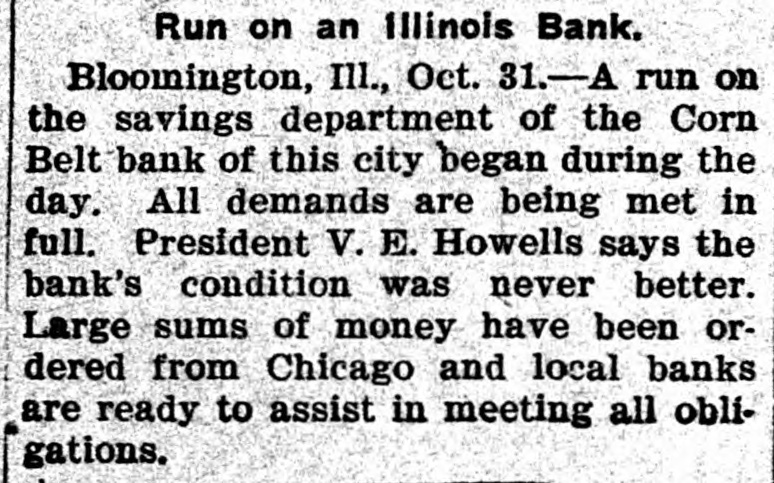
Run on an Illinois Bank. Bloomington, III., Oct. 31.-A run on the savings department of the Corn Belt bank of this city began during the day. All demands are being met in full. President V.E. Howells says the bank's condition was never better. Large sums of money have been ordered from Chicago and local banks are ready to assist in meeting all obligations.
4.October 31, 1905Ottumwa Tri-Weekly CourierOttumwa, IA
Click image to open full size in new tab
Article Text
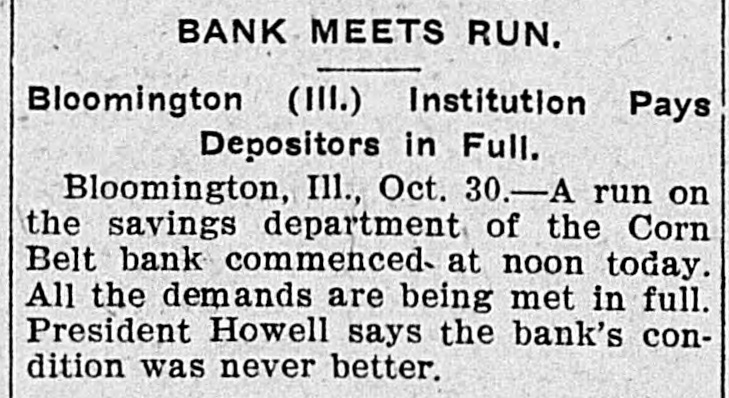
BANK MEETS RUN. Bloomington (III.) Institution Pays Depositors in Full. Bloomington, Ill., Oct. 30.-A run on the savings department of the Corn Belt bank commenced at noon today. All the demands are being met in full. President Howell says the bank's condition was never better.
5.October 31, 1905The Montgomery AdvertiserMontgomery, AL
Click image to open full size in new tab
Article Text
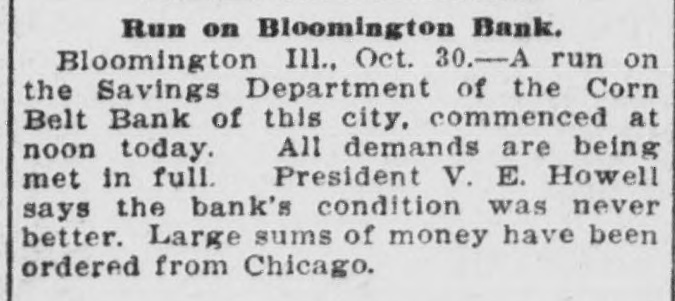
Run on Bloomington Bank. Bloomington Ill., Oct. 30.-A run on the Savings Department of the Corn Belt Bank of this city, commenced at noon today. All demands are being met in full. President V. E. Howell says the bank's condition was never better. Large sums of money have been ordered from Chicago.
6.October 31, 1905Omaha Daily BeeOmaha, NE
Click image to open full size in new tab
Article Text
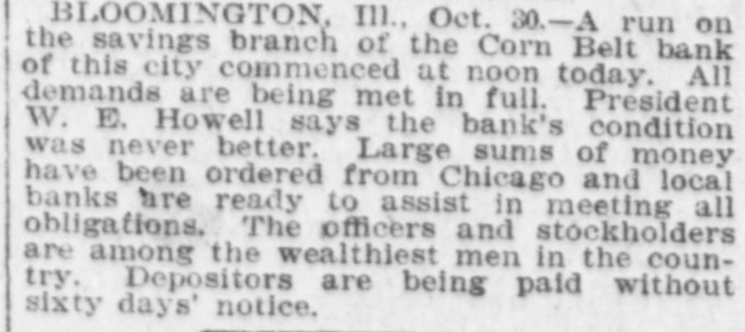
BLOOMINGTON, Ill., Oct. 30.-A run on the savings branch of the Corn Belt bank of this city commenced at noon today. All demands are being met in full. President W. E. Howell says the bank's condition was never better. Large sums of money have been ordered from Chicago and local banks are ready to assist in meeting all obligations. The officers and stockholders are among the wealthiest men in the country. Depositors are being paid without sixty days' notice.
7.November 1, 1905Rock Island ArgusRock Island, IL
Click image to open full size in new tab
Article Text
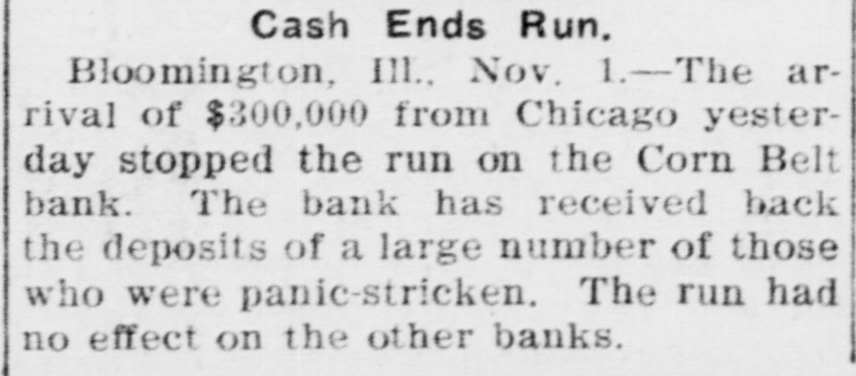
Cash Ends Run. Bloomington, III., Nov. 1.-The arrival of $300,000 from Chicago yesterday stopped the run on the Corn Belt bank. The bank has received back the deposits of a large number of those who were panic-stricken. The run had no effect on the other banks.
8.November 1, 1905Watertown RepublicanWatertown, WI
Click image to open full size in new tab
Article Text
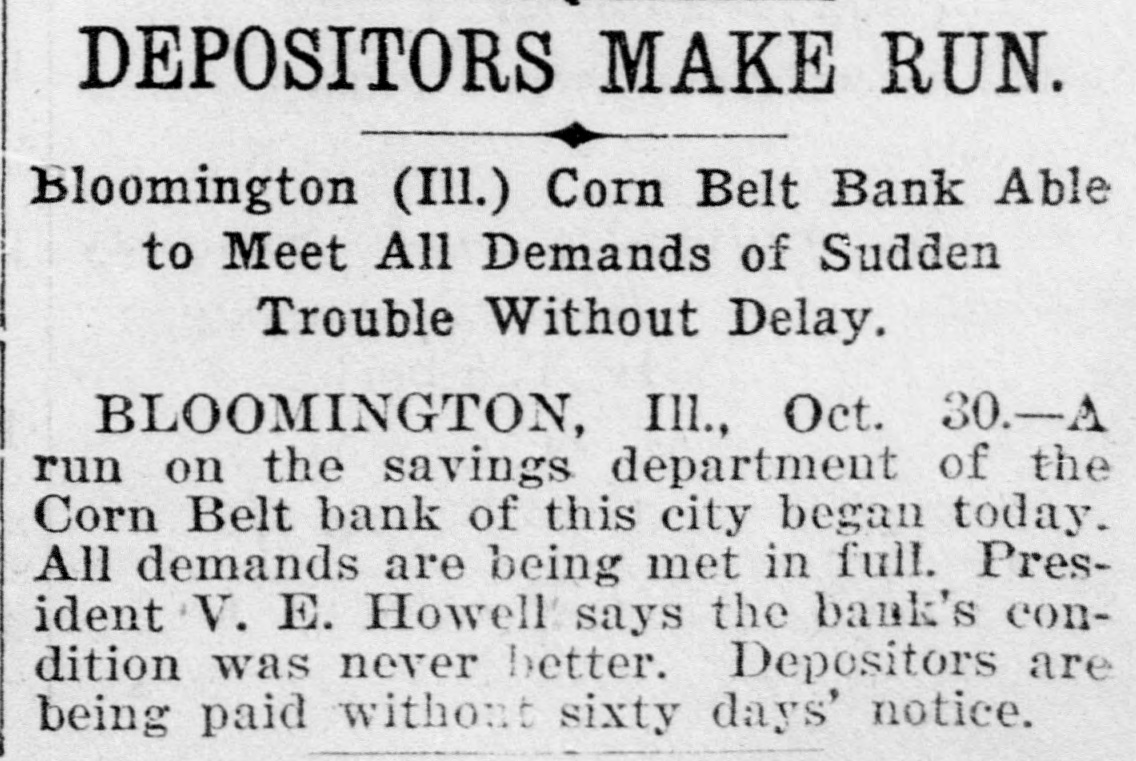
DEPOSITORS MAKE RUN. Bloomington (Ill.) Corn Belt Bank Able to Meet All Demands of Sudden Trouble Without Delay. BLOOMINGTON, III., Oct. 30.-A run on the savings department of the Corn Belt bank of this city began today. All demands are being met in full. President V. E. Howell says the bank's condition was never better. Depositors are being paid without sixty days' notice.
9.November 2, 1905Baxter Springs NewsBaxter Springs, KS
Click image to open full size in new tab
Article Text
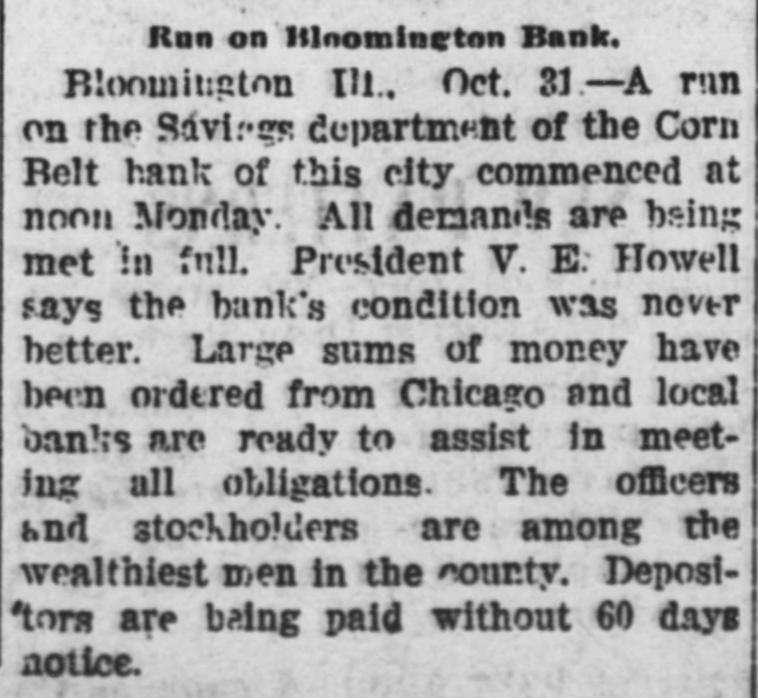
Run on Bloomington Bank. Bloomington III., Oct. 31-A run on the Sávings department of the Corn Relt hank of this city commenced at noon Monday. All demands are being met in full. President V. E: Howell says the bank's condition was nover better. Large sums of money have been ordered from Chicago and local banks are ready to assist in meeting all obligations. The officers and stockholders are among the wealthiest men in the county. Deposi'tors are being paid without 60 days notice.
10.November 6, 1905The Cairo BulletinCairo, IL
Click image to open full size in new tab
Article Text
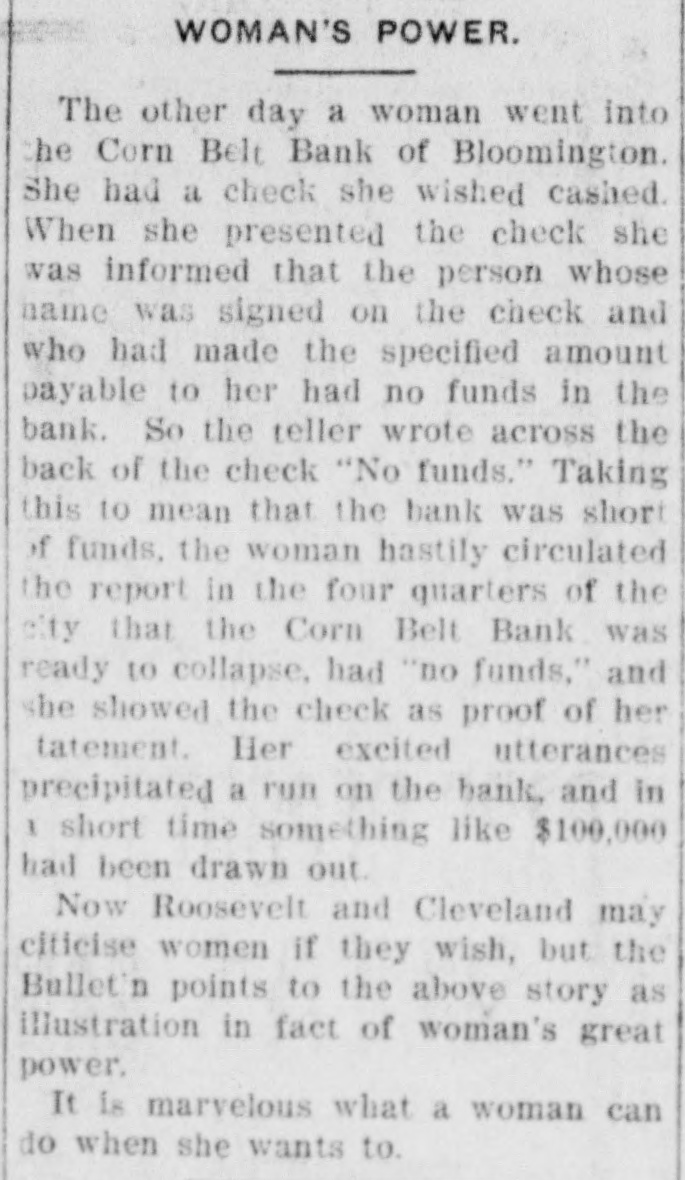
WOMAN'S POWER. The other day a woman went into the Corn Belt Bank of Bloomington. She had a check she wished cashed. When she presented the check she was informed that the person whose name was signed on the check and who had made the specified amount payable to her had no funds in the bank. So the teller wrote across the back of the check "No funds." Taking this to mean that the bank was short of funds, the woman hastily circulated the report in the four quarters of the city that the Corn Belt Bank was ready to collapse, had "no funds," and she showed the check as proof of her tatement. Her excited utterances precipitated a run on the bank. and in 1 short time something like $100,000 had been drawn out. Now Roosevelt and Cleveland may citicise women if they wish, but the Bullet'n points to the above story as illustration in fact of woman's great power. It is marvelous what a woman can do when she wants to.
11.November 9, 1905Iron County RegisterIronton, MO
Click image to open full size in new tab
Article Text
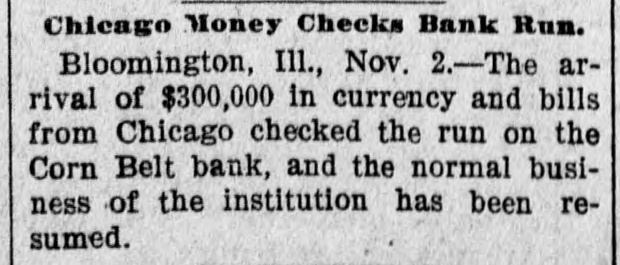
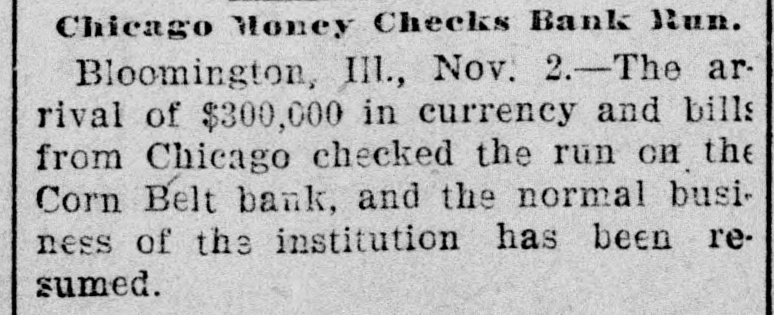
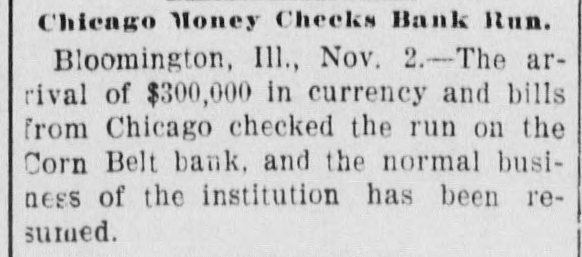
Chicago Money Checks Bank Run. Bloomington, Ill., Nov. 2.-The arrival of $300,000 in currency and bills from Chicago checked the run on the Corn Belt bank, and the normal business of the institution has been resumed.
12.November 9, 1905Mexico Missouri MessageMexico, MO
Click image to open full size in new tab
Article Text
Chicago Money Checks Bank Run. Bloomington, III., Nov. 2.-The arrival of $300,000 in currency and bills from Chicago checked the run on the Corn Belt bank, and the normal business of the institution has been resumed.
13.November 10, 1905The Tupelo JournalTupelo, MS
Click image to open full size in new tab
Article Text
Chicago Money Checks Bank Run. Bloomington, III., Nov. 2.-The arrival of $300,000 in currency and bills from Chicago checked the run on the Corn Belt bank, and the normal business of the institution has been resumed.
14.November 11, 1905Macon BeaconMacon, MS
Click image to open full size in new tab
Article Text
Chicago Money Checks Bank Run. Bloomington, Ill., Nov. 2.-The arrival of $300,000 in currency and bills from Chicago checked the run on the Corn Belt bank, and the normal business of the institution has been resumed.