Shapard Bank (Opelika, AL)

Episode Information

Episode UID
354363691250
Episode Type
Suspension โ†’ Closure
Bank Type
state
Bank ID
35436369 hash
Start Date
February 26, 1904
Location
Opelika, Alabama (32.645, -85.378)

Metadata

Model
gpt-5-mini (chosen from majority vote of a three-model LLM ensemble)
Short Digest
b0f4c8ae5bcf36b3

Response Measures

None

Description

Newspaper spells Opelika variably; bank closed after examiner found impaired capital from bad loans.

Events (2)

1. February 26, 1904 Suspension
Cause
Government Action
Cause Details
Closed by State Bank Examiner after investigation found capital impaired due to continuous accumulation of bad loans.
Newspaper Excerpt
The doors of the bank were closed Friday by State Bank Examiner T. J. Rutledge.
Source
newspapers
2. March 3, 1904 Receivership
Newspaper Excerpt
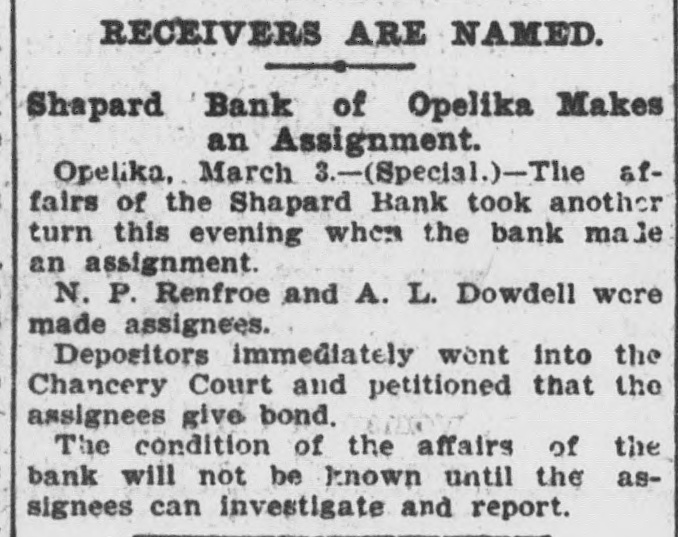
The Shapard Bank of Opelika makes an assignment. N. P. Renfroe and A. L. Dowdell were made assignees.
Source
newspapers

Newspaper Articles (5)

Article from The Montgomery Advertiser, February 28, 1904

Click image to open full size in new tab

Article Text

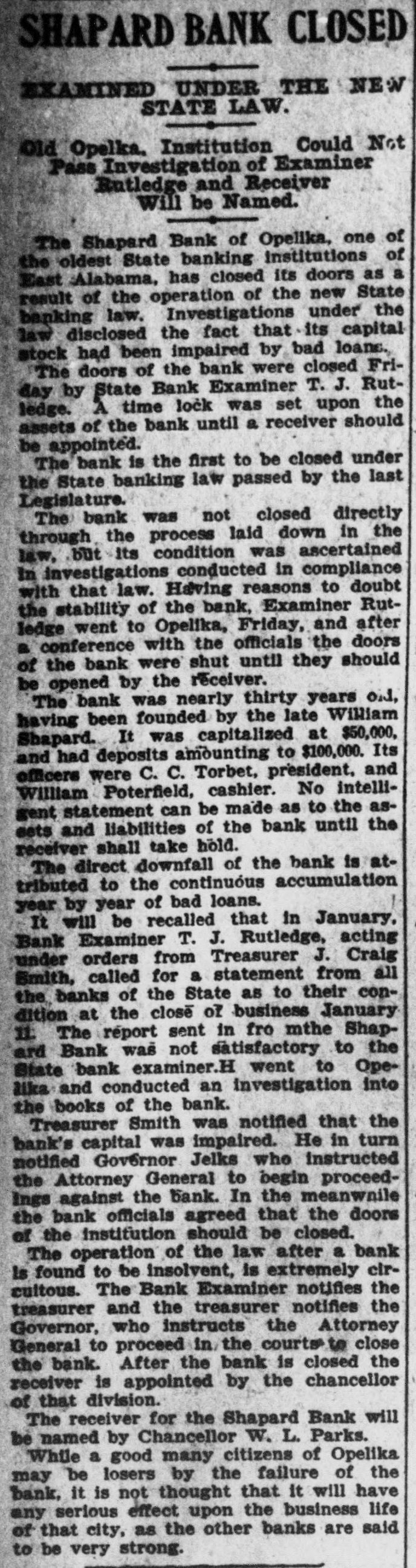
SHAPARD BANK CLOSED EXAMINED UNDER THE NEW STATE LAW. Old Opelka. Institution Could Not Pass Investigation of Examiner Rutledge and Receiver Will be Named. The Shapard Bank of Opelika, one of the oldest State banking Institutions of East Alabama, has closed its doors as a result of the operation of the new State banking law. Investigations under the law disclosed the fact that its capital stock had been impaired by bad loans. The doors of the bank were closed Friday by State Bank Examiner T. J. Rutledge. A time lock was set upon the assets of the bank until a receiver should be appointed. The bank is the first to be closed under the State banking law passed by the last Legislature. The bank was not closed directly through the process laid down in the law, but its condition was ascertained In investigations conducted in compliance with that law. Having reasons to doubt the stability of the bank, Examiner Rutledge went to Opelika, Friday, and after a conference with the officials the doors of the bank were shut until they should be opened by the receiver. The bank was nearly thirty years oil, having been founded by the late William Shapard. It was capitalized at $50,000. and had deposits amounting to $100,000. Its officers were C. C. Torbet, president. and William Poterfield, cashier. No intelligent statement can be made as to the aseets and liabilities of the bank until the receiver shall take hold. The direct downfall of the bank is attributed to the continuous accumulation year by year of bad loans. It will be recalled that in January. Bank Examiner T. J. Rutledge, acting under orders from Treasurer J. Craig Smith, called for a statement from all the banks of the State as to their condition at the close of business January 11 The report sent in fro mthe Shapard Bank was not satisfactory to the State bank examiner.H went to Opelika and conducted an investigation into the books of the bank. Treasurer Smith was notified that the bank's capital was impaired. He in turn notified Governor Jelks who instructed the Attorney General to begin proceedIngs against the bank. In the meanwnile the bank officials agreed that the doors of the institution should be closed. The operation of the law after a bank Is found to be insolvent, is extremely circultous. The Bank Examiner notifies the treasurer and the treasurer notifies the Governor, who instructs the Attorney General to proceed in the courts to close the bank. After the bank is closed the receiver is appointed by the chancellor of that division. The receiver for the Shapard Bank will be named by Chancellor W. L. Parks. While a good many citizens of Opelika may be losers by the failure of the bank, it is not thought that it will have any serious effect upon the business life of that city, as the other banks are said to be very strong.
Article from The Montgomery Advertiser, March 1, 1904

Click image to open full size in new tab

Article Text

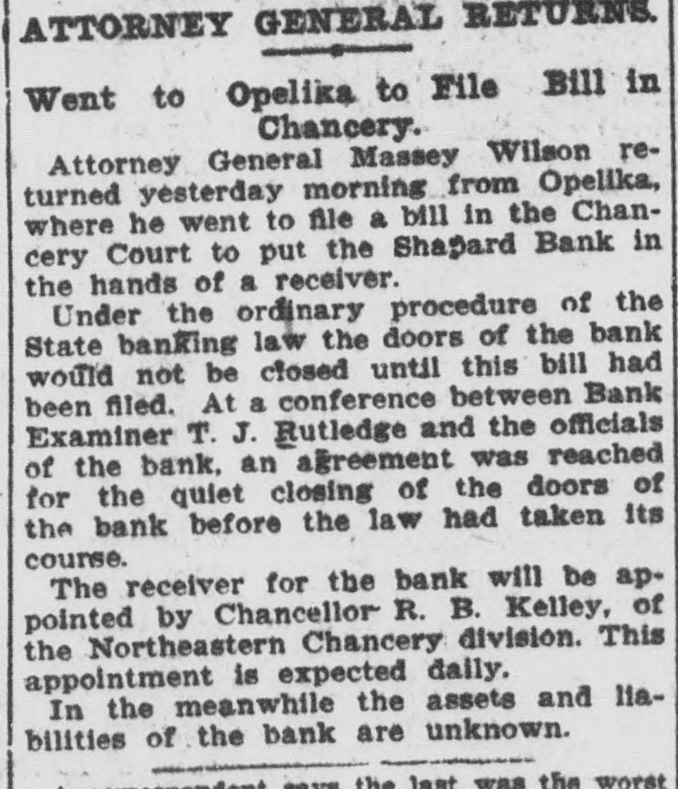
ATTORNEY GENERAL RETURNS. Went to Opelika to File Bill in Chancery. Attorney General Massey Wilson returned yesterday morning from Opellka, where he went to file a bill in the Chancery Court to put the Shapard Bank in the hands of a receiver. Under the ordinary procedure of the State banking law the doors of the bank would not be closed until this bill had been filed. At a conference between Bank Examiner T. J. Rutledge and the officials of the bank, an agreement was reached for the quiet closing of the doors of the bank before the law had taken its course. The receiver for the bank will be appointed by Chancellor R. B. Kelley, of the Northeastern Chancery division. This appointment is expected daily. In the meanwhile the assets and liabilities of the bank are unknown. the was worst


Article from The Montgomery Advertiser, March 3, 1904

Click image to open full size in new tab

Article Text

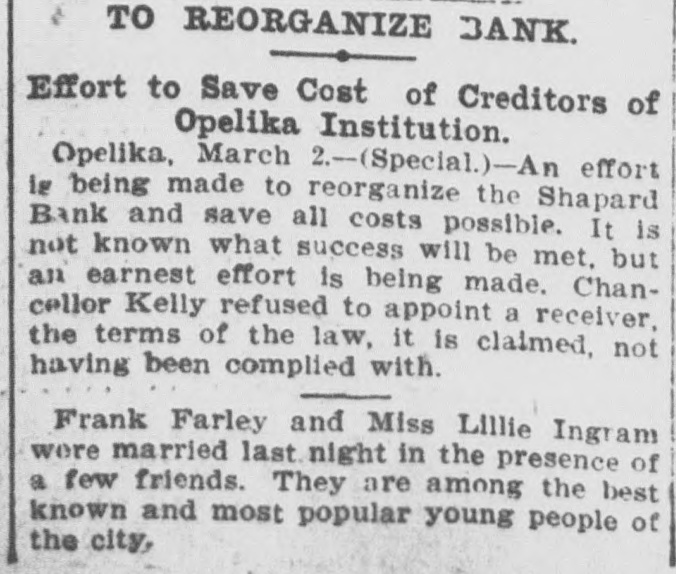
TO REORGANIZE BANK. Effort to Save Cost of Creditors of Opelika Institution. Opelika, March 2.-(Special.)-An effort le being made to reorganize the Shapard Bank and save all costs possible. It is not known what success will be met, but an earnest effort is being made. Chancellor Kelly refused to appoint a receiver, the terms of the law, it is claimed, not having been complied with. Frank Farley and Miss Lillie Ingram were married last night in the presence of a few friends. They are among the best known and most popular young people of the city,


Article from The Montgomery Advertiser, March 3, 1904

Click image to open full size in new tab

Article Text

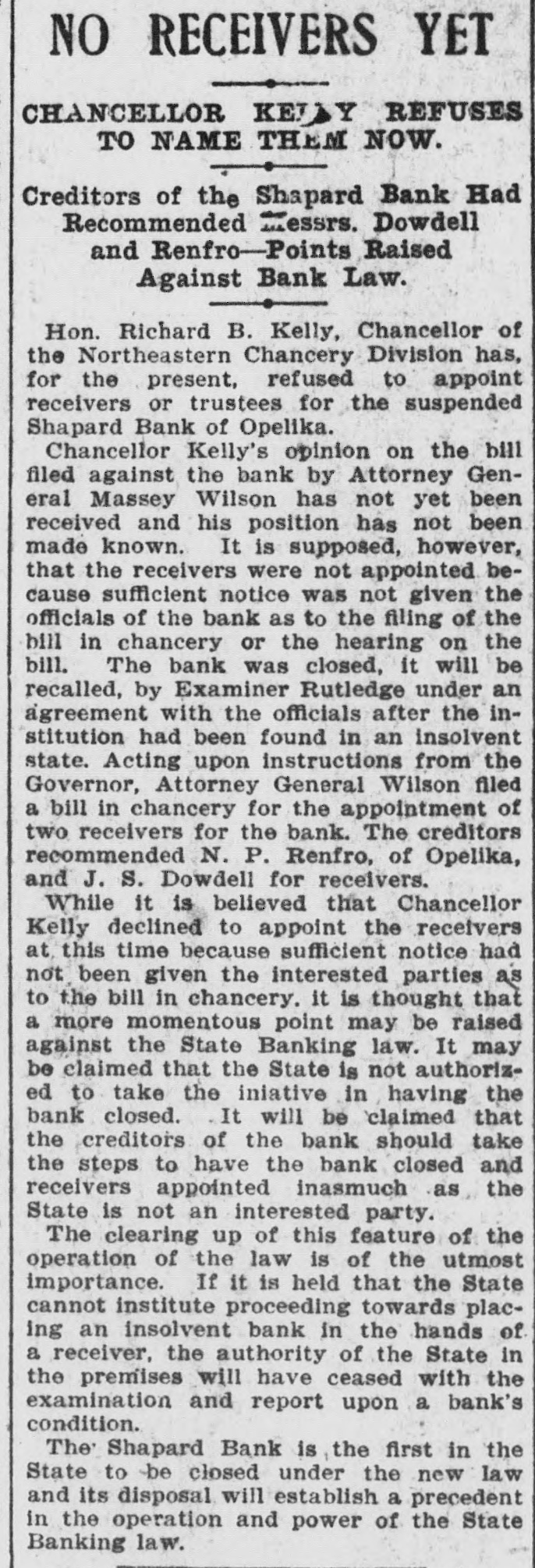
NO RECEIVERS YET CHANCELLOR KEJLY REFUSES TO NAME THEM NOW. Creditors of the Shapard Bank Had Recommended messrs. Dowdell and Renfro-Points Raised Against Bank Law. / Hon. Richard B. Kelly, Chancellor of the Northeastern Chancery Division has, for the present, refused to appoint receivers or trustees for the suspended Shapard Bank of Opelika. Chancellor Kelly's opinion on the bill filed against the bank by Attorney General Massey Wilson has not yet been received and his position has not been made known. It is supposed, however, that the receivers were not appointed. because sufficient notice was not given the officials of the bank as to the filing of the bill in chancery or the hearing on the bill. The bank was closed, it will be recalled, by Examiner Rutledge under an agreement with the officials after the institution had been found in an insolvent state. Acting upon instructions from the Governor, Attorney General Wilson filed a bill in chancery for the appointment of two receivers for the bank. The creditors recommended N. P. Renfro, of Opelika, and J. S. Dowdell for receivers. While it is believed that Chancellor Kelly declined to appoint the receivers at this time because sufficient notice had not been given the interested parties as to the bill in chancery. it is thought that a more momentous point may be raised against the State Banking law. It may be claimed that the State is not authorized to take the iniative in having the bank closed. It will be claimed that the creditors of the bank should take the steps to have the bank closed and receivers appointed inasmuch as the State is not an interested party. The clearing up of this feature of the operation of the law is of the utmost importance. If it is held that the State cannot institute proceeding towards placing an insolvent bank in the hands of a receiver, the authority of the State in the premises will have ceased with the examination and report upon a bank's condition. The Shapard Bank is the first in the State to be closed under the new law and its disposal, will establish a precedent in the operation and power of the State Banking law.


Article from The Montgomery Advertiser, March 4, 1904

Click image to open full size in new tab

Article Text

RECEIVERS ARE NAMED. Shapard Bank of Opelika Makes an Assignment. Opelika, March 3.-(Special.)-Tle affairs of the Shapard Bank took another turn this evening when the bank male an assignment. N. P. Renfroe and A. L. Dowdell were made assignees. Depositors immediately went into the Chancery Court and petitioned that the assignees give bond. The condition of the affairs of the bank will not be known until the assignees can investigate and report.