Click image to open full size in new tab
Article Text
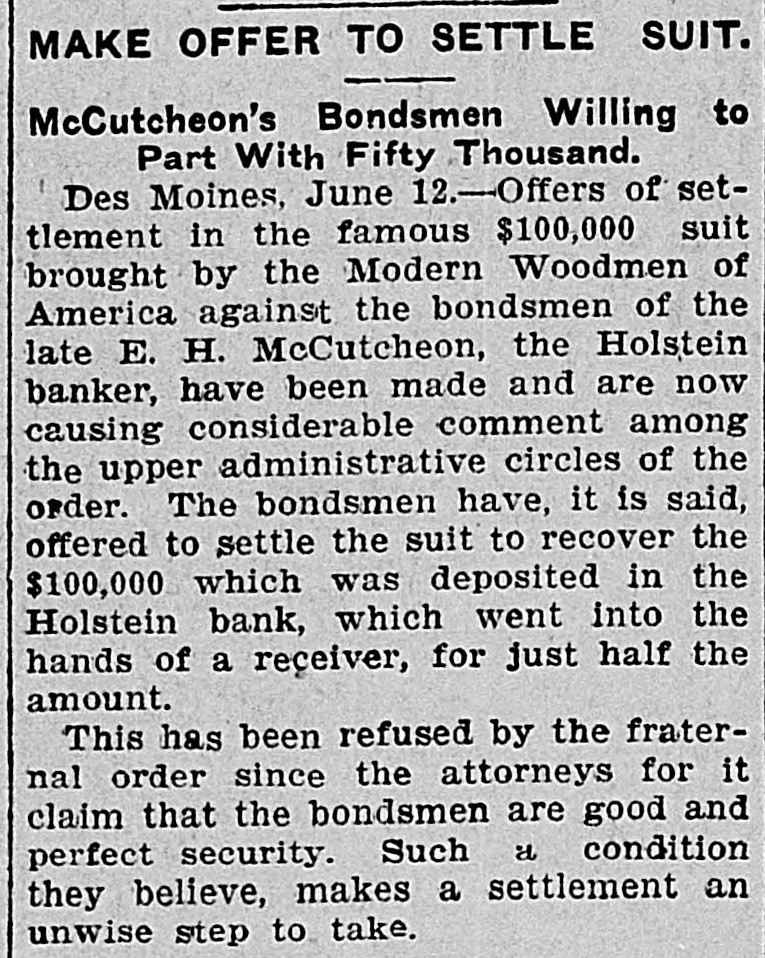
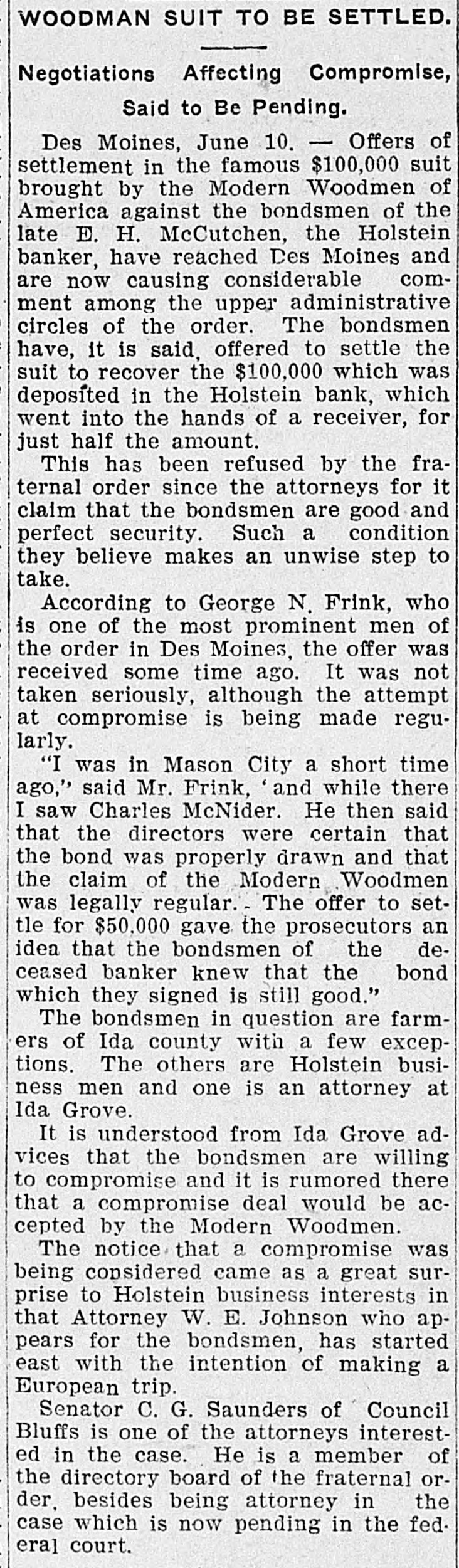
appellant of an abuse of discretion on the part of the trial court in giving Smith the death sentence instead of a life imprisonment-Smith having pleaded guilty, the discretion was to be exercised by the court instead of a jury-the supreme court says it could not interfery. Smith was to have been hung or December. He is colored, about 40 years of age, and has no relatives in Iowa. He is confined at Fort Madison. Governor Com mins will have the duty to perform of fixing a date for his death. The measure of the damage to a husband in Iowa by reason of injury to his wife is not the expense of hiring a domestic to do the household work which the wife was in the habit of doing before the injury. So declared the supreme court of Iowa in an opinion affirming a $2,000 judgment obtained in Linn county by Fannie Hutchens from the Marion & Cedar Rapids traction, line. "In giving damages to the husband for injuries to his wife the law," says the Iowa court, "does not compute his recovery on a commercial basis but gives him such compensation as in the judgment of the jury is a money equivalent for the loss of such services. asistance, companionship and society as he has been deprived of by the injury." According to a dispatch from Washington to the Register and Leader Washington is wondering if Secretary Shaw will become president of the Equitable Life Assurance society of New York. The question arises, says the dispatch, "from New York reports that James H. Hyde favors Secretary Shaw for the position. It is said that special efforts have been made to get Mr. Shaw to consider the position. It is denied here that Secretary Shaw has been actually asked to take the place. It is not denied that he is being considered. The secretary is now in the south, and there is conjecture whether he would take the proposed position, which is worth $100,000 a year. One view is that on account of presidential aspirations he would not accept it under any circumstances. But it comes from close friends of the secretary that he is likely to take it, if factional differences are so composed in the Equitable as to insure him support in both factions. Inasmuch as his going to the Equitable would mean an end or the movement for the presidency to succeed Roosevelt, and at the same time would leave a cabinet vacancy, developments are being watched with much interest here." Chief A. O. Lund of Blackwell, Okla., has written Governor Cummins to inform him that he expects to come a third time for Frank Shercliffe. And when he comes this time he will come armed with perfect papers. When the officer left the state house recently, his requisition unhonored, he swore that he would never come back. But some friends advised him to get the papers that the governor asked for and from his letter to the executive office it is assumed that he has gone after them. The Iowa law was not satisfied by the recent showing. That is, no showing was made on the most im. portant point connected with the case. That is, as to whether Shercliffe is a fugitive from justice in Oklahoma. All that the authorities of that territory need to present to the governor is an affidavit from some man who knows it to be a fact that Shercliffe was in that territory at the time the crime with which he is charged was committed. Without evidence of this sort there he cannot be convicted. It is presumed, therefore, that it will be easy to procure if the prosecution is in good faith. Offers of settlement in the famous $100,000 suit brought by the Modern Woodmen of America against the bondsmen of the late E. H. McCutchen, the Holstein banker, have reached Des Moines and are now causing considerable comment among the upper administrative circles of the order. The bondsmen have, it is said, offered to settle the suit to recover the $100,000 which was deposited in the Holstein bank which went into the hands of a receiver, for just half the amount. This has been refused by the fraternal order since the attorneys for it claim that the bondsmen are good and perfect security. Such a condition they believe makes a settlement an unwise step to take. According to George N. Frink, who is one of the most prominent men of the order in Des Moines, the offer was received some time ago. It was not taken seriously,