3460. Bank of Nampa (Nampa, ID)

Bank Information

Episode Type
Run โ†’ Suspension โ†’ Closure
Bank Type
state
Start Date
September 27, 1913
Location
Nampa, Idaho (43.541, -116.563)

Metadata

Model
gpt-5-mini
Short Digest
8bbf8d7c09342c03

Response Measures

None

Description

Contemporary articles report heavy withdrawals (a run) tied to the crop movement and inability to collect long-term realty loans, the bank suspended late September 1913 (papers say failed/suspended Sept. 27/30) and a receiver (Smallwood) was appointed soon after. The institution remained defunct with litigation over state deposits and sureties, so closure was permanent. Dates taken from newspaper reports (suspension/failure around 1913-09-27; receiver reported by 1913-10-17).

Events (3)

1. September 27, 1913 Run
Cause
Local Shock
Cause Details
Heavy withdrawals incidental to the current crop movement (seasonal/crop-related withdrawals) together with inability to liquidate long-time realty loans; depositor panic and mass withdrawals.
Measures
Bank suspended payments; no other remedial measures reported in articles prior to suspension.
Newspaper Excerpt
The failure is charged to heavy withdrawals incidental to the current crop movement and to the inability of the banking house to collect loans
Source
newspapers
2. September 27, 1913 Suspension
Cause
Bank Specific Adverse Info
Cause Details
Examination found reserve below legal limit; bank unable to meet heavy withdrawals due to illiquid, long-term realty loans and depressed real estate values.
Newspaper Excerpt
The Bank of Nampa ... suspended business Saturday morning and now is in the hands of the state bank commissioner.
Source
newspapers
3. October 17, 1913 Receivership
Newspaper Excerpt
A receiver has been appointed for the Bank of Nampa ... Stockholders and Depositors Finally Agree on Smallwood as Receiver
Source
newspapers

Newspaper Articles (20)

Article from The Emmett Index, October 2, 1913

Click image to open full size in new tab

Article Text

Bank of Nampa Fails. The Bank of Nampa, capitalized at $100,000 and with deposits aggregat... ing $290,000, suspended business Saturday morning and now is in the hands of the state bank commissioner. The closing of the bank followed an examination of the books of the institution by Deputy State Bank Commissioner Record who, it is said, found the reserve fund below the legal limit. Officers. of the bank claim that the embarrassment is only temporary that there are sufficient assets to more than balance all liabilities and that depositors will be paid in full. The failure is charged to heavy withdrawals incidental to the current crop movement and to the inability of the banking house to collect loans to cover this shrinkage. These loans are understood to consist largely of long time realty paper on which it was impossible to realize, due to the present financial depression.


Article from The Meridian Times, October 3, 1913

Click image to open full size in new tab

Article Text

Bank of Nampa Fails There was considerable excite. ment at Nampa last Saturday over the closing of the Bank of Nampa, the oldest institution of the kind in the city and having deposits of $290,000. The slump in real estate values, thus depreciating the value of the loans made by the bank, with slow payments, caused the failure. Most of the stock was owned by Dr. J. W. Givens and J.A. Givens, who will lose heavily. The depositors will probably get all their money back, but when -that is another question. W.J. Howell, the moving picture man, was one of many who had all their savings in the bank, and it will be a severe hardship. Why does not Idaho have a guarantee bank law so that such a calamity could not happen? Besides protecting the depositor it would practically do away with the panic among the depositors which leads to the closing of the door against further withdrawals. No bank can stand a run if all those who have money in it make a rush to take it out, and to make the depositor secure by a guaranty law such as William J. Bryan advocates will do away with nearly all the bank failures.


Article from The Caldwell Tribune, October 10, 1913

Click image to open full size in new tab

Article Text

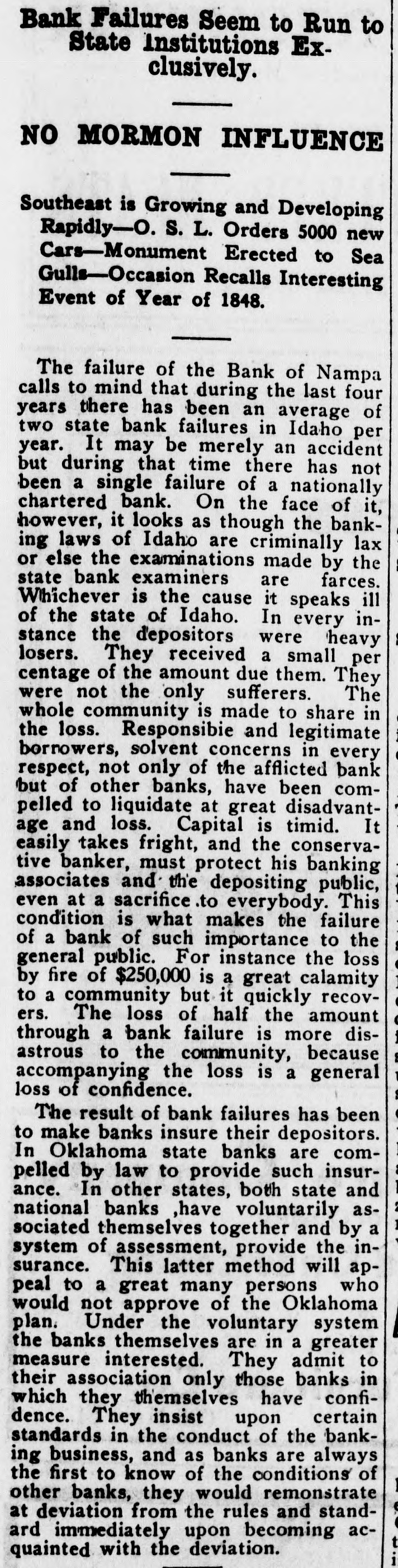
# Bank Failures Seem to Run to State Institutions Exclusively. # NO MORMON INFLUENCE Southeast is Growing and Developing Rapidly-O. S. L. Orders 5000 new Cars-Monument Erected to Sea Gulls-Occasion Recalls Interesting Event of Year of 1848. The failure of the Bank of Nampa calls to mind that during the last four years there has been an average of two state bank failures in Idaho per year. It may be merely an accident but during that time there has not been a single failure of a nationally chartered bank. On the face of it, however, it looks as though the bank-ing laws of Idaho are criminally lax or else the examinations made by the state bank examiners are farces. Whichever is the cause it speaks ill of the state of Idaho. In every instance the depositors were heavy losers. They received a small per-centage of the amount due them. They were not the only sufferers. The whole community is made to share in the loss. Responsibie and legitimate borrowers, solvent concerns in every respect, not only of the afflicted bank but of other banks, have been com-pelled to liquidate at great disadvant-age and loss. Capital is timid. It easily takes fright, and the conserva-tive banker, must protect his banking associates and the depositing public, even at a sacrifice to everybody. This condition is what makes the failure of a bank of such importance to the general public. For instance the loss by fire of $250,000 is a great calamity to a community but it quickly recov-ers. The loss of half the amount through a bank failure is more dis-astrous to the community, because accompanying the loss is a general loss of confidence. The result of bank failures has been to make banks insure their depositors. In Oklahoma state banks are com-pelled by law to provide such insur-ance. In other states, both state and national banks, have voluntarily as-sociated themselves together and by a system of assessment, provide the in-surance. This latter method will ap-peal to a great many persons who would not approve of the Oklahoma plan. Under the voluntary system the banks themselves are in a greater measure interested. They admit to their association only those banks in which they themselves have confi-dence. They insist upon certain standards in the conduct of the bank-ing business, and as banks are always the first to know of the conditions of other banks, they would remonstrate at deviation from the rules and stand-ard immediately upon becoming ac-quainted with the deviation.


Article from The Twin Falls Times, October 10, 1913

Click image to open full size in new tab

Article Text

STATE HAD DEPOSITS $45,000 State Money Tied Up in Defunct Nampa Bank. Developing an interesting situation with relations to state deposits in the Bank of Nampa, which suspended a week ago, the state of Idaho Saturday, through the action of Attorney General J. H. Peterson, brought suit against C. R. Hickey, William Strode and George Duval for the recovery of $40,000 on a bond given to secure state deposits amounting to $45,905,45, representing funds that State Treasurer O. V. Allen had placed on deposit in the bank prior to its failure. Messrs. Hickey, Strode and Duval are bondsmen or surety for the safety of the state's deposit. Judge Edwin Bryan of the district court for Canyon county ordered injunctions to issue out of that court directed to the defendants to restrain them from removing, encumbering or disposing of their property during the outcome of the pending suit. The state asks for judgment against C. R. Hickey and William Strode for the sum of $10,000 each and against George Duval for the sum of $20,000. It is recited in the complaint that State Treasurer Allen had deposited with the Bank of Nampa, a depository of part of the current funds in the state treasury in th sum of $45,500 and that on Sept. 30 of the present year there was and now is due Treasurer Allen from the defunct bank that sum together with interest thereon amounting to $405.45. On Sept. 30 State Treasurer Allen presented his check and demanded in writing on the bank for the state's money together with the interest and the bank failed, neglected and refused to cash it. On Sept. 28, 1912, the three defendants named are alleged to have executed to the state a bond in the sum of $40,000 as surety for the safety of the deposit in the bank and that in the event of default they would be liable. Failure and refusal on the part of the bank to pay the state treasurer's check resulted in the state starting suit against the bondsmen.-Pocatello 1, Tribune.


Article from The Idaho Republican, October 10, 1913

Click image to open full size in new tab

Article Text

STATE SUES NAMPA BANK. Developing an interesting situation with relation to state deposits in the Bank of Nampa, which suspended a week ago, the state of Idaho Saturday through the action of Attorney General Peterson. brough suit against C. R. Hickey, William Strode and George Duval for the recovery of $40,000 on a bond given to secure state deposits amounting to $45,905.45, representing funds that State Treasuer Allen had placed on deposit in the bank prior to its failure. Messers. Hickey, Strode and Duval are bondsmen or surety for the safety of the state's deposit. Judge Edwin Bryan of the district court for Canyon county ordered injuctions to issue out of that directed to the defendants to restrain them from removing, encumbering or disposing their property during the outcome of the pending suit. The state asks for judgement against C. R. Hickey and William Strode for the sum of $10,000 each and against George Duval for the sum of $20,000. Treasurer Allen had deposited with the Bank of Nampa, a depository of part of the current funds in the state treasury in the sum of $45,500 and that on September 30 of the present year there was and is now due Treasurer Allen from the defunct bank that sum together with interest thereon amounting to $405.45. On Sept. 30 State Treasurer Allen presented his check and demand in writing on the bank for the state's money together with the interest and the bank failed, neglected and refused to cash it. On Sept. 28, 1912, the three de-


Article from The Parma Herald, October 16, 1913

Click image to open full size in new tab

Article Text

of a signal announcing that the Panama Canal was officialy opened, all business ceased for one minute, while sirens, locomotive whistles, bells and automobile horns proclaimed the fact that the canal is now a reality. The following telegram was sent by the Commercial club to President Woodrow Wilson: "Congratulations. Opening of Panama canal gives all-American water route from Lewiston, Idaho, to ports of the United States via Columbia-Celilo cenal." Lewiston - Fred Forsman arrived recently from Pierce City with samples of rich ore from a ledge he recently discovered on Slaughter House Gulch. The ledge, as exposed, shows a width of 18tinches and the ore contains gold visible to the naked eye. W. P. Bounds reports that a stampede is in progress to the Pot Mountain district of the Upper North Fork country, where copper ground is to be located. A rumor that the Northern Pacific is to build though the North Fork country has revived interest in the properties. Boise-The state of Idaho, through Attorney General Peterson, has instituted suit against the Bank of Nampa, suspended, C. R. Hickey, William Strode and George Duval, bondsmen, as security for $45,500 of the state's money on deposit in the bank when it failed on September 27, asking that the bondsmen be forced to reimburse the state treasury. Judge Bryan, of the Canyon County District Court, issued an injunction on the application of the state, directed against the bondsmen, enjoining them from selling, transferring, disposing of or encumbering any of their property. Boise-Local option elections will be held in two counties in this state this fall, one in Bannock county, now "dry," but to which the "wets" are determined to give back the saloon, and the other in Kootenai county, where the "drys" are seeking to turn the county back into the "dry" column. The county is "wet," having so voted at the election two years ago. The anti-Saloon league headquarters in this city is in charge of the campaigns that are being made by the "drys" in both counties. It is said here that the Bannock county election will result in that county remaining "dry" and the Kootenai county election may not change the conditions in that county. Lewiston-A whirlwind campaign to close up the subscriptions for the promotion and publicity work of the Lewiston Commercial club for the coming year was inaugurated by the finance committee of the club, as the result of an enthusiastic meeting of the committee Friday. The aim of the club will be to secure TO $5000 for the club's publicity work, which will be in addition to the regular membership dues, approximately about $2500. The entire funds will be handled by the Commercial club, and the general club work and the promotion and development work of the Idaho-Washington Development league will be taken care of therefrom without duplication of effort or expenses. At the committee meeting it developed that approximately $1500 has been subscribed. I Lewiston-Mayor Morris, of Lewiston, drove the spike for the first rail on the construction of the Nez Perce & Idaho Railroad company's extension t. from Lewiston to Vollmer. The spikedriving ceremony was watched by 300 a persons. Addresses were made by President Osmers and Secretary Strua tl ble, of the Lewiston Commercial club; C. H. McDonald, representing the E builders of the road; Major Fred R. Reed, Idaho immigration commissionle er, and J. C. Jansen, of Waha, repreto senting the farmers of Waha and Tammany, who have united with Mr. Johnbe in the railroad enterprise. di Steel is on the ground for the first a o 14 miles of the line and grading is ready for the track several miles out of Lewiston. The farmers announced of that within a short time their teams 8 would be put on the work to render voluntary service. The route of the tl line is by way of Tammany, Waha and c Craig Mountain to Vollmer, a distance ** of 60 miles. The road has purchased extensive terminal grounds on the fo Snake River water front in Lewiston 11 R for the purpose of connecting with open-river boats plying to Portland when the Celilo canal is finished. h Immigration Commissioner Reed W said in his address that the new road B was going in the right direction and b that he felt it would ulitmately solve 12 Idaho's pressing need-a north and f outh railroad wholly within the conines of the state. S Mr. Johnson took up the constructl tion of the extension about a year ago u and the project reached such a point is to insure the completion of the line "


Article from The Idaho Republican, October 17, 1913

Click image to open full size in new tab

Article Text

THE NAMPA BANK FAILURE Stockholders and Depositors Finally Agree on Smallwood as Receiver A receiver has been appointed for the Bank of Nampa, owned by Dr. Givens and his two sons and others. The reports of the condition of the affairs of the bank are not any better than at first, and some features are a disappointment. The state had money loaned or deposited with them, for which the state held security bonds. A few months ago one of the surety companies withdrew on account of the condition of the bank, and three individuals executed bonds in its place, amounting to some $60,000. Now it develops that one of these surities was owing the bank $19,000, and is about bankrupt on other accounts. The other two surities were, also ;borrowing heavily from the bank at the time of giving the surety bonds, and are still owing it. Under these circumstances it does not appear that the state will be able to realize very readily if at all from them.


Article from Shoshone Journal, October 24, 1913

Click image to open full size in new tab

Article Text

# SAFE BANKING. The failure of the Bank of Nampa calls to mind that during the last four years there has been an average of two state bank failures in Idaho per year. It may be merely an accident but during that time there has not been a single failure of a nationally chartered bank. On the face of it, however, it looks as though the banking laws of Idaho are criminally lax or else the examinations made by the state bank examiners are farces. Whichever is the cause it speaks ill of the state of Idaho. In every instance the depositors were heavy losers. They received a small percentage of the amount due them. They were not the only suffers. The whole community is made to share in the loss. Responsible and legitimate borrowers, solvent concerns in every respect, not only of the afflicted bank but of other banks, have been compelled to liquidate at great disadvantage and loss. Capital is timid. It easily takes fright, and the conservative banker, must protect his banking associates and the depositing public, even at a sacrifice to everybody. This condition is what makes the failure of a bank of such importance to the general public. For instance the loss by fire of $250,000 is a great calamity to a community but it quickly recovers. The loss of half the amount through a bank failure is more disastrous to the community, because accompanying the loss is a general loss of confidence. The result of bank failures has been to make banks insure their depositors. In Oklahoma state banks are compelled by law to provide such insurance. In other states, both state and national banks, have voluntarily associated themselves together and by a system of assessment, provide the in-


Article from The Salt Lake Tribune, November 7, 1913

Click image to open full size in new tab

Article Text

ECHO OF FAILURE OF IDAHO BANK Special to The Tribune. CALDWELL, Idaho, Nov. 6.-An echo of the recent failure of the Bank of Nampa was heard today when the bondsmen obligated to the state for deposits of state funds in the defunct institution petitioned the district court here for relief. The petitioners claim that the state funds were Illegally deposited for the reason that the amount deposited was considerably over the sum the bank is entitled to under the law which instructs the state treasurer to divide the money pro rata among the banks designated as state depositories. The bondsmen, Messrs. Duval, Strode and Hickey, ask that the $45,000 due the state, for which they are liable, be declared a preferred claim and the receiver be instructed by the court to pay the same out of the first money available


Article from The Caldwell Tribune, November 14, 1913

Click image to open full size in new tab

Article Text

PERTINENT NEWS OF STATE WITH OUR OWN COMMENT Depositors of Nampa Bank Organize Protective Association. BANK REALTY TAXABLE Gooding Replies to Senator BradySays he Will Tell Truth-Press Favors Pardon of Barney O'Neil_ Scarcity of Cars is due to Fight Among Railroads over Traffic. The depositors of the Bank of Nampa have organized the Protective Association of the Depositors of the Bank of Nampa. As the name indicates the association is organized for the purpose of protecting the interests of the depositors of the bank. The association has appointed an executive committee consisting of M. N. Baker, chairman; W. C. Frazier, secretary-treasurer; and L. Foster. It thas also levied an assessment of onehalf of one per cent of the deposits in the bank on all depositors in order to defray the expenses of the association. The first matter that will claim the attention of the association will be the petition filed in the district court asking that the state's claim of $45,500 be declared a preferred claim and paid out of the first money coming to the receiver of the bank. In case this is done the depositors will receive no portion of this $45,500 and they will lose to that extent. Of course the depositors do not want the settlement of the affairs of the bank to take ly. this course and they will fight it bitterAt the present time there is no way of telling what the depositors of the bank will realize. Receiver Smallwood is doing all in his power to straighten out the affairs of the bank. It will be some time however before he will be able to pay dividends. The action of State Treasurer Allen in depositing state funds illegally, beyond the amount authorized by the bonds, is meeting with criticism. This crtiticism is all the more bitter because of the rumor that the state treasurer had borrowed money at the bank. If it proves true that the state treasurer was a heavy debtor to this bank it indicates a bad condition of affairs. In the seven or eight state bank failures which have occurred in Idaho during the past few years a state officer has been a borrower in every one of them. Realty Exemptions are Limited. Bank real estate exemptions from taxes are limited according to an opinion recently given by Attorney General Peterson. In replying to W. H. Wyatt, assessor of Nez Perce county, Attorney General Peterson says that the only safe and legal rule for assessors to follow in assessing bank stock is to assess it at its full cash value and to deduct as an exemption the value of such real estate as is used for a banking house, or such real estate as a bank would purchase for a building site to be used in the future, such exemptions however, are not to exceed 50% of the total capital stock and surplus of said bank. He continues: "While banks, of course, are authorized to realize upon their securities, and to acquire real estate in this manner, yet they can only hold it for a limited time, and the law does not contemplate the investment of the bank funds of capital stock in real estate as a part of the banking business, but limits the amount of real estate that may be purchased by the bank to 50% of its capital stock and surplus, and that purchase would be for the use of the banking house. This would include, however, a building in which portions of it could be rented as a source of income for the bank. "The fact that a bank acquires real estate in payment of a debt or fore. closure of a mortgage will be almost conclusive evidence that it was secur ed by depositors' money because a a general rule the deposits of a bank are always much in excess of the capi tal stock of a bank, and the deposits of a bank are used in making loans and it would be practically impossible for a bank to show how its capital stock is invested in such real estate so acquired, so that there can arise no conditions upon which the latter par of section 173 can apply, and such leg islation becomes meaningless when ditions.' attempted to be applied to actual con Gooding Replies to Brady. Governor Gooding has no intention of being diverted from his purpose t show up political conditions in th State of Idaho and in the Republica party. Senator Brady gave out an in terview, the principal part of which appeared in the last issue of The Tri bune, deploring the fact that M Gooding was entering upon a "mu alinging campaign. The Senato stated that he would not engage such methods. As The Tribune pub lished the announcement of Governo Gooding and the statement of Senato


Article from The Blackfoot Optimist, February 5, 1914

Click image to open full size in new tab

Article Text

J. A. GIVENS ARRESTED Caldwell, Feb. 2.-J. A. Givens, who was vice president of the Bank of Nampa at the time it was closed by the state bank examiner, is under arrest at La Grande and is being held for the Idaho authorities for alleged irregularities in connection with that bank. A warrant is also out for the arrest of Cashier Lore of the same institution who is believed to be in California. Ever since the failure of the bank became known there have been rumor of irregularities and of the pending arrest of some of the officers of the institution, who disappeared immediately after the bank closed its doors.


Article from Evening Capital News, June 11, 1914

Click image to open full size in new tab

Article Text

RECEIVER OF BANK IS CALLED AS WITNESS (Capital News Special Service.) Caldwell, June 11.-The testimony of Edward Hayes in the trial of J. A. Givens and Charles Lore, president and cashier of the Bank of Nampa, was largely a repetition of that given by Walter Bruce and did not go behind the general ledger, the tellers' cage books and the vault cash book in comparison of the report on which the case is based. His testimony was in greater detail than that given by Mr. Bruce. He testified that the difference between the report and the books might be accounted for in the system of classification of books. He was under cross-examination at the night session last night and again this morning. D. Smallwood, receiver of the bank, was called as a witness this morning. He told of the alleged bad accounts and bad paper on hand at the time he took charge of the affairs of the institution. Some of the notes classed as bad, he said, were not yet due and others were secured by property which has deteriorated in value since the mortgages were given


Article from The Emmett Index, October 15, 1914

Click image to open full size in new tab

Article Text

Progressives Hold Meeting Clarence VanDeusen and Will Monk were the speakers at a Progressive party meeting held here Monday night. About 100 men were present VanDeusen, though making some rash statements, makes an interesting talk. A number in the audience are familiar with the value of the M. E. Lewis land here and the Jenness land in Long Valley, and deny that excessive loans have been made on them, VanDeusen to the contrary notwithstanding. In regard to his charge that State Treasurer Allen owed the Bank of Nampa when it failed, Receiver Smallwood says it is untrue. Van Deusen seems to be very unreliable in his statements. Monk puts up a poor talk. His remarks and his actions are so pregnated with ill-will and spite against Sheriff Breshears and Clerk Stovel, as to reveal his motives and carry little O no weight with the thinking voter.


Article from The Nezperce Herald, January 7, 1915

Click image to open full size in new tab

Article Text

RAMSTEDT TELLS OF TREASURY LOOTING Report on Shortages Found at Boise Made Part of Governor's Message Sensational Results. Boise, Idaho, Jan. 5.-By inserting in his message to the legislature, at the last moment and just before reading it, the Ramstedt report on the state treasury affair, Governor Alexander sp.ung a genuine sensation here today. The govern r read his message in person in the hall of the house of representatives before the joint assembly. The Ramstedt report on the treasury department was made to Governor Haines December 4 by Tax Commissioner Axel P. Ramstedt. It was withheld from publication, but more than a week later turned over to the prosecuting attorney for consideration by a grand jury. Immediately on taking office Governor Alexander demanded a copy of the report. Attorney General J. H. Peterson and State Auditor Fred L. Huston are named in the report as two state officials to whom money was ad. vanced by O. V. Allen defaulting treasurer, out of the public funds. Former Pure Food Commissioner James H. Wallis is named as being a state official who secured from Allen an advance of $200, the advance being made on an order for a salary warrant for that amount which, it is said, was never issued. The other I. O. U's carried as cash items by the embezzling treasurer, according to the report, were as follows: g R. W. Wark, $75, $209, and $120 D. W. Robb $1.10; Henry Spieler, $30 ; Guy McKinley, $6; Fred M. Coleman, former deputy treasurer, $22,000; O. V. Allen, $70,304; Wark, Robb and McKinley were at different times employes in the state S auditor's office. Allen's shortage of the amount th named was covered by an undated check drawn on the Idaho Trust and la Savings bank of Boise, and carried as cash. In his report Ramstedt alleges that this item is made up of five separate items showing amounts of money Allen took from public funds and advanced to himself and d four others. These five items are given as follows: ta Allen, $37,334; H. F. Allen, a st brother of the former treasurer, now en a resident of Twin Falls $26,500; th Peterson, attorney general, $660 th Huston, state audttor, $350; J.J. Long, at one time connected with the so American National bank at Caldwell, Sp $550. The report shows Allen had defo posited in the Bank of Nampa, at Nampa, when it failed, $24.352, A re demand was made for its payment. qu The receiver of the bank disputed di the state's claim, but Attorney GenCO eral Peterson is said to have effected at settlement of it. Ramstedt says $5 that if the state does not move rap-


Article from American Falls Press, January 14, 1915

Click image to open full size in new tab

Article Text

Depositors, Receiver Smallwood and Judge Bryan of the Seventh judicial district agreed that such a settlement as was made by the state was the proper thing in the case of the defunct Bank of Nampa, according to the report of the matter submitted by attorney general Peterson to Governor Alexander Monday. Furthermore the state will not lose anything in the opinion of the attorney general who asserts that, according to information he has received, the account will be settied in full during this coming year. In his report to the governor the attorney general asserts that he regards it as unfortunate that the Ramstedt report should have mentioned the case when, according to the attorney seneral, there was insufficient data on which to base such an assertion.


Article from Lincoln County Times, January 21, 1915

Click image to open full size in new tab

Article Text

# URGES ABOLITION OF IDAHO SENATE MAJORITY FLOOR LEADER OF HOUSE PROPOSES RADICAL CHANGE IN LEGISLATURE. Introduces Proposed Constitutional Amendment Which Seeks to Abolish Senate and Reduce House to Twenty-four Members. A radical change in the legislative system of Idaho was proposed in the house of representatives of the legislature of this state, in session here, on January 16, with the introduction of a proposed constitutional amendment which seeks to abolish the senate and reduce the house to twenty-four salaried members, thereby cutting down the present legislature just seventy members. The amendment was introduced by Representatives Johnston and Koelsch, majority floor leader and "whip," respectively. If passed it will divide the state into twelve districts composed of contiguous counties divided equally as to population and each entitled to two representatives. The plan is better known as the "one-house" legislature. The opening of the legislatve probe into state departments and transactions of state officials, the filing of Expert Gleason's first report showing how the state lost money in the handling of the public building endowment fund; the passage, with practically no opposition, of the Boundary, Benewah and Teton county creation bills in the house, and the attack made on the public utilities commission followed in close succession as the features of Friday's legislative programme. Boundary county is to be the north half of Bonner; Benewah county, part of old Kootenai; Teton, the east half of Madison. The first two named passed the house unanimously; the third had only two votes registered against it. Edelblute spoke against Benewah, but voted for it. The three bills went to the senate. Attorney General Peterson, State Treasurer Eagleson, Receiver Smallwood and E. H. Dewey appeared bebore the committee and testified with regard to state moneys in the Bank of Nampa, at Nampa, Idaho, at the time of the failure of the institution. The testimony summarized was to the effect that after the bank failed the state instituted suit to recover against the bank as principal, and the personal sureties, C. R. Hickey in the sum of $10.000, W. S. Strode in the sum of $20.000. As the personal bondsmen owed the bank, a compromise agreement was reached by the attorney general by which the bank released them from their obligations to it and the state then sought to recover from them in payment for its deposit. Their personal property was seized and Krull appointed as trustee to administer and collect on it for the state. Up to the present time the state has not recovered the full amount of its deposit. Senator Thomas of Bingham county attacked the utility commission by introducing a bill to remove from its power the right to regulate competition between public utilities, seeking to repeal section 48 of the act. The first report of Expert Gleason, probing into the affairs of state accounts and funds, was filed with Governor Alexander. It deals exclusively with the public building endowment fund, showing that a total of $83,509.61 has been misplaced from this fund, itemized as follows: Seventy-five thousand dollars lost by disposing of $750,000 capitol building bonds, sold at 4ยฝ per cent when they could have been sold at 4 per cent; $2,982.76 in overpayments to contractors and supply companies, and $5,526.85 taken from the trust fund and used for maintenance of the capitol, for which the last legislature specifically appropriated $50,000. Senator Kaline of Lewis county introduced a community property law amendment providing that community property can pass to a survivor to the exclusion of collateral heirs. Senator Rockwell of Blaine introduced an act to consolidate the insurance department with the banking department. Representatives Munsinger of Minidoka fathered a nepotism act making it a crime for a state official to appoint a relative in his office. The state affairs committee, of which Senator John Hart is chairman, has introduced a bill seeking to strengthen the present local option law, and which, if passed, will close every brewery operating in a dry county in the state. The introduction of the measure is creating unusual discussion. It is believed to be the first step taken to put through the present legislature not only a constitutional prohibition amendment, but a state-wide prohibtion act. As a companion to the bill was a report on the constitutional amendment introduced by Hart, offering an amendment to change the date. The amendment, if passed, will become effective from July 1, 1915, to May 1, 1917. The house was put on a working basis on Tuesday when Speaker Conner announced the permanent standing committees. Aside from the introduction of twelve new bills, the house did little. The senate held short sessions in the morning and afternoon. Teton county, the new unit to be added to southeastern Idaho from territory taken from Madison county, with Griggs as the county seat, was moved up to third reading in the house of representatives of the legislature on Thursday and will pass that assembly, thereby winning half its fight for existence. Clark of Fremont county introduced a bill relating to sheep grazing on cattle ranges. Woodward of Franklin county fathers an act to establish


Article from The Meridian Times, January 22, 1915

Click image to open full size in new tab

Article Text

# URGES ABOLITION OF IDAHO SENATE MAJORITY FLOOR LEADER OF HOUSE PROPOSES RADICAL CHANGE IN LEGISLATURE. Introduces Proposed Constitutional Amendment Which Seeks to Abolish Senate and Reduce House to Twenty-four Members. A radical change in the legislative system of Idaho was proposed in the house of representatives of the legislature of this state, in session here, on January 16, with the introduction of a proposed constitutional amendment which seeks to abolish the senate and reduce the house to twenty-four salaried members, thereby cutting down the present legislature just seventy members. The amendment was introduced by Representatives Johnston and Kovlach, majority floor leader and "whip," respectively. If passed it will divide the state into twelve districts composed of contiguous counties divided equally as to population and each entitled to two representatives. The plan is better known as the "one-house" legislature. The opening of the legislative probe into state departments and transactions of state officials, the filing of Expert Gleason's first report showing how the state lost money in the handling of the public building endowment fund; the passage, with practically no opposition, of the Boundary, Benewah and Teton county creation bills in the house, and the attack made on the public utilities commission followed in close succession as the features of Friday's legislative programme. Boundary county is to be the north half of Bonner; Benewah county, part of old Kootenal; Teton, the east half of Madison. The first two named passed the house unanimously; the third had only two votes registered against it. Edelblute spoke against Benewah, but voted for it. The three bills went to the senate. Attorney General Peterson, State Treasurer Eagleson, Receiver Smallwood and E. H. Dewey appeared before the committee and testified with regard to state moneys in the Bank of Nampa, at Nampa, Idaho, at the time of the failure of the institution. The testimony summarized was to the effect that after the bank failed the state instituted suit to recover against the bank as principal, and the personal sureties, C. R. Hickey in the sum of $10,000, W. S. Strode in the sum of $20,000. As the personal bondsmen owed the bank, a compromise agreement was reached by the attorney general by which the bank released them from their obligations to it and the state then sought to recover from them in payment for its deposit. Their personal property was seized and Kruil appointed as trustee to administer and collect on it for the state. Up to the present time the state has not recovered the full amount of its deposit. Senator Thomas of Bingham county attacked the utility commission by introducing a bill to remove from its power the right to regulate competition between public utilities, seeking to repeal section 48 of the act. The first report of Expert Gleason, probing into the affairs of state accounts and funds, was filed with Governor Alexander. It deals exclusively with the public building endowment fund, showing that a total of $83,509.61 has been misplaced from this fund, itemized as follows: Seventy-five thousand dollars lost by disposing of $750,000 capitol building bonds, sold at 4ยฝ per cent when they could have been sold at 4 per cent; $2,982.76 in overpayments to contractors and supply companies, and $5,526.85 taken from the trust fund and used for maintenance of the capitol, for which in the last legislature spec-ially appropriated $50,000. Senator Kaline of Lewis county introduced a community property law amendment providing that community property can pass to a survivor to the exclusion of collateral heirs. Senator Rockwell of Blaine introduced an act to consolidate the insurance department with the banking department. Representatives Munsinger of Minidoka fathered a nepotism act making it a crime for a state official to appoint a relative in his office. The state affairs committee, of which Senator John Hart is chairman, has introduced a bill seeking to strengthen the present local option law, and which, if passed, will close every brewery operating in a dry county in the state. The introduction of the measure is creating unusual discussion. It is believed to be the first step taken to put through the present legislature not only a constitutional prohibition amendment, but a state-wide prohibtion act. As a companion to the bill was a report on the constitutional amendment introduced by Hart, offering an amendment to change the date. The amendment, if passed, will become effective from July 1, 1915, to May 1, 1917. The house was put on a working basis on Tuesday when Speaker Conner announced the permanent standing committees. Aside from the introduction of twelve new bills, the house did little. The senate held short sessions in the morning and afternoon. Teton county, the new unit to be added to southeastern Idaho from territory taken from Madison county, with Griggs as the county seat, was moved up to third reading in the house of representatives of the legislature on Thursday and will pass that assembly, thereby winning half its fight for existence.
Article from Montpelier Examiner, January 22, 1915

Click image to open full size in new tab

Article Text

ROAD COMMISSION CENTER OF ATTACK P. BILL INTRODUCED IN IDAHO LEGISLATURE TO ABOLISH HIGHWAY COMMISSION. A Peace in Memorial Meets Painless Death Teton Senate, While House Passes County Bill and Act Regarding Strays. m attacked The state highway commission le islature, on January 19 in the was S Ish the and a bill introduced to leg. 0 feature commission entirely abolta gramme. event of the legislative was the G tor It was introduced by prog Hutton, Democrat, of Shoshone, Sena. c Senator Grant, Republican, arwater. By abolishing the commis- of of sion they seek to place disbursement motor-license funds in the hands of county commissioners. t d little The senate, quietly and with rest parliamentary ceremony, laid some against the peace memorial, protesting at by the an increase in appropriation poses, United States for military cure and urging this country to purties, by a cessation of European hostili- seSenator indefinitely postponing it. Bowman, Socialist, introduced it. It The house was in session two hours. which again passed the Teton county ate; had been amended in the bill, animals passed an act permitting estray sento on the range without brands be taken possession of, and passed peace an act depriving justices of also of authority to take acknowl- the edgments. Clark A bill was introduced of of Custer to abolish the office by water commissioner. Governor Moses Alexander on January 19 called upon members of capitol duct building commission to the an investigation into the misap- conpropriations of pointed out in the who W. is H. Gleason, expert accountant, report examining state departments. Gleason the reported overpayments out to public building endowment fund of also contractors and supply houses, and taken reported that $5,526.85 had been itol from the fund and used for cap. maintenance. The governor has called for the resignations of all members of the state live stock sanitary board, because board of his desire to organize the along lines of economy and efficiency. The board members Henry Thiessen, Sweetwater; Clay are burg. Vance, Dickey, and R. S. Hunt, RexThe legislative investigating committee on January 19 completed its loan probe into the $45,000 state treasury on personal securities to the Bank of Nampa, now defunct. Former Governor Haines was on the stand, together with Earnest Noble, executor of the Noble estate, and John D. Robertson of the tax commission. Their testimony went to show that the state's security, so far as the personal bondsmen are concerned, did not justify the loan. Representatives Koelsch, Shattuck and Faris are the three members of the committee to draft its findings. A radical change in the legislative system house of Idaho was proposed in the of representatives of the legis. lature of this state, in session here, January 16, with the introduction on of a proposed constitutional amendment which seeks to abolish the senate and reduce the house to twenty-four salaried the members, thereby cutting down present legislature just seventy members. The amendment was and troduced by Representatives Johnston inand Koelsch, majority floor leader it "whip," respectively. If passed will divide the state into twelve districts composed of contiguous counties divided equally as to population and each entitled to two representatives. The plan is better known as the "one-house" legislature. Attention of the members has been called to by the committee on reference their carelessness in the drawing of bills. One of the house rules requires that when an amendatory is introduced the amendatory words act must be underscored. It is expected that the state treasury will be the first department probed by the legislative committee. On the list of witnesses to be subpoenaed it is understood will appear the names of Attorney General Peterson, State Treasurer Eagleson and former State Treasurer Dewey. State Senator Mendenhall comes to the legislature from Bannock county as a Republican for the second time, having served in the Twelfth session in the house of representatives. He was born at Dayton, Oneida county, Idaho, November 21, 1873. Senator Graham of Ada has introduced a bill proposing the elimina tion of the 4 per cent penalty now inflicted on those who pay only hal of their taxes in January. His bil would also reduce the rate of interest charged on delinquent taxes from 18 per cent a year to 12 per cent. The bill introduced in the house to appropriate twenty-five upper hun dred dollars for payment of W. H Gleason, the expert who is auditing the books of the state, was passed rules. by the houe under suspension of the Teton county, the new unit to be added to southeastern Idaho from ter ritory taken from Madison county with Griggs as the county seat, wa (moved up to third reading in th house of representatives of the legis it lature on Thursday and will pass tha assembly, thereby winning half light for existence. Clark of Fremont county intro duced a bill relating to sheep grazin on cattle ranges. Woodward of Fran) lin county fathers an act to establis a fish hatchery on Cub river, Fran] lin county. The state affairs committee of th senate outlined the Republican admin on policy with reference to pul ads through the introduction doint resolutions to amend Litution. Under the constitutio th of school land is limited annum. The first re


Article from The Caldwell Tribune, September 17, 1915

Click image to open full size in new tab

Article Text

District Court Filings. District court filings on Saturday included a suit by J. A. Dement vs. John L. Hollingshead, et al., to quiet title to a piece of property in this city. The only other action started was that the First National Bank of Nampa against James E. Hart, E1mira Hart, E. Smallwood as receiver of the Bank of Nampa, and Alexander Bills. The bank seeks to foreclose on a mortgage held against the Harts for $2285.49. The other parties are included in the title by reason of their having claims against the first named defendants.


Article from Evening Capital News, May 5, 1916

Click image to open full size in new tab

Article Text

morning. Both attended the funeral of their brother at Gooding yesterday, one of the largest ever held there. The supreme court heard argument today on the appeal in the case of C. W. Barrett versus the Northern Pacific Railway company, an action to recover on the shipment of a stock of drugs and drug store fixtures from Spokane to Rupert. The state livestock sanitary board opened its regular monthly session at the state veterinarian's department today with all members of the board present. A number of claims were inspected and audited. John W. Graham, a member of the public utilities commission, is mourning the loss of a dog-his pet canine which he had to have killed several days ago because it was attacked by rabies. An examination of the animal's brain by State Bacteriologist Laubaugh proved this suspicion to be correct. Fortunately the animal did not attack any of the members of the family. He was taken ill while tied up in the Graham home. Articles of incorporation were filed with the secretary of state by the Farmers' Hardware company of Kendrick. The capital stock is given as $5000. The incorporators are named as A. Hooker, H. E. Lien and W. M. McCrea, all of Kendrick. The state board of veterinary examiners met today at the state house and organized. Dr. W. S. Decker of Twin Falls was elected president and Dr. Roy Hurd of Payette secretary. The third member of the board is Dr. John D. Adams of Genesee. Governor Alexander today issued a proclamation suspending all state business from 10:30 o'clock next Wednesday until noon and calling upon all women as well as other citizens to meet the members of the suffrage special and representatives of the Women's Congressional union who will be in this city on that date. The governor holds in his proclamation that in view of the fact Idaho is one of the states which led in the adoption of woman suffrage, it is but fitting that some mark of esteem and testimony of approval should be accorded the women representing the union on their visit to Boise and Idaho. The reception will be held in the state house rotunda, commencing at 10:30 o'clock Wednesday morning. "Be Kind to Animal Week" is set aside in Idaho for from May 8 to 13, inclusive by proclamation issued by the governor today. This proclamation urges citizens to do some act or in some manner show a feeling of kindness and thoughtfulness for animals and birds, and to impress upon the children the manifest advantages from humane acts, thoughts and deeds. State Tax Agent Evans of the Oregon Short Line Railway company was in the city yesterday and called on officials at the state house. Owing to other engagements previously made Governor Alexander is unable to accept an invitation to go to Holbrook May 12 and deliver an address. Articles of incorporation were filed with the secretary of state today as follows: Capital Ditch company of Bonneville county. Capital stock, $6240. Incorporators, Gus Stonberg, Hugo Osterberg, C. R. Lundblade and Hjalmar Hamfelt. Fargo Holding company, of Pocatello. Capital stock, $100,000. Incorporators, Lyman Fargo, Clara B. Fargo and E. C. White. Service Garage, limited, of Rigby. Capital stock, $3000. Incorporators, W. E. Bills, F. A. Wishart and F. W. Hardesty. The Island Park Land & Cattle company, a Utah corporation, filed a designation naming Thomas Elliott of St. Anthony as its Idaho agent. The supreme court heard argument today on the application of the American Surety company to establish a preference claim against the Bank of Nampa, which failed. It seems the Nampa & Meridian Irrigation district had a deposit in the bank at the time it failed and the American Surety company was its surety. The surety company paid the irrigation district and on the grounds the deposit was a special one the surety company brought action to have it classed as preferred. Charles Hackney, editor of the Jordan Valley Express at Jordan Valley, is in the city today and paid his respects to officials at the statehouse. State Auditor Fred L. Huston went over to Weiser yesterday on business in connection with his office. Notary public appointments were announced at the governor's office as follows: F. W. Rush, Ashton, and D. M. Cathcart, a resident of Kootenai county. Owen Swift reported to the fish and