Franklin Institution For Savings (Providence, RI)

Episode Information

Episode UID
343351390896
Episode Type
Suspension โ†’ Closure
Bank Type
savings
Bank ID
34335139 hash
Start Date
August 19, 1874
Location
Providence, Rhode Island (41.824, -71.413)

Metadata

Model
gpt-5-mini (chosen from majority vote of a three-model LLM ensemble)
Short Digest
dc8b2a128920326a

Response Measures

None

Description

Bank was in receivership with depositors pursuing removal of the receiver; no run reported.

Events (2)

1. August 19, 1874 Receivership
Newspaper Excerpt
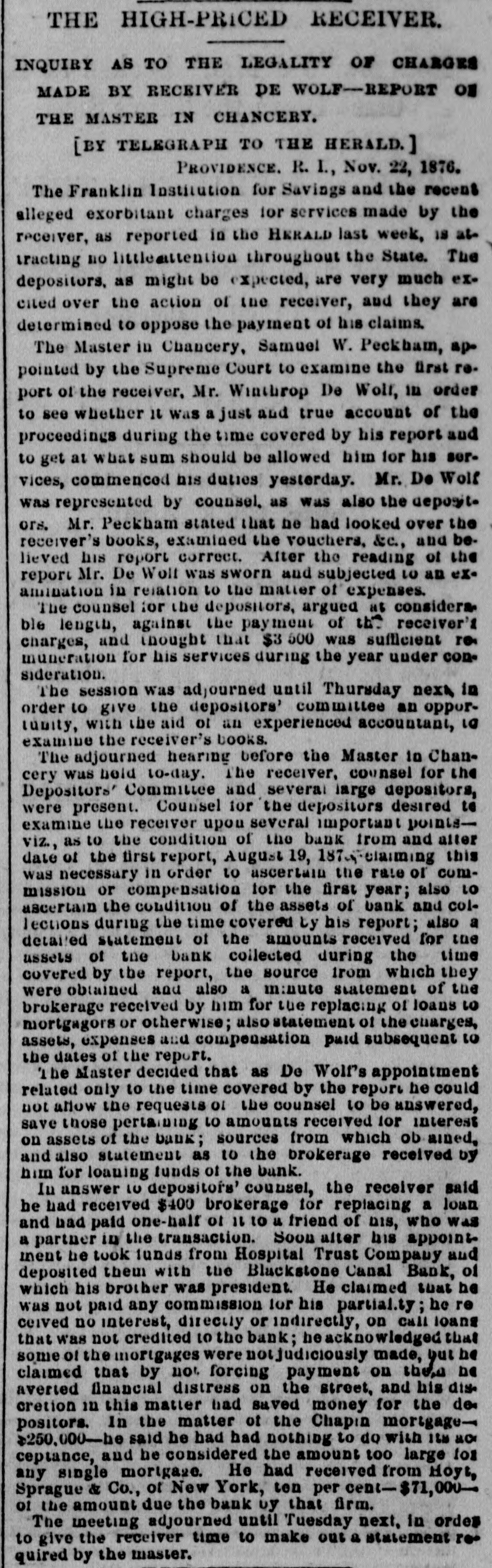
receiver of the Franklin Institution for Savings and the recent alleged exorbitant charges for services made by the receiver, Mr. Winthrop De Wolf
Source
newspapers
2. August 19, 1874 Suspension
Cause
Government Action
Cause Details
Bank placed in receivership (Winthrop DeWolf) and suspended operations; receivership proceedings and lawsuits (Sprague suits) followed
Newspaper Excerpt
the first report of the receiver of the Franklin Institution for Savings
Source
newspapers

Newspaper Articles (4)

Article from The New York Herald, November 24, 1876

Click image to open full size in new tab

Article Text

RECEIVER. THE HIGH-PRICED INQUIRY AS TO THE LEGALITY OF CHARGES MADE BY RECEIVER DE WOLF-REPORT ON THE MASTER IN CHANCERY. [BY TELEGRAPH TO THE HERALD. PROVIDENCE. R. I., Nov. 22, 1876. The Franklin Institution for Savings and the recent alleged exorbitant charges for services made by the receiver, as reported in the HERALD last week, IS as tracting no littleattention throughout the State. The depositors, as might be expected, are very much excited over the action of the receiver, and they are determined to oppose the payment of his claims. The Master in Chancery, Samuel W. Peckbam, ap. pointed by the Supreme Court to examine the first re. port of the receiver, Mr. Winthrop De Wolf, in order to see whether it was a just and true account or the proceedings during the time covered by his report and to get at what sum should be allowed him for his services, commenced his duties yesterday. Mr. De Wolf was represented by counsel. as was also the deposit. ors. Mr. Peckham stated that be had looked over the receiver's books, examined the vouchers, &c., and be. lieved his report correct. After the reading of the report Mr. De Woll was sworn and subjected 10 an ex. amination in relation to the matter of expenses. The counsel for the depositors, argued ab considera ble length, against the payment of the receiver't charges, and thought that 500 was sufficient re. muneration for his services during the year under con. sideration. The session was adjourned until Thursday nexa in order 10 give the depositors' committee an opportubity, with the aid of all experienced accountant, 10 examine the receiver's books. The adjourned hearing before the Master in Chancery was hold 10-day. The receiver, counsel for the Depositors' Committee and several large depositors, were present. Counsel for the depositors desired to examine the receiver upon several important pointsviz, as to the condition of the bank from and alter date of the first report, August 19, 87.4-elaiming this was necessary in order to ascertain the rate or commission or compensation for the first year; also LO ascertain the condition of the assets of bank and collections during the time covered by his report; also a detailed statement of the amounts received for the assets of the bank collected during the time covered by the report, the source from which they were obtained and also a minute statement of the brokerage received by him for the replacing of loans to mortgagors or otherwise; also statement of the charges, assets, expenses and compensation paid subsequent to the dates of the report. The Master decided that as De Wolf's appointment related only to the time covered by the report he could not allow the requests of the counsel to be answered, save those pertaining to amounts received for interest on assets of the bank; sources from which ob ained, and also statement as to the brokerage received by him for loaning funds of the bank. In answer 10 depositors' counsel, the receiver said he had received $400 brokerage for replacing a loan and had paid one-half of 11 to u friend of his, who was a partner in the transaction. Soon ulter his appointment be took funds from Hospital Trust Company and deposited them with the Blackstone Canal Bank, of which his brother was president. He claimed that he was not paid any commission for his partiality; he re ceived no interest, directly or indirectly, on Call loans that was not credited to the bank; he acknowledged that some of the mortgages were not judiciously made, but be claimed that by not forcing payment on the be averted financial distress on the street, and his dis. cretion in this matter had saved money for the de positors. In the matter ot the Chapin mortgage$250,000-be said he had had nothing to do with its ua ceptance, and be considered the amount too large for any single mortgaze. He had received from Hoyt, Sprague & Co., of New York, ten per cent-$71,000 of the amount due the bank by that firm. The meeting adjourned until Tuesday next, in order to give the receiver time to make out a statement re. quired by the master.
Article from The New York Herald, November 25, 1876

Click image to open full size in new tab

Article Text

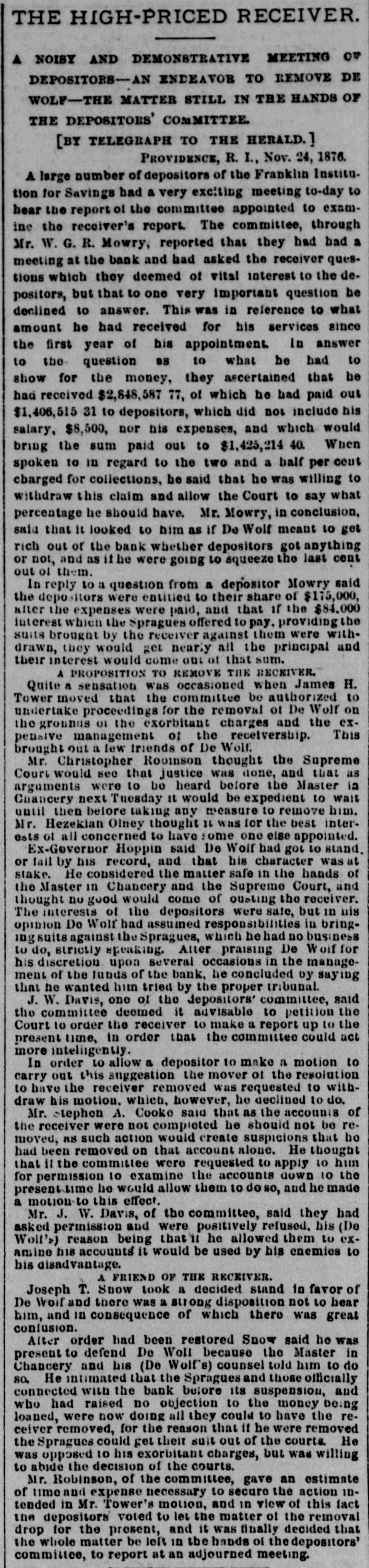
THE HIGH-PRICED RECEIVER. A NOISY AND DEMONSTRATIVE MEETING or DEPOSITORS-AN ENDEAVOR TO REMOVE DE WOLF-THE MATTER STILL IN THE HANDS OF THE DEPOSITORS' COMMITTEE. [BY TELEGRAPH TO THE HERALD. PROVIDENCE, R. I., Nov. 24, 1876. A large number of depositors of the Franklin Institution for Savings had a very exciting meeting to-day to hear the report of the committee appointed to examine the receiver's report. The committee, through Mr. W. G. R. Mowry, reported that they had bad a meeting at the bank and had asked the receiver questions which they deemed of vital interest to the depositors, but that to one very important question be declined to answer. This was in reference to what amount he had received for his services since the first year of his appointment In answer to the question as to what he had to show for the money, they ascertained that be had received $2,848,587 77, of which he had paid out $1,406,515 31 to depositors, which did DOL include his salary, $8,500, nor his expenses, and which would bring the sum paid out to $1,425,214 40. When spoken to in regard to the two and a balf per ceut cbarged for collections, he said that he was willing to withdraw this claim and allow the Court to say what percentage he should have. Mr. Mowry, in conclusion, said that it looked to him as if De Wolf meant to get rich out of the bank whether depositors got anything or not, and as it he were going to squeeze the last cent out of them. In reply to a question from a depositor Mowry said the depositors were entitled to their share of $175,000, alter the expenses were paid, and that if the $84,000 interest when the Spragues offered to pay. providing suits brought by the receiver against them were withdrawn, they would get nearly all the principal and their interest would come out of that sum. A PROPOSITION TO REMOVE THE RECEIVER. Quite a sensation was occasioned when James H. Tower moved that the committee be authorized to undertake proceedings for the removal of De Wolf on the grounus 01 the exorbitant charges and the expensive management of the receivership. This brought out a few friends of De Wolf. Mr. Christopher Roomson thought the Supreme Court would see that justice was done, and that as argaments were to be heard before the Master ia Chancery next Tuesday It would be expedient to wait until then before taking any measure to remove him. Mr. Hezekian Olney thought IL was for the best interests of all concerned to have some one else appointed. Ex-Governor Hoppin said De Wolf had got to stand. or fail by his record, and that his character was at stake. He considered the matter safe in the hands of the Master in Chancery and the Supreme Court, and thought no good would come of ousting the receiver. The interests of the depositors were sale, but in uis opinion Do Wolf had assumed responsibilities in bringingsuits against the Spragues, which hehad no business to do, strictly speaking. Alter praising De Woif for his discretion upon several occasions in the management of the funds of the bank, he concluded by saying that he wanted him tried by the proper tribunal. J. W. Davis, one of the depositors' committee, said the committee deemed it advisable to petition the Court to order the receiver to make a report up to the present time, in order that the committee could act more intelligently. In order to allow a depositor to make a motion to carry out this suggestion the mover of the resolution to have the receiver removed was requested to withdraw his motion. which. however, he declined to do. Mr. >tephen A. Cooke said that as the accounts of the receiver were not completed he should not be removed, as such action would create suspicions that he had been removed on that account alone. He thought that it the committee were requested to apply to him for permission to examine the accounts GOWD 10 the present-time he would allow them to doso, and he made a motion-to this effect. Mr. J. W. Davis, of the committee, said they had asked permission and were positively refused. his (De Wolt'>) reason being that he allowed them to examine his accounts it would be used by his enemies to his disadvantage. A FRIEND OF THE RECEIVER. Joseph T. Snow took a decided stand in favor of De Woif and there was a strong disposition not to hear him, and in consequence of which there was great confusion. Alter order had been restored Snow said he was present to defend De Woll because the Master in Chancery and his (De Wolf's) counsel told him to do so. He intimated that the Spragues and those officially connected with the bank before its suspension, and who had raised no objection to the money being loaned, were now doing all they could to have the receiver removed, for the reason that it he were removed the Spragues could get their suit out of the courts. He was opposed to his exorbitant charges, but was willing to abide the decision of the courts. Mr. Robinson, of the committee, gave an estimate of timeand expense necessary to secure the action intended in Mr. Tower's motion, and in view of this fact the depositors voted to let the matter of the removal drop for the present, and it was finally decided that the whole matter be left in the hands ol the depositors' committee, to report at an adjourned meeting.


Article from The New York Herald, December 3, 1876

Click image to open full size in new tab

Article Text

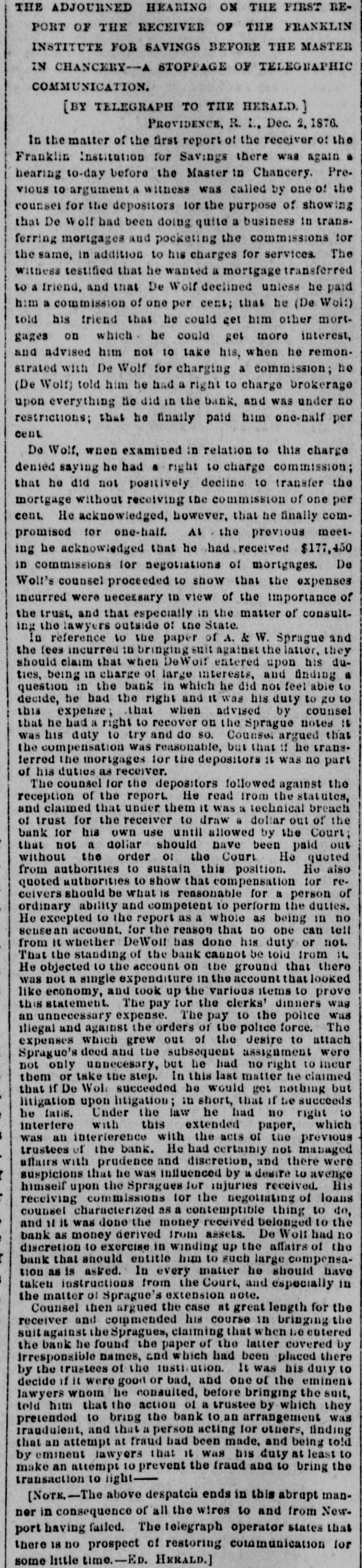
THE ADJOURNED HEARING ON THE FIRST REPORT OF THE RECEIVER OF THE FRANKLIN INSTITUTE FOR SAVINGS BEFORE THE MASTER IN CHANCERY--A STOPPAGE OF TELEGRAPHIC COMMUNICATION. BY TELEGRAPH TO THE HERALD. ] PROVIDENCE. R. i. Dec. 2. 1876. In the matter of the first report of the receiver of the Franklin Institution for Savings there was again hearing to-day before the Master in Chancery. Previous 10 argument a witness was called by one o! the counsel for the depositors for the purpose of showing that De wolf had been doing quite a business in trans. ferring mortgages and pocketing the commissions for the same, in addition to his charges for services. The witness testified that he wanted a mortgage transferred to a friend, and that De Wolf declined unless he paid h:m a commission of one per cent; that he (De Wol:) told his friend that he could get him other mort. gages on which he could get more interest, and advised him not 10 take his, when he remonstrated with De Wolf for charging a commission; he (De Wolf) told him he had a right to charge brokerage upon everything He did in the bank, and was under no restrictions; that he finally paid him one-nalf per cent Do Wolf, when examined in relation to this charge denied saying he had a right to charge commission; that he did not positively decline to transfer the mortgage without receiving the commission of one per cent. He acknowledged, however, that he finally compromised for one-half. AI the previous meet. ing he acknowledged that he had received $177,450 in commissions for negotiations of mortgages. De Wolt's counsel proceeded to show that the expenses incurred were necessary in view of the importance of the trust, and that especially in the matter of consult. ing the lawyers outside of the State In reference to the paper of A. & W. Sprague and the fees incurred in bringing suit against the latter, they should claim that when DeWolf entered upon his duties, being in charge of large interests, and finding a question in the bank in which he did not feel able to decide, he bad the right and it was his duty to go to this expense; that when advised by counsel that he had a right to recover on the Sprague notes it was his duty to try and do so. Counsel argued that the compensation was reasonable, but that If he trans. terred the mortgages for the depositors is was no part of his duties as receiver. The counsel for the depositors followed against the reception of the report. He read from the statutes, and claimed that under them it was a technical breach of trust for the receiver to draw a dollar out of the bank for his own use until allowed by the Court; that not a doliar should have been paid out without the order of the Court He quoted from authorities to sustain this position. He also quoted authorities to show that compensation for receivers should be what is reasonable for is person of ordinary ability and competent to perform the duties. He excepted to the report as a whole as being in no seusean account. !or the reason that DO one can tell from 11 whether DeWoll has done his duty or not. That the standing of the bank cannot be told from it He objected to the account on the ground that there was not a single expenditure in the account that looked like economy, and took up the various items to prove this statement. The pay for the clerks' dinners was an unnecessary expense. The pay to the police was illegal and against the orders of the police force. The expenses which grew out of the Jesire to attach Sprague's deed and the subsequent assignment were not only unnecesary, but he had no right to incur them or take the step. In this last matter he claimed that if De Woll succeeded he would get nothing but litigation upon litigation; in short, that if be succeeds he falls. Under the law he had no right to intertere with this extended paper, which was all interierence with the acts of the previous trustees of the bank. He had certainly not managed affairs with prudence and discretion, and there were suspicions that he was influenced by is desire to avenge himself upon the Spragues for injuries received. His receiving commissions for the negotiating of loans counsel characterized as a contemptible thing to do, and 11 it was done the money received belonged to the bank as money derived from assets. De Woll had no discretion to exercise in winding up the affairs of the bank that should entitle him to such large compensation as is asked. In every matter he should have taken instructions from the Court, and especially in the matter of Sprague's extension note. Counsel then argued the case at great length for the receiver and commended his course in bringing the suitagainst theSpragues, claiming that when be entered the bank he found the paper of the latter covered by Irresponsible names, and which had been placed there by the trustees of the institution. It was his duty to decide if 11 were good or bad, and one of the eminent lawyers whom he consulted, before bringing the suit, told him that the action of a trustee by which they pretended to bring the bank to an arrangement was fraudulent, and that a person acting for others, finding that an attempt at fraud had been made, and being told by eminent lawyers that it was his duty at least to make an attempt to prevent the fraud and to bring the transaction to light[Notk.-The above despatch ends in this abrupt mannor in consequence of all the wires to and from Newport having failed. The telegraph operator states that there 18 no prospect of restoring communication for some little time.-ED. HERALD.]


Article from The New York Herald, May 24, 1877

Click image to open full size in new tab

Article Text

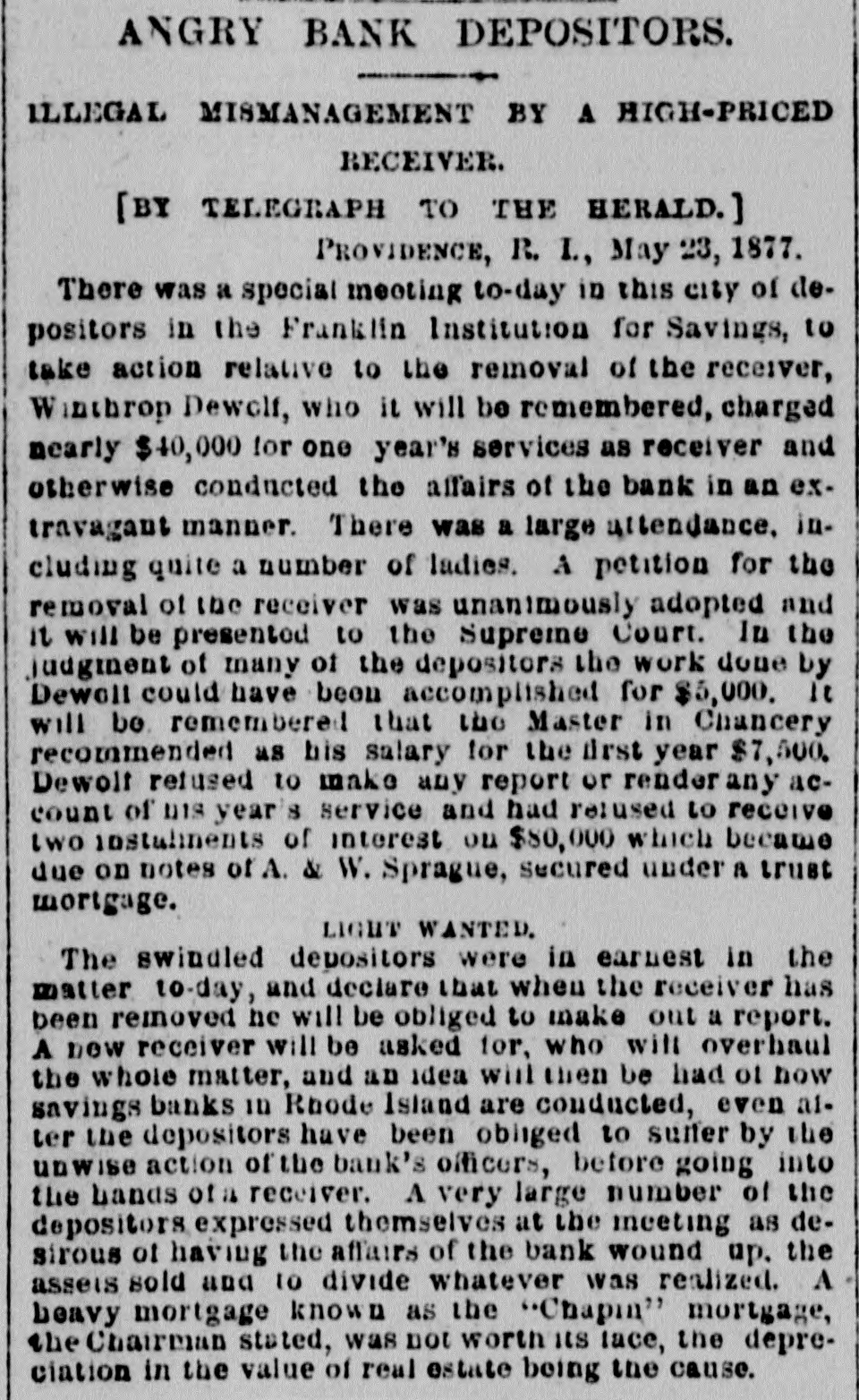
ANGRY BANK DEPOSITORS. ILLEGAL MISMANAGEMENT BY A HIGH-PRICED RECEIVER. [BY TELEGRAPH TO THE HERALD. ] PROVIDENCE, R. I., May 23, 1877. There was a special meeting to-day in this city of depositors in the Franklin Institution for Savings, to take action relative to the removal of the receiver, Winthrop Dewolf, who it will be remembered, charged nearly $40,000 for one year's services as receiver and otherwise conducted the affairs of the bank in an extravagant manner. There was a large attendance, including quite a number of ladies. A petition for the removal of the receiver was unanimously adopted and n will be presented to the Supreme Court. In the judgment of many of the depositors the work done by Dewoll could have been accomplished for $5,000. It will be remembered that the Master in Chancery recommended as his salary for the first year $7,500. Dewolf refused to make any report or render any account of us year's service and had relused to receive two instaliments of interest ou $80,000 which became due on notes of A. & W. Sprague, secured under a trust mortgage. LIGHT WANTED. The swindled depositors were in earnest in the matter 10-day, and declare that when the receiver has been removed he will be obliged to make out a report. A new receiver will be asked for, who will overhaul the whole matter, and an idea will then be had of how savings banks in Rhode Island are conducted, even alter the depositors have been obliged to sunfer by the unwise action of the bank's officers, before going into the hands of a receiver. A very large number of the depositors expressed themselves at the meeting as desirous of having the affairs of the bank wound up. the assets sold and to divide whatever was realized. A beavy mortgage known as the "Chapin" mortgage, the Chairman stated, was not worth its lace, the depreciation in the value of real estate being the cause.