Bank is the reorganized Jenkins Trust Co.; officers opted to liquidate and superintendent took charge.
Events (3)
1.April 15, 1908Reopening
Newspaper Excerpt
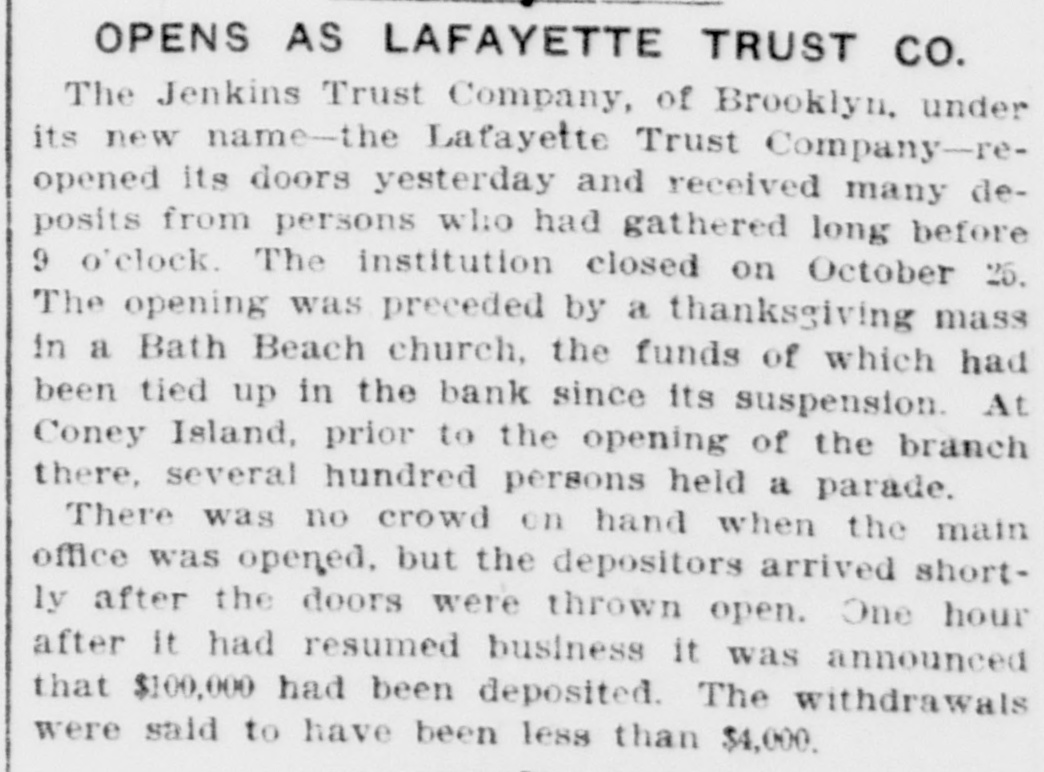
reopened its doors yesterday and received many deposits ... The institution closed on October 26.
Source
newspapers
+8 months
2.November 30, 1908Suspension
Cause
Voluntary Liquidation
Cause Details
Officers decided to permit the institution to go into liquidation after failing to obtain an increase in capital.
Newspaper Excerpt
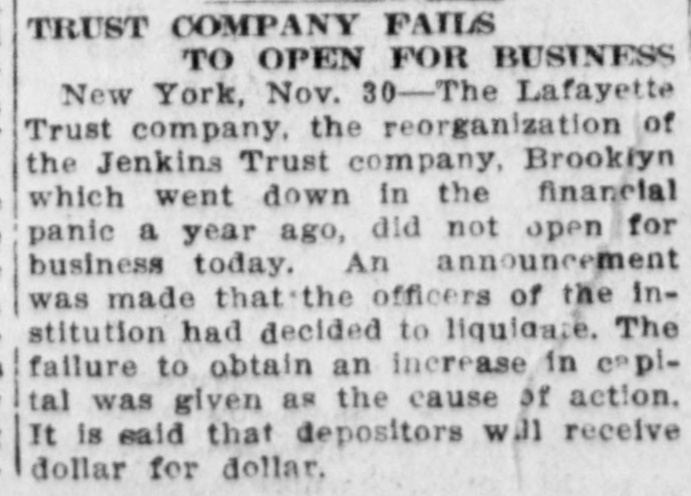
did not open for business today. An announcement was made that the officers of the institution had decided to liquidate.
Source
newspapers
same day
3.November 30, 1908Receivership
Newspaper Excerpt
The superintendent of banks took charge of the Trust company today.
Source
newspapers
Newspaper Articles (21)
1.April 16, 1908New-York TribuneNew York, NY
Click image to open full size in new tab
Article Text
OPENS AS LAFAYETTE TRUST CO
The Jenkins Trust Company, of Brooklyn, under its new name-the Lafayette Trust Company-reopened its doors yesterday and received many deposits from persons who had gathered long before 9 o'clock. The institution closed on October 26. The opening was preceded by a thanksgiving mass in a Bath Beach church, the funds of which had been tied up in the bank since its suspension. At Coney Island, prior to the opening of the branch there, several hundred persons held a parade. There was no crowd on hand when the main office was opened. but the depositors arrived shortly after the doors were thrown open. One hour after It had resumed business it was announced that $100,000 had been deposited. The withdrawals were said to have been less than $4,000.
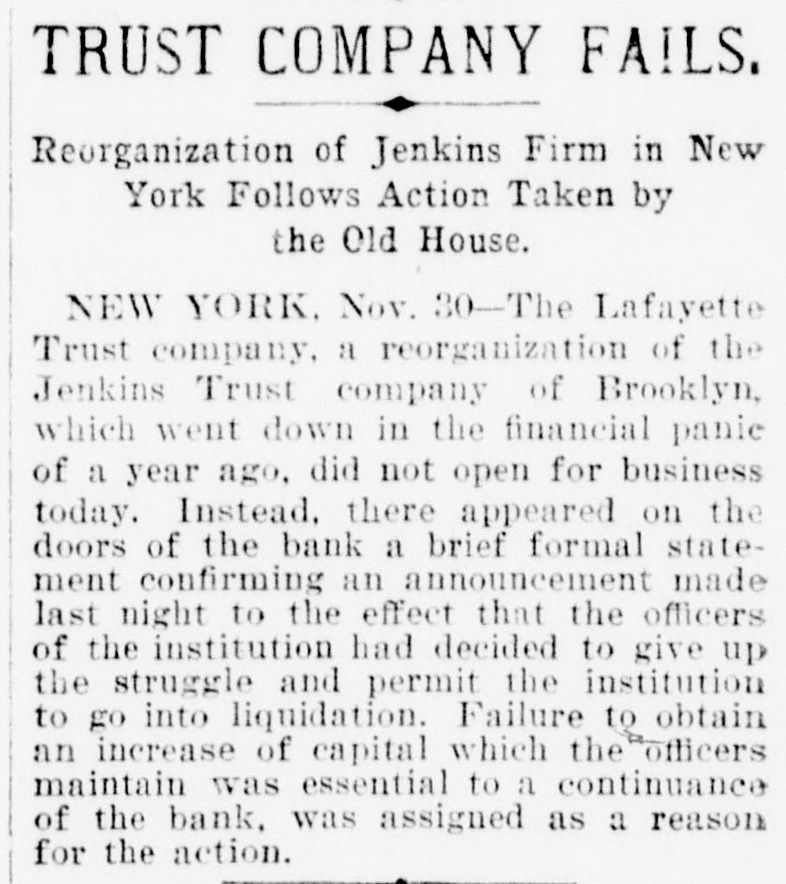
TRUST COMPANY FAILS TO OPEN FOR BUSINESS New York, Nov. 30-The Lafayette Trust company. the reorganization of the Jenkins Trust company, Brooklyn which went down in the financial panic a year ago, did not open for business today. An announcement was made that.the officers of the institution had decided to liquidate. The failure to obtain an increase in capital was given as the cause of action. It is said that depositors will receive dollar for dollar.
3.November 30, 1908Santa Fe New MexicanSanta Fe., Santa Fe, NM
Click image to open full size in new tab
Article Text
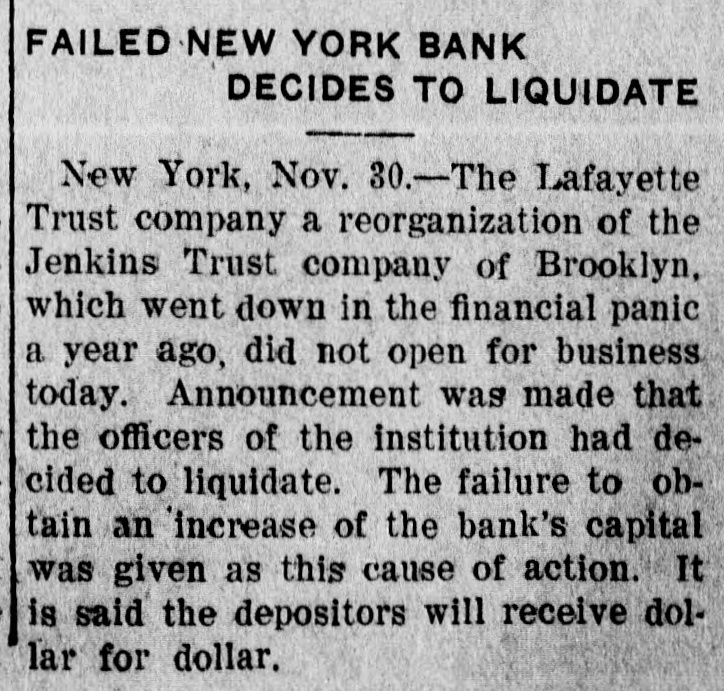
FAILED NEW YORK BANK DECIDES TO LIQUIDATE New York, Nov. 30.-The Lafayette Trust company a reorganization of the Jenkins Trust company of Brooklyn, which went down in the financial panic a year ago, did not open for business today. Announcement was made that the officers of the institution had decided to liquidate. The failure to obtain an increase of the bank's capital was given as this cause of action. It is said the depositors will receive dollar for dollar.
4.November 30, 1908The Fargo Forum and Daily RepublicanFargo, ND
Click image to open full size in new tab
Article Text
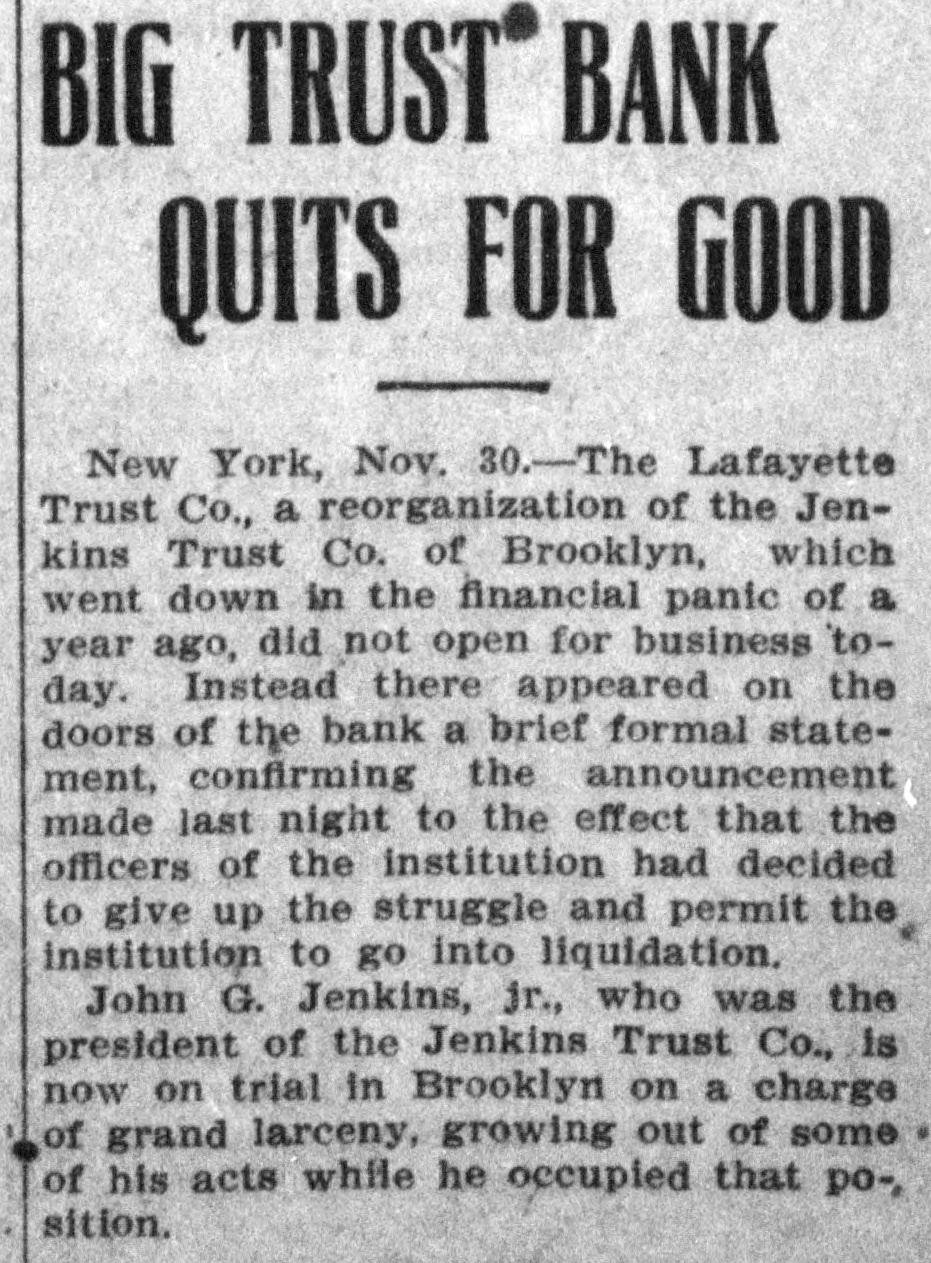
BIG TRUST BANK QUITS FOR GOOD New York, Nov. 30.-The Lafayette Trust Co., a reorganization of the Jenkins Trust Co. of Brooklyn, which went down in the financial panic of a year ago, did not open for business today. Instead there appeared on the doors of the bank a brief formal statement, confirming the announcement made last night to the effect that the officers of the institution had decided to give up the struggle and permit the institution to go into liquidation. John G. Jenkins, jr., who was the president of the Jenkins Trust Co., is now on trial in Brooklyn on a charge of grand larceny, growing out of some of his acts while he occupied that po-, sition.
5.November 30, 1908Evening Times-RepublicanMarshalltown, IA
Click image to open full size in new tab
Article Text
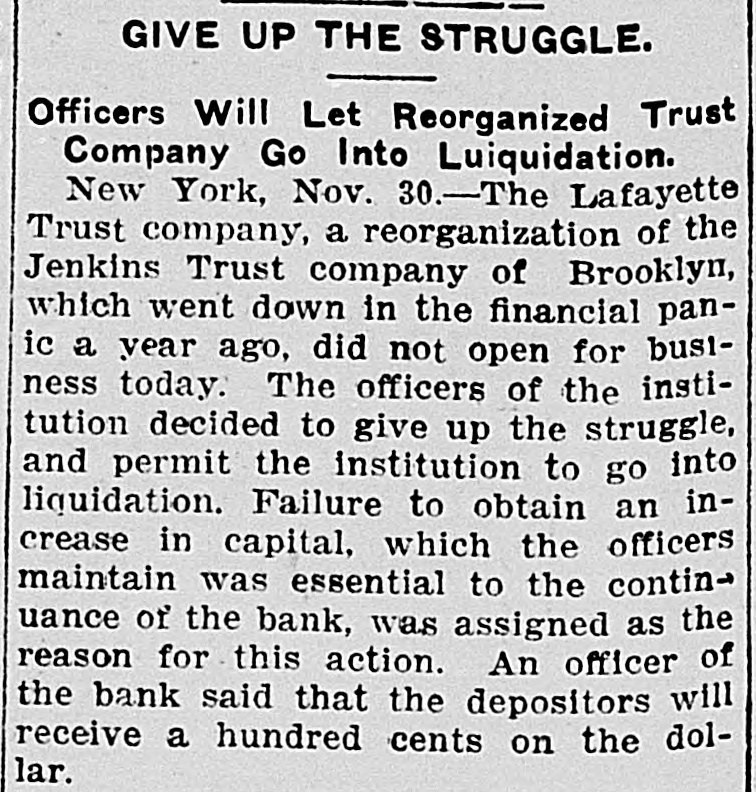
GIVE UP THE STRUGGLE
Officers Will Let Reorganized Trust Company Go Into Luiquidation. New York, Nov. 30.-The Lafayette Trust company, a reorganization of the Jenkins Trust company of Brooklyn, which went down in the financial panic a year ago, did not open for business today. The officers of the institution decided to give up the struggle, and permit the institution to go into liquidation. Failure to obtain an increase in capital, which the officers maintain was essential to the continuance of the bank, was assigned as the reason for this action. An officer of the bank said that the depositors will receive a hundred cents on the dollar.
6.November 30, 1908The Marion Daily MirrorMarion, OH
Click image to open full size in new tab
Article Text
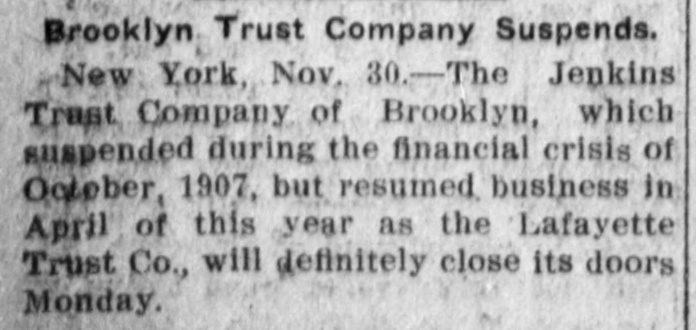
Brooklyn Trust Company Suspends
New York, Nov. 30.-The Jenkins Trust Company of Brooklyn, which suspended during the financial crisis of October, 1907, but resumed business in April of this year as the Lafayette Trust Co., will definitely close its doors Monday.
7.November 30, 1908Rock Island ArgusRock Island, IL
Click image to open full size in new tab
Article Text
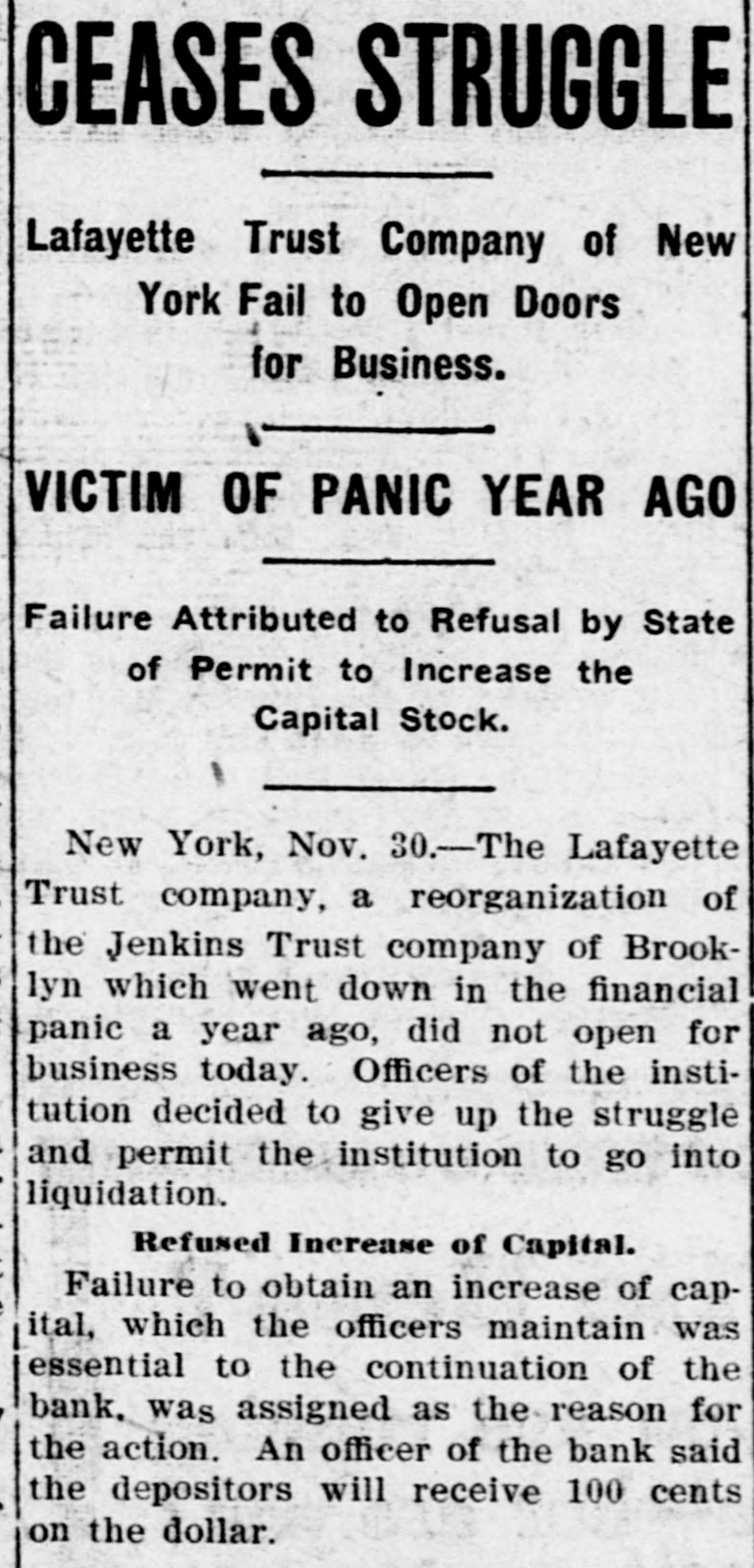
CEASES STRUGGLE Lafayette Trust Company of New York Fail to Open Doors for Business. VICTIM OF PANIC YEAR AGO Failure Attributed to Refusal by State of Permit to Increase the Capital Stock. New York, Nov. 30.-The Lafayette Trust company, a reorganization of the Jenkins Trust company of Brooklyn which went down in the financial panic a year ago, did not open for business today. Officers of the institution decided to give up the struggle and permit the institution to go into liquidation. Refused Increase of Capital. Failure to obtain an increase of capital, which the officers maintain was essential to the continuation of the bank. was assigned as the reason for the action. An officer of the bank said the depositors will receive 100 cents on the dollar.
8.November 30, 1908Deseret Evening NewsSalt Lake City, UT
Click image to open full size in new tab
Article Text
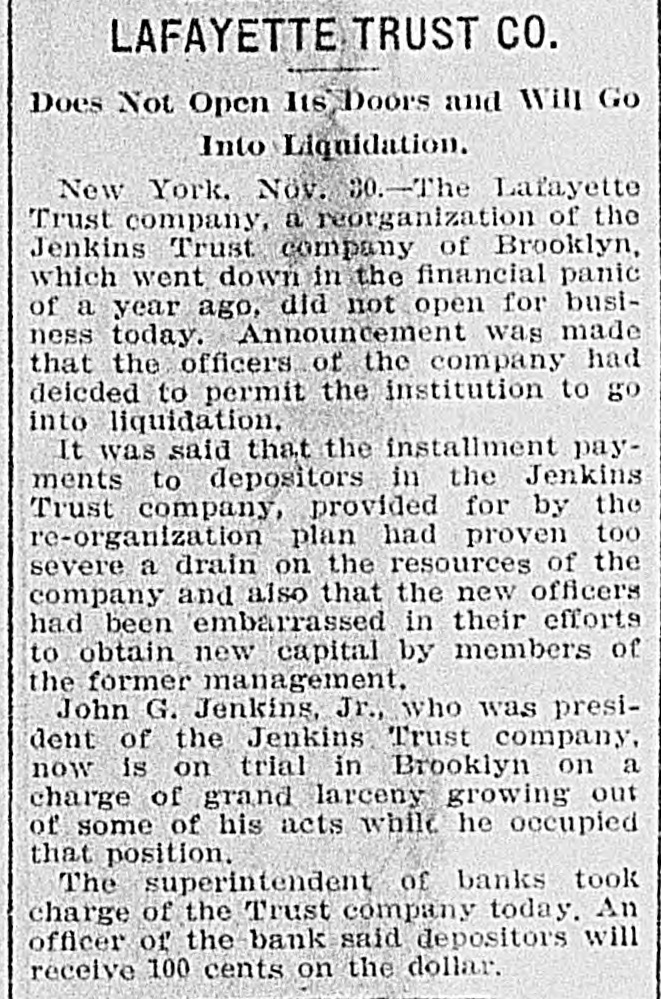
LAFAYETTE TRUST CO
Does Not Open Its Doors and Will Go Into Liquidation. New York, Nov. 30.-The Lafayette Trust company, a reorganization of the Jenkins Trust company of Brooklyn, which went down in the financial panic of a year ago, did not open for business today. Announcement was made that the officers of the company had deicded to permit the institution to go into liquidation. It was said that the installment payments to depositors in the Jenkins Trust company, provided for by the re-organization plan had proven too severe a drain on the resources of the company and also that the new officers had been embarrassed in their efforts to obtain new capital by members of the former management. John G. Jenkins, Jr., who was president of the Jenkins Trust company, now is on trial in Brooklyn on a charge of grand larceny growing out of some of his acts while he occupied that position. The superintendent of banks took charge of the Trust company today. An officer of the bank said depositors will receive 100 cents on the dollar.
9.November 30, 1908The Detroit TimesDetroit, MI
Click image to open full size in new tab
Article Text
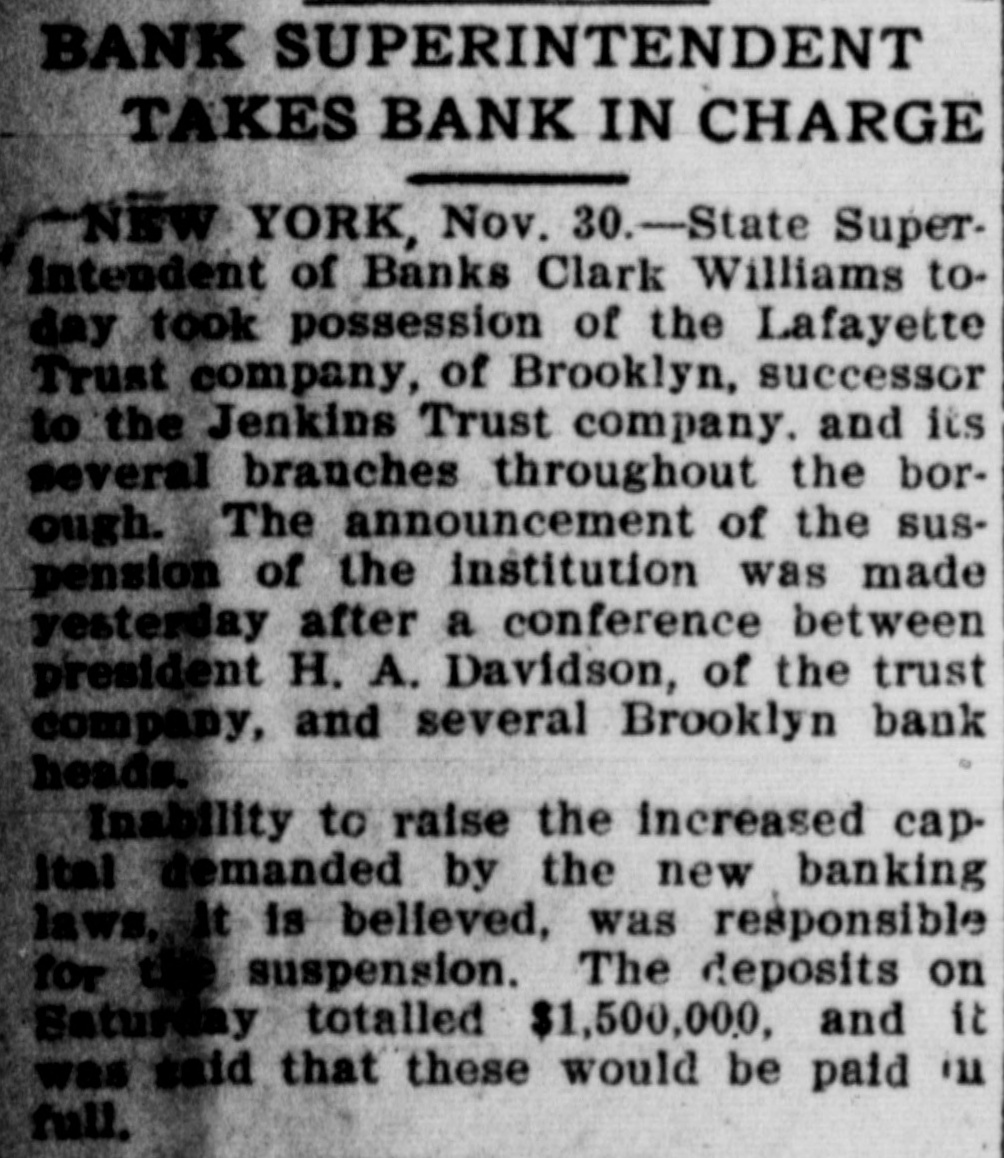
BANK SUPERINTENDENT TAKES BANK IN CHARGE NEW YORK, Nov. 30.-State Superintendent of Banks Clark Williams today took possession of the Lafayette Trust company, of Brooklyn, successor to the Jenkins Trust company. and its several branches throughout the borough. The announcement of the suspension of the institution was made yesterday after a conference between president H. A. Davidson, of the trust company, and several Brooklyn bank heads. Inability to raise the increased capital demanded by the new banking laws, It is believed, was responsible for suspension. The deposits on Saturday totalled $1,500,000, and it was said that these would be paid in full.
10.December 1, 1908Los Angeles HeraldLos Angeles, CA
Click image to open full size in new tab
Article Text
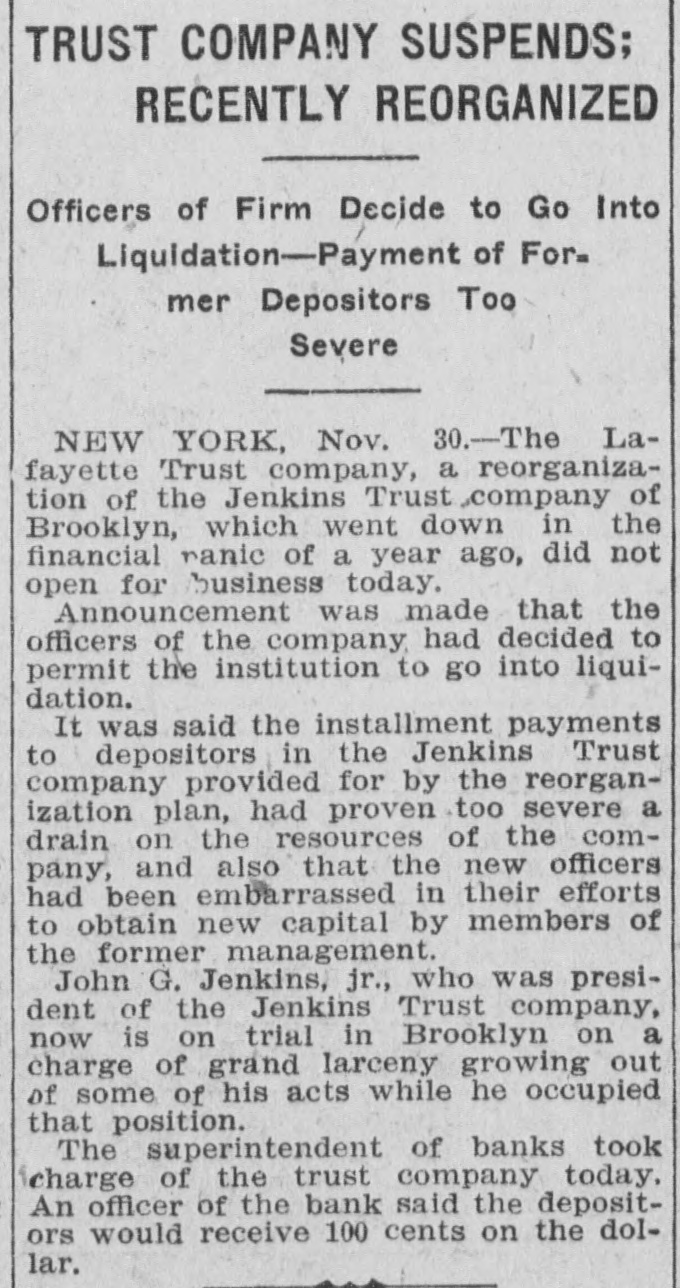
TRUST COMPANY SUSPENDS; RECENTLY REORGANIZED Officers of Firm Decide to Go Into Liquidation-Payment of Former Depositors Too Severe NEW YORK, Nov. 30.-The Lafayette Trust company, a reorganization of the Jenkins Trust company of Brooklyn, which went down in the financial ranic of a year ago, did not open for business today. Announcement was made that the officers of the company had decided to permit the institution to go into liquidation. It was said the installment payments to depositors in the Jenkins Trust company provided for by the reorganization plan, had proven too severe a drain on the resources of the company, and also that the new officers had been embarrassed in their efforts to obtain new capital by members of the former management. John G. Jenkins, jr., who was president of the Jenkins Trust company, now is on trial in Brooklyn on a charge of grand larceny growing out of some of his acts while he occupied that position. The superintendent of banks took charge of the trust company today. An officer of the bank said the depositors would receive 100 cents on the dollar.
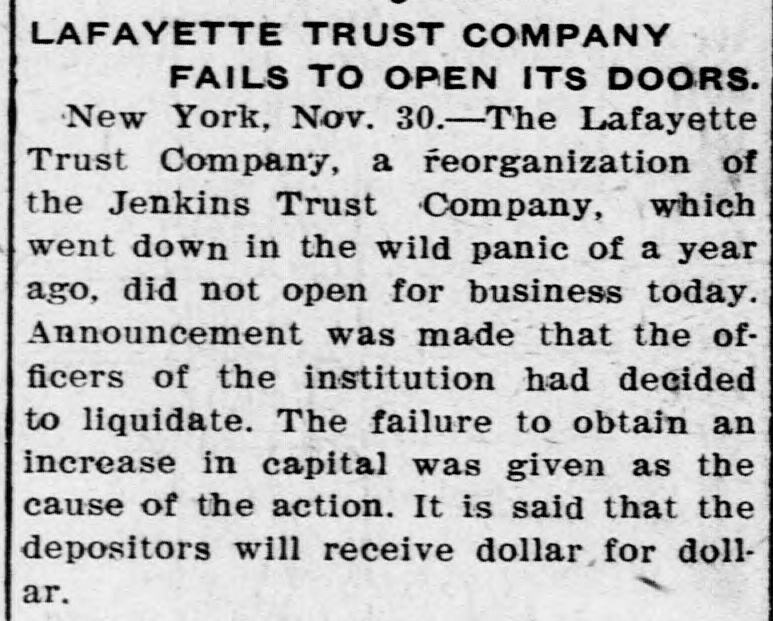
LAFAYETTE TRUST COMPANY FAILS TO OPEN ITS DOORS. New York, Nov. 30.-The Lafayette Trust Company, a reorganization of the Jenkins Trust Company, which went down in the wild panic of a year ago, did not open for business today. Announcement was made that the officers of the institution had decided to liquidate. The failure to obtain an increase in capital was given as the cause of the action. It is said that the depositors will receive dollar for dollar.
12.December 1, 1908The White Pine NewsEly, NV
Click image to open full size in new tab
Article Text
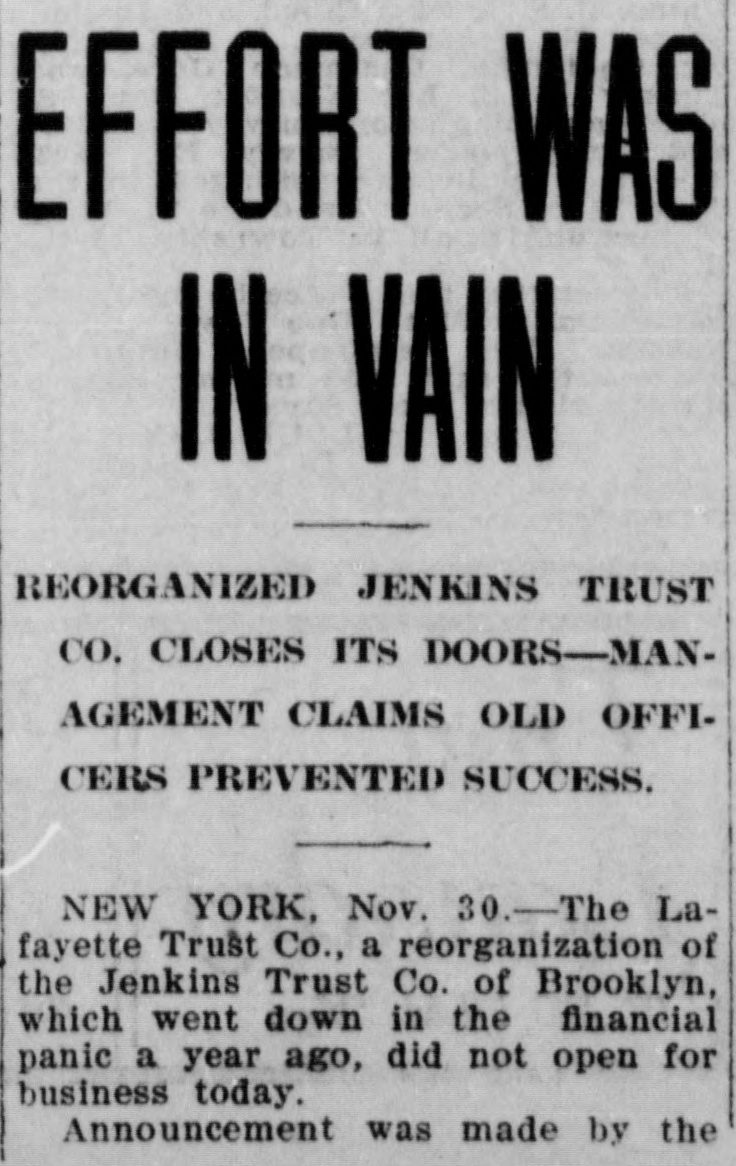
EFFORT WAS IN VAIN REORGANIZED JENKINS TRUST CO. CLOSES ITS DOORS-MANAGEMENT CLAIMS OLD OFFICERS PREVENTED SUCCESS. NEW YORK, Nov. 30.-The Lafayette Trust Co., a reorganization of the Jenkins Trust Co. of Brooklyn, which went down in the financial panic a year ago, did not open for business today. Announcement was made by the
13.December 1, 1908The San Francisco CallSan Francisco, CA
Click image to open full size in new tab
Article Text
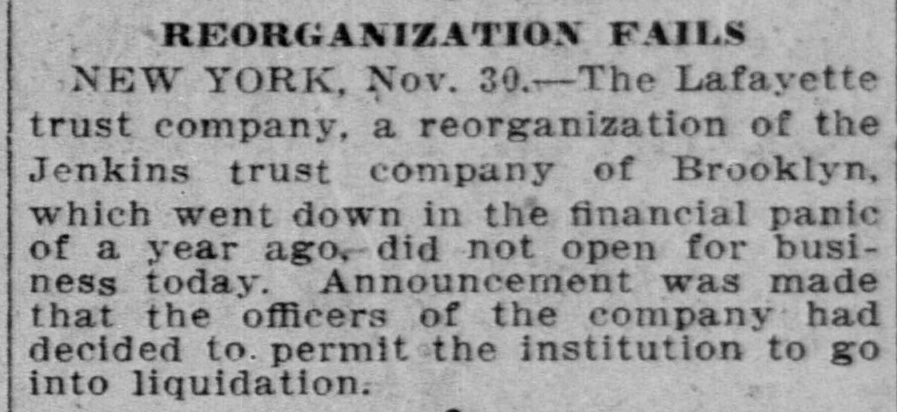
REORGANIZATION FAILS NEW YORK, Nov. 30.-The Lafayette trust company, a reorganization of the Jenkins trust company of Brooklyn, which went down in the financial panic of a year ago, did not open for business today. Announcement was made that the officers of the company had decided to. permit the institution to go into liquidation.
14.December 1, 1908The Barre Daily TimesBarre, VT
Click image to open full size in new tab
Article Text
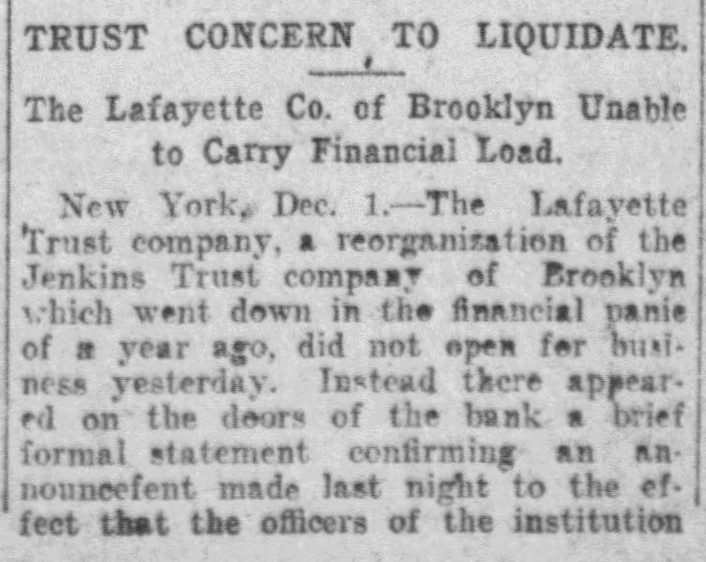
TRUST CONCERN TO LIQUIDATE
The Lafayette Co. of Brooklyn Unable to Carry Financial Load. New York, Dec. 1.-The Lafayette Trust company, a reorganization of the Jenkins Trust company of Brooklyn which went down in the financial panie of a year ago, did not open for business yesterday. Instead there appeared on the deors of the bank a brief formal statement confirming an n.n. nouncefent made last night to the effect that the officers of the institution
15.December 1, 1908The Salt Lake HeraldSalt Lake City, UT
Click image to open full size in new tab
Article Text
TRUST COMPANY QUITS
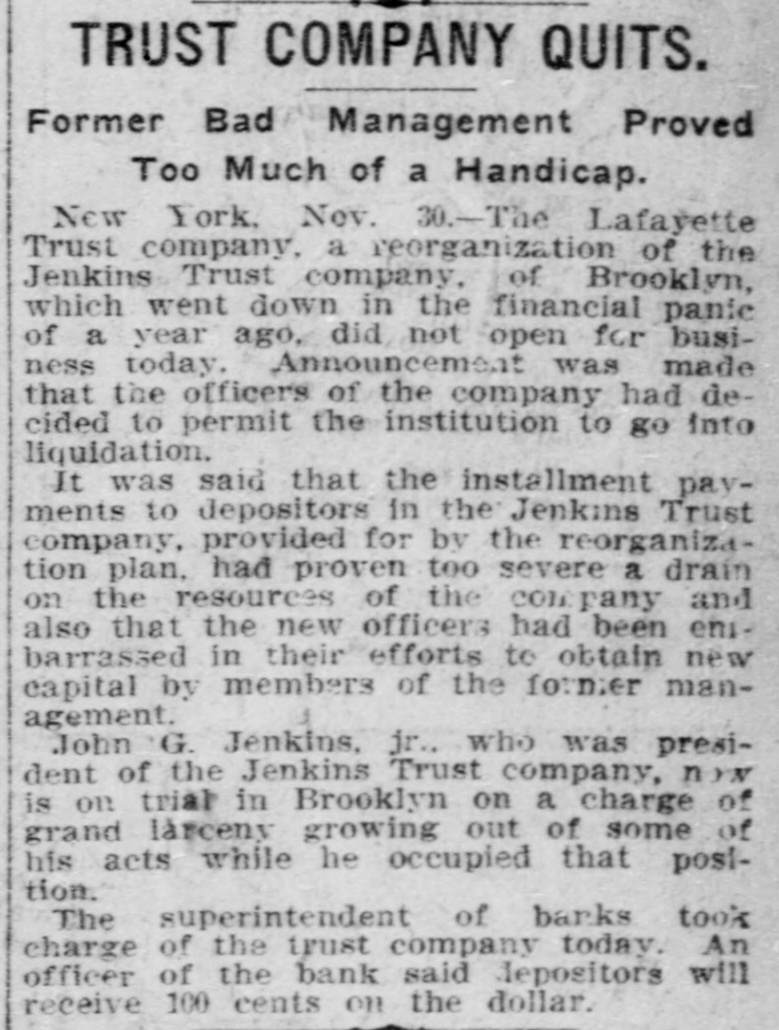
Former Bad Management Proved Too Much of a Handicap. New York. Nov. 30.-The Lafayette Trust company, a reorganization of the Jenkins Trust company, of Brooklyn, which went down in the financial panic of a year ago, did not open for business today. Announcement was made that the officers of the company had decided to permit the institution to go into liquidation. It was said that the installment payments to depositors in the Jenkins Trust company, provided for by the reorganization plan, had proven too severe a drain on the resources of the company and also that the new officers had been enibarrassed in their efforts to obtain new capital by members of the fornier management. John G. Jenkins, jr., who was president of the Jenkins Trust company, now is on trial in Brooklyn on a charge of grand larceny growing out of some of his acts while he occupied that posttion. The superintendent of banks took charge of the trust company today. An officer of the bank said depositors will receive 100 cents on the dollar.
16.December 3, 1908The Weekly HeraldAmarillo, TX
Click image to open full size in new tab
Article Text
TRUST COMPANY QUITS
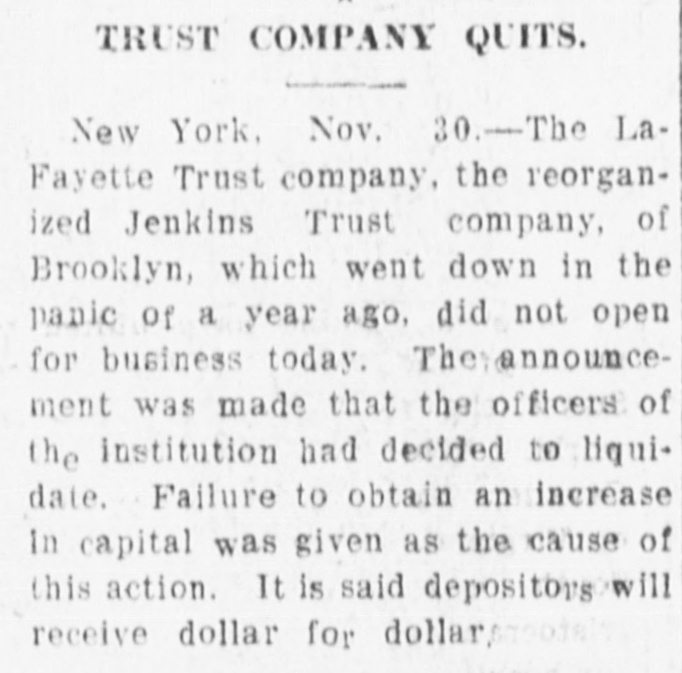
New York, Nov. 30.-The LaFayette Trust company, the reorganized Jenkins Trust company, of Brooklyn, which went down in the panic of a year ago, did not open for business today. The:announcement was made that the officers of the institution had decided to liquidate. Failure to obtain an increase In capital was given as the cause of this action. It is said depositors will receive dollar for dollar,
17.December 3, 1908The Manitowoc PilotManitowoc, WI
Click image to open full size in new tab
Article Text
TRUST COMPANY FAILS
Reorganization of Jenkins Firm in New York Follows Action Taken by the Old House. NEW YORK. Nov. 30-The Lafayette Trust company, a reorganization of the Jenkins Trust company of Brooklyn, which went down in the financial panie of a year ago, did not open for business today. Instead. there appeared on the doors of the bank a brief formal statement confirming an announcement made last night to the effect that the officers of the institution had decided to give up the struggle and permit the institution to go into liquidation. Failure to obtain an increase of capital which the officers maintain was essential to a continuance of the bank, was assigned as a reason for the action.
18.May 5, 1909Omaha Daily BeeOmaha, NE
Click image to open full size in new tab
Article Text
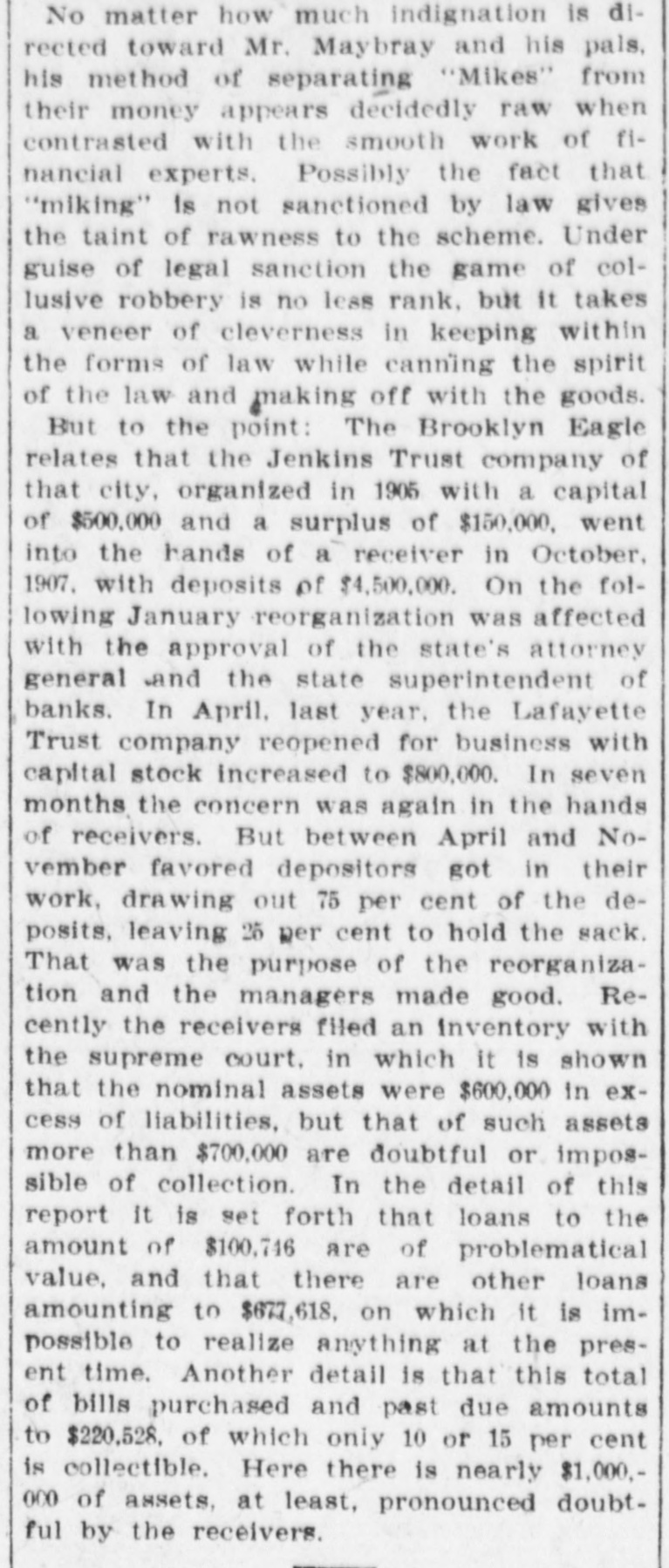
No matter how much indignation is directed toward Mr. Maybray and his pals, his method of separating "Mikes" from their money appears decidedly raw when contrasted with the smooth work of financial experts. Possibly the fact that "miking" Is not sanctioned by law gives the taint of rawness to the scheme. Under guise of legal sanction the game of collusive robbery is no less rank, but It takes a veneer of cleverness in keeping within the forms of law while canning the spirit of the law and making off with the goods. But to the point: The Brooklyn Eagle relates that the Jenkins Trust company of that city, organized in 1905 with a capital of $500,000 and a surplus of $150,000. went into the hands of a receiver in October, 1907. with deposits of $4,500,000. On the following January reorganization was affected with the approval of the state's attorney general and the state superintendent of banks. In April, last year. the Lafayette Trust company reopened for business with capital stock increased to $800,000. In seven months the concern was again in the hands of receivers. But between April and November favored depositors got in their work, drawing out 75 per cent of the deposits, leaving 25 per cent to hold the sack. That was the purpose of the reorganization and the managers made good. Recently the receivers filed an inventory with the supreme court. in which it is shown that the nominal assets were $600,000 in excess of liabilities, but that of such assets more than $700,000 are doubtful or impossible of collection. In the detail of this report it is set forth that loans to the amount of $100,746 are of problematical value, and that there are other loans amounting to $677,618. on which it is impossible to realize anything at the present time. Another detail is that this total of bills purchased and past due amounts to $220,528. of which only 10 or 15 per cent is collectible. Here there is nearly $1,000,000 of assets, at least, pronounced doubtful by the receivers.
19.October 1, 1909New-York TribuneNew York, NY
Click image to open full size in new tab
Article Text
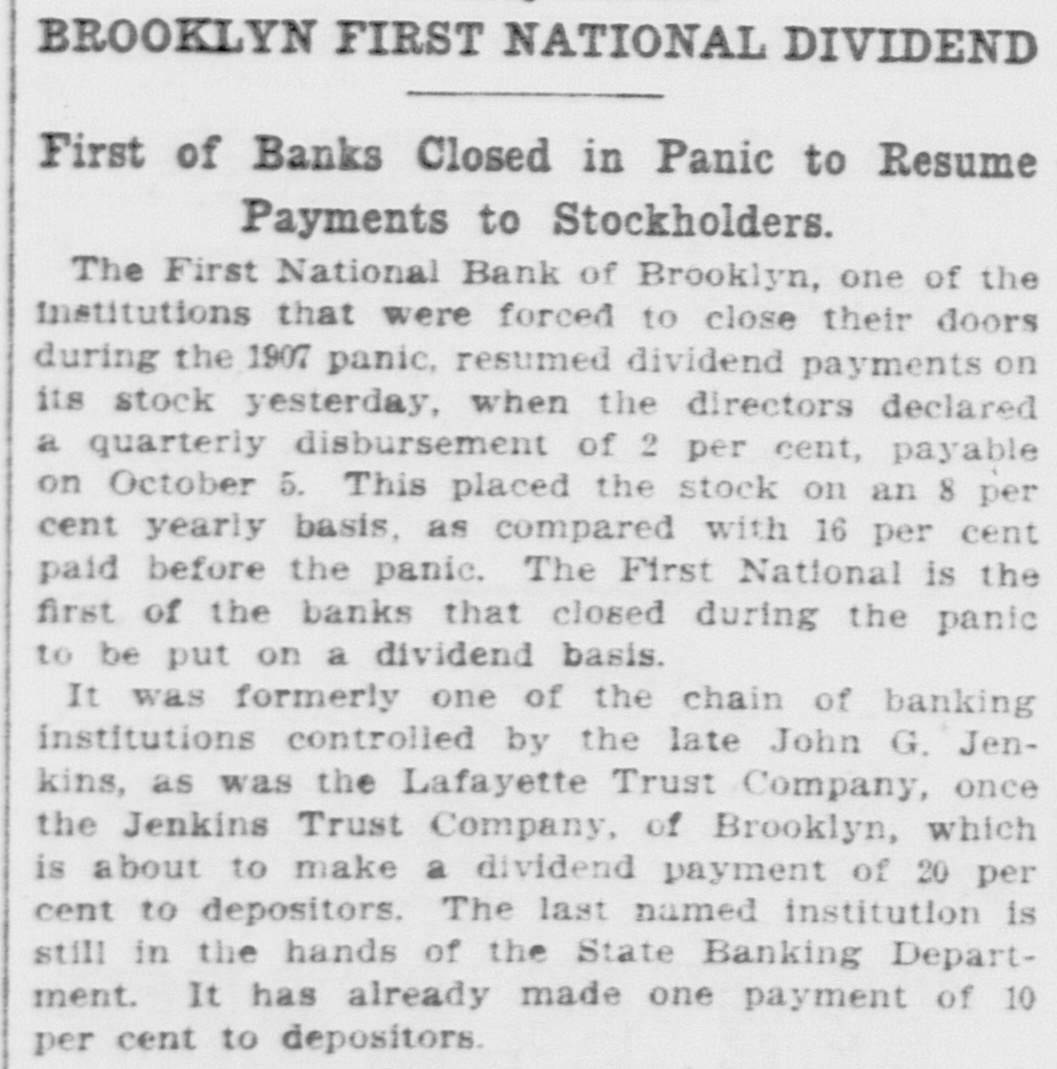
BROOKLYN FIRST NATIONAL DIVIDEND First of Banks Closed in Panic to Resume Payments to Stockholders. The First National Bank of Brooklyn, one of the institutions that were forced to close their doors during the 1907 panic, resumed dividend payments on its stock yesterday, when the directors declared a quarterly disbursement of 2 per cent, payable on October 5. This placed the stock on an 8 per cent yearly basis, as compared with 16 per cent paid before the panic. The First National is the first of the banks that closed during the panic to be put on a dividend basis. It was formerly one of the chain of banking institutions controlled by the late John G. Jenkins, as was the Lafayette Trust Company, once the Jenkins Trust Company, of Brooklyn, which is about to make a dividend payment of 20 per cent to depositors. The last named institution is still in the hands of the State Banking Department. It has already made one payment of 10 per cent to depositors.
20.October 2, 1910The SunNew York, NY
Click image to open full size in new tab
Article Text
Lafayette Trust Co
Stockholders Sued. A suit has been begun by Superintendent Cheney of the State Banking Department against the stockholders of the defunct Lafayette Trust Company of Brooklyn on behalf of the depositors for the recovery of the 100 per cent. assessment levied on each sto. kholder A committee of the stockholders has been appointed to resist the collection of the assessment and Almet R. Latson has been retained as counsel. The amount of stock involved is $50,000. The Lafayette Trust Company had a brief and unsuecessful career following the 1907 panie.
21.January 22, 1911New-York TribuneNew York, NY
Click image to open full size in new tab
Article Text
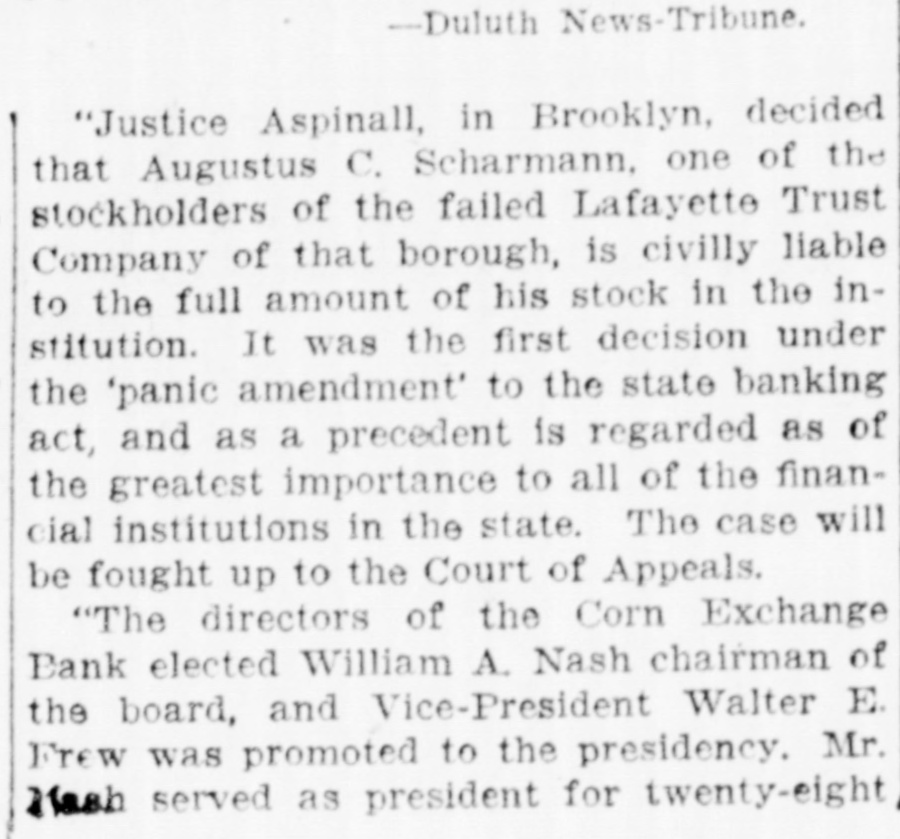
"Justice Aspinall, in Brooklyn, decided that Augustus C. Scharmann, one of the stockholders of the failed Lafayette Trust Company of that borough, is civilly liable to the full amount of his stock in the institution. It was the first decision under the 'panic amendment' to the state banking act, and as a precedent is regarded as of the greatest importance to all of the financial institutions in the state. The case will be fought up to the Court of Appeals.
"The directors of the Corn Exchange Bank elected William A. Nash chairman of the board, and Vice-President Walter E. Frew was promoted to the presidency. Mr. Nash served as president for twenty-eight
Bank runs are almost always and everywhere a deterioration of bank fundamentals.
But not for you.
You are the measure-zero exception: great fundamentals, solid bank, and yet the Diamond Dybvig fairy spread its rumor. Depositors woke up. Your collateral was not prepositioned. The Clearinghouse had it for you.
Do not pass Go. Do not collect $200. Go directly to jail… or worse.
Flag Article for Review
Flag Episode for Review
Lafayette Trust Company · Episode ID 3403806191300