Article Text
TAYLOR STILL AT LARGE
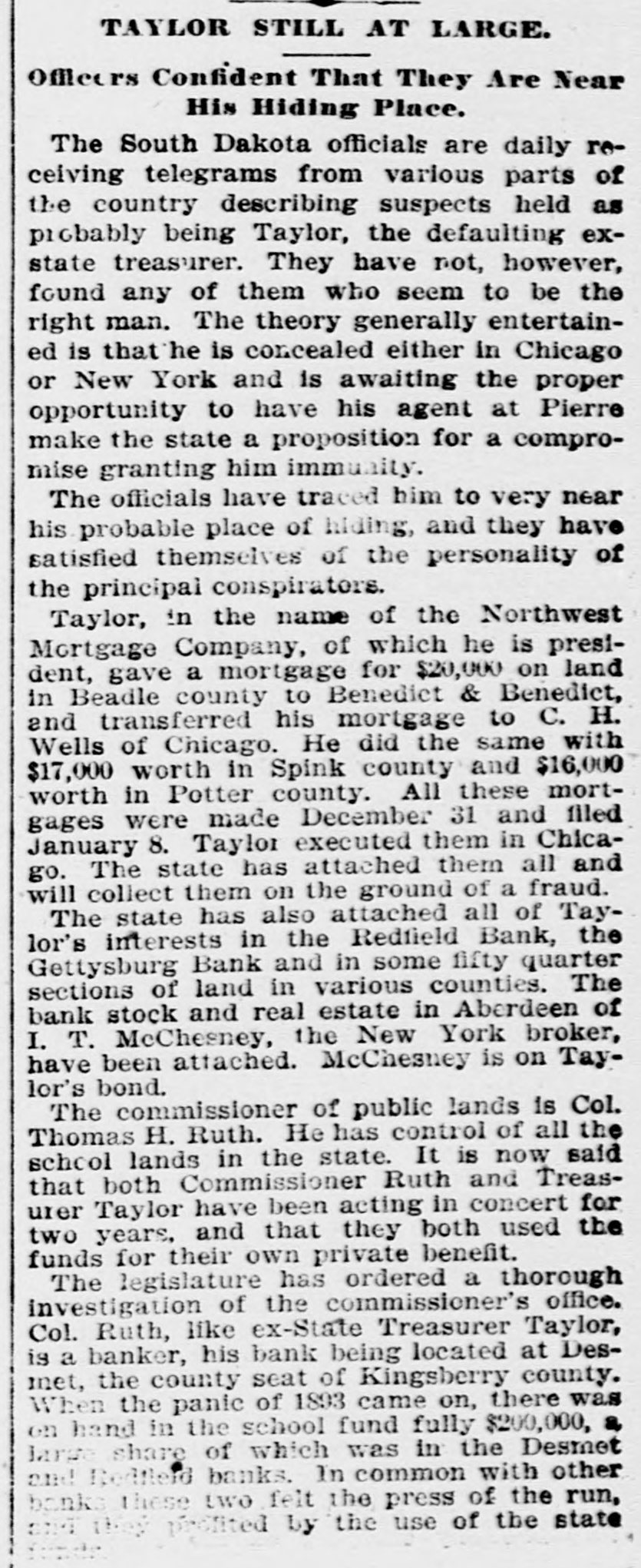
Offlecrs Confident That They Are Near His Hiding Place. The South Dakota officials are daily receiving telegrams from various parts of the country describing suspects held as probably being Taylor, the defaulting exstate treasurer. They have not, however, found any of them who seem to be the right man. The theory generally entertained is that he is concealed either in Chicago or New York and is awaiting the proper opportunity to have his agent at Pierre make the state a proposition for a compromise granting him immunity. The officials have traced him to very near his probable place of hiding, and they have satisfied themselves of the personality of the principal conspirators. Taylor, in the name of the Northwest Mortgage Company, of which he is president, gave a mortgage for $20,000 on land in Beadle county to Benedict & Benedict, and transferred his mortgage to C. H. Wells of Chicago. He did the same with $17,000 worth in Spink county and $16,000 worth in Potter county. All these mortgages were made December 31 and filed January 8. Taylor executed them in Chicago. The state has attached them all and will collect them on the ground of a fraud. The state has also attached all of Taylor's interests in the Redfield Bank, the Gettysburg Bank and in some fifty quarter sections of land in various counties. The bank stock and real estate in Aberdeen of I. T. McChesney, the New York broker, have been attached. McChesney is on Taylor's bond. The commissioner of public lands is Col. Thomas H. Ruth. He has control of all the school lands in the state. It is now said that both Commissioner Ruth and Treasurer Taylor have been acting in concert for two years, and that they both used the funds for their own private benefit. The legislature has ordered a thorough investigation of the commissioner's office. Col. Ruth, like ex-State Treasurer Taylor, is a banker, his bank being located at Desmet, the county seat of Kingsberry county. When the panic of 1893 came on, there was on hand in the school fund fully $200,000, a large share of which was in the Desmet and Redfled banks. In common with other banks these two felt the press of the run, and they profited by the use of the state