Mower County Bank (Austin, MN)

Episode Information

Episode UID
3315877791038
Episode Type
Suspension β†’ Closure
Bank Type
trust
Bank ID
331587779 hash
Start Date
June 12, 1886
Location
Austin, Minnesota (43.667, -92.975)

Metadata

Model
gpt-5-mini (chosen from majority vote of a three-model LLM ensemble)
Short Digest
8ecfec204bbcb13b

Response Measures

None

Description

Assets/liabilities estimates vary across reports; receiver appointed within a month.

Events (2)

1. June 12, 1886 Suspension
Cause
Bank Specific Adverse Info
Cause Details
Numerous calls and falling deposits exhausted the bank's ability to meet payments; liabilities large relative to cash on hand.
Newspaper Excerpt
The Mower County-bank ... suspended payments today.
Source
newspapers
2. July 13, 1886 Receivership
Newspaper Excerpt
Receiver Crane is now in full possession.
Source
newspapers

Newspaper Articles (13)

Article from St. Paul Daily Globe, June 13, 1886

Click image to open full size in new tab

Article Text

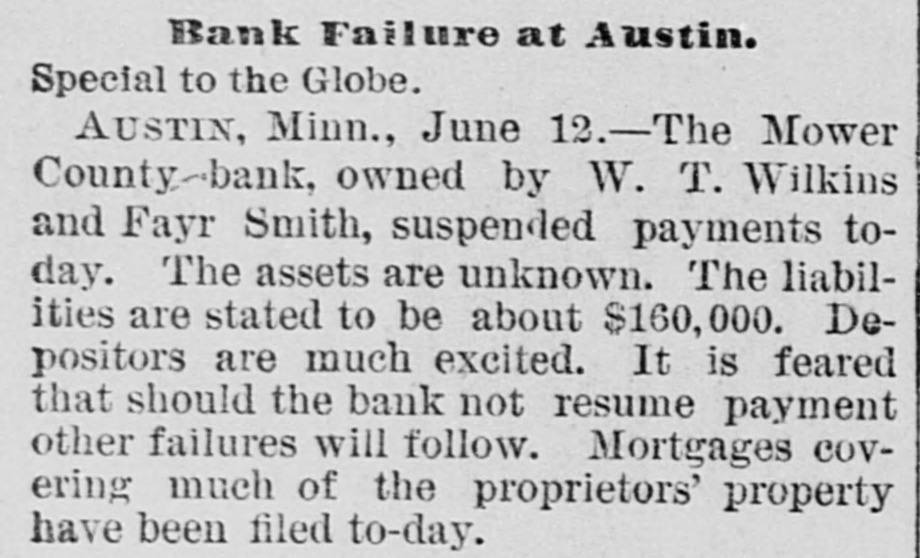
Bank Failure at Austin. Special to the Globe. AUSTIN, Minn., June 12.-The Mower County-bank, owned by W. T. Wilkins and Fayr Smith, suspended payments today. The assets are unknown. The liabilities are stated to be about $160,000. Depositors are much excited. It is feared that should the bank not resume payment other failures will follow. Mortgages covering much of the proprietors' property have been filed to-day.


Article from St. Paul Daily Globe, June 13, 1886

Click image to open full size in new tab

Article Text

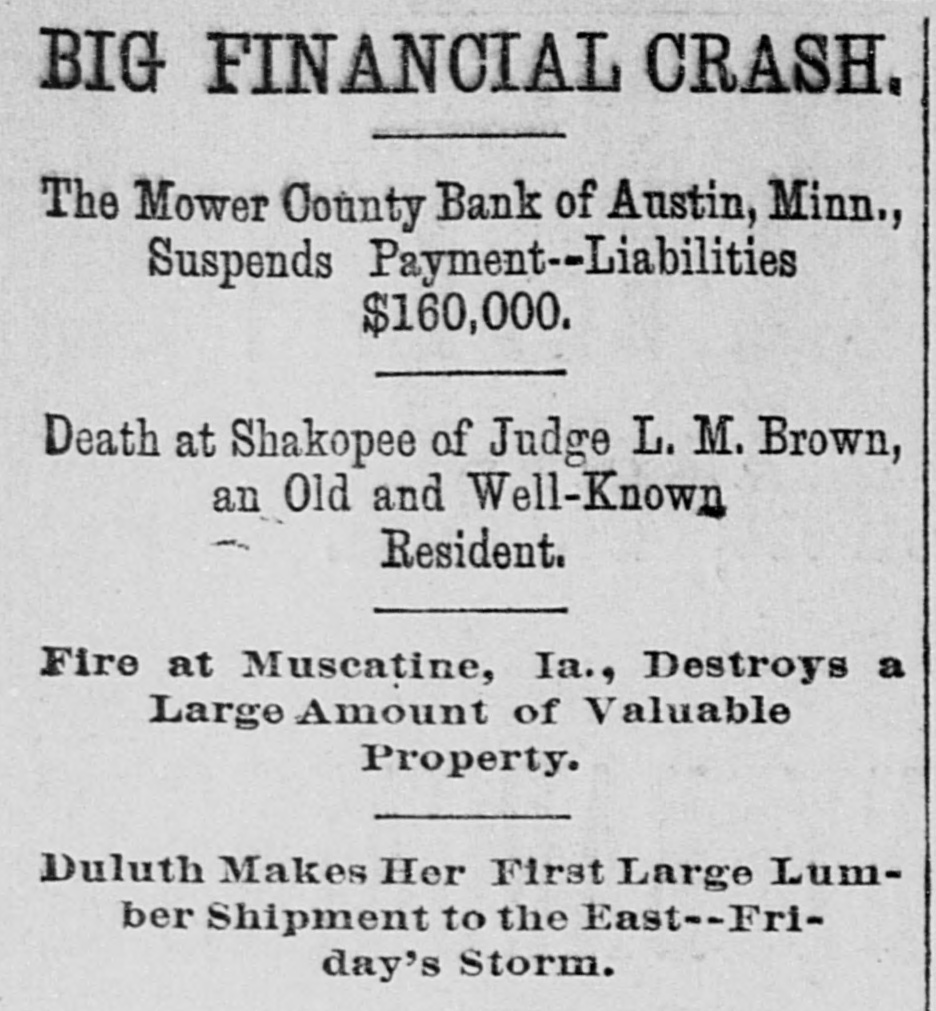
BIG FINANCIAL CRASH. The Mower County Bank of Austin, Minn., Suspends Payment--Liabilities $160,000. Death at Shakopee of Judge L. M. Brown, an Old and Well-Known Resident. Fire at Muscatine, Ia., Destroys a Large Amount of Valuable Property. Duluth Makes Her First Large Lumber Shipment to the East--Friday's Storm.


Article from Mower County Transcript, June 16, 1886

Click image to open full size in new tab

Article Text

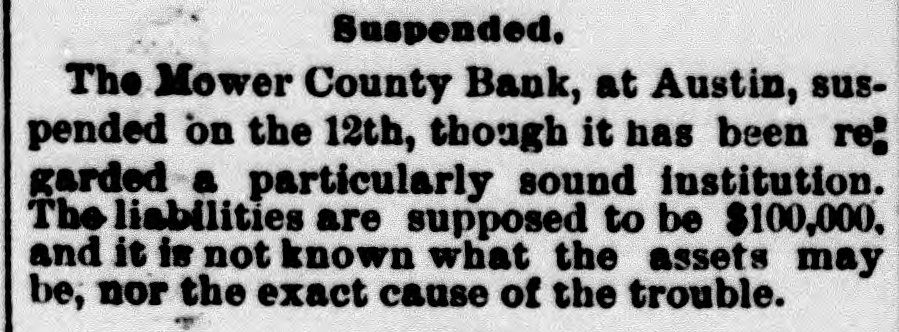
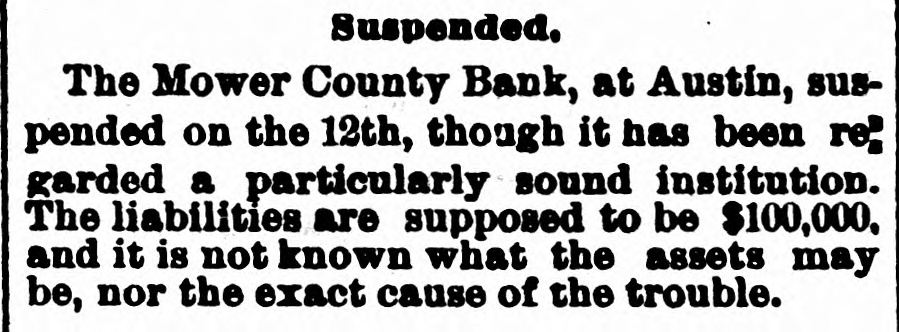
Suspended, The Mower County Bank, at Austin, suspended on the 12th, though it has been re: garded a particularly sound institution. The liabilities are supposed to be $100,000. and it is not known what the assets may be, nor the exact cause of the trouble.


Article from Mower County Transcript, June 16, 1886

Click image to open full size in new tab

Article Text

Mr. Wilkins Estimates Liabilities at from $70,000 to $75,000; Assets, $80,000 to $90,000. Saturday morning, soon after the beginning of banking hours, our citizens were startled with the report that the Mower County Bank, where many of our people have been accustomed to do business for many years, and in which a large number were financially interested, had failed. On repairing to the bank building, the following notice was found posted up Owing to circumstances beyond our control, we are compelled to announce that the Mower County Bank has suspended payment temporarily, and will remain closed for the present. WILKINS & SMITH. To most people. this was a genuine surprise, and equally unpleasant to those whose surplus funds, if not their little all, had been invested in its safe-keeping. The Mower County Bank was established by Sylvester Smith, W. T. Wilkins & J. C. Easton, in 1869. In 1882, Mr. Easton withdrew from the firm, and the business has been conducted since that time by W. T. Wilkins & Fay R. Smith. It started in the brick building, adjoining the old court house. and was transferred to its present quarters in 1875-6, which building was erected by Smith, Wilkins & Easton. In 1882, Fay R., son of Sylvester Smith, succeeded his father (deceased in 1877) as a member of the firm. On Monday afternoon, we called on Mr. Wilkins at his residence, and interviewed him in regard to affairs. He stated the liabilities to be from $70,000 to $75,000, and the assets from $80,000 to $90,000, and that they expect to be able to pay all depositors dollar for dollar. That people will have to wait until assets can be converted into cash. Neither of the parties have anything in reserve. In regard to the $21,000 of county funds in their hands, he said, that M. Driesner, J. Gregson and M. M. Trowbridge, the bondsmen, were secured by real estate valued at nearly if not quite the whole amount of the indebtedness to the county. Mr. Wilkins further said, that if there was not property enough to pay up all claims against the bank, the balance would be met somehow. He would give his careful attention to the matter, and if not crowded by creditors, hoped to realize the largest possible sum out of the assets. He said the bank building was in the name of J. C. Easton, but belonged to the bank, and would be reckoned among the assets. The Hayes estate, for a loan of $10.000, has security on real estate. Mr. Wilkins gave his valuation of the assets, in round numbers, as follows: Notes and Accounts $22,000 85,000 Real Estate belonging to Bank 20,000 Real Estate belonging to Wilkins. 20,000 Real Estate belonging to Smith Total. $97,000 Mr. Wilkins also gives the following statement of liabilities: $60,000 Due Depositors 10,000 Due Hayes estate 5,000 Due W. H. Strong Total $75,000 Mr. Wilkins said that for about two weeks before the suspension, deposits began to fall off, and numerous calls exhausted the ability of the bank to meet them, and SO compelled the closing up. The loss is divided, in part, among many of the people, in small sums, the savings of years, and unless the assurance is given by the proprietors of the bank that theliabilities will be met speed ily and surely, there will result much uneasiness and possible suffering. We hope an assignee or receiver will be appointed in whom the entire community will have the utmost confidence, a man who will render this important service honestly, and for a reasonable compensation, without an eye to plunder or speculation. The following is a partial list of creditors, made up largely from street rumor. We do not pretend that the amounts given are correct. We do know, how. ever, that several of them are substantially correct and the list, as a whole, much more reliable than any which has been


Article from New Ulm Weekly Review, June 16, 1886

Click image to open full size in new tab

Article Text

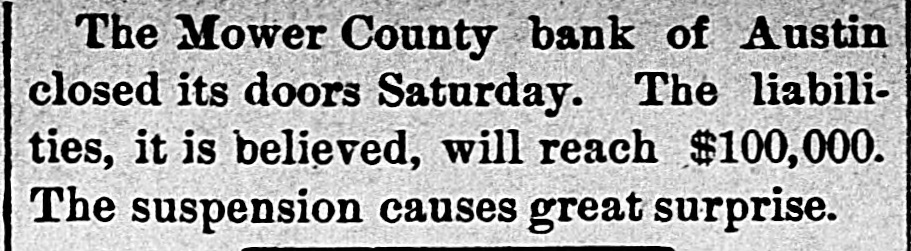
The Mower County bank of Austin closed its doors Saturday. The liabilities, it is believed, will reach $100,000. The suspension causes great surprise.


Article from The Iowa Plain Dealer, June 17, 1886

Click image to open full size in new tab

Article Text

Suspended, The Mower County Bank, at Austin, suspended on the 12th, though it has been re" garded a particularly sound institution. The liabilities are supposed to be $100,000. and it is not known what the assets may be, nor the exact cause of the trouble.


Article from The Stark County Democrat, June 17, 1886

Click image to open full size in new tab

Article Text

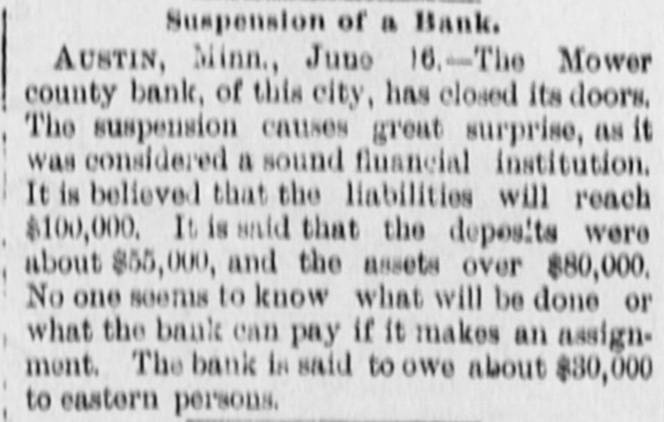
Suspension of a Bank. AUSTIN, Minn., June 16.-The Mower county bank, of this city, has closed its doors. The suspension causes great surprise, as it was considered a sound fluancial institution. It is believed that the liabilities will reach $100,000. It is said that the deposits were about $55,000, and the assets over $80,000. No one seems to know what will be done or what the bank can pay if it makes an assignment. The bank is said to owe about $30,000 to eastern persons.


Article from River Falls Journal, June 17, 1886

Click image to open full size in new tab

Article Text

NORTHWESTERN NEWS. A destructive wind and thunderstorm visited Crookston on the evening of the 11th, and for fifteen minutes made a mighty havoc. The Germania House, the Crookston House, the Catholic church, McKinnon Bros. agricultural warehouse, several stables and small buildings were destroyed. The track of the storm was from southwest to northwest. The people generally took refuge in their cellars. At the Germania House, which was completely demolished eight people were injured, though it is thought none of them fatally. The electric light system was destroyed and trees uprooted all over the town. At Valley City, D. T., the tornado of the 11th struck the town, and for twenty minutes the whole population remained in their collars. Some damage was done to buildings, but nothing very serious. At Grand Forks the North Dakota mill was struck by lightning, and damaged. At Jamestown and Carrington bail damaged window glass to considerable extent. The rain was quite general in that portion of the territory and was very beneficial to the crops. The city of Vancouver situated at the Pacific end of the Candian Pacific railway, is in ashes. Not half a dozen of houses re main out of 500, and, worst of all, there is a large loss of life. Ten bodies have thus far been recovered, and a number of persous are missing and are supposed to have peaished. One short hour did the whole work. The property saved isinsignificant, consisting of only two plaining mills. The loss is estimated at $1,000,000, with only $10,000 insurance. A thousand men areat work cleaning up the debris for the railroad company. Many men lost their all, but are determined to start in again. The property loss falls directly on the pioneer e ement of the new city. The fire began from fires on railroad land set by an engine and a stiff wind blew it into the city The storm Mongay afternoon did considdamage at Montevideo, orthington and Bird Island, Minn., damaging houses, barns, outbuildings and trees, but no injury to persons is reported. At Salem and Montrose, Dak., a tornado Saturday evening did some mischief. At Montrose the school house and several barns were blown to pieces and chimaneys swept off from houses. At Salem the canvass of the Great Eastern circus was torn into shreds. At the session of the Episcopal Diocesan Council, at Minneapolis, Rev. M. N. Gilbert, Rector of Christ's Church, St. Paul was on the 4th. ballot elected assistant B'shop, with the salary of $3.000. Mr. Gill bert is 38 years of age and graduated from the Seabury divinity school at Fairbault in 1875. DΓ©legates were elected to the general convention to be held at Chicago bext October. Near St. Andrews, D.T., a farmer became jealous of his hired man but his wife would not allow him to be discharged. Thereppon the farmer called in some neighbors and after they had imbibed a jug of liquor, a rope was put around the man's neck and he was strung up, the intention being to frighten him, but he hung too long and was dead when let down. A meeting of Minnesota Democratic politicians washeld in St. Paul on the 10th. It was composed exclusively of those who are opposed to what is! styled the Kelly Doran regime. As the result a call Was ordered for a mass meeting to be held at St. Paul July 1. The house of D. H. Houston at Hunter Cass county, D. T., wasscycloned on the night of the 11th. Nine persons were in the house. One was killed, Christopher Johnson and all the rest were more or less injured. ! A hot wave touched the Northwest Monday. At La Crosse the record was 97 to 104, with several sunstrokes. At the Madison observatory, it was reported 91 in the shade, the highest register since August 1881. The Mower county bank at Austin, Minn., failed on the 12th. The liabilities are over $100,000. It is not known how much can be realized from the assets. Muscative, Iows, had the largest fire ever known there on the 12th. The mill and lumber of the Muscantine Lumber company burned. Loss $175,000. President Chapin of Beloit, Wis., College has resigned and Rev. E. S. Eaton, of Oak Park, Ill., (class of 172, Beloit College) appointed his successor. Oconto, Wis., had a serious fire on the 12th, purning a flouring mill, shingle mill, & number of 6848 40% several residences. Loss $20,000. A break in the dam at Lanesboro, Mins, has compelled two flouring mills and the creamery to suspend operations for a time. L. W. Seeley, formerly deputy postmaster at Shakopee, Minn. has been arrested for a defalcation of $700. Hon. Geo. A. Allen, of Erie, Pa., will soon succeed Hon. Geo. Rice, of Flandreau, resigned, as attorney general of Dakota. Taylors Falls had its first log jam Monday, from a hundred to a hundred and forty million feet being blocked. T. G. Emsley, president of the city bank
Article from The Mankato Free Press, June 18, 1886

Click image to open full size in new tab

Article Text

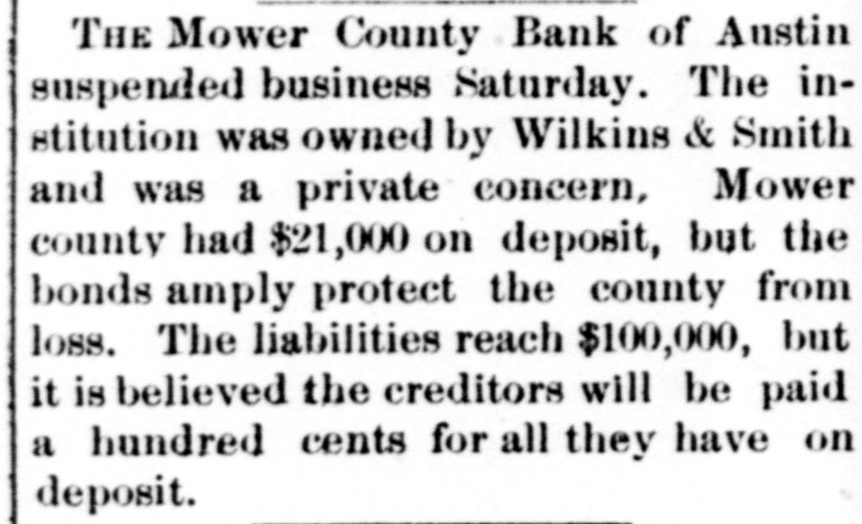
THE Mower County Bank of Austin suspended business Saturday. The institution was owned by Wilkins & Smith and was a private concern, Mower county had $21,000 on deposit, but the bonds amply protect the county from loss. The liabilities reach $100,000, but it is believed the creditors will be paid a hundred cents for all they have on deposit.


Article from Mower County Transcript, June 23, 1886

Click image to open full size in new tab

Article Text

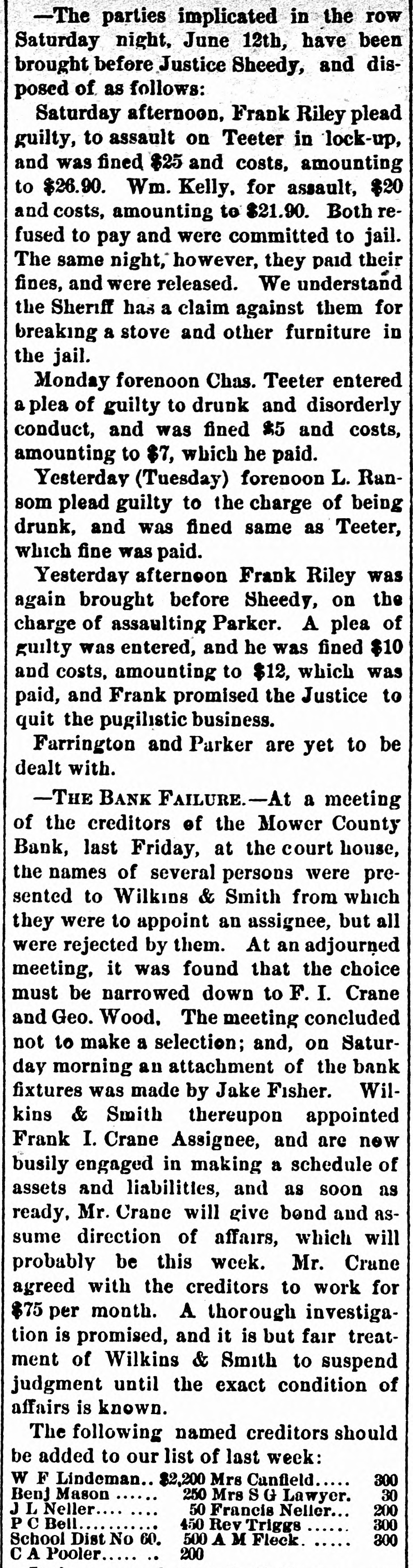
-The parties implicated in the row Saturday night, June 12th, have been brought before Justice Sheedy, and disposed of as follows: Saturday afternoon, Frank Riley plead guilty, to assault on Teeter in lock-up, and was fined $25 and costs, amounting to $26.90. Wm. Kelly, for assault, $20 and costs, amounting to $21.90. Both refused to pay and were committed to jail. The same night, however, they paid their fines, and were released. We understand the Sheriff has a claim against them for breaking a stove and other furniture in the jail. Monday forenoon Chas. Teeter entered a plea of guilty to drunk and disorderly conduct, and was fined $5 and costs, amounting to $7, which he paid. Yesterday (Tuesday) forenoon L. Ransom plead guilty to the charge of being drunk, and was fined same as Teeter, which fine was paid. Yesterday afternoon Frank Riley was again brought before Sheedy, on the charge of assaulting Parker. A plea of guilty was entered, and he was fined $10 and costs, amounting to $12, which was paid, and Frank promised the Justice to quit the pugilistic business. Farrington and Parker are yet to be dealt with. -THE BANK FAILURE.-At a meeting of the creditors of the Mower County Bank, last Friday, at the court house, the names of several persons were presented to Wilkins & Smith from which they were to appoint an assignee, but all were rejected by them. At an adjourned meeting, it was found that the choice must be narrowed down to F. I. Crane and Geo. Wood, The meeting concluded not to make a selection; and, on Saturday morning an attachment of the bank fixtures was made by Jake Fisher. Wilkins & Smith thereupon appointed Frank I. Crane Assignee, and are new busily engaged in making a schedule of assets and liabilities, and as soon as ready, Mr. Crane will give bond and assume direction of affairs, which will probably be this week. Mr. Crane agreed with the creditors to work for $75 per month. A thorough investigation is promised, and it is but fair treatment of Wilkins & Smith to suspend judgment until the exact condition of affairs is known. The following named creditors should be added to our list of last week: W F Lindeman 300 $2,200 Mrs Canfield Benj Mason 30 250 Mrs SG Lawyer. J L Neller 200 50 Francis Neller P C Bell 300 450 Rev Triggs School Dist No 60. 500 A M Fleck 300 200 C A Pooler


Article from St. Paul Daily Globe, July 14, 1886

Click image to open full size in new tab

Article Text

Austin. Special to the Globe. AUSTIN, July 13.-The work of settling up the affairs of the defunct Mower county bank is progressing slowly. Receiver Crane is now in full possession. It is understood here that Dunnell and White have agreed upon a division of the delegates from this county and the weaker candidates to withdraw in favor of the stronger in convention Both Republicans and Democrats were considerably amused on reading the editorial in the Pioneer Press of Sunday, seeking to ascribe the Minneapolis postoffice robbery to the administrative poiicy of Dr. Ames. The day. after the postoffice robbery a man was caught in the act of robbing the money drawer of the Fisher hotel at this place. Several of our citizens would like to ask the Pioneer Press if Mayor Ames' administrative policy is not to blame.


Article from St. Paul Daily Globe, July 14, 1886

Click image to open full size in new tab

Article Text

Austin. Special to the Globe. AUSTIN, July 13.-The work of settling up the affairs of the defunct Mower county bank is progressing slowly. Receiver Crane is now in full possession. It is understood here that Dunnell and White have agreed upon a division of the delegates from this county and the weaker candidates to withdraw in favor of the stronger in convention Both Republicans and Democrats were considerably amused on reading the editorial in the Pioneer Press of Sunday, seeking to ascribe the Minneapolis postoffice robbery to the administrative poiicy of Dr. Ames. The day. after the postoffice robbery a man was caught in the act of robbing the money drawer of the Fisher hotel at this place. Several of our citizens would like to ask the Pioneer Press if Mayor Ames' administrative policy is not to blame.


Article from The Austin Daily Herald, November 25, 1929

Click image to open full size in new tab

Article Text

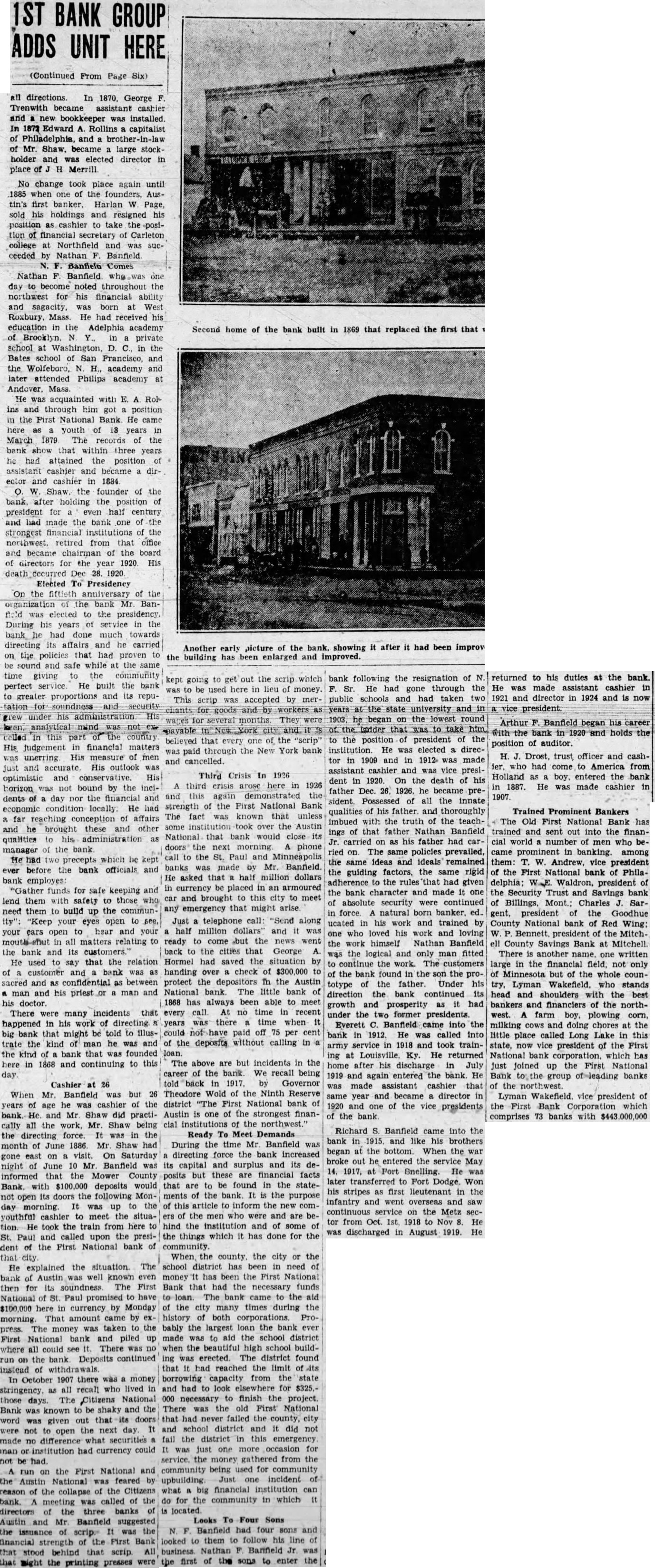
1ST BANK GROUP ADDS UNIT HERE (Continued From Page Six) all directions. In 1870, George F. Trenwith became assistant cashier and a new bookkeeper was installed. In 1872 Edward A. Rollins a capitalist of Philadelphia, and a brother-in-law of Mr. Shaw. became a large stockholder and was elected director in place of H Merrill No change took place again until 1885 when one of the founders, Austin's first banker. Harlan W Page, sold his holdings and resigned his position as cashier to take the posttion of financial secretary of Carleton college at Northfield and was succeeded by Nathan F. Banfield N. Banfield Comes Nathan F. Banfield. who one day to become noted throughout the northwest for his financial ability and sagacity, was born at West Roxbury, Mass. He had received his education in the Adelphia academy of Brooklyn. N Y., in a private school at Washington, D. C., in the Bates school of San Francisco, and the Wolfeboro, N. H., academy and later attended Philips academy at He was acquainted with E. A. Rok ins and through him got a position in the First National Bank He came here as youth of 18 years in March 1879 The records of the bank show that within three years he had attained the position of assistant cashier and became a director and cashier in 1884 O. W. Shaw. the founder of the bank, after holding the position of president for even half century and had made the bank one of the strongest financial institutions of the northwest. retired from that office and became chairman of the board of directors for the year 1920 His death_cccurred Dec 28. 1920 Elected To Presidency On the fiftieth anniversary of the organization of the bank Mr Banfield was elected to the presidency. During his years of service in the bank he had done much towards directing its affairs and he carried on the policies that had proven to the building has been enlarged and improved. be sound and safe while at the same time giving to the community kept going to get out the scrip which perfect service He built the bank was to be used here in lieu of money. to greater proportions and its repuThis scrip was accepted by mertation for soundness and security chants for goods and by workers as grew under his administration wages for several months. They were keen. analytical mind was not CX# celled in this part the country believed that every one of the "scrip" His judgement in financial matters was paid through the New York bank was unerring His measure of men and cancelled. just and accurate. His outlook was Third Crisis In 1926 optimistic and conservative. His A third crisis arose here in 1926 horizon was not bound by the inciand this again demonstrated the dents of a day nor the financial and strength of the First National Bank economic condition locally. He had The fact was known that unless far reaching conception of affairs some institution took over the Austin and he brought these and other National that bank would close its qualities to his administration as doors the next morning A phone manager of the bank. call to the St. Paul and Minneapolis He had two precepts which be kept banks was made by Mr. Banfield. ever before the bank officials and He asked that a half million dollars bank employes: in currency be placed in an armoured "Gather funds for safe keeping and car and brought to this city to meet lend them with safety to those who any emergency that might arise. need them to build up the community": "Keep your eyes open to see, Just a telephone call: "Send along your ears open to hear and your half million dollars" and it was mouth-shut in all matters relating to ready to come but the news went the bank and its customers." back to the cities that George A. He used to say that the relation Hormel had saved the situation by of a customer and a bank was as handing over a check of $300,000 to sacred and as confidential as between protect the depositors In the Austin a man and his priest or a man and National bank. The little bank of his doctor. 1868 has always been able to meet There were many incidents that every call. At no time in recent happened in his work of directing years was there a time when it big bank that might be told to illus- could not have paid off 75 per cent trate the kind of man he was and of the deposits without calling in the kind of bank that was founded loan. here in 1868 and continuing to this The above are but incidents in the career of the bank. We recall being day. Cashier at 26 When Mr. Banfield was but 26 years of age he was cashier of the bank. He and Mr. Shaw did practically all the work, Mr. Shaw being the directing force. It was in the month of June 1886 Mr. Shaw had gone east on a visit. On Saturday night of June 10 Mr Banfield was informed that the Mower County Bank. with $100,000 deposits would not open its doors the following Monday morning. It was up to the youthful cashier to meet the situation. He took the train from here to St. Paul and called upon the president of the First National bank of that city. He explained the situation. The bank of Austin was well known even then for its soundness The First National of St. Paul promised to have $100,000 here in currency by Monday morning. That amount came by express. The money was taken to the First National bank and piled up where all could see it. There was no run on the bank Deposits continued instead of withdrawals In October 1907 there was money stringency. as all recall who lived in those days. The Citizens National Bank was known to be shaky and the word was given out that its doors were not to open the next day. It made no difference what securities a man or institution had currency could not be had. run on the First National and the Austin National was feared by reason of the collapse of the Citizens bank. A meeting was called of the directors of the three banks of Austin and Mr. Banfield suggested the issuance of scrip. It was the financial strength of the First Bank that stood behind that scrip. All that might the printing presses were told back in 1917, by Governor Theodore Wold of the Ninth Reserve district "The First National bank of Austin is one of the strongest financial institutions of the northwest." Ready To Meet Demands During the time Mr. Banfield was directing force the bank increased its capital and surplus and its deposits but these are financial facts that are to be found in the statements of the bank. It is the purpose of this article to inform the new comers of the men who were and are behind the institution and of some of the things which it has done for the community. When, the county. the city or the school district has been in need of money has been the First National Bank that had the necessary funds to loan. The bank came to the aid of the city many times during the history of both corporations. Probably the largest loan the bank ever made was to aid the school district when the beautiful high school building was erected. The district found that it had reached the limit of -its borrowing capacity from the state and had to look elsewhere for $325.000 necessary to finish the project. There was the old First National that had never failed the county, city and school district and it did not fail the district in this emergency It was just one more occasion for service. the money gathered from the community being used for community upbuilding. Just one incident of what a big financial institution can do for the community in which It is located. Looks To Four Sons N. F. Banfield had four sons and looked to them to follow his line of business Nathan F Banneld Jr was the first of the sons to enter the bank following the resignation of N. F. Sr. He had gone through the public schools and had taken two years at the state university and in 1903. he began on the lowest round of the Ladder that was to take him to the position of president of the institution. He was elected a director in 1909 and in 1912 was made assistant cashier and was vice president in 1920. On the death of his father Dec. 26. 1926. he became president. Possessed of all the innate qualities of his father. and thoroughly imbued with the truth of the teachings of that father Nathan Banfield Jr. carried on as his father had carried on. The same policies prevailed, the same ideas and ideals remained the guiding factors, the same rigid adherence the rules that had given the bank character and made it one of absolute security were continued in force. A natural born banker. ed. ucated in his work and trained by one who loved his work and loving the work himself Nathan Banfield was the logical and only man fitted to continue the work. The customers of the bank found in the son the prototype of the father. Under his direction the bank continued its growth and prosperity as it had under the two former presidents. Everett C. Banfield came into the bank in 1912. He was called into army service in 1918 and took training at Louisville. Ky. He returned home after his discharge in July 1919 and again entered the bank. He was made assistant cashier that same year and became a director in 1920 and one of the vice presidents of the bank. Richard S. Banfield came into the bank in 1915. and like his brothers began at the bottom. When the war broke out he entered the service May 14. 1917. at Fort Snelling He was later transferred to Fort Dodge. Won his stripes as first lieutenant in the infantry and went overseas and saw continuous service on the Metz sector from Oct. 1st. 1918 to Nov 8. He was discharged in August 1919. He returned to his duties at the bank. He was made assistant cashier in 1921 and director in 1924 and is now a vice president. Arthur F. Banfield began his career with the bank in 1920 and holds the position of auditor. H. J. Drost. trust officer and cashier. who had come to America from Holland as a boy, entered the bank in 1887. He was made cashier in 1907. Trained Prominent Bankers The Old First National Bank has trained and sent out into the financial world a number of men who became prominent in banking. among them: T. W. Andrew, vice president of the First National bank of Philadelphia; W.E. Waldron, president of the Security Trust and Savings bank of Billings, Mont.: Charles J. Sargent, president of the Goodhue County National bank of Red Wing: W. P. Bennett. president of the Mitchell County Savings Bank at Mitchell. There is another name, one written large in the financial field, not only of Minnesota but of the whole country, Lyman Wakefield. who stands head and shoulders with the best bankers and financiers of the northwest. A farm boy, plowing corn, milking cows and doing chores at the little place called Long Lake in this state, now vice president of the First National bank corporation, which has just joined up the First National Bank group of leading banks of the northwest Lyman Wakefield. vice president of the First Bank Corporation which comprises 73 banks with $443,000,000