3308. State Bank (Tabor, IA)

Bank Information

Episode Type
Suspension โ†’ Reopening
Bank Type
state
Start Date
November 3, 1905
Location
Tabor, Iowa (40.898, -95.671)

Metadata

Model
gpt-5-mini
Short Digest
cedfc7bc50f89506

Response Measures

None

Description

Vice-president C. H. (Claude/Claud) H. Dye confessed forging notes and causing a large shortage; the State Bank of Tabor closed in early November 1905 under the state bank examiner's charge and reopened November 11, 1905 after relatives agreed to make good the shortage and arranged funds. No sustained depositor run is reported at reopening (articles explicitly state 'No run on the bank'). OCR variations: C. H./Claud/Claude Dye appear in texts; closure dates reported as Nov 3โ€“4, 1905. I corrected these to 1905 and standardized the bank name as 'State Bank of Tabor' (given bank info).

Events (3)

1. November 3, 1905 Suspension
Cause
Bank Specific Adverse Info
Cause Details
Vice-president C. H. Dye confessed forging notes and discounting forged paper, producing a shortage of roughly $50,000โ€“$53,000; state bank examiner took charge.
Newspaper Excerpt
The State bank of Tabor ... The bank is closed and the state bank examiner is in charge of its affairs.
Source
newspapers
2. November 4, 1905 Other
Newspaper Excerpt
A panic resulted among these students when they discovered that the bank was in the hands of the state examiner.
Source
newspapers
3. November 11, 1905 Reopening
Newspaper Excerpt
No special demonstration followed the reopening of the State Bank of Tabor yesterday, and deposits at the close of the day's business were practically the same as the opening, $130,000.
Source
newspapers

Newspaper Articles (8)

Article from The Minneapolis Journal, November 5, 1905

Click image to open full size in new tab

Article Text

SQUANDERED FUNDS IN BUCKETSHOPS Tabor Bank's Vicepresident Is Watched By a Director for Two Days. Special to The Journal. Council Bluffs, Iowa, Nov. 4.-Director Gregory of the State bank of Tabor, Iowa. played detective and watched Vicepresident H. C. Dye of the same institution for two days this week, and as a result he caught Dve in Omaha drinking heavily and squandering the bank's money in bucketshops. Dye has confessed to forging notes and indorsements, to borrowing tho bank's cash and to forging accounts to cover up his shortage. Aside from his shortage at the bank, which will amount to $20,000, he has confessed to an outstanding indebtedness of more than $40,000, making the total more than $50,000. The bank is closed and the state bank examiner is in charge of its affairs. Dye is now at the home of his father in Council Bluffs. Tabor is the seat of a big Congregational collรฉge and many students had the money with which they expected to pay their year's expenses, in the closed bank. A panic resulted among these students when they discovered that the bank was in the hands of the state examiner.


Article from Watertown Republican, November 8, 1905

Click image to open full size in new tab

Article Text

BANK EXAMINER IS DISCHARGED. COMPTROLLER OF CURRENCY TAKES FIRM STAND IN CASHIER CLARK'S CASE. Failure to Discover Conditions in Enterprise National at Allegheny (Pa.) Subject for Action. WASHINGTON, D. C., Nov. 4.The comptroller of the currency today removed from service Bank Examiner R. H. Mattern, on account of his failure to discover the conditions existing in the Enterprise National bank of Allegheny City, Pa. Owen P. Reeves, Jr., has been appointed to fill the vacancy. Mr. Reeves has been an assistant bank examiner in New York city. No Suspicion on Examiner. The case of Examiner Mattern has been carefully investigated and he has been given a full opportunity to be heard in his own defense. According to a statement issued by Comptroller Ridgely there is not the slightest ground for suspicion of any criminal intent on the part of Mr. Mattern or any corrupt collusion with the officers of the bank. He was, however, it is claimed, entirely too credulous in his acceptance of their statements, and careless and inefficient in his examinations. Schoolma'ams Storm Bank. PITTSBURG, Pa., Nov .4.-A swarm of women, mostly school teachers, attempted to storm the Enterprise National bank. Rumors became current that some depositors were to be paid off. Receiver Cunningham ordered the doors barred. It is reported that Receiver Cunningham has made the former employes of the bank sign over their properties to him. He has learned, it is said, that the tellers. bookkeepers and assistants knew of the bank's condition; that he made each one confess that the handwriting on the books was theirs, but that the cash and securities were not as they represented in the accounts; and that they said Cashier Clark compelled them to make false entries under threat of dismissal. Depositors May Get 25 Per Cent. Receiver Cunningham intimates that a final settlement may result in the payment of 25 per cent. to the depositors. The bank directors will make a legal battle on any judgments filed against them. Clark's Books Are Opened. The personal books and papers of Cashier Clark of the Enterprise National Bank of Allegheny, which were found in the dead cashier's desk, were taken up by the examiner today for the first time. It is hoped that in these personal or private books will be found some trace of the missing funds of the institution. Churchman-Banker Confesses. DES MOINES, Nov. 4.-C. H. Dye, vice president of the Tabor State bank at Tabor, treasurer of Tabor college, a trustee of the Congregational church there and treasurer of the local school district, confessed that he had forged notes amounting to between $50,000 and $75,000, which had been discounted by the bank. The bank was closed and the auditor of state immediately dispatched an examiner. The officers claim it is solvent despite the loss. The bank has a capital of $25,000 and deposits amounting to $165,000. He Floated Oil Schemes. Dye declares he abstracted the money from the bank to float oil schemes in Kansas in competition with the Standard Oil company. He also had been operating through the Chicago board of trade and sought to corner the stock of several large mining properties in the west. He took chances on the board and in mines to recoup himself for the oil losses. His father may make good for him. There is no disposition to prosecute the son if the losses are made good. The young man has lived in Tabor twelve years, serving as cashier of the bank for ten years. It was not until he was made a vice president that he attempted to get rich quickly.

Article from Evening Times-Republican, November 9, 1905

Click image to open full size in new tab

Article Text

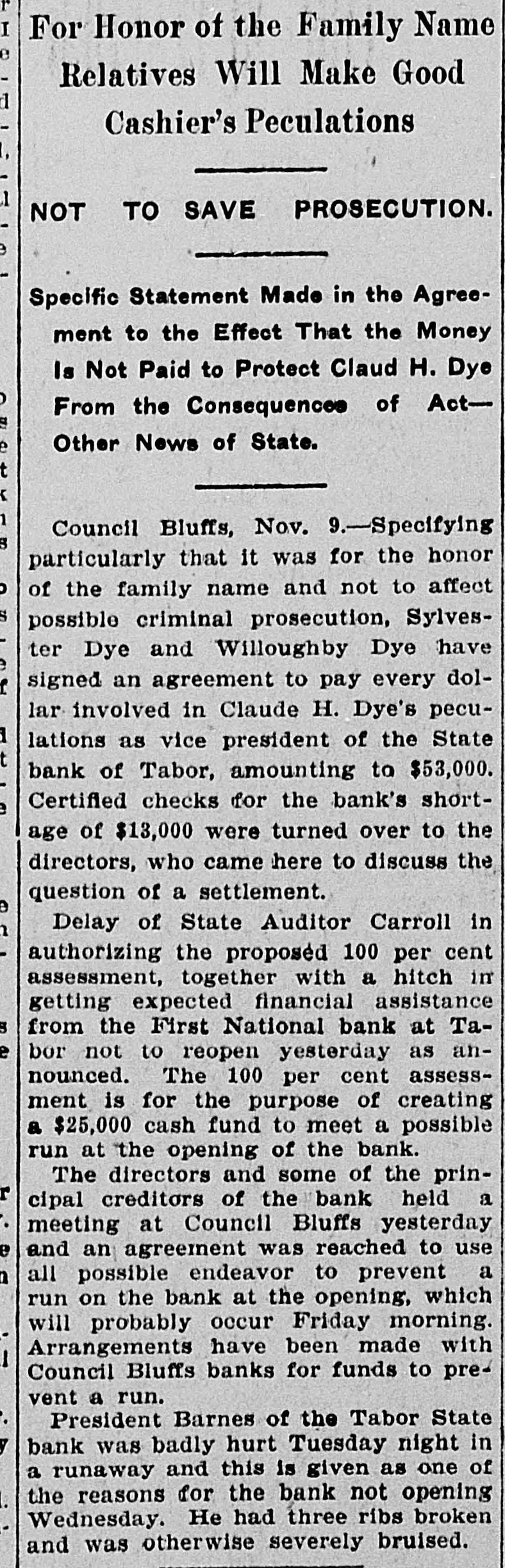
I For Honor of the Family Name e Relatives Will Make Good 1 Cashier's Peculations 1 NOT TO SAVE PROSECUTION. Specific Statement Made in the Agreement to the Effect That the Money Is Not Paid to Protect Claud H. Dye From the Consequences of ActOther News of State. 1 Council Bluffs, Nov. 9.-Specifying particularly that it was for the honor of the family name and not to affect possible criminal prosecution, Sylvester Dye and Willoughby Dye have signed an agreement to pay every dollar involved in Claude H. Dye's peculations as vice president of the State t bank of Tabor, amounting to $53,000. Certified checks for the bank's shortage of $13,000 were turned over to the directors, who came here to discuss the question of a settlement. Delay of State Auditor Carroll in 1 authorizing the proposed 100 per cent assessment, together with a hitch in getting expected financial assistance from the First National bank at Tabor not to reopen yesterday as announced. The 100 per cent assessment is for the purpose of creating a $25,000 cash fund to meet a possible run at the opening of the bank. The directors and some of the prinr cipal creditors of the bank held a meeting at Council Bluffs yesterday e and an agreement was reached to use all possible endeavor to prevent a run on the bank at the opening, which will probably occur Friday morning. Arrangements have been made with Council Bluffs banks for funds to prevent a run. President Barnes of the Tabor State bank was badly hurt Tuesday night in a runaway and this is given as one of the reasons for the bank not opening Wednesday. He had three ribs broken and was otherwise severely bruised.


Article from The Oskaloosa Herald, November 9, 1905

Click image to open full size in new tab

Article Text

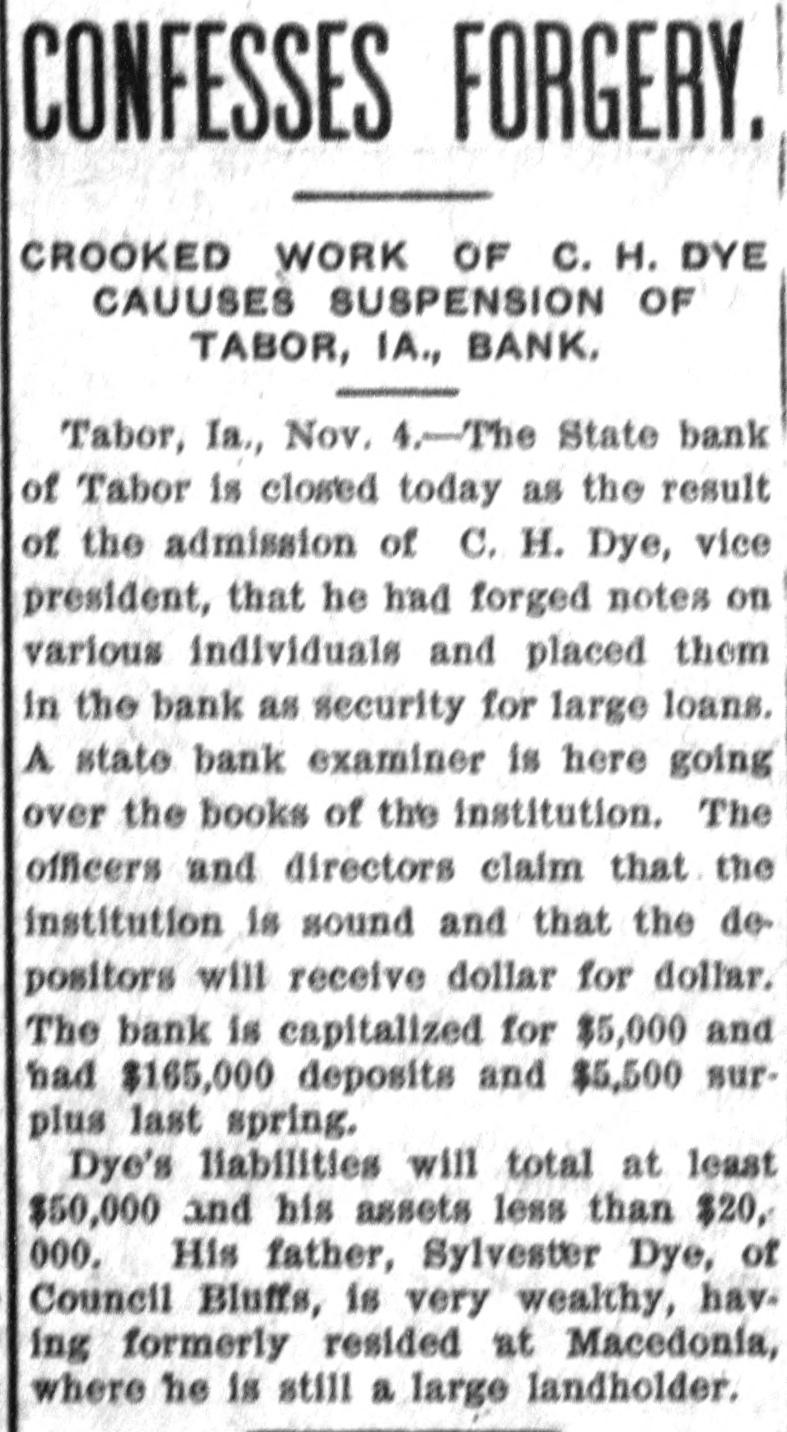
CONFESSES FORGERY. CROOKED WORK OF c. H. DYE CAUUSES SUSPENSION OF TABOR, IA., BANK, Tabor, Ia., Nov. 4.-The State bank of Tabor is closed today as the result of the admission of C. H. Dye, vice president, that he had forged notes on various individuals and placed them in the bank as security for large loans. A state bank examiner is here going over the books of the institution. The officers and directors claim that the institution is sound and that the depositors will receive dollar for dollar. The bank is capitalized for $5,000 and had $165,000 deposits and $5,500 surplus last spring. Dye's liabilities will total at least $50,000 and his assets less than $20, 000, His father, Sylvester Dye, of Council Bluffs, is very wealthy, having formerly resided at Macedonia, where he is still a large landholder.


Article from Wood County Reporter, November 10, 1905

Click image to open full size in new tab

Article Text

BANK EXAMINER IS DISCHARGED. COMPTROLLER OF CURRENCY TAKES FIRM STAND IN CASHIER CLARK'S CASE. Failure to Discover Conditions in Enterprise National at Allegheny (Pa.) Subject for Action. WASHINGTON, D. C., Nov. 4.The comptroller of the currency today removed from service Bank Examiner R. H. Mattern, on account of his failure to discover the conditions existing In the Enterprise National bank of Allegheny City, Pa. Owen P. Reeves, Jr., has been appointed to fill the vacancy. Mr. Reeves has been an assistant bank examiner in New York city. No Suspicion on Examiner. The case of Examiner Mattern has been carefully investigated and he has been given a full opportunity to be heard In his own defense. According to a statement issued by Comptroller Ridgely there is not the slightest ground for suspicion of any criminal intent on the part of Mr. Mattern or any corrupt collusion with the officers of the bank. He was, however, it is claimed, entirely too credulous in his acceptance of their statements, and careless and inefficient In his examinations. Schoolma'ams Storm Bank. PITTSBURG, Pa., Nov .4.-A swarm of women, mostly school teachers, attempted to storm the Enterprise National bank. Rumors became current that some depositors were to be paid off. Receiver Cunningham ordered the doors barred. It is reported that Receiver Cunningham has made the former employes of the bank sign over their properties to him. He has learned, it is said, that the tellers, bookkeepers and assistants knew of the bank's condition; that he made each one confess that the handwriting on the books was theirs, but that the cash and securities were not as they represented in the accounts; and that they said Cashier Clark compelled them to make false entries under threat of dismissal. Depositors May Get 25 Per Cent. Receiver Cunningham intimates that a final settlement may result in the payment of 25 per cent. to the depositors. The bank directors will make a legal battle on any judgments filed against them. Clark's Books Are Opened. The personal books and papers of Cashier Clark of the Enterprise National Bank of Allegheny, which were found in the dead cashier's desk, were taken up by the examiner today for the first time. It is hoped that in these personal or private books will be found some trace of the missing funds of the institution. Churchman-Banker Confesses. DES MOINES, Nov. 4.-C. H. Dye, vice president of the Tabor State bank at Tabor, treasurer of Tabor college, a trustee of the Congregational church there and treasurer of the local school district, confessed that he had forged notes amounting to between $50,000 and $75,000, which had been discounted by the bank. The bank was closed and the auditor of state immediately dispatched an examiner. The officers claim it is solvent despite the loss. The bank has a capital of $25,000 and deposits amounting to $165,000. He Floated Oil Schemes. Dye declares he abstracted the money from the bank to float oil schemes in Kansas in competition with the Standard Oil company. He also had been operating through the Chicago board of trade and sought to corner the stock of several large mining properties in the west. He took chances on the board and in mines to recoup himself for the oil losses. His father may make good for him. There is no disposition to prosecute the son if the losses are made good. The young man has lived in Tabor twelve years, serving as cashier of the bank for ten years. It was not until he was made a vice president that he attempted to get rich quickly.

Article from Evening Times-Republican, November 11, 1905

Click image to open full size in new tab

Article Text

NO RUN ON THE BANK. Tabor Institution is Reopened Without Any Unusual Demonstration. Council Bluffs, Nov. 11.-No special demonstration followed the reopening of the State Bank of Tabor yesterday, and deposits at the close of the day's business were practically the same as the opening, $130,000. Some of the bank's patrons who had been without bank facilities for several days featured the opening with heavy deposits as a special mark of confidence and quite a few withdrawals were made later in the day, but there was no demonstration that could be classed as a run. Cashier Hall admitted at the close of the day's business that the occasion had been one of great anxiety to him. A large amount of cash was on hand to satisfy prospective demands and a special watchman is being used at the bank tonight to guard the funds.


Article from Missouri Valley Times, November 16, 1905

Click image to open full size in new tab

Article Text

TABOR BANK OPENS. Tabor, 1a., Nov. 11.-The State Bank of Tabor, which closed its doors No'vember 3 owing to an alleged shortage of $20,000, has resumed business. Every dollar of the deficit was made good. This enabled the bank to re-establish its credit, and when it reopened yesterday morning merchants hastened to show their confidence by making large deposits. A good many withdrawals occurred later in the day, but the bank was amply prepared, and promptly paid every depositor who asked for his money.


Article from Audubon Republican, November 16, 1905

Click image to open full size in new tab

Article Text

TROUBLE IN WAKE OF TABOR BANK Des Moines, Nov. 10.-Auditor of State Carroll was called to Tabor yesterday by Bank Examiner H. M. Cormany because of the new complication which had arisen in the affairs of the State bank of Tabor, whose doors closed Friday. The bank was expected to open its doors on Wednesday and resume business as usual. President C. A. Barnes had arranged to secure plenty of ready money with which to meet any run that might be started on account of the reported shortage of the vice president, C. H. Dye. While on the mission of securing this ready cash, Mr. Barnes was very seriously injured in a runaway. He suffered the fracture of several ribs and otherwise was badly hurt. On account of his injuries it was impossible to carry out the plan he had formulated for resumption of business by the bank. Bank Examiner Cormany, who has charge of the bank all of this time and was familiar with the plan for reopening it, considered the complication of sufficient importance to wire the auditor of state to come on to examine the condition of the institution and make a statement concerning it to the people. Tabor, Nov. 10.-Sylvester Dye and Willoughby Dye. father and uncle of H. C. Dye, late vice president of the Tabor State bank, have arranged to assume every dollar of liability of the $53,000 involved in the vice president's recent peculations. These pay ments have been arranged for and will not be made under any restrictions or promises that young Dye shall be immune from punishment. The made simply to maintain the family honor, which the father and uncle allege has been without a stain for more than a century. Council Bluffs, Nov. 11.-No special demonstration or excitement follow ed the reopening of the State Bank of Tabor yesterday and deposits. at the close of the day's business were practically the same as the opening, $130,000.