West Side Bank (St Paul, MN)

Episode Information

Episode UID
3307411091165
Episode Type
Run β†’ Suspension β†’ Reopening
Bank Type
state
Bank ID
330741109 hash
Start Date
January 4, 1897
Location
St Paul, Minnesota (44.944, -93.093)

Metadata

Model
gpt-5-mini (chosen from majority vote of a three-model LLM ensemble)
Short Digest
a462497363db03e8

Response Measures

None

Description

Initially suspended/assigned Jan 4, 1897; later reorganized and made payments to the city and expected to reopen by mid-July 1897.

Events (6)

1. January 4, 1897 Other
Newspaper Excerpt
filed a deed of assignment to Charles F. Staples, the president of the bank; assignee Staples was handling schedules and reorganization plans were discussed in court later that month.
Source
newspapers
2. January 4, 1897 Run
Cause
Local Banks
Cause Details
Depositors withdrew funds after the failure/suspension of neighboring St. Paul banks (Bank of Minnesota, then Germania and Allemannia), and the Allemania returned West Side clearings.
Measures
Closed doors, directors met and filed deed of assignment to Charles F. (or C.F.) Staples; assignee worked on schedules and sought reorganization.
Newspaper Excerpt
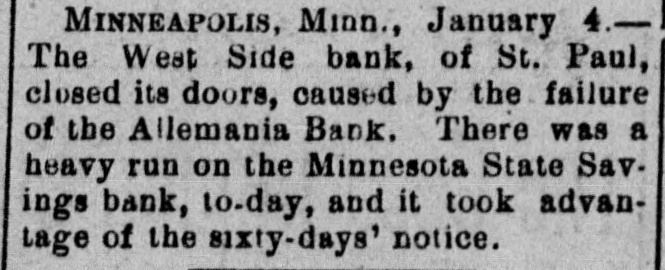
a run began on the West side bank...when the news of the suspension of the Allemannia and Germania banks reached the West side
Source
newspapers
3. January 4, 1897 Suspension
Cause
Local Banks
Cause Details
Suspension was directly due to the failure/suspension of the Allemannia (and general panic following Bank of Minnesota failure) which returned its clearings and precipitated withdrawals.
Newspaper Excerpt
the bank directors had determined to suspend...Blinds on the windows of the West Side bank were drawn shortly after 1 o'clock yesterday, and the sign 'Bank Closed' was hung on the door.
Source
newspapers
4. July 17, 1897 Other
Newspaper Excerpt
The reorganization plan is expected to be put into effect by an order of the district court on July 17; bank expects to reorganize by cutting capital stock and levying assessment.
Source
newspapers
5. July 17, 1897 Reopening
Newspaper Excerpt
bank expects to reorganize by cutting its capital stock...the reorganization plan is expected to be put into effect by an order of the district court on July 17.
Source
newspapers
6. November 25, 1897 Other
Newspaper Excerpt
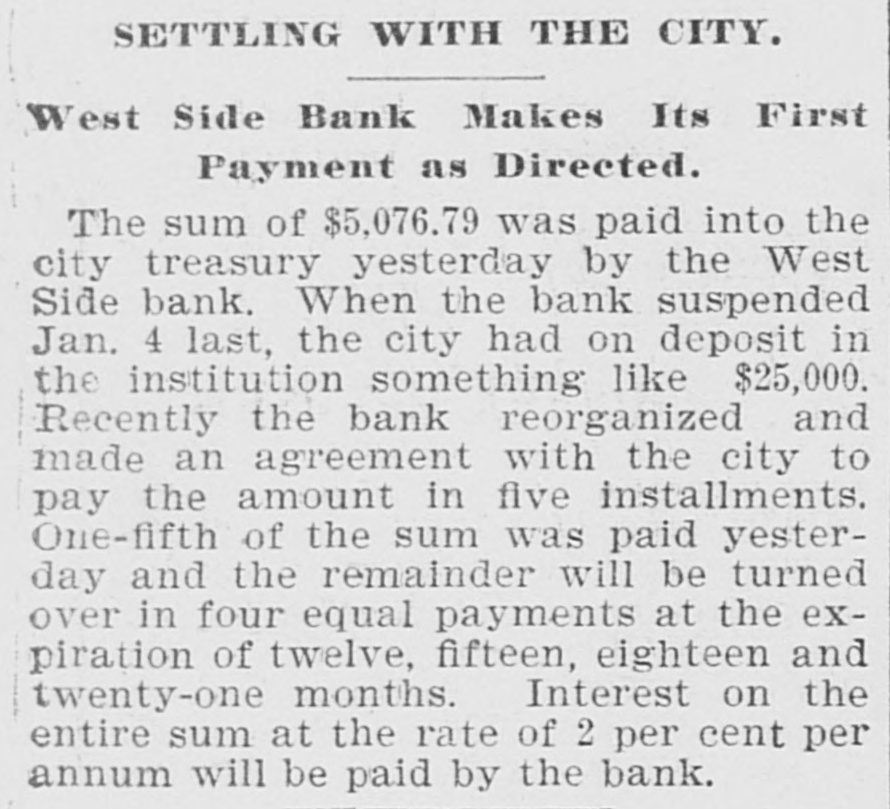
West Side Bank Makes Its First Payment as Directed...the bank suspended Jan. 4 last...reorganized and made an agreement with the city to pay the amount in five installments.
Source
newspapers

Newspaper Articles (23)

Article from Daily Camera, January 4, 1897

Click image to open full size in new tab

Article Text

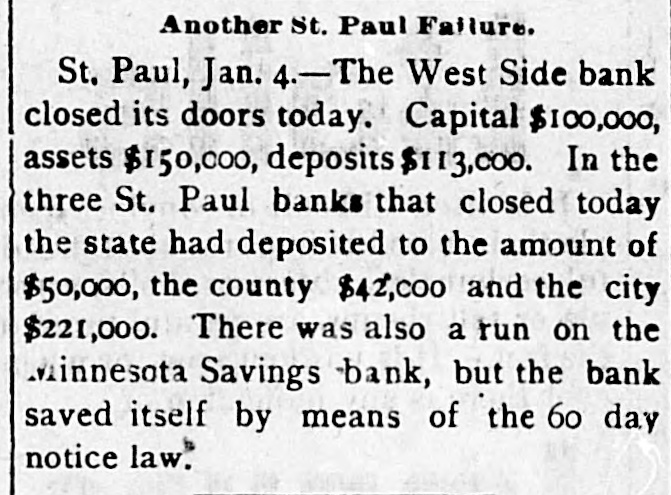
Another St. Paul Failure. St. Paul, Jan. 4.-The West Side bank closed its doors today. Capital $100,000, assets $150,000, deposits $113,000. In the three St. Paul banks that closed today the state had deposited to the amount of $50,000, the county $42,000 and the city $221,000. There was also a run on the Minnesota Savings bank, but the bank saved itself by means of the 60 day notice law."


Article from Rock Island Argus, January 4, 1897

Click image to open full size in new tab

Article Text

More Banks Collapse at St Paul. PUBLIC FUNDS ARE INVOLVED A Little Failure in Northern Iowa. Baltimore Banker Commits Suicide. St. Paul, Mian., Jan. 4 -The Germania bank has assigned to Peter M. Korst, its cashier. The bank was a state institution with a capital of $400,000. It has stood the run nearly two weeks. The last statement of the condition Dec. 17 showed loans and discounts of $975,420; stocks and bonde, $37,890; banking house certificates, $257,847;currency, $42,339; gold, $103,560; other resourses bring the aggregate up to $1,625,768. The deposits aggregate $1,001,910; due the bank $90,203. President Willis says the closing is the result of the unreasonable panic; that the bank will be reopened as soon as the people regain their cool sense. The bank paid $335,000 in the last nine days. The Allemania bank, a state institution with a capital of $400,000, having a clienage similar to that of the Germania, closed its doors soon after the latter announced its assignment. The Allemania also suffered by the panicky feeling after the Bank of Minnesota closed. The last official statement, Dec. 17, showed loans and discounts of $759,723; due from other banks, $35,927; cash, $77,674; demand loans, $62,881, and other items making a total in resources of $1,061,010. The deposits were $602,308. President Scheffer says the failure is due to the combined withholding and withdrawing of deposits. The West Sidebank has just closed. The Westside bank had a capital of $100,000. It cleared through the Allemania and had its clearings returned today because of the closing of that bank. Public funds were on deposit in all three banks. The state had $10,546 the Germania, $35,303 in the Alleis, $3,647 in the Westside. The nty treasurer had $9,635 in the mania, $25,215 in the Allemania, d $7,585 in the Westside. The ty treasurer had $49,794 in the rmania, $151,457 in the Allemania, d $21,894 in the Westside. Mason City, Iowa, Jan. 4.-The irst City Bank of Nora Springs assigned today to Byron Gammidg. Baltimore, Jan. 4.-Richard Corneliur, cashier in the Farmers and Planters' National bank, drowned himself at Druid Hall park today.


Article from The Record-Union, January 5, 1897

Click image to open full size in new tab

Article Text

Demands Made Upon Them. Expected That They Will Soon be Reorganized and Reopened. The President of One of the Institutions Makes a Statement in Which He Charges That Evil Disposed Persons Maliciously Directed the Attempt to Break the Bank Over Which He Presided. ST. PAUL, Jan. 4.-The Germania, Allemannia and West Side Banks, all doing business as State Banks, to-day closed their doors. The failure of the Bank of Minnesota December 22d caused unrest in the community, and depositors withdrew their money from these banks to such an extent that they were forced to go to the wall because they had not Lunds enough on hand to meet the demands made upon them. Any of the three, however, is solvent, and they will be re-organized as soon as the money for that purpose can be put into use. The directors of the Germania met this afternoon and appointed a committee on re-organization. The Germania is in the hands of P. M. Kerst as assignee, and the other two are in the hands of Bank Examiner Kenyon. A receiver will be appointed for the Allemannia tomorrow, and the West Side Bank will try to make arrangements with its creditors and re-open without the intervention of receiver. The last official statement of the Germania Bank showed total resources of $1,625,768, $253,847 of this being in the building and $975,420 in loans and discounts. Liabilities $1,625,768, including $400,000 capital stock and $633,019 in time certificates of deposits. The deposits subject to check are $44,551. The closing of the Germania was in pursuance of the action of the directors on Saturday night, who concluded to protect their depositors by suspending. President Willius prepared a statement in which he said: "As soon as the result of the Presidential election became known matters began to improve in a remarkable degree. and there did not seem to be any doubt on May 1st the bank would be in so strong and impregnable condition that an assessment could successfully be made on the stock. This was the condition on the 22d of December, when the suspension of the Bank of Minnesota occurred, following immediately upon the failure of the National Bank of Illinois of Chicago, which came as unexpectedly as a stroke of lightning in midwinter. Failures of other Minnesota banks increased the panicky feeling, but I did not fear any disastrous outcome until it became apparent that certain eveil disposed persons maliciously directed the attempt toward the Germania Bank, circulating false and manufactured reports regardI ing it with systematic persistency. hoped from day to day that the excitement would subside and make room for better judgment, but it grew in intensity. The attack became bolder every day. After the close of business on Saturday, the 2d of January, we found that the withdrawal of deposits had assumed such dimensions that we did not feel justified to continue receiving deposits or to pay out money beyond that day without submitting the condition of affairs to the directors. Consequently we called a special meeting of the board on said day at 7:30 p. m. We had paid off nearly $225,000 deposits in nine business days, and kept on hand and in reserve fund $70,000. which shows the unreasonableness of the attack. The directors came immediately to the conclusion that the action of the officers had been correct, and however deplorable it might be, it became their duty, for the protection of depositors and other creditors, to close the doors and place the assets of the bank in charge of an assignee." The Allemannia closed a few minutes before 11 o'clock, with a crowd of depositors clamoring at the paying telJer's window for their money. President Scheffer said: "Our suspension is due to the large number of withdrawals this morning, and the fact that most of the new depositors withheld their deposits. The news of the suspension of our neighbor, the Germania, precipitated the run here, and of course with all the deposits being withheld, and the fact that there was a steady withdrawal we could not stem the tide. When the full force of the Germania's failure burst on them the crowd seemed to become panic-stricken, and they came down upon us like a wolf on the fold. When the Bank of Minnesota failed the business men fortunately were not disturbed, and few were caught. The feeling of ease returned shortly. and might have continued had it not beeen for the failure of the four banks in Minneapolis. Then the panicky feeling came back, and was intensified by the fact that the business men caught it very badly. The feeling naturally spread over here. and the people have not been easy since then. When the Germania closed its doors this morning that was the last straw in the case, and they came down upon us like a herd of wolves." The total resources of the Allemannia, according to their report of the same day. was $1,061,009. including $706,842 of loans and discounts. Liabilities also $1,061,009. including capital stock of $400,000 and deposits of $329, 789. Speaking of the failure of the West Side Bank, President Staples said: "Our suspension was due to the Allemannia. We did all of our clearing through the Allemannia. and this morning they failed to cover our clearings, and sent them all back to us. News of the suspension of the Germania and Allemannia spread through West St. Paul, and our depositors began scram-


Article from The Wheeling Daily Intelligencer, January 5, 1897

Click image to open full size in new tab

Article Text

THREE BANK FAILURES In St. Paul Due to the Runs Caused by the Closing of the Bank of Minnesota. ST. PAUL, Minn.. Jan. 4.-The Germania Bank, a state Institution, capital $400,000, did not open for business to-day, but announced its assignment to Peter M. Kerst, who for the past year or two has been the cashier of the bank. The announcement stated that this action was taken after full consideration of all the phases of the situation, as it was deemed best for all concerned that this action be taken. The bank stood a run for nearly two weeks, its depositors beginning to withdraw their accounts at the time the Bank of Minnesota closed on December 22. The Germania bank has been organized for many years, ex-Governor Alex Ramsey being for a long time president, and William Bickel cashier. A few years ago Governor Ramsey retired from the bank, becoming vice president of the newly organized Allemania Bank. He was succeeded by Gustav Willius, as president of the Germania: T. H. Menk being vice president, and P. M. Kerst cashier. The Allemania bank, capital $400,000 and having a clientage similar to that of the Germania, closed its doors soon after the other bank had announced its assignment. The Allemania bank was organized last year, being the successor of the Commercial bank, William Beckel, formerly president of the Germania bank, joining forces with Albert Scheffer, of the Commercial, to organize the new bank, of which Mr. Scheffer was made president, and E. D. Barnett, cashier. The Commercial had formerly been a national bank. but after its failure in the spring of 1892, it was re-organized a state bank and became merged last spring in the present Allemania bank. This bank was also a sufferer by the panicky feeling after the Bank of Minnesota had closed. President Scheffer, of the Allemania, said at noon that they had been suffering from the panic, the failure being due to the combined withholding There and withdrawing of deposits. had for some time been a gradual drain on the bank, and it seemed to gain added force as soon as the announcement of the Germania failure was announced. A crowd of depositors goon gathered, demanding their money and at 11 o'clock it was decided to close at once, State Bank Examiner Kenyon being called in and taking possession of the bank. President Willius told an Associated Press reporter to-day that the closing was the result of an unreasonable pan1c, and that the bank would be opened for business just as soon as the people regained their usual cool sense. The bank, as a result of the panicky feeling. had paid out to depositors $335,000 in the last nine days and as they saw what the continuation of this would lead to, the directors had decided to close for the present. Mr. Willius says he fully expects to have the bank re-opened and ready for business by the last of March. At a few minutes before 2 o'clock the West Side Bank organibed in 1886, with a capital of $100,000, closed its doors, The president, C. F. Staples. told the Associated Press representative that the bank cleared through the Allemania and had its clearings returned today because of the closing of the bank. This was but one of the causes that led to the closing of the West Side Bank, which had suffΓ©red considerably from the general condition of affairs. The West Side bank has not closed finally, but in view of the panic created by the sudden closing of the Germanla and Allemania. and because of the summary return by the latter of the West Side bank's clearings It was decided to close pending action by the bank's directors. who are now in session. The bank is considered strong. though small, and loss to depositors is not thought possible.


Article from The Salt Lake Herald, January 5, 1897

Click image to open full size in new tab

Article Text

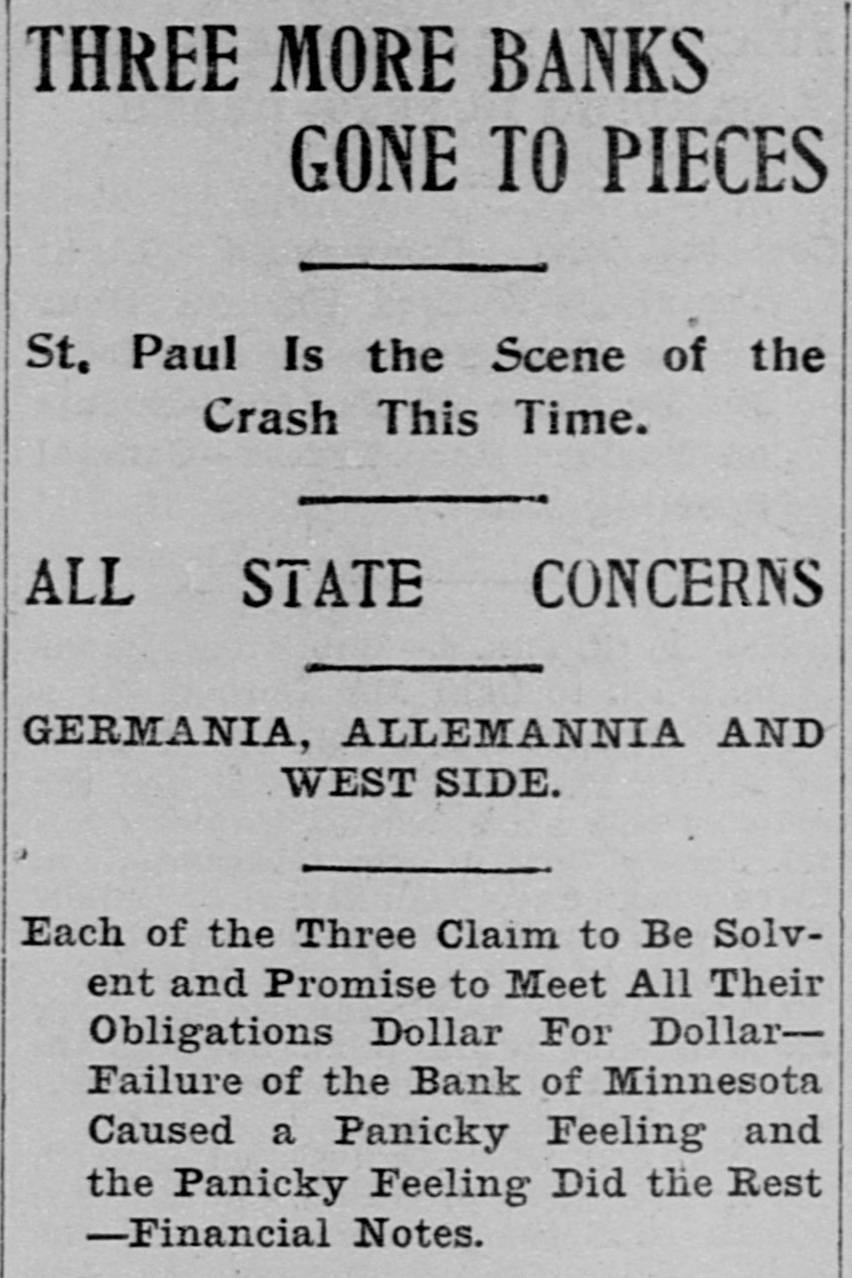
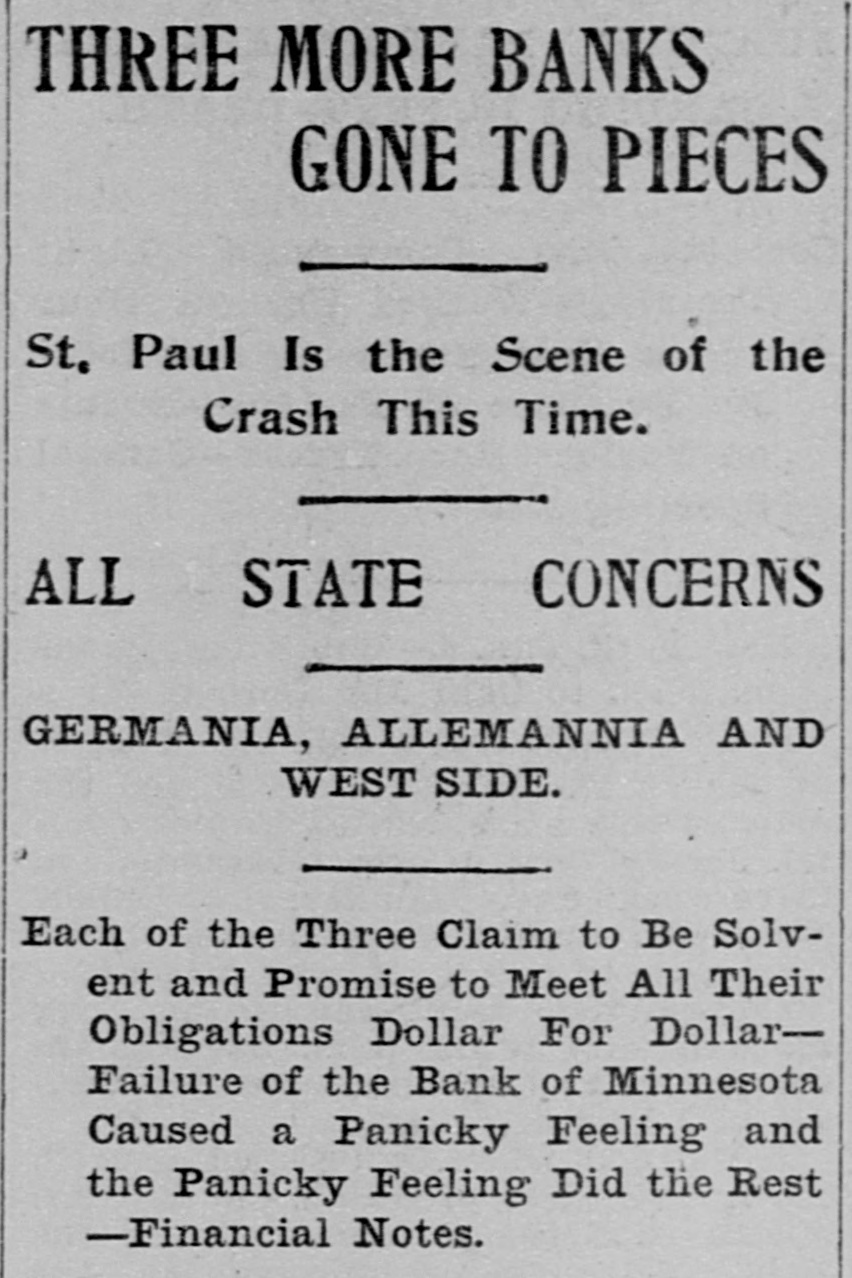
THREE MORE BANKS GONE TO PIECES St. Paul Is the Scene of the Crash This Time. ALL STATE CONCERNS GERMANIA, ALLEMANNIA AND WEST SIDE. Each of the Three Claim to Be Solvent and Promise to Meet All Their Obligations Dollar For DollarFailure of the Bank of Minnesota Caused a Panicky Feeling and the Panicky Feeling Did the Rest -Financial Notes.


Article from The Daily Morning Astorian, January 5, 1897

Click image to open full size in new tab

Article Text

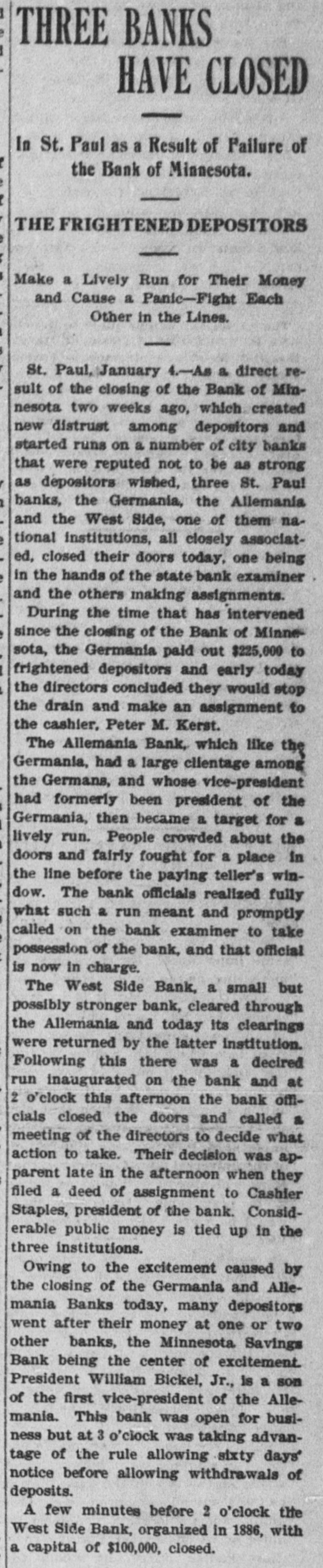
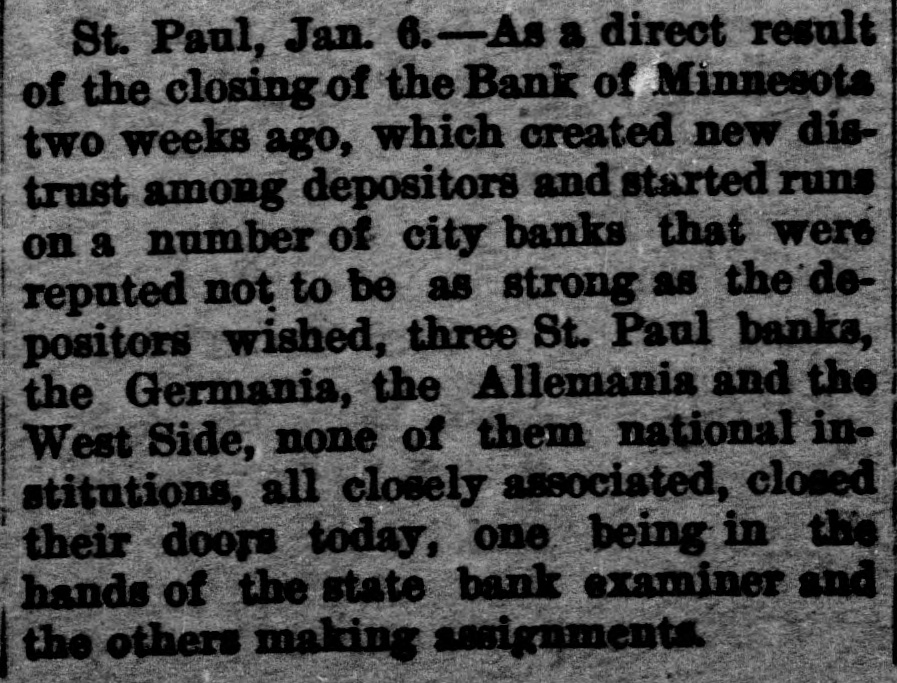
THREE BANKS HAVE CLOSED In St. Paul as a Result of Failure of the Bank of Minnesota. e / THE FRIGHTENED DEPOSITORS e : I Make a Lively Run for Their Money and Cause a Panic-Fight Each Other in the Lines. I I r St. Paul, January 4.-As a direct re: sult of the closing of the Bank of Minnesota two weeks ago, which created new distrust among depositors and started runs on a number of city banks that were reputed not to be as strong as depositors wished, three St. Paul r banks, the Germania, the Allemania a and the West Side, one of them nae tional institutions, all closely associat: ed, closed their doors today, one being in the hands of the state bank examiner e : and the others making assignments. . During the time that has intervened since the closing of the Bank of Minne e : sota, the Germania paid out $225,000 to i frightened depositors and early today i the directors concluded they would stop the drain and make an assignment to the cashier, Peter M. Kerst. The Allemania Bank, which like the Germania, had a large clientage among the Germans, and whose vice-president had formerly been president of the Germania, then became a target for a lively run. People crowded about the doors and fairly fought for a place in the line before the paying teller's window. The bank officials realized fully what such a run meant and promptly called on the bank examiner to take possession of the bank, and that official is now in charge. The West Side Bank, a small but possibly stronger bank, cleared through the Allemania and today its clearings were returned by the latter institution. Following this there was a decired run inaugurated on the bank and at 2 o'clock this afternoon the bank offlcials closed the doors and called a meeting of the directors to decide what action to take. Their decision was apparent late in the afternoon when they filed a deed of assignment to Cashier Staples, president of the bank. Considerable public money is tied up in the three institutions. Owing to the excitement caused by the closing of the Germania and Allemania Banks today, many depositors went after their money at one or two other banks, the Minnesota Savings Bank being the center of excitement. President William Bickel, Jr., is a son of the first vice-president of the Allemania. This bank was open for business but at 3 o'clock was taking advantage of the rule allowing sixty days' notice before allowing withdrawals of deposits. A few minutes before 2 o'clock the West Side Bank, organized in 1886, with a capital of $100,000, closed.


Article from The Evening Herald, January 5, 1897

Click image to open full size in new tab

Article Text

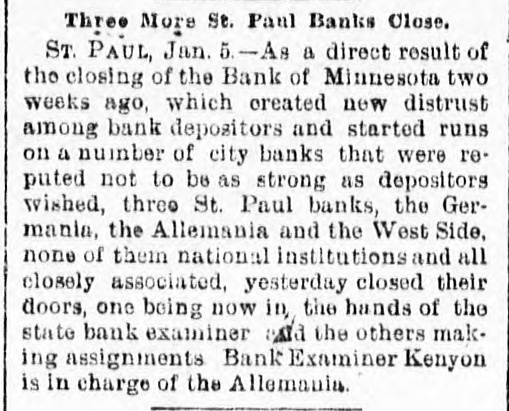
Three More St. Paul Banks Close. ST. PAUL, Jan. 5.-As a direct result of the closing of the Bank of Minnesota two weeks ago, which created new distrust among bank depositors and started runs on a number of city banks that were reputed not to be as strong as depositors wished, three St. Paul banks, the Germania, the Allemania and the West Side, none of them national institutions and all closely associated, yesterday closed their doors, one being now in the hands of the state bank examiner and the others making assignments. Bank Examiner Kenyon is in charge of the Allemania.


Article from The Saint Paul Globe, January 5, 1897

Click image to open full size in new tab

Article Text

WEAK BANKS CLOSE THREE OF THE SMALLER INSTITUTIONS OF ST. PAUL SHUT THEIR DOORS, ONE GOES, OTHERS FOLLOW. AND ALLEMANNIA GERMANIA, WEST SIDE SUSPEND IN THAT ORDER. COULDN'T STAND WITHDRAWALS. Maurice Auerbach Appointed Receiver of the Allemannia-The Others Assign. St. Paul banks were put to the test yesterday. Three comparatively unimportant ones went to the wall. The others were impregnable. In fact, public confidence was shown in all the others by the fact that a larger number of deposits than usual were made in those institutions. Of the three that failed, two were understood to be under a strain really before the opening of business today, one carrying the other down; the third was embarrassed by one of the others, and was caught in the maelstrom. The Germania bank, whose condition has been common gossip for about two weeks, did not open its doors yesterday at all. One hour before the usual banking hour, there was filed in the office of Clerk of the Court Rogers a deed of assignment to Peter M. Kerst, who has been the cashier of the bank. When 10 o'clock came and the doors of the Germania were not opened to the bank customers, the news spread like wild fire. The expected had happened. The Allemannia bank was soon in the throes of a lively "run." The morning deposits were not coming in, and it became apparent that the contest was an unequal one. The officers of the bank decided to protect their depositors by suspending payment, so that all would be on an equal footing. The savings banks were afterwards drawn upon by depositors to such an extent that most of them claimed the 60 days' notice for savings deposits, which the law allows them, and the other savings banks will do so today. About noon the West side bank succumbed to the pressure. This bank cleared through the Allemannia and its suspension was due directly to the going down of the Allemannia. The other banks, as told heretofore, took care of their customers all day, with the exception of the precautions taken by the savings banks to protect their depositors. Reassuring advices were received from Chicago and New York last night after the close of business, and there will be no dearth of money today with which to pay off any claims, even if they are presented, which is considered unlikely. Bankers last night agreed that there was no possibility of any more local banks suspending. In fact, a large number of the depositors in the banks from which withdrawals were made yesterday. hurried to the other banks of the city to re-entrust their savings.


Article from The Saint Paul Globe, January 5, 1897

Click image to open full size in new tab

Article Text

WEST SIDE BANK PULLED IN. Decided Best for All Parties to Suspend. Blinds on the windows of the West Side bank were drawn shortly after 1 o'clock yesterday, and the sign "Bank Closed," was hung on the door. A group of depositors were in waiting at the time, and they were informed that the bank directors had determined to suspend. The suspension of this bank was directly due to the suspension of the Allemannia bank. When the news of the suspension of the Allemannia and Germania banks reached the West side, a run began on the West side bank. The officers of the bank realizing that all the funds would soon be exhausted, determined to close the doors and if possible save the bank. The directors went into session and remained closeted in the little room back of the bank all the afternoon. No offi-


Article from The Saint Paul Globe, January 5, 1897

Click image to open full size in new tab

Article Text

# NO CAUSE FOR ALARM. As far as the closing of three comparatively small banks in this city yesterday is concerned, it is a reason for confidence in the future rather than for alarm. There is not the slightest foundation for the senseless agitation that exhibited itself in the minds of a few of our people; and we hope, both for the credit and the prosperity of the city, that there will be no more of it. The facts are perfectly evident on their fact, and there is no reason to conceal, deny, distort or misrepresent them. The closing of the Bank of Minnesota, together with recent bank failures in Minneapolis, had filled the public mind with apprehensions that were groundless. These were the cause of wild rumors without foundation, and of an alarm that the events themselves could not have created. The failures yesterday would not, but for these preceding events, have caused a ripple on the surface. It is utterly absurd that they should be regarded now as serious. That the business of the Germania has for some time been unsatisfactory was a matter of general knowledge. The same has been true lately of the Allemannia; a fact which was brought sharply to the public notice rather than relieved by heavy deposits of public moneys. In ordinary times, neither of these institutions would have experienced difficulty in weathering the storm. But with the distrust created by other failures, withdrawals became frequent and deposits fell off. To this there is but one end in the banking business; just as the cessation of purchases will speedily end the career of any merchant. The West Side bank is a small institution, apparently perfectly solvent, which had to yield to the accident that it cleared through the Allemannia. This formal connection required its suspension to protect its own interests. And this is all that there is of the little flurry yesterday. We cannot reprehend too strongly the folly of those who began to draw their deposits out of the vaults of other banks. It is not only without reason, it is suicidal. The depositors can break any bank in the world if they all demand their money. No such institution keeps or can keep enough cash on hand to pay all depositors on demand. The savings banks, which are above reproach, have very properly taken advantage of the law requiring sixty days' notice before deposits can be withdrawn. Although amply able to meet every demand upon them, the sight of people taking out their funds has an alarming effect upon the minds of those who know nothing of the circumstances. As to the other banks, they are as proof against attack as any other in the country. The statement which we print from the comptroller of the currency at Washington shows the senselessness of wild rumors that find credence in such times. Nowhere are the national banks better fortified. And those that are still doing business under the state law are impregnable. The fact is that every weak banking institution has been weeded out, and some that are able to pay in full have been foreed to suspend. Now the thing to do is for the people to understand that all that are left are secure against any attack, and to realize that their money is safer where it now is than it would be in their own hands. We assure every reader that there exists no longer the least cause for disturbance or doubt in any quarter; that the storm has wholly passed; and that the man who draws any money out of any institution hereafter, except for legitimate needs and business purposes, is guilty not only of outrageous folly, but of a crime against the interests of St. Paul, and especially against his own. "A BURLY HATRED OF CANT." The death of Joseph McCullagh, the virile editor of the St. Louis Globe.


Article from The Evening Tribune, January 5, 1897

Click image to open full size in new tab

Article Text

THREE BANKS SUSPEND. Bank Examiner at St. Paul Kept Exceedingly Busy These Days. Cashier Cornelius of the Farmers' Bank of Baltimore Suicides. ACCOUNTS WERE $60,000 SHORT. He Had Been Very Prominent as a Local Preacher-His Dead Body Was Found In a Pond. St. Paul, Jan. 5.-As a direct, result of the closing of the Bank of Minnesota two weeks ago, which created new distrust among bank depositors and started runs on a number of city banks that were reputed not to be as strong as depositors wished, three St. Paul banks, the Germania, the Allemania and the West Side, none of them national institutions, and all closely associated, yesterday closed their doors, one being now in the hands of the state examiner and the others making assignments. During the time that has intervened since the closing of the Bank of Minnesota the Germania bank paid out $225,000 to frightened depositors, and early yesterday the directors concluded that they would stop the drain and made an assignment to the cashier, Peter M. Korst. The Allemania bank, which, like the Germania, had a large clientage among the Germans, and whose vice president had formerly been president of the Germania, then became the target for as lively a run as could be seen I during panic times anywhere. People crowded about the doors and fairly fought for a place in the line before the paying teller's window, The bank officials realized fully what such a run meant, and promptly called on Bank Examiner Kenyon to take possession 1 of the bank, and that official is now in charge. The West Side bank was small, but tuh the


Article from The Indianapolis Journal, January 5, 1897

Click image to open full size in new tab

Article Text

Suspension of the Germania, the Allemania and the West-Side, the Latter a Small Concern. DEPOSITORS WERE PANICKY AND THE BANKS LACKED CASH TO MEET SUDDEN DEMANDS. Officers Confident of Reopening When Assets Are Realized On-A Devil's Lake Bank Closed. ST. PAUL, Minn., Jan. 4.-As a direct reselt of the closing of the Bank of Minnesota, two weeks ago, which created new distrust among bank depositors and started runs on a number of city banks that were reputed not to be as strong as depositors wished, three St. Paul banks-the Germania, the Allemania and the West Side, none of them national institutions, and all closely associated-to-day closed their doors, one being now in the hands of the state bank examiner and the others making assignments. During the time that has intervened since the closing of the Bank of Minnesota, the Germania Bank paid out $225,000 to frightened depositors, and early to-day the directors concluded that they would stop the drain, and made an assignment to the cashier. Peter M. Kerst. The Allemania Bank, which, like the Germania, had a large clientage among the Germans, and whose vice president had formerly been president of the Germania, then became the target for as lively a run as could be seen during panic times anywhere. People crowded about the doors and fairly fought for a place in the line before the paying teller's window. The bank officials realized fully what such a run meant, and promptly called on Bank Examiner Kenyon to take possession of the bank, and that official is now in charge. The West Side Bank. a small but possibly stronger bank, cleared through the Allemania, and to-day its clearings were returned by the latter institution. Following this there was a decided run inaugurated on the bank, and at 2 o'clock this afternoon the bank officials closed the doors and called a meeting of the directors to decide what action to take. Their decision was apparent late in the afternoon, when they filed a deed of assignment to Charles F. Staples, the president of the bank. Considerable public money is tied up in the three institutions, but there is an ample supply for all immediate needs in the other banks of the city. The assignment of the Germania and West Side banks has brought up a somewhat new question in the banking laws of the State, and the courts will be called on to settle it. The state bank examiner doubts their right to assign. holding that they should have, under the law. turned over their assets to him. The attorney general intimates that he will bring action to test the matter as soon as the papers can be prepared. During the day numerous reports of trouble among the other banks were current, and a few banks suffered runs of greater or less intensity, but the savings banks were protected by the law that allows them to require sixty days notice before paying out deposits, and the national banks are in a strong condition and have no fear of anything of the sort. THE GERMANIA BANK. The Germania Bank stood a run of nearly two weeks, its depositors beginning to withdraw their accounts at the time the Bank of Minnesota closed, on Dec. 22. The last official statement of the condition of the bank was made Dec. 17, 1896, and was as follows: -Resources


Article from The Bryan Daily Eagle, January 6, 1897

Click image to open full size in new tab

Article Text

CAUGHT IN ALL THREE. / State, City and County Had Money In St. Paul Banks. ST. PAUL, Jan. 5.-The public school funds were on deposit in all three banks that closed on yesterday. The state had $10,456 in the Germania, $35,302 in the Allemania and $3646 in the West Side bank. The county treasurer had deposited $9633 in the Germania, $26,215 in the Allemania and $7564 in the West Side bank. City Treasurer Horst had on deposit city funds in the Germania $49,793, in the Allemania, $151,456 and in the West Side $21,894. The West Side bank has not closed finally, but in view of the panic create. by the sudden closing of the Germania and the Allemania, and because of the summary return by the latter of the West Side bank clearings, it was decided to close pending action by the bank's directors.


Article from Richmond Dispatch, January 6, 1897

Click image to open full size in new tab

Article Text

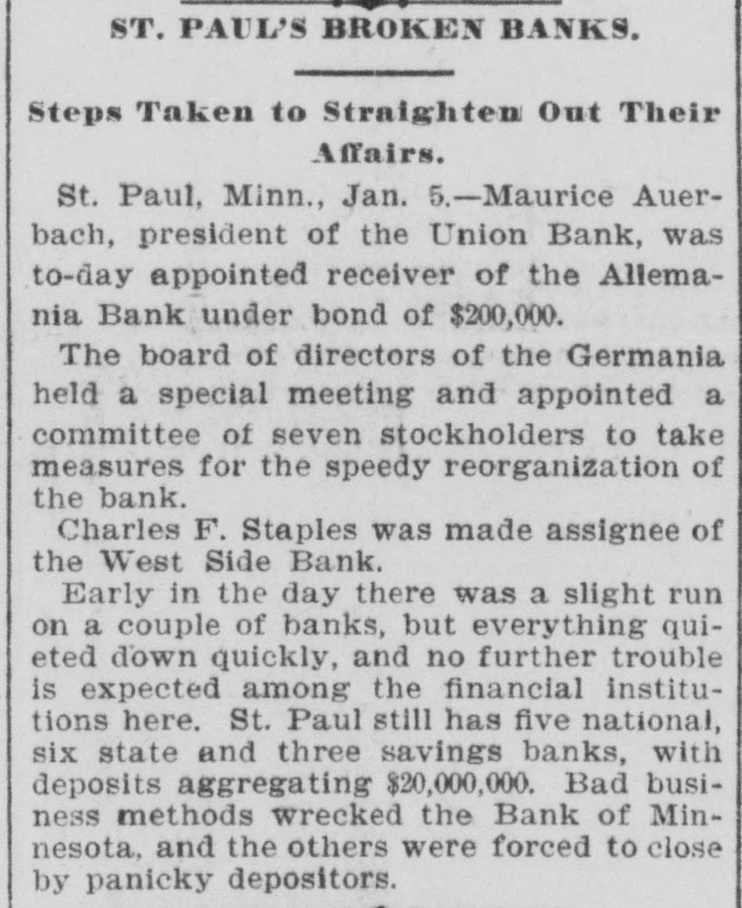
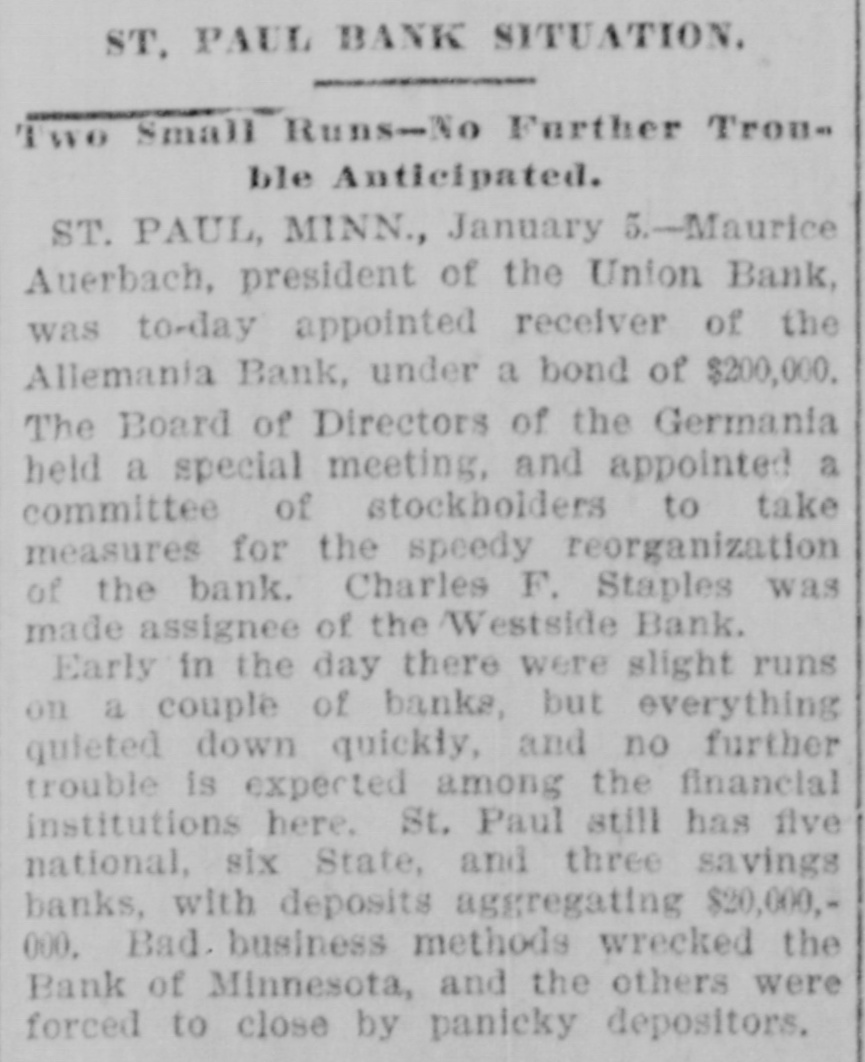
ST, PAUL BANK SITUATION. Two Small Runs-No Further Trouble Anticipated. ST. PAUL, MINN., January 5.-Maurice Auerbach, president of the Union Bank, was to-day appointed receiver of the Allemania Bank, under a bond of $200,000. The Board of Directors of the Germania held a special meeting, and appointed a committee of stockholders to take measures for the speedy reorganization of the bank. Charles F. Staples was made assignee of the Westside Bank. Early in the day there were slight runs on a couple of banks, but everything quieted down quickly, and no further trouble is expected among the financial institutions here. St. Paul still has five national, six State, and three savings banks, with deposits aggregating $20,000,000. Bad. business methods wrecked the Bank of Minnesota, and the others were forced to close by panicky depositors.


Article from Connecticut Western News, January 7, 1897

Click image to open full size in new tab

Article Text

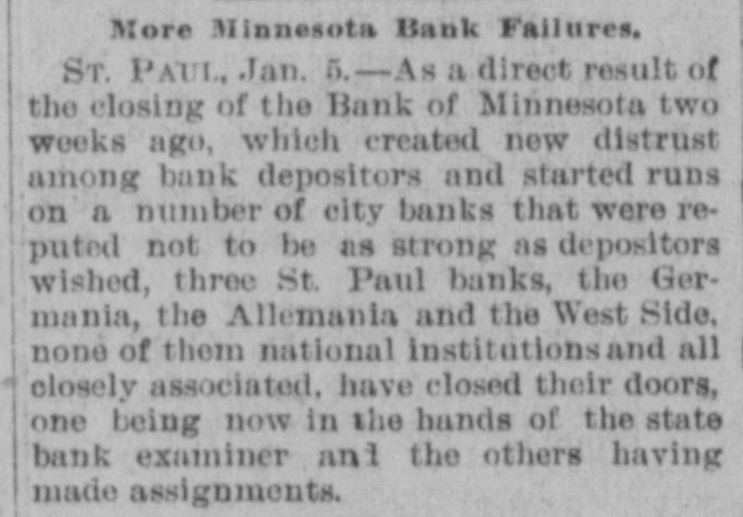
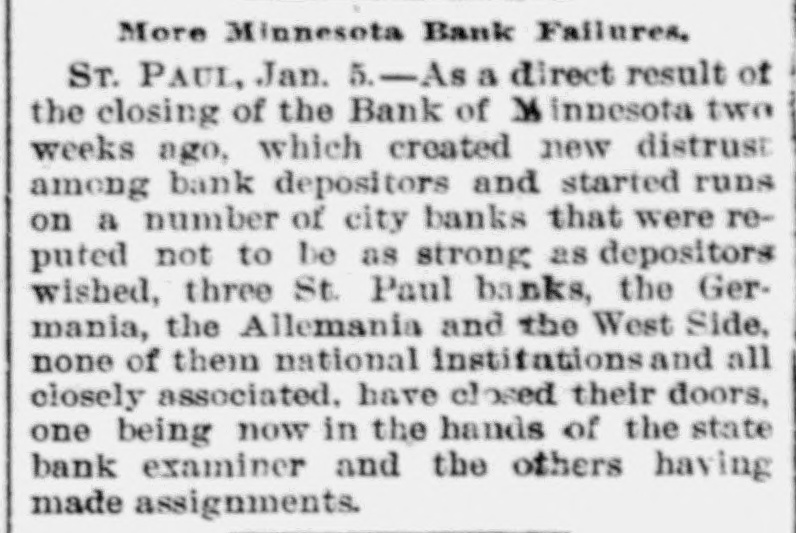
More Minnesota Bank Failures, ST. PAUL, Jan. 5.-As a direct result of the closing of the Bank of M innesota two weeks ago, which created new distrust among bank depositors and started runs on a number of city banks that were reputed not to be as strong as depositors wished, three St. Paul banks, the Germania, the Allemania and the West Side, none of them national institationsand all closely associated. have closed their doors, one being now in the hands of the state bank examiner and the others having made assignments.


Article from The New North-West, January 8, 1897

Click image to open full size in new tab

Article Text

THREE MORE ST. PAUL BANKS. Two Were Large Institutions, the Other Was Small. St. Paul, Minn., Jan. 4.-As a direct result of the closing of the Bank of Minnesota, two weeks ago, which created new distrust among depositors and started runs on a number of city banks that were reputed not to be as strong as the depositors wished, three St. Paul banks-the Germania, the Allemania and the Vest Side, none of them national institutions, all closely associated-closed their doors today, one being in the hands of the state bank examiner and the others making assignments. During the time that had intervened since the closing of the Bank of Minnesota, the Germania paid out $225,000 to frightened depositors, and early today the directors concluded they would stop the drain and make an assignment to the cashier, Peter M. Keerst. The Allemania bank, which, like the Germania, had a large clientage among the Germans, and whose vice president had formerly been vice president of the Germania, then became the target for a lively run. Crowds gathered about the doors and fairly fought for a place in the line before the paying teller's window. The bank officials realized fully what such a run meant, and promptly called on Bank Examiner Kenyon to take poss sion of the bank, and that official is now in charge. The West Side bank, a small but possibly stronger bank, cleared through the Allemania, and today its clearings were returned by the latter institution. Follows ing this there was a decided run inaugurated on the bank, and at 2 o'clock this afternoon the bank officials closed the doors and called a meeting of the directors to decide what action to take. Their decision was apparent late in the afternoon, when they filed a deed of assignment to S. H. Staples, president of the bank. Considerable public money is tied up in the three institutions, but there is an mple supply for all immodiate needs in the other banks of the city. The assignment of the Germania and West Side banks has brought up a somewhat new question in the banking laws of the state, and the courts will be called upon to settle it. The state bank examiner doubts their right to assign, holding that they should have, under the law, turned over their assets to him. The attorney general intimates that he will bring an action to test the matter as soon as papers can be issued. During the day numerous reports of trouble among the other banks were current, and a few banks suffered runs of greater or lesser intensity, but the savings banks were protected by the law that allows them to require 60 days' notice before paying out deposits; and the national banks are in strong condition, and have no fear of anything of the sort. The Germania Bank. The Germania bank was a state institution and had a capital of $400,000. The last official statement of the condition of the bank, December 21, gave loans and discounts as $975,420.53; total resources, $1,625,788. Among the liabilities were cap, ital stock, $400,000; surplus and undivided profits, $58,797; individual deposits subject to check, $345,191; demand certificates of deposit, $7899; time certificates of deposit, $633,019. The Germania bank has been organize. many years, ex-Governor Alexander Ram. say being a long time president, and William Bickell, cashier. When the governor retired, Mr. Bickell became president, but last spring Bickell retired, becoming vice president of the newly organized Alle, mania bank. He was succeeded by Gustav Willius. President Willius told an Associated Press representative that the closing was the result of an unreasonable panic, and the bank would be opened for business as soon as the people regained their usual cool sense. The bank, as a result of the panicky feeling, had paid the depositors $335,000 in the last nine days. Willius said he fully expected to have the bank reopened by the last of March. The Allemania. The Allemania bank has a capital of $400,000, and a clientage similar to that of the Germania. The Allemania was organized last year, as a successor of the Commercial, William Bickell, formerly pres. ident of the Germania, joining forces with Albert Scheffer, of the Commercial, to organize a new bank. The last official statement made, December 17, showed loans and discounts, $706,842; undivided profits, less expenses, $508,764; individual deposits, $329,789; interest certificates, $187,253. President Scheffer, of the Allemania, said the failure was due to combined withdrawal of deposits. A crowd of depositors gathered today demanding their money, and at 11 o'clock it was decided to close. f Runs on Other Banks. Owing to the excitement caused by the closing of the Germania and the Allemania banks, many depositors went after their money in one or two other banks.

Article from The Saint Paul Globe, January 9, 1897

Click image to open full size in new tab

Article Text

ancient prestige. The bank has honor-* ed me with the presidency, and I feel that I am under a moral obligation to leave nothing undone that will tend to a reorganization. That is my position. The press and the public have treated us with uniform kindness and courtesy, and we are under a deep sense of obligation to them." WEST SIDE BANK. Assignee Staples, of the West Side bank, was seen also on the status of affairs at that institution. Said he: "We are busily at work on the schedules, and it will be impossible to do anything until that matter is settled." "How about reorganization?" "The people are all anxious that the West Side bank be reorganized, but no definite action has been taken in that direction, and will not be until such time as the statement is got ready for presentation to the court. Several members of the board of directors are inclined that way, and everything looks favorable." NORTH ST. PAUL BANK. Capt. H. A. Castle, president of the North St. Paul bank, said yesterday, speaking about the appointment of John F. Fitzpatrick as receiver of that institution, that he was assured the bank would be able to pay all its depositors in full. He said that the total deposits amounted to less than $22,000. while the petiti n for the receiver stated that the assets of the bank would amount to about $35,000. Capt. Castle said that he thought this was a trifle larger than it should be. The bulk of the money in the bank is public money, the deposits of the state, county, village and school district. Capt. Castle took hold of the bank about three years ago. At that time the officers in control of the bank were ready to throw up the entire matter, and Capt. Castle took charge to protect himself, he being on the bonds of the bank. In the three years he has had control the deposits have been greatly reduced, and it was the intention to further reduce the indebtedness and the capital stock until it reached a point where it was of the right size for a bank in a town the size of North St. Paul. As an instance of the way in which the indebtedness has been reduced Capt. Castle stated last evening that when he took charge of the bank it owed the state over $24,000, which amount has been reduced to $2,900. The reserve fund of the bank was deposited in the Allemannia bank. ATTACHMENTS ISSUE. NEW YORK, Jan. 8.-An attachment for $10,000 was issued today against property of the Allemannia Bank of St. Paul in favor of the American Exchange National bank on two bills of exchange made last week. The sheriff today received another attachment against the Germania Bank of St. Paul in favor of Houston M. Sadler for $3,249 on an assigned claim of the St. Paul Rubber company.


Article from The Diamond Drill, January 9, 1897

Click image to open full size in new tab

Article Text

MORE BANKS FAIL. Three Institutions in St. Paul Close Their Doors. St. Paul, Minn., Jan. 5.-The Germania, the Allemania and West Side banks, all doing business as state banks, on Monday closed their doors, every one of them being literally pulled down by their depositors. The failure of the Bank of Minnesota December 22 caused unrest in the community and depositors withdrew their money from the three banks above to such an extent that they were forced to go to the wall because they had not funds enough immediately in hand to meet the demands made upon them. Each of the three, however, is solvent, and all of them will reorganize ns soon as the machinery for that purpose can be put into use. The directors of the Germania met Monday evening and appointed a committee on reorganization. The Germania is in the hands of P. M. Kerst as assignee and the other two are in the hands of Bank Examiner Kenyon. A receiver will be appointed for the Allemania to-day and the West Side bank will try to make arrangements with its creditors and reopen without the intervention of a receiver.


Article from The Saint Paul Globe, January 29, 1897

Click image to open full size in new tab

Article Text

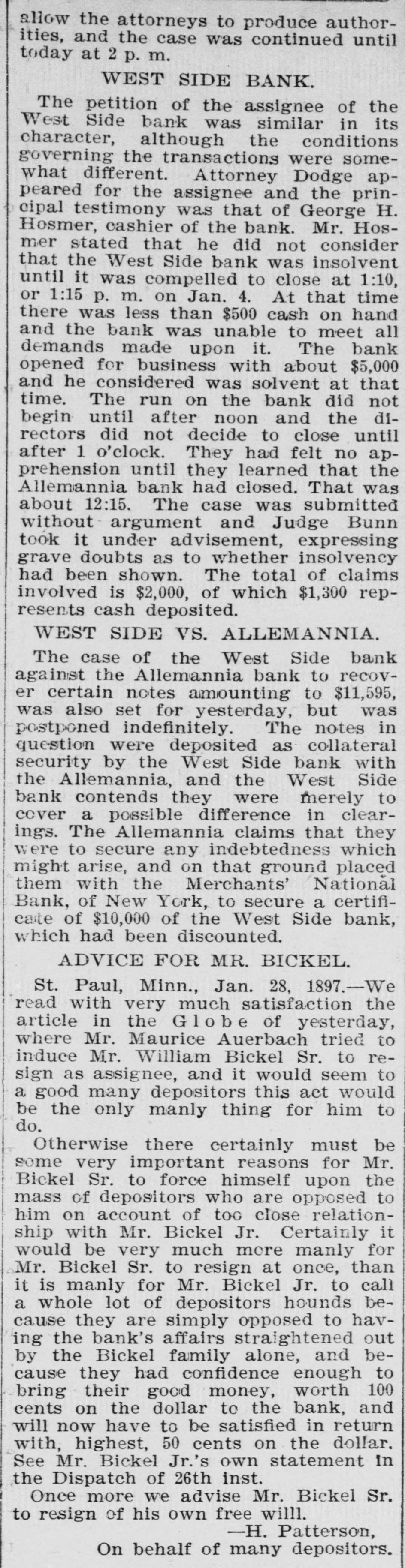
allow the attorneys to produce authorities, and the case was continued until today at 2 p. m. WEST SIDE BANK. The petition of the assignee of the West Side bank was similar in its character, although the conditions governing the transactions were somewhat different. Attorney Dodge appeared for the assignee and the principal testimony was that of George H. Hosmer, cashier of the bank. Mr. Hosmer stated that he did not consider that the West Side bank was insolvent until it was compelled to close at 1:10, or 1:15 p. m. on Jan. 4. At that time there was less than $500 cash on hand and the bank was unable to meet all demands made upon it. The bank opened for business with about $5,000 and he considered was solvent at that time. The run on the bank did not begin until after noon and the directors did not decide to close until after 1 o'clock. They had felt no apprehension until they learned that the Allemannia bank had closed. That was about 12:15. The case was submitted without argument and Judge Bunn took it under advisement, expressing grave doubts as to whether insolvency had been shown. The total of claims involved is $2,000, of which $1,300 represents cash deposited. WEST SIDE VS. ALLEMANNIA. The case of the West Side bank against the Allemannia bank to recover certain notes amounting to $11,595, was also set for yesterday, but was postponed indefinitely. The notes in question were deposited as collateral security by the West Side bank with the Allemannia, and the West Side bank contends they were merely to cover a possible difference in clearings. The Allemannia claims that they were to secure any indebtedness which might arise, and on that ground placed them with the Merchants' National Bank, of New York, to secure a certificaite of $10,000 of the West Side bank, which had been discounted. ADVICE FOR MR. BICKEL. St. Paul, Minn., Jan. 28, 1897.-We read with very much satisfaction the article in the Globe of yesterday, where Mr. Maurice Auerbach tried to induce Mr. William Bickel Sr. to resign as assignee, and it would seem to a good many depositors this act would be the only manly thing for him to do. Otherwise there certainly must be some very important reasons for Mr. Bickel Sr. to force himself upon the mass of depositors who are opposed to him on account of too close relationship with Mr. Bickel Jr. Certainly it would be very much more manly for Mr. Bickel Sr. to resign at once, than it is manly for Mr. Bickel Jr. to call a whole lot of depositors hounds because they are simply opposed to having the bank's affairs straightened out by the Bickel family alone, and because they had confidence enough to bring their good money, worth 100 cents on the dollar to the bank, and will now have to be satisfied in return with, highest, 50 cents on the dollar. See Mr. Bickel Jr.'s own statement In the Dispatch of 26th inst. Once more we advise Mr. Bickel Sr. to resign of his own free will. -H. Patterson, On behalf of many depositors.


Article from The Saint Paul Globe, April 24, 1897

Click image to open full size in new tab

Article Text

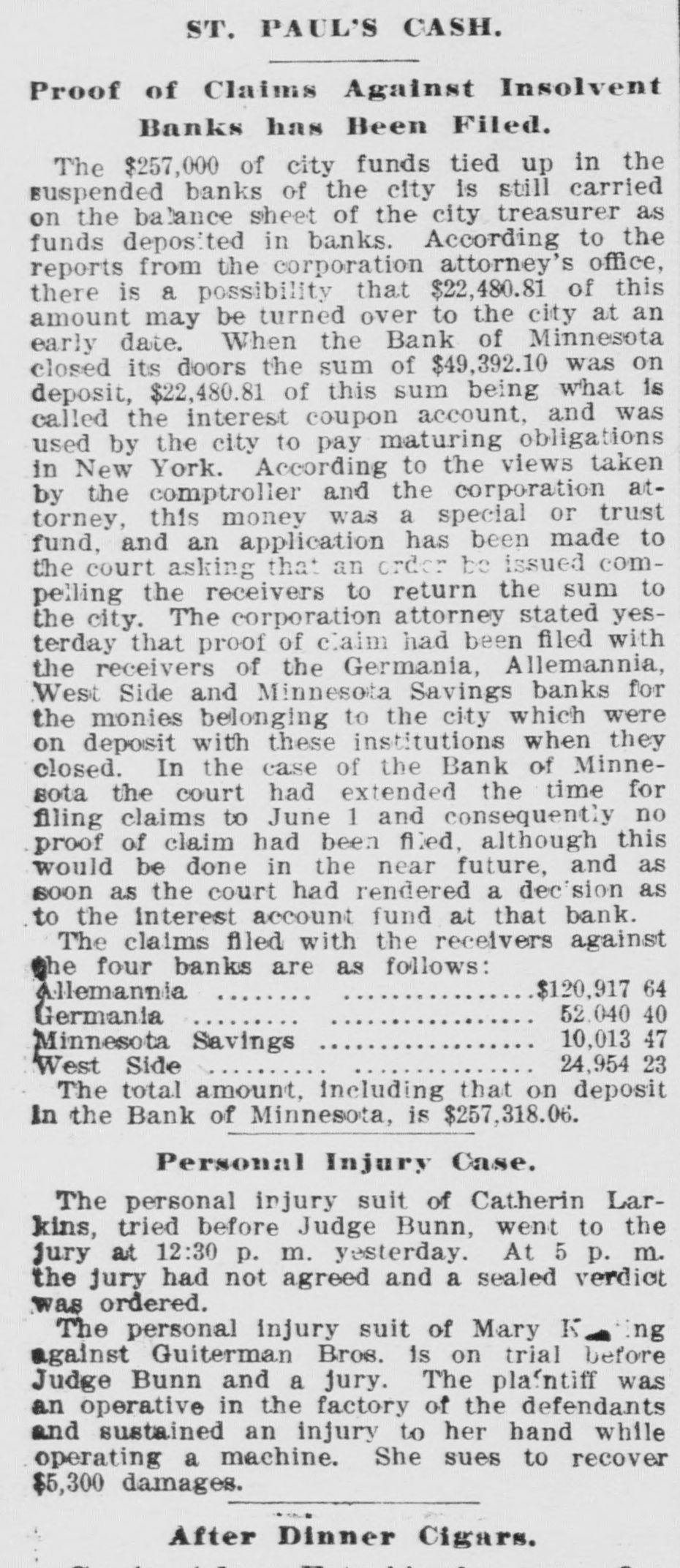
ST. PAUL'S CASH. Proof of Claims Against Insolvent Banks has Been Filed. The $257,000 of city funds tied up in the suspended banks of the city is still carried on the balance sheet of the city treasurer as funds deposited in banks. According to the reports from the corporation attorney's office, there is a possibility that $22,480.81 of this amount may be turned over to the city at an early date. When the Bank of Minnesota closed its doors the sum of $49,392.10 was on deposit, $22,480.81 of this sum being what is called the interest coupon account, and was used by the city to pay maturing obligations in New York. According to the views taken by the comptroller and the corporation attorney, this money was a special or trust fund, and an application has been made to the court asking that an order be issued compelling the receivers to return the sum to the city. The corporation attorney stated yesterday that proof of claim had been filed with the receivers of the Germania, Allemannia, West Side and Minnesota Savings banks for the monies belonging to the city which were on deposit with these institutions when they closed. In the case of the Bank of Minnesota the court had extended the time for filing claims to June 1 and consequently no proof of claim had been filed, although this would be done in the near future, and as soon as the court had rendered a decision as to the interest account fund at that bank. The claims filed with the receivers against he four banks are as follows: Allemannia $120,917 64 52.040 40 Germania 10,013 47 Minnesota Savings West Side 24,954 23 The total amount, including that on deposit In the Bank of Minnesota, is $257,318.06. Personal Injury Case. The personal injury suit of Catherin Larkins, tried before Judge Bunn, went to the Jury at 12:30 p. m. yesterday. At 5 p. m. the jury had not agreed and a sealed verdict was ordered. The personal injury suit of Mary K ng against Guiterman Bros. is on trial before Judge Bunn and a jury. The plaintiff was an operative in the factory of the defendants and sustained an injury to her hand while operating a machine. She sues to recover $5,300 damages. After Dinner Cigars.


Article from The Saint Paul Globe, May 14, 1897

Click image to open full size in new tab

Article Text

GRAND JURY SPENT THE AFTERNOON INQUIRING INTO THE ALLEMANNIA'S AFFAIRS. NOT THROUGH WITH OTHERS. REPORT THAT CONGRESSMAN STEVENS HAS BEEN REQUESTED TO CALL AROUND TO TELL JURY WHAT HE KNOWS. Rumor That the Germania Will Be Left Alone and Another That It Will Not. The grand jury resumed its investigation of the banks and bankers yesterday afternoon. The body was in session from 2:15 p. m. until almost 6 o'clock. Most of the time was devoted to examining into the affairs of the Allemannia bank and the transactions of its officers, though the grand jury has not finished with the Minnesota Savings bank and the Bank of Minnesota. In fact, it was reported yesterday that the grand jury had sent word to Congressman Stevens that it would like to have a talk with him about the affairs of the Minnesota Savings bank before it got through its work. The witnesses in attendance in the matter of the Allemannia bank were C. S. Bunker, the expert accountant employed by Receiver Auerbach to assist in preparing the schedules; William Hamm and Paying Teller Devitt, of the Allemannia bank. Mr. Bunker and Mr. Hamm were each before the grand jury for a considerable length of time. Mr. Bunker had with him a bundle of books. The West Side bank is also to be investigated, judging from the presence in the witness room of Charles F. Staples, the president and assignee, and George H. Hosmer, the cashier of that bank. Neither of these gentlemen, so far as could be learned, appeared before the jury yesterday. Receiver Frank A. Seymour was on hand as usual with the books of the Bank of Minnesota, but was not called in. T. D. Sheehan, one of the receivers of the Minnesota Savings bank, was also present, but did not testify yesterday. It is understood that the grand jury proposed to take a peep into the affairs of the Germania bank, and thereby hangs a tale. Rumor has it that the movement in this direction is not inspired by the county attorney, but that it has its origin among two or three members of the grand jury itself. The truth or falsity of the rumor may never be ascertained and certainly will not be known until after the grand jury is discharged. On the other hand it is reported that the Germania bank's officers have received assurance that the grand jury will not examine into its affairs. Whether this report has any foundation the future will reveal. It is likely that the grand jury will make a partial report today on the jail cases considered Wednesday afternoon, and there is a possibility that an indictment may be returned against a bank official. It is more probable, however, that the next report in the bank cases will not be submitted until Monday.


Article from The Saint Paul Globe, July 7, 1897

Click image to open full size in new tab

Article Text

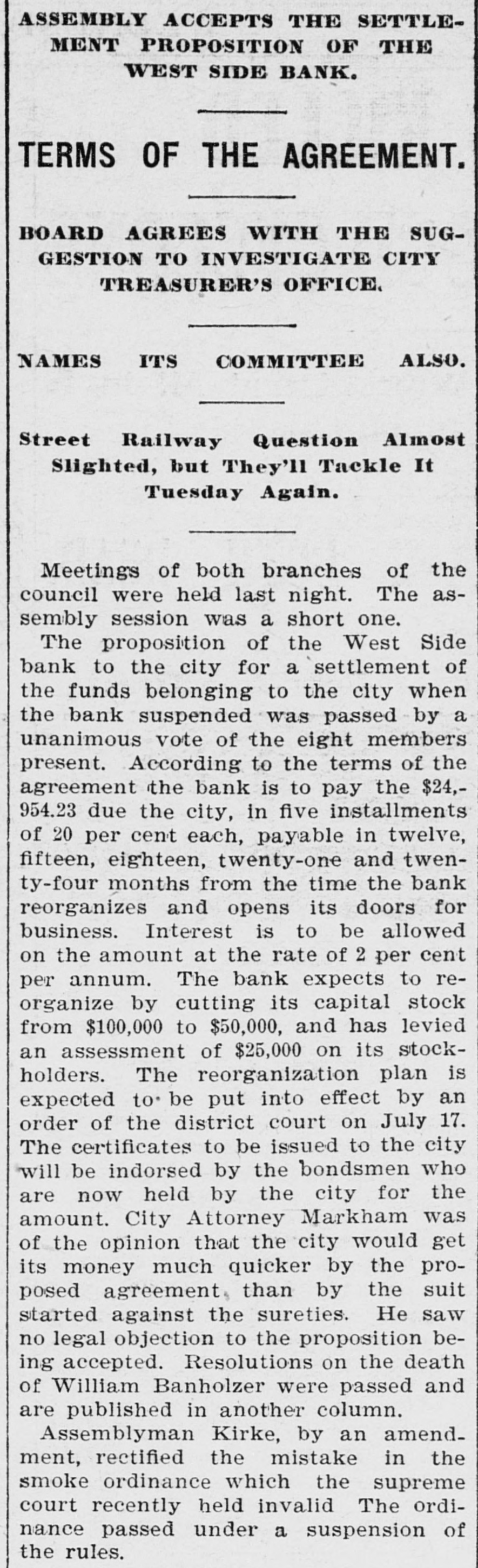
ASSEMBLY ACCEPTS THE SETTLEMENT PROPOSITION OF THE WEST SIDE BANK. TERMS OF THE AGREEMENT. BOARD AGREES WITH THE SUGGESTION TO INVESTIGATE CITY TREASURER'S OFFICE. NAMES ITS COMMITTEE ALSO. Street Railway Question Almost Slighted, but They'll Tackle It Tuesday Again. Meetings of both branches of the council were held last night. The assembly session was a short one. The proposition of the West Side bank to the city for a settlement of the funds belonging to the city when the bank suspended was passed by a unanimous vote of the eight members present. According to the terms of the agreement the bank is to pay the $24,954.23 due the city, in five installments of 20 per cent each, payable in twelve, fifteen, eighteen, twenty-one and twenty-four months from the time the bank reorganizes and opens its doors for business. Interest is to be allowed on the amount at the rate of 2 per cent per annum. The bank expects to reorganize by cutting its capital stock from $100,000 to $50,000, and has levied an assessment of $25,000 on its stockholders. The reorganization plan is expected to be put into effect by an order of the district court on July 17. The certificates to be issued to the city will be indorsed by the bondsmen who are now held by the city for the amount. City Attorney Markham was of the opinion that the city would get its money much quicker by the proposed agreement, than by the suit started against the sureties. He saw no legal objection to the proposition being accepted. Resolutions on the death of William Banholzer were passed and are published in another column. Assemblyman Kirke, by an amendment, rectified the mistake in the smoke ordinance which the supreme court recently held invalid The ordinance passed under a suspension of the rules.


Article from The Saint Paul Globe, November 25, 1897

Click image to open full size in new tab

Article Text

SETTLING WITH THE CITY. West Side Bank Makes Its First Payment as Directed. The sum of $5,076.79 was paid into the city treasury yesterday by the West Side bank. When the bank suspended Jan. 4 last, the city had on deposit in the institution something like $25,000. Recently the bank reorganized and made an agreement with the city to pay the amount in five installments. One-fifth of the sum was paid yesterday and the remainder will be turned over in four equal payments at the expiration of twelve, fifteen, eighteen and twenty-one months. Interest on the entire sum at the rate of 2 per cent per annum will be paid by the bank.