Farmers Trust Company (Sioux City, IA)

Episode Information

Episode UID
3284588991164
Episode Type
Suspension โ†’ Closure
Bank Type
trust
Bank ID
328458899 hash
Start Date
December 29, 1896
Location
Sioux City, Iowa (42.500, -96.400)

Metadata

Model
gpt-5-mini (chosen from majority vote of a three-model LLM ensemble)
Short Digest
df575e3ac79339bd

Response Measures

None

Description

A receiver was appointed Dec 29, 1896 and court records in 1902 still refer to Hollister as receiver, implying permanent closure.

Events (2)

1. December 29, 1896 Receivership
Newspaper Excerpt
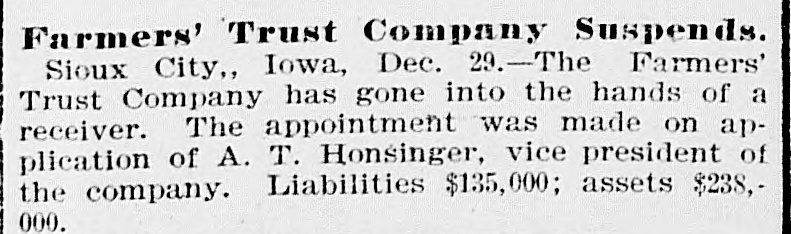
The appointment was made on application of W. T. Honsinger, vice-president... G. H. Hollister was to-day appointed receiver for the institution.
Source
newspapers
2. December 29, 1896 Suspension
Cause
Government Action
Cause Details
Appointment of a receiver due to inability to realize on mortgage-secured assets and defaulted notes amid tight money market
Newspaper Excerpt
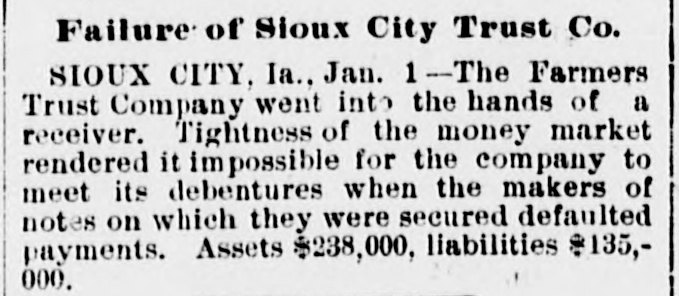
The Farmers Trust company has gone into the hands of a receiver... Tightness of the money market rendered it impossible for the company to meet its debentures
Source
newspapers

Newspaper Articles (14)

Article from The Wichita Daily Eagle, December 30, 1896

Click image to open full size in new tab

Article Text

DAY'S NEWS OF FAILURES Assignments. Receiverships, Foreclosures and Financial Disasters Generally. Sioux City, Ia., Dec. 29.-While, Howe & Co., shoe dealers, have assigned. Credi tors are mostl eastern firms. Mount Carmell, Ill., Dec. 29.-J. M. Mitchell, dealer in dry goods and clothing, failed today. Liabilities about $35,000. Parkersburg, W. Va., Dec. 29.-Isaac Prager & Sons, dry goods merchants, have failed. Assets and liabilities about $100,000. Philadelphia, Pa., Dec. 29.-M. J. Rosenberg, trading in clothing as Milton & Co., at Eleventh and Chestnut streets, has failed. His store was closed today on attachments aggregating $31,000. Sioux City, Ia., Dec. 29.-The Farmers Trust company has gone into the hands of a receiver. The appointment was made on application of W. T. Hosinger, vice-president of the company. The ilabilities are $135,000; assets $238,000. The assets ocnsist principally of notes secured by real estate mortgages. Inability to realize on assets is given as the cause of the failure. The company intends to continue to do business and expects to pay in full.


Article from The Record-Union, December 30, 1896

Click image to open full size in new tab

Article Text

ciering their property, investing to the limit of their resources in various enterprises without taking the precaution of keeping a reserve of quick assets, such as stocks and bonds, upon which they might have realized in an emergency such as this was. A long time loan was being negotiated on the $700,000 plant at Appleton, Wis., which would have enabled the brothers to weather the storm when the Illinois Bank failed. Having a bank of their own, and having borrowed to the legal limit-$300,000-from the Atlas Bank, in which they were heavy stockholders, it was a difficult task for the Van Nortwicks to get a large amount of money from a bank where they were strangers, even on their money-making properties. Their collapse was the result of failure to borrow more money. ONE BANK NOT INVOLVED. APPLETON (Wis.), Dec. 29.-The failure of Van Nortwick Brothers' Bank at Batavia, Ill., which involved the Appleton Manufacturing Company's agricultural works at Geneva, Ill., and the Western Paper Bag Company's paper and bag manufacturing plant at Batavia has not yet affected the Fox River properties of that place. It is said the Fox River property will pull through unharmed. The Citizens' National Bank of this city, of which John S. Van Nortwick was President, will not be involved in the failure. John S. has resigned as President and director, ad his place has just been filled by Lamar Olmstead as President and John McNaughton as director. No run has begun on the bank, although the news of the embarrassment of the Van Nortwicks has created a flurry in business circles. John S. Van Nortwick, who is in the city, to-day refused absolutely to be interviewed regarding his embarrassment. FAILURE AT SIOUX CITY. SIOUX CITY (Ia.), Dec. 29.-An application of W. T. Honsinger, Vice-President and a large shareholder in the Farmers' Trust Company of this place, G. H. Hollister was to-day appointed receiver for the institution. Tightness of the money market made it impossible for the company to meet its debentures. Receiver Hollister estimates assets of $238,000, and liabilities of $135,000.


Article from The Indianapolis Journal, December 30, 1896

Click image to open full size in new tab

Article Text

Farmers' Trust Company. SIOUX CITY, Ia., Dec. 29.-The Farmers' Trust Company has gone into the hands of a receiver. The appointment was made on application of W. T. Honsinger, vice president of the company. Liabilities, $135,000: assets, $238.000. Assets consist principally of notes secured by real estate mortgages. Inability to realize on assets is given as the cause of the failure. The company intend to continue to do business and expects to pay in full.


Article from The Wheeling Daily Intelligencer, December 30, 1896

Click image to open full size in new tab

Article Text

Furmers' Trust Company Fails. SIOUX CITY, Town. Dec. 29.-The Farmer's Trust Company has gone Into the hands of a receiver. The appointment was made on application of W. T. Honsinger, vice president of the company. The liabilities are $135,000; assets $238,000. Assets consist principally of notes secured by real estate mortgages. Inability to realize on assets is given as the cause of the fatture. The company intends to continue to do business and expects to pay in full.


Article from Birmingham State Herald, December 30, 1896

Click image to open full size in new tab

Article Text

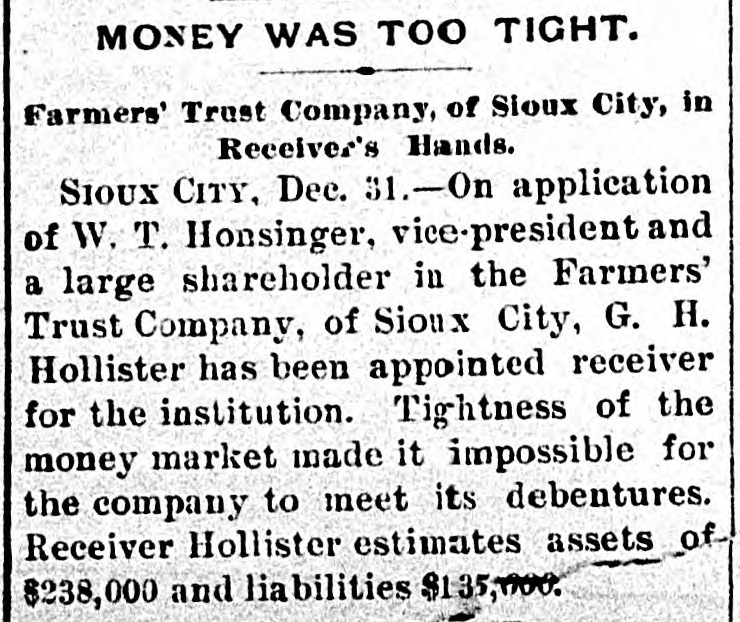
FINANCIAL. Cincinnati, Dec. 29.-A petition was filed last evening by members of the wellknown firm of Duhme & Co., jewelers, for a dissolution and a receiver for the firm. They say the company is insolvent and unable to meet its maturing debts. Seattle Wash., Dec. 9.-The B. E. Stetson and Post Saw Mill company closed down its plant yesterday, throwing seventy men out of employment. The overproduction of lumber, together with the recent failures of eastern banks, affecting a number of western lumber firms, caused the suspension. Auburn, Me., Dec. 29.-A petition for a receiver for the American Trust and Banking company has been filed. A director says: "The .money is coming in such amounts that we are encouraged to think our doors can again be opened for business. The company has little borrowed money, and the directors believe that western investments will prove all right." Minneapolis, Minn., Dec. 29.-The Columbia National bank of this city closed its doors this morning, owing to inability to make collections. It is a comparatively new bank, having been organized about five years ago, with ex-State Treasurer Charles Kittelson as its president, and ex-State Treasuer Bobleter as its cashier, which positions they still hold. Its capital on December 18 was about $200,000, with a surplus of about $6,000. It has never been profitable. Deputy Comptroller of the Currency George W. Coffin, who happened to be in the city, took charge of the bank. Its officers claim that they will be able to pay depositors in full. Minneapolis, Minn., Dec. 29.-The Washington bank of this city has closed its doors. Its last statement, December 17, shows loans and discounts of $500,000 and deposits of $540,000. Its capital is $100,000, and its surplus $13,000. A. C. Haugan, its president, is city treasurer, and it is likely that quite an amount of city funds will be locked up by the failure. Its business is largely with working people. The officers claim that they will be able to pay them in full. Baltimore, Md., Dec. 29.-Berger & Co., leading retail dry goods merchants of South Baltimore, made an assignment today. Liabilities $50,000; assets about the same. Pressure of creditors and slow collections caused the suspension. Sioux City, Ia., Dec. 29.-On application of W. T. Honsinger, vice-president and a large shareholder in the Farmer's Trust company, of this place, G. H. Hollister was today appointed receiver for that institution. Tightness of the money market rendered it impossible for the company to meet its debentures when the makers of notes on which they were secured defaulted payments. Receiver Hollister estimates assets $238,000 and liabilities at $135,000.


Article from The Austin Weekly Statesman, December 31, 1896

Click image to open full size in new tab

Article Text

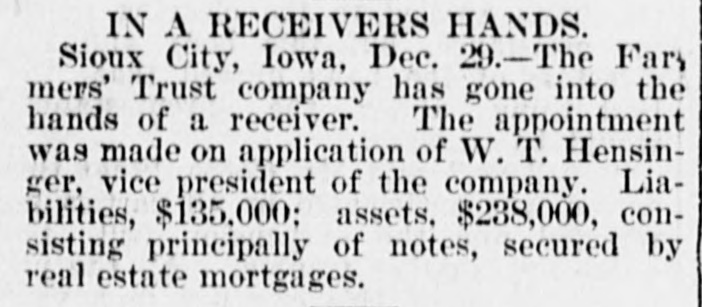
IN A RECEIVERS HANDS. Sioux City, Iowa, Dec. 29.-The Far, mers' Trust company has gone into the hands of a receiver. The appointment was made on application of W. T. Hensinger, vice president of the company. Liabilities, $135,000; assets, $238,000, consisting principally of notes, secured by real estate mortgages.


Article from The Sauk Centre Herald, December 31, 1896

Click image to open full size in new tab

Article Text

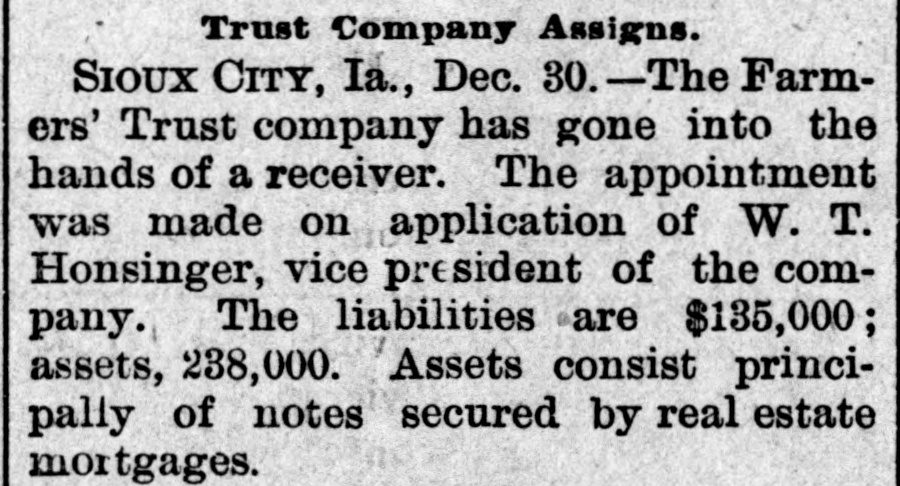
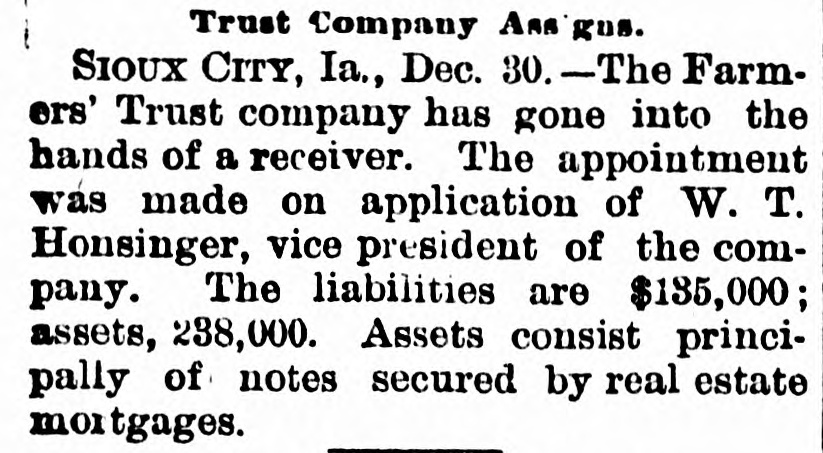
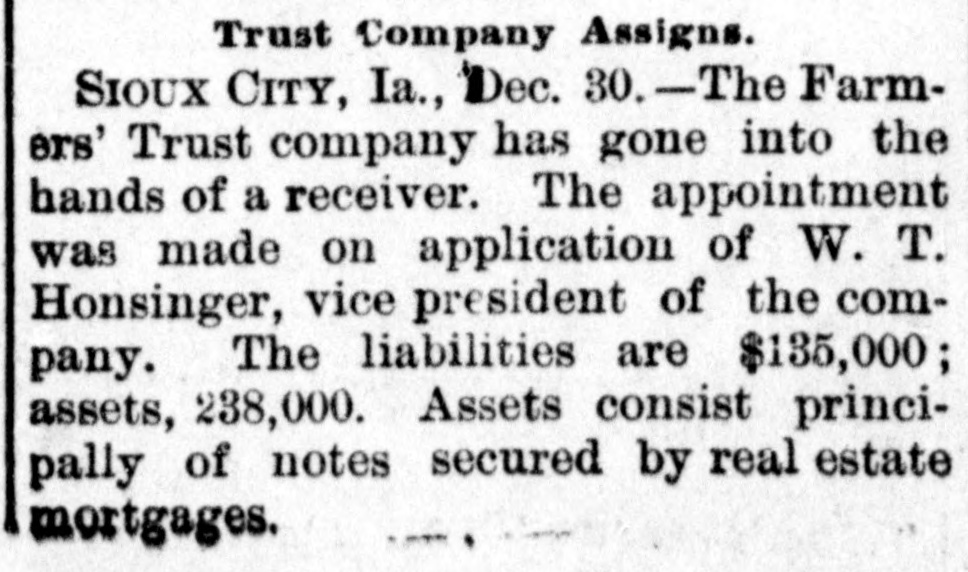
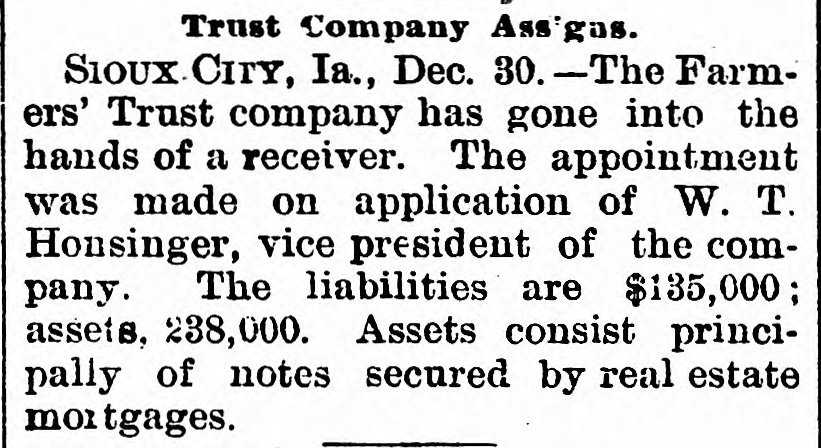
Trust Company Assigns. SIOUX CITY, Ia., Dec. 30.-The Farmers' Trust company has gone into the hands of a receiver. The appointment was made on application of W. T. Honsinger, vice president of the company. The liabilities are $135,000; assets, 238,000. Assets consist principally of notes secured by real estate mortgages.


Article from Spirit of the Age, January 2, 1897

Click image to open full size in new tab

Article Text

Failure of Sioux City Trust Co. SIOUX CITY, Ia., Jan. 1 -The Farmers Trust Company went into the hands of a receiver. Tightness of the money market rendered it impossible for the company to meet its debentures when the makers of notes on which they were secured defaulted payments. Assets $238,000, liabilities $135,000.


Article from The Diamond Drill, January 2, 1897

Click image to open full size in new tab

Article Text

William M. & J. S. Van Nortwick. bankers and manufacturers, made au assignment at Batavia, III., with liabilities of $2,000,000. At the opening day in Washington of the hearings before the ways and means committee in preparation for the framing of a tariff bill representatives of hundreds of millions of dollars made brief statements of their views. Eleven cracks in the bicycle world entered a six days'. eight hours a day. international bicycle contest in Washington. Statistics from 1,388 industrial establishments in 46 states show that 52,448 less hands were employed in those es. tablishments in 1896 than in 1892. and that $19,214,448 less was paid out in wages. Frank E. Clark, for 18 years editor of the Grayville (TII.) Independent. committed suicide by taking poison. No cause is known. The Scandis bank st Minneapolis suspended payments with liabilities of $300,000. Will Robinson (colored). who Allled sweetheart in a church in Pike counMo., was taken to the penitentiary for 102 years. The large furniture house of Julius Lansburg in Washington was destroyed by fire. the loss being $160,000. The McCoy Banking company of Independence, Mo., went into voluntary liquidation with liabilities of $125,000. The Bank of Superior at Superior, Wis., closed its doors with liabilities of $100,000. By the explosion of a lamp Gregor Kirchbaum and his wife were burned to death in their home at Johnston, R. 1. One thousand Chicago saloon keepers have been compelled during the last three months to retire from business because of hard times. The state of Iowa celebrated its 50th birthday. At Stamford, Conn., Mrs. Henry Ward Beecher fell and broke her hip and may be forced to use crutches for the rest of life. She is 84 years old. At the annual meeting in Chicago-of the Northwestern Traveling Men's association William H. Cribben was electpresident. The death payments for the year amounted to $169,400. Gov. R. M. Harris, of Indian territory, has called the legislature to meet in extraordinary session at Tishmingo January 5. Lane county, Kan., has formally been declared insolvent by the county commissioners. A new counterfeit ten dollar national bank note on the Union national bank of Detroit, Mich., is in circulation. One distinguishable feature is that the back of the note is upside down. It is announced that Gov. Bradley intends to resign the office of governor of Kentucky at an early date because of failing health. The wedding of Count Adam de Moltke Huitfeldt, of Denmark, and Miss Louise Eugenie Bonaparte, daughter of the widow of the late Jerome Bonaparte, took place in Washington. The People's Electric Light & Power company's plant at Newark, N. J., was burned, the loss being $175,000. The Columbia national bank in Minneapolis closed its doors with liabilities of $247,000, and the Washington bank, a state institution in the same city, also suspended. The Commercial national bank of Roanoke, Va., closed its doors with liabilities of $100,000. William W. Whaley and wife, living near Seaviersville, Tenn., were murdered in their home by unknown persons. Henry F. Strauss, aged 72, county clerk of Langlade county, Wis., commitsuicide at Antigo. He was a defaulter to the amount of $3,770. It is officially denied at the state department in Washington that Spain has consented to grant home rule to Cuba Edward Rosa shot and killed his sweetheart, Miss Mary Brehl, at the home of her sister, Mrs. Stewart, in Forest City, S. D., and then killed himself. Jealousy was the cause. The Farmers' Trust company at Sioux City, Ia., failed with liabilities of 000


Article from Shepherdstown Register, January 7, 1897

Click image to open full size in new tab

Article Text

# BAD BUSINESS. The past two weeks have not been exactly what the gold standard orators promised as a result of the election of Major McKinley President and the triumph of "honest money" principles. On the contrary, the developments show that the financial condition of the country is not gilt-edged by any means, and there is a feeling of uneasiness in the business world and a spreading belief that the gold standard is not all that its friends tried to prove it. The record of broken banks is a startling one. We have heretofore referred to the failures of some of the oldest and largest banking institutions in Chicago. St. Paul, Minnesota, has also passed through a panic from the same cause. Last Saturday three State banks went under, and Monday of this week the Germania, the Allemania and the West Side banks in that city failed, and runs were made on other banks. The excitement has been allayed, but the situation is critical there. Saturday there was a bank failure at Fargo, N. D., Omaha, Neb., and Denver, Col. The Commercial National Bank of Roanoke, Va., has also gone to the wall, and others in the same list the past two weeks are the Merchants' National at Devil's Lake, N. D., the Calumet at Chicago, one at Superior and one at West Superior, Wis., the Atlas National of Chicago, and the Farmers' Trust at Sioux City, Iowa. Many manufacturing and business concerns in various parts of the country have also collapsed, among them being the failure of Isaac Prager & Son, of Parkersburg, this State, whose liabilities will run up into the hundreds of thousands. One of the distressing features of the present situation is the number of suicides of bank officials, men who, feeling disgraced by the failure of their banks, or in remorse at their own wrong-doing, having taken their own lives. Richard Cornelius, cashier of the National Farmers' and Planters' Bank of Baltimore, was on Monday found to be a defaulter to the amount of over $40,000, and when he saw he could no longer hide his crime he went out and drowned himself. He was regarded as one of the most upright men in Baltimore. The bank is solid and well able to stand the loss. Last Saturday Henry Husted, cashier of the National Bank of Liberty, Ind., hanged himself. The same day W. A. Hammond, cashier of the collapsed National Bank of Illinois, drowned himself in Lake Michigan at Chicago. Otto Grosmandorff, another banking official affected by the same failure, blew his brains out with a pistol. President-elect McKinley is no more to be blamed for these failure and the consequent troubles than Mr. Bryan would have been had he been elected. Nor is the Republican party any more responsible for dishonest bank officials than the Democratic party. Yet these occurrences point unmistakably to the truth of the assertions of the free silver advocates that there is something wrong with the financial system of the country, and it will be hard to persuade the people that the gold standard is the panacea for our monetary and commercial evils. In a speech some time ago Senator Stewart said "the gold standard is driving unnumbered people to poverty, despair, degradation and suicide." He spoke like a prophet.


Article from River Falls Journal, January 7, 1897

Click image to open full size in new tab

Article Text

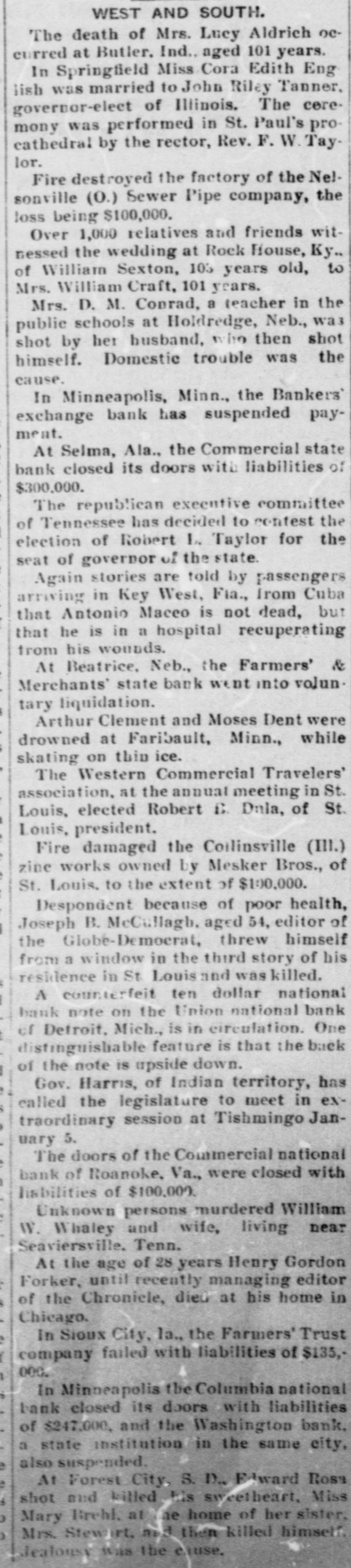
WEST AND SOUTH. The death of Mrs. Lucy Aldrich occurred at Butler. Ind., aged 101 years. In Springfield Miss Cora Edith Eng lish was married to John Riley Tanner, governor-elect of Illinois. The ceremony was performed in St. Paul's procathedral by the rector, Rev. F. W. Taylor. Fire destroyed the factory of the Nelsonville (0.) Sewer Pipe company, the loss being $100,000. Over 1,000 relatives and friends witnessed the wedding at Rock House, Ky., of William Sexton, 103 years old, to Mrs. William Craft, 101 years. Mrs. D. M. Conrad, a teacher in the public schools at Holdredge, Neb., was shot by her husband, he then shot himself. Domestic trouble was the cause. In Minneapolis, Minn., the Bankers' exchange bank has suspended payment. At Selma, Ala., the Commercial state bank closed its doors with liabilities of $300,000. The republican executive committee of Tennessee has decided to contest the election of Robert L. Taylor for the seat of governor of the state. Again stories are told by passengers arriving in Key West, Fta., from Cuba that Antonio Maceo is not dead, but that he is in a hospital recuperating from his wounds. At Beatrice, Neb., the Farmers' & Merchants' state bank went into volun. tary liquidation. Arthur Clement and Moses Dent were drowned at Faribault, Minn., while skating on thin ice. The Western Commercial Travelers' association, at the annual meeting in St. Louis, elected Robert B. Dnla, of St. Louis, president. Fire damaged the Coilinsville (III.) zine works owned by Mesker Bros., of St. Louis. to the extent of $100,000. Despondent because of poor health, Joseph B. McCullagh, aged 54, editor of the Globรฉ-Democrat, threw himself from a window in the third story of his residence in St Louis and was killed. A counterfeit ten dollar national bank note on the Union national bank of Detroit, Mich., is in circulation. One distinguisliable feature is that the back of the note is upside down. Gov. Harris, of Indian territory, has called the legislature to meet in extraordinary session at Tishmingo January 5. The doors of the Commercial national bank of Roanoke, Va., were closed with liabilities of $100,000. Unknown persons murdered William W. Whaley and wife, living near Seaviersville. Tenn. At the age of 28 years Henry Gordon Forker, until recently managing editor of the Chronicle, died at his home in Chicago. in Sioux City, la., the Farmers' Trust company failed with liabilities of $135,000. In Minneapolis the Columbia national bank closed its doors with liabilities of $247,000, and the Washington bank. a state institution in the same city, also suspended. At Forest City, S. D., F ward Ross shot and killed is SW retheart, Miss Mary Brehl, at ae home of her sister, Mrs. Stew irt, nid then killed himself.


Article from The Worthington Advance, January 7, 1897

Click image to open full size in new tab

Article Text

The News Condensed. Important Intelligence From All Parts. DOMESTIC. Gov. R. M. Harris, of Indian territory, has called the legislature to meet in extraordinary session at Tishmingo January 5. At the annual meeting in Chicago of the Northwestern Traveling Men's association William H. Cribben was elected president. The death payments for the year amounted to $169,400. Lane county, Kan., has formally been declared insolvent by the county commissioners. A new counterfeit ten dollar national bank note on the Union national bank of Detroit, Mich., is in circulation. One distinguishable feature is that the back of the note is upside down. It is announced that Gov. Bradley inlends to resign the office of governor of Kentucky at an early date because of failing health. The wedding of Count Adam de Moltke Huitfeldt, of Denmark, and Miss Louise Eugenie Bonaparte, daughter of the widow of the late Jerome Bonaparte, took place in Washington. The People's Electric Light & Power company's plant at Newark, N. J., was burned, the loss being $175,000. The Columbia national bank in Minneapolis closed its doors with liabilities of $247,000, and the Washington bank, a state institution in the same city, also suspended. The Commercial national bank of Roanoke, Va., closed its doors with liabilities of $100,000. William W. Whaley and wife, living near Seaviersville, Tenn., were murdered in their home by unknown persons. Henry F. Strauss, aged 72, county clerk of Langlade county, Wis., committed suicide at Antigo. He was a defaulter to the amount of $3,770. It is officially denied at the state department in Washington that Spain has consented to grant home rule to Cuba. Edward Rosa shot and killed his sweetheart, Miss Mary Brehl, at the home of her sister, Mrs. Stewart, in Forest City, S. D., and then killed himself. Jealousy was the cause. For the first time since the present struggle in Cuba began this government has given permission to a customs official to clear for Cuba a vessel (the Dauntless) loaded, according to its manifest, with munitions of war, and presumably intended for the insurgent army. At Holdredge, Neb., Mrs. D. M. Conrad, a teacher in the public schools, was shot by her husband, who then shot himself. Domestic trouble was the cause. The Farmers' Trust company at Sioux City, Ia., failed with liabilities of $135,000. The factory of the Nelsonville (0.) Sewer Pipe company was burned, the loss being $100,000. Mrs. Elias Tucker, aged 54 years, and her step-daughter, Mrs. William Siebel, aged 30, were killed by an explosion of dynamite at Reading, Pa. Stories are again told by passengers arriving in Key West, Fla., from Cuba that Antonia Maceo is not dead, but that he is in a hospital recuperating from his wounds. Levi P. Wyman, aged 64, a famous restaurateur and the founder of "Wyman's sandwich depots," died in Boston from exhaustion produced by three weeks' violent hiccoughing. Willia Lichenberg, 22 months old, and his ten-weeks-old brother Jacob, were suffocated by coal gas at their home in New York. The Bankers' exchange bank at Minneapolis, Minn., has suspended payment. The Commercial state bank of Selma, Ala., closed its doors with liabilities of $300,000. At the annual meeting in St. Louis of the Western Commercial Travelers' association Robert B. Dula, of St. Louis, was elected president. The Farmers' & Merchants' state bank at Beatrice, Neb., went into voluntary liquidation. Comptroller of the Currency Eckels says that he feels no apprehension over the bank failures which have occurred of late throughout the country. Joseph B. McCullagh, aged 54, editor of the Globe-Democrat, threw himself from a window in the third story of his residence in St. Louis and was killed. He had been in poor health for a long time. After a short absence the wife of George Duttera returned to her home near York, Pa., and found her three children burned to death. Moses Dent and Arthur Clement were drowned at Faribault, Minn., while skating on thin ice. The total number of persons who committed suicide in the United States during 1896 is 6,520, as compared with 5,758 in 1895. The Collinsville (III.) zinc works, owned by Mesker Bros., of St. Louis, were damaged by fire to the extent of $100,000.


Article from The Democratic Advocate, January 9, 1897

Click image to open full size in new tab

Article Text

patches. MONTPELIER, VERMONT, January 2.-The Farmers' Trust Company, of Sioux City, Iowa, which closed its doors this week, was an institution in which many people in this vicinity had faith, and the failure will prove a hard blow to its Vermont investors. It is estimated that $100,000 in stock of the company was held in this county. According to returns since the failure, eighty per cent. of the liabilities of $135,000 is said to be due the people of this state. Frank A. Dwinell, the president, George W. Wing, the treasurer, and Clark King, one of the directors, reside here, and the company had an office in this city. Yest's Weekly, Republican, of Staunton, Virginia, has been placed in the hands of a receiver. LIBERTY, IND., Jan. 3.-Henry Husted, cashier of the Union County National Bank of Liberty, Indiana, was found hanging by the neck to a rafter in his stable Saturday. His knees were touching the floor, and he was dead when found by his Husted's financial affairs were believed to be in good condition. He was 67 years old. The past year was a bad one for railroads, since 5,441 miles went into the hands of receivers, involving $178,064,000 of bonds and $102,538,000 of stocks. The B. and O., with 2,094 miles, and the Louisville, New Albany and Chicago, with 501 miles, were the principal sufferers. The present era of receiverships began, says the Railway Age, in 1892, when 10,508 miles of road were involved. In 1893 the milleage was 29,340 miles, in 1894 it was 7,025 miles, in 1895 it was 4,089 miles. To find like figures we have to go back to 1885, when 8,386 miles went into receivers' hands. and 1884, when the mileage was 11,038 miles. In the intermediate years the average was little over 2,000 miles. The five years beginning with 1892 broke the record. Foreclosures in 1896 affected 1,373 miles and $1,150,377,000 of stocks and bonds. Since 1876 the sales under foreclosure have aggregated 89,487 miles, with $5,440,239,000 of stocks and bonds. The Sullivan Savings Institution. of Claremont, N. H., has been placed in the hands of assignees. The Western Paper Bag Company, of Batavia, III., one of the Van Nortwick plants, was placed in the hands of a receiver by the United States Court at Chicago on Saturday. The receiver was required to give a bond of $100,000. A receiver has been appointed for the Little Rock and Mississippi Railroad, a short uncompleted line near Little Rrck, Arkansas. The employes of all the mines in the Massillon, Ohio, district, about 2000 men, have struck on account of a reduction 111 the price of pick mining from 61 to 51 cents per ton. The employes of the Illinois Steel Company have been notified that their wages would be cut on February 1. There are 3500 men employed at the South Chicago mills. M. W. Pyne, dealer in musical instruments, Petersburg, Virginia, made an assignment. The Aberdeen Can Co., of Harford county, Md., has been placed in the hands of a receiver. Attorney General Maloney, of Illinois, has filed an information in court, at Chicago, against the International Building, Loan and Investment Union, declaring it to be insolvent, and for the appointment of a receiver. The Mercantile Trust Company, of New York, filed a bill in St. Louis Thursday for a foreclosure against the St. Louis, Salem and Arkansas Railroad. Quigley & Mullen, wholesale grocers, Wilmington, Delaware, have failed; liabilities $76,000, assets $26,000. Liebler & Maas, printers and lithographers, New York, have assigned. Liabilities, $99, 179; nominal assets, $128,598; actual assets, $34,839. At Liberty, Ind., the Columbia Drill Company has gone into the hands of a receiver. The assets are $17,000. J. H. Johnston & Co (corporation, dealers in diamonds, jewelry and silverware, New York, have assigned. A receiver has been appointed for the Dorner & Dutton Car Wheel Manufacturing Co. Covignat judgments amounting to $68,000 were previously taken against the company. The Bank of Canton, at Canton, Minn., and the Citizen's Bank, of Lanesboro. Minn., both owned and operated by Field, Kelsey & Co., have suspended business. The Commercial Bank of Eau Claire, Wis., capital $30,000, closed Tnursday. Depositors will be paid in full. The Iowa mortgage Company of Hartford, Connecticut, has asked for a receiver. Liabilities $218,129, including $100,000 paid up capital. C. L. Richardson, grocer, and Mrs. H. F. Brown grocer, both of Norfolk, Virginia, have assigned. On Monday three more banks closed their doors in St. Paul, Minnesota. The Merchant's National Bank of Dev. il's Lake, North Dakota, and the First City Bank of Moran Springs, Iowa. M. Schneeberger, Westminster, Md., dry goods, notions, &c. George E. Mather &. Sons, printer's ink manufacturers, New York city have failed.
Article from Bismarck Daily Tribune, May 17, 1902

Click image to open full size in new tab

Article Text

# THE COURT DECIDES SUPREME COURT HANDS DOWN DECISION IN A CASS COUNTY CASE. The supreme court, in an opinion written by Chief Justice Wallin, has affirmed the district court in the case of Woodhull vs. the Farmers Trust Company of Sioux City, Iowa, and George H. Hollister as receiver. The syllabus of the opinion is as follows: In this action both defendants are non-residents of this state and service was made by publication. The action is brought to recover damages for alleged breach of a contract made between the defendant Trust company and the plaintiff. Long prior to the commencement of this action, the defendant George H. Hollister was, by an order made by a competent court of the state of Iowa, appointed receiver of the estate of said Trust company and after qualifying as such, Hollister took possession of the effects of said Trust company, among which were seven interest coupon notes of the face value of $70 each. Said receiver, after taking possession of the notes in the state of Iowa, brought the same within this state for a lawful purpose and while the notes were in this state the same were seized by the sheriff under a warrant of attachment issued in this action. Upon motion made in behalf of the defendants, appearing specially, the district court by its order vacated the attachment and set aside the service of the summons. Held, that the order of the district court was properly made. It is a rule resting upon comity between the states that where a receiver, as such, has obtained rightful possession of personal property within the jurisdiction of his appointment, he will not be deprived of its possession when he takes the property, in the performance of his duty, into a foreign staet. When in a foreign jurisdiction the property cannot betaken by attachment from the receiver's possession by creditors of the insolvent debtor. An opposite rule would prevail where a seizure of the property is made by a creditor prior to the appointment of the receiver or prior to his taking possession within the state of his appointment. (Syllabus by the court.) The plaintiff appeals from an order of the district court of Cass county, Charles A. Pollock, judge. John E. Greene, attorney for appellant. Ball, Watson & Maclay, attorneys for respondents.