Article Text
EXCITEMENT ABATING.
New York, Sept. 23, 10 a. m.-The Gov- Terning Committee of the Stock Exchange have decided not to open the Exchange to- day. The Gold Exchange is open, and reg- ular transactions are being made. The ex- citement on the street seems to be lessening and wearing itself out, and a better feeling appears to exist. Brokers have congrega- ted in front of the Stock Exchange and formed a street market, all sales being for cash. A number of poor women and labor- ing inen have gathered at the Savings Bank, awaiting their opening, but nobody seems to think that anything like a run will take place.
ANOTHER BANK SUSPENSION.
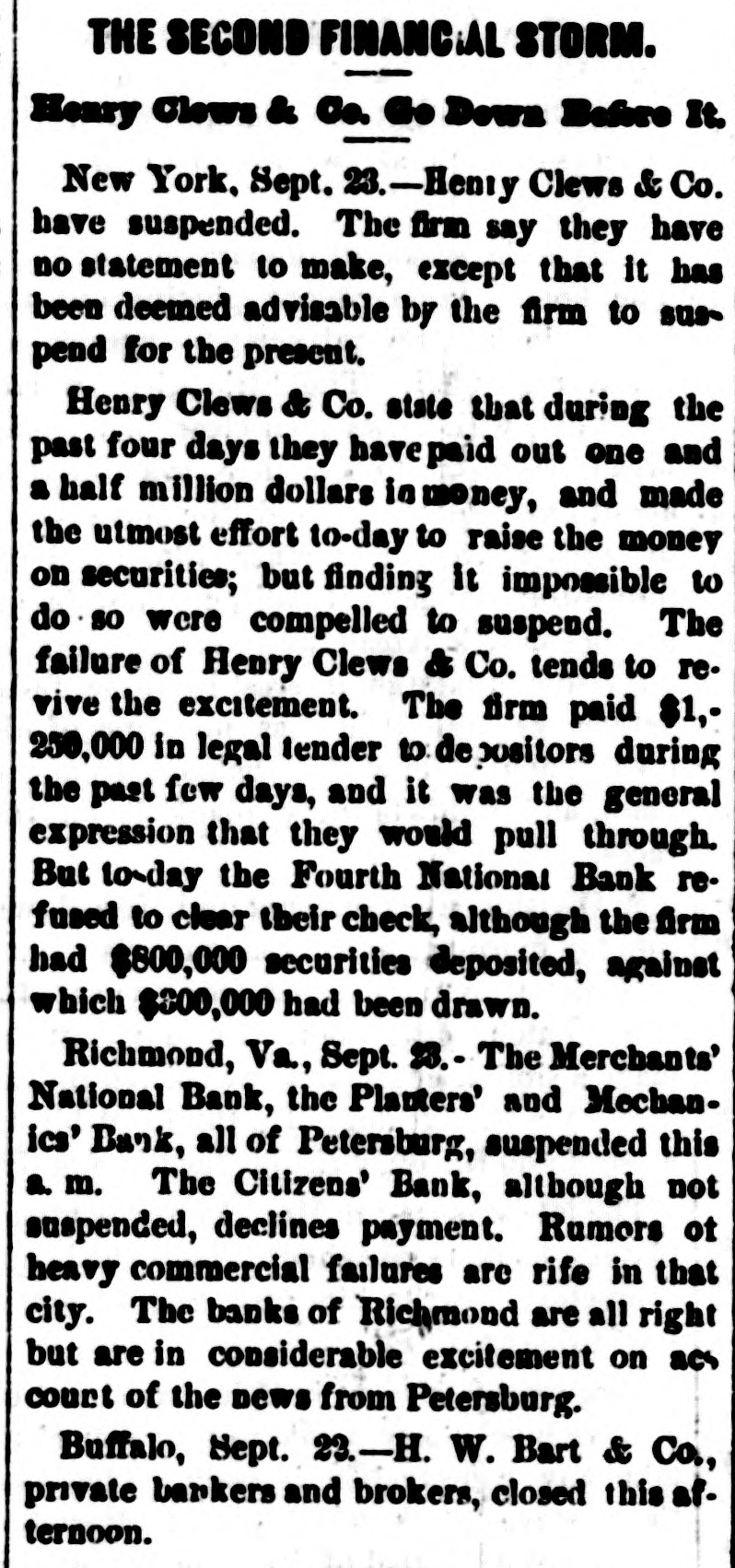
The suspension of Henry Clews & Co. is announced. The failure tends to increase the excitement. The firm paid $1,250,000 in legal tenders to depositors during the past few days, and it was generally the impres- sion that they would pull through, but to- day the Fourth National Bank refused to clear their checke, although the firm had $500,000 of securities, against which $300,- 000 had been drawn.
The clearings of the Gold Exchange Bank are completed and balances will be paid as usual. The Assistant Treasurer has re- ceived $20,000,000 in greenbacks, from Washington, and is ready to buy all bonds offered. $3,800,000 of the $10,000,000 loan certificates issued to relieve the banks, have been taken up, and it is expected that the remaining $10,000,000 will be taken up to- day; in that event additional loan certificates will be issued.
At 20 minutes to 3 o'clock the banking house of Henry Clews & Co. suspended pay- ment. As soon as the announcement was made that the bank had suspended, large crowds gathered in front of the building. Intelligence that their checks were refused payment at the Fourth National Bank reached the banking house about 2:30 p. m., and the closing of doors followed the an- nouncement. Immediately after the closing of the doors, several prominent capitalists were eagerly seeking Mr Clews, who was not to be found. Assistance is necessary to pull through the day. There would have been had there been any suspicion that the bank wou'd refuse payment of Henry Ciews & Co's checks. The fact of the suspension created as much excitement as the suspen- sion of Jay Cooke & Co. The Clews left the street at the close of business in a condition of great excitement, and the headway made in restoring confidence, in a great measure lost. This afternoon Mayor Havemeyer, after consultation with several gentlemen, decided to issue an address on the present financial crisis and to tran mit it to the spe- cial Board of Aldermen which was called for to-day. When asked what his views were about the panic, the Mayor said he had intended to advise the working men and laborers of this city not to continue to run on the various savings banks, as he feit assured their deposits were perfectly se- cure, and that a run during the present panic might possibly result in the loss of both principal and interest of the amount de- posited.
The effect of the panic upon the importing business, or the withdrawing of goods trom the bonded warehouse for the current de- mands of trade, is hardly perceptible as shown by receipt of duties. The following dispatch is published:
London, Sept. 23.-Jay Cooke, McColloch & Co. are throwing out drafts drawn by Jay Cooke & Co. and which have come to hand since the news of suspension was received.
Washington, Sept. 23. The most promi- nent depositor in the First National Bank of this city, next to President Grant, was An- drew Johnson. At the time of the failure of the bank Mr. Johnson had $60,000 to his credit, on which he was receiving 6 per cent interest, which was his only revenue. Should the bank be unable to discharge its obliga- tions, a contingency by no means improba- ble, ex-President Johnson will be almost penniless. The widow of a former navy agent had $17.000, the proceeds of a sale of all the property she had, and it is said General Hunter had a large balance to his credit.
Mr. Knox, collector of currency, whose money was in the bank, said he hadn't money enough to go to market with, the day after the enspension.
General Schofield, commanding the de- partment of Columbia, has issued orders to the commanding officer at Fort Klamath, Oregon, to carry out on October 31 the sen- tence of the military commission which tried the Modocs. The Indians to be executed are Captain Jack, Schonchin, Shack Nasty Jim, Boston Charley, One-Eyed Jim and Stolock.
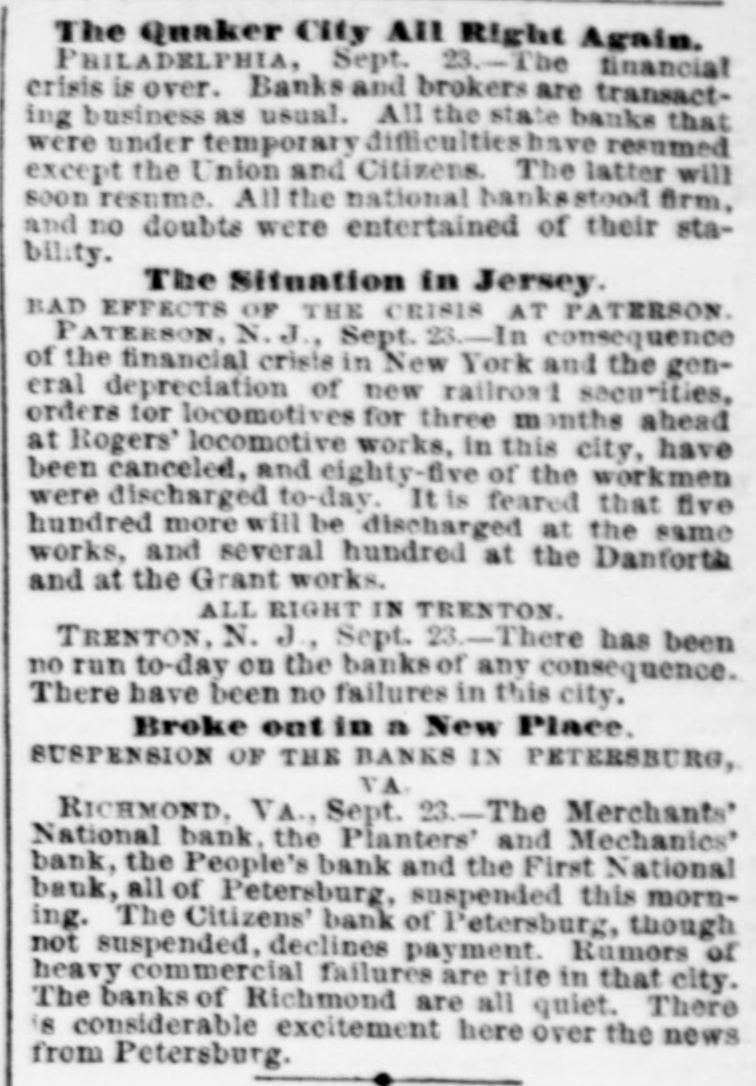
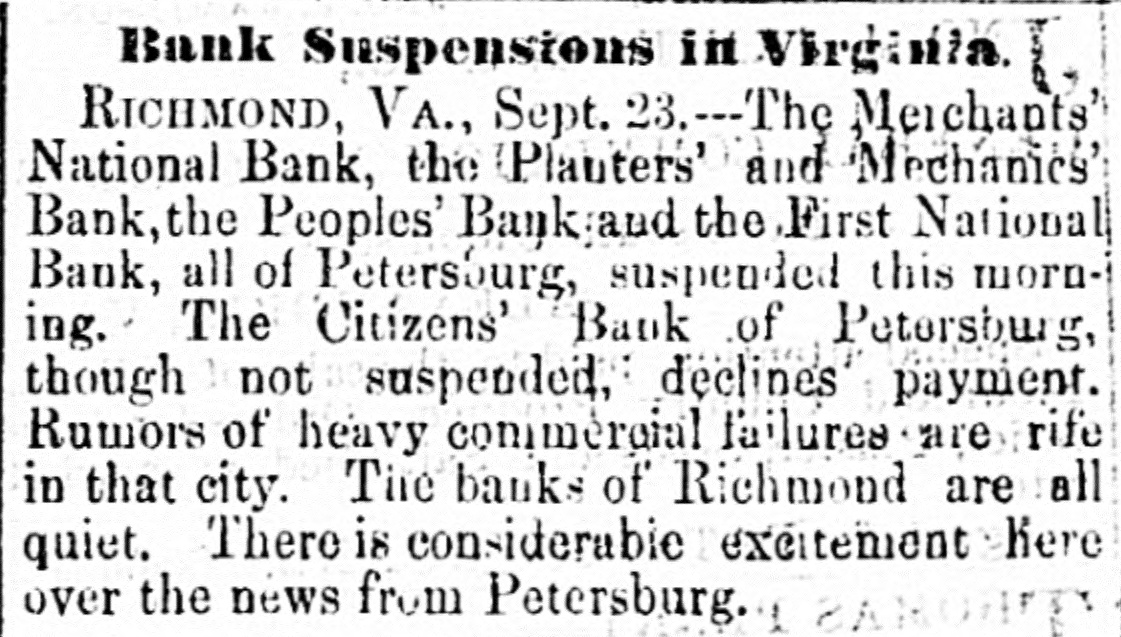
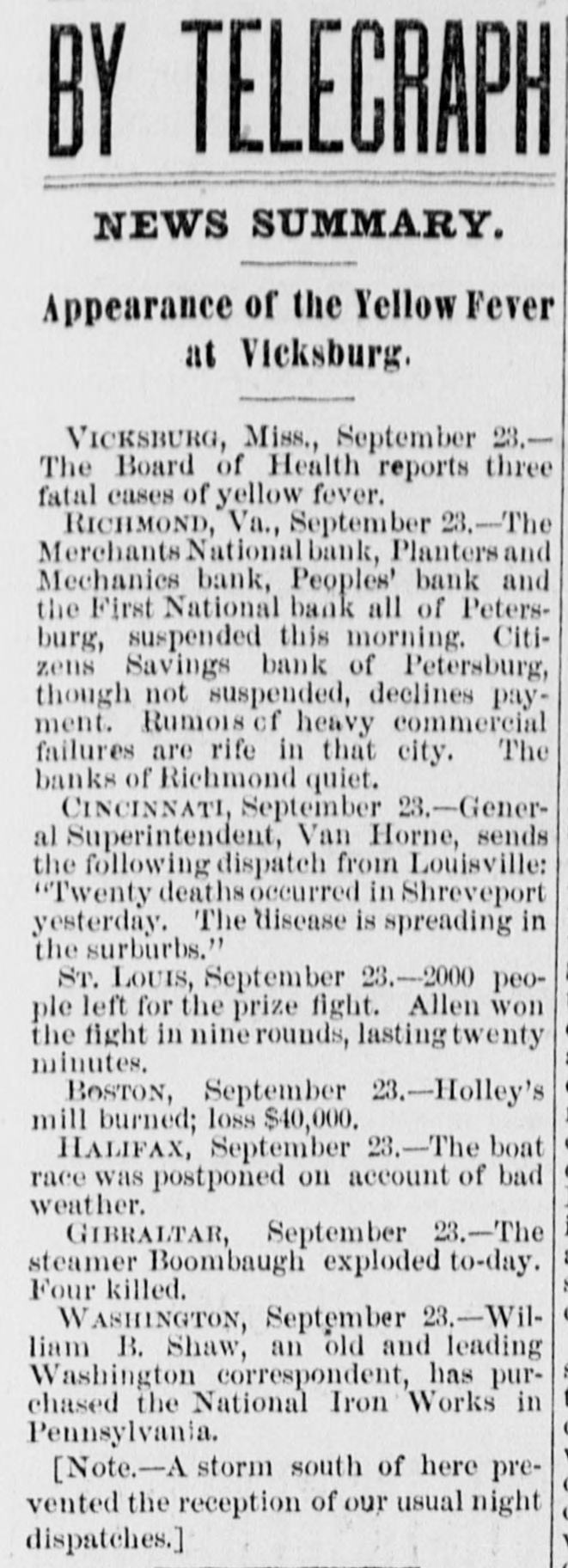
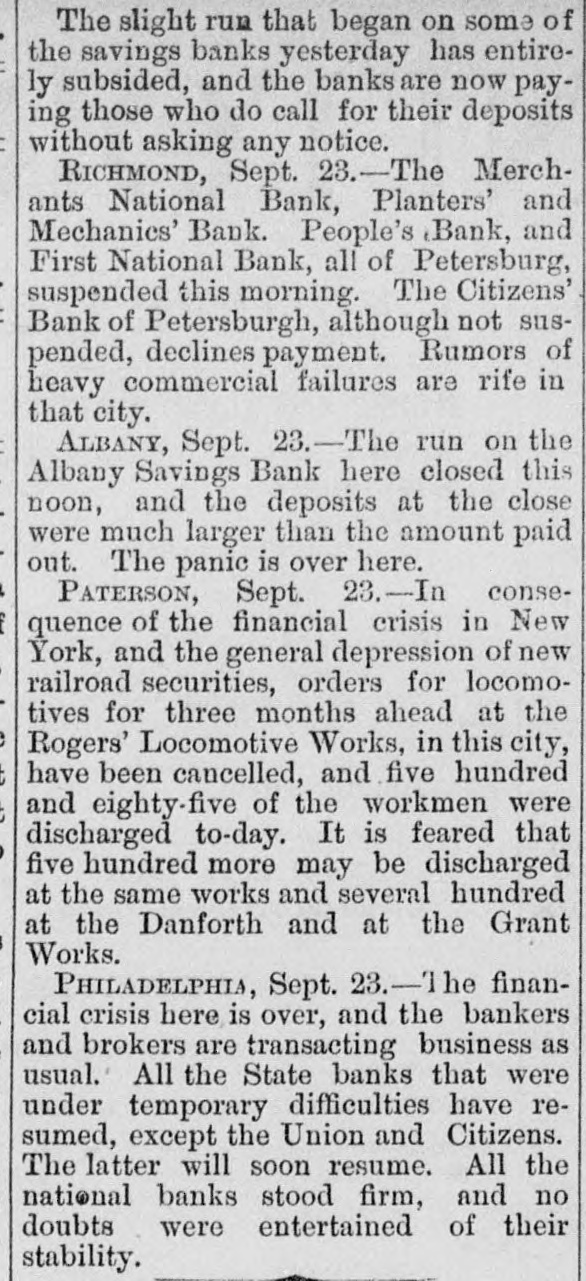
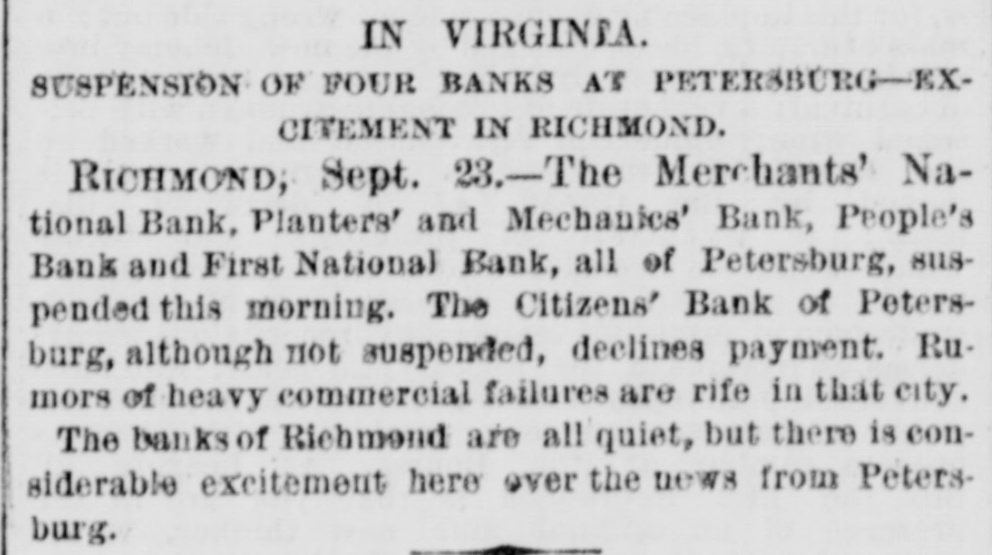
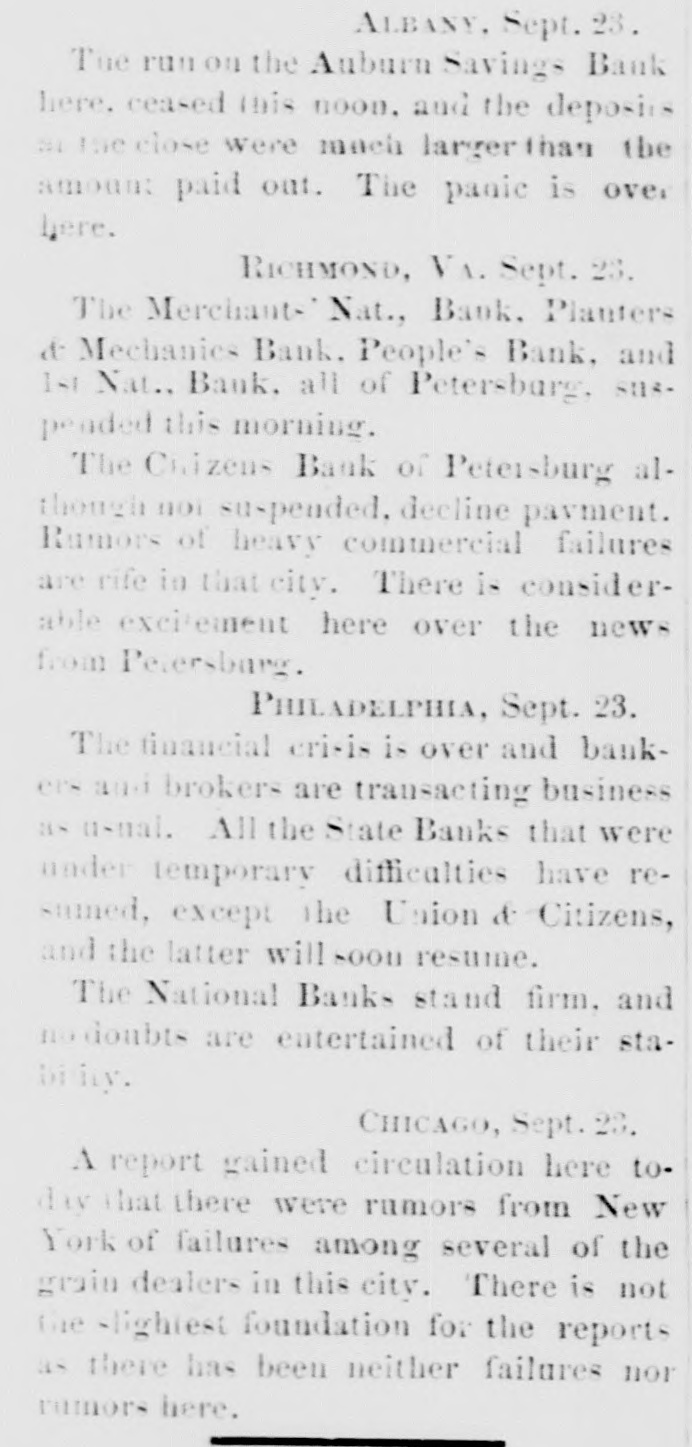
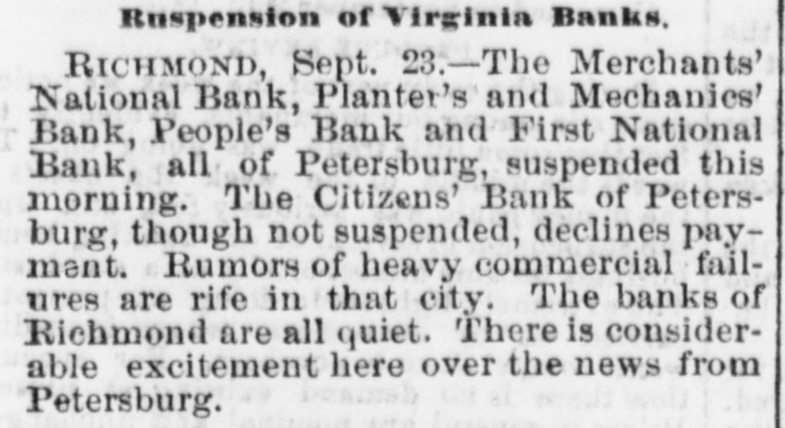
Richmond, Va., Sept. 23-The Mer- chants' National Bank, Planters' and Me- chanics' Bank, People's Bank, and First National Bank, all of Petersburg, failed this morning. The Citizens' Bank, although not enspended, declined payment. Rumors of heavy commercial failures are also rife in that city. The banks of Richmond are safe, but there is considerable excitement over the news from Petersburg.
Chicago, Sept. 23. A report gained cir- culation here to-day, that there were rumors in New York of the failure of heavy grain dealers in this city. There is not the plight- est foundation for the report, as there have neither been failures nor rumors here.
The slight run which began on some of the savings banks yesterday, has entirely subsided, and the banka are now paying those who cell for deposits without asking any no- tice.