Stock Growers National Bank (Miles City, MT)

Episode Information

Episode UID
327501123
Episode Type
Suspension โ†’ Closure
Bank Type
national
Bank ID
32750 national
Charter Number
3275
Start Date
July 29, 1893
Location
Miles City, Montana (46.408, -105.841)

Metadata

Model
gpt-5-mini (chosen from majority vote of a three-model LLM ensemble)
Short Digest
f9d5d6e0a331045e

Response Measures

None

Receivership Details

Depositor recovery rate
55.0%
Date receivership started
1893-08-09
Date receivership terminated
1907-09-30
OCC cause of failure
Fraud
Share of assets assessed as good
15.5%
Share of assets assessed as doubtful
48.6%
Share of assets assessed as worthless
35.9%

Description

Receivership and criminal prosecution of the president followed the suspension, indicating permanent failure.

Events (5)

1. December 20, 1884 Chartered
Source
historical_nic
2. July 29, 1893 Suspension
Cause
Bank Specific Adverse Info
Cause Details
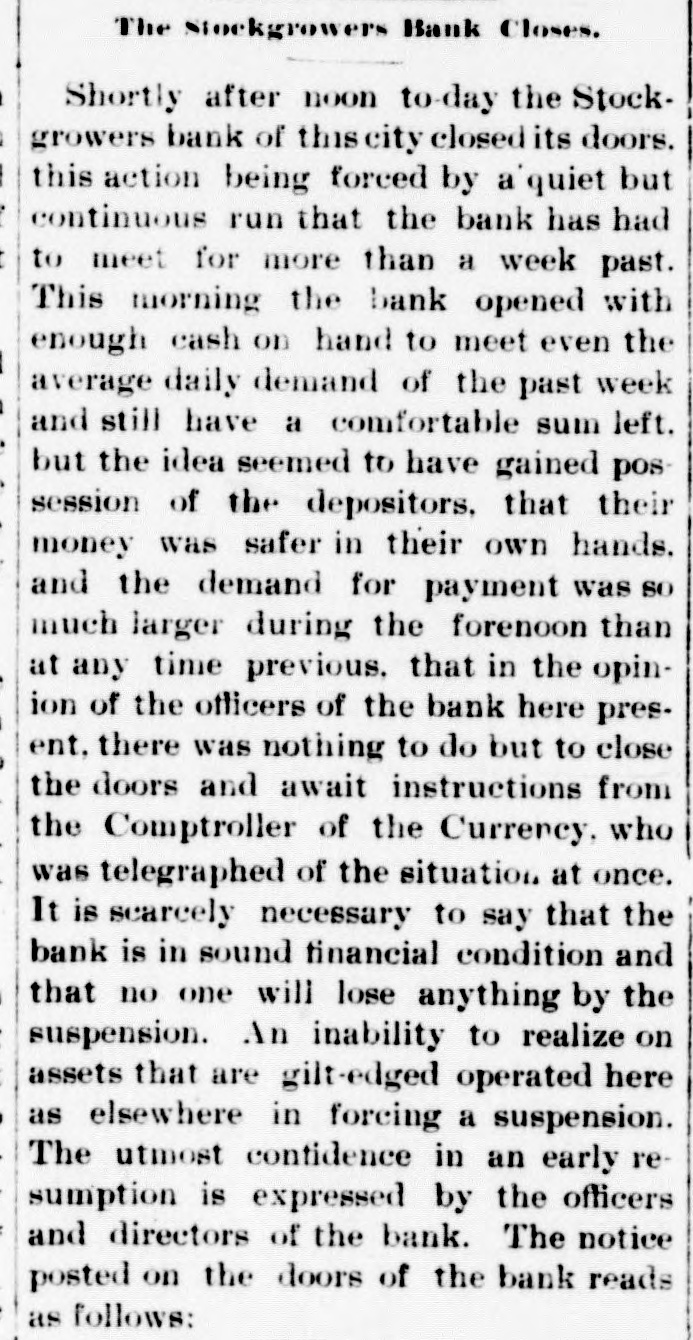
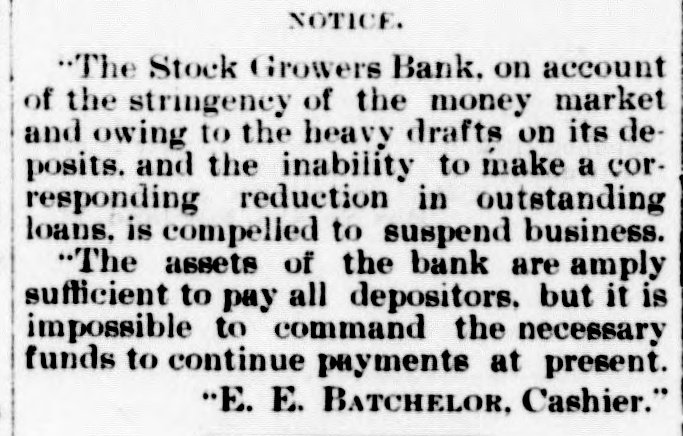
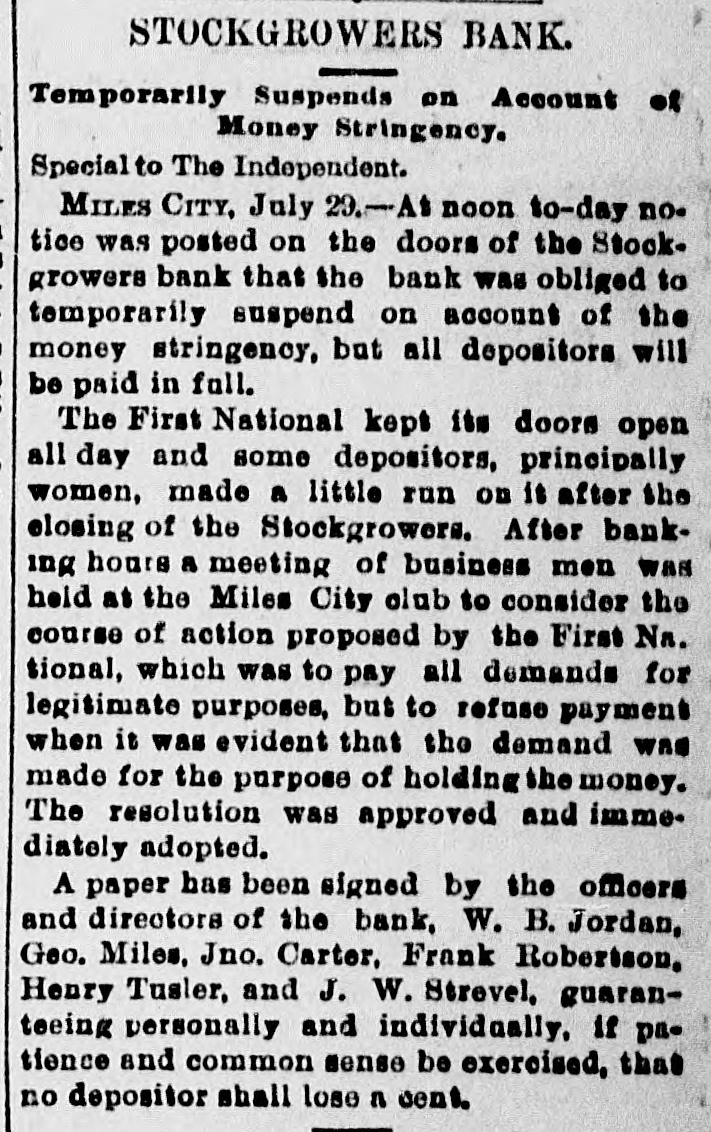
Bank closed amid insolvency concerns and loss of confidence tied to bank-specific troubles (later embezzlement and mismanagement charges against president H. F. Batchelor).
Newspaper Excerpt
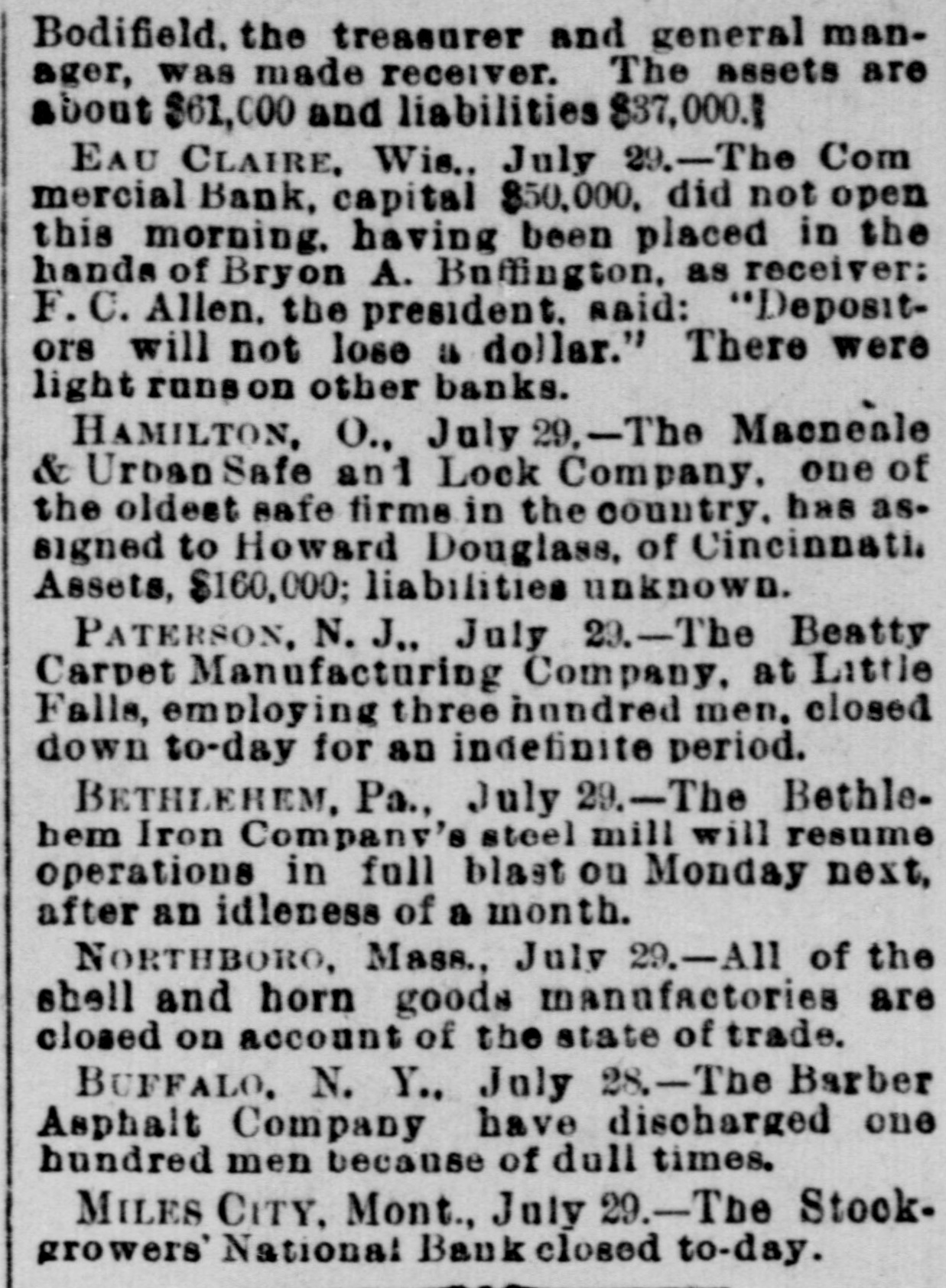
MILES CITY, Mont., July 29.-The Stockgrowers' National Bank closed to-day.
Source
newspapers
3. August 9, 1893 Receivership
Source
historical_nic
4. August 9, 1893 Receivership
Newspaper Excerpt
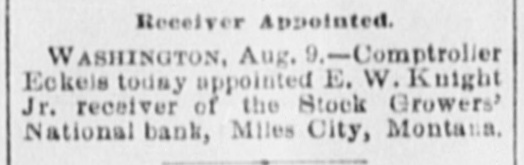
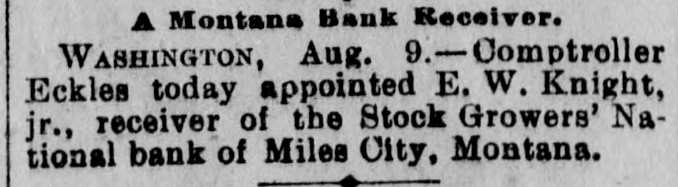
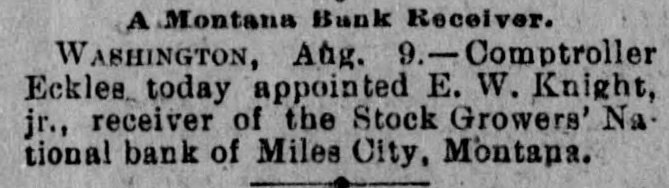
Comptroller Eckels today appointed ... E. W. Knight Jr., receiver of the Stock Growers' National bank, of Miles City, Mont.
Source
newspapers
5. December 8, 1893 Other
Newspaper Excerpt
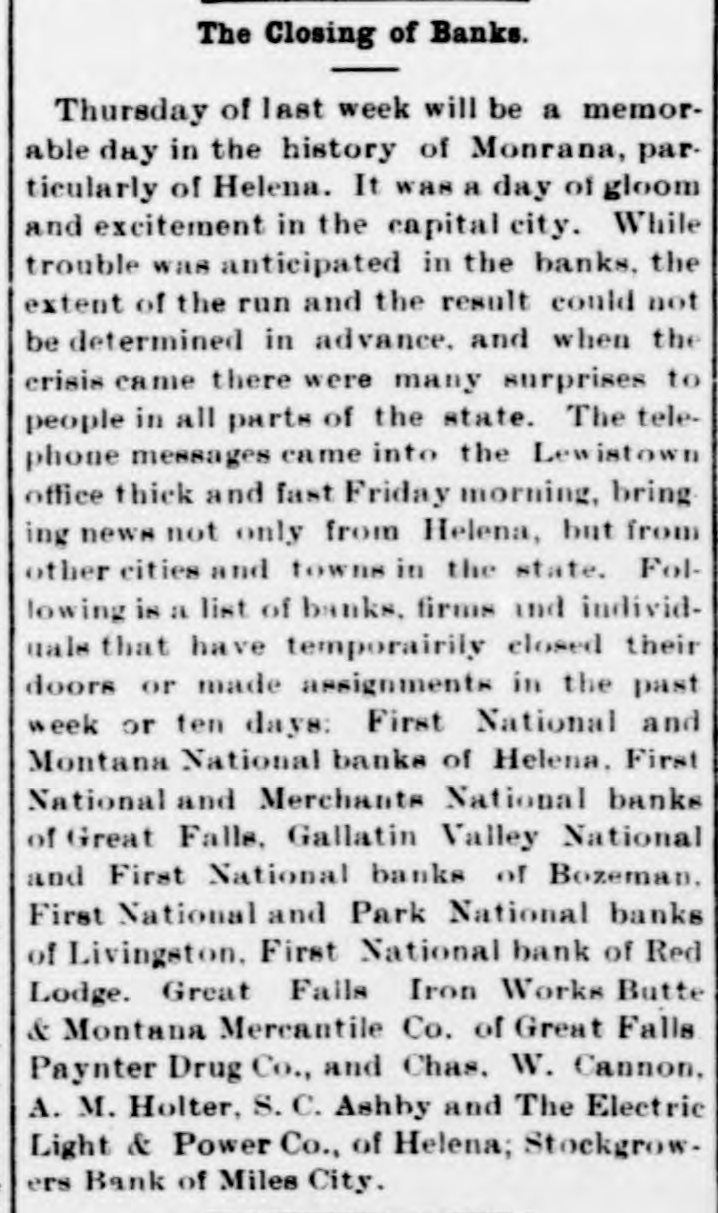
Each of these institutions has been compelled to close its doors, suspend payments to depositors and cease doing business. Receivers have been appointed ... the Stock-Growers' National bank of Miles City.
Source
newspapers

Newspaper Articles (22)

Article from The Yellowstone Journal, July 29, 1893

Click image to open full size in new tab

Article Text

fidence in the Banks. Following the closing of the Stockgrowers bank to day. and with a view to excitement that this event may a meeting of have allay caused. any the citizens called and business men of the city was Miles City club rooms at half four to consider a course past at the National of action bank. proposed by the First Promptly at the hour named the meet ing was called to order by W. B. Jordan motion of Dr. Fish. elected chairman of and vell was on Judge the meet Stre assuming the position the but forcibly ing. judge On briefly portrayed the damage the situation as it existed and disaster that would overtake all our local interests if the unreasonable alarm that causes bank runs" should take possession of this community. He was W. B. Jordan president of National bank who followed the First by stated of that the it was the desire and intention of the bank to keep of it open but to officers that institution the do doors this would require the co-operation and sup port of the community. The bank was financially sound. and its stockholders men of well known wealth. He stated that the bank had funds to conduct business in the ordinary way. sufficient easily course Although for pursuing a very conservative the last three months the bank has nevertheless made loans continuously for of its patrons. and be to do so. All that was able the benefit required will still to accomplish this and save this community the distressing effects of having to gointo forced liquidation was the confidence of the people. The plan decided upon by the directhe bank to protect the interests and through it. of tors the of bank. those demands of the community was to pay all made upon it for legitimate business purposes. but to refuse to pay any demands made where it was known and apparent that such demands were-made for the purpose of hoarding the money away. and retiring it from circulation. Prof. Bach followed in an endorsement action of the that he would do all stated of the proposed bank that and he could to aid them in its performance. Mr. Jordan stated that the bank did not ask for any assistance save in the continuance of ordinary business transac tions and the full moral support of the and the latter most of all. known financial community. The well ability of the directorsof the bank was an assurance of its solidity and if this needed any strengthening it was afforded by the fol lowing announcement which the bank had at hour before made public: ANNOU INCEMENT. We are not insensible to the fact that financial condition of the people in in the country. present having banks money banks. however solvent such may liable to be anxious about the of such money. and safety be. are by reason of such anxiety create what is commonly known as "a run on the bank." To the patrons and the depositors of the First National bank of Miles City, we the undersigned. officers and stockof said bank. desire to state that the financial holders we know condition sound. of this bank. to be absolutely safe and that the bank is to pay every if all come at once l'o state depositor able would not be the truth. No bank in the United States, isolated from help from other banks. as we are. could do that. But to the depositors and patrons of this bank is we desire to state that if the patience the bank to be no and know confidence exercised worthy which of. if we run is created or precipitated. and the bank is allowed to pursue its usual course of business we will guarantee. and individually. no shall lose one cent of money personally positor that the dewhich he now hason deposit in the bank. W. B. JORDAN, President. GEO. M. MILES. Vice-President. JOHN CARTER. Director. FRANK C. ROBERTSON. Director. HENRY TUSLER. Director. J. W. STREVELL. Director. Mr. Jordan added that the presenteon dition would be only temporary as in two t weeks the return from beef shipments t would begin to come in and continue until November. R In order to place the matter before the M meeting Mr. Moran moved: li That it is the sense of this meeting that the business men and citizensof of b we. City, approve of the proposed action to National Bank in refusing those that of when they are for the aydepositorson deposit. First olding certificates satisfied is being withdrawn simply of putting it away. or that are desired for amounts the the money sake No actual small need. to be refused payment.


Article from The Indianapolis Journal, July 30, 1893

Click image to open full size in new tab

Article Text

Bodifield, the treasurer and general manager, was made receiver. The assets are $ 1000 and liabilities $37,000.1 EAU CLAIRE. Wis.. July 29.-The Com mercial Bank, capital $50,000. did not open this morning. having been placed in the hands of Bryon A. Buffington, as receiver: F.C. Allen. the president. said: "Depositors will not lose is dollar." There were light runson other banks. HAMILTON, O., July 29.-The Macneale & Urban Safe and Lock Company. one of the oldest safe firms in the country. has assigned to Howard Douglass, of Cincinnati. Assets, $160,000; liabilities unknown. PATERSON, N. J.. July 29.-The Beatty Carpet Manufacturing Company. at Little Falls, employing three hundred men. closed down to-day for an indefinite period. BETHLEHEM, Pa., July 29.-The Bethlehem Iron Company's steel mill will resume operations in full blast ou Monday next, after an idleness of a month. NORTHBORO, Mass., July 29.-All of the shell and horn goods manufactories are closed on account of the state of trade. BUFFALO. N. Y., July 28.-The Barber Asphalt Company have discharged one hundred men because of dull times. MILES CITY, Mont., July 29.-The Stockgrowers' National Bank closed to-day.


Article from The Yellowstone Journal, July 31, 1893

Click image to open full size in new tab

Article Text

CITIZENS' MEETING. A Strong Expression of Confidence in the First National Bank of Miles City, Mont. Following the closing of the Stockgrowers bank to-day. and with a view to allay any excitement that this event may have caused. a meeting of the citizens and business men of the city was called at the Miles City club rooms at half four to consider a course of action by the First past proposed National the meet bank. Promptly at the hour named called to order by W. B. Jordan motion of Dr. Fish. and ing was on Judge meet Stre. vell was elected chairman of the ing. On assuming the position the judge briefly but forcibly portrayed the situation as it existed and the damage disaster that would overtake all our local interests if the unreasonable alarm that causes "bank runs" should take possession of this community. He was followed by W. B. Jordan president of the First National bank who stated that it was the desire and intention of the officers of the bank to keep the doors of it that institution open but to do this would require the CO operation and sup port of the community The bank was financially sound. and its stockholders men of well known wealth. He stated that the bank had sufficient funds to conduct business easily in the ordinary way. Although pursuing a very conservative course for the last three months. the bank has nevertheless made loans continuously for the benefit of its patrons. and will still to able to do so. All that was required accomplish this and save this community the distressing effects of having to go into forced liquidation was the confidence the people. The plan decided upon by the directors of the bank to protect the interests of the bank. and through it. those of the community. was to pay all demands made upon it for legitimate business depurposes. but to refuse to pay any mands made where it was known and apparent that such demands were made for the purpose of hoarding the money if away. and retiring it from circulation. sit deemed necessary until the financial be uation changes. or collections can made.- Prof. Bach followed in an endorsement of the proposed action of the bank and he stated that he would do all that could to aid them in its performance. did Mr. Jordan stated that the bank not ask for any assistance save in the continuance of ordinary business transac- the tions and the full moral support of community. and the latter most of the all. The well known tinancial ability of of directorsof the bank was an assurance its solidity and if this needed any folstrengthening it was afforded by the bank lowing announcement which the had a hour before made public: ANNOUNCEMENT. We are not insensible to the fact that of the present financial condition in the in country. people having money banks. however solvent such banks may the be. are liable to be anxious about of safety of such money. and by commonly reason such anxiety create what is known as "a run on the bank." To the patrons and the depositors of the First National bank of Miles City, we the undersigned. officers and stockholders of said bank. desire to state that this know the financial condition of bank. we to be absolutely safe and sound. To state that the bank is able to pay depositor if all comeat once would every not be the truth. No bank the United States. isolated from help from other banks, as we are. could do that. But bank to the depositors and patrons of this desire to state that if the patience we and we confidence is exercised which know the bank to be worthy of. if the no run is created or precipitated. and bank is allowed to pursue its usual course of business we will guarantee. depersonally and individually. that no positor shall lose one cent of the money bank. which he now on deposit in the W. B. JORDAN, President. GEO. M. MILES. Vice President, JOHN CARTER. Director. FRANK C. ROBERTSON. Director. HENRY TUSLER. Director. J. W. STREVELL, Director. Mr. Jordan added that the presenteon two dition would be only temporary as in weeks the return from beef shipments unwould begin to come in and continue til November. In order to place the matter before the Mr. Moran moved: meeting That it is the sense of this meeting that


Article from The Yellowstone Journal, July 31, 1893

Click image to open full size in new tab

Article Text

Monday. July 31, 1893. THE feeling in the commercial and financial circles of Miles City exhibited a marked improvement to-day over the depression of Saturday. caused by the closing of the Stockgrowers National Bank. The action taken by the citizens at the meeting Saturday seems to have had a very quieting effect. and there was no semblance of a run on the First National to-day. Business progressed in the ordinary way and deposits were received and checks paid as if there was no panic existing. This is as it should be. Situated as we are, remote from other localities and living as it were among ourselves. there is no cause for any excitement. The men who have always been solvent with us. are solvent to-day. and the inability to realize on assets is the only clog in the way of easy transaction of business. We believe it would be shown when the affairs of the Stock Growers National bank are made public. that it is abundantly able to pay dollar for dollar to every creditor and have money left. and the directors of the First National have proclaimed publicly that every depositor can have abundant security for his claim. if he feels in the least concerned abont its safety. Some little concern has been expressed in regard to what action will be taken tomormor by the county commissioners in regard to the county funds that are in the Stockgrowers Bank. but after diligent enquiry we feel authorized to state that no action will be taken by the Commis. sioners until the condition of the bank is made public. and not then will any steps be taken that will in any degree embarass the Treasurer or his bondsmen. The Commissioners fully realize that this is no time to press settlements. where it is evident that the county is abundantly protected. and they will not do it.


Article from St. Paul Daily Globe, August 10, 1893

Click image to open full size in new tab

Article Text

Gold in the Treasury. WASHINGTON, Aug. 9.-The gold in the treasury is today $3,157,853 above the $100,000,000 gold reserve. Comptroller Eckels today appointed receivers of national banks as follows: W. G. Sykes, receiver of the First National Bank of Starkville, Miss., and E. W. Knight Jr., receiver of the Stock Growers' National bank, of Miles City, Mont.


Article from The Helena Independent, August 16, 1893

Click image to open full size in new tab

Article Text

Money Matters at Miles. Special to The Independent. MILES CITY, Aug. 15.-The city council has made the tax levy on city property for the current fiscal year eight mills on the dollar of valuation fixed by the county board of equalization. City Treasurer Allertion had the municipal funds in the suspended Stockgrowers bank. the city balance being about $1,400. W. F. Batchelor. president of the Stook. growers bank, Col. George Scheetz, one of the stockholders, and Sydney Paget, heavy depositor therein. were Mr. Allerton's bondemen. A motion was agreed to at last night's meeting of the council that Treasurer Allerton furnish is new bond for $8,000, the liability of the old bondsmen for tue sum tied up in the Stockgrowers bank not being vacated. Goo. Burmiston, County Treasurer Savage's deputy, has been employed by Receiver Knight as an expert accountant to aid in straightening out the accounts of the Stockgrowers bank.


Article from The Helena Independent, August 23, 1893

Click image to open full size in new tab

Article Text

PERSONAL. Hon. T. E. Collins, of Great Falls, is at The Helena. H. O. Burghardi, of Great Falls, is at the Grand Central. Jas. A. Coram, of the Boston & Montana company. is in town. Dr. Carl Schulin returned last night from White Sulphur Springs. Louis Hel'mann, of White Sulphur Springs, is a visitor in Helena. E. T. Wilson, of Miles City, is among the eastern Mentana people in town. A. B. Keith, private secretary to Gov. Rickards. is confined to his home by 111ness. J. E. MeIntire, clerk in the office of the secretary of state, left yesterday for a visit to Chicago. Lieut.-Gov. Botkin. Attorney-General Haskell and Secretary of State Rotwitt went to Deer Lodge yesterday to inspect the prison. A. Kleinschmidt, accompanied by his daughters Misses Bertha and Ella. and the boys. left yesterday for a visit to his ranch in the Big Blackfoot country. Prof. S. A. Merritt, of the high school, and his family have returned from a visit east. During the summer Mr. Merritt took a special course in an eastern college. Mrs. E. W. Knight, Jr., and child went to Miles City Sunday and will remain there for some time; in fact as long as Mr. Knight's position as receiver of the Stock Growers bank keeps him in that city. Edward Rosewater. proprietor of the Omaha Bee, and his son, stopped over in Helena yesterday on his way home from an Alaskan tonr. It is Mr. Rosewater's first visit to the northwest and the Pacido coast and he was both surprised and pleased with what he has seen. Hugh MeQuaid and Sheriff Curtis returned from the Flathead eservation last night, where they went to attend the funeral of Major Peter Ronan. They left here Monday at noon, reached the agency at 10 e'clock that night, at three o'clock Tuesday morning they started with the funeral party for Arlee, where they took the trais, arriving in Missoula at 5:30 8. m. Funeral services were held at nine a. m. and when Mr. MeQuaid and Sheriff Curtiff reached Helena last night they had had no sleep since they got up Monday morning. Edward Phelps and Miss Mary Williams were married at the residence of John Sarley, Sixth avenue and Beattie street, last night, Rev. J. Wesley Hill performing the ceremony. Mr. Phelps is the driver of the city hall hose carriage and very popular both with the officers and men of the department, to whom the news of the wedding will come as a surprise, as he obtained leave of absence to go fishing. J. E. Do Haas acted as best man and Mrs. Mary Sarley was bridesmaid. Friends of both the contracting parties were present and after the ceremony a nice supper was served.


Article from The Yellowstone Journal, August 24, 1893

Click image to open full size in new tab

Article Text

PRESENT. W. S. Snell. Chairman of Board. W. N. Haynes, Member of Board. T. J. Graham. Member of Board. J. B. Hawkins. Sheriff. A. H. Swerdtiger, Clerk of Board. The Sheriff duly announced the meeting. The following resolution was offered by Mr. Snell. who moved its adoption: Whereas, It has come to the knowledge of the Board of County Commissioners of the County of Custer. that the Stock Growers National Bank of Miles City, Montana. has suspended and is now in the hands of E. W. Knight. Jr.. bank examiner. and knowing that the said Bank has for a long time been the depository for the County funds: now. therefore be it Resolved. That the County Treasurer of the County of Custer be. and he IS hereby requested to deliver forthwith all the books of his office. together with all funds and moneys in his possession by virtue of his office of County Treasurer to the Board of County Commissioners of Cnster County. for inspection and a count of the funds: and further. that the County Treasurer be furnished with a copy of this resolution. Adopted. The Board now took a recess until 2 o'clock p. m. Office of the County Clerk. 2 o'clock p. m.-The Board re-convened as per recess taken, all members present. The Board now proceeded to the Treasurer's office and made an examination of the books and funds in his office. Said examination disclosed that on this date there is a cash balance due the County. as shown by the books. which we accept as correct. of 853,160.08. Upon further examination we find the funds composed of the following items. viz:


Article from The Helena Independent, October 22, 1893

Click image to open full size in new tab

Article Text

No Years of the Results. Special to The Independent. MILES CITY, Oct. 21.-H. F. Batcheler, president of the Stockgrowers bank. stated that the charges made in the complaint of E. W. Knight, Jr., receiver. were preposterous and that he had no fears as to the ultimate result. His attorney, O. R. Middieton, has a communication in 10-day's Yellowstone Journal in which he explains the transactions and entries in the books of the bank, and states that the records in the bank give a complete history of the entries. As to the charge of embezzlement, he sayu that the monies were paid out for the purposes indicated by the records of the bank, and that neither of the Batchelers realised any benefit from such payments.


Article from The Yellowstone Journal, November 1, 1893

Click image to open full size in new tab

Article Text

through the records of the Stock Growers National bank, which show that it was paid on Oct. 25, 1892. The note itself remains uncancelled in my possession as receiver. I have also traced the note, No. 4857 through the records, and find no such note signed by Andrew F. Burleigh. There is a copy of that note. There is no record of the payment of note No. 4857. In a general way I am acquainted with the handwriting of H. F. Batchelor, but not as an expert. I am well enough acquainted with it to tell whether the Burleigh entry is in his handwriting. I should judge it was. At this point Mr. Porter asked for an adjournment until this morning at 10 o'clock, which was granted. # MORNING SESSION. The examination was resumed at 10 o'clock this morning, with Receiver Knight still testifying, who said: Regarding the Burleigh note No. 4857, it was registered first as No. 4857 and subsequently changed to No. 4858. It also bears the number "3731" with a line drawn through it. This number (3731) is the number of the original Burleigh note for $3,153.92. The bills receivable register shows note No. 3731 as "paid" on Oct. 25, 1892. This statement brought forth an objection by Judge Strevell on the ground that the witness has no right to make conclusions from what certain records show. The commissioner ruled that the witness was only testifying as to the state of those records, and that his testimony was, therefore, admissable, and the witness then proceeded: I found note No. 3731 and the other notes attached to it, on taking possession of the bank. I found with note No. 3731, a note marked "copy," dated May 29, 1891, also a note dated May 29, 1891, No. 3731, signed "Andrew F. Burleigh," also a note with no number, same date, for $873.60, signed "Andrew F. Burleigh;" also a receipt dated Oct. 26, 1891, issued by the Richmond Mining Co. to Wm. Harmon, trustee, for $110.00 for "assessment No. 1 and cost of advtg." on etf. No. 83, for 10,000 shares Richmond Co. capital stock. I find no record of the note of $873.60 on the books of the bank, except in a copy of a letter dated Oct. 24, 1892, enclosing this note to E. A. Gardner, manager, for collection. This letter is signed "H. F. Batchelor, Pt." Quite a tilt preceded the opening of the next line of testimony. The witness was asked how much Mr. Batchelor owed the bank on the 25th Oct. 1892. This was strenuously objected to by the defense as having no connection whatever with the matters set forth in the complaint, and asearnestly insisted upon by the prosecution, and on the assurance of Mr. Porter that he would show connection, the testimony was admitted conditionally, the commissioner reserving the right to strike it out on reconsideration. The witness then proceeded: From the records, as far as I have been able to ascertain, Mr. Batchelor was owing the bank on Oct.25, 1892, in the neighborhood of $14,000. I could not say positively how much stock he had without referring to the stock book. He continued to be a debtor to the bank until the date of its closing. I took charge Aug. 9, 1893. The witness then produced the general journal of the bank, and at request read from it certain entries of Dec. 31, 1890, relating to the Logan transaction. [These entries may be explained to show a transaction by which two notes made by T. H. Logan, dated June 30, 1890, and for $2,500.00 and $2,262.56 respectively, were grouped into one note for $5,048.24, dated Dec. 31, 1890.-Ed.] The prosecution offered the portion of the page showing the entry in evidence, and the defense objected for the reason that other and irrelevant matter was included in the entry. The objection was sustained as to the exclusion of the irrelevant matter, and only that portion of the entry referring to the Logan notes was allowed to go in. The witness then proceeded as follows: The word "Logan" in the entry refers to T. H. Logan. I know this by the entries on the bills receivable register, which shows that the Logan notes referred to in the entry on the general journal as No. 3101, $2,500.00; No. 3102, $2,262.56, and the note for $5,048.24, were made by T. H. Logan. The bills receivable register shows that notes Nos. 3101 and 3102 were paid December 31, 1890, and on the same date the general journal shows a credit to "Loans and Dis." for No. 3101, $2,500.00 and for No. 3102, $2,262.56. The notes referred to as Nos. 3101 and 3102 are still in the bank, uncancelled and unsigned. [This statement will be more clearly understood when it is explained that the notes 3101 and 3102 appear to have been made for the purpose of taking up two other notes made and signed by T. H. Logan. Oct. 7, 1889, and for $2,500.00 and $1,931.43 respectively, but were never executed-Ed.] The witness here produced the Logan notes, Nos. 3101 and 3102, but the defense objected to having them considered until it was shown that they were in the same condition as when the wit-


Article from The Weekly Tribune, December 8, 1893

Click image to open full size in new tab

Article Text

The Grand Jury's Report. The grand jury was then discharged finally after making their report. In the report they say: "Your grand jury believes that it would be derelict in the discharge of is duty to the court if it failed to visit severe censure upon the directors of the Livingston National bank. the Merchants National bank of Great Falls. and the Stock-Growers' National bank of Miles City. Each of these institu tions has been compelled to close its doors, suspend payments to depositors and cease doing business. Receivers have been appoir ted in each case by the comptroller of the currency owing to the unsatisfactory condition of the banks' resources. The consequence is that de. positors who in good faith have done business with these institutions and have left their money for safe-keeping in full confidence that it would be honestly returned to them with legal interest have been grossly deceived and wronged, their confidence abused, their earnings frittered away in reckless speculation by those in charge. and, in some instances, have, been deliberately swindled by the bank officials out of sums large enough to be considered comfortable fortunes The grand jurors are of the opinion that the fact of being an officer or director of a national bank ought not to give any man license to swindle and defraud his fellow-men. The unfortunate condition of the banks named above and consequent hardship and loss to innocent depositors, as well as prostration of the business community, are, in the opinion of your grand jurors, largely due to the gross and inexeusable neglect of duty and apparent indifference to their oaths as directors so flagrant and resulting in effects grave and injurious alike to in dividuals and the public that it should be distinctly declared to be a crime by the UnitedStates laws. National bank di rectors owe a duty to the United States. to bank depositors, and the business public, and that duty is to faithfully and bonestly oversee and manage the busi


Article from The Helena Independent, April 14, 1894

Click image to open full size in new tab

Article Text

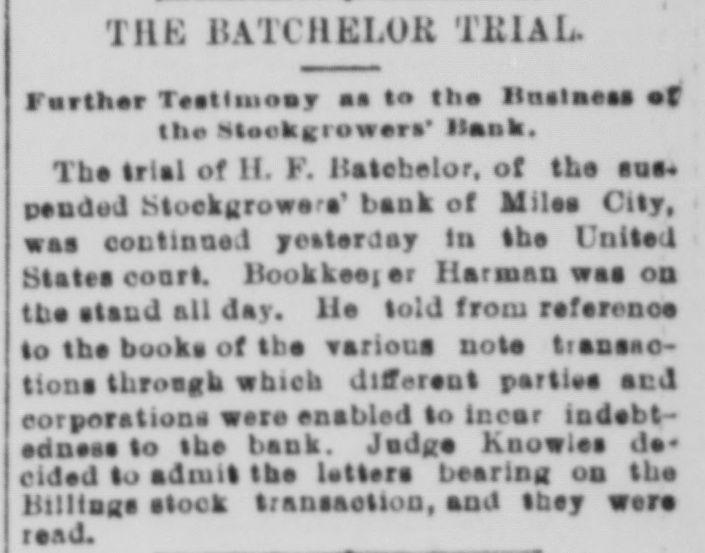
THE BATCHELOR TRIAL Further Testimony as to the Business of the Stockgrowers' Bank. The trial of H. F. Batchelor, of the sus. pended Stockgrowere' bank of Miles City, was continued yesterday in the United States court. Bookkeeper Harman was on the stand all day. He told from reference to the books of the various note transnotions through which different parties and corporations were enabled to incar indebtedness to the bank. Judge Knowles decided to admit the letters bearing on the Billings stock transaction, and they were read.


Article from The Helena Independent, April 17, 1894

Click image to open full size in new tab

Article Text

# THE BATCHELOR CASE. Continuation of the Testimony on Behalf of the Prosecution. The trial of H. F. Batche'or, president of the Stockgrowers' National bank of Miles City, moved along quite briskly in the United States court yesterday. The cross-examination of Bookkeeper Harman occupied the morning. Witness admitted that though the books showed the notes of July 5 were entered long after their date, that the transaction might in fact all have taken place on that date and the notes dated back. He was examined concerning the finding of the lette file of defendant's, for the purpose of demonstrating it was in no concealed place. As to the Logan notes he testined that the original notes were always kept with the memorandum notes; that the second set of notes consisted of the amount of the original notes and interest, and the third note consisted of the amount of the second note and interest, and that the original notes never left the pocket of the bank. He was asked if he did not know that a note had been sent to Major Logan for execution and returned, but disclaimed any knowledge of any such transaction. A similar examination was conducted as to the Barleigh note. Witness testified that something over $7,000 of Newman notes hau been included in the H. F. Batchelor indebtedness. Of the paper on which C. L. Me rill was endorser some was secured by chattel mortgage, some was commerci paper discounted, and some was endorsed by third parties. Of the defendant's total indebtedness, $10.626.27 represented interest upon his indebtedness since Aug. 2, 1886, and the defendant's indebtedness in his own name at the suspension of the bank was over $38,000, and that which stood in the name of his father was over $12.000. On redirect examination Witness Harmon gave a history of the indebtedness of the defendant to the banis from its beginning in August, 1886, down to Jan. 1, 1891, showing a steady increase during that period. The original draft transmitted for the cash payment on the Billings stock was identified and read in evidence. Clerk and Recorder Swerdfiger, of Custer county, was then called and produced the assessments liste of the defendant, sworn to and in many instances in his own handwriting, from 1885 to 1893 inclusive, the first year amounting to something over $300, and the highest list of property during the tem being about $3,000. Witness also produced the assessment list of the bank from 1890 to 1893 inclusive, which showed that the stock was not assessed to the individuals but to the bank, and testified that the name of defendant's father did not appear on the assessment roils of that county. Witness also produced the annual state-ment, articles of incorporation, and assessment lists of the Water and Electrie Light company of Miles City for 1893, showing the value of its property to be about $11,-000, its debts about $45,000, and its capital stock pri in $19,000. The nasessments lists of C. L. Merrill for 1890, George Newman for 1891, 1892 and 1893 were also produced. Witness Briggs was then called and testified that he was a representative of the Frederick Billings estate in Billings, and produced and identified three stock certificates of fifty shares each and two notes signed by defendant, each for $6,000. Each, he said, was the property of tue estate and held by him as such; that the stock certificates were collateral to the notes. He also identified a couple of deposit slips and a letter or receipt written in New York, all of which papers were proven subsequently to have been in the handwriting of the defendant.


Article from The Helena Independent, April 21, 1894

Click image to open full size in new tab

Article Text

SOON WITH THE JURORS. The Batchelor Trial Drawing to a Close in the United States Court. All the Evidence in the Case Was Completed on Friday. The Opening Argument for the Prosecution Is Begun by Assistant District Attorney Wallace. The trial of H. F. Batchelor for misusing funds of the Stockgrowers' National bank of Miles City, while its president, is nearly over in the United States court, and the case will very likely go the jury to day. The 0 088 examination of the defendant was completed yesterday morning, and then C. R. Middleton, one of the directors of the bank, took the stand. He insisted that the board of di ectors knew of the purchase of the Stebbins stock by defendant. On cross examination he was unable to fix any dates of formal or informal meetings of the board, but he knew the subject had been discussed a dozen times. Before Batchelor went east he was given to understand by the directors that the purchase of the Stebbins stock would be to the interest of the bank. ce-President Harmon, of the bank. was recalled by the defense. He told the story of the time when the bank deposits fell off on account of Stebbins' connection with it. Witness walked into the bank one day and asked Batchelor how he was getting along. Batchelor told him the funds of the bank were getting quite low, and owing to the failure of the Deadwood bank the Stockgrowers' was threatened with a run. While they were talking Judge Bach came in and demanded the county funds. some $13,000, on deposit there. Batchelor referred him to witness, who stepped into the vault with Batchelor. There witness asked Batchelor how much money there was in the bank. Batchelor said the money only amounted to about $1,800. Witness asked Judge Bach what he meant to do with the funds and was told he meant to take them to Helena. "Then," said the witness. "I made & bluff. I gave Judge Bach a draft on the Bank of Commerce of Minneapolis, and took a train right away for that city, and arranged for a oredi & to meet the draft." Witness said that by reason of this and other troubles caused by Steb bins' connection with the bank the feeling was that they should get the Stebbins stock One day Batchelor came in and said he was going to get the Stebbins stock. Witness asked him how. Batchelor eplied that he would give his notes. In consideration of what he had done in the matter of getting the Stebbins stock, Batchelor thought he ought to be made president of the bank. Witness voted for Batchelor for president himself on that account. Witness was asked if he had been told that Batchelor paid for the Stebbins stock with the bank's money. He replied that he had never been sold so. He knew that Batchelor was bor owing money from the bank, and he drew his own inferences. George Sheetz was recalled and testified to the value of the electric light stock In his judgment the plant was worth $50.000 It was never encumbered until just before the suspension of the bank he plant ought to be run on $7,000 a year and the income ought to be $12,000 or $13,000 E. H. Johnson was called by the prosecu. tion. He said that when he bought his stock in the bank Batchelor had told him that the concern would be dec 8 ing div dends in the fellowing June. After he became a director he was away most of the time, but not continuously. He had no knowledge of the discount committee being called to meet at any time and never attended any of their meetings. He never knew of any occasion for attending the meetings. After the bank failed be asked Batchelor for a list of the assets. Batchelor sHil he couldn't give it to him as the books were in the hands of the examiner and he bad no A00088 to them. Witness told Batcheler he ought to be better posted on the condition of affairs. The defense them put on a number of witnesses as to the reputation of the defendant in Miles City. They were D. A. Cory, A. J. Seligman, Col. James Sullivan. Richard Lockey. J. W. Kins E. H. Johnson, E. B. Weirick, T. C. Bach, AI Smith and Capt. Harmon. They all testi fied to the fact that in Miles City defendant stood high and enjoyed unlimited confiMence and was regarded as one of the leading young men of eastern Montana. Tbis closed the testimony for both sides. William Wallace. Jr. began the opening argument for the prosecution during the afternoon He wished to be as fair to the defendant, he said, na he would be to any man accused of bighway robbery or any such offense. He fain would say, however, that in his opinion the offense charged against defendant was a R eater one than that committed by B highwayman. He had violated the trust and cont dence reposed in him by the community When a highwayman stopped a traveler and forced him to surrender his property, the traveler was the only one inconvenienced, and his financial condition might not be seriously impaired. The man charged with crime like that charged against defendant perpetrated crime which was not only far reaching in its effects, but affected a class of small depositors who had int usted their OR nings to the bank by reason of the supposed security affended rather than yield to the temptation of larger profits in the ordinary course of business, The fact Was that defendant had not and never had, during his connection with the bank, any assets except his house and fur niture, his stock in the Electric Light and Water company, and his stock in the bank At the time the bank failed defendant owed it $52,000, of which $40,000 was in his own name and $12,000 in the name of his father. To tuis must be added about $6,500 interest which he had failed to charge on his own notes, having only charged six per cent. when the current rate was twelve De: cent he $52 000 owed. plus the interest withheld, made nearly $60.000. which was about four firths of the entire capital stock of the bank. At the time of the suspension of the bank, accord. ing to his own testimon: defendent's total indebtedness, including that to Site bank, was about $90,000. It was in October, 1891. that defendant began using the funds of the banks, Mr. lace said, to pay for his own ventu ea From then on his connection with the bank was a se 108 of misappropriations and false entries. When he undertook to urchase the Stebbins stock he claimed to expect assistance om friends in Pattsburg and other places in the east, upon which assistance he relied to pay to the funds he had used; and he also OX pected to place portions of the stock with stockg owers hrouguout that section. If, when the notes given in this ansaction


Article from The Yellowstone Journal, May 7, 1894

Click image to open full size in new tab

Article Text

Notice of Hearing. In the District Court of the Seventh Judicial District of the State of Montana, in and for the County of Custer. In the Matter of the Receivership NOTICE OF of the Stockgrowers National HEARING. Bank of Miles City, Montana. E W. KNIGHT. JR., receiver of said Bank, having this day filed his petition for an order of this said Court to compound a certain balance of debt amounting to seven thousand six hundred and fifty-or dollars and sixteen cents ($7,651.16), due the First National Bank of Chicago, from the Stockgrowers National Bank of Miles City, Montana. WHEREFORE, IT IS ORDERED, That the said petition is set for hearing on Saturday the 12th day of May, 1894. at 3 o'clock p. m., at the court room in the city of Miles City, and County of Custer. By order of the Judge of this Court. W. J. ZIMMERMAN, Clerk, Dated May 7th, 1894.


Article from The Yellowstone Journal, May 8, 1894

Click image to open full size in new tab

Article Text

Notice of Hearing. In the District Court of the Seventh Judicial District of the State of Montana, in and for the County of Custer. In the Matter of the Receivership NOTICE OF of the Stockgrowers National HEARING. Bank of Miles City, Montana. E. W. KNIGHT. JR.. receiver of said Bank, having this day filed his petition for an order of this said Court to compound a certain balance of debt amounting to seven thousand six hundred and fifty-one dollars and sixteen cents ($7,651.16). due the First National Bank of Chicago, from the Stockgrowers National Bank of Miles City, Montana. WHEREFORE, IT IS ORDERED, That the said petition is set for hearing on Saturday the 12th day of May, 1894. at So'cloek p. m.. at the court room in the city of Miles City, and County of Custer. By order of the Judge of this Court. W. J. ZAMMERMAN, Clerk, Dated May 7th, 1894.


Article from The Yellowstone Journal, May 10, 1894

Click image to open full size in new tab

Article Text

Notice of Hearing. In the District Court of the Seventh Judicial District of the State of Montana, in and for the County of Custer. In the Matter of the Receivership NOTICE OF of the Stockgrowers National HEARING. m Bank of Miles City, Montana. E. W. KNIGHT. Jr., receiver of said Bank, having this day filed his petition for an order of this said Court to compound a certain balance of debt amounting to seven thousand six hundred and fifty-one dollars and sixteen cents ($7,651.16), due the First National Bank of Chicago, from the Stockgrowers National Bank of Miles City, Montana. WHEREFORE, IT IS ORDERED, That the said petition is set for hearing on Saturday the 12th day of May, 1894, at o'clock p. m., at the court room in the city of Miles City, and County of Custer. By order of the Judge of this Court. W. J. ZIMMERMAN, Clerk, Dated May 7th, 1894.


Article from The Yellowstone Journal, August 28, 1894

Click image to open full size in new tab

Article Text

Hood's Pills cure habitual constipation. # Notice of Receivership. TO WHOM IT MAY CONCERN, Public notice is hereby given, that the undersigned was on the 17th day of August, 1894, by an order of the district court in and for Custer county in the suit of Leo C. Harmon, as receiver of the Stock Growers National bank, of Miles City, Montana, laintiff vs. The Water & Electric Light company, a Corporation Defendant, duly appointed receiver of all the property of the said Water & Electric Light company mentioned in two mortgages annexed to the complaint of plaintiff in said action, for the purpose of taking possession of said property and continuing the business of defendant during the pendency of the said foreclosure suit and collecting the revenue and paying the running expenses of said defendant; and the undersigned has entered upon the discharge of his duties as such receiver, and the business and operation of the said defendants Water & Electric Light plant is under the management and control of the undersigned as such receiver, to whom all payments for water and light furnished by the said Water & Electric Light company must be made, and with whom all business concerning the same is to be transacted. The office of the undersigned is located in the rear of the Stock Growers National bank building, Miles City, Montana. J. B. COLLINS, Receiver of the Water & Electric Light Co. Dated August 21st, 1894. First publication, August 23, 1894.


Article from The Yellowstone Journal, August 30, 1894

Click image to open full size in new tab

Article Text

Notice of Receivership. TO WHOM IT MAY CONCERN, Public notice is hereby given, that the und-rsigned was on the 17th day of August, 1894. by an order of the district court in and for Custer county in the suit of Leo C. Harmon, as receiver of the Stock Growers National bank. of Miles City, Montana, laintiff vs. The Water & Electric Light company, a Corporation Defendant, duly appointed receiver of all the property of the said Water & Electric Light company mentioned in two mortgages annexed to the complaint of plaintiff in said action. for the purpose of taking possession of said property and continuing the business of defendant during the pendency of the said foreclosure suit and collecting the revenue and paying the running expenses of said defendant: and the undersigned has entered upon the discharge of his duties as such receiver, and the business and operation of the said defendants Water & Electric Light plant is under the management and control of the undersigned as such receiver. to whom all payments for water and light furnished by the said Water & Electric Light company must be made, and with whom all business concerning the same is to be transacted. The office of the undersigned is located in the rear of the Stock Growers National bank building, Miles City, Montana. J.B. COLLINS, Receiver of the Water & Electric Light Co. Dated August 21st. 1894. First publication, August 23, 1894.


Article from Bismarck Weekly Tribune, June 21, 1895

Click image to open full size in new tab

Article Text

with cold lead, one of the men being shot in the back of the head, the bullet coming out through the chin. The injured man at last accounts was still alive, but sinking gradually, and the murderer chained in the guard house. A telegram from Grand Master Workman Moore, now attending the supreme session of the A. O. U. W. in Chicago, states that favorable action has been taken and that Supreme Master Workman Joseph E. Riggs of Kansas will be in Fargo, Tuesday, July 16th, to organize the grand lodge of North Dakota. This will bring fifty two representatives from subordinate lodges in the state there together with many visiting brethren, and will separate North from South Dakota. The delegates to the various Masonic grand lodge bodies went to Fargo this morning, where the annual sessions will be held, commencing at noon on the 18th. Thursday the grand chapter of the Order of the Eastern Star will meet. Mrs. H. E. White is grand matron and Mrs. N. R. Briggs grand secretary. In the evening the initiation services will be exemplified by the degree team from Mecca Chapter, Fargo, and the floor work by the chapter from Jamestown. That evening a banquet will also be given the visitors and grand officers by Fargo. A very pleasant time is anticipated. Perkins, Briggs, Hare and others will attend from Bismarck. Leo Harmon of Miles City, Mont., a son of Capt. William Harmon, formerly post trader at Fort Lincoln, who is well known among the old timers on the river, was in the city yesterday, having come up from Cannon Ball, where he attended the funeral of his uncle, H. S. Parkin. Leo has been in Miles City for some years past, and was engaged with the Stockgrowers' Bank, and after its failure was appointed receiver of that institution. The position is a responsible one, and is efficiently and satisfactorily filled by the present incumbent. Captain Harmon has a well stocked ranch near Miles City, and is doing well financially, although his health is poor, he having suffered from an attack of locomotor ataxia some time ago. Leo returned west this morning.


Article from The Herald, September 14, 1895

Click image to open full size in new tab

Article Text

TOO FREE WITH THE PEN, And Now Finds Himself in Serious Trouble FOR ARRESTED FORGERY Prominent Throughout the West in Business Circles w. R. Stebbins of Kansas City Charged With Having Used Another Man's Signature SALT LAKE Sept. 13.-A special to the Tribune from Cheyenne, Wyo., says: W. R. Stebbins, who has been well known in banking and business circles throughout the west for the past twenty years, was arrested here this morning by Sheriff Armstrong of Crook county on the charge of forgery. The sheriff started north at once with his prisoner, who will have a hearing at Sun Dance early next week. Mr. Stebbins' home is in Kansas City, Kan., where he is connected with the American Loan and Trust comDany. He has large property interests here, owning the Cheyenne postoffic e building. He has been connected as a stockholder or officer in the Merchants' National bank of Deadwood, S. D.: the Stebbins, Post & Co. bank of Cheyenne; the First National bank of Sun Dance; the Stock Growers National of Miles City; Cheyenne National and California National of San Diego, all of which have failed but without loss, it is alleged, to Stebbins. It 18 charged that Mr. Stebbins owne ed a block of stock in the First National of Sun Dance from its organization. To conceal his ownership of the bank stock Mr. Stebbins transferred it to a Kansas City man named Mills. The bank was then prospering and paying dividends on the stock. It is alleged that in order to secure the dividends on the stock transferred to Mills, Stebbins made out a power of attorney to the addition of Sun Dance, signed Mills' name to it and sent the document to A. D. Dunn. It authorzed him to vote the stock and collect the dividends. It is also alleged that Mills was in ignorance of this transaction. Later the bank failed and went into the hands of Receiver Milo A. Adams, who levied an assessment on all stockholders for the benefit of the banks' creditors. Both Mills and Stebbins denied owning the stock referred to and an investigation which followed resulted in the discovery of the forgery. Besides his connection with western banks, Mr. Stebbins is connected with the banking firm of Christic & Janney of New York. Suits against him by representatives of the broken banks have been commenced in New York city. Wyoming and Kansas City. Mr. Stebbins and his family have traveled abroad considerably, and he is regarded as personally being very wealthy.


Article from The Seattle Post-Intelligencer, September 15, 1895

Click image to open full size in new tab

Article Text

All His Banks Failed, but, It Is Said, Without Loss to Him. Salt Lake, Sept. 13.-A special to the Tribune from Cheyenne says: W. R. Stebbins, who has been well known in banking and business circles throughout the West for the past twenty years, was arrested here this morning by Sheriff Armstrong, of Crookston, on a charge of forgery. The sheriff started north at once with his prisoner, who will have a hearing at Sun Dance early next week. Mr. Stebhins' home is in Kansas City, Kan., where he is connected with the American Loan and Trust Company. He has large property interests here, owning the Cheyenne postoffice building. He has been connected as a stockholder or officer with the Merchants' National Bank of Deadwood, S. D.; the Stebbins, Post & Co. Bank of Cheyenne; the First National Bank of Sun Dance: the First National Bank of Spearfish: the Stock Growers' National Bank of Miles City: the Cheyenne National Bank and the California National Bank of San Diego, all of which have failed, but without loss, It is alleged, to Stebbins. It is charged that Mr. Stebbins owned a block of stock in the First National Bank of Sun Dance from its organization. To conceal his ownership of the bank stock Mr. Stebbins transferred it to a Kansas City man named Mills. The bank was then prospering and paying dividends on the stock. It is alleged that in order to secure the dividends on the stock transferred to Mills, Stebbins made out a power of attorney. signed Mills' name to It and sent the document to A. D. Dun. It authorized him to vote the stock, receipt for and collect the dividends. It is also alleged that Mills was in ignorance of this transaction. Later the bank failed and went into the hands of a receiver, Milo A. Adams, who levied an assessment on all the stockholders for the benefit of the bank's creditors. Both Mills and Stebbins denied owning the stock referred to, and an investigation followed. resulting in discovery of the forgery. During his connection with Western banks he has also been connected with the banking firm of Christie & Janney, of New York. Suits against him by representatives of the broken banks have been commenced in New York city, Wyoming and Kansas City. Mr. Stebbins and his family have traveled abroad considerably, and he is regarded as being very wealthy.