Accommodated withdrawals, Borrowed from banks or large institutions, Public signal of financial health, Capital injected, Full suspension, Books examined
Receivership Details
Date receivership started
1897-01-07
Date receivership terminated
1897-03-16
Description
Newspapers report heavy withdrawals and a run that coincided with the closing of the First National (closed Dec. 6, 1930), appointment of a federal receiver, liquidation procedures and an organized reorganization plan that led to authorization to sell assets and reopen the bank by mid-April 1931. OCR errors in some articles (Sloux = Sioux) corrected.
Events (10)
1.December 28, 1870Chartered
Source
historical_nic
2.January 7, 1897Receivership
Source
historical_nic
3.March 16, 1897Restored To Solvency
Source
historical_nic
4.December 6, 1930Run
Cause
Bank Specific Adverse Info
Cause Details
Heavy withdrawals and 'frozen assets' amid general business depression led depositors to rush the bank; large sums were paid out and money was shipped into Sioux City.
Measures
Banks paid depositors; police squads stationed at banks; cash shipments to Sioux City to meet withdrawals.
Newspaper Excerpt
Two million was rushed here after the First National and Sioux National ... were closed Saturday
Source
newspapers
5.December 6, 1930Suspension
Cause
Bank Specific Adverse Info
Cause Details
Bank closed because of 'frozen assets' and general business depression; federal examiner appointed receivers and doors were closed pending audit/liquidation procedures.
Newspaper Excerpt
the First National ... were closed Saturday ... Appointment of receivers for the First National ... closed Saturday was announced Monday evening
Source
newspapers
6.December 8, 1930Receivership
Source
historical_nic
7.December 8, 1930Receivership
Newspaper Excerpt
B. C. Schram, of Grand Forks, N. D., has been named receiver for the First National ... appointment ... by the United States controller of currency at Washington, D. C.
Source
newspapers
8.December 19, 1930Other
Newspaper Excerpt
holders of safety deposit boxes ... might have access ... only in case of an emergency ... doors of the banks have not yet been opened for the general business of liquidation. B. C. Schram is receiver for the First National bank.
Source
newspapers
9.January 29, 1931Other
Newspaper Excerpt
The First National bank here will be reopened within 60 days ... committee obtained permission of the comptroller of the currency to reopen the which was closed Dec. 6.
Source
newspapers
10.April 15, 1931Reopening
Newspaper Excerpt
Sale of assets to new bank authorized ... Reorganization reopening of the First National bank advanced ... reopening of the bank must be accomplished by April 15.
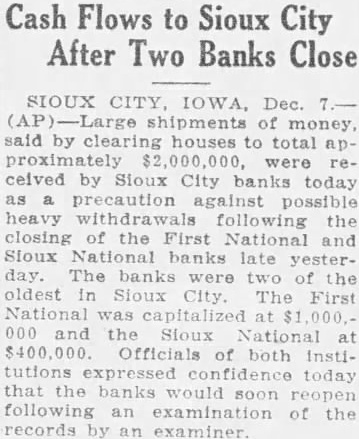
Cash Flows to Sioux City After Two Banks Close
SIOUX CITY, IOWA, Dec. shipments of money, said by houses to total were celved by Sioux City banks today precaution against possible heavy following the closing of the First National and Sloux National banks late yesterday. The banks were two oldest in Sioux City. The First National 000 and the National Officials of both Institutions expressed today that the banks following examination the records by examiner
2.December 9, 1930The Sioux City JournalSioux City, IA
Click image to open full size in new tab
Article Text
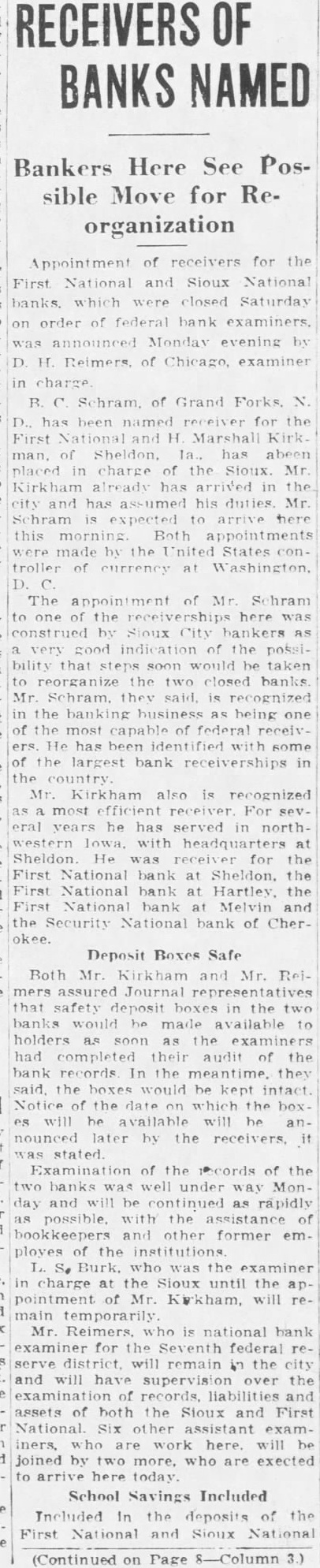
BANKS NAMED
Bankers Here See Possible Move for Reorganization
Appointment of receivers for the First National and Sloux National closed Saturday banks, which were federal bank examiners, order of on was announced Monday evening by of Chicago, examiner D. H. charge. B. C. Schram, of Grand Forks, N. D., has been named receiver for the First National and H. Marshall Kirk. has abeen man, of Sheldon, placed In charge of the Bloux. Mr. Kirkham already has arrived In the assumed his Mr. city and has expected to arrive here Schram morning. Both appointments this were made by the United States controller of currency at Washington, D. The appointment of Mr. Schram to one of the receiverships here was construed by Bloux City bankers very good indication of the possibility that steps soon would be taken reorganize the two closed Mr. Schram, they said, is recognized the being one in of the most capable of receivers. He has been with some the largest bank receiverships in the country. Mr. Kirkham also is recognized most efficient receiver. For says eral years he has served in north. western Iowa, with headquarters He was receiver for the Sheldon. National bank at Sheldon, the First First National hank at the First National bank Melyin and the Security National bank of Cher-
Deposit Boxes Safe Kirkham and Mr. that deposit the two safety banks would made to holders as soon as the their of the had completed the they said, the which the boxNotice will 1 available will anlater by
3.December 9, 1930The Sioux City JournalSioux City, IA
Click image to open full size in new tab
Article Text
RECEIVERS OF BANKS NAMED
Bankers Here See Possible Move for Reorganization
Appointment of receivers for the First National and Sioux National closed Saturday order of federal bank announced Monday evening by Reimers of examiner charge of Grand has been named for the First H. Marshall Kirk abeen placed in charge of the Mr Kirkham has and has assumed his duties Mr. expected here this morning Both appointments made the States The appointment of Mr Schram to the here construed by Sloux City bankers very good of the possibility would be taken reorganize the two closed banks Mr recognized the banking business as being one of the most of federal receivHe some of the largest bank receiverships in the Mr Kirkham is recognized most receiver he has served in northwestern with Sheldon for the First National bank at the First National bank at Hartley the National bank at Melvin and the Security National bank of Cherokee.
Deposit Boxes Safe
Both Mr. Kirkham and Mr. Reiassured Journal that safety boxes in the two banks made available to holders as soon as the examiners had completed audit the records In the meantime, they said, the would be kept intact. Notice the which the box. will he available be announced by the receivers, Examination of the records of the two banks well under way Monday and be continued as rapidly possible. with the assistance of bookkeepers and other former em. ployes of the institutions S. Burk, who the examiner charge at the until the pointment of Mr. Kirkham, will temporarily Mr. Reimers. is national bank examiner for the federal serve will remain in the city and will have supervision over the of records, assets of both the Sioux and First Six other iners, work here. will be joined by two who are exected to arrive here School Savings Included
Included the deposits the First National and Sioux National (Continued on Page 3.)
4.December 9, 1930The Sioux City JournalSioux City, IA
Click image to open full size in new tab
Article Text
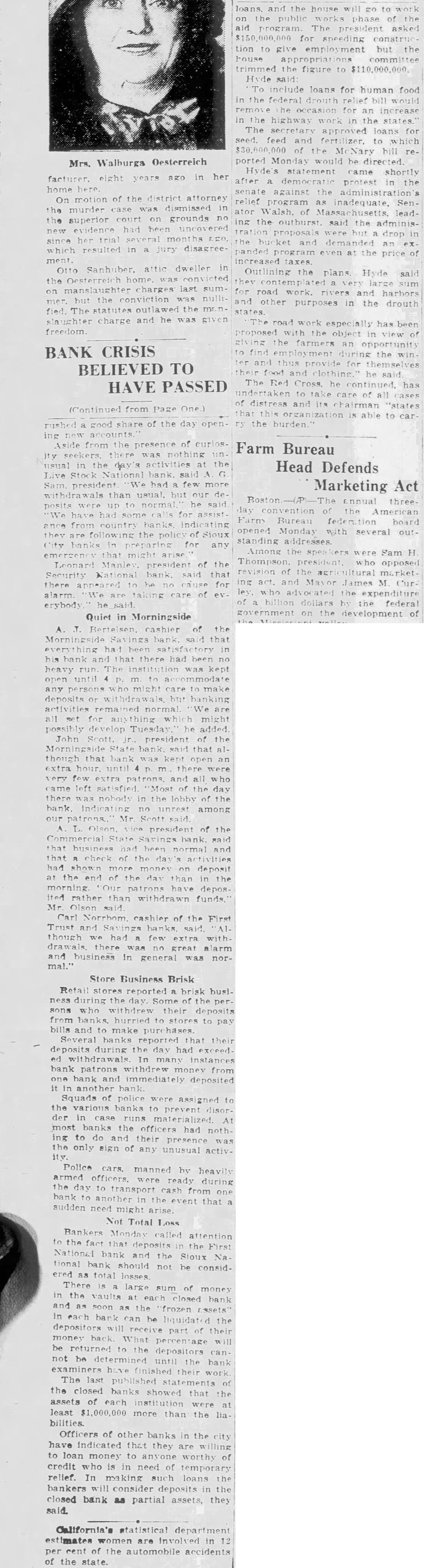
BANK CRISIS TO HAVE PASSED
(Continued from Page One.) loans, and the house go to work phase aid program. The president asked for construe tion to employment but the house appropriat trimmed the figure to $110,000,000 said include loans for human food in the federal drouth relief bill would remove occasion for an increase in the highway in the states.' The secretary approved loans for seed. feed fertilizer. to which of the bill reMrs. Walburga Oesterreich ported Monday would be directed statement came shortly after protest in the senate against the relief program as inadequate. Senator leading the outburst said the adminisproposals but drop and demanded ex. panded even at the taxes. Outlining the plans. Hyde said sum for road and harbors other purposes in the drouth work especially has been proposed in of giving the farmers an to find the win. clothing." he said The Red Cross. has undertaken all cases of distress and its "states that is able to car rushed good share of the day open- the burden ing accounts. side the presence of curios. Farm Bureau ity seekers. was nothing in the activities at the Head Defends Live bank. said president had few more Marketing Act withdrawals than usual. but our annual threeposits were up normal he said day American have had for assist. Bureau board ance from country banks indicating opened Monday several they are following the policy of Sioux standing City banks preparing for any Among the Sam H emergency that might who opposed Leonard Manley president of the Security National bank said that ing and James M Curappeared for alarm. taking of ev. who the erybody of dollars the federal government on development of Quiet in Morningside the cashier of the Morningside Savings bank. that everything ha satisfactory his bank and that there had been no heavy run was kept until to ecommodate any persons might care to make remained normal We are all for thing might possibly develop Tuesday he added John Scott. president of the State that although that bank an few and all who came left the day there was nobody the lobby of the bank Indicating no among our patrons." Mr. president of the Commercial Savings bank. said that business had normal and that check of the activities had shown more on deposit at the than in the morning Our deposited rather than withdrawn funds, Mr. Olson Norrhom cashier of the First Trust and banks said. though we had few extra withdrawals was no great alarm and business in general was normal.'
Store Business Brisk
Retail stores reported brisk business during the day. Some of the sons who withdrew their deposits from banks. hurried to stores to pay and to make puro hases. Several banks reported that their deposits during day had exceed. withdrawals In many instances bank patrons from bank and immediately deposited bank Squads of police to the various banks to der in materialized At most banks the officers had nothing to do and their was the only sign of any unusual activ-
Police cars. manned by heavily armed officers, ready during the day to transport from one bank another the event that sudden need might arise.
Not Total Loss
Bankers called attention to the fact deposits the First National bank and the Stoux Na tional should not be considered as losses There large of money the closed bank and as as the frozen ssets" in each bank can be liquidated the depositors will receive part their money back What percentage will returned to the depositors cannot be determined the bank finished their work The last published statements of the closed banks showed that the assets of institution were least $1,000,000 more than the liabilities. Officers of other banks in the city have indicated that they are willing to loan money to anyone worthy of credit who in need of temporary relief. In making such loans the bankers will consider in the closed bank as partial assets, they
California's statistical department estimates are Involved in 12 per cent of the automobile accidents of the state.
5.December 9, 1930The Sioux City JournalSioux City, IA
Click image to open full size in new tab
Article Text
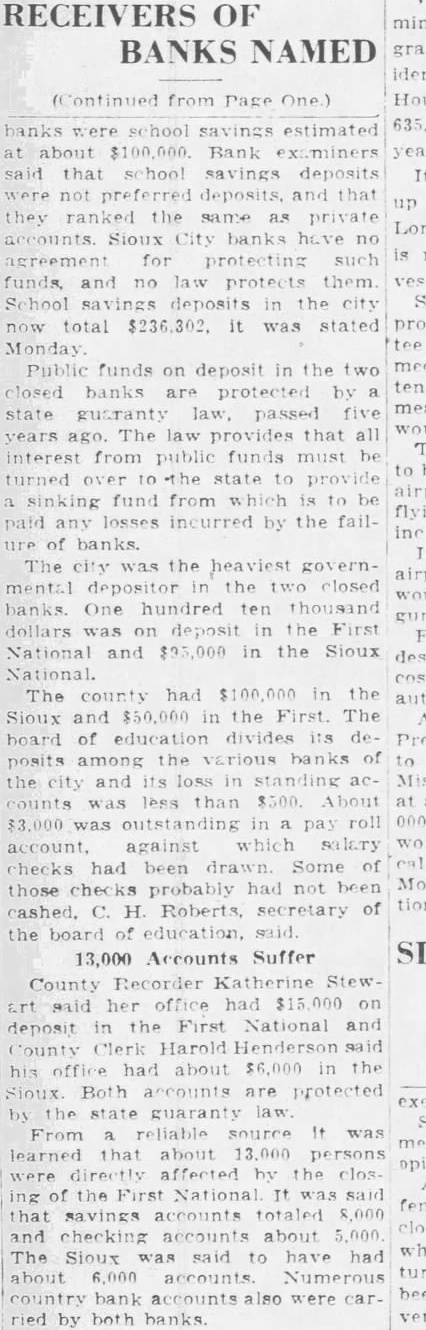
OF BANKS NAMED
(Continued from Page One.) banks estimated about $100,000 Bank said that savings deposits not deposits, and that they the same as private accounts. Sioux banks have no agreement protecting such funds, and no protects them School savings deposits the city now total $236,302. it was stated Monday Public funds on deposit in the two closed banks are protected by state guaranty passed five The law provides that all interest from public funds must be turned the state to provide sinking fund from which is to be paid any losses by the failure of banks. The city the heaviest governmental depositor the two closed banks. One hundred ten dollars was on deposit in the First National and in the Sioux National. The county had in the Sioux and $50,000 the First The board of education divides its deposits the banks of the city and its loss in standing less than About outstanding in roll against salary hecks had been Some of those had not been cashed. H. Roberts, secretary of the board 13,000 Accounts Suffer
County Recorder Katherine Stew. art said office had on deposit in the First National and County Clerk Harold Henderson said his office had about $6,000 in the Sioux Both accounts are protected by the guaranty law From reliable source It was learned that about 13,000 persons were directly affected by the ing of the First National It said that savings accounts totaled and checking accounts about 5,000 The Sioux to have had about 6,000 accounts Numerous bank were car. ried by both banks.
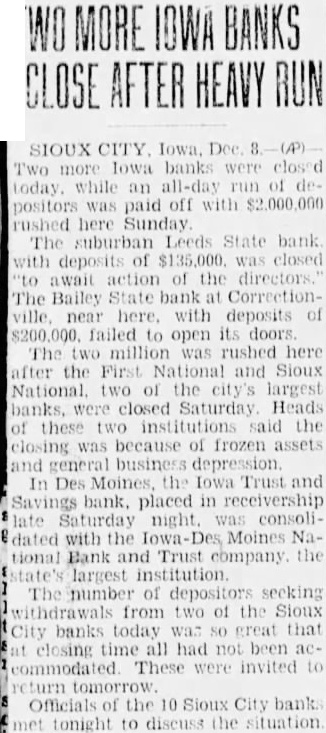
MORE BANKS CLOSE AFTER HEAVY
Two more Iowa banks were closed today. while an all-day run of depositors was paid off with $2,000,000 rushed here Sunday The suburban Leeds State bank with deposits of $135,000 was closed to await action of the directors The Bailey State bank at Correctionville near here. with deposits of $200.000. failed to open its doors The two million was rushed here after the First National and Sioux National two of the city's largest banks, were closed Saturday Heads of these two institutions said the closing was because of frozen assets and general business depression. In Des Moines, the Iowa Trust and Savings bank. placed in receivership late Saturday night was consolidated with the Iowa Moines National Bank and Trust company the state's largest institution. The number of depositors secking withdrawals from two of the Sioux City banks today was so great that closing time all had not been accommodated These were invited to return tomorrow Officials the 10 Sioux City bank tonight to discuss the situation
7.December 17, 1930Des Moines TribuneDes Moines, IA
Click image to open full size in new tab
Article Text
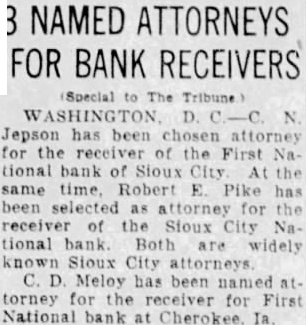
3 NAMED ATTORNEYS FOR BANK RECEIVERS
Special The Tribune D N Jepson has been attorney for the of the First Na tional bank of Sioux City the same time, Robert E. Pike has been attorney for the receiver of the Sioux City Na. tional bank. Both are widely known Sioux City attorneys D. Meloy has been named at torney for the receiver for First National bank at Cherokee Ia.
8.December 19, 1930The Sioux City JournalSioux City, IA
Click image to open full size in new tab
Article Text
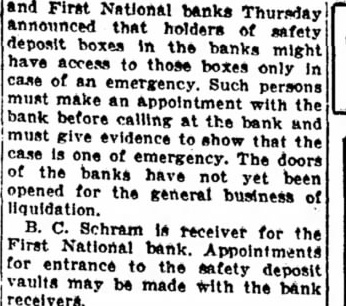
and First National banks Thursday announced that holders of safety deposit boxes in the banks might have access to those boxes only In case of an emergency. Such persons must make an appointment with the bank before calling at the bank and must give evidence to show that the case is one of emergency. The doors of the banks have not yet been opened for the general business of liquidation. B. C. Schram is receiver for the First National bank. Appointments for entrance to the safety deposit vaults may be made with the bank receivers.
9.December 19, 1930The Sioux City JournalSioux City, IA
Click image to open full size in new tab
Article Text
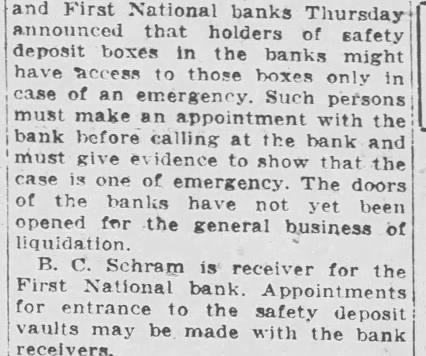
and First National banks Thursday announced that holders of safety deposit boxes in the banks might have access to those boxes only in case of an emergency. Such persons must make an appointment with the bank before calling at the bank and must give idence to show that the case is one of emergency The doors of the banks have not yet been opened for the general business of liquidation. B. C. Schram is receiver for the First National bank Appointments for entrance to the safety deposit vaults may be made with the bank receivers.
10.January 29, 1931Des Moines TribuneDes Moines, IA
Click image to open full size in new tab
Article Text
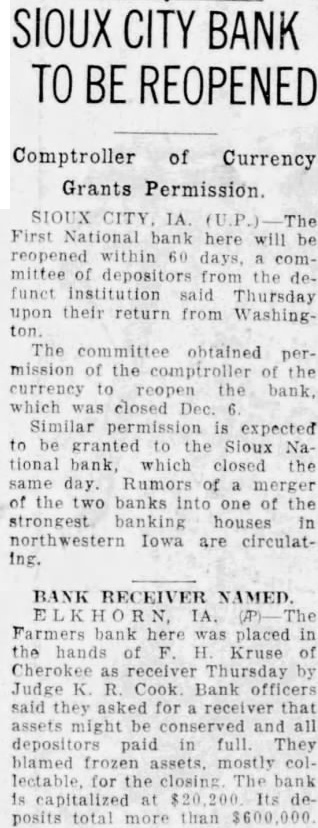
SIOUX CITY BANK TO BE REOPENED
Comptroller of Currency
Grants Permission.
SIOUX IA. The First National bank here will be reopened within 60 days, a committee of depositors from the defunct institution said Thursday upon their return from Washington.
The committee obtained permission of the comptroller of the currency to reopen the which was closed Dec. 6. Similar permission is expected to be granted to the Sloux National bank, which closed the same day. Rumors of merger of the two banks into one of the strongest banking houses in northwestern Iowa are circulat-
BANK RECEIVER NAMED. ELK H IA. The Farmers bank here was placed in the hands of F. Kruse of Cherokee as receiver Thursday by Judge K. R. Cook Bank officers said they asked for receiver that assets might be conserved and all depositors paid in full. They blamed frozen assets, mostly collectable, for the closing The bank is capitalized at Its deposits total more than $600,000.
11.January 30, 1931The Sioux City JournalSioux City, IA
Click image to open full size in new tab
Article Text
BEGIN FILING CLAIMS MONDAY
First National Bank Receiver Tells of Reorganization Plans
The second important step toward the prospective reorganization and reopening of the First National bank taken late Thursday by members of the depositors committee, announced that notices to creditors of the bank to file their claims would be published for the first time Monday with the publishing the notices, bank early Monday for the vanguard of creditors who enter and formally state their receiver of the bank has that his force will unite members the Monday the task of handling the claims of and creditors of the plans to open for the depositors' committee the building abandoned Thursday night The creditors be days file their Mr. made following late Thursday relative to plans for opening the
Must Prove Claims
"Reopening the bank depends upon the assignments by 100 per cent of the creditors. The theory that the end, the sponsors the reorganization the only creditors the First National bank the committee is able all insolvent bank will its obligations respect the to claims by delivering all assets the bank through process of of the old bank. must prove their claims in the prescribed by the of controller's office, regardless of whether the desire to do so may assign their claims the reorganization committee. which will have desks provided for them in the bank. The proof claims necessary any event order to place the creditor sition participate in dividend dis-
To Be Well Organized
"The forms for the assignments will by and the prepared in my office by clerks and employes, the depositors. The proper forms at the same time will mailed depositors made requests for same whose present address on rec. ord in the bank. big undertaking to ceive and proofs from the thousands of have claims the bank We shall expect to well organized to sat. isfactorily handle matter in an orderly of space in the bank the depositors will the only the but for the depositors who to their Mr. said notices the filing claims would be published every week for 12 He traced the of bank follows: First, audit of the bank's holdings whether condition reopening: second, creditors filing period 90 days, and the opening bank charter. With hopes for ultimate and reopening of the the depositors turned Thursday from
(Continued on Page
12.February 3, 1931The Sioux City JournalSioux City, IA
Click image to open full size in new tab
Article Text
DEPOSITORS FILE CLAIMS
More Than 1,000 Call at Sioux and First Banks Monday
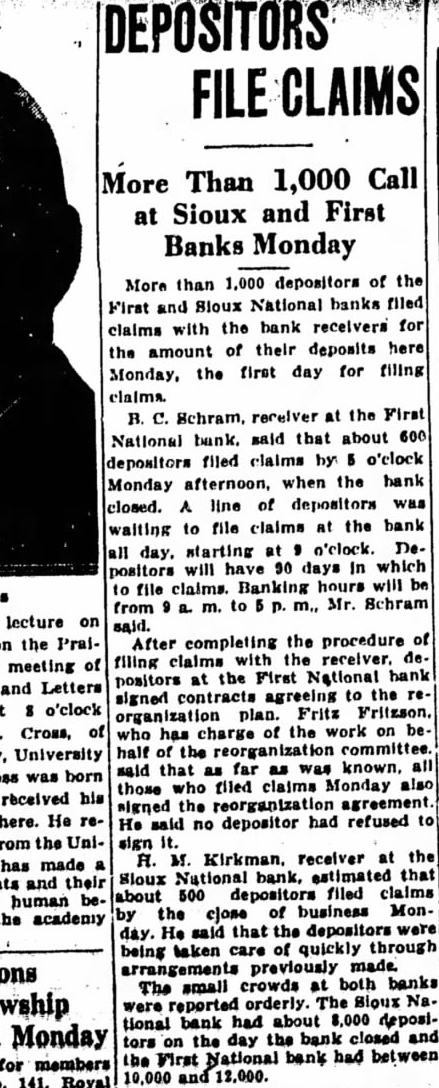
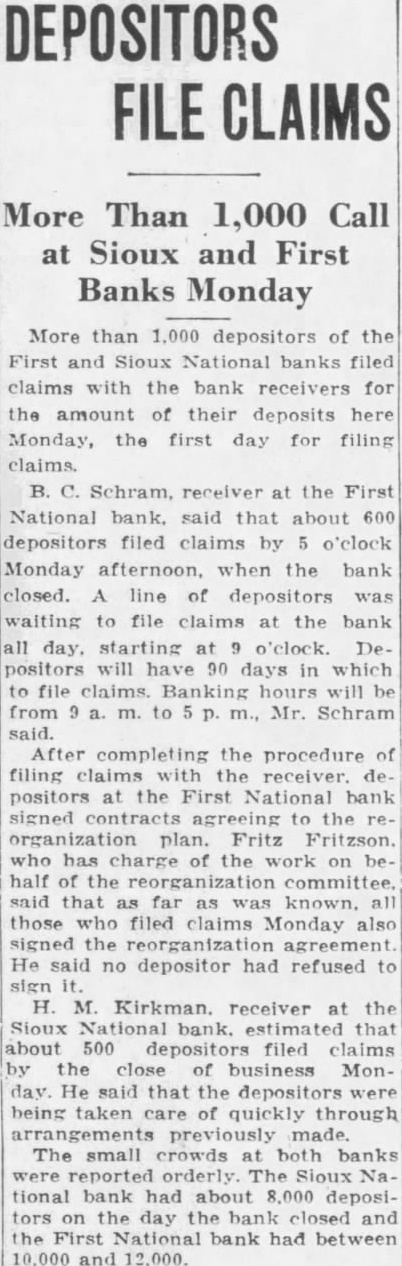
More than 1,000 depositors of the First and Sloux National banks filed claims with the bank receivers for the amount of their deposits here Monday, the first day for filing claims. B. C. Schram, receiver at the First National bank. said that about 600 depositors filed claims by 5 o'clock Monday afternoon, when the bank closed. A line of depositors was waiting to file claims at the bank all day. starting at o'clock. Depositors will have 90 days In which to file claims. Banking hours will be from 9 a. m. to p. m., Mr. Schram said. After completing the procedure of filing claims with the receiver. depositors at the First National hank signed contracts agreeing to the reorganization plan. Fritz Fritzson. who has charge of the work on be half of the reorganization committee. said that as far as was known, all those who filed claims Monday also signed the reorganization agreement. He said no depositor had refused to sign H. M. Kirkman. receiver at the Sloux National bank, estimated that about 500 depositors filed claims by the close of business Monday. He said that the depositors were being taken care of quickly through arrangements previously made The small crowds at both banks were reported orderly. The Bloux Na. tional bank had about 8,000 depositors on the day the bank closed and the First National bank had between 10,000 12,000.
13.February 3, 1931The Sioux City JournalSioux City, IA
Click image to open full size in new tab
Article Text
DEPOSITORS FILE CLAIMS
More Than 1,000 Call at Sioux and First Banks Monday
More than 1,000 depositors of the First and Sioux National banks filed claims with the bank receivers for the amount of their deposits here Monday, the first day for filing claims.
B. C. Schram, receiver at the First National bank. said that about 600 depositors filed claims by 5 o'clock Monday afternoon, when the bank closed. A line of depositors was waiting to file claims at the bank all day. starting at o'clock. Dewill have 90 days in which to file claims Banking will be from a. m. to p. m., Mr. Schram said. After completing the procedure of filing claims the receiver de. positors at the First National bank signed to the organization plan. Fritz Fritzson. who has of the on behalf of the committee said that as far known. all those who filed claims Monday also signed the agreement He said no depositor had refused to sign it. H. M. Kirkman. receiver at the Sioux bank. estimated that about 500 depositors filed claims by the close of business Monday. He said that the depositors being taken of quickly through arrangements previously made The small crowds at both banks were orderly. The Sioux National bank had about 8,000 depositors on the day the bank closed and the First National bank had between 10,000 and 12,000.
14.February 5, 1931The Sioux City JournalSioux City, IA
Click image to open full size in new tab
Article Text
URGES ALL TO HOLD CLAIMS
Head of Reorganization Committee Gives a Warning
Warning to depositors of the First National bank to be hesitant about disposing of their claims. after having signed the reopening plan agreement. was given Wedneslay by Mike King. chairman of the reorganization committee. Mr. King said that information had reached the committee that parties were endeavoring to purchase the claims of depositors. He advised the depositors to think the matter over carefully before dis. posing of their claims. Sees 93 Per Cent Return "Very few closed banks are able to reopen with a payment of 60 per cent in cash. with 10 per cent in stock which is as good, If not bet. ter. than cash, and 30 per cent In n trust fund." said Mr. King. "Based on present values. the claims should realize 95 per cent. "I believe that depositors who retain their stock will realize 100 per cent on their deposits. because there will be demand for the stock when the new bank is established. The reorganized bank will be sounder and safer than most banks, because It will have about $4,000,000 in deposits at the beginning. without one dollar's worth of poor or slow paper Business men and bankers with whom have talked are of the same opinion. "I would like to make It clear that the stock of the reorganized bank will be all new, and the stock. holders will be all new. No stockholders of the old First National bank will own stock In the reorganized bank unless they purchase it. and they will have nothing to do with the reorganized bank." Urges Depositors to Act Mr. King also urged that deposit ors call at the bank as soon as pos. sible, file their claims and sign the reorganization agreement in order to hasten the reorganization of the bank. "The receiver has announced that depositors have 90 days in which to file their claims," said Mr. King. "That is government requirement. but If the bank in to be reorganized within 30 or 60 days, as we planned. all agreements for reorganization must be signed within the next 18 days. We hope everyone will file claims and sign the agreement promptly. Fritz Fritzson, who with John Hainer has charge of the work of signing depositors' agreements at the bank for the reorganization committee, reported that more than 1,000 persons had signed their ap. plan to receive the depositors and explain the reorganization plan. The work was reported to be proceeding more rapidly at the First National bank Wednesday, and on timism prevailed generally concerning the possibilities of early reor ganization of the bank.
15.February 5, 1931The Sioux City JournalSioux City, IA
Click image to open full size in new tab
Article Text
URGES ALL TO HOLD CLAIMS
Head of Reorganization Committee Gives a Warning
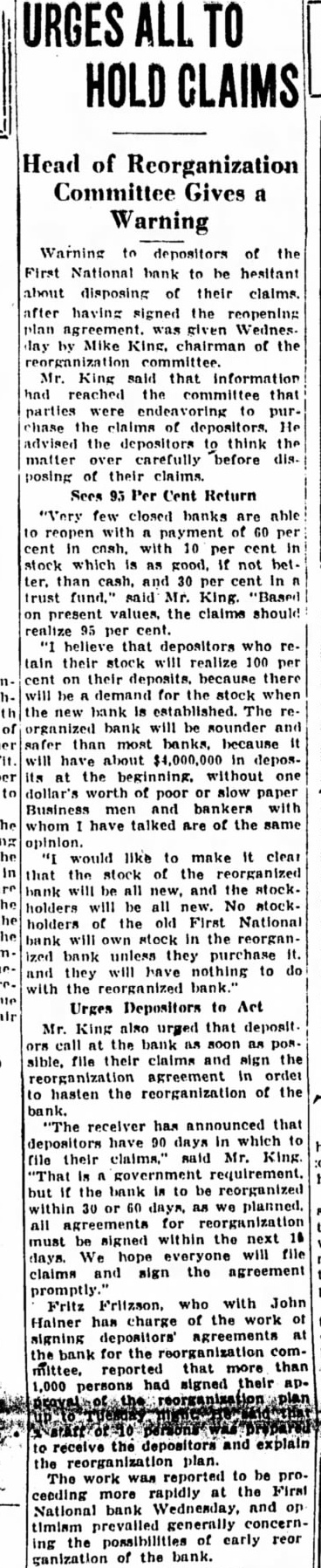
Warning to depositors of the First National bank to be hesitant about disposing of their claims, after having signed the reopening plan agreement. was given Wednesday by Mike King, chairman of the reorganization committee Mr. King said that information had reached the committee that parties were endeavoring to purchase the claims of depositors. He advised the depositors to think the matter over carefully before disposing of their claims. Sees 95 Per Cent Return
"Very few closed banks are able to reopen with a payment of 60 per cent in cash, with 10 per cent in stock which is as good, if not better, than cash, and 30 per cent in trust fund," said Mr. King. "Based on present values, the claims should realize 95 per cent. "I believe that depositors who retain their stock will realize 100 per cent on their deposits, because there will be demand for the stock when the new bank is established. The reorganized bank will be sounder and safer than most banks, because it will have about $4,000,000 in deposits at the beginning, without one dollar's worth of poor or slow paper Business men and bankers with whom have talked are of the same "I would like to make it clear that the stock of the reorganized bank will be all new, and the stockholders will be all new. No stockholders of the old First National bank will own stock in the reorganized bank unless they purchase it. and they will have nothing to do with the reorganized bank.' Urges Depositors to Act
Mr. King also urged that deposit call at the bank as soon as pos. sible, file their claims and sign the reorganization agreement in order to hasten the reorganization of the "The receiver has announced that depositors have 90 days in which to file their claims," said Mr. King "That is government requirement, but if the bank is to be reorganized within 30 or 60 days, as we planned, all agreements for reorganization must be signed within the next 15 days. We hope everyone will file claims and sign the agreement promptly Fritz Fritzson, who with John Hainer has charge of the work of signing depositors' agreements at the bank for the reorganization committee, reported that more than 1,000 persons had signed their approval of the reorganization plan up to Tuesday night. He said that a staff of 10 persons was prepared to receive the depositors and explain the reorganization plan. The work was reported to be proceeding more rapidly at the First National bank Wednesday, and op. timism prevailed generally concerning the possibilities of early reor ganization of the bank.
16.April 1, 1931The Sioux City JournalSioux City, IA
Click image to open full size in new tab
Article Text
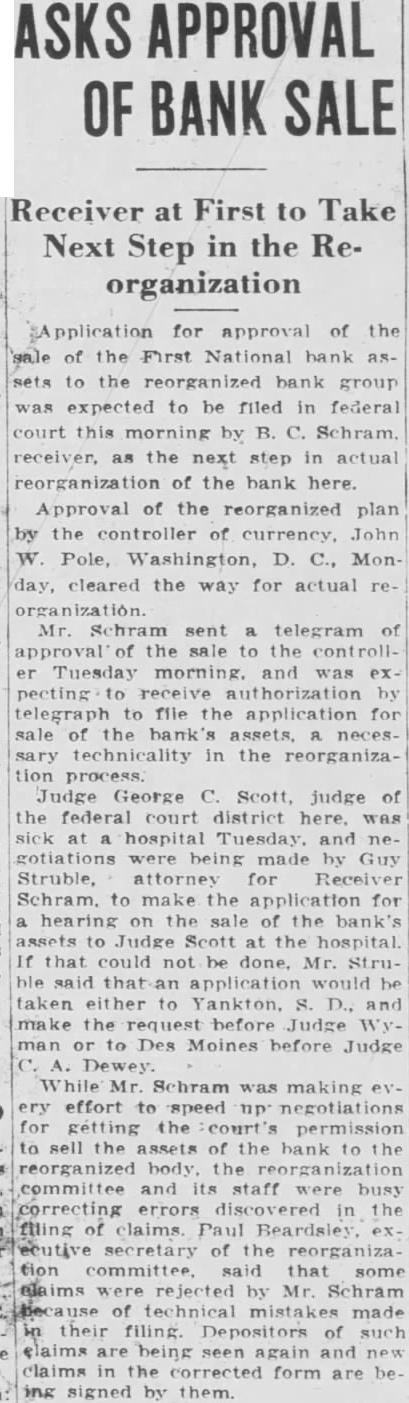
ASKS APPROVAL OF BANK SALE
Receiver at First to Take Next Step in the Reorganization pplication for approval of the sale of the First National bank as. sets to the reorganized bank group expected to be filed in federal court this morning by B. C. Schram. receiver, as the next step in actual reorganization of the bank here. Approval of the reorganized plan by the of currency, John W Pole, Washington, D. C., Monday, cleared the way for actual reorganization. Mr. Schram sent a telegram of approval of the sale to the controller Tuesday morning. and was expecting to authorization by telegraph to file the application for sary technicality in the reorganization Judge George C. Scott, judge of the federal court district here. was sick at hospital Tuesday. and negotiations were being made by Guy Struble, attorney for Receiver Schram. to make the application for hearing on the sale of the bank's assets to Judge Scott at the hospital. If that could not be done, Mr. Struble said that an application would be taken either to Yankton, S. D., and make the before Judge Wyman or to Des Moines before Judge C. While Mr. Schram was making every effort to speed np negotiations for getting the court's permission to sell the assets of the bank to the reorganized body the reorganization committee and its staff were busy correcting errors discovered in the filing of claims Paul Beardsley, ex ecutive secretary of the reorganiza. tion committee. said that some claims rejected by Mr. Schram of technical mistakes made in their filing. Depositors of such elaims are being seen again and new claims in the form are being signed by them.
17.April 7, 1931The Sioux City JournalSioux City, IA
Click image to open full size in new tab
Article Text
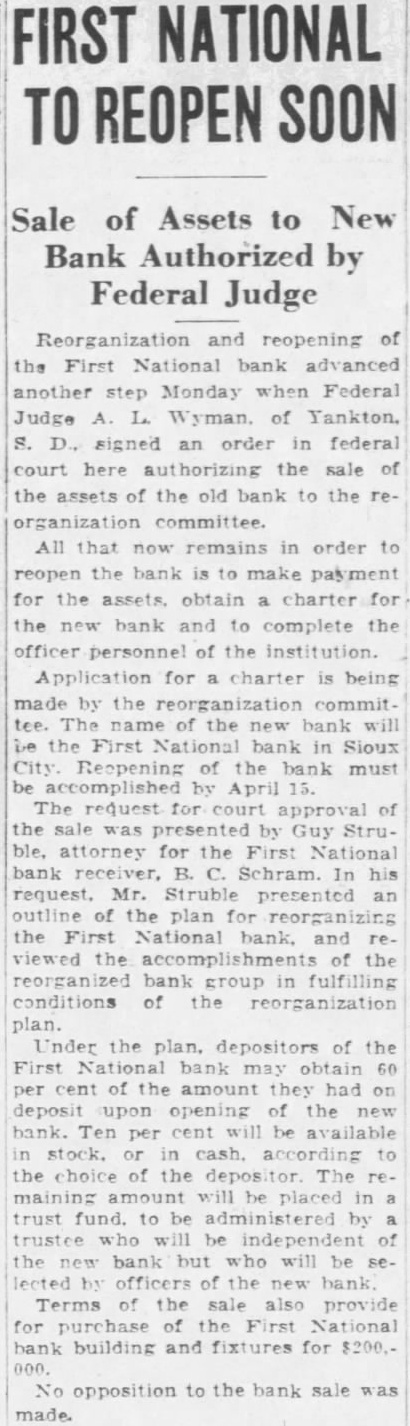
FIRST NATIONAL TO REOPEN SOON
Sale of Assets to New Bank Authorized by Federal Judge
Reorganization reopening of the First National bank advanced another step Monday when Federal Judge A. L. Wyman. of D., signed an order in federal court here authorizing the sale of the assets of the old bank to the reorganization committee. All that now remains in order to reopen the bank is to make payment for the obtain a charter for officer of the Application for a charter is being made by the reorganization tee. The name of the new bank will be the First National bank in Sioux City Reopening of the bank must be accomplished by April 15. The request for approval of the was presented by Guy Struble. attorney for the First National bank B. Schram. In his request. Mr. Struble presented an outline of the plan for reorganizing the First National bank. and re. viewed the accomplishments of the reorganized bank group in fulfilling conditions of the reorganization plan. Under the plan. depositors of the First National bank may obtain 60 per cent of the amount they had on deposit upon opening of the new bank. Ten per will be available in stock. or according to the choice of the depositor The remaining be placed in trust fund. to be administered by trustee will be independent of the bank but who will be lected officers the new bank. Terms of the sale also provide for purchase of First National bank building and fixtures for $200.000. No opposition to the bank sale was