3251. First National Bank (Sioux City, IA)

Bank Information

Episode Type
Run โ†’ Suspension โ†’ Reopening
Bank Type
national
Bank ID
1757
Charter Number
1757
Start Date
November 19, 1896
Location
Sioux City, Iowa (42.500, -96.400)

Metadata

Model
gpt-5-mini
Short Digest
1d2f6140341f5000

Response Measures

Capital injected, Partial suspension, Full suspension, Books examined

Receivership Details

Date receivership started
1897-01-07
Date receivership terminated
1897-03-16

Description

First National Bank (Sioux City, IA) suffered heavy withdrawals following the failure of the Iowa Savings Bank and rumor-driven withdrawals; it closed/suspended Nov 19, 1896, a receiver (Blanding/F.B. Ross) was appointed, and the bank was permitted to resume in mid-March 1897 under reorganization. Dates based on contemporary newspaper reports (suspension/failure reported 1896-11-19; reopening reported March 17โ€“27, 1897).

Events (9)

1. December 28, 1870 Chartered
Source
historical_nic
2. November 19, 1896 Run
Cause
Local Banks
Cause Details
Heavy withdrawals precipitated by the recent failure of the Iowa Savings Bank and circulation of rumors about bank weakness.
Measures
Officers invoked the sixty-day (30/60/90) law to delay payments; notified the comptroller and awaited examiner.
Newspaper Excerpt
The First National bank of Sioux City closed its doors ... a result of heavy withdrawals since the failure of the Iowa Savings bank last week.
Source
newspapers
3. November 19, 1896 Suspension
Cause
Local Banks
Cause Details
Suspension/closure caused by inability to raise funds amid heavy withdrawals following the Iowa Savings Bank failure and rumor-driven runs.
Newspaper Excerpt
The First National bank has closed its doors. The failure is due to heavy withdrawals ... Bank Examiner Blanding has been placed in charge; a receiver was appointed.
Source
newspapers
4. November 20, 1896 Receivership
Newspaper Excerpt
Late in the day F. B. Ross was appointed receiver for the protection of the stockholders and creditors. Bank Examiner Blanding to-day took charge of the defunct First National Bank.
Source
newspapers
5. December 22, 1896 Other
Newspaper Excerpt
The stockholders ... decided upon a plan of reorganization. The bank will be reopened with a capital stock of $200,000 ... $50,000 contributed by depositors.
Source
newspapers
6. January 7, 1897 Receivership
Source
historical_nic
7. March 16, 1897 Restored To Solvency
Source
historical_nic
8. March 17, 1897 Reopening
Newspaper Excerpt
The First national bank of Sioux City, Ia., which suspended payment November 19, 1896 ... has been permitted to reopen its doors for business / resume business.
Source
newspapers
9. December 8, 1930 Receivership
Source
historical_nic

Newspaper Articles (23)

Article from Deseret Evening News, November 19, 1896

Click image to open full size in new tab

Article Text

Business Failures. Broux CITY, Nov. 19,-The First National bank has closed its doors. The failure is due to heavy withdraw. ale. CHICAGO, Nov. 19. - The Probet Construction company made an assignment to Gustave Wilke, The company is one of the Inrgest contracting concerns in the country. The company buflt the Coliseum, Schiller bullding, and Peristyle at the World's Fair, the Fisheries building. Hagenbacks building on Midway Plaisance, the court house at Fort Worth, Texas, and other notable buildings. NEW YORK, Nov. 19.-Blichter, a member of the Probat Construction company, with headquarters in this city, was questioned today with reference to the report from Chicago that the company had made an assignment. He 9810: "I have heard nothing of the assignment, though naturally I should have been advised. I know no cause for such proceeding." WASHINGTON, Nov. 19.-The comptroller of currency has received notice of the failure of the First National bank, Sioux City, Iowa. The capital is $100,000. The liabilities to depositors at the date of the last report Was $407,000; loans and discounts $492,000. Bank Examiner Bianding bas been placed in charge.


Article from The Portland Daily Press, November 20, 1896

Click image to open full size in new tab

Article Text

Sioux City Bank Closed. Sioux City, Iowa, November 19.-The First National bank closed its doors uuexpectedly this morning. No statement of its condition has been made. The statement of October sixth showed capital and surplus, $140,000: loans, $192,564; deposits, $537,993. The officers of the bank declare the bank is perfectly solvent and dollar for dollar will be paid its creditors. The crash was caused by the recent heavy withdrawals and difficulty in realizing on assets. Many bad investments were made within the last few years and much of the bank's money is in unproductive property. The publication this morning of the reported weakness of & Sioux City bank to which, no direct reference was made, is also said to have precipitated matters. As a result of the suspension of the bank a receiver was appointed this afternoon for the Sioux City savings bank. The officers declare that all depositors were paid in full. The bank assets are estimated at $100,000.


Article from The Seattle Post-Intelligencer, November 20, 1896

Click image to open full size in new tab

Article Text

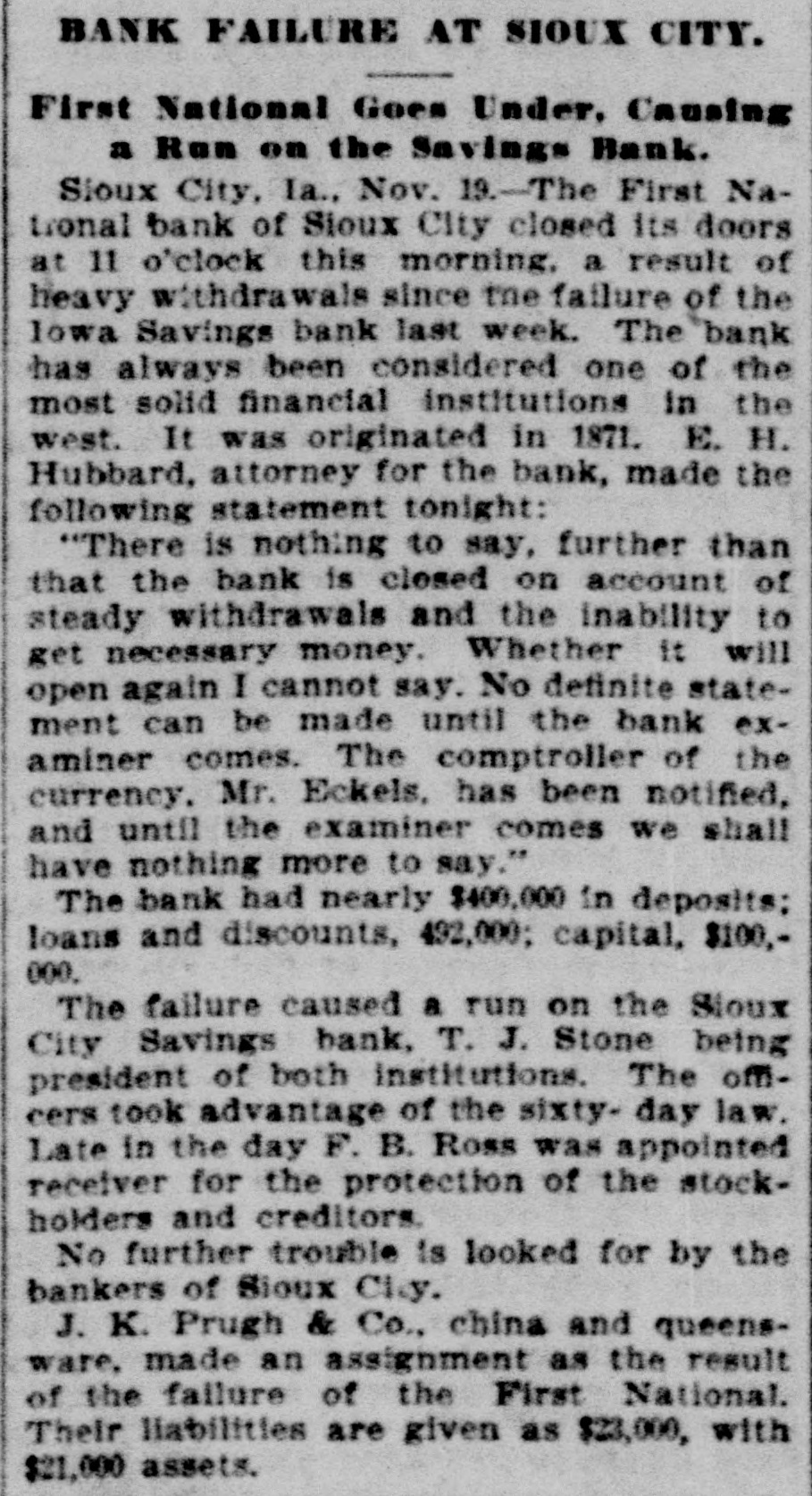
BANK FAILURE AT SIOUX CITY. First National Goes Under, Causing a Run on the Savings Bank. Sioux City, Ia., Nov. 19.-The First Natronal bank of Sioux City closed its doors at 11 o'clock this morning, a result of heavy withdrawals since the failure of the Iowa Savings bank last week. The bank has always been considered one of the most solid financial institutions in the west. It was originated in 1871. E. H. Hubbard, attorney for the bank, made the following statement tonight: "There is nothing to say, further than that the bank is closed on account of steady withdrawals and the inability to get necessary money. Whether it will open again I cannot say. No detinite statement can be made until the bank examiner comes. The comptroller of the currency. Mr. Eckels, has been notified, and unt!! the examiner comes we shall have nothing more to say." The bank had nearly $400,000 in deposits: loans and discounts, 492,000; capital, $100,000. The failure caused a run on the Sioux City Savings bank, T. J. Stone being president of both institutions. The officers took advantage of the sixty- day law. Late in the day F. B. Ross was appointed receiver for the protection of the stockholders and creditors. No further trouble is looked for by the bankers of Sioux City. J. K. Prugh & Co., china and queensware, made an assignment as the result of the failure of the First National. Their liabilities are given as $23,000, with $21,000 assets.


Article from The Wheeling Daily Intelligencer, November 20, 1896

Click image to open full size in new tab

Article Text

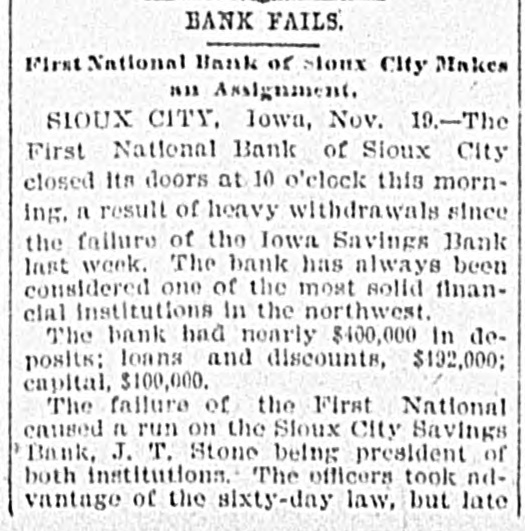
BANK FAILS. First National Bank or stonx City Makes 1411 Assignment. SIOUX CITY, Iowa, Nov. 19.-The First National Bank of Sioux City closed its doors at 10 o'clock this morning. a result of heavy withdrawals since the failure of the Iowa Savings Bank Inst week. The bank has always been considered one of the most solid financlal Institutions in the northwest. The bank had nearly $400,000 In deposits: loans and discounts, $192,000; capital, $100,000. The failure of the First National caused n run on the Sloux City Savings Bank, J. T. Stone being president of both institutions. + The officers took ndvantage of the sixty-day law, but late


Article from Great Falls Weekly Tribune, November 20, 1896

Click image to open full size in new tab

Article Text

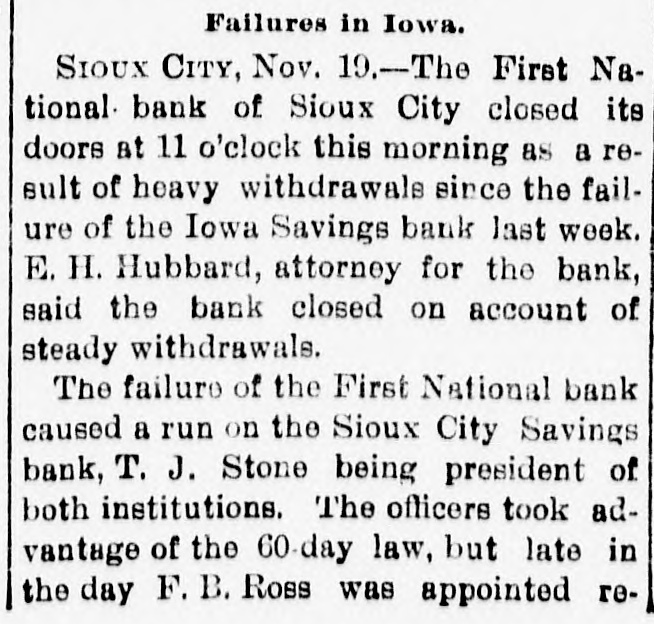
Failures in Iowa. SIOUX CITY, Nov. 19.-The First National. bank of Sioux City closed its doors at 11 o'clock this morning as a result of heavy withdrawals since the failure of the Iowa Savings bank last week. E. H. Hubbard, attorney for the bank, said the bank closed on account of steady withdrawals. The failure of the First National bank caused a run on the Sioux City Savings bank, T. J. Stone being president of both institutions. The officers took advantage of the 60-day law, but late in the day F. B. Ross was appointed re-


Article from Rock Island Argus, November 20, 1896

Click image to open full size in new tab

Article Text

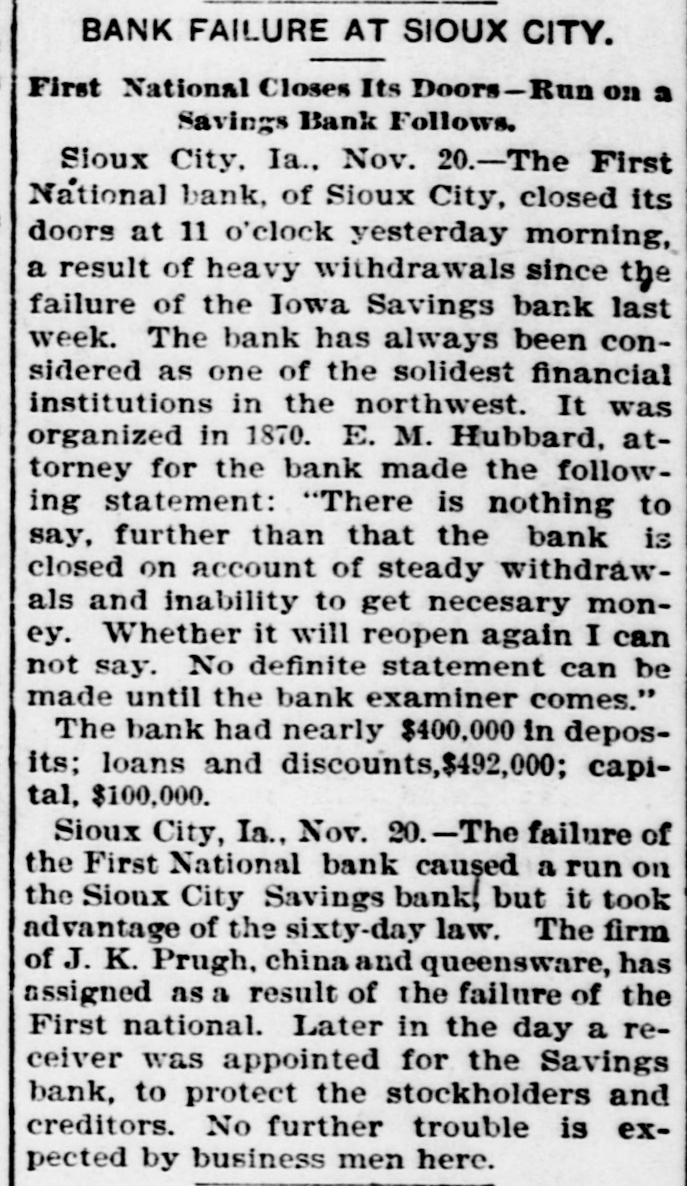
BANK FAILURE AT SIOUX CITY. First National Closes Its Doors-Run on a Savings Bank Follows. Sioux City, Ia., Nov. 20.-The First National bank, of Sioux City, closed its doors at 11 o'clock yesterday morning, a result of heavy withdrawals since the failure of the Iowa Savings bank last week. The bank has always been considered as one of the solidest financial institutions in the northwest. It was organized in 1870. E. M. Hubbard, attorney for the bank made the following statement: "There is nothing to say, further than that the bank is closed on account of steady withdrawals and inability to get necesary money. Whether it will reopen again I can not say. No definite statement can be made until the bank examiner comes." The bank had nearly $400,000 in deposits; loans and discounts, $492,000; capital, $100,000. Sioux City, Ia., Nov. 20. -The failure of the First National bank caused a run on the Sioux City Savings bank, but it took advantage of the sixty-day law. The firm of J. K. Prugh, china and queensware, has assigned as a result of the failure of the First national. Later in the day a receiver was appointed for the Savings bank, to protect the stockholders and creditors. No further trouble is expected by business men here.


Article from The Herald, November 20, 1896

Click image to open full size in new tab

Article Text

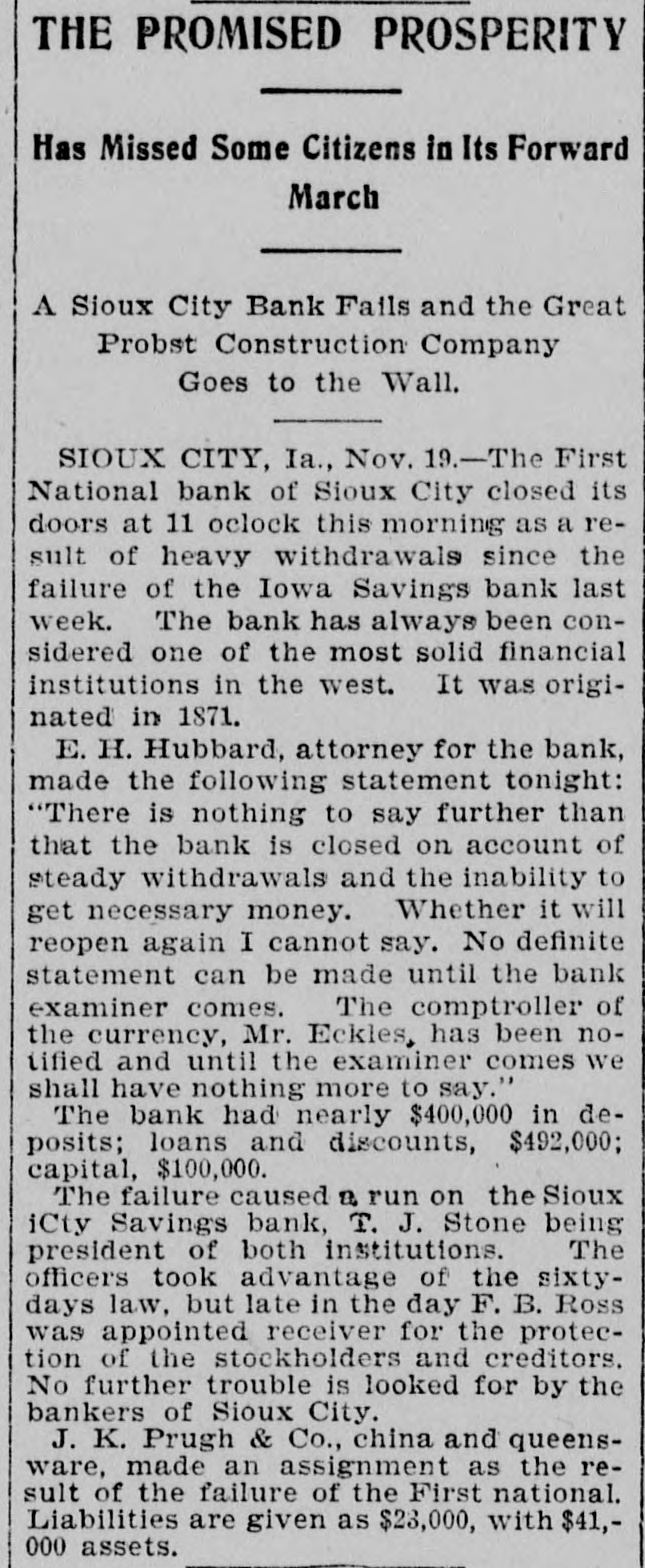
THE PROMISED PROSPERITY Has Missed Some Citizens in Its Forward March A Sioux City Bank Fails and the Great Probst Construction Company Goes to the Wall. SIOUX CITY, Ia., Nov. 19.-The First National bank of Sioux City closed its doors at 11 oclock this morning as a result of heavy withdrawals since the failure of the Iowa Savings bank last week. The bank has always been considered one of the most solid financial institutions in the west. It was originated in 1871. E. H. Hubbard, attorney for the bank, made the following statement tonight: "There is nothing to say further than that the bank is closed on account of steady withdrawals and the inability to get necessary money. Whether it will reopen again I cannot say. No definite statement can be made until the bank examiner comes. The comptroller of the currency, Mr. Eckles, has been notified and until the examiner comes we shall have nothing more to say." The bank had nearly $400,000 in deposits; loans and discounts, $492,000; capital, $100,000. The failure caused a run on the Sioux iCty Savings bank, T. J. Stone being The president of both institutions. officers took advantage of the sixtydays law, but late in the day F. B. Ross was appointed receiver for the protection of the stockholders and creditors. No further trouble is looked for by the bankers of Sioux City. J. K. Prugh & Co., china and queensware, made an assignment as the result of the failure of the First national. Liabilities are given as $23,000, with $41,000 assets.


Article from The Saint Paul Globe, November 20, 1896

Click image to open full size in new tab

Article Text

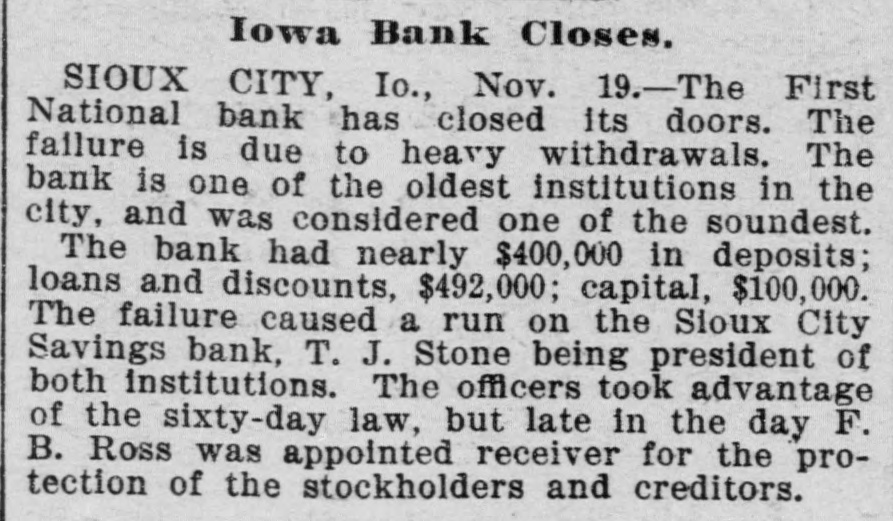
Iowa Bank Closes. SIOUX CITY, Io., Nov. 19.-The First National bank has closed its doors. The failure is due to heavy withdrawals. The bank is one of the oldest institutions in the city, and was considered one of the soundest. The bank had nearly $400,000 in deposits; loans and discounts, $492,000; capital, $100,000. The failure caused a run on the Sioux City Savings bank, T. J. Stone being president of both institutions. The officers took advantage of the sixty-day law, but late in the day F. B. Ross was appointed receiver for the protection of the stockholders and creditors.


Article from Omaha Daily Bee, November 20, 1896

Click image to open full size in new tab

Article Text

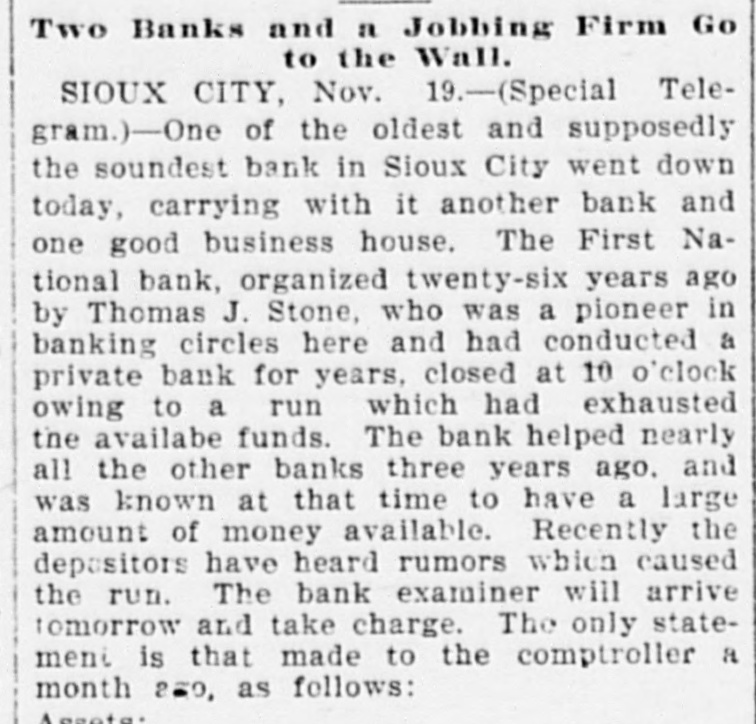
Two Banks and a Jobbing Firm Go to the Wall. SIOUX CITY, Nov. 19.-(Special Telegram.)-One of the oldest and supposedly the soundest bank in Sioux City went down today, carrying with it another bank and one good business house. The First National bank, organized twenty-six years ago by Thomas J. Stone, who was a pioneer in banking circles here and had conducted a private bank for years, closed at 10 o'clock owing to a run which had exhausted the availabe funds. The bank helped nearly all the other banks three years ago. and was known at that time to have a large amount of money available. Recently the depositors have heard rumors which caused the run. The bank examiner will arrive tomorrow and take charge. The only statement is that made to the comptroller a month 260, as follows:


Article from San Antonio Daily Light, November 20, 1896

Click image to open full size in new tab

Article Text

FOREIGN AND DOMESTIC LATEST OFF THE WIRES FROM OVER THE WORLD. A Complete Epitome of the Day's Happenings, Briefed and Boiled Down, up to Time of Going to Press. Peruvian congress closes session today. Public prosecutor in France opens the Dreyfus case. Hardware men continue in session in Philadelphia. Buenos Ayres places an internal and an export tax on sugar. Norwegian bark Seladon, with 16 men, given up as lost at sea. The Athens socialist who dynamited & merchant, suicides. All Galveston newly elected county officers have qualified. Grant's friends continue to boom him for the postmastership. Probst Construction company, Chicago, assigns; no statement. Heavy whisky sales in Cincin nati indicate a rise in the productTwo torpedo boats belonging to the French navy collide and one of them is missing with 16 men. The debate in the French ministry over the Dreyfus case almos t wrecks the Melin ministry. French senate refuses to pass the emergency motion on the universal suffrage question 212 to 32. Taking of testimony in the Burt murder case begun in Austin. Prisoner unmoved. Congressional investigation begine into management of Kansas soldier's home. Kate Field's remains have not reached San Francisco, as anticipated. Detective tug is watching the Bermuda steamer in New York water. Vermont lower house refuses to pass woman suffrage bill, 135 to 89. Dr. Curry, of North Carolina, exminister to Spain, does not relish flying old glory over school houses. Nat Goodwin arrives from Australia and stops his suit entered in San Francisco court. Uncle Sam will order 40,000 Lee rifles from the Winchester Arms company. Washout passengers travel 60 miles on foot, in canoes and in hand cars, to reach Seattle. First National bank, Sloux City, Ia., closes its doors, but no other bank troubles are looked for. Press censor at Havana refuses to send any more news by wire from Havana. Judge Felix McCord of the Fourth Texas district has resigned. S inta Fe receivership case at Topeka is tied up tight by the court, neither party can wiggle. Winter tourist rates abolished to all points southeast, including New Orleans. Interchangeable mileage ticket is knocked out by the Central Pas. senger association. Orders are placed in this country for 15,000 tons rails, 5,000 for Japan and 10,000 for China. Rev. Hull, Minnesota, pleads guilty of poisoning his wife and gets six years in the pen. Jetty contractors restrained from tearing up railway track at Boliver Point and sued for damages. Judge Foster, of Iowa, wants the governorship of New Mexico. Ward case in Memphis makes progress and it is thought that defendant will testify. Hanna denies that he said his commercial relations would bar him from the treasury head. Higher duties on the drug decreases opium smuggling. Chief Engineer of the Navy Mellville makes his report, navy yard disbursements for the year being $675,000. Kenticky Democrate will contest the electoral vote of that


Article from The San Francisco Call, November 21, 1896

Click image to open full size in new tab

Article Text

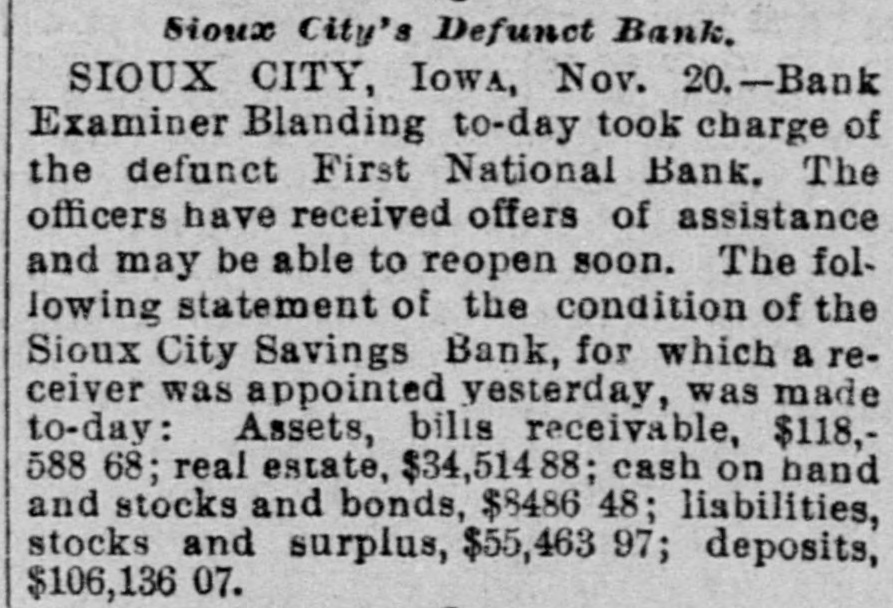
Sioux City's Defunct Bank. SIOUX CITY, IOWA, Nov. 20.-Bank Examiner Blanding to-day took charge of the defunct First National Bank. The officers have received offers of assistance and may be able to reopen soon. The following statement of the condition of the Sioux City Savings Bank, for which a receiver was appointed yesterday, was made to-day: Assets, bilis receivable, $118,588 68; real estate, $34,51488; cash on hand and stocks and bonds, $8486 48; liabilities, stocks and surplus, $55,463 97; deposits, $106,136 07.


Article from Twice-A-Week Plain Dealer, November 27, 1896

Click image to open full size in new tab

Article Text

# OUR CANDIDATE IN 1900 # THANKSGIVING CRUMBS. Reasons for Thankfulness(?) for a Few Who Voted for the Advance Agent of Prosperity. A soup house will be opened in Des Moines and a charity ball will be given during the holidays to raise funds to buy the bovine bones to flavor the liquid; tickets one dollar. Johnson, Ohrundro & Co., the largest dry goods and notton house Baltimore failed the 19th with liabilities of $189,000. The Probst Construction Company filed the 19. It was the largest contracting concern in the country with headquarters in New York. No statement of liabilities but understood it be heavy. The Sullivan county Savings bank New Hampshire is called upon to face a loss of $1,000,000. The banker John L. Farwell has gone to Europe and left only worthless or depreciated paper to the confiding depositers. Another wave of prosperity struck Sioux City Thursday last when the First National bank closed its doors upon its creditors. Its statement of October 6 showed capital $140,000, deposits $537,998.57. The crash was caused by depositors asking for cash instead of confidence. J. K. Prugh a large crockery dealer of Sioux City failed on Thursday last. No statement of liabilities, assets in the First National bank. Large cloak house in New York made assignment Thursday with $150,000 liabilities and meagre assets. CHILLICOTHE, 111., Nov. 16.-The Lacon Woolen Mills of John Grieves Son of Lacon, Ill., gave notice last night that the night force would be laid off for an indefinite period on account of lack of orders. They have tin night and day for several years and a few days before election they practiced the same game that many others did. They showed their men orders for woolens which would have required full force to make by April 1. They said that in case Bryan was elected the orders would be countermanded. Now that election is over it is apparent that these pretended orders were a fraud. The Tribune at Des Moines says: among the reports of many factories starting their wheels is one to the effect that a Des Moines factory, employing 200 men, has started up since the election. Nobody in Des Moines appears to know anything about it, and it can't be located. Wonder if most of the other reports are not based upon the same kind of a "confidence" foundation? The opening factories seem to be just over in the other state. The B. B. Richards Lumber company at Duluth has failed with $295,800 liabilities. B. B. Richards is president of a National bank at Dubuque, thinks there is money enough in the country, is a professed democrat, who went into the republican camp and voted for McKinley the advance agent of prosperity. POSTVILLE, Ia, Nov. 20.-The high wave of prosperity has swept over the Iowa and Dakota division of the . M. & St. P. railroad, which runs from North McGregor to Mitchell, South Dakota and left in its wake the mangled remains of 12 train crews sand numerous assistants at the depots who were laid off on account of "no business." As a train crew consists of two brakemen, conductor, fireman and engineer, it will be seen that 60 men who looked forward to steady work at good wages, when it was announced on Nov. 4th that the advance agent of prosperity had been elected are now standing around with their hands in their pockets, asking themselves the question, "Was all this a game of bluff or will the prosperity came later on?" Under the title, "Prosperity is Here," the Emmetsburg Democrat says, "Seven freight crews on the Milwaukee road were laid off the day after election, and five 'more are to lose their jobs. A large number of operators will also have to look elsewhere for positions. This is prosperity for you. However, the mills that closed the day before election, for the purpose of forcing their employees to vote the gold standard, have started up again. The dailies are talking about this. have nothing to say about those who have lost their positions since the defeat of Bryan," CHICAGO, Nov. 21.-The South Chicago Calumet announces that the Illinois Steel company has posted a notice of reduction in wages paid its blast furnace men, ranging from 10 to 25 per cent, to take effect December 1. The new scale ranges from $2.40 per day for keepers down to $1.35 for common labor and 85 cents for sample boys. The men affected work 12 hours per day and number several hundred. Only two out of eight blast furnacee at the South Chicago works are now running. SAGINAW, Mich., Nov. 21.-The First national bank of East Saginaw lis in the hands of National Bank Examiner Caldwell, who took charge of its affairs Saturday morning. YONKERS, N. Y., Nov. 20.-Owing to a large surplus of carpets on hand the big tapestry mill of the Alexander Smith & Sons' carpet company closed down Friday. It is rumored that the shutting down of other mills operated by the company will shortly follow. Friday's close down throws


Article from Omaha Daily Bee, December 23, 1896

Click image to open full size in new tab

Article Text

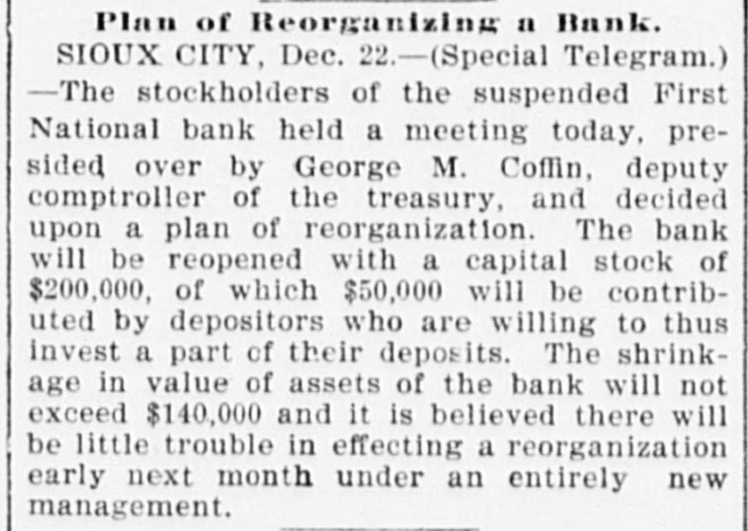
Plan of Reorganizing a Bank. SIOUX CITY, Dec. 22.-(Special Telegram.) -The stockholders of the suspended First National bank held a meeting today, presided over by George M. Coffin, deputy comptroller of the treasury, and decided upon a plan of reorganization. The bank will be reopened with a capital stock of $200,000, of which $50,000 will be contributed by depositors who are willing to thus invest a part of their deposits. The shrinkage in value of assets of the bank will not exceed $140,000 and it is believed there will be little trouble in effecting a reorganization early next month under an entirely new management.


Article from St. Johnsbury Caledonian, January 1, 1897

Click image to open full size in new tab

Article Text

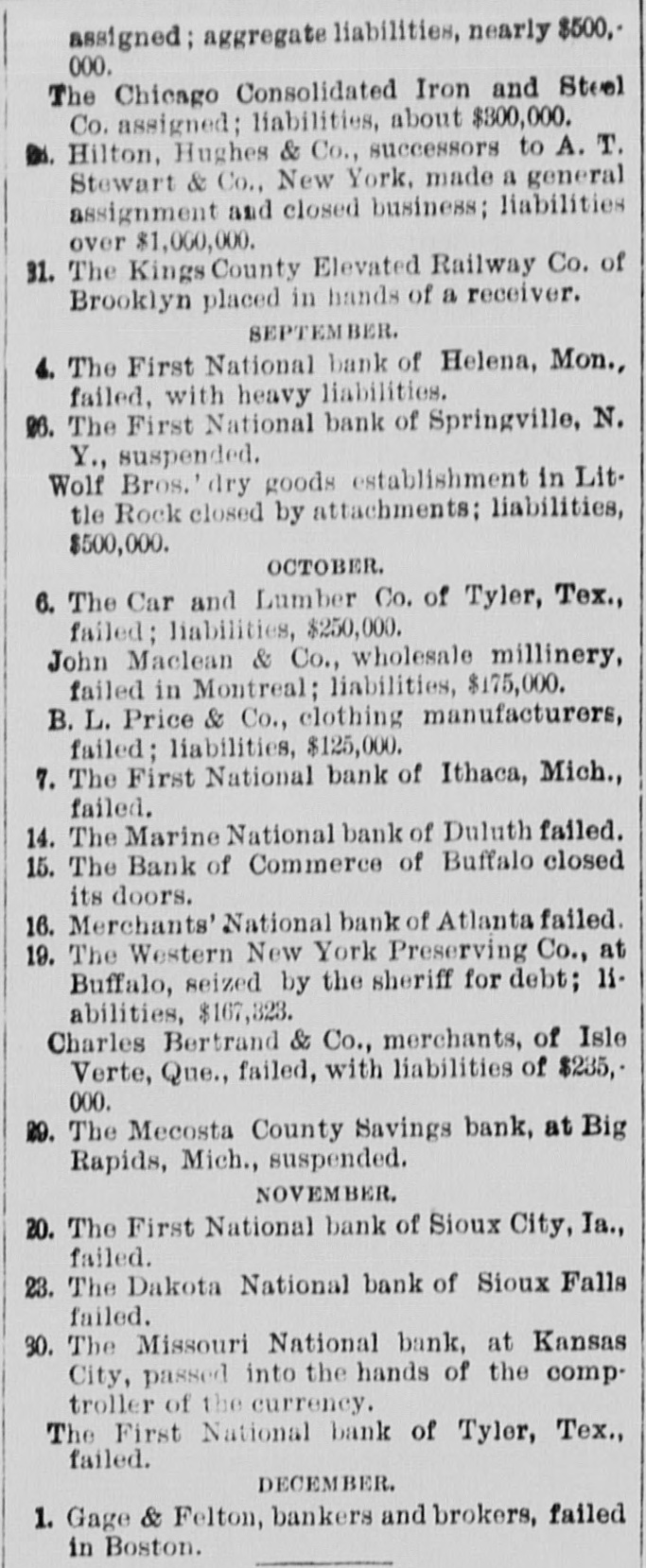
assigned; aggregate liabilities, nearly $500,000. The Chicago Consolidated Iron and Steel Co. assigned; liabilities, about $300,000. B. Hilton, Hughes & Co., successors to A. T. Stewart & Co., New York, made a general assignment and closed business; liabilities over $1,000,000. 31. The Kings County Elevated Railway Co. of Brooklyn placed in hands of a receiver. SEPTEMBER. 4. The First National bank of Helena, Mon., failed, with heavy liabilities. 26. The First National bank of Springville, N. Y., suspended. Wolf Bros.' dry goods establishment in Little Rock closed by attachments; liabilities, $500,000. OCTOBER. 6. The Car and Lumber Co. of Tyler, Tex., failed; liabilities, $250,000. John Maclean & Co., wholesale millinery, failed in Montreal; liabilities, $175,000. B. L. Price & Co., clothing manufacturers, failed; liabilities, $125,000. 7. The First National bank of Ithaca, Mich., failed. 14. The Marine National bank of Duluth failed. 15. The Bank of Commerce of Buffalo closed its doors. 16. Merchants' National bank of Atlanta failed. 19. The Western New York Preserving Co., at Buffalo, seized by the sheriff for debt; 11abilities, $167,323. Charles Bertrand & Co., merchants, of Isle Verte, Que., failed, with liabilities of $235,000. 29. The Mecosta County Savings bank, at Big Rapids, Mich., suspended. NOVEMBER. 20. The First National bank of Sioux City, Ia., failed. 23. The Dakota National bank of Sioux Falls failed. 30. The Missouri National bank, at Kansas City, passed into the hands of the comptroller of the currency. The First National bank of Tyler, Tex., failed. DECEMBER. 1. Gage & Felton, bankers and brokers, failed in Boston.


Article from The Kimball Graphic, January 2, 1897

Click image to open full size in new tab

Article Text

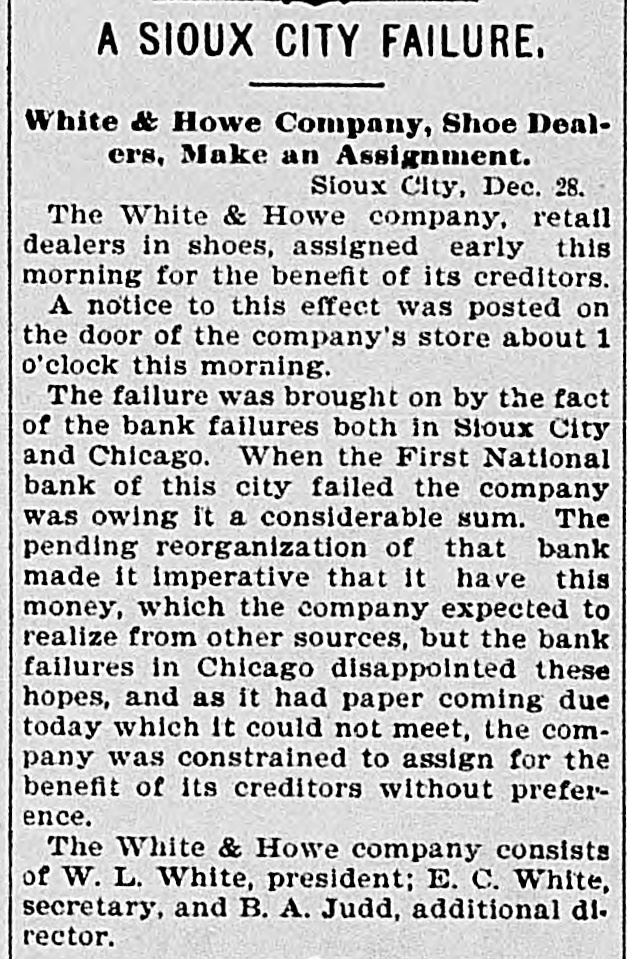
A SIOUX CITY FAILURE. White & Howe Company, Shoe Dealers, Make an Assignment. Sioux City, Dec. 28. The White & Howe company, retail dealers in shoes, assigned early this morning for the benefit of its creditors. A notice to this effect was posted on the door of the company's store about 1 b'clock this morning. The failure was brought on by the fact of the bank failures both in Stoux City and Chicago. When the First National bank of this city failed the company was owing it a considerable sum. The pending reorganization of that bank made it imperative that it have this money, which the company expected to realize from other sources, but the bank failures in Chicago disappointed these hopes, and as it had paper coming due today which it could not meet, the company was constrained to assign for the benefit of its creditors without preference. The White & Howe company consists of W. L. White, president; E. C. White, secretary, and B. A. Judd, additional di. rector.


Article from The Wichita Daily Eagle, January 8, 1897

Click image to open full size in new tab

Article Text

GOT A STRAIGHT TIP BANKS THAT STOOD FROM UNDER A GREAT FINANCIAL SMASH. Somebody. Nobody Will Tell Who, Told Certain Favored Banks What Was Going to Happen to the National Bank of IIIIneis, Giving Them an Opportunity to Withdraw Their Deposits Which They Were Swift to Improve-Eckles Names Bank Receivers-American National, of Denver Re-opens-Day's List of Failures Chicago, Jan. 7.-It has been ascertained positively that several banks which had deposits in the defunct Natioral Bank of Illinois were warned of what was to come and as a result their money was withdrawn just in time to save them from being carried down with the wreck. Henry W. Austin, president of the Oak Park State bank, made the statement today that he had received information of the dangerous condition of the Illinois National during the week previous to the failure. Acting upon this tip, Mr. Austin says, he immediately took out of the bank the money his bank had there. Five thousand dollars was withdrawn Friday previous to the Monday in December when the National Bank of Illinois failed to open its doors for business. The following day, Saturday, $45,000 more, which constituted the balance due the Oak Park State bank by the National Bank of Illinois was taken out. Hinckley and Tilden, proprietors of the West Side bank, were also warned In time to withdraw their cash from the tottering institution. Mr. Austin refused positively to state who his informant was. He said, however, that he was not a director or official of the Illinois National. BANK RECEIVERS NAMED. Washington, Jan. 7.-The comptroller of the currency has appointed Bank Examiner Blancing temporary receiver of the First National Bank of Sioux City, and Examiner Anheir receiver of the Citizens National bank, of Fargo, N. D. Both of these appointments are temporary, pending resumption. Bank Examiner Turtilot has been appointed rereiver of the Second National, of Grand Forks, N. D. The comptroller has received information that the Commercial National bank of Roanoke, W. Va., which suspended some time ago, has raised sufficient funds with which to go into liquidation without the intervention of a receiver. DENVER BANK RE-OPENS. Washington, Jan. 7.-The American National bank of Denver, Colo., which suspended payment April 21, 1896, having complied with the conditions imposed by the comptroller of the currency precedent to resumption, has today been permitted to re-open its doors for business as a national banking association. Denver, Colo., Jan. 7.-The American National bank re-opened today under its old management with $600,000 cash on hand to meet liabilities and conduct business. There remains but $200,000 of liabilities to be provided for out of all other assets of the bank. DAY'S LIST OF FAILURES. New York, Jan. 7.-J. J. Johnston & Co., a corporation, dealers in diamonds, jewelry and silverware, today assigned to John R. Keim, and Arthur H. Masten. The liabilities are reported to be $219,000 and assets about $201,000. St. Paul, Minn., Jan. 7.-A Preston, Minn., dispatch to the Dispatch says: The Bank of Canton, at Canton, and the Citizens bank of Lanesboro, both owned and operated by Field, Kelsey & Co., suspended business yesterday. Lancaster, Pa., Jan. 7.-Schroder, Smith & Schroder's ready-mixed paint works were entirely destroyed by fire today. The origin of the fire is unknown. The members of the firm decline to make an estimate of the loss, but it is thought to be fully covered by insurance.


Article from Evening Journal, January 8, 1897

Click image to open full size in new tab

Article Text

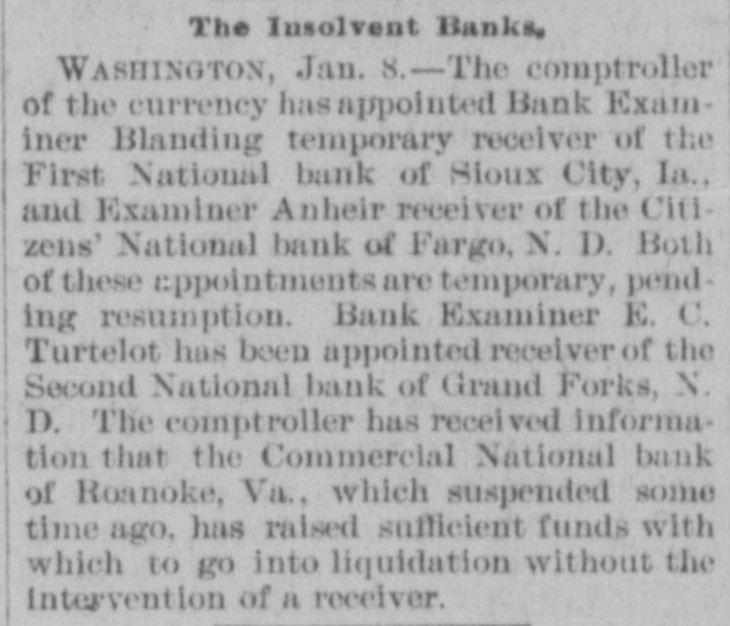
The Insolvent Banks, WASHINGTON, Jan. 8.-The comptroller of the currency has appointed Bank Examiner Blanding temporary receiver of the First National bank of Sloux City, Ia., and Examiner Anheir receiver of the Citizens' National bank of Fargo, N. D. Both of these appointments are temporary, pending resumption. Bank Examiner E. C. Turtelot has been appointed receiver of the Second National bank of Grand Forks, N. D. The comptroller has received information that the Commercial National bank of Roanoke, Va., which suspended some time ago, has raised sufficient funds with which to go into liquidation without the Intervention of a receiver.


Article from Twice-A-Week Plain Dealer, March 19, 1897

Click image to open full size in new tab

Article Text

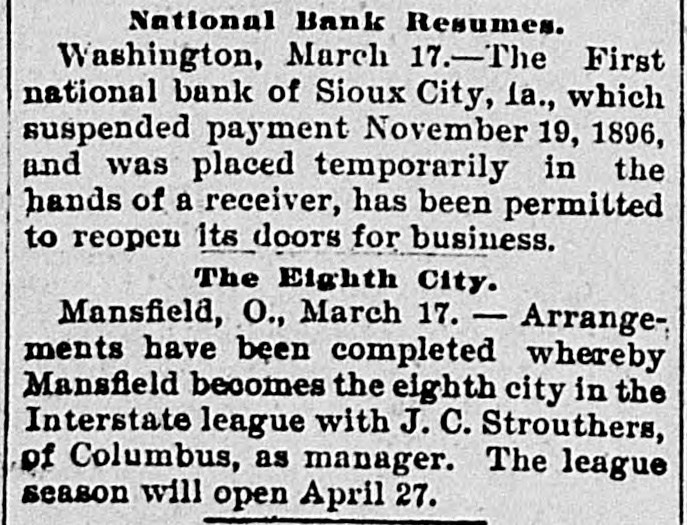
National Bank Resumes. Washington, March 17.-The First national bank of Sioux City, 1a., which suspended payment November 19, 1896, and was placed temporarily in the hands of a receiver, has been permitted to reopen its doors for business. The Eighth City. Mansfield, O., March 17. - Arrangements have been completed whereby Mansfield becomes the eighth city in the Interstate league with J.C. Strouthers, of Columbus, as manager. The league season will open April 27.


Article from Perrysburg Journal, March 20, 1897

Click image to open full size in new tab

Article Text

LATER. 'THE Phenix Savings bank, of Phenix. R. I., has suspended payment. THE sugar refinery in Williamsburg, N. Y., belonging to the American Sugar Refining Co., after a shut-down of over five months has opened with a force of nearly 500 men. THE First National Bank of Sioux City, Ia., which suspended payment November 19, 1896, and was placed temporarily in the hands of a receiver, has been permitted to resume business. THE Rhode Island republican state convention met at Providence on the 16th and nominated Elisha Dyer, of Providence, for governor. A BILL introduced in the senate on the 16th by Senator Elkins, of West Virginia, provides for a discriminating duty of 10 per cent. on all goods imported into this country in vessels other than those of the United States. It also provides for the same duty on the importation of such goods by land means of transportation. JUDGE BROWN, of the United States district court at New York City, on the 16th declined to take bail in the case of Turkish Consul Iasigi, who is wanted in Boston on a charge of embezzlement, but granted a motion to place him in enstody of the United States court. Iasigi was taken to Ludlow street jail. Gov. BLACK'S legal adviser, Charles Z. Lincoln, has completed the preparation of the two anti-trust bills which are intended to carry out the recommendations of the Lexow trust investigating committee. THE archbishop of Manila, the capital of the Phillippine islands, has cabled to the authorities at Madrid that 20,000 additional troops to reinforce the Spanish soldiery there are imperatively necessary. JUDGE MORROW, of the United States circuit court at San Francisco, has denied the application made by Butler, 2 the alleged Australian murderer, for an appeal to the supreme court of the United States. GEORGE H. COE, the old-time minstrel, died at his residence in Cambridge, Mass., on the 16th, aged 68 years. IN the senate on the 16th one pension bill was passed. and several hundred bills, public and private, were introduced and referred. There was hardly one of them which had not been on the calendar or on committee files b in the last congress. The senate spent over e two hours in discussion of the credentials of John A. Henderson, appointed by the governor S of Florida to fill the vacancy caused by the expiration on March 4 of the term of Senator Call. Finally the matter was referred-as were 1. the like cases this session from Kentucky and Oregon-to the committee on privileges and elections. Then the senate adjourned until the 18th The house was not in session


Article from The Diamond Drill, March 20, 1897

Click image to open full size in new tab

Article Text

home near Keithsburg, III., aged 87 years. The Mississippi river reached the highest mark ever known at Memphis, Tenn., and vicinity, and several towns were flooded and great damage done. The United States supreme court says that states have power to tax the franchaises of corporations, such as express, telegraph and railroad companies. Mount Baker, one of the loftiest peaks in the Cascade range, is in a state of eruption for the first time in 70 years. Barney McKernan, the last survivor in this country who took part in the famous charge of the Light brigade at Balaklava, died at Phoenixville, Pa. The lives of hundreds of families and thousands of live stock were in peril throughout the lower Mississippi valley on the Arkansas side from the disastrous flood that was sweeping down upon them. Three negroes who murdered John Barfield and John R. Turner at Juliette, Fla., were lynched by a mob. The visible supply of grain in the United States on the 15th was: Wheat, 41,449,000 bushels; corn, 26,795,000 bushels; oats, 13,528,000 bushels; rye, 3,616,000 bushels; barley, 3,135,000 bushels. President McKinley in his first message to congress declares in favor of a protective policy and says that prompt revenue legislation is the first duty of the lawmakers. The wholesale dry goods house of Ely, Walker & Co., the largest in St. Louis, was destroyed by fire, the loss being $1,000,000, and George Gutewald, a fireman, was killed and others were injured by falling walls. Seven tollgates were destroyed in Mercer county, Ky., by regulators. The jail at Dover, Tenn., was destroyed by fire and three colored prisoners were cremated. Chairman Dingley, of the ways and means committee, says the new tariff bill is expected to increase the revenue $112,000,000. Secretary Sherman informed the Spanish minister, Senor de Lome, that this administration will insist upon Americans in Cuba being amply protected. In South Dakota over 600 miles of road have been practically abandoned for fully two weeks because of a snow blockade. A train was wrecked at Wolf Creek, Kan., and Engineer Nye, Fireman Connor and J. P. Meador, a passenger, were killed and six persons were injured. John Cramer, aged 16, son of Jacob Cramer, of Duryea, Pa., died of hydrophobia and his father while witnessing his son's struggles dropped dead. The Headley Grocery company (wholesale) at Springfield, Mo., failed for $100,000. Postmaster-General Gary says that the administration has decided to adhere to the four-year-tenure-of-oflice policy for all postmasters. John O'Rourke, John Burns and Antonio Molinaskj were fatally burned by explosions of molten iron at the Emma blast furnace in Cleveland, O. For the eight months ended February 28 there has been a gain of over $132,000,000 in the amount of merchandise exported and a decrease of nearly $119,000,000 in the amount imported. The First national bank of Sioux City, Ia., which suspended payment November 19, 1896, has resumed business. The five new state senators, four republicans and one democrat, were sworn in by the Kentucky legislature, and this will insure the election of a republican United States senator. Charles Rodatinsky and his wife and baby were burned to death near Omaha, Neb., by the explosion of a gasoline stove. The piano and organ firm of Estey & Camp, which has been in business in Chicago for 30 years, has decided to retire. Gen. James M. Warner, aged 62, a prominent resident of Albany, N. Y., and postmaster under Harrison's administration, died while attending a theater. Nearly 2,000 homeless and half-starved persons rescued from the overflowed districts of eastern Arkansas are being cared for in Memphis, Tenn.
Article from The Pioneer Press, March 25, 1897

Click image to open full size in new tab

Article Text

The Pacific coast poyder war is ov An agreement has been effected tween the Atlantic and Pacific co: companies. Isaac S. Dement of Chicago, cha pion shorthand writer, broke his P vious record of 39 words by writing words in one minute at Quincy, Ill It is very probable that the Noi California division of the League American Wheelmen will go out of istence. The De Leeuw & Oppenheimer Pri ing company in New York have signed to Rudolph M. De Leeuw. T company was incorporated in 196, wi a capital stock of $100,000. Mrs. Mollie Grady died at Knoxvil Tenn., from a peculiar trouble. S had been unconscious for ten da One hour before her death her sk burst open. Then her feet and har turned, reversing their natural positi On going out from a hot qitchen hang out a washing Mrs. Leroy Sha non of Stevens Point, Wis., was tak with a severe attack of pneumonia a died within forty minutes. She w forty years of age. The attorneys for Mrs. Craven, w claims to be the contract widow ex-Senator James G. Fair, has filed the San Francisco superior coart 1 original pencil deeds to property y ued at $2,000,000 conveyed by Fair Mrs. Craven. The cloth weavers employed in Jo and James Dobson's big mill, Philad phia, who struck about ten days a because of a ten per cent reduction, turned to work to-day, a satisfact agreement haveing been reached w Mr. Dobson. The First National Bank of Sio City, Iowa, which suspended payme Nov. 19, 1896, having complied w all the conditions precedent to resur tion, and its capital stock being n unimpaired, has been permitted to sume business. The Vermont Marble company Proctor, Vt., has brough suit again William W. Winfree and George Sheeban of Washington to recover $1 535, alleged to be due for mater used in the amusement hall of the ) tional Soldiers' home at the capital. Mary Anderson De Navarro has S for about $44,000 her house at 31 W Thirty-eighth street, Ne wYork. a fo story brownstone dwelling. The bu is a Mrs. Prince, who will occupy she was on the stage Mary Anders lived there. The house is now leased Judge Goff has appointed Z T. V cent receiver for U. S. Buskirk, m chant and timberman of Logan, Va. Assets, $125,000; liabilities known. This is a result of the rec failure of the Sliger Lumber and Ma facturing company. The trial of twelve women and t men was begun at Hold Mezo-Vas hely, on Lake Hodos. Hungary. 1 prisoners are charged with poison their husbands or others of their re tives in oredr to obtain insura money. Some of the prisoners are cused of four or five murders. It is reported that Sir William \ Horne. president of the Canadian cific railroad, and Mr. Angus, preside of the Bank of Montreal, have beco associated with Gen. R. A. Alger of troit, secretary of war, in operat the Leurentide Pulp company of Gra Mere, Que. Secretary W. G. Preutt of the bos of Montana stock commissioners, sa "The stock on the ranges has had a markably hard time the whole wint In the extreme northern part of


Article from The Dickinson Press, March 27, 1897

Click image to open full size in new tab

Article Text

Otherwise, The South Africa republic and Orange Free State resolve to form a federal union. The Dubuque Stamping and Enameling works, which have been idle for some time, will start up Monday. A receiver for the Garden State National Building and Loan Association of Chicago has been asked for. The First National Bank of Sioux City, Iowa, which suspended payment Nov. 19. 1896, has been permitted to resume. In nine days farmers near Spencer, Wie., where the local blast furnace buys wood, hauled to town and sold 5,000 cords at $1.50 a cord.


Article from Courier Democrat, April 1, 1897

Click image to open full size in new tab

Article Text

From Foreign Shores. Dispatches received in New York from Panama state that Gen. Antonio Ezeta is dead. In four legislative elections which took place in France, all the districts returned the Radical-Socialist candidates. The London England, city council has decided to impose a license fee of $100 on cigarette venders, in the hope of lessening the cigarette habit among the youths of the city. By far the northernmost postoffice in the world has just been ordered established by the Norwegian government on Spitzenberg island, to the north of Norway. It will be mainly for the benefit of the excursionists who find their way there at rare intervals. The Quebec government has granted $500,000 toward the erection of a bridge across the St. Lawrence river opposite Quebec. The bridge is to cost $6,000,000. The Dominion government is expected to grant at least $1,000,000 toward the structure. William Steinitz, the famous chessplayer, has been discharged from the hospital for insane patients attached to the university at Moscow, to which he was taken early in February. His discharge must mean that he is improved, if not completely cured. Prince Frederick Leopold of Prussia, who began bicycling secretly, has been forbidden to continue S0 doing by the empress, on the ground that it is not gentlemanly. Her majesty has concelved a violent dislike for bicycling, and has prevailed upon the emperor to discontinue the practice. Miscellaneous Sig. Grimaldi, the Italian statesman and ex-cabinet minister, is dead. The Pacific coast poyder war is over. An agreement has been effected between the Atlantic and Pacific coast companies. Isaac S. Dement of Chicago, champion shorthand writer, broke his previous record of 39 words by writing 402 words in one minute at Quincy, Ill. It is very probable that the North California division of the League of American Wheelmen will go out of existence. The De Leeuw & Oppenheimer Printing company in New York have assigned to Rudolph M. De Leeuw. The company was incorporated in 196, with a capital stock of $100,000. Mrs. Mollie Grady died at Knoxville, Tenn., from a peculiar trouble. She had been unconscious for ten days. One hour before her death her skull burst open. Then her feet and hands turned, reversing their natural position. On going out from a hot qitchen to hang out a washing Mrs. Leroy Shannon of Stevens Point, Wis., was taken with a severe attack of pneumonia and died within forty minutes. She was forty years of age. The attorneys for Mrs. Craven, who claims to be the contract widow of ex-Senator James G. Fair, has filed in the San Francisco superior court the original pencil deeds to property valued at $2,000,000 conveyed by Fair to Mrs. Craven. The cloth weavers employed in John and James Dobson's big mill, Philadelphia, who struck about ten days ago because of a ten per cent reduction, returned to work to-day, a satisfactory agreement haveing been reached with Mr. Dobson. The First National Bank of Sioux City, Iowa, which suspended payment Nov. 19, 1896, having complied with all the conditions precedent to resumption, and its capital stock being now unimpaired, has been permitted to resume business. The Vermont Marble company of Proctor, Vt., has brough suit against William W. Winfree and George A. Sheeban of Washington to recover $19,535, alleged to be due for material used in the amusement hall of the National Soldiers' home at the capital. Mary Anderson De Navarro has sold for about $44,000 her house at 31 West Thirty-eighth street, Ne wYork, a fourstory brownstone dwelling. The buyer is a Mrs. Prince, who will occupy the she was on the stage Mary Anderson lived there. The house is now leased. Judge Goff has appointed Z T. Vincent receiver for U. S. Buskirk, merchant and timberman of Logan, W. Va. Assets, $125,000; liabilities unknown. This is a result of the recent failure of the Sliger Lumber and Manufacturing company. The trial of twelve women and two men was begun at Hold Mezo-Vasarhely, on Lake Hodos, Hungary. The prisoners are charged with poisoning their husbands or others of their relatives in oredr to obtain insurance money. Some of the prisoners are accused of four or five murders. It is reported that Sir William Van Horne. president of the Canadian Pacific railroad, and Mr. Angus, president of the Bank of Montreal, have become associated with Gen. R. A. Alger of Detroit, secretary of war, in operating the Leurentide Pulp company of Grand Mere, Que. Secretary W. G. Preutt of the board of Montana stock commissioners, says: "The stock on the ranges has had a remarkably hard time the whole winter. In the extreme northern part of the state it has not been above zero for weeks, and stock was in poor condition when this began."