Bank owned by Schiffer brothers; failure followed suspension and criminal charges.
Events (3)
1.October 1, 1905*Run
Cause
Local Shock
Cause Details
Withdrawals triggered by opening of a new competing bank in town, leaving bank short on cash.
Measures
Directors closed the bank (ceased payments) fearing continuation of withdrawals.
Newspaper Excerpt
There was a slight run Saturday and fearing a continuance the directors decided to close.
Source
newspapers
+1 day
2.October 2, 1905Suspension
Cause
Local Shock
Cause Details
Bank short on cash after withdrawals (linked to new bank opening); directors voluntarily suspended operations.
Newspaper Excerpt
The Bank of Alamosa...closed its doors Monday morning.
Source
newspapers
+6 months
3.March 19, 1906Receivership
Newspaper Excerpt
United States Judge Moses Hallett...appointed Christopher Wallrich receiver of the bank.
Source
newspapers
Newspaper Articles (20)
1.October 5, 1905Durango Semi-Weekly HeraldDurango, CO
Click image to open full size in new tab
Article Text
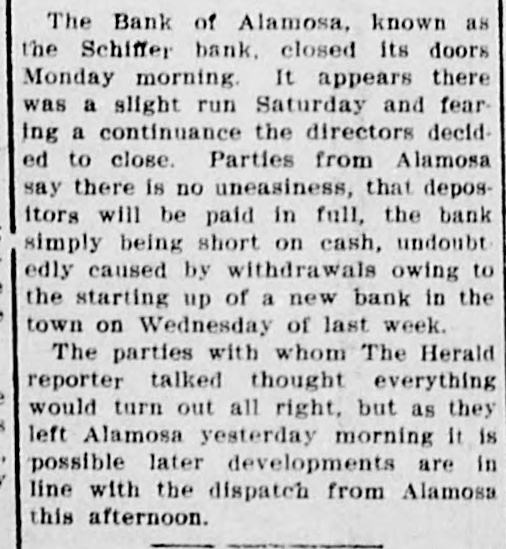
The Bank of Alamosa, known as the Schiffer bank. closed its doors Monday morning. It appears there was a slight run Saturday and fearing a continuance the directors decided to close. Parties from Alamosa say there is no uneasiness, that depositors will be paid in full, the bank simply being short on cash, undoubt edly caused by withdrawals owing to the starting up of a new bank in the town on Wednesday of last week. The parties with whom The Herald reporter talked thought everything would turn out all right, but as they left Alamosa yesterday morning It is possible later developments are in line with the dispatch from Alamosa this afternoon.
2.October 9, 1905The Topeka State JournalTopeka, KS
Click image to open full size in new tab
Article Text
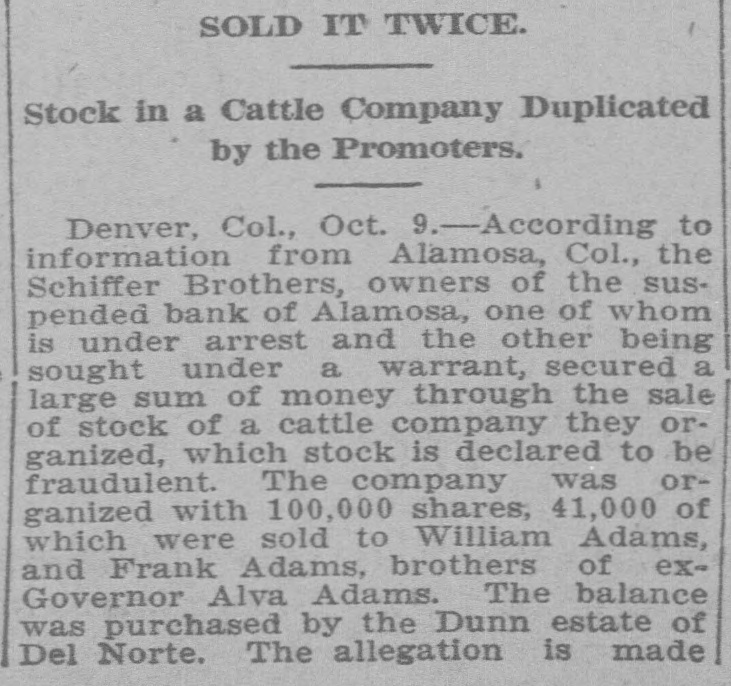
SOLD IT TWICE
Stock in a Cattle Company Duplicated by the Promoters. Denver, Col., Oct. 9.-According to information from Alamosa, Col., the Schiffer Brothers, owners of the suspended bank of Alamosa, one of whom is under arrest and the other being sought under a warrant, secured a large sum of money through the sale of stock of a cattle company they organized, which stock is declared to be fraudulent. The company was organized with 100,000 shares, 41,000 of which were sold to William Adams, and Frank Adams, brothers of exGovernor Alva Adams. The balance was purchased by the Dunn estate of Del Norte. The allegation is made
3.October 9, 1905Evening StarWashington, DC
Click image to open full size in new tab
Article Text
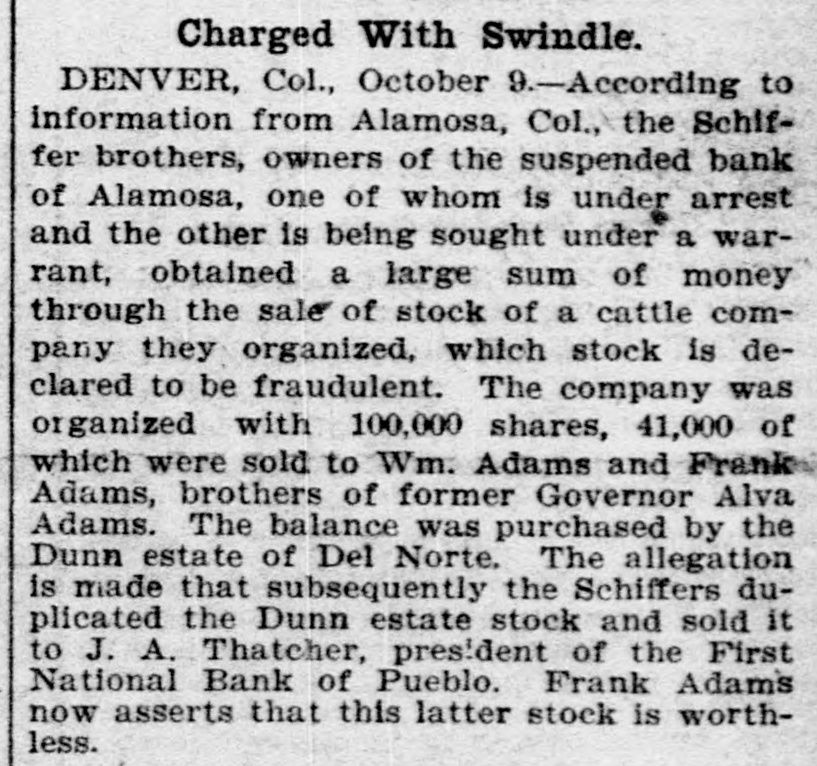
Charged With Swindle
DENVER, Col., October 9.-According to information from Alamosa, Col., the Schiffer brothers, owners of the suspended bank of Alamosa, one of whom is under arrest and the other is being sought under a warrant, obtained a large sum of money through the sale of stock of a cattle company they organized, which stock is declared to be fraudulent. The company was organized with 100,000 shares, 41,000 of which were sold to Wm. Adams and Frank Adams, brothers of former Governor Alva Adams. The balance was purchased by the Dunn estate of Del Norte. The allegation is made that subsequently the Schiffers duplicated the Dunn estate stock and sold it to J. A. Thatcher, president of the First National Bank of Pueblo. Frank Adams now asserts that this latter stock is worthless.
4.October 9, 1905Evening Times-RepublicanMarshalltown, IA
Click image to open full size in new tab
Article Text
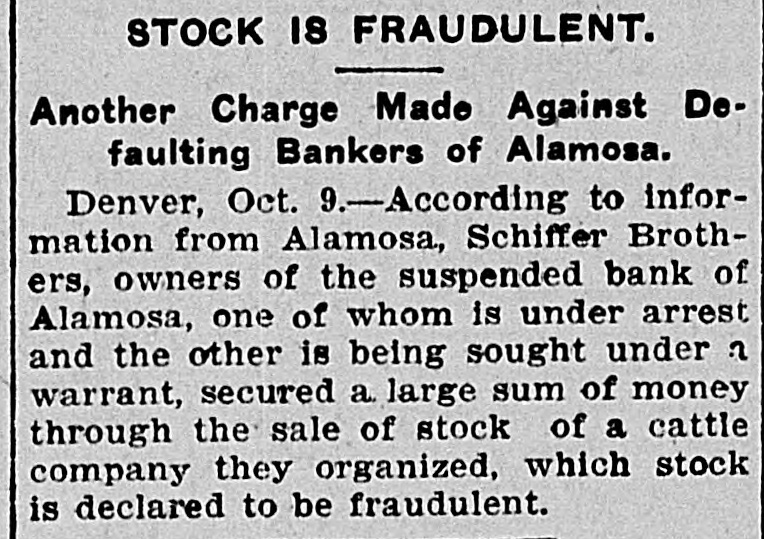
STOCK IS FRAUDULENT
Another Charge Made Against Defaulting Bankers of Alamosa. Denver, Oct. 9.-According to information from Alamosa, Schiffer Brothers, owners of the suspended bank of Alamosa, one of whom is under arrest and the other is being sought under 2 warrant, secured a. large sum of money through the sale of stock of a cattle company they organized, which stock is declared to be fraudulent.
5.October 9, 1905The Daily SentinelGrand Junction, CO
Click image to open full size in new tab
Article Text
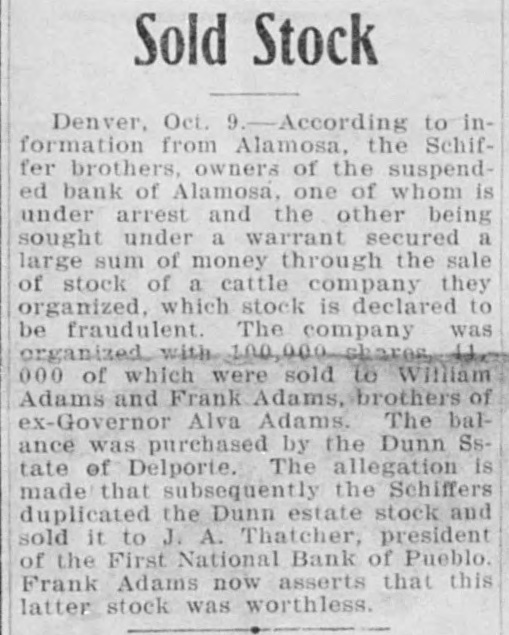
Sold Stock Denver, Oct. 9.-According to information from Alamosa, the Schiffer brothers, owners of the suspended bank of Alamosa, one of whom is under arrest and the other being sought under a warrant secured a large sum of money through the sale of stock of a cattle company they organized, which stock is declared to be fraudulent. The company was organized with 100,000 shares 11 000 of which were sold to William Adams and Frank Adams, brothers of ex-Governor Alva Adams. The balance was purchased by the Dunn Sstate of Delporte. The allegation is made that subsequently the Schiffers duplicated the Dunn estate stock and sold it to J. A. Thatcher, president of the First National Bank of Pueblo. Frank Adams now asserts that this latter stock was worthless.
6.October 9, 1905The Providence NewsProvidence, RI
Click image to open full size in new tab
Article Text
ACCUSED OF FRAUD IN
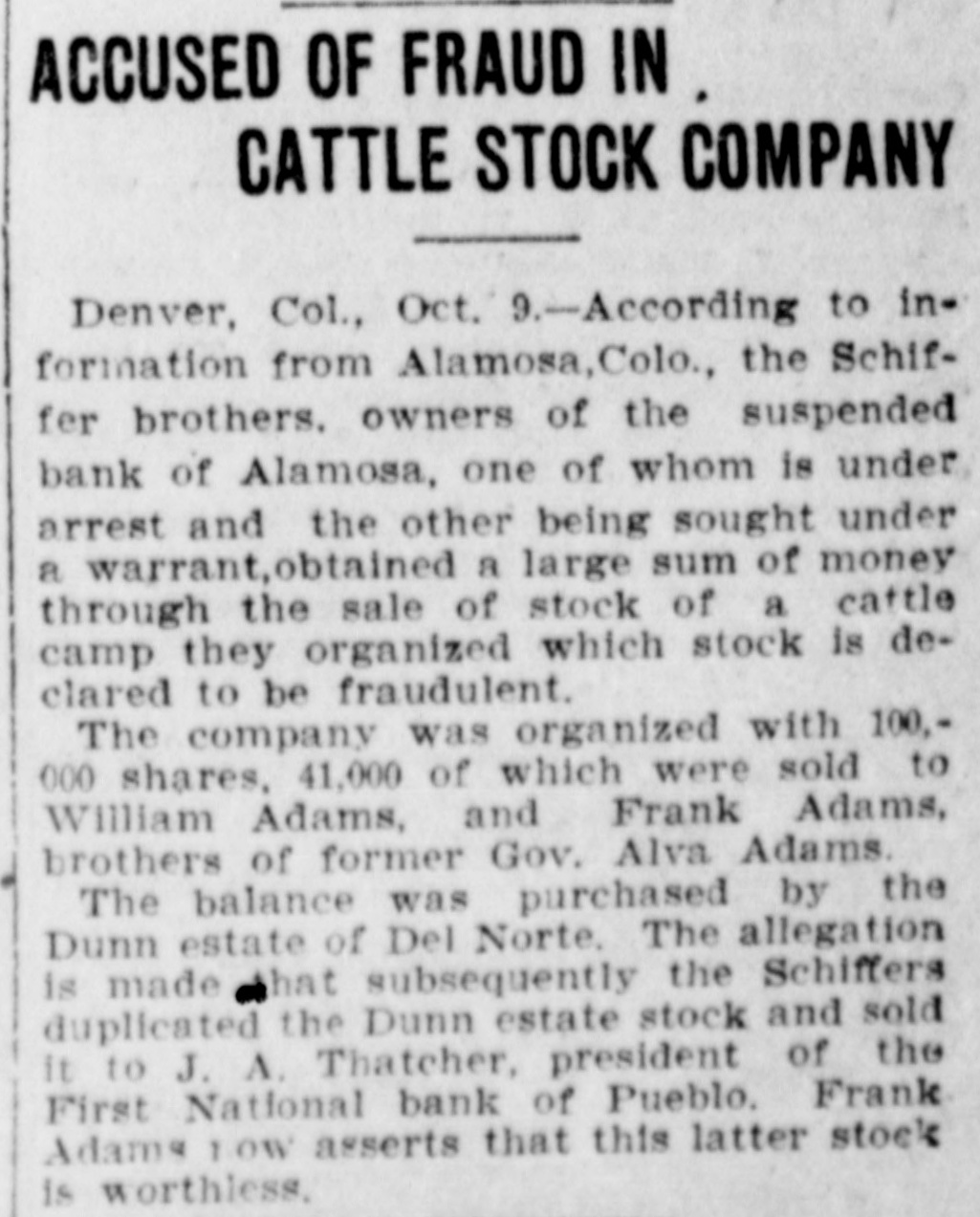
CATTLE STOCK COMPANY Denver, Col., Oct. 9.-According to information from Alamosa, Colo., the Schiffer brothers. owners of the suspended bank of Alamosa, one of whom is under arrest and the other being sought under a warrant,obtained a large sum of money through the sale of stock of a cattle camp they organized which stock is declared to be fraudulent. The company was organized with 100,000 shares, 41,000 of which were sold to William Adams, and Frank Adams, brothers of former Gov. Alva Adams. The balance was purchased by the Dunn estate of Del Norte. The allegation is made hat subsequently the Schiffers duplicated the Dunn estate stock and sold it to J. A. Thatcher, president of the First National bank of Pueblo. Frank Adams 1 ow asserts that this latter stock is worthless.
7.October 10, 1905Daily Kennebec JournalAugusta, ME
Click image to open full size in new tab
Article Text
STOCK IS WORTHLESS
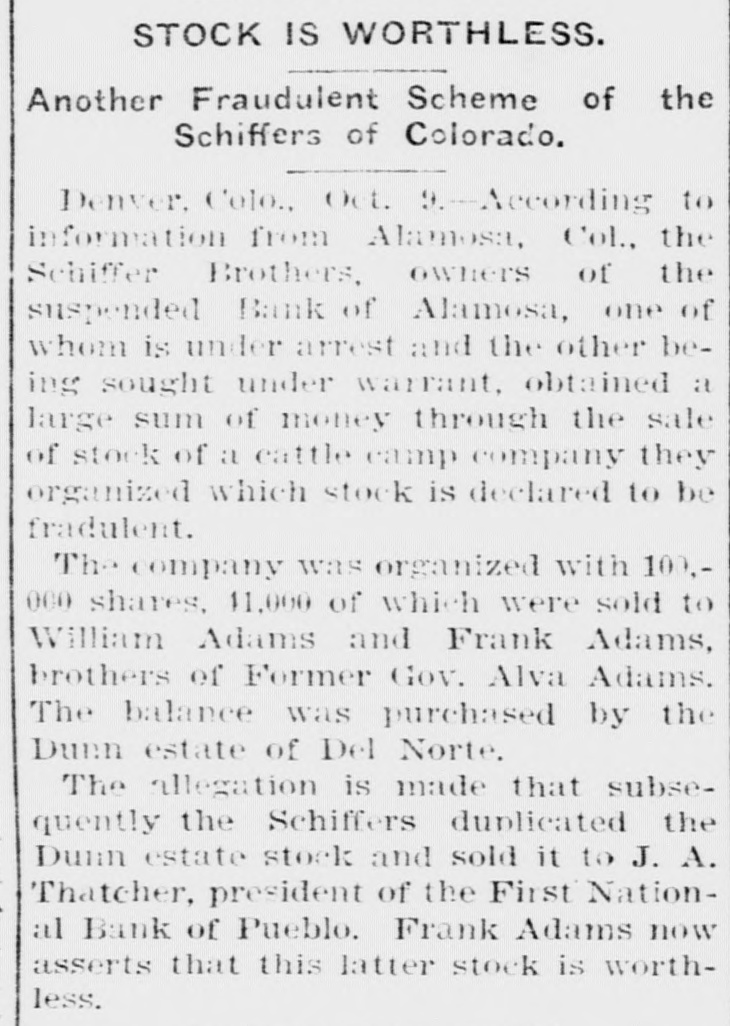
Another Fraudulent Scheme of the Schiffers of Colorado. Denver, Colo., Oct. 3.-According to information from Alamosa, Col., the Schiffer Brothers, owners of the suspended Bank of Alamosa, one of whom is under arrest and the other being sought under warrant, obtained a large sum of money through the sale of stock of a cattle camp company they organized which stock is declared to be fradulent. The company was organized with 100.000 shares. 11,000 of which were sold to William Adams and Frank Adams, brothers of Former Gov. Alva Adams. The balance was purchased by the Dunn estate of Del Norte. The allegation is made that subsequently the Schiffers duplicated the Dunn estate stock and sold it to J. A. Thatcher, president of the First National Bank of Pueblo. Frank Adams now asserts that this latter stock is worthless.
8.November 11, 1905Deseret Evening NewsSalt Lake City, UT
Click image to open full size in new tab
Article Text
Schiffer is Arraigned
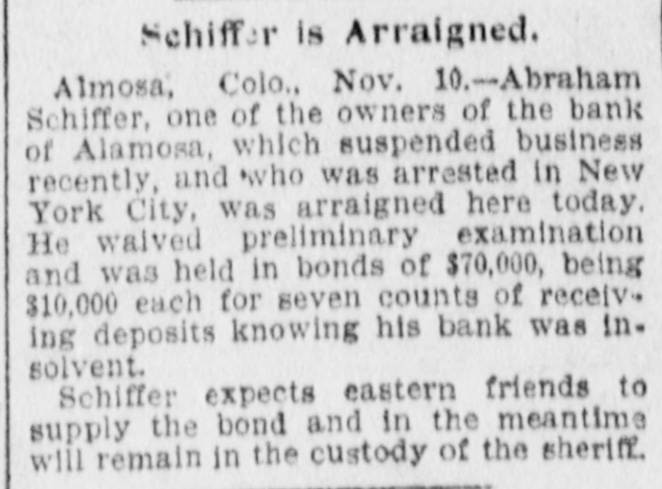
Almosa, Colo., Nov. 10.-Abraham Schiffer, one of the owners of the bank of Alamosa, which suspended business recently, and who was arrested in New York City, was arraigned here today. He waived preliminary examination and was held in bonds of $70,000, being $10,000 each for seven counts of receiving deposits knowing his bank was insolvent. Schiffer expects eastern friends to supply the bond and in the meantime will remain in the custody of the sheriff.
9.November 11, 1905Los Angeles HeraldLos Angeles, CA
Click image to open full size in new tab
Article Text
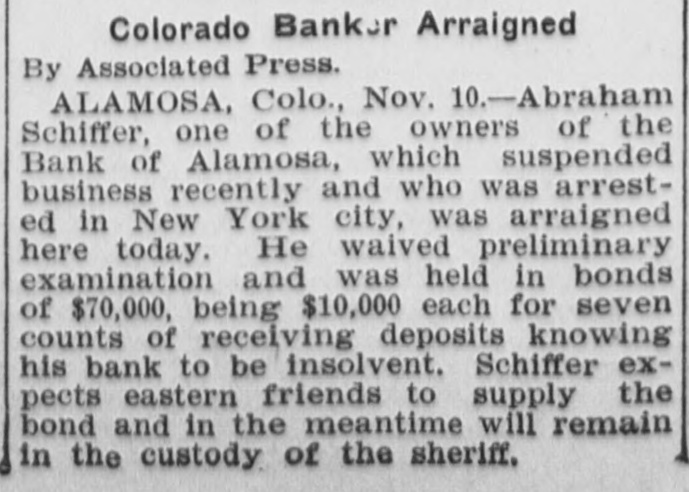
Colorado Banker Arraigned By Associated Press. ALAMOSA, Colo., Nov. 10.-Abraham Schiffer, one of the owners of the Bank of Alamosa, which suspended business recently and who was arrested in New York city, was arraigned here today. He waived preliminary examination and was held in bonds of $70,000, being $10,000 each for seven counts of receiving deposits knowing his bank to be insolvent. Schiffer expects eastern friends to supply the bond and in the meantime will remain in the custody of the sheriff.
10.November 17, 1905Wood County ReporterWisconsin Rapids, WI
Click image to open full size in new tab
Article Text
SCHIFFER UNDER HEAVY BONDS
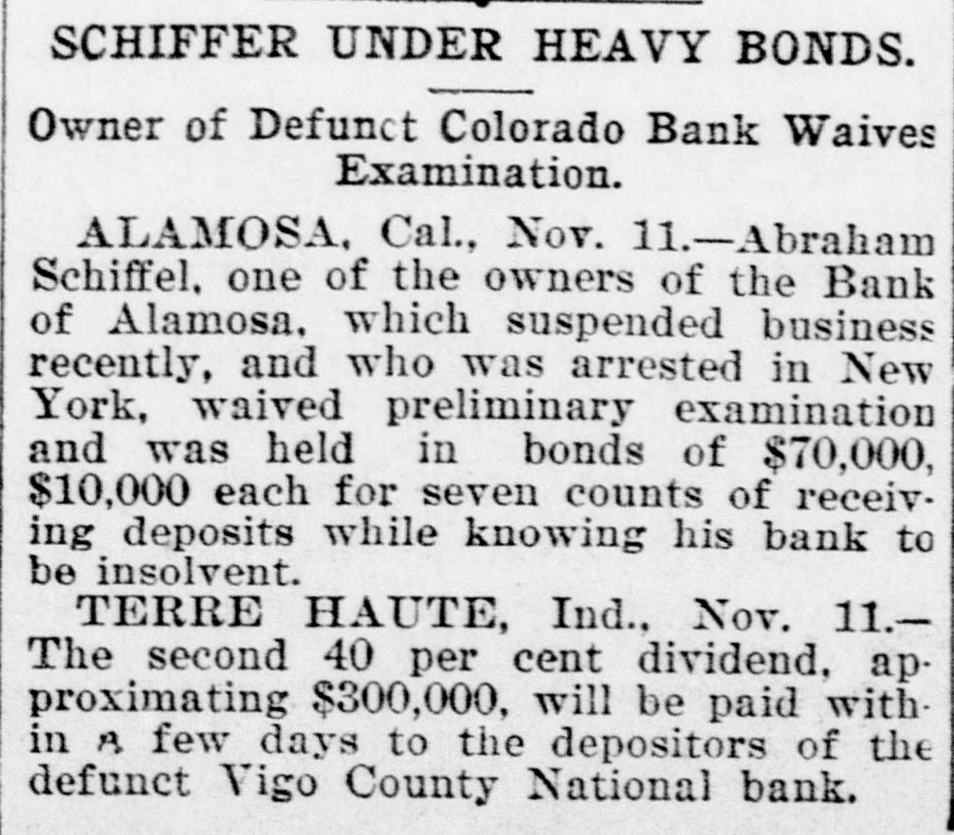
Owner of Defunct Colorado Bank Waives Examination. ALAMOSA. Cal., Nov. 11.-Abraham Schiffel. one of the owners of the Bank of Alamosa, which suspended business recently, and who was arrested in New York, waived preliminary examination and was held in bonds of $70,000, $10,000 each for seven counts of receiving deposits while knowing his bank to be insolvent. TERRE HAUTE, Ind., Nov. 11.The second 40 per cent dividend, approximating $300,000, will be paid with. in A few days to the depositors of the defunct Vigo County National bank.
11.March 20, 1906The Salt Lake TribuneSalt Lake City, UT
Click image to open full size in new tab
Article Text
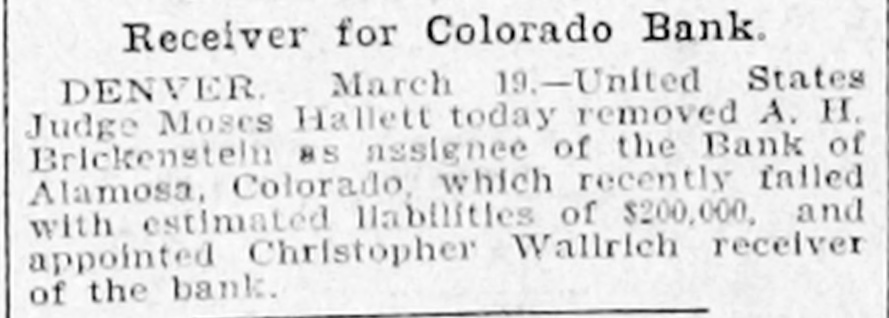
Receiver for Colorado Bank DENVER March 19.-United States Judge Moses Hallett today removed A. H. Brickensteln as assignee of the Bank of Alamosa, Colorado, which recently falled with estimated liabilities of $200,000. and appointed Christopher Wallrich receiver of the bank.
12.March 24, 1906The Monte Vista JournalMonte Vista, CO
Click image to open full size in new tab
Article Text
pairing by Marshall will receive strict attention. MCINTOSH & DUNCAN The Del Norte Prospector has secured over one hundred signatures to H petition for free rural delivery and the papers have been sent to Congressman Hogg for his approval And co-operation. Representative Stevenson of Minnesota, has introduced R bill in congress for the reclamation of swamp lands of which there Are about 100,000,000 acres in the United States, 70,000,000 of which have been surveyed. These lands when properly drained would make splendid rich farma and homes for the millions of landless. After fighting poverty ever since the death of her husband six years ago, Mrs. H. A. W. Tabor Is about to come into her own Through the sale of almost forgotten claims in the San Juan district, negotia. tions for which are on at the present time, Mrs. Tabor, it 18 believed will realize a princely sum, possibly $1,000,000.-Chieftain. The national convention of the United Mine Workers of America is now in session at Indianapolis, with over 1,000 delegates present representing 1,461 locals. The convention was called by President John Mitchell to decide whether or not 11 general strike that will bring 425,000 men from the mines shall be called for April 1. The conference with the operators will begin here Monday next. Another step in wiping out the the Brickenstein family by the citizens of Alamoea was taken in the federal court Monday when Judge Hallett removed from all connection with the defunct Bank of Alamoea, which recently failed with liabilities estimated all the way from *100,000 to over $200. 000, A. H. Brickenstein as nseig gnee and appointed NO receiver Christopher Walirich, who has been a lumber dealer in Alamosa for eighteen years.-Denver Times, Our San Luis Valley sheep men are attracting attention in Chicago. The Chicago market has what purports to be " half tone of Ru. dolph Ahrens under which it says: Here we have 11 good likeness of one of Rio Grande County, Colo., hustling sheep feeders, Mr. Ahrens, the jumor member of the firm of Robb & Ahrens, of Monte Vista. Colo. Mr. Ahrens has been in Chiengo the past week overseeing the sale of 11 train of Colorado fed lambs that he is marketing through the National Live Stock Commis. sion Co. Mr. Ahrens expressed himself as well pleased with prices and prompt manner in which the "National" handled his shipments, end said that while this WAN the first season the "National" had handled any shipments for him it would not be the last. Ntomach Trouble and Constipution.
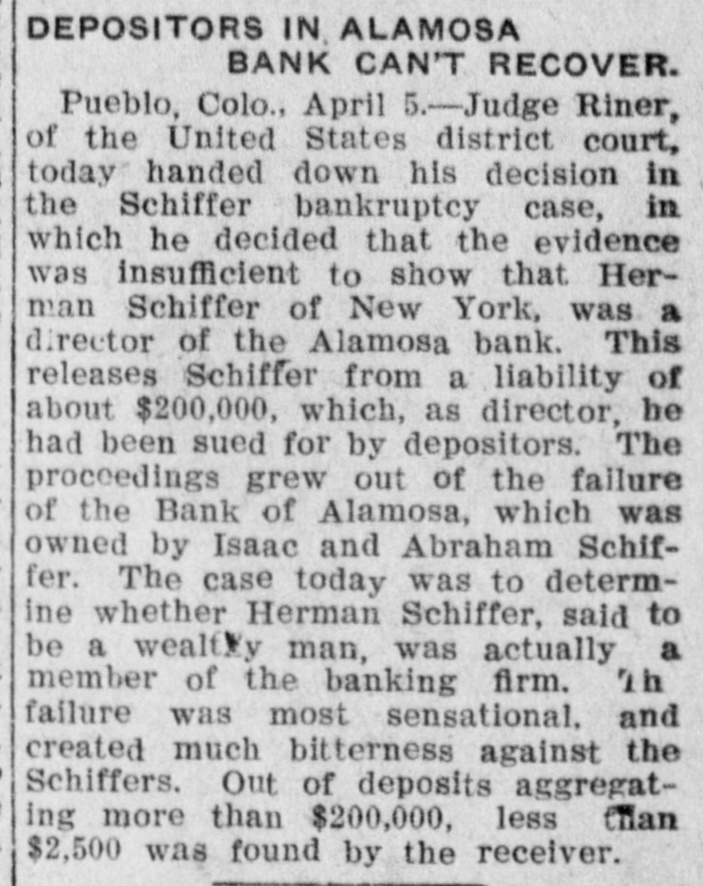
ALAMOSA BANK CAN'T RECOVER. Pueblo, Colo., April 5.-Judge Riner, of the United States district court, today handed down his decision in the Schiffer bankruptcy case, in which he decided that the evidence was insufficient to show that Herman Schiffer of New York, was a director of the Alamosa bank. This releases Schiffer from a liability of about $200,000, which, as director, he had been sued for by depositors. The proceedings grew out of the failure of the Bank of Alamosa, which was owned by Isaac and Abraham Schiffer. The case today was to determine whether Herman Schiffer, said to be a wealty man, was actually a member of the banking firm. Th failure was most sensational, and created much bitterness against the Schiffers. Out of deposits aggregating more than $200,000, less than $2,500 was found by the receiver.
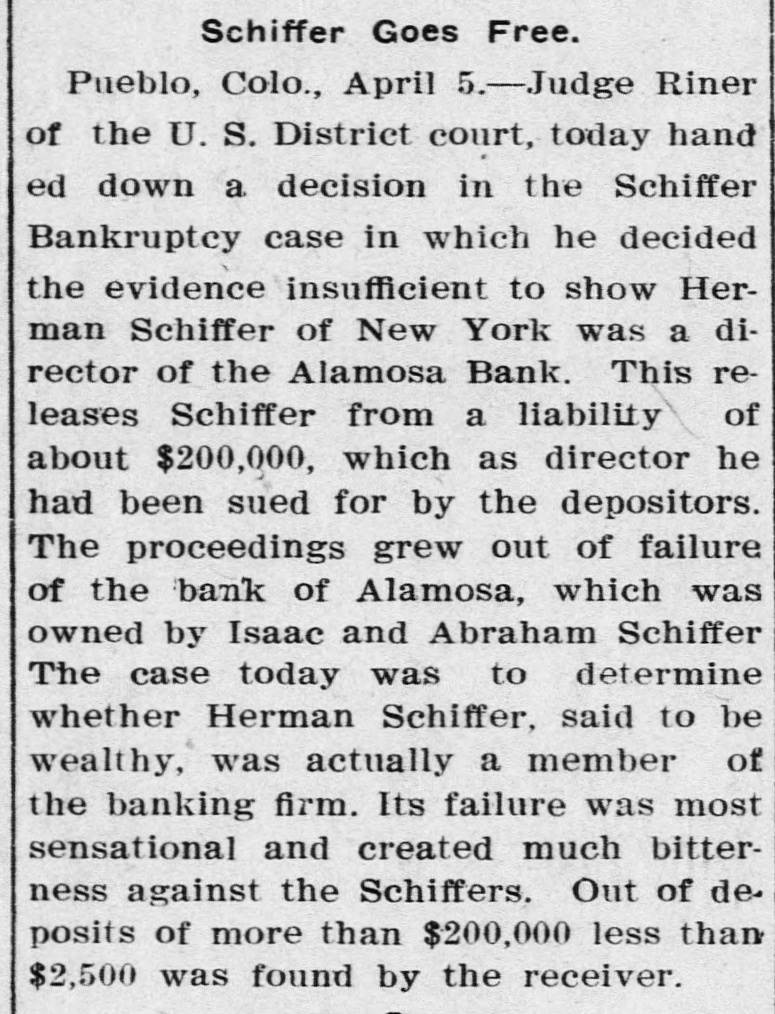
Pueblo, Colo., April 5.-Judge Riner of the U. S. District court, today hand ed down a decision in the Schiffer Bankruptcy case in which he decided the evidence insufficient to show Herman Schiffer of New York was a director of the Alamosa Bank. This reof leases Schiffer from a liability about $200,000, which as director he had been sued for by the depositors. The proceedings grew out of failure of the bank of Alamosa, which was owned by Isaac and Abraham Schiffer The case today was to determine whether Herman Schiffer, said to be wealthy, was actually a member of the banking firm. Its failure was most sensational and created much bitterness against the Schiffers. Out of deposits of more than $200,000 less than $2,500 was found by the receiver.
15.April 11, 1906The Lamar RegisterLamar, CO
Click image to open full size in new tab
Article Text
SCHIFFER DECISION
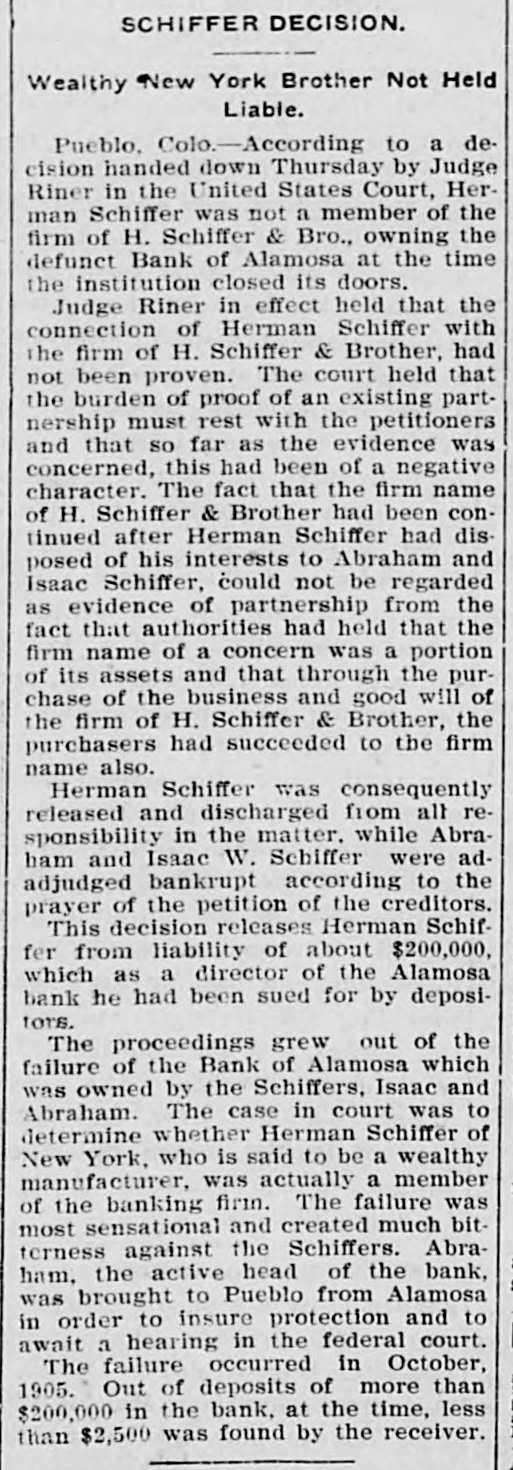
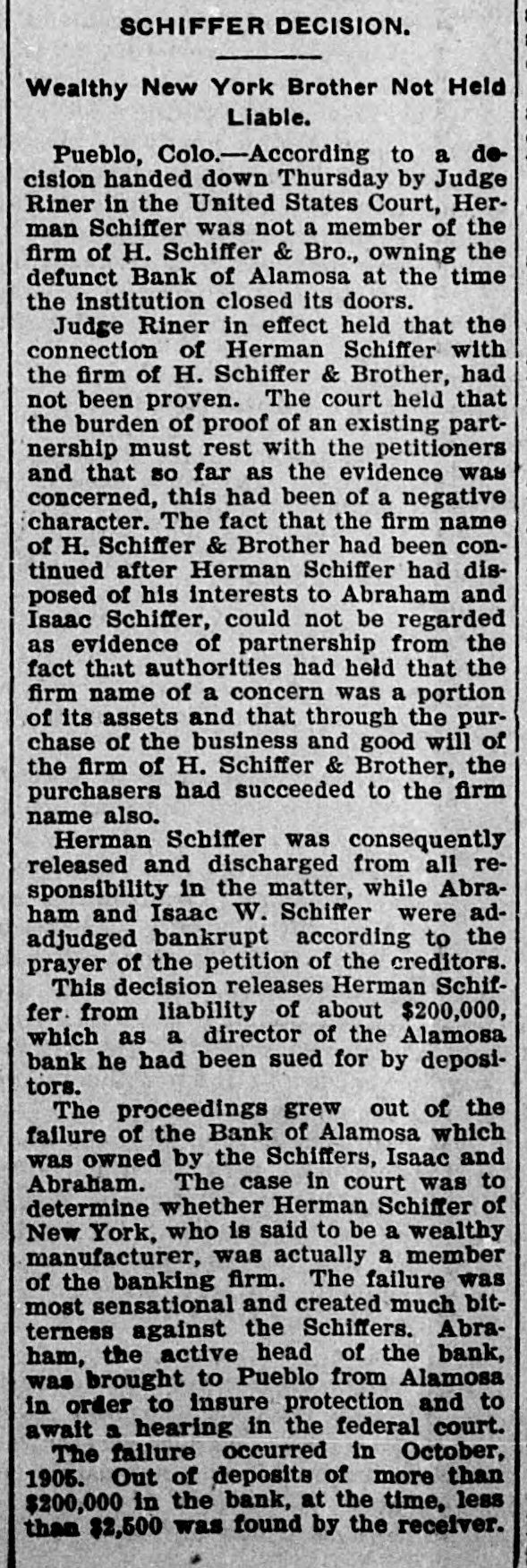
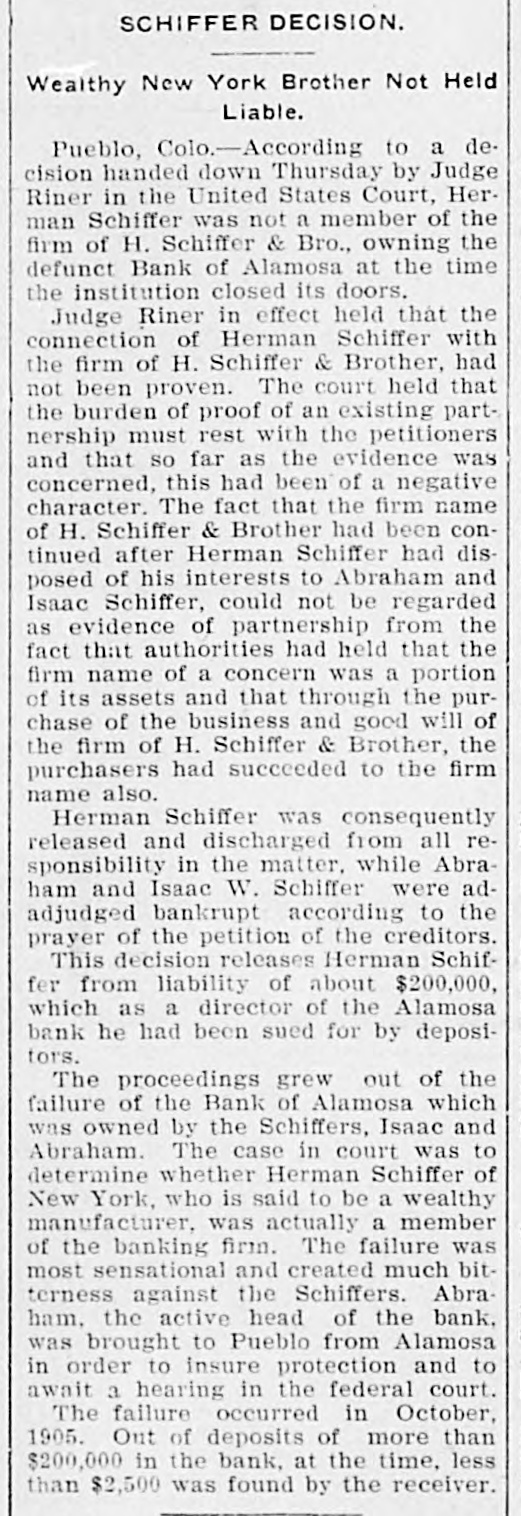
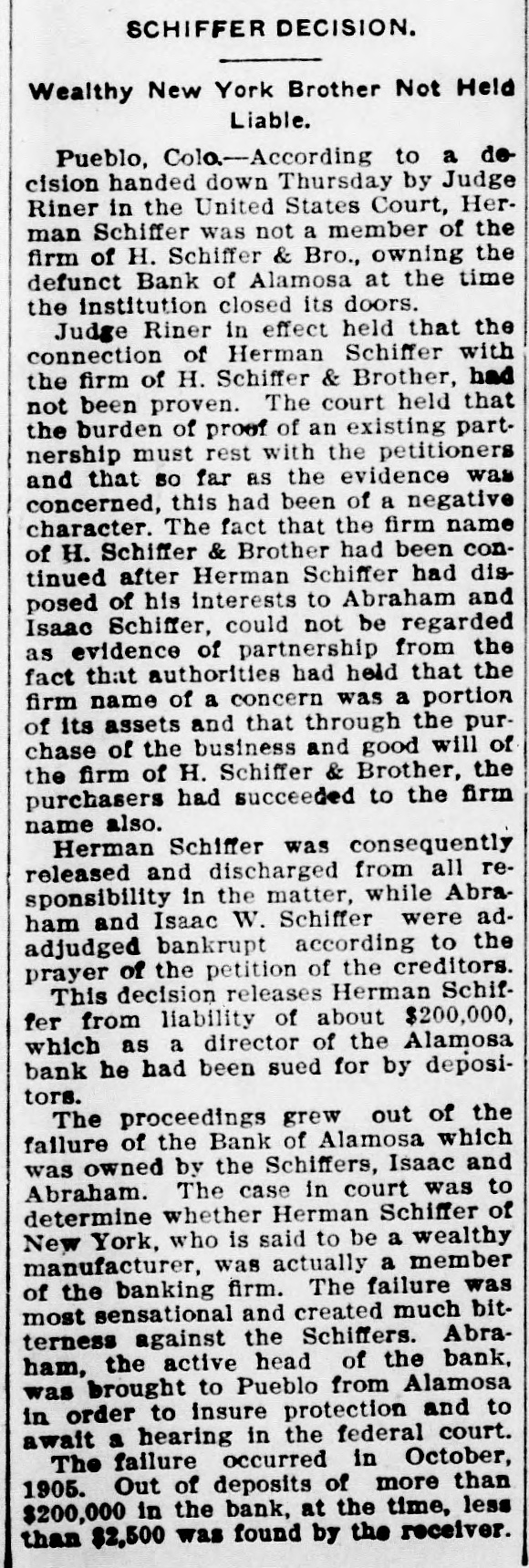
Wealthy New York Brother Not Held Liable. Pueblo, Colo.-According to a decision handed down Thursday by Judge Riner in the United States Court, Herman Schiffer was not a member of the firm of H. Schiffer & Bro., owning the defunct Bank of Alamosa at the time the institution closed its doors. Judge Riner in effect held that the connection of Herman Schiffer with the firm of H. Schiffer & Brother, had not been proven. The court held that the burden of proof of an existing partnership must rest with the petitioners and that so far as the evidence was concerned, this had been of a negative character. The fact that the firm name of H. Schiffer & Brother had been continued after Herman Schiffer had disposed of his interests to Abraham and Isaac Schiffer, could not be regarded as evidence of partnership from the fact that authorities had held that the firm name of a concern was a portion of its assets and that through the purchase of the business and good will of the firm of H. Schiffer & Brother, the purchasers had succeeded to the firm name also. Herman Schiffer was consequently released and discharged from all responsibility in the matter. while Abraham and Isaac W. Schiffer were adadjudged bankrupt according to the prayer of the petition of the creditors. This decision releases Herman Schiffer from liability of about $200,000, which as a director of the Alamosa bank he had been sued for by deposi10TE. The proceedings grew out of the failure of the Bank of Alamosa which was owned by the Schiffers, Isaac and Abraham. The case in court was to determine whether Herman Schiffer of New York, who is said to be a wealthy manufacturer, was actually a member of the banking firm. The failure was most sensational and created much bitterness against the Schiffers. Abraham. the active head of the bank, was brought to Pueblo from Alamosa in order to insure protection and to await a hearing in the federal court. The failure occurred in October, 1905. Out of deposits of more than $200,000 in the bank, at the time, less than $2,500 was found by the receiver.
16.April 12, 1906Gilpin ObserverCentral City, CO
Click image to open full size in new tab
Article Text
SCHIFFER DECISION
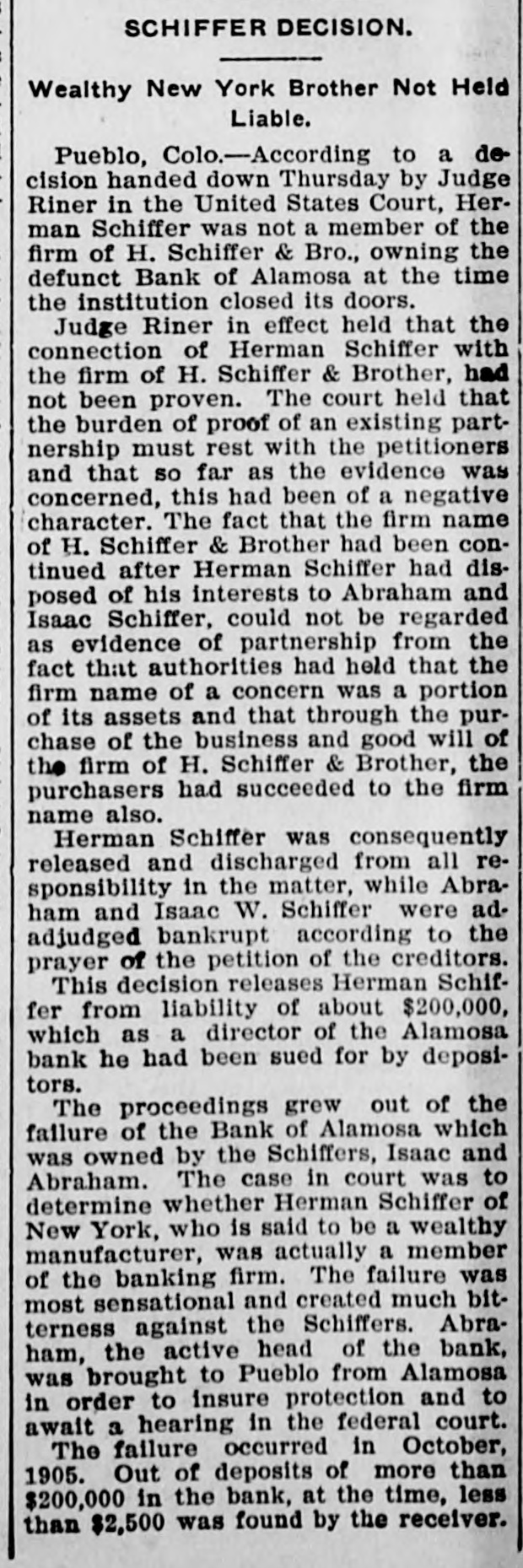
Wealthy New York Brother Not Held Liable. Pueblo, Colo.-According to a decision handed down Thursday by Judge Riner in the United States Court, Herman Schiffer was not a member of the firm of H. Schiffer & Bro., owning the defunct Bank of Alamosa at the time the institution closed its doors. Judge Riner in effect held that the connection of Herman Schiffer with the firm of H. Schiffer & Brother, had not been proven. The court held that the burden of proof of an existing partnership must rest with the petitioners and that so far as the evidence was concerned, this had been of a negative character. The fact that the firm name of H. Schiffer & Brother had been continued after Herman Schiffer had disposed of his interests to Abraham and Isaac Schiffer, could not be regarded as evidence of partnership from the fact that authorities had held that the firm name of a concern was a portion of its assets and that through the purchase of the business and good will of the firm of H. Schiffer & Brother, the purchasers had succeeded to the firm name also. Herman Schiffer was consequently released and discharged from all responsibility in the matter, while Abraham and Isaac W. Schiffer were adadjudged bankrupt according to the prayer of the petition of the creditors. This decision releases Herman Schiffer from liability of about $200,000, which as a director of the Alamosa bank he had been sued for by depositors. The proceedings grew out of the failure of the Bank of Alamosa which was owned by the Schiffers, Isaac and Abraham. The case in court was to determine whether Herman Schiffer of New York, who is said to be a wealthy manufacturer, was actually a member of the banking firm. The failure was most sensational and created much bitterness against the Schiffers. Abraham, the active head of the bank, was brought to Pueblo from Alamosa in order to insure protection and to await a hearing in the federal court. The failure occurred in October, 1905. Out of deposits of more than $200,000 in the bank, at the time, less than $2,500 was found by the receiver.
17.April 12, 1906The Elbert County TribuneElbert, CO
Click image to open full size in new tab
Article Text
SCHIFFER DECISION
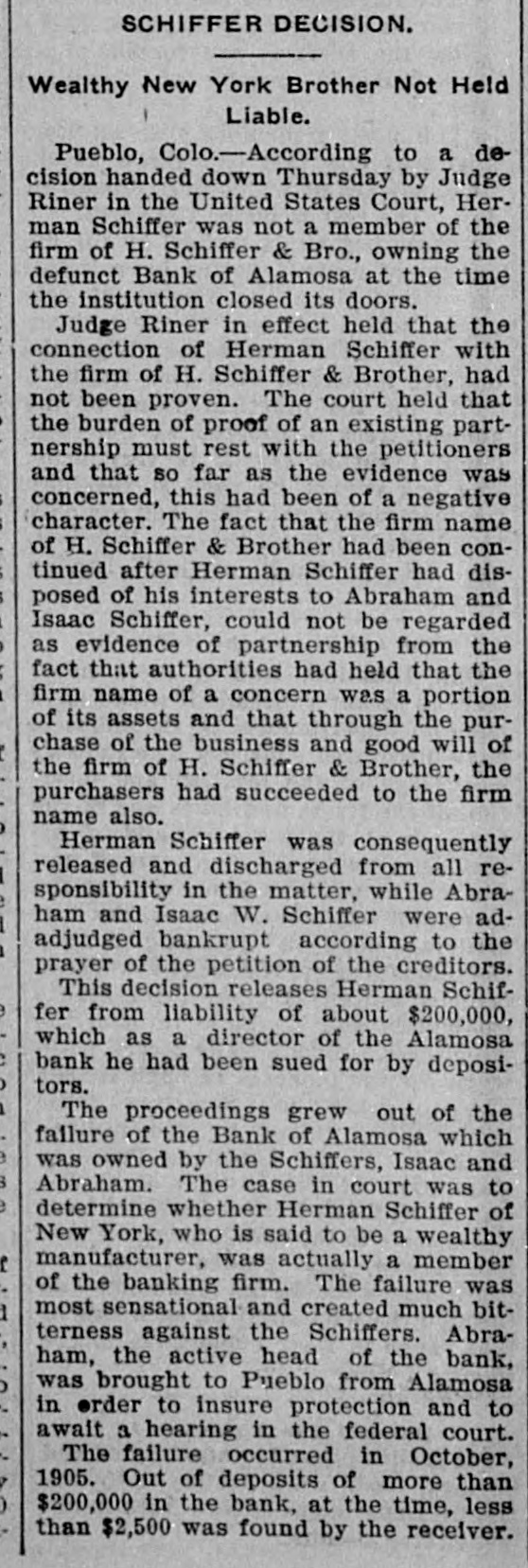
Wealthy New York Brother Not Held Liable. Pueblo, Colo.-According to a decision handed down Thursday by Judge Riner in the United States Court, Herman Schiffer was not a member of the firm of H. Schiffer & Bro., owning the defunct Bank of Alamosa at the time the institution closed its doors. Judge Riner in effect held that the connection of Herman Schiffer with the firm of H. Schiffer & Brother, had not been proven. The court held that the burden of proof of an existing partnership must rest with the petitioners and that so far as the evidence was concerned, this had been of a negative character. The fact that the firm name of H. Schiffer & Brother had been continued after Herman Schiffer had disposed of his interests to Abraham and Isaac Schiffer, could not be regarded as evidence of partnership from the fact that authorities had held that the firm name of a concern was a portion of its assets and that through the purchase of the business and good will of the firm of H. Schiffer & Brother, the purchasers had succeeded to the firm name also. Herman Schiffer was consequently released and discharged from all responsibility in the matter, while Abraham and Isaac W. Schiffer were adadjudged bankrupt according to the prayer of the petition of the creditors. This decision releases Herman Schiffer from liability of about $200,000, which as a director of the Alamosa bank he had been sued for by depositors. The proceedings grew out of the failure of the Bank of Alamosa which was owned by the Schiffers, Isaac and Abraham. The case in court was to determine whether Herman Schiffer of New York, who is said to be a wealthy manufacturer, was actually a member of the banking firm. The failure was most sensational and created much bitterness against the Schiffers. Abraham, the active head of the bank, was brought to Pueblo from Alamosa in order to insure protection and to await a hearing in the federal court. The failure occurred in October, 1905. Out of deposits of more than $200,000 in the bank, at the time, less than $2,500 was found by the receiver.
18.April 13, 1906The Dolores StarDolores, CO
Click image to open full size in new tab
Article Text
SCHIFFER DECISION
Wealthy New York Brother Not Held Liable. Pueblo, Colo.-According to a decision handed down Thursday by Judge Riner in the United States Court, Herman Schiffer was not a member of the firm of H. Schiffer & Bro., owning the defunct Bank of Alamosa at the time the institution closed its doors. Judge Riner in effect held that the connection of Herman Schiffer with the firm of H. Schiffer & Brother, had not been proven. The court held that the burden of proof of an existing partnership must rest with the petitioners and that so far as the evidence was concerned, this had been of a negative character. The fact that the firm name of H. Schiffer & Brother had been continued after Herman Schiffer had disposed of his interests to Abraham and Isaac Schiffer, could not be regarded as evidence of partnership from the fact that authorities had held that the firm name of a concern was a portion of its assets and that through the purchase of the business and good will of the firm of H. Schiffer & Brother, the purchasers had succeeded to the firm name also. Herman Schiffer was consequently released and discharged from all responsibility in the matter, while Abraham and Isaac W. Schiffer were adadjudged bankrupt according to the prayer of the petition of the creditors. This decision releases Herman Schiffer. from liability of about $200,000, which as a director of the Alamosa bank he had been sued for by depositors. The proceedings grew out of the failure of the Bank of Alamosa which was owned by the Schiffers, Isaac and Abraham. The case in court was to determine whether Herman Schiffer of New York, who is said to be a wealthy manufacturer, was actually a member of the banking firm. The failure was most sensational and created much bitterness against the Schiffers. Abraham, the active head of the bank, was brought to Pueblo from Alamosa in order to insure protection and to await a hearing in the federal court. The failure occurred in October, 1905. Out of deposits of more than $200,000 in the bank, at the time, less than $2,500 was found by the receiver.
19.April 13, 1906The Springfield HeraldSpringfield, CO
Click image to open full size in new tab
Article Text
SCHIFFER DECISION
Wealthy New York Brother Not Held Liable. Pueblo, Colo.-According to a decision handed down Thursday by Judge Riner in the United States Court, Herman Schiffer was not a member of the firm of H. Schiffer & Bro., owning the defunct Bank of Alamosa at the time the institution closed its doors. Judge Riner in effect held that the connection of Herman Schiffer with the firm of H. Schiffer & Brother, had not been proven. The court held that the burden of proof of an existing partnership must rest with the petitioners and that SO far as the evidence was concerned, this had been of a negative character. The fact that the firm name of H. Schiffer & Brother had been continued after Herman Schiffer had disposed of his interests to Abraham and Isaac Schiffer, could not be regarded as evidence of partnership from the fact that authorities had held that the firm name of a concern was a portion of its assets and that through the purchase of the business and good will of the firm of H. Schiffer & Brother, the purchasers had succeeded to the firm name also. Herman Schiffer was consequently released and discharged from all responsibility in the matter. while Abraham and Isaac W. Schiffer were adadjudged bankrupt according to the prayer of the petition of the creditors. This decision releases Herman Schiffer from liability of about $200,000. which as a director of the Alamosa bank he had been sued for by depositors. The proceedings grew out of the failure of the Bank of Alamosa which was owned by the Schiffers, Isaac and Abraham. The case in court was to determine whether Herman Schiffer of New York, who is said to be a wealthy manufacturer. was actually a member of the banking firm. The failure was most sensational and created much bitterness against the Schiffers. Abraham. the active head of the bank. was brought to Pueblo from Alamosa in order to insure protection and to await a hearing in the federal court. The failure occurred in October, 1905. Out of deposits of more than $200,000 in the bank. at the time, less than $2,500 was found by the receiver.
20.April 14, 1906The Idaho Springs Siftings-NewsIdaho Springs, CO
Click image to open full size in new tab
Article Text
SCHIFFER DECISION
Wealthy New York Brother Not Held Liable. Pueblo, Cola.-According to a decision handed down Thursday by Judge Riner in the United States Court, Herman Schiffer was not a member of the firm of H. Schiffer & Bro., owning the defunct Bank of Alamosa at the time the institution closed its doors. Judge Riner in effect held that the connection of Herman Schiffer with the firm of H. Schiffer & Brother, had not been proven. The court held that the burden of proof of an existing partnership must rest with the petitioners and that so far as the evidence was concerned, this had been of a negative character. The fact that the firm name of H. Schiffer & Brother had been continued after Herman Schiffer had disposed of his interests to Abraham and Isaac Schiffer, could not be regarded as evidence of partnership from the fact that authorities had held that the firm name of a concern was a portion of its assets and that through the purchase of the business and good will of the firm of H. Schiffer & Brother, the purchasers had succeeded to the firm name also. Herman Schiffer was consequently released and discharged from all responsibility in the matter, while Abraham and Isaac W. Schiffer were adadjudged bankrupt according to the prayer of the petition of the creditors. This decision releases Herman Schiffer from liability of about $200,000, which as a director of the Alamosa bank he had been sued for by depositors. The proceedings grew out of the failure of the Bank of Alamosa which was owned by the Schiffers, Isaac and Abraham. The case in court was to determine whether Herman Schiffer of New York, who is said to be a wealthy manufacturer, was actually a member of the banking firm. The failure was most sensational and created much bitterness against the Schiffers. Abraham, the active head of the bank, was brought to Pueblo from Alamosa in order to insure protection and to await a hearing in the federal court. The failure occurred in October, 1905. Out of deposits of more than $200,000 in the bank, at the time, less than $2,500 was found by the receiver.
Bank runs are almost always and everywhere a deterioration of bank fundamentals.
But not for you.
You are the measure-zero exception: great fundamentals, solid bank, and yet the Diamond Dybvig fairy spread its rumor. Depositors woke up. Your collateral was not prepositioned. The Clearinghouse had it for you.
Do not pass Go. Do not collect $200. Go directly to jail… or worse.