California Bank (Oakland, CA)

Episode Information

Episode UID
3087505591295
Episode Type
Suspension โ†’ Closure
Bank Type
state
Bank ID
308750559 hash
Start Date
November 12, 1907
Location
Oakland, California (37.804, -122.271)

Metadata

Model
gpt-5-mini (chosen from majority vote of a three-model LLM ensemble)
Short Digest
2394a76c04ef3755

Response Measures

None

Description

Suspension Nov 12, 1907 preceded appointment of a receiver in Jan 1908; failure tied to exposure to Ventura bank.

Events (2)

1. November 12, 1907 Suspension
Cause
Local Banks
Cause Details
Temporary suspension after the closing/insolvency of the Ventura bank, which owed the California Bank enough to embarrass it.
Newspaper Excerpt
At the earnest solicitation of the Oakland clearing house association, the California bank ... did not open its doors this morning, and will take advantage of the legal holidays.
Source
newspapers
2. January 15, 1908 Receivership
Newspaper Excerpt
Judge Harris ... appointed James P. Edoff receiver for the California Bank, which suspended during the recent financial flurry. Edoff is ... The affairs of this bank are alleged to be in a hopeless tangle and the institution is practically without funds. Cashier O. C. Mathis disappeared the day before the bank suspended and his whereabouts are not yet known.
Source
newspapers

Newspaper Articles (21)

Article from The Salt Lake Herald, November 13, 1907

Click image to open full size in new tab

Article Text

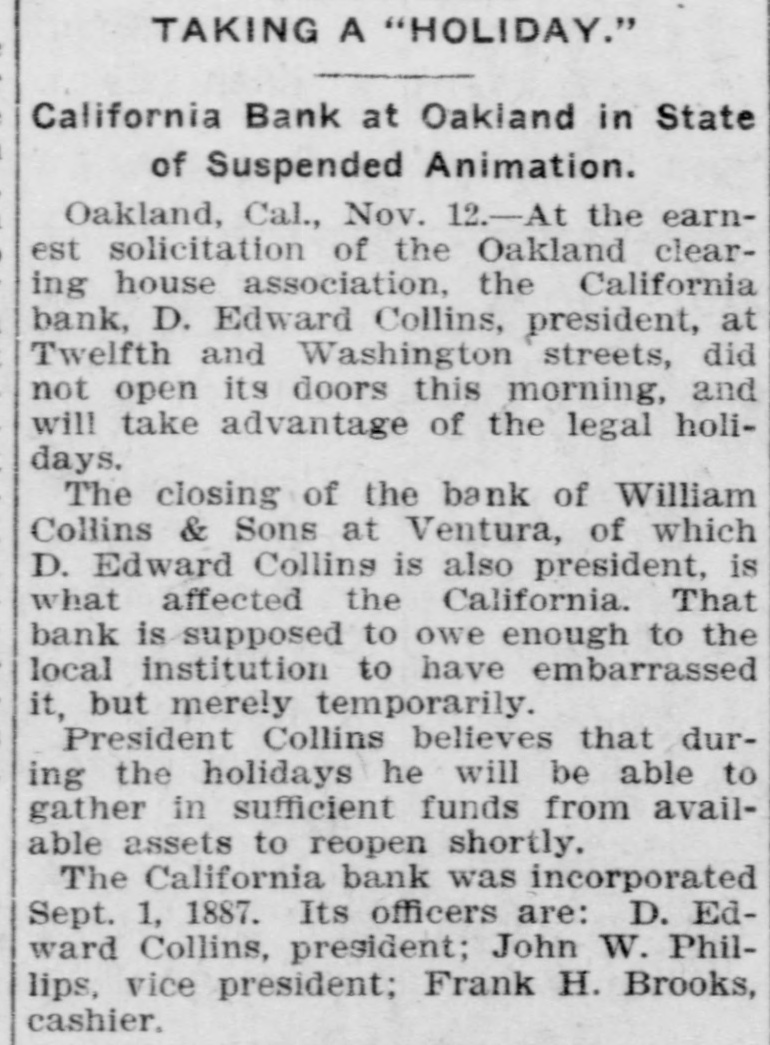
TAKING A "HOLIDAY." California Bank at Oakland in State of Suspended Animation. Oakland, Cal., Nov. 12.-At the earnest solicitation of the Oakland clearing house association, the California bank, D. Edward Collins, president, at Twelfth and Washington streets, did not open its doors this morning, and will take advantage of the legal holidays. The closing of the bank of William Collins & Sons at Ventura, of which D. Edward Collins is also president, is what affected the California. That bank is supposed to owe enough to the local institution to have embarrassed it, but merely temporarily. President Collins believes that during the holidays he will be able to gather in sufficient funds from available assets to reopen shortly. The California bank was incorporated Sept. 1, 1887. Its officers are: D. Edward Collins, president; John W. Phillips, vice president; Frank H. Brooks, cashier.


Article from Arizona Republican, November 13, 1907

Click image to open full size in new tab

Article Text

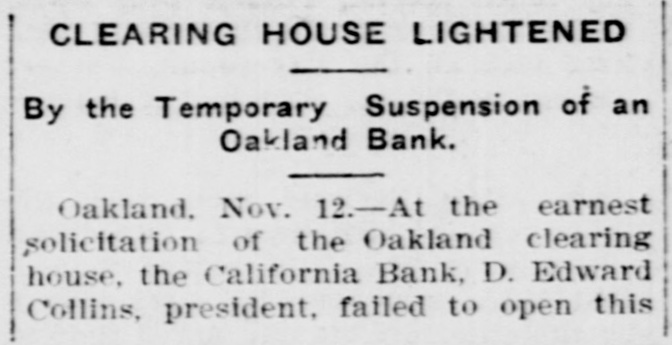
CLEARING HOUSE LIGHTENED By the Temporary Suspension of an Oakland Bank. Oakland, Nov. 12.-At the earnest solicitation of the Oakland clearing house, the California Bank, D. Edward Collins, president, failed to open this


Article from Wausau Pilot, November 19, 1907

Click image to open full size in new tab

Article Text

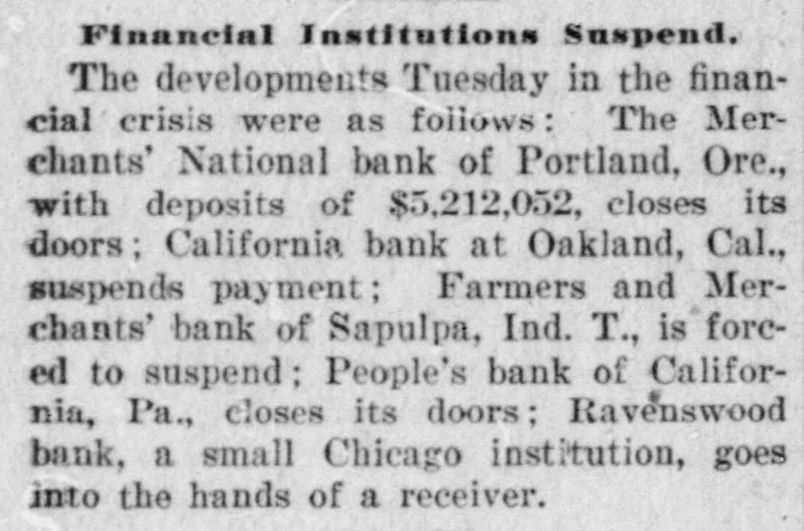
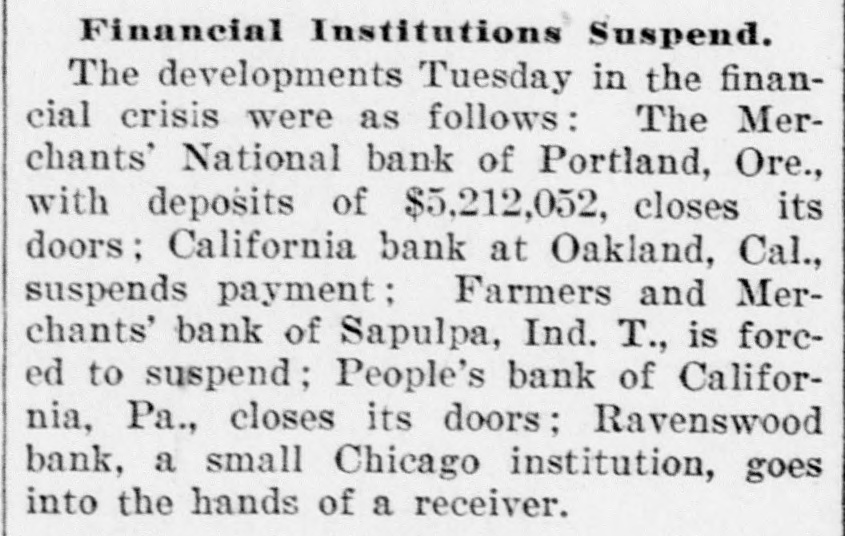
Financial Institutions Suspend. The developments Tuesday in the financial crisis were as follows: The Merchants' National bank of Portland, Ore., with deposits of $5,212,052, closes its doors; California bank at Oakland, Cal., suspends payment; Farmers and Merchants' bank of Sapulpa, Ind. T., is foreed to suspend; People's bank of California, Pa., closes its doors; Ravenswood bank, a small Chicago institution, goes into the hands of a receiver.


Article from River Falls Journal, November 21, 1907

Click image to open full size in new tab

Article Text

Missouri, committed Midland hotel in Kansas City, leaving no message to explain his action. There was no evidence that the affairs of the Bank of Albany were involved in the tragedy. Charles Tracy Barney, the deposed president of the Knickerbocker Trust Company of New York, and until recently a power in the financial world, shot and killed himself. The deed was attributed to despondency over the loss of his large fortune and high business standing. Bankers and merchants in session at Sioux City, Ia., adopted a system of grain checks which it was agreed should be accepted as currency. The Merchants National bank of Portland, Ore.; the California bank of Oakland, Cal.; the Farmers and Merchants bank of Sapulpa, I. T., and the Ravenswood Exchange bank in a Chicago suburb suspended. The Royal Motor Car company of Cleveland, O., and the Gary wholesale grocery house of Selma, Ala., went into the hands of receivers. Secretary Cortelyou made the announcement that as a means of affording relief to the financial situation the treasury would issue $50,000,000 of Panama bonds, and $100,000,000 certificates of indebtedness, or SO much thereof as may be necessary. The certificates will run for one year and will bear three per cent. interest. Prince Charles of Bourbon was married to Princess Louise of France at Wood Norton, England, in the presence of about 40 members of royal families. Charles H. Seitz. formerly general manager of the Michigan Telephone company at Detroit, died in Chicago from pneumonia. Mrs. Evelyn Romadka, the Milwaukee woman burglar, was sentenced to the Joliet penitentiary for an indeterminate period of from one to twenty years by Judge Brentano of Chicago on her plea of guilty to the charge of burglary. Louis H. Krehl, a young civil engineer on the Rock Island railroad, shot himself in the head at Topeka, Kan. The $22,000 worth of pay checks for the miners of the Carbon Coal & Coke company, which were lost from the stage that runs between Longsdale and Cokedale, Col., were found by boys and returned to the company. J. Ballin, a stock broker of Hamburg and a brother of Albert Ballin, director general of the Hamburg-American Steamship line, committed suicide. Alexander Fries, head of the firm of Alexander Fries & Bro., New York and Cincinnati, and one of the most eminent chemists of the country, died in Cincinnati. Harry Waters and his son Walter were struck by the fast mail train on the Vandalia and instantly killed at the village of Almeda, Ind. The safe in the post office at Seneca, S. C., was blown open and $800 in stamps and $200 in currency taken. The indorsement of William H. Taft for the presidency, and a demand for home rule were the salient features of the platform reported to the Alaskan Republican convention. William Willcox, former superintendent of the municipal lighting plant of Columbus, O., was found guilty by a jury on the charge of defrauding the city out of $1,170. A fatal wreck occurred on the Missouri River & Northwestern railroad between Mystic, S. D., and Rapid City. An extra engine and three cars, one filled with passengers, plunged into Rapid creek, where a bridge had burned. Fireman Martin was pinned under the engine and died. The fiscal year for the state of Ohio closed with a cash balance in the treasury of $5,081,850.95, an increase of $1,335,817 compared with the previous year, which was a recordbreaker for revenues. While running at the rate of 60 miles an hour, westbound train No. 13 on the Wabash road jumped the track near Dillon, Laporte county, Ind. Four passengers and three trainmen were seriously injured and scores of passengers slightly hurt. Gov. Vardaman of Mississippi was prevailed upon to take a ride in Baldwin's airship at Jackson, Miss. Ten feet above the ground was the limit and the trip was very short. John C. Jeans, a day laborer of Ludington, Mich., has been bequeathed $1,000,000 by his aunt, Anna T. Jeans of Philadelphia. William E. Shiebler, the telegraph operator who received the first message over the Atlantic cable, sent to President Buchanan by Queen Victoria, died in Brooklyn. One man was blown to pieces and property loss of $10,000 resulted when two tons of powder in the grinding and storage room of the plant of the Pittsburg Fulminite company, near Zelienople, Pa., exploded. Eight persons, nearly all trainmen, were killed in a Canadian Pacific wreck at Chalk river, near the Canadian Sault. The board of trustees of the Catholic University of America at a meeting in Washingt placed the


Article from Audubon Republican, November 21, 1907

Click image to open full size in new tab

Article Text

Missouri, committed suicide at the Midland hotel in Kansas City, leaving no message to explain his action. There was no evidence that the af fairs of the Bank of Albany were involved the tragedy. Charles Tracy Barney, the deposed president of the Knickerbocker Trust Company of New York, and until recently a power in the financial world, shot and killed himself. The deed was attributed to despondency over the loss of his large fortune and high business standing. Bankers and merchants in session at Sioux City, Ia., adopted a system of grain checks which it was agreed should be accepted as currency. The Merchants National bank of Portland, Ore.; the California bank of Oakland, Cal.: the Farmers and Merchants Ravens- the a "L I Sending, TO bank wood Exchange bank in a Chicago suburb suspended. The Royal Motor Car company of Cleveland, O., and the Gary wholesale grocery house of Selma, Ala., went into the hands of receivers. The Peoples bank of Portsmouth. Va., went into the hands of a receiver on petition of the directors, who gave out a statement that the bank has been made insolvent through defalcations of the cashier. Col. Garrett J. Lydecker, corps of engineers, in charge of river and harbor works at Detroit, was placed on the retired list on account of age, with the rank of brigadier general. Dora May French, poet and author, committed suicide at Carmel-by-theSea, Cal., by taking cyanide of potassium. The American Shipbuilding company decided to close down all its yards on the great lakes temporarily because of the financial stringency. The steam schooner Berkeley, in ballast, from San Pedro for San Francisco, was destroyed by fire about 15 miles off Gaviota, Cal. Capt. Higgins and the crew of 19 escaped from the burning vessel by the narrowest marshing Attorney General William H. Dixon, of Colorado, began an action under the common law in the Denver district court with a view to breaking up the so-called grocers' trust. Juliette Estelle Prescott Mathis, 68 years old, a writer of songs and verses. formerly a resident of Illinois, died Anseles. SOT u] The directors of the Jamestown exposition accepted a committee report favoring keeping the exposition open next year provided $200,000 can be raised by popular subscription. Ensign Ulmo, who was arrested at Toulon, charged with being a spy, confessed his guilt when confronted in court with the original of a telegram which he had filed at Toulon, addressed to an agent of a foreign power. Mrs. George Decker, of Toledo, O., was burned to death by an explosion of furniture polish. The peace conference of Central American delegates opened in Washington, Senor Luis Anderson, of Costa Rica, being president. The third Russian douma opened without disorder, the czar being cheered by the conservatives, who elected M. Khornyakoff president. Denver was selected as the meeting place of the national W. C. T. U. con19061 up vention The vacancy on the bench of the court of appeals of the District of Columbia, caused by the death of Judge McComas, was filled by the appointment of Josiah A. Van Orsdel, assistant attorney general in the department of justice. Through the editorial columns of The Commoner William Jennings Bryan declared he will not seek nor ask for the nomination for president, but if it is the desire of the rank and file of the party that he should have it, he would accept it cheerfully. Gov. George L. Sheldon, of Nebras ka, was notified that the executive mansion had been sold for the delinquent taxes of 1890. Merriment was caused at the trial of W. R. Hearst for criminal libel in New York when Raymond Hitchcock's former cook picked out Mr. Hearst instead of William Astor Chanler as the man whom she had seen at her employer's house with two little girls us penss! has said si 11 'edod eque order forbidding any Catholic priest to marry Miss Gladys Vanderbilt and Count Szechenyi. According to the Shipping Gazette of London, there is a strong probabil ty that the Salvation Army will soon own its own fleet of ocean steam ships. These will be used in connection with the army's scheme for pro moting Canadian immigration. Fire which is said to have started from a defective flue destroyed the main building of Monmouth college, Monmouth, III., causing a loss esti mated at nearly $40,000. Orval Dean a telephone lineman, lost his life by being buried under falling floors. A jury at Joliet, III., acquitted Rev B. F. Graff, a former Baptist minister who was accused of forgery in con


Article from The L'anse Sentinel, November 23, 1907

Click image to open full size in new tab

Article Text

Bankers and merchants in session of Sloux City, Ia., adopted a system agreed at checks which it was The should grain be accepted as currency. Portland, Merchants National bank of the California bank of Oakland, Ore.; the Farmers and Merchants RavensCal.; bank of Sapulpa, I. T., and the Chicago wood Exchange bank in a Motor suburb suspended. The Royal and the Car company of Cleveland, O., house of wholesale grocery hands of Gary Selma, Ala., went into the receivers. leading New York banks were meet exerting The themselves actively to corredemands of their country currency. the spondents and depositors for suggestions They declared that the sources from several western legitimate made they were not meeting west demands that for currency from the that entirely unfounded and taking were were, on the contrary, aid the every they practicable measure to west and south. first direct reports from Kara- the The of the great earthquake at the vicscene Russian Turkestan, say the city tagh, number about 14,000; and tims many villages were destroyed. The Peoples bank of Portsmouth, receiver went into the hands of a gave Va., petition of the directors, bank who has on statement that the defalcaout been a made insolvent through tions of the cashier. Photographs and official data the repa summer's work of in- in resenting ternational boundary commission capAlaska were lost when a canoe sized in the Bradfield river. was proposed in the Michigan to inIt constitutional convention obligastate an article making voting sentence sert tory, with a fine and prison as penalties. Senator Haines' bank of doors ForState Grove, Ore., did not open its obest business because it could not for its balances from the Merchants susNational tain Bank of Portland, which pended payment. total equalized assessment of in The property, lands, and lots personal Illinois for the year 1907 aggregates by $1,138,622,398, according to reports of committees of the state board equalization. Checks and currency to the amount $22,000, intended to pay the wages of of the Carbon Coal & Coke company's lost miners at Cokedale, Col., were stage. or stolen while in transit in a Former Gov. James E. Campbell, of said that he is a receptive can- to didate Ohio, for United States senator succeed Senator J. B. Foraker. Kansas City, Mo., the grand jury returned At 149 additional indictments violatagainst persons charged with labor ing the state law which forbids Sunday. on boiler at the ginhouse on the Trulock .A plantation, near Pine Bluff, J. B. Ark., exploded killing the owner, Trulock, and five negroes. The confession of Steve Adams, of in the office of the warden made the Idaho state penitentiary February 1906, was introduced in evidence murder 27, the trial of Adams for the murder It told of and Boule and of at of Fred Tyler Tyler. Pettibone. the involved Moyer, Haywood and The engine and tender of a Balti- at& Ohio train to which was Vice more tached a private car bearing President Fairbanks and a party returning from the funeral of Judge McComas was derailed at Weverton Junction, Md. Immediately following the closing Pa., bank of Examiner Bynns, L. P. of by the State Peoples California, Oliver Piper, the cashier, and William Lenhart, a business man who lives in Brownsville, Pa., were arrested, charged with conspiracy to defraud the bank. A report reached Durango, Col., that occurred at McElmo canyon, a Ute Indians and between battle Indians United States troops, in which six killed were killed. No soldiers were or wounded. in the basement of the new dormitory at East wich I.) academy Eastman A boiler (R. exploded Green- Three and partly wrecked the structure. young women students were severely but not seriously injured. hall of St. at King Windsor In the historic Castle, Edward George and Queen Alexandra gave a state banquet in honor of the emperor and empress of Germany and their suite. A state convention of Democrats at Nashville, Tenn., started a movement for the nomination of a southern man as Democratic candidate for the presidency in 1908. Ray Bricker fell 115 feet down a mine near Boone, Ia., landed on his feet and was unhurt. Asserting that the cold weather has caused untold suffering on account of of the scarcity of coal, the residents Somerset, Neb., appealed to the state railway commission for relief. Charles Howard, 60 years old, a convict in the Jollet penitentiary, made his escape while working in the stone quarry. Six nersons were injured when


Article from The Greenville Journal, January 2, 1908

Click image to open full size in new tab

Article Text

FINANCIAL to Jan. 21-Merchants' and Farmers' bank of Fairmont, Minn., suspended. Feb. 2-F. D. Gilman, former president suspended Home bank of Goodland, Ind., found guiltv of embezzlement. 4-First National bank of Scotland, S. D., close by bank examiner. 8-F. D. Gilman, Indiana banker. sentenced to term of one to three years in state prison. 25-Disappearance of $173,000 from subtreasury at Chicago made public. Mar. 14-Virtual panic in Wall street; Secretary Cortelyou relieved the situation. 19-Citizens' State bank of Firth, Neb., closed by state. 28-Corbin Banking company of New York, assigned; assets, $3,000,000; liabilities, $1,700,000. Apr. 2-Maj. H. W. Salmon of Warsaw, Mo., convicted of illegal banking, sentenced three years in penitentiary. 11-Bank of Conception, at Clyde, Mo., ordered closed. 19-Ex-Judge Smith of Chicago, found guilty of conspiring to defraud stockholders and depositors of Bank of America, of which he was president; penalty, imprisonment and $1,000 fine. Jul. 1-Citizens' bank of Eureka Springs, Ark., suspended. 2-First National bank of Hicksville, O., closed by comptroller of currency. 5-Fort Dallas National bank of Miami, Fla., closed. 20--Farmers' National bank of Boyertown, Pa., ordered closed. Aug. 3-People's State bank of Brownstown, Ind., closed by state authorities. it-Receivers appointed for Pope Mfg. Co., of Hartford, Conn.: failure ascribed to stringency of money market. Sep. -Watson & Co., members of New York stock and produce exchanges and of Chicago board of trade, failed. Oct. 9-Union bank of Richland, and Bowman bank of Kalamazoo, Mich., both private institutions, closed doors. 10-H. D. Reynolds' bank of Valdez, Alaska, closed doors. 15-First National bank of Dresden, O., failed. 16-Collapse of Heinze corner in copper caused violent slump in stocks in New York; firm of Otto Heinze & Co., suspended from stock exchange. 19-New York clearing house committee declared that the Heinze, Morse and Thomas interests had been eliminated from banking organizations of New York. 22-Knickerbocker Trust Co., New York's second largest financial institution, forced to suspend; great slump in securities; call money at 70 per cent. 23-Secretary of treasury ordered deposit of $25,000,000 of government funds in New York banks Four Westinghouse companies at Pittsburg and one trust company forced into hands of receivers because of financial stringency State Bank and Trust Co., of Carson, Nevada, failed. 24-Three minor banks in New York forced to close Southern Steel Co., of Birmingham, Ala., filed involuntary petition in bankruptcy. 25-Six more minor banking institutions in New York closed doors. Union Trust Co., of Providence, R. I., suspended. 26-Banks in New York and Chicago, and many other cities adopted clearing house loan certificate system to prevent draining of supplies of currency and made withdrawal of savings deposits subject to legal notice. 30-California Safe Deposit & Trust Co. bank, at San Francisco, closed Financial conditions in New York practically normal again. Nov. 4-Three small banks in Kansas closed United States Steel corporation secured controlling interest in Tennessee Coal & Iron Co. 6-Receiver appointed for Arnold Print works of North Adams, Mass., one of largest textile concerns in country. 12-Merchants' National bank of Portland, Ore., California bank of Oakland, Cal., and Farmers' & Merchants' bank of Sapulpa, I. T., suspended. 18-Secretary of Treasury Cortelyou ordered issue of $50,000,000 of Panama bonds and $100,000,000 certificates of in'debtedness as means of relieving financial situation City National bank of Frederick, Okla., failed. 27-American Silk Co. capital stock, $11,000,000, which operated mills in several cities, placed in hands of receiver. Dec. 2-Chelsea Savings abnk of Chelsea, Mich., owned by State Treasurer Glazier, closed. 5-National Bank of Commerce, one of largest financial institutions of Kansas City, suspended. 6-Fort Pitt National bank of Pittsburg, closed. 17-Jewelers' National bank at North Attleboro, Mass., in hands of receiver.
Article from River Falls Journal, January 2, 1908

Click image to open full size in new tab

Article Text

FINANCIAL Jan. 21-Merchants' and Farmers' bank of Fairmont, Minn., suspended. Feb. 2-F. D. Gilman, former president suspended Home bank of Goodland, Ind., found guiltv of embezzlement. 4-First National bank of Scotland, S. D., close by bank examiner. 8-F. D. Gilman, Indiana banker, sentenced to term of one to three years in state prison. 25-Disappearance of $173,000 from subtreasury at Chicago made public. Mar. 14-Virtual panic in Wall street; Secretary Cortelyou relieved the situation. 19-Citizens' State bank of Firth, Neb., closed by state. 28-Corbin Banking company of New York, assigned; assets, $3,000,000; liabilities, $1,700,000. Apr. 2-Maj. H. W. Salmon of Warsaw, Mo., convicted of illegal banking, sentenced three years in penitentiary. 11-Bank of Conception, at Clyde, Mo., ordered closed. 19-Ex-Judge Smith of Chicago, found guilty of conspiring to defraud stockholders and depositors of Bank of America, of which he was president; penalty, imprisonment and $1,000 fine. Jul. 1-Citizens' bank of Eureka Springs, Ark., suspended. 2-First National bank of Hicksville, O., closed by comptroller of currency 5-Fort Dallas National bank of Miami, Fla., closed. 20-Farmers' National bank of Boyertown, Pa., ordered closed. Aug. 3-People's State bank of Brownstown, Ind., closed by state authorities. 14-Receivers appointed for Pope Mfg. Co., of Hartford, Conn.; failure ascribed to stringency of money market. Sep. 5-Watson & Co., members of New York stock and produce exchanges and of Chicago board of trade, failed. Oct. 9-Union bank of Richland, and Bowman bank of Kalamazoo, Mich., both private institutions, closed doors. 10-H. D. Reynolds' bank of Valdez, Alaska, closed doors. 15-First National bank of Dresden, O., failed. 16-Collapse of Heinze corner in copper caused violent slump in stocks in New York; firm of Otto Heinze & Co., suspended from stock exchange. 19-New York clearing house committee declared that the Heinze, Morse and Thomas interests had been eliminated from banking organizations of New York. 22-Knickerbocker Trust Co., New York's second largest financial institution, forced to suspend; great slump in securities; call money at 70 per cent. 23-Secretary of treasury ordered deposit of $25,000,000 of government funds in New York banks Four Westinghouse companies at Pittsburg and one trust company forced into hands of receivers because of financial stringency State Bank and Trust Co., of Carson, Nevada, failed. 24-Three minor banks in New York forced to close Southern Steel Co., of Birmingham, Ala., filed involuntary petition in bankruptcy. 25-Six more minor banking institutions in New York closed doors Union Trust Co., of Providence, R. 1., suspended. 26-Banks in New York and Chicago, and many other cities adopted clearing house loan certificate system to prevent draining of supplies of currency and made withdrawal of savings deposits subject to legal notice. 20-California Safe Deposit & Trust Co. bank, at San Francisco, closed. Financial conditions in New York practically normal again. Nov. 4-Three small banks in Kansas closed. United States Steel corporation secured controlling interest in Tennessee Coal & Iron Co. 6-Receiver appointed for Arnold Print works of North Adams, Mass., one of largest textile concerns in country. 12-Merchants' National bank of Portland, Ore., California bank of Oakland, Cal., and Farmers' & Merchants' bank of Sapulpa, I. T., suspended. 18--Secretary of Treasury Cortelyou ordered issue of $50,000,000 of Panama bonds and $100,000,000 certificates of indebtedness as means of relieving financial situation City National bank of Frederick, Okla., failed. 27-American Silk Co. capital stock, $11,000,000, which operated mills in several cities, placed in hands of receiver Dec. 2-Chelsea Savings abnk of Chelsea. Mich., owned by State Treasurer Glazier, closed. 5-National Bank of Commerce, one of largest financial institutions of Kansas City, suspended. 6-Fort Pitt National bank of Pittsburg, closed. 17-Jewelers' National bank at North Attleboro. Mass. in hands of receiver


Article from The Ely Miner, January 3, 1908

Click image to open full size in new tab

Article Text

Jan. 21-Merchants' and Farmers' bank of Fairmont, Minn., suspended. Feb. 2-F. D. Gilman, former president suspended Home bank of Goodland, Ind., found guilty of embezzlement. 8-F. D. Gilman, Indiana banker, sentenced to term of one to three years in state prison. -Disappearance of $173,000 from subtreasury at Chicago made public. Mar. 14-Virtual panic in Wall street; Secretary Cortelyou relieved the situation. 19-Citizens' State bank of Firth, Neb., closed by state. 28-Corbin Banking company of New York, assigned; assets, $3,000,000; liabilities, $1,700,000. Apr. 2-Maj. H. W. Salmon of Warsaw, Mo., convicted of illegal banking, sentenced three years in penitentiary. 11-Bank of Conception, at Clyde, Mo., ordered closed. 19-Ex-Judge Smith of Chicago, found guilty of conspiring to defraud stockholders and depositors of Bank of America, of which he was president; penalty, imprisonment and $1,000 fine. Jul. 1-Citizens' bank of Eureka Springs, Ark., suspended. 5-Fort Dallas National bank of Miami, Fla., closed. 20-Farmers' National bank of Boyertown, Pa., ordered closed. Aug. 3-People's State bank of Brownstown, Ind., closed by state authorities. It-Receivers appointed for Pope Mfg. Co., of Hartford, Conn.; failure ascribed to stringency of money market. Sep. 5-Watson & Co., members of New York stock and produce exchanges and of Chicago board of trade, failed. Oct. 9-Union bank of Richland, and Bowman bank of Kalamazoo, Mich., both private institutions, closed doors. 16-Collapse of Heinze corner in copper caused violent slump- in stocks in New York: firm of Otto Heinze & Co., suspended from stock exchange. 19-New York clearing house committee declared that the Heinze, Morse and Thomas interests had been eliminated from banking organizations of New York. 22-Knickerbocker Trust Co., New York's second largest financial institution, forced to suspend; great slump in securities; call money at 70 per cent. -Secretary of treasury ordered deposit of $25,000,000 of government funds in New York banks Four Westinghouse companies at Pittsburg and one trust company forced into hands of receivers because of financial stringency State Bank and Trust Co., of Carson, Nevada, failed. 24-Three minor banks in New York forced to close Southern Steel Co., of Birmingham, Ala., filed involuntary petition in bankruptcy. 25-Six more minor banking institutions in New York closed doors Union Trust Co. of Providence, R. I., suspended. 26-Banks in New York and Chicago, and many other cities adopted clearing house loan certificate system to prevent draining of supplies of currency and made withdrawal of savings deposits subject to legal notice. 30-California Safe Deposit & Trust Co. Finanbank, at San Francisco, closed cial corditions in New York practically normal again. Nov. 4- Three small banks in Kansas closed United States Steel corporation secured controlling interest in Tennessee Coal & Iron Co. 6-Receiver appointed for Arnold Print works of North Adams, Mass., one of largest textile concerns in country. 12-Merchants' National bank of Portland, Ore., California bank of Oakland, Cal., and Farmers' & Merchants' bank of Sapulpa, I. T., suspended. 18-Secretary of Treasury Cortelyou ordered issue of $50,000,000 of Panama bonds and $100,000,000 certificates of indebtedness as means of relieving financlal situation City National bank of Frederick, Okla., failed. 27-American Silk Co. capital stock, $11,000,000, which operated mills in several cities, placed in hands of receiver. Dec. 2-Chelsea Savings abnk of Chelsea, Mich., owned by State Treasurer Glazier, closed. 5-National Bank of Commerce, one of largest financial institutions of Kansas City. suspended. 6-Fort Pitt National bank of Pittsburg, closed. 17-Jewelers' National bank at North Attleboro, Mass., in hands of receiver.

Article from The Spanish Fork Press, January 9, 1908

Click image to open full size in new tab

Article Text

FINANCIAL Jan. 21-Merchants' and Farmers' bank of Fairmont, Minn., suspended. Feb. 2-F. D. Gilman, former president suspended Home bank of Goodland, Ind., found guilty of embezzlement. 8-F. D. Gilman, Indiana banker. sentenced to term of one to three years in state prison. -Disappearance of $173,000 from subtreasury at Chicago made public. Mar. 14-Virtual panic in Wall street: Secretary Cortelyou relieved the situation. 19-Citizens' State bank of Firth, Neb., closed by state. 28-Corbin Banking company of New York, assigned; assets, $3,000,000; liabilities, $1,700,000. Apr. 2-Maj. H. W. Salmon of Warsaw, Mo., convicted of illegal banking, sentenced three years in penitentiary. 11-Bank of Conception, at Clyde, Mo., ordered closed. 19-Ex-Judge Smith of Chicago, found guilty of conspiring to defraud stockholders and depositors of Bank of America, of which he was president; penalty, imprisonment and $1,000 fine. Jul. 1-Citizens' bank of Eureka Springs, Ark., suspended. 5-Fort Dallas National bank of Miami, Fla., closed. 20-Farmers' National bank of Boyertown, Pa., ordered closed. Aug. 3-People's State bank of Brownstown, Ind., closed by state authorities. M-Receivers appointed for Pope Mfg. Co., of Hartford, Conn.: failure ascribed to stringency of money market. Sep. 5-Watson & Co., members of New York stock and produce exchanges and of Chicago board of trade, failed. Oct. 9-Union bank of Richland, and Bowman bank of Kalamazoo, Mich., both private Institutions, closed doors. 16-Collapse of Heinze corner in copper caused violent slump in stocks in New York: firm of Otto Heinze & Co., suspended from stock exchange. 19-New York clearing house committee declared that the Heinze, Morse and Thomas interests had been eliminated from banking organizations of New York. 22-Knickerbocker Trust Co., New York's second largest financial institution, forced to suspend; great slump in securities: call money at 70 per cent. 23-Secretary of treasury ordered deposit of $25,000,000 of government funds in New York banks. Four Westinghouse companies at Pittsburg and one trust company forced into hands of receivers because of financial stringency State Bank and Trust Co., of Carson, Nevada, failed. M-Three minor banks in New York forced to close Southern Steel Co., of Birmingham, Ala., filed involuntary petition in bankruptcy. 25-Six more minor banking institutions in New York closed doors. Union Trust Co., of Providence, R. I., suspended. Banks in New York and Chicago, and many other cities adopted clearing house loan certificate system to prevent draining of supplies of currency and made withdrawal of savings deposits subject to legal notice. $0-California Safe Deposit & Trust Co. bank, at San Francisco, closed Financial conditions in New York practically normal again. Nov. 4-Three small banks in Kansas closed United States Steel corporation secured controlling Interest in Tennessee Coal & Iron Co. -Receiver appointed for Arnold Print works of North Adams, Mass., one of largest textile concerns in country. 12-Merchants' National bank of Portland, Ore., California bank of Oakland, Cal. and Farmers' & Merchants' bank of Bapulpa, I.T., suspended. as Secretary of Treasury Cortelyou ordered issue of $50,000,000 of Panama bonds and $100,000,000 certificates of indebtedness as means of relieving financial situation City National bank of Frederick, Okla., failed. 17-American Silk Co. capital stock, $11,000,000, which operated mills in several cities, placed in hands of receiver. Dec. Chelsea Savings abnk of Chelsea, Mich., owned by State Treasurer Glazier, closed. -National Bank of Commerce, one of largest financial institutions of Kansas City, suspended. Fort Pitt National bank of Pittsburg, closed. l7-Jewelers' National bank at North Attleboro, Mass., in hands of receiver.


Article from Tonopah Daily Bonanza, January 18, 1908

Click image to open full size in new tab

Article Text

Receivers Are Put In Charge of Two Banks (By Associated Press.) (By Associated Press.) OAKLAND, Jan. 17.-Judge HarBELLINGHAM, Wash., Jan. 17. ris of the Superior Court today apGeorge Montford was today appointpointed James P. Edoff receiver for ed temporary receiver for the Exthe California Bank, which suspendchange State Bank of Blaine, which ed during the recent financial flurry. Edoff is vice-president of the Oakclosed its doors January 15th. The land Stock and Bond Exchange, and affairs of this bank are alleged to be is a large stockholder in the Oakland in a hopeless tangle and the instituSavings Bank. He was the candidate tion is practically without funds. of the depositors' committee. Edoff Cashier O. C. Mathis disappeared the has been ordered to report to Judge day before the bank suspended and Harris every six weeks. His bonds his whereabouts are not yet known. were fixed at $300,00v.


Article from The San Francisco Call, January 20, 1908

Click image to open full size in new tab

Article Text

Denounces Alameda's Courthouse Ring Rev. Charles R. Brown Predicts Early Downfall of Clique of Grafters OAKLAND, Jan. 19.-In a denunciation of the county courthouse gang tonight Rev. Charles R. Brown, pastor of the First Congregational church and one of the most prominent divines on the Pacific coast, excoriated the methods of the politicians who dominate the county government and predicted the early downfall of the entire crew of parasitical wasters of the people's money. Rev. Mr. Brown said that the condition of county administrative affairs was rotten; that for years this had been known. He disclosed the attempt of the political ring to obtain control 02 the receivership of the California bank and its failure to accomplish this purpose. His scorching remarks were delivered in the course of a sermon on the theme "The Call to Wider Service." Concerning county governmental affairs he said: "For years it has been well known that the condition of the county government would smell to heaven if the lid were taken off. Recently, when it became known that a receiver would be appointed for the California bank, the politicians exerted every effort. to have one of their kind appointed. Their dirty paws itched to get control of that institution and to administer its affairs. "It might have been well had they succeeded, for if they had the depositors of that bank and the depositors of every other bank here would have risen the sooner and pitched out the entire elique, as inevitably it will be pitched out. A clean, capable man was appointed receiver in spite of the efforts of the ring, one who will brook no interference from the county government ring or from any ring that would prevent the proper administration of the affairs of the bank: Any such attempt would be answered with language that might not look well, but which would be beautifully appropriate and which even those people could not fail to understand as decisive and final." He said that he was a depositor in the California bank, along with what he termed "3,000 other unfortunates." The inference from the clergyman's remarks was that he had been advised of the attempt to put a courthouse politician in the receivership. Rev. Mr. Brown urged his hearers to combat graft, greed and selfishness in any form in which they might be presented. The large church auditorium was crowded and the pastor's straight from the shoulder utterances caused a perceptible stir in the congregation.


Article from The San Francisco Call, March 6, 1908

Click image to open full size in new tab

Article Text

WOULD RAISE BANK COMMISSION'S PAY Financiers Suggest $10,000 a Year as Lowest Price for Competent Examiners Divorce State Board From Pol= itics Proviso Insisted Upon for Greater Safety "Have for bank commissioners the same character of men as are bank directors; pay them $10,000 a year salary. The banks, which now pay the expenses of the bank commission, would be glad to meet the increased cost, owing to the guarantee of increased protection," was the recommendation John D. McKee, vice president and cashier of the Mercantile trust company, made to the legislative investigation committee yesterday. "Have a competent examiner as the head of the commission," I. W. Hellman Jr., vice president and general manager of the Union trust company, added. "Let the salary of the head of the commission be $10.000 a year or more. Divide the state into districts, paying the head man in each district, say, $6,000 a year. Have the district heads familiar with their district's condition. Take the appointments out of politics, though still leaving it in the hands of the governor." Senators Leavitt and Wolfe and other members of the committee assented to portions of the recommendations of McKee and Hellman, and it is probable that the committee will incorporate regulations for the change of the bank commission system in the report it will submit to the legislature. Leavitt introduced a lengthy discussion of the radical sections of the banking laws of Oklahoma, whereby banks are assessed 1 per cent of their daily average deposits for the purpose of creating a depositors' guaranty fund. In case a bank fails the state takes control of its assets, reimburses depositors out of those assets and meets any deficiency by drawing on the guaranty fund, which, in turn, is reimbursed by levying on the stock holders of the concern. But that suggestion did not find favor with the bankers present The legislators had invited representatives of trust companies to a conference yesterday morning. With Hellman and McKee there were present William G. Irwin, president of the Mercantile trust company, and B. C. Tognazzi, manager of the Central trust company. In outlining the scope of a trust company's activities, McKee said that there was not enough business of a purely trust nature in California for such a concern to thrive on, so they had to do a general banking business. Hellman agreed with that view, and recommended that laws be passed prohibiting trust companies from mingling their trust and their banking businesses. He said that to properly examine a trust company should take 30 days, instead of the one or two days the bank commissioners are able to devote to each institution. He spoke of the danger of a trust company making insecure investments, and spoke favorably of the system in eastern states whereby securities are classified by the bank commissioners In discussing the Oklahoma laws. Senator Curtin thought that they would tend to give the public confidence in the banks and prevent hoarding. Hellman feared that by insuring depositors the state would tempt them to deposit their funds in the banks making the most alluring inducements. Leavitt pointed out that the Oklahoma laws made misuse of bank funds by a bank officer a serious offense, and declared that the drastic laws would guard the state from the evils of wildcat banking, which Hellman feared. A post mortem will be held this morning over the California bank of Oakland, James Edoff, the receiver. having been invited to describe .the failure of that institution, so that the legislators, by a study of bad methods, may obtain ideas for remedial laws.


Article from New-York Tribune, March 29, 1908

Click image to open full size in new tab

Article Text

ON THE PACIFIC SLOPE. San Francisco Police Fear Japanese= Corean Feud. [By Telegraph to The Tribune.) San Francisco. March 28.-The assassination of D. W. Stevens created great excitement in the Japanese and Corean colonies here. The Japanese affect to believe that it was designed to include Consul General Kolke among the victims, but there seems to be no evidence of this. Cheung. who did the shooting, was only a few feet away from Stevens. but he was so poor a marksman that he missed three out of five shots. He could have killed Koike easily. but his purpose seemed to be only to kill Stevens. The Coreans here are largely adventurers who have come to this city by way of Hawait They do not learn English as quickly as the Japanese, but in habits and appearance it is almost impossible to tell the two races apart. Most of the Coreans here belong to a revolutionist society and all are extremely bitter against the Japanese, who. they assert. are stamping out all liberty in their country. They declare that private letters give details of many shocking tragedies in Corea. due to Japanese cruelty, which are suppressed by the dominant race. So bitter is the feeling here that the police fear that reprisals will be made and a bloody feud begun. The trouble at Leland Stanford Junior University which has resulted in the departure of many students and the complete ruin of athletic events during the semester is largely due to the selection of unpopular professors to carry out the rules governing the college campus. The method of the old student affairs committee in cases of intemperance was to warn privately students who were known to be drinking. The new rules affected all the students. but they probably would not have aroused opposition had it not been for the appointment of Professor Clark. a radical Prohibitionist, as head of the new committee. It was a demonstration largely against his appointment that led to the trouble. The reception to D. O. Mills. of New York, who is one of the famous California pioneers, by the Chamber of Commerce on Wednesday was a noteworthy affair. More than two hundred and fifty leading citizens gathered to pay their respects to Mr. Mills. who made a short speech in which he praised highly the courage and energy shown in rebuilding the city. He warned the merchants however, that there can be no lasting success without strict integrity and fair play between capital and labor, which means the open shop. Mr Mills declares that any government that does not secure this is a false pretence, not worth what it costs. The new $500,000 state building to accommodate the Supreme and Appellate courts, the Attorney General. Bank and Insurance Commission and other officials will be erected on the northeast corner of Polk and Fulton streets, directly opposite the City Hall. A corner lot. 120 by 100 feet. was purchased this week for $72,000. The Supervisors finally voted $7,400 this week for tearing down the dome of the City Hall, which has been an eyesore ever since the disaster. The dome was of steel, but defects in the foundation would have rendered reconstruction extremely costly. Mrs. Ida Brown. of this city, has lost a legacy of $5.000 because rats chewed off the signature to the will of John Arrowsmith which bequeathed her that amount for nursing him during his last years. Arrowsmith left a brother in Massachusetts, who will inherit his estate of $20,000. Among the deaths of the week was that of Brigadier General Elisha I. Baily, U. S. A. (retired), at the Presidio General Hospital. General Baily was attached to the medical department and was retired twenty years ago. The Alaska Packets' Association has decided to pay union wages to fishermen, the same that were paid last year. About three thousand fishermen were involved. and a general strike would have been called had not the packers' association agreed to their terms. The receiver of the California Bank of Oakland has asked permission to declare a dividend of 10 per cent. or $99,131. He has also begun proceedings against several creditors of the bank Complaints of the ruthless cutting of live trees in the California redwood park in Santa Clara County led to an investigation recently. which shows that State Forester Lull appointed a warden of park who marked certain redwoods as dead when they were really alive. These trees were scarred by fire. but they were not materially injured. as redwood endures much fire without damage. What irritated the friends of the park was that after making roads at much expense to the state lumberment should be allowed to cut many of the finest trees along these roads. under the plea that they had been marked dead or unsightly. Two indictments have been found against Jackson Hatch, of San Jose. formerly one of the most


Article from The San Francisco Call, April 22, 1908

Click image to open full size in new tab

Article Text

BLAMES DIRECTORS FOR BANK FAILURE Receiver for California of Oak= land Declares Board Was Not Advisory Body Failure on the part of the board of directors of the California bank of Oakland to conduct the bank along conservative lines and the fact that the directors never acted in the capacity of an advising body are said by J. P. Edhoff, receiver for the defunct bank, to have caused the closing of the institution. Edhoff's testimony was taken yesterday morning by the state legislative committee appointed to inquire generally into banking methods at a meeting held by that body in the rooms of the harbor commissioners in the ferry building. D. Edward Collins, former president of the defunct bank, according to Edboff, had only a superficial knowledge of the science of banking. Many of the loans he made were made irrespective of the loaning capacity of the bank. Many loans of large sums were made to the president of the bank and corporations with which he was actively connected. D. Edward Collins, according to Edhoff, was also too much interested in the welfare of religious organizations and too little interested in his depositors. On one occasion Edhoff claims a loan of several thousand dollars was made to the Oakland Young Men's Christian association, the only security taken by Collins being an oil painting. Edhoff was unable to post the legislative committee on the value of the painting referred to, but he declared it was not a Van Dyke and said it was striking testimony of the loose method in which the bank was conducted.


Article from The San Francisco Call, May 23, 1908

Click image to open full size in new tab

Article Text

EDOFF SOON TO PAY THIRD INSTALLMENT OAKLAND, May 22.-The third dividend paid by Receiver James P. Edoff to creditors of the defunct California bank will be ready some time in June, according to announcement which he made in Judge Harris' court today. The amount will be close to $100,000. or about 10 per cent on the total liabilities. Edoff said that he was making rapid progress with his accounts. and, that the tangled affairs of the institution might be wound up soon. He has asked Superior Judge Harris to set aside an agreement made by the directors of the bank with the debtor Ventura bank. whereby a claim of $171,000 against the Ventura bank was wiped out for a trifing amount. Edoff said that the claims against the Ventura bank could be made to yield a respectable sum of money If liquidated in the ordinary manner, as that bank is also insolvent.


Article from Los Angeles Herald, June 13, 1908

Click image to open full size in new tab

Article Text

OAKLAND BANK WANTS ITS SHARE OF VENTURA MONEY A petition for a writ of prohibition to prevent any further steps being taken in the receivership proceedings of the Ventura bank, which recently went into the hands of a receiver, has been filed by James P. Edoff, receiver for the California bank of Oakland. Mr. Edoff claims the Oakland bank has been discriminated against in the proposed distribution of a dividend by the Ventura institution. An order was issued yesterday by the appellate court directing Judge Ewing of the Ventura county superior court and other interested parties to appear June 22 and show why a permanent restraining order should not be made enjoining them from all further action in the case.


Article from The San Francisco Call, May 6, 1909

Click image to open full size in new tab

Article Text

FIFTY PER CENT HAS BEEN RECEIVED BY DEPOSITORS Affairs of California Bank May Be Wound Up by 1911 OAKLAND, May 5.-Depositors and creditors of the defunct California bank have received 50 per cent of their claims, according to the fifteenth report of Receiver James P. Edoff, filed with the superior court today. The report showed that liabilities had been reduced by $47,017.32 during the month of April, making a total reduction of $584,943.87 since Edoff's appointment. He estimated that the total payments would amount to 75 or 80 per cent of the liabilities and that the affairs of the bank might be wound up by 1911.


Article from The San Francisco Call, March 5, 1910

Click image to open full size in new tab

Article Text

Suburban Brevities DDD FELLOWS BANQUET-Oakland. March 4. Golden Rule encampment, I. O. O. F.. of this city celebrated the fortietb anniversary of its organization with a banquet tonight to memhers of Unity encampment of San Francisco. $TRUCK BY CAR -Oakland, March 4.-James Chulos of 1715 Goss street, driver of a bakery wagon. was struck by an electric ear in Tweifth street this morning and badly bruised. PARISH TO ENTERTAIN - -Berkeley, March 4. Members of the new St. Ambrose parish of West Berkeley and Albany plan a social entertainment for St. Patrick's day. HEADS ABSTRACT COMPANY-Oakland, - March 4.-James P. Edoff, receiver of the defunct California bank. was elected president of the Oakland title and abstract company today. INSTALLING BLOCK SYSTEM-Alameda. March 4. -The Oakland traction company is installing a block system on its San Jose avenue line west of Park street. WOMEN WILL SPEAK-Alameda, March 4.Women speakers from the Adeipbian club will address the pupils of the Various public schools at the arbor day exercises to be held next Monday morning. WILL TRY SWITCHBACK Oakland, March 4. Representatives of the Oakland traction company notified the city council last night that the company would experiment with a switchback in Broadway near the business center, rather than put in the suggested loop along Eighth. Franklin and Ninth streets, to relieve the congestion of traffic at Broadway and Seventh street.


Article from The San Francisco Call, March 20, 1910

Click image to open full size in new tab

Article Text

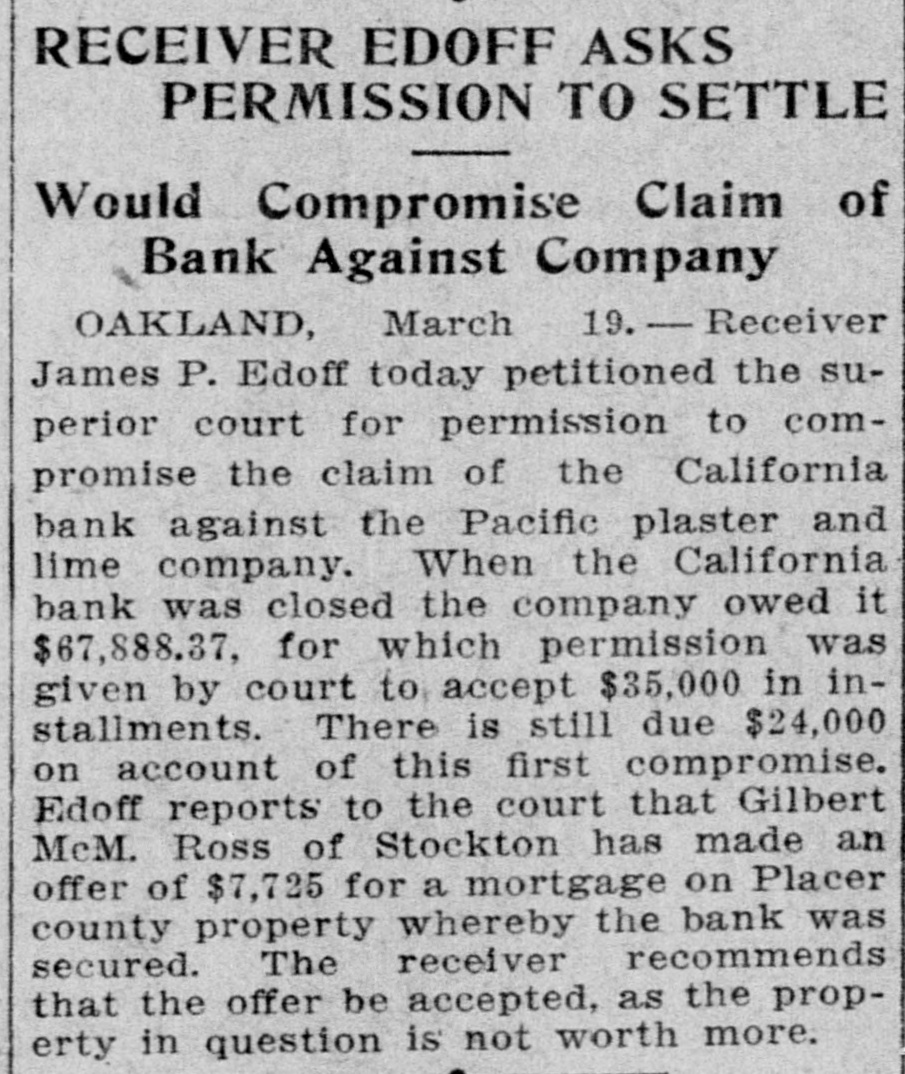
RECEIVER EDOFF ASKS PERMISSION TO SETTLE Would Compromise Claim of Bank Against Company OAKLAND, March 19. - Receiver James P. Edoff today petitioned the superior court for permission to compromise the claim of the California bank against the Pacific plaster and lime company. When the California bank was closed the company owed it $67,888.37, for which permission was given by court to accept $35,000 in installments. There is still due $24,000 on account of this first compromise. Edoff reports to the court that Gilbert McM. Ross of Stockton has made an offer of $7,725 for a mortgage on Placer county property whereby the bank was secured. The receiver recommends that the offer be accepted, as the property in question is not worth more.


Article from The San Francisco Call, April 6, 1910

Click image to open full size in new tab

Article Text

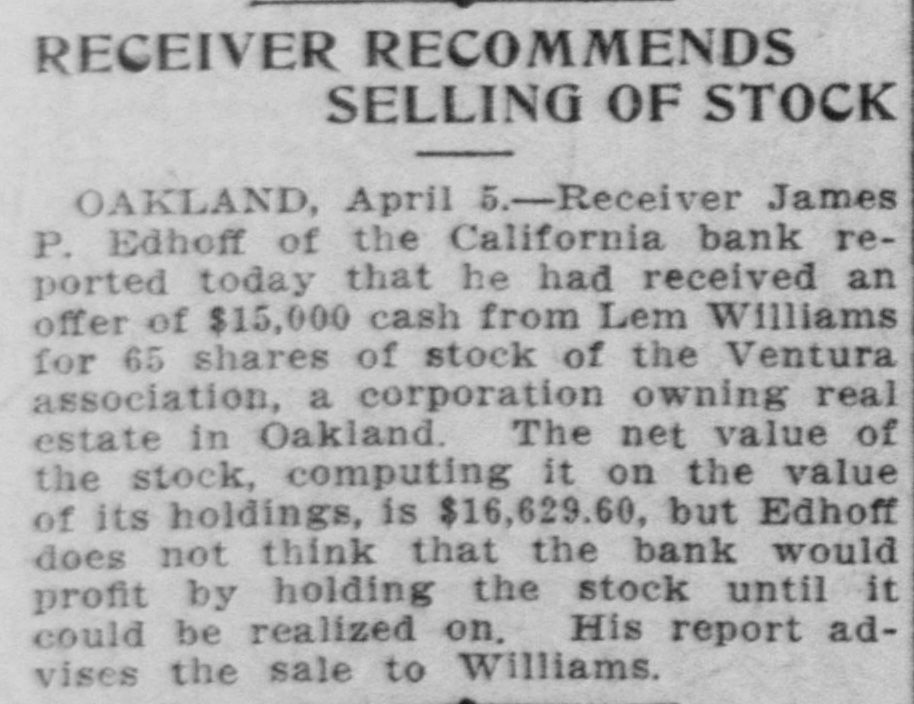
RECEIVER RECOMMENDS SELLING OF STOCK OAKLAND, April 5.-Receiver James P. Edhoff of the California bank reported today that he had received an offer of $15,000 cash from Lem Williams for 65 shares of stock of the Ventura association, a corporation owning real estate in Oakland. The net value of the stock, computing it on the value of its holdings, is $16,629.60, but Edhoff does not think that the bank would profit by holding the stock until it could be realized on, His report advises the sale to Williams.