Central National Bank (Topeka, KS)

Episode Information

Episode UID
307801267
Episode Type
Run Only
Bank Type
national
Bank ID
30780 national
Charter Number
3078
Start Date
July 3, 1905
Location
Topeka, Kansas (39.048, -95.678)

Metadata

Model
gpt-5-mini (chosen from majority vote of a three-model LLM ensemble)
Short Digest
007d848e2a7a621e

Response Measures

Accommodated withdrawals, Public signal of financial health, Capital injected

Events (2)

1. November 19, 1883 Chartered
Source
historical_nic
2. July 3, 1905 Run
Cause
Local Banks
Cause Details
Run triggered by failure/suspension of the First National Bank of Topeka and publicity about major stockholder C. J. Devlin's troubles.
Measures
Paid depositors promptly; displayed cash on hand and received a $300,000 deposit to bolster reserves.
Newspaper Excerpt
The Central National opened promptly for business and the rush of depositors was quickly paid off.
Source
newspapers

Newspaper Articles (11)

Article from The Topeka State Journal, July 3, 1905

Click image to open full size in new tab

Article Text

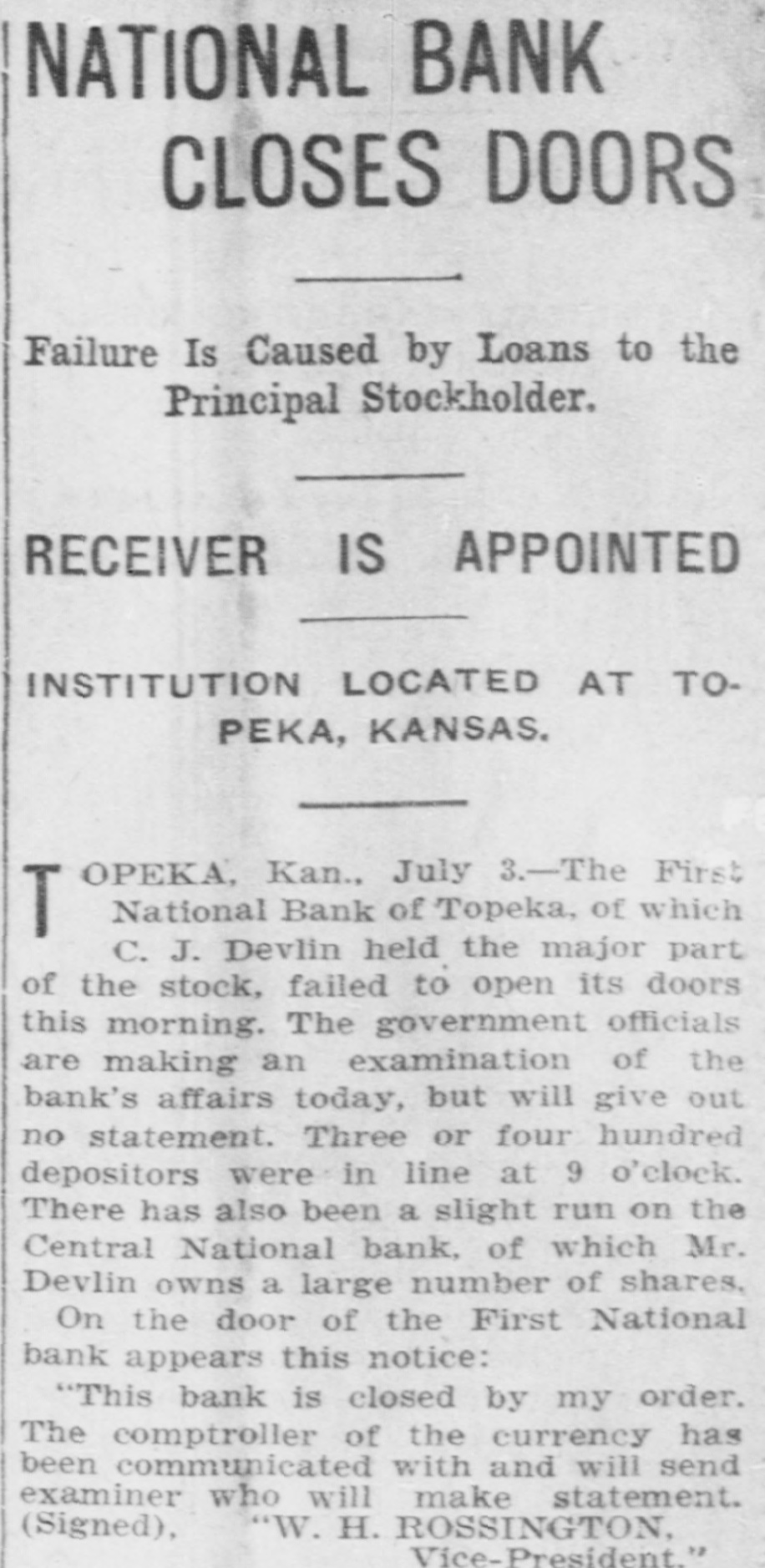
Depositors Waited in Vain for Doors to Open. Notice Posted at Five Minutes Before Nine. SIGNED BY ROSSINGTON Comptroller of the Currency Has Been Notified. C.J. Devlin Turns Topeka Property Over to Bank. WHY THEY GAVE UP. Could Not Raise Enough Money to Meet Demands. Claimed Depositors Will Be Paid in Full. National Examiner Bradley Is Appointed Receiver. At five minutes before 9 o'clock this morning, the following typewritten notice was posted on the front door of the First National bank: "This bank is closed by my order. The comptroller of the currency has been communicated with, and will send examiner who will make a statement. W. H. ROSSINGTON, ice President." "Topeka, Kan.. July 3, 1903." Washington, July 3.-The comptroller of the currency has appointed National Bank Examiner J. T. Bradley receiver of the First National bank. Topeka, Kas., upon receipt of advices from the vice president of the bank that its doors had been closed. A crowd of three or four hundred people, many of whom were depositors, read this notice and quietly dispersed. There was no great amount of excitement. As early as 8 o'clock this morning, it was evident that the First National was in for a run. People began to line up in front of the building, and three or four policemen were detailed to keep the crowd in order. Through the front windows the crowd could see the bank employes and some of the officials walk. ing about in the rear room. There was no evidence of any intention to open the doors. There were no books on the desks, no money in sight and no bustle of preparation to pay off the depositors. Hence the rumor was prevalent through the crowd that the bank would not open for business, and no particular surprise was expressed when the notice was actually posted. About one-third of the crowd at the First National bank was composed of women. The women took the situation with as much composure as did the men, however, and there was no weeping when the notice went up. While the crowd was collecting in front of the First National a smaller crowd assembled on the steps of the Central National. The Central National opened promptly for business. and the rush of depositors was quickly paid off. The people at the Central National who withdrew their money seemed to be mostly savings depositors. There was also considerable of a flurry at the Bank of Topeka. At the Merchants' National bank there were but few people doing any business. At the State Savings there was a small gathering. The North Topeka banks were not affected. The fact that the Monday morning business is usually heavier than other mornings of week served to scare a few timid depositors into the idea that a run was in progress. Depositors May Be Paid. It is claimed, however, at this time that the bank is fully solvent and that the creditors will be paid in full. The closing of the bank hinged upon the inability of the Topeka banks to extend enough aid in addition to the refusal of the banks in Kansas City, Missouri, to come to the rescue of the First National. The Central National bank and the Bank of Topeka both stood ready to help but on condition that the Kansas City banks should extend aid. A wire was received by the First National bank from Kansas City stating their inability to come to the rescue. The answer was terse and no particular interpretation of the refusal could be construed. At eight o'clock the crowds commenced to loiter around in the vicinity of the First National and across the street from vantage points where operations could be viewed In the crowds were curiosity seekers as well as interested depositors. At 8:15 there were some 15 patrons of the bank waiting for the doors to open and at nine o'clock this number had been increased to fully 175. They hung around and pressed forward to the doors until at nine o'clock the statement made by W H. Rossington, director and vice president of the bank. was affixed to the door. Anxious faces pressed close up to the glass dcors to read the statement and then turned away. The press continued The and at 9:30 gradually grew less. people took the statement philosophically and with as much optimism as could be expected. Few words indicative of chagrin or grief were made and the remarks were simply passing in their nature. The groups was divided among the large and small patrons alike. The face of the large as well as the small depositor was seen in the press. One man had $15,000 and but few feet away was small bootblack with savings of a few dollars. Could Not Save Bank. The holding corporation which was to take over the properties of Mr. Devlin will be permitted to lapse. The corporation which was to be established primarily to save the First National bank will be suffered to lapse unless it is found on further examination that it is best to establish such an organization. Mr. J. W. Gleed, who


Article from The Topeka State Journal, July 3, 1905

Click image to open full size in new tab

Article Text

about $300,000 of city and Topeka property and $400,000 in coal lands." Central National Sound. A crowd of fifty anxious depositors crowded on the steps and the sidewalk leading to the Central National bank building prior to the opening of the bank at 9 o'clock this morning. The crowd gathered quickly and in about 15 minutes there was a cloud of depositors lined up close to the doors. Here and there were a few who were simply transacting the usual morning's business, but by far the larger number had come to withdraw their savings, panic-stricken by ill founded rumors. The crowd was evenly divided between men and women. At a quarter after 9 the crowd had swelled in proportions and was wedged tightly in leading to the windows of paying tellers. At the moment of the greatest rush there were probably some 100 persons in line. There was plenty of money on hand to meet any emergency and all depositors were paid promptly. Edwin Knowles, cashier of the Central National bank, said: "We have more money now than we have ever had on


Article from Santa Fe New Mexican, July 3, 1905

Click image to open full size in new tab

Article Text

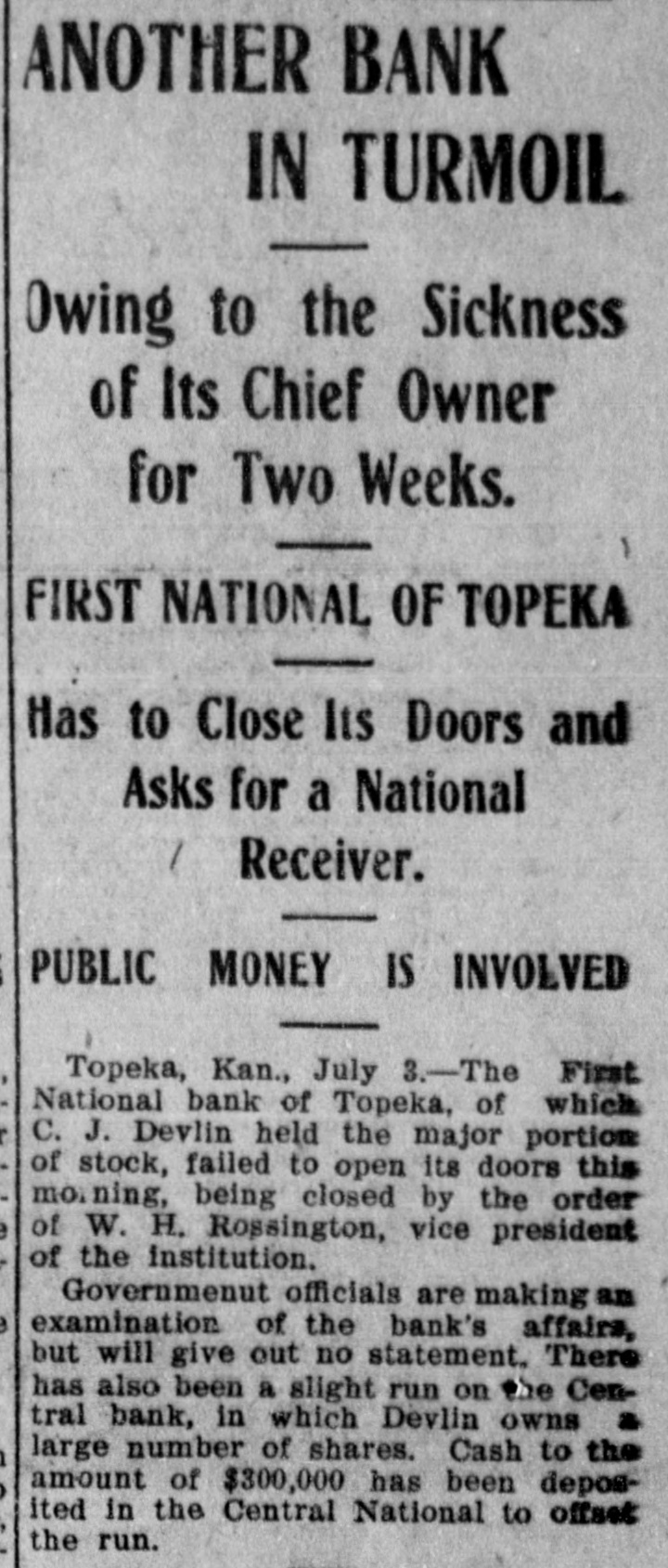
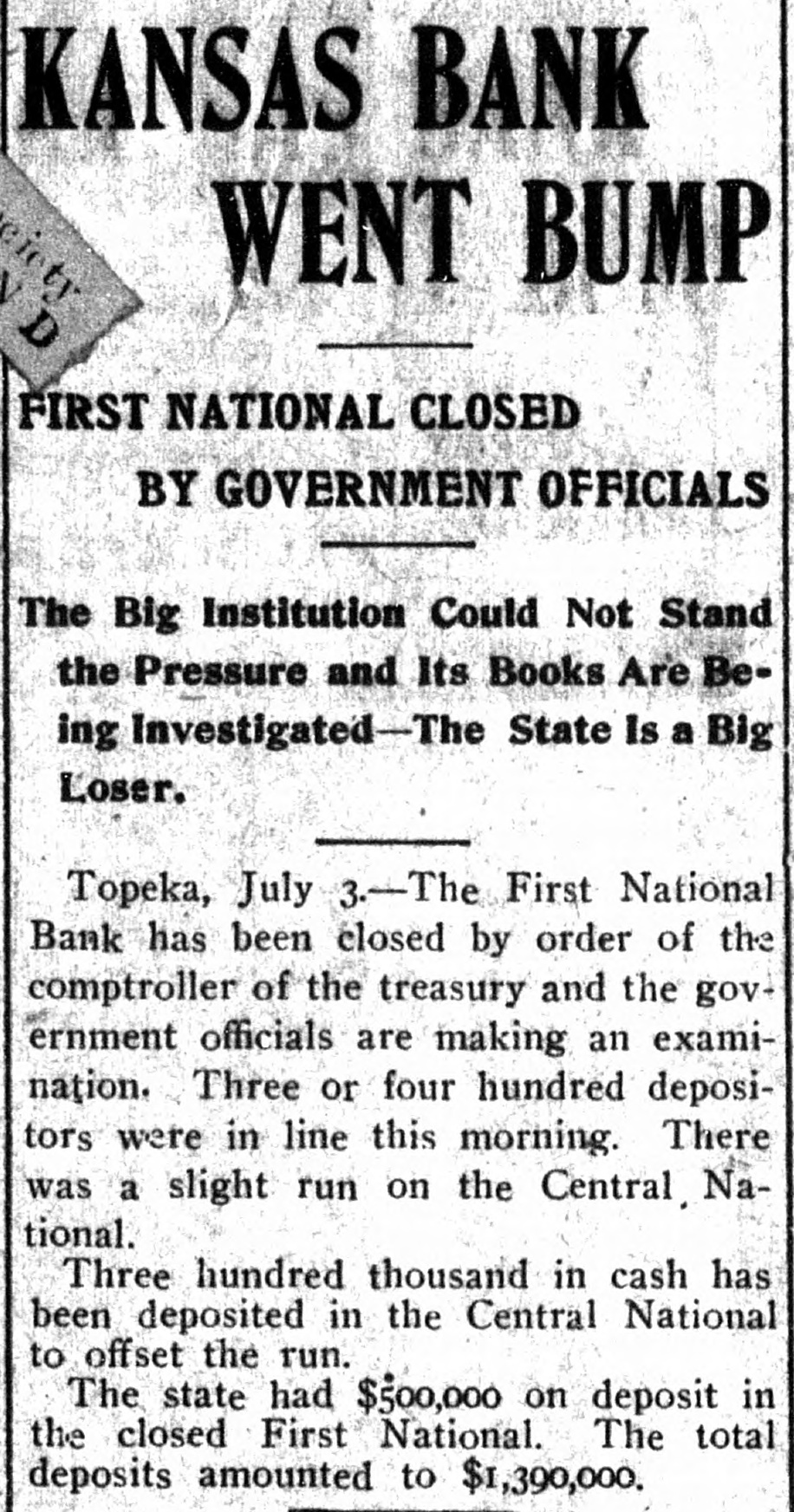
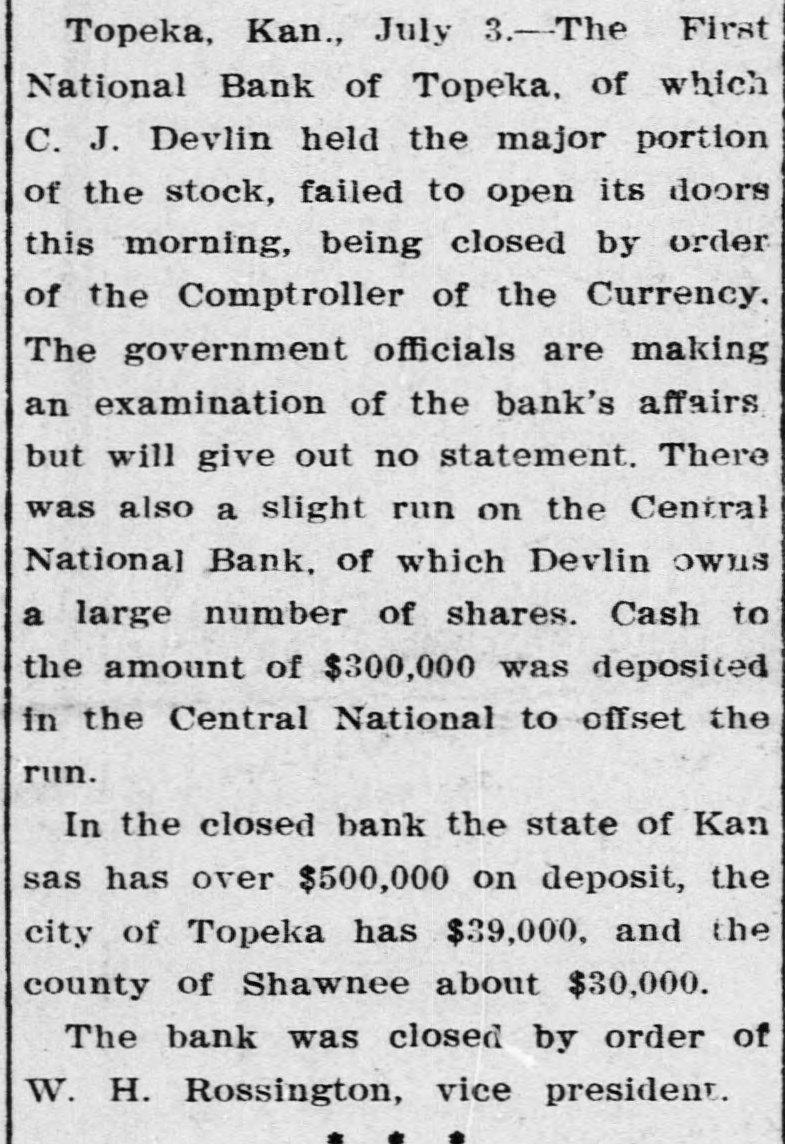
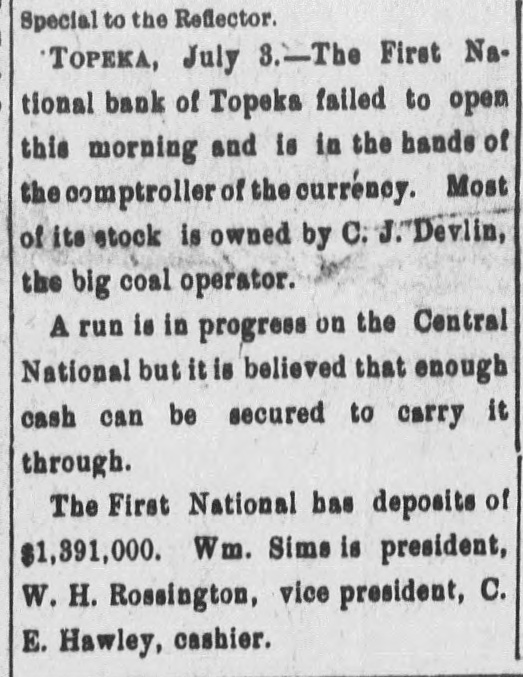
KANSAS BANK CLOSES DOORS d e 1 First National of Topeka Fails to e Open This Morning for Business. b EXAMINING OFFICERS f Into its Affairs C. J. Devlin, Principal Stockholder, and One of the e Wealthiest Men in Section. Topeka, July 3.-The First National Bank of Topeka, of which C. J. Devlin held the major portion of the stock, failed to open its doors this morning, being closed by order of W. H. Ros. sington, the vice president. Government officers are making an examination of the bank's affairs but will give out no statement. There has also been a slight run on the Central National Bank of which Mr. Devlin owns a large number of shares. Cash to the amount of $300,000 was deposited in the Central National to offset the run. Kansas Public Funds in Closed Bank. Topeka, July 3.-In the closed bank the state of Kansas has over $500,000 in deposits, the city of Topeka $39,000 and the county of Shawnee about $30, 000. Deposits of Over a Million and a Quarter. New York, July 3.-According to a ecent statement, the First National of Topeka owed depositors in 9,000. De 1 Said to Be All Right, Financi. ally. Kansas City, Mo., July 3.-C. J. Devlin was generally credited with being one of the wealthiest men in Kansas. He was the head of twenty different companies, coal mining enterprises and mercantile establishments and for many years has been one of the most active business men in the southwest. His wealth is largely in coal mining properties in southern Kansas, in the vicinity of Marceline, Missouri, and in Illinois. He also owns a number of coal yards in Kansas City. He is a stockholder in twenty-five banks, his bank stock being estimated to amount to a million dollars. Charles S. Gleed, of Topeka, general manager of the Missouri Telephone Company and for many years a business associate of Mr. Devlin, says: "Devlin's assets amount to about $7,000,000 and his liabilities do not exceed two millions. These liabilities are debts of the different companies he controls. His personal liabilities are practically nothing." Mr. Devlin was born at St. Louis E4 years ago. Apoplexy Caused the Entire Trouble. Chicago, Ill., July 3.-The whole trouble involving both Mr. Devlin's af. fairs and those of the First National Bank of Topeka came as a result of an attack of apoplexy two weeks ago and which rendered Mr. Devlin incapable of doing business. Had he remained in his accustomed health, say bankers who are interested in the First National, he would have been able to prevent the trouble. National Bank Examiner Appointed Receiver. Washington, July 3.-The comptroller of the currency has appointed National Bank Examiner J. T. Bradley as receiver of the First National Bank of Topeka upon receipt of advices from the vice president of the bank that its doors had closed.


Article from The Evening Statesman, July 3, 1905

Click image to open full size in new tab

Article Text

BIG KANSAS BANK FAILS FIRST NATIONAL AT TOPEKA CLOSED ITS DOORS THIS MORNING. Other Banks Are Involved-Speculations of the Heaviest Stockholder the Cause. TOPEKA, July 3.-The First National bank, the biggest financial institution in this city, failed to open its doors this morning. A notice signed by Vice President Rossington was posted on the door. It says: "This bank is closed by my orders. The comptroller of currency has been notified and an examiner will be sent." The closing of the bank is the result of complications in the affairs of C. H. Devlin, one of the chief stockholders, reputed to be the richest man in Kansas. His affairs have been placed in the hands of million-dollar corporation chartered Saturday in Missouri, The bank's liabilities and assets May 1 were $2,351,304. A. large number of depositors were lined up in front of the bank this morning. Devlin's attorney has announced that his client owes the First National bank $1,000,000, Kansas City banks, $400,000, the banks of New York, $250,000, of Chicago $150,000 and of St. Louis, $250,000. Following the announcement of the failure, a run started at the Central National in which Devlin is also a stockholder and at other banks in which Devlin is interested. Many deposits were drawn and it is announced that Devlin has turned over to the First National real estate and securities worth $700,000 and insurance policies valued at $667,000. Devlin's assets are estimated at $7,000,000 and his liabilities at $2,000,000. His interest in Topeka banks is said to amount to $1,000,000. He owns 11 coal companies.


Article from The Daily Telegram, July 3, 1905

Click image to open full size in new tab

Article Text

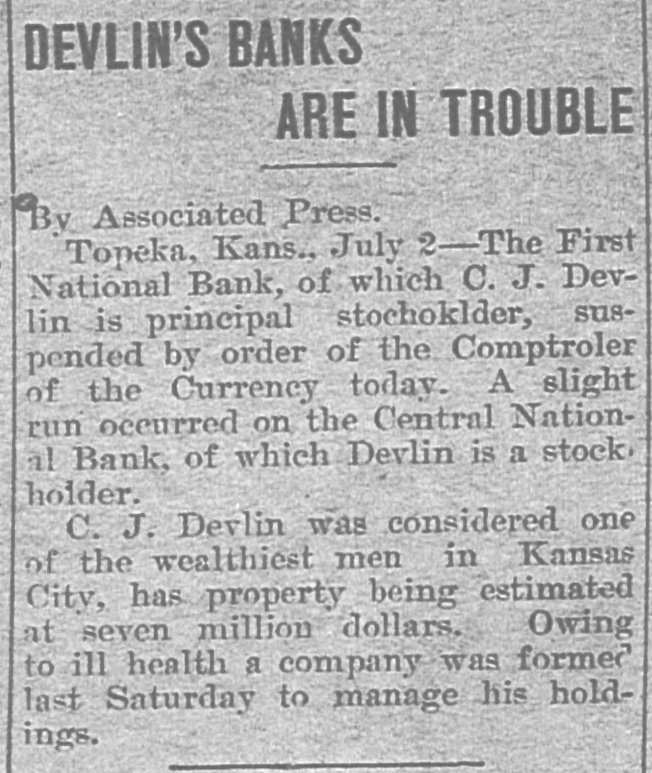
DEVLIN'S BANKS ARE IN TROUBLE By Associated Press. Topeka, Kans., July 2-The First National Bank, of which C. J. Devlin is principal stochoklder, suspended by order of the Comptroler of the Currency today. A slight run occurred on the Central National Bank, of which Devlin is a stock. holder. C. J. Devlin was considered one of the wealthiest men in Kansas City, has property being estimated at seven million dollars. Owing to ill health a company was formed last Saturday to manage his holdings.


Article from New-York Tribune, July 4, 1905

Click image to open full size in new tab

Article Text

TOPEKA BANK SHUTS DOOR LARGE LOANS TO ONE MAN. C. J. Devlin, One of the Wealthiest Men in Kansas City, Involved. Topeka, Kan., July 3.-The First National Bank of Topeka, of which C. J. Devlin is the principal stockholder, failed to open its doors to-day. The government officials are making an examination of the bank's affairs, but gave out no statement to-day. On the door of the bank appeared this notice: This bank is closed by orders. The Controller of the Currency has been communicated with and will send an examiner, who will make a statement. W. H. ROSSINGTON, Vice-President. No definite statement was obtainable to-day regarding the condition of the First National Bank, controlled by Charles J. Devlin, a wealthy coal mine owner, which closed its doors this morning. Colonel W. H. Rossington, vice-president of the bank. locked the institution's books in the vault to await the arrival of J. T. Bradley, national bank examiner, whom the Controller had appointed receiver of the failed bank. Colonel Rossington would only say: "The bank's trouble has not been caused by dishonesty on the part of any one, but by lending too largely to one borrower. There has been no stealing." The borrower, it is said, is Mr. Devlin, and the bank is said to hold the capitalist's paper to the amount of $1,000,000. Mr. Devlin, whose sudden illness brought about the tangle in the big coal minrailroad valued, at close to $7,000,000. is still under care ing and properties, it the is estimated, from of a physician, and no statement can be obtained him. All that came from his home to-day was that coal had over in life insurance the bank stricken nearly $700,000 operator turned and about to the the same amount in Topeka real estate. Business associates of Mr. Devlin expressed their opinion that if properly handled this would allow the bank to pay out. Aside from the temporary flurry that the failure of the First National Bank caused on the other banks of the city, the most interesting phase of the situation was the statement of the State Treasurer, T. T. Kelly, that the bank held $547,000 of the State's funds. Mr. Devlin was one of the Mr. Kelly's bondsmen. Following the announcement of the failure, a lively but not disastrous run was started on the Central National Bank. Other runs of a lesser degree were started on the State Savings Bank, the Bank of Topeka and on the Merchants' National Bank. At none of these banks, however, was the demand for withdrawals great. Following the closing of the First National Bank there was a slight run on the Central National Bank, in which Mr. Devlin also is a large stockholder, and there were small runs later in the day on the Merchants' National Bank, the Bank of Topeka and the State Savings Bank. At each of these institutions all depositors who requested their money were paid and confidence was expressed in the ability to meet any demands of the depositors. Cash to the amount of $300,000 was deposited in the Central National to offset the run. J. W. Gleed stated that $700,000 worth of real estate -$300,000 unencumbered Topeka property, the other $400,000 in coal lands in Southeastern Kansas-had been turned in by Mr. Devlin, together with $700,000 life insurance. Mr. Gleed asserted that the Central National was in a perfectly solvent condition. He further stated that nothing more would be done with the Missouri organization of the Devlin property until after the report of the Controller here. In the First National Bank the State of Kansas has over $500,000 in deposits, the city of Topeka. $39,000, and the county of Shawnee about $30,000. Mr. Devlin, who has been under the care of a physician, was unable to leave his home to-day. He was up and around, however. He was in the best of spirits, and in reply to questions, said that he expected to be able to go to the bank in another week.


Article from Arizona Republican, July 4, 1905

Click image to open full size in new tab

Article Text

appointed receiver of the failed bank, and he would only say: "The bank's trouble has not been caused by dishonesty on the part of any one, but by lending too largely to one borrower. There has been no stealing." This borrower is, of course, Mr. Devlin, and the bank is said to hold the capitalist's papers to the amount of a million dollars. Mr. Devlin, whose sudden illness brought about the tangling of his twenty-six big coal mining and railroad properties, valued, it is estimated, at close to seven million dollars, is still under the care of physicians, and no statement could be secured from him. All that came from his home during the day or could be secured from other sources, was that the stricken coal operator had turned over to the bank nearly $700,000 in life insurance and about the same amount in Topeka real estate. The business associates of Mr. Devlin gave it as their opinion that, if properly handled. this would allow the bank to pay out. Elmer Ames, bank examiner for the northern district of Kansas, who took charge pending the arrival of Receiver Bradley, would say nothing additional that would throw any light on the situation. Probably the most interesting phase of the situation was the statement of State Treasurer T. T. Kelly that the bank held $568,000 of the state's funds. Mr. Devlin was one of Treasurer Kelly's bondsmen. The statement was made that Treasurer Kelly had exceeded his authority in placing more of the state's money in the bank than the law allows, but Mr. Kelly declined to discuss the matter at this time. Following the announcement of the failure a lively run was started on the Central National Bank, and before closing time today it was said that more than $100,000 had been withdrawn from this institution. The Central also holds some of Devlin's paper, and he likewise owns 15-28 of the capital stock of $250,000 of this institution. But it developed that the Central National Bank held but little of Devlin's paper, and when its officers displayed $600,000 in cash and made every effort to pay the depositors as fast as they made demands for their deposits, the excitement died down, and at clos-


Article from Waterbury Evening Democrat, July 5, 1905

Click image to open full size in new tab

Article Text

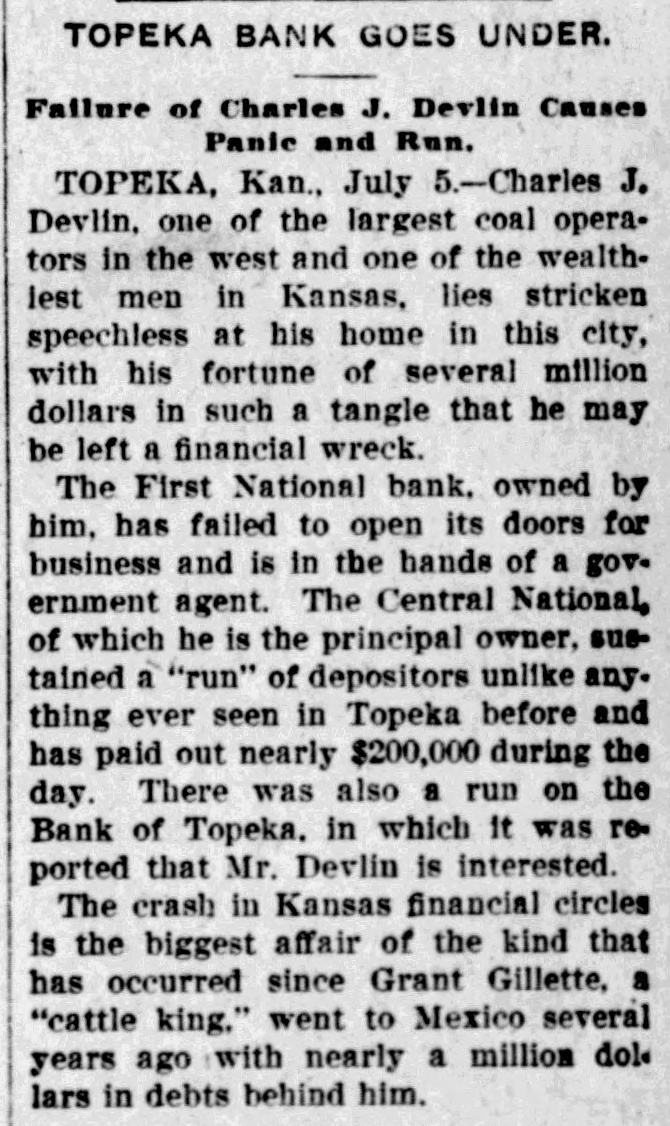
TOPEKA BANK GOES UNDER. Failure of Charles J. Devlin Causes Panic and Run. TOPEKA, Kan., July 5.-Charles J. Devlin, one of the largest coal operators in the west and one of the wealthlest men in Kansas, lies stricken speechless at his home in this city, with his fortune of several million dollars in such a tangle that he may be left a financial wreck. The First National bank. owned by him, has failed to open its doors for business and is in the hands of a gov. ernment agent. The Central National, of which he is the principal owner, sustained a "run" of depositors unlike any. thing ever seen in Topeka before and has paid out nearly $200,000 during the day. There was also a run on the Bank of Topeka. in which It was reported that Mr. Devlin is interested. The crash in Kansas financial circles is the biggest affair of the kind that has occurred since Grant Gillette, a "cattle king." went to Mexico several years ago with nearly a million dol. lars in debts behind him.


Article from The Oskaloosa Herald, July 6, 1905

Click image to open full size in new tab

Article Text

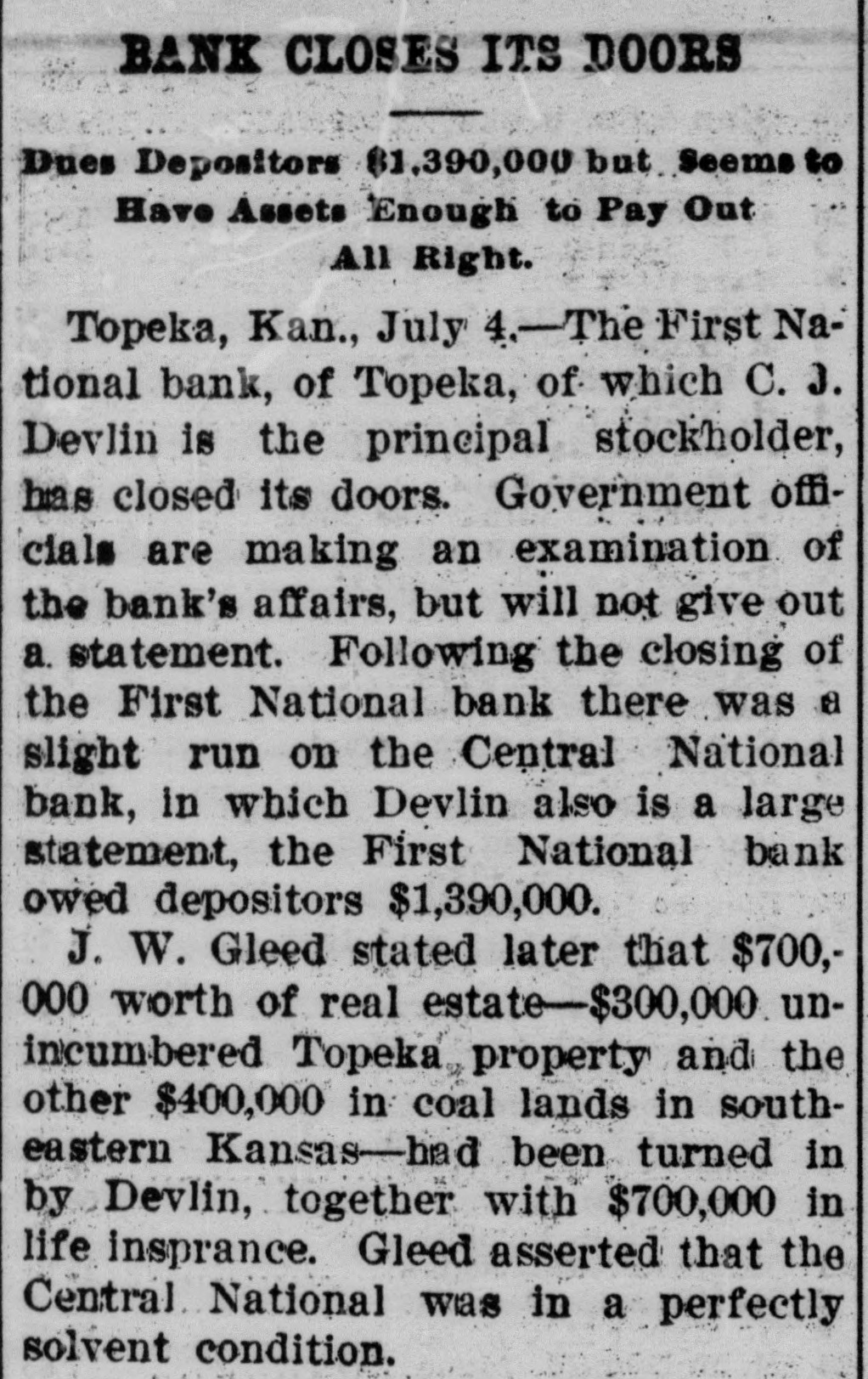
BANK IN TOPEKA CLOSES'ITS DOORS FAILURE OF THE FIRST NATIONAL IS ANNOUNCED RECEIVER IS APPOINTED Institution Is Saiti to Owe Depositers a Total of $1,390,000-The $7,. 000,000 Estate of c. J. Deviin Envolved in Failure. Topeka, Kan., July 4.-By closing Its doors Monday the First national bank of Topeka threw Into liquidation. the $7,000,000 estate of C J Devllu. in which several Chicago banks are heavily Interested. The bank owed depositors $1,300,000. The comptroller of the currency has appointed National Bank Examiner J. T. Bradley receiver of the bank. There were several hundred deposi tors in line when the hour for opening the First national arrived. The bank, however, did not open. Instead, the 300 or 400 men in line read on the door the following notice: "This bank is closed by my orders The comptroller of the currency has been communicated with and will send an examiner, who will make a statement. W. H. Rossington, Vice President." Government Agents in Charge. The government authorities are now making an examination of the bank's affairs, but will give out no statement According to a recent statement the First national bank of Topeka owed depositors $1,390,000. Of these depositors the state of Kansas has over $500,000 in deposits, the city of Topeka $39,000 and the county of Shawnee about $30,000. Mr. Deviin's wealth is largely in coal mining properties in southern Kansas, in the vicinity of Marceline. Mo., and in Illinois. These properties include the following: Mount Carmel coal mines. Toluca coal mines the Marquette Third Vein mines, the Devlin Coal company, the DevlinMiller Coal company the Crawford County Mining company. the Pittsburg and Midway Coal company the Kansas City Coal and Coke company, the Southwestern Fuel company, the Wiley Coal company and the Marceline Coal company. Try to Save Bank. Less than 36 hours previous to the closing of the bank the Chicagoans had formed the Deviin Mining, Manu facturing and Mercantile company with a capital of $1,000,000, as a holding company to take over and manage the Devlin properties. The closing of the bank will prevent the holding com pany from managing the Devlin interests. Mr. Deviin has long been reputed the richest man in Kansas, Recently he became too 111 to manage his affairs longer, It was said, and his interests became involved in such a way that the Chicagoans interested in his schemes were notified that a large sum would have to be raised to keep the various enterprises going. This led to a conference in Topeka of representatives of Kansas City, Topeka and Chicago banks. The Chicagoans in the conference included D. A. Moulton, vice president of the Corn Exchange bank; A. A. McClanahan, of the Continental national bank, and Adolph Uhrlaub, vice president of the Central Trust company. At the conference it was decided that between $250.0 and $1,000,000 would be necessary to put new life into the 26 different Devlin companies. The banks concerned took immediate steps to raise the amount and to form the holding corporation that was intended to take over the management of the properties. The holding corporation was formed Saturday in Kansas City and a special train to Jefferson City was hired torsecure its charter. Holds State Funds. Aside from the temporary flurry that the failure of the First national bank caused upon the other banks of the city, probably the most interesting phase of the situation was the statement of State Treasurer T. T. Kelly, that the bank held $547,000 of the state's fund, and the knowledge that Mr. Devlin was one of Treasurer Kelly's bondsmen. The statement was made that Treasurer Kelly had exceeded his authority in-placing more of the state's money in the bank than the law allowed, but Mr. Kelly declined to discuss the matter at this time. Runs on Other Banks. Following the announcement of the failure, a lively run was started on the Central national bank, and before closing time Monday it, was known that something more than $100,000 had been withdrawn from this institution. The Central national also held some of Devlin's paper, and he likewise OWDS fifteen twenty-eighths of the capital stock of $250,000 of this institution. But It developed that the Central national held but little of Devlin's paper, and when its officers displayed $600,000 in cash and made every effort to pay the depositors as fast as they made demads the excitement died down, and at closing time only a few small depositors remained at the teller's window. Other runs, of a lesser degree, were started on the State savings bank, the Bank of Topeka, and on the Merchants' national bank. At none of these banks, however, was the demand for withAenels great only the small deposit-


Article from Washington Standard, July 7, 1905

Click image to open full size in new tab

Article Text

THE First National Bank at Topeka, Ks., has failed, and it has started a run on another National bank, the Central, and it may likewise close its doors.


Article from The Topeka State Journal, August 14, 1905

Click image to open full size in new tab

Article Text

der before November 1. There has been no squabble. Mr. Davis wanted to be president of the new bank, but some of us thought that the office should seek the man rather than the man the office. We preferred to take some man who could give the bank his entire time. We felt that Mr. Davis as mayor and as the head of that big business of his could not give the bank all of his time. This is just the thing that we wished to avoid. That was the trouble with the old bank. We wanted to avoid getting into any difficulties and therefore thought that we should have a man in charge who could be at the bank from the first thing in the morning until closing time. We had nothing against Mr. Davis; in fact, we were only too glad to have him associated with us. However, he did not care to take an interest unless he was given some position far up as president, and we broke. We have full confidence in Mr. Kno wles and consider him one of the best bankers in the state." No Fight, Says Davis. Mayor W. H. Davis in his office this morning said: "There has been no fight between the two factions. There was some difference of opinion but there was no ill feeling mixed up in it. I believe that the new bank will be a success. There is no doubt that it will stand, for it has a very good man at the head. Mr. Knowles is a shrewd, careful, conservative banker and will bring with him to the new bank the esteem and confidence of every one." Mr. Edwin Knowles was at his duties as usual this morning. "I have not resigned yet," he remarked, "I presume that I will take the position though. In leaving it is not because of any dissatisfaction with the management of the Central National for there has been always the kindest of feelings existing. It is simply a case of less work and more pay. I cannot but help think that with the location and the men that are behind of the institution the bank is going to start out and remain a success." Receiver Bradley expressed his satisfaction at the way things had turned out. "I am completely satisfied with the bargain we made for the sale of the bank fixtures and the lease. It is the highest lease as regards terms, that has been made. The fixtures are worth every cent of the money for them and could not be duplicated for less than $4,000. I am also well pleased with the set of men who are going to start the