Tenth National Bank (New York, NY)

Episode Information

Episode UID
30700868
Episode Type
Run Only
Bank Type
national
Bank ID
3070 national
Charter Number
307
Start Date
April 5, 1872
Location
New York, New York (40.714, -74.006)

Metadata

Model
gpt-5-mini (chosen from majority vote of a three-model LLM ensemble)
Short Digest
45df62bb08172c08

Response Measures

Accommodated withdrawals, Public signal of financial health, Books examined

Clearinghouse involved: Yes (loan, examination, or other measures)

Events (3)

1. March 10, 1864 Chartered
Source
historical_nic
2. April 5, 1872 Run
Cause
Bank Specific Adverse Info
Cause Details
Large deposits and withdrawals tied to speculators (H. N. Smith, Jay Gould et al.) who used the bank to withdraw/shift legal-tender notes and to 'lock up' greenbacks, provoking heavy withdrawals and market tightness.
Measures
Clearing House examination and visit by bank examiner; public inquiry; bank directors promised no repetition; Clearing House adopted resolution to investigate and potentially suspend members involved; bank certified checks extensively to meet demands.
Newspaper Excerpt
the locking up in the Tenth National Bank the other banks are endeavoring to disguise their own indirect connection with the speculative mania
Source
newspapers
3. November 23, 1877 Voluntary Liquidation
Source
historical_nic

Newspaper Articles (25)

Article from The Evening Telegraph, March 11, 1871

Click image to open full size in new tab

Article Text

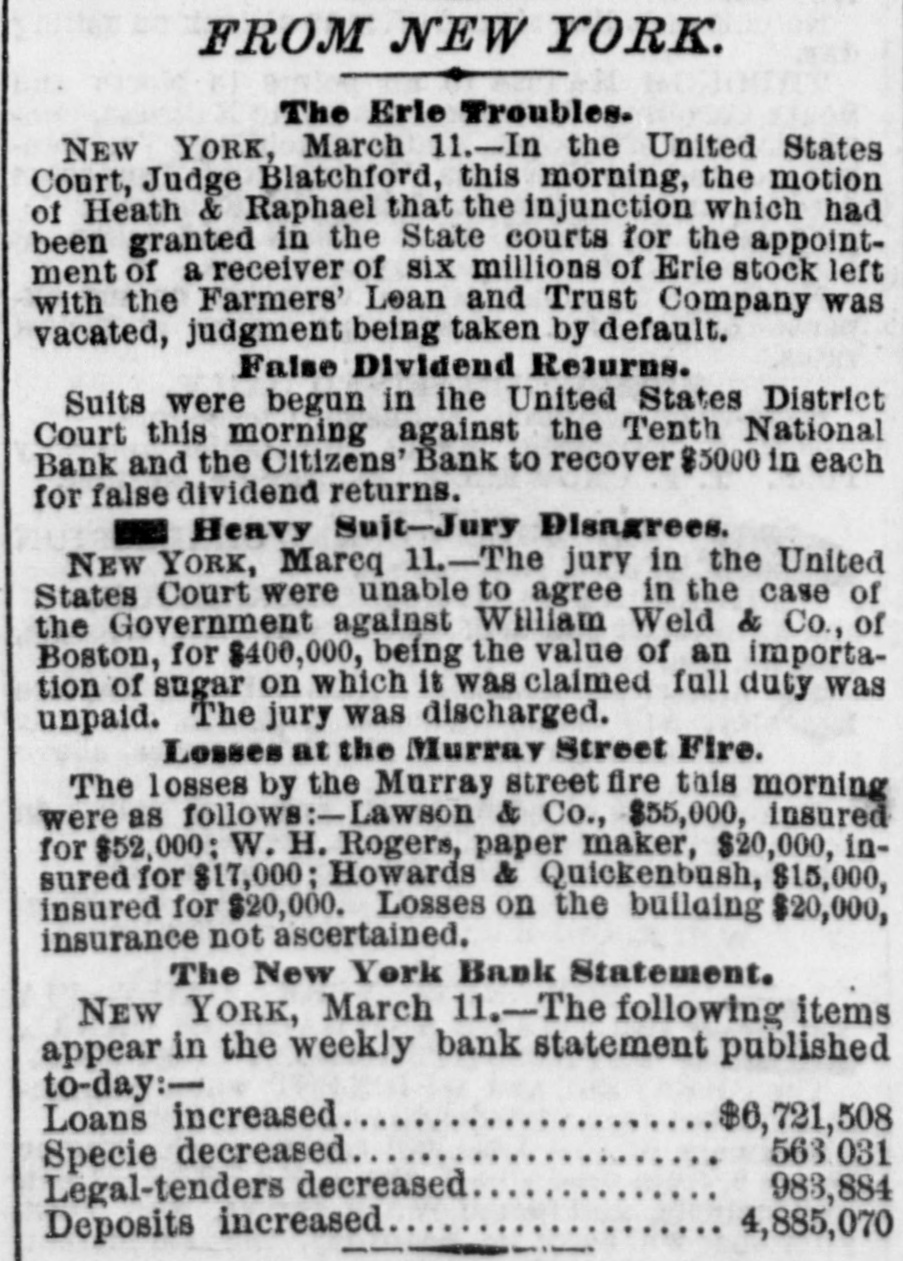
FROM NEW YORK. The Erie Troubles. NEW YORK, March 11.-In the United States Court, Judge Blatchford, this morning, the motion of Heath & Raphael that the injunction which had been granted in the State courts for the appointment of a receiver of six millions of Erie stock left with the Farmers' Loan and Trust Company was vacated, judgment being taken by default. False Dividend Returns. Suits were begun in the United States District Court this morning against the Tenth National Bank and the Citizens' Bank to recover $5000 in each for false dividend returns. Heavy Suit-Jury Disagrees. NEW YORK, Mareq 11.-The jury in the United States Court were unable to agree in the case of the Government against William Weld & Co., of Boston, for $400,000, being the value of an importation of sugar on which it was claimed full duty was unpaid. The jury was discharged. Lesses at the Murray Street Fire. The losses by the Murray street fire this morning were as follows:-Lawson & Co., $55,000, insured for $52,000; W. H. Rogers, paper maker, $20,000, insured for $17,000; Howards & Quickenbush, $15,000, insured for $20,000. Losses on the building $20,000, insurance not ascertained. The New York Bank Statement. NEW YORK, March 11.-The following items appear in the weekly bank statement published to-day:Loans increased $6,731,508 563 031 Specie decreased 983,884 Legal-tenders decreased 4,885,070 Deposits increased


Article from Nashville Union and American, October 7, 1871

Click image to open full size in new tab

Article Text

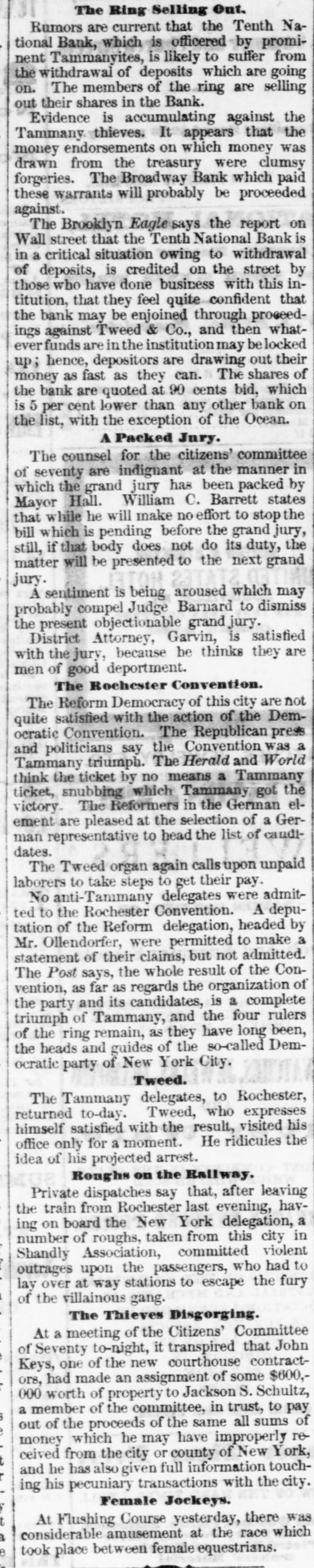
The Ring Selling Out. Rumors are current that the Tenth National Bank, which is officered by prominent Tammanyites, is likely to suffer from the withdrawal of deposits which are going on. The members of the ring are selling out their shares in the Bank. Evidence is accumulating against the Tammany thieves. It appears that the money endorsements on which money was drawn from the treasury were clumsy forgeries. The Broadway Bank which paid these warrants will probably be proceeded against. The Brooklyn Eagle says the report on Wall street that the Tenth National Bank is in a critical situation owing to withdrawal of deposits, is credited on the street by those who have done business with this intitution, that they feel quite confident that the bank may be enjoined through proceedings against Tweed & Co., and then whatever funds are in the institution may belocked up; hence, depositors are drawing out their money as fast as they can. The shares of the bank are quoted at 90 cents bid, which is 5 per cent lower than any other bank on the list, with the exception of the Ocean. A Packed Jury. The counsel for the citizens' committee of seventy are indignant at the manner in which the grand jury has been packed by Mayor Hall. William C. Barrett states that while he will make no effort to stop the bill which is pending before the grand jury, still, if that body does not do its duty, the matter will be presented to the next grand jury. A sentiment is being aroused which may probably compel Judge Barnard to dismiss the present objectionable grand jury. District Attorney, Garvin, is satisfied with the jury, because be thinks they are men of good deportment. The Rochester Convention. The Reform Democracy of this city are not quite satisfied with the action of the Democratic Convention. The Republican press and politicians say the Convention was a Tammany triumph. The Herald and World think the ticket by no means a Tammany ticket, snubbing which Tammany got the victory. The Reformers in the German element are pleased at the selection of a German representative to head the list of caudidates. The Tweed organ again calls upon unpaid laborers to take steps to get their pay. No anti-Tammany delegates were admitted to the Rochester Convention. A deputation of the Reform delegation, headed by Mr. Ollendorfer, were permitted to make a statement of their claims, but not admitted. The Post says, the whole result of the Convention, as far as regards the organization of the party and its candidates, is a complete triumph of Tammany, and the four rulers of the ring remain, as they have long been, the heads and guides of the so-called Democratic party of New York City. Tweed. The Tammany delegates, to Rochester, returned to-day. Tweed, who expresses himself satisfied with the result, visited his office only for a moment. He ridicules the idea of his projected arrest. Roughs on the Railway. Private dispatches say that, after leaving the train from Rochester last evening, having on board the New York delegation, a number of roughs, taken from this city in Shandly Association, committed violent outrages upon the passengers, who had to lay over at way stations to escape the fury of the villainous gang. The Thieves Disgorging. At a meeting of the Citizens' Committee of Seventy to-night, it transpired that John Keys, one of the new courthouse contractors, had made an assignment of some $600,000 worth of property to Jackson S. Schultz, a member of the committee, in trust, to pay S out of the proceeds of the same all sums of money which he may have improperly received from the city or county of New York, t and he has also given full information touchr ing his pecuniary transactions with the city. Female Jockeys. y t At Flushing Course yesterday, there was a considerable amusement at the race which e took place between female equestrians.


Article from The New York Herald, April 7, 1872

Click image to open full size in new tab

Article Text

One Hundred and Forty-five Per Cent Per Annum Interest Paid for Loans on Stocks. Stocks Give Way and Close at a Decline. An Unfavorable Bank Statement. GOLD AND GOVERNMENTS FIRM. The Week's Imports of Foreign Goods Nearly Thirteen Millions. WALL STREET, SATURDAY. April 6-6 P. M. On 'Change to-day wheat was firm, but less active. The cotton market was quiet and steady. THE COTTON MOVEMENT. The receipts of cotton at all the ports for the past week were 36,062 bales, against 40,649 bales the previous week. The total receipts since September 1, 1871, are 2,464,228 bales, against 3,383,081 bales for the corresponding period of the previous year, showing a decrease in the present crop of 919,853 bales. The exports from all the ports for the week were 57,665 bales, against 90,461 bales for the same week last year. The total exports for the expired portion of the cotton year are 1,617,342 bales, against 2,370,350 bales 1or the same time last year. The stock at all the ports is 371,429 bales, against 555,208 for the same date in 1871. MONEY 1-16 A 3/1 PER CENT A DAY. The money market was excessively stringent, and the scarcity was greater than experienced on any previous da during the present crisis. The general expectation was that, as usual on Saturday, there would be a relaxation at the close; but even with this belief so current the rate started off at 1/4 per cent, which in some instances was paid in addition to 7 per cent. Early in the alternoon the idea above referred to had the effect of creating some relaxation, and some loans were made at 1-16, but as three o'clock approached the inquiry quickened again and the money market was maintained until within a 1ew minutes of four o'clock, the demand being so great that as high as 3/4 in addition to 7 per cent was paid by the frightened borrowers. Indeed, it is said that as high as 1/2 per cent was paid in the excitement between half-past three and four o'clock. THE LOCKED-UP GREENBACKS. The Indignation of the other banks at the part played by the Tenth National Bank in locking up of money led to a meeting of the Clearing House to-day, at which Mr. Tappan, the President of the Gallatin Bank, was appointed a committee of one to investigate the affair in connection with an official inquiry on the part of Mr. Meigs, the National Bank Examiner of this district. These gentlemen proceeded to the Tenth National Bank and found that the creditor balance of nearly $5,000,000 yesterday was due to the withdrawal of about four and a quarter millions in legal tenders and the calling in of loans to the extent of over haif a million. The money withdrawn was on checks presented by a prominent "bear" speculator in Wall street. The President of the bank asserted its entire innocence of complicity in the conspiracy, and furthermore promised, in company with several of the directors, that they would not allow a repetition of the matter complained of, earnestly asking that the Clearing House would overlook the present case, espectally as a rejection of the checks of the bank might lead to a run upon it, with probably very serious conseThe President and directors referred to their their good expressed diately quences. should determination intentions to resign be overruled immein the future by the majority of the Board. The case, as investigated by Mr. Tappan, will be submitted to the Clearing House on Monday. THE BANK STATEMENT. The bank statement proved to be very unfavorable and suggests a much worse condition than is presented, for, with even the half of a distribution of the loss of resources over SIX days, the surplus reserve is reduced almost to a million dollars. Were the statement made for the day and not given as an for the week it would the are below reserve average banks actually the probably limit of to show keep that which the law requires them on hand. It is, of course, very proper to throw blame on the speculators for locking up money; but the banks ought not to leave it in the power of a clique to place them in their present position. Were they not so unduly expanded there could not be this unlawiul dimitaution of the proportion between reserve and liabilities. Tne banks, in their greed to make money out of the wild speculation in stocks, have loaned every dollar they could spare to Wall while turning a cold merchants applications A more street, presenting of shoulder excitement to legitimate the character. Under cover or the about the locking up in the Tenth National Bank the other banks are endeavoring to disguise their own indirect connection with the speculative mania in the stock market. The morality of the business 13 not the least changed because the Tenth National Bank happens to help one set of stock gamblers and the other banks another. The total averages for the week compare with those of last week as follows:-


Article from The Wheeling Daily Intelligencer, April 9, 1872

Click image to open full size in new tab

Article Text

rNEW YORK CITY. in NEW YORK, April 8.-The Tribune says that the Attorney General's suit against Jay Gould and others of the Erie road was not instigated by the new management. On the contrary, it is said, Gould is giving the management every assistance in the work of reforming the road. The Bar Association say that the published reports of the testimony before the Judiciary Committee have been imperfect and inaccurate, and that they now desire no further testimony. They ask that there be no opinion in the cases until the publication of the testimony which was taken first. The committee for the celebration of the anniversary of last year's Peace Jubilee have issued a call to the Germans to decorate their houses on April 10th and illuminate them in the evening. The German Landwehr Verein Association, former members of the Prussian militia, has appointed a committee to make arrangements for the observance of the day. Rev. Robert Collyer, of Chicago, last evening, preached to an immense congregation at the Academy of Music in Brooklyn. Subject-"Christian Society, The coroner's jury in the Siegfried case -day rendered a verdict that Frederick Siegtried died in 1869 from the effects of poison supposed to have been administered by Frederick Heggi for the purpose of getting Siegfried's property. Deputy Sheriff Leebacher o-day re ceived another execution against the Staten Island Ferry Company, but the property of the company having been placed in the hands of a receiver, Lee bacher was unable to seize any one of the boats. The report that Dr. "Lookup" Evans, the abortionist, has been released on bail is be confirmed. witnesses He will probably against him not tried again, as cannot be found. At a meeting of the cigar manufacturers to day a resolution was adopted not to buy any seed leaf tobacco after the 1st May, except by sample. This action was taken in consequence of the frauds practiced on cigar makers. Patrick McMalcon, was arrested and committed o-day, charged with attempting toshoot Patrick McGuire,keeper of the Brooklyn morgue. McMalcon fired at McGuire through a window twice, but neither shot took effect. The black Friday suits of Howard vs. Henry N. Smith, and Howard vs. Jay Gould and others, was discontinued to day. Examination in the case of the Tenth National Bank, charged with locking up money, was commenced to day before Commissioner Davenport. The test mony is unimportant. The case wasad journed until to morrow, when the motion to admit reporters will be decided. Mayor Hall denies receiving a letter from Governor Hoffman, stating that the appointment of Controller Green was un constitational. There have been 22 cases of small pox since Saturday, and 8 deaths. Dr. Joseph Woodhull, husband of Victoria C. Woodhull, died suddenly, last night. The Coroner is investigating the case. The new charter as amended in the Senate seems to have gone out of favor. The only two journals that supported when it passed the Assembly now denounce it as it stands in the Senate. The Times says it would be infinitely preferable to get along another year under the charter now existing, than to press the one amended by the Senate. The Heening Post, in referring to the rumors in the cable dispatches to the Associated Press to day of a peaceable settlement of the conferences pertaining to the Alabama case, says: We have strong reason to believe our government convey ed to Great Britain its willingness to exclude by agreement the consideration of the claims for indirect damages from the arbitrators. At least SO far as to demand no award on this ground. These clafms in must remain in the case as arguments favor of the award of the gross sum, but not as claims to be paid the United States. The proposition, the Post is informed, is in a form which the British government can hardly in consistency fail to accept, and before another week it is hoped that final friendly agreement will be accomplished between the two countries as to the interpretation of the treaty.


Article from Nashville Union and American, April 9, 1872

Click image to open full size in new tab

Article Text

NEW YORK. A Lock-up of Five Million Dollars. Secretary Boutwell Appealed to. Jay Gould Holding with the Hare and Running with the Hound. this states that been morning NEW YORK, April proceedings 8.-The Tribune have instituted by the United States Assistant District Attorney Purdy in the United States Commissioner's Court against the officers of the Tenth National Bank, for having used their institution to lock up legal tenders, with a view of causing a decline in stocks. LATER.-The lock up of money with which the Tenth National Bank is charged was caused by an attempt of Henry N. Smith, Jay Gould and other Wall street men to secure a fall in stocks, these gentlemen being on the Bear side. Altogether they withdrew from circulation without moment's warning about four and threequarters millions legal tenders. Inconsequence of the closeness of money this has induced, there was great embarrassment A Saturday at the Commercial Exchange. telegram has been sent to Secretary Boutwell, requesting him to relieve the money market by loaning a portion of the large reserve in the Treasury. It is said a number of the operators will be arrested to-day. The Tribune says that the Attorney General's suit against Gould and others of Erie is not instigated by the new management. On the contrary it is said Gould is giving the management every assistance in the work of reforming the road! The Franco-German Peace. The committee for the celebration of the anniversary of last year's peace jubilee have issued a call on Germans to decorate their houses April 10 and to illuminate them in the evening. The German Landwehr Verein, an association of former members of the Prussian militia, has appointed a committee to make arrangement for the observance of the day. The International Working up the Oppressed Masses Relief or Revelution. A mass meeting of Germans was held yesterday forenoon in East-fourth street to discuss the eight hour question and form an eight hour league. One of the speakers said if they could not obtain what they wanted by legislation it would be got by revolutionary means. The New York Internationals held a meeting yesterday. Five new ziens were organized. Communications from seventy different parts of the country were received. The Germans forming a part of the Federal Council have split and organized a separate be a council of their own. There seems to disunion existing in the Internationals of Europe, and here the Germans wish to establish their,communistic system, the French advocating their doctrine of socialism. The General Council of London has been applied to to settle the difficulty. It was decided to invite the discontented Germans to return. The Internationals will hold of Congress on Aug. 1. The proceedings yesterday give signs of brewing trouble. Rome's African Mission. Rev. Herbert Vaughan, who is on a mission to America for the Archbishop of Westminster, England, on behalf of the colored people, yesterday preached at St. Peter's Catholic Church. He said, although much thus far has been done for the colored race, little had been thought of their spiritual welfare. The new Church of St. Alphonsus Ligouri, said to present the most elegant interior on the continent, was dedicated by Archbishop McClosky yesterday. Universalism. Rev. Henry Ward Beecher surprised congregation yesterday by calling on them to contribute to a Universalist preacher, of Kansas, who would solicit from them during the week. Tried to Shoot Her Husband. Mrs. Fidelia Manning, of Brooklyn, was before Justice Delmar and charged with attempting to kill her husband by firing two shots from a revolver at him on Monday last. The testimony showed the most cruel treatment on the part of Manning toward his wife. She was held to wait the action of the grand jury. Alsatians. Some sixteen hundred immigrants from Alsace and Lorraine arrived during last week, all destined West, and all in apparent good circumstances. Yachting. The yachts Sappho and Dauntless are for the ocean trip to Cowes, and will sail the 15th. It is reported of New York Club ready other on yachts fleet will that make join five them in June, and the whole trip to St. Petersburg. Silk. Weavers' Political Club. a The German silk-weavers organized political workingmen's club last night. Fisk's Opera House. It is reported that Gould sold his interest in the Grand Opera House to Mrs. Fisk, who is now the sole owner of that building. Spotted Fever. Three new cases of spotted fever occur red in Newark yesterday, and several other cases in the neighboring villages. It feared that it will become epidemic. Explosion of Fire-Damp. Scranton dispatch states that Edward Sullivan A was fatally and three others seriously burned by an explosion of fire-damp in the Pinebrook coal mine Friday. ... MISSAURI


Article from The New York Herald, April 9, 1872

Click image to open full size in new tab

Article Text

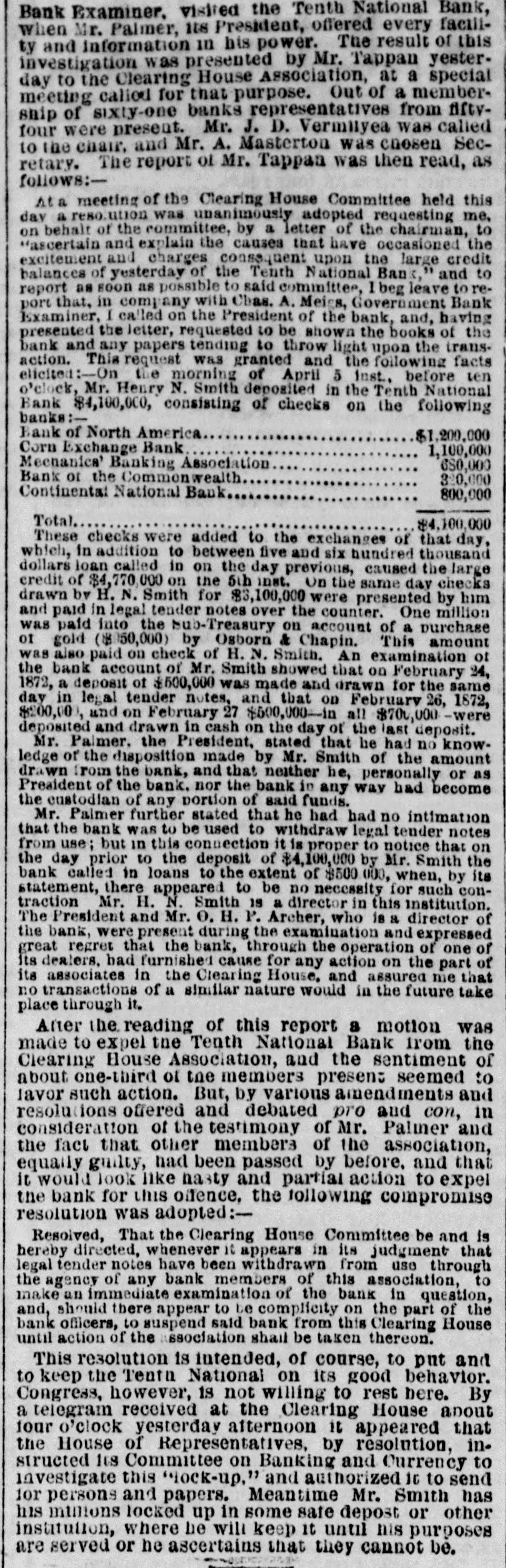
Bank Examiner. visited the Tenth National Bank, when Mr. Palmer, 1ts President, offered every factilty and information in his power. The result of this investigation was presented by Mr. Tappan yesterday to the Clearing House Association, at a special meeting called for that purpose. Out of a membership of sixty-one banks representatives from ffftfour were present. Mr. J. D. Vermilyea was called to the chair, and Mr. A. Masterton was cnosen Secretary. The report of Mr. Tappan was then read, as follows:sta meeting of the Clearing House Committee held this day a resolution was unanimously adopted requesting me, on behalt of the committee, by a letter of the chairman, to "ascertain and explain the causes that have occasioned the excitement and charges consequent upon the large credit balances of yesterday of the Tenth National Bank," and to report as soon as possible to said committee, I beg leave to report that, in comi any with Chas. A. Meigs, Government Bank Examiner, I called on the President of the bank, and, having presented the letter, requested to be shown the books of the bank and any papers tending to throw light upon the transaction. This request was granted and the following facts elicited:- On the morning of April 5 Inst., before ten o'clock, Mr. Henry N. Smith deposited in the Tenth National Bank $4,100,000, consisting of checks on the following banks:Bank of North America $1,200,000 Corn Exchange Bank 1,100,000 Mecnanica' Banking Association 650,000 Bank of the Commonwealth 320,000 Continental National Bank 800,000 Total $4,100,000 These checks were added to the exchanges of that day, which, in addition to between five and six hundred thousand dollars loan called in on the day previous, caused the large credit of $4,770,000 on the 5th inst. On the same day checks drawn by H. N. Smith for $3,100,000 were presented by him and paid in legal tender notes over the counter. One million was paid into the sub-Treasury on account of a purchase of gold $050,000) by Osborn & Chapin. This amount was also paid on check of H. N. Smith. An examination ot the bank account of Mr. Smith showed that on February 24, 1872, a deposit of $500,000 was made and drawn for the same day in legal tender notes, and that on February 26, 1872, $200,000, and on February 27 $500,000-in all $700,000-were deposited and drawn in cash on the day of the last deposit. Mr. Palmer. the President, stated that he had no knowledge of the disposition made by Mr. Smith of the amount drawn from the bank, and that neither he, personally or as President of the bank. nor the bank in any way had become the custodian of any portion of said funds. Mr. Palmer further stated that he had had no intimation that the bank was to be used to withdraw legal tender notes from use; but in this connection it is proper to notice that on the day prior to the deposit of $4,100,000 by Mr. Smith the bank called in loans to the extent of $500 000, when, by its statement, there appeared to be no necessity for such contraction Mr. H. N. Smith 19 a director in this institution. The President and Mr. O. H. P. Archer, who is a director of the bank, were present during the examination and expressed great regret that the bank, through the operation of one of its dealers. had furnished cause for any action on the part of its associates in the Clearing House. and assured me that no transactions of a similar nature would in the future take place through it. After the reading of this report a motion was made to expel the Tenth National Bank from the Clearing House Association, and the sentiment of about one-third of the members present seemed to lavor such action. But, by various amendments and resolutions offered and debated pro and con, in consideration of the testimony of Mr. Palmer and the fact that other members of the association, equally guilty, had been passed by before, and that it would look like nasty and partial action to expel the bank for this offence, the following compromise resolution was adopted:Resolved, That the Clearing House Committee be and is hereby directed, whenever it appears in its judgment that legal tender notes have been withdrawn from use through the agency of any bank members of this association, to make an immediate examination of the bank in question, and, should there appear to be complicity on the part of the bank officers, to suspend said bank from this Clearing House until action of the ssociation shall be taken thereon. This resolution is intended, of course, to put and to keep the Tentn National on its good behavior. Congress, however, is not willing to rest here. By a telegram received at the Clearing House anout four o'clock yesterday afternoon it appeared that the House of Representatives, by resolution, in. structed Its Committee on Banking and Currency to investigate this "lock-up," and authorized 10 to send for persons and papers. Meantime Mr. Smith has his minions locked up in some safe depost or other institution, where be will keep it until his purposes are served or he ascertains that they cannot be.


Article from Memphis Daily Appeal, April 15, 1872

Click image to open full size in new tab

Article Text

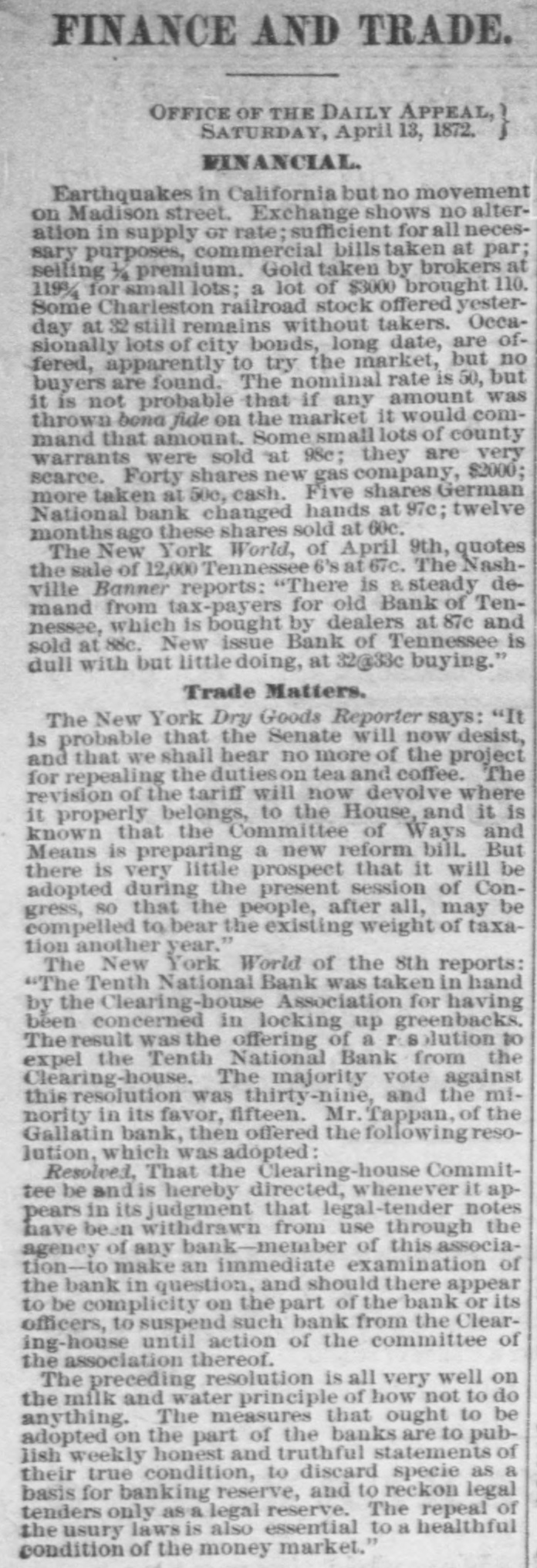
FINANCE AND TRADE. OFFICE OF THE DAILY APPEAL, SATURDAY, April 13, 1872. FINANCIAL Earthquakes in California but no movement on Madison street. Exchange shows no alteration in supply or rate; sufficient for all necessary purposes, commercial bills taken at par; selling 1/4 premium. Gold taken by brokers at 119% for small lots; a lot of $3000 brought 110. Some Charleston railroad stock offered yesterday at 32 still remains without takers. Occasionally lots of city bonds, long date, are offered, apparently to try the market, but no buyers are found. The nominal rate is 50, but it is not probable that if any amount was thrown bona fide on the market it would command that amount. Some small lots of county warrants were sold at 98c; they are very scaree. Forty shares new gas company, $2000; more taken at 50c, cash. Five shares German National bank changed hands at 97c; twelve months ago these shares sold at 60c. The New York World, of April 9th, quotes the sale of 12,000 Tennessee 6's at 67c. The Nashville Banner reports: "There is a steady demand from tax-payers for old Bank of Tennessee, which is bought by dealers at 87c and sold at 88c. New issue Bank of Tennessee is dull with but little doing, at 32@33c buying." Trade Matters. The New York Dry Goods Reporter says: "It is probable that the Senate will now desist, and that we shall hear no more of the project for repealing the duties on tea and coffee. The revision of the tariff will now devolve where it properly belongs, to the House, and it is known that the Committee of Ways and Means is preparing a new reform bill. But there is very little prospect that it will be adopted during the present session of Congress, so that the people, after all, may be compelled to bear the existing weight of taxation another year." The New York World of the 8th reports: "The Tenth National Bank was taken in hand by the Clearing-house Association for having been concerned in locking up greenbacks. Theresult was the offering of a r solution to expel the Tenth National Bank from the Clearing-house. The majority vote against this resolution was thirty-nine, and the mimority in its favor, fifteen. Mr. Tappan, of the Gallatin bank, then offered the following resoJution, which was adΓ³pted: Resolved, That the Clearing-house Committee be and is hereby directed, whenever it appears in its judgment that legal-tender notes have bea withdrawn from use through the agency of any bank-member of this association- to make an immediate examination of the bank in question, and should there appear to be complicity on the part of the bank or its officers, to suspend such bank from the Clearing-house until action of the committee of the association thereof. The preceding resolution is all very well on the milk and water principle of how not to do anything. The measures that ought to be adopted on the part of the banks are to publish weekly honest and truthful statements of their true condition, to discard specie as a basis for banking reserve, and to reckon legal tenders only as a legal reserve. The repeal of the usury laws is also essential to a healthful condition of the money market."


Article from Chicago Daily Tribune, December 20, 1872

Click image to open full size in new tab

Article Text

In passing the Deficiency Appropriation bill, yesterday, the House added an amendment forbidding the Board of Public Works of the District of Columbia to involve the United States in any further liabilities beyond the appropriations of the last session. One hundred thousand dollars was appropriated for the Vienna Exposition, and the appointment was authorized of twelve American artisans to visit the Exposition and study foreign industry. With regard to the celebrated greenback lockup perpetrated last year by the Tenth National Bank of New York, the Banking Committee reported that the Directors meant to create a panic by what they did, and that they succeeded so far as to produce a tightness of the money market throughout the country. They recommend no action against the bank, but, to prevent such financial corners in the future, they offer a bill which imposes a fine of $10,000 upon any bank offending hereafter in this way, forfeits its charter, and imprisons the guilty officers five years. The Committee have been ordered to ascertain whether any combinations are now in existence for locking up coin or greenbacks, and in what way they may be defeated and prevented in future.


Article from Ottumwa Weekly Courier, December 26, 1872

Click image to open full size in new tab

Article Text

CONCRESSIONAL. WASHINGTON, Dec. 19. HOUSE, On motion of Wood. a resolution was adopted that the Banking Committee enquire whether unlawful combinations for locking up gold and other money exist, causing commercial and financial stringency, and report the legislation necessary to prevent such uniawful combinations. Mr. Hooper reported from the investigation committee, ou the charge again t the Tenth National bank of New York, of its locking up currency, with a view of producing a money panic. The committee recommended the passage of a bill prohibiting national banks from locking up currency, and any officer of such banks abetting such action be fined ten thousand dollare and imprisonment for five years. Resolutions were adopted appoint* ing a Committee of Three to examine into the cause of the loss of stamps from the Assistant Treasurer's office at New York. The bill for paying the expenses of the Mexican Commission passed. The Diplomatic Appropriation bill, appropriating $1,332,000 dollars was reported and made the special order for January 7th. The House went into Committee of the Whole on the Deficiency bill. After debate the bill was reported with amendment, forbidding the board of Public Works of the District of Columbia from incurring any indebt. edness for the U. S. beyond the amount appropriated by Congrese. The bill passed 109 against 45.


Article from St. Johnsbury Caledonian, December 27, 1872

Click image to open full size in new tab

Article Text

Congressional. SENATE. Dec. 19. Mr. Sherman, from the Finance Committee, reported a substitute for the bill prohibiting the sale of liquors in the District of Columbia and other Territories. Mr. Edmunds said he intended to call up the joint resolution adverse to the erasure of the names of battles from the flags and Army Register. but retrained. as he understood that Mr. Summer was too unwell to speak. House.-Mr. Hooper of Massachusetts reported from the investigating committee on the charges against the Tenth National Bank of New York of its locking up currency with the view of produeing a money panic. The committee recommend the passage of a bill prohibiting national banks from locking up currency, and that any officer of such banks abetting such action be fined $10,000 and imprisoned five years. Mr. Banks' (of Massachusetts) bill appropriating $100,000 in aid of American exhibitors at the Vienna Exposition was amended on the motion of Mr. Hoar, by providing for an appointment of a commission of twelve skilled citizens to attend the Exposition and report their observations to the President, and passed. SENATE. Dec. 20. A bill appropriating $18,790, to defray the expenses of the Mexican frontier commission, was passed. The Indian appropriation bill was postponed, and the deficiency bill taken up. Some debate ensued in reference to the appropriation for public works in the District of Columbia. Mr. Edmunds, before voting for the appropriation, desired an investigation as to whether the moneys heretofore appropriated had been properly expended. Mr. Morrill of Vermont said the board of public works had acted with fairness and justice. On motion of Mr. Edmunds an amendment was adopted that the amount appropriated shall be paid on approval of the prices by the commissioner of public works.


Article from The New York Herald, December 31, 1872

Click image to open full size in new tab

Article Text

letter referred to. The City Deposits-The Custody of the City Funds and the Interest Question. Comptroller Green last week addressed a letter to the City Chamberlain, expressing a want of confidence in the Tenth National Bank, in which was deposited two million one hundred thousand dollars belonging to the city of New York, and requesting the Chamberlain to "make immediate arrangements to have the same transferred to some banking institution of the city of recognized standing and means." This letter reached the Chamberlain at four o'clock on Saturday afternoon, and on Monday morning early that officer drew a warrant for one million eight hundred and fifty thousand dollars on the Tenth National Bank, and sent it to the Comptroller for his signature, for the purpose of drawing out that amount of the public deposit. The Chamberlain, in his reply to the Comptroller, states that he thus withdraws all but two hundred and fifty thousand dollars from the Tenth National, "without any notice," in order to show how unnecessary are the Comptroller's apprehensions in relation to the safety of the public moneys on deposit in that bank, but adds that he does not by this action waive his right to exclusive direction in regard to the custody and safety of the public moneys. If Comptroller Green had any good grounds for believing that the Tenth National Bank is an unsafe depository of the city moneys he did perfectly right to counsel their withdrawal therefrom. No person else shared his fears as to the solvency of that institution, which is supposed to stand in as good credit as any bank of its capital in the city, and its prompt payment of nearly the whole of the large deposit at sight will probably remove even Comptroller Green's apprehension. If the request made to the Chamberlain was prompted by less worthy motives it has only recoiled upon himself, for it has afforded the Tenth National bank an opportunity to prove its strength, and has fully justified the discretion of the Chamberlain in selecting it as a bank of deposit. Indeed, the "alarm" of the Comptroller must have been of recent origin. No portion of the deposits can be withdrawn from the Broadway Bank and placed in any other bank without the countersigning of the warrant by the Comptroller; hence that officer must have had full confidence in the solvency of the Tenth National when he consented, by his signature, to the transfer of so large an amount of the city moneys to that bank. The Chamberlain is right in protesting against any intermeddling on the part of the Comptroller with the custody of the public funds. The present financial system contemplates the entire separation of the two offices. The Chamberlain is the treasurer of the city, holding custody of its moneys, responsible for their safe keeping, and giving bonds in a heavy amount-one million two hundred thousand dollars-for the faithful discharge of his duties. The object is clear. It would be an unwise policy to allow the Comptroller-who gives only twenty-five thousand dollars bonds-to draw warrants and pay them himself; to hold the custody of the city funds in one hand and to disburse them with the other. Whether the law regulating the Chamberlain's powers and prescribing his duties does or does not need amendment is foreign to the subject. The principle of separating the offices of Comptroller and Chamberlain is a good one, and the rest is matter of detail. The HERALD long since advocated a law compelling the banks holding the city deposits to pay interest on the same, and, in its absence, approved the action of Chamberlain Sweeny, who, on his own responsibility, required the depositories to allow four per cent interest, and paid the amount over to the city, thus creating a fund of between four and five hundred thousand dollars for the benefit of the taxpayers up to the time Chamberlain Palmer took office. Comptroller Green thought proper to prohibit this arrangement. Like much of the Comptroller's official conduct this action savored more of personal spite than of public spirit. The city received the money, but the Chamberlain obtained credit for the arrangement. The interests of the taxpayers were sacrificed to gratify petty jealousy. However much it may be the fashion to applaud Comptroller Green's honesty, these are plain facts, known to every citizen, and the communication from Chamberlain Palmer on the subject only renders them more clear and


Article from Wilmington Daily Commercial, September 22, 1873

Click image to open full size in new tab

Article Text

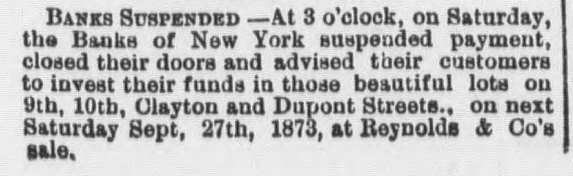
BANKS SUSPENDED -At 3 o'clock, on Saturday, the Banks of New York suspended payment, closed their doors and advised their customers to invest their funds in those beautiful lots on 9th, 10th, Clayton and Dupont Streets., on next Saturday Sept, 27th, 1873, at Reynolds & Co's sale.


Article from Wilmington Daily Commercial, September 22, 1873

Click image to open full size in new tab

Article Text

THE UNION TRUST co. IN THE HANDS OF A RE" CEIVER - THE BANKS ABLE TO MEET ALL DE" MANDS. NEW YORK, Sept. 22. The Union Trust Company has gone into the hands of a Receiver. The Stock Exchange remains closed. A meeting of the Governing Committee will be held tomorrow. All the banks are said to be fully able to meet the demands likely to be made to-day. ONE MILLION IN BONDS PURCHASED. New York, Sept 22, 11 A. M. The Sub Treasury has bought one million in bonds. Large crowds are waiting to sell. SETTLEMENTS AT THE CLEARING HOUSE-RUN COMMENCED ON ALL SAVINGS BANKS. All the banks have settled their accounts at the Clearing House, except two, and those are now settling through a loan committee. A run has commenced on all the Savings Banks. One has paid out half & million. Much excitement prevails. The Government has purchased two millions in bonds, and the Clearing house has issued two millions in loan certificates. THE BANKS ALL RIGHT AND " CLEARED." New YORK, Sep. 22. The Clearing House statement is issued, and shows that all the banks made their clearing, satisfactorily, including the two heretofore reported in doubt. THE GOLD EXCHANGE CLOSED-U 6. BONDS IN GREAT DEMAND-RUN OPENED ON THE BEAMANS SAVINGS BANK. The Gold Exchange has been closed, and 12 has been established as a basis of settlement for gold. U.S. Bonds of all descriptions are being purchased at the Sub-Treasury at the rate of 101/3 with accrued interest in coin. Payments are being made in currency. A run has commenced on the Seamens' Saying Bank. The excitement in Wall St. is much less than on Saturday. THE RUN ON THE BANKS CEASED. There is no run on any of the Banks and a feeling of great relief prevails. All is quiet in Brooklyn, also.


Article from The Daily State Journal, September 22, 1873

Click image to open full size in new tab

Article Text

[SUNDAY NIGHT'S DISPATCHES.] NEW YORK, September 21, 8:10 P. M.-President Grant and Secretary Richardson, have been in consultation with Vanderbilt and other leading capitalists, bankers and merchants since noon. No action reported yet. LATER-RESULT OF THE CONFERENCE, NEW YORK, September 21.-The following is the result of the conference at Avenue hotel, between the and others, as to of the remeans President the Fifth overcoming difficulties the best from the recent financial President positively sulting The declines disasters action to interfere in the matter, as any be of his in connection therewith would unconstitutional. committee of bankers and mercome down to to the government, chants proposition The had the to issue final $80,000,000 of the legal reserve. Reverdy Johnson is said to have given his opinion to the effect that to use the legal reserve is unconstitutional. Secretary Richardson opposes the placing at any considerable sum of the reserve To of the disposal of the New York banks. use his own words, quoted on the authority of one of the committee 'This, gentlemen, is not my funeral." VANDERBILT PAYS $2,000,000 INTO THE UNION TRUST COMPANY-GI ERAL CAUSE OF THE SUSPENSIONS CONDITION OF HEVARIOUSTRADES NEW YORK, September 21.-At a late hour last (Saturday) night, it was stated in one the clubs that Commodore Vanderbilt into the Union the day $2,000,000, the during had of paid Trust amount company due the by the Lake Shore road thus enabling Trust company to restime business Monday morning. The general cause of suspension on the of the banks and bankers yesterday part inability to convert securities into Even government not of except at be cash. was disposed the bonds immense officers could yester- loss. action of the bank difficulty is done away by depositing in the day, By Any the bank, this hands obtain with. of committee good securities, can amount of can an be in the clearing business the used equal certificates, which instead into of legal tenders. The certificates will go effect to-morrow (to-day). The dry goods men believe that Jay Cooke & Co. will pay the last cent of their liabilities. The tea trade is in a healthy cendition, nearly all of that branch of business being done through foreign bankers. The wholesale druggists fear nothing, in unless the stress continues. Sales other branches of trade run along in the same old channels. [TO-DAY'S DISPATCHES.] September 22.-It is offiannounced that Secretary continue to buy bonds at cially NEW will YORK, Richardson Richard- Saturson quotations. Secretary the last he did not see to do more than buy said day's power night bonds, he without had and offered, will be bought or " The government," the all delay 5-20s red tape." secretary says, trust company or loan is doubtful if congress and "is not it a would institution, power." sancsuch construction of my alludes to the using of 000 of the tion [The any above reserves.] $40,000, Thirty savings banks have resolved to rigidlv enforce the previous notice clause. The Union trust company is in the hands of The a receiver. New York stock exchange remains closed to-day. The manager of the clearing house says check passed through clearing will no every paid. He says the banks are in danger, be and that they were never stronger. is The suspension of Marvin & Brothers announced. All banks have pulled through except loan the two settling through the two committee. All the savings banks are having a run on them. The clearing house loan committee have issued $2,500,000 certified checks. The government has bought a million to in bonds. Large crowds are waiting sell. Montreal and Europe are buying stocks at the shrinkage. The gold exchange is closed, 112 has been established as the basis of settlement. The rate of interest is fixed at 7 for carry70-100. ing. The sub-treasury is buying 5-20s at Arun on the Seaman's bank has commenced. They pay all sums of $100 law's and under. Larger sums must wait the delay* WASHINGTON, September 22.-In President the of the morning, the called at the treasury department course Richardson. and had conference with Secretary a of it may be the fact The result that subsequently inferred secretary Associated from stated the of the New York to the President will do bethe law, but in no go within Press the that agent particular will anything main+ clear legal authority. He tain yond the safety of the treasury department, States protect the credit of the United financial and from the influences of the present London house. embarrassment. Jay Cooke reassures the solvency of the PHILADELPHIA, September 22. The the savings uks has subsided. run on September 22. The savings of the banks CHICAGO, give notice of the enforcement sixty days' notice.


Article from Wilmington Daily Gazette, September 22, 1873

Click image to open full size in new tab

Article Text

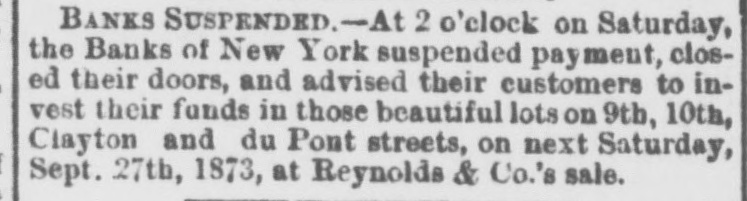
BANKS SUSPENDED.-At 1 2 o'clock on Saturday, the Banks of New York suspended payment, closed their doors, and advised their customers to invest their funds in those beautiful lots on 9th, 10th, Clayton and du Pont streets, on next Saturday, f Sept. 27th, 1873, at Reynolds & Co.'s sale. I


Article from Alexandria Gazette, September 24, 1873

Click image to open full size in new tab

Article Text

NEW YORK, Sept. 24.-Gold opened firm at 112g, but after frequent fluctuatiens fell to 111g. The rate paid for carrying was 7 per cent, to flat for borrowing. Foreign Exchange is demoralized and quotations are almost nominal. NEWYORK, Sept.24--At the meeting of Bank Presidents to-day it was resolved, in addition to the issuing of $10,000,000 of loan certificates and the suspension of currency payments in large amounts to stand by each other with all assets, and any member faiiing to do SO will be expelled. Each member was appointed a committee to ascertain where ten million government bonds or any part thereof can be purchased on account of each bank and sold to the Treasury, any loss accruing thereby to be sustained by the banks according to their deposits in the clearing house. The committee request the President and Secretary of the Treasury to anticipate the payment of bonds due January 1874. FROM PHILADELPHIA. PHILADELPHIA, Sept. 24.-No failures are reported at Allentown, Bethelem, Harrisburg, Pa.. and Trenton, New Jersey. WILKESBARRE PA., Sept. 24.-Brown & Gray, Bankers, have suspended giving the failure of Clews & Co. as the cause, but stating that they will resume in a few days. The mining clases are large depositors with this firm and much excitement exists. They were considered good and reliable men.


Article from New-York Tribune, September 25, 1873

Click image to open full size in new tab

Article Text

a relief. Yet it served to excite and depress the less observing and logical. The sales on the street, which began immediately on the announcement that the Stock Exchange would not open during the day, were at fair rates compared with those that ruled at the close on Saturday last, so that altogether there appeared reasons to be encouraged rather than depressed by these sales. The next event to influence the street was the announcement of the resolutions passed by the Clearing-house Committee. The first resolution issuing an additional $10,000,000 of loan certificates had been anticipated, and the effect had been "discounted." The proposition to obtain $10,000,000 Government bonds to be sold to the Treasury by banks was also accepted as an indication that the Clearing-house banks understood the needs of the hour. But the last proposition, resolving that the banks should not cash heavy checks for currency, but should certify such checks as good only when passed through the Clearing-house, was at once translated to be a practical suspension of all the banks. The discussions which followed, however, convinced many that the resolution was a wise precaution. It prevents panic stricken depositors from drawing out their money and hoarding it, thus taking greenbacks out of the street and from business. It was stated and understood that the banks will liberally provide for all legitimate business and manufacturing firms who need money to pay employΓ©s and to continue their exports and imports. The action soon came to be looked upon as beneficial as the suspension of business on the Stock Exchange, since it helps to allay excitement and prevent individual transactions, which can benefit no one. By the time of the official close of business confidence had largely returned, and the depression was not so marked. There was less croaking heard of probable disasters on the morrow than has marked the close of other days of the panic. At night, too, at the Fifth Avenue and other hotels, the excitement was much abated; and the night closed with a better feeling and far less agitation than any for a week past.


Article from The Daily Phoenix, October 3, 1873

Click image to open full size in new tab

Article Text

Telegraphiq APPLA CARLIST DISSENSIONS DEMORATIZATION OF INSURGENTS-MONRY OF October 1.-Diseensions in MADRID, ranks of the Corlists are increasing. and the leaders Derregarray, Roda and Lizzaraga The have left their commands arrived at Bayonne. Edward October 2-Sir LONDON, the celebrated painter, isdead. from Landleer, October 2. Dasortere and inMADRID, report emoralization the insubordination. Cartagena A majority of but are desire to surrender, more surgents overawed by liberated coavjole and desperate BERLIN, volunteers. October 2.4"Trade A (panic specila on tion is almost suspended the The bourse King is of apprehended Saxony is dangerously sick. LONDON, October Robert Bigby, the English October writer, 2. is dead. Despatches from MADRID, sections of the country represent The all much better feeling prevails. in the re-establishment that of discipline in the served to restore confidence all insurrections. ability army of the Government to suppress relegraphic-American Matters. CONVIOTED-DEZAULTING_CA CASH KU ER-COTTON KLUX DAMAGED IN TEXAS-JUS STATES "RAID" OF UNITED SOLDIERS TIFIABLE IN MEXICO-VELLOW FEVER DEATHS-AID TO SUFFERERS-SIOK AND PUOLLIST-RESUMPTION OF BANKS BROKERS-THE MODOO SUSPENSION- DEMO PLATFORM OF THE NEW YORK CRACY, &0., &0 BROWNSVILLE, TEXAS, October 1.heavy rains have damaged entire Continued cotton crop throughout the have the Rio Grande Valley. Worms lower appeared on a number of plantations The in vicinity, doing much damage. inches this are covered with several the lowlands of water, stopping the work of gathering crop. charge of the Vose Publico, that The United States soldiers When had again the armed invaded Mexico, is untrue. the steamboat Little Fleta stranded on Army Mexican bank of the Rio Grande, with Paymaster Nichols was a passenger, who of United States soldiers, a guard in saving the cargo and guarded landing it assisted and the paymaster's safe after it from the wreck N.O. October 1. The Courts first RALEIGH, Klux trial before, the State Johnson Ku off before Judge Watts, at and came Superior Court, this week, resulted County in the conviction of the parties white, the murder of two men-one of other colored. They went disguised whipped the the colored man's house and to to death on the 6th of September and senhim were convicted o-day. of No tenced They to be hanged on the 13th vember. 3,000 articles have been entered Over exhibition in the coming State instant Fair, for commences on the 13th of the which D. W, Voorhees, the orator the 15th. Hon. will reach here on society, The citizens are making preparations large the ccommodation of the crowd for of visitors that is expected. October Millard FillBUFFALO, the International Exposimore Redmond, of New opened D. Orleans, large. followed tion. The audience is very Ste ST. Louis, Odtobernia Cashier In of the St. Lbula Mutual Life with Company, is from the safe. His surance $6,500 ven#, missing, accounts do not ap- bepear correct, and his friends lieve he embezzled the funds. Nashyille, on Wednesday the In day of the Blood Horse ASHOCIA- heats, second the first race, two mile tion won races, by Arizona, beating Lampie, 3,4634 Carrington was and Duster-time heats, The second race. mile Sur3.441/4. won by Quartermaster, bearing and Lady vey, was Fiprence, Emer Florence Greenfield. YORK October,1--Mid-night- banks NEW visitits the different savings fears on A city, to dayshaw that all vauished, this of depositors haye their the part large numbers who drew out it. and last week have returned money are about $13,000,000 in green- all in the vaults, which, signs of any run are There backs passed, will when be distributed through other channels. NEW YORK, October -The Danforth half Locomotive Works is working on in They have plenty of cashed. money time. but can't get a check bank, John C. Heonan is fatally sick, with hemorrbage of the langs. 386 delegates to the Evangelical morrow, Convention, which assembles to have arrived. Grinnell & Co., brokers and bankers, Paton G. B. & have Co., suspended. one of the oldest dry


Article from National Republican, October 4, 1873

Click image to open full size in new tab

Article Text

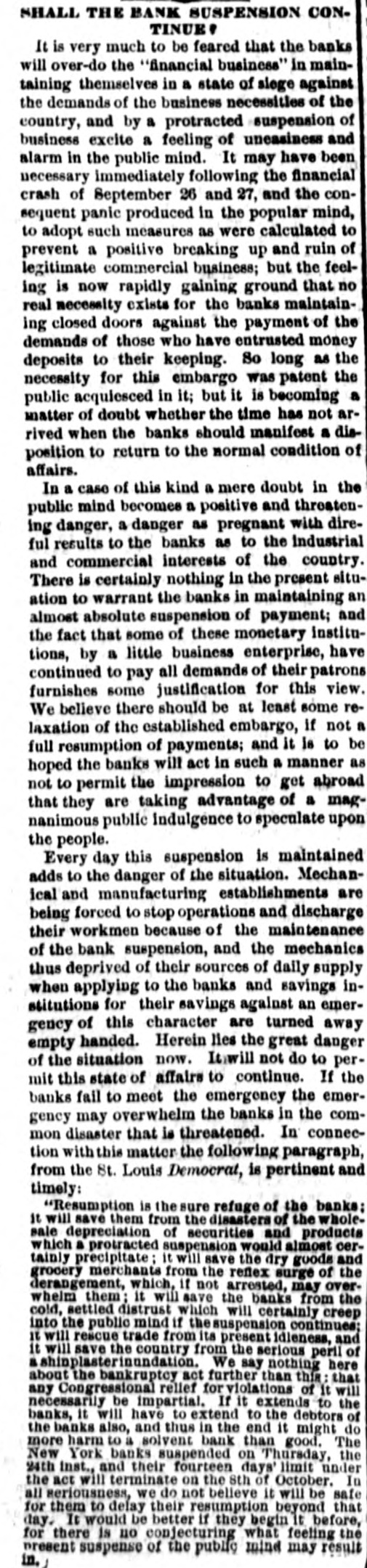
# SHALL THE BANK SUSPENSION CONTINUE It is very much to be feared that the banks will over-do the "financial business" in main-taining themselves in a state of slege against the demands of the business necessities of the country, and by a protracted suspension of business excite a feeling of uneasiness and alarm in the public mind. It may have been necessary immediately following the financial crash of September 26 and 27, and the con-sequent panic produced in the popular mind, to adopt such measures as were calculated to prevent a positive breaking up and ruin of legitimate commercial business; but the feel-ing is now rapidly gaining ground that no real necessity exists for the banks maintain-ing closed doors against the payment of the demands of those who have entrusted money deposits to their keeping. So long as the necessity for this embargo was patent the public acquiesced in it; but it is becoming a matter of doubt whether the time has not ar-rived when the banks should manifest a dis-position to return to the normal condition of affairs. In a case of this kind a mere doubt in the public mind becomes a positive and threaten-ing danger, a danger as pregnant with dire-ful results to the banks as to the industrial and commercial interests of the country. There is certainly nothing in the present situ-ation to warrant the banks in maintaining an almost absolute suspension of payment; and the fact that some of these monetary institu-tions, by a little business enterprise, have continued to pay all demands of their patrons furnishes some justification for this view. We believe there should be at least some re-laxation of the established embargo, if not a full resumption of payments; and it is to be hoped the banks will act in such a manner as not to permit the impression to get abroad that they are taking advantage of a mag-nanimous public indulgence to speculate upon the people. Every day this suspension is maintained adds to the danger of the situation. Mechan-ical and manufacturing establishments are being forced to stop operations and discharge their workmen because of the maintenance of the bank suspension, and the mechanics thus deprived of their sources of daily supply when applying to the banks and savings in-stitutions for their savings against an emer-gency of this character are turned away empty handed. Herein lies the great danger of the situation now. It will not do to per-mit this state of affairs to continue. If the banks fail to meet the emergency the emer-gency may overwhelm the banks in the com-mon disaster that is threatened. In connec-tion with this matter the following paragraph, from the St. Louis Democrat, is pertinent and timely: "Resumption is the sure refuge of the banks; it will save them from the disasters of the whole-sale depreciation of securities and products which a protracted suspension would almost cer-tainly precipitate; it will save the dry goods and grocery merchants from the reflex surge of the derangement, which, if not arrested, may over-whelm them; it will save the banks from the cold, settled distrust which will certainly creep into the public mind if the suspension continues; it will rescue trade from its present idleness, and it will save the country from the serious peril of a shinplasterinundation. We say nothing here about the bankruptcy act further than this: that any Congressional relief for violations of it will necessarily be impartial. If it extends to the banks, it will have to extend to the debtors of the banks also, and thus in the end it might do more harm to a solvent bank than good. The New York banks suspended on Thursday, the 24th inst., and their fourteen days' limit under the act will terminate on the 8th of October. In all seriousness, we do not believe it will be safe for them to delay their resumption beyond that day. It would be better if they begin it before, for there is no conjecturing what feeling the present suspense of the public mind may result in."


Article from Mower County Transcript, October 9, 1873

Click image to open full size in new tab

Article Text

N.MOWER COUNTY, MINNESOTA, THURSDAY from 000 to ber did they begin $200,000,000 of to the five alarmed successive and 181. was weeks preceding they withdrew in from the banks each week than the the banks withdrew from them by the de pression of loans. Although the panic started on the 25th of August, caused bny gold without fear, In the middle by the contraction of loane, and was at of September it bon $9,000,000 at Mormons to be Drov once carried by the telegraph with the 1331@134 in one batch. On the mornCorrespondence of speed of lightping to all parts of the ing of Wednesday, the 22d. it held country, marked withdrawal of SALT LAKE CITY, A several millions more than there were day visited the Gre deposits depositors took in the city of New York outside the place till more than an few strangers go to it Sub-Treasury, and yet the price had entire month later. Up to that spend a month in t been forced no higher than 141. The would find out how t time the depositors presented a steady clique settled its plans on Thursday ably half of the resid front, apparently determined to sus, evening. It had tain the public credit if everything mon capital have net sums at 138. The plan at first to else hen October came shores of this great call in all of this, lock it up and force atonce to cease to and Profile Rocks, th the bears to settle by buying in under be and on the 8d of that interest, are twenty the rule. The Tenth National Bank month a marked change came over the Accompanied by th to have been used to shift the immense spirit of the depositors. Over four Rood, formerly of sums, but the appearance of the bank millions of deposite were withdrawn in party of ladies, left examiners unsettled this plan, and the the seven following, and over 6a. m. We had a fin programme was to put gold up swiftly fourteen millions in the next twenty. Running out of town and frighten the bears into direct setThe 14th of October was the date of street turning at th tlements. As it was, the officials of struck for a mountain banks suspension. On the day the bank agreed to certify to an unlimfollowing withdrawals ceased and lake apparently but t ited extent night day. Oh Thursrestoration Its true distance is 18 One of the day it did certify checks amounting to causes the by banks mosphere is so clear $25,000,000, and on Friday, spite of themselves themselves for their susfield of glass, makin the presence of the examiners, $14, pension was the sudden withappear much nearer 000,000 more. All this time an army drawal of country balances, and are. At times they of holders in the pay of the clique, rifle range. Occasion for this the telegraph was responsible. and under the leadership of one Albert It not only took the news to the valley grows hazy and Speyers, was buying up all the gold country banks of the collapse of credit peaks loom up abov that was offered, and endeavoring to island cliffs above the in the city, but brought back their bring it up to 200. Their efforts were orders demanding their deposits in more than successful. Gold reached specie. The Clearing House, too, was 160, and for an instant touched 165. The road to the lal alleged to aid in increasing the general This was the harvest time for the by irrigating ditche collapse. Its daily settlements in coin Jordan. With these clique, and while some of his agents forced the smaller banks into contract level as a floor. For were thus keeping the price by bawling their loans, into sacrifices of prop. ng bide for millions 160, Gould was is bordered by fields of erty, and finally iuto bankruptcy. unloading through a dozen different but few fences. The Default at the Clearing House became is a desert. Even the brokers at far lower figures, but yet the Banquo's ghost that appeared at refuses toggrow. The an immense profit to himself. He had, the bank ard of all the smaller instihowever. pushed the price too far, and impregnated with alk tutions. The most universally accepted when news came that Secretary Boutplaces at looks as t cause for the panic of 1857 is the viosprinkled it with well would sell $4,000,000 of gold the lent contraction of bank loans immediprice fell even more anddenly than The Jordan is a qui ately after the 24th of August. And rods wide. The wat it had risen, and general ruin and this was entirely the action of the There are no utter confusion fell upon Wall street banks, and they had only themselves to a certain extent even-involving those banks. The Mormo to blame. It was, too, the expansion who had been chiefly instrumental in very much as the Cr of banks previous to the panic that producing it. Down, down went the the original Jordan laid the foundation for the memorable falsely bolstered price. The day was their eyes is sac commercial crisis of 1857. the blackest that ever set on Wall declare that the OF '66. street. Men knew not where they Smith appeared to In the early months of 1866 the stood. The confusion and madness upon one of the moun financial position and feeling in Lonso great that it was supposed that city, and pointed out don was in morbid state; organized all the clique had gone down. Of the as it wound its way ov bear cliques formed during the months times that followed it is impossible to narrow silver ribb of March and April, and were bearing give an idea. There was run on the Brigham that the Gre all kinds of stocks, but especially the Tenth National Bank the next day, and the promised land. newly created tocial companies and million was drawn out. The Gold site of the of several of the stock banks, of which the Clearing House kept $14,000,000 inexthe crection of thetem Agra and Masterman was a central tricably locked up. The $500,000,000 spot. object. Although Overend & Gurney's of clearings demanded in one day of THE GREAT SALT L company was selected for attack, the bank dizzied its incapacity. Gould A dozen miles from no one of the most sanguine had not yet done his work. proached the marsh bears dreamt of the really rotten When it was publicly known that Great Salt T state of the great discounting only the account of his firm was extent, and were co house. On the beginning of May, needed to finish the clearances for herds of fat cattle. 1866, people or 'Change andin the city Black Friday, and when upon that herds are owned by congratulated themselves that the account fortunes were spending, hourly Jesus Christ of Latt morbid feeling in financial affairs was Gould telegraphed from his barracks The real foundation past, and the stocks all round were at the Grand Opera House, where he its tithing system. U considered better and stronger. These was guarded from the mob by police, each saint turns over delusions almost invariably follow the not to send it down. The bank went bis earnings for th greatest disasters On Thursday, the into the hands of a receiver. Then church. Many of th 8th of August, 1866, I was walking up came a crash. Four firms were declared their tithes in cattle Newgate street about four P. M., when suspended. Then came a rumor that is said to include met one of those noisy, busy men Lockwood & Co., Vanderbilt's brokers, of stock. It is a sour ho hear and know everything first. had gone under-the strongest house ing revenue, for the I was on the opposite side of the street on the street. They had been carrying choicest kind when this man bawled out to me, Pacific Mail, Lake Shore, Chicago and prices. The herders " Did you hear Overend-Gurney's have Northwestern, on which the loss was the dignitarie of failed Walking acrosst he street millions, with money at 800 to 1,200 Bishops keep to meet him (a dozen men per cent. a year. The firm stock. or more were already arrested But Vanderbilt poured in millions, and The marshes of the by his loud communication,) sent up Lake Shore, Northwestern, are the resort of the cautiously said hush," when with and Central, held them, and saved fowl. They present louder tone he bawled out again, bimself. Ou Saturday, October 1, for sportsmen. Amor say Gurney's have failed By this Gould began his clearances not till snipe we saw time a perfect mob had gathered round then. The delay of the clique in dling up a little lagoo us. Ideft the crowd and wended my settling is accountable, with the cumbare said to be very way to the well known corner house rous machinery of the Gold Exchange of wild beans are in Lombard street. To my astonishand bank, for the terrible wear and marshes. ment saw no crowd, no excitement, tear of the week that followed the fatal fou height of The only sign of suspension was the Friday. fragrant closed doors of the house must


Article from Mower County Transcript, October 9, 1873

Click image to open full size in new tab

Article Text

$150,000,000 to $200,000,000 of floating gold, and gold was. weak at 131. There was $80,000,000 in the Sub-Treasury, but somebody had promisel that the government would not sell. The clique, therefore, could buy gold without fear. In the middle of September it bought $9,000,000 at 1334@134 in one batch. Ou the morning of Wednesday, the 22d. it held several millions more than there were in the city of New York outside the Sub-Treasury, and yet the price had been forced no higher than 141. The clique settled its plans on Thursday evening. It had loaned gold in immense sums at 138. The plan at first was to call in all of this, lock it up and force the bears to settle by buying in under the rule. The Tenth National Bank was to have been used to shift the immense sums, but the appearance of the bank examiners unsettled this plan, and the programme was to put gold up swiftly and frighten the bears into direct settlements. As it was, the officials of the bank agreed to certify to an unlimited extent night and day. Oh Thursday it did certify checks amounting to $25,000,000, and on Friday, spite of the presence of the examiners, $14, 000,000 more. All this time an army of holders in the pay of the clique, and under the leadership of one Albert Speyers, was buying up all the gold that was offered, and endeavoring to bring it up to 200. Their efforts were more than successful. Gold reached 160, and for an instant touched 165. This was the harvest time for the clique, and while some of his agents were thus keeping the price by bawlng bids for millions at 160, Gould was unloading through a dozen different brokers at far lower figures, but yet at an immense profit to himself. He had, however, pushed the price too far, and when news came that Secretary Boutwell would sell $4,000,000 of gold the price fell even more suddenly than it had risen, and general ruin and utter confusion fell upon Wall street, to a certain extent even involving those who had been chiefly instrumental in producing it. Down, down went the falsely bolstered price. The day was the blackest that ever set on Wall street. Men knew not where they stood. The confusion and madness was so great that it was supposed that all the clique had gone down. Of the times that followed it is impossible to give an idea. There was a run on the Tenth National Bank the next day, and a million was drawn out. The Gold Clearing House kept $14,000,000 inextricably locked up. The $500,000,000 of clearings demanded in one day of the bank dizzied its incapacity. Gould had not yet done his work. When it was publicly known that only the account of his firm was needed to finish the clearances for Black Friday, and when upon that account fortunes were spending, hourly Gould telegraphed from his barracks at the Grand Opera House, where he was guarded from the mob by police, not to send it down. The bank went into the hands of a receiver. Then came a crash. Four firms were declared suspended. Then came a rumor that Lockwood & Co., Vanderbilt's brokers, had gone under-the strongest house on the street. They had been carrying Pacific Mail, Lake Shore, Chicago and Nortbwestern, on which the loss was millions, with money at 300 to 1,200 per cent. a year. The firm went down. But Vanderbilt poured in millions, and sent up Lake Shore, Northwestern, and Central, held them, and saved himself. Ou Saturday, October 1, Gould began his clearances--not till then. The delay of the clique in settling is accountable, with the cumbrous machinery of the Gold Exchange and bank, for the terrible wear and tear of the week that followed the fatal Friday.


Article from Daily Kennebec Journal, October 16, 1873

Click image to open full size in new tab

Article Text

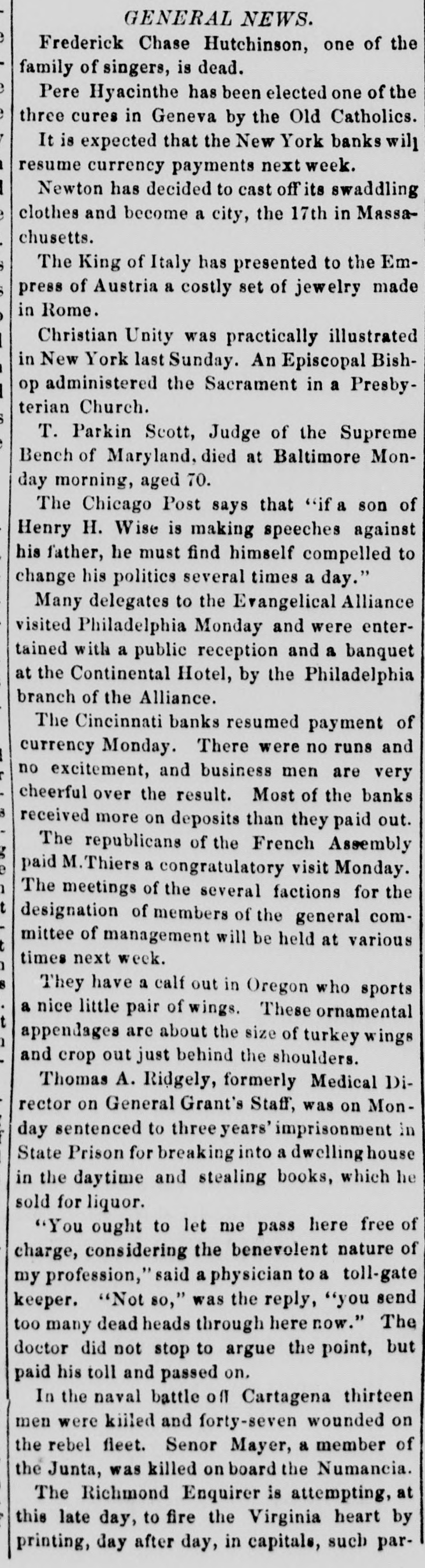
# GENERAL NEWS. Frederick Chase Hutchinson, one of the family of singers, is dead. Pere Hyacinthe has been elected one of the three cures in Geneva by the Old Catholics. It is expected that the New York banks will resume currency payments next week. Newton has decided to cast off its swaddling clothes and become a city, the 17th in Massachusetts. The King of Italy has presented to the Empress of Austria a costly set of jewelry made in Rome. Christian Unity was practically illustrated in New York last Sunday. An Episcopal Bishop administered the Sacrament in a Presbyterian Church. T. Parkin Scott, Judge of the Supreme Bench of Maryland, died at Baltimore Monday morning, aged 70. The Chicago Post says that "if a son of Henry H. Wise is making speeches against his father, he must find himself compelled to change his politics several times a day." Many delegates to the Evangelical Alliance visited Philadelphia Monday and were entertained with a public reception and a banquet at the Continental Hotel, by the Philadelphia branch of the Alliance. The Cincinnati banks resumed payment of currency Monday. There were no runs and no excitement, and business men are very cheerful over the result. Most of the banks received more on deposits than they paid out. The republicans of the French Assembly paid M. Thiers a congratulatory visit Monday. The meetings of the several factions for the designation of members of the general committee of management will be held at various times next week. They have a calf out in Oregon who sports a nice little pair of wings. These ornamental appendages are about the size of turkey wings and crop out just behind the shoulders. Thomas A. Ridgely, formerly Medical Director on General Grant's Staff, was on Monday sentenced to three years' imprisonment in State Prison for breaking into a dwelling house in the daytime and stealing books, which he sold for liquor. "You ought to let me pass here free of charge, considering the benevolent nature of my profession," said a physician to a toll-gate keeper. "Not so," was the reply, "you send too many dead heads through here now." The doctor did not stop to argue the point, but paid his toll and passed on. In the naval battle off Cartagena thirteen men were killed and forty-seven wounded on the rebel fleet. Senor Mayer, a member of the Junta, was killed on board the Numancia. The Richmond Enquirer is attempting, at this late day, to fire the Virginia heart by printing, day after day, in capitals, such par-


Article from The Cairo Bulletin, October 17, 1873

Click image to open full size in new tab

Article Text

TELEGRAPHIC. Reported Expressly for the Bulletin. FROM NEW YORK. WOMAN'S CONGRESS, NEW YORK, October 16.β€”The first congress of the association to promote the moral, intellectual and physical well-being of women was begun yesterday at League hall, and was numerously attended, Letters were read from Emily Faithfu and others, last evening. Mrs. Mary Ol-ivemore was chosen president, and among the secretaries were Mrs. M. Loomis, Thos. Piumer, P. M. Sherwood, Rev. Elva T. Wilkes, Colorado; Mr. E. S. Tupper, Iowa; Mrs. F. Emlard, 1lle.; Mr. L. Woods, Mrs. Frances Miner, Missouri. The executive committee includes Mrs. Augusta Chapin, Iowa; and Professor Maria Mitchell, of Vasser college. STOKES' TRIAL. In the Stokes trial to-day, Thomas Hart, doorman at the ladies' entrance of the Grand Central hotel, and the principal witness against the prisoner, admitted on cross-examination that after the last trial, being sick and out of employment he called on Chapin & Co., Fisk's brokers, and from them he went to Mr. Coner, Fisk's former managing agent and was by him sent to the private secretary of Mrs. Fisk, from whom he received fifty dollars. The rest of the witness' evidence was as on former trials. Judge Friedman and jury, in the supe-rior court to-day, tried the suit of Charlotta Gilbert against the New York and Charleston Steamship company, claiming $10,000 damages for being excluded from the state-room of the steamer Manhattan in 1870. The plaintiff obtained a verdict in her fayor for $75. Phillip, Spier & Co., Scott, Strong & Co., and Alcott & Co., had their stock sold out under rule for thew ccount of Grinnel & Co., as follows: 3,000 shares in the Union Pacific at 18@19, 3,700 Lake Shore at 66@67; 300 New York Central at 83Β½; 100 Pacific Mail. STOKE'S TRIAL. Phillip Farley, hotel porter, contradict-ed the testimony of Thos. Hart, as to Stokes saying he knew nothing of the shooting. Farley was the man who seized Stokes, and he heard everything said. Witness also stated that he searched for the pistol in room number 207 about half-past four and found none. MONEY. Money closed at 1 1-16@1 3-16, but just before this when the bank accounts were made up, offers went down rapidly on small amourtesaamarcantverki that it was regarded by some as having connection with current speculation in stock exchange, as prices were bid up rapidly. At the very close of the market, greenbacks were less active at Β½@ΒΎ. At the final close quotations were Β½@ΒΎ. The premmum demand for foreign exchange for 6 months at 5Β½ to 6 for long and 6Β½ to 7 for short. Commercial bilis in good supply and dull at 4Β½@5. Custom house receipts $171,000. Gold heavey and lower, declining from Β½ to 7/8, which price has not been before reached since June, 1865. When the closing rate was 8c. The assistant treasurer disbursed $76,000. Government's firm early in the day but closed lower in sympathy with gold. The quietest decline was in 67 and 68's. Railroad and miscellaneous speculations irregular, but prices in main higher. Adding, the 'Express' says: "The question of the banks resuming greenback payments now being actively discussed in financial circles, especially as it has an important bearing upon the general situation, while the New York banks are in a state of suspension the people in the interior have a good excuse for not paying the debts to the Atlantic cities, and consequently collections are much lower than they would otherwise be. In different parts of the country the national banks are gradually resuming currency payment, and these banks could make still greater headway if the banks of New York, and Philadelphia, should resume. The Philadelphia banks have about $300,000 of their reserve in this city, and they cannot remit until our own banks do. It does not follow that this money would be withdrawn from New York in case of resumption, but, on the contrary, it would probably remain, as the Philadelphia banks would not draw it as soon as it became apparent that they could get it. Resumption by New York banks is an important step in the restoration of confidence, and this can only be accomplished by giving up the present system of pooling greenbacks, which has always been an injustice to strong banks, able to take care of themselves. These banks have carried safely through the recent panic about a dozen weak banks, and its but right that they should deserve resumption. These weak banks would no doubt be called upon to liquidate largely in consequence of the withdrawal of deposits and cancellation of accounts, and possibly some might have to to be wound up, but our banking business would be placed, on a strange basis, and moral effect and resumption would be felt here though not in the country. The deposits of our city banks now range from a hundred and forty-four to a hundred and fifty million dollars, and greenbacks on hand are from fifty-five to six million dollars. By this it will be seen that the per cent, of greenbacks on deposit is only apout four per cent, and adding the city bank circulation of twenty-eight million dollars, the per cent of greenbuck


Article from Chicago Daily Tribune, October 23, 1873

Click image to open full size in new tab

Article Text

MONEY AND COMMERCE. MONETARY. WEDNESDAY EVENING, Oct. 22. Money matters are very quiet in this market, and we find no considerable change to note in the aspect of affairs since the beginning of the week. New York exchange continues scarce, and sold between banks to-day at 500 per $1,000 premium. Shippers' bills drawn against grain in transit are taken at ΒΌ and also at ΒΎ of 1 per cent discount. The amount of this class of bills is, however, very small, compared to what it would be under ordinary circumstances at this season of the year. One obstacle to the free movement of grain is, that shippers of cargoes cannot get the usual advances from their New York consignees, because the latter cannot get the usual accommodations at the New York banks. The movement of Western crops to market is therefore being done mainly on Western capital. The scarcity of money in the Eastern markets also has its effect upon the prices of products, as well as of the foreign exchange made against the shipment of the products to Europe. There is a very moderate but steady flow of currency from this city to New York, but the stock of currency in the banks here is very large, and some of it can very well be spared. The main cause of the great accumulation of currency here is that the banks of this city are still acting on the policy of keeping their whole reserve here in greenbacks, instead of keeping half of it in New York exchange, -as the Nationals are permitted to do by law, and as has heretofore been their custom. The recent panic gave the Western banks such a scare that, even after New York banks resume currency payments, it will be a long time, perhaps a year or two, before the New York balances of Western banks will increase to anything like the proportions they had attained just before the panic. The accumulations of money caused by the increase of banking facilities, are, however, bound to accumulate somewhere at certain seasons of the year. No amount of currency-tinkering to make the volume of currency "elastic," will prevent this accumulation of bank credits, even if the much-denounced system of paying interest on deposits were entirely discontinued. These accumulations once made, there is no question that inducements of one kind or another will be offered to draw this temporarily unused money out into the prosecution of enterprises and speculations that could not command the money under any other condition of the money market. In the foregoing connection, we print the following ably-written communication from a banker at Eau Clairo, Wis., in DEFENSE OF INTEREST ON DEPOSITS: To the Editor of The Chicago Tribune: DEAR SIR: By common agreement the "system of paying interest on deposits subject to call," seems to have been chosen as the goat over which to confess all the iniquities of the children of Mammon, and, putting their transgressions in all their sins upon his head, they are going to send him away by the hand of a fit man into the wilderness. The fit man in this case may prove to be President Grant, who proposes to recommend a law absolutely prohibiting the practice, which he, as well as all those whose views on the subject find expression in print, calls by very hard names. It must be agreeable to those who have been tinkering at our finances in a legislative and administrative way, to be assured that the real cause of all the recent trouble is a natural outgrowth of competition in the banking business, and nothing for which they are in any way responsible. They will thereby be cheered and encouraged to proceed. It is encouraging, also, for those who may have taken desponding views of human nature to observe the zeal and the high moral tone with which metropolitan bankers are advocating a return to sound and legitimate banking principles, especially in this direction. There is something quite touching in the circulars with which they favor country bankers now-a-days, -the old matter-of-fact inducement style of that literature having given place to something very like gush. So also their opinions, given as the results of interviewing, and reflected in financial columns. No doubt the enthusiasm of good resolve, which always comes to men in times of adversity, has much to do with this feeling-but the idea will suggest itself whether the leaven of selfishness is not in some degree responsible for this particular uprising of the spirit of reform? However, manner and motives are beside the question which I beg permission to put, which is: Will so radical a reform as is proposed in the matter of paying interest on deposits be productive of good? Will it result in making the banks keep a larger reserve, and so become safer depositories, -better able to withstand the shock of panics, -while at the same time affording legitimate accommodations to the business community? In short, will it make them fitter to fulfill all the functions which pertain to banks? This is, in effect, asking-and perhaps this is a more pertinent way of putting the question-will it endow bank-managers with a greater degree of sagacity, judgment, and honesty? Will it make them brave without recklessness; prudent without timidity; firm without obstinacy; amenable to counsel, yet not vacillating? All this, and more, will it do if we are to take literally the somewhat extravagant talk on the subject; yet, when thus put, no one would probably answer the question affirmatively. We must reduce it, then, still further, and ask: Will the contemplated reform remove any of the allurements that lead men away from the paths of correct banking? Will it free the business from any of the dangerous vicissitudes we are so familiar with? Has the much-abused practice no element which dissuades from undue expansion in some directions as much as, if not more than, it encourages it in others? It is the object of this article to assert-no matter how indifferently the assertion be maintained-that these are at least open questions. It is indeed much too extended a subject to be satisfactorily discussed within the limits of your space, or the time and patience of the reader of a daily paper. The best argument to be urged against loose talk on any subject is the logic of facts. Statistics have come to be regarded with a good deal of respect, but, unfortunately, not very much statistical information bearing on this subject has thus far been collected, and, such as there may be, is not accessible to the writer. It is a matter of general knowledge, however, which of the leading banks of the country have the largest number of country correspondents, and, therefore, pay interest most largely, and if the practice is necessarily fraught with so much danger, it is evident that we shall see these banks betraying the greatest weakness in times of panic. Take, for example, the two banks which have confessedly the largest deposits of this kind in New York and Chicago, respectively. The Associated Press dispatch of the 17th, from New York, says: "The present system of pooling was gotten up for the benefit of weak banks, especially those paying 4 per cent on balances." Would the writer include the National Park Bank in that category? and yet that bank probably pays more interest in that way, both absolutely and relatively, than any bank in New York, while all advices, public and private, agree that the Park Bank is sound, if any of them are (I say probably because at this distance one can only make a qualified statement of this kind, and I therefore write under correction). The Chicago bank referred to is, of course, the


Article from The Daily Dispatch, October 27, 1873

Click image to open full size in new tab

Article Text

# FINANCIAL. SATURDAY, October 25, 1873. There is a continued improvement in good feeling in financial circles in all the principal cities of the country, but stocks are yet unsettled in almost every locality. On Thursday the New York stock market was weak and lower during the day, but closed with a slight recovery from the extreme depression. On Friday the general list was more steady, with a slight decline. At a meeting of the New York Clearing-house on Thursday a resolution was offered proposing to use national bank notes in settlement of differences at the clearing-house. The resolution was voted down by a large majority; but in view of the improved condition of the banks it was resolved to abandon the "pooling" process on the 1st proximo. In reference to this action the Baltimore Sun (money article) of to-day says: "It is indicative of preparation for a speedy re-sumption of full currency payments. Some of the banks are said to be already paying on all demands when preferred to the certification of checks, and the difference against the checks of other banks that decline to pay out large sums of currency is only ΒΌ@Β½ per cent. Some of the first class of banks are not only helping their neighbors to greenbacks and sending currency to their country corre-spondents, but they are paying out their debtor balances at the Clearing-House, as a matter of choice, in greenbacks, in place of relief certificates. No bank that hopes to retain their old accounts of value, or expects to acquire new accounts of a desirable character, city or country, as the smoke of the panic clears up, will deem it prudent to have it known that it is behind its neighbors. It is quite confidently asserted, however, that the New York banks generally will resume full currency payments by the 1st November. It is hardly thought the Philadelphia banks can follow the example. A large amount of dividends have to be paid in Philadelphia at that time." Papers supposed to be in the confidence of the Administration say that so far as the Government can do so it is already assisting towards the equalization of currency with specie. Secretary Richardson states that the Government will pay out silver as soon as it can be profitably and conveniently coined for that purpose, and the treasury is following, as far as possible, the policy of specie payments.