People's Bank (Philadelphia, PA)

Episode Information

Episode Type
Suspension โ†’ Closure
Start Date
March 25, 1898
Location
Philadelphia, Pennsylvania (39.952, -75.164)
Bank Type
state

Metadata

Notes

Failure followed collapse of an associated finance company and suicide of the cashier; receiver administered estate and paid depositors in full later in 1898.

Events (4)

1. March 25, 1898 Suspension
Cause
Bank Specific Adverse Info
Cause Details
Collapse/embarrassment tied to the Guarantors' Finance Company and misconduct by cashier John S. Hopkins (suicide); bank found insolvent.
Newspaper Excerpt
The People's Bank closed its doors March 25; the institution was insolvent.
Source
newspapers
2. March 25, 1898 Receivership
Newspaper Excerpt
the bank went into the hands of a receiver; Thomas W. Barlow, receiver of the People's bank, ... identified the books of the bank.
Source
newspapers
3. April 21, 1898 Other
Newspaper Excerpt
The embarrassment of the Guarantors' company ... caused the downfall of the People's Bank of Philadelphia. Receivers appointed in Harrisburg for the Guarantors' company (Apr 21) related to collapse.
Source
newspapers
4. November 26, 1898 Other
Newspaper Excerpt
Thomas W. Barlow, receiver of the People's Bank, has notified the depositors ... the remaining 10 per cent due them will be paid on and after December 5th, 1898.
Source
newspapers

Newspaper Articles (25)

Article from The Evening Times, March 29, 1898

Click image to open full size in new tab

Article Text

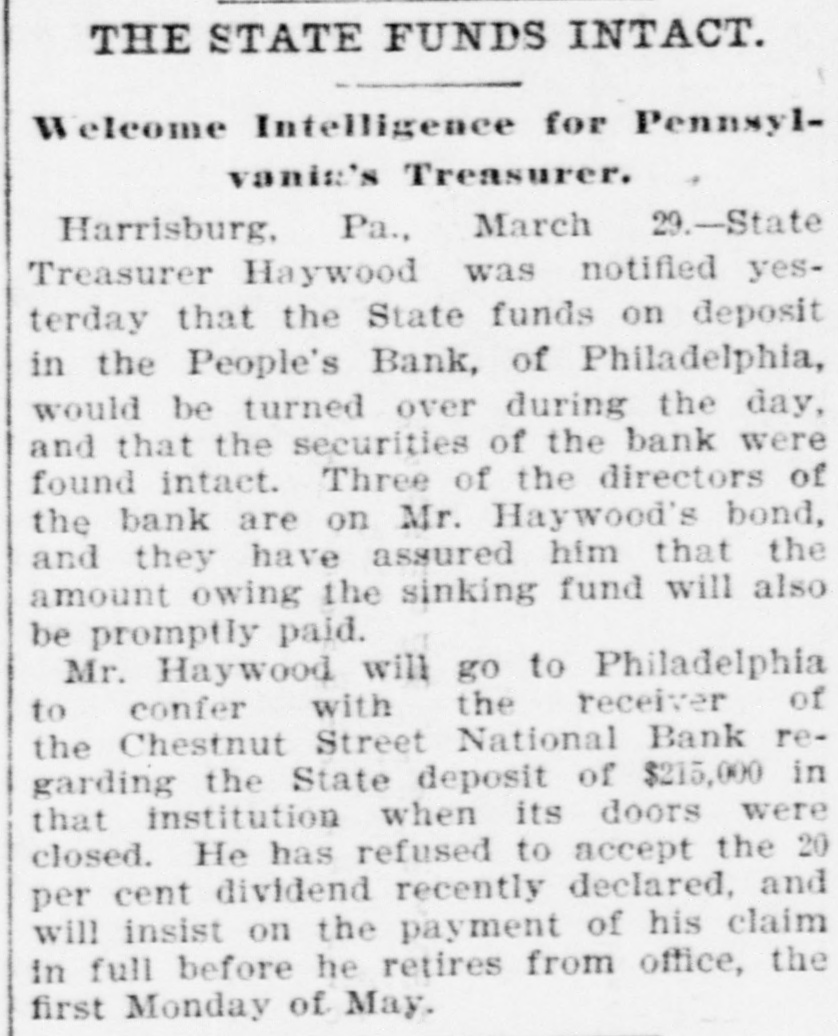
THE STATE FUNDS INTACT

Welcome Intelligence for Pennsylvanials Treasurer. Harrisburg, Pa., March 29.-State Treasurer Haywood was notified yesterday that the State funds on deposit in the People's Bank, of Philadelphia, would be turned over during the day, and that the securities of the bank were found intact. Three of the directors of the bank are on Mr. Haywood's bond, and they have assured him that the amount owing the sinking fund will also be promptly paid. Mr. Haywood will go to Philadelphia to confer with the receiver of the Chestnut Street National Bank regarding the State deposit of $215,000 in that institution when its doors were closed. He has refused to accept the 20 per cent dividend recently declared, and will insist on the payment of his claim in full before he retires from office, the first Monday of May.


Article from The Evening Herald, March 29, 1898

Click image to open full size in new tab

Article Text

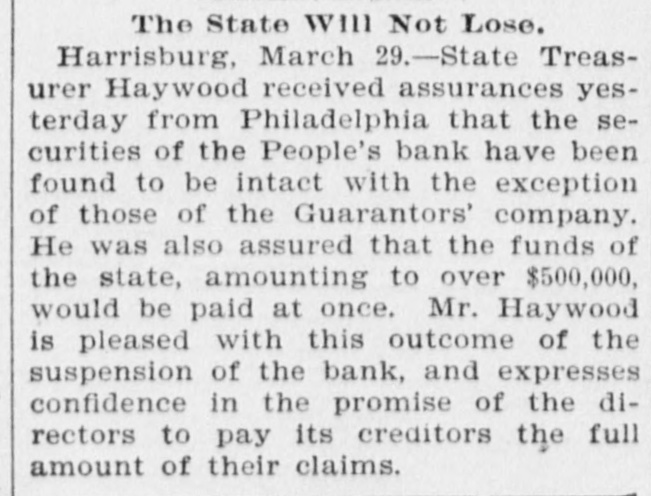
The State will Not Lose

Harrisburg, March 29.-State Treasurer Haywood received assurances yesterday from Philadelphia that the securities of the People's bank have been found to be intact with the exception of those of the Guarantors' company. He was also assured that the funds of the state, amounting to over $500,000, would be paid at once. Mr. Haywood is pleased with this outcome of the suspension of the bank, and expresses confidence in the promise of the directors to pay its creditors the full amount of their claims.


Article from The Evening Herald, March 30, 1898

Click image to open full size in new tab

Article Text

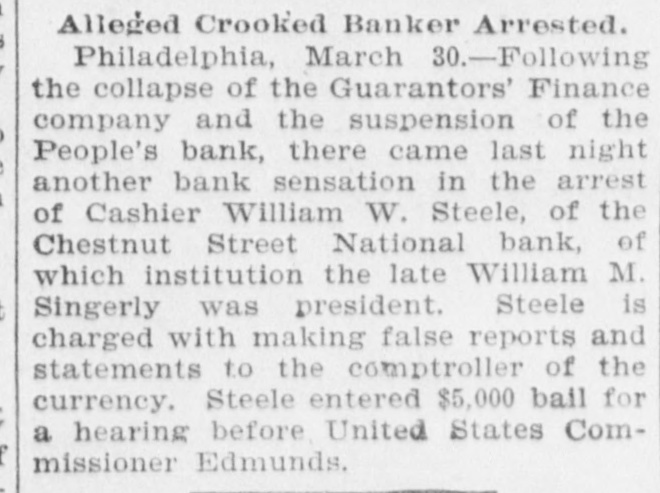
Alleged Crooked Banker Arrested

Philadelphia, March 30.-Following the collapse of the Guarantors' Finance company and the suspension of the People's bank, there came last night another bank sensation in the arrest of Cashier William W. Steele, of the Chestnut Street National bank, of which institution the late William M. Singerly was president. Steele is charged with making false reports and statements to the comptroller of the currency. Steele entered $5,000 bail for a hearing before United States Commissioner Edmunds.


Article from Evening Journal, March 30, 1898

Click image to open full size in new tab

Article Text

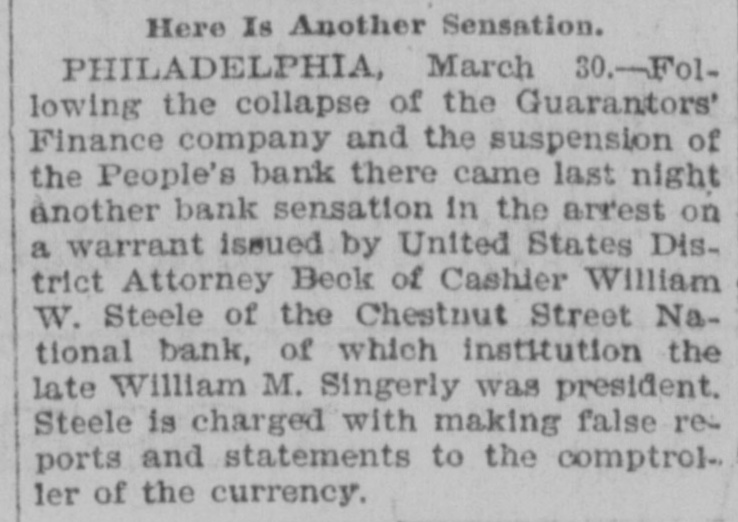
Here Is Another Sensation

PHILADELPHIA, March 30.-Following the collapse of the Guarantors' Finance company and the suspension of the People's bank there came last night Another bank sensation in the arrest on a warrant issued by United States District Attorney Beck of Cashier William W. Steele of the Chestnut Street National bank, of which institution the late William M. Singerly was president. Steele is charged with making false reports and statements to the comptrol1er of the currency.


Article from Richmond Dispatch, March 30, 1898

Click image to open full size in new tab

Article Text

WILL PROTECT THEM

GUARANTOR'S VIRGINIA POLICYHOLDERS WILL NOT SUFFER. BE PAID OUT STATE DEPOSIT. Treasurer Harman will Not Surrender the Fund Until Their Claims Are Satisfied-A Suicide and an Arrest. The developments and disclosures made the connection with the failure of People's In Bank, of Philadelphia, on March 25th. involving. as they do, the Guaran- headtors' Finance Company, which has folquarters in the same city, have been the lowed with close interest here by numerous clients of the Guarantors' of Liability and Indemnity Company, abPennsylvania, which was recently morbed by the Finance Company The local agents for the Liability Comwere Messrs. Pleasants and Crenpany shaw, who stated yesterday afternoon that they had done little of no business and for the company since October last, that the liability in this city would hardly by exceed $7,000, fully secured, however, $25,000 deposited by the old company, with with Treasurer Harman, in accordance the State law regarding foreign corporations. Among the firms which have claims the company are the Chesapeake RichRailway Company, Traction Company, and and mond against Ohio the the on Rich- the mond Cedar-Works. An attempt recover of the Finance Company to the part these bonds has been frustrated them by to State Treasurer, who will hold desatisfy the claims of the Virginia inpositors, some of whom have already in the stituted suits, which have resulted Crenshaw appointment of Mr. Charles S. in RS receiver for the Finance Company this State. DRAMA WITH MONEY MOTIF. story which has come to light named as The result of the failure of the above its bank, a unfolds a drama with money in as its motif, a drama which embraces and of catastrophe the passion of grief the vengeance. In this modern drama husband, are three. First, a second, the the a demanding vengeance for characters suicide; the first, widow, woman weeping on bethird-the man whom that ruined her husband and caused of lieves to take his life. On all the spirit It him for money grains satirically. late is desire the story of John S. Hopkins, widow- the Bank cashier, of his RichPeople's week ago his wife-and of until F. a Loper, promoter and general man- Comard ager of the Guarantors' Finance pany. Before Mr. Hopkins sent the bullet career into brain that ended his earthly his penned a letter to his wife and daugh- Loper he ters. Briefly this letter charges with Hopkins's downfall. He (Hopkins) the Guartwo years ago had loaned securities some antors-Loper Company some them the bank. He could not get would of but, hoping that the tide eventually back, turn, hรฉ then began loaning them the bank's money to keep and afloat. them The tide never turned. Deeper indebted the Guarantors became after deeper the People's Bank, and as dollar bank to was thus thansferred, the dollar weaker and weaker. In this manner collategrew $790,000 of the bank's money and Comrals passed over to the Guarantors' consideraThe securities given in wellpany. tion for this sum are said to be night worthless. LETTER TO HIS WIFE. Harassed, weighed down by a burden overhad become heavier than his could strained that nerves and overtaxed brain but John S. Hopkins killed himself, letter bear, before dying he wrote the following is an his wife and daughters, which which appeal to for pity and for mercy, and clearly reflects his character: "My Dear, Devoted, Loving Wife and on Daughters, For months I have been the verge of insanity from trouble at bank. the After my first sleep of exhaustion fought the balance of the night of have through praying to God to get me out my trouble, but it was of no avail. "I, some two years ago, let the Guarantors-Loper Company have some securi- them of the bank, and could not get back, ties and then from that I had to loan money to keep them afloat, and could my them was in the lion's mouth and I has hand get it out. The only thing that tide not me alive was the hope that the would kept turn with them and I could get can the securities back, but now I see it never be, and I cannot bear this pressure on my brain any longer. "I say to you this and swear it before Almighty God never, from December 20. until this moment, have I on my family, my or 1869, dollar house, ever and spent mine my A yelf that was not earned by me the spend. I have to leave you to to nercy of a loving God. "Lovingly, HUSBAND AND PAPA. March 24, 1898. On Monday afternoon Richard F. Toper, of rice-president and general manager arrested Finance Company, was dethe charged with conspiracy to cheat and the People's Bank, whose president its !raud has agreed to pay in full the claims of
Article from New-York Tribune, April 22, 1898

Click image to open full size in new tab

Article Text

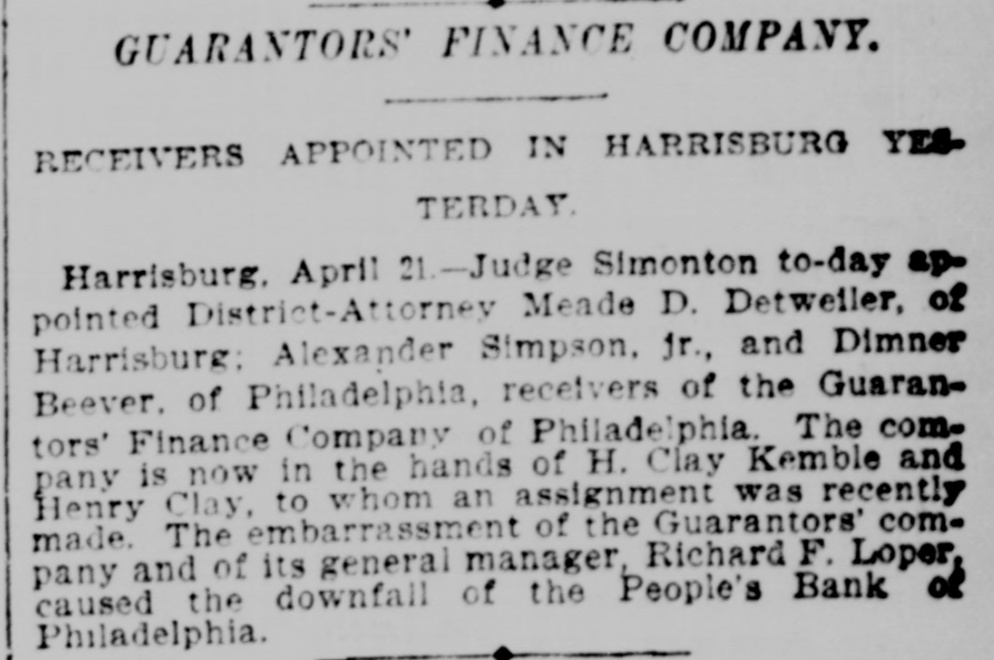
GUARANTORS' FINANCE COMPANY

RECEIVERS APPOINTED IN HARRISBURG YESTERDAY Harrisburg. April 21.-Judge Simonton to-day pointed District-Attorney Meade D. Detweiler, of Harrisburg Alexander Simpson, Jr., and Dimner Beever. of Philadelphia, receivers of the Guarantors' Finance Company of Philadelphia. The com. pany is now in the hands of H. Clay Kemble and Henry Clay, to whom an assignment was recently made. The embarrassment of the Guarantors' company and of its general manager, Richard F. Loper, caused the downfall of the People's Bank of Philadelphia.


Article from The Houston Daily Post, June 14, 1898

Click image to open full size in new tab

Article Text

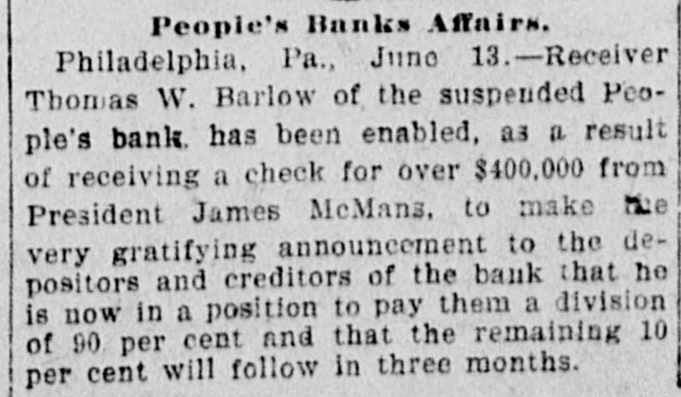
People's Banks Affairs

Philadelphia, Pa., June 13.-Receiver Thomas W. Barlow of the suspended People's bank. has been enabled, as a result of receiving a check for over $400,000 from President James McMans, to make the very gratifying announcement to the depositors and creditors of the bank that he is now in a position to pay them a division of 90 per cent and that the remaining 10 per cent will follow in three months.


Article from Richmond Planet, June 18, 1898

Click image to open full size in new tab

Article Text

Kansas Prohibitionists nominated ex-United States Senator Peffer for governor.

Farm products are drawing more money to this country from abroad this year than ever before.

A. S. Van Wickle, millionaire coal operator at Hazleton, Pa., was accidentally killed by his own gun at a clay pigeon shoot.

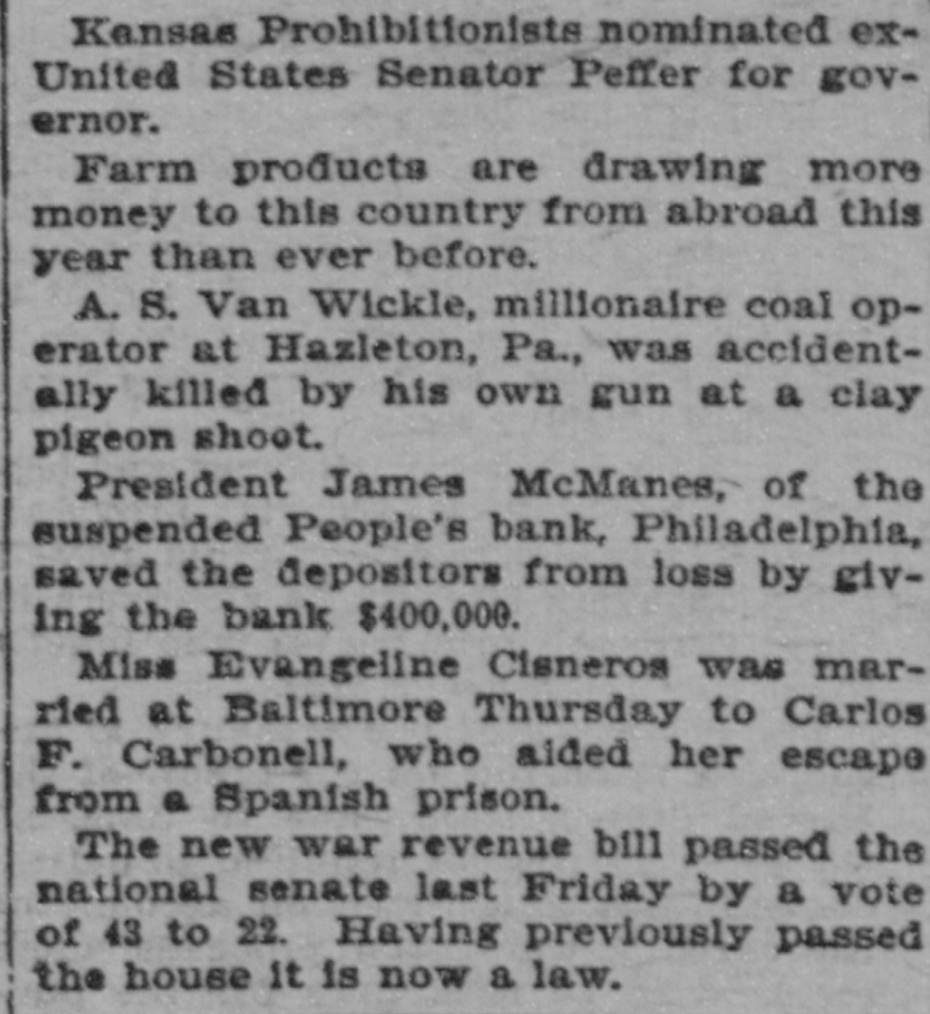
President James McManes, of the suspended People's bank, Philadelphia, saved the depositors from loss by giving the bank $400,000.

Miss Evangeline Cisneros was married at Baltimore Thursday to Carlos F. Carbonell, who aided her escape from a Spanish prison.

The new war revenue bill passed the national senate last Friday by a vote of 43 to 22. Having previously passed the house it is now a law.


Article from Martinsburg Herald, June 18, 1898

Click image to open full size in new tab

Article Text

BRIEF ITEMS OF NEWS.

Farm products are drawing more money to this country from abroad this year than ever before.

New Jersey Prohibitionists nominated George M. Le Monte, of Bound Brook, for governor.

Etievant, the French anarchist who on Jan. 19 stabbed M. Renard, a Paris police agent, has been sentenced to death.

President James McManes, of the suspended People's bank, Philadelphia, saved the depositors from loss by giving the bank $400,000.

Miss Evangeline Cisneros was married at Baltimore Thursday to Carlos F. Carbonell, who aided her escape from a Spanish prison.

The new war revenue bill passed the national senate last Friday by a vote of 43 to 22. Having previously passed the house it is now a law.

The individual coal operators in the anthracite region will consider alleged excessive frieght charges at a convention to be held at Scranton, Pa., June 28

Mrs. Julia C. Brown, 76-year-old widow of Lynn, Mass., was found murdered in her bed. Her sons, William and Ernest, are under arrest pending investigation.


Article from The San Francisco Call, October 4, 1898

Click image to open full size in new tab

Article Text

from the fact that It comes in the T. rottenness ought to be shown up, no midst of one of the most bitter camK. matter upon whom it reflects. It is not paigns ever fought between Quay and t my practice to speak in advance of the his opponents, involving the question of trial of cases and I will say nothing his re-election to the Senate. e further as to its merits." 1Graham expressed a firm determinaThe People's Bank suspended busition to proceed vigorously. ness on March 24 last, and it presently s James H. McManes, formerly presideveloped that Cashier Hopkins had t dent of the defunct People's Bank, said committed suicide. At this time the to that he had known the warrants were State had deposited in the bank $505,11 to be issued, although he had nothing 000 and the city $52,000, but the institu1. to do with the action. He asserted igtion was insolvent. to norance of any transactions justifying President McManes agreed to make it. Mr. McManes added: is


Article from The Seattle Post-Intelligencer, October 6, 1898

Click image to open full size in new tab

Article Text

Who Is Responsible for It! The attorneys for the defense opened the proceedings with a fruitless effort to secure from the d'strict attorney the names of the persons responsible for the prosecution. There were only three witnesses. The first was Thomas W. Barlow, receiver of the People's bank, who is also a special assistant district attorney. Albert L. Tabor, receiving teller of the People'a bank. identified the handwriting in the book as that of the cashier, Johns Hopkins, and also identified a number of letters as written by Senator Quay and Treasurer Haywood. A number of these letters were put in evidence, one from Treasurer Haywood to President McManes, saying $600,000 of state funds would be deposited the following week and that Richard Quay be allowed to borrow $100,000. All through the ordeal, Senator Quay bore an air of composure. He prompted his lawyers frequently and passed judgment on every point raised.


Article from The Somerset Herald, October 12, 1898

Click image to open full size in new tab

Article Text

THE arrest of Senator Quay on a charge of using the funds of the State for purposes not warranted by the Constitution, made, as it was, in the last month preceding the close of an important political campaign, in which the enemies of the Senator throughout the State attempt to make him the sole issue before the people, will probably impress the citizens of the State at large as a very poor piece of political acting. Such maneuvers have rarely had any important bearing on the result of a campaign. There is a general liking of fair play which characterizes the population, which serves to render such carefully planned schemes abortive and reactionary. That State funds were on deposit in the defunct People's Bank of Philadelphia was well known. The fact that the Senator was a borrower from this bank does not by any means stamp him as a violator of the laws of the State. The receiver of the broken bank himself testifies that all such loans have been repaid, and he himself has paid to the State the money belonging to it. The opponents of Senator Quay have apparently in this instance overreached themselves most signally. As affecting the politics of the State the scheme is equally futile to do harm to the Republican standard-bearers.


Article from The Saint Paul Globe, October 15, 1898

Click image to open full size in new tab

Article Text

Quay Case Warrants

PHILADELPHIA, Oct. 14.-Two writs in civil proceedings were filed today in the prothonotary's officie by Thomas W. Barlow, receiver for the People's bank, against ex-State Treasurer Benjabin J. Haywood and Auditor General Ames H. Meylin. The writs are the result of the investigations growing out of the closing of the bank. Mr. Haywood is at present under bail with Senator Quay and others on the charge of conspiracy and illegally using state funds in the bank.


Article from The Herald, November 27, 1898

Click image to open full size in new tab

Article Text

DOLLAR FOR DOLLAR People's Bank Depositors Get Their Money Back PHILADELPHIA, Nov. 26.-Thomas W. Barlow, receiver of the People's Bank, has notified the depositors of that institution that the remaining 10 per cent due them will be paid on and after December 5th, 1898. This payment will close every uncontested claim against the bank, including the deposits of the city and State. The People's Bank closed its doors March 25th, after the cashier, John S. Hopkins, had committed suicide. The liabilities were about $1,500,000, while the assets were less than $1,000,000. At the time of the suspension President McManes pledged himself to pay the depositors dollar for dollar, and the announcement of Receiver Barlow shows that he has kept his word.


Article from The Worthington Advance, December 1, 1898

Click image to open full size in new tab

Article Text

PAYS DEPOSITORS IN FULL

Creditors of the People's Bank of Philadelphia Do Not Not Lose a Dollar-A Well-Kept Pledge. Philadelphia, Nov. 23.-Thomas W. Barlow, receiver of the People's bank, has notified the depositors of that institution that the remaining ten per cent. due them will be paid on and after December 5, 1898. This payment will close every uncontested claim against the bank, including the deposits of the city and state. The People's bank closed its doors on March 25, after the cashier, John S. Hopkins. had committed suicide. When the bank closed its doors the liabilities were about $1,500,000, while the assets were less than $1,000,000. At the time of the suspension President McManes pledged himself to pay the depositors dollar for dollar, and the announcement of Receiver Barlow shows that he has kept his word.


Article from The Neihart Herald, December 3, 1898

Click image to open full size in new tab

Article Text

GENERAL NEWS NOTES

Mrs. Pullman's income is $9,000 a month. Our export trade with England is on the increase. The Blackfeet Indians are trying to oust their agent. A powder mill and 6 men blown "p at Lamotte, Mo. A blizzard has raged in London during the past week. A post office has been established at Schley, Fergus county, Mont. The Tennessee court sustains the validity of the anti-cigarette law. There is an extensive movement of southern cattle to northern ranges. The spirit of independence at Seoul results in a riot. Several killed. An old time blizzard visits Kentucky and takes the thermometer to zero. Several rough riders have gone to San Juan hill, Cuba, to prospect for gold. The Pittsfield express on a Connecticut road is wrecked: no one killed. A fire in the Pinole works of the California powder company costs $25,000. Revolutionary bands from Brazil threaten an attack on the capital of Uraguay. A tribe of cannibals has been located in the German group of the Sula islands. The British navy has hoisted the union jack over the Chu San archipelago, near Shanghai. All the big elevator manufacturing concerns in America have formed an $11,000,000 trust. The president's message containing 60,000 words, twice the usual dose, is ready for congress. A Chinaman in Frisco dies of A disease resembling bubonic plague, and the officials are alarmed. Queen Wilhelmina of Holland t will wed Prince William of Wiede, who is an officer in the German army. The government experiments show that oats, barley, flax and h spuds can be successfully grown in Alaska. 0 South Dakota by a majority of 6,000 has made the initiative and , referendum a part of the state con stitution. . r The rotten People's bank of Phil . adelphia has arranged to pay all claims of depositors including city and state. d The Fe road has put on a train n which makes the distance from San Francisco to Chicago only two and e a half days. g r Two hand cars loaded with a parr ty returning from IL hoedown near n Elkhart, Ind., are run down by an . express. Three or four killed. y Fire destroys the big Baldwin hog tel in San Francisco. Two lives and a half million dollars lost, one fourth of the latter covered by insurance. Fire destroys the railroad bridge two miles east of Sand Coulee causing a temporary shut down of the n mines of Sand Coulee and Stockett. e of An awful storm sweeps the New h England coast, working great havoc is to shipping. More than eighty are known to have drowned, and a hunin h dred ships have been destroyed. 8, Gov.-elect Roosevelt assures the er labor leaders of New York that he will enforce every labor law on the statute books in New York. All n hands agree that there are laws to enough if properly enfored. ero The old Hope mine at Basin reIt ports an immense strike in the new 10 erossout on the 300 foot. This mine 100


Article from The Morning News, December 5, 1898

Click image to open full size in new tab

Article Text

A SENSATIONAL TRIAL.

It is expected that the trial of Senator Quay will be a sensational one. It was hoped by some of the friends of the senator that the indictments against him would be quashed, the points made in the demurrers to them being considered particularly strong. The demurrers, however, have been overruled and the trial of the defendant ordered. The principal point made in the demurrers was that as the state's money became the bank's money when deposited in bank, it could not be said that the senator had used the state's money to speculate with when he used, without security, money of the bank in which the state's money was deposited.

The case against the senator rests largely on letters and dispatches sent by him to Cashier Hopkins of the People's Bank of Philadelphia. In that bank the state was a large depositor. The cashier committed suicide and the bank went into the hands of a receiver. The letters and dispatches from the senator to this cashier showed that under the senator's instructions the cashier bought and sold large amounts of stock for the senator's account with the bank's money. The claim is that the senator furnished no security to the bank, but was allowed to use the bank's money for buying and selling stocks because he influenced the state treasurer to keep on deposit with the bank a very large sum of the state's money.

The chances are that the senator will find a way out of his troubles. Either the state will not be able to make out a case or else there will be a failure to convict because of some technicality. In the meantime, the senator is getting alarmed about his chances for re-election to the Senate. It was published a few days ago that his friends were trying to pledge representatives from the different counties to vote for him, and were much surprised to find that the rural districts were very strongly prejudiced against him. For the feeling against him among the farmers he has Mr. Wanamaker to blame. Mr. Wanamaker made an extraordinary campaign against him, and it may appear that it was a successful one.


Article from Albuquerque Daily Citizen, April 10, 1899

Click image to open full size in new tab

Article Text

Trial of Quay

Philadelphia, April 10. - The trial of ex-United States Senator Quay and his son Richard, on charges of conspiracy in the misuse of the funds of the People's bank, begun this morning before Judge Biddle. The senator and son were in court. The work of securing a jury occupied the day. Talcott Williams, editorial writer, of Philadelphia, was on the venire. He claimed that he was competent to try the case on the evidence, though he had formed an opinion. He was peremptorily challenged. The first witness was Thomas W. Barlow, special assistant to former District Attorney Graham, who was appointed receiver of the bank at the time of its failure. He identified the books of the bank, and papers, letters and other books found in Hopkins' desk. Among the lat. ter was one in which there were entries in red ink. which apparently indicated computations of interest on state funds by Hopkins. The court adjourned until to-morrow, when the defense will crossexamine Mr. Barlow.


Article from Santa Fe New Mexican, April 10, 1899

Click image to open full size in new tab

Article Text

Senator Quay's Trial

Philadelphia, April 10.-The trial of ex-United States Senator Quay and his son Rinehard, on charges of conspiracy to misuse funds of the People's bank began this morning before Judge Biddle. The senator and his son were in court. The work of securing the jury occupied the entire day. Talcott Williams, the editorial writer of Philadelphia, was on the venire. He claimed he was competent to try the case on evidence, though he had formed an opinion. He was peremptorily challenged. The first witness was Thomas W. Barlow, special assistant to Former District Attorney Graham, who was appointed receiver of the bank at the time of its failure. He identified the books of the bank, the papers, letters and other books found in Hopkins' desk, among the latter of which was one containing entries in red ink, which ap. parently indicated computations of interest of the state funds by Hopkins. The court adjourned until tomorrow, when the defense will cross-examine Mr. Barlow.


Article from The Wilmington Daily Republican, April 11, 1899

Click image to open full size in new tab

Article Text

THE QUAY TRIAL BEGUN

The Evidence of the First Witness Precipitates a Legal Battie. Philadelphia, April 11.-Ex-United States Senator Matchew S. Quay and his son, Richard R. Quay, were called to the bar of the court of quarter sessions yesterday, and the trial of the two defendants was begun. Judge Craig Biddle was the trial judge. Districe Attorney Rothermel, after over two hours had been spent in selecting a jury, elected to try the ex-senator first on that one of the five indictments in which he and his son are variously named. which charges Mr. Quay and the late ex-State Treasurer Benjamin J. Haywood with conspiracy in using the state funds for their personal benefit and profit. and in a manner unauthorized by law. This action practically leaves the ex-senator alone on trial. Beyond the selection of a jury and the examination of one witness, Thomas J. Barlow, receiver of the People's bank, nothing was done yesterday. The only witness examined Mr. Barlow, led to the first clash between counsel. and apparently indicated that a determined legal battle, replete with knotty points of law. will be fought in the trial of the cause. The district attorney called Mr. Barlow to identify books and papers found by him when he assumed the receivership. Mr. Shapley undertook to cross-examine the witness with respect to his knowledge of whether certain books, which the defense it is understood claims is missing. are included in those testified to by the witness. This was objected to, and after repeated efforts to obtain an answer to the question in another form it was abandoned, and Mr. Shapley said he would begin his ceross-examination this morning.


Article from The Times, April 11, 1899

Click image to open full size in new tab

Article Text

QUAY'S TRIAL BEGUN.

Indications Are that a Most Determined Legal Battle Has Begun.

PHILADELPHIA, April 10.-The trial of Ex-United States Senator Quay and his son Richard R. Quay, on charges of conspiracy in the misuse of funds of the People's Bank of this city was begun this morning.

Judge Craig Biddle, one of the oldest and most respected members of the bench was the trial judge. District Attorney Rothermel, after two hours had been spent in selecting a jury, elected to try the Ex-Senator first on that one of the five indictments (in which he and his son are variously named) which charges Mr. Quay and the late Ex-State Treasurer Benj. J. Haywood with conspiracy in using the State funds for their personal benefit and profit and in a manner unauthorized by law.

This action practically leaves the Ex-Senator alone on trial. The only witnesses examined to-day-Mr. Barlow, receiver of the People's Bank, led to the first clash between counsel and indicated that a determined legal battle, replete with knotty points of law, will be fought. The District Attorney called Mr. Barlow to identify books and papers found by him when he assumed the receiver-ship. Mr. Shapley, of counsel for the defense, undertook to cross examine the witness with respect to his knowledge of whether certain books, which the defense claims are missing, are included in those testified by the witness. This was objected to and after repeated consultations among the counsel for the defense and several other efforts to obtain an answer to the question in another form, it was abandoned and Mr. Sharpley said he would begin his cross-examination in the morning.


Article from The Houston Daily Post, April 11, 1899

Click image to open full size in new tab

Article Text

QUAY CASES GO TO TRIAL.

THE SENATOR AND HIS SON UNDER FIVE INDICTMENTS.

First Case to Be Tried Is the One Against the Senator for the Use of State Funds.

Philadelphia, April 10.--Ex-United States Senator Quay, and his son, Richard Quay, were called to the bar of the court of quar- ter sessions today and after many months of delay the trial of the two was begun. There was an entire absence of any crowd either outside or within the court room.

District Attorney Rothermel elected to try the ex-senator first on that one of the five indictments in which he and his son Richard were named, which charges Mr. Quay and the late Treasurer Haywood with conspiracy in using the State funds for their personal benefit and profit, and in a manner unauthorized by law. This action practically leaves the ex-senator alone on trial.

Beyond the selection of a jury and the examination of one witness, Thomas Bar- low, receiver of the People's bank, noth- ing was done today.

Thomas W. Barlow, special assistant to former District Attorney Graham, who was appointed receiver of the bank at the time of its failure, identified the books of the bank and papers, letters and other books found in Hopkins' desk. Among the letters was one in which was written some computations of interest on State funds made by Hopkins. This counsel agreed to designate as "The Red Book." Court adjourned at 3:05 until tomorrow morning, when the defense will cross- examine Mr. Barlow.


Article from Freeland Tribune, April 17, 1899

Click image to open full size in new tab

Article Text

FREELAND, PA., APRIL 17, 1899. Exposing Rottenness. From the Wilkesbarre Record. Whatever may be the result of the Quay trial, one thing that has heretofore been unexplained has been made perfectly clear, viz.: The reason for keeping large balances of state funds in favored banks while the appropriations to the public schools and charitable institutions, and the personal property tax due the counties, remained unpaid. The books of the People's bank show that one state treasurer received more than $30,000 from that bank as interest on state funds, and he only received a portion of the interest, at that. Other state treasurers also received large sums as interest. It would be interesting to know how many more of the banks that held large deposits of the state funds paid interest to the state treasurers and other politicians. The People's could pay $30,000. There were half a dozen other banks that had state funds in sums nearly as large, and if all of them were made to sweat in the same proportion a sum running high upinto the hundreds of thousands must have been gathered in by the state treasury ring during the past ten or twelve years. The late Treasurer Haywood, as well as his predecessors, constantly kept anywhere from $3,000,000 to $4,000,000 in favored banks, usually in sums ranging from $200,000 to $600,000. Those who felt sufficiently interested in the matter to examine the statements periodically published by the state treasurer probably wondered why the sums on deposit in some half a dozen banks remained practically stationary from one year to another. The People's bank of Philadelphia was one of them, and it had for years from $500,000 to $600,000, and even though school districts were compelled to borrow money at the rate of 6 per cent. because they could not get the state appropriation, the half million or more in the People's bank remained undisturbed. The bank was paying interest on the money. too, but not a cent of it went into the state treasury: it was divided up among the members of the treasury ring, except when the state's money was loaned to them, without interest, to speculate with. Yes, the revelations made by the books of the People's bank show very clearly and conclusively why school and other appropriations remained unpaid for months, and sometimes a year, after they were due. The banks that had the money were paying interest on it for the personal enrichment of state treasurers and members of the treasury ring. For years it was very generally believed that such methods were in vogue in the treasury department. Mr. Darlington, the president of the defunct Chester Trust Company, threw some light on the subject, but it remained for the books of the collapsed People's bank of Philadelphia to lay bear the infamous methods that have been practiced in all their enormity. This has doubtless been going on for a quarter of a century, but did not reach its fullest proportions of rottenness until


Article from People's Voice, April 27, 1899

Click image to open full size in new tab

Article Text

The charges against Senator Quay followed the collapse of the People's bank in Philadelphia in March, 1898, and the examination of its books by a receiver. The warrants were issued in the following October, and included, besides Mr. Quay, his son, the name of Charles H. McKee, a Pittsburg lawyer, and ex-State Treasurer Haywood. On November 21 the grand jury found true bills against all but McKee. The suicide of Cashier Hopkins just prior to the bank's failure, prevented his coming within the scope of criminal action. Theindictments were five in number. These were reduced to four by the death of Mr. Haywood, on February 23 of this year. One week after true bills had been found, counsel for Mr. Quay and the other defendants filed demurrers to four of them and moved to quash the fifth. Judge Finletter, on December 1, decided against the defendants. Counsel then carried the case to the supreme court, on the plea, among other contentions, that the prosecution was actuated by political motives which would prevent an impartial trial in this country. The supreme court declined to interfere. The trial was set for February 20,and was post poned until the 27th, when it was again postponed until Monday of last week.


Article from Richmond Dispatch, November 25, 1899

Click image to open full size in new tab

Article Text

M'MANES, THE BOSS, IS DEAD. He Ruled Philadelphia Absolutely for a Generation. (New York Journal.) PHILADELPHIA, November 23.-James McManes, the famous Republican boss of Philadelphia, who for years held a stronger grip upon the government of this city than any Democratic leader ever held upon that of New York, died to-day in his 78th year. He had been feeble and ailing for many a day, and the reins of power had long since slipped from his grasp into those of stronger men. He leaves a widow and one child. Mr. McManes was a Scotch-Irishman and a strong Presbyterian. He was born in Tyrone, Ireland, whence he was brought by his parents when only 8 years of age. His boyhood was very much like that of Richard Croker. His father was poor, and he had to work hard and educate himself as best he might. His first occupation was that of a bobbin boy in a Southwark cotton-mill. When he was 25 he had saved enough money to go into business as a cotton-spinner on a small scale. A disastrous fire wiped out the savings of years soon afterward, and he had to begin all over again as a workman. The profits McManes made in cotton he put into real estate. This was the foundation of his subsequent fortune. His first political office was that of school director. He showed political sagacity for the first time by getting himself elected a member of the Board of Education by deft wire-pulling. Then he became political leader of the Seventeenth Ward. In 1858 the votes of his ward controlled the nominations for Mayor and Sheriff. When the men were elected McManes owned them. That was the dawn of his political power. The leader had a genius for controlling men. He never forgot a favor and he never talked. He always held that a politician could make more trouble with his tongue than his brains could mend. He did not thrust himself forward for public office, but nominated others, and when they were elected made them do his bidding and bear the brunt of any criticisms. When the Republican convention met in 1869 McManes, as a delegate from Pennsylvania, favored the nomination of Lincoln. After that his influence spread to Washington. SAW THE PEOPLE'S BANK THROUGH When the People's Bank, of which he was president, collapsed, owing to the peculations of John S. Hopkins, the cashier, McManes made over $400,000 of his personal fortune to supply the deficiency. People had put money into the bank because he was the head of it, and he would not allow them to lose a dollar. On a previous occasion, when the People's Bank was in trouble, owing to a panic, McManes produced $600,000 worth of bonds and handed them over to the president, telling him to use them in pulling the bank through. 1