Article Text
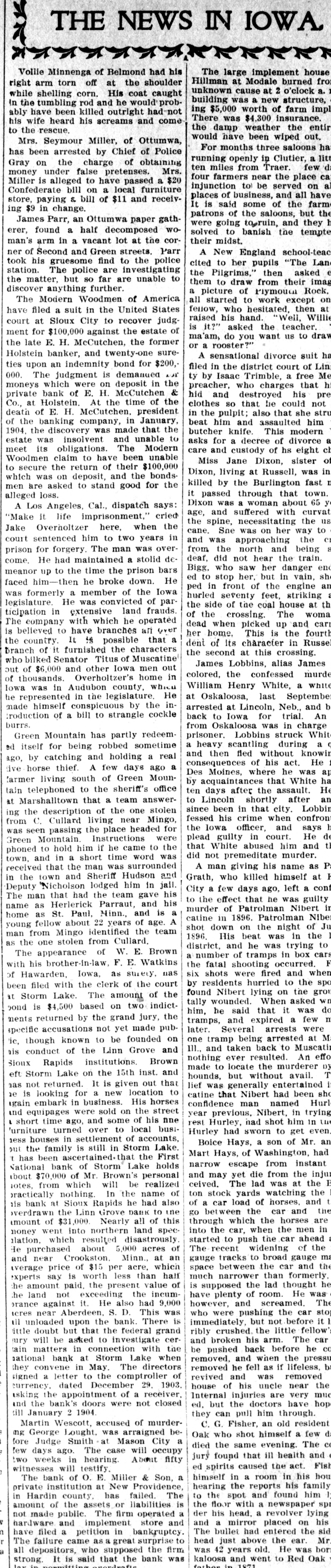
# THE NEWS IN IOWA Vollie Minnenga of Belmond had his right arm torn off at the shoulder while shelling corn. His coat caught In the tumbling rod and he would probably have been killed outright had not his wife heard his screams and come to the rescue. Mrs. Seymour Miller, of Ottumwa, has been arrested by Chief of Police Gray on the charge of obtaining money under false pretenses. Mrs. Miller is alleged to have passed a $20 Confederate bill on a local furniture store, paying & bill of $11 and receiving $9 in change. James Parr, an Ottumwa paper gatherer, found a half decomposed woman's arm in a vacant lot at the corner of Second and Green streets, Parr took his gruesome find to the police station. The police are investigating the matter, but so far are unable to discover anything further. The Modern Woodmen of America have filed a suit in the United States court at Sioux City to recover judgment for $100,000 against the estate of the late E. H. McCutchen, the former Holstein banker, and twenty-one sureties upon an indemnity bond for $200,000. The judgment is demanued for moneys which were on deposit in the private bank of E. H. McCutchen & Co., at Holstein. At the time of the death of E. H. McCutchen, president of the banking company, in January, 1904, the discovery was made that the estate was insolvent and unable to meet its obligations. The Modern Woodmen claim to have been unable to secure the return of their $100,000 which was on deposit, and the bondsmen are asked to stand good for the alleged loss. A Los Angeles, Cal., dispatch says: "Make it life imprisonment," cried Jake Overholtzer here, when the court sentenced him to two years in prison for forgery. The man was overcome. He had maintained a stolid demeanor up to the time the prison bars faced him-then he broke down. He was formerly a member of the Iowa legislature. He was convicted of participation in extensive land frauds. The company with which he operated is believed to have branches ari over the country. It is possible that a branch of it furnished the characters who bilked Senator Titus of Muscatine out of $6,000 and other Iowa men out of thousands. Overholtzer's home in Iowa was in Audubon county, which he represented in the legislature. He made himself conspicuous by the introduction of a bill to strangle cockle burrs. Green Mountain has partly redeemed itself for being robbed sometime ago, by catching and holding a real live horse thief. A few days ago a farmer living south of Green Mountain telephoned to the sheriff's office at Marshalltown that a team answering the description of the one stolen from C. Cullard living near Mingo, was seen passing the place headed for Green Mountain. Instructions were phoned to hold him if he came to the town, and in a short time word was received that the man was surrounded in the town and Sheriff Hudson and Deputy Nicholson lodged him in jall. The man that had the team gave his name as Herlerick Parraut, and his home as St. Paul, Minn., and is a young fellow about 22 years of age. A man from Mingo identified the team as the one stolen from Cullard. The appearance of W. E. Brown with his brother-in-law, F. E. Watkins of Hawarden, Iowa, as surety, nas been filed with the clerk of the court at Storm Lake. The amount of the pond is $4,500 based on two indictments returned by the grand jury, the specific accusations not yet made public, though known to be founded on ais conduct of the Linn Grove and Sioux Rapids institutions. Brown eft Storm Lake on the 15th inst. and aas not returned. It is given out that he is looking for a new location to again embark in business. His horses und equipages were sold on the street a short time ago, and some of his nne furniture turned over to local business houses in settlement of accounts, out the family is still in Storm Lake. It has been ascertained that the First National bank of Storm Lake holds about $70,000 of Mr. Brown's personal notes, from which will be realized practically nothing. In the name of his bank at Sioux Rapids he had also overdrawn the Linn Grove bank to une amount of $31,000. Nearly all of this money went into northern land speculation, which resulted disastrously. He purchased about 5,000 acres of and near Crookston, Minn., at an average price of $15 per acre, which experts say is worth less than half the amount paid, the present value of the land not exceeding the incumbrance against it. He also had 9,000 tcres near Aberdeen, S. D. This was til unloaded upon the bank. There is little doubt but that the federal grand ury will be asked to investigate certain matters in connection with the national bank at Storm Lake when they convene in May. The directors signed a letter to the comptroller of currency, dated December 29, 1903. usking the appointment of a receiver, and the bank's doors were not closed till January 2 1904. Martin Wescott, accused of murdering George Lought, was arraigned before Judge Smith at Mason City a few days ago. The case will occupy two weeks in hearing. About fifty witnesses will testify. The bank of O. E. Miller & Son, a private institution at New Providence, in Hardin county, has failed. The amount of the assets or liabilities is not made public. The firm operated a hardware and implement store and have filed a petition in bankruptcy. The failure came as a great surprise to aall depositors, who supposed the firm was strong. It is said that the bank was The large implement house of Hillman at Modale burned from an unknown cause at 2 o'clock a. m. The building was a new structure, costing $5,000 worth of farm implements. There was $4,300 insurance. But for the damp weather the entire town would have been wiped out. For months three saloons have been running openly in Clutier, a little town ten miles from Traer. few days ago four farmers near the place came for an injunction to be served on all three places of business, and all have closed. It is said some of the farmers are not patrons of the saloons, but the patrons were going to ruin, and they have resolved to banish the tempter from their midst. A New England school-teacher cited to her pupils "The Landing of the Pilgrims," then asked each of them to draw from their imagination a picture of riymouca Rock. They all started to work except one little fenow, who hesitated, then at last raised his hand. "Well, Willie, what is it?" asked the teacher. "Well, ma'am, do you want us to draw a Plymouth or a rooster?" A sensational divorce suit has been filed in the district court of Linn county by Isaac Trimble, a free Methodist preacher, who charges that his wife hid and destroyed his preacher clothes so that he could not appear in the pulpit; also that she struck him, beat him and assaulted him with a butcher knife. This modern preacher asks for a decree of divorce and the care and custody of hs eight children. Miss Jane Dixon, sister of Mrs. Dixon, living at Russell, was instantly killed by the Burlington fast mail as it passed through that town. Miss Dixon was a woman about 65 years of age, and suffered with curvature of the spine, necessitating the use of a cane. Sne was on her way to the crossing and was approaching the crossing from the north and being somewhat deaf, did not hear the train. John Bigg, who saw her danger endeavored to stop her, but in vain, she stepped in front of the engine and was hurled seventy feet, striking against the side of the coal house at the side of the crossing. The woman was dead when picked up and carried to her home. This is the fourth accident of its character in Russell and the second at this crossing. James Lobbins, alias James colored, the confessed murderer of William Henry White, a white man, at Oskaloosa, last September, was arrested at Lincoln, Neb., and brought back to Iowa for trial. An officer from Oskaloosa was in charge of the prisoner, Lobbins struck White with a heavy scantling during a quarrel and then fled without knowing the consequences of his act. He went to Des Moines, where he was apprehended by acquaintances that White had died ten days after the assault. He went to Lincoln shortly after and has since been in that city. Lobbins confessed his crime when confronted by the Iowa officer, and says he will plead guilty in court. He declares that White abused him and that he did not premeditate murder. A man giving his name as P. McGrath, who killed himself at Hot Springs City a few days ago, left a confession to the effect that he was guilty of the murder of Patrolman Nibert in Muscatine in 1896. Patrolman Nibert was shot down on the night of July 18, 1896. His beat was in the levee district, and he was trying to arrest a number of tramps in box cars when the fatal shooting occurred. Five or six shots were fired and when citizens by residents hurried to the spot they found Nibert lying on the ground mortally wounded. When asked who shot him, he said that it was done by the tramps, and expired a few moments later. Several arrests were made, one tramp being arrested at Muscatine, Ill., and taken back to Muscatine, but nothing ever resulted. An effort was made to locate the murderer by blood hounds, but without avail. The belief was generally entertained in Muscatine that Nibert had been shot by a confidence man named Hurley. The year previous, Nibert, in trying to arrest Hurley, nad shot him in the leg. Hurley had sworn to get even. Boice Hays, a son of Mr. and Mart Hays, of Washington, had a narrow escape from instant death and may yet die from the injuries received. The lad was at the Burlington stock yards watching the loading of a car load of horses, and tried to go between the car and the platform through which the horses are loaded into the car, when the men in charge started to push the car ahead a little. The recent widening of the narrow gauge tracks to broad gauge made the space between the car and the platform much narrower than formerly. It is supposed the lad thought he would have plenty of room. He was caught, however, and screamed. The men who were pushing the car stopped immediately, but not before it terribly crushed, the little fellow's leg and broken his arm. The car had to be pushed back before he could be removed, and when the pressure was removed he fell as if lifeless, but was revived and was removed to the house of his uncle near the yards. Internal injuries are very much feared, but the doctors have hopes that they can pull him through. C. G. Fisher, an old resident of Red Oak who shot himself a few days ago, died the same evening. The coroner's jury found that ill health and disordered spirits caused the act. Fisher shot himself in a room in his house after hearing the reports his family had gone to the spot and found him lying on the floor with a newspaper spread under his head, a revolver lying near him and a mirror placed on his chest. The bullet had entered the side of his head just above the ear. Mr. Fisher was 42 years old. He was born in Kaloosa and went to Red Oak with his father in 1871.