Merchants National Bank (Seattle, WA)

Episode Information

Episode UID
298501145
Episode Type
Run β†’ Suspension β†’ Closure
Bank Type
national
Bank ID
29850 national
Charter Number
2985
Start Date
May 20, 1895
Location
Seattle, Washington (47.606, -122.332)

Metadata

Model
gpt-5-mini (chosen from majority vote of a three-model LLM ensemble)
Short Digest
69c97e7bb1057c2d

Response Measures

Accommodated withdrawals, Borrowed from banks or large institutions, Clearinghouse loan, Public signal of financial health, Capital injected, Full suspension, Books examined

Clearinghouse involved: Yes (loan, examination, or other measures)

Receivership Details

Depositor recovery rate
77.0%
Date receivership started
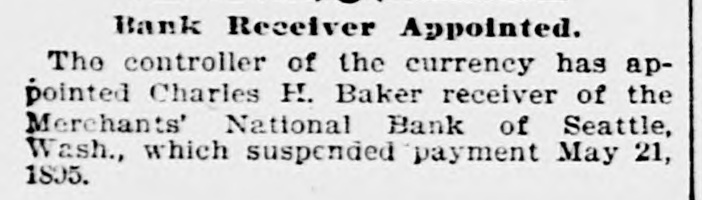
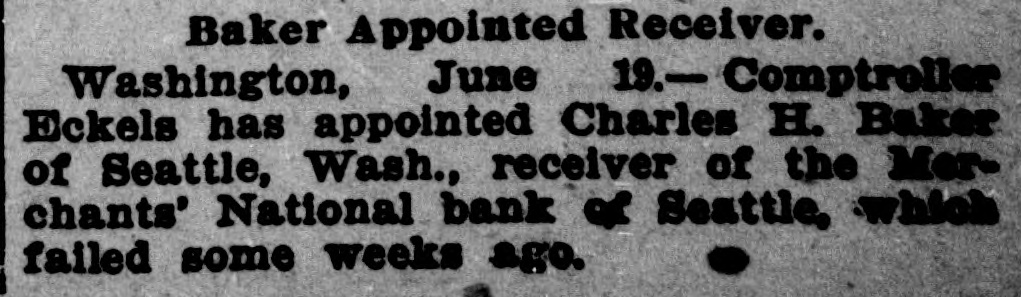
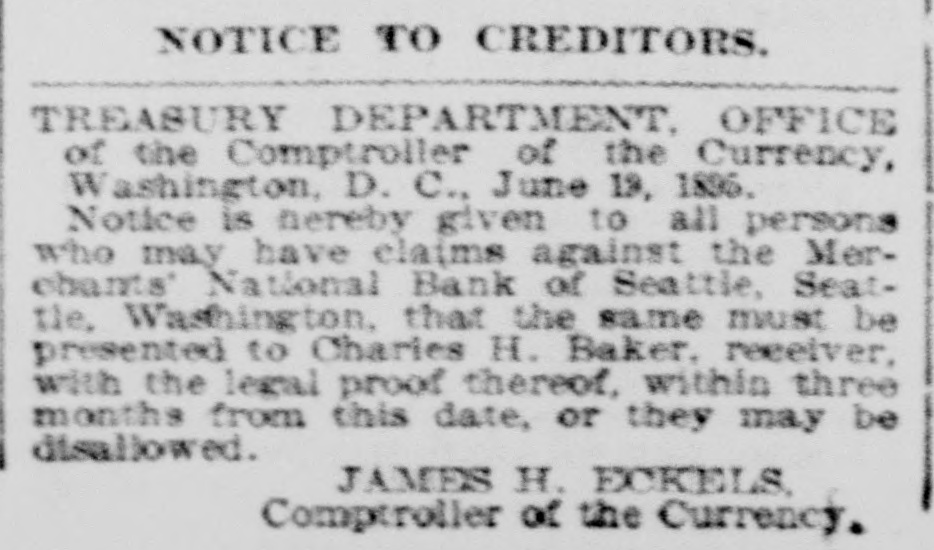
1895-06-19
Date receivership terminated
1901-08-19
OCC cause of failure
Losses
Share of assets assessed as good
32.1%
Share of assets assessed as doubtful
57.9%
Share of assets assessed as worthless
10.0%

Events (5)

1. June 23, 1883 Chartered
Source
historical_nic
2. May 20, 1895 Run
Cause
Rumor Or Misinformation
Cause Details
Reports that a consolidation with another bank failed spread and depositors hastily withdrew funds; certain depositors got the tip from clearing-house circles.
Measures
Temporary loan from clearing house of $25,000 to tide over crisis; cashier notified controller; attempts to secure liquidity.
Newspaper Excerpt
It is apparent to me that the bank had been operating in its normal condition up to May 20, when there was a run...the sums paid over the counter May 20 aggregated $41,077
Source
newspapers
3. May 21, 1895 Suspension
Cause
Rumor Or Misinformation
Cause Details
Following the run of May 20 (precipitated by rumors/reports about failed consolidation), the bank suspended operations and closed its doors.
Newspaper Excerpt
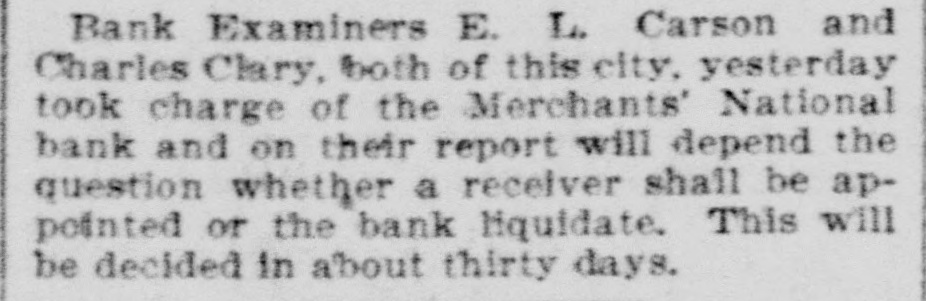
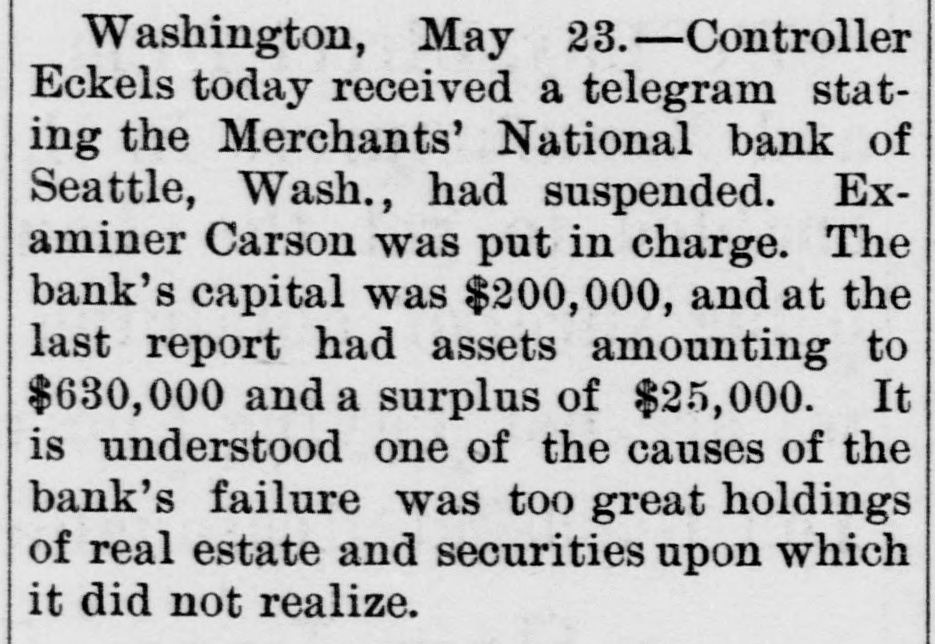
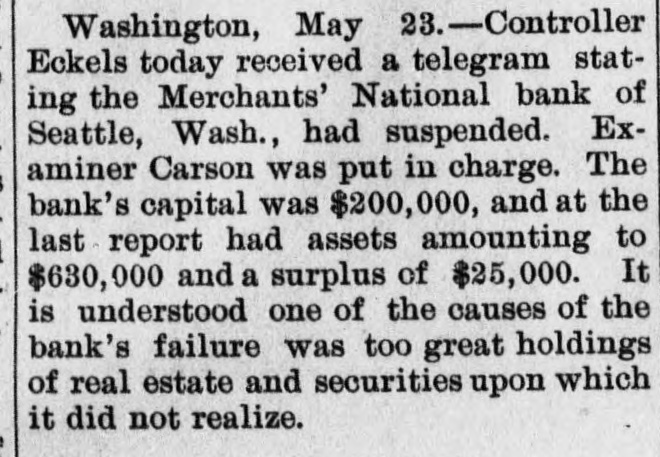
The Merchants' National bank closed its doors this morning and will not re-open...the Merchants' National bank of Seattle had suspended. Examiner Carson was put in charge.
Source
newspapers
4. June 19, 1895 Receivership
Source
historical_nic
5. June 28, 1895 Receivership
Newspaper Excerpt
Charles H. Baker has been appointed receiver of the Merchants' National bank... (Chicago Tribune report; appointment noted June 28). Examiner Carson was put in charge (earlier dispatches).
Source
newspapers

Newspaper Articles (25)

Article from The Seattle Post-Intelligencer, November 9, 1894

Click image to open full size in new tab

Article Text

Totals. $684,134 93 $474,676 18 Of this amount in suspended banks the city will be able to realize approximately $40,000, as the Traders' and the Washington National will probably pay dollar for dollar in the long run, and the Merchants' National will probably pay from 40 to 50 per cent. In accounting for his balances, Mr. Boggs tendered the bank books of the suspended banks. This was on the ground that the city, having failed to name depositories, was responsible for the deposits as placed by the city treasurer. When the States Savings bank closed, the city at once began to take vigorous action, under the direction of Mayor Orr, to recover the $5,000 held there in the form of city warrants. By a recent decision of the superior court the city secured the warrants, and it was during the trial of this case that Mr. Boggs, on the witness stand, made the admissions upon which it was proposed to arrest him on a criminal charge. Chairman Cavender, of the financial committee, can speak on this point. He says: "If Boggs had only returned to the city the warrants which he had at the time he went out of office, we would have been willing to have accepted the same, and have reduced the accounts of the banks just that much, But I understand he was afraid to do so, on the ground that it was not legal to buy warrants out of their order, and that he feared certain citizens, who were taking an interest in the financial matter, might prosecute him on an alleged criminal offense. So he placed the warrants in bank as cash, $212,000 in all at that time, according to his report just before he went out, In other words, he reported $212,000 on hand, held as cash in warrants. That was just before he went out of office, and, when he turned over the office, there wasn't a warrant there. On the stand in the State Savings bank case he testified that he had deposited these warrants as cash, but there is no telling what the number of the warrants were, and if they were returned today I guess the city would be willing to credit the banks with them in reducing their account." Now as to the specific counts: "It appears that Boggs rendered himself liable in buying the warrants as he did, and I'm afraid he rendered himself liable by disposing of them as he did, At any rate, the test in this matter is to be made on a $7,000 note given by his clerk, Hill, and indorsed by himself, another note given by Bair & Loomis and an item for campaign purposes' of $5,000, all of which he deposited as cash for the city. The notes were not cash, of course, and the campaign fund item is not cash, of course." Mr. Boggs is charged by the finance committee with having control of the State Bavings bank and using it as & place to deposit worthless paper. For instance, it is cisimed the Bair-Loomis note came from the Bair-Loomis banking institution, and that that was the amount of city money reported on hand there at one time. Later, however, it is understood that the amount was lost in the townsite of Des Noines, and the amount in the form of a bote came into the possession of Mr. Boggs and was deposited as cash. One member of the committee says: "Boggs, no doubt, used the State SavIngs bank to cover up his shortages. The Hill note laid him open to a criminal action, The campaign fund item, of course, was placed in the bank to cover up ashort. age and in my opinion It was a very foolish way in which to cuver up a leak. When the city council tried to secure interest on the deposits in the banks, Baggs agreed to pay 5 per cent. interest, or rather secured an agreement of the banks to pay it. This amounted to $1,200 per month, and was paid in full for only a short time, when several of the banks failed


Article from The Indianapolis Journal, May 22, 1895

Click image to open full size in new tab

Article Text

A SEATTLE BANK FAILS. The Merchants' National, Capital Stock $300,000, Closes Its Doors. SEATTLE, Wash., May 21.-The first failure of a rational bank in this city occurred this morning, when the Merchants' National Bank closed its doors. It was announced that it would not reopen. The bank was incorporated July 21, 1890, with a capital stock of $300,000. In explaining the failure Angus Mackintosh, the president, said: "This misfortune is the inevitable result of hard times and the inability of people to respond to the calls made on them. Our board of directors met this morning and decided, in view of the condition of business, not to open to-day. The cashier was instructed to notify the Controller of action taken. We can do nothing until the bank examiner arrives. The bank will pay all its obligations and our aim will be to call on our stockholders and not to go through the hands of a receiver. The stockholders will be able to recoup themselves from the assets as fast as they are able to realize on them and they will be sufficient to reimburse stockholders. There are no really bad assets, the only difficulty being that they are slow to realize."


Article from The Dalles Daily Chronicle, May 22, 1895

Click image to open full size in new tab

Article Text

Seattle Bank Falls. SEATTLE, May 21.-The first failure of a national bank in this city occured this morning, when the Merchants' National bank closed its doors and it was announced that it would not reopen. The bank was incorporated July 21, 1890, with a capital stock of $300,000. In explaining its failure, Angus McIntosh, the president, said this morning: "This misfortune is the inevitable result of the hard times and the inability of the people to respond to the calls made upon them. Our board of directors met this morning and decided, in view of the position of things, not to open today and to have the cashier notify the controller of the action taken. We can do nothing until the examiner comes in. The plan of consolidation fell through and this bank will simply liquidate. The bank will pay all its obligations and I do not think that this will absorb any of the capital stock. Our aim will be to call upon our stockholders and not to go through the hands of a receiver. The stockholders will be able to recoup themselves from the assets as fast as they are able to realize on them and they will be quite sufficient to make the stockholders whole again. I cannot give you. an exact statement of the affairs of the bank until the examiner gets here, but I can say generally that there are no really bad assets, the only difficulty being that they are slow to realize on."


Article from The Dalles Daily Chronicle, May 22, 1895

Click image to open full size in new tab

Article Text

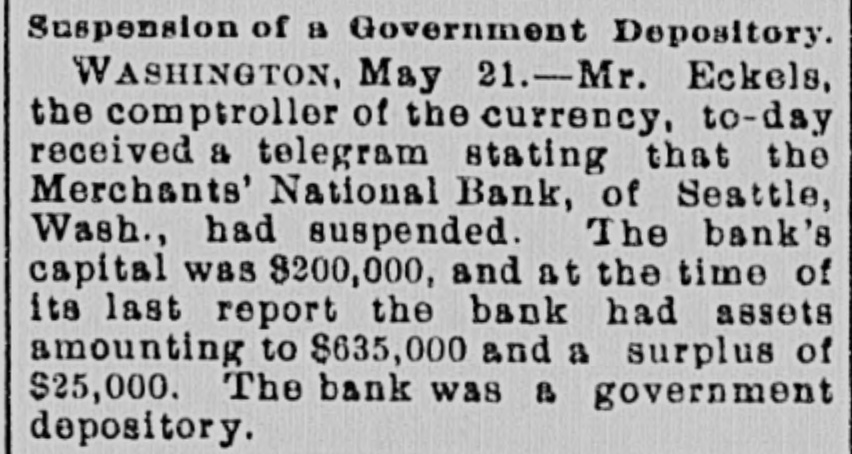
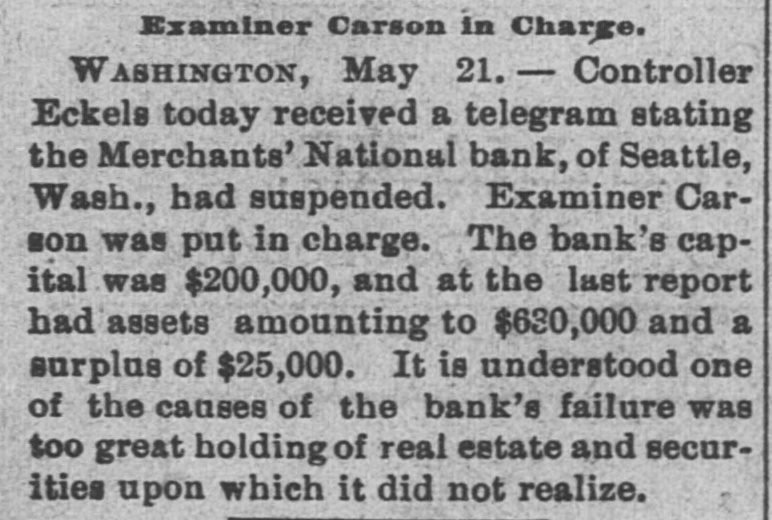
Examiner Carson in Charge. WASHINGTON, May 21. - Controller Eckels today received a telegram stating the Merchants' National bank, of Seattle, Wash., had suspended. Examiner Carson was put in charge. The bank's capital was $200,000, and at the last report had assets amounting to $630,000 and a surplus of $25,000. It is understood one of the causes of the bank's failure was too great holding of real estate and securities upon which it did not realize. &


Article from The Herald, May 22, 1895

Click image to open full size in new tab

Article Text

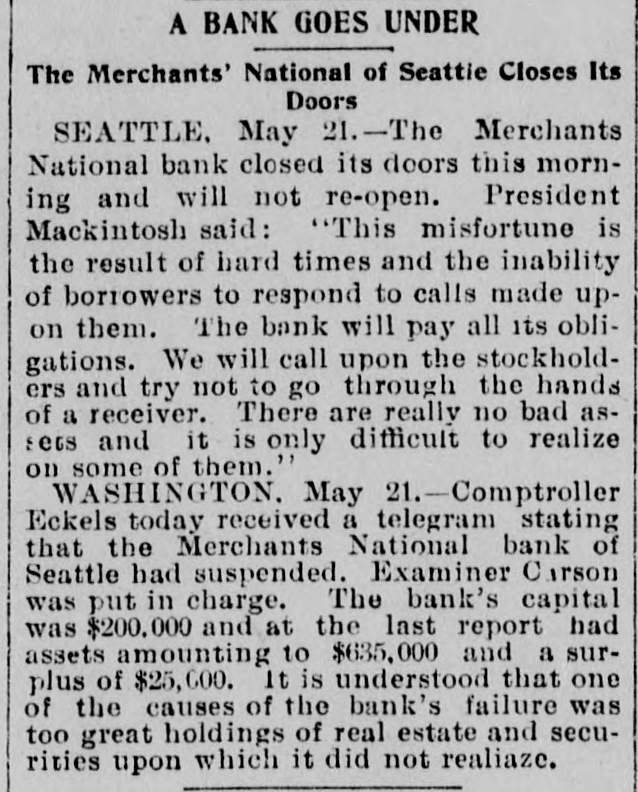
A BANK GOES UNDER The Merchants' National of Seattie Closes Its Doors SEATTLE, May 21.-The Merchants National bank closed its doors this morning and will not re-open. President Mackintosh said: "This misfortune is the result of hard times and the inability of borrowers to respond to calls made upon them. The bank will pay all its obligations. We will call upon the stockholders and try not to go through the hands of a receiver. There are really no bad assets and it is only difficult to realize on some of them." WASHINGTON. May 21.-Comptroller Eckels today received a telegram stating that the Merchants National bank of Seattle had suspended. Examiner Carson was put in charge. The bank's capital was $200.000 and at the last report had assets amounting to $635,000 and a surplus of $25,000. It is understood that one of the causes of the bank's failure was too great holdings of real estate and securities upon which it did not realiaze.


Article from The San Francisco Call, May 22, 1895

Click image to open full size in new tab

Article Text

SEATTLE BANK FAILURE The Merchants' National Permanently Closes Its Doors to Business. Failure to Realize Upon Its Assets Is the Cause of the Collapse. SEATTLE, Wash., May 21.-The first failure of a National bank in this city occurred this morning, when the Merchants' National Bank closed its doors, and it was announced that it would not reopen. The bank was incorporated July 21, 1890, with a capital stock of $200,000. In explaining the failure, Angus Mackintosh, the president, said: "This misfortune is the inevitable result of the hard times and the inability of the people to respond to calls made upon them. Our board of directors met this morning and decided in view of the position of things not to open to-day, and to have the cashier notify the Comptroller of the action taken. We can do nothing until the bank examiner comes in. The bank will pay its obligations, and our aim will be to call upon our stockholders and not to go through the hands of a receiver. Stockholders will be able to recoup themselves from the assets as fast as they are able to realize on them, and they will be quits sufficient to make the stockholders whole again. There are no really bad assets, the only difficulty being that they are slow to realize."


Article from The Seattle Post-Intelligencer, May 23, 1895

Click image to open full size in new tab

Article Text

CONFIDENCE WAS NOT SHAKEN. No Serious Results From Closing of Merchants' National Bank. A round of the various banks in the city yesterday showed that the failure of the Merchants' National bank has had no perceptible effect on their depositors, whose confidence in the stability of their individual bank appears to remain unshaken. A few timid people called for their deposits, which was paid with such alacrity that many of them returned with them later shamefaced, acknowledging that their alarm was groundless. Around the Merchants' National bank all was quiet, with nothing of the excitement that usually attends the closing of a moneyed Institution. A few depositors kept coming In during yesterday inquiring as to the safety of their deposits, and the reassuring words given them by Cashier Harry Meserve seemed to have the destred effect. as all left satisfied that by a short delay every cent due would be given' them. Business men feel equally confident that the result of this failure will have no material effect on trade or check the advance of the growing good times. The bankers best qualified to know the condition of the Merchants' National are firm in their convictions that every depositor of that bank will be paid in full, and eventually the stockholders as well. In other words. the general confidence in the community remains unshaken. The bank examiner has not yet arrived to take charge of the bank, but is expected in a day or two. Although it is not the intention of the bank to go into the hands of a receiver, but to liquidate without the delay incldent to a receivership. applications for that position are already beginning to pour in on Comptroller Eckels, as the spatch shows: following special "Washington City, May 22-Many telegrams were received today by Comptroller Eckels from residents of Seattle, who either want to be receiver of the Merchants' National bank. or have some friend whom they would like to get appointed to that place. Among the first was one from George Hazzard. urging the appointment of Henry Drum. whom. he tried so succesfully to have made a bank examiner. when he was here two months ago, Other applicants for the receivership are F H. Osgood, Charles H. Baker. W R. Forrest, F. W. Trounce. Julius Kahn. James Bothwell. of Seattie,' and 1. K Church, of Everett. It is by no means certain yet that the bank will be put in the hands of a receiver. It may find Itself in a condition to reopen for business, and, If It can, It will have every encouragement to do so from Comptroller Eckels. He has often spoken In praise of the people of Seattle, who stood so nobly by their banking Institutions during the panie and now speaks with regret that so good a record has been broken."


Article from The Seattle Post-Intelligencer, June 4, 1895

Click image to open full size in new tab

Article Text

NO RECEIVER NEEDED Merchant's National Bank Will Pay All Claims. DUPLICITY DISGUSTS ECKELS. Baker's Former Friends Now Trying to "Down" Him-Stockholddrs RaisIng the Deficit. After all the wire pulling of the host of applicants for the position of receiver for the suspended Merchants' National Bank of this city, It now seems about certain that no appointment will be made by Comptroller Eckels. The position would have been a very nice plum, as the salary attached would be at least $350 per month and would last two or three years. It was learned from a reliable source not directly connected with the bank, that Comptroller Eckels is very much inclined to favor the proposition of the stockholders to raise a sufficient sum of money to pay off all immediately pressing claims on the bank and to go into voluntary liquidation. With the amount that is proposed to be raised at once and the other available assets which can readily be turned into cash, the obligations of the bank can be met, depositors paid in full and a good surplus left over to divide among the stockholders. Bank Examiner Carson was unwell yesterday and was not at his accustomed place at the bank. Mr. Clary, when approached on the subject, closed up like a clam and said that there was absolutely nothing to give out for publication. A person who is well informed on the affairs of the bank, however, stated that no receiver would be appointed. He stated that a few days ago, with the consent of the comptroller of currency, a reliable and competent business man. who was agreed on by the stockholders in a meeting held for the purpose, went through and thorougly examined the assets of the bank and made a report to the effect that if a certain named sum of money was raised by the stockholders at once in cash and the bank kept out of the hands of a receiver, all liabilities could be paid off, including the depositors, and a snug sum left to divide among the stockholders, who would be the only persons not recovering donar for dollar. This report was forwarded to Comptroller Eckels. who wired a favorable reply. and the work of raising the necessary sum is now going on with every indication of success. Meanwhile the friends of the other candidates for receiver have combined their forces to defeat Charles H. Baker, who is the strongest candidate, and according to a special dispatch to the PostIntelligencer have got into hot water by It. The dispatch reads: "Washington City, June 3.-Special.-As soon as the Post-Intelligencer announced the likelihood of Charles H. Baker being appointed receiver of the Merchants' National bank, telegraphic protests began to pour in on Comptroller Eckels. Mr. Eaker was designated as incompetent, a pcor business man, incapable of conducting financial affairs, etc. The comptroller took the telegrams and compared them with the mass of indorsements of Baker as a business man when he was a candidate for postmaster and found many of Baker's strongest indorsers for postmaster. Eckels has written letters to the protesters asking the meaning of their being double-faced in the matter. The 60tion of these men has lowered the comptroller's high opinion of some of the citizells of Seattle. He also learned that Baker is indebted in a small amount to the Merchants' bank, hence the appointment has been held up, as Eckels will not appoint any man owing the bank. The next man in line for receiver is Josiah Collins, who has some excellent indorsements from Seattle and North Carolina. Gen. John H. Bryant has been here and


Article from The Seattle Post-Intelligencer, June 28, 1895

Click image to open full size in new tab

Article Text

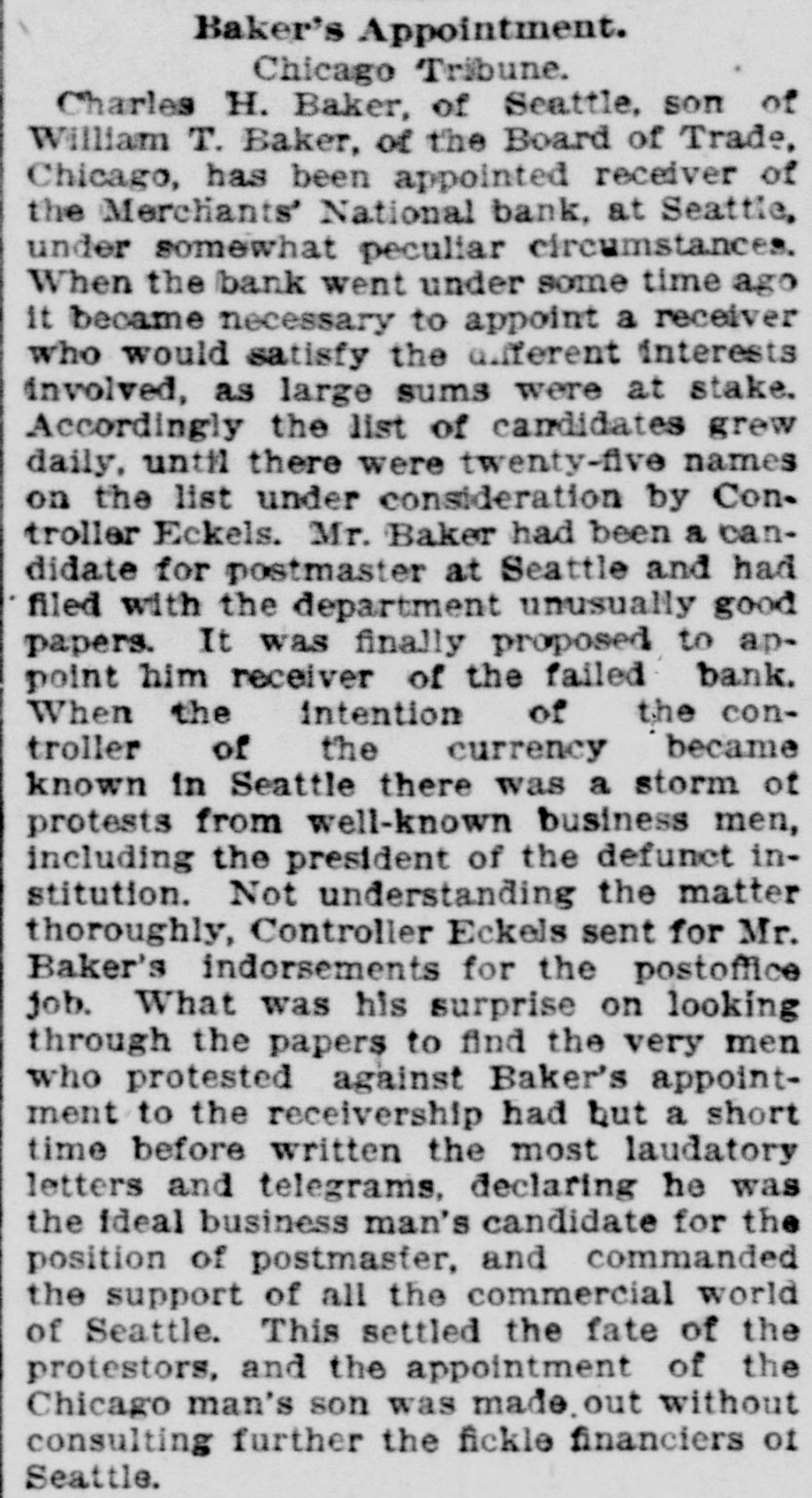
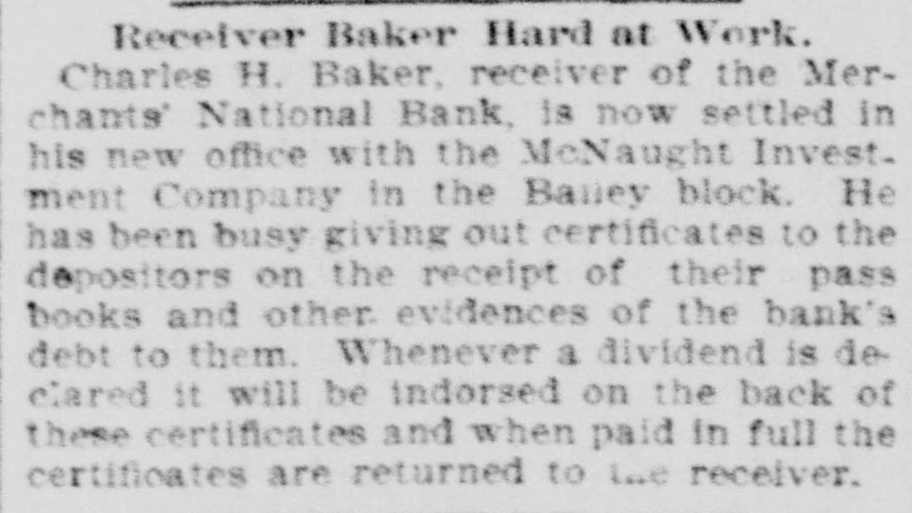
# Baker's Appointment. Chicago Tribune. Charles H. Baker, of Seattle, son of William T. Baker, of the Board of Trade, Chicago, has been appointed receiver of the Merchants' National bank, at Seattle, under somewhat peculiar circumstances. When the bank went under some time ago it became necessary to appoint a receiver who would satisfy the afferent interests involved, as large sums were at stake. Accordingly the list of candidates grew daily, until there were twenty-five names on the list under consideration by Controller Eckels. Mr. Baker had been a candidate for postmaster at Seattle and had filed with the department unusually good papers. It was finally proposed to appoint him receiver of the failed bank. When the intention of the controller of the currency became known in Seattle there was a storm of protests from well-known business men, including the president of the defunct institution. Not understanding the matter thoroughly, Controller Eckels sent for Mr. Baker's indorsements for the postoffice job. What was his surprise on looking through the papers to find the very men who protested against Baker's appointment to the receivership had but a short time before written the most laudatory letters and telegrams, declaring he was the ideal business man's candidate for the position of postmaster, and commanded the support of all the commercial world of Seattle. This settled the fate of the protestors, and the appointment of the Chicago man's son was made out without consulting further the fickle financiers of Seattle.


Article from The Salt Lake Herald, July 18, 1895

Click image to open full size in new tab

Article Text

Jamaica. He said he was going to New York at once to strengthen in that city a favorable feeling toward the revolution ists. EL PASO, Texas, July 17.-Sigmund Weisel, aged 35, a merchant well known through the southwest, was accidentally killed today at Carlisle, N. M. He was formerly manager of the merchandise de partment of the Arizona Copper com pany at Clifton. NEW YORK, July 17.-The Herald to day says: The resignation of the Rt. Rev Mgr. Dennis J. Connell from his office of rector of the American college at Rome has started considerable speculation as to the future of this American prelate and about his successor in the resigned position. SEATTLE, Wash., July 17.-The depositors of the Merchants' National bank are preparing to begin criminal proceed ings against the officials and are raising funds or the pufrpose. They claim to have abundant evidence and will proceed under a state law making it a felony for bankers to receive deposits when they know the bank is insolvent. MILWAUKEE, July 17.-D. H. Hogan, the first book-maker arrested at State Fair park, has been held for trial under $2,000 bond. He declined to give the bond and went to jail. It is reported that the book-makers will retaliate by arresting the members of the civic federation who bought tickets on the races to secure evidence. DENVER, July 17.-Jennie John, an 11year-old girl, was arrested here tonight on instructions from Rock Springs, Wyo., where she is wanted as a witness against her father, who was recently taken into custody on a charge of raping the child. When his case came to trial, she had disappeared. The child WE dressed in boys clothing when arrested. BOSTON, July 17.-The first delegate convention of the Massachusett's People's party opened today in this city. Massachusetts stood twenty-second in the list of states casting Populistic votes in the last election. was voted to make the state organization permanent, and J. P. Gardner, of Danvers. was elected president of the convention. WASHINGTON, July 17.-The comptroller of the currency has declared dividends in favor of the creditors of insolvent national banks as follows: Thirty per cent, the First National Bank of Texarkana, Texas: 20 per cent, the Washington National Bank of Tacoma. Wash. 5 per cent, the Chemical National Bank of Chicago. WASHINGTON. Juy 17.-The navy department was informed today that President Criscom, of the International Steamship company, saied today for England where he will remain until the next trip of the St. Louis, making arrangements for the trial of that ship to ascertain her fitness to become one of the auxiliary naval ships entitled to the provisions of the subsidy act. SAN FRANCISCO, July 17.-Maud Lamont, the sister of the unfortunate victim of the brutal Emmanuel church murder, has returned here from Montana to testify for the prosecution in the forthcoming trial of Theodore Durrant. The police believe she will prove a valuable witness. She was her sister's most constant companion during the eisure hours of the murdered girl, and also knew Durrant. ROCHESTER, N. Y., July 17.-The parochial school connected with the church of the Holy Cross at Charlotte burned at 2 o'clock this afternoon. Warrants have been issued for the arrest of the janitor, John Cronin, and his sister Nora. both of whom are in the employ of Father John M. Fitzgerald. There is much feeling among the church members, who are divided into factions. BRA IL, Ind., July 17.-George A. Knight, one of the best known lawyers in the state, while sitting in his home last night, heard a noise in an upstairs room. Search was made and the gate was heard to shut on the outside. Mr. Knight saw a man disappearing in the darkness. He shot and fatally wounded hi best friend, John Wehrle, the county KEY WEST, Fla., July 17.-The cruiser Montgomery, with the board of survey of the Nicaragua canal, sailed today for New York. They were to have disembarked here and taken the steamer Mascot to Tampa, but where prevented by the state quarantine regulations from SO doing. The cruiser Atlanta arrived from Havana today and was placed in qurantine. DENVER, July 17.-A special to the Times from Hahn's Peak says: A committee from Snake river passed through her today bound for Hayden and Steamboat Springs to plead with the people to allow the sheep to be driven into California Park. J. E. Edwards, the Wyoming sheep man, will meet the Snake river men, Robert McIntosh and G. W. Arnold. at Steamboat Springs. The settlers will not agree to have the sheep driven and pastured in Routt county. GALESBURG, Ill., July 17.-A sensation prevails here in Pythian circles over the order asking the Catholic Knights of Pythias to renounce the organization. College City lodge, the strongest one here, has many Catholic members, and a number of them are averse to leaving their organization. A prominent Knight who conferred with Mgr. Satolli in Washington says a movement is on foot to secure a rehearing by the pope and a revocation of the decree. KANSAS CITY, July 17.-Miss Sarah Mead, 32 years old, a former school teacher of Greenwich. Conn., who met Dr. J. L. alker. of Des Moines, Ia., in this city by appointment on June 5. and was married to him on the same day in Kansas City, Kas., has discovered that her husband is false and that she has been the victim of most creul desertion. Her husband has deserted her, and worse still. he has taken her gold watch and $1,200 in money, leaving her more than 1,500 miles from home with only $10. JEFFERSONVILLE, Ind., July 17.During the storm last night, lightning struck the three towers of the prison, and the greatest excitement among the convicts, 850 in number, followed. The prisoners had just been locked in their respective cells when the storm was raging SO furiously and thus a panic was averted. The guards had no sooner left their posts of duty than the lightning did its work. Had they remained a minute later the chances are that they would have been killed. ANDERSON, Ind., July 17.-This section was again visited by a destructive wind and rain storm today. Trees. small buildings and large roofs suffered most. At Alexandria, twelve miles north, a new business block was blown down, some buildings unroofed and flooded. North of here many fields of corn were levelled. The Big Four accommodation train arriving here at 8 o'clock had all the glass
Article from The Progressive Farmer, July 30, 1895

Click image to open full size in new tab

Article Text

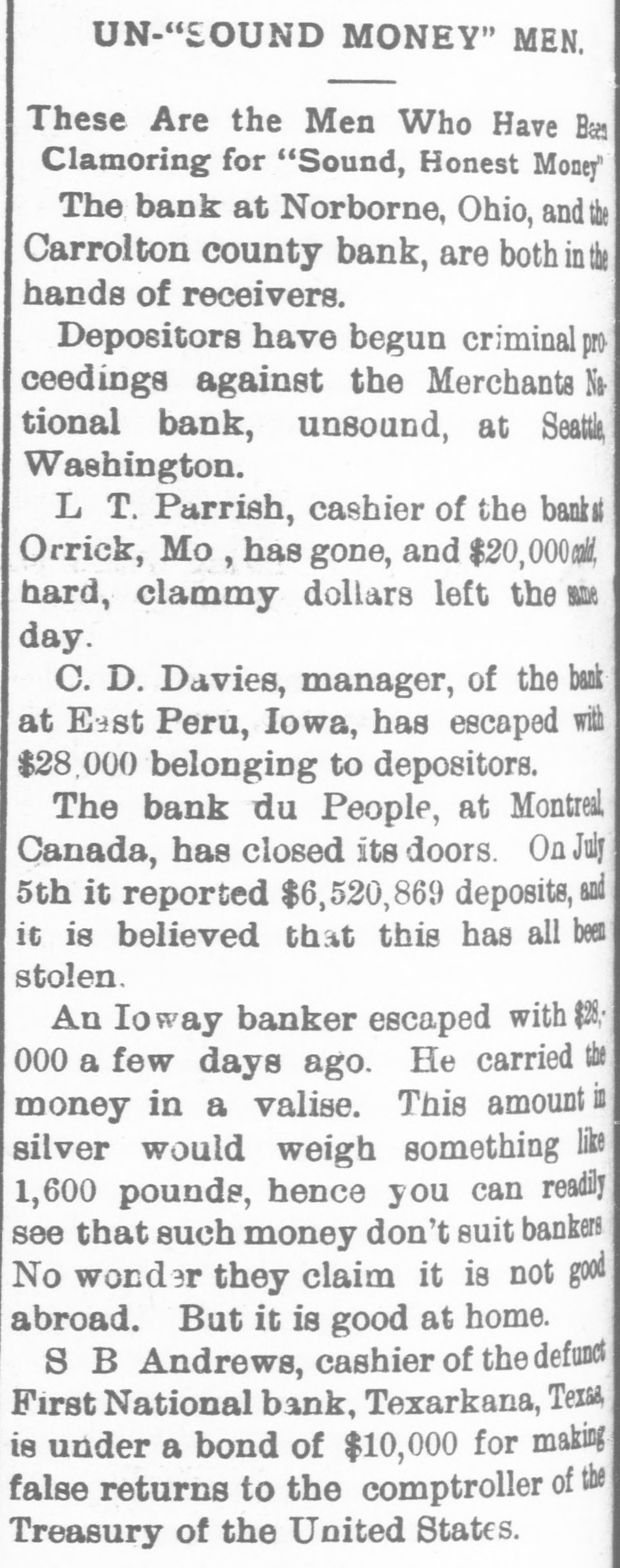
UN-"SOUND MONEY" MEN. I These Are the Men Who Have Been Clamoring for "Sound, Honest Money" The bank at Norborne, Ohio, and the Carrolton county bank, are both in the hands of receivers. Depositors have begun criminal pro. ceedings against the Merchants National bank, unsound, at Seattle, Washington. L T. Parrish, cashier of the bankst Orrick, Mo, has gone, and $20,000 cold, hard, clammy dollars left the same day. C. D. Davies, manager, of the bank at East Peru, Iowa, has escaped with $28,000 belonging to depositors. The bank du People, at Montreal. Canada, has closed its doors. On July 5th it reported $6,520,869 deposits, and it is believed that this has all been stolen. An Ioway banker escaped with $28,000 a few days ago. He carried the money in a valise. This amount in silver would weigh something like 1,600 pounds, hence you can readily see that such money don't suit bankers No wonder they claim it is not good abroad. But it is good at home. S B Andrews, cashier of the defunct First National bank, Texarkana, Texas, is under a bond of $10,000 for making false returns to the comptroller of the Treasury of the United States.


Article from The Silver Blade, August 10, 1895

Click image to open full size in new tab

Article Text

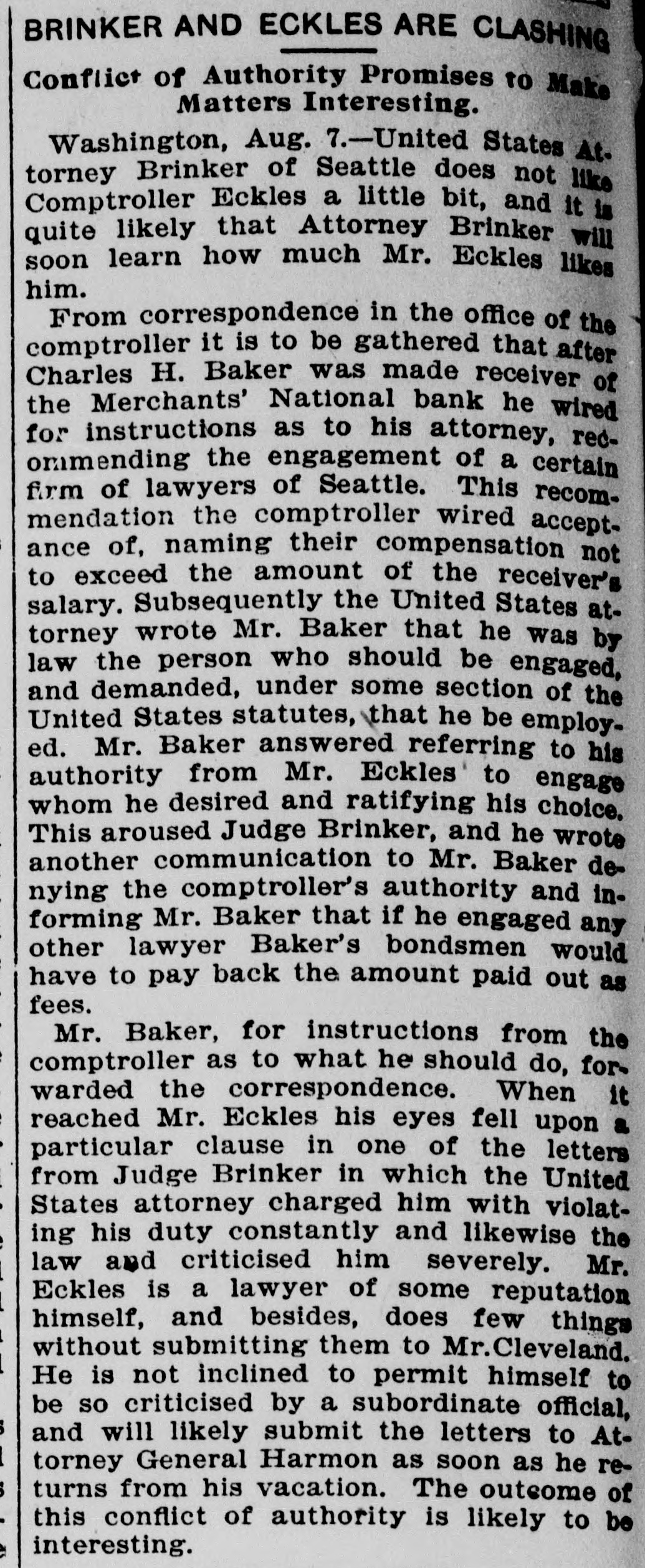
# BRINKER AND ECKLES ARE CLASHING Conflict of Authority Promises to Make Matters Interesting. Washington, Aug. 7.-United States Attorney Brinker of Seattle does not like Comptroller Eckles a little bit, and it is quite likely that Attorney Brinker will soon learn how much Mr. Eckles likes him. From correspondence in the office of the comptroller it is to be gathered that after Charles H. Baker was made receiver of the Merchants' National bank he wired for instructions as to his attorney, recommending the engagement of a certain firm of lawyers of Seattle. This recommendation the comptroller wired acceptance of, naming their compensation not to exceed the amount of the receiver's salary. Subsequently the United States attorney wrote Mr. Baker that he was by law the person who should be engaged, and demanded, under some section of the United States statutes, that he be employed. Mr. Baker answered referring to his authority from Mr. Eckles to engage whom he desired and ratifying his choice. This aroused Judge Brinker, and he wrote another communication to Mr. Baker denying the comptroller's authority and informing Mr. Baker that if he engaged any other lawyer Baker's bondsmen would have to pay back the amount paid out as fees. Mr. Baker, for instructions from the comptroller as to what he should do, forwarded the correspondence. When it reached Mr. Eckles his eyes fell upon a particular clause in one of the letters from Judge Brinker in which the United States attorney charged him with violating his duty constantly and likewise the law and criticised him severely. Mr. Eckles is a lawyer of some reputation himself, and besides, does few things without submitting them to Mr. Cleveland. He is not inclined to permit himself to be so criticised by a subordinate official, and will likely submit the letters to Attorney General Harmon as soon as he returns from his vacation. The outcome of this conflict of authority is likely to be interesting.


Article from The San Francisco Call, August 11, 1895

Click image to open full size in new tab

Article Text

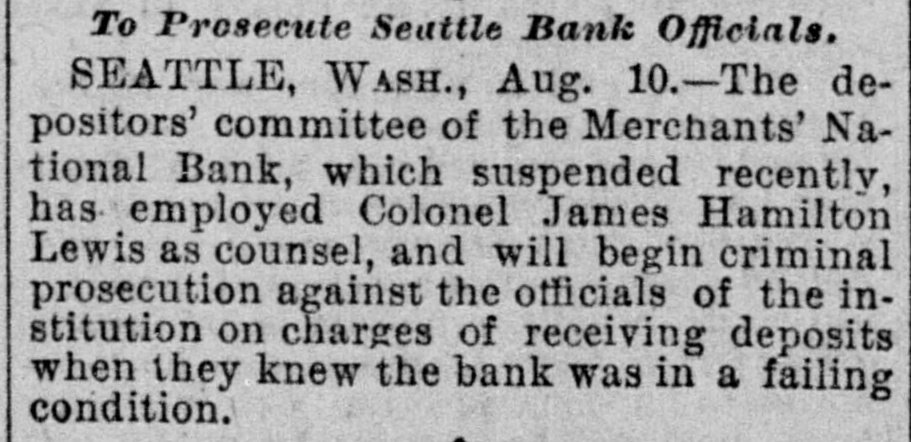
To Prosecute Seattle Bank Officials. SEATTLE, WASH., Aug. 10.-The depositors' committee of the Merchants' National Bank, which suspended recently, has employed Colonel James Hamilton Lewis as counsel, and will begin criminal prosecution against the officials of the institution on charges of receiving deposits when they knew the bank was in a failing condition.


Article from The Seattle Post-Intelligencer, August 24, 1895

Click image to open full size in new tab

Article Text

SLOWLY GATHERING IN CASH. Receiver Sheafe Explains Affairs of Washington Savings Bank. Receiver C. M. Sheafe, of the Washington Savings bank, was asked yesterday what ground there was for the complaint of Henry Bode in regard to the management of the bank, and answered: "The simple reason why the bank does not declare another dividend is that times continue 8 hard that it is impossible at present to realize on the assets fast enough. The assets are ample to pay off all claims of depositors If we realize on them as fast as we can get fair prices, although at forced sale they would not bring anywhere near their real value. We are gradually getting them in good shape to sell by securing title to property on which loans have been made, and money is coming in slowly but steadily. I have now in cash on hand and on deposit to the credit of the bank, divided between two banks, $2,460.01, and there was in the Merchants' National at the time it closed $3,098.37, making a total of $5,558.38. These two sums together would pay a dividend of over 5 per cent., but the amount locked up in the Merchants' National alone would not be sufficient to do so. An assessment of the par value of the stock has been levied on the stockholders and is to be paid by September 3. If It were all paid it would bring in $100,000, but we cannot tell how much of it will be paid until the expiration of the time given for reply. "There has never been any difficulty about learning the names of the stockholders. A list of them was filed in court with my first report and a copy of it can be seen in this office, together with any other information that may be required by those interested in the bank." Following is a list of the stockholders, the capital stock being $100,000, divided into 1,000 shares: Shares. Alexander Cochrane, Wells River, Vt., 10 50 N. P. Dodge, Council Bluffs, la J. W. Vinal. Boston 20 M. A. Webster, Newton Highlands, 23 Mass 10 Thomas S. Pulsifer, Plymouth, N. H Charles W. Pulsifer, Plymouth, N. H 3 3 E. A. Webster. Jr., Dorchester, Mass 1 Caroline D. Aborn, Medford. Mass 1 W. G. Albright, Port Madison, Ia 100 A. V. Larimer, Sioux City, Ia 220 W. W. Dearborn, Seattle 50 B. B. Dearborn, Seattle 20 Louise A. Hall, South Chicago 30 John T. Cutter, Plymouth, N. H 30 Annie D. Richardson, Nashua, N. H 10 John L. Howe, Council Bluffs, la 15 David M. Webster, Ashland, N. H 5 D. B. Kenniston, Plymouth, N. H 2 Lizzie M. Richardson, Lowell, Mass 2 Emily W. Brown. Cambridge, Mass 310 H. W. Higgins, San Francisco Estate of Ellen A. Webster, Ashland, 50 N. H 30 Elizabeth D. Bulfinch, Boston 2 Willard C. Pulsifer, Plymouth, N, H 1 Grace E. Albright, Port Madison, la 2 Cynthia Albright, Port Madison, la All good housekeepers rejoice in using Price's Cream Baking Powder.


Article from The Seattle Post-Intelligencer, August 31, 1895

Click image to open full size in new tab

Article Text

# New Suits Flied. The following new suits were filed in the superior court yesterday: John Anderson vs. John Burns et ux.-$138 for labor performed. Lester F. Wyman vs. The Madison Street Cable Railway Company-$10,000 damages for defamation of character. Dennis Keeler vs. Commercial Printing Company-Promissory notes for about $1,000. Blanche Butler Ames vs. Emeline and I. N. Bigelow-Demurrer; complaint not filed. A. Levy & Co. vs. Joseph Green-$3,539.72. merchandise sold and delivered. Arthur A. Denny vs. George T. Ford-$3,000 promissory note and to foreclose mortgage. E. A. Brooks vs. Edward McDonald-$163.70, goods sold and delivered. Charles H. Baker, as receiver of Merchants' National bank, vs. George A. Gates and John S. Edwards-$6,900 promissory note, and to foreclose mortgage on parts of lots 78, 79 and 80, West Seattle five-acre tracts. Hall & Galloway Company et al. vs. W. H. White, administrator of M. V. Stewart's estate-To surrender mortgages and notes. Huber R. Calkins, administrator of estate of Mary A. Calkins and Arthur Calkins. vs. George C. Woolery et ux.-To make deeds. Maria Scullin vs. Patrick Scullin-Divorce. Ellen Foster vs. Edward Foster-Divorce. Delights in cookery attend the use of


Article from The Salt Lake Herald, September 12, 1895

Click image to open full size in new tab

Article Text

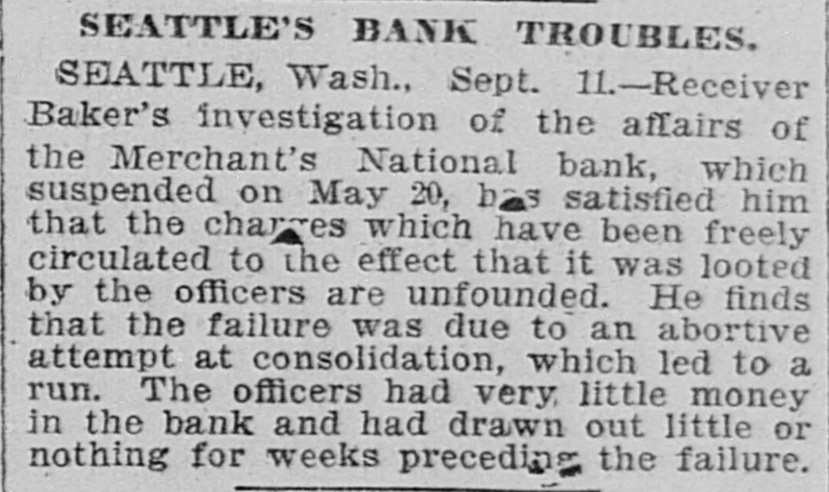
SEATTLE'S BANK TROUBLES. SEATTLE, Wash., Sept. IL-Receiver Baker's investigation of the affairs of the Merchant's National bank, which suspended on May 20, bas satisfied him that the charges which have been freely circulated to the effect that it was looted by the officers are unfounded. He finds that the failure was due to an abortive attempt at consolidation, which led to a run. The officers had very, little money in the bank and had drawn out little or nothing for weeks preceding the failure.


Article from The Seattle Post-Intelligencer, September 12, 1895

Click image to open full size in new tab

Article Text

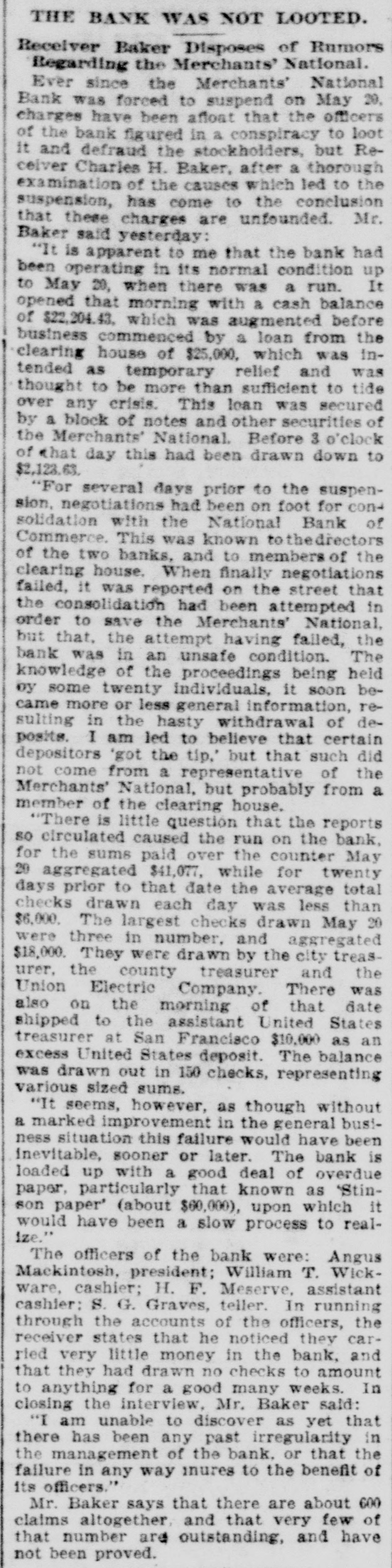
THE BANK WAS NOT LOOTED. Receiver Baker Disposes of Rumors Regarding the Merchants' National. Ever since the Merchants' National Bank was forced to suspend on May 20, charges have been affoat that the officers of the bank figured in a conspiracy to loot it and defraud the stockholders, but Receiver Charles H. Baker, after a thorough examination of the causes which led to the suspension, has come to the conclusion that these charges are unfounded. Mr. Baker said yesterday: "It is apparent to me that the bank had been operating in its normal condition up to May 20, when there was a run. It opened that morning with a cash balance of $22,204.43. which was augmented before business commenced by a loan from the clearing house of $25,000, which was intended as temporary relief and was thought to be more than sufficient to tide over any crisis. This loan was secured by a block of notes and other securities of the Merchants' National. Before 3 o'clock of that day this had been drawn down to $2,123.63. "For several days prior to the suspension, negotiations had been on foot for consolidation with the National Bank of Commerce. This was known tothedrectors of the two banks, and to members of the clearing house. When finally negotiations failed, It was reported on the street that the consolidation had been attempted in order to save the Merchants' National, but that, the attempt having falled, the bank was in an unsafe condition. The knowledge of the proceedings being held by some twenty individuals, it soon became more or less general information, resulting in the hasty withdrawal of deposits. I am led to believe that certain depositors 'got the tip,' but that such did not come from a representative of the Merchants' National, but probably from a member of the clearing house. "There is little question that the reports so circulated caused the run on the bank, for the sums paid over the counter May 20 aggregated $41,077, while for twenty days prior to that date the average total checks drawn each day was less than $6,000. The largest checks drawn May 20 were three in number, and aggregated $18,000. They were drawn by the city treasurer. the county treasurer and the Union Electric Company. There was also on the morning of that date shipped to the assistant United States treasurer at San Francisco $10,000 as an excess United States deposit. The balance was drawn out in 150 checks, representing various sized sums. "It seems, however, as though without a marked improvement in the general business situation this failure would have been inevitable, sooner or later. The bank is loaded up with a good deal of overdue paper, particularly that known as Stinson paper' (about $60,000), upon which it would have been a slow process to realize." The officers of the bank were: Angus Mackintosh, president; William T. Wickware, cashier; H. F. Meserve. assistant cashier: S. G. Graves, teller. In running through the accounts of the officers, the receiver states that he noticed they carried very little money in the bank, and that they had drawn no checks to amount to anything for a good many weeks. In closing the interview, Mr. Baker said: "I am unable to discover as yet that there has been any past irregularity in the management of the bank. or that the failure in any way inures to the benefit of its officers." Mr. Baker says that there are about 600 claims altogether, and that very few of that number are outstanding, and have not been proved.


Article from The Seattle Post-Intelligencer, October 14, 1895

Click image to open full size in new tab

Article Text

Totals There were filed for record Saturday 21 deeds, the considerations aggregating $14,- 495. Following is the list as furnished by the Daily Record, room 42, Scheuerman block: B. F. Day et ux. to George Lee, lots 1 and 2, block 2, Francis R. Day's La Grande sup, $5. B. F. Day et ux. to George and Joseph E. Lee, 20x160 feet in sw sec 18, tp 25, r 4, $1. B. F. Day et ux. to Joseph E. Lee, lots 3 and 4, block 2, Francis R. Day's La Grande sup, $5. U. S. to Thomas F. Moran, se sec 22, 20, 6, 160 acres. B. F. Day et ux. to Christina Olson, lots 12 and 13, block 8, B. F. Day's Eldorado add, $5. H. F. Meserve to Chas. H. Baker, re- ceiver Merchants' National Bank, lots 1 to 5, block 14; lots 12 to 14, block 6, Steel Works add; und one-third blocks 2, 6 and 18, F. D. Dibble's add, Ballard, q. c., $1. Abram Barker to Merchants' National Bank, lots 2 to 8, block 9, Wallingford's div, Green Lake add, q. c., $5. Sheriff to Merchants' National Bank, tract C; lots 1 to 5, acre 3, and all acre 4, tract 15; acres 2 and 3, tract 35; lots 2 to 4, acre 1; lot 3, acre 5, tract 31; lots 1 to 3, acre 1; acres 2 to 5, tract 36; lots 1 to 3, acre 1; lots 1 to 3, acre 2; lots 1 to 3, acre 3; lots 1 to 3, acre 4; lots 1 to 3, acre 5, tract 52; lots 1 to 3, acre 1; lot 4, acre 5, tract 98; lots 3 and 4, acre 1; lots 2 to 6, acre 2; all acre 3; lots 1, 2, 5 and 6, acre 4; lots 3 and 4, acre 5, tract 106, and all tract 111, Maple Leaf add, Green Lake Circle; blocks 1 and 2, and lots 10 to 25, block 3; lots 1 to 22, block 4, Monroe's subdiv, of blocks 104 and 105, Maple Leaf add, Green Lake Circle, $2,472.60. Sheriff to Merchants' National Bank, nΒ½ se and sΒ½ ne sec 8, tp 24, r 7, 160 acres (except 1 acre); 2 tracts, 33x165 feet and 50x165 feet, in se sec 28, tp 24, r 6; und ΒΌ of 69-100 acres in sw sw and 5 acres in wΒ½ sw sec 27, 24, 6 (except 30 feet wide); sΒ½ ne and nΒ½ se sec 29, 24, 6, 160 acres, $677.50. Sheriff to Merchants' National Bank, se nw and sw sec 29, 24, 6, 200 acres, $400. Sheriff to Merchants' National Bank, ne sw, sΒ½ nw and nw nw sec 3; se ne, ne ne and wΒ½ ne sec 4, 23, 8 (except 40 acres in ne sec 4); lot 8 and se se sec 33, sw sw sec 34, 24, 8; lots 8, 19 and 20, block 4; lot 8, block 3; lots 1, 2, 10 to 12, 21, block 5; lots 4 to 11, 13 to 22, block 9, W. H. Taylor's plat, Snoqualmie; lots 27 and 28, block 21, Lake Avenue add, $1,750. Sheriff to Merchants' National Bank, 5-acre tracts C, F, K. H and 45, 52, 61, 62, 81, 104 to 106 and 111; part tract 36; acre 5, tract 2; acres 1 and 4 and lots 3 to 6, acre 2, tract 16; acre 5 and lots 2 to 6, acre 1, tract 31; lots 1 to 5, acre 1; acres 2 and 3, tract 35; lots 1 to 3, acre 1; acre 5, tract 98; lots 3 and 4, acre 2, tract 97; acres 2 to 4 and lots 1 to 4, acre 1, tract 15. Maple Leaf add, Green Lake Circle, $235.35. Angus Mackintosh et ux. to Chas. H. Baker, receiver Merchants' National Bank, lot 6, block 40, A. A. Denny's 6th add; lots 9 and 10, block 7, Rainier add; lot 5, block 91, Terry's 2d add; lots 10 and 11, block 47, A. A. Denny's add; lots 1 to 4, block 64, supl plat Woodland Park add; lots 24 to 26, block 4. Banner tract, West Seattle; lots 1 to 5, block 45, Woods' S. Shore div, Green Lake add; lots 1 to 4, block 13, Lake Union 2d add; lots 11 to 15, 44 to 48, block 3, Wassom's add to Ra- verna Springs Park add; lots 6 and 7, block 2; lots 1 and 2, block 3; lots 5 and 6, block 5; lots 6 and 7, block 6; lots 5 to 8, block 7, Rainier add; blocks 1 to 3 and lots 1 to 6, block 4, Lindenae; lots 9 to 12, block 1; lots 5 to 8, block 2; lots 1 to 3, 18, 19, block 38; lots 5 to 8, 21 to 24, block 4; lots 1 and 2, block 5; lots 5 to 8, 21 to 24, block 7; lots 1 to 5, 17 to 20, block 8; lots 12 16 to 19, block 9, Gilman's add (1st sub- div) lots 5 to 8, block 2, McKenzie & Dempsey's Lake Washington add; lots 5 to 7, block 24: lot 1, block 25, Woods' S. Shore div, Green Lake add; lots 4 to 8, block 8; lots 5 and 6, block 3, Hunter's Lake Union add; lots 11 to 16, 19, block 2; lot 18, block 3; lots 11 to 15, block 4; lots 2, 13, 14, block 5; lots 10 to 16, block 6; lots 5, 6, 10, 11, 15, block 7: lots 1 to 3, 8 to 14, block 9; lots 2, 6, 7, 11 to 15, 20, block 11; lots 1 to 8, block 12; lots 8 and 9, block 13, Palantine Hill add, q. c., $1. Sheriff to Merchants' Natiorial Bank, part lot 2, sec 34, 26, 4, $5,200. Robert N. McFadden to Chas. H. Ba- ker, receiver Merchants' National Bank, part lot 2, sec 30, 25, 5; lots 3 to 6, block 30, Burke's 2d add; nΒ½ nw sec 35, 25, 5, 80 acres, q. c., $1. B. F. Day et ux. to James Spurr, lots 7 to 11, block 5; lot 3, block 9; lots 11 to 14, block 16, B. F. Day's Eldorado, q. c., $1. Carrie G. Ball and husband, Michael, to Ben M. Henschel, und Β½ se sw sec 21, 22, 5, $100. Sheriffs to Chas. H. Bowles, trustee, plf., eΒ½ lots 1 and 2, block 2, Kaufman's add, $1,873.55. C. H. Adsit to George Shearer, lot 9, block 1, C. H. Adsit's Lake Washington plat, $1. West Coast Imp. Co. to Emil Hedell, lot 16, block 80, Gilman Park, $500. Hans J. Hansen et ux. to John D. Smith, lot 2, block 43, Bigelow's add, $250.


Article from The Seattle Post-Intelligencer, February 6, 1896

Click image to open full size in new tab

Article Text

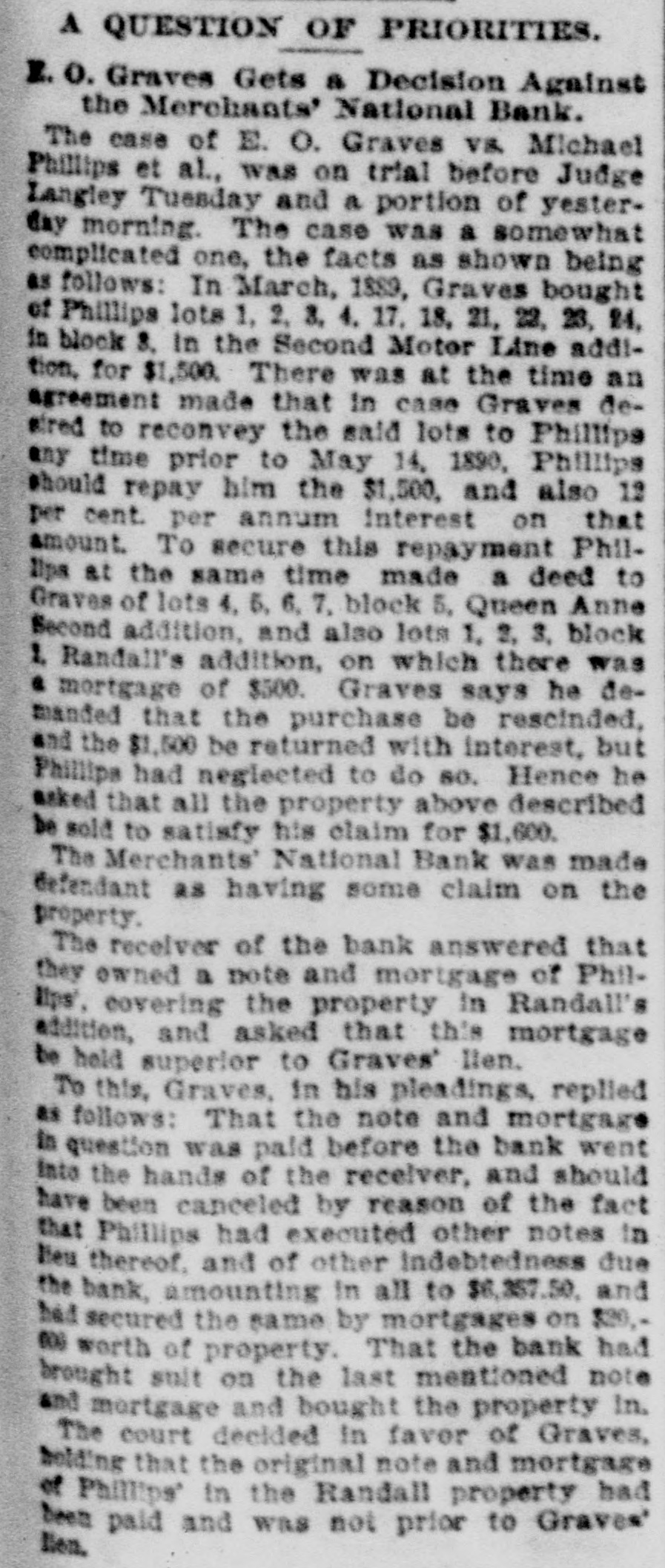
A QUESTION OF PRIORITIES. E. O. Graves Gets a Decision Against the Merchants' National Bank. The case of E. O. Graves vs. Michael Phillips et al., was on trial before Judge Langley Tuesday and a portion of yesterday morning. The case was a somewhat complicated one, the facts as shown being as follows: In March, 1889, Graves bought of Phillips lots 1, 2, 3, 4, 17, 18, 21, 22, 23, 24, in block 8. In the Second Motor Line addition, for $1,500. There was at the time an agreement made that in case Graves desired to reconvey the said lots to Phillips any time prior to May 14, 1890, Phillips should repay him the $1,500, and also 12 per cent. per annum interest on that amount. To secure this repayment Phillips at the same time made a deed to Graves of lots 4, 5, 6, 7, block 5, Queen Anne Second addition, and also lots 1, 2, 3, block 1, Randall's addition, on which there was a mortgage of $500. Graves says he demanded that the purchase be rescinded, and the $1,500 be returned with interest, but Phillips had neglected to do so. Hence he asked that all the property above described be sold to satisfy his claim for $1,600. The Merchants' National Bank was made defendant as having some claim on the property. The receiver of the bank answered that they owned a note and mortgage of Phillips, covering the property in Randall's addition, and asked that this mortgage be held superior to Graves' lien. To this, Graves, in his pleadings, replied as follows: That the note and mortgage in question was paid before the bank went into the hands of the receiver, and should have been canceled by reason of the fact that Phillips had executed other notes in lieu thereof, and of other indebtedness due the bank, amounting in all to $6,357.50, and had secured the same by mortgages on $20,-000 worth of property. That the bank had brought suit on the last mentioned note and mortgage and bought the property in. The court decided in favor of Graves, holding that the original note and mortgage of Phillips' in the Randall property had been paid and was not prior to Graves' lien.


Article from The Seattle Post-Intelligencer, April 19, 1896

Click image to open full size in new tab

Article Text

OUT FOR THE TAX. County Says Merchants' National Assessment Is Valid. The county of King, through Prosecuting Attorney Hastle, yesterday filed an answer to the petition of Charles H. Baker, as receiver, that the assessment of the stock of the Merchants' National bank be cancelled. The receiver claims that the bank is assessed on an aggregate of the stock at $69,360 over and above the amounts upon the real estate, when in truth the full value in money of the capital stock after deducting the value of the real estate was no sum whatever. These facts, it is claimed, were placed before the board of equalization, but the board refused to make a reduction, on the ground that the assessment was in accordance with the rule applied to all the other banks of the city. The answer contends that long before and long after the assessment the bank held itself out to the public as financially solvent and solicited and received deposits, issued certificates of deposit and performed other acts showing its solvency. When the assessor applied for a statement W. T. Wickware, cashier, furnished a sworn statement, showing among other facts that the value of the real estate belonging to the bank was $111,400, the amount of the surplus $25,000, and the amount of the undivided profits $2,000. This statement purported to show the condition of affairs on April 1, 1835, and the prosecuting attorney claims that the bank is now estopped from alleging, as against the demand for taxes for 1895, that on that date is was insolvent, or that the liabilities exceeded the resources. It is shown that after receiving the cashier's statement, the assessor proceeded as follows: He took the real estate at $111,400, the value given by the cashier; deducted that sum from $200,000, the par value of the capital stock; added the surplus of $25,000 and undivided profits of $2,000, leaving a remainder of $115,600, which was assessed at a valuation of $69,360. When the bank applied for a reduction to the board of equalization, the application was duly disallowed, the bank failing to appeal. For the above reasons, the county contends, it is entitled to the tax, and the bank is estopped from denying the correctness or legality of the assessment.


Article from The Seattle Post-Intelligencer, April 22, 1896

Click image to open full size in new tab

Article Text

IN THE FEDERAL COURT. Complaint of Receiver Baker, of the Merchants', Against Denton. Charles H. Baker, receiver of the Merchants' National bank, yesterday filed in the Federal court a complaint against David B. Denton, asking for an order enjoining Denton from collecting a judgment given in his favor and against the bank by the superior court. The facts of the case, as set forth in the complaint, are as follows: The Merchants' National bank, in July, 1893, borrowed money from the National Park bank of New York, giving as partial security $25,000 of the Sidney Newer Pipe and Terra Cotta Works mortgage bonds, owned by President Mackintosh, of the Merchants' National bank. After the appointment of Receiver Baker, President Mackintosh presented his claim against the bank for $29,250 on account of these bonds, which the receiver refused to honor. Mackintosh then transferred the bonds to Denton, who, after duly presenting his claim to the receiver and meeting refusal, sued in the superior court of King county last fall and obtained judgment for the full amount. The complaint asserts that in this suit in the superior court the summons and complaint was served on William T. Wickware as cashier of the Merchants' National bank: that Wickware gave the receiver no notice or information as to the institution or pendency of the suit, and that the first knowledge the receiver or any person Interested in the affairs of the bank had of the suit was from the report in the newspapers announcing that a judgment had been rendered. The complaint declares that at the time of the suit in the superior court both Wickware and Denton well knew that the claim was not a valid claim against the bank, or at any rate for nothing more than the real value of the bonds, which the complaint asserts were practically worthless: and that Wickware and Denton conspired together to bring the suit and obtain judgment without Receiver Baker's knowledge; that the service of the summone and complaint on Wickware amounted to nothing. as he did not at that time in any way represent the bank: that since obtaining judgment in the superior court Dentom has begun suit in the Federal court asking that the receiver be enjoined from further rejecting his claim: that Receiver Baker, over since the Sidney Sewer Pipe and Terra Cotta Works bonds came into his possession, has been perfectly willing to turn them over to their rightful owner. Rece'ver Baker accordingly now deposits the bonds with the Federal court, and asks not only for an injunction against the collection of the judgment secured by Denton in the superior court, but also for a subpoena directing Denton to appear and answer the complaint filed yesterday.


Article from The Seattle Post-Intelligencer, August 13, 1896

Click image to open full size in new tab

Article Text

MERCHANTS' BANK DIVIDEND. Receiver Baker Pays $74,029.95 to the Creditors. Charles H. Baker, receiver of the Merchants' National bank, has posted a notice that he is now prepared to pay a divIdend of 30 per cent to creditors of the bank whose claims were proved prior to the order of the comptroller of the currency, dated June 24, declaring the dividend. The comptroller's checks, aggregating $74,029.95, 559 in number, drawn on the assistant United States treasurer, have Just been received from Washington City, and will be distributed to depositors upon presentation of their receiver's certificate. The Merchants' National bank suspended a year ago and Charles H. Baker was appointed receiver by Comptroller Eckles. The liabilities were about $260,000, and the assets were nominally more, but upon careful examination and appraisement by the receiver a deficiency of assets of $150,000 was declared to exist and an assessment for that amount was levied upon the shareholders of the bank. the collection of which is now being enforced through the courts here and in New York and Providence. Thirty per cent. is the largest single dividend ever paid by a bank in liquidation in the Northwest, and in fact very few have paid that much altogether. The distribution of this amount of money locally at this time will tend to relieve the financial situation very materially. The dividend as first declared and as reported through the Associated Press was 25 per cent, but when Mr. Baker went to Washington City recently he urged the comptroller to declare 30 per cent, which was done upon his assurance that that amount would be collected. The receiver was asked yesterday If the bank would eventually pay out in full. He replied: "I can tell you better after the financial question is settled. If I have to pay in a depreciated currency It will take twice as long as otherwise, for there will be no corresponding law to compel the shrinkage of liabilities in a corresponding ratio, and the depositors being a credftor class will naturally insist upon having par value money. If the proposed silver coinage law were already enacted It might be my privilege as receiver to take the $74,000 in gold. which is to my credit as receiver in the United States treasury, and exchange it for silver metal, which I could get coined into 148,000 silver dollars. If I could work off this money on the depositors the bank could pay 60 per cent instead of 30 per cent., but this scheme would have a screw loose In It apparent to anyone and would be like the perpetual motion machine, which men have gone crazy over trying to Invent. As receiver, I very much regret that It is not also contemplated to remonetize real estate and shingle mills. which would thus enable me to pay depositors in full at once and 100 per cent. to the stockholders. In fact, I have understood that a very strong effort had been made to include a horse plank with silver, but failed on the ground that horses had been demonetized by bloycles and not by gold. As receiver. I am inclined to espouse the silver cause, because the bank Is interested in a Colorado silver mine listed as valueless, but as a eltIzen I oppose unsound dollars, even though they assume that what they are short in weight is made good by the assuring stamp they bear, In God we trust.' A return of prosperity will enable this bank to pay out in full, and that means solid gold."


Article from The Seattle Post-Intelligencer, September 10, 1896

Click image to open full size in new tab

Article Text

# THE STOCK NO GOOD. Assessment Against the Merchants' National Canceled. WILL NOT HAVE TO PAY TAXES. Receiver Baker Proves That the Stock Is of No Value-Bank Was Over- loaded with Real Estate. Under a ruling of Judge Langley in the superior court yesterday, the assessment against the stock of the Merchants' National bank is canceled, and the county officers are restrained from attempting to collect it. The case is entitled Charles H. Baker, as receiver, vs. the county of King. From the complaint it appears that the assessor added together the amount of the capital stock at its par value, the amount of the nominal surplus and undivided profits, making $227,000 in all, and then deducted from that amount real estate valued at $111,400. This left a balance of $115,600. Following out his system of fixing values, the assessor finally assessed the bank for $29,360, against which the bank has been fighting. A petition to the board of equalization resulted in a decision upholding the assessment. The bank thereupon took an appeal to the superior court, and at the hearing yesterday made the showing that the stock being absolutely worthless, the assessment was excessive. The court held with the bank. In order to establish the claim that the bank stock was valueless, the attorneys for the receiver went into the history of the institution from a date preceding the application for the receiver. It appeared that the Merchants' National was heavily overloaded with real estate, and that its condition had been a subject of consultation by members of the clearing house for some time previous to the failure. W. T. Wickware was placed on the stand and testified that the Merchants' National had been crowded to the wall by Ladd & Tilton, but this testimony was rebutted by N. H. Latimer. Before the hearing was ended a great deal of ancient history was thrashed over.


Article from The Seattle Post-Intelligencer, October 22, 1896

Click image to open full size in new tab

Article Text

# The Assessment Is Void. Judge Langley yesterday decided that taxes cannot be collected on the stock of an insolvent bank by giving judgment for plaintiff in the case of Charles H. Baker, as receiver of the Merchants' National Bank, vs. the County of King. On April 1, 1895, the assessor of King county assessed the stock of the Merchants' National bank at $69,300, or $34.63 per share. There are 2,000 shares of stock in the bank of a par value of $100 per share. The total par value of the stock is $200,000. The county commissioners refused to cut down the assessment. The receiver then brought suit to have the assessment set aside. He showed at the hearing of the case that the bank was insolvent at the time of the assessment, and that the stock was worth less than nothing, as an assessment of 75 per cent. was levied upon the stock to pay the debts of the bank. Judge Langley declared the assessment made by the assessor of King county to be null and void.


Article from The Seattle Post-Intelligencer, May 20, 1897

Click image to open full size in new tab

Article Text

# IN THE SUPERIOR COURT OF THE State of Washington, for King County. John Wilson, plaintiff, vs. J. F. Brewer, Adora B. Brewer, his wife; Eugene Fischer and Anna Fischer, his wife; the Washington National Bank of Seattle, a corporation; the County of King, in the State of Washington; Byron Phelps, as County Treasurer; the City of Seattle, in the State of Washington, and Adolph Krug, as Treasurer of the City of Seattle; Malcolm McDougal, C. G. Bradner, Willis L. Ames, as Trustee; R. J. Lamoreux, Franz Koehler, Chas. H. Baker, as Receiver of the Merchants' National Bank of Seattle; the Pioneer Savings and Loan Company, a corporation; the Scottish American Mortgage Co., Limited, a corporation; the Seattle Hardware Co., a corporation, defendants. Summons for publication. The State of Washington to the said R. J. Lamoreux, Franz Koehler and the Pioneer Savings and Loan Company, defendants above named: β€’ You and each of you are hereby summoned to appear within sixty (60) days after the date of the first publication of this summons, to-wit: Within sixty (60) days after the 22d day of April, 1897, and defend the above entitled action in the above entitled court, and answer the complaint of the plaintiff, and serve a copy of your answer upon the undersigned attorneys for plaintiff at their office below stated; and in case of your failure so to do, judgment will be rendered against you according to the demand of the complaint, which has been filed with the clerk of said court. The object of the above entitled action is to obtain judgment against the defendants, J. F. Brewer and Adora B. Brewer, his wife, for the sum of $2,000 and interest upon the notes given by them to the plaintiff, and against the defendants, Eugene and Anna Fischer, for $1,400 assumed by them, and for the costs of this action, including an attorney's fee of $200; also praying for a decree establishing and foreclosing a certain mortgage given to secure the payment of the above indebtedness, and recorded in the Mortgage records of the Auditor's office of King County, State of Washington, in Vol. 73, on page 400 thereof, and describing and covering the following lands, situated in said county, to-wit: Lots Nos. nine (9) and ten (10) in Block ten (10), and lots seven (7) and eight (8) in Block twenty (20) of Walla Walla addition to Seattle, shown on Volume 5 of Plats in Auditor's office of King County, at page eighty-one (81), also praying that in said decree the interest of each of the defendants in and to said property be declared junior, inferior and subordinate to plaintiff's interest therein, and that the equity of redemption of each of the defendants be forever barred and foreclosed, and for general equitable relief. HASTINGS & STEDMAN, Plaintiff's Attorneys. P. O. Address: 64 Haller Building, Seattle, King County, Washington.