
City National Bank (Dayton, OH)

Episode Information

Episode UID
287401360
Episode Type
Suspension โ†’ Reopening
Bank Type
national
Bank ID
28740 national
Charter Number
2874
Start Date
April 4, 1913
Location
Dayton, Ohio (39.759, -84.192)

Metadata

Model
gpt-5-mini (chosen from majority vote of a three-model LLM ensemble)
Short Digest
c4de32effbefc2fb

Response Measures

None

Description

Articles describe a Dayton-wide temporary closure/reopening but do not name City National Bank explicitly.

Events (3)

1. February 7, 1883 Chartered
Source
historical_nic
2. April 4, 1913 Suspension
Cause
Government Action
Cause Details
After the March 1913 flood, the Treasury designated every national bank in Dayton a government depository and pledged $2,000,000 to restore confidence so banks could reopen.
Newspaper Excerpt
banks were afraid to reopen their doors, dreading runs... every national bank in Dayton was made a Government depositary, and it was announced that $2,000,000 of government funds would be lodged with them
Source
newspapers
3. March 8, 1930 Voluntary Liquidation
Source
historical_nic

Newspaper Articles (3)

Article from Brownsville Herald, December 4, 1913

Click image to open full size in new tab

Article Text

# MCADOO'S REPORT Secretary McAdoo's report, as outlined in The Herald Wednesday, was necessarily an important document, and incidentally a very able one. It could not all be given in The Herald as it makes a book of 80 pages-much of it, the tables especially, being rather fine print. The synopsis given in The Herald, as sent out by the Associated Press, covers broadly most of the points of interest touched on by the Secretary. However, the document is worth preserving and it is worthy of careful study. It is only when we begin to study it in detail that we perceive the magnitude of Uncle Sam's business concerns and how he is linked up in innumerable ways, through his treasury department with every interest of the country, from the cross-roads post office to the latest and biggest battleship. An examination of the report shows conclusively: That the affairs of the nation, for the fiscal year ending in June 1913 have been carefully administered. That in many details large savings in expenditure have been effected. That in many ways the department has been able to be of great help to the people in emergencies that demanded help-as in the case of flood damages on the Ohio river and its tributaries. The story of how the government came to the rescue of Dayton, is very interesting. The Secretary tells us how as the waters receded, banks were afraid to reopen their doors, dreading runs that might be made on them. In that crisis the government sent an examiner, and within 24 hours of his arrival every bank in Dayton was made a Government depositary, and it was announced that $2,000.000 of government funds would be lodged with them, yet secured in such a way as to safeguard the funds. The effect of this was to secure confidence. As a matter of fact the treasury was only called on for $182,000. The story of the distribution of money to help move crops in the cotton state is another interesting feature of the document. One of the comforting features of Mr. McAdoo's report relates to the wise and statesmanlike precautions taken to forestall any panicky conditions which might grow out of the tariff and currency reform measures. This was done, simply and wisely, by the setting aside of $500,000,000 emergency currency. The relief obtained by the announcement of this emergency fund was instantaneous. As a matter of fact the emergency fund was not drawn on at all. Mr. McAdoo tells how the farmers or farming communities were represented in a most interesting meeting at Washington to make known the needs of their several sections-south and southwest, middle and northwest, Pacific coast and Rocky mountains: how on an estimated need of $50,000,000 forty six millions were actually distributed in the way of loans. One of the large achievements of the administration was the reorganization of the customs service, consolidating many ports, abolishing many and defining district boundaries with greater precision, resulting in greater economy and efficiency. The saving of expense is estimated at $356,000 annually. Altogether the report shows us the nature and the weight of the problems the democrats had to deal with this year We cannot avoid the conclusion that the affairs of the nation have been in able hands since March 4. A Minnesota cow has given 19,000 pounds of milk in one year. This milk

Article from The Cincinnati Enquirer, September 7, 1934

Click image to open full size in new tab

Article Text

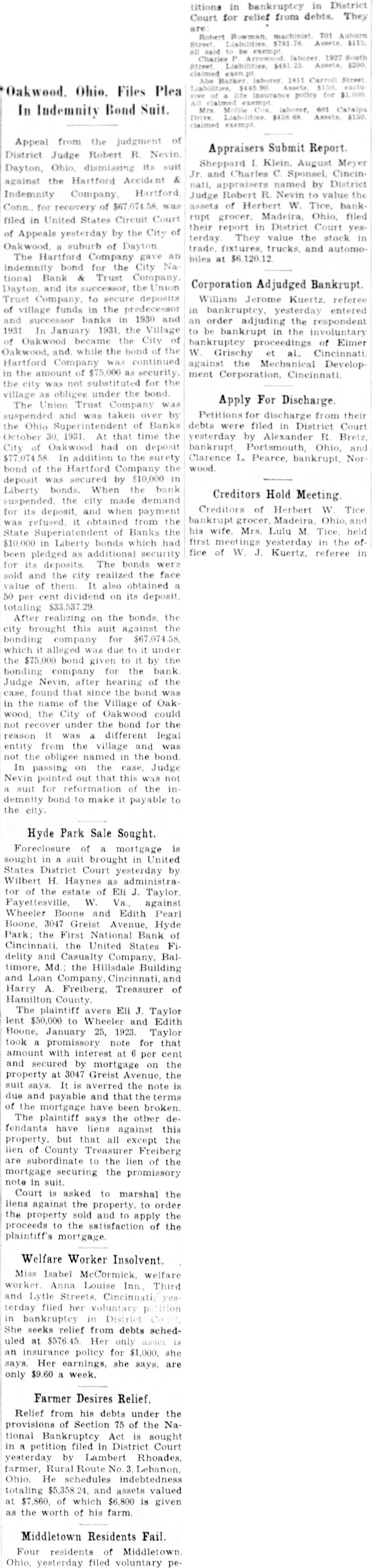
Oakwood. Ohio. Files Plea In Indemnity Bond Suit. Appeal from the judgment of District Judge Robert R. Nevin suit against the Hartford Accident Indemnity Hartford Conn. recovery of filed in United States Circuit Court of Appeals yesterday by the City of suburb Dayton The an indemnity bond for the City National Bank Trust Company Dayton and its the Union Trust to secure deposits of village funds in the and banks in 1930 and 1931 In January 1931 the Village of Oakwood became the City Oakwood, and while the of the Hartford was in the security. the city not for the village obligee the bond The Trust Company suspended and was taken by the Ohio of Banks 1931 At that time the City Oakwood had on deposit $77,074.58 In addition to the surety bond of the Hartford Company the deposit secured by $10,000 in Liberty When bank the city made demand for its and when payment was refused from the State Banks the $10,000 Liberty bonds which had been pledged as additional security for its deposits. The bonds were sold and the city realized the face value of also obtained 50 per cent dividend on its totaling $33,537.29 After realizing on the bonds the city brought this suit against the bonding company for which due under the $75,000 bond giver by the bonding for the bank Judge of the case, found that since the bond was in the name of the Village of Oak wood the City of Oakwood could not recover under the bond for the reason was different legal entity from the village and was not the obligee named the bond In passing on the case, Judge Nevin pointed out that this was not the demnity bond to make it payable the city. titions in bankruptcy in District Court for relief from debts They are Appraisers Submit Report. Sheppard Klein August Meyer Jr. and Sponsel, Cincinappraisers named by District Judge Robert R. Nevin to value the assets of Herbert W. Tice, bank rupt grocer Ohio, filed their report in District Court yesterday They value stock in trade fixtures trucks and automobiles at $6,120.12 Corporation Adjudged Bankrupt. William Jerome Kuertz referee order adjuding the respondent to be bankrupt in the involuntary bankruptey proceedings of Elmer Grischy Cincinnati against the Mechanical Apply For Discharge Petitions for discharge from their debts were filed in District Court yesterday by Alexander R Bretz bankrupt and Clarence L. Pearce, bankrupt, Nor wood Creditors Hold Meeting Creditors of Herbert W Tice bankrupt grocer Madeira Ohio and first meetings yesterday in the of fice of W J. Kuertz, referee in Hyde Park Sale Sought. Foreclosure of mortgage is sought in suit brought in United States District Court yesterday by Wilbert H. Haynes administrator of the estate of Eli J. Taylor Fayettesville, W against Wheeler and Edith Pearl Boone, 3047 Avenue, Hyde Park the First National Bank of Cincinnati the United States F1 delity and Casualty Company, Baltimore, Md. the Hillsdale Building and Loan Company Cincinnati and Harry A. Freiberg, Treasurer of Hamilton The plaintiff avers Eli J. Taylor lent $50,000 to Wheeler and Edith Boone, January 25, 1923. Taylor took promissory note for that amount with interest per cent and by mortgage on the at 3047 Greist Avenue, the suit says is the note is due and payable and that terms of the mortgage have been broken The plaintiff says the other defendants have liens against this property, but that all except the lien of County Treasurer Freiberg are subordinate the lien of the mortgage securing the promissory note in suit Court is asked to marshal the liens against the property, order the property sold and apply the the of the plaintiff's mortgage. Welfare Worker Insolvent. Miss Isabel McCormick welfare worker Anna Louise Third terday filed her voluntary P in bankruptcy She seeks relief from debts scheduled at $576.45 Her an policy for $1,000, she says Her earnings, she says, are only $9.60 week. Farmer Desires Relief. Relief from his debts under the provisions of Section 75 of the National Bankruptcy Act is sought in petition in District Court yesterday by Lambert Rhoades, farmer, Rural Route Lebanon, Ohio. He schedules indebtedness totaling and assets valued at $7,860 of which $6,800 is given as the worth of his farm. Middletown Residents Fail. Four residents of Middletown Ohio, yesterday filed voluntary pe-


Article from Evening Star, May 19, 1946

Click image to open full size in new tab

Article Text

Capital Sidelights By Will P. Kennedy. In the early days of Congress, oratorical members, especially the brilliant but long-winded John Randolph of Roanoke, Va., vexed their colleagues by frequent and extended speeches. On March 26, 1820, Randolph spoke more than four hours on the Missouri bill and on April 28 of the same year Representative Stevenson Archer of Maryland proposed a rule that no member should speak longer than an hour at a time, and that no question should be discussed over five days, but this proposed rule was not acted upon. In 1822 Representative John Cocke of Tennessee, again proposed the hour curb. but it was not adopted. Again, in 1828, Representative William Haile of Mississippi reviewed the tediousness of debates but failed to get a limit accepted. On March 1, 1833, Representative Frank E. Plummer of Mississippi so wearied the House in the closing hours of the Congress that repeated attempts were made to take him off the floor and there was serious disorder. On the motion of Representative Lott Warren of Georgia, July 6, 1841, the first rule for the purpose was adopted, and on June 11, 1842, on motion of Representative Benjamin S. Cowen of Ohio, it was made one of the standing rules of the House when unlimited debate caused the greatest danger to bills in the Committee of the Whole. This rule that no member should occupy "more than one hour in debate on any question," often has been attacked-notably by Thomas Hart Benton of Missouri in his "Thirty Years' View" and by Representative Clement L. Vallandigham of Ohio at the time of the revision in 1860, three years before he was arrested by the Union military authorities for treasonable utterances and was banished to the Confederate States. * During these wild-cry days of threatened inflation and far-flung propaganda to avert a financial panic. with the "Wolf! Wolf!" pack in full cry, some of the sober men in Congress are counseling their more affrighted colleagues that often these forecast calamities are really not so imminent or colossal as they are imagined to be. Some of the elder statesmen in Congress are recalling two less-than-a-month-apart illustrations of 33 years ago. In March, 1913, a great storm had swept the Ohio Valley, with the city of Dayton a special sufferer. The banks of that community, after the flood had subsided, feared to reopen their doors. On April 4 the Citizens' Relief Committee wired the Treasury Department. Within 24 hours on the recommendation of a national bank examiner the Federal Department designated every national bank in Dayton a Government depository, with the Government ready to ship in $2,000,000 of Government funds. Confidence was restored, the banks reopened and there was a call for only $182,000 of the anticipated $2,000,000. When a special session of Congress was convened on April 7, 1913, to consider currency and tariff reforms, a pandemonium of unrest pervaded business circles. To relieve anxiety, to pull the teeth of threatened restriction of credit, to assure the country that there was an unjustifiable false alarm, the Treasury announced that there was on hand $500,000,000 in new national bank note currency to be shipped to any and all banks complying with the requirements under the Aldrich-Vreeland Act of May 30, 1908-and none of this money was applied for by the banks. The wiser heads in Congress are advising: "Don't be stampeded by false alarms and propaganda."