Arkansas National Bank (Hot Springs, AR)

Episode Information

Episode UID
283201294
Episode Type
Suspension โ†’ Reopening
Bank Type
national
Bank ID
28320 national
Charter Number
2832
Start Date
October 28, 1907
Location
Hot Springs, Arkansas (34.504, -93.055)

Metadata

Model
gemini-3-flash-preview (chosen from majority vote of a three-model LLM ensemble)
Short Digest
781aa0f0bfb56bb4

Response Measures

None

Description

The bank was affected by the regional banking holiday in October 1907. Articles 1-3 mention the bank only as a party in a legal case unrelated to its solvency.

Events (2)

1. December 5, 1882 Chartered
Source
historical_nic
2. October 28, 1907 Suspension
Cause
Macro News
Cause Details
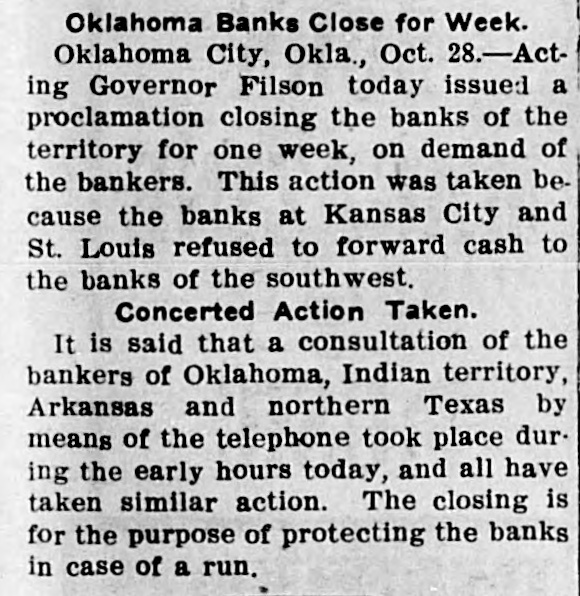
Regional banking holiday declared across Arkansas and neighboring territories to prevent runs during the Panic of 1907.
Newspaper Excerpt
a consultation of the bankers of Oklahoma, Indian territory, Arkansas and northern Texas by means of the telephone took place during the early hours today, and all have taken similar action. The closing is for the purpose of protecting the banks in case of a run.
Source
newspapers

Newspaper Articles (4)

Article from The Monticellonian, April 2, 1903

Click image to open full size in new tab

Article Text

occasionally, but had never seen him play either the races or slot machines. Had never seen him drunk. W. H. Lewis of Hot Springs stated that he had seen the defendant intoxicated in the Kentucky saloon. W. H. Martin. an attorney of Hot Springs stated that he had been appointed by the defendant in the cause of the Arkansas National Bank against Sumpter: the defendant had never demanded loans of him. but after he was appointed receiver he advanced sums aggregating $1,500; served four years as receiver and received a fee of $6,000. Geo. H. Lawer, chancery clerk of Garland county, had served as master and commissioner in chancery at several different times, for which he had received fees amounting to $1,200; had loaned Judge Leatherman money whenever the latter stated that he needed it. Witness identified certain checks as those given by him to defendant. S. A. Sammons, a grocer at Hot Springs, testified that he loaned the defendant $200 at one time and that at that time there was a judgment against him with several others in defendant's court for $4,600, which was later reduced to $1,700. F. T. Housley testified that he was one of the men against whom the judgment of $4,600. later reduced to $1,700. was rendered in the defendant's court. He said he gave Mr. Sammons $100 which the latter said he wanted for Judge Leatherman. John L. Smith testified that the defendant offered him a sum of money if he would allow him (the defendant) to name the judges and clerks for the primary election last spring. C. S. Bell testified that he had been appointed receiver for the defunct City Savings Bank by the defendant. He stated that during the five years of his receivership he had collected between $2,000 and $3,000. most of which had been allowed on his salary as receiver. The defense will later introduce witnesses.


Article from The Forrest City Times, April 3, 1903

Click image to open full size in new tab

Article Text

FRIDAY, MARCH 27. The senate proceeded with the impeachment trial of Chancellor Leatherman. Eight witnesses were introduced by the prosecution. The house passed Senator King's bill enlarging the powers of the railroad commission. Sentor Pinnix's bill creating the office of county school superintendent, was defeated in the house. The house passed a bill authorizing cities of the first and second class to levy tax for maintenance of public libraries. ### The Senate. H. B. 261 (Whitthorne), and S. B. 253 (Logan), both providing for the better protection of fish, were passed without opposition. At 10 o'clock the senate set as an impeachment court to proceed with the trial of Chancellor Leatherman. The first witness called was L. D. Cooper of Hot Springs, who stated that he was interested in the operation of slot machines. He testified that in a conversation with the defendant, the latter had said that inasmuch as the pool rooms and slot machines were conducted under cover, he thought those institutions should set aside a fund for campaign purposes. He had seen defendant in pool rooms occasionally, but had never seen him play either the races or slot machines. Had never seen him drunk. W. H. Lewis of Hot Springs stated that he had seen the defendant intoxicated in the Kentucky saloon. W. H. Martin, an attorney of Hot Springs stated that he had been appointed by the defendant in the cause of the Arkansas National Bank against Sumpter; the defendant had never demanded loans of him, but after he was appointed receiver he advanced sums aggregating $1,500; served four years as receiver and received a fee of $6,000. Geo. H. Lawer, chancery clerk of Garland county, had served as master and commissioner in chancery at several different times, for which he had received fees amounting to $1,200; had loaned Judge Leatherman money when-


Article from Newport Weekly Independent, April 3, 1903

Click image to open full size in new tab

Article Text

occasionally, but had never seen him play either the races or slot machines. Had never seen him drunk. W. H. Lewis of Hot Springs stated that he had seen the defendant intoxicated in the Kentucky saloon. W. H. Martin, an attorney of Hot Springs stated that he had been appointed by the defendant in the cause of the Arkansas National Bank against Sumpter; the defendant had never demanded loans of him, but after he was appointed receiver he advanced sums aggregating $1,500; served four years as receiver and received a fee of $6,000. Geo. H. Lawer, chancery clerk of Garland county, had served as master and commissioner in chancery at several different times, for which he had received fees amounting to $1,200; had loaned Judge Leatherman money whenever the latter stated that he needed it. Witness identified certain checks as those given by him to defendant. S. A. Sammons, a grocer at Hot Springs, testified that he loaned the defendant $200 at one time and that at that time there was a judgment against him with several others in defendant's court for $4,600, which was later reduced to $1,700. E. T. Housley testified that he was one of the men against whom the judgment of $4,600. later reduced to $1,700, was rendered in the defendant's court. He said he gave Mr. Sammons $100 which the latter said he wanted for Judge Leatherman. John L. Smith testified that the defendant offered him a sum of money if he would allow him (the defendant) to name the judges and clerks for the primary election last spring. C. S. Bell testified that he had been appointed receiver for the defunct City Savings Bank by the defendant. He stated that during the five years of his receivership he had collected between $2,000 and $3,000. most of which had been allowed on his salary as receiver. The defense will later introduce witnesses. The House. Mr. Fletcher introduced by request a bill making it unlawful for any newspaper in the state to publish accounts of prize fights or sparring contests, occurring either in the state or without. A bill was introduced making it unlawful for any persons to engage in selling pools or maks bets on any horse race. An amendment to the insane asylum appropriation bill was adopted maki it unlawful for any member of the board or officer of the institution to employ any of his kinsmen. S. B. 12 (Pinnix), creating the office of county superintendent was taken up. Mr. Du Laney urged the passage of the bill. Mr. Chambers opposed the bill on the ground that it destroyed local self-government by taking the power away from the school directors and placing it in the hands of one man. Messrs. Jacobs, McGuigan and Latimer spoke in favor of the measure. Mr. Bell opposed the bill because it would create seventy-five new offices and tax the people to pay for them. The bill was defeated-24 to 48. S. B. 40 (King). enlarging the powers of the railroad commission passed. S. B. 101 (Wilson), authorizing cities of the first and second class to levy a tax of one-fourth of a mill for the maintenance of public libraries, was read third time and passed. S. B. 98 (Hardy), allowing railroad companies seven days in which to pay discharged employes, passed. Mr. Brooks called up S. B. 35, limiting the hours of work of railway train crews. except in cases of wrecks and other accidents, to sixteen consecutive hours per day. The bill passed without opposition. S. B. 113 (Gray), providing for a division of liquor license funds between county and school funds, was taken up. Amendments were adopted exempting about forty counties.


Article from The Laramie Republican, October 28, 1907

Click image to open full size in new tab

Article Text

Oklahoma Banks Close for Week. Oklahoma City, Okla., Oct. 28.-Acting Governor Filson today issued a proclamation closing the banks of the territory for one week, on demand of the bankers. This action was taken because the banks at Kansas City and St. Louis refused to forward cash to the banks of the southwest. Concerted Action Taken. It is said that a consultation of the bankers of Oklahoma, Indian territory, Arkansas and northern Texas by means of the telephone took place during the early hours today, and all have taken similar action. The closing is for the purpose of protecting the banks in case of a run.