First National Bank (Spokane, WA)

Episode Information

Episode Type
Run → Suspension → Closure
Start Date
July 26, 1893
Location
Spokane, Washington (47.659, -117.426)
Bank Type
national
Charter Number
2805

Metadata

Response Measures

Public signal of financial health, Full suspension, Books examined

Receivership Details

Depositor recovery rate
44.0%
Date receivership started
1893-11-20
Date receivership terminated
1900-02-12
OCC cause of failure
Excessive lending
Share of assets assessed as good
12.7%
Share of assets assessed as doubtful
87.0%
Share of assets assessed as worthless
0.4%

Notes

Suspension on July 26, 1893 led to later appointment of a receiver (F. Lewis Clark) and eventual insolvency.

Events (5)

1. October 24, 1882 Chartered
Source
historical_nic
2. July 26, 1893 Run
Cause
Local Banks
Cause Details
Withdrawals triggered by prior local bank failures/panic (Bank of Spokane Falls and other Spokane closures) causing heavy withdrawals on First National.
Measures
Noted continued withdrawals; bank posted notice and suspended payments the same day.
Newspaper Excerpt
owing to continued withdrawal by depositors
Source
newspapers
3. July 26, 1893 Suspension
Cause
Local Banks
Cause Details
Inability to realize on securities combined with continued withdrawals forced temporary suspension of payments.
Newspaper Excerpt
this bank has temporarily suspended payment.
Source
newspapers
4. November 20, 1893 Receivership
Newspaper Excerpt
Appointment of F. Lewis Clark as receiver reported late November 1893; the appointment of F. Lewis Clark as receiver of the First National bank of this city (Nov. 29 reports).
Source
newspapers
5. November 20, 1893 Receivership
Source
historical_nic

Newspaper Articles (25)

Article from The Record-Union, June 7, 1893

Click image to open full size in new tab

Article Text

BANK FAILURES

Three Spokane Institutions Close Their Doors. SPOKANE (Wash.), June 6.--Three banks closed their doors to-day. They have assets largely in excess of the liabilities, and have been conducted with sound management. They were caught in a sudden whirl and flurry. The public suddenly became alarmed, and distance from the money centers prevented timely fortification. When the banking hours arrived this morning the Washington National and Washington Savings Banks, allied institutions, failed to open their doors. They had been subjected to a heavy run the day before, and although they had made arrangements for money, it failed to arrive in time. This startled the public, and a run was started anew upon all banks. By 1 o'clock it had almost entirely subsided, but relief came too late for the Citizens' National, which closed its doors at 2 o'clock. The other banks stood the strain with no visible signs of weakening, and since they have been strengthening themselves, and the worst of the flurry is believed to be over. It is generally believed that there will be no more suspensions.


Article from The Kootenai Herald, June 10, 1893

Click image to open full size in new tab

Article Text

Spokane Banks Fail

Last Monday the Bank of Spokane Falls closed its doors. This was the oldest banking institution in Spokane. It was a private institution owned by A. M. Cannon who was supposed to be as solid as adamant financially. The failure of Cannon's bank caused a panic among depositors and immediately a run started on all the banks of the city. On Tuesday morning the Washington National, the Washington Savings and the Citizens National were unable to open their doors for business. The run on the other banks continued, but they were able to stand the run and quiet was resumed. Confidence seems to have taken hold again and everything appears to be all right. Of the four banks that have closed all will pay dollar for dollar and that speedily, it is believed. Cannon's bank has assets three times in access of its liabilities. The Citizens' has $400,000 gilt edge security against $200,000 deposits. There were a series of misfortunes which led up to the financial crash in Spokane. First, depositors caught the infection of foreign alarm. The failures in other states produced a spirit of uneasiness among depositors. Then some accident started a run on the Bank of Spokane and the panic followed. All the banks were perfectly solvent, but four found themselves short of ready money to meet a, run, and it was impossible to get cash in their vaults in time to meet the demands. Every bank in Spokane will pay dollar for dollar upon its deposits, but the temporary failure will doubtless bring ruin to many a man.


Article from The Wichita Daily Eagle, July 27, 1893

Click image to open full size in new tab

Article Text

TWO OF A KIND

SPOKANE, Wash., July 26.-The First National bank and an allied institution of the Spokane Savings bank have suspended payment temporarily. The First National has a capital of $250,000, and the Savings bank of $100,000. No runs were made on the other banks,


Article from Asheville Daily Citizen, July 27, 1893

Click image to open full size in new tab

Article Text

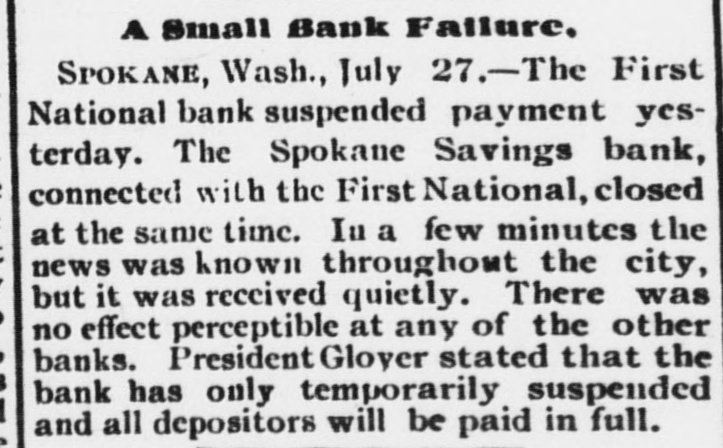
A Small Bank Failure

SPOKANE, Wash., July 27.-The First National bank suspended payment yesterday. The Spokane Savings bank, connected with the First National, closed at the same time. In a few minutes the news was known throughout the city, but it was received quietly. There was no effect perceptible at any of the other banks. President Gloyer stated that the bank has only temporarily suspended and all depositors will be paid in full.


Article from The Daily Morning Astorian, July 27, 1893

Click image to open full size in new tab

Article Text

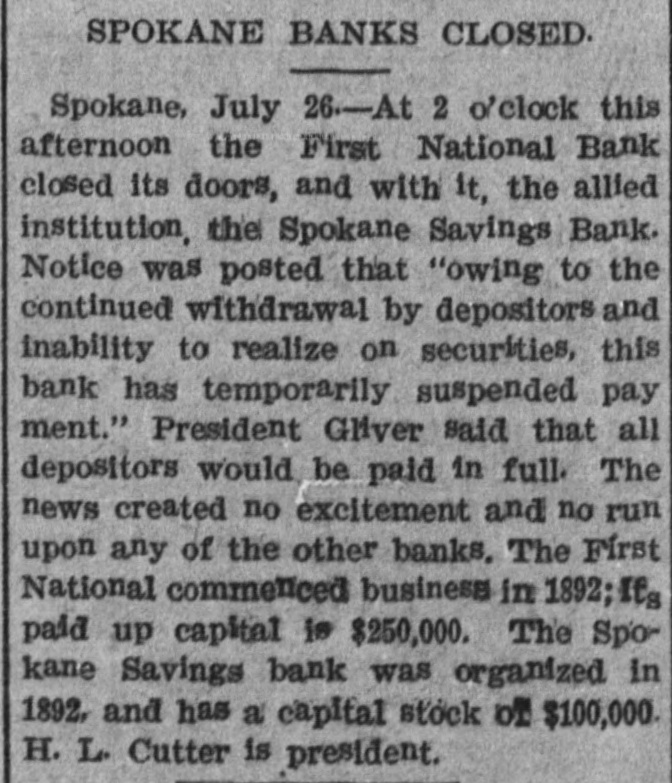
SPOKANE BANKS CLOSED

Spokane, July 26-At 2 o'clock this afternoon the First National Bank closed its doors, and with it, the allied institution, the Spokane Savings Bank. Notice was posted that "owing to the continued withdrawal by depositors and inability to realize on securities, this bank has temporarily suspended pay ment." President Gliver said that all depositors would be paid in full. The news created no excitement and no run upon any of the other banks, The First National commercied business in 1892;Ifg paid up capital is $250,000. The Spo kane Savings bank was organized in 1892. and has a capital stock of $100,000. H. L. Cutter is president.


Article from Deseret Evening News, July 27, 1893

Click image to open full size in new tab

Article Text

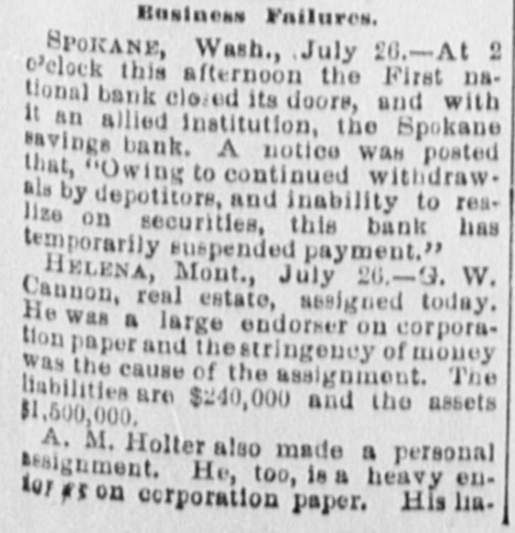
Business Failures

SPOKANE, Wash., July 26.-At 2 o'elock this afternoon the First national bank closed its doors, and with it an allied institution, the Spokane savings bank. A notice was posted that, "Owing to continued withdrawals by depotitors, and inability to realize on securities, this bank has temporarily suspended payment." HELENA, Mont., July 26.-G. W. Cannon, real estate, assigned today. He was a large endorser on corporaNon paper and thestringency of money was the cause of the assignment. The liabilities are $240,000 and the assets $1,500,000. A. M. Holter also made a personal assignment. He, too, is a heavy enfor #5 on corporation paper. His lia-


Article from The Portland Daily Press, July 28, 1893

Click image to open full size in new tab

Article Text

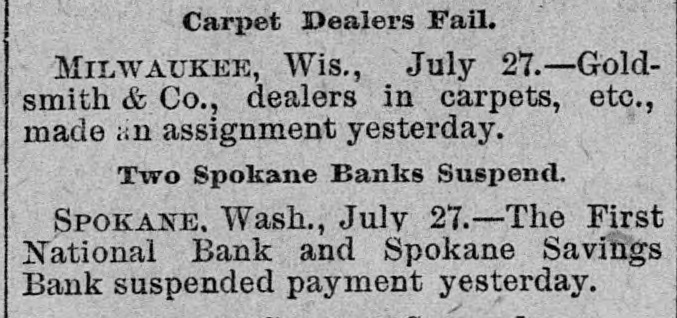
Carpet Dealers Fail

MILWAUKEE, Wis., July 27.-Goldsmith & Co., dealers in carpets, etc., made an assignment yesterday. Two Spokane Banks Suspend. SPOKANE. Wash., July 27.-The First National Bank and Spokane Savings Bank suspended payment yesterday.


Article from The Morning News, July 28, 1893

Click image to open full size in new tab

Article Text

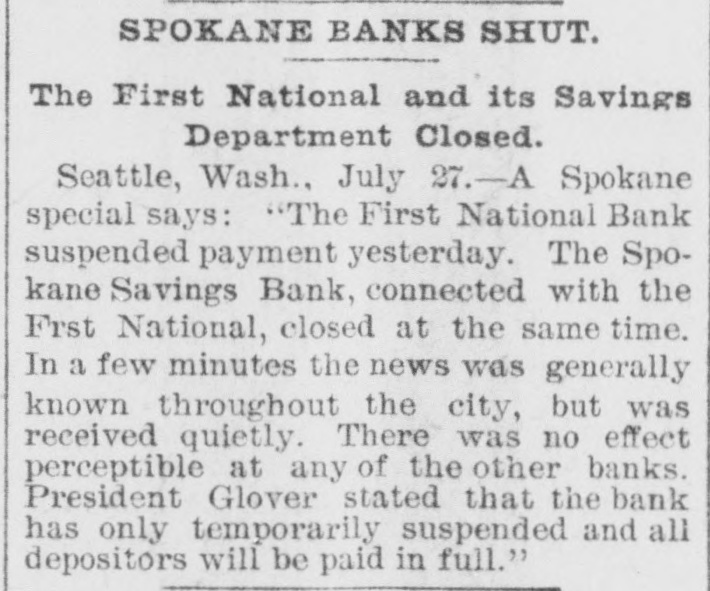
SPOKANE BANKS SHUT

The First National and its Savings Department Closed. Seattle, Wash., July 27.-A Spokane special says: "The First National Bank suspended payment yesterday. The Spokane Savings Bank, connected with the Frst National, closed at the same time. In a few minutes the news was generally known throughout the city, but was received quietly. There was no effect perceptible at any of the other banks. President Glover stated that the bank has only temporarily suspended and all depositors will be paid in full."


Article from Deseret Evening News, July 28, 1893

Click image to open full size in new tab

Article Text

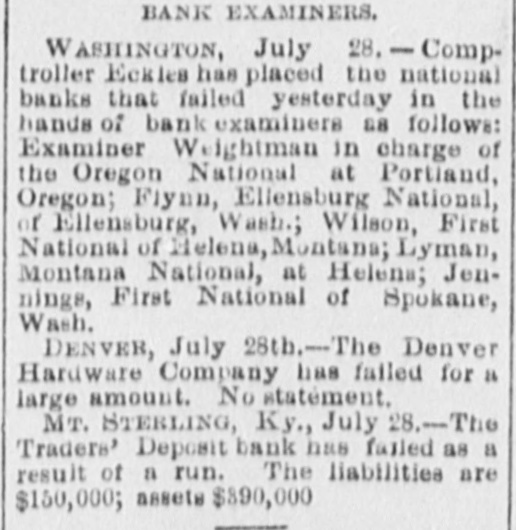
BANK EXAMINERS

WASHINGTON, July 28. - Comptroller Eckles has placed the national banks that failed yesterday in the hands of bank examiners 68 follows: Examiner Weightman in charge of the Oregon National at Portland, Oregon; Flynn, Ellensburg National, of Ellensburg, Wash.; Wilson, First National of Helena, Montana; Lyman, Montana National, at Helena; Jennings, First National of Spokane, Wash. DENVER, July 28th.-The Denver Hardware Company has failed for 24 large amount. No statement. MT. STERLING, Ky,, July 28.-The Traders' Deposit bank has failed as a result of a run. The liabilities are $150,000; assets $890,000


Article from Washington Standard, July 28, 1893

Click image to open full size in new tab

Article Text

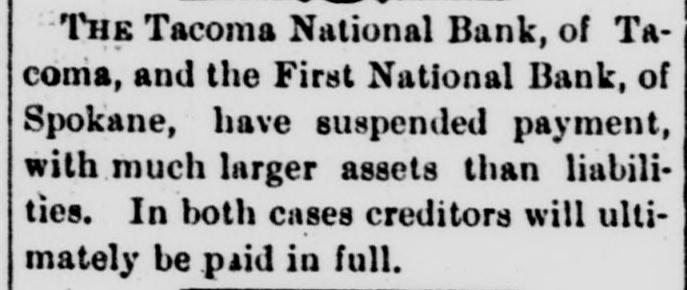
THE Tacoma National Bank, of Tacoma, and the First National Bank, of Spokane, have suspended payment, with much larger assets than liabilities. In both cases creditors will ultimately be paid in full.


Article from Huntsville Gazette, July 29, 1893

Click image to open full size in new tab

Article Text

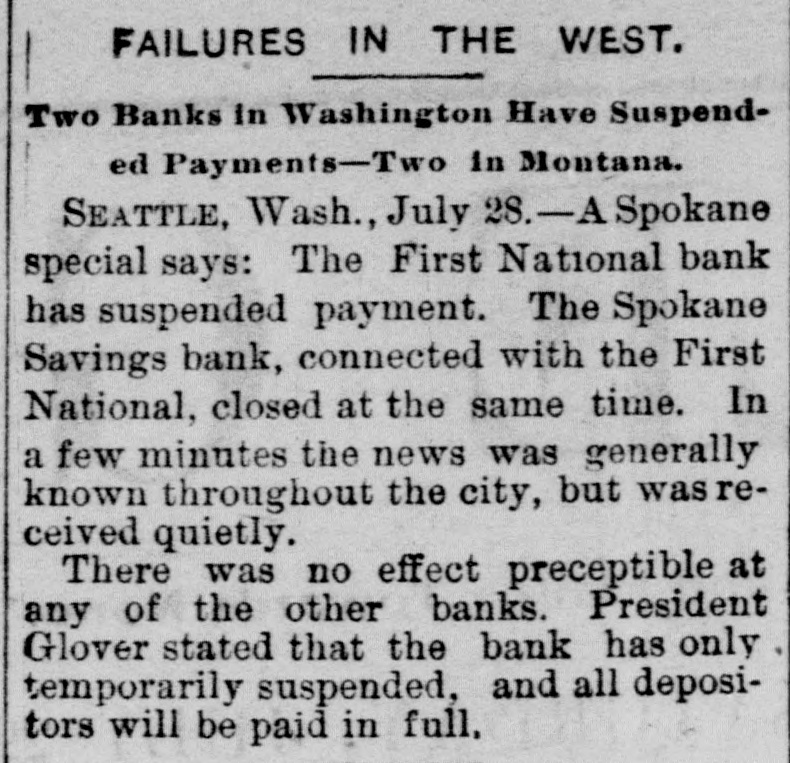
FAILURES IN THE WEST

Two Banks in Washington Have Suspended Payments-Two in Montana. SEATTLE, Wash., July 28.-A Spokane special says: The First National bank has suspended payment. The Spokane Savings bank, connected with the First National, closed at the same time. In a few minutes the news was generally known throughout the city, but wasreceived quietly. There was no effect preceptible at any of the other banks. President Glover stated that the bank has only temporarily suspended, and all depositors will be paid in full.


Article from The Kootenai Herald, August 5, 1893

Click image to open full size in new tab

Article Text

F. L. CLARK FOR RECEIVER. He Is Requested to Assume Control of the First National. SPOKANE, Aug. 1.-A movement is on foot to induce F. Lewis Clark to accept the position of receiver of the First National bank, recently suspended. A petition to that effect was circulated yesterday and received numerous signatures of parties interested in the bank's welfare. The bank officials themselves are said to favor Mr. Clark's appointment. Several other names have been suggested for the place. The determination will rely largely upon the recommendation made by the stockholders, together with that of the bank examiner designated to take charge of the bank's affairs.


Article from Pine Bluff Daily Graphic, November 29, 1893

Click image to open full size in new tab

Article Text

All Republicans

SPOKANE. Wash.. Nov. 29.-The appointment of F. Lewis Clark as receiver of the First National bank of this city makes five Republican receivers of national banks in this state, and there are no Democratic receivers.


Article from The Morning News, January 30, 1894

Click image to open full size in new tab

Article Text

criminal record in this instance is one the has stood high in the community. and who who is a national bank examiner. When began to be whispered about that Lionel Stagge was a forger and an ex-convict, those who knew him would not for a moment believe it. However, an investigation showed that there was much foundation for the report, and eventually the following facts were discovered: Dec. 8, 1889, a young man much given to dress, who gave the name of A. L. Waterhouse, was arrested in this city for passing fraudulent checks, both here and in California. The First National Bank of San Francisco was his victim in California. The check, on the bank was for $300, and was given to the United States hotel in Marysville, Cal. The check, however, which caused his immediate arrest was drawn on the First National Bank of Chicago and was hypothecated to S. Bailey, proprietor of the Gilman house in this city, in liquidation of a board bill. The check called for $35. Waterhouse represented himself to be the authorized agent and traveling correspondent of a Chicago newspaper. This caused the police to believe he was Harry A. Royce, whom the paper had recently exposed. This Waterhouse denied, but admitted he was acquainted with Royce, having met him in the east. Among the prisoner's effects were found number of cards bearing the name of & Waterhouse, but there was nothing to identify him with Royce. Waterhouse, however, claimed he had done some work for the Chicago paper. He also said he had written a great deal for other papers while traveling in Europe, Mexico and the south. Two days after his arrest, Dec. 10, he was arraigned in the police court charged with larceny by Bailey. He waived examination and was held in the sum of $500 to answer before the grand jury. The next day another check came to sight signed by Waterhouse. This was uttered in Salem, Ore., and when produced for payment here was declared fraudulent. On Dec. 16 Waterhouse pleaded guilty to the charge of obtaining money under false pretenses, and the following day, Dec. 17, was sentenced to one year in the state penitentiary at Salem. Before the sentence was passed the prisonerasked that he might serve his term in the county jail, saying his professional career. that of a journalist. would be jeopardized by a penitentiary term. During the trial many other checks came to light, his victims being principally hotelkeepers in California. After serving his term, Waterhouse disappeared. and for a year afterward his doings are unknown. In the summer of 1891, a young man of pleasing appearance and agreeable manners arrived in Portland. giving the name of Lionel Stagge, and soon secured the position of advertising solicitor for the Oregonian. In the latter part of 1892 he married into one of the nicest families here. His father-in-law assisted Stagge in establishing in February, 1893. the Pacific Banker and Investor. a financial journal. Through this magazine Stagge obtained a reputation for financial ability among the bankers in the northwest. Last summer he sought and obtained the position of national bank examiner. His work was affective, and gave entire satisfaction to all concerned. He first examined theaffairs of the Dallas bank in this state, which was speedily reopened. He was soon afterwards sent to Spokane, Wash., to investigate the failure of the First National bank there, which was soon reopened. When the Oregon National bank, of this city, the depository of the county funds, on Dec. 9. was closed the second time by the indictment of its officials. Mr. Stagge was called to Washington and was appointed receiver for the bank. He was making good ress toward the settlement of its affairs, and then began ominous whisperings. When Stagge was first informed of these rumors he was visibly affected. His manner showed that there was truth in the charges, and he said:


Article from The Morning Call, November 24, 1894

Click image to open full size in new tab

Article Text

SPOKANE APPEALS.

Suit to Recover Funds From a Broken Bank.

The county of Spokane, Washington, has appealed to the United States Circuit Court of Appeals from a decision of Judge Hanford. The county had $11,400 in the First National Bank of Spokane at the time that institution became insolvent, and its attorney petitioned the court for an injunction to restrain the receiver of the bank from distributing the county's deposit pro rata among the creditors.

The petitioner claimed that the money was placed in the bank unlawfully, and that it was a trust fund. Judge Hanford decided in the bank's favor, and the appeal filed yesterday is the result.


Article from Daily Kennebec Journal, January 7, 1895

Click image to open full size in new tab

Article Text

The many friends of Willis E. Goodspeed, eldest son of Judge Goodspeed of Randolph, who went to Spokane, Wash., a few years ago, to seek his fortune, will be pleased to learn that he is prospering in his new home and was recently married to Miss Genevieve A. Bancroft, a highly educated and prominent young lady of Auburnrora, Whitman county, in that state. Will is now the private secretary of F. Lewis Clark, the receiver of the First National Bank of Spokane.


Article from Elmore Bulletin, April 20, 1895

Click image to open full size in new tab

Article Text

A BRIEF HISTORY OF THE CASE One of the Most Noted Mining Contests in the History of the Country. The case went before the supreme court on a writ of certiorari issued by the supreme court against the United States circuit court of appeals at San Francisco, John R. McBride of Spokane appeared for the Tyler, and assoelated with him were Senator Dolph of Oregon and Arthur Brown of Salt Lake. Counsel for the Last Chance are United States Attorney-General Olney, Charles S. Voorhees, attorney for the receiver of the First National bank, and W. B. Heyburn, attorney for the mining company, Mr. Olney comes in by reason of the First National bank being one of the principal creditors of the Last Chance mine, the bank, by reason of insolvency, being in charge of the comptroller of currency. This is one of the most noted mining cases in the history of the country. The ground in dispute is worth $500,000; there is also involved over $200,000 worth of ore taken out of the disputed area by the Last Chance and claimed by the Tyler. The mines are at Wardner and the litigation has been one of the exciting features of the Idaho courts for several years. The case was carried up to the United States circuit court of appeals, where the Tyler people won Then the Last Chance people went before the supreme court and asked for a writ of certiorari, and the petition was granted. an action seldom taken by the supreme court. EFFECT ON THE BANKS "It will be impossible to tell the exact extent of the victory," said Receiver F. Lewis Clarke of the First National bank. "until the full text is received of the supreme court's decision. We only know now that the court at Washington has reversed the judgments of both lower courts, and ordered a new trial. Considering the law points that were involved in this decision, I feel confident that this new trial will result in a permanent victory for the Last Chance." The decision means a great deal to the depositors of the First National bank and the Spokane Savings bank. The mine and its owners owed a great deal to these banks, not far from a quarter of a million. A favorable decision would give the banks a big asset, and if things should brighten up a little that asset would probably enable them to pay their depositors in full. In one sense, every person in Spokane is financially interested in the decision, because the First National owed the city and county of Spokane about $50.000. At Wardner, where the sympathies of the people have always been largely in favor of the Last Chance, the news was received last evening with many manifestations of pleasure.


Article from Great Falls Weekly Tribune, July 5, 1895

Click image to open full size in new tab

Article Text

court of appeals has announced decisions in the cases of the city and county of Spokane against the First National bank, reversing the decision in the former case and affirming the decision in the latter. These suits were brought on the claim that the city's and the county's deposits in the bank at the time it failed should be recognized by the receiver as preferred claims. The city had $40,000 in the bank and the county about $20,000. The lower court gave judgment in both cases in favor of the back.


Article from The San Francisco Call, September 4, 1895

Click image to open full size in new tab

Article Text

ASSESSMENT SUED FOR.

The Defunct First National Bank of Spokane After Its Shareholders.

A peculiar suit was filed in the United States Circuit Court yesterday, when the receiver of the National Bank of Spokane sought to recover an assessment levied the day before the bank failed. A stockholder refused to pay, so the law has been invoked.

The suit is entitled F. Louis Clarke, receiver of the First National Bank of Spokane, vs. I. Kohn. The bank was declared


Article from Daily Kennebec Journal, October 1, 1897

Click image to open full size in new tab

Article Text

A Comparison That Tells the Story. A comparison has been made, compiled from reliable statistics which no one can question, between the operation of the Wilson law during its first sixty days and the Dingley law for the same period. The period in 1893 marked the beginning of the Democratic attack upon protection and in 1897 its restoration. SIXTY DAYS UNDER THE WILSON LAW. The following data, gathered largely from official reports, presents a picture of the sixty-day period of the year 1893 with which the two months just ended correspond both as to the portion of the year and the period of the presidential administration, and also proximity to the tariff legislation. WEEK ENDING JULY 24, 1893. Failure of Bozeman, Mont., National Bank. Four Denver banks closed their doors. Bank suspensions in other western cities. Two other bank failures in Milwaukee and runs on numerous other banks. Commercial bank of Denver fails, capital $250,000. Bank failures at Vernon, Texas, and Knoxville, Tenn., capital $200,000. Failure of Tacoma, Wash., National Bank. capital $200,000. Failures of banks at Great Falls, Mont., and Orlando, Fla., capital $200,000. Suspension of work in manufactories reported from all sections. WEEK ENDING AUG. 1, 1893. National banks at Manchester, N. H., and Indianapolis, fail, capital $500,000. Failure of First National Bank at Spokane, Wash., capital $250,000. Ten banks suspend in one day (July 27), capital $2,000,000. Bank failures in South Dakota, Montana, Illinois. Kansas, Texas, Washington. New Hampshire, and correspondingly large numbers of business suspensions. WEEK ENDING AUG. 8, 1893. Collapse of Chicago provision deal and many failures of commission houses. Failure of National Bank of El Paso, Texas. Failure of National Bank, of San Antonio. Texas. Failure of National Bank of Muncie, Ind. Fifty-third Congress meets in special session to begin its destruction of the McKinley law. WEEK ENDING AUG. 28, 1893. Encounter between anarchists and soclalists averted by New York police. Meeting of anarchists broken up by New York police. Failure of National Bank of Hindman, Pa. Failure of National Bank of Tacoma, Wash. Suspension of manufacturing establishments in numerous states. Announcement by the comptroller of the currency that 155 national banks and 560 private banks had failed during the year ending Aug. 28. Railroad receivers appointed during August for Northern Pacific, Philadelphia and Reading, New England and Pittsburg, Akron and Western railways. SEPTEMBER. Railroad receivers appointed for Wisconsin Central. Chicago, Peoria and St. Louis, Cleveland, Canton and Southern and Evansville and Terre Haute Railroads. The mileage of roads placed in the hands of receivers during the year 1893 was 25,375, nearly one-seventh of all the lines in the United States, and their indebtedness $1,212,217,033. During the year there were 16,115 mercantile suspensions, involving liabilities amounting to $346,779,889. During the bank suspensions of July loans were made on call at the New York Stock Exchange as high as 72 per cent. The number of minor business failures owing to bank suspensions and to inability to make collections has not been tabulated, but reaches into the hundreds. SIXTY DAYS UNDER THE DINGLEY LAW. WEEK ENDING JULY 24, 1897. From Bradstreet's Financial Journal: Twenty thousand workmen resume work in the iron and steel industries.


Article from The Providence News, October 2, 1897

Click image to open full size in new tab

Article Text

Washington, D.C., Oct. 2.-The reports of business improvement and activity in masufacturing and commercial lines which have come to the front since the enactment of the Dingley law has suggested to somebody with a good memory a comparison of present conditions with those ot the corresponding dates in the first year of the Cleveland administration. It is a curious fact that the enactment of the Wilson law came at just about a corresponding period with the meeting of the free-trade Congress in the first year of Ceveland's second term, [and that it is therefore possible to contrast business conditions under the shadow of approaching free trade with the business condition in the sunshine of returning protection. This comparison is startling. This period covered in the comparison of the two months since the final action upon the Dingley bill compared with the corresponding two months in the Cleveland term. or from July 24 to Seteraber 24, 1893, contrasted with July 24 to Setember 24, 1897. Here is the contrast; it is well worth laying for reference: Week ending July 24, 1893-Failure of Bozeman. Montana, national bank. Four Denver banks closed their doors. Bank suspensions in other Western cities. Two bank failures in Milwaukee, and runs on numerous other banks. Commercial Bank of Denver fails; capital, $250,000. Bank failures At Vernon, Tex., and Knoxville, Tenn.; capital. $200,000. Failure of Tacoma (Wash.) National Bank; capital, $200,000; also failures of banks at Great Falls. Mont., and Orladno, Fla. ; capital, $200,000. Suspension of work in manufactories reported from all sections. Week ending August 1, 1893,-National banks at Manchester, N.H., and Indianapolis, Ind fail; capital $500,000. Failure of First National Bank at Spokane, Wash. ; capital, 2500,000. Ten banks sus pended in one dav (July 27) capital, $2,000,000. Bank failures in South Dakota. Montana, Illinois, Kansas, Texas, Washington, New Hampshire, and correspendingly large number of business suspensions. Week ending August 8, 1893-Collapse of Chicago provision deal and many failures of commision houses. Failure of National Bank of El Paso, Texas. Failure of National Bank of San Antono, Texas. Failure of National Bank of Mounce, Ind. LIIId Congress meets in special session to begin its destruction of the McKinley law. Week ending August 28, 1893-Encounter between the Anarchists and Soeialists averted by New York police. Failure of National Bank at Hindman, Pa. Failure of National Bank at Tacoma, Wash. Suspension of manufacturing establishments in numerous states. Announcement by controller of the currency that 155 national banks and 560 private banks had failed during the year ending August 28. Railroad receivers appointed during August for Northern Pacific, Pt itadelphia & Reading, New England and Pittsburg, Akron & Western. September-Railroad receivers appointed for Wisconsin Central. Chicogo, Peoria & St. Louis, Cleveland, Canton & Southern. Evansville & Terre Haute railroads. The mileage of roads placed in the hands of receivers during the year 1893 was 25,375, nearly one-seventh of all the lines in the United States, and their indebtedness $1,212,217,033. During the year there were 16,115 mercantile suspensions, involving liabilities amounting to $346 779,889. During the bank suspensions of July loans were made on call at the New York Stock Exchange as high as 72 per cent. The following statements of revival of manufacturing industries during the sixty days following the enactment of the Dingley law. the period corresponding with the similar dates in the first year of Cleveland's second term, show the contrast between present conditions and those of the corresponding months of the preceding adminisration. The statements which follow are from "Brad street's:' Week ending July 24, 1897-Twenty thousand workmen resumed work in iron and steel industries. Bigelow Carpet Company, at Clinton, Mass. resumes


Article from The Salt Lake Herald, October 11, 1897

Click image to open full size in new tab

Article Text

yond the shadow of a doubt that McKinley tariff law had something to do with the inauguration of the great financial panic beginning in 1893. The fact that the Chicago Times-Herald is the staunchest advocate of a high protective tariff, and the added fact that the relations between its editor, Mr. Kohlsaat, and President McKinley are such that the Times-Herald is looked upon as the president's personal organ, makes this showing all the more unexpected and remarkable. The mere fact that the was mixed in its dates, charging the Wilson law with being the cause of things that transpired before the Wilson law was introduced in congress. does not break the force of that organ's arraignment of the McKinley law. The Times-Herald has apologized for its blunder. but the awful record of business failure and industrial depression under the McKinley law still stands. B Jepun '17 IO enss) S11 us Washington date line, the Times-Herald undertook to prove that the Dingley law is productive of prosperity The matter occupies a four column square on the first page, under a flaring head line, and contrasts two periods. One period covers the time from July 24 to September 24, 1893; the other a similar time in 1897. The two periods are printed in parallel columns. That of 1897 is under the sub-heading of "Sixty Days Under the Dingley Law. -qns Jepun SI 3683 JO that heading, 'Sixty Days Under the Wilson Law The latter is here reproDays Under the Wilson MET Week Ending July 24. 1893.-Failure of Bozeman (Mont.) National bank. Four Denver banks closed their doors Bank suspensions in other western cities. Two other bank failures in Milwaukee and runs on numerous other banks. Commercial bank of Denver fails, capital $250,000. Bank failures at Vernon. Tex. and Knoxville, Tenn. capital $200,000. Failure of Tacoma (Wash.) National bank, capital $200,000. Failures of banks at Great Falls. Mont. and Orlanda, Fla., capital $200,000. Suspension of work in manufactories reported from all sections. Week Ending Aug. 1. 1893.-National -UI pue "H N 18 dianapolis, Ind., fail, capital $500,000 Failure of First National bank at Spokane, Wash., capital $250,000. Ten banks suspend in one day (July 27), capital $2,000,000. Bank failures in South Dakota, Montana, Illinois, Kansas, Texas, Washington. New Hampshire and correspondingly large number of business suspensions. Week Ending Aug. 8. 1893.-Collapse of Chicago provision deal and many failures of commission houses. Failure of National bank of El Paso, Tex. Failure of National bank of San Antonio, Tex. Failure of National bank of Muncie, Ind. Fifty-third congress meets in special session to begin Its destruction of the McKinley law. Week Ending Aug. 28. 1893. -Encounter between anarchists and socialists averted by New York police. Meeting MIOX MAN sq dn broken JO police. Failure of national bank of Hindman. Pa. Failure of national bank of Tacoma, Wash. Suspension of manufacturing establishments in numerous states Announcement by the comptroller of the currency that 155 national banks and 560 private banks had falled during the year ending Aug 28 Railroad receivers appointed during August for Northern Pacific, Philadelphia & Reading. New England & Pittsburg, Akron & Western railways September.-Rallroad receivers ap pointed for Wisconsin Central, Chicago, Peoria & St. Louis, Cleveland. Canton & Southern and Evansville & Terre Haute. The mileage of roads placed in the hands of receivers during the year He TO seventh euo '948'97 SBM 2681 the lines in the United States, and their indebtedness 212,217 033. During the year there were 16,115 mercantile suspensions, involving liabilities amount ing to $346,779,889. During the bank suspensions of July loans were made on call at the New York Stock Exchange TO requinu ene ask 21 SE SB minor business failures owing to bank suspensions and to inability to make collections has not been tabulated, but reaches into the hundreds. This is a bad record for the tariff law under which all these calamities occurred. but. unfortunately for the Times-Herald, the Wilson law was not then in operation. In fact, at that time the Wilson law had not been introduced in congress. The congress which passed the Wilson law met in Decem ber, 1893-two months after the ending of the period set forth in the TimesHerald. The Wilson law passed the house on Feb. 1. 1894 four months after the ending of the period set forth by the Times Herald. It passed the sen1994 E Ainr uo u! air nine months after the ending of the period set forth by the Times Herald. After repeated conferences and disagreements the house adopted the sen ate bill entire on Aug. 13, 1894-ten months and 13 days after the expira tion of the period set forth by the Times-Herald. The Wilson law went into effect just 11 months after the ending of the period set forth by the Times Herald. Briefly, every business failure attributed by the Chicago Times-Herald in the above ex S tract to the Wilson law took place un der the McKinley law before the Wilson bill had been introduced in con. gress. In Its efforts to prove that the 941 JOJ SEM ME WITHON business depression in 1893 the Times Herald succeeeds only in proving that the McKinley law was responsible. A correspondent of the Chicago protection organ was quick to discover the hole which engulfed it, and wrote as follows: Editor of the Times-Herald: Did you not make a blunder in your supposedly 4 deadly parallel on Monday morning when you contrasted the workings of S the Wilson and the Dingley acts ano the business failures under them? The period dating from July 24 to Septem ber, 1833, which you say was "sixty days under the Wilson law." was more than 2. year before the Wilson law went into operation, and some months in 01 persented SEM 11 before house. The McKinley law was then in full force. Ought you not as a fair an & great newspaper to retract this mis statement? B. A. M'CONNELL The Times-Herald admitted that a made a grave mistake by publishing one


Article from The Laramie Republican, October 14, 1897

Click image to open full size in new tab

Article Text

JUST FOR COMPARISON

SOMETHING IN RELATION TO THE CONDITIONS WHICH EXISTED IN 1892. And Then Look Upon the Fair Picture Presented in 1897-Then the Banks Were Failing and Everything Was Tumbling-Now Everything is on the Mend and Mills Are Opening. Washington, D. C., Oct. 11.-(Special Correspondence.)-The reports of business improvement and activity in manu. facturing and commercial lines which have come to the front since the enact. ment of the Dingley law has suggested to somebody with a good memory a comparison of present conditions with those of the corresponding dates in the first year of the Cleveland administration. It is a curious fact that the enactment of the Wilson law came at just about a corresponding period with the meeting of the free-trade congress in the first year of Cleveland's second term, and that it is therefore possible to contrast business conditions under the shadow of approaching free trade with the busid ness conditions in the sunshine of re1 turning protection. This comparison is e startling. The period covered in the comparison is the two months since the final action upon the Dingley bill compared with the corresponding two it months in the Cleveland term, or from July 24 to September 24, 1893, contrasted with July 24 to September 24, 1897. Here is the contrast; it is well worth e laying aside for reference: Week ending July 24, 1893-Failure of e Bozeman, Montana, national bank. Four Denver banks closed their doors. Bank a suspensions in other western cities. Two e banks failed in Milwaukee, and runs.on d numerous other banks. Commercial bank of Denver falls; capital $250,000. h Bank failures at Vernon, Tex., and Knoxville, Tenn., capital, $200,000. Faily ure of Takoma, Wash., National bank; capital, $200,0000; also failure of banks d at Great Falls, Mont., and Orlando, Fla.; capital, $200,000. Suspension of work in y S manufactories reported from all seca tions. Week ending August 1, 1893-National banks at Manchester, N. H., and g Indianapolis, Ind., fail; capital $500,000. e Failure of First National bank at Spo. kane, Wash.,; capital $250,000. Ten 0 banks suspended in one day (July 27); n capital $2,000,000. Bank failures in South Dakota, Montana, Illinois, Kand sas, Texas, Washington, New Hampat shire, and correspondingly large num9 bers of business suspensions. 6 Week ending August 8, 1893-Collapse r of Chicago provision deal, and many failures of commercial houses. Failure at of national bank of El Paso, Texas. FailS ure of national bank of San Antonio, 1 Texas. Failure of national bank of it Muncie, Ind. Fifty-third congress meets 1 in special session to begin its destruction d of the McKinley law. d Week ending August 28, 1893-Ener counter between the anarchists and 80y clalists averted by New York police; * meeting of New York anarchists broken d up by New York police. Failure of na. tional bank at Hindman, Pa. Failure of Ф national bank at Tacoma, Wash. SusR pension of manufacturing establishments in numerous states. Announcement by 8 6 comptroller of currency that 155 national banks and 560 private banks had falled d during the year ending August 28. Railat road receivers appointed during August for Northern Pacific, Philadelphia and s Reading, New England, and Pittsburg, Akron and Western. is September-Railroad receivers ap0 pointed for Wisconsin Central, Chicago, 0 Peoria and St. Louis, Cleveland, Canton e and Southern, and Evansville and Terre Haute railroads. The mileage of roads 19 placed in the hands of receivers during g the year 1893 was 25,375, nearly oneseventh of all the lines in the United a States, and their indebtedness, $1,212,10 217,033. During the year there were 16,115 mercantile suspenions, Involve ing liabilities amounting to $346,779,889. 8 During the bank suspensions of July loans were made on call at the New York stock exchange as high as 72 per cent.
Article from The Islander, October 21, 1897

Click image to open full size in new tab

Article Text

SOME COMPARISONS OFFICIAL REPORTS SHOW THE DIFFERENCE IN THE TIMES. Under the First 60 Days of the Cleve. land-Wilson Low Tariff the Country Was in a Panic-Under the McKinleyDingley Tariff the Country Confident. E. F. PARSONS, Special Correspondent. Washington, D. C.-The close of the first sixty days of the operations of the new tariff law and the business improvements which are visible in every direction during that time have suggested a comparison of the conditions during the two months in question with those of the corresponding date in the first year of the Cleveland administration, during which time the free trade congress, elected with President Cleveland, was just beginning its attack upon the protective system which the Dingley law sixty days ago re-established. The two periods from July 24 to September 24 in the years 1893 and 1897, respectively, present a marked contrast -Bod St 1! pus conditions business 01 SE sible to obtain from government records some data bearing upon this subject and now especially interesting. The following data gathered from official reports presents a picture of the sixty-day period of the year 1893 with which the two months just ended correspond both as to the portion of the year and the period of the presidential administration and also proximity to tariff legislation: Week ending July 24, 1893-Failure of Bozeman, Mont., National Bank; four Denver banks closed their doors; bank suspensions in other western cities; two bank failures in Milwankee and runs on numerous other banks; Commercial Bank of Denver fails, capital $250,000; bank failures at Vernon, Texas, and Knoxville, Tenn., capital $200,000; failure of Tacoma, Wash., National Bank, capital $200,000; also failures of banks at Great Falls, Mont., and Orlando, Fla., capital $200,000; suspension of work in manufactories reported from all sections. Week ending August 1,1893-Nation-uI pus "H N Manohester 18 queq 18 dianapolis, Ind., fail, epaital $500,000; failure of First National Bank at Spokane, Wash., capital $250,000; ten banks suspend in one day (July 27), capital $2,000,000; bank failures in South Dakota, Montana, Illinois, Kansas, Texas, Washington, New Hampshire, and correspondingly large number of business suspensions. Week ending August 8, 1893-Collapse of Chicago Provision Deal and many failures of commission houses; failure of National bank of El Paso, Texas; failure of National bank of San Antonio, Texas; failure of National bank of Muncie, Ind; fifty-third congress meets in special session to begin its destruction of the McKinley law. Week ending August 28, 1893-Encounter between the anarchists and socialists averted by New York police; meeting of anarchists broken up by New York police; failure of National bank at Hindman, Pa.; failure of National bank at Tacoma, Wash., suspension of manufacturing establishments in numerous states; announcement by comptroller of the currency that 155 National banks and 560 private banks had failed during the year tnding August 28; railroad receivers apppointed during August for Northern Pacific, Philadelphia & Reading, New England and Pittsburg, Akron & West"ure September-Railroad receivers


Article from The Spokane Press, December 17, 1929

Click image to open full size in new tab

Article Text

Pioneer Talks

As Told to Robert Owen By HARRY GOETZ

The courage and faith of the citizens of Spokane Falls met its first test in the fire of Au gust 1889 that practically wiped out the town. much improved and prosperous city of brick appear ed from the ruins, and under the impetus of mining lopment in the Coeur Alenes, set tlement and of the farm ing lands the Inland Empire and the the lumber busi as an important the city enjoyed rapid and splendid prosperity for several years But the courage of the citizens and the resources of Spokane soon to be tested in the panic of 1893. There was little indication of impending events to people of the financial situation that was 80 near Trade and industry prospered in this prosperity being reflected in large increase in railway freight tonnage Spokane forward to big year in business The Great North ern completed, and the public still hoped for lower rates. Mining had been resumed in the Coeur Alenes an extensive scale, and territory to the north in the neighborhood the Old Dominion mine booming Heavy falls promised good crops and irrigation now being used effectively varlous points in the Inland Empire More than million dollars had in new building in Spokane in including the new the Marble Bank building erected by M Cannon But Cannon had unfortunately himself to come interested in too many distant and doubtful enterprises Under the leadership of Paul Mohr. W. Durham tells us, "He had been lured into heavy invest ments in coal mines in the Cascade portage railroad scheme around the rapids in the Columbia river above The Dalles. Mohr went east desperate ef. fort to these elephants on New York and Mr. Cannon, realizing critical condition. eagerly scanned his agent's ports. Mohr falled get aid in the and Cannon was forced to ask for help from the Spokane banks. After examination of his affairs on the morning June 3. 1893, the Bank of Spokane Falls failed open its doors for business. This news created sensation and no blame attached to Mr. Cannon by the general public, the popular reaction being one deep sym pathy for the kind hearted pioneer had done much to make Spokane the lively little city which had become Twenty hours the Bank Spokane Falls closed. the Wash ington National and the Washing ton Savings bank suspended pay ment, and hard run on the CitiNational forced to close its doors one hour closing time. On July the Washington National business in quar ters previously occupied by the broken Spokane National Riverbeen side and Howard property that had vacant years banks disasters subjected the remaining These to July 26 the First National and after on steady run of 50 days, became in solvent