Click image to open full size in new tab
Article Text
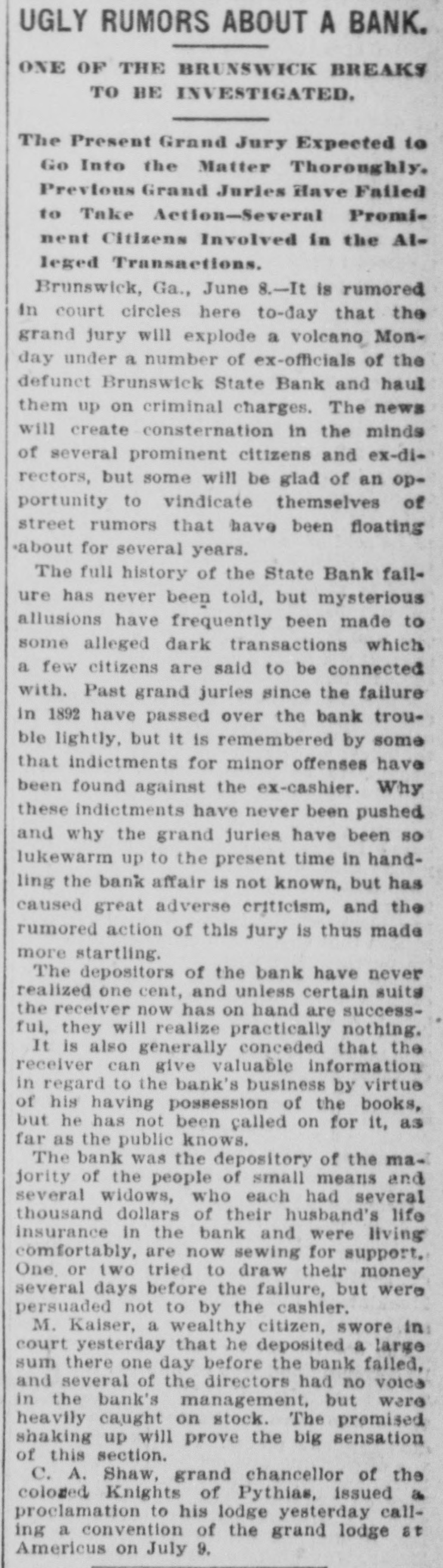
CASHIER CUNNINGHAM'S CASE. The Official's Fate in the Hands of the Jury. Brunswick, Ga., Dec. 19.-No case before Glynn's court has attracted as much interest this term as that of the state vs. F. E. Cunningham, the ex-cashier of the defunct Brunswick State Bank, an institution which failed here in 1892 and swallowed up thousands of dollars of small depositors' money, besides causing heavy losses to several large concerns. The history of the case and trial, the result of which has been given in these columns, form interesting reading for the many who were swamped in the wreck and others who suffered badly. The on state's case was based the grounds that the cashier with a knowledge of the bank's insolvency, received deposits, and failed to return the money within three days after the demand for it had been made. The indictment was under a section of the code making such offense a felony, with punishment ranging from one to ten years in the penitentiary. Dunwoody & Atkinson represented the defense and Solicitor Brantley the state. The defense entered a general denial, after which the state proceeded to introduce testimony. Director Coney swore that the defendant was cashier at the time of the bank's failure: that he was supposed to be in the bank during bank hours; bank was now in the hands of a receiver, but was not placed in receivers' hands until after doors closed. Depositor Veronki testified that he carried $700 in silver to the bank to exchange for paper. The cashfer took it and told him to return the next day. He returned as requested, but the defendant told him they had no paper money yet, but not to be uneasy, they were as solid as a rock. His $700 had been in the meantime entered as a deposit. He did not get it and went away. Next day the bank closed. The defendant came to his store the next day and he said to him. What am I going to do? You've got my money; I can't pay my bills: I am ruined; you make me crazy. The defendant said: "Don't be alarmed; the bank is all right; we'll be open again in a couple of days, but I will get you up $100 from a party to pay your pressing bills." On cross examination the witness stated that he did not intend to deposit the $700; he only wanted change for it. Others swore substantially to having deposited after receiving positive assurances from the defendant that the bank was safe. After all the evidence was submitted the accused made his statement, which was in substance that he did not deem the bank insolvent when the various deposits were received. That he had placed confidence in a superior officer now dead which had been misplaced; that he had intimate friends whom he could have warned to withdraw their money, but did not do SO thinking the institution solvent. He admitted some of the testimony, but denied the most material. The president took a large amount of notes to New York, but failed to secure money on them. "I certainly plead not guilty. I have begun life again on the lowest round to build myself up. I want to change this ill-feeling against me, and I hope to succeed.' A request from the solicitor to ask the defends ant a question being denied Attorney Atkinson began the argument for the defense. He argued that the defendant was not aware of the bank's insolvency, dwelling at length on the law of reasonable doubt: Further, that with more paper in bank than its debts amounted to no man could safely argue that defendant knew the bank to be insolvent. Solicitor Brantley followed for the state and his effort has been characterized as the best ever delivered in a Glynn county court room. His case was based on two conclusions. First, that the bank was insolvent when the deposits were received; second, that the defendant knew it to be so. He termed the defense an 'ambush of technicality "A cashier,' he said, "is a trustee. The stockholders trust him and therefore the people trust him. The betrayai of that trust is a crime. He pointed to the evidence to show that there was no run on the bank, but instead, during the week preceding its failure, the deposits exceeded the withdrawals by $4,000 That the bank was then in a rotten condition and the cashier knew it. "Why did he not know the condition of this bank, continued the solicitor, 'does he come here pleading incapacity, imbecility or idiocy It was his business to know and he did know In his arraignment the solicitor was very severe. saying: He comes here, gentlemen, claiming to be a victim of misplaced confidence. He goes down to the grave and places an unproven stigma upon the memory of the dead Attorney Dunwoody began the closing argument for the defense by stating, "I will not discuss the dead except in justice to the living.' Following this he delivered an efoquent and touching word picture of the aged father and mother of the defendant waiting by their fireside in a distant city for tidings from their beloved boy now on trial before that court and jury, From this he took up the evidence as submitted and argued that the defendants best judgment told him the bank was solvent when he recelved the deposits and his judgment was worth as much as any man's. He denied that the defendant was guilty of a criminal act. and asked the jury to consider well before they rendered a verdict against him. His attacks on the witnesses were sarcastic, and he then referred to the bank's obligations, stating that the reason more were not now paid was on account of receiverships' expenses. This brought Judge Sweat's gavel down with a hard knock, as a reprimand, while his honor stated "That does not bear on the case. Counsel will refrain from any comments on that matter. The counsel's concluding remarks were eloquent and fervid. being a remarkably strong appeal for the defendant and sympathies of the jury In his charge Judge Sweat was very impartial, but followed the letter of the law strictly, giving the case to the jury in a comprehensive manner. At a late hour to-night the jury was still out