2729. State Savings Bank (Atlanta, GA)

Bank Information

Episode Type
Run → Suspension → Closure
Bank Type
savings bank
Start Date
February 8, 1897
Location
Atlanta, Georgia (33.749, -84.388)

Metadata

Model
gpt-5-mini
Short Digest
b13d93e6

Response Measures

Accommodated withdrawals, Full suspension, Books examined

Description

Multiple dispatches (Feb 8-9, 1897) report a run on the State Savings Bank of Atlanta; temporary receivers (W. A. Bates and T. J. Ripley) were appointed and the receivership was later made permanent. The run was triggered by the collapse/receivership of the Southern Mutual Building and Loan Association with which the bank was closely connected. The bank did not continue normal operations and was liquidated under the receiver (dividends paid).

Events (4)

1. February 8, 1897 Run
Cause
Local Banks
Cause Details
Run triggered by collapse/receivership of the Southern Mutual Building and Loan Association with which the bank had close relations; rumors that the association owed the bank large sums prompted withdrawals.
Measures
Other banks went to its assistance; all demands were reportedly met.
Newspaper Excerpt
There was a run on the bank, but every demand was met.
Source
newspapers
2. February 8, 1897 Suspension
Cause
Local Banks
Cause Details
Temporary receivership filed after runs and allegations tied to the failure of the Southern Mutual Building and Loan Association and related stock transfers; receivers appointed by court (W. A. Bates and T. J. Ripley).
Newspaper Excerpt
The State Savings Bank was placed in a temporary receivership to-day, but the bank did not close its doors.
Source
newspapers
3. February 9, 1897 Receivership
Newspaper Excerpt
The receivership should be made permanent... Mr. Ripley was made permanent receiver. The bank will now proceed to marshal its assets and put them into distribution.
Source
newspapers
4. March 29, 1897 Other
Newspaper Excerpt
Receiver Ripley ... announced that he was ready to make the first payment to depositors under the plan of liquidation ... The first instalment will be 10 per cent.
Source
newspapers

Newspaper Articles (21)

Article from Richmond Dispatch, February 9, 1897

Click image to open full size in new tab

Article Text

RECEIVER FOR ATLANTA BANK. A Run, but Institution Doesn't Close-Southern Building Ass'n. ATLANTA, GA., February 8.-The State Savings Bank was placed in a temporary receivership to-day, but the bank did not close its doors. There was a run on the bank, but every demand was met. W. A. Bates and T. J. Ripley were appointed temporary receivers by Judge John S. Candler, on the application of W. C. McLane, a book-keeper in the Bates Farley Bank. Ripley is an attorney here. The State Savings Bank is capitalized at $100,000, and its deposits are about $75,000. It is alleged in the petition for a receiver that the Southern Mutual Building and Loan Association was indebted to the bank in a large sum, and that the bank probably would never be able to collect its indebtedness. In answer to this, the bank's officers says that the Building and Loan Association owes nothing to the bank; but that, on the contrary, the bank was carrying a deposit for the association. The case will be heard on next Saturday, when the question of permanent receivership will be determined.


Article from Birmingham State Herald, February 9, 1897

Click image to open full size in new tab

Article Text

AN ATLANTA BANK Placed in Receiver's' Hands, But the Officials Claim Solvency. Atlanta, Ga., Feb. 8.-The State's Saving bank was placed in a temporary receivership today, but the bank did not close its doors. There was a run on the bank, but every demand was met, some of the other banks going to its assistance. W. A. Bates and T. J. Ripley were appointed temporary receivers by Judge John S. Candler, on the application of W. C. McLane, a bookkeeper in the Bates-Farley bank. Ripley is an attorney here. The State's Savings bank is capitalized at $100,000, and its deposits were about $75,000. It is alleged in the petition for a receiver that the Southern Mutual Building and Loan association was indebted to the bank in a large sum, and that the bank probably would never be able to collect its indebtedness. In answer to this the bank's officers say that the Building and Loan association owes nothing to the bank and on the contrary, the bank was carrying a deposit for the association. The case will be heard on next Saturday, when the question of permanent receivership will be determined.


Article from The Morning News, February 9, 1897

Click image to open full size in new tab

Article Text

SAVING DEPOSITORS SCARED. TEMPORARY RECEIVER NAMED FOR AN ATLANTA BANK. Rumor Afloat That the Southern Mutual Loan Association Owes the Bank $25,000-Its Capital $100,000 and Its Deposits Only $75,000-The Bank's Officers Says It Owes the Association Instead of the Later Being Its Debtor. (Atlanta, Ga., Feb. 8.-The failure of the State Saving3 Bank to-day, which was placed in the hands of W. A. Bates and T. J. Ripley as receivers by Judge Candler of the superior court, is attributed to the failure of the Southern Mutual Building and Loan Association. That concern went into the hands of a receiver last Saturday, and this morning it was rumored that the State Savings Bank, which had close business relations with the association, had been crippled to the amount of $25,000 in its collapse. President Hale of the Building and Loan Association, and Cashier Dayton Hale of the Savings Bank are brothers and this helped to cause the uneasiness among the depositors of the bank, who drew their money so steadily during the day as to amount to a run. Most of the depositors are small traders and persons whose accounts represented their small savings, so that the losses will be particularly hard to bear if the depositors should lose. This is not expected to happen, however, as the officials say that all will be paid in full. The deposits amount to $75,000, while the capital stock of the bank is $100,000. It is alleged in the bill upon which the receiver was appointed that the cash in the vaults now amounts to only about $3,000. At the time the receivers were appointed Cashier Dayton Hale was not at the bank and could not be reached by the receivers. There was a report that he had purposely absented himself, but he soon turned up all right, and lent his assitance to the receivers. The bank was turned over to the receivers by the president, A. C Wright. W. C. McLain, upon whose petition the receiver was appointed, is a stockholder in the bank, owning fifty-six shares. He is connected with the Bates-Farley Banking Company, of which W. C. Bates, the receiver appointed, is the head. From this it is inferred that the receivership is a friendly one, designed to prevent a further crippling of the assets by a continuation of the run by depositors to-morrow. The hearing to make the appointment of the receiver permanent will take place next Saturday. Officers of the bank deny that the loan association owes it a large sum of money, and say that on the contrary the association is a depositor in the bank.


Article from The Indianapolis Journal, February 9, 1897

Click image to open full size in new tab

Article Text

Savings Bank Closed. ATLANTA, Ga., Feb. 8.-State Savings Bank of Atlanta was this afternoon placed in the hands of a receiver. W. A. Bates and T. J. Ripley were appointed to take charge of the property. The bank's capital is $100,000 and its deposits amount to $75,000. The failure is due to the collapse several days ago of the Mutual Building and Loan Association, with which the bank was intimately related.


Article from The Ocala Evening Star, February 9, 1897

Click image to open full size in new tab

Article Text

Georgia Bank Suspends. Word was received here late this afternoon that the State Sav. ings bank of Atlanta, Ga,, of which Captain H. C. Wright, of this city, is cashier, had suspended.


Article from The Times, February 9, 1897

Click image to open full size in new tab

Article Text

BUSINESS TROUBLES. An Atlanta Bank Goes Intothe Hands of a Receiver. ATLANTA, GA., Feb. 8-The States Saving Bank was placed in a temporary receivership to-day, but the bank did not close Its doors. There was a run on the bank, but every demand was met. W. A, Rates and T. J. Ripley were appointed temporary receivers by Judge John S. Candler on the application of W. C. McLane, a book-keener in the Bates' Farley


Article from The Providence News, February 9, 1897

Click image to open full size in new tab

Article Text

RECEIVER IN CHARGE. Failure of the State Savings Bank of Atlanta. Georgia. Trouble Caused by Collapse of a Building and Loan Association. Atlanta, Ga., Feb. 9.-The state sevings bank of Atlanta, has been put in the hands of a receiver. The bank capital is $100,000 and its deposits amount to $75,000. The failure is due to the collapse several days ago of the Mutual Building and Loan Association with which the bank was intimately related.


Article from The Morning News, February 10, 1897

Click image to open full size in new tab

Article Text

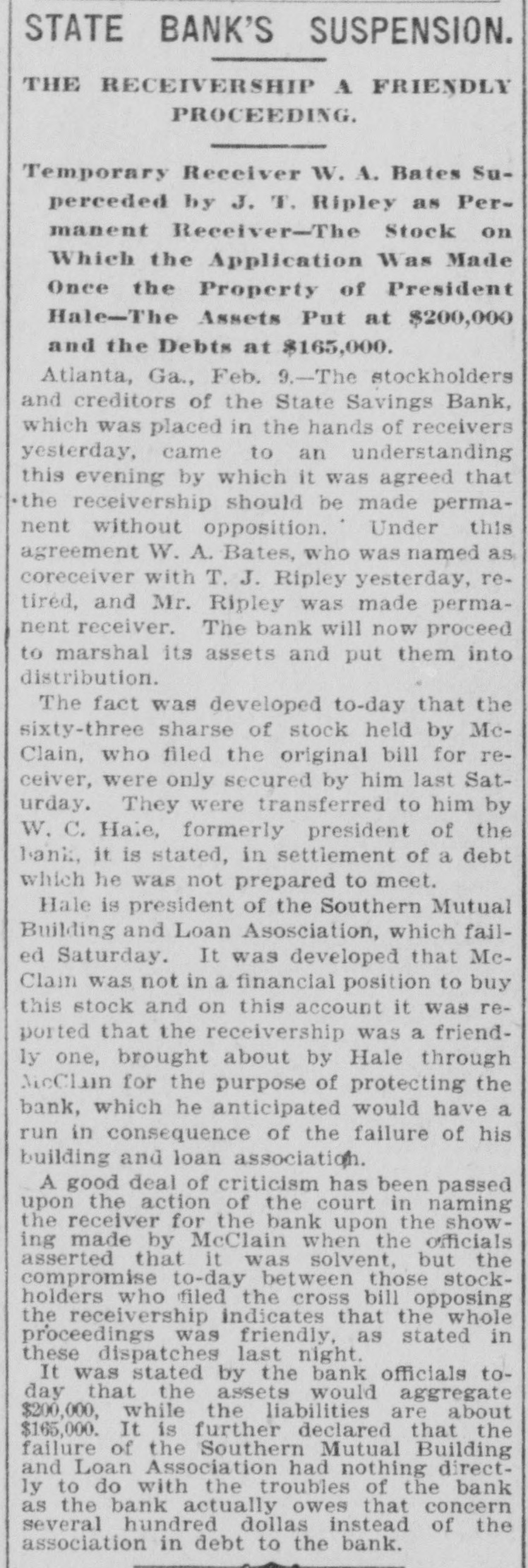
STATE BANK'S SUSPENSION. THE RECEIVERSHIP A FRIENDLY PROCEEDING. Temporary Receiver W. A. Bates Superceded by J. T. Ripley as Permanent Receiver-The Stock on Which the Application Was Made Once the Property of President Hale-The Assets Put at $200,000 and the Debts at $165,000. Atlanta, Ga., Feb. 9.-The stockholders and creditors of the State Savings Bank, which was placed in the hands of receivers yesterday, came to an understanding this evening by which it was agreed that the receivership should be made permanent without opposition. Under this agreement W. A. Bates, who was named as coreceiver with T. J. Ripley yesterday, retired, and Mr. Ripley was made permanent receiver. The bank will now proceed to marshal its assets and put them into distribution. The fact was developed to-day that the sixty-three sharse of stock held by McClain, who filed the original bill for receiver, were only secured by him last Saturday. They were transferred to him by W. C. Hale, formerly president of the lank, it is stated, in settlement of a debt which he was not prepared to meet. Hale is president of the Southern Mutual Building and Loan Asosciation, which failed Saturday. It was developed that McClaim was not in a financial position to buy this stock and on this account it was reported that the receivership was a friendly one, brought about by Hale through licCluin for the purpose of protecting the bank, which he anticipated would have a run in consequence of the failure of his building and loan association. A good deal of criticism has been passed upon the action of the court in naming the receiver for the bank upon the showing made by McClain when the officials asserted that it was solvent, but the compromise to-day between those stockholders who filed the cross bill opposing the receivership indicates that the whole proceedings was friendly, as stated in these dispatches last night. It was stated by the bank officials today that the assets would aggregate $200,000, while the liabilities are about $165,000. It is further declared that the failure of the Southern Mutual Building and Loan Association had nothing directly to do with the troubles of the bank as the bank actually owes that concern several hundred dollas instead of the association in debt to the bank.


Article from The Bryan Daily Eagle, February 10, 1897

Click image to open full size in new tab

Article Text

Georgia Bank Fails. ATLANTA, Feb. 9.-The State Savings Bank of Atlanta has been placed in the hands of a receiver. W. A. Bates and J. T. Ripley were appointed to take charge of the property. The bank's capital is $100,000 and its deposits amount to $75,000. The failure is due to the collapse several days ago of the Mutual Building and Loan association, with which the bank was intimately related.


Article from The Charlotte Democrat, February 11, 1897

Click image to open full size in new tab

Article Text

IN A PECEIVER'S HANDS. An Atlanta Savings Bank Has a Heavy Run. By Telegraph to The News. ATLANTA, Ga., Feb. 9. - The State Savings Bank was placed in a temporary receivership today, but the bank did not close its doors. There was a run on the bank but every demand.made was met. Other banks went to the assistance of the State. W. A. Bates and T. J. Ripley were appointed temporary receivers. The bank's capital is $100,000, and it has deposits of $75,000.


Article from The Morning News, February 12, 1897

Click image to open full size in new tab

Article Text

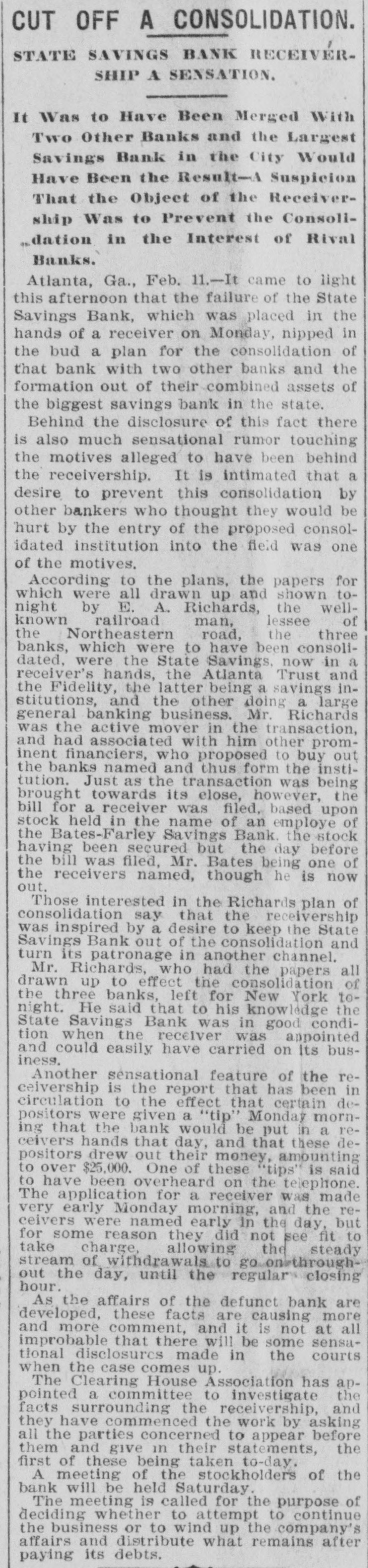
CUT OFF A CONSOLIDATION. STATE SAVINGS BANK RECEIVERSHIP A SENSATION. It Was to Have Been Merged With Two Other Banks and the Largest Savings Bank in the City Would Have Been the Result-A Suspicion That the Object of the Receivership Was to Prevent the Consolidation in the Interest of Rival Banks. Atlanta, Ga., Feb. 11.-It came to light this afternoon that the failure of the State Savings Bank, which was placed in the hands of a receiver on Monday, nipped in the bud a plan for the consolidation of that bank with two other banks and the formation out of their combined assets of the biggest savings bank in the state. Behind the disclosure of this fact there is also much sensational rumor touching the motives alleged to have been behind the receivership. It is intimated that a desire to prevent this consolidation by other bankers who thought they would be hurt by the entry of the proposed consolidated institution into the field was one of the motives. According to the plans, the papers for which were all drawn up and shown tonight by E. A. Richards, the wellknown railroad man, lessee of the Northeastern road, the three banks, which were to have been consolidated, were the State Savings, now in a receiver's hands, the Atlanta Trust and the Fidelity, the latter being a savings institutions, and the other doing a large general banking business. Mr. Richards was the active mover in the transaction, and had associated with him other prominent financiers, who proposed to buy out the banks named and thus form the institution. Just as the transaction was being brought towards its elose, however, the bill for a receiver was filed, based upon stock held in the name of an employe of the Bates-Farley Savings Bank. the stock having been secured but the day before the bill was filed, Mr. Bates being one of the receivers named, though he is now out. Those interested in the Richards plan of consolidation say that the receivership was inspired by a desire to keep the State Savings Bank out of the consolidation and turn its patronage in another channel. Mr. Richards, who had the up to effect the the banks, left for said that to his the night. State drawn three He consolidation New knowledge papers York to- all of Savings Bank was in good condition when the receiver was appointed and could easily have carried on its business. Another sénsational feature of the receivership is the report that has been in circulation to the effect that certain depositors were given a "tip" Monday morning that the bank would be put in a receivers hands that day, and that these depositors drew out their money, amounting to over $25,000. One of these "tips' is said to have been overheard on the telephone. The application for a receiver was made very early Monday morning, and the receivers were named early In the some reason they did not allowing the to stream for take charge. of withdrawals go onethrough- see day, steady fit but to out the day, until the regular closing hour. As the affairs of the defunct bank are developed, these facts are causing more and more comment, and it is not at all improbable that there will be some sensational disclosures made in the courts when the case comes up. The Clearing House Association has appointed a committee to investigate the facts surrounding the receivership, and they have commenced the work by asking all the parties concerned to appear before them and give in their statements, the first of these being taken to-day. A meeting of the stockholders of the bank will be held Saturday. is called for the to to deciding the The meeting whether attempt purpose continue of business or to wind up the company's affairs and distribute what remains after paying its debts.


Article from The Morning News, February 13, 1897

Click image to open full size in new tab

Article Text

STATE SAVINGS BANK SOLID. 7 he Receiver Thinks Depositors Will Be Paid in Full. Atlanta, Ga., Feb. 12.-Thomas J. Ripley, receiver of the State Savings Bank, says that from the partial investigation of the affairs which he has made, he is led to believe that the depositors will be paid in full. The stockholders meet tomorrow.


Article from The Diamond Drill, February 13, 1897

Click image to open full size in new tab

Article Text

DOMESTIC. There were 311 business failures in the United States in the seven days ended on the 5th, against 331 the week previous and 323 in the corresponding period of 1896. The exchanges at the leading clearing houses in the United States during the week ended on the 5th aggregated $1,047,109,766, against $961,245,228 the previous week. The increase compared with the corresponding week of 1896 was 4.9. The president sent to congress the complete report of the World's Columbian Exposition commission. The First national bank of Franklin, O., suspended with liabilities of $75,000. The Northwestern national bank at Great Falls, Mont., closed its doors with liabilities of $700,000; assets, $750,000. John K. Gowdy, chairman of the Indiana republican state committee, announces that he has been appointed and has accepted the post of consul general to Paris. Joe Richie and John Thomas, stonemasons, were killed in a premature dynamite explosion at Frankfort, Ky. Anderson Parker, a farmer of Rock Castle county, Ky., in a drunken rage struck his wife and fractured her skull with a club. He then shot his son through the wrist, when the boy secured a revolver and killed his father. Cashier C. E. Breder, of the First national bank of Bethlehem. Pa., was said to be a defaulter to the extent of $15,000. Thirty thousand people in the towns east of Shreveport, La., are said to be in a starving condition. Charles Radbourne. the famous baseball pitcher, so long identified with the National League clubs of Providence and Boston, died in Bloomington, III.. aged 43 years. A revival of industry is beginning in the Monongahela (Pa.) valley, over 4,000 men having been given work in the past week. In a collision between freight trains on the Louisville & Nashville railroad near Montgomery, Ala., Sink Kirkland, engineer, and Brakeman Weller were killed and the fireman fatally hurt. A severe earthquake shock was felt at Bengles and Chase's stations in Maryland and also at Baltimore. After a quarrel with her husband the wife of Robert Cort, a well-to-do rancher living near Big Timber, Mont., drowned her three children and herself. A large portion of the business part of Shellrock, Ta., was destroyed by fire. Judge Goff, of West Virginia, has, it is said, declined a cabinet appointment because of his wife's poor health. John Hardisty and Miss Cora Akers were killed by the cars near Caliente, Cal., while gathering wild flowers. The president has signed an order reducing the number of pension agencies in the United States from 18 to 9. In a freight train wreck near Tolono, III., 30 fine horses were killed and five cars of merchandise destroyed. The New York Central's four-track steel drawbridge over the Harlem river in New York, the largest bridge of the kind in the world, has been completed. It cost over $3,000,000, and work was begun on it September 1, 1895. The thirteenth annual report of the civil service commission, covering the past fiscal year, shows that the total approximate number of positions in the civil branch of the government is 178,717. Of these 87,107 are in the classified service, and 91,610 unclassified. The age gregate compensation paid in the executive civil service during the last fiscal year was $100,000,000. The State savings bank at Atlanta, Ga., closed its doors with liabilities of $75.000. According to a dispatch from Washington Secretary of the Treasury Carlisle has definitely decided to locate in New York city. With the Chinese New Year the Six Companies, the most powerful and richChinese organization in America, st of existence in San Francisco.


Article from The Dawson News, February 24, 1897

Click image to open full size in new tab

Article Text

THE Committee of the Atlanta Clearing House Association, appointed to investigate the condition of the State Savings Bank, found that the man who made the application for a receivership was a mere dummy or figure head, and held that he ought not to have had any standing in court at all. The committee calls upon the business men of the state to unite in an effort to have the legislature rectify the evils of the receivership system. When the legislature next convenes it will be memorialized by nearly every commercial body in Georgia for relief from the wreckers who now prowl among our business institutions seeking that which they may devour.


Article from Birmingham State Herald, February 25, 1897

Click image to open full size in new tab

Article Text

TEN PER CENT DIVIDEND. Atlanta, Ga., Feb 24. The receiver of the State Savings Bank will pay a dividend of 10 per cent. next week to the depositors.


Article from The Wichita Daily Eagle, March 23, 1897

Click image to open full size in new tab

Article Text

interested in the concern are largely labor ing men employed in the vicinity of Deering. A bill for a receiver for the association was today asked by President Brieske, the bill charging David J. Sachsel, secretary, and Karl Kronenberger, treasurer, with being short in their accounts, and placing the shortage at $35,000. Nothing has yet been learned of the whereabouts of Sachsel. Judge Ball appointed as receiver Arthur Nollau, a member of the association. GEORGIA BANK FAILURE. West Point, Ga., March 22.-The West Point State bank closed its doors this morning. It was suposed to be a branch of the State Savings bank of Atdanta, and since the failure of that institution it has been weakened from a lack of patronage. W. C. Hale, who was connected with the State Savings bank, was vice president of the West Point State bank, and it caused a heavy run on the bank here soon after the failure of the State Savings bank and it has been in a shaky condition since. The West Point State bank had a capital of $25,000 and the nominal assets amount to about the same. INSOLVENT BANK DIVIDENDS. Washington, March 22.-The comptroller of the currency has declared dividends in favor of the creditors of the insolvent national banks as follows: Ten per cent, the First National bank, of Sedalia, Mo.; 10 per cent, the National bank of Illinois, Chicago; 20 per cent, the First National bank, of Hot Springs, S. D.; 10 per cent, the El Paso National bank, of El Paso, Tex.; 5 per cent, the Columbia National bank, of Chicago, III.; 45 per cent in favor of the stockholders of the First National bank, of Clearfield, Pa.


Article from Wheeling Register, March 23, 1897

Click image to open full size in new tab

Article Text

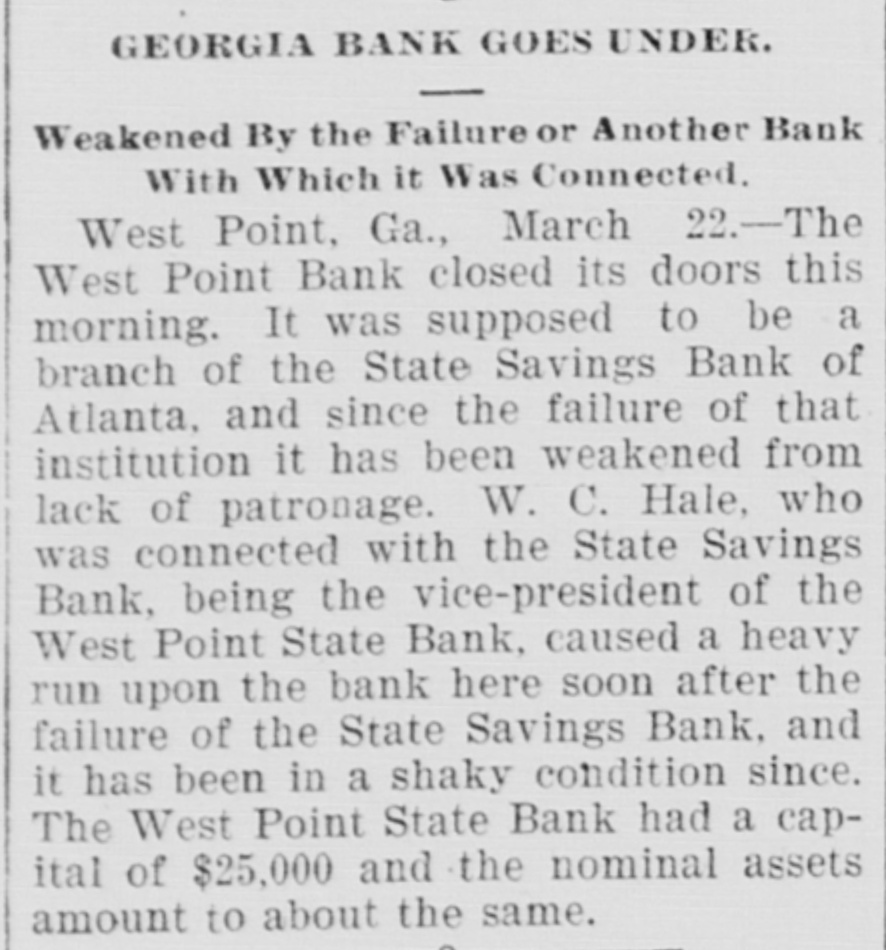
GEORGIA BANK GOES UNDER. Weakened By the Failure or Another Bank With Which it Was Connected, West Point, Ga., March 22.-The West Point Bank closed its doors this morning. It was supposed to be a branch of the State Savings Bank of Atlanta, and since the failure of that institution it has been weakened from lack of patronage. W. C. Hale, who was connected with the State Savings Bank, being the vice-president of the West Point State Bank, caused a heavy run upon the bank here soon after the failure of the State Savings Bank, and it has been in a shaky condition since. The West Point State Bank had a capital of $25,000 and the nominal assets amount to about the same.


Article from The Herald, March 23, 1897

Click image to open full size in new tab

Article Text

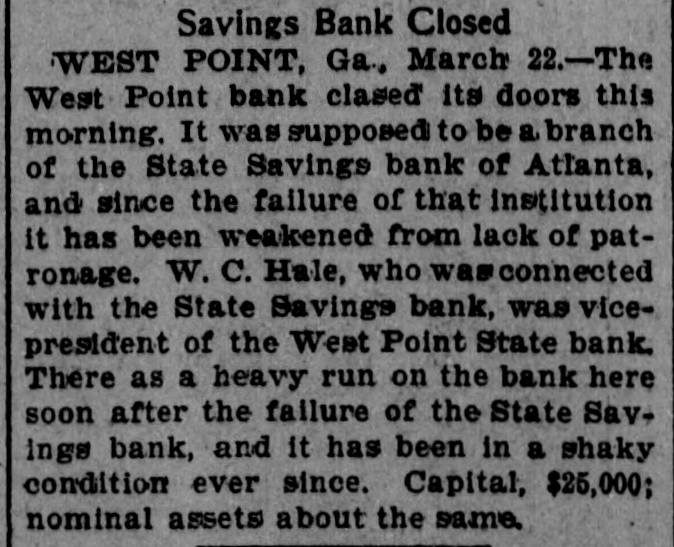
Savings Bank Closed WEST POINT, Ga., March 22.-The West Point bank clased its doors this morning. It supposed to be a. branch of the State Savings bank of Atlanta, and since the failure of that institution it has been weakened from lack of patronage. W. C. Hale, who was connected with the State Savings bank, was vicepresident of the West Point State bank. There as a heavy run on the bank here soon after the failure of the State Say, ings bank, and it has been in a shaky condition ever since. Capital, $25,000; nominal assets about the same.


Article from The Morning News, March 24, 1897

Click image to open full size in new tab

Article Text

sume Operations-The West Point State Bank Closed-Sheriff Closes a Store at Columbus-Pitched Battle Fought at Jasper-An Indian Trapper to Hang. GEORGIA. Georgia's cotton mills give employment to 50,000 people, and 3,000,000 spindles are kept in constant operation. W. A. Jester, a prominent business man of Athens, fell from the loft of his stable Monday and had his shoulder blade and collar bone broken. A. J. Riddle, for about twenty-five years a photographer of Columbus, died at the Inn, of which his wife is the proprietress, Sunday night. D. H. Smith, boss of the picker room of the Dixie cotton mills, at LaGrange, was killed by a train Sunday night. He was under the influence of liquor at the time. Fred D. Johnson, a negro boy, attempted an assault upon the 4-year-old daughter of W. J. Eaverson, three miles from Royston, Sunday night, about dark. He is under arrest. H. F. Everett's stove store at Columbus was closed by the sheriff Monday, at the instance of W. H. Brannon, executor of the estate of I. G. Struppa. Liabilities, principal, $5,967.60, and interest, $2,803.25. The Piedmont Marble Company, at its works near Jasper, will resume operations in a few days. This is one of the largest companies doing business in the south, but has been closed down for more than a year, owing to litigation. The name of Dr. I. S. Hopkins of Atlanta has been presented to President McKinley as an applicant for appointment as minister to Greece. Senator Clay handed in the application Saturday. He did it, it is said, at the request of Dr. Hopkins. London papers publish a denial by Clyde Shropshire of Georgia, United States army, former vice consul to the consul general at Paris, in which he declares as absurd the recent reports of heavy embezzlements and general crookedness on his part. The Grady hospital physicians attending J. P. Weaver, who was shot Saturday morning by Charles Owens at Atlanta, who took him for a burglar, say that Weaver is much improved, and that there is a strong possibility of his recovering. Weaver was suffering with the tremens when shot. The supreme court has decided that M. Lowry, an Indian trapper on the Altamaha river, must hang. Lowry and a white man named Patrick Burns lived in a little shanty on the Altamaha river and kept their rations there. It appears that the Indian was in the habit of eating the white man's provisions, and that the latter was consequently annoyed by this free and easy way of appropriating his property. The matter culminated in the Indian shooting Burns. The West Point State Bank of West Point closed its doors Monday. It was supposed to be a branch of the State Savings Bank and since the failure of that institution it has been weakened for a lack of patronage by the business men of the place. The fact that W. C. Hale, who was connected with the State Savings Bank of Atlanta, was the vice president of the West Point State Bank caused a heavy run upon the bank soon after the failure of the State Savings Bank, and it has been in a shaky condition since. The West Point bank had a capital of $25,000, and the nominal assets amount to about the same. Mr. Bailey, the cashier, states that all depositors will be paid in full. At Jasper Friday Charlie McHan, A. McHan's, son, and Eugene Rhyne had a quarrel, in which A. McHan took part. Monday Cecil Rhyne and Charlie McHan had an encounter, which resulted in Cecil Rhyne getting knocked down. He went home and returned with his older brothers, Hardy and Eugene. Hardy Rhyne demanded or started to demand an explanation of A. McHan, when McHan knocked him down. A pitched battle followed, and the three Rhyne brothers and A. McHan and his son being participants. Rocks and clubs were used freely. All were very bloody and considerably bruised. Charlie McHan, Cecil and Eugene Rhyne were most seriously wounded. Friends interfered and prevented further trouble. A suit was brought against the Jacobs Pharmacy Company of Atlanta for $4,550 by Jonathan Norcross. The property for the loss of which the suit is brought is alleged to be a lot of shelving valued at $3,000; one lot of fine counters valued at $1,000; one lot of electrical appliances, consisting of fans, motors, wires and other appurtenances, valued at $300; and one lot of gas fixtures, consisting of pipes, burners, shades and chimneys, valued at $250, making a total of $4,550. These goods are alleged to have been in the building on which the Jacobs Pharmancy Company had a lease, and which was OCcupied as a drug store. The petition alleges that the fixtures was the property of Mr. Norcross and that the Jacobs Pharmacy Company refuses to give them up. The store in which these goods are alleged to have been kept was the store that collapsed in 1894, for which a suit was brought by the Jacobs Pharmacy Company for $25,000 against Mr. Norcross, the amount alleged to have been lost by the collapse. That was tried not over two months ago, and resulted in a verdict for the plaintiff for $5,000. FLORIDA. Richard Alfred died at his home at Umatilla Saturday morning.
Article from The Morning News, March 30, 1897

Click image to open full size in new tab

Article Text

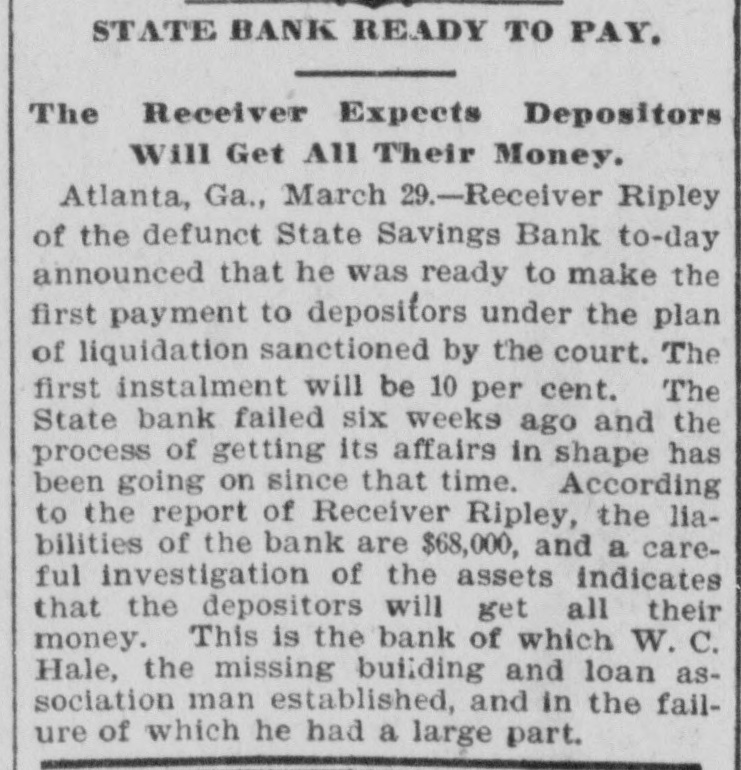
STATE BANK READY TO PAY, The Receiver Expects Depositors Will Get All Their Money. Atlanta, Ga., March 29.-Receiver Ripley of the defunct State Savings Bank to-day announced that he was ready to make the first payment to depositors under the plan of liquidation sanctioned by the court. The first instalment will be 10 per cent. The State bank failed six weeks ago and the process of getting its affairs in shape has been going on since that time. According to the report of Receiver Ripley, the liabilities of the bank are $68,000, and a careful investigation of the assets indicates that the depositors will get all their money. This is the bank of which W. C. Hale, the missing building and loan association man established, and in the failure of which he had a large part.


Article from The Morning News, April 30, 1897

Click image to open full size in new tab

Article Text

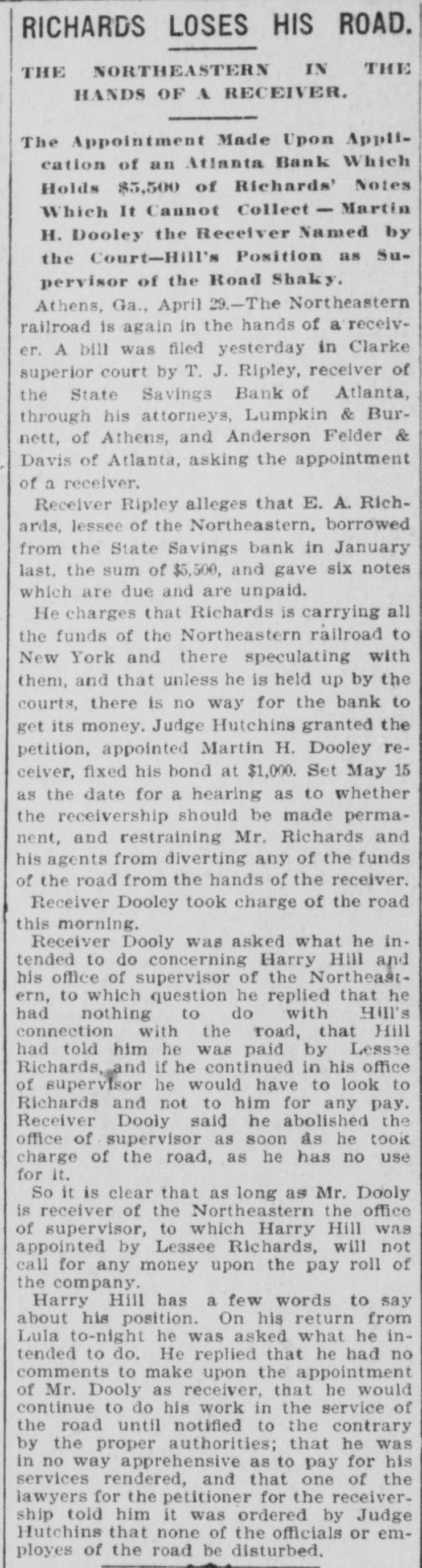
# RICHARDS LOSES HIS ROAD. THE NORTHEASTERN IN THE HANDS OF A RECEIVER. The Appointment Made Upon Application of an Atlanta Bank Which Holds $5,500 of Richards' Notes Which It Cannot Collect—Martin H. Dooley the Receiver Named by the Court-Hill's Position as Supervisor of the Road Shaky. Athens, Ga., April 29.-The Northeastern railroad is again in the hands of a receiver. A bill was filed yesterday in Clarke superior court by T. J. Ripley, receiver of the State Savings Bank of Atlanta, through his attorneys, Lumpkin & Burnett, of Athens, and Anderson Felder & Davis of Atlanta, asking the appointment of a receiver. Receiver Ripley alleges that E. A. Richards, lessee of the Northeastern, borrowed from the State Savings bank in January last, the sum of $5,500, and gave six notes which are due and are unpaid. He charges that Richards is carrying all the funds of the Northeastern railroad to New York and there speculating with them, and that unless he is held up by the courts, there is no way for the bank to get its money. Judge Hutchins granted the petition, appointed Martin H. Dooley receiver, fixed his bond at $1,000. Set May 15 as the date for a hearing as to whether the receivership should be made permanent, and restraining Mr. Richards and his agents from diverting any of the funds of the road from the hands of the receiver. Receiver Dooley took charge of the road this morning. Receiver Dooly was asked what he intended to do concerning Harry Hill and his office of supervisor of the Northeastern, to which question he replied that he had nothing to do with Hill's connection with the road, that Hill had told him he was paid by Lessee Richards, and if he continued in his office of supervisor he would have to look to Richards and not to him for any pay. Receiver Dooly said he abolished the office of supervisor as soon as he took charge of the road, as he has no use for it. So it is clear that as long as Mr. Dooly is receiver of the Northeastern the office of supervisor, to which Harry Hill was appointed by Lessee Richards, will not call for any money upon the pay roll of the company. Harry Hill has a few words to say about his position. On his return from Lula to-night he was asked what he intended to do. He replied that he had no comments to make upon the appointment of Mr. Dooly as receiver, that he would continue to do his work in the service of the road until notified to the contrary by the proper authorities; that he was in no way apprehensive as to pay for his services rendered, and that one of the lawyers for the petitioner for the receivership told him it was ordered by Judge Hutchins that none of the officials or employes of the road be disturbed.