Exchange Bank (Maquoketa, IA)

Episode Information

Episode UID
2711417591258
Episode Type
Suspension β†’ Closure
Bank Type
private
Bank ID
271141759 hash
Start Date
October 4, 1904
Location
Maquoketa, Iowa (42.069, -90.666)

Metadata

Model
gpt-5-mini (chosen from majority vote of a three-model LLM ensemble)
Short Digest
5d81786142230fec

Response Measures

None

Description

Assignee C. M. Thomas is mentioned, indicating a formal failure/receivership.

Events (2)

1. October 4, 1904 Receivership
Newspaper Excerpt
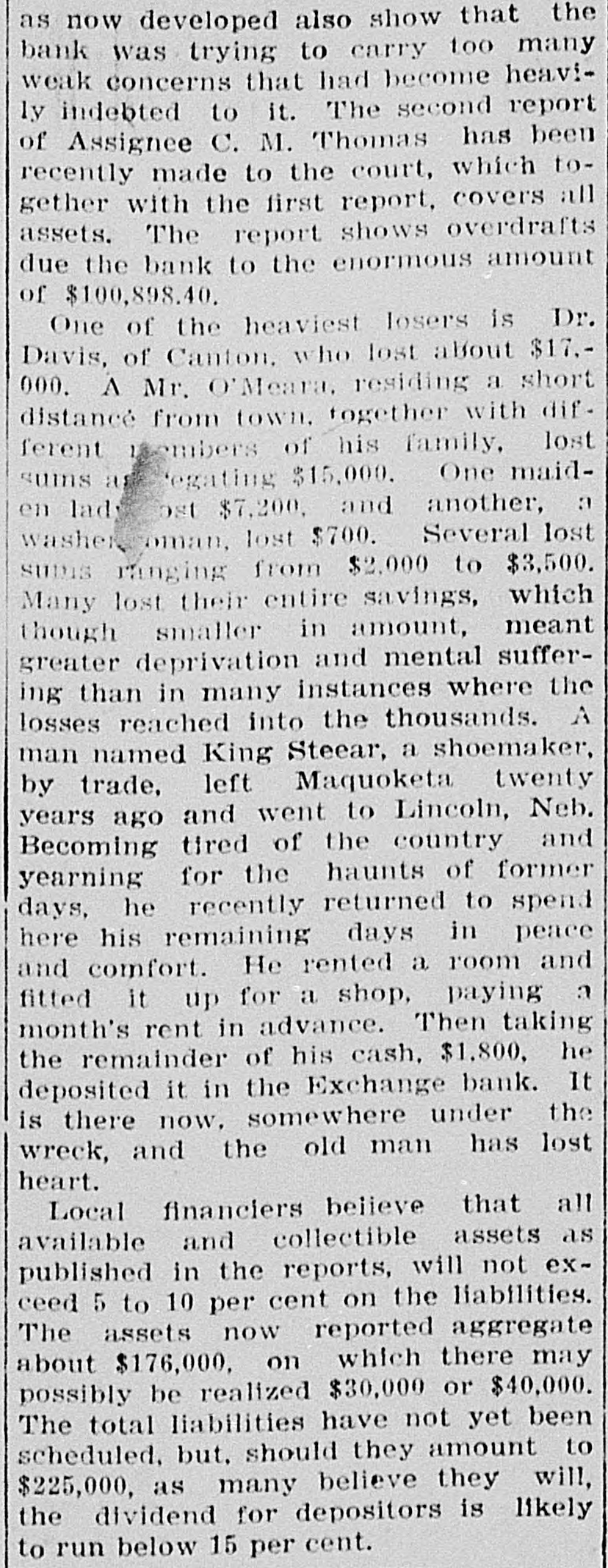
the second report of Assignee C. M. Thomas has been recently made to the court... It is there now, somewhere under the wreck, and the old man has lost heart.
Source
newspapers
2. October 4, 1904 Suspension
Cause
Bank Specific Adverse Info
Cause Details
Broken up due to dishonesty, shiftlessness, extravagance and heavy bad loans as reported by assignee.
Newspaper Excerpt
Maquoketa - Exchange bank. Broken up on account of dishonesty, shiftlessness and extravagance.
Source
newspapers

Newspaper Articles (2)

Article from Evening Times-Republican, October 4, 1904

Click image to open full size in new tab

Article Text

as now developed also show that the bank was trying to carry too many weak concerns that had become heavily indebted to it. The second report of Assignee C. M. Thomas has been recently made to the court, which together with the first report, covers all assets. The report shows overdrafts due the bank to the enormous amount of $100,898.40. One of the heaviest losers is Dr. Davis, of Canton, who lost about $17.000. A Mr. O'Meara. residing a short distancΓ© from town. together with different 18 embers of his family, lost sums as legating $15,000. One maiden lad: lost $7,200. and another, a washer oman, lost $700. Several lost sums ranging from $2,000 to $3,500. Many lost their entire savings, which though smaller in amount, meant greater deprivation and mental suffering than in many instances where the losses reached into the thousands. A man named King Steear, a shoemaker, by trade, left Maquoketa twenty years ago and went to Lincoln, Neb. Becoming tired of the country and yearning for the haunts of former days, he recently returned to spend here his remaining days in peace and comfort. He rented a room and fitted it up for a shop, paying a month's rent in advance. Then taking the remainder of his cash, $1,800, he deposited it in the Exchange bank. It is there now, somewhere under the wreck, and the old man has lost heart. Local financiers believe that all available and collectible assets as published in the reports, will not exceed 5 to 10 per cent on the liabilities. The assets now reported aggregate about $176,000, on which there may possibly be realized $30,000 or $40,000. The total liabilities have not yet been scheduled, but, should they amount to $225,000, as many believe they will, the dividend for depositors is likely to run below 15 per cent.


Article from Ottumwa Tri-Weekly Courier, June 3, 1905

Click image to open full size in new tab

Article Text

account of age. He is a rich man. Mt. Ayr - Citizens' bank. Failed on account of bad management and bad loans, but not to farmers. Sigourney - Sigourney Savings bank. The cashier took $47,000 and used it in speculation on the board of trade, and when the discovery was made, shot himself. The bank paid out. Holstein - F. H. McCutcheon & Co.'s bank, Speculations on the board of trade. Corning - Corning State Savings bank. The proprietor of the bank used the funds as his own and when the discovery was made killed himself. Pella - People's Savings bank. Suspended but in settlement paid out. Coin - Bank of Coin. Broke up on account of bad loans, Banker speculated on board of trade. Garden Grove - Farmers' bank. Speculation on Chicago board of trade. Maquoketa - Exchange bank. Broken up on account of dishonesty, shiftlessness and extravagance. Pleasanton - Royal Richardson & Co.'s bank. Broken up on account of speculation. Dixon - Bank of Dixon. Broken up on account of embezzlement by the banker and his son. New Liberty - New Liberty Savings bank, Broken up by loaning money to a theatrical syndicate in Chicago and by speculation and extravagance on the port of the manager. Imogene - Citizens' bank. This bank did not fail; cashier skipped and his father put up shortage and bank flourishes. Birmingham - E. H. Skinner & Co.'s bank. Failed from bad management. Banker now under nine indictments. Olin - Bank of Olin. Broken up by speculation. Buck Grove - H. S. Green's bank. Banker skipped with the money. Dow City - H. S. Green's bank. Failed on account of speculation, and banker skipped. Waverly - German-American Loan and Trust Co. Failed, but paid out. Curlew - Bank of Curlew. Did not fail; moved to another town. Gaza - Bank of Gaza, Did not fail; sold out and moved away. Little Sioux - Little Sioux bank. Failed on account of speculation; president was a farmer and feeder and speculator; finally paid out. Tiffin - Corn Exchange bank. Did not fail; was the private bank and incorporated under the name of Tiffin Savings bank. Emerson - Farmers' bank. This bank never failed. It was consolidated with another bank under name of Emerson state bank. Sheldon - Sheldon state bank. This bank failed on account of politics and bad business methods. Ireton - Bank of Ireton. Failed because it had no capital; manager was a cranky man, and lost money in a brick plant. Ireton - F. M. McKeever's bank. There was no such bank. The bank referred to was the Bank of Ireton. Germania - State bank. This was one of the W. E. Brown banks and was loaded with northern and Canadian lands, hence its failure. Colfax - Bank of Colfax. This bank failed on account of speculations on the board of trade; the cashier suicided. Royal - Bank of Royal. This is one of the W. E. Brown banks and failed on account of speculations on the board of trade. New Providence - O. E. Miller & Sons' bank. This firm kept a store; had small capital; for various reasons lost public confidence and failed. Linn Grove - H. W. Main's bank. This was one of W. E. Brown's banks and failed on account of the speculation upon the part of Brown; Main suicided. Grinnell - National bank. Failed on account of misuse of funds by the Spencer family, extending over a period of years; Spencer and son were drowned, either by accident or intention. Storm Lake - National bank. This was W. E. Brown's bank and failed on account of Brown's speculations; Brown is under indictment. Le Mars - National bank. This bank failed about the year 1900, and the cashier was convicted of embezzlement. The bank failed for want of public confidence and on account of bucketshop speculations by cashier. In some cases it will be seen that the banks were not failures, but were incorporated with others. But in spite of the fact that the story is entirely wrong it is allowed to go out over the country and exert an influence dangerous to Iowa and her real estate interests. The fact is that loans to farmers in Iowa are sought after by country bankers and are valued by them. There is a great deal of legitimate and truthful ground upon which to fight the beef trust without damaging the reputation of the Iowa farmer. According to the magazine article, Senator L. W. Lewis of Page county is quoted as authority for the statements made by Mr. Russell. The Des Moines Capital wrote to Mr. Lewis and received the following in reply: "I am of the opinion that the Iowa bank failures are due to down-right rascality, outside speculation and over-loans.