Article Text
Pennsylvania Bank Suspends
Uniontown, Pa., Jan. 18.—The first National bank of Uniontown, failed to open its doors this morning. The capital is $100,000 and deposits $2,600,000.
Borrowed from banks or large institutions, Fed/other loan, Capital injected, Full suspension, Books examined
Click image to open full size in new tab
Uniontown, Pa., Jan. 18.—The first National bank of Uniontown, failed to open its doors this morning. The capital is $100,000 and deposits $2,600,000.
Click image to open full size in new tab
First National of Uniontown, Pa., is Forced to Suspend. Uniontown, Pa., Jan.' 19.-The First National bank of Uniontown, which has led the honor roll of national banks in the United States for several years, did not open its doors yesterday. J. V. Thompson is president.

Click image to open full size in new tab
Uniontown's Suspension Laid to Plot Against Josiah Thompson. RECEIVERS TAKE HIS PROPERTY His Assets Placed at $70,000.000 and Liabilities at $22,000,000. (By Telegraph to The Tribunal Uniontown, Penn., Jan. 19.-Following the suspension of the Uniontown "Honor" First National Bank, which vesterday voluntarily closed its doors and is now in charge of federal inrestigators, Josiah Thompson is facing an army of angry creditors. He is head of the $100,000,000 Greene County Coal Land Syndicate, one of the largest independent coal land owners in the United States and president of the closed bank. He accepted to-day R voluntary recoivership in the Fayette County Court, turned over his affairs to a triumvirate of receivers and started New York, ostensibly to negotiate loan to save the bank. Probably ten thousand persons are affected by this financial upheaval. which has upturned all of Western Pennsylvania and parts of Ohio and West Virginia The Controller of the Currency in Washington admits that the affairs of the bank have been unsatisfactory since 1912, and there has been virtually a run on the bank for many months. One of Thompson's creditors. by his own admission, is Republican State Chairman William Crow, virtually political "ruler" of Fayette County. He acknowledged to-day that he had sold coal lands to Mr. Thompson and that he held the latter's notes. He maintains that Thompson's affairs will be righted. Thompson was an aspirant for the Governorship nomination in 1906. It is common talk about town that millions of dollars have been withdrawn from the bank by depositors in the last two years. It is said the withdrawal of $200,000 of deposits since December 31, 1914, coming on top of the withdrawal of $1,400,000 in the preceding fourteen months, caused the crisis. Scarcity of money and inability to realize on the vast amount of paper which the bank is reputed to hold are said by Thompson's many friends to have caused the embarrassment of the institution. Likewise, it is said, Thompson has been forced into a corner RS the result of sales of coal lands to operators dating back to 1907. In the bill of equity filed to-day it is set forth that Thompson's assets are $70.000,000 and that his total indebtedness is $22,000,000, of which $7,000,000 is unsecured. Back of the crash, it is said, is a battle between Thompson, as the head of an independent syndicate, and powerful financial interests, in which the latter are said to have aimed at the overthrow of Thompson and his lieutenants by forcing the value of their coal and coke land holdings to such a low level that they could be bought for a song Thompson's rise from a poor boy to the dominating head of & large corporation has been meteoric Starting with an inheritance of $100,000, he is accredited with having won a $100,000.000 fortune. The confidence of those who have invested with him is shown by the fact that the directors of the First National Bank have voluntarily pledged their private funds for rehabilitation of its affairs and as a guarantee to depositors that they will be paid. While the creditors' petition declares there is $7,000,000 of unsecured property, it asserts that the balance of $15,000,000 is secured by mortgage or pledge of substantially the entire assets of the defendant, leaving nothing but equities out of which unsecured creditors can be paid and on which they cannot realize. Three large coal land deals, said to be pending are Thompson's hope for prompt relief. Closing any one of them, according to report, will enable him to set the bank on its feet. When the bank became a member of the District Regional Reserve Bank it is said to have had a surplus of $1,700,000 and that $700,000 was distrib-
Click image to open full size in new tab
RECEIVER FOR HEAD OF $100,000,000 CO. Josiah Thompson, President of Failed Uniontown Bank. Put Assets at $70,000,000. CAME UP FROM POOR BOY UNIONTOWN, Pa., Jan. 19.-Following the suspension yesterday of the Uniontown First National Bank, Josiah Thompson, head of the $100,000,000 Greene County Coal Land Syndicate, and one of the largest independent coal land owners in the country and president of the bank, accepted voluntary receivership in the Fayette County courts to-day, turned over his affairs to three receivers and left for New York. His assets were given as $70,000,000. and his debts $22,000,000, with $7,000,000 unsecured. Probably 10,000 persons are involved in the failure. The statement of the Comptroller of the Currency in Washington that the affairs of the bank have been unsatisfactory since 1912, is followed by the admission here that there has been virtually a run on the bank for many months. One of Thompson's creditors, by his own admission. is Republican State Chairman William Crow, who said today that he had sold coal lands to Mr. Thompson and that he held the latter's notes. He maintains Thompson's affairs will be righted. Thompson was an aspirant for the Gubernatorial nomination in 1906. While the affairs of the bank are guarded. it is said the withdrawal of $200,000 of deposits since the first of the year. coming on top of the withdrawal of $1,400,000 in the preceding fourteen months, precipitated the crisis. Back of the present disturbance, it is said, lies the story of a gigantic battle between Thompson as the head of an independent syndicate and powerful financial interests engaged in the coal and coke business. Thompson's rise in the world, his progress from a poor boy to the dominating head of a vast financial. holding corporation. has been meteoric. Starting with an inheritance of $100,000 from a relative he is accredited with having fought his way up to a $100,000,000 fortune. The faith to those who have invested with him is shown by the fact that directors of the First National Bank have voluntarily pledged their private funds for rehabilitation of the affairs of the bank and as a guarantee to depositors that they will be paid. When the bank became a member of the Federal reserve system it is said to have had a surplus of $1,700,000. and that the $700,000 was distributed in a "700 per cent. dividend." This was paid on July 6. 1914. Organized in 1854 with a capital of $100.000 the bank came up so fast that it has been paying dividends at the rate of 22 per cent. annually.
Click image to open full size in new tab
UNIONTOWN, Pa., Jan. 20.-Receivers were appointed today for I. W. Seaman and Frank H. Rosbero, business associates of Josiah V. Thomp son, for whom receivers were appointed yesterday following the closing of the First National Bank of Uniontown Monday. Seaman and Rosboro are large holders of coal land in Pennsy¹vania, West Virginia and Ohio. State. ments showed Seaman's liabilities as $2,800,000 and his assets as $8,000,000 and Rosboro's liabilities as $90,000, with assets of $300,000.
Click image to open full size in new tab
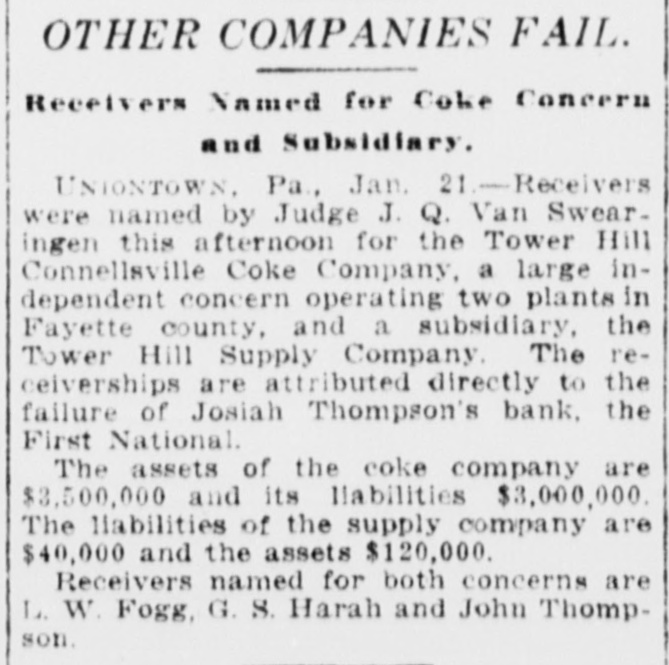
Receivers Named for Coke Concern and Subsidiary. UNIONTOWN, Pa., Jan. 21.-Receivers were named by Judge J. Q. Van Swearingen this afternoon for the Tower Hill Connellaville Coke Company, a large independent concern operating two plants in Fayette county, and a subsidiary, the Tower Hill Supply Company. The receiverships are attributed directly to the failure of Josiah Thompson's bank, the First National. The assets of the coke company are $3,500,000 and its liabilities $3,000,000. The liabilities of the supply company are $40,000 and the assets $120,000. Receivers named for both concerns are L. W. Fogg, G. S. Harah and John Thompson.
Click image to open full size in new tab
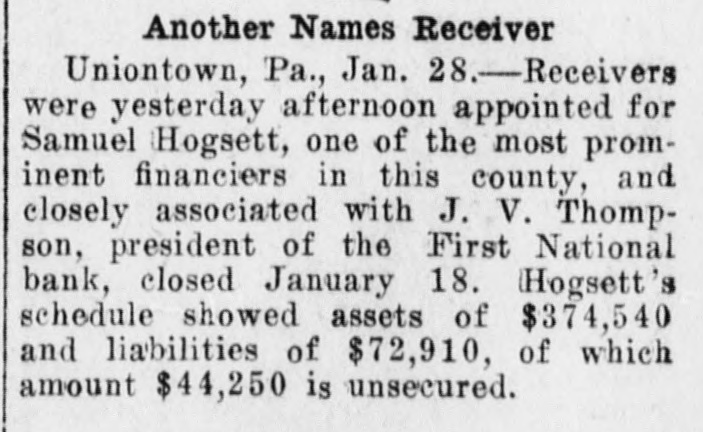
Another Names Receiver Uniontown, Pa., Jan. 28.-Receivers were yesterday afternoon appointed for Samuel Hogsett, one of the most prominent financiers in this county, and closely associated with J. V. Thompson, president of the First National bank, closed January 18. Hogsett's schedule showed assets of $374,540 and liabilities of $72,910, of which amount $44,250 is unsecured.
Click image to open full size in new tab
Strawn of Pennsylvania, was appointed permanent receiver for the First National Bank of Uniontown, Pa., by Controller of the. Curreney Williams.
Click image to open full size in new tab
Strawn of Pennsylvania was appointed permanent receiver for the First National Bank of Uniontown, Pa., by Controller of the Currency Williams. -
Click image to open full size in new tab
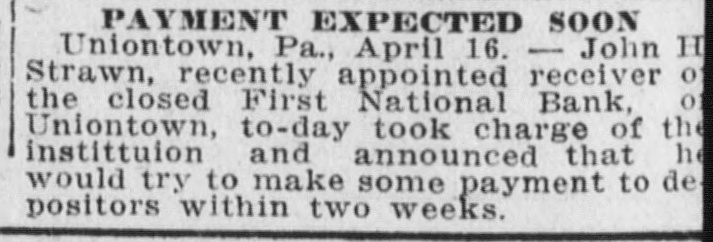
PAYMENT EXPECTED SOON Uniontown, Pa., April 16. - John H Strawn, recently appointed receiver 01 the closed First National Bank, 01 Uniontown, to-day took charge of the instittuion and announced that he would try to make some payment to depositors within two weeks.
Click image to open full size in new tab
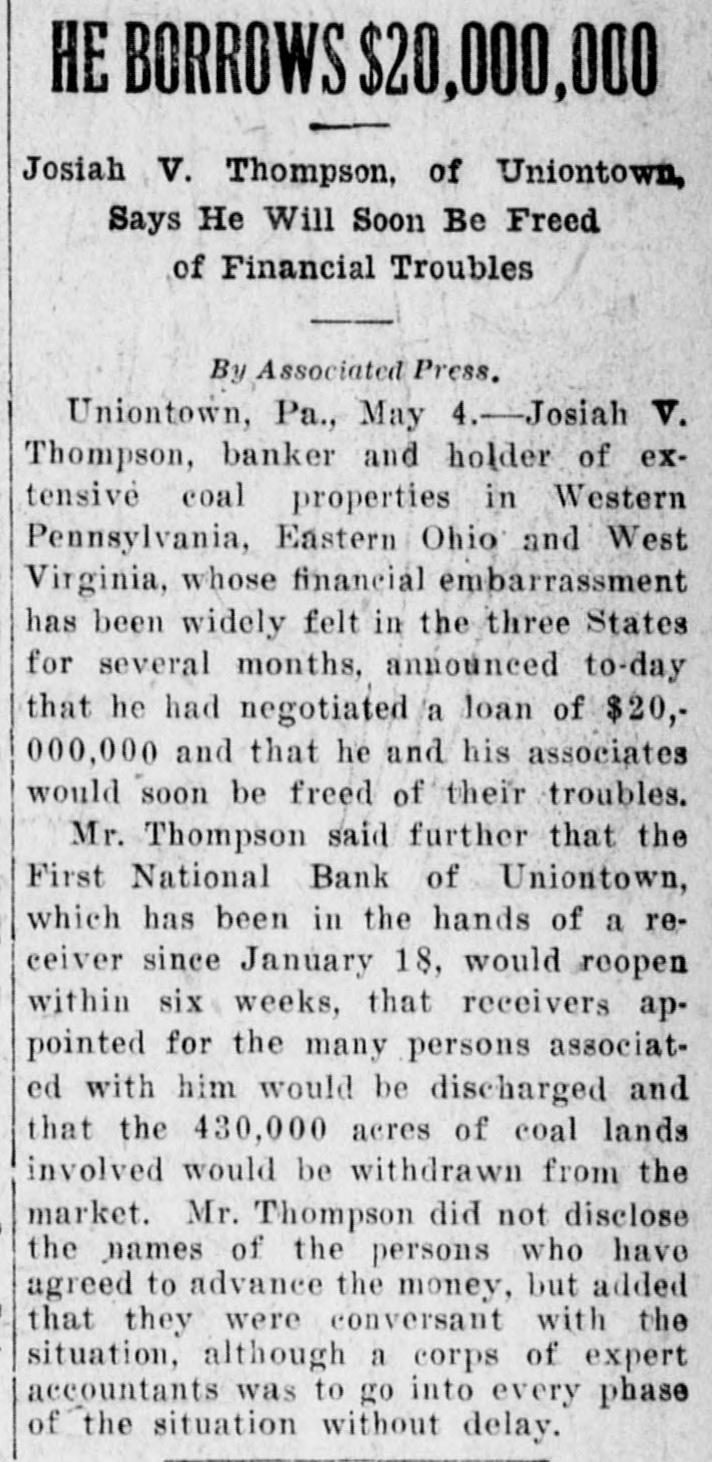
HE BORROWS $20,000,000 Josiah V. Thompson, of Uniontown, Says He Will Soon Be Freed of Financial Troubles By Associated Press. Uniontown, Pa., May 4.-Josiah V. Thompson, banker and holder of extensive coal properties in Western Pennsylvania, Eastern Ohio and West Virginia, whose financial embarrassment has been widely felt in the three States for several months, announced to-day that he had negotiated a loan of $20,000,000 and that he and his associates would soon be freed of their troubles. Mr. Thompson said further that the First National Bank of Uniontown, which has been in the hands of a receiver since January 18, would reopen within six weeks, that receivers appointed for the many persons associated with him would be discharged and that the 430,000 acres of coal lands involved would be withdrawn from the market. Mr. Thompson did not disclose the names of the persons who have agreed to advance the money, but added that they were conversant with the situation, although a corps of expert accountants was to go into every phase of the situation without delay.
Click image to open full size in new tab
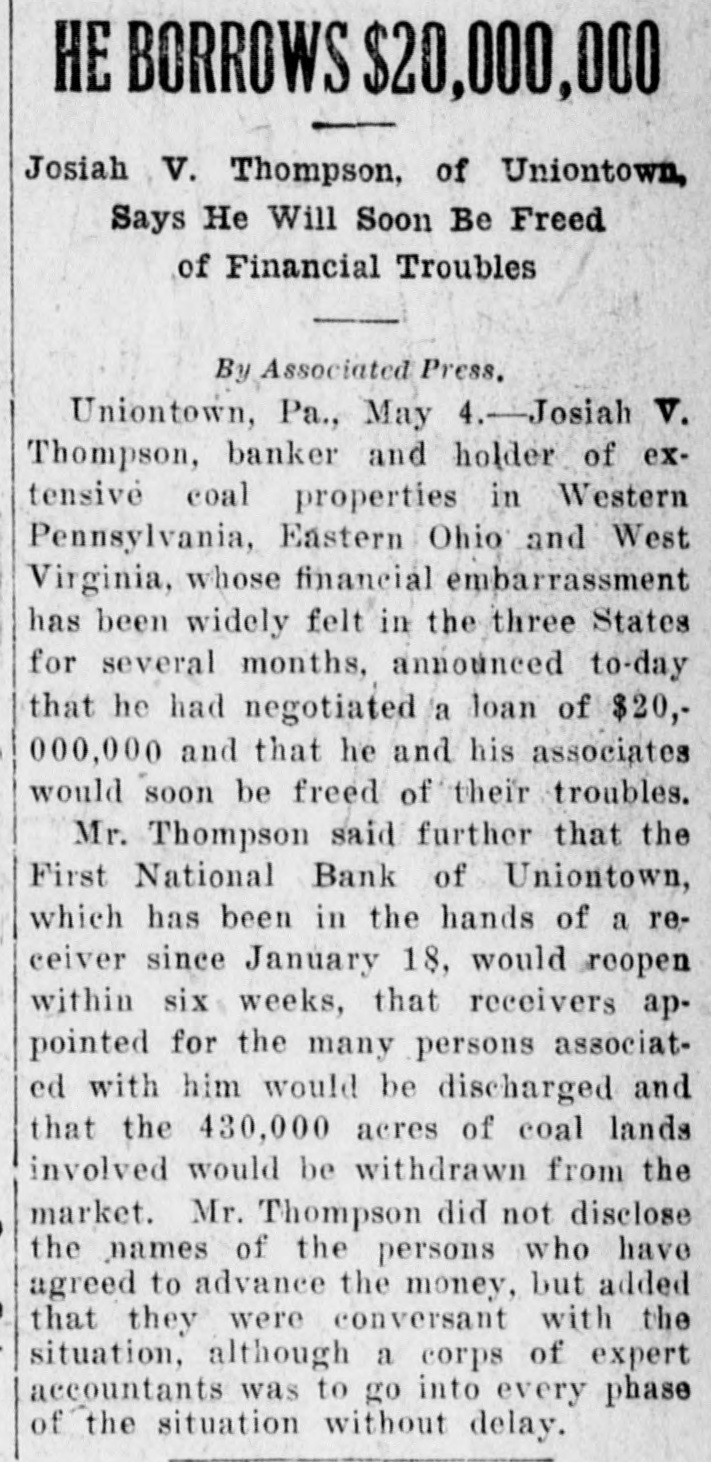
HE BORROWS $20,000,000 Josiah V. Thompson, of Uniontown, Says He Will Soon Be Freed of Financial Troubles By Associated Press. Uniontown, Pa., May 4.-Josiah V. Thompson, banker and holder of extensive coal properties in Western Pennsylvania, Eastern Ohio and West Virginia, whose financial embarrassment has been widely felt in the three States for several months, announced to-day that he had negotiated a loan of $20,000,000 and that he and his associates would soon be freed of their troubles. Mr. Thompson said further that the First National Bank of Uniontown, which has been in the hands of a receiver since January 18, would reopen within six weeks, that receivers appointed for the many persons associated with him would be discharged and that the 430,000 acres of coal lands involved would be withdrawn from the market. Mr. Thompson did not disclose the names of the persons who have agreed to advance the money, but added that they were conversant with the situation, although a corps of expert accountants was to go into every phase of the situation without delay.
Click image to open full size in new tab
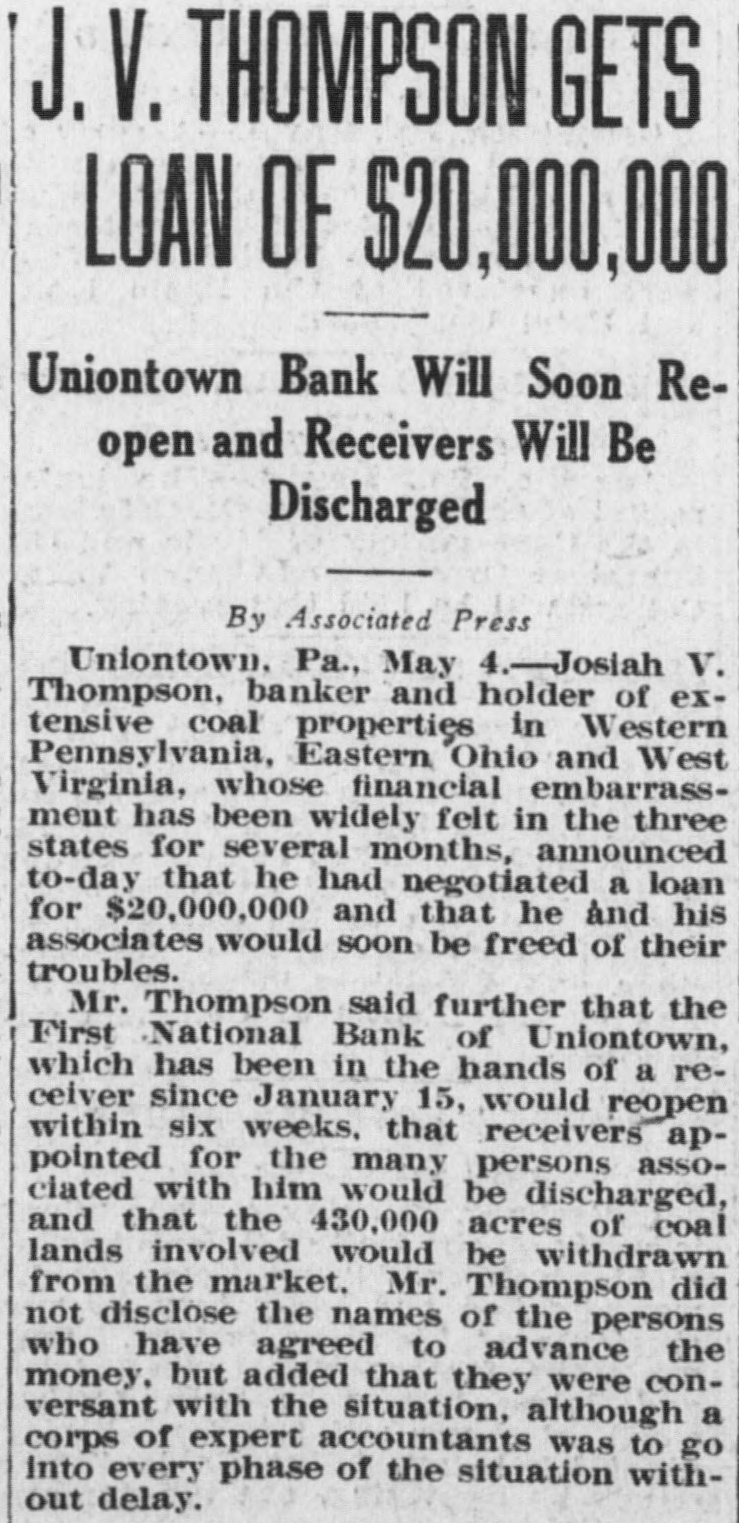
J.V. THOMPSON GETS LOAN OF $20,000,000 Uniontown Bank Will Soon Reopen and Receivers Will Be Discharged By Associated Press Uniontown. Pa., May 4.-Josiah V. Thompson, banker and holder of extensive coal properties in Western Pennsylvania, Eastern Ohio and West Virginia, whose financial embarrassment has been widely felt in the three states for several months, announced to-day that he had negotiated a loan for $20,000,000 and that he and his associates would soon be freed of their troubles. Mr. Thompson said further that the First National Bank of Uniontown, which has been in the hands of a receiver since January 15, would reopen within six weeks, that receivers appointed for the many persons assoclated with him would be discharged, and that the 430,000 acres of coal lands involved would be withdrawn from the market. Mr. Thompson did not disclose the names of the persons who have agreed to advance the money, but added that they were conversant with the situation, although a corps of expert accountants was to go Into every phase of the situation without delay.
Click image to open full size in new tab
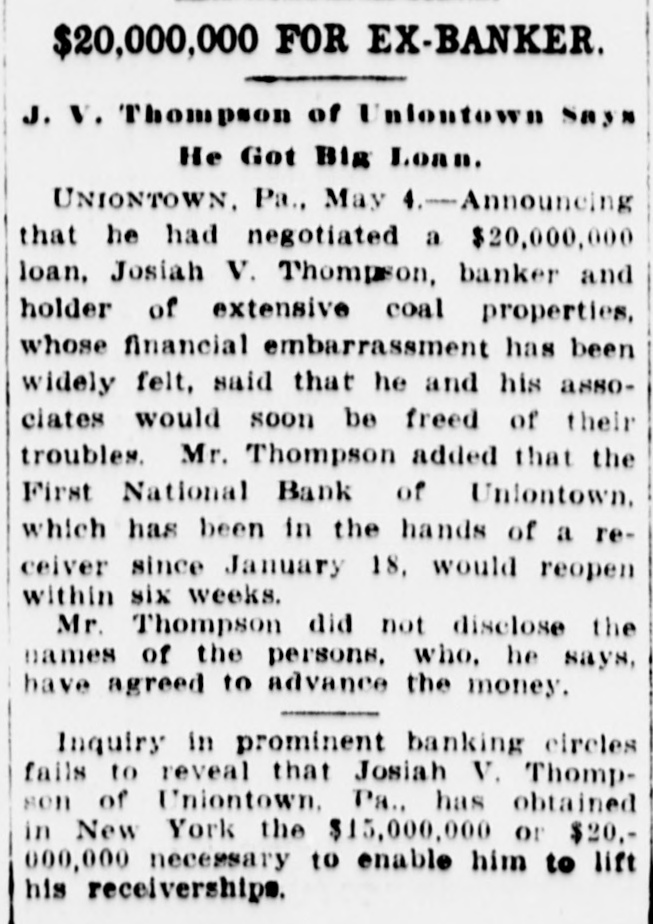
$20,000,000 FOR EX-BANKER. J. v. Thompson of Uniontown Says He Got Big Loan. UNIONTOWN. Pa., May 4.-Announcing that he had negotiated a $20,000,000 loan, Josiah V. Thompson, banker and holder of extensive coal properties, whose financial embarrassment has been widely felt, said that he and his assoclates would soon be freed of their troubles. Mr. Thompson added that the First National Bank of Uniontown. which has been in the hands of a receiver since January 18, would reopen within six weeks. Mr. Thompson did not disclose the names of the persons, who, he says, have agreed to advance the money. Inquiry in prominent banking circles fails to reveal that Josiah V. Thompson of Uniontown. Pa., has obtained in New York the $15,000,000 or $20.000,000 necessary to enable him to lift his receiverships.
Click image to open full size in new tab
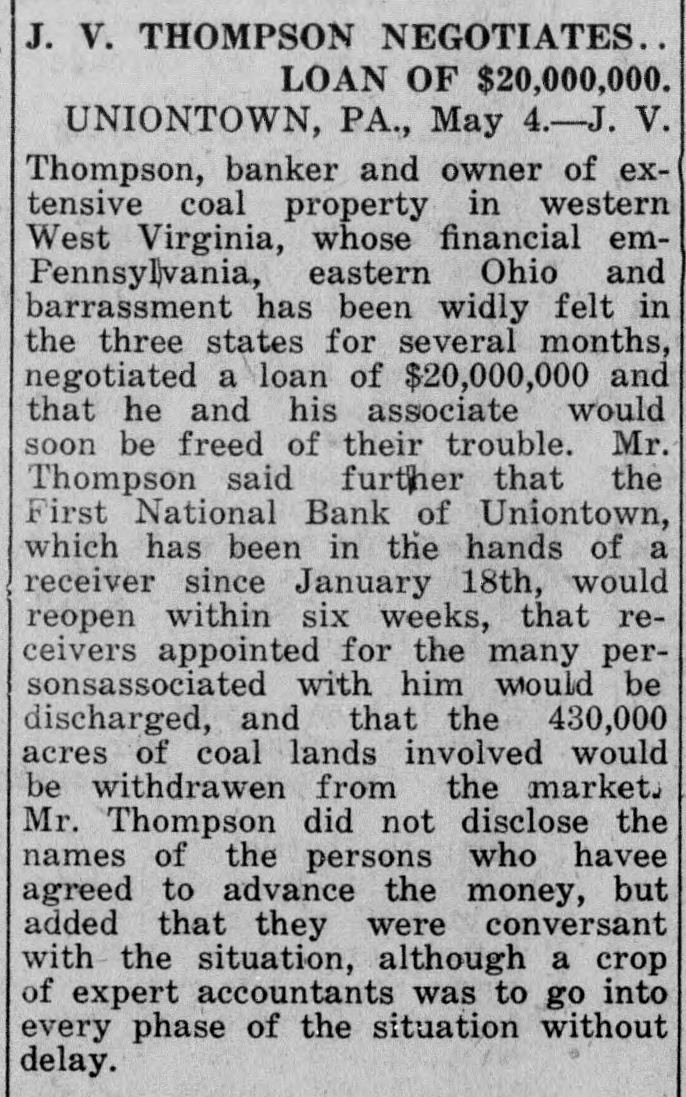
J. V. THOMPSON NEGOTIATES LOAN OF $20,000,000. UNIONTOWN, PA., May 4.-J. V. Thompson, banker and owner of extensive coal property in western West Virginia, whose financial emPennsylvania, eastern Ohio and barrassment has been widly felt in the three states for several months, negotiated a loan of $20,000,000 and that he and his associate would soon be freed of their trouble. Mr. Thompson said further that the First National Bank of Uniontown, which has been in the hands of a receiver since January 18th, would reopen within six weeks, that receivers appointed for the many personsassociated with him would be discharged, and that the 430,000 acres of coal lands involved would be withdrawen from the market. Mr. Thompson did not disclose the names of the persons who havee agreed to advance the money, but added that they were conversant with the situation, although a crop of expert accountants was to go into every phase of the situation without delay.
Click image to open full size in new tab
Uniontown, Pa., July 14-Josiah V. Thompson, whose affairs were placed in the hands of receivers when the First National bank of Uniontown was closed, owned coal lands valued at $65,367,785.
Click image to open full size in new tab
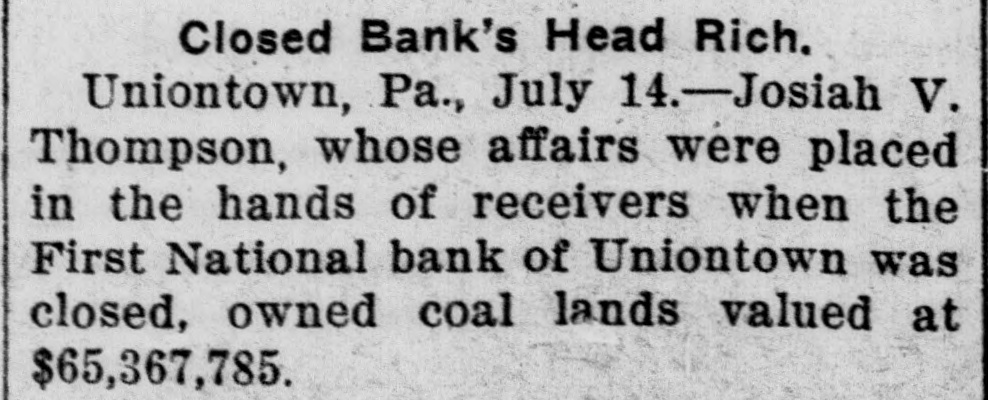
Uniontown, Pa., July 14.-Josiah V. Thompson, whose affairs were placed in the hands of receivers when the First National bank of Uniontown was closed, owned coal lands valued at $65,367,785.
Click image to open full size in new tab
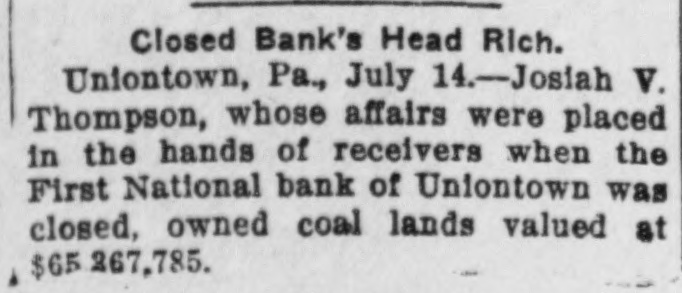
Uniontown, Pa., July 14.-Josiah V. Thompson, whose affairs were placed in the hands of receivers when the First National bank of Uniontown was closed, owned coal lands valued at $65,367,785.
Click image to open full size in new tab
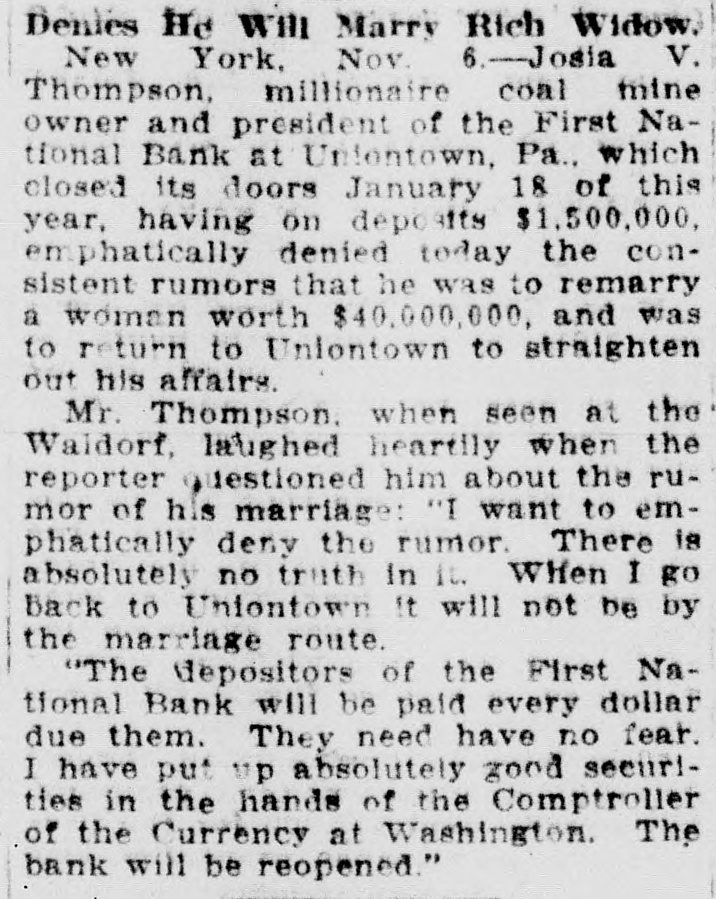
Uniontown, Pa., July 14.-Josiah V. Thompson, whose affairs were placed in the hands of receivers when the First National bank of Uniontown was closed, owned coal lands valued at $65 267,785.
Click image to open full size in new tab
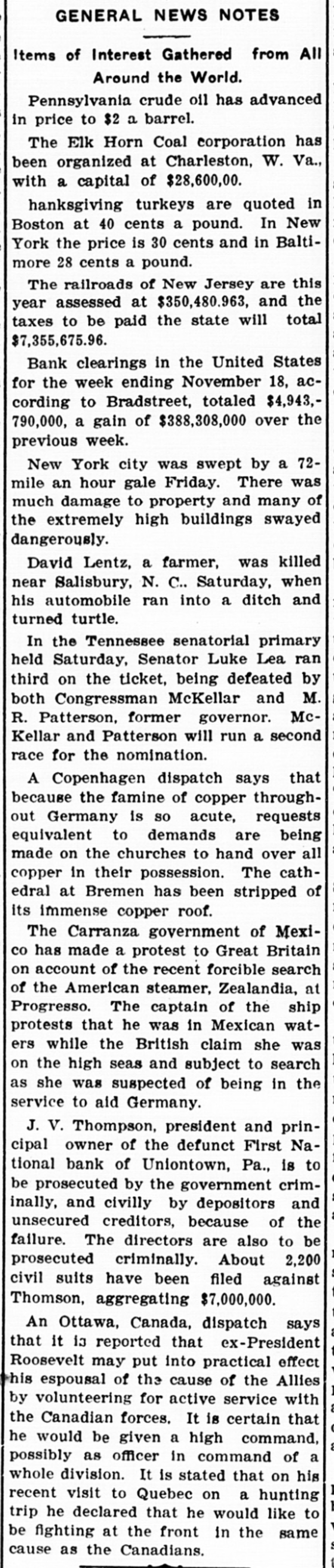
Denies He Will Marry Rich Widow. New York, Nov. 6.-Josia V. Thompson, millionaire coal mine owner and president of the First National Bank at Uniontown, Pa., which closed its doors January 18 of this year, having on deposits $1,500,000, emphatically denied today the consistent rumors that he was to remarry a woman worth $40,000,000, and was to return to Uniontown to straighten out his affairs. Mr. Thompson. when seen at the Waldorf, laughed heartily when the reporter questioned him about the rumor of his marriage: "I want to emphatically deny the rumor. There is absolutely no truth in IL. When I go back to Uniontown It will not be by the marriage route. "The depositors of the First National Bank will be paid every dollar due them. They need have no fear. I have put up absolutely good securities in the hands of the Comptroller of the Currency at Washington. The bank will be reopened."
Click image to open full size in new tab
Items of Interest Gathered from All Around the World. Pennsylvania crude oil has advanced in price to $2 a barrel. The Elk Horn Coal corporation has been organized at Charleston, W. Va., with a capital of $28,600,00. hanksgiving turkeys are quoted in Boston at 40 cents a pound. In New York the price is 30 cents and in Balti- more 28 cents a pound. The railroads of New Jersey are this year assessed at $350,480.963, and the taxes to be paid the state will total $7,355,675.96.
Bank clearings in the United States for the week ending November 18, ac- cording to Bradstreet, totaled $4,943,- 790,000, a gain of $388,308,000 over the previous week.
New York city was swept by a 72- mile an hour gale Friday. There was much damage to property and many of the extremely high buildings swayed dangerously.
David Lentz, a farmer, was killed near Salisbury, N. C.. Saturday, when his automobile ran into a ditch and turned turtle.
In the Tennessee senatorial primary held Saturday, Senator Luke Lea ran third on the ticket, being defeated by both Congressman McKellar and M. R. Patterson, former governor. Mc- Kellar and Patterson will run a second race for the nomination.
A Copenhagen dispatch says that because the famine of copper through- out Germany is so acute, requests equivalent to demands are being made on the churches to hand over all copper in their possession. The cath- edral at Bremen has been stripped of its immense copper roof.
The Carranza government of Mexi- co has made a protest to Great Britain on account of the recent forcible search of the American steamer, Zealandia, at Progresso. The captain of the ship protests that he was in Mexican wat- ers while the British claim she was on the high seas and subject to search as she was suspected of being in the service to aid Germany.
J. V. Thompson, president and prin- cipal owner of the defunct First Na- tional bank of Uniontown, Pa., is to be prosecuted by the government crim- inally, and civilly by depositors and unsecured creditors, because of the failure. The directors are also to be prosecuted criminally. About 2,200 civil suits have been filed against Thomson, aggregating $7,000,000.
An Ottawa, Canada, dispatch says that it is reported that ex-President Roosevelt may put into practical effect this espousal of the cause of the Allies by volunteering for active service with the Canadian forces. It is certain that he would be given a high command, possibly as officer in command of a whole division. It is stated that on his recent visit to Quebec on a hunting trip he declared that he would like to be fighting at the front in the same cause as the Canadians.
Click image to open full size in new tab
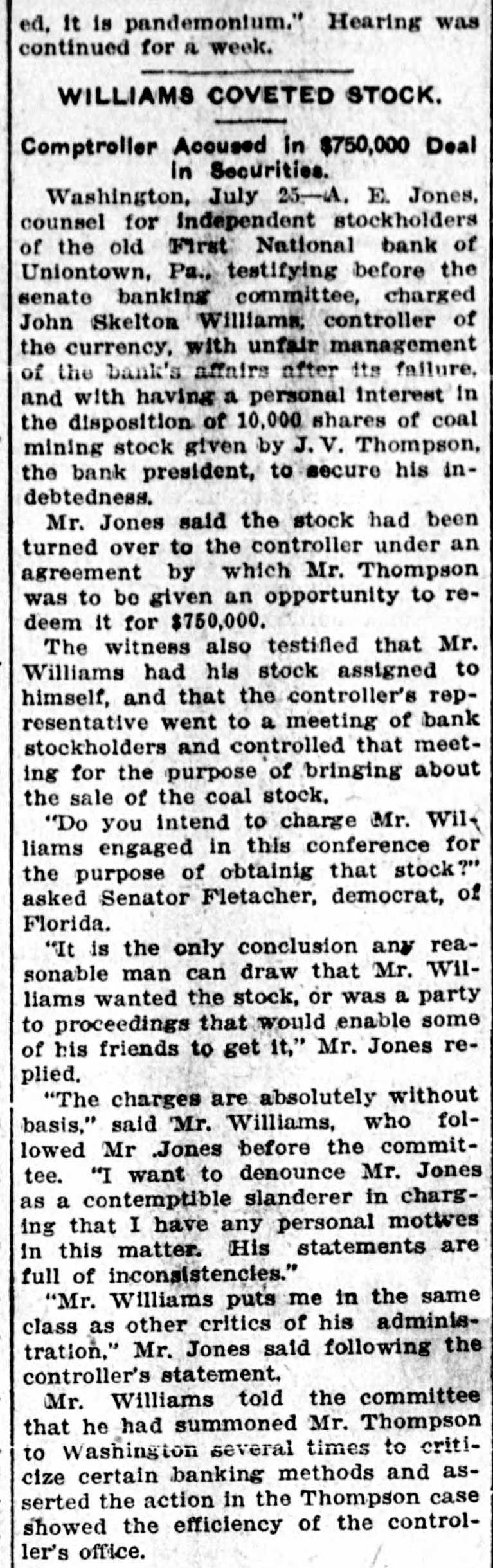
ed, It is pandemontum." Hearing was continued for a week. WILLIAMS COVETED STOCK. Comptroller Accused in $750,000 Deal in Securities. Washington, July 25- A. E. Jones. counsel for Independent stockholders of the old First National bank of Uniontown, Pa., testifying before the senate banking committee, charged John Skelton Williams, controller of the currency, with unfair management of the bank's affairs after its failure, and with having a personal interest in the disposition of 10,000 shares of coal mining stock given by J.V. Thompson, the bank president, to secure his indebtedness. Mr. Jones said the stock had been turned over to the controller under an agreement by which Mr. Thompson was to be given an opportunity to redeem it for $750,000. The witness also testifled that Mr. Williams had his stock assigned to himself, and that the controller's representative went to a meeting of bank stockholders and controlled that meeting for the purpose of bringing about the sale of the coal stock. "Do you intend to charge Mr. Williams engaged in this conference for the purpose of obtainig that stock?" asked Senator Fletacher, democrat, of Florida. "It is the only conclusion any reasonable man can draw that Mr. Williams wanted the stock, or was a party to proceedings that would enable some of his friends to get it," Mr. Jones replied. "The charges are absolutely without basis," said Mr. Williams, who followed Mr .Jones before the committee. "I want to denounce Mr. Jones as a contemptible slanderer in charging that I have any personal motters in this matter. His statements are full of inconsistencies." "Mr. Williams puts me in the same class as other critics of his administration," Mr. Jones said following the controller's statement. Mr. Williams told the committee that he had summoned Mr. Thompson to Washington several times to criticize certain banking methods and asserted the action in the Thompson case showed the efficiency of the controller's office.
Click image to open full size in new tab
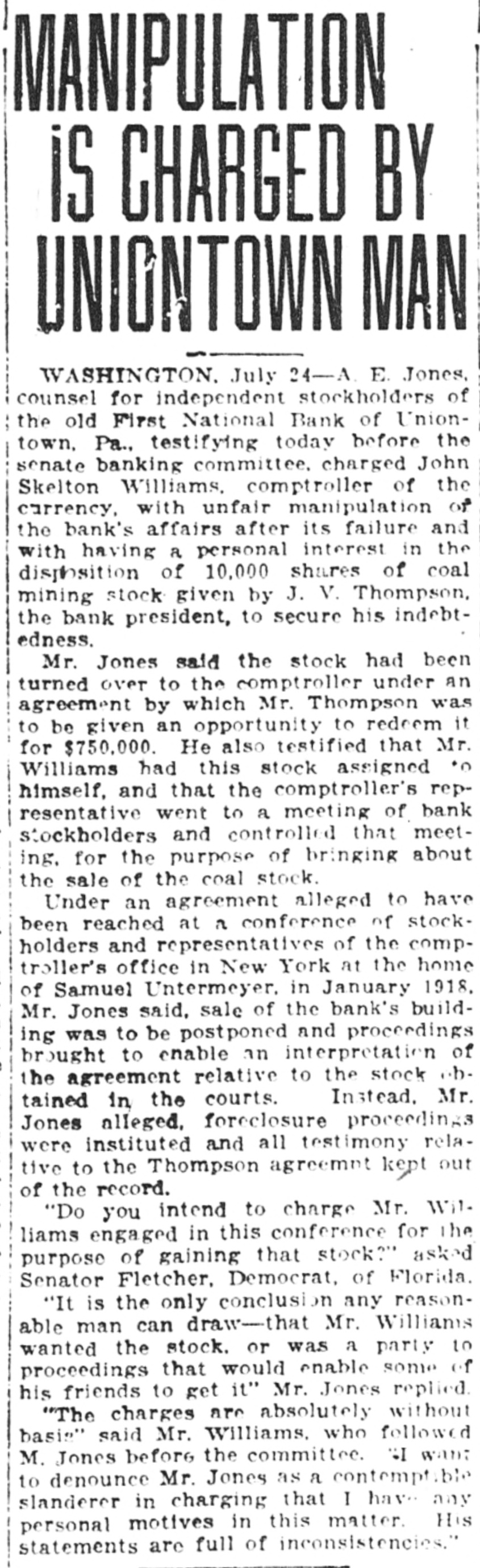
MANIPULATION is CHARGED BY UNIONTOWN MAN WASHINGTON July 24-A E. Jones, counsel for independent stockholders of the old First National Bank of Uniontown, Pa., testifying today before the senate banking committee. charged John Skelton Williams, comptroller of the currency with unfair manipulation of the bank's affairs after its failure and with having a personal interest in the disposition of 10,000 shares of coal mining stock given by J. V. Thompson, the bank president, to secure his indebtedness. Mr. Jones said the stock had been turned over to the comptroller under an agreement by which Mr. Thompson was to be given an opportunity to redeem it for $750,000. He also testified that Mr. Williams had this stock assigned in himself, and that the comptroller's representative went to a meeting of bank stockholders and controlled that meeting. for the purpose of bringing about the sale of the coal stock. Under an agreement alleged to have been reached at a conference of stock. holders and representatives of the comptroller's office in New York at the home of Samuel Untermeyer in January 1918. Mr. Jones said, sale of the bank's building was to be postponed and proceedings brought to enable an interpretation of the agreement relative to the stock ib. tained in the courts. Instead. Mr. Jones alleged, foreclosure proceedings were instituted and all testimony relative to the Thompson agreement kept out of the record. "Do you intend to charge Mr. Wil. liams engaged in this conference for the purpose of gaining that stock?" asked Senator Fletcher, Democrat, of Florida. "It is the only conclusion any reasonable man can draw-that Mr. Williams wanted the stock. or was a party to proceedings that would enable some of his friends to get it" Mr. Jones replied "The charges are absolutely without basis" said Mr. Williams, who followed M. Jones before the committee. 'I want to denounce Mr. Jones as a contemptible slanderer in charging that I have any personal motives in this matter His statements are full of inconsistencies."

Click image to open full size in new tab
President Jones of Failed Uniontown Bank Accuses Comptroller.
WASHINGTON, July 24.-A. E. Jones, counsel for independent stockholders of the old First National Bank of Uniontown, Pa., testifying to-day before the Senate Banking Committee, charged John Skelton Williams, Comptroller of the Currency, with unfair management of the bank's affairs after its failure and with having a personal interest in the disposition of 10,000 shares of coal mining stock given by J. V. Thompson, the bank president, to secure his indebtedness.
Mr. Jones said the stock had been turned over to the Comptroller under an agreement by which an opportunity was to be given Mr. Thompson to redeem it for $750,000. He also testified that Mr. Williams had this stock assigned to himself, and that the Comptroller's representative went to a meeting of bank stockholders and controlled that meeting for the purpose of bringing about the sale of the coal stock.
Under an agreement alleged to have been reached at a conference of stockholders and representatives of the Comptroller's office in New York at the home of Samuel Untermyer in January, 1918, Mr. Jones said, sale of the bank's building was to be postponed and proceedings brought to enable an interpretation of the agreement relative to the stock obtained in the courts. Instead, Mr. Jones alleged, foreclosure proceedings were instituted and all testimony relative to the Thompson agreement kept out of the record.
"Do you intend to charge Mr. Williams engaged in this conference for the purpose of obtaining that stock?" asked Senator Fletcher, Democrat, of Florida. "It is the only conclusion any reasonable man can draw that Mr. Williams wanted the stock, or was a party to proceedings that would enable some of his friends to get it," Mr. Jones replied.
"The charges are absolutely without basis," said Mr. Williams, who followed Mr. Jones before the committee. "I want to denounce Mr. Jones as a contemptible slandered in charging that I have any personal motives in this matter. His statements are full of inconsistencies."
"Mr. Williams puts me in the same class as other critics of his administration," Mr. Jones said, after the Comptroller's statement.
Continuing his testimony Mr. Jones said national banks had been instructed to turn in Thompson paper, which was presented to the bank in a "flood." He also asserted that the Comptroller instructed E. S. Hackney, an official of the bank, to withdraw $250,000 deposited to assist it.
This statement was contradicted later by Mr. Williams, who said the sum had been loaned to the bank at 6 per cent. interest and was a liability instead of a deposit, although the bank carried it as a deposit.
While withholding a general reply to charges made by Mr. Jones until another time, Mr. Williams told the committee that he had summoned Mr. Thompson to Washington a number of times to criticise certain methods of his bank, and asserted that his action in the Thompson bank case only showed the efficiency of the Comptroller's office.
Mr. Williams renewed his denial of testimony given to the committee by John Poole and Frank J. Hogan, who alleged the Comptroller had discriminated against the Federal National Bank of Washington, with which they are associated.
The Comptroller also presented letters addressed to Chairman McLean by R. W. Bolling of the Emergency Fleet Corporation, and President Kaufman of the Chatham Phoenix Bank of New York denying statements that deposits by a bank with the Chatham Phoenix Bank would bring about deposits from the Fleet Corporation. These letters branded the testimony as untrue.