Petroleum Bank (Titusville, PA)

Episode Information

Episode Type
Run → Suspension → Unsure
Start Date
March 29, 1866
Location
Titusville, Pennsylvania (41.627, -79.674)
Bank Type
private

Metadata

Notes

Bank displayed a 'National' sign but several articles state it was not a national bank; receivership was requested but not clearly confirmed in these items.

Events (3)

1. March 29, 1866 Run
Cause
Correspondent
Cause Details
Withdrawals and crowding triggered by the suspension/failure of correspondent/banking house Culver, Penn & Co.
Measures
Doors remained closed; notices posted (customers unable to cash checks)
Newspaper Excerpt
a numerous crowd ... mainly in front of the First National and Petroleum Banks, anxiously debating the situation
Source
newspapers
2. March 30, 1866 Suspension
Cause
Correspondent
Cause Details
Closed immediately after suspension of Culver, Penn & Co.; its notes were discredited and refused redemption at Pittsburgh agency
Newspaper Excerpt
the Petroleum Bank of Titusville, which was closed immediately on the suspension of Culver, Penn & Co.
Source
newspapers
3. May 8, 1866 Other
Newspaper Excerpt
An affidavit has been made ... asking for the appointment of a Receiver for the Petroleum Bank of Titusville.
Source
newspapers

Newspaper Articles (14)

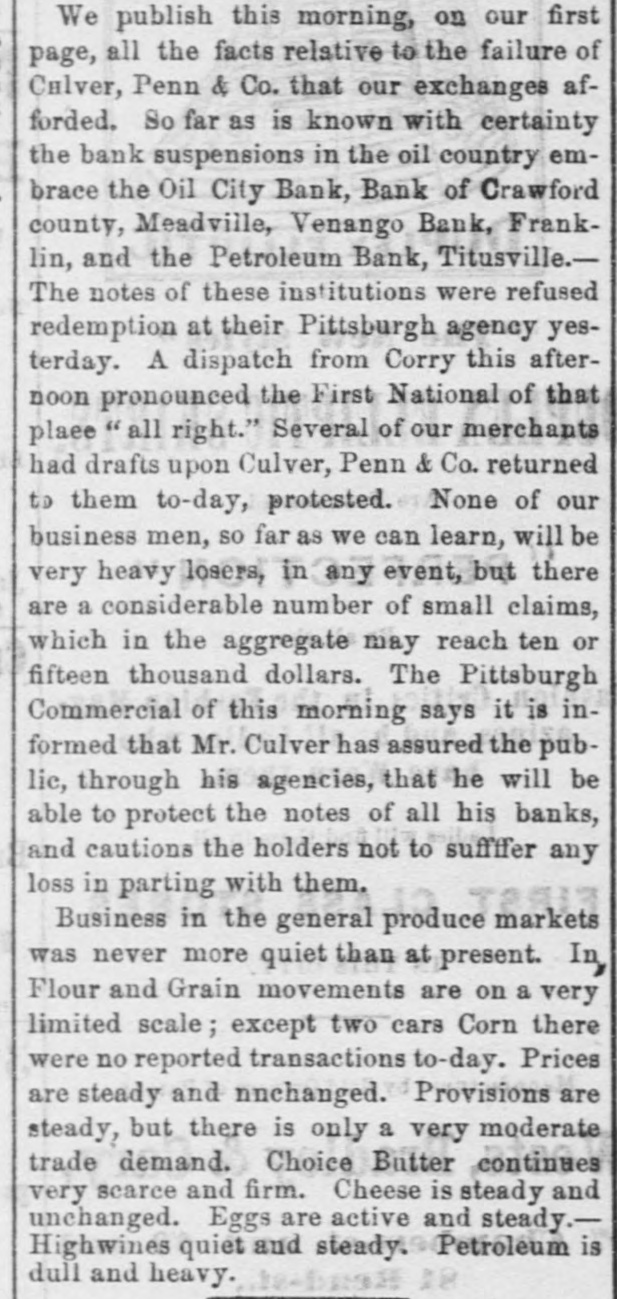
Article from Cleveland Daily Leader, March 30, 1866

Click image to open full size in new tab

Article Text

We publish this morning, on our first page, all the facts relative to the failure of Calver, Penn & Co. that our exchanges afforded. So far as is known with certainty the bank suspensions in the oil country embrace the Oil City Bank, Bank of Crawford county, Meadville, Venango Bank, Franklin, and the Petroleum Bank, Titusville.The notes of these institutions were refused redemption at their Pittsburgh agency yesterday. A dispatch from Corry this afternoon pronounced the First National of that place "all right." Several of our merchants had drafts upon Culver, Penn & Co. returned to them to-day, protested. None of our business men, so far as we can learn, will be very heavy losers, in any event, but there are a considerable number of small claims, which in the aggregate may reach ten or fifteen thousand dollars. The Pittsburgh Commercial of this morning says it is informed that Mr. Culver has assured the public, through his agencies, that he will be able to protect the notes of all his banks, and cautions the holders not to suffffer any loss in parting with them. Business in the general produce markets was never more quiet than at present. In Flour and Grain movements are on a very limited scale; except two cars Corn there were no reported transactions to-day. Prices are steady and nnchanged. Provisions are steady, but there is only a very moderate trade demand. Choice Butter continues very scarce and firm. Cheese is steady and unchanged. Eggs are active and steady.Highwines quiet and steady. Petroleum is dull and heavy.


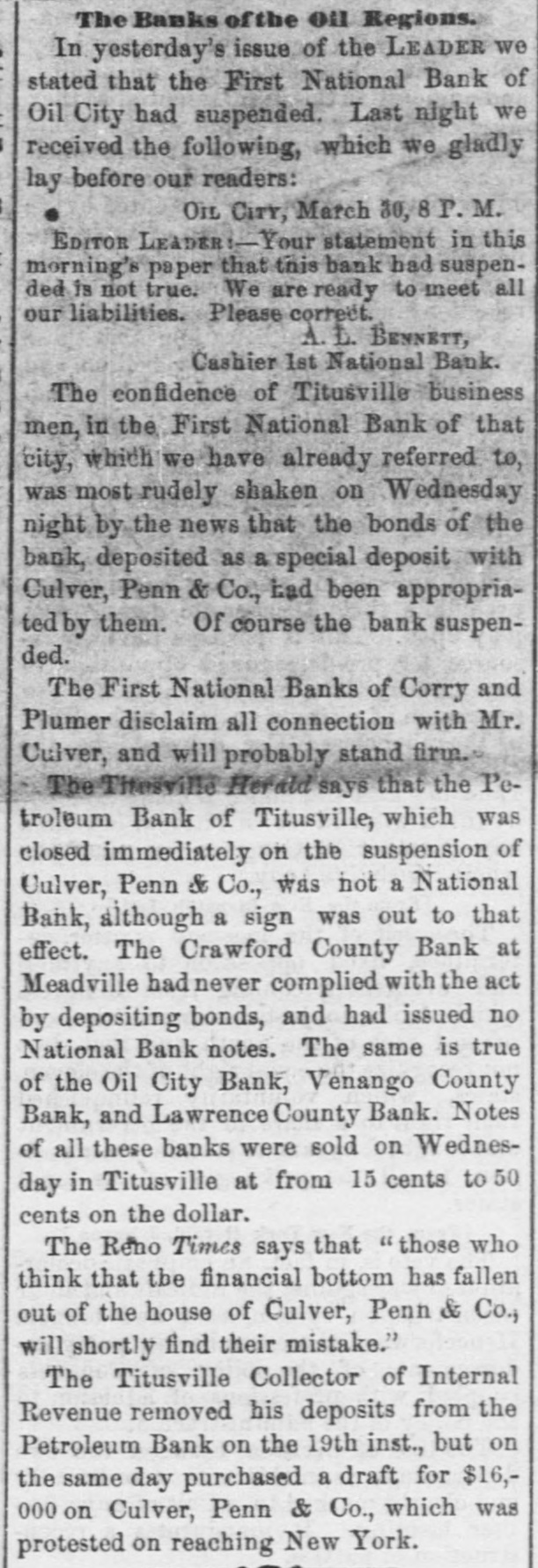
Article from Cleveland Daily Leader, March 31, 1866

Click image to open full size in new tab

Article Text

The Banks of the Oil Regions. In yesterday's issue of the LEADER we stated that the First National Bank of Oil City had suspended. Last night we received the following, which we gladly lay before our readers: OIL City, March 30, P. M. EDITOR LEADER:-Your statement in this morning's paper that this bank had suspended is not true. We are ready to meet all our liabilities. Please correct. A. L. BENNETT, Cashier 1st National Bank. The confidence of Titusville business men, in the First National Bank of that city, which we have already referred to, was most rudely shaken on Wednesday night by the news that the bonds of the bank, deposited as a special deposit with Culver, Penn & Co., had been appropriated by them. Of course the bank suspended. The First National Banks of Corry and Plumer disclaim all connection with Mr. Culver, and will probably stand firm. The Titesville Herald says that the Petroleum Bank of Titusville, which was closed immediately on the suspension of Uulver, Penn & Co., was not a National Bank, although a sign was out to that effect. The Crawford County Bank at Meadville had never complied with the act by depositing bonds, and had issued no National Bank notes. The same is true of the Oil City Bank, Venango County Bank, and Lawrence County Bank. Notes of all these banks were sold on Wednesday in Titusville at from 15 cents to 50 cents on the dollar. The Reno Times says that "those who think that the financial bottom has fallen out of the house of Culver, Penn & Co., will shortly find their mistake." The Titusville Collector of Internal Revenue removed his deposits from the Petroleum Bank on the 19th inst., but on the same day purchased a draft for $16,000 on Culver, Penn & Co., which was protested on reaching New York.


Article from The New York Times, April 1, 1866

Click image to open full size in new tab

Article Text

Public Feeling in Titusville—Scenes at the Banks, &c. From the Titusville Herald, March 29. The absorbing topic of discussion in all circles yesterday was the Culver, Penn & Co. failure, announced in the Morning Herald. Before 8 o'clock a numerous crowd of citizens had assembled at the corners of Spring and Franklin streets, and mainly in front of the First National and Petroleum Banks, anxiously debating the situation, and indulging in all sorts of conjectures respecting the stability of these institutions. Before banking hour arrived the crowd had largely augmented, but the doors of the Petroleum Bank remained closed, and the depositors who had indulged in the hope of getting their checks cashed at its counter were sadly disaffected by the result. The only consolation afforded them was contained in the following announcements, placed against the window from the interior:


Article from The New York Herald, April 2, 1866

Click image to open full size in new tab

Article Text

Bankers' bills on England, at sixty days, 106% a 106%; three days, 107% a 107%; commercial, 105% a 106%; bills on Paris at long date, 5f. 30c.; short sight, 5f. 25c.; on Hamburg, 35% a 35%; on Amsterdam, 40 a 40%; on Bremen, 77 a 77%; on Berlin, 70% a 70%; on Frank- fort, 40% a 40%. The large receipts of cotton at the ports-those for the week being reported at about 45,000 bales-have had a tendency to weaken rates in combination with the firm- ness of the Liverpool market, which is stimulating ex- ports. More sanguine expectations are at the same time gaining ground as to the extent of the next crop. The receipts in this city for the week ending on Friday evening are returned at 12,892 bales, and the exports from the port for the week ending the 27th ult. at 16,609 bales. There is a firmer and more hopeful feeling felt in the dry goods trade, alike with the general merchandise markets, although no material recovery in prices has taken place. This is mainly attributable to the turn of the gold market. The money market has been extremely easy at five per cent, with exceptions at six, for call loans, and the indications favor prolonged ease. The recent numerous bank failures in the oil regions, resulting from the suspension of Culver, Penn & Co., in this city, serve to indicate the existence of a class of irresponsible banks throughout the country, suggestive of the "wild cat" establishments of former years, against which "Long John Wentworth" waged war so success- fully in Illinois. It is not generally understood that the national currency act afforded peculiar facilities for the establishment of banks in different parts of the country in the interest of capitalists at this or some subordinate financial centre, and that the notes issued by obscure country banks are less likely to be returned to them for redemption than those of banks occupying central posi- tions. Once put in circulation they are kept moving from hand to hand and State to State without find- ing a resting place, the bonds pledged as security for their redemption at Washington inspiring confidence enough in their value to keep them at par, without their actually being a legal tender unless in the payment of taxes to the government or in payment of debts due from one national bank to another. This gives such banks the full use of the currency to which they are entitled by law, the maximum of which is ninety per cent of the par value of the bonds deposited by them with the Treasury, while at the same time they draw interest upon the latter at the full rate of interest in coin paid to ordinary fund holders. As a mere specula- tion banking under such circumstances held out strong temptations to capital. But when we add to these facilities the prestige of nationality associated with these banks, and the confidence thereby inspired in the minds of depositors, the inducements to establish national banks it will be seen were very strong. A popular idea has gone abroad that some how or other the liabilities of national banks are guaranteed, whereas it is only the circulation that is so, to the extent of the bonds deposited against it. The deposits of the banks in the petroleum region that have just closed their doors are as entirely unsecured under the National Banking law as if they had been in the hands of private individ- uals, and hence the credit of a national bank, as much as that of a private firm, depends upon the character of its individual proprietors and managers. In the case of one of the suspended banks-that of the Petroleum Bank of Titusville, Pa.-direct misrepre- sentation appears to have been resorted to to convey the idea that it was a national bank, whereas it was not. The Herald of that town says that it had never obtained a permit, notwithstanding the fact that the sign "Petro- leum National Bank" was conspicuously posted upon one side of the building. That the solvency of some thirteen country banks should have been dependent upon that of a single private banking firm in New York argues a very unsound condition of the affairs of a con- siderable number of other local banks. If the business of these suspended institutions had been properly con- ducted, Culver, Penn & Co.'s failure could hardly have seriously affected them; and the fact that it did so goes to show that they were more deeply involved in the for- tunes of that house than in justice to their depositors they should have been. Great dissatisfaction prevails among the stockholders of national banks with the decision of the Supreme Court declaring the shares of such institutions liable to taxation under State authority, and various opinions are expressed as to the soundness of the opinion and the working of the law as thus interpreted. Section one of the act of June 30, 1864, says:-"All bonds, Treasury notes and other obligations of the United States shall be exempt from taxation by or under State or municipal authority." So far as the direct taxation of government securities by the States is concerned the law is, there- fore, clear. But that national bank stocks were not in- tended by Congress to be similarly exempted is evident from the following provision in the National Currency act:- Provided, that nothing in this act shall be construed to prevent all the shares in any of the said associations, held by any person or body corporate, from being in- cluded in the valuation of the personal property of such person or corporation in the assessment of taxes imposed by or under State authority at the place where such bank is located, and not elsewhere, but not at a greater rate than is assessed upon other moneyed capital in the hands of individual citizens of such State. Provided further, that the tax so imposed under the laws of any State upon the shares of any of the associations author- ized by this act shall not exceed the rate imposed upon the shares in any of the banks organized under authority of the State where such association is located. In another section of the same act it is also provided that- The president and cashier of every such association shall cause to be kept at all times a full and correct list of the names and residences of all the shareholders in the association, and the number of shares held by each, in the office where its business is transacted; and such list shall be subject to the inspection of all the share- holders and creditors of the association, and the officers authorized to assess taxes under State authority, during business hours of each day in which business may be legally transacted. The Court, in its opinion, very properly held that these two provisions, the one providing that nothing in the act shall be construed to prevent the shares from being included in the valuation of personal property in the assessment of taxes imposed by State authority; and the other providing for the keeping of a list of the names and residences of the shareholders, among other things, for the inspection of the State officers, not only recognizes in express terms the sovereign right of a State to tax, but prescribes regulations and duties to the associations, with a view to disembarrass the officers of the State engaged in the exercise of the right. Nothing, it would seem, could be made plainer or more direct and comprehensive on the subject. The language of the several provisions is so explicit and positive as scarcely to call for Judicial construction. The great powers and privileges enjoyed by the banks organized under the act were referred to by the Court in


Article from The Elk Advocate, April 5, 1866

Click image to open full size in new tab

Article Text

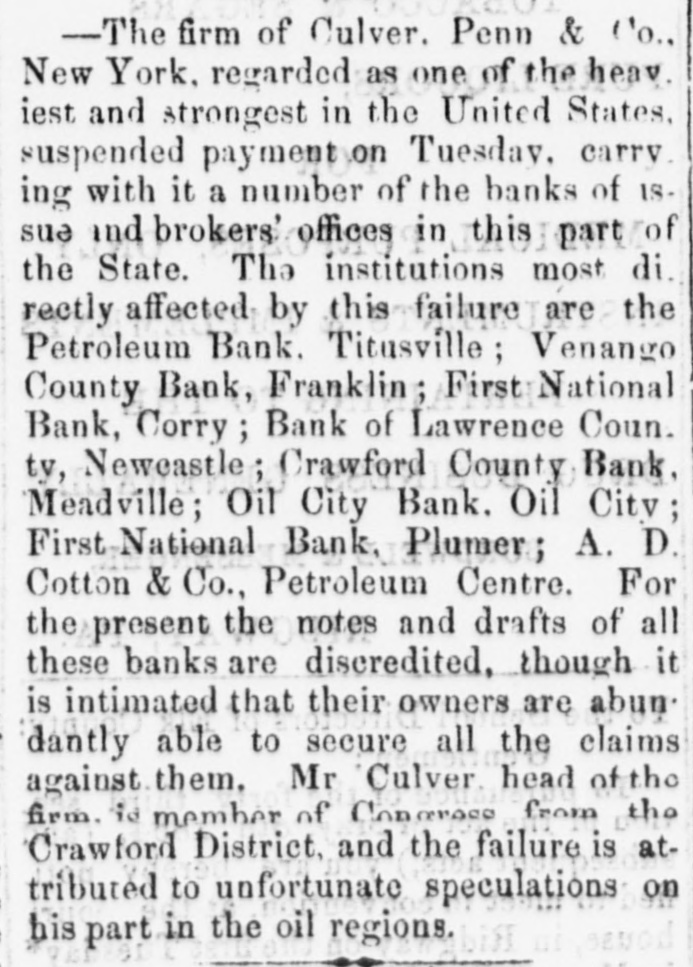
-The firm of Culver. Penn & Co., New York, regarded as one of the heav iest and strongest in the United States. suspended payment on Tuesday. carry ing with it a number of the banks of IS sue and brokers' offices in this part of the State. The institutions most di rectly affected by this failure are the Petroleum Bank. Titusville Venango County Bank, Franklin; First National Bank, Corry; Bank of Lawrence Coun. ty, Neweastle ; Crawford County Bank Meadville; Oil City Bank. Oil City ; First National Bank, Plumer; A. D Cotton & Co., Petroleum Centre. For the present the notes and drafts of all these banks are discredited, though it is intimated that their owners are abundantly able to secure all the claims against them. Mr Culver head of the firm. id member of Congress from the Crawford District, and the failure is attributed to unfortunate speculations on his part in the oil regions.


Article from The Daily Gate City, April 5, 1866

Click image to open full size in new tab

Article Text

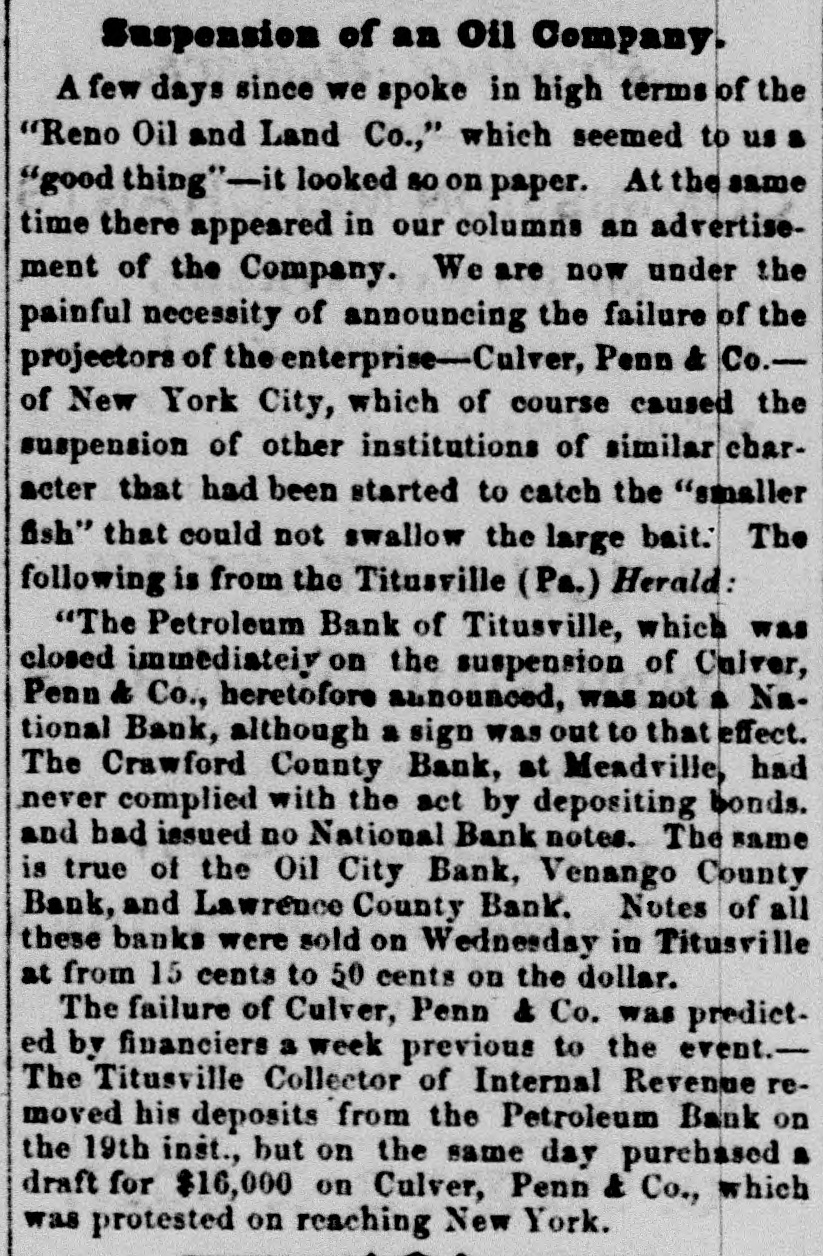
# Suspension of an Oil Company. A few days since we spoke in high terms of the "Reno Oil and Land Co.," which seemed to us a "good thing"—it looked so on paper. At the same time there appeared in our columns an advertisement of the Company. We are now under the painful necessity of announcing the failure of the projectors of the enterprise—Culver, Penn & Co.—of New York City, which of course caused the suspension of other institutions of similar character that had been started to catch the "smaller fish" that could not swallow the large bait. The following is from the Titusville (Pa.) Herald: "The Petroleum Bank of Titusville, which was closed immediately on the suspension of Culver, Penn & Co., heretofore announced, was not a National Bank, although a sign was out to that effect. The Crawford County Bank, at Meadville, had never complied with the act by depositing bonds, and had issued no National Bank notes. The same is true of the Oil City Bank, Venango County Bank, and Lawrence County Bank. Notes of all these banks were sold on Wednesday in Titusville at from 15 cents to 50 cents on the dollar. The failure of Culver, Penn & Co. was predicted by financiers a week previous to the event.—The Titusville Collector of Internal Revenue removed his deposits from the Petroleum Bank on the 19th inst., but on the same day purchased a draft for $16,000 on Culver, Penn & Co., which was protested on reaching New York.


Article from New-York Daily Tribune, April 5, 1866

Click image to open full size in new tab

Article Text

prices bet the two dates March 22. April 4. 8: 561 081 ets. ad. $5.69 Lump 11 66 577 Store 15 5 45 5 60 Steamer 60 5 45 6 15 Egg Dec. 72) 6 69 5 971 Stove 09 5 31 5 40 Chestnut Average advance (except on stove) 23icents per tun. The business of the Sub-Treasury was: Receipts, $1,236,368 89-for Customs, $394,000; Pay yments, Bal$1,926,870 93-on account of Loan, $97,000; ance, $81,119,891 12. Gold notes, $909,000. Freights to Liverpool, 500 bales Cotton, at 5-16d. 15,000 bush. Corn at 31 @4d. An Italian bark from Portland, Me., to London with 30,000 bush Oats, at 6d. 32 lb. The National Intelligencer makes the following comments upon the financial situation: There are everywhere seen mysterious and alarming of a coming financial storm. The excess an irredeemable portents paper currency has done its work by exaggeration of prices. by an accumulation of merchandise. and by promoting enormous plenand hazardous engagements. Paper money is as that tiful forest leaves. For once, Wall-st. admits for as is easy. because there is little employment it. at Gold money has fallen, and will not soon regainits place Dry and products of all kinds are Ling. thirty, in ported and domestic, first began to tumble, The goods, and their holders after them, in many instances. No decline is gradually reaching other products ever came so suddenly and devast tingly rinderpest 88 this revulsion will fall upon speculator deupon cattle There is now a cessation of mand and manufacturers. for goods, and importers and manufacturers loss. are glad to reduce their stocks. at a very considerable persist in The largest of the domestic cotton factories idle, running. though at a great loss. rather than be and hazard a disorganization of their establishments. reaction The general causes are as plain as any other to undue excitement. The special causes are John after an too, in the impression which President be found. restoration policy has made in Europe. The most of son's of our opponents and the most desponding Presijealous friends abroad are equally well convinced, by and our Johnson's Messages, that for this Government dent nation there is a future of power and prosperity this unlooked for, and surpassing all the followed most 88 guine bitherto predictions. Political confidence which is had at one by securities, financial credit; down to and 40, have our risen to 70 in England, and 74 time run Holland. Perhaps $300,000,000 of our 5-20s and the already held abroad. Then, again, since 10-40s of are the war the South has developed an increased close of cotton-about 2,000,000 bales- may as quantity valued at $375,000,000. This quantity brought have much money as be a crop of 6,000,000 bales would brought The exportation before the war. of Government bonds and of in cotton the necessity of exporting gold pay enormous and still has thus been turned in our circumstances. would under ment have Exchange for superseded ordinary our increasing facilitate circumstances favor, importe. a which, return payments. Beside all these commodities, to which specie have favored decline in gold and The receipts from California have been large. effect ex- in contraction has had the stagnation of trade. We have larger followed causing the pected currency overaction. present sold, stocks great even Reaction of at goods very has in warehouses than can be fullpiled up The South came into market handed reduced last prices. Fail, and so did the West, but they means. are supplied to the present extent of their wantsand Petroleum is more disposition to sell than to buy. Petroleum There have led to the failure of some National specuations banks in Pennsylvania. This is another failure sign of financial revulsion. An accident like the revulof Ohio Trust Company in 1857 may bring out a the that did. Fortunately whatever may happen sion National as banks, the note-holders are secure-they to can go to the Government for payment in greenbacks. From The Bank Note Reporter. Bank, at Oil City. This bank is A State not in Oil City with a circulation of some $260.0 secured stitution, by any bonds. We believe the circulating notes of this bank have only a nominal value. Bank of Crawford County. at Meadville. This is bank with about $350,000 circulation, not secured. a State It had filed the preliminar y papers to reorganize in Wash as National Bank-had deposited some National bonds Currency. has never received any Co." is ington-but impression is that the Bank of Crawford Our bad A failure as the Oil City Bank.' not as Bank, at Franklin. This is a free State Venango converted into a National. The old circulation deBank $130,000, secured by 7.30 Treasury Notes is about at Harrisburgh, and $50,000 National Currency, that posited deposits In Washington. We believe secured old circulation by will be taken up at its face, after the delay, probably at Pittsburgh. For the present Cursome quote it at 10 discount. The $50,000 National will suffer no discredit. rency Petroleum Bank, at Titusville. This is a free State circulation some $200,000, secured by 7.30 Treas- we Bank, Notes deposited at Harrisburgh. Its notes, ury will be taken up at their face. at Pittsburgh, This believe. some delay. We quote them at 10 discount. National after Bank had filed its papers to reorganize as & Bank. Penn & Co: owned but a small Titusville, portion of but the Culver, of the First National Bank at the unstock New-York account was with that house. In its certainty of the moment it suspended. It losses has since are not sumed business on a solid basis. The of sufficient to impair its solvency. Its managers are and solid class of local citizens Its drafts on Culver. sound Penn & Co. are cashed by the First National Bank of this city. These are all the banks that are directly hurt by the failure of Culver, Penn & Co. Other banks have been placed in the broken lists published in the newspapers. Cashier of the Bank of Lawrence County writes that The his bank had DO business with P. & Co., and the no loss whatever will be sustained in consequence of failure, List Repeated. 75 et. dis. Oil City Bank, Oil City, Pa Bank of Crawford County, Pa Venango Bank, Franklin Pa. Petroleum Bank, Titusville, Pa. PAR. All National Currency. broken or not, The Cincinnati Commercial of Monday says: Exchange is scarce enough to keep bankers close up to the point of shipping legal tenders. The demand 18 steadily large, and but little is making through movements of produce. Ten per cent is stated as the ruling a rate of interest that money is worth on first-class customers paper. k d The Chicago Tribune says: The money market is closer to-day, in consequence of a disinclination on the part of bankers to extend their discount lines on the at day of the quarter, and just s before making their quarterly statements: but there was no particular pressure felt in monetary circles, as $, the demand was comparatively light Die ounts are S steady at 10 per cent per month on it street. Eastern still y is exchange is still scarce, but the de d to-d at in ar buy. light, and the market ruled quiet a. 1 ing. and 1-10-premium selling. Th bankers enerally e bought as little outside exchange as possible. THE CROTON NATIONAL BANK of the City of New York


Article from New Orleans Daily Crescent, April 9, 1866

Click image to open full size in new tab

Article Text

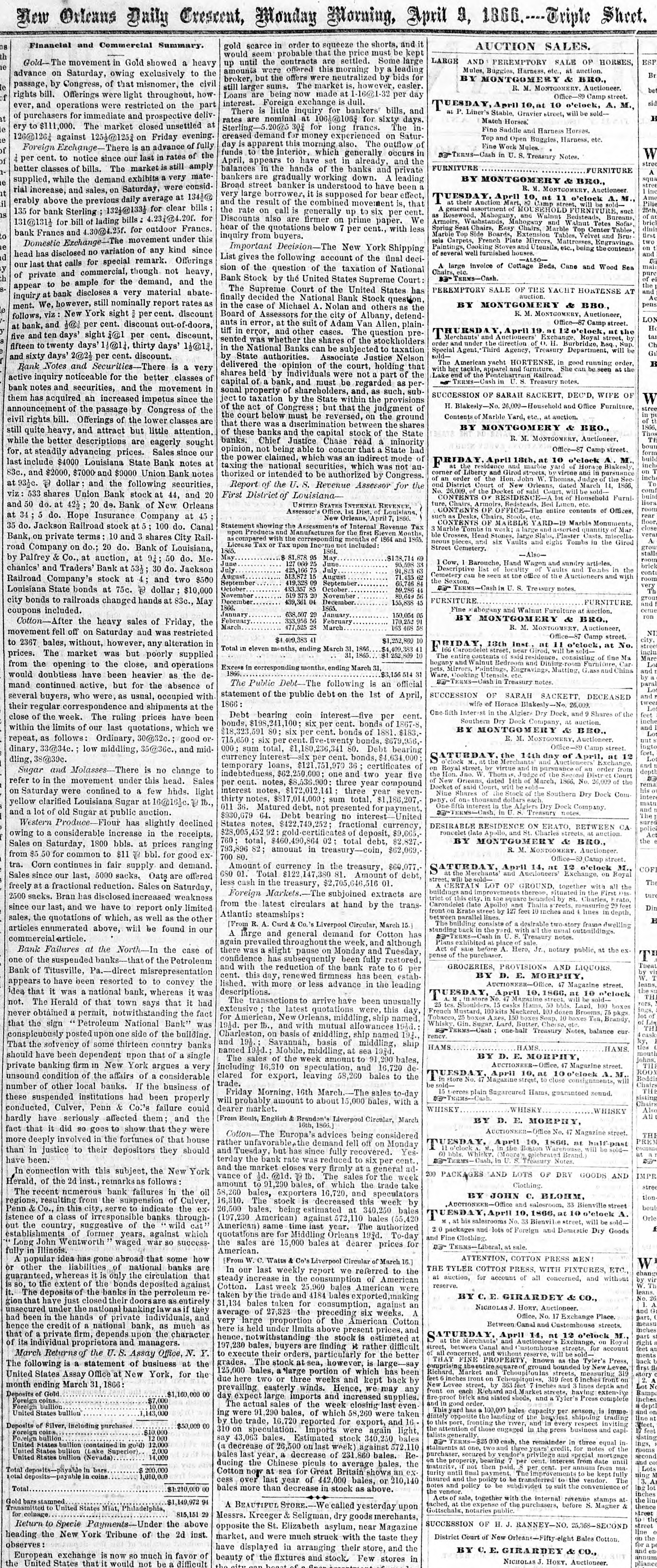
New Oricans Daily Crescent, Monday Morning, April 9, 1866. Triple Sheet. gold scarce in order to squeeze the shorts, and it Financial and Commercial Summary. AUCTION SALES. would seem probable that the price must be kept th LARGE ESP AND PEREMPTORY SALE OF HORSES, up until the contracts are settled. Some large Gold- movement in Gold showed a heavy Mules, Buggies, Harness, etc., at auction. amounts were offered this morning by leading Br advance on Saturday, owing exclusively to the Y MONTGOMERY & HRO., broker, but the offers were neutralized by bids for passage, by Congress, of that misnomer, the civil still larger sums. The market is, owever, easier. R. M. MONTGOMERY, Auctioneer. bet OfficeS9 street Camp Loans are being now made at 1-16@1-2 per day rights bill. Offerings were light throughout, how f interest. Foreign exchange is dull. sid ever, and operations were restricted on the part April 10. at 10 o'clock, A. M., There is little inquiry for bankers bills. and at P. Liner's Stable. Gravier street, will soldof purchasers for immediate and prospective deliv H Match Horses rates are nominal at 106A@1068 for sixty days. ery to $111,000. The market closed unsettled at Sterling 5.20@5 30£ for long francs. The inFine Saddle and Harness Horses. creased demand for money experienced on Satur126@126. against 1251@1252 on Friday evening. Top and Open Buggies, Harness, etc. day is apparent this morning also. The outflow of Fine Work Mules. Foreign Exchange-There is an advance of fully of funds to the interior, which generally occurs in W as TERMS-Cash in U. S. Treasury Notes. & per cent. to notice since our last in rates of the April, appears to have set in already and the FURNITURE better classes of bills. The market is still amply FURNITURE balances in the hands of the banks and private bankers are gradually working down leading supplied, while the demand exhibits a very mate BY MONTGOMERY & BRO., R. Broad street banker is understood to have been M. rial increase, and sales, on Saturday, were considvery large supposed for bear effect, TUESDAY, April 10, at 11 o'clock erably above the previous daily average at 1344@ il and the result of the combined movement is, that SEHOLD 135 for bank Sterling 1321@133} for clear bills the rate on call generally up to six per cent. is Armoirs, Discounts also firmer on prime paper. We 131@131} for bill of lading bills 4.234@4.20f. for Tetes hear of the quotations below 7 per cent., with less Spring Chairs, Easy Chairs, Marble Top Center Tables bank Francs and 4.30@4.25f. for outdoor Francs. Marble Bru and to inquiry from buyers. French Plate Mirrors, Domestic Exchange-The movement under this e Important Decision-The New York Shipping etc., being the contents of several well furnished houses. head has disclosed no variation of any kind since d List gives the following account of the final deciour last that calls for special remark. Offerings large invoice of Cottage Beds, Cane and Wood Sea sion of the question of the taxation of National y of private and commercial though not heavy, -TERMS-Cash. th Bank Stock by the United States Supreme Court: appear to be ample for the demand, and the The Supreme Court of the United States has PEREMPTORY SALE OF THE YACHT HORTENSE AT inquiry at bank discloses a very material abatefinally decided the National Bank Stock question. ment. We, however, still nominally report rates BY MONTGOMERY & BBO, the case of Michael A. Nolan and others as the M. R. Auctioneer, follows, viz New York sight rus per cent. discount Board of Assessors for the city of Albany, defendLON Office -87 Camp street. ants in error, at the suit of Adam Van Allen, plainat bank, and 1@1 per cent. discount out-of-doors, H THURSDAY April 19 at 12 'clock, at the tiff in error, and other cases. The question prefive and ten days' sight @@ per cent. discount, Royal street, sented was whether the shares of the stockholders order and direction of rbridizo Esq., Ch fifteen to twenty days' 11@1}, thirty days' 1&@12, in the National Banks can be subjected to taxation Special Agent, Third Agency, Treasury Department, will Gi and sixty days' 2@21 per cent. discount. by State authorities. Associate Justice Nelson American yacht HORTENSE. in good running order, B delivered the opinion of the court, holding that Bank Notes and Securities is a very apparer and furniture. She seen the Lake the Railroad shares held by were not part of the active inquiry noticeable for the better classes of TERMS-Cash in S. Treasury notes. capital of bank, and must be regarded as perbank notes and securities, and the movement in sonal property of shareholders, and, such, subSUCCESSION OF SARAH SACKETT, DEC'D, WIFE OF W them has acquired an increased impetus since the ject to taxation by the State within the provisions H. Blakesly-No. 26,000-Household and Office Furniture, of the act of Congress but that the judgment of announcement of the passage by Congress of the Contents of Marble Yard, etc., at auction. the court below must be reversed, on the ground eivil rights bill. Offerings of the lower classes are that there was discrimination between the shares BY MONTGOMERY & REO., still quite heavy, and attract but little attention, of these banks and the capital stock of the State R. M. MONTGOMERY, Auctioneer rf banks. Chief Justice Chase read a minority while the better descriptions are eagerly sought Offic street. Camp opinion, not being able to concur that a State had for at steadily advancing prices. Sales since our the power claimed, which was an indirect mode of pril 18th at 10 'clock A M. last include $4000 Louisiana State Bank notes at taxing the national securities. which was not au Girod and Liberty virtue in 83c., and $2000, $7000 and $0000 Union Bank notes W thorized or intended to be authorized by Congress. Sec dated March 14, 1866, at 93cc. a dollar and the following securities, Report of the U. S. Revenue Assessor for the viz 533 shares Union Bank stock at 44, and 20 First District of Louisiana CONTENTS OF RESIDENCE Household FurniBed and 50 do. at 42 20 de. Bank of New Orleans UNITED STATES INTERNAL REVENUE, entire contents of Offices, Dist. Assessor's New 1866. Orleans, at 5 do. Hope Insurance Company at 45 April ARBLE Marble Monum 35 do. Jackson Railroad stock at 100 do. Canal Statement showing the of Internal Revenue Tax anufactures for the Plaster Casts. Head the 1865. and Bank, on private terms 10 and 3 shares City Rail1864 months Vaults eight Tombs in the License Tax not upon Street Cemetery. road Company on do.; 20 do. Bank of Louisiana, -Alsoby Palfrey & Co., at auction, at 94; 50 do. MeCow, Barouche, Hand Wagon articles July Tombs chanics' and Traders' Bank at 531; 30 do. Jackson the the other of with the Railroad Company's stock at 4: and two $500 as U. S. Treasury notes. Louisiana State bonds at 75c. $8 dollar $10,000 FURNITURE FURNITURE 155,888 439,361 city bonds to railroads changed hands at 83c., May 1866. Fine abogany and Walnut at Auction. coupons included. 150,054 BY & BRO. Cotton-After the heavy sales of Friday, the March R. 477,525 M. Auctioneer, movement fell off on Saturday and was restricted Camp street 4,409,383 $1,252,860.10 at FRIDAY, 13th to 2367 bales, without, however, any alteration in at o'clock, No. $4,409,383 41 Total in eleven months, ending March The $1,252,869 prices. The market was but poorly supplied of Ma fine from the opening to the close, and operations Excess in corresponding months ending March 31. Mutting, would doubtless have been heavier as the denotes. Treasury The Public Debt- The following is an official mand continued active, but for the absence of statement of the public debt on the 1st of April, SUCCESSION OF SARAH SACKETT, DECEASED several buyers, who were, as usual, occupied with 1866 of Horace 26,009. their regular correspondence and shipments at the One-fifth Interest Algier Dry Dock, and 9 Shares Debt bearing coin interest five per cent. close of the week. The ruling prices have been Dry Dock bonds, $198,241,100 six per cent. bonds of 1867-8, within the limits of our last quotations, which we B MONTGO 35 ER Y & BEO., six per cent. bonds of 1881 $183.R. M. repeat, as follows: Ordinary, 30@32c. good or 715,650 per cent. five-twenty bonds $679,956, 000; sum total, $1,180,236,341 80. Debt bearin dinary, 33@34c. ; low middling 35@36c., and midof 14th the day 12 interest at pril, SATURDAY, bonds currency dling, 38@39c. temporary loans, Sugar and Molasses There is no change to indebtedness $62,250,000; and two year five 03 dated 1866, $8,536,900 cent. refer to in the movement under this head. Sales three per notes, year compound interest $172,012.14 three year on Saturday were confined to a few hids. light Southern Dry Dock thirty notes, $817,014,000: sum total. $1,186,207. yellow clarified Louisiana Sugar at 16@16}c. P lb., Dry 011 36. Matured debt. not presented and a lot of old Sugar at public auction. 64. Debt bearing no interest -United Western Produce- Flour has slightly declined States notes. $422,749,252 fractional currency, DESIRABLE RESIDENCE ON ERATO, BETWEEN CA deposit, $9.66 owing to a considerable increase in the receipts, total, $460,490,864 total debt, $2,827. BY MONTGOMERY & BRO., Sales on Saturday, 1800 bbls. at prices ranging M. R. S2 amount in treasury-coin $62,069, from $5 50 for common to $11 a bbl. for good ex700 80. tra. Corn continues in fair supply and demand. 14, at 12 o'clock Amount of currency in the treasury, $69,077. COF 6S0 01. Total 81. Amount of debt, Sales since our last, 5000 sacks. Oats are offered Th less cash in the treasury, $2,705 01. OF GROUND, freely at a fractional reduction. Sales on Saturday, Foreign Markets The subjoined extracts are 2500 sacks. Bran has disclosed increased weakness from the latest circulars at hand by the transDir since our last, and we have to report only limited inches in Atlantic steamships: sales, the quotations of which, as well as the other E frauna dwelling [From R. A. Curd & Co.'s Liverpool Circular, March 15. articles enumerated above, will be found in our A large and general demand for Cotton has commercial article. again prevailed throughout the week, and although Bank Failures at the North In the case of A. Hero, Jr. notary public, at th there was slight pause on Monday and Tuesday, pense confidence has subsequently been fully restored. one of the suspended banks- that of the Petroleum GROCERIES, PROVISIONS AND LIQUORS and with the reduction of the bank rate to 6 per Bank of Titusville, -direct misrepresentation BY D. E. MORPHY. cent. this day, renewed firmness has been estabappears to have been resorted to to convey the 47 lished. with more or less advance in the leading TUESDAY, descriptions. 10 idea that it was a national bank, whereas it was 1866, at The transactions to arrive have been unusually not. The Herald of that town says that it had extensive the latest quotations were, this day never obtained a permit, notwithstanding the fact for American New Orleans, middling, ship named. that the sign Petroleum National Bank" was and mutual with lb., per 194d. Treasury Notes, balance rleston, on basis of middling, ship named 19t. conspicuously posted upon one side of the building. and 194.: Savannah basis of middling, ship That the solvency of some thirteen country banks HAMS HAMS HAMS named 194d. Mobile, middling at 193d. should have been dependent upon that of a single BY D. E. MORPHY, The sales of the week amount to 91,200 bales. Magazine street. private banking firm in New York argues a very including 16,310 on speculation, and 16,720 deTUESDAY April 10. at 10 o'clock A. M. unsound condition of the affairs of a considerable clared for export, leaving 58,260 bales to the trade. number of other local banks. If the business of plain Sugareured Hams, guaranteed sound. Friday Morning, 16th March The sales to-day these suspended institutions had been properly probably amount to about 5,000 bales, with WHISKY dearer market. conducted, Culver, Penn & Co.'s failure could WHISKY WHISKY hardly have seriously affected them: and the [From Boult, English & Brandon's Liverpool Circular, March BY D. E. MORPHY, 16th, fact that it did so goes to show that they were Magazine Cotton- The Europa's advices being considered more deeply involved in the fortunes of that house TUESDAY, April 10, 1866. at rather the demand fell off on Monday and Tuesday, but has since fully recovered. than in justice to their depositors they should have been. terda the bank rate reduced to six per cent. and the market closes very firmly at a general ad connection with this subject, the New York 200 AGES AND LOTS OF DRY GOODS AND vance of @ld. 19 tb. The sales for the week Herald, of the 2d inst., remarks as follows amount to 91,290 bales, of which the trade take stre The recent numerous bank failures in the oil 58,260 bales, exporters 16,720, and speculators BY JOHN C. BLOHM, regions, resulting from the suspension of Culver, 16,810. The stock is decreased this week by ille Penn & Co., in this city, serve to indicate the ex26,500 bales. being estimated at 340,250 bales pril 10, 1866, at 10 o'clock A T istence of a class of irresponsible banks through (197,230 American) against 572,110 bales (55,420 No out the country, suggestive of the wild American) same time last year. The authorized , 20 and lots of Foreign and Domestic Dry Goods establishments of former years, against which and quotations are for Middling Orleans 197d. To-day Fine Clothing " Long John Wentworth waged war so success the sales are 15,000 bales at dearer prices for as TERMS+ Liberal at sale. American. fully in Illinois. ATTENTION, COTTON PRESS MEN A popular idea has gone abroad that some how [From W.C. Watts & Co's Liverpool Circular of March 16.] W or other the liabilities of national banks are THE TYLER COTTON PRESS, WITH FIXTURES, ETC. In our last weekly report we referred to the guaranteed whereas only the circulation that for account of all concerned, and without steady increase in the consumption of American so to the extent of the bon deposited against reserve. Cotton. Last week 25,960 bales American were it. The deposits the banks in the perroleum retaken by the trade and 4184 Dales exported. making BY C. E. GIRARDEY & CO. zion that have just closed their doors 31,134 bales taken for consumption, against an NICHOLAS J. HOKY. unsecured under the national banking lawas they average of 27,823 the preceding six weeks. A Office, 17 No Exchange Place. had been in the hands of private individuals, and very large proportion of the American Cotton Between Canal and Customhouse streets. hence the credit of a national bank, as much as here is held under llmits above present prices, and that of a private firm. depends upon the character SATURDAY, April 14, at 12 o'clock M hence. notwithstanding the stock is estimeted of its individual proprietora and managers. 197,230 bales, buyers are finding it rather difficult March Returns of the U. S. Assay Office, N. Y. to execute their orders. particularly for the better PROPERTY The following is a statement of business at the grades. The stock at sea, however, large. 125,000 bales, large portion of which has been United States Assay Office at New York, for the 319 due here two or three weeks and kept back by month ending March 31, 1866 prevailing easterly winds. Hence, we any $1,160,000 Deposits of Gold expect large ports and increased supplies. $7,000 Porcisti billion The actual sales of the week closing even 100,000 capacity per season. United States bullion ing were .290 bales, of which 58,260 were taken 1,143,000 by the trade, 16,720 reported for export, and 00 $50,000 Deposits of Silver, including purchases 310 on speculation. Imports were again light, foreign billion say 43,063 bales. Estimated stock 340,250 bales in the three remainder United States bullion gold) 12,000 (a decrease of 26,500 on last week) against 572.110 bullion States bales last year a decrease of 231.860 bales. Re14,000 United States per ducing the Chinese piculs average bales, the 200.000 Total deposits- in bars Cotton now at sea for Great Britain shows an total 1,010,000 depositsto be the cess over last year of 2,000 bales, or 210,140 policy to to suit the convenience Total $1:210,000.00 bales more than decrease in stock as above. together with the internal revenue stamps Gold bars stamped $1,149,972 the purchasers, before S. Magner A BEAUTIFUL STORE. We called yesterday upon to United States Miat, Philadelphia, for 815,151 2 Messrs. Kreeger & Seligman, dry goods merchants, Return to Specie Payments-Under the above SUCCESSION OF H. J. RANNEY- 25,368-SECOND opposite the St. Elizabeth asylum, near Magazine District Court of New Orlean lifty eight Bales Cotton. heading the New York Tribune of the 2d inst. market, and were much struck with the taste they observes have displayed in arranging their store, and the BY C. E. & CO., European exchange is now so much in favor of beauty of the fixtures and stock, Few stores in NICHOLAS HOEY, Auctioneer the United States that would not
Article from The Iowa Transcript, April 11, 1866

Click image to open full size in new tab

Article Text

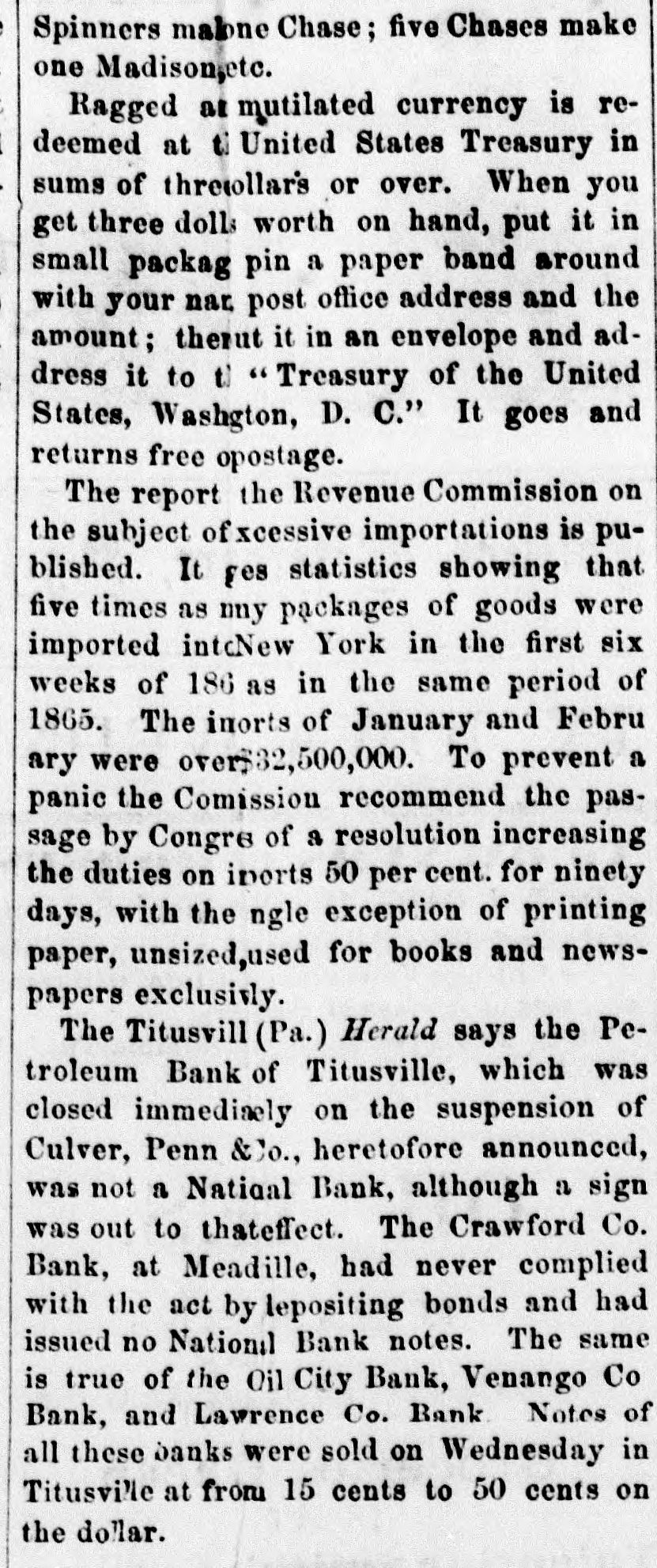
) Spinners makome Chase; five Chases make one Madisonete. Ragged at mutilated currency is redeemed at ti United States Treasury in sums of threwollars or over. When you get three dolls worth on hand, put it in small packag pin a paper band around with your nar post office address and the amount; therut it in an envelope and address it to t "Treasury of the United States, Washgton, D. C." It goes and returns free opostage. The report the Revenue Commission on the subject of xcessive importations is published. It ges statistics showing that five times as muy packages of goods were imported intcNew York in the first six weeks of 186 as in the same period of 1865. The inorts of January and Febru ary were over$32,500,000. To prevent a panic the Comission recommend the passage by Congre of a resolution increasing the duties on inorts 50 per cent. for ninety days, with the ngle exception of printing paper, unsized,use for books and newspapers exclusivly. The Titusvill (Pa.) Herald says the Petroleum Bank of Titusville, which was closed immediaely on the suspension of Culver, Penn &Co., heretofore announced, was not a Natigal Bank, although a sign was out to thateffect. The Crawford Co. Bank, at Meadille, had never complied with the act by lepositing bonds and had issued no National Bank notes. The same is true of the Oil City Bank, Venango Co Bank, and Lawrence Co. Bank Notes of all these banks were sold on Wednesday in Titusville at from 15 cents to 50 cents on the dolar.


Article from Dodgeville Chronicle, April 12, 1866

Click image to open full size in new tab

Article Text

Spinners make one Chase; five Chases make one Madison," etc. Ragged and mutilated currency is redeemed at the United States Treasury in sums of three dollars or over. When you get three dollars worth on hand, put it in small packages, pin a paper band around with your name, post office address and the amount; then put it in an envelope and address it to the Treasury of the United States, Washington, D. C." It goes and returns free of postage. The report of the Revenue Commission on the subject of excessive importations is published. It gives statistics showing that five times as many packages of goods were imported into New York in the first six weeks of 1866 as in the same period of 1865. The imports of January and Febru ary were over $32,500,000. To prevent a panic the Commission recommend the passage by Congress of a resolution increasing the duties on imports 50 per cent. for ninety days, with the single exception of printing paper, unsized, used for books and newspapers exclusively. The Titusville (Pa.) Herald says the Petroleum Bank of Titusville, which was closed immediately on the suspension, of Culver, Penn & Co., heretofore announced, was not a National Bank, although a sign was out to that effect. The Crawford Co. Bank, at Meadville, had never complied with the act by depositing bonds and had issued no National Bank notes. The same is true of the Oil City Bank, Venango Co Bank, and Lawrence Co. Bank. Notes of all these banks were sold on Wednesday in Titusville at from 15 cents to 50 cents on the dollar.


Article from North Branch Democrat, April 18, 1866

Click image to open full size in new tab

Article Text

A Bank Panic, Considerable excitement has been creat ed in business circles during the past few weeks by a report that the notes of a number of Banks had been thrown out by the Banks of Philadelphia. The following were placed ou the rejected list, and were for a short time discredited : Crawford County Bank, Meadville. Oil City Bank, Oil City, Pa. Venango Bank, Franklin, Pa. Petroleum Bank, Titusville, Pa. Tioga County Bank, Tioga, Pa. Lawrence Co. Bank Newcastle, Pa. Clearfield County Bank,Clearfield, Pa. Kittanning Bank, Kittanning, Pa. Octorara Bank, Oxford, Pa. Diamond State Bank, Seaford, Del. First National Bank, Titusville. Pa The suspension of the Banking House of Culver, Penn & Co., at New York, is given as the cause of the discredit of the Banks in the Oil Region. The Panic, has however, in a great measure subsided. The notes of the following discredited Banks are again current : Kittanning Bank, Kittanting. Octorara Bank, Oxford Chester co. Clearfield County Bank, Clearfield. First National Bank, Titusville. Tioga County Bank, Tioga Pa. Bank of Lawrence county Newcastle. The notes of the Venango Bank. Franklin ; and Petroleum Bank, Titusville, are believed to be good. Thompson's New York Bank Note Reporter quotes them at 10 per cent discount. The only Pennsylvania Banks that have really failed, and the notes of which, having no substantial security, may be considered worthless, are : Oil City Bank, Oil City Pa. Bank of Crawford County, Meadville.


Article from The Potter Journal, May 8, 1866

Click image to open full size in new tab

Article Text

: 00 losses of the people at Franklin are prob. ably double that amount. An affidavit has been made by Henry R. Lisle, and sent to the Auditor- General, asking for the appointment of a Receiver for the Petroleum Bank of Titusville. The firm of A. D. Cotton & Co. are reported to have effected a compromise with their creditors.


Article from Clearfield Republican, May 9, 1866

Click image to open full size in new tab

Article Text

dent of the Confederate States of Amer iea, so-called, and the heads of depart f ments thereof. Second. Those who in other couno n tries acted as agents of the Confeder d ate States of America, -called. 0 Third. Heads of departments of the 8 United States, officers of the army and t navy of the United States, and all persons educated at the military and na0 val academy of the United States, judges of the courts of the United e States. and members of either House e of the thirty-sixth Congress of the r United States, who gave aid and comfort to the late rebellion. Fourth. Those who acted as officers of the Confederate States of America, so called, above the head of colonel in the army or master in the navy; and any one who, as Governor of either of the so-called Confederate States, gave aid or comfort to the late rebellion. Fifth. Those who acted as officers or soldiers or sailors of the army or navy of the United States, captured during the late war, otherwise than as prisoners of war. The Committee removed the injunction of secrecy, 80 far as the above propositions are concerned and permitted copies to be furnished to the press. It is understood that the vote upon them was twelve against three. As is known that Senator Johnson and Representatives Grider and Rogers only voted in the negative, the affienative must be Senators Fessenden, Grimes, Harris, Howard and Williams, and Representatives Stevens, Washburne, (III.,) Morrill, Bingham, Conkling, Boutwell and Blair. BAD TREATMENT FOR A CONGRESS MAN.-The Pittsburg Gazette says: A few months ago Mr. C. V. Culver was a universal favorite in the district in which he lived. Now he has fallen into such disesteeta that on Monday he was arrested at Reno, for conspirney to defraud. The complamantsare Thomas Hoge, P. R. Gray and John Duffield, of Franklin. Mr. Culver was held to bail in the sum of $60,000, which he procured. Mr. Austin, the cashier of the Vonango bank, was arrested on similar charges, and gave bail in the sum of $80,000. The citizens of Franklin have suffered more severely than those of any other locality by the failure. The following named persons are the principal losers: James S. Myers, $61,000, Richard Irvin, 40,000, L. D. Rodgers, 40,000 John Duffield, 40,000, John Rynd, 100,000, N. R. Bushnell, 50,000, Thomas Hoge, 50,000. Here are seven persons whose losses approximate $400,000. The aggregate losses of the people at Franklin are probably double that amount. An affidavit has been made by Henry R. Lyle, and sent to the Auditor General, asking for the appointment of a receiver for the Petroleum Bank of Titusville. The firm of A. D. Cotton & Co. are reported to have effected a compromise with their creditors.


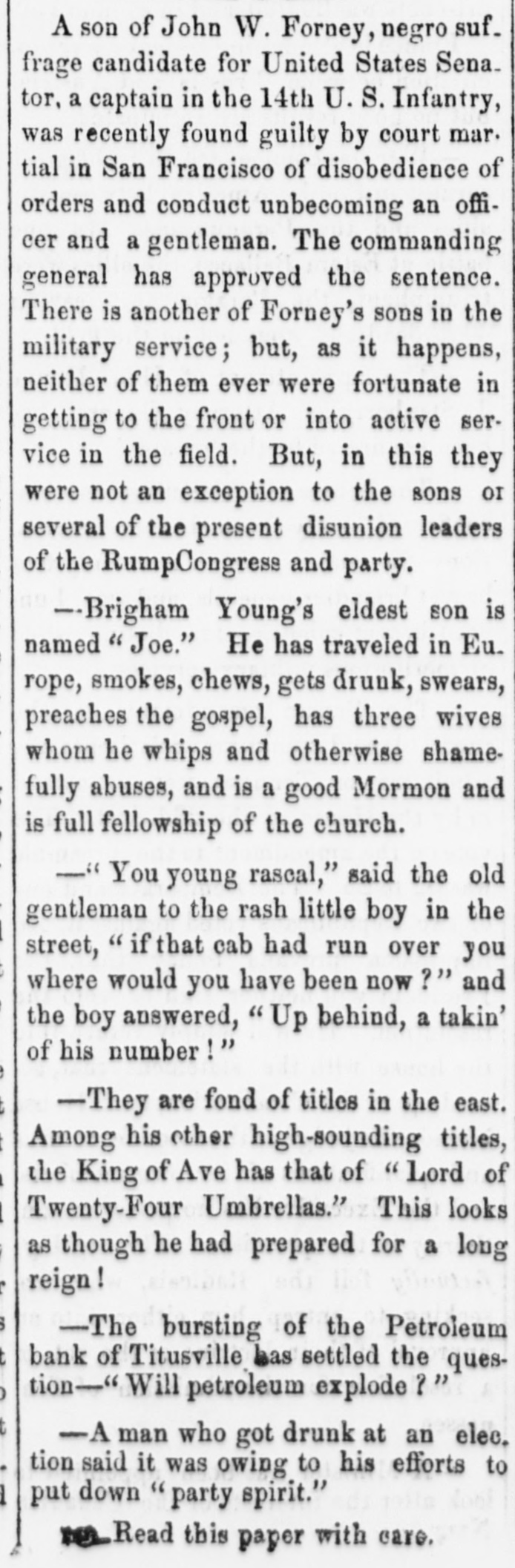
Article from The Elk Advocate, July 26, 1866

Click image to open full size in new tab

Article Text

A son of John W. Forney, negro suffrage candidate for United States Senator, a captain in the 14th U. S. Infantry, was recently found guilty by court martial in San Francisco of disobedience of orders and conduct unbecoming an officer and a gentleman. The commanding general has approved the sentence. There is another of Forney's sons in the military service; but, as it happens, neither of them ever were fortunate in getting to the front or into active service in the field. But, in this they were not an exception to the sons or several of the present disunion leaders of the RumpCongress and party. --Brigham Young's eldest son is named "Joe." He has traveled in Europe, smokes, chews, gets drunk, swears, preaches the gospel, has three wives whom he whips and otherwise shamefully abuses, and is a good Mormon and is full fellowship of the church. -"You young rascal," said the old gentleman to the rash little boy in the street, "if that cab had run over you where would you have been now?" and the boy answered, "Up behind, a takin' of his number!" --They are fond of titles in the east. Among his other high-sounding titles, the King of Ave has that of "Lord of Twenty-Four Umbrellas." This looks as though he had prepared for a long reign! --The bursting of the Petroleum bank of Titusville has settled the question-"Will petroleum explode?" --A man who got drunk at an election said it was owing to his efforts to put down "party spirit." Read this paper with care.