Watervliet Bank (Watervliet, NY)

Episode Information

Episode UID
2694503390591
Episode Type
Suspension β†’ Closure
Bank Type
state
Bank ID
269450339 hash
Start Date
March 24, 1849
Location
Watervliet, New York (42.730, -73.701)

Metadata

Model
gpt-5-mini (chosen from majority vote of a three-model LLM ensemble)
Short Digest
8907517ee4d88ccd

Response Measures

None

Description

Multiple articles refer to a receiver and claims against the bank across 1849–1851, indicating failure/receivership rather than a run.

Events (3)

1. March 24, 1849 Receivership
Newspaper Excerpt
called on the receiver of the Watervliet Bank for a report
Source
newspapers
2. May 31, 1850 Receivership
Newspaper Excerpt
The debt due from the Watervliet Bank ... now held by the Receiver
Source
newspapers
3. January 9, 1851 Receivership
Newspaper Excerpt
stock to the amount of $5,424.78 has been issued to the remaining creditors of the Watervliet Bank
Source
newspapers

Newspaper Articles (6)

Article from New-York Daily Tribune, March 24, 1849

Click image to open full size in new tab

Article Text

JUDGES OF MARINE COURT. The bill providing for the election of Judges of the Marine Court coming up for & third reading, Mr. HALL moved to amend so as to allow the Common Council to give extra compensation to such of the Justices as they might deem worthy, which was adopted. Mr. HAWLEY moved to re-commit the bill in order to amend it 80 that the present Justices should be continued in office until their terms expired. Mr. HALL said they might as well pass no bill as to adopt such an amendment. Some considerable discussion here ensued, Meters. FLOYD and HAWLEY insisting that its object was to legislate Democrats out of office, and Mr. HALL stating that the bill was requested and deemed necessary in more respects than that &jluded to. The bill then passed. It will be seen that the House assented to the amendment, so that the bill only awaits the signature of the Governor to become a law. ASSEMBLY. BILL TO PREVENT FRAUDS. The bill more effectually to prevent frauds came up for a third reading. Mr. CORNELL of N.Y. stated that the bill gave the Emigrant Boarding House keepers a partial and restricted lien on the effects of emigrants. The other amendments to the present law allowed licensed Board. ing-House keepers to solicit emigrants to go to their houses Mr. DISO&WAY of Richmond intimated that the Select Committee had never seen this. and that the numerous amendments to the present law, adjusted by the Emigrant Commissioners and others, had been entirely overlooked. Mr. CORNELL replied that the measures in contemplation by the Select Committee are not interfered with by this bill. After some farther debate the bill was passed. LEWISTON SUSPENSION BRIDGE. The bill chartering the Lewiston Suspension Bridge Company was read a third time and passed. ASSOCIATION FOR THE IMPROVEMENT OF HORSES. The bill to charter the Association for the Improvement in the breed of Horses was read a third time and rejected. Mr. HALE of Steuben moved to reconsider the vote rejecting the bill, and the motion to reconsider was laid on the table. HOURS OF LABOR. The bill to regulate the hours of labor then came up for & third reading. The bill met with considerable opposition. upon the ground urged against it when it was in the Committee. It is almost useless to follow the train of argument as to the reason that the bill was recome tted without instructions, to be reported complete The bill is to be reported at the afternoon sessico, completely eviscerated Its bearings will proba bly not be rreetly got up until it reaches the Senate. CANAL APPROPRIATION BILLS. The eral Canal Appropriation bills sent by telex apa at noon on Wednesday were passed in Committee, and ordered to a third reading. . WESTERN HOUSE OF REFUGE. The Committee of the Whole then took up the bill appropriating 87,700 for the Western House of Refuge. FIRE-PROOF BUILDINGS. The Committee of the Whole also took up the bill providing for the construction of Fire-proof Build ings for the State Library and Historical Society, made some progress therein, and had leave to sit again. CHANCELLOR'S LIBRARY. The bill relative to the disposition of the Chancellor's Library was referred to be reported complete. GOLD MEDALS. On motion of Gen. STRYKER the name of Capt. HERMAN THORNE was added to those to receive gold medals Mr. FIKKE of Kings offered a resolution, which was referred giving Commander SANDS of the U.S. Navy a gold medal in consideration of his services in the last war with Great Britain, and the late war with Mexico. MOUTH 07 THE ERIE BASIN. Mr. THOMPSON of Erie gave notice of his intention to introduce a bill to change the mouth of the Erie Basin at Buffalo. WATERVLIET BANK. Mr. FISH of Montgomery called for the consideration of the resolution previously offered by him calling on the receiver of the Watervliet Bank for a report, which was adopted. GOLD MEDALS. Resolutions were offered in favor of presenting gold medals to Lieuts. GIBBS and PALMER, which were referred.

Article from New-York Daily Tribune, April 9, 1849

Click image to open full size in new tab

Article Text

Mr. NOBLE made a Minority Report on the subject of selling liquors. Mr. PERLEY, directing the Judiciary Committee to inquire into the propriety of abolishing all laws for the collection of debt. Lost. Mr. DISOSWAY, a written report in regard to frauds on emigrants, Ordered printed. Mr. KIDD moved to refer, to amend and report complete, the Senate bill in relation to assessments of taxes. Agreed t to, and subsequently reported complete. Mr. FISH moved to print three times the usual number of the Report of the Receiver of the Watervliet Bank. Carried. Mr. WING brought in a bill making an appropriation to the Albany Hospital. Mr. L. W. SMITH presented a petition of Phelps, Dodge, and others, in regard to opening streets in New. York. Mr. WHITE brought in a bill to regulate the rates of Railroad fare between Albany and Buffalo. Mr. BOWEN, complete, the bill to incorporate the Rockland Hydraulie Company. Mr. CAMPBELL brought in a bill in relation to Adjourned. pardone. Third reading


Article from New-York Daily Tribune, June 1, 1850

Click image to open full size in new tab

Article Text

FRIDAY, May 31. The Stock market to-day was heavy for Fancies, but Sound Stocks were firm and in demand. At the Second Board the market was heavy, but reacted in some stocks at the close. In Exchange the market is heavy and the leading drawer has put down his rate ΒΌ per cent. Sterling is 91 292 for first class bills. In freights there is a small business doing for Liverpool, but there is a good demand for timber vessels. Four or five more foreign vessels have been taken up at Β£3 15s for St. Johns to London, and one from the St. Lawrence River to London, at Β£4 4s. To Havre some Cotton was taken id 15. The receipts at the Sub-Treasury are $98,870: payments, $12,302; balance, $3,829,632. The aggregate in all the Sub-Treasuries is $9,472,000. The State of Pennsylvania has made a claim on the Trustees of the United States Bank for the $100,000 annual liability of the Bank to the School Fund. The Bank has been broken for eight years, and consequently owes the State $800,000. The institution, it is contended, is legally liable, although out of business, from the fact that its charter is recognized and used for the collection of debts and for other purposes. The price of shares has fallen off materially, selling now at 2 per cent. A decision has been lately made by the Supreme Court of Tennesee, which, among other things, embraces a claim of the Ohio Life Insurance and Trust Company of about half a million of dollars, which involved many intricate legal principles and the interest of some six hundred persons. Two bills were filedβ€”one by the Trust Company and the other by other parties against the Nashville Insurance Company. The Nashville Whig says that the Court dismissed both bills for multifariousness, but declared that after the filing of proper bills, the stockholders of the Nashville Insurance Company might be held liable under their charter to the amount of their stock, but as between the deed-holders and depositors of Nashville Company and the Ohio Trust Company, the latter, before they could receive anything from the stockholders, must account for all they would receive in virtue of the deed of trust. The subscriptions for extending the Chicago and Galena Railroad beyond Elgin westwardly are coming in freely. The iron for the road from Dayton to Greenville, Ohio, will be ready and laid down in a short time. The road from Dayton to Springfield is nearly ready for the cars. One-third of the grading on the road from Hamilton to Eton will be done by the middle of July. The continuation of the road from Cincinnati to Hamilton is progressing very rapidly. The Little Miami road is being thoroughly repaired and straightened, and flat bar is giving place to the heavy T rail. The Directors of the Cincinnati and Belpre Railroad Company held a meeting on the 21st inst. at Chilicothe, and made Greenfield a point in their road. The subscription on the Greenfield route amounts to near $200,000. The surveys of the Northern Michigan Railroad are being pushed toward the west. There have been three routes surveyed from Coldwater westβ€”one by Constantine, in Michigan, called the Northern route; one by White Pigeon, Bristol, Elkhart, called the Middle route; and one by Lima, Goshen and Elkhart, callled the Southern route. The distance on the Northern and Southern routes is about the same, being from three to four miles further than on the Middie route. A meeting of the Directors was to be held sometime in May to settle this matter. Some fifty thousand dollars, it is said, has been subscribed in Goshen. The books of subscription to the Cleveland, Sandusky and Toledo Railroad have been opened at Elyria, and the amount requisite to effect the organization of the Company subscribed. A meeting of the stockholders is called for the 7th of June next, for the choice of Directors, and to adopt measures to push forward the work immediately. It is understood that this Company possess all the property and rights of the old Ohio Railroad Company west of Cleveland; and that a part of the located line of that Company, some small portions of which are already graded, will be adopted by this Company. This road is one of the links in the chain of roads from New-York to Galena. The whole route is under contract to Erie, Pa. and will soon be pushed through to the Mississippi. The cars of the Northern Railroad were to ran from Lake Champlain to Chateauguy (45 miles) this week. An order was granted by Justice Wright of the Supreme Court, on Tuesday, directing bill-holders of the exploded Canal Bank of Albany to present the same for payment within two years, or be precluded from the benefit of the fund set aside for that purpose; the Receiver to sell at auction such of the assets of the Bank as he may deem it advisable for the interest of the creditors to dispose of giving at least thirty days' notice of the sale. The debt due from the Watervliet Bank, and which is a charge on the Safety Fund, that due from E. Crosswell, and a certain check for $50,000 drawn on the Canal Bank by the Bank of Geneva in favor of Edwin Crosswell, now held by the Receiver, are not to be sold. It is by the said order referred to William L. Marcy, to pass the accounts of the Receiver and to inquire generally into the matters relating to the Receivership; and also to ascertain who were the creditors of the Canal Bank at the time of its failure, and the amount due to each. The following table, from the Buffalo Commercial, exhibits the weekly Lake imports at that port of some of the leading articles, from the opening of navigation to 1st May, of the years 1849 and 1850, by which it will be seen that in the articles of flour and wheat the falling off was very heavy; while in corn, pork, lard, lumber and staves, the increase was very heavy; but in the two lost named articles part of the increase may be accounted for.


Article from The New York Herald, January 9, 1851

Click image to open full size in new tab

Article Text

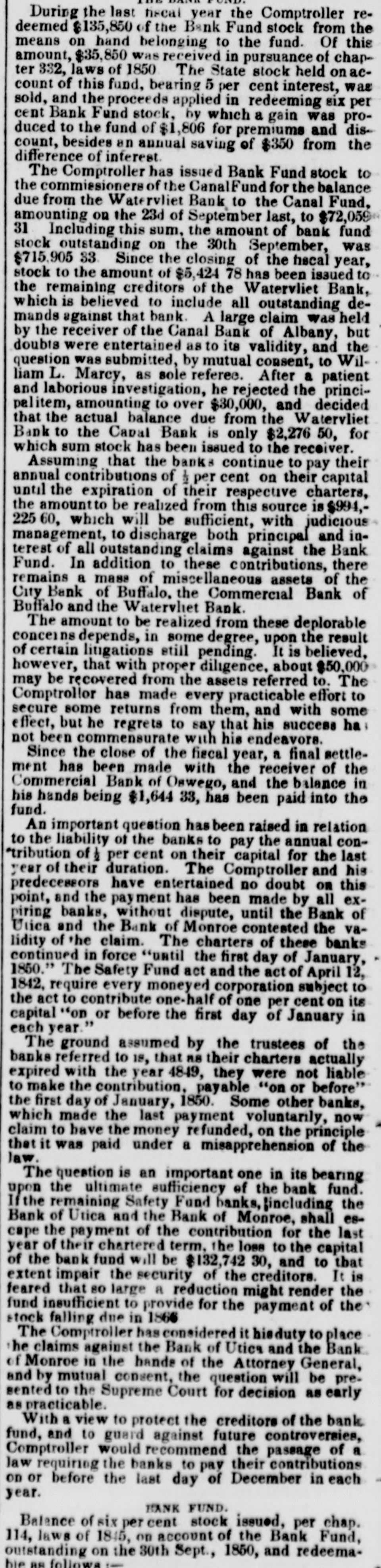
reDuring the last fiscal year the Comptroller deemed $135,850 of the Bank Fund stock from the means on hand belonging to the fund. Of this amount, $35,850 was received in pursuance of chapter 332, laws of 1850 The State stock held naccount of this fund, bearing 5 per cent interest, was sold, and the proceeds applied in redeeming six per cent Bank Fund stock, by which a gain was produced to the fund of $1,806 for premiums and discount, besides an annual saving of $350 from the difference of interest. The Comptroller has issued Bank Fund stock to the commissioners of the CanalFund for the balance due from the Watervliet Bank to the Canal Fund. amounting on the 23d of September last, to $72,059 31 Including this sum, the amount of bank fund stock outstanding on the 30th September, was $715,905 33 Since the closing of the fiscal year, stock to the amount of $5,424 78 has been issued to the remaining creditors of the Watervliet Bank, which is believed to include all outstanding demands against that bank. A large claim was held by the receiver of the Canal Bank of Albany, but doubts were entertained as to its validity, and the question was submitted, by mutual consent, to William L. Marcy, as sole referee. After a patient and laborious investigation, he rejected the principalitem, amounting to over $30,000, and decided that the actual balance due from the Watervliet Bank to the Capal Bank is only $2,276 50, for which sum stock has been issued to the receiver. Assuming that the banks continue to pay their annual contributions of 1/2 per cent on their capital until the expiration of their respective charters, the amountto be realized from this source is $994,225 60, which will be sufficient, with judicious management, to discharge both principal and interest of all outstanding claims against the Bank Fund. In addition to these contributions, there remains a mass of miscellaneous assets of the City Bank of Buffalo. the Commercial Bank of Buffalo and the Watervhet Bank. The amount to be realized from these deplorable conceins depends, in some degree, upon the result of certain litigations still pending. It is believed, however, that with proper diligence. about $50,000 may be recovered from the assets referred to. The Comptrollor has made every practicable effort to secure some returns from them, and with some effect, but he regrets to say that his success ha not been commensurate with his endeavors. Since the close of the fiscal year, a final settlement has been made with the receiver of the Commercial Bank of Oswego, and the balance in his hands being $1,644 33, has been paid into the fund. An important question has been raised in relation to the liability of the banks to pay the annual con"tribution of & per cent on their capital for the last year of their duration. The Comptroller and his predecessors have entertained no doubt OR this point, and the payment has been made by all expiring banks, without dispute, until the Bank of Ulica and the Bank of Monroe contested the validity of the claim. The charters of these banks continued in force "until the first day of January, 1850." The Safety Fund act and the act of April 12, 1842, require every moneyed corporation subject to the act to contribute one-half of one per cent on its capital "on or before the first day of January in each year." The ground assumed by the trustees of the banks referred to 18, that R8 their charters actually expired with the year 4849, they were not liable to make the contribution. payable "on or before" the first day of January, 1850. Some other banks, which made the last payment voluntarily, now claim to have the money refunded, on the principle that it was paid under a misapprehension of the law. The question is an important one in its bearing upon the ultimate sufficiency of the bank fund. f the remaining Safety Fund banks, including the Bank of Utica and the Bank of Monroe, shall escape the payment of the contribution for the last year of their chartered term, the loss to the capital of the bank fund will be $132,742 30, and to that extent impair the security of the creditors. It is feared that 80 large a reduction might render the fund insufficient to provide for the payment of the stock falling due in 1866 The Comptroller has considered it hisduty to place he claims against the Bank of Utica and the Bank of Monroe in the hands of the Attorney General, and by mutual consent, the question will be presented to the Supreme Court for decision as early practicable. With a view to protect the creditors of the bank fund, and to guard against future controversies, Comptroller would recommend the passage of a law requiring the banks to pay their contributions on or before the last day of December in each year. BANK FUND. Balance of six per cent stock issued, per chap. 114, laws of 1845, on account of the Bank Fund, outstanding on the 30th Sept., 1850, and redeemahie BR follows


Article from New-York Daily Tribune, January 10, 1851

Click image to open full size in new tab

Article Text

Wyoming THE BANK FUND. During the last fiscal year the Comptroller redeemed $135,850 of the Bank Fund Stock from the means on hand belonging to the fund. Of this of amount, $35,850 was received in pursuance chapter 332, laws of 1850. The State Stock inter hold account of this fund, bearing 5 per cent. on was sold, and the proceeds applied in redeem. ing est, six per cent. Bank Fund stock, by which & was produced to the fund of $1,806 for premigain ums and discount, beside an annual saving of $350 from the difference of interest. The Comptroller has issued Bank Fund stock to the Commissioners of the Canal Fund for the balance due from the Watervliet Bank to the Canal Fund, amounting on the 23d of September last, to $72,059 31. Including this sum, the amount of Bank Fund stock outstanding on the 30th Septem+ ber, was $715,905 33. Since the closing of the fiscal year, stock to the amount of $5,424 78 W& has been issued to the remaining creditors of the tervliet Bank, which is believed to include allout. standing demands against that bank. A large claim was held by the receiver of the Canal Bank of Albany, but doubts were entertained as to its validity, and the question was submitted, by mutual consent to William L. Marcy, ssole referee. After a patient and laborious investigation, he re. jected the principal item, amounting to over $30, 000, and decided that the actual balance due from the Watervliet Bank to the Canal Bank is only $2,276 50, for which sum stock has been issued to the receiver. Assuming that the Banks continue to pay their annual contributions of 1/2 per cent. on their capital until the expiration of their respective charters, the amount to be realized from this source is $994,225 60, which will be sufficient, with judicious management, to discharge both principal and inter. est of alloutstanding claims against the Bank Fund. In addition to these contributions, there remains R mass of miscellaneous assets of the City Bank of Buffalo, the Commercial Bank of Buffalo and the Watervliet Bank. The amount to be realized from these deplora. ble concerns depends, in some degree, upon the result of certain litigations still pending. It is be. lieved, however, that with proper diligence, about $50,000 may be recovered from the assets referred to. The Comptroller he made every practicable effort to secure some returns from them, and with some effect, but he regrets to say that his suc. cess has not been commensurate with his endeavors. Since the close of the fiscal year, a final settlement has been made with the Receiver of the Commercial Bank of Oswego, and the balance in his hands being $1,644 33, has been paid into the Fund. An important question has been raised in rela tion to the liability of the banks to pay the annual contribution of 1/2 per cent on their capital for the last year of their duration. The Comptroller and his predecessors have entertained no doubt on this point, and the payment has been made by all expiring banks, without dispute, until the Bank of Utica and the Bank of Monroe contested the VA. lidity of the claim. The charters of these banks continued in force " until the first day of January, 1850." The Safety Fund act and the act of April 12,1842, require every moneyed corporation subject to the act to contribute one half of one per centon its capital on or before the first day of January in each year." The ground assumed by the trustees of the banks referred to is, that as their charters actually expired with the year 1849, they were not liable to make the contribution, payable " on or before," the first day of January. 1850. Some other banks, which made the last payment voluntarily, now claim to have the money refunded, on the principle that it was paid under a misapprehension of the law. The question is an important one in its bearing upon the ultimate sufficiency of the bank fund. If the remaining Safety Fund banks, including the Bank of Utica and the Bank of Monroe, shall egcape the payment of the contribution for the last year of their chartered term, the loss to the capital of the bank fund will be $132,742 3 and to that extent impair the security of the creditors. It is feared that so large a reduction might render the fund insufficient to provide for the payment of the stock falling due in 1866. The Comptroller has considered it his duty to place the claims against the Bank of Utica and the Bank of Monroe in the hands of the Attorney General, and by mutual consent, the question will be presented to the Supreme Court for decision as early as practicable. With view to protect the creditors of the bank fund, and to guard against future controversies, Comptroller would recommend the passage of & law requiring the banks to pay their contributions on or before the last day of December in each year. BANK FUND. Balance of six per cent. stock issued, per obap. 114, laws of 1845, on account of the Bank Fund, outstanding on the 30th Sept. 1850, and redeemable as follows 1851 $27,278.42 1852 24,414 00 1858 77,213 31 1855 7,938 $ 30 1856 237,650 00 1858 144,000 00 1859 55,892 82 1861


Article from The Jeffersonian, May 30, 1861

Click image to open full size in new tab

Article Text

Bank Failures at Albany, New York. The old Bank of Albany, and the Bank of the Capitol have both failed-owning, it is said, to disbonest manage. ment. Albany banks have been unfor tunate in proportion to their number.The State Bank years ago suspended the payment of dividends for several years, through the defalcation of a trasted Tel. ler. The Commercial Bank was nearly ruined by the operation of its Cashier, Mr. Baretow. The Canal Bank was destroyed years ago, and its Casbier, Mr. Olcott, was for a long time imprisoned. The Watervliet Bank, in the County of Albany, was used by a brother of the Ceebier of the Canal Bank, who ran a. way.