Article Text
COMMERCIAL AND MONEY MATTERS.
THURSDAY, P. M. The business of the Stock Board was confined to-day almost exclusively to Reading, Harlem, Norwich and Worcester, and Long laland. Of Reading the sales were large-sales at the seller's option being made by the broker of the Union Club. The market, in despite of the bearing, was buoyant, and the Fancles improved materially. The Summer session of the Board promises to be unusually active, as the recent transactions in the Fancles have been sufficiently large to keep the ball rolling actively all Summer.
The demand for foreign bills is very light and the supply much beyond the wants of remitters. Sterling is 7⅛@8; Franca 5 36¼.
Freights are not active, and the amount of tonnage in market is larger than it was. There are considerable engagements of Flour, but Cotton is not offered freely. Cotton is 1d@5-16d.; Flour 2s. 6d.; Grain 8@8½d. Two or three ships were taken up to load at the South for Europe. The large payments of dividends now being made has thrown considerable sums into Wallst. for employment, and borrowers on first class securities find not much difficulty in meeting their wants. The Banks continue to do for their regular dealers nearly all the good short paper offered.
There is some kind of a screw loose in the administration of the Harlem Railroad. Three or four of the moneyed men who were elected only six weeks since have already resigned in disgust. The reasons given by rumor for these resignations are not definite anough for point, but indicate true self-respect upon the part of those who took the step.
The earnings of the Boston and Worcester Railroad for the last six months show a highly satisfactory condition of the business of the Road. The passenger receipts were $109,128, showing an increase of $13,239 over the corresponding period of last year. The freight receipts were $111,108, showing an excess of $11,929, making an aggregate increase in six months of $25,168, or about 12½ per ct. The Road is now doing more than it has ever before done. Various branches are under consid-eration, which if built will add materially to the business of the Road. The above increase has taken place not-withstanding a reduction in the proportion of receipts on the joint business with the Western Railroad Co.
The exports of Specie from this Port for the month of June were nil. The imports in the hands of immi-grants were considerable.
Upwards of fifteen thousand shares of the stock of the Central (Pa) Rallroad have been subscribed for. The work of relaying the track of the Somerville, N. J. Railroad has been commenced. The rail used is of the best quality.
The Boston money market will be relieved by the payment of half-yearly dividends. The half-yearly re-turns of the Massachusetts capital invested in factories and railways, will amount, it is estimated, to over a million of dollars. The seven Railroad Companies will alone yield over half a million in dividends, besides the collateral advantages which they impart to all the vari-ous channels of business.
The arrivals at Boston for the month of June reached 1035, of which 236 were Foreign. The clear-ances were 469, of which 223 were Foreign. Of the clearances 2 ships, 3 barke, 18 brigs, and 137 schrs. were British.
The earnings of the Eastern Division of the Erie Railroad for the month of June, 1846, were as follows: From Freight $10,433 04 From Passengers and Mail 5.491 85 Total $15,924 89 Same time last year 13,854 05 Increase $2.070 84 Increase from freight on Milk $896 99 other freight 421 01 Passengers 752 84 Total $2,070 84
The Bank of Monroe and the City Bank of Ro-chester have declared dividends of 3 per cent. payable on demand. The Merchants' Bank of Baltimore 3 per cent payable on demand. The Morris and Essex Railroad 3½ per cent. payable on demand. The Bank of Pennsylvania a semi-annual dividend of 4 per cent-The Girard Trust a semi-annual dividend of 3 per cent.
At New Orleans there has been a decided im-provement in the money market. Capitalists are more desirous of making investments, and the rate of interest out of doors, for undoubted signatures, at short date, has receded to 10@12 per cent. per annum. There is not much paper offering in the street, as the Banke, of late, have been generally disposed to discount the greater portion that is tendered. The market for Texas Se-curities has been rather quiet, but without change in the rates. Red Backs 14@15c.; Interest Notes 16; Eight Per Cent. Bonda 18@19c.; Ten Per Cent. do. 23@24c, on the dollar. The demand both for Foreign and Domestic Exchange has been extremely limited, and the market wears a very heavy appearance. Sterling 7@7¼ per cent. prem.; Francs, 5 35@5 40. Bills on New-York, at 60 days, 1½@2½ per cent, dis.; Checks, par@½ per cent. dis.
Application having been made to the Canadian Government to permit the importation of American Wheat for grinding, under bond, the Inspector General answered that under the circumstances under which was enacted the Provincial Act. 6 Vic. Ch. 28 and which the bill introduced this session if sanctioned by the Im-perial Government will materially affect, it has not been considered expedient to advise his Excellency to antic-Ipate the course which the Home Government may think fit to adopt.
Speaking of the exports of Cotton Goods from this Port, the Montreal Courier has the following sensible reflections:
And this has been one of the consequences of that system which some revile so much, a nation encourag-ing its own manufactures. Those goods are destined for markets which Great Britain hitherto had the mo-nopoly of, in which the United States now not only compete with her, but which she bids fair soon to supply entirely. We leave it to political economists to calcu-late how large a number of hands have been employed In making these febrics, the amount which their produc-tion has caused to be circuisted at home instead of being spent abroad, and the quantity of provision and fuel thus brought into profitable consumption.
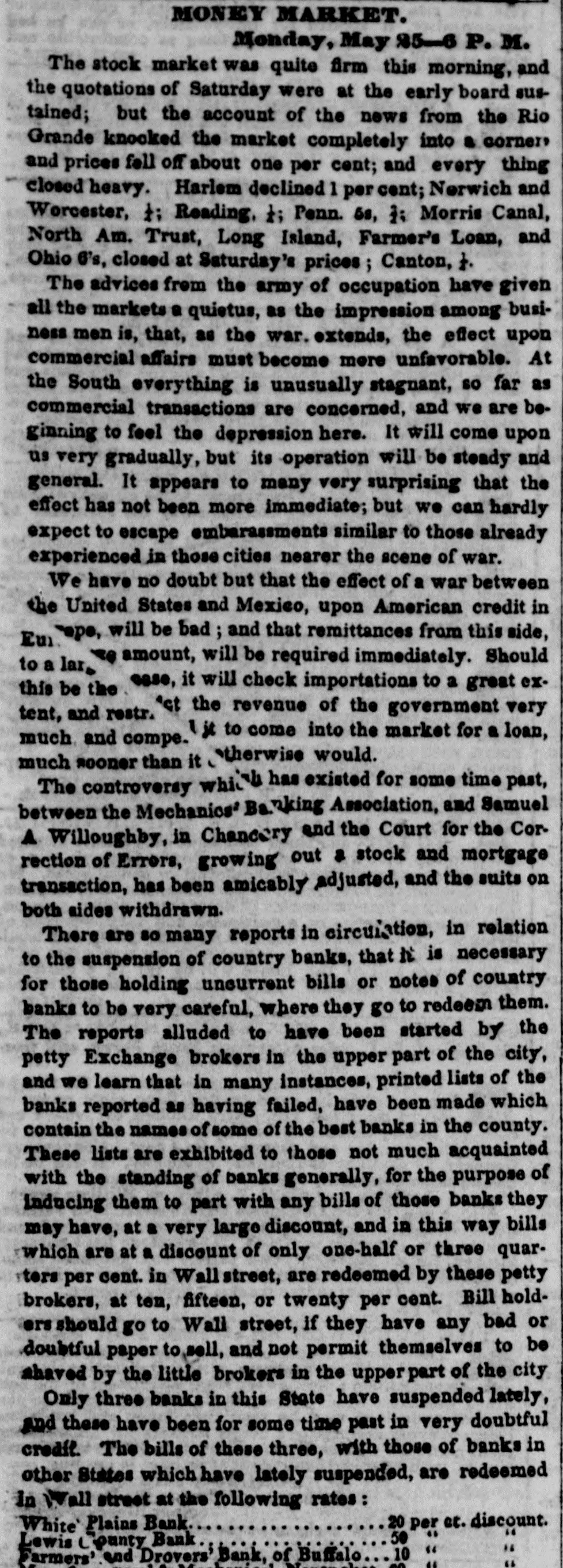
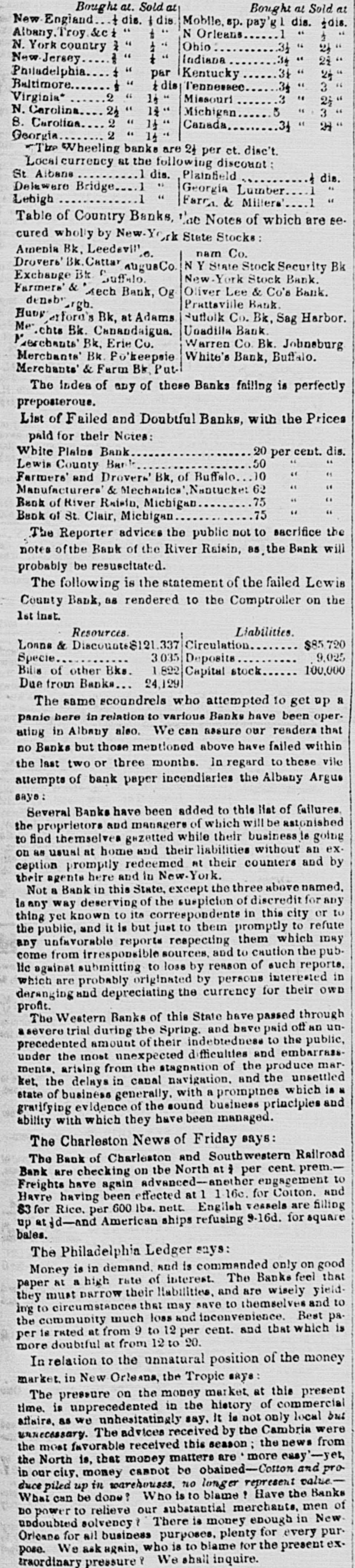
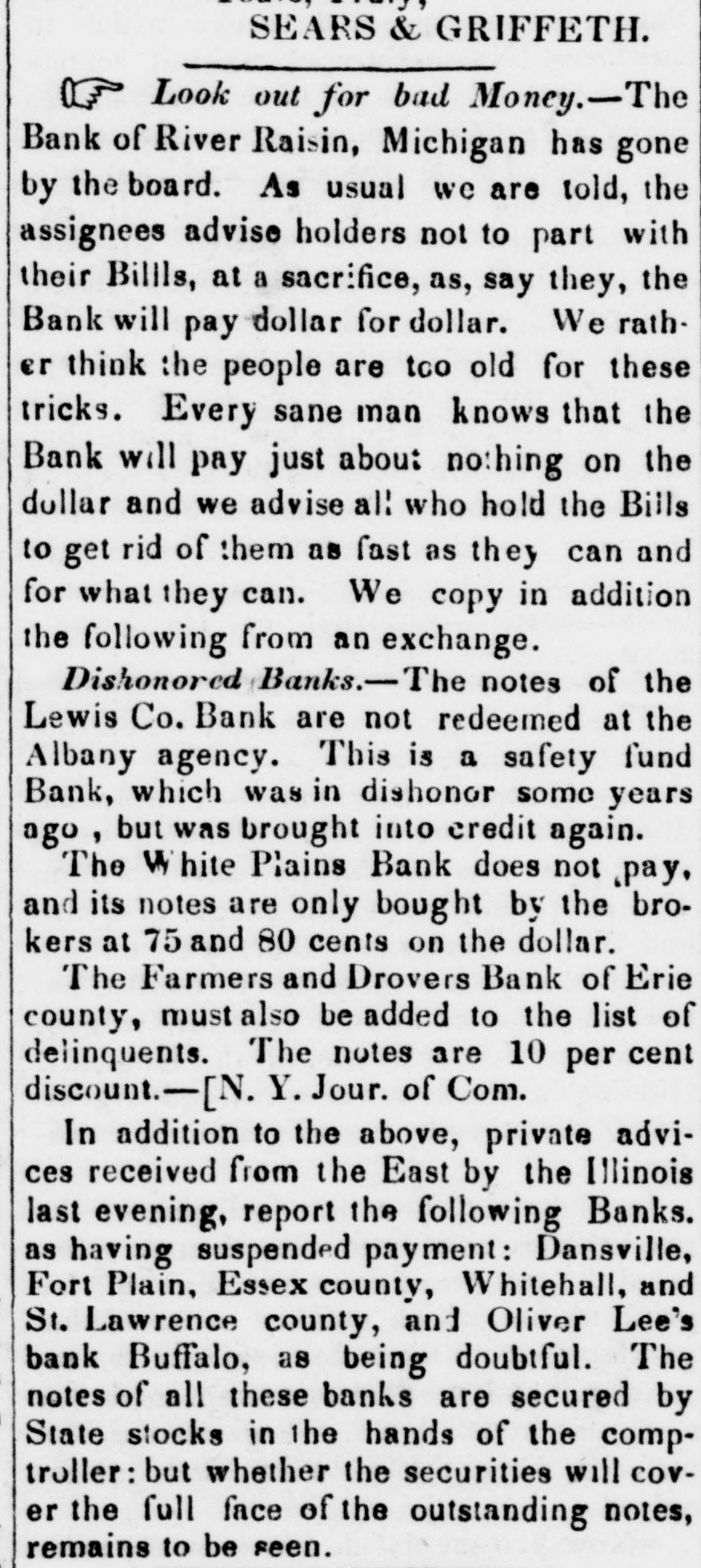
Thompson's Bank Note Reporter, speaking of the White Plains Bank says:
We have good reason for belleving that the circulat-ing notes of this Banks will be redeemed at par, after some three or four wecke, from the proceeds of the se-curities in the Comptroller's hands. The Bank De-partment at Albany, act with energy in closing up the broken Banks, and evince a determination to save the people from being shaved. All Banks under the Free Banking Law which have been organized since foreign stocks were rejected as securities, will pay par for their notes, or the Comptroller will, from the securities in his hands.
The arrivals at Philadelphia during June were 387, of which 15 were foreign. The clearances were 572, of which 48 were foreign. These figures show a consid-