Sixth National Bank (New York, NY)

Episode Information

Episode UID
25401081
Episode Type
Suspension β†’ Reopening
Bank Type
national
Bank ID
2540 national
Charter Number
254
Start Date
January 31, 1890
Location
New York, New York (40.714, -74.006)

Metadata

Model
gpt-5-mini (chosen from majority vote of a three-model LLM ensemble)
Short Digest
5f17d541c90de208

Response Measures

None

Description

Closed by federal examiner after apparent embezzlement; later recapitalized and authorized to resume.

Events (4)

1. February 20, 1864 Chartered
Source
historical_nic
2. January 31, 1890 Suspension
Cause
Government Action
Cause Details
Closed/taken possession by U.S. Bank Examiner A. R. Hepburn after discovery of misappropriation/abstracted securities and alleged embezzlement.
Newspaper Excerpt
the managers in the Sixth National Bank... Bank Examiner Hepburn yesterday brought to light an astounding state of affairs... The cashier ... laid the facts before the Clearing House Committee, and the National Bank Examiner Hepburn was called in to make an investigation. This resulted in the closing of the doors of the bank.
Source
newspapers
3. February 3, 1890 Reopening
Newspaper Excerpt
The Sixth National Bank to-day elected a new board of directors and restored Mr. Leland to the presidency. Mr. Leland paid into the bank $280,000, and it has been authorized to resume business.
Source
newspapers
4. January 6, 1899 Voluntary Liquidation
Source
historical_nic

Newspaper Articles (23)

Article from Evening Journal, January 31, 1890

Click image to open full size in new tab

Article Text

BANK WRECKERS WORK. Been Closed. Two Have New York Institutions "ANOTHER IVES-STAYNER CASE." The Sixth Half Ruined Nearly by National Alleged and Dishonest Lenox HIII Banks Has the Money? a Million Missing-Who Practices. condition light of affairs 31-A most Commissioner who A. B by United has been startling NEW Hepburn, YORK, Jan. States Bank brought to Sixth National its examining It day. been discovered P. J. accounts all and Broadway, and Thirty-fourth busy Possession of street the that of the new the bank, president who days two only Classen, of $622. has since dispose ago, of of 000 the bank's consisting of a of over gilt value market bonds gilt edged but of All bonds these $800,000. and have been sold, is gone assumed Tuesday. the bank, and sents the syndicate control former president interest on yet unknown. of of Charles Mr last H. the Classen week money has Leland, bought repre- the Notice. and In the was the bank closed on sheet the and The doors surrounded of crowd panic depositors and morning, and from gleaned assistants, the premissioner Hepburn following liminary Statement. of "Mr. stock. at parties controlling of in and control gave them 23, $622,000 possession to the belonging bank Wallace and follows: 1890, Received the New York, Sixth for sold for the books of the show any bank the for The book stock called original the bonds $622,000 amount and to Pell. president, and for with that them. they Bud. of $201,000 "They bonds. not could the renother bank. with of the the bank dered in imperative carry out the reopen taking will the possession anything. all. that stated Hepburn the new of the office oath of the Bank. The organized the 1864. presj. Leland dent. the cate two days. 45 Broad Classen M. way County T H and regarded Broadway the drug Cutter store the Kings concerns and city, of the The bank Alexander bought Hudnut surplus, last ing market. the Cashier D. has Andrew of been is by mentioned He notified Were They Commission are $401,000. that thus far the Bank stated Wreckers of $180,000 hand nt which missing. market There value last par night protested Mr. of report controller be and ready rency will of speedily ch pointment it He says of b. this city. wrecking The Fails. ng The the National Sixth in Hill the at the the de Lenox trouble the bas failed. ust bank son late Lester of There new board the he The ip $50,000 their apintions-the acquired table and red is prime Lexon and the syndicata on. Case." Another Frederick Gallatin he of bank and resident a of the to pay to the the certified Sixth committee stocks national and says member bank


Article from St. Paul Daily Globe, January 31, 1890

Click image to open full size in new tab

Article Text

FRAUDS. FINANCIAL A of Syndicate in Speculators Succeeds Wrecking TWO Banks. of The Ives Schemes Gigantic Are Totally Eclipsed. of Giltand the Steal in and one SevJail NOW Be Will eral Others soon. of the bank of The the of the run to the The in Wall but The on acted the to drop Sixth are the from There the Sixth regard its that one new being in only been charge had few its secur posthey Its sident, who have sold out obtained Claato con been have Chemes Lead The has bank the other resident makes the of two The banks but in Wall street widels the that think effect the bear the the and marke Wall decided advers the upon this the of by the of bank, high bery Presends from to simply that bonds them over to ting his Mr. of the the bank leartified Claasen and bank house the The latter began afternoo the in the bonds of bank Claase These of of the the short value $ 10,000. None been this the ban of fairs bank, up the that bonds FOUND. the Their He loan bank by bar which and was 000 of doubtured bank Gas and in Orlea ComOcean in of pany and $50,000 pantral The third on Mr. Hep these loans, In addi prob M to tion these found loans. on in 308 000 Hepated of the and others of alleged the Hill bank Sixth cleared. and for being his make specton the be his that that that the they H the has see Even the ex him bank, he ANY GOOD in of his ing the the to his was the most in the It the The of liable an the the While Miltation recobus and into hour and were where held. an very the was and their came When talkebled the he was coming his the object he first bank would he had made any to but finally the catch Way men ble. How he they the Charles came Late Trenho: affairs banks the of liam into Faultable the said, sion bank after was it look and evening theire they taken posnded lately


Article from Waterbury Evening Democrat, January 31, 1890

Click image to open full size in new tab

Article Text

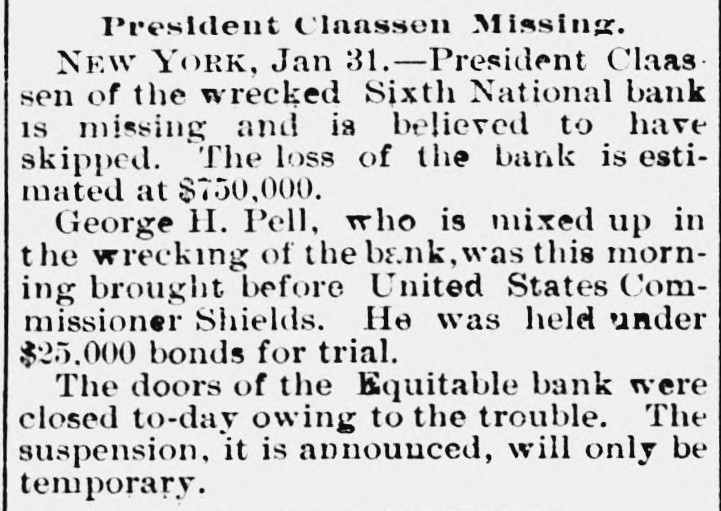
BANKS IN A CRASH Two Big Financial Surprise for New York City. ARRESTING THE WRECKERS The Timely Warning of a Oashier Stop the Work of a R-ckless Syndicate. The Bank Examiner Recovers Part o the Steal--Big Price Paid for Bank Stock The Nafe Gutted to Raise the Money-Queer Financial Tricks of the Conspirators. NEW YORK, Jan. 31.-Two banks closed and the third in a shaky condition and broker George H. Pell arrested for alleged complicity in a deal that caused the trouble. Such is the record of the last two days in New York following on the announcement of the managers in the Sixth National Bank, Broadway and Thirty-third street. Bank Examiner Hepburn yestΔ™rday brought to light an astounding state of affairs. The new T esident of the bank. P. J. Classen. du ing his two days' term of office had endeavored to dispose of $622,000 worth of the bank's securities, consisting of bonds with a market value of $800,000. These bonds were all sold with the exception of $ 50,000 worth. and no one can tell where the money has gone. The syndicate which bought the con trolling interest in the bank from Charles H. Leland, the former president. is represented by Mr. Classon,and the most mysterious part of the whole affair is the fact that that Mr. Leland sold his 1,035 shares of stock at $650, though they never brought more than $350 in the market before. The Bank Ruined A week ago the Sixth National Bank was considered one of the soundest financial institutions of this city. 11 had :1 record of 25 years' standing, and its depositors were proud of the prud ence and energy which the manage ment was reputed to have $0 wisely combined. Its capital had been strengthened by a handsome reserve fund. while its stock was rated very high by judicious investors. and commanded a handsome premium. Last evening the United States Bank Examiner who had made a thorough investigation of the bank's affairs, was compelled to admit that the bank was ruined, and that it was "the most scandalous case of bank wrecking which had ever come within his juris diction." Method in Their Madness. The payment of $650 a share for bank stock which was quoted at $250 was not the piece of recklessness which it would at first appear. Immediately upon the payment of the checks the keys of the vault were turned over to them. In the vaults of the bank were gilt edged securities valued at $692,000. These were taken and the greater part either sold or bypothecated. The proceeds were deposited in the banks on which the checks were drawn, so that they would not be protested. In other words, they used the assets of the bank to pay for the stock they had purchased. A very clever scheme, when it is remembered not a dollar was actually paid out of their own pockets. Exposed by the Cashier. They obtained control of the bank for nothing and at the same time succeeded in getting rid of a lot of worthless stock, certificates that were not even notable as specimens of the lithographer's art. The privilege which the bank possesses of raising the capital stock of the bank from $200,000 to $1,000,000 afforded such glorious opportunities for fleecing the public by watering the stock that it is fair to presume it would be taken ad vantage of had not the exposure occurred. The cashier of the bank, A. E. Colson, first put into active shape the suspicions which had lain dormant in the minds of many. He became alarmed when he saw the new control making big loans on the stock of the Equitable and the Lenox Hill banks, two comparatively small concerns. He laid the facts before the Clearing House Committee. and the National Bank Examiner Hepburn was called in to make an investigation. This resulted in the closing of the doors of the bankr. The Scene at the Bank. The scene at the door of the bank was an exciting one. Before it stood policemen, who good naturedly but firmly urged along even the most substantial looking of the depositors, who began to arrive at the Broadway ontrance. Not only these, but citi-


Article from Alexandria Gazette, January 31, 1890

Click image to open full size in new tab

Article Text

NEWS OF THE DAY. Count Andrassy, formerly prime minister of Austria, is dying, The charity ball in Washington last night was a brilliant affairs. It is deemed pretty certain that Senater Gorman's harbor bill will not pass. The great statue of William Penn, 37 feet four inches high, is about to be cast in bror ZB at the Tacony Works, Philadelphia. Cardinal Gibbons yesterday entertained at dinner Bishop Keane and other members of the faculty of the Catholic University. Mr. Richard H. Edelen has declined Gov. Jackson's offer to appoint him as chief judge of the Southern Maryland circuit. A trust, which includes the absorption of all the cracker bakeries in and around New York, has been practically completed. The trial of the English cotton buyers for importing under contract English cotton graders is in progress in the United States Circuit Court at Norfolk. Sister Rose Gertrude, of England, who will take Father Damien's place in attendlog the unfortunate people afficted with leprosy on the island of Molokai, hasarrived in New York. The hearing in the Marquis Lampson contest case for the lieutenant governorship was concluded in the Ohio senate yesterday evening, and Lampson (republican) ousted by a strict party vote. The captain of a steamer which arrived at Bremen yesterday from New Orleans picked up on the Atlantic a life boat and a number of articles supposed to belong to the steamer Erin, reported as lost. Arthur Blake, the alleged adopted son of Arthur Gorham, the millionaire cattle dealer of Kineley, Kansas, on trial at Kinsley for attempting to blackmail Mr. Gorbam, pleaded guilty to the charge yesterday. On Thursday Lucia Zerate, the Mexican midget, said to be the smallest human being in the world, who was a passenger on one of the snow blockaded trains in the west, died at Truckee from grastric fever. Since the death of her son Rudolph the condition of the Empress of Austria has been very sad. She is subject to great depression, of mind and settled melancholy, and gives undoubted evidence of Insanity, hereditary in her family. In New York yesterday the Sixth Nation al Bank was closed and thrown out of the Clearing House; the Equitable Bank'schecks went to protest, and the Lenox Hill Bank suspended. Depositors will lose no money probably, but stockbolders will. Richard Goodwin, an old negro, cut his throat in court while on trial at Holly Hill, S. C., yesterday. ОдС of his daughters swore out an affidavit against him for as. saulting her. At the conclusion of his daughter's evidence he drew his knife and out bis throat. An attempt was made last night to blow up the residence of Rev. Father Fleckinger, of St. Joseph's Catholic Church, of Mansfield, Pa., with dynamite. It is eupposed the object was to kill Father Fleckinger, and he says he believes the attempt was the work of anarchists. Assunta Porccuto. an Italian woman, who is on trial in New York for killing another woman, while giving her testimony yesterday suddenly threw up her hands and screamed in Italian: "Ob, my sister Amelia, come down from heaven and tell all that I am innocent." The wretched woman waved her hands in B delirious way, and finally swooned. Her action created something of a panic in the court room and Judge Fitzgerald at once suspended the proceedlogs of the trial.


Article from The Wheeling Daily Intelligencer, January 31, 1890

Click image to open full size in new tab

Article Text

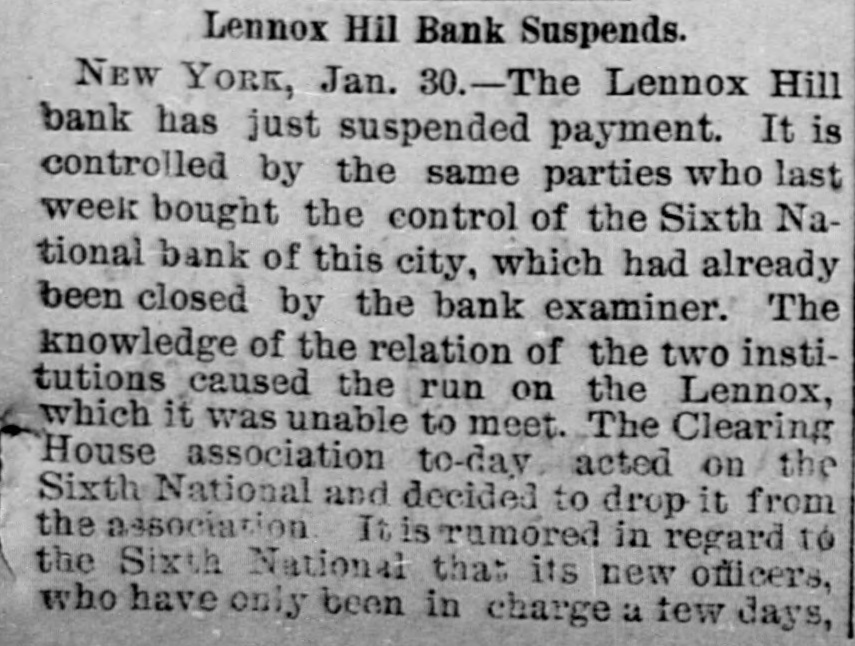
TWO BANKS WRECKED By the Dishonest Practices of the President-Order of Arrest Issued. NEW YORK, Jan. 30.-The Lenox Hill bank has suspended payments. It is controlled by the same parties, who last week bought the control of the Sixth National bank of this city, which had already been closed by the examiner. The knowledge of the relation of the one uo uns B cansed OM1 Lenox, which it was unable to meet. The President is said to have made an attempt to obtain funds in Wall street to continue payments, but was unsuccessful. The Clearance House Association today acted on the Sixth National and decided to drop it from the association. There are all kinds of rumors in regard Sujeq euo Lund National TXIS our of that its new officers, who have only been in charge a few days, had sold out its NOcurities as soon as they obtained possession. Its president, P. J. Glassen, is said to have been connected with mining schemes in Leadville a number of years ago. The representatives of the Bank Examiner say that depositors will certainly be paid in full. The Equitable Bank has also been mentioned in connection with the other two institutions. Its President makes the following statement: "The owners of the Sixth National have a minority interest in the Equitable only, and the bank is not affected.' The suspension of the two banks was widely discussed on Wall street, but brokers appeared to think that the effect would be confined to stockholders' losses, and although the bear traders depressed stocks at the opening, the market easily recovered and stocks made decided advances. Wall street this afternoon looks upon the attempt to dispose of the $600,000 in bonds owned by the Sixth National Bank as simply a case of highway robbery. It seems that President Classen, after abstracting the bonds from thesafe deposit vault, turned them over to George H. Pell, a broker of unsavory reputation, who attempted to dispose of them on the street, representing them to be the property of his wife. Mr. Colsen, cashier of the bank, learning of the action of Classen, notified the Clearing House and Bank Examiner. The latter began an investigation yesterday afternoon. He soon learned enough to cause him to close the bank and call on Classen for the return of the $622,000 in securities. The Examiner, by his prompt action, succeeded in getting back $201,000 of the bonds. On account of the rest of the abstracted bonds Classen handed the Bank Examiner checks for $382,000. These checks fell short of the market value of the abstracted securities $140,000. None of the checks, however, have been paid, and they are being protested. The Comptroller of the Currency will appoint a receiver, and all the facts in the case will be laid before the District Attorney. Later in the day the District Attorney issued an order for the arrest of Classen and broker Peli for their connection with wrecking the Sixth National bank. BANK EXAMINER'S STATEMENT. Mr. Hepburn, Bank Examiner was at the bank early this morning and was at work examining into the securities and business. About noon he made the following statement to the reporters who had asked for it: Mr. Leland sold 1,035 shares of stock, a controlling interest, to the parties at present in control of the bank and gave the possession January 22. January 23, $622,000, the par value of high priced bonds belonging to the bank were delivered to Pell, Wallack & Co., and a receipt taken, reading as follows: Received, New York, January 23, 1890, of the Sixth National Bank of New York, the following named bonds to be sold for account of said bank, and accounted for to its president as he may demand. T Classen the Prosident


Article from The Portland Daily Press, February 1, 1890

Click image to open full size in new tab

Article Text

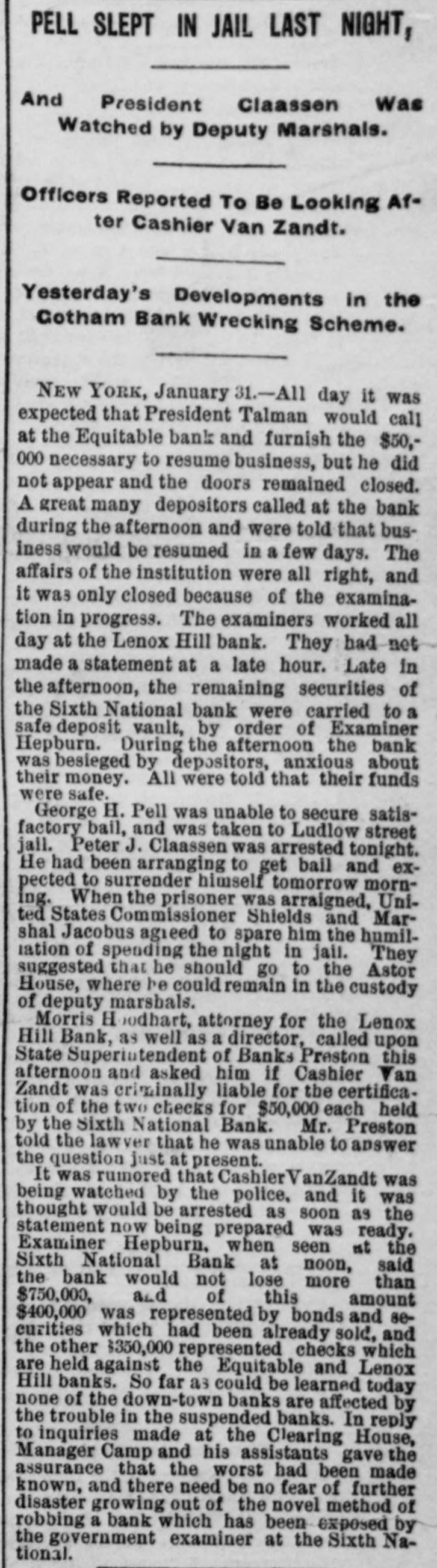
PELL SLEPT IN JAIL LAST NIGHT, And President Claassen Was Watched by Deputy Marshals. Officers Reported To Be Looking After Cashier Van Zandt. Yesterday's Developments in the Cotham Bank Wrecking Scheme. NEW YORK, January 31.-All day it was expected that President Talman would call at the Equitable bank and furnish the $50,000 necessary to resume business, but he did not appear and the doors remained closed. A great many depositors called at the bank during the afternoon and were told that business would be resumed in a few days. The affairs of the institution were all right, and it was only closed because of the examination in progress. The examiners worked all day at the Lenox Hill bank. They had net made a statement at a late hour. Late in the afternoon, the remaining securities of the Sixth National bank were carried to a safe deposit vault, by order of Examiner Hepburn. During the afternoon the bank was besieged by depositors, anxious about their money. All were told that their funds were safe. George H. Pell was unable to secure satisfactory bail, and was taken to Ludlow street jail. Peter J. Claassen was arrested tonight. He had been arranging to get bail and expected to surrender himself tomorrow morning. When the prisoner was arraigned, United States Commissioner Shields and Marshal Jacobus agreed to spare him the humilration of spending the night in jail. They suggested that he should go to the Astor House, where be could remain in the custody of deputy marsbals. Morris H odhart, attorney for the Lenox Hill Bank, as well as a director, called upon State Superiutendent of Banks Preston this afternoon and asked him if Cashier Van Zandt was criminally liable for the certification of the two checks for $50,000 each held by the Sixth National Bank. Mr. Preston told the lawver that he was unable to answer the question just at present. It was rumored that Cashier VanZandt was being watched by the police. and it was thought would be arrested as soon as the statement now being prepared was ready. Examiner Hepburn. when seen at the Sixth National Bank at noon, said the bank would not lose more than $750,000, and of this amount $400,000 was represented by bonds and securities which had been already sold, and the other $350,000 represented checks which are held against the Equitable and Lenox Hill banks. So far as could be learned today none of the down-town banks are affected by the trouble in the suspended banks. In reply to inquiries made at the Clearing House, Manager Camp and his assistants gave the assurance that the worst had been made known, and there need be no fear of further disaster growing out of the novel method of robbing a bank which has been exposed by the government examiner at the Sixth National.


Article from Wichita Eagle, February 2, 1890

Click image to open full size in new tab

Article Text

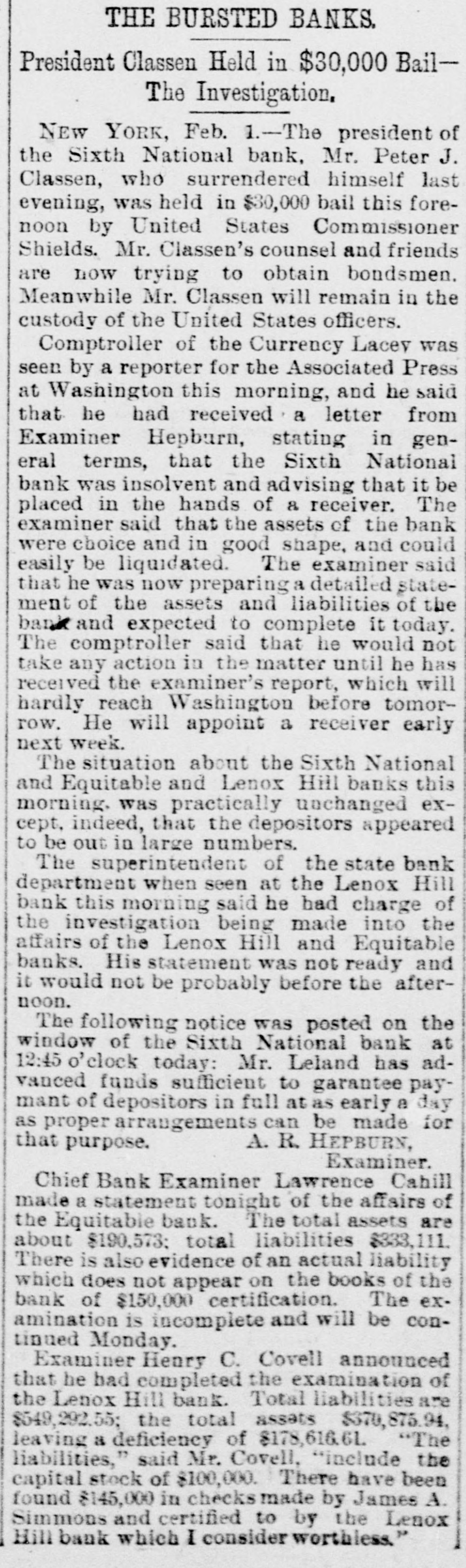
THE BURSTED BANKS. President Classen Held in $30,000 BailThe Investigation. NEW YORK, Feb. 1.-The president of the Sixth National bank, Mr. Peter J. Classen, who surrendered himself last evening, was held in $30,000 bail this forenoon by United States Commissioner Shields. Mr. Classen's counsel and friends are now trying to obtain bondsmen. Meanwhile Mr. Classen will remain in the custody of the United States officers. Comptroller of the Currency Lacev was seen by a reporter for the Associated Press at Washington this morning, and he said that he had received a letter from Examiner Hepburn, stating in general terms, that the Sixth National bank was insolvent and advising that it be placed in the hands of a receiver. The examiner said that the assets of the bank were choice and in good shape, and could easily be liquidated. The examiner said that he was now preparing a detailed statement of the assets and liabilities of the ban and expected to complete it today. The comptroller said that he would not take any action in the matter until he has received the examiner's report, which will hardly reach Washington before tomorrow. He will appoint a receiver early next week. The situation about the Sixth National and Equitable and Lenox Hill banks this morning, was practically unchanged except, indeed, that the depositors appeared to be out in large numbers. The superintendent of the state bank department when seen at the Lenox Hill bank this morning said he had charge of the investigation being made into the affairs of the Lenox Hill and Equitable banks. His statement was not ready and it would not be probably before the afternoon. The following notice was posted on the window of the Sixth National bank at 12:45 o'clock today: Mr. Leland has advanced funds sufficient to garantee paymant of depositors in full at as early a day as proper arrangements can be made for that purpose. A. R. HEPBURN, Examiner. Chief Bank Examiner Lawrence Cahill made a statement tonight of the affairs of the Equitable bank. The total assets are about $190,573: total liabilities $333,111. There is also evidence of an actual liability which does not appear on the books of the bank of $150,000 certification. The examination is incomplete and will be continued Monday. Examiner Henry C. Covell announced that he had completed the examination of the Lenox Hill bank. Total liabilities are $549,292.55; the total assets $370,875.94, leaving a deficiency of $178,616.61. "The liabilities," said Mr. Covell, "include the capital stock of $100,000. There have been found $145,000 in checks made by James A. Simmons and certified to by the Lenox Hill bank which I consider worthless."


Article from The Times, February 2, 1890

Click image to open full size in new tab

Article Text

The Wrecked Banks The Chief Conspirator Has Probably Escaped. NEW YORK, February 1.-One fact that appears most prominent to-day, amid the complex and not yet fully explained story of the wreck of three banks is the fact that the chief conspirator has probably escaped. Pell, the peddler of the stolen securities of the Sixth National Bank, and Claassen, the president of that institu tion, who is under arrect, seem now to have been only small partners of the boss conspirator. James A. Simmons. the contractor, who had many stupendous financial and contracting schemes on hands, has skipped, and SO has Wallack, the president of the ruined Lenox Hill Bank, and Pell's partner. Simmons is said to have been the chief manipulator of the scheme to get possession of the Sixth National Bank and that Claassen was hisagent. Simmons took 785 shares of the 1,035 purchased from President Leland. It is known that he has been pressed by his creditors for money, and the gutting of the Sixth National Bank is regarded as abold scheme for relief from his financial difficulties. THE EIGHTH STREET TUNNEL. One of Mr. Simmons, schemes was the Richmond Tunnel Construction and Rail. road Company, which is building a tunnel under Eighth street, in Richmond, Va. He was the manager of the company, and had charge of the finances, It was bonded for $1,500,000, and he claimed that nearly onehalf of the amount had been sold and used in constructing the work. Mr. Leland former president of the Sixth National Bank, has advanced funds sufficient to guarantee payment depositors in full at as early a date as proper arrangements can be made For a week past State Insurance Examiners Michael Shannon and John A. Horan have been examining into the condition of three insurance companies organized under the laws of this State, and doing business in this city on the assessment plan. If their surmises are true, the Guaranty Mutual, the Security Mutual, and the Mercantile Mutual, of this city, are practically insolvent. THE WASHINGTON CENTENNIAL The Plan and Scope Committee of the Washington Centennial celebration have voted the unexpected balance of the fund amounting to $4,741 in publishing a memorial volume detailing the'work done by the various committees. etc. Most of the members of the General Committee wish the, balance turned over to the arch fund, as the best possible way in which the centennial celebration could be perpetuated and the occasion commemorated. THE WORLD'S FAIR SCANDAL. The real secret of the World's Fair scandal is said to be that Depew and Belden have locked horns with Platt and Hiscock. That's the whole sum and substance of it. Platt's interference with the fair bill has raised a new difficulty. The question has been asked, "Can subscribers to the guarantee fund be compelled to make their subscriptions it they do not wish to do 80, in case Platt's men are added to the incorporators ?" The finance committee, under the terms of the subscription heading, has power to withhold the guarantee fund from the corporation formed if it 80 desires, and it was intimated to-day that such action would be taken it necessary. A trust among the hat manufacturers is being negotiated by a British syndicate. Last Tuesday evening, Cella Luther. fourteen years old, was sent out from her home in Delmonico place. Brooklyn, to buy a loat of bread at a baker's not half a block away. She has not since been seen or heard from Three years ago another girl disappeared almost this time of the year in this same neighborhood. RICHMOND TERMINAL There has been considerable talk about Richmond Terminal in Wall street for the past week in expectation of an advance The following figures were supplied the street by the parties in control: The company now controls 7.521 miles of road and water lines, an increase of 211 within the past year. Last year was the first in which the company had a surplus over fixed charges; in every year before that since its organizatian its interest charges and running expenses exceeded its income, and there were years in which its only income was the proceeds of loans That for the first time there is credit to the profit and loss account is due to the fact that the losses of previous years will be nominally offset by charging up $7,500,000 capital as full paid, although previously carried on the books as half paid. The net revenue for the past year was $668,356, the increase in the bonded debt $4,306,000, the decrease in the floating debt $1,199,193.84. and the net increase in the total debt $2,506,817.16. This net increase se in debt is recommended by an excess of o curities acquired over securities sold $4,175,930. It is probable that during the current yea k the floating debt of a little over $2,000,00 I net can be further reduced by the with drawal of some securities. The company has now left a comparatively small amount of securities which it could withdraw advantage. and it will require an expensive t development of the properties which it con d trols before their surplus earning power car . be largely increased. e or these the Virginia Midland is by fa to the most important. Although it now earn e, but little over its fixed charges, its busines th to is growing as fast as that of any road in e South, and it can hardly fail to keep o d doing so, for the Piedmont Air Line is th Id main trunk line of the South, and its equip P= ment has been largely added to and it 1. motive power largely increased during th past year by the demand of its in reasin it business. ed RZERY'GRIEF.


Article from Wheeling Sunday Register, February 2, 1890

Click image to open full size in new tab

Article Text

ANXIOUS DEPOSITORS. SITUATION OF NEW YORK BANKS. Comptroller of the Currency Interviewed. Officials Decline to TALK ABOUT THE MATTER. The Probable Arrest of the Conspirators. NEW YORK, February 1.-President Cleasen, of the Sixth National Bank, is being held on charges made by Bank Examiner Henburn. In an affidavit the Bank Examiner charged that "Peter J. Classen, president and director of the bank, did for the use, benefit and advantage of himself, unlawfully embezzle, abetract and willfully misapply large some of money and the funds and credita of the bank amounting in the aggregate to $432.466, with the intent to injure and defraud the Sixth National Bank of the City of New York. Comptroller of the Currency Lacy was seen by a reporter for the Associated Press at Washington this morning, and he said that he had received a letter from Ex. aminer Hepburn, stating in general terms that the bank was insolvent, and advising that be placed in the hands of a receiver. The examiner said that the assets of the bank were choice and in good shape, and could easily be liquidated. The examiner said also that he was DOW preparing a detailed statement of the assets f and liabilities of the band and expected to complette it to-day. The Comptroller said that he would take no action in the matter until he has received the examiner's report, which will hardlv reach Washington before to-moriow. He will appoint a e receiver early next week. 1 The situation about the Sixth National, I Equitable and Lenox Hill banks this f morning was practically unchanged excepting that the depositors appeared to be out in larger numbers. There are many business men among them who still indulged t in the hope that some turn might take p'ace which would parmit of their receiving money enough to pay off their creditors. The others held their ground, de termined that if the business men got any 7 money so would they, and as one young lady put it: "They would see that there e W&S no making fish of one and flesh of ane other." I The Superintendent of the State Bank Department, when seen at the Lenox Hill r Bank this morning, said he had charge of the investigation being made into the affairs of the Lenox Hill and Equitable banks. His statement was not ready and it would not be probably before the afternoon. With regard to the probable arrest of the cashiers of the Lenox Hill Bank and the Equitable, Mr. Preston declined to express an opinion. In reply to a number of questions as to whether or not Mr. Preston bad discovered any additional irregularities, since yesterday, Mr. Preston e declined to say. The following notice was posted on the window of the Sixth National Bank at a quarter to twelve e o'clock. 1 "Mr. Leland has advanced funds suffi0 cient to guarantee payment of depositora in full at as early a date 38 proper arrangements can be made for that purpose. [Signed] A. R. HEPBURN, Examiner. Later in the day Mr. George H. Pell was brought down to the U. S. Building from Ludlow street jail. Counsel for Pell, ex-Judge Donahue, says that he will make 1 & motion for a reduction of bail before Commissioner Shielda this afternoon.


Article from New-York Tribune, February 2, 1890

Click image to open full size in new tab

Article Text

WHAT CONTROLLER LACEY SAYS. Washington, Feb. 1.-Mr. Lacey, Controller of the Currency, said this morning that the newspapers contained a great deal more information than he possessed in regard to the affairs of the Sixth National Bank of New-York City. He had been, he continued. in constant communication with Bank Examiner Hepburn up to the time the latter took charge of the affairs of the bank; but since then he had heard little from the Examiner. Mr. Lacey added that Mr. Hepburn was not likely to make a report on the subject until he had completed his examination. The bank was now in the hands of the Government, and there was no particular necessity for haste. The Controller said De received a telegram from Examiner Hepburn soon after the suspension saying that the latter had protected the maturing paper of the bank, and he had received a letter from Mr. Hepburn in this morning's mail saying in general Terms that the bank was insolvent and advising that 1t be placed in the hands of a receiver. The Examiner said that the assets of the bank were choice and in good shape, and could easily be liquidated. The Examiner added that he was now preparing a detailed statement of the assets and llabilities of the bank. The Controller said he would take no action in the matter until he received the Examiner's report, which will hardly reach Washington before to-morrow. He will appoint a receiver early next week.


Article from The Morning News, February 4, 1890

Click image to open full size in new tab

Article Text

GOTHAM'S CLOSED BANKS. THE SIXTH NATIONAL AUTHORIZED TO RESUME. Mr. Leland Re-elected to its Presidency and Pays in $280,000-The State Authorities Prevent a Resumption at the Equitable, Though it is Ready to do So. NEW YORK, Feb. 3.-As early as 10 o'clock this morning there were at least 200 angry depositors of the Lenox Hill Bank around that structure. The fact that the bank statement of the bank examiner was not forthcoming as promised caused additional discontent. Many of the depositors formed themselves into groups and harangued each other on the situation. The all around inclination seemed to be that the depositors must act. In a short time three distinct factions called as many special meetings, but after a while it was thought better to hold but one meeting, which was soon in session. The depositors to-day were not at all as good humored as they had been on the preceding days, as their hopes had descended to despair. Broker Pell left Ludlow street jail at 10 o'clock for the United States building, to await the result of the hunt of his friends for bail, or a motion to have it reduced. THE EQUITABLE NOT OPENED. It was expected that the Equitable Bank would be opened this morning, but there was a bitch in the proceedings. Atan early hour the cashier of the bank and the clerks were on the sidewalk, as well as a number of depositors with their bank books and checks. Examiner Trenholm stood behind the iron gate and refused admittance to everybody. The cashier of the Western National Bank drove up to the Equitable and stood for some time talking with Mr. Trenholm, but Mr. Trenholm told him that he (Mr. Trenholm) was acting under the orders of the attorney general of the state and could not let anybody into the bank without a written order. A MAN WITH MONEY KEPT OUT. At about 11 o'clock President Jordan of the Western National Bank came to the bank with a large satchel. which contained cash to pay off the depositors, but he was refused admittance by Mr. Trenholm. He tried to convince the latter that his object was to furnish the necessary money to pay the depositors and put the bank on its feet again, but failed to get in, and went away in anything but an amiable frame of mind. Shortly afterward Jacob Tallmann, president of the Equitable, and S. T. Meyer walked up to the door of the bank and protested against the action of Mr. Trenholm. Mr. Meyer said that the state authorities were exceeding their authority in the whole matter. He declared that they were trying to hinder the stockbolders from opening the bank, and that they were too anxious to have a receiver appointed and give some politician a position. He alleged that he and Mr. Tallman were ready to pnt up the money to pay off the depositors on Friday last at 10:45 o'clock, as they had agreed, but said that Mr. Trenholm had refu ed to allow it. On being asked as to the last statement, Mr. Trenholm said that it was false. CONDITION OF THE BANK. In an interview Mr. Jordan said the position of affairs at the Equitable bank was now excellent. The cancellation of $150,000 in certified checks which had been given in payment of the missing bonds and the payment of its over-drafts had reduced the liabilities of the bank to $31,000, of which $16,000 is held by the directors and their friends, leaving $150,000 due to depositors. To pay this amount there is $150,000 assets. The bank was amply able to continue its business if it should be permitted by the state authorities to do so, and Mr. Jordan believed that the necessary consent would be obtained to-day, and the bank be open for business to-morrow morning. The Sixth National Bank to-day elected a new boardof directors and restored Mr. Leland to the presidency. Mr. Leland paid into the bank $280,000, and it has been authorized to resume business. Bank-wreckers Claassen and Pell spent most of the day in the office of the United States marshal, waiting for bail. They were visited by several friends and their counsel but did not bail


Article from Daily Republican, February 4, 1890

Click image to open full size in new tab

Article Text

Losses Made Good. WASHINGTON, D. C., Feb. 4.-The Comptroller of the Currency yesterday morning received a telegram from Bank Examiner Mepburn saying that the funds cupplied by ex-President Leland had made good te impaired capital of the Sixth National Bank of New York, and that the bank is now solvent. This will do away with the necessity of appointing a receiver to wind up the affairs of the bank. The amount paid in by Leland yesterday morning was $280,000, the deficiency to be covered being $279,33%.


Article from Smyrna Times, February 5, 1890

Click image to open full size in new tab

Article Text

News Items. A National Convention of Colored Men is in session in Washington. York The County Democracy of New form. is going for Cleveland and reThe the grippe has reached the in Northwest and the Indians reserves are simply terrorized. Rapid progress is being made on new cruiser Philadelphia. Her the engines will be tried about March 1. Rev. Dr Talmage has returned from his trip to the Holy Land with a ner-stone for his new Brooklyn Taber- cornacle from Mount Calvary. As a result of a conference held between bankers and lawyers, a comprowill mise was effected, which, it is expected result in the Sixth National Bank of New York resuming business totors. morrow under the old board of direcEleven people were killed, and two fatally and nine others seriously injured in a tenement house fire in the North end of Boston, a flaming stairway cutting off all egress to the street and from compelling the inmates to jump the windows to escape the flames and smoke. Buenos Ayres has been for nearly two if years on the edge of a panic, and the large failure just announced is confirmed, the world is likely to the Argentine Confederation in d finan- see cial convulsion, like that in this country in 1837. The confederation has been passing through a like period of land speculation, paper money and vast public improvements.


Article from Wheeling Register, February 6, 1890

Click image to open full size in new tab

Article Text

Both Banks Running. NEW YORK, February 5.-There was nothing to indicate this morning that there had been any trouble with either the Sixth National or Equitable banks. The regular business of both institutions had been resumed and the only feature to at. tract attention was the meager business being transacted.


Article from Delaware Gazette and State Journal, February 6, 1890

Click image to open full size in new tab

Article Text

SIXTH AVENUE IS SOLVENT. WASHINGTON, Feb. 3.-Comptroller of the currency Lacey received a telegram this morning from Bank Examiner Hepburn saying that the funds supplied by ex. ex-Presidant Leland has made good the impaired capital of the Sixth National Bank of New York. and that the bank is now solvent. This will of course do away with the necessity of appointing & receiver to wind up the affairs of the bank.


Article from The Stark County Democrat, February 6, 1890

Click image to open full size in new tab

Article Text

WOOSTER, On Jan. 81,-Karl Merz, di rector of the musical department Wooster University, died yesterday after noon at 4:20 o'clock of pneumonia, H was taken down on Saturday with grippe, which rapidly developed into the fatal disease, Neither of his children, Dr Charles H. Merz, of Sandusky and Mis Bessie Merz, of St. Charles, Mo., were a home. His sudden death has caused profound sensation. COLUMBUS, Jan. 81,-[Special.]-The verdiet of the coroner's jury on the five victims of the recent gasexplosion charges it was due to gross negligence of the con tractor, J. C. Gibney, in leaving one joint in the pipes uncalked. ST. LOUIS, Mo., Jan. 31,-[Special.] Mrs. Nora Dunn of this city and Captain James Cargbett of Gardner, Maine, were remarried here this morning after a seperation of 45 years. He married her near ly half a century ago at Gardner, Maine, and then went to sea, He was reported lost. She married again. After a long time he returned and married again. Her husband and his wife have since died. Both are very wealthy. NEW YORK, ner Hessburn is still in possession of the Sixth National Bank. No receiver has yet been appointed. The numbers on the bonds missing from the bank cannot be ascertained as no entry was made on the books. If nothing can be collected from the protested notes the total loss will be about $750,000. It is believed that President Classen, of the Sixth National, and President Walter, of the Lenox Hill bank, have both skipped. LONDON, Jan. 81.-1 Special. ]-The French Line steamer La Normandie, from Havre for New York, January 25, was sighted three days later in 49 degrees northern latitude 23 degrees west longitude with her machinery partly disabled. She did not signal for assistance. COLUMBUS, Jan. was no trouble in the senate this morning. President pro tem Adams took the chair in the absence of Lieut. Gov. Marquis. Lampson did not try to take the chair as he said he would last night. Later he left for his home in Asthabula. KANSAS CITY, Mo., Jan. 31 [Special.] During his absence from home last evenmasked burglars bound and gagged the wife of Charles Roonan on Mercier street. They tied her by the neck to a bedpost and then robbed the house. The woman is in a precarious condition. Not much booty was secured. SAN FRANCISCO, Jan. 31.-[Special.]The amount realized from the sale of single season tickets to the Patti opera season, of two weeks, aggregated $25.000. This, with the amount realized from the box sales, makes a total of $34,000. CHARLESTON, West Va., Feb. 1,-[Spe cial.]-Delegate Horr, of the Union-Labor party created a great sensation here today in the Legislative Court investigation involving the question of the election of Governor, by filing a written statement that he had been offered a bribe of $1,800 and the State Mine Inspectorship, if he would vote for Goff (Rep for Governor of West Virginia. The affair has created a most profound sensation, as Horr in believed to be an honorable man. An investigating committee of five has been appointed to hunt the rascals down. WASHINGTON, Feb. 1. Special. World's Fair Committee of the Housemet to-day and concluded two bills as proposed by the sub-committee, and while they did not complete the work, they progressed sufficiently to show that two bills will be reported. One making no appropriation and leaving the place for holding the Exposition blank, to be filled by the House, and the other making an appropriation and providing for holding the Exposition at Washington. WASHINGTON, February [Special.] There was a great crowd at the Capitol to-day. The House galleries filled early and the crowd overflowed into the corridors of the main floor. On the conclusion of the reading of the Journal McKinney moved its approval and pending that motion Springer of Illinois moved an adjournment and demanded a roll call on his motion. It is evident the Democrats intend to continue yesterday's tactics. The motion to adjourn was defeated yeas 135, nays 158. WICHITA, Kan., Feb. 1.-[Special.]George Black, a young man doing business here, became violently insane, a raving maniac, yesterday and attacked his sister with a poker inflicting probably fatal injuries. He thenattacked his brother-inlaw injuring him so that he will die. He was arrested only after a terrible fight with the officers. LOUISVILLE, Ky., Feb. 1.-[Special.] Bill Nye, the humorist, and James Whitcomb Riley, the poet, havedissolved partnership, owing, it is said, to the convivial habits of the latter. Riley broke loose on a bender yesterday and he has since been in a dazed condition. YOUNGSTOWN, Jan. 31.-The series of meetings being held here under the auspices of Evangelist C. H. Yatman have been very successful, and $40,000 of the which he started out to raise for building for the Young Men's Christian Association has already been subscribed. WASHINGTON, Feb. 1.-[Special.]-ExSergeant-at-Arms Leedom has received a dispatch from the Mayor of Gerrelbonne, Canada, denying that Silcott is or has been in that place as reported. KANSAS CIUY, Feb. 1,- Special.]-The plant of the Kansas City Packing and Provision house was destroyed by fire last night. The loss is $200,000, insurance $300,000. WASHINGTON, Feb. 1.-[Special.]-The condition of Mrs. Coppinger, Secretary Blaine's daughter, is reported greatly improved to-day, and she will probably recover. WASHINGTON, Jan. 31.-The Washington Post, the Republican newspaper of the capital, edited by Frank Hatton, the Postmaster General of a former Republican administration, has a double-leaded leading editorial in which it calls loudly for precisely what the Democrats in the House of Representatives have been calling for, namely, rules of procedure. Under the heading, "Report the Rules," the editorial says: There is one way out of the disgraceful tangle in which the House found itself yesterday, and that is for the committee charged with the duty of formulating the rules for the government of that body to make a prompt report. Rules are what is needed-rules that give to the majority every right it is entitled to, and rules that protect to the fullest extent the rights of the minority. Until this is done there is little show for the harmonious and effective prosecution of public business. Precedents, to apply to the House of Representatives, should be found inside and not outside of that body. The country at large has rights in this controversy that rise superior to the wild and frantic antics of partisanship. The people know what is right, aud they will be satisfled with nothing short of what is right. Let the rules be reported. Let them be fair and just to both majority and minority. The sooner this is done the more creditable it will be


Article from The Desmet Leader, February 8, 1890

Click image to open full size in new tab

Article Text

To Pay the Depositors. The president of the Sixth National bank of New York city, Peter J. Claas sen, was beld in $30,000 bail by Unit ed State Commissioner Shields in default of which he was committed to jail. He is being held on charges made by Bank Examiner Hepburn, who makes afiidavit that Claaser has embezzled $432,466 of the funds of the Sixth National bank. A dispatch from Washington says the controller of currency, upon receipt of Mr. Hepburn's report, appointed a receiver for the bank. President King, of the Union Trust company, says that Mr. Leland, the former president of the bank, has placed a blank check in his hands, which he has filled out for $500,000, as a guarantee to a syndicate, who will take the assets of the bank and pay the depositors in full, after that the rights of the minority stockholders will be considered. Chief Bank Examiner Cahill has furnished the press with a statement of the affairs of the Equitable bank. The assets are $151,000 of commercial paper of uncertain value, $30,000 in Sixth National bank stock of uncertain value, and a few minor items. total, $190,000. The liabilities are: Deposits, $30,000; due to other banks, $198,000; capital, $100,000, and a few other items total, $333.000. The deficiency is therefore $143,000; but there is also evidence of a liability of $150,000 in certifications which do not appearon the books. The examination is not yet complete. Examiner H. C. Covell also issued a statement of the Lenox Hillbank It shows total liabilities, $549,29s;total assets $370,665, deficiency $178,617. Mr. Covell thinks depositors will get 70 per cent. of thier claims. Bank Examiner Preston says no forgeries have yet been discovered in the investigation of the two banks.


Article from The Ketchum Keystone, February 8, 1890

Click image to open full size in new tab

Article Text

THE sixth National Bank of New York, which was considered one of the soundest and best banks of the city, has been placed in the hands of a receiver. It is stated that the first move towards a steal by the new president, who went into office only a few days ago, was by his attempting to dispose of $622,000 of the bank's securities, consisting of gilt-edged bonds of a market value of over $800,000. All but $250,000 of these bonds have been sold, and where the money has gone to is yet unknown. The president and his broker have been arrested, and failing to give the required bail, are at last accounts resting behind the bars of the Ludlow street jail.


Article from St. Johnsbury Caledonian, February 13, 1890

Click image to open full size in new tab

Article Text

THE WRECKING OF A BANK. The wrecking of the Sixth National bank of New York and the consequent downfall of two smaller state banks, illustrate, in a way as startlingas it is disagreeable, the rapidity and completeness with which, despite our carefully drawn banking laws, the property of stockholders and depositors of a bank may be ruthlessly sacrificed when once it comes under the control of greedy and unprincipled officers. In this case the method of wrecking was as novel as it was bold. The president of the bank was induced to part with his stock, he holding a controlling amount, at a high price, to a set of men who seem to have deliberately planned to appropriate the bank's funds. Not having capital enough to pay for the stock, they persuaded smaller banks which they controlled to falsely certify checks. As soon as Mr. Leland, the former president, received his price for the stock, he turned over securities to a large amount to the new president, Claassen, who promptly handed over all these securities to his confederate, a broker named Pell, who at once sold or pledged them, and used part of the proceeds to cover the checks paid to Mr. Leland. What became of the balance is what the courts must determine. When the bank examiner, learning these facts, took possession of the bank and demanded the return of the securities, he was handed, instead, worthless checks drawn by the confederateso the smaller banks, which at once refused payment and suspended. Opinions differ as to the responsibility of Mr. Leland in the matter, many holding that the circumstances were such as should have awakened his suspicions that his action imperiled the interests of his fellow-stockholders: but it is quite clearfrom his subsequent course that he was not in actual collusion with the wreckers, for he has since come forward and guaranteed the depositors from loss. As to Claassen and Pell, no question exists about their intentions, and they are at present in prison with Ives and Stayner. Through Mr. Leland's provision and the service of five banks, which have been guaranteed from loss by Mr. Leland, the Sixth National has been reorganized and reopened. The entire incident suggests the danger of one man holding absolute control over a great public institution, and the responsibility of men so placed to assure themselves of the integrity as well as the business "smartness" of those with whom they hold large dealings.-[Christian Union.


Article from Crawford Avalanche, February 13, 1890

Click image to open full size in new tab

Article Text

# A Bank Wrecker Out on Bail. P. J. Claasen, accused of causing the suspension of the Sixth National Bank of New York, has been released on $30,000 bail.


Article from The Telegraph-Courier, February 13, 1890

Click image to open full size in new tab

Article Text

A Bank Wrecker Out on Bail. P. J. Claasen, /accused of causing the suspension of the Sixth National Bank of New York, has been released on $30,000 bail.


Article from New-York Tribune, February 14, 1890

Click image to open full size in new tab

Article Text

CHARLESH. LELAND'S LOSSES HOW HE COMES OUT OF, THE BANK TROUBLES. A STATEMENT SENT TO THE NEWSPAPERS FROM THE SIXTH NATIONAL BANK. What purported to be an official statement of the affairs surrounding the transactions which caused the temporary suspension of the Lenox Hill, the Equitable and the Sixth National banks was prepared yesterday and sent from the Sixth National Bank, of which Charles H. Leland is president, to various newspapers. The statement lacks just the points of interest which the public, the minority stockholders and the depositors in these three institutions have been eagerly looking for since publicity was first given to the troubles of these banks. It does not tell much of how, when and where any plans for the settlement were made. When A. B. Hepburn, the National Bank Examiner, closed the doors of the Sixth National Bank. he announced a deficiency of $676,311 03. This was made up by certified checks amounting to $382,000. representing abstracted securities; $180,000 in loans considered worthless; Lenox Hill Bank overdrafts. $78,101 03: and other overdrafts and items amounting to $36,210. Mr. Leland paid in $620,000 in cash to make this good, giving a guarantee that he would be responsible for the balance, $56,311 03, if necessary. He received the checks for $382,000 worth of securities, five of which, in accordance with their certification, were obligations of the Lenox Hill and Equitable banks. They amounted to $250,000. These checks, with $200,000, were given to get back the 1,035 shares of Sixth National Bank stock which Mr. Leland sold to the Claassen-Pell syndicate. This was done through an arrangement with Conrad N. Jordan. president of the Western National Bank. These checks were not used against the Lenox Hill or the Equitable Bank, but were cancelled in accordance with the agreement between Messrs. Jordan and Leland. The balance of the $382,000 was made by checks of Pell. Wallack & Co. on the Third National Bank for $27,000; James A. Simmons on the Commercial National Bank for $40,000, and one on the American Loan and Trust Company for $25,000. and George H. Pell on the St. Nicholas Bank for $40,000. The statement figures up Mr. Leland's financial position now as follows: Received for 1,005 1-2 shares Sixth National Bank stock, $653,575; against this $620,000 was paid to make up the deficiency and $200,000 for the return of the stock. to which may be added $56,311 the amount guaranteed. These figures make Mr. Leland's present actual loss $166,425, and possible loss $222,736.03. Of $310,500 of certified checks of the Lenox Hill Bank the National Bank Examiner recognized $109,000 as a claim against the Sixth National Bank, because it was the Clearing House agent for the Lenox Hill. Collateral security of the Lenox Hill Bank on which $53,500 was realized was held by the Sixth National. The balance was included in the deficiency made good by Mr. Leland. The holders of the certified checks settled their claims for $109,000, which amount was paid to the Western National Bank by the Sixth National Bank, and the checks were destroyed in the presence of Charles M. Preston, State Superintendent of Banks. It is argued now that the Claassen-Pell syndicΓ’te is ronsiderably ahead on the transactions. From the abstracted bonds $382,000 was realized; $180,000 in loans from the Sixth National Bank was obtained, and practically the capital of both the Lenox Hill and the Equitable banks went to them. But against this must be placed the amount paid to Mr. Leland for his 1,035 shares of stock. At the Sixth National Bank yesterday nothing could be obtained from the vice president as to the value of the securities still missing. It was learned from another source that all within a few thousand dollars of the entire amount of the securities were in the bank's vaults, and that the remainder would probably be returned by this morning. Judge Donohue, counsel for George H. Pell, appeared before Commissioner Shields yesterday at the hour set for the examination in Pell's case. DistrictAttorney Mitchell desires to finish Claassen's examination first, and the hearing in the case against Pell was adjourned to next Thursday. President Jordan, of the Western National Bank, will probably testify to-day in the examination on the charge against Claassen and will tell how many of the bonds taken from the Sixth National Bank have been returned to that institution.


Article from The Abbeville Press and Banner, February 19, 1890

Click image to open full size in new tab

Article Text

THE NEWS EPITOMIZED. Eastern and Middle States. THE first annual meeting and banquet of the United States Navy Veteran Association has been held at Boston. Admiral Porter was elected Commander. THE Sixth National Bank in New York city has been closed by the United States Bank Examiner and thrown out of the Clearing House; the Equitable Bank is in the hands of a State Bank Examiner, and its checks have gone to protest; and the Lenox Hill Bank has suspended. All these institutions lately came under the control of a clique, of which one P. J. Claassen was the head. Warrants were out for the arrest of Claassen, who was illegally elected President of the Sixth National, and George H. Pell, a broker. Depositors will lose no money probably, but stockholders will. About $700,000 were misappropriated. THE debate in the New York Presbytery on the revision of the Confessional of Faith was closed by a lively tilt between Dr. Hall on one side and Dr. Hastings on the other. WHILE Frank B. Wilson and Benjamin Townsend were fooling with a revolver at New Brighton, Penn!, Wilson's brains were blown out. The boys were sixteen years old. Townsend was a son of Congressman Townsend. DURING the dress parade of the school regiment at the Latin school, Boston, when an American flag was presented, five of the young boy soldiers fainted in the ranks and were carried off by their comrades. A TRAIN wreck occurred six miles from Lancaster, N. H. The engineer, L. F. Crouch, was killed, and the fireman and brakeman badly injured. A STATEMENT signed by Edward King, President of the Union Trust Company, annonnced that Charles H. Leland, ex-President of the Sixth National Bank, of New York city, made arrangements by which the bank would resume business. DANBURY, Conn., had the most destr nctive fire in the history of the place. Several Wocks of stores were destroyed and many t nants had narrow escapes. Explosions occurred during the fire. Loss, about $300,000. THE steamer Waseland had a rough passage to New York from Antwerp. Her fourth officer and a quartermaster were swept overboard and lost. ALFRED BROWN, a "professor of medicine," at Westchester, Penn., was convicted of practicing medicine without a diploma and using incantations and "voudoo" methods, and sentenced to three years' imprisonment and $70 fine. REV. T. DE WITT TALMAGE, the noted Brooklyn divine, has returned from his pilgrimage to the Holy Land. HON. SETH Low, ex-Mayor of Brooklyn, was installed eleventh President of Columbia College at the Metropolitan Opera House in New York, with impressive ceremonies. THE Gloucester fishing schooner Alice M. Stouple was reported lost at sea with a crew of fourteen souls. THE New York Presbytery, by a vote of 93 to 43, accepted the report by the special committee in favor of revision of the Confession of Faith. THE New England Agricultural Society met at Boston. GENERAL JOHN D. ANDERSON, of Augusta, Me., has been elected Commander G. A. R., Department of Maine.