Bank suspended June 23, 1893; reopened Aug 29 with limited payouts and later went into receivership/liquidation in 1894.
Events (4)
1.June 23, 1893Suspension
Cause
Local Banks
Cause Details
Suspension followed the Pacific Bank's failure/clearing-house refusal and shortage of coin to meet the anticipated run.
Newspaper Excerpt
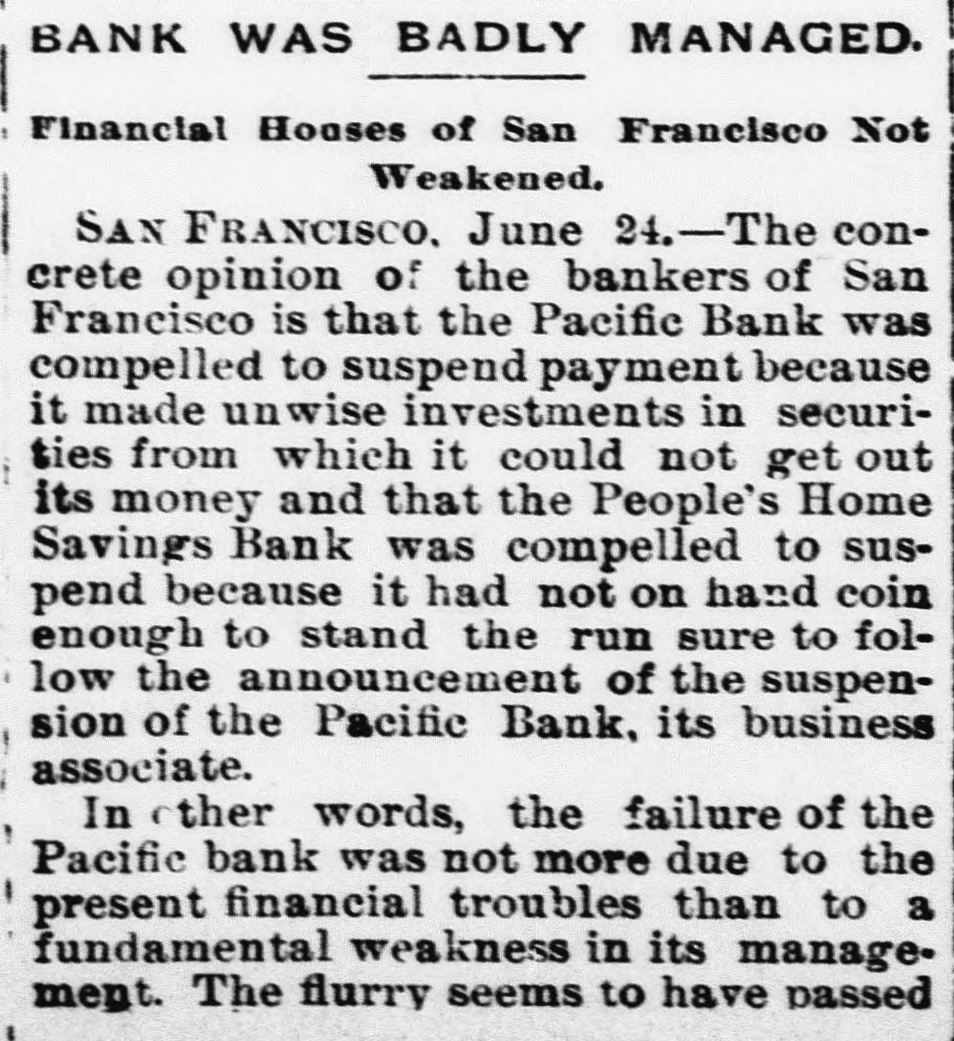
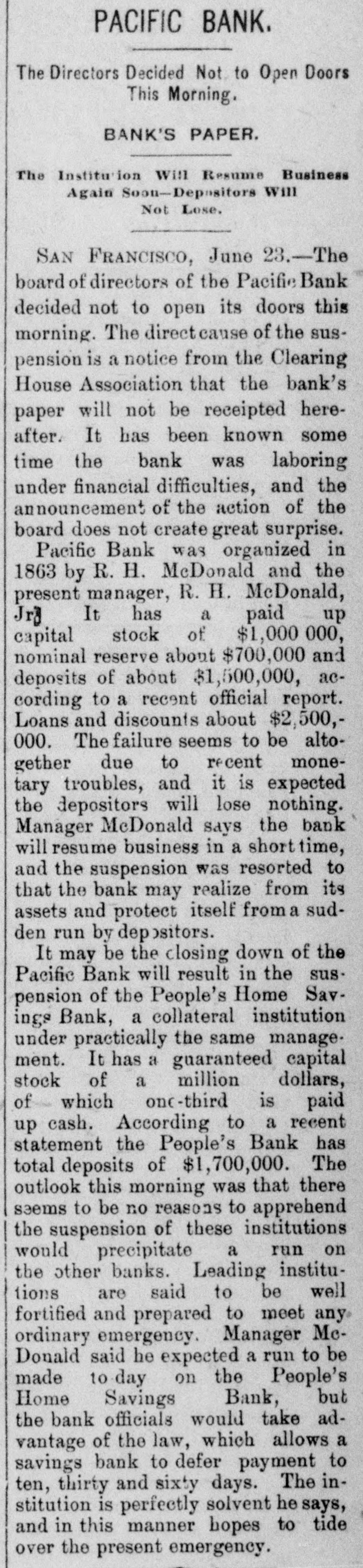
It may be that the closing of the doors of the Pacific Bank will result in the suspension of the People's Home Savings Bank, a collateral institution under practically the same management.
Source
newspapers
+67 days
2.August 29, 1893Run
Cause
Local Banks
Cause Details
Depositors rushed to withdraw when the bank reopened after the June suspension tied to the Pacific Bank failure.
Measures
Paid out only 2% of deposits to avoid a run; limited teller staffing and controlled entry.
Newspaper Excerpt
As early as 7 o'clock people with passbooks ... began to gather in front of the banking-house ... A bunch of depositors rushed in. ... During the day 110 cus-
Source
newspapers
same day
3.August 29, 1893Reopening
Newspaper Excerpt
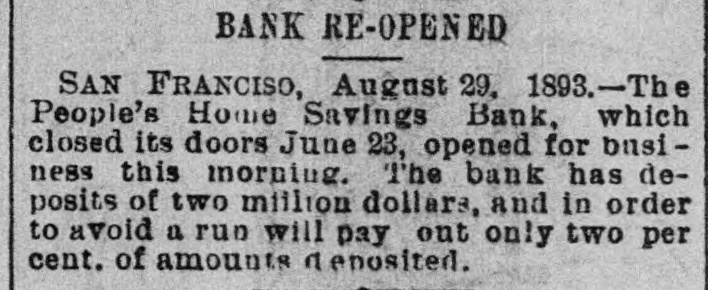
The People's Home Savings Bank, which closed its doors June 23, opened for business this morning. The bank has deposits of two million dollars, and in order to avoid a run will pay out only two per cent. of amounts deposited.
Source
newspapers
+8 months
4.May 2, 1894Receivership
Newspaper Excerpt
On May 2, 1894, after my appointment as receiver by the court in the suit brought by the Attorney-General and the Bank Commissioners, there was found in the vaults of the bank ... General Sheehan was appointed receiver of the bank
Source
newspapers
Newspaper Articles (22)
1.June 23, 1893The Record-UnionSacramento, CA
Click image to open full size in new tab
Article Text
PACIFIC BANK. The Board of Directors Decide Not to Open Its Doors To-Day. SAN FRANCISCO, June 22.-At a meeting of the Board of Directors of the Pacific Bank to-night it was decided not to open the doors to-morrow. The direct cause of the suspension is notice from the Clearing-house Association that the bank's paper would not hereafter be accepted. It has been known for some time that the bank was laboring under financial difficulties, and the announcement of the action of the board does not create great surprise. The Pacific Bank was organized in 1863 by R. H. McDonald, and its present manager is R. H. McDonald, Jr. It has a paid-up capital stock of $1,000,000, a nominal reserve of $700,000 and deposits of about $1,500,000, according to the recent official report to the State Bank Examiners. Its loans and discounts are said to be about $2,500,000. The failure seems to be altogether due to the recent monetary troubles, and it is expected that the depositors will lose nothing. Manager McDonald says that the bank will resume business in a short time, and that the suspension is resorted to that the bank may realize from its assets and protect itself from a sudden run by depositors. It may be that the closing of the doors of the Pacific Bank will result in the suspension of the People's Home Savings Bank, a collateral institution under practically the same management. It has a guaranteed capital stock of $1,000,000, of which one-third is paid up in cash. According to a recent statement of the bank, it has over 10,000 depositors, and total deposits of $1,700,000. Its assets consist of real estate, county and school district bonds and SO forth. The depositors probably will be paid all. There seems to be no reason to apprehend that the suspension of these institutions will precipitate a run on other banks. The leading institutions are well fortified and prepared to meet any ordinary emergency. R. H. McDonald, Jr., to-night said he expected a run would be made to-morrow on the People's Home Savings Bank, in consequence of the closing of the Pacific Bank, but the bank officials would take advantage of the law which allows savings banks to defer payment ten, thirty and sixty days. The institution is perfectly solvent, he said, and in this manner he hopes to tide over the present emergency.
2.June 23, 1893The HeraldLos Angeles, CA
Click image to open full size in new tab
Article Text
A SAN FRANCISCO SUSPENSION. The Pacific Bank Temporarily Closes Its Doors. SAN FRANCISCO, June 22.-At a meeting of the board of directors of the Pacific bank tonight it was decided not to open the doors tomorrow. The direct cause of the euspension is a notice from the clearing house association that the bank's paper would not hereafter be accepted. It had been known for some time that the bank was laboring under financial difficulties, and the announcement of the action of the board does not create great surprise, The Pacific bank was organized in 1863 by R. H. McDonald, and its present manager is R. H. McDonald, jr. It has a paid-up capital stock of $1,000,000, a nominal reserve of about $700,000, and deposits of about $1,500,000, according to the recent official report of the state bank examiners. Its loans and diecounts are said to be about $2,500,000. The failure seems to be altogether due to the recent monetary troubles, and it is expected that the depositors will lose nothing. Manager McDonald says that the bank will resume business in a short time, and that the suspension is resorted to that the bank may realize from its assets and protect itself from a eudden run by depositors. It may be that the closing of the doors of the Pacific bank will result in the suspension of the People's Home Savings bank, a collateral institution under practically the same management. It has a guaranteed capital stock of $1,000,000, of which one-third is paid up in cash, According to a recent statement of the bank, it has over 10,000 depositore and total deposits of $1,700,000. Its assets consist of real estate, county and school dietrict bonde, etc. The depositors probably will be paid in full. There seems to be no reason to apprehend that the suspension of these institutions will precipitate a run on other banks. The leading institutions are well fortified and prepared to meet any ordinary emergency. R. H. McDonald, jr., tonight said he expected a run would be made tomorow on the People's Home Savings bank, in consequence of the closing of the Pacific bank. But the bank officials would take advantage of the law which allows savings banks to defer payment 10, 30 and 60 days. The institution is perfectly solvent, he said, and in this manner hopes to tide over the present emergency.
3.June 24, 1893Evening StarWashington, DC
Click image to open full size in new tab
Article Text
Caused by Unwise Investments. SAN FRANCISCO, June 24.-The opinion of the bankers of San Francisco was that the Pacific Bank was compelled to suspend because it made unwise investments in securities from which it could not get its money, and the People's Home Savings Bank was compelled to suspend because it had not on hand coin enough to stand the run sure to follow the suspension of the Pacific Bank, its business associate. The flurry seems to have passed in this city and no anxiety is felt that other banks will succumb. Bankers say they have ample funds to meet all demands.
4.June 29, 1893The Russellville DemocratRussellville, AR
Click image to open full size in new tab
Article Text
PACIFIC BANK. The Directors Decided Not to Open Doors This Morning. BANK'S PAPER. The Institution Will Resume Business Again Soon-Depositors Will Not Lose. SAN FRANCISCO, June 23.-The board of directors of the PacificBank decided not to open its doors this morning. The direct cause of the suspension is a notice from the Clearing House Association that the bank's paper will not be receipted hereafter. It has been known some time the bank was laboring under financial difficulties, and the announcement of the action of the board does not create great surprise. Pacific Bank was organized in 1863 by R. H. McDonald and the present manager, R. H. McDonald, Jrg It has a paid up capital stock of $1,000 000, nominal reserve about $700,000 and deposits of about $1,500,000, according to a recent official report. Loans and discounts about $2,500,000. The failure seems to be alto. gether due to recent monetary troubles, and it is expected the depositors will lose nothing. Manager McDonald says the bank will resume business in a short time, and the suspension was resorted to that the bank may realize from its assets and protect itself from a sudden run by depositors. It may be the closing down of the Pacific Bank will result in the suspension of the People's Home Savings Bank, a collateral institution under practically the same management. It has a guaranteed capital stock of a million dollars, of which one-third is paid up cash. According to a recent statement the People's Bank has total deposits of $1,700,000. The outlook this morning was that there seems to be no reasons to apprehend the suspension of these institutions would precipitate a run on the other banks. Leading institutions are said to be well fortified and prepared to meet any ordinary emergency. Manager McDonald said he expected a run to be made to day on the People's Home Savings Bank, but the bank officials would take advantage of the law, which allows a savings bank to defer payment to ten, thirty and sixty days. The institution is perfectly solvent he says, and in this manner hopes to tide over the present emergency.
5.June 30, 1893Iowa County DemocratMineral Point, WI
Click image to open full size in new tab
Article Text
BANK WAS BADLY MANAGED. Financial Houses of San Francisco Not Weakened. SAN FRANCISCO, June 24.-The concrete opinion of the bankers of San Francisco is that the Pacific Bank was compelled to suspend payment because it made unwise investments in securities from which it could not get out its money and that the People's Home Savings Bank was compelled to suspend because it had not on hand coin enough to stand the run sure to follow the announcement of the suspension of the Pacific Bank, its business associate. In ther words, the failure of the Pacific bank was not more due to the present financial troubles than to a fundamental weakness in its management. The flurry seems to have passed
6.August 13, 1893The Morning CallSan Francisco, CA
Click image to open full size in new tab
Article Text
A Receiver for the Hom Savings Bank. THE ORDER IS SUSPENDED A Petition by the Stockholders o Which J. E. Farnum Was Appointed Temporarily. J. E. Farnum was appointed temporar receiver of the People's Home Saving Bank by Judge Sanderson at 11 o'cloc yesterday morning, service being mad 4 P. M. on a complaint signed by Directo Joseph Winterburn and Stockholders Wi liam H. Barnes, E. H. Knight, R. D. Rol bins, W. I. Wilson and Louis Corriveat and an order was entered citing the de fendants, the People's Home Savings Ban and its directors, to appear next Thursda and show cause why the receiver shoul not be permanently appointed. At 11 o'clock last night Judge Sanderso suspended the temporary order and cite the plaintiffs to appear at 11 o'clock to morrow morning and show cause why th temporary order should not be revoked. These orders, follo wing each other i such rapid succession, are the result of tl complaint which was filed yesterday. It is an action brought to obtain a ten porary injunction and restraining order et joining the defendants from taking posse sion of or making any disposition of an of the property, moneys, funds or secur ties of the People's Home Savings Banl and upon final hearing that the order ma be made perpetual. In the complaint it is alleged that eve since the organization of the savings bank the management of its affairs has bee and IS still under the control and directio of persons who were officers, directors an employes of the Pacific Bank, and the these persons constituted a majority of th board of directors of the savings banl and that they have at all mes controlled directed and managed the business of th savings bank in the interest of the Pacif Bank, and not in the interest of the Sa ings bank and its stockholders and depos tors. It is further alleged that the Pacifi Bank was made treasurer for the saving bank, and while this was the cas the board of directors retained th same legal advisers as were in the emplo of the Pacific Bank, and that all loans an investments were made under the orde of the board of directors, constituted a aforesaid, and under the direction of th attorneys of the Pacific Bank. It is further charged that for a lon time prior to June 1, 1893, the defendant conspired to increase the money an funds of the Pacific Bank to the negle ( the affairs of the savings bank, and the the money of the savings bank, wh c should have been loaned out by that 11 stitute, was first deposited in the Pacifi Bank and then loaned out, the latte bank getting the interest. Then follows a long list of transaction by which hundreds of thousands of do lars were tossed about by the financie like rubber balls in a nursery, only th Pacific Bank never came out the worse fo the tossing. The plaintiffs t en aver that on accoun of the fraudulentactings of the defendants the directors of the savings bank. and th fraudulent diversion of the funds an
7.August 28, 1893Grand Rapids HeraldGrand Rapids, MI
Click image to open full size in new tab
Article Text
Will Resume Tomorrow. SAN FRANCISCO, Aug. 27.-Judge Sanderson yesterday ruled that he had no authority to appoint receiver of the People's Home Savings bank as asked by petitioners. The bank has decided to resume business next Tuesday.
8.August 28, 1893St. Paul Daily GlobeSaint Paul, MN
Click image to open full size in new tab
Article Text
Decides to Resume. SAN FRANCISCO, Aug. 27. - Judge Sanderson yesterday ruled that he had no authority to appoint a receiver for the People's Home Savings bank as asked by petitioners. The bank has decided to resume business next Tuesday. R. H. McDonald Jr. declared very positively last night that It had been determined by his father and other members of the McDonald family to reopen the Pacific bank four months hence on a small scale.
9.August 29, 1893The Jersey City NewsJersey City, NJ
Click image to open full size in new tab
Article Text
BANK RE-OPENED SAN FRANCISO, August 29. 1893.-The People's Home Savings Bank, which closed its doors June 23, opened for business this morning. The bank has deposits of two million dollars, and in order to avoid a run will pay out only two per cent. of amounts n enosited.
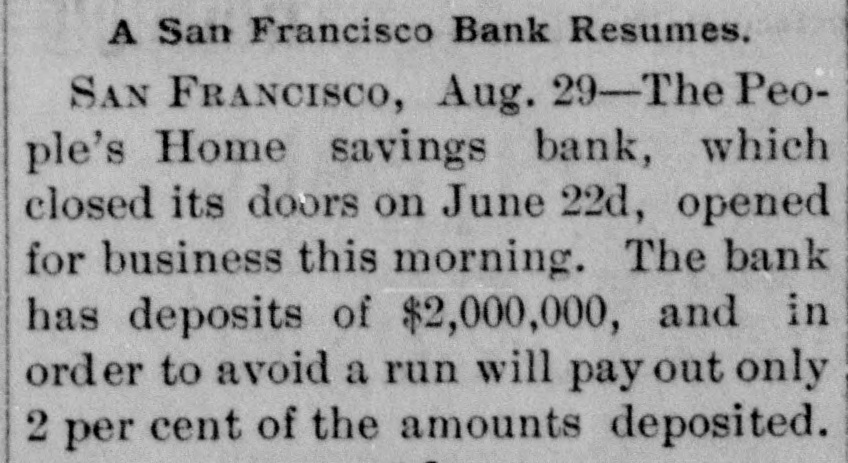
A San Francisco Bank Resumes. SAN FRANCISCO, Aug. 29-The People's Home savings bank, which closed its doors on June 22d, opened for business this morning. The bank has deposits of $2,000,000, and in order to avoid a run will pay out only 2 per cent of the amounts deposited.
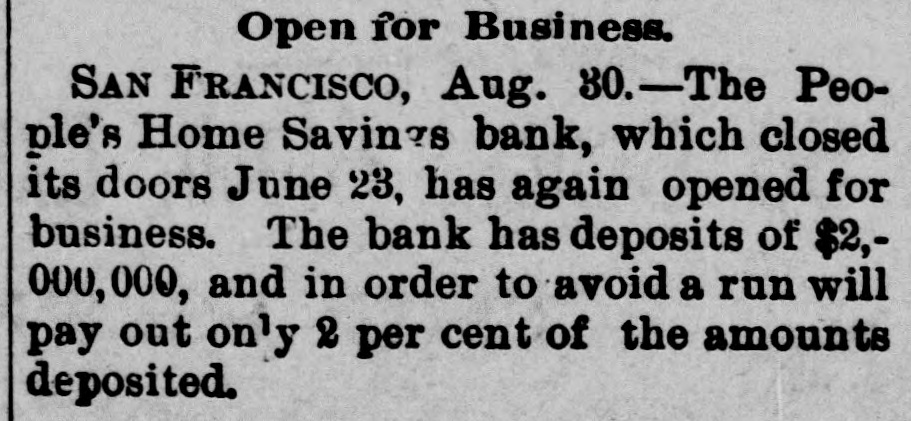
Open for Business. SAN FRANCISCO, Aug. 30.-The People's Home Savings bank, which closed its doors June 23, has again opened for business. The bank has deposits of $2,000,000, and in order to avoid a run will pay out only 2 per cent of the amounts deposited.
12.August 30, 1893The Morning CallSan Francisco, CA
Click image to open full size in new tab
Article Text
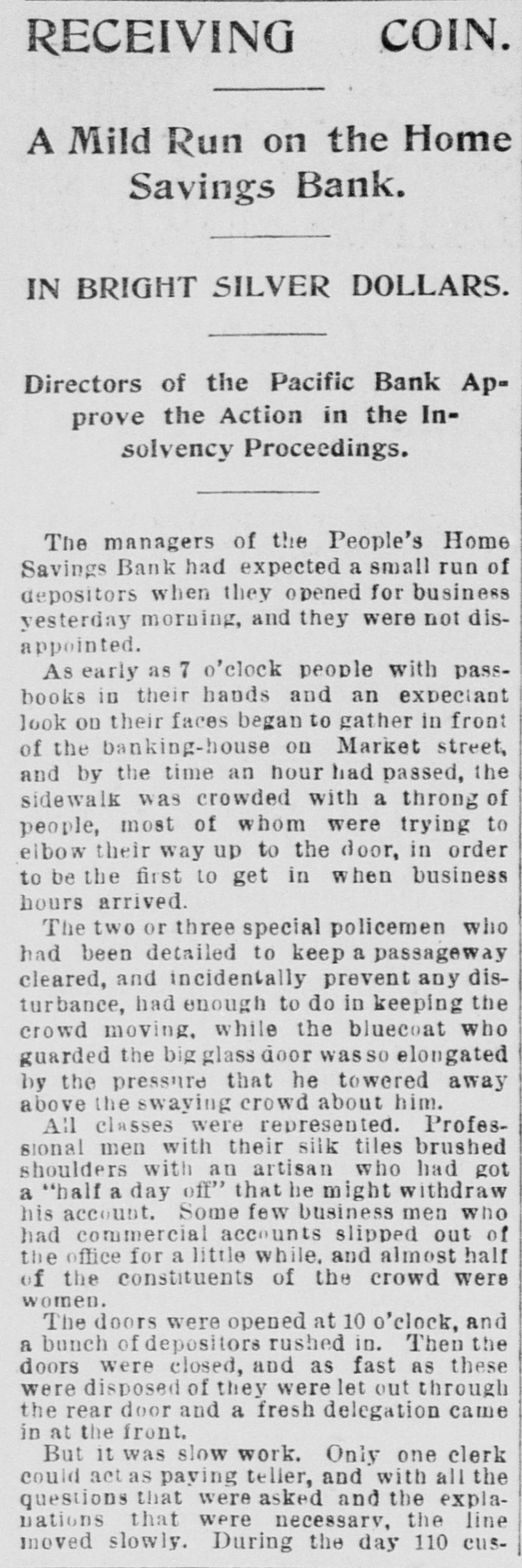
COIN. RECEIVING A Mild Run on the Home Savings Bank. IN BRIGHT SILVER DOLLARS. Directors of the Pacific Bank Approve the Action in the Insolvency Proceedings. The managers of the People's Home Savings Bank had expected a small run of depositors when they opened for business yesterday morning, and they were not disappointed. As early as 7 o'clock people with passbooks in their hands and an expectant look on their faces began to gather in front of the banking-house on Market street, and by the time an hour had passed, the sidewalk was crowded with a throng of people, most of whom were trying to elbow their way up to the door, in order to be the first to get in when business hours arrived. The two or three special policemen who had been detailed to keep a passageway cleared, and incidentally prevent any disturbance, had enough to do in keeping the crowd moving, while the bluecoat who guarded the big glass door wasso elongated by the pressure that he towered away above the swaying crowd about him. All classes were represented. Professional men with their silk tiles brushed shoulders with an artisan who had got a "half a day off" that he might withdraw his account. Some few business men who had commercial accounts slipped out of the office for a little while, and almost half of the constituents of the crowd were women. The doors were opened at 10 o'clock, and a bunch of depositors rushed in. Then the doors were closed, and as fast as these were disposed of they were let out through the rear door and a fresh delegation came in at the front. But it was slow work. Only one clerk could act as paying teller, and with all the questions that were asked and the explanations that were necessary, the line moved slowly. During the day 110 cus-
13.September 9, 1893The L'anse SentinelL'anse, MI
Click image to open full size in new tab
Article Text
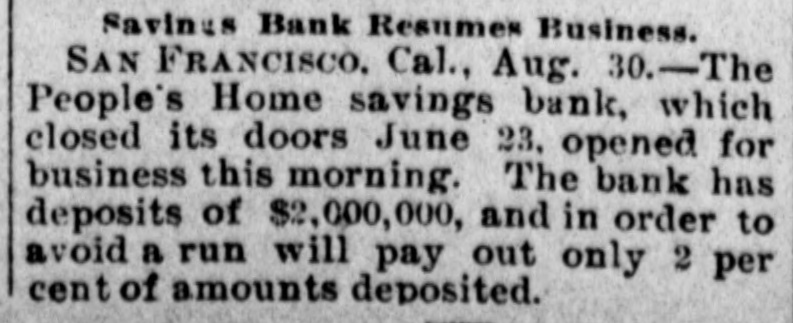
Savings Bank Resumes Business. SAN FRANCISCO. Cal., Aug. 30.-The People's Home savings bank, which closed its doors June 23, opened for business this morning. The bank has deposits of $2,000,000, and in order to avoid a run will pay out only 2 per cent of amounts deposited.
14.May 11, 1894The Morning CallSan Francisco, CA
Click image to open full size in new tab
Article Text
JURORS AT WORK. Bank Affairs Still Keep Them Busy. Depositors Arrange to Hold a Committee Meeting With the Direc= tors This Evening. Grand Jurors Delafield and Summerhayes spent a good portion of the day at Pacific Bank yesterday pursuing their inquiries the into the affairs of that institution. The action of the depositors at the massmeeting in B'nai B'rith Hall on Wednes- to day evening has caused the Grand Jury take up another line of investigation, which promises to lead. results not at first anticipated. Inquiries are being made into the services which Frank M. Stone rendered the People's Home Savings Bank, with the intention of ascertaining why 80 much of the bank's money went to him in legal fees. is quite likely that M. H. Sherman It be summoned before the Grand Jury conwill explain certain dickers which he Savsummated to with the People's Home other ings Bank and the Pacific Bank, and propositions which he proposed, but which the airectors refused to ratify. The attorneys for Charles R. Mont- the one of the directors of gomery, People's Home Savings Bank, have the rethat the Grand Jury act on presented and give then a chance to evidence quested gomery defend Mr. Jury himself. Mont- will It is believed that the Grand return several indictments to-day. committee of depositors waited on Receiver A Sheehan yesterday to request build- the of the back rooms of the bank use for a joint meeting with the directors ing the bank this evening. They were their of assured that the rooms would be at service. C. O. Swanberg called at the bank yes- he morning to secure a box which terday has in the large vault. He was told by to Receiver Sheeban that he would have get an order from Judge Hebbard before he could obtain the box. One of the strange things in connection with the management of the bank when much literature was printed urging so that dimes be saved and deposited instead of being spent for liquors and cigars was the order to the employes always to accommodate neighboring saloon-keepers and cigar-dealers with small change. When M. D. Merritt, after two weeks' as a director. tendered so in these words: service tion he did his member "I resigna- hereby of tender my resignation as a board." No reason for the resignayour was attached. Dick McDonald was not tion pleased with this brief communication, when a week later Dr. W. T. Jenning- with and offered his resignation, coupled son the usual regrets and couched in the most sympathetic strain, Dick took occasion to a hold up the Jenningson resignation act as in model upon which directors should offer. future when they had resignations to Suit has been commenced in the Superior Court by F. A. Williams, both on his cred- own and as assignee for other account to recover $11,145 49, amount in the alitors, to have been lying in deposit on leged Bank at the time of its failure 1893. R. H. McDonald, Frank V. McDonald, June Pacific 23, McDonald, James Mabury Simon M. H. C. Meyer and Paul R. Meyer, made defendants in the action, and this are alare sued for proportionate amounts of numleged indebtedness, according to the Of of shares held by each defendant. ber amount so claimed $4820 16 stands stated in the of the plaintiff: $2011 is M. the due name to J. B. Gonyeau; $1070 to F. as Stevens; James F. Logan, $3244. George A. Knight will defend Dick Mc- on when the case comes to trial the Donald indictments brought by the Grand Jury. C.O. Swanberg related some further dein reference to his securities yestertails He declared that Dick McDonald has day. forced him into the arrangement which culminated in the present troubles. the failure of the Pacific Bank owed $40,000 on a note. secured by $120,000 worth of Swanberg Prior to securities. This for was Swanberg declares that the note was thirty days and gave the bank the power He securities after that time. Dick threatened to which would have securities, to states sell his that arrangement ruined sell him, his not enter into the of second note with the the letter of credit to securities, if for he the did the deposit from trip the Pacific Bank and the sequel of the Sweden, and that he had to yield to threats of McDonald.
15.November 16, 1894The Morning CallSan Francisco, CA
Click image to open full size in new tab
Article Text
# FOR THEIR MONEY.
# Depositors Begin to See the Light.
Creditors of the People's Home Savings Bank Meet and Assign Their Claims.
Depositors of the defunct People's Home Savings Bank have at last decided upon a course of action, which, they think, will tend to save something out of the wreck for them. The plan was agreed upon at a meeting of the depositors' committee, held on November 8 last, and was formally presented at a meeting of depositors held in Labor Bureau Hall, 115 Turk street, last evening.
After casting about for a long time for some method of retrieving their savings, the com- mittee was presented with a proposition from the California Safe Deposit and Trust Company. The company agreed, in consideration of an assignment of at least $100,000 worth of claims to it, to institute proceedings against the stockholders and take such measures to enforce the speedy liquidation of the assets of the corporation, either by the directors or by the receiver, as may be consistent with sound business principles. Also that it would from time to time confer with the general committee of the depositors and report to it what steps had been taken. Upon the collection of any moneys on such assignments the trust company agrees to distribute the same pro rata to the parties entitled, less 6 per cent to be retained by it for services rendered. The company also agrees to advance such sums as may be required for legal or any other expenses.
F. H. Qualman presided at the meeting last evening, and addresses were made by Messrs. H. D. Pike, A. L. Casavan, E. F. Kendall, T. S. Williams Jr., Benjamin Lucy and Nicholas Morcom, of the depositors' committee. They stated the proposition was, in their judgment, a good one, and called upon the depositors to assign. Mr. Pike was particularly urgent, and pointed out that this was the only way to bring the bank to time. Since the matter had become known, he said, the bank people were in fear, and only yesterday Receiver Sheehan had deposited $20,000 in the Safe Deposit Company's vaults as per order of the court.
J. D. Brown, manager of the Safe Deposit Company, and W. G. Bartnett of the firm of Gunnison, Booth & Bartnett, were also present. The latter stated that as soon as the data could be gathered suits would be instituted to enforce the payment of $666,666 67, unpaid capital of the bank, as well as against the individual stockholders for their pro rata of the liability.
The proposition was received with applause, and the half dozen clerks of the Safe Deposit Company who were on hand were kept busy making out assignments. It is estimated that nearly a quarter of a million of dollars in claims have already been assigned, quite a number having taken the earliest opportunity at the offer. Those who have not yet done so and wish to can present their books at the office of the California Safe Deposit and Trust Company at any time.
16.December 16, 1894The Morning CallSan Francisco, CA
Click image to open full size in new tab
Article Text
PEOPLE'S HOME SAVINGS BANK DEPOSITORS. | T wo THOUSAND (2000) DEPOSITORS, REPresenting claims aggregating $550,000, having already assigned their deposits to us for collection, and our attorneys being now engaged in the institution of appropriate proceedings to enforce such collection, we hereby give public notice that all depositors desiring to assign their claims against the PEOPLE'S HOME SAVINGS BANK must do 80 on or before MONDAY, THE 24TH DAY OF DECEMBER, 1894. All depositors wishing to avail themselves of our services must make their assignments on or before that date, OTHERWISE THEY WILL NOT BE RECEIVED. Depositors wishing to make assignments may do so at room 11, SAFE DEPOSIT BUILDING, 328 MONTGOMERY ST., SAN FRANCISCO, between the hours of 9 o'clock A. M. and 5 o'clock P. M. BRING WITH YOU YOUR PASSBOOKS. Depositors at a distance may send for forms of assignment. CALIFORNIA COMPANY. SAFE DEPOSIT AND TRUST J.D. FRY, President. J. DALZELL BROWN, Secretary. Dated December 14, 1894. del4 eod td 12p
17.January 14, 1895The Morning CallSan Francisco, CA
Click image to open full size in new tab
Article Text
Still Another Muddle That May Cause More Delay. DEPOSITORS MAY GET SOME STOCK. General Sheehan Reports to the Directors. Books and Records Denied to Experts. This morning the stockholders of the People's Home Savings Bank will meet to elect directors, and if indications are fulfilled it will be one of the liveliest business meetings which have been beld in banking circles for a long time. The opposition, comprising those of the stockholders who are not in sympathy with the present management, are moving every influence in their power to obtain control of sufficient stock to elect a board of directors which will not, perhaps, change the course of the administration now in charge, but which will, at least, be more willing to submit to the dictation of the unsatisfied faction. The present directors have no fear that the threats of the opposition can be carried into effect, but they make all sorts of charges and bitterly offer any amount of proof required to substantiate them. One of the grounds upon which the "government" rests its charge of lack of faith and flagrant deceit is the fact that for some six weeks past there has been an expert in the office of the bank examining the stock books, etc.. ostensibly for the purpose of collecting data for the information of dissatisfied stockholders in the ranks of the opposition, but really, it is claimed by the directors, for the express purpose of gathering information to be used in the overthrow of the directors now in office. It is alleged, too, that the stockholders, led by E. J. Livernash, Dick McDonald's attorney, have been holding meetings and have been using every art and artifice to secure proxies. Dr. Jenningson of Chicago, who owns 3100 shares, but which are held by the bank as security for a note for $100,000, was, the directors say, offered a considerable sum if he would let his proxy go to Mr. Livernash. Failing In securing this proxy the opposition has secured an injunction against the voting of this stock, but the directors say they can get along without it. Several more such transactions are alleged by General Sheehan, the secretary of the present board, but be believes the present administration can still hold its own easily. On January 9 last General Sheehan, who had been appointed receiver of the bank, was, at his own request, relieved from his position, and the bank is now in liquidation. General Sheeban is now secretary of the board of directors and manager of the bank's affairs. He nas submitted the following, which is the substance of a report upon the conditition of the assets of the bank, to the board of directors: GENTLEMEN: On May 2. 1894, after my appointment as receiver by the court in the suit brought by the Attorney-General and the Bank Commissioners, there was found in the vaults of the bank in cash, as counted by the Bank Commissioners, the sum of $1511 25, about $800 of which was for advances on box rents. The total amount of assets as per the books is now $1,878,965 82. Among the assets is included the claim against the Pacific Bank building and ground and the amount of the Jenningson note. The amount due depositors is $1.543,818 75. Cash on hand and in banks, $92,266 93.
18.January 22, 1895The Morning CallSan Francisco, CA
Click image to open full size in new tab
Article Text
HAVE TAKEN CONTROL The People's Home Savings Bank Imbroglio. AN INVESTIGATION GOING ON. The Bank Commissioners Will Cut Down Expenses. OTHER CHANGES TO BE MADE AT ONCE. After a Consultation With the Directors the Commissioners Decided to Look Into the Bank's Affairs. Another change took place in the affairs of the People's Home Savings Bank yesterday. The Bank Commissioners are now in control of the institution and will fix the number of employes and decide what their remuneration shall be. John F. Sheehan, who for eight months was receiver, has been appointed manager of the board of directors. As receiver his salary was $500 a month, but it is safe to say that the Commissioners will cut those figures in two. The board got to work yesterday morning about 10 o'clock. The first Commissioner to arrive was Paris Kilburn. He was followed a few minutes later by Colonel J. B. Fuller and Judge W. H. McGee. They did not waste any time, but at once went to work. They counted the cash in bank and on hand and then proceeded to thoroughly overhaul the affairs of the institution. The cash, stocks, bonds and warrants were found to agree with the statement furnished by Sheehan and James Alva Watt, his attorney. Then the other assets were taken up. It will require some time to complete this job, as the Commissioners intend making a thorough examination into the value of each piece of property held by the bank. Some big changes are liable to be made in valuations, as several of the properties would not bring to-day in the open market the money that has been advanced on them. When this work has been completed the salaries of the employes of the bank will be fixed, and then the institution will have a rest for a time. How long that time will be depends on Commissioners Kilburn, Fuller and McGee. The present investigation only anticipates the action of the Bank Commissioners. In any event the bank's affairs would have been overhauled in the near future. Owing, however, to the fact that the receiver had been discharged and that the directors were in full control, it was determined to look into the matter at once. When they have completed their labors the new board will be in full control, and will arrange matters to suit themselves, subject to the approval of the Bank Commissioners. The latter will insist upon the curtailing of expenses, and a number of changes are sure to follow. As receiver, Sheehan drew $500 a month, but as manager the Commissioners will probably only allow him $250, or possibly less. It is also probable that the services of James Alva Watt will be dispensed with. He was attorney for the receiver, but the board of directors may put another man in the position. Yesterday was not the first occasion upon which the directors of the bank and the Commissioners had talked over the affairs of the People's Home Savings Bank. Last Saturday afternoon the directors and officers of the bank met Messrs. Kilburn, Fuller and McGee in the rooms of the commission, and a conference that last three hours followed. Ways and means were discussed and a policy concerning the conduct of the bank's affairs was agreed upon. One hopeful feature
19.January 26, 1895The Morning CallSan Francisco, CA
Click image to open full size in new tab
Article Text
# NOW FOR GOOD WORK
New Officers for the Home Bank.
# SHEEHAN AND WATT ROUTED.
The Reorganized Board Discussed Changes.
# DETAILS WILL BE SETTLED TO-DAY.
The Bank Commissioners Will Then Fix the Number of Employes and Their Salaries.
The reorganization of the People's Home Savings Bank as accomplished yesterday, much to the relief of the depositors and greatly to the chagrin of John F. Sheehan and J. Alva Watt. Sheehan as receiver and Watt as his legal, or, as the duped depositors think, illegal, adviser, have been drawing $1000 a menth for practicing as amateur financiers with the bank's funds. That these costly experiments are soon to end was made certain by yesterday's action of the board of directors.
John R. Hillman, B. K. Michaels and Henry Marshall retired from the directorate of the bank. Thomas S. Williams was the choice of the depositors for one of the vacancies caused by the resignations, but Receiver Sheehan and Attorney Watt fought so bitterly against granting him a seat that it was feared a deadlock would result. Sheehan and Watt, with tears in their eyes, pleaded with their friends and relatives for support, but their wishes in the end were overthrown and the able representative of the depositors was given a place on the board.
The board of directors as reorganized is composed as follows: George Stone, president; S. K. Thornton, vice-president; J. C. Johnson, John W. Coleman, Thomas S. Williams Jr., Rolla V. Watt and J. L. Merrill. Another member will be appointed by the Bank Commissioners today, making eight all told on the board. The gentleman named for the position is said to be George F. Davidson, son of Professor Davidson of the United States Coast and Geodetic Survey.
Although Commissioner Magee is on his way to Los Angeles and Commissioner Fuller is in Sacramento, still Commissioner Kilburn will be able to arrange all remaining matters with the directors to-day. Before leaving the three Commissioners held a conference, and just what salary each employe should receive was decided upon. As soon, therefore, as the directors of the bank call upon him, Mr. Kilburn will announce the decision of the commission.
At a meeting of the directors of the wrecked bank yesterday the California Safe Deposit and Trust Company was represented by Attorney A. S. Booth. The trust company hold depositors', bankbooks which foot up a total of over $700,000. A close watch is being kept on the bank's affairs in consequence, and the company and depositors have joined hands in the effort to minimize expenses and oust all useless and expensive employes.
In talking about the matter J. Dalzell Brown, manager of the California Safe Deposit and Trust Company, said: "It was a monstrous piece of business paying Sheehan and Watt $500 a month each for doing nothing. Watt, I see, has drawn his January salary in advance. I suppose he saw a storm coming and was determined to secure all he could. He will have to refund that amount and also a considerable portion of the other monthly installments he drew.
"As to Sheehan, I can't on earth see what he was paid $500 a month for doing, unless it was to occupy a chair in the office and while away the time. He was receiver and is now styled manager; but what managing he has to do no one but himself knows. He also will have to disgorge some of that $4000 before we are through with him. It is an outrage that $8000 of the depositors' money should have been paid for such services.
"The People's Home Savings Bank will never pay 100 cents on the dollar. Fictitious values have been placed upon the real estate, and Sheehan knows it. For instance, a certain sum has been advanced upon a ranch in Madera County. The interest is not paid, and it is added to the principal. In this way the amount on which the ranch is security keeps growing and the bank's assets with it. It is ridiculous to keep tacking on accrued interest when it is impossible to collect the principal. When everything is straightened out you will find that at least a 25 per cent reduction will have been made in the assets."
20.December 1, 1896The San Francisco CallSan Francisco, CA
Click image to open full size in new tab
Article Text
# JUDGE HEBBARD TESTIFIES
secured the consent of four of the McDonald board of directors to resign and that he, the witness, and H. W. Hutton called upon Judge Hebbard and told him of the willingness of four directors to resign if he would modify his injunction for the purpose of allowing them to meet for the purpose of resigning. They named four good men to take the place of the four objectionable men on the McDonald board. He said that Judge Hebbard agreed to let the old board meet in his chambers for the purpose of making the change, but that he did not fulfill his promise
Mr. McCarthy said that before he and Mr. Hutton left Judge Hebbard's chambers D. M. Delmas and Samuel M. Shortridge, at that time attorneys for the People's Home Savings Bank, entered the chambers and Judge Hebbard repeated to them that he had consented to allow the old board to meet for the purpose of resigning.
One or two days later Mr. McCarthy said that he saw James Alva Watt, at that time attorney for J. F. Sheehan, the receiver for the bank, at the office of Mr. Hutton.
When Mr. Henley attempted to bring out the conversation with Mr. Watt, an objection was interposed by Mr. Foote.
Judge Daingerfield said that he would exclude this class of testimony for the present, but would admit it subsequently if prima facie proof is offered that Judge Hebbard had any knowledge of Mr. Watt's wishes, if he had any.
An exception to this ruling was noted by the defense.
Witness McCarthy continued by stating that he called on Judge Hebbard, and asked him to set a time when the two boards could meet to carry out the proposed change, and that Judge Hebbard said he had changed his mind and had decided not to allow the meeting, but made no explanation of his position in that matter. He said that subsequently Attorney D. M. Delmas, in open court, had taxed Mr. Hebbard with breaking his promise; that Judge Hebbard denied it, and that when Mr. Delmas challenged him to the proof that Judge Hebbard pounded with his fist on his desk and declared that he would not allow the meeting as requested.
Mr. Foote closely questioned the witness touching the occurrences in Judge Hebbard's court and the other matters pertaining to the voluminous legislation in which the bank became involved. It appeared to be Mr. Foote's idea to prove that the alleged libelous circular was untrue in stating that the Supreme Court overruled Judge Hebbard's action in appointing John F. Sheehan as receiver.
In reply to a question on this point Mr. McCarthy said: "I understood that the order of the Supreme Court was a reversal of Judge Hebbard's order appointing John F. Sheehan receiver for the bank."
Judge J. C. B. Hebbard was at this point called as a witness for the defense. He testified that he was the prosecuting witness in the case now pending, and that in
21.December 2, 1896The San Francisco CallSan Francisco, CA
Click image to open full size in new tab
Article Text
evening when the Judge wrote an order in the Goldtree case and gave it to Watt. He related also what he had heard that day in court when Mr. Delmas called Judge Hebbard's attention to his promise and about Judge Hebard's denial of the same.
Then Mr. Spelling was asked as to the reasons why he had drawn $500 from the bank, and Mr. Spelling, who appeared to be very uneasy at the question, replied that he had been allowed the money by the directors for his services as attorney in a case outside of and not connected at all with this one. He appeared to impute a sinister motive in Mr. Thornton's asking the question. This caused Mr. Thornton to remark that Mr. Spelling was mistaken as to the outcome of the case and that the court records showed that the case had been dismissed.
T. H. McCarthy was recalled and was asked whether the reputation or the actions of James Alva Watt had not formed the subject of a discussion among the people. Mr. McCarthy replied that he had heard Mr. Watt discussed in a very uncomplimentary way in the Foresters' and the B'nai B'rith halls.
"Did you sign this circular?" asked Mr. Foote on the cross-examination.
Mr. McCarthy declined to answer any questions of that purport on the statutory grounds.
General John F. Sheehan was the next witness. In response to questions by Mr. Henley he said that he acquired his title of general because he had been adjutant-general on the staff of Governor Perkins. He also held the position of Register of the United States Land Office in this City, and was holding that position on the day he was appointed receiver of the People's Home Savings Bank. He was also secretary of the Yosemite Commission at a salary of $75 per month. He was appointed by Judge Hebbard as one of the Commissioners in the case of Emeric vs. Alvarado, a three years' job. He was allowed $11,000 for his services in that case. He was also a receiver in three cases in which the People's Home Savings Bank was concerned.
He drew nothing from the bank during the first month of his employment as receiver, and after that he drew $250 per month to live on. Then the directors made him an allowance of $500 per month for the whole time, which amount he drew. He was not positive whether as receiver he had made an accounting to the court or not. He had signed a statement to the court of receipts and expenditures.
Mr. Watt was his attorney in the preparation of his account, and Mr. Watt was also attorney for the bank.
"It was the duty of Mr. Watt as attorney for the bank to contest any improper account presented by the receiver, was it not?"
Mr. Foote objected again, and the court adjourned until 10 o'clock this morning.
22.November 21, 1898The San Francisco CallSan Francisco, CA
Click image to open full size in new tab
Article Text
The conspirators who ruined the Pacifle Bank and the People's Home Savings Bank and their confidential advisors who assisted them in the destruction of the institutions were good and prolific letter writers. In its expose of the wrecking of the banks The Call has produced many sensational letters, but It will discuss this morning an epistle perhaps more sensational than the others. The Call has shown over the signature of Dr. R. H. McDonald and in the handwriting of his sons that the McDonald family, while they controlled the McDonald banks, were thieves. Moses H. Sherman has proved to the people of this city over his own signature that he is a corrupter of public officials. a briber of City Councils and the debaser of Bank Commissioners. The Call has also in its possession a letter in which Moses H. Sherman is accused of having paid four thousand dollars to J. Alva Watt of this city for the appointment of John F. Sheehan as the receiver of the People's Home Savings Bank. The letter in which this sensational accusation was made particularizes every detail of the alleged transaction even to the time and place when It is charged the money was paid. The history of the events which led up to this alleged crooked deal between the Los Angeles manipulator and the attorney are of grave moment. Sherman has already shown himself not
Bank runs are almost always and everywhere a deterioration of bank fundamentals.
But not for you.
You are the measure-zero exception: great fundamentals, solid bank, and yet the Diamond Dybvig fairy spread its rumor. Depositors woke up. Your collateral was not prepositioned. The Clearinghouse had it for you.
Do not pass Go. Do not collect $200. Go directly to jail… or worse.
Flag Article for Review
Flag Episode for Review
Peoples Home Savings Bank · Episode ID 2536772291122