Article Text
SUSPENSION-We understand that the Vicksburg and Commercial Bank has not only refused to pay specie for her large notes, but has declined to redeem even her $5'8 and $10's. We rather think she is in a bad way.
Click image to open full size in new tab
SUSPENSION-We understand that the Vicksburg and Commercial Bank has not only refused to pay specie for her large notes, but has declined to redeem even her $5'8 and $10's. We rather think she is in a bad way.
Click image to open full size in new tab
18,191,047 348,127 3,104,217 6,481,958 Some of the banks it will be perceived are in a most wretched condition. The manner in which most of these banks have been conducted is such as forever to ruin the credit of their bills abroad. The aggregate amount of cotton now held on their ac count is near $2,000,000 a fact which shows how material is the price of that article to their welfare. Their liabilities for sterling bills drawn against stocks and cotton amounts to $2, 500,000 and upwards. While their suspended debt has been increased upwards of $2,000,000 during the past year, which has been one of high prices for a large crop. How little able, there. fore. are these banks to stand against a reverse of prosperity. It is reported that the Commercial Rail Road Bank at Vicksburg has suspended. A most extraordinary statement with regard to this institution has been made by the Commissioners.It appears that previous to the meeting of the legislature, the Commissioners wrote to this bank, requesting a statement of their condition. Accordingly the Bank of Vicksburg, en the 22d of December, deposited with this institution $100,000 in the notes of the Canal and Banking Co. of N. Orleans. In the state ment forwarded to the Commissioners this money was actually denominated specie, and so reported to the executive, and by him laid before the legislature. The amount of specie thus reported on hand was $111,911, while the true amount, as appears by the bock, was as is stated in the above table. The $100,000 never having been entered on the books as specie. At Augusta, Geo., on the 28th ult. the appearance of the money market was daily becoming worse, and money getting more searce. The city banks refused to receive the bills of the banks of the interior, either on deposite or in payment of notes. This was the cause of much distress. Exchange was quite searce at lal} per cent premium at sight on N. Y. The notes of the Bank of Darien were selling at 25 per cent. The packet ship Baltimore for Havre takes out $32,000 in specie shipped by one firm. The operations at stock exchange today have been limited. Prices present no material change from those of yesterday; in some cases, however, a disposition to give way is manifest. Ohio Life & Trust recededed 1 per cent; Kentucky 1 per cent; Vicksburg 2 per cent; Mohawk 1 per cent; Canton I per cent.

Click image to open full size in new tab
07 The Commercial Bank at Vicksburg. Mis. sissippi, and the Branch Bank of Darien, at Savannah, Georgia, have suspended specie payments.
Click image to open full size in new tab
- The Commercial Bank of Vicksburg suspended payment of its notes on the 21st ult. Thus we go!
Click image to open full size in new tab
The Commercial and Rail Road Bank at Vicksburg, Miss., has suspended specie payments. The Banks in the south-west are in a precarious condition, and fears are entertained that many of them are destined soon to be involved in difficulties from which they will not be very easily extricated.
Click image to open full size in new tab
The following Banks, according to news. paper report, have suspended specie pay. men: The Commercial Bank. at Vicksburg the Bank at Rodney, Mississippi; the Darien Bank at Savannah. and the Hawkensville Bank, Georgia.-Tuscaloosa Monitor.
Click image to open full size in new tab
Our Banks and our Credit. is somewhat singular that people in- in It Northern cities, whoare as much terested the in the currency of Mississippi, as the people of our State, should evince to such a disposition and take such pains credit. decry both our currency and our New That such should be the case in is not at all surprising consideration how there by the gained take Orleans, into depreciation when much of our we is although it is very problemain the long ruin our does not lose full as city currency, tical whether much Sister But as be gained from our calamities. the of the the show of the pretence not may with even people North in defiance there to is justify their proceedings, for have own true interests, they Bankers, one and all, as acted, of Merchants their Brokers, Shavers though that and our he Banks must suspend again, and alone was safe, who was first to present his demands. When the Deer Creek Bank, and the Commercial Bank of Vicksburg suspendfear became universal again. Even our ed, would the suspend and that some own all citizens partook of the panic, of them withdrew all they could withdraw from our Banks. Well, the panic is now over, our banks have not suspended, and will not suspend, contrary no doubt to the expectations of of many, and to the hopes and wishes not a few. They are sound and beyond of casualty. Nothing can them to stop can be created a compel the No necessity reach specie payments.- place for second all, suspension, and if it takes at it will be from policy, and because all the Banks in the North suspend; an occurrence not likely to be again witnessed for many years. True it is, that the circulation of our Banks has been returned upon them and been redeemed, far, very far, below the lowest point it was ever expected to reach, and our good citizens have been the sufferers thereby--yet in the end the result will be beneficial. Our Banks having a of sixty a was never before made, stood run as for period days, and that such which no it is hazarding little to assert, Banks in the North or South, not even the United States Bank, could have stood in the same proportion for half the time, confidence is now restored, and people are perfectly willing to hold the notes of our city Banks, when they can get them, and no longer carry off the specie. They are now satisfied that they can have the specie when they want it, and satisfied too, that they never did want it, for the notes answered all their purposes just as well as specie. Distrust no longer prevails, and it is not arrogant to assert that our Banks will stand hereafter as high as any Banks in the Union, and higher than many Banks that have heretofore enjoyed more of the public confidence. We have forborne to speak of this subject before, lest we might be suspected of having a design to bolster up our monied institutions, but we have not been inattentive observers of their movements. Now that your Natchez Banks are beyond the reach of the malice and hatred of their maligners at home and abroad, and have won the confidence of the timid and the wavering who were in fact disposed to be friendly, we may speak with boldness and without the risk of exciting suspicion of our motives or the sincerity of our opinion; Let the banks of other places suspend when they may, our Banks are safe.
Click image to open full size in new tab
dues under these circumstances, when they do not expect any further facilities or favors from the same quarter in future. Sowih the bink: but let it be furn shed with the means of showing the debiors that it is to be resuscitated, and will be able to grant facilities or favors in future, and they will make exertions to pay it what they owe. These means wanted are in the shape of facilities, rather an capital. I do not doubt they can be obtained, but it must be shown that, by whoms.ever gr.net, they will not incur the smallest risk. That, beyond a doubt, cate be done,-1 need not here enter into an commission which the to the adequate details. Under such circuits bank ances, could afford for pay, would not those gen lem n who administer the affairs of the Bank of the United States, and, perhaps, some of the other Philadelphia banks, for a piri, take pleasure in rendering th se facilities which will so essentially benefit their own fellowcirizens who are interested in the Vick-burg Bank to the extent of upwards of three million dollars, and many of whom prob bly are als interested in those banks? I should suppose there cannot be a doubt of it. The exhet condition of the debts due the bank, you will prob soon know, but I either know nor have heard of any thing in relation to the condition of the assets of the bank to justity the seeming panic which exists, and the ex:raordinary and great decline which h is taken place in the price of the stock during the last few weeks. Suspended debts and pro-ested notes in that country, are not like those of similar character in large coin nercial cities. While in the latter they are generally regarded as nearly valueless, in the former, they are offentimes better in reality than the current notes in a bank. or the Railroad, in which a large amount of the capital of the bank is invested, I heard a diversity of opinions expressed as to is productiveness, from six per cent. per annum upward<. If the rates of toll shall not befixed unnecessarily low, I think beyoud a doubt, it will yield a lerge interest on the investinent. W of no point in the United States so well situated, and po-sessing such natural advantages for doing an extensive and profitable binking business as Vicksburg. The whole Mississippi and all its ribitary streams have intercourse with that place Indly a inibia ascends or descends the liver hat does not stop there, and the people located on the whole of those waters have an exten-ive comreial intercourse with Vick-burg. Isaw had daily conversati ns with gentlemen from fivedifferent Sates bordering on the Mississippi or its waters, at Vick-burg, all holding the prote-ted checks of the bank, who could obtain no satisf ion whatever respecting their pavinent. From them I learned that, while they, and those sections of the country Iro n wh eh they came, had lost all confidence in the administration of the bank, yet they all telt a deep interest that it should be resu-citated. They said it was imp rtant to the whole country having intercourse with Vicksburg, that there should be a sound and well conducted banking institution at that place. Oa the whole, if you (the stockholders) adort proinptly, the measures which those best acquainted and di-i interested, declare are the only proper ones I see nothing whatever to cause despondency; but on the contrary, every thing to lead of to, and enc urage hope. These, added to a proper degree of parience, and doubt not, the products of the fertile an luxuriant fields of Mi-si-sippi will speedity retrieve and renovate the affairs of the institution fro n he effects of injudicious management, it not of anal-adiministration. It would IVe b.en much more agreeable to my feelings, to have avoided communicating this thru' the columns of the public press; but the subrance of the assaulis made on me, to which this is intended chiefly as an answer, left me without an alternative. Very respectfully, R. M. WHITNEY Washington, July 11, 1839.
Click image to open full size in new tab
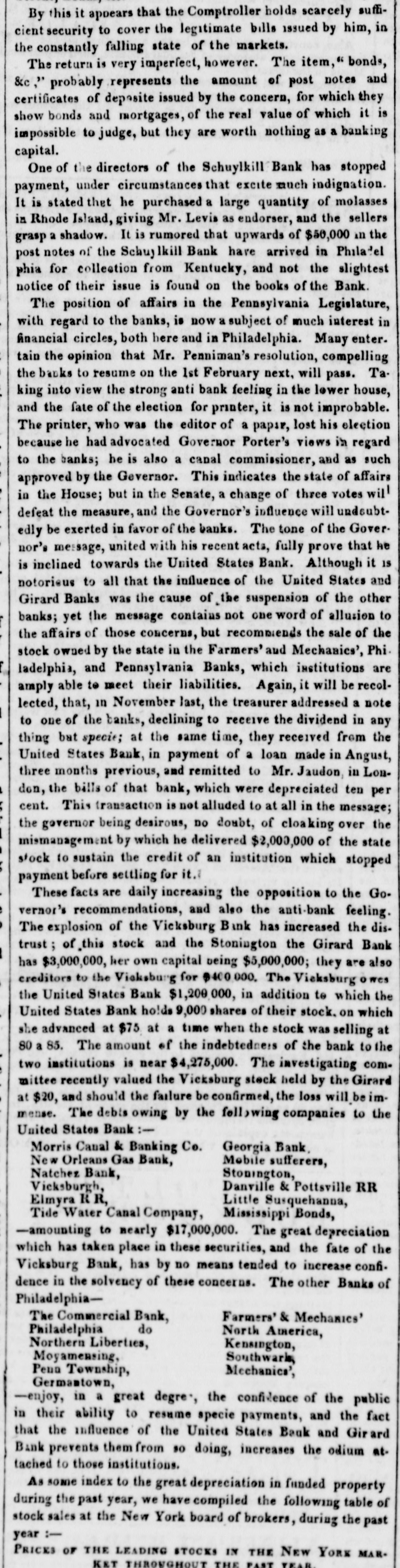
By this it appears that the Comptroller holds scarcely sufficient security to cover the legitimate bills issued by him, in the constantly falling state of the markets. The return is very imperfect, however. The item," bonds, &c," probably represents the amount of post notes and certificates of deposite issued by the concern, for which they show bonds and mortgages, of the real value of which it is impossible to judge, but they are worth nothing as a banking capital. One of the directors of the Schuylkill Bank has stopped payment, under circumstances that excite much indignation. It is stated thet he purchased a large quantity of molasses in Rhode Island, giving Mr. Levis as endorser, and the sellers grasp a shadow. It is rumored that upwards of $50,000 in the post notes of the Schuylkill Bank hare arrived in Philadel phia for collection from Kentucky, and not the slightest notice of their issue is found on the books of the Bank. The position of affairs in the Pennsylvania Legislature, with regard to the banks, is now a subject of much interest in financial circles, both here and in Philadelphia. Many enter. tain the opinion that Mr. Penniman's resolution, compelling the backs to resume on the 1st February next, will pass. Taking into view the strong anti bank feeling in the lower house, and the fate of the election for printer, it is not improbable. The printer, who was the editor of a papir, lost his election because he had advocated Governor Porter's views in regard to the banks; he is also a canal commissioner, and as such approved by the Gevernor. This indicates the state of affairs in the House; but in the Senate, a change of three votes will defeat the measure, and the Governor's influence will undsubtedly be exerted in favor of the banks. The tone of the Governor's message, united with his recent acts, fully prove that he is inclined towards the United States Bank. Although it IS notorieus to all that the influence of the United States and Girard Banks was the cause of the suspension of the other banks; yet the message contains not one word of allusion to the affairs of those concerns, but recommends the sale of the stock owned by the state in the Farmers' and Mechanics', Phi. ladelphia, and Pennsylvania Banks, which institutions are amply able to meet their liabilities. Again, it will be recollected, that, in November last, the treasurer addressed a note to one of the banks, declining to receive the dividend in any thing bat specie; at the same time, they received from the United States Bank, in payment of a loan made in Angust, three months previous, and remitted to Mr. Jaudon in London, the bills of that bank, which were depreciated ten per cent. This transaction is not alluded to at all in the message; the governor being desirous, DO doubt, of cloaking over the mismanagement by which he delivered $2,000,000 of the state stock to sustain the credit of an institution which stopped payment before settling for it These facts are daily increasing the opposition to the Go. vernor's recommendations, and also the anti-bank feeling. The explosion of the Vicksburg Bank has increased the distrust; of this stock and the Stonington the Girard Bank has $3,000,000, her own capital being $5,000,000; they are also creditors to the Vicksburg for $400.000. The Vicksburg owes the United States Bank $1,200,000, in addition to which the United States Bank holds 9,000 shares of their stock. on which she advanced at $75 at a time when the stock was selling at 80 a 85. The amount of the indebtedness of the bank to the two institutions is near $4,275,000. The investigating committee recently valued the Vicksburg stock held by the Girard at $20, and should the failure be confirmed, the loss will be immense. The debts owing by the following companies to the United States Bank :Morris Canal & Banking Co. Georgia Bank New Orleans Gas Bank, Mobile sufferers, Natchez Bank, Stonington, Danville & Pottsville RR Vicksburgh, Elmyra R R, Little Susquehanna, Tide Water Canal Company, Mississippi Bonds, -amounting to nearly $17,000,000. The great depreciation which has taken place in these securities, and the fate of the Vicksburg Bank, has by no means tended to increase confidence in the solvency of these concerns. The other Banks of PhiladelphiaFarmers' & Mechanics' The Commercial Bank, Philadelphia do North America, Northern Liberties, Kensington, Moyamensing, Southwark Pena Township, Mechanics', Germantown, -enjoy, in a great degre the confidence of the public in their ability to resume specie payments, and the fact that the influence of the United States Bank and Girard Bank prevents them from so doing, increases the odium at. tached to those institutions. As some index to the great depreciation in funded property during the past year, we have compiled the following table of stock sales at the New York board of brokers, during the past year :PRICES OF THE LEADING STOCKS IN THE NEW YORK MAR. YEAR KET THROUGHOUT THE
Click image to open full size in new tab
banks marked (A) have informed the conditional, department Those dividends declared in November were that the bepaiduntil a full resumption of specie payments, circumor and until netto the legislature authorise their payment under that they stances Those of marked a partial (B) resumption. have informed the department have not Lewiston suspended Bank specie declared payments. a dividend in November last, The The informed the department of the amount. added dividend but has not declared by the Northumberland Bank, was to the capital stock of that institution: It appears that four of the banks of Pennsylvania yet redeem their notes in specie. There is nothing definite as yet from the Pennsylvania Le. gislature, on the resumption question. Vehave received from our Philadelphia correspondent, the following important letter on the subject of resumption: PHILADELPHIA, Jan. 26, You have doubtless seen an account of the proceedings then of legislature ou the 22d inst; and from the new move I can our made by Brodhead, one of the Governor's confidants, am long that the day for a resumption will put off as in the banks desire. After spending the two a many which, by the by, carried on usele vinced of discussion, and whole anti- by day the masons of the democrats alone, the whigs until the yeas and nays were on time pro- for n to refer the original resolution, (fixing remaining positi branches quiet substitute called the offered the on the 1st of February) and a new by a member from Northampton the day gave to the Governor the bank proposition resumpion Brodhead, right district, to appoint fix (which for general resumption, and the right to with the consercommisioners,) a when they (the whigs) joined to 40, in refertive democrats, and succeeded, by a vote of 55 on Banks whole matier again to the Committee ring the Higgins of Northumberland Hopkius (Speaker) charac- of Brodhead, and Lee of Philadelphia, are the leading bv the Washington, who moved by the adroit wireworkersemplayed and his rs are and secretly influenced by the Governor action the banks, will not permit any immediate rethe resolutions or the cabinet. either The resumption Governor Senate's prevent bill, on the United States Bank charter, if he can upwards pealing Bank of the United States yet owes the State the certiThe $800,000, OR account of the loan of August last, and hypothecated for which loan, as you are aware, are now either of in ficates hence his asxiety to prevent measures, banks to London; would compel the United States and Girard the which at discretion, and consequently expose in for surrender by which the State would come State transaction, $800,000 as a " common creditor," the con only their credit monthly, as a depositor, for the Should amount the receiving suit the convenence of the bank. within three re tracted, to for a resumption pass, to take effect to solutions the United States Bank will not make a struggle satisfied months, a protracted existence; but, I am wards sustaining nnounce her intention to wind up Policy on would 10 the influential democrats who would of a to permit that bill to !ay aim subject dictate at once repeal, object have dermant, moved they the resumption; by this course the back to press an early be reached. as the refusal on the part of the effectually at would with the requisitions of the' legivlatur ewosid charter be comply char er. On the ether hand, should the Court, forfeit the the bank may carry the case into our Supreme su repealed, postpone & decision amongst its friends. every to this, and there judge being opposed to the repeal; and added adherents, preme the political influence of the bank and revolutionize its the would be the scale next fall, which might horse: thrown Resumpilon into would put the saddle on the do right no essenstate. insolvent banks would give up the ghost, and would tial the to the solvent banks and trade. A repeal with, and injury opposition a new political capital to work triumph, give the eventually, the democratic party would the substanalthough, much mischief would be done in the straggle to tial institutions and business. article of Saturday, alludes to the report that repealed.- the Phi. Your Bank is one whose charter is likely to be the United ladelphia I think must have been shat slily from States or Thisarrow some of the friends of the United of the States Bank, or as there is not the remotest probability this session Girard banks, the charter of the Philadelphia Bank, that repeale Bank sable to resume, and Iknow time some men. The Philadelphia directors are very anxious that the earliest cannot conject of the for a resumption, should be adopted. should I have been tioned other quarter from which such a hint States Bank is ture any the aforesaid. The game of the U. the contest, given, than the other banks, who now stand aloof in Bank into and to enlist such hints may be intended to draw the Philadelphia the vortex. that the time has arrived to unmask confidential the secret I new think of the agent, who manages the private the Gimovements the Governor, with the United States the and and matters for I in a day or two give you a sketch of formerly man are. rard,and may His name is D. M. Brodhead. and in his transactions. Wayne county, in this State, but now located, is very sident of in this city. His moral and political influcence management business and were his movements known, and his be very limited; Governor, for the banks, exposed, he would a with the indeed. He was defeated in the Northampton by Dise an small man when a candidate for the State Senate triet, in in a district too, in ich an Anti an democratic majority; a short time been of his unpopularity at home; and in on the shelf evidence Mason, overwhelming 1835, and up,be,laid this there defeat has always was here. he will, unless the opposition who take negotiated him the loan last August, It this gentleman with the Governor (of course for a quid the proquo) assaults for the bank, he, in my opinion, who prompted the sound banks, and it was in the Governor's message, upon Pennsylvania; which were and Mechanics, Philadelphia and member viz:-Farmers who prompts his rela Bredhead (a and substiand it is be defeat Penniman's resolutions, when the of the bill legislature)-t giving to the Governor the right commissioners. to say Of tute resume and also to appoint bank and will banks shall B. will be one of those commissioners, banks course to D. "his M. friend the Governor," when the the subject can'r of the signify the substitute pass. Could certificate to the sume, should of the Governor, in giving a and other mismanagement $1,800,000, without receiving the money. clique any who, bank for connected with the movements of the the expressed little matters Governor, are warring against would have will together of the with people, the be adroitly introduced by B. it good effect. yesterday that at least $100,00, in amount, made pay of I was told and R Bank of Vicksburg post notes. These notes Commercial the Girard, were protested on Friday. at 6} and ablea to the Girard. Specie yesterday at was a stand bought still. sold at 7 belonged Everything like business is as be following is the latest return of the Bank of Kentucky, compared with its last semi annual statement:On December, 1839. the 30th STATEMENT of June, 1839. OF THE as compared BANK OF with KENTUCKY the return of 31st
Click image to open full size in new tab
the produce on reaching New Orleans lays dead, the irredeemable paper of the suspended banks will not perform the office of a circulating medium, because they have destroyed public confidence. The pressure among the dealers is daily increasing, and private letters state that a large cotton house has failed. With the ruin around them, the stagnation of trade in every department, the banks still insanely cling to their suspension. They are rapidly decreasing their loans, but their currency is still increasing. Their specie, to circulation, is MOW as 1 to 43. This is not a very large proportion, if a fair amount of their loans mature within a circle of 50 days.-The great difficulty is, however, that their bills are mostly at long dates, and not readily available. Last year, when the banks paid specie, and the crops came freely forward, bills en New Orleans were, in the month of February, at a premium of 1 per cent in New York. This year, with the crops 20 percent larger, bills on New York are at a premium of 4) per cent in New Orleans. This is the difference between resumption and non-resumption. An immediate return to specie payments in New Orleans, we apprehend, would, by restoring confidence, cause the crops to go forward quite as fast as would be necessary to supply the banks with Eastern funds, and prevent any great demand for specie. It is the only alternative for the banks to save themselves from rain. The Vicksburg Sentinel states that the Union Bank of Mississippi intended to suspend on the 6tn instant. It is said the directors are trying to sell the $5,000,000 of State bonds for their own post notes. In consequence of this, Governor McNutt has issued a proclamation, warning all persons and corporations not to advance money or credits on the by pothecation of said bonds, or to purchase them on a credit or for a less sum than their par value in specie as in either case the State is not accountable for the payment of the stock. The Governor has also vetoed the bill which passed the Legislature repealing that section of the Union Bank charter which imposes 15 per cent damages on all its notes not paid on presentation. Almost all the bills passed at the late session of the Mississippi Legislature have been vetoed by the Governor.
Click image to open full size in new tab
NEW YORK, TUESDAY MORNING, APRIL 21, 1840.
PHILADELPHIA, APRIL 18, 1840. You will have learnt by the papers that the Gover-nor convened the Legislature by proclamation on the 17th (yesterday), though that body had determined by resolution to adjourn on the 16th. Both houses accordingly assembled yesterday, and, after the transaction of some business, deemed of pressing importance, again adjourned to the 12th May. By that time they will probably be able to learn the wishes of their constituents in relation to the topics of the Governor's proclamation.
One of the effects of the late law, postponing a re-sumption of specie payments by the banks of this State, is already apparent in the rise of certain stocks, in which two of our largest banking institutions are immediately and largely interested. I allude to the rapid improvement in the price of the stocks of the Girard and United States Banks of this city, of the Canal and Railroad Bank of Vicksburg, and of the Stonington Railroad. You will duly appreciate my motives, I doubt not, when I say, in relation to one of these at least, "touch not-handle not."
I have no positive personal knowledge as to the influence which has recently been brought to bear upon these stocks. It is well known, however, that an individual, very intimate at one, if not two of the "largest banking institutions," and who is not himself in affluent circumstances, has, within a few weeks, been a very large purchaser of certain of the stocks alluded to, in this market. It is also believed that the same influence has been brought to bear on Stonington, in your market, though this fact is not so well established. The consequence has been, a rise of 6 per cent in the United States Bank, of 20 per cent. in Girard, and of 50 per cent in Vicksburg and Stonington, within the last 30 days.
Without referring particularly to the condition of the other concerns mentioned, I think it must be evident to all who will investigate candidly the affairs of the Canal and RR Bank of Vicksburg that it is at present selling at a price not warranted by its present condition or future prospects. By not resuming specie payments on the 1st inst., on its F.T., the institution has forfeited its banking privileges, and would be compelled to wind up its affairs, even though no assignment had been made. Five years is allowed by law to close the concerns, and all who know anything of the state of the assets must be aware that it is not probable that this can be effected within the time specified. The creditor of the concern cannot reasonably expect to receive any portion of the proceeds of the assets for several years. What then is the stockholder to expect?
The report of Messrs Cowperthwaite and Schote suppose that the creditors of the bank will ultimately be paid all, and that the railroad will be left for the stockholder. It is also stated (though not in the report) that about $2,000,000 due to the banks has been secured by him on real estate, but it is not generally known that this security is the same which the bank received originally, and thus the amount loaned on it is nearly double what the property could be sold for at present, if, indeed, it could be sold at all. It seems also to be forgotten, that according to the statement made to the Mississippi Legislature in 1838, a very large proportion of the loans made by the bank have been made to a few individuals (directors and others), without security, or on security which was even then considered very inadequate. Now it should be borne in mind that the "railroad cannot be left for the stockholders" unless their assets shall prove good and available.
It is also estimated by the gentlemen referred to, that the receipts of the road, when completed, will be equal to 4 per cent. per annum on the entire capital. The road, it is supposed, will be completed the present year; a loan of $300,000 having been made by the United States Bank for that object, and for which loan she is preferred in the assignments. Out of this estimated 4 per cent, I presume the interest on the loan is to be paid, as well as the ordinary expenses, amounting to no trifling item. It will be recollected, too, that before the explosion of this concern, the railroad was universally thought to be a dead weight; but now it seems that it is to prove the salvation of the stockholders.
But even if the visionary anticipations of Messrs. Schote and Cowperthwaite are to be realized, admit that the railroad may be saved to the stockholders, and that its business will amount to 4 per cent. on the capital, still these stockholders, under the most favorable view of the case, can hope for settling within the next ten years. Estimating the stock at $24 per share, it would have cost the owner, at the expiration of ten years, all that Mr. Cowperthwaite estimates it to be worth, should the most favorable anticipations be realized.
I believe you will agree with me that the stock, at present prices, is not a very desirable investment. The reason assigned for the present extraordinary rise in the price of the stock, is, that some arrangement will be effected, by which the prospects of the concern will be greatly improved. The true secret, however, I believe to be, an intention to force up the price, with the hope of inducing inordinate speculation, and eventually to saddle the public with the immense amount of the stock now held by the Girard and U. S. Banks. The notes of the institution are daily offered at 50 per cent. discount, and it would really seem if this be the actual value of the notes (which must first be paid), the stock is 50 per cent worse than nothing!
Click image to open full size in new tab
- - is now well known that the Water Works bank and bank of Vichsburg-both of which never had as much real capital as would pay for on good Mississippi trolic-commence paying specie on their $5 notes on 'all fools day.' The event was considered SO improbable that the report was looked on as an April hoax, by most of our citizens, and few of them could be induced to ascertain the fact for themselves by presenting the shipolas ters. A flat boatman. it is said was reconoit. ering about Washington street, and seeing an unusual intercourse between the Vicks. burg bank and the sovereigns, he inquired the cause; and being informed that they were paying specie. he walked in, and looked amazed at what he considered as little short of one of Price Hohem. loe's miracleas. He stepped up to our friend Bancks, who was shelling out the rhino, and whispered to him thus: 'Do you think your bank will be able to hold out till I run down to my boat and bring up a five dallar bill.?' Yes,' says Bancks looking savagely at the Housier 'until you to and back.'
Click image to open full size in new tab
According to the Vicksburg Sentinel, two of the banks of that place, commenced paying specie on their 85 notes on the 1st instant. A Hat-boatman, it is said, was reconnoitering on one of the streets, and seeing an unusual intercourse between the Vicksburg and the sorereigns, he enquired the cause; and informed that they were paying specie, he soon walked in, and looking round at what he considered as little short of ona of Prince Hohenloe's miracles, he step. ped up to the paying teller, who was shelling out the rhino, and whisdered to him thus "Do you think your bank will hold out till 1 run down to my boatand bring up a five doilar bill ? "Yes," says the teller, looking savage at the hoosier, "until you go to and back again!
Click image to open full size in new tab
New YORK-The Herald's Money article of Thursday says:-" There has been less doing in the stock market to-day, and prices have generally given way.The little speculation which was springing up in fancy stock, previously to the receipt of the news, has been checked, within a few days, by the chill occasioned by the nature of the news from abroad. The stocks which have more particularly been under the influence of speculation, are Stonington Railroad and Vicksburg Bank. The prices of the se have more t an doubled in a short time, although their actual values have decreased rather than otherwise. The Vicksburg Bank is utterly rotten. The mi-management of the assignees has left nothing to the shareholders, even if the bank can pay its debts. The railroad, if detached from the bank, might, in time, come to something; but it is now a "road to ruin." The road carried to Jackson, during the week ending on the 3d October, 1000 bales of cottan; and the freight, on the 1st October, was $400, exclusive of passengers. The United States Bank, however, takes all it makes over the expenses, and a fee simple of the whole. The bills receivable of the Vicksburg Bank are daily depreciating. Its stock declined to day per cent; U. States Bank deelined 1 per cent; North American Trust and Banking Company I per cent; Harlem 1/6 per cent, Stonington 1 per cent; Long Island improved 1/4 per ct. Sales of bills on Philadelphia were made at 21 a 24 dis. Sales of state stocks were made as follows :914 1,000 New York Canal Fives, 1855, " " " " 911 1,000 " " " " 91 3,000 714 1,000 Indiana Bonds, The following statement of the financial condition of
Click image to open full size in new tab
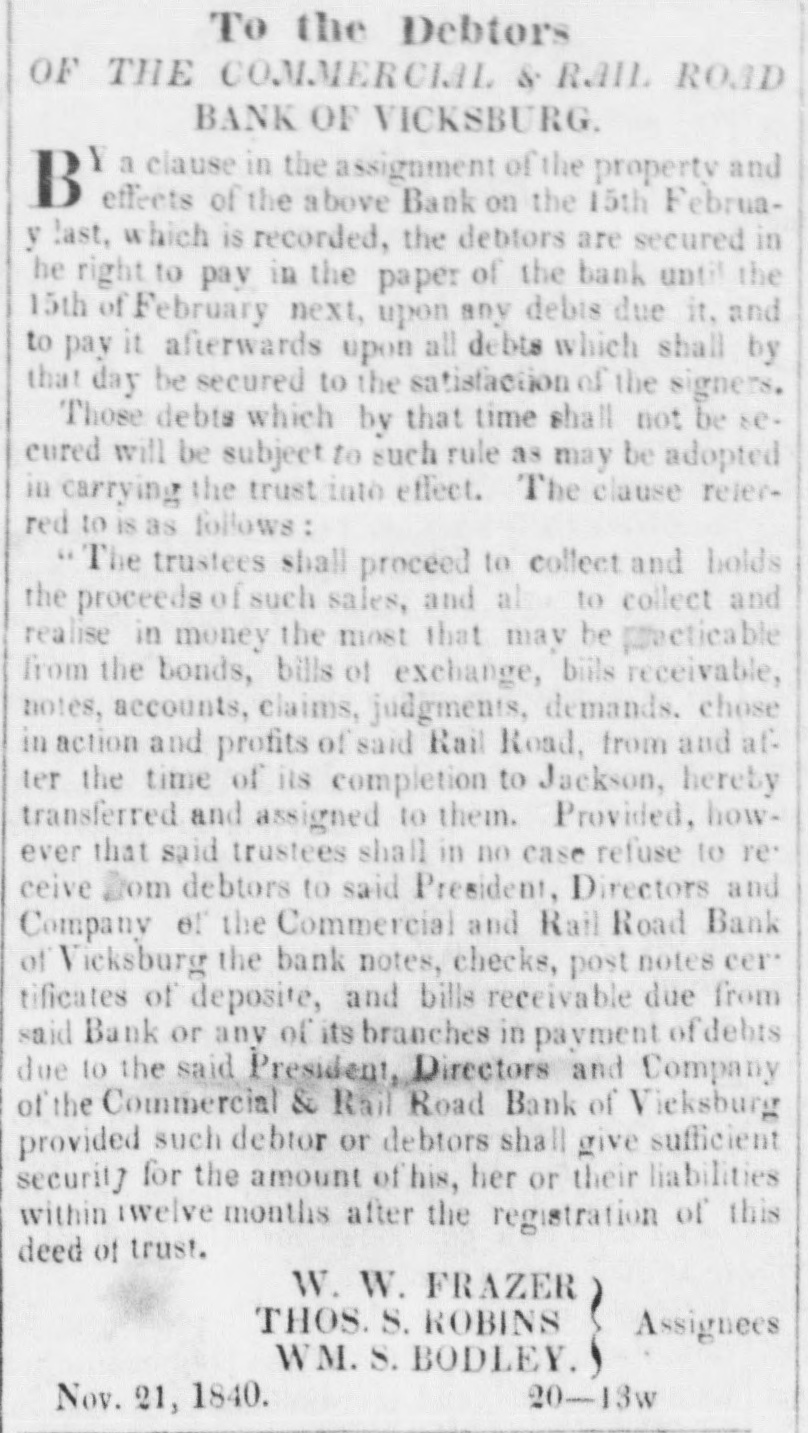
To the Debtors OF THE COMMERCIAL s RAIL ROAD BANK OF VICKSBURG. Y 3 clause in the assignment of the property and B eff ets of the above Bark on the 15th Februay last. which is recorded the debtors are secured in he right to pay in the paper of the bank until the 15th of February next, upon any debts due it. and to pay it afierwards upon all debts which shall by that day be secured to the satisfaction of the signers. Those debts which by that time shall not be secured will be subject to such rule as may be adopted in carrying the trust into effect. The clause relerred to is as follows: " The trustees shall proceed to collect and holds the proceeds of such sales, and also to collect and realise in money the most that may be practicable from the bonds, bills of exchange, bills receivable, notes, accounts, claims judgments, domands, chose in action and profits of said Rail Road, from and aler the time of its completion to Jackson, hereby transferred and assigned to them. Provided how. ever that said trustees shall in no case refuse to IT. ceivefrom debtors to said President, Directors and Company of the Commercial and Rail Road Bank of Vicksburg the bank notes, checks, post notes cer. tificates of deposite, and bills receivable due from said Bank or any of its branches in payment of debts due to the said President, Directors and Company of the Commercial & Rail Road Bank of Vicksburg provided such debtor or debtors shall ive sufficient tsecurity for the amount of his, her or their liabilities within twelve months after the registration of this deed of trust, W. W. FRAZER Assignees THOS. S. ROBINS WM. S. BODLEY. 20-13w Nov. 21, 1840.
Click image to open full size in new tab
To the Debtors OF THE COMMERCIAL & RAIL ROAD Bank of Vicksburg,
BY a clause in the assignment of the property and effects of the above Bank on the 15th February last, which is recorded, the debtors are secured in the right to pay in the paper of the Bank until the 15th of February next, upon any debt due it, and to pay it afterwards upon all debts which shall by that day be "secured" to the satisfaction of the assignees.
Those debts which by that time shall not be so secured will be subject to such rule as may be adopted in carrying the trust into effect. The clause referred to is as follows: to wit:- "The trustees shall proceed to collect and hold the proceeds of such sales and also to collect and realise in money the most that may be practicable from the bonds, Bills of Exchange, Bills receivable, Notes, Accounts, claims, judgments, demands, choses in action and profits of said Rail Road, from and after the time of its completion to Jackson, hereby transferred and assigned to them.-Provided, that however the said trustees shall in no case refuse to receive from debtors to said President, Directors and Company of the Commercial and Rail Road Bank of Vicksburg the bank notes, checks, post notes certificates of deposit, and Bills receiveable due from said Bank, or any of its branches in payment of debts due to the said President, Directors and Company of the commercial and Rail Road Bank of Vicksburg, provided such debtor or debtors shall give sufficient security for the amount of his, her, or their liabilities within twelve months after the registratation of this deed of trust.
W. W. FRAZIER, THOS. E. ROBBINS, Assignees WM. S. BODLEY. November 21, 2-3m.

Click image to open full size in new tab
Company, and The Commercial and Rail Road Bank of Vicksburg.
All the assets of the latter institution, were assigned to trustees, by the Board of Directors, previous to the passage of the bank law. The evidence required by law has not been furnished to the Executive, to enable him to issue his proclamations declaring the charters of those banks forfeited. I have understoood that the Commercial Bank of Natchez, the Commercial Bank of Manchester, the West Feliciana Raild Road and Banking Company, the Bank of Port Gibson, and the Northern Bank of Mississippi, complied with the provisions of the bank law during the last year. Their heaviest engagements were to be met on the first day of the present month.
The situation and affairs of the Mississippi Rail Road Company, the Planters' Bank of this State, and of the Mississippi Union Bank, will demand your calm consideration. All of those institutions are insolvent; and neither of them can resume specie payments for several years, or make further loans. I submit herewith copies of my letters to those banks, calling for specific information in relation to their condition, and the answers and statements furnished. The Union Bank has $4,349 06 of specie on hand.
Her suspended debt in suit is $2,698,869 26 "not sued on, 1,777,337 78 "resources, chiefly unavailable, 8,034,154 28 "immediate liabilities, 3,034,154 28 "capital stock, 5,000,000 00
A reference to the report of the Joint Committee of the Legislature, at the last session, will satisfy you that not more than one-third of the debts due the bank will be collected, and that the whole capital stock has already been lost. The bank has seven thousand bales of cotton in Liverpool unsold, on which it has drawn $267,116 04. An advance of sixty dollars per bale was made to the planters upon that cotinn in 1838. They will sustain a clear loss, including interest, of thirty dollars per bale; equal, in the aggregate, to $210,000. The bank has been irretrievably ruined by making advances upon cotton, issuing post notes and loaning the principal portion of her capital to insolvent individuals and companies. The situation of the Mississippi Rail Road Company, and the Planters' Bank, is equally bad. The former, to the year 1838, issued about a million and a half of dollars in post-notes, and expended them in constructing the rail road and building expensive depots. I certainly would not have approved the transfer act, had I anticipated this improvident course. The company has failed to pay the interest on the Planters' Bank bonds. The Bank of the United States has advanced the same, and has presented an account against the State for $124,222 22 and demanded payment thereof in specie. The first instatment of the Planters' Bank rbonds, amounting to the sum of $125.000, will be due next July. No provision has been made for its payment. One of the Circuit Judges has decided that recoveries cannot be had on the notes belonging to the Sinking Fund. The fund is specially appropriated to the payment of the two first instalments of the Planters' Bank bonds. The Mississippi Union Bank, hereafter, will be totally unable to pay the interest on the five millions of State bonds issuued in the year 1838.
In my last annual message, I informed you that I had declined executing the last five and a half millions of State Bonds, called for by the Mississippi Union Bank. Having a well founded apprehension that an attempt would be made illegally to dispose of the five million of State bonds, issued in the year 1839, and delivered to the managers of the Bank, I issued my proclamation on the 2d day of March last, "warning all persons and corporations not to advance money or securities or credit on the hypothecation of said bonds, or to receive the same in exchange for the circulation of other liabilities of the Mississippi Union Bank, or to purchase the same on a credit, or for a less sum than their par value in specie, or on any other terms not expressly authorized by the charter of said bank." A copy of that proclamation is herewith transmitted. I am happy to inform you that it had the desired effect, and has prevented an invalid sale of those bonds. Inasmuch as there is no prospect that the State bonds, and the semi-annual interest accruing thereon, can be paid by the banks bound therefor, it becomes us to consider the attitude in which this state of things places the State. I am not advised upon what terms the two millions of State bonds, delivered to the Planters' Bank in the years 1831 and 1833, were sold. Those bonds were endorsed by the bank, and the act transferring the State stock in the Planters' Bank to the Mississippi Rail Road Company, and obligating the latter company to pay the interest on those bonds, and seventeen hundred and fifty thousand dollars of the principal, does not and could not release the Planters' Bank from her obligations to
Click image to open full size in new tab
To the Debtors OF THE COMMERCIAL & RAIL ROAD BANK OF VICKSBURG Y a clause in the assignment of the property and B effects of the above Bank on the 15th Februay last, which is recorded, the debtors are secured in he right to pay in the paper of the bank until the 15th of February next, upon any debts due it, and to pay it afterwards upon all debts which shall by that day be secured to the satisfaction of the signers. Those debts which by that time shall not be secured will be subject to such rule as may be adopted in carrying the trust into effect. The clause reierred to is as follows: " The trustees shall proceed to collect and holds the proceeds of such sales, and al to collect and realise in money the most that may be practicable from the bonds, bills of exchange, bills receivable, notes, accounts, claims, judgments, demands. chose in action and profits of said Rail Road, from and after the time of its completion to Jackson, hereby transferred and assigned to them. Provided, however that said trustees shall in no case refuse to re: ceive om debtors to said President, Directors and Company or the Commercial and Rail Road Bank of Vicksburg the bank notes, checks, post notes cer' tificates of deposite, and bills receivable due from said Bank or any of its branches in payment of debts due to the said President, Directors and Company of the Commercial & Rail Road Bank of Vieksburg provided such debtor or debtors shall give sufficient security for the amount of his, her or their liabilities within twelve months after the registration of this deed of trust. W. W. FRAZER THOS. S. ROBINS Assignees WM. S. BODLEY. 20-13w Nov. 21, 1840.
Click image to open full size in new tab
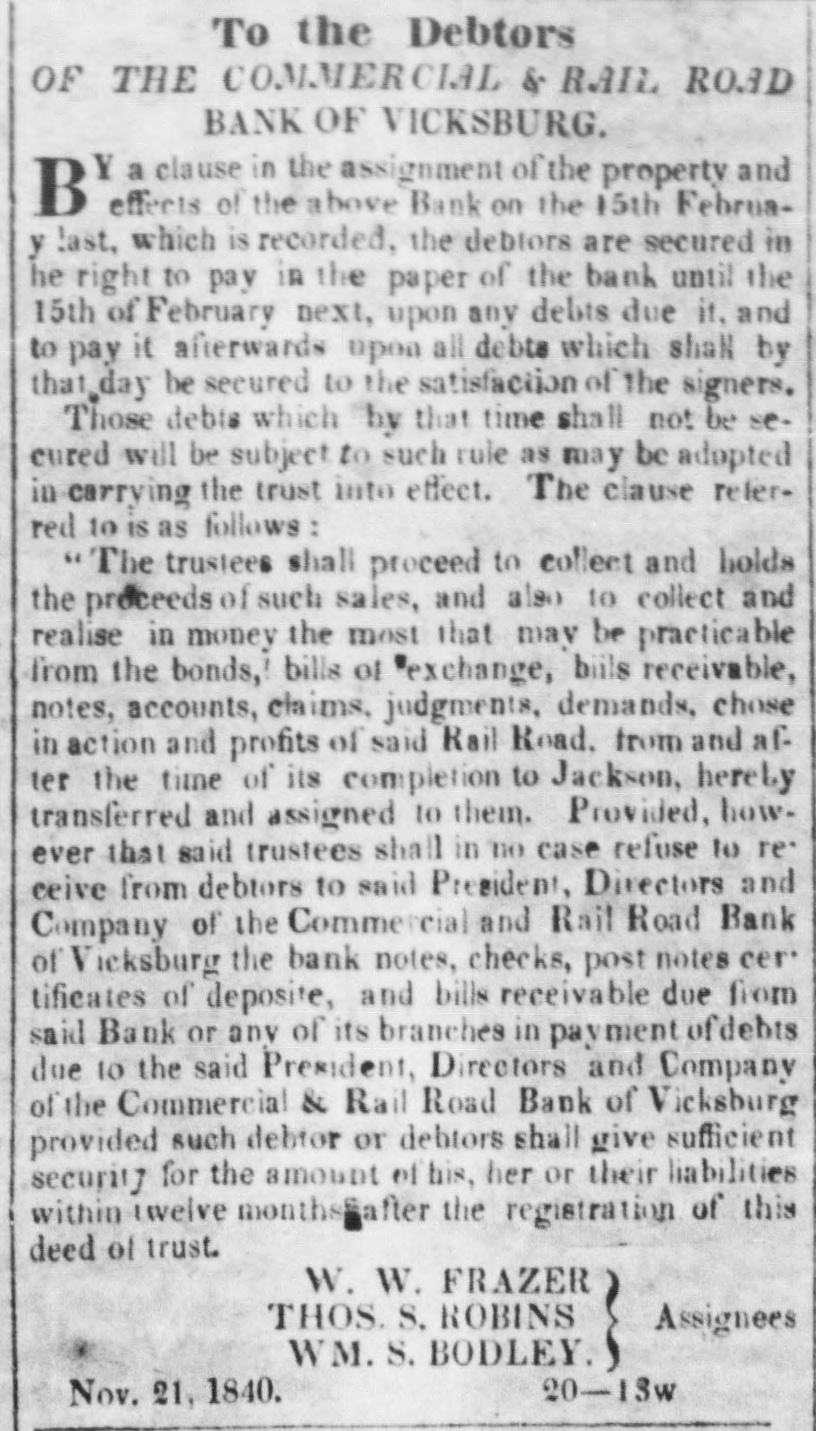
To the Debtors OF THE COMMERCIAL s RAIL ROAD BANK OF VICKSBURG. Y a clause in the assignment of the property and B effects of the above Bank on the 15th Februay last, which is recorded, the debtors are secured in he right to pay in the paper of the bank until the 15th of February next, upon any debts due it. and to pay it afterwards upon all debts which shall by that day be secured to the satisfaction of the signers. Those debts which by that time shall not be secured will be subject to such rule as may be adopted in carrying the trust into effect. The clause referred to is as follows : " The trustees shall proceed to collect and holds the proceeds of such sales, and also to collect and realise in money the most that may be practicable from the bonds, bills of "exchange, bills receivable, notes, accounts, claims, judgments, demands, chose in action and profits of said Rail Road. from and alter the time of its completion to Jackson, herely transferred and assigned to them. Provided, however that said trustees shall in no case refuse to re ceive from debtors to said President, Directors and Company of the Commercial and Rail Road Bank of Vicksburg the bank notes, checks, post notes cer' tificates of deposite, and bills receivable due from said Bank or any of its branches in payment of debts due to the said President, Directors and Company of the Commercial & Rail Road Bank of Vicksburg provided such debtor or debtors shall give sufficient security for the amount of his, her or their liabilities within twelve months after the registration of this deed of trust. W. W. FRAZER THOS. S. ROBINS Assignees WM. S. BODLEY. 20-13w Nov. 21, 1840.
Click image to open full size in new tab
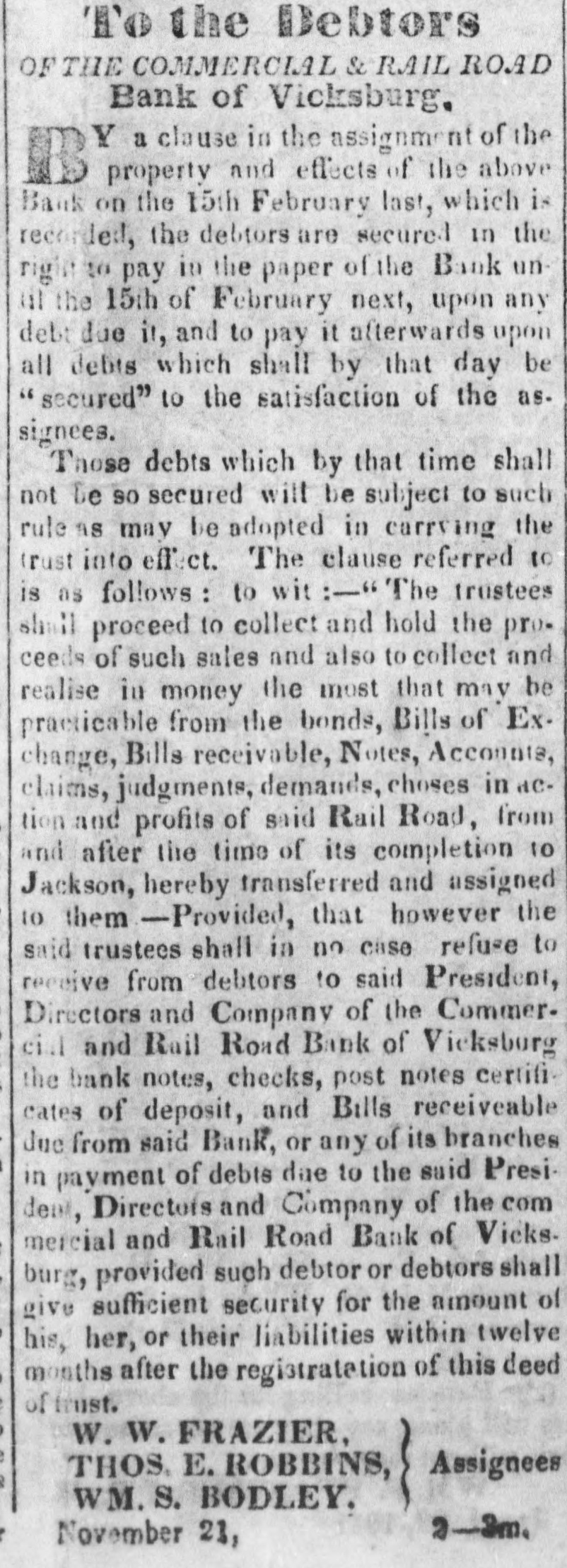
To the Debtors OF THE COMMERCIAL & RAIL ROAD Bank of Vicksburg. Y a clause in the assignment of the B property and effects of the above Bank on the 15th February last, which is recorded, the debtors are secured in the riginto pay in the paper of the Bank un(il the 15th of February next, upon any debt due ii, and to pay it afterwards upon all debts which shall by that day be "secured" to the satisfaction of the assignees. Those debts which by that time shall not be so secured will be subject to such rule as may be adopted in carrying the (rust into effect The clause referred to is as follows : to wit :-" The trustees shall proceed to collect and hold the proceeds of such sales and also to collect and realise in money the most that may be practicable from the bonds, Bills of Exchange, Bills receivable, Notes, Accounts, claims, judgments, demands, choses in action and profits of said Rail Road, from and after the time of its completion 10 Jackson, hereby transferred and assigned to them -Provided, that however the said trustees shall in no case refuse to receive from debtors to said President, Directors and Company of the Commercia and Rail Road Bank of Vicksburg the bank notes, checks, post notes certifi cates of deposit, and Bills receiveable due from said Bank, or any of its branches in payment of debts due to the said President, Directois and Company of the com mercial and Rail Road Bank of Vicks. burg, provided such debtor or debtors shall give sufficient security for the amount of his, her, or their liabilities within twelve months after the registratation of this deed of trust. W. W. FRAZIER, THOS. E. ROBBINS, Assignees WM. S. BODLEY. 2-3m. November 23,
Click image to open full size in new tab
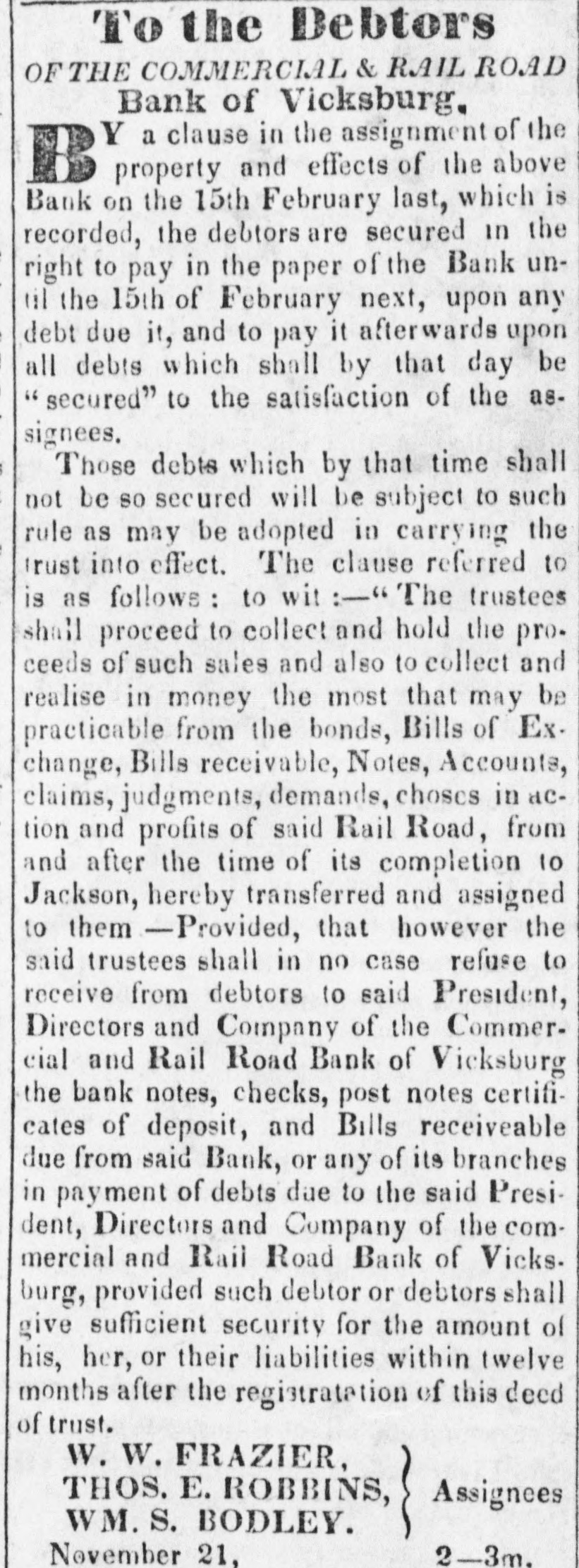
To the Debtors OF THE COMMERCIAL & RAIL ROAD Bank of Vicksburg. Y a clause in the assignment of the property and effects of the above Bank on the 15th February last, which is recorded, the debtors are secured in the right to pay in the paper of the Bank un(il the 15th of February next, upon any debt due it, and to pay it afterwards upon all debts which shall by that day be "secured" to the satisfaction of the assignees. Those debts which by that time shall not be so secured will be subject to such rule as may be adopted in carrying the trust into effect. The clause referred to is as follows: to wit :-" The trustees shall proceed to collect and hold the proceeds of such sales and also to collect and realise in money the most that may be practicable from the bonds, Bills of Ex. change, Bills receivable, Notes, Accounts, claims, judgments, demands, choses in action and profits of said Rail Road, from and after the time of its completion to Jackson, hereby transferred and assigned to them -Provided, that however the said trustees shall in no case refuse to receive from debtors to said President, Directors and Company of the Commercial and Rail Road Bank of Vicksburg the bank notes, checks, post notes certificates of deposit, and Bills receiveable due from said Bank, or any of its branches in payment of debts due to the said President, Directors and Company of the commercial and Rail Road Bank of Vicks. burg, provided such debtor or debtors shall give sufficient security for the amount of his, her, or their liabilities within twelve months after the registratation of this deed of trust. W. W. FRAZIER, THOS. E. ROBBINS, Assignees WM. S. BODLEY. November 21, 2-3m.
Click image to open full size in new tab
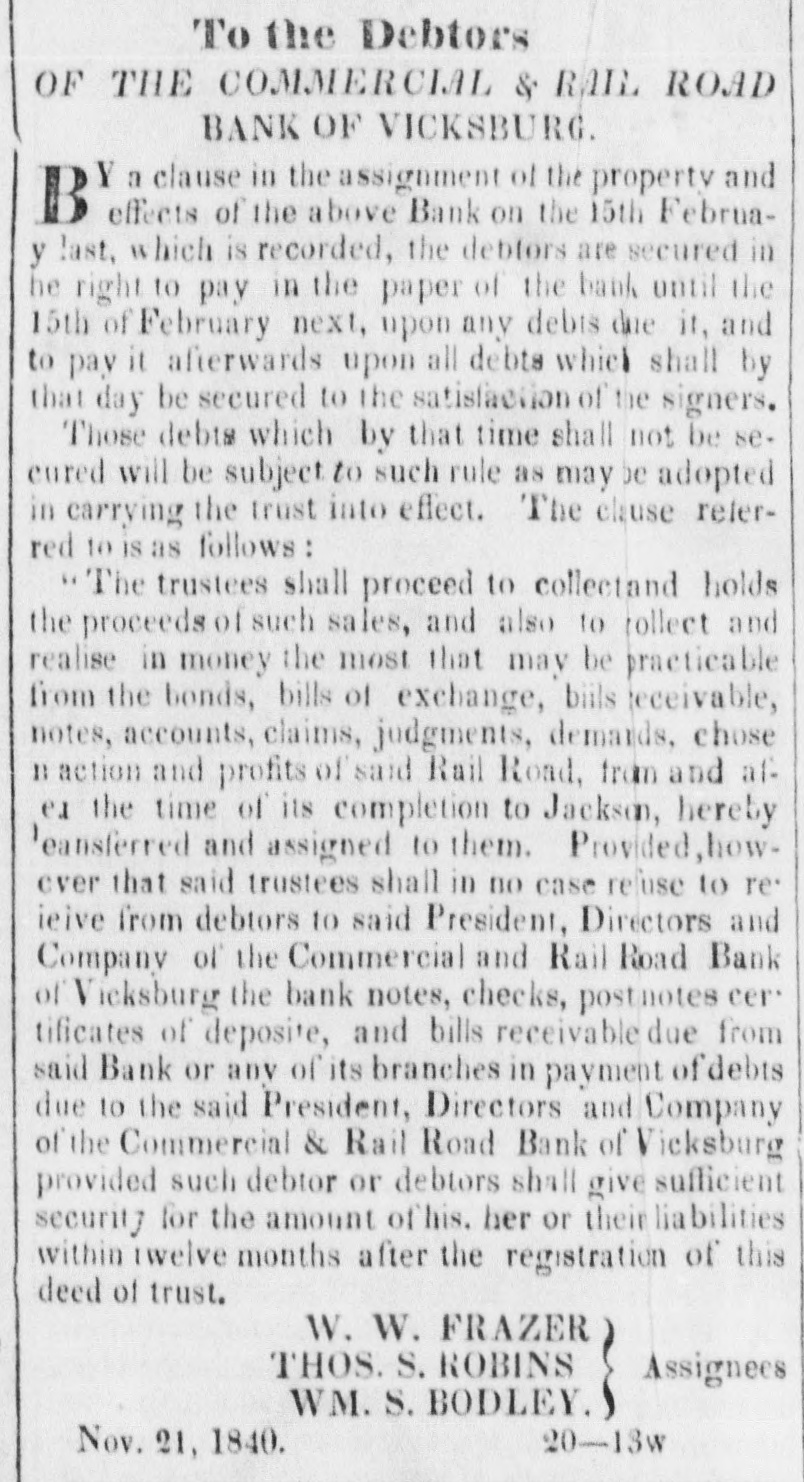
To the Debtors OF THE COMMERCIAL & RAIL ROAD BANK OF VICKSBURG. Y a clause in the assignment of the property and B effects of the above Bank on the 15th Februay last, which is recorded, the debtors are secured in he right to pay in the paper of the bank until the 5th of February next, upon any debts due it, and to pay it afterwards upon all debts which shall by that day be secured to the satisfaction of the signers. Those debts which by that time shall not be secured will be subject to such rule as may be adopted in carrying the trust into effect. The clause referred to is as follows: " The trustees shall proceed to collectand holds the proceeds of such sales, and also to collect and realise in money the most that may be practicable from the bonds, bills of exchange, bills receivable, notes, accounts, claims, judgments, demards, chose 11 action and profits of said Rail Road, from and alen the time of its completion to Jackson, hereby leansferred and assigned to them. Provided, however that said trustees shall in no case refuse to re leive from debtors to said President, Directors and Company of the Commercial and Rail Road Bank of Vicksburg the bank notes, checks, postnotes cer tificates of deposite, and bills receivable due from said Bank or any of its branches in payment of debts due to the said President, Directors and Company of the Commercial & Rail Road Bank of Vicksburg provided such debtor or debtors shall give sufficient security for the amount of 'his. her or their liabilities within twelve months after the registration of this deed of trust. W. W. FRAZER THOS. S. ROBINS Assignees WM. S. BODLEY. 20-13w Nov. 21, 1840.
Click image to open full size in new tab
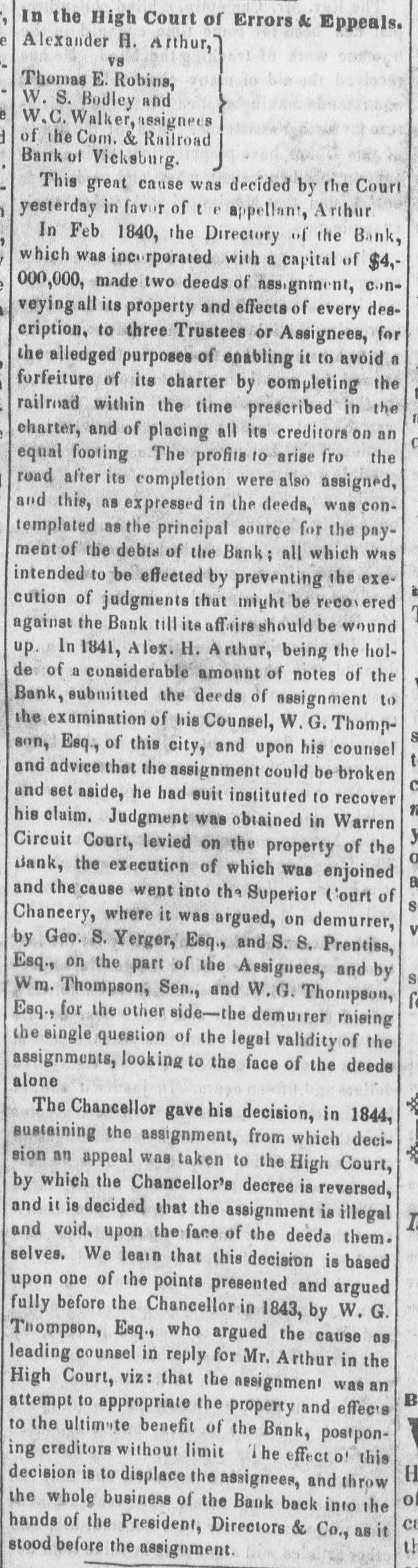
, In the High Court of Errors & Eppeals. e Alexander H. Arthur, VS Thomas E. Robins, W. S. Bodley and e W.C. Walker, assignees d of the Com. & Railroad Bank of Vicksburg. This great cause was decided by the Court ) yesterday in favor of the appellant, Arthur , In Feb 1840, the Directory of the Bank, , which was corporated with a capital of $4,e 000,000, made two deeds of assignment, canI veying all its property and effects of every description, to three Trustees or Assignees, for the alledged purposes of enabling it to avoid a forfeiture of its charter by completing the railroad within the time prescribed in the charter, and of placing all its creditors on an equal footing The profits to arise fro the road after its completion were also assigned, and this, as expressed in the deeds, was contemplated as the principal source for the payment of the debts of the Bank; all which was intended to be effected by preventing the execution of judgments that might be reco ered against the Bank till its affairs should be wound up In 1841, Alex. H. Arthur, being the holde of a considerable amount of notes of the 1 Bank, submitted the deeds of assignment to the examination of his Counsel, W.G. ThompS son, Esq., of this city, and upon his counsel t and advice that the assignment could be broken C and set aside, he had suit instituted to recover n his claim. Judgment was obtained in Warren Circuit Court, levied on the property of the 0 Bank, the execution of which was enjoined a and the cause went into the Superior Court of S Chaneery, where it was argued, on demurrer, V by Geo. S. Yerger, Esq., and S. S. Prentiss, Esq., on the part of the Assignees, and by S Wm. Thompson, Sen., and W.G. Thompson, f Esq., for the other side-the demuirer raising the single question of the legal validity of the assignments, looking to the face of the deeds alone The Chancellor gave his decision, in 1844, sustaining the assignment, from which decision an appeal was taken to the High Court, by which the Chancellor's decree is reversed, and it is decided that the assignment is illegal I and void, upon the face of the deeda them. selves. We leain that this decision is based upon one of the points presented and argued fully before the Chancellor in 1843, by W. G. Thompson, Esq., who argued the cause as leading counsel in reply for Mr. Arthur in the High Court, viz: that the assignment was an B attempt to appropriate the property and effecia to the ultimate benefit of the Bank, postponing creditors without limit The effect o! this H decision is to displace the assignees, and throw of the whole business of the Bank back into the CE hands of the President, Directors & Co., as it th stood before the assignment.