Accommodated withdrawals, Full suspension, Books examined
Receivership Details
Depositor recovery rate
100.0%
Date receivership started
1904-05-16
Date receivership terminated
1906-05-12
OCC cause of failure
Excessive lending
Share of assets assessed as good
34.4%
Share of assets assessed as doubtful
62.2%
Share of assets assessed as worthless
3.4%
Description
The First National Bank of Macon opened on May 16, 1904 but closed the same morning after the private I. C. Plant & Sons bank failed; crowds/great excitement and checks were refused, and a receiver (examiner) was appointed. The suspension led to receivership and eventual permanent closing (affairs finally closed by 1906). OCR minor fixes: R. H. Plant = Robert H. (R. H.) Plant; Examiner Albertsen/Albertson appears in sources.
Events (5)
1.December 9, 1865Chartered
Source
historical_nic
2.May 16, 1904Receivership
Source
historical_nic
3.May 16, 1904Receivership
Newspaper Excerpt
Examiner Albertsen was appointed receiver of the First National ... the comptroller of the currency has been advised ... closed its doors this morning by order of the board of directors.
Source
newspapers
4.May 16, 1904Run
Cause
Local Banks
Cause Details
Run and heavy withdrawals were triggered by the failure/suspension of the affiliated private I. C. Plant & Sons bank (same president), leading depositors to attempt withdrawals from the First National.
Measures
Bank posted notice that it would be closed until arrival of the bank examiner; directors closed doors to prevent a larger run; examiner appointed receiver.
Newspaper Excerpt
The failures came without the slightest intimation ... great crowds gathered ... a check for $2,000 ... was turned down, and with it a notice was passed out that the bank had closed its doors.
Source
newspapers
5.May 16, 1904Suspension
Cause
Bank Specific Adverse Info
Cause Details
The First National closed and was placed in receivership due to heavy losses tied to the suspension/failure of the private I. C. Plant & Sons bank (same president) and related bad assets/transfers between the institutions.
Newspaper Excerpt
The First National Bank ... closed its doors this morning, pending the arrival of the examiners ... Examiner Albertsen was appointed receiver of the First National.
Source
newspapers
Newspaper Articles (24)
1.May 16, 1904Lewiston Evening TellerLewiston, ID
Click image to open full size in new tab
Article Text
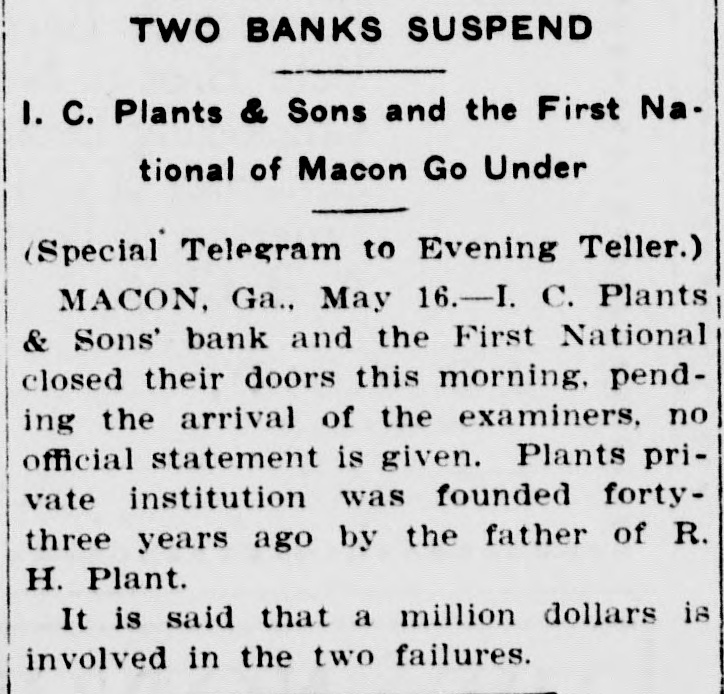
TWO BANKS SUSPEND 1. C. Plants & Sons and the First National of Macon Go Under (Special Telegram to Evening Teller.) MACON, Ga., May 16.-I. C. Plants & Sons' bank and the First National closed their doors this morning, pending the arrival of the examiners, no official statement is given. Plants private institution was founded fortythree years ago by the father of R. H. Plant. It is said that a million dollars is involved in the two failures.
2.May 17, 1904The Montgomery AdvertiserMontgomery, AL
Click image to open full size in new tab
Article Text
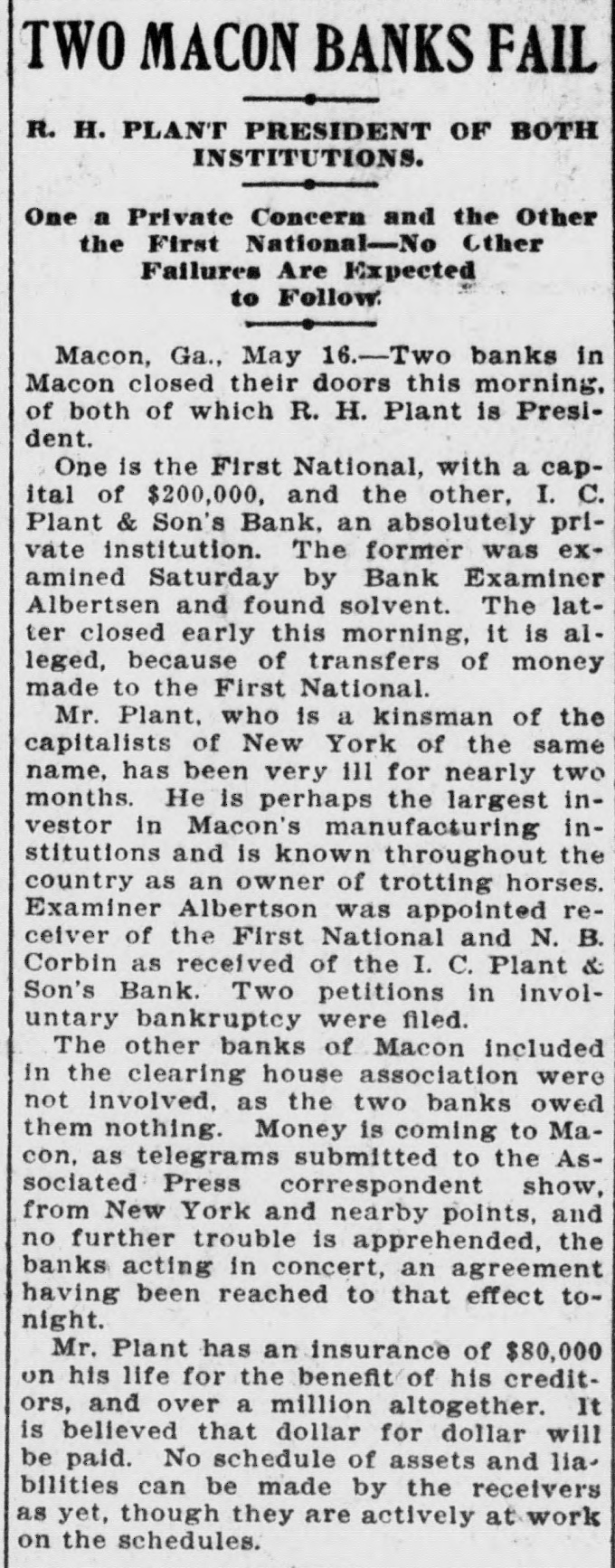
TWO MACON BANKS FAIL R. H. PLANT PRESIDENT OF BOTH INSTITUTIONS. One a Private Concern and the Other the First National-No Other Failures Are Expected to Follow Macon, Ga., May 16.-Two banks in Macon closed their doors this morning, of both of which R. H. Plant is President. One is the First National, with a capital of $200,000. and the other, I. C. Plant & Son's Bank, an absolutely private institution. The former was examined Saturday by Bank Examiner Albertsen and found solvent. The latter closed early this morning, it is alleged, because of transfers of money made to the First National. Mr. Plant, who is a kinsman of the capitalists of New York of the same name, has been very ill for nearly two months. He is perhaps the largest investor in Macon's manufacturing institutions and is known throughout the country as an owner of trotting horses. Examiner Albertson was appointed receiver of the First National and N. B. Corbin as received of the I. C. Plant & Son's Bank. Two petitions in involuntary bankruptcy were filed. The other banks of Macon included in the clearing house association were not involved, as the two banks owed them nothing. Money is coming to Macon, as telegrams submitted to the Associated Press correspondent show, from New York and nearby points, and no further trouble is apprehended, the banks acting in concert, an agreement having been reached to that effect tonight. Mr. Plant has an insurance of $80,000 on his life for the benefit of his creditors, and over a million altogether. It is believed that dollar for dollar will be paid. No schedule of assets and liabilities can be made by the receivers as yet, though they are actively at work on the schedules.
3.May 17, 1904The Birmingham Age-HeraldBirmingham, AL
Click image to open full size in new tab
Article Text
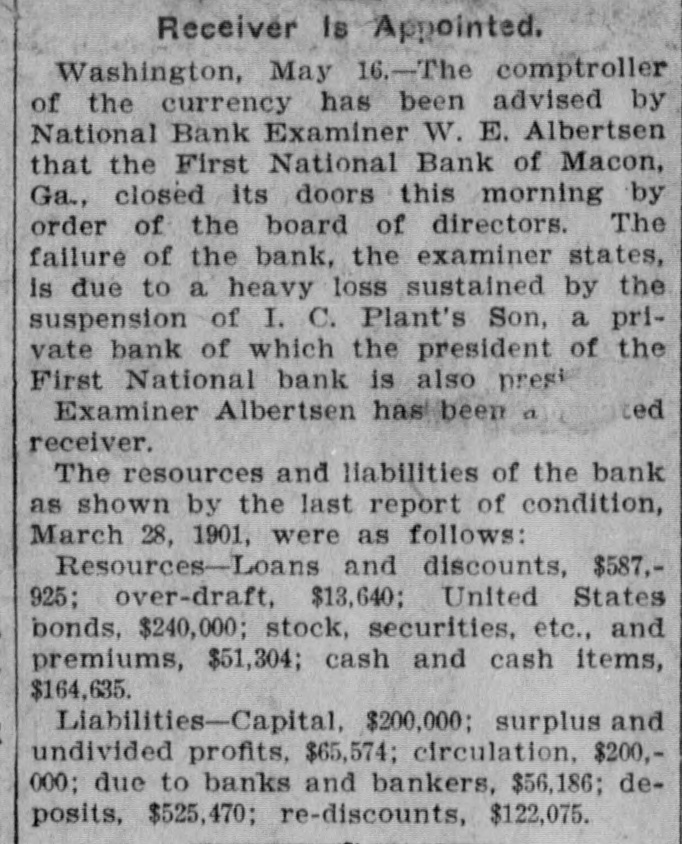
Receiver Is Appointed. Washington, May 16. - The comptroller of the currency has been advised by National Bank Examiner W. E. Albertsen that the First National Bank of Macon, Ga., closed its doors this morning by order of the board of directors. The failure of the bank, the examiner states, is due to a heavy loss sustained by the suspension of I. C. Plant's Son, a private bank of which the president of the First National bank is also presi ted Examiner Albertsen has been a receiver. The resources and liabilities of the bank as shown by the last report of condition, March 28, 1901, were as follows: Resources-Loans and discounts, $587.925; over-draft, $13,640; United States bonds, $240,000; stock, securities, etc., and premiums, $51,304; cash and cash items, $164,635. Liabilities-Capital, $200,000; surplus and undivided profits, $65,574; circulation, $200,000; due to banks and bankers, $56,186; deposits, $525,470; re-discounts, $122,075.
4.May 17, 1904The Birmingham Age-HeraldBirmingham, AL
Click image to open full size in new tab
Article Text
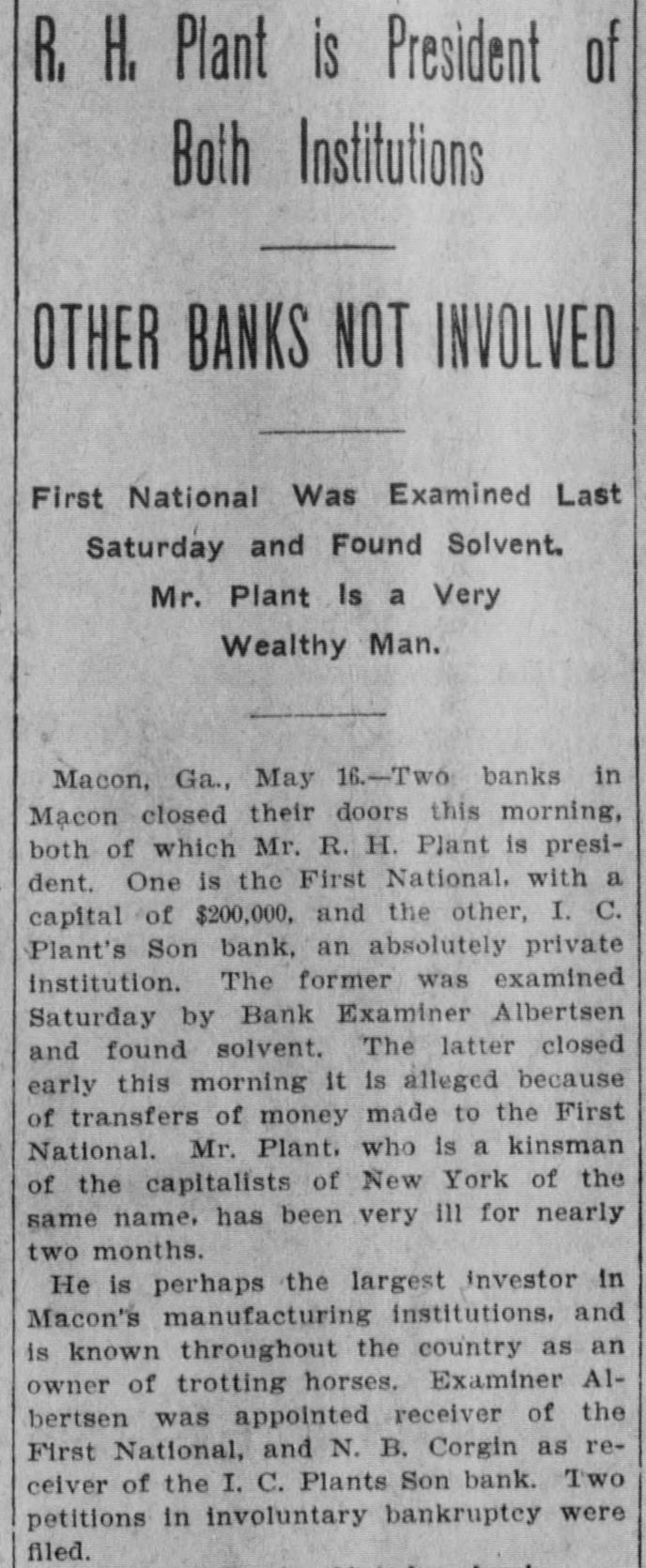
R. H. Plant is President of Both Institutions OTHER BANKS NOT INVOLVED First National Was Examined Last Saturday and Found Solvent. Mr. Plant Is a Very Wealthy Man. Macon, Ga., May 16.-Two banks in Macon closed their doors this morning, both of which Mr. R. H. Plant is president. One is the First National. with a capital of $200,000, and the other, I. C. Plant's Son bank, an absolutely private institution. The former was examined Saturday by Bank Examiner Albertsen and found solvent. The latter closed early this morning it is alleged because of transfers of money made to the First National. Mr. Plant, who is a kinsman of the capitalists of New York of the same name, has been very ill for nearly two months. He is perhaps the largest investor in Macon's manufacturing institutions. and is known throughout the country as an owner of trotting horses. Examiner A1bertsen was appointed receiver of the First National, and N. B. Corgin as receiver of the I. C. Plants Son bank. Two petitions in involuntary bankruptcy were filed.
5.May 17, 1904The Savannah Morning NewsSavannah, GA
Click image to open full size in new tab
Article Text
Macon, May 16.-The I. C. Plant's Sons' Bank, of which R. H. Plant, extensively known in the financial world, East as well as South, has long been director and manager, and the First National Bank, of which R. H. Plant is president, went to the wall this morning with liabilities running up into the millions. The failures came without the slightest intimation to the people of the city, and created the wildest excitement and consternation in the business world, and among the money savers who, had for years, been putting money in the depositaries. This morning the I. C. Plant's Sons' Bank did not open its doors, but no one noticed that until the banking life of the city had beer going on for nearly an hour. Next door, the First National Bank had been doing business. Deposits were being accepted and checks were being paid. Judge Drew Out $40,000. At 9:40 o'clock the judge of the court here presented a check for $40,000, and the cash was passed over the counter to him. As the judge stepped aside, a depositor handed in his book and a sum of money. A second later a check for $2,000, drawn by Congressman Charles L. Bartlett, was turned down, and with it a notice was passed out that the bank had closed its doors. The key was quickly turned in the locks and the National Bank was closed. It required but a few minutes for it all to became known, and great crowds gathered. So far neither bank has given out any statement, but it is generally known that it is the private bank which will do all the damage that may come. The bank owes its depositors heavy sums, the greater part being due money savers, women and wage earners, who have been hoarding up.
6.May 17, 1904The Brunswick Daily NewsBrunswick, GA
Click image to open full size in new tab
Article Text
A BIG SURPRISE IN CENTRAL CITY I. C. Plant and First National Closed Doors Yesterday FIRMS MANY EFFECTED Judge Speer Has Already Appointed a Receiver for Plant's Bank-First National May be Solvent, But Closed to Prevent Rush. Macon, Ga., May 16.-A financial sensation was caused in this city today by the failure of two banks, the I. C. Plant Sons' bank and the First Nation al Bank of Macon. The first named institution did not open its doors at all, but simply posted a notice announcing that it would not be open for business. The First Na tional opened at the usual hour, but an hour later It closed, also putting a notice that it would b closed until the arrival of the bank examiner. R. H. Plant, who is president of both the banks, refused to give out a state ment and says nothing officially will be given out until the arrival of the bank examiner. Judge Speer this afternoon appoint ed N. B. Corbin, president of the Macon Grocery Company, receiver for the I C. Plant's bank. it is understood that the failure OI the First National, as well as the Plant's bank, will effect a number O. business concerns in Macon, among them the Acme Brewing Company, It also stated that the Central of Geor 154 I-Groad carried a large deposit in the First National. The First National is said to be solvent, and closed its alcors today only to preve a big run after the failure or the thit's bank. The ouncement caused a complet sensation in Macon, and came as a surprise, THE 1. C. Piant Sons Bank was : pri ale. institution, founded in 1843, and. has never been incorporated. It was founded by R. H. Plant, The president of the two banks, R. H. Plant, is interested in a number of business concerns in this city, and it is believed that many of them will be effected by the failures. It is not thought, however, that any of the other Mscon banks will be effected.
7.May 17, 1904Evening JournalWilmington, DE
Click image to open full size in new tab
Article Text
The World's News WASHINGTON. The United States Supreme Court sustained the action of the New York immigration authorities in ordering the deportation of the Englishman, Turner, alleged to be an Anarchist. The opinion upholds the Federal law excluding Anarchists. The United States Supreme Court held that a telegraph operator for a railroad company and a fireman on a railroad engine are fellow-servants. There was a dissenting opinion. The inreads upon the treasury owing principally to Panama Canal disbursements caused a decrease in the available cash balance since May 1 from $219,091,651 to $174,361,378. POLITICAL. The deadlock over the nomination for Governor in the Illinois Republican Convention is still unbroken. Roosevelt leaders oppose the renomination of Yates. Hearst lost in the preliminary organization of the California State Convention. Republican leaders have urged the selection of Secretary Contelyou as Chairman of the National Committee. Colonel James M. Guffey is not a candidate for Democratic National Chairman. The Hanna faction will control the Ohio Republican Convention to be held toJay. FOREIGN. Rebels in Northern Nigeria were completely crushed by a British force, which, however, had thirteen officers killed. Austria gave permission for nine American warships to enter the ports of Trieste and Flume. Lord Curzon, Viceroy of India, had a great reception on his arrival in London. Owing to the bitterness of the partisans of rival candidates for President, and the demand for the resignation of army chiefs, Colombia is threatened with an outbreak. The Tibetans at Gyantse received heavy ordnance from Lassa and reinforcements of troops for a renewed attack on the British camp. SPORTING. Athletics beat St. Louis in the first game of the series 5 to 4. Phillies-St. Louis game prevented by rain. Lansdowne Country Club women defeated Belfield County Club players in an interclub tennis match three games to two. Hurst Park, a Kingston colt, captured another handicap event at Morris Park. The Guardsman won an exciting race at Louisville ran away and threw his jockey, breaking the latter's leg. Naval Board of the Schuylkill Navy announced the programs for the People's and Navy Day regatta, adopted a new rule and decided to petition the Park Commissioners to better police the Schuylkill river. MISCELLANEOUS. In his inaugural address, Governor Blanchard pledged Louisiana to protect the negro. The body of Leonidas Hubbard, who perished in the interior of Labrador last October while on an exploring expedition, is expected to arrive at St. John's, N. F., today. The First National Bank, of Macon, Cha., closed, following the suspension of I. C. Plant's Sons' private bank. Robert H. Plant was President of both Institutions. Dr. William E. Woodend, the New York bankrupt broker, may escape arrest upon any civil process. By an omission on the part of Congress no appropriation was made for forty clerks in the Steam Engineering Department of the Brooklyn Navy Yard. They will be laid off July 1.
8.May 20, 1904The Herald and NewsNewberry, SC
Click image to open full size in new tab
Article Text
GENFRAL NEWS NOTES. Items of More or Less Interest Condensed Outside the State. Admiral Johnson. commander of the Boston. navy yard. will soon be retired on account of age. Newton C. Blanchard was inaugurated on Monday as governor of Louisiana. In his inaugural address he touched on the subjects of lynchings, saying they would not be permitted under any circumstances if It was possible for the military, under the command of the governor. to prevent it. The Moros. who attacked a detachment of American troops in the Philippine islands on May 8. killing two officers and a number of men. may be severely punished by Major General Leonard Wood. who is marching on the band with a force of 450 officers and men. The plant of the Augusta Evening Herald was completely destroyed by fire on Monday night. The Herald's complete outfit of linotypes. presses: etc., was destroyed. The Herald will b issued from the Chronicle's office until a new plant can be obtained. In a recent primary in Florida two tickets for the national democratic convention were put in the field-a Hearst ticket and a ticket in the interest of no particular candidate. Three of the Hearst men were elected and six of the others. The First National bank. of Macon, Ga.. has closed its doors. by order of the board of directors. The suspension of the bank. it is stated. is due to the suspension of a private bank. of which the president of the First National bank was also president. Charles F. Pircher. of Choctow Bluff. Clarke county. Ala., was indicted in the United States court on Monday on eight charges. including forging a proposal to carry the mails, forging securities and bonds. forging checks. embezzleing etc. There are 32 counts in one indictment. If given the extreme penalty Pircher would get an aggregate sentence of about 180 years and be fined about $60,000. In default of a bail of $4,000 he was sent to the jail.
9.May 22, 1904The Wichita Daily EagleWichita, KS
Click image to open full size in new tab
Article Text
HE KILLED HIMSELF. President of a Failed Bank Ends His Existence. Macon, Ga., May 21.-R. H. Plant, presIdent of the I. C. Plant & Sons' bank and the First National bank, which were closed here Monday, killed himself late this afternoon. He had been confined to his home by illness for several days. Unnoticed, he slipped away from his nurse, secured a revolver and shot himself through the head. Fifteen minutes later the nurse found the capitalist dead, with a pistol in his hand. Mr. Plant leaves a widow and nine children. The Plant banking institutions were the oldest in Macon. The receiver of the private bank has reported a shortage of more than $844,000. The national examiner has not yet reported on the First National. Mr. Plant had life insurance for more than $1,000,000. of which about $800,000 was for the benefit of creditors.
10.May 22, 1904The Washington TimesWashington, DC
Click image to open full size in new tab
Article Text
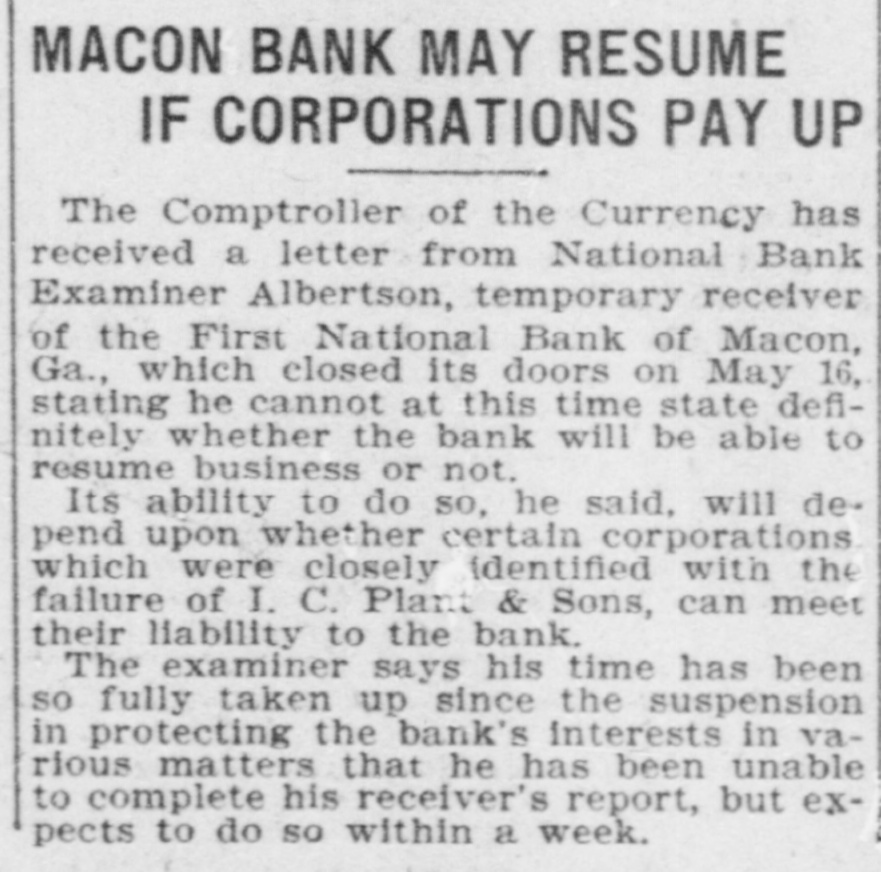
MACON BANK MAY RESUME IF CORPORATIONS PAY UP The Comptroller of the Currency has received a letter from National Bank Examiner Albertson, temporary receiver of the First National Bank of Macon, Ga., which closed its doors on May 16, stating he cannot at this time state definitely whether the bank will be able to resume business or not. Its ability to do so, he said, will depend upon whether certain corporations which were closely identified with the failure of I. C. Plant & Sons, can meet their liability to the bank. The examiner says his time has been so fully taken up since the suspension in protecting the bank's interests in various matters that he has been unable to complete his receiver's report, but expects to do so within a week.
11.May 23, 1904Evening BulletinHonolulu, HI
Click image to open full size in new tab
Article Text
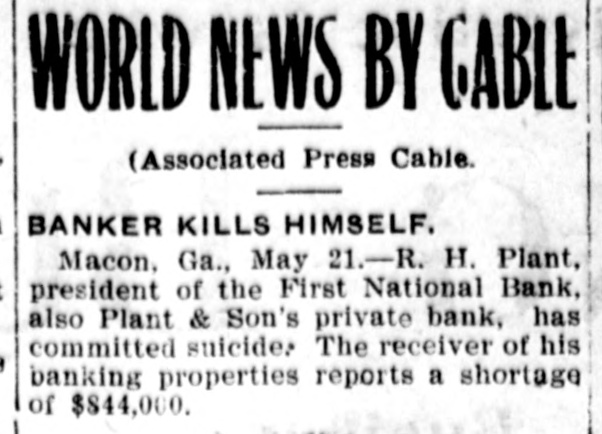
WORLD NEWS BY GABLE (Associated Press Cable. BANKER KILLS HIMSELF. Macon. Ga., May 21.-R. H. Plant, president of the First National Bank, also Plant & Son's private bank, has committed suicide. The receiver of his banking properties reports a shortage of $844,000.
12.May 23, 1904The Daily PalladiumRichmond, IN
Click image to open full size in new tab
Article Text
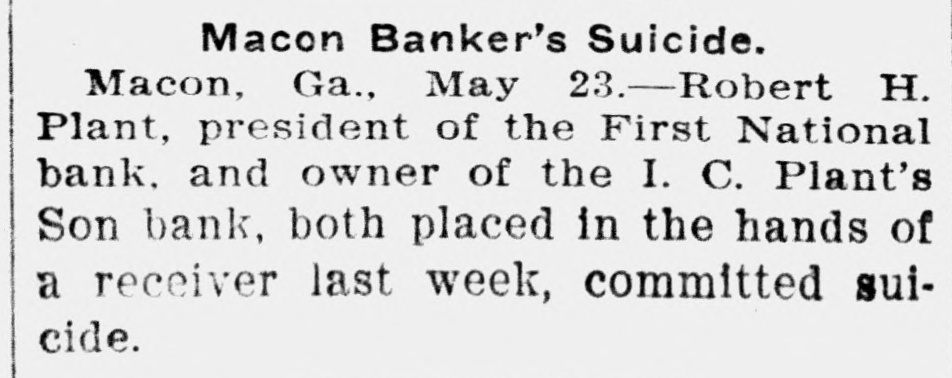
Macon Banker's Suicide. Macon, Ga., May 23.-Robert - H. Plant, president of the First National bank. and owner of the I. C. Plant's Son bank, both placed in the hands of a receiver last week, committed suicide.
13.May 23, 1904Evening JournalWilmington, DE
Click image to open full size in new tab
Article Text
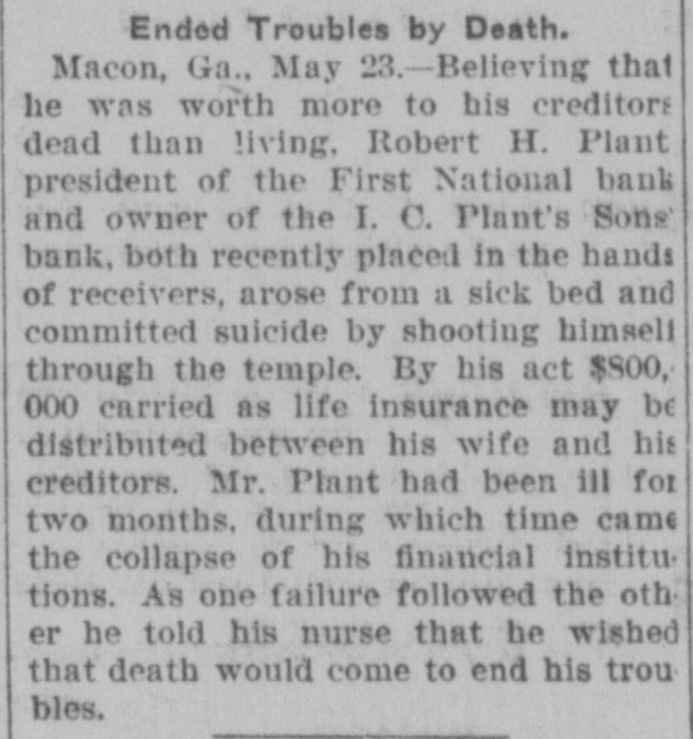
Ended Troubles by Death. Macon, Ga., May 23.-Believing that he was worth more to his creditors dead than living. Robert H. Plant president of the First National bank and owner of the I. C. Plant's Sons' bank, both recently placed in the hands of receivers, arose from a sick bed and committed suicide by shooting himself through the temple. By his act $800, 000 carried as life insurance may be distributed between his wife and his creditors. Mr. Plant had been ill for two months, during which time came the collapse of his financial institu. tions. As one failure followed the oth er he told his nurse that he wished that death would come to end his troubles.
14.May 24, 1904The Birmingham Age-HeraldBirmingham, AL
Click image to open full size in new tab
Article Text
SOUTHERN SUES BANK. Washington, May 23.-The Southern railway today entered suit in the district supreme court against the First National Bank of Macon. Ga., for $22,957, which was on deposit with the bank when it went into the hands of a receiver. The railroad company alleges that the bank owns 100,000 gallons of cotton seed oil now in this city.
15.May 24, 1904Wausau PilotWausau, WI
Click image to open full size in new tab
Article Text
Two Banks Close Doors. The I. C. Plant Sons' bank, in Macon, Ga., failed to open its doors Monday. The First National Bank opened at 9 o'clock, but later closed, posting a notice that it would not open the next day, pending the arrival of a bank examiner. No official statement of the bank's condition has been given out. It is reported the action taken by the First National was from an apprehension of a run following the closing of the other institution.
16.May 25, 1904The Dawson NewsDawson, GA
Click image to open full size in new tab
Article Text
ACCOUNTANTS AT WORK. Depositors Await Report on Condition of Suspended Banks at Macon. The excitement, caused by the suspension of the First National and the private bank of I. C. Plant's Sons, it Macon, G2. is subsiding, and the people are patiently awaiting the report or the condition of affairs of the in. stitutions. It will be several days be 10.e the report will be ready.
17.May 26, 1904River Falls JournalRiver Falls, WI
Click image to open full size in new tab
Article Text
KILLS SELF TO PAY DEBTS HEAD OF TWO DEFUNCT BANKS COMMITS SUICIDE. Shortage of $800,000 Can Be Made Good When Insurance Policies on Life Are Collected. Macon, Ga., May 23.-Realizing that he was financially wrecked and that he would be worth more to his creditors as a corpse than while living, R. H. Plant, once a millionaire banker, arose from a sick bed, put on his bathrobe and slippers, and asked his nurse to assist him to the bathroom. Then, passing through the bathroom, he went to the back porch and sent a pistol ball through his head Saturday afternoon. He died without a word. Nothing by way of explanation was found. He carried $800,000 life insurance. Of this $50,000 was incumbered to secure debts. Besides this he carried $250,000 in favor of his wife. He told a friend five years ago that he had $1,000,000 secured to his wife and children so that they would get it no matter what business reverses overtook him. Those who knew him intimately say they are satisfied that when the receiver for his two banks published a day or two ago that his net liabilities were $800,000, the figures became so fixed in his mind and he realized that the only way for him to pay his debts was by suicide. His total liabilities are upwards of $2,000,000. He was pro-' prietor of the I. C. Plant's Sons' private bank, which, was established here half a century ago, and he was president of the First national bank. He asserted that he had not known his distressing financial predicament until a bank examiner reached here last Saturday and demanded $100,000 represented by a due bill held against R. H. Plant in the national bank. When $100,000 was taken out of the private bank it exhausted the funds of the latter. When notified of this in his sick room on Sunday he ordered the private bank closed. A run on the national bank was started and the directors closed it early Monday morning. Mr. Plant was the general agent of the New York Life Insurance company for years. He secured investments of life insurance money paid by the company to beneficiaries of policies. Therefore hundreds of widows and orphans were heavy losers by his failure. He said after the failure that it was on this account that his misfortune wrung his heart.
18.May 27, 1904The Savannah Morning NewsSavannah, GA
Click image to open full size in new tab
Article Text
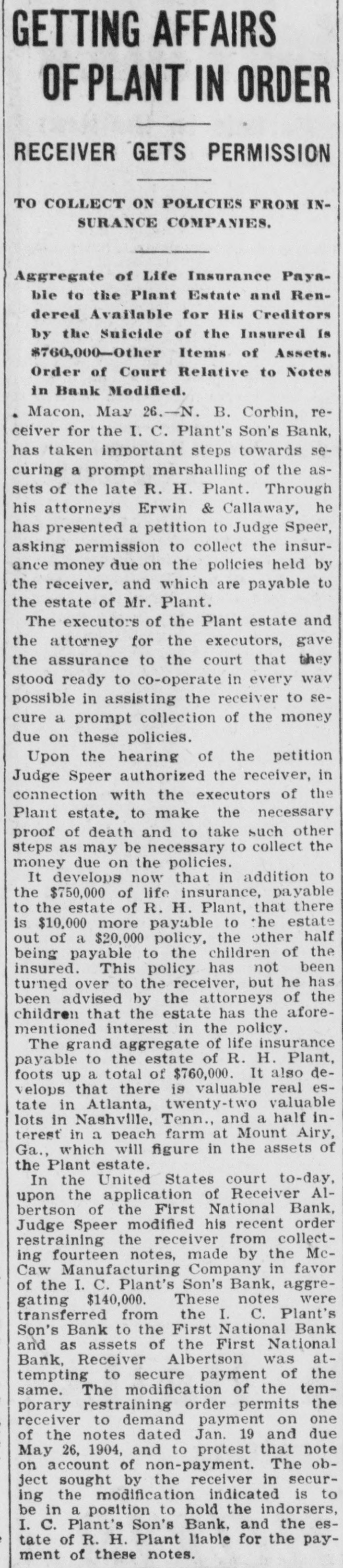
GETTING AFFAIRS OF PLANT IN ORDER RECEIVER GETS PERMISSION TO COLLECT ON POLICIES FROM INSURANCE COMPANIES. Aggregate of Life Insurance Payable to the Plant Estate and Rendered Available for His Creditors by the Suicide of the Insured Is 8760.000-Other Items of Assets. Order of Court Relative to Notes in Bank Modified. Macon, May 26.-N. B. Corbin, receiver for the I. C. Plant's Son's Bank, has taken important steps towards securing a prompt marshalling of the assets of the late R. H. Plant. Through his attorneys Erwin & Callaway, he has presented a petition to Judge Speer, asking permission to collect the insurance money due on the policies held by the receiver. and which are payable to the estate of Mr. Plant. The executors of the Plant estate and the attorney for the executors, gave the assurance to the court that they stood ready to co-operate in every wav possible in assisting the receiver to secure a prompt collection of the money due on these policies. Upon the hearing of the petition Judge Speer authorized the receiver, in connection with the executors of the Plant estate, to make the necessary proof of death and to take such other steps as may be necessary to collect the money due on the policies. It develops now that in addition to the $750,000 of life insurance, payable to the estate of R. H. Plant, that there is $10,000 more payable to he estate out of a $20,000 policy, the other half being payable to the children of the insured. This policy has not been turned over to the receiver, but he has been advised by the attorneys of the children that the estate has the aforementioned interest in the policy. The grand aggregate of life insurance payable to the estate of R. H. Plant, foots up a total of $760,000. It also develops that there is valuable real estate in Atlanta, twenty-two valuable lots in Nashville, Tenn., and a half interest in a peach farm at Mount Airy, Ga. which will figure in the assets of the Plant estate. In the United States court to-day, upon the application of Receiver Albertson of the First National Bank, Judge Speer modified his recent order restraining the receiver from collecting fourteen notes, made by the McCaw Manufacturing Company in favor of the I. C. Plant's Son's Bank, aggregating $140,000. These notes were transferred from the I. C. Plant's Son's Bank to the First National Bank and as assets of the First National Bank, Receiver Albertson was attempting to secure payment of the same. The modification of the temporary restraining order permits the receiver to demand payment on one of the notes dated Jan. 19 and due May 26, 1904, and to protest that note on account of non-payment. The object sought by the receiver in securing the modification indicated is to be in a position to hold the indorsers, I. C. Plant's Son's Bank, and the estate of R. H. Plant liable for the payment of these notes.
19.June 10, 1904The Savannah Morning NewsSavannah, GA
Click image to open full size in new tab
Article Text
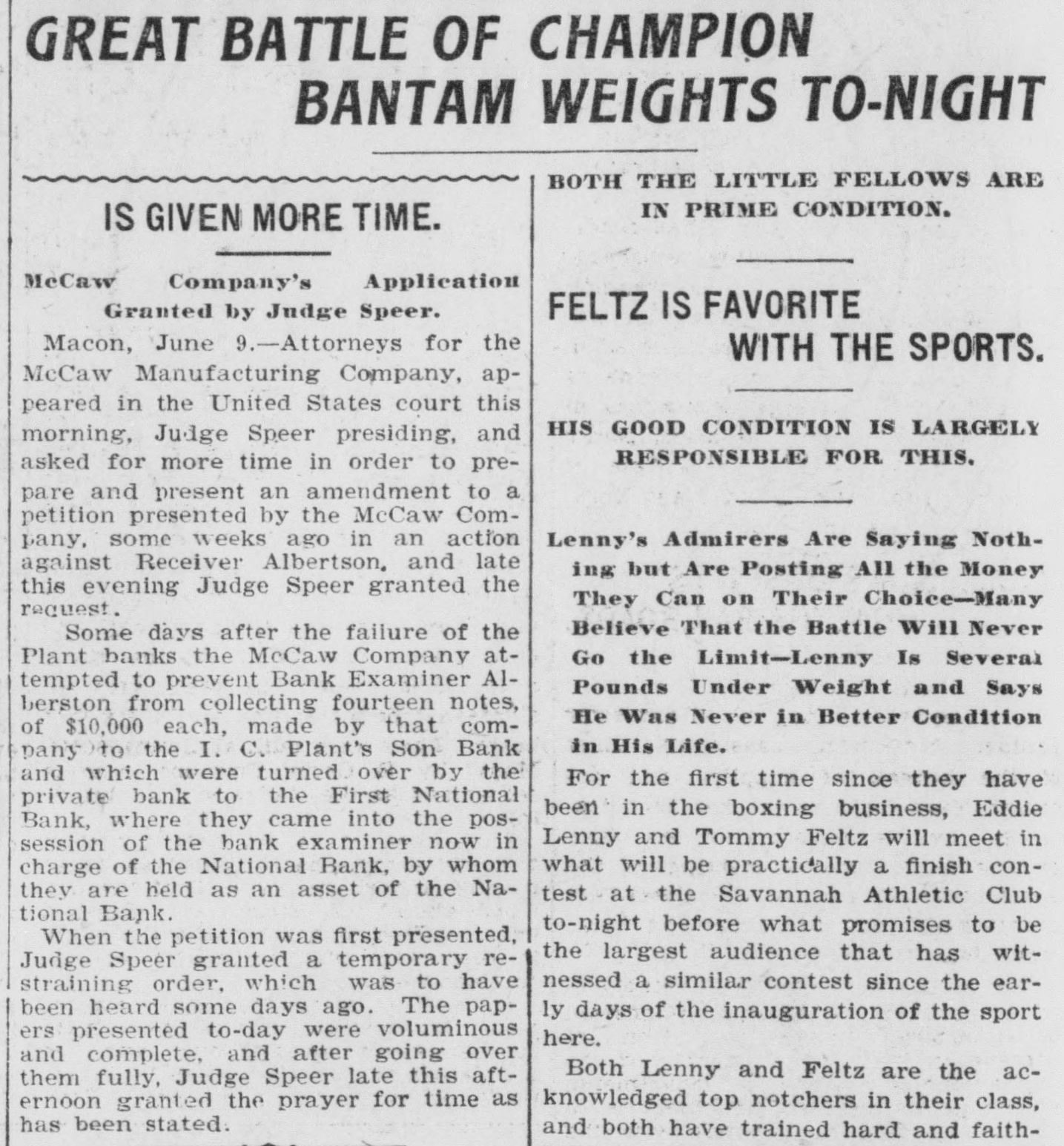
GREAT BATTLE OF CHAMPION BANTAM WEIGHTS TO-NIGHT BOTH THE LITTLE FELLOWS ARE IN PRIME CONDITION. IS GIVEN MORE TIME. McCaw Company's Application FELTZ IS FAVORITE Granted by Judge Speer. Macon, June 9.-Attorneys for the WITH THE SPORTS. McCaw Manufacturing Company, appeared in the United States court this HIS GOOD CONDITION IS LARGELY morning, Judge Speer presiding, and RESPONSIBLE FOR THIS. asked for more time in order to prepare and present an amendment to a petition presented by the McCaw Company, some weeks ago in an action Lenny's Admirers Are Saying Nothagainst Receiver Albertson. and late ing but Are Posting All the Money this evening Judge Speer granted the They Can on Their Choice-Many request. Believe That the Battle Will Never Some days after the failure of the Plant banks the McCaw Company atGo the Limit-Lenny Is Several tempted to prevent Bank Examiner AlPounds Under Weight and Says berston from collecting fourteen notes, He Was Never in Better Condition of $10,000 each, made by that comin His Life. pany to the I. C. Plant's Son Bank and which were turned over by the For the first time since they have private bank to the First National been in the boxing business, Eddie Bank, where they came into the posLenny and Tommy Feltz will meet in session of the bank examiner now in what will be practically a finish concharge of the National Bank, by whom they are held as an asset of the Natest at the Savannah Athletic Club tional Bank. to-night before what promises to be When the petition was first presented, the largest audience that has witJudge Speer granted a temporary renessed a similar contest since the earstraining order, which was to have been heard some days ago. The paply days of the inauguration of the sport ers presented to-day were voluminous here. and complete, and after going over Both Lenny and Feltz are the acthem fully, Judge Speer late this aftknowledged top notchers in their class, ernoon granted the prayer for time as has been stated. and both have trained hard and faith-
20.June 15, 1904The Abbeville Press and BannerAbbeville, SC
Click image to open full size in new tab
Article Text
BANKER SACRIFICES LIFE R. H. Plant Kills Himself That Insurance May Be Available. SAVES DEPOSITORS $800,000 Southern Financier Atones Through Death For Crash of Two Banks of Which He Was Head-Revolver Ends His Troubles-Had $1,015,000 Insurance, Which is Incontestable. Macon. Ga.-A tragic sequel to the crash of the private bank of I. C. Plant's Sons and the First National Bank came, when R. H. Plant, the head of both institutions. committed suicide. thereby making available over $1,000,000 life insurance for payment on liabilities of about $800,000 of the two banking institutions. That Mr. Plant deliberately sacrificed his life that the creditors should not suffer is believed by his most intimate friends and by banking and insurance men who knew him here. During the last twenty-five years Mr. Plant had accumulated life insurance amounting to $1,015,888, on which he was paying an annual premium of about $43,000. As a result of his death the indications are that the creditors of the two banks will not lose a single penny. Many of the creditors are working people. whose deposits represented years of self-denial and saving. At least $800,000 of Mr. Plant's life insurance is now made payable to his estate. and this amount, it is estimated, will fully cover his liabilities. Mr. Plant had been ill for two months past. When the banks collapsed ugly charges were circulated and much indignation expressed because he failed to make any statements as to the cause. During his illness, especially since the failure of his institutions, he had been closely watched at his home in College street here by his family and nurses, for fear he would commit some rash act. He told his nurse he wished to lie down. Twenty minutes later he asked to be assisted to the bath-room. While there he sent the nurse for a glass of milk. In her absence he secured his revolver from his room, returned to the bathroom and stepped out a small doorway leading to a porch in the rear of his home. There he placed the weapon to his head and fired. The nurse, returning with the glass of milk, heard the shot, dashed into the bathroom and out on the porch, where she found the capitalist dead, the smoking revolver still clenched in his hand. The bullet had passed through the right temple and out of the left, flattening itself upon the house wall. Death was probably instantaneous. The Coroner was at once summoned, and upon the testimony of the nurse and of a physician a verdict of death by his own hands was rendered. Mr. Plant leaves a widow and nine children. Wallace E. McCaw, President of the McCaw Manufacturing Company, and Mr. Felton Hatcher, a prominent attorney. are sons-in-law., The Plant banking institutions are the oldest in the city. The receiver of the private institution has reported a deficit of over $844,000. The National Bank Examiner has as yet made no report as to the First National's affairs. Mr. Plant, in addition to being identifled with various manufacturing enterprises, and formerly largely engaged with the New York Life Insurance Company. was known throughout the trotting world, and his horses for years have raced in the grand circuit. He owned Grattan Boy. Dulce Cor, Miss Willamont and other well-known horses. George H. Plant, Vice-President of the First National, is a brother.
21.July 22, 1904The Herald and NewsNewberry, SC
Click image to open full size in new tab
Article Text
# GENERAL NEWS NOTES.
Items of More or Less Interest Condensed Outside of The State.
Frank Satterwhite, a farmer of Princess Anne County, Va., crazed by jealousy, attacked his wife with a monkey wrench on Friday night and battered her skull into a pulp. He then fled, carrying his two-year-old child with him and finally throwing it into a neighbor's yard.
Sampson Flournoy, a negro, fired with a shot gan on four fishermen, all white, at Alexander, near Waynesboro, Ga., on Saturday afternoon, killing two of them and mortally wounding a third. The negro had had a quarrel over a trivial matter with one of the party. He escaped and blood-hounds were put on his track.
Jack O'Brien and Bob Fitzsimmons fought a fast six-round bout in Philadelphia on Saturday. When the gong announced the close both men were on their feet, but were very badly burised.
August 10 has been fixed as the date for the formal notification to Judge Parker of his nomination for the presidency. The ceremony will take place at Judge Parker's home at Esopus and, following the desire of Mr. Parker, will be simple and brief.
The notification of Henry G. Davis, of West Virginia, of his nomination by the democrats for the vice-presidency will take place at White Sulphur Springs, W. Va., about the middle of August. Mr. Davis is now at Bedford Springs, Pa., for a rest and says that as this is the only opportunity he will have he does not intend to talk or think politics during his sojourn there. He will go to his home at Elkins, W. Va., on Thursday.
Senator Gorman, while he declines to be considered for the chairmanship of the national democratic committee, says, however, that he will be glad to render all the service in his power to those who may be selected to take charge of the campaign, which he fully believes will be crowned with success.
Gorman and Sheehan have both positively stated that they decline to be considered for the chairmanship of the democratic national committee and the choice will in all probability fall upon Thomas T. Taggart.
The Missouri democratic convention nominated Joseph W. Folk, of St. Louis, for governor, on a platform standing for the stamping out of boodling and of bribery of officials.
A number of indictments were found against members of the mob which made an attempt to lynch a negro in Danville, Va., on last Wednesday, and several fines have been imposed, while many have been released on bond and will be brought to trial this week.
The case of Senator Joseph R. Burton, convicted in St. Louis of accepting a fee for services before the post-office department while a member of the United States senate, will be reviewed by the United States supreme court, probably in the fall.
The First National bank, of Macon, Ga., which failed some time ago, and whose president, Mr. Plant, committed suicide in order that his creditors might get the full benefit of his life insurance, will pay its creditors in full, it has been definitely announced by the receiver into whose hands the institution was placed.
It is reported from London that during a discussion of South African affairs in the house of commons Joseph Chamberlain, who was defending the introduction of Chinese labor in the Transvaal, contended that white laborers would not work side by side with black laborers
22.July 27, 1904The Savannah Morning NewsSavannah, GA
Click image to open full size in new tab
Article Text
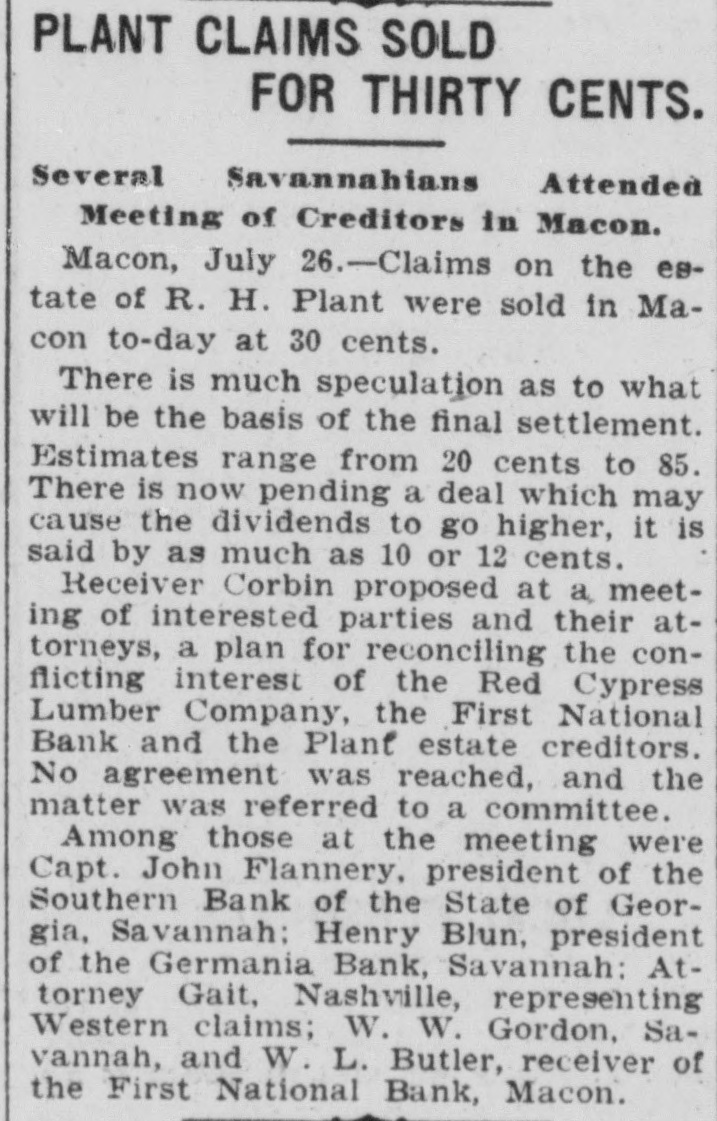
PLANT CLAIMS SOLD FOR THIRTY CENTS. Several Savannahians Attended Meeting of Creditors in Macon. Macon, July 26.-Claims on the estate of R. H. Plant were sold in Macon to-day at 30 cents. There is much speculation as to what will be the basis of the final settlement. Estimates range from 20 cents to 85. There is now pending a deal which may cause the dividends to go higher, it is said by as much as 10 or 12 cents. Receiver Corbin proposed at a, meeting of interested parties and their attorneys, a plan for reconciling the conflicting interest of the Red Cypress Lumber Company, the First National Bank and the Plant estate creditors. No agreement was reached, and the matter was referred to a committee. Among those at the meeting were Capt. John Flannery, president of the Southern Bank of the State of Georgia, Savannah: Henry Blun, president of the Germania Bank, Savannah: Attorney Gait, Nashville, representing Western claims; W. W. Gordon, Savannah, and W. L. Butler, receiver of the First National Bank, Macon.
23.September 29, 1904The Times DispatchRichmond, VA
Click image to open full size in new tab
Article Text
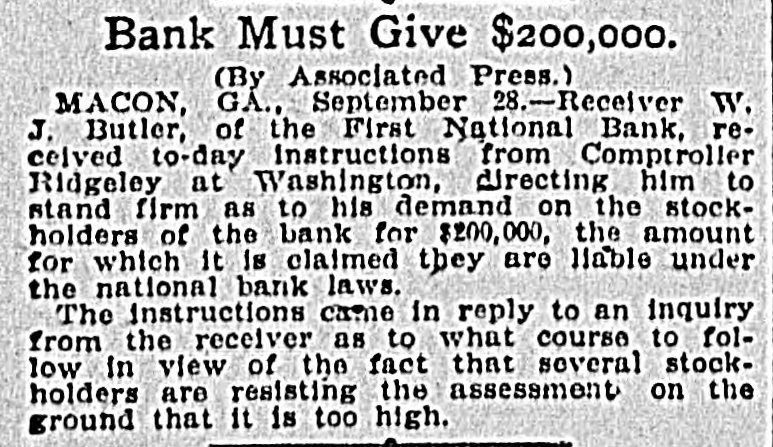
Bank Must Give $200,000. (By Associated Press.) MACON, GA., September 28.-Receiver W. J. Butler, of the First National Bank, recelved to-day instructions from Comptroller Ridgeley at Washington, directing him to stand firm as to his demand on the stockholders of the bank for $200,000, the amount for which it is claimed they are liable under the national bank laws. The instructions came in reply to an inquiry from the receiver as to what course to follow in view of the fact that several stockholders are resisting the assessment on the ground that it is too high.
24.June 13, 1908The Brunswick NewsBrunswick, GA
Click image to open full size in new tab
Article Text
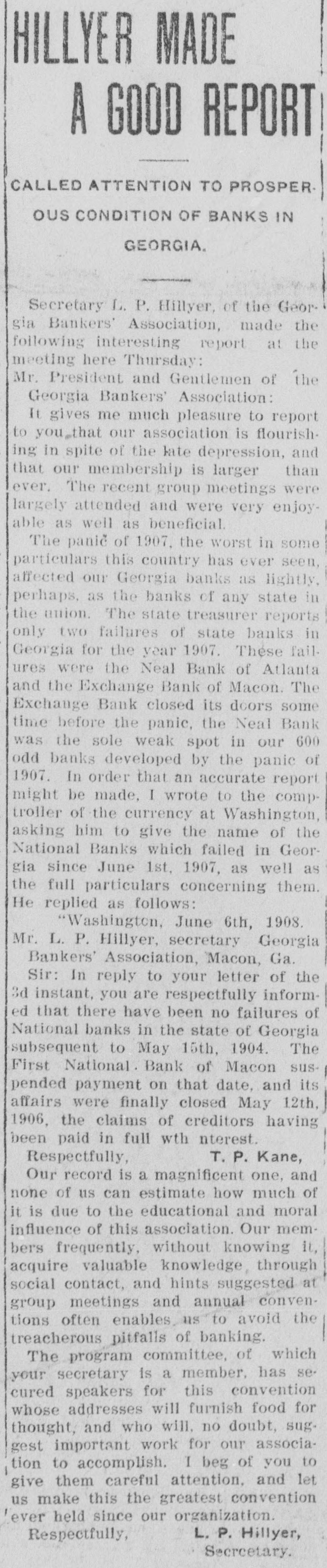
HILLYER MADE A GOOD REPORT CALLED ATTENTION TO PROSPER OUS CONDITION OF BANKS IN GEORGIA. Secretary L. P. Hillyer, of the Georgia Bankers' Association, made the following interesting report at the meeting here Thursday: Mr. President and Gentlemen of the Georgia Bankers' Association: It gives me much pleasure to report to you that our association is flourishing in spite of the late depression, and that our membership is larger than ever. The recent group meetings were largely attended and were very enjoyable as well as beneficial. The panic of 1907. the worst in some particulars this country has ever seen, affected our Georgia banks as lightly, perhaps, as the banks of any state in the union. The state treasurer reports only two failures of state banks in Georgia for the year 1907. Thése fail. ures were the Neal Bank of Atlanta and the Exchange Bank of Macon. The Exchange Bank closed its doors some time before the panic, the Neal Bank was the sole weak spot in our 600 odd banks developed by the panic of 1907. In order that an accurate report might be made, I wrote to the comptroller of the currency at Washington, asking him to give the name of the National Banks which failed in Georgia since June 1st, 1907, as well as the full particulars concerning them. He replied as follows: "Washington, June 6th, 1908. Mr. L. P. Hillyer, secretary Georgia Bankers' Association, Macon, Ga. Sir: In reply to your letter of the 3d instant, you are respectfully informed that there have been no failures of National banks in the state of Georgia subsequent to May 15th, 1904. The First National. Bank of Macon suspended payment on that date, and its affairs were finally closed May 12th, 1906, the claims of creditors having been paid in full wth interest. T. P. Kane, Respectfully, Our record is a magnificent one, and none of us can estimate how much of it is due to the educational and moral influence of this association. Our members frequently, without knowing it, acquire valuable knowledge through social contact, and hints suggested at group meetings and annual conventions often enables us to avoid the treacherous pitfalls of banking. The program committee, of which your secretary is a member, has secured speakers for this convention whose addresses will furnish food for thought, and who will, no doubt, suggest important work for our association to accomplish. I beg of you to give them careful attention. and let us make this the greatest convention 'ever held since our organization. L. P. Hillyer, Respectfully, Secretary.