2463. First National Bank (Ocala, FL)

Bank Information

Episode Type
Run → Suspension → Closure
Bank Type
national
Bank ID
3470
Charter Number
3470
Start Date
April 20, 1895
Location
Ocala, Florida (29.187, -82.140)

Metadata

Model
gpt-5-mini
Short Digest
ca5d8390

Response Measures

Capital injected, Full suspension, Books examined

Other: Receivership followed suspension; criminal indictments of president for embezzlement.

Receivership Details

Depositor recovery rate
28.2%
Date receivership started
1895-04-22
Date receivership terminated
1899-06-30
OCC cause of failure
Fraud
Share of assets assessed as good
43.9%
Share of assets assessed as doubtful
33.2%
Share of assets assessed as worthless
22.9%

Description

A run and heavy withdrawals (including $17,000 paid out and state funds withdrawn) and impaired capital from bad loans preceded the Comptroller closing the bank on 1895-04-20 and placing it in charge of an examiner. The bank never resumed normal operations; it was placed in receivership and assets were later sold (receiver's sale in 1899). Underlying bank-specific insolvency (bad loans, misapplied assets) and subsequent indictments and conviction of the president confirm permanent failure.

Events (7)

1. March 16, 1886 Chartered
Source
historical_nic
2. April 20, 1895 Receivership
Newspaper Excerpt
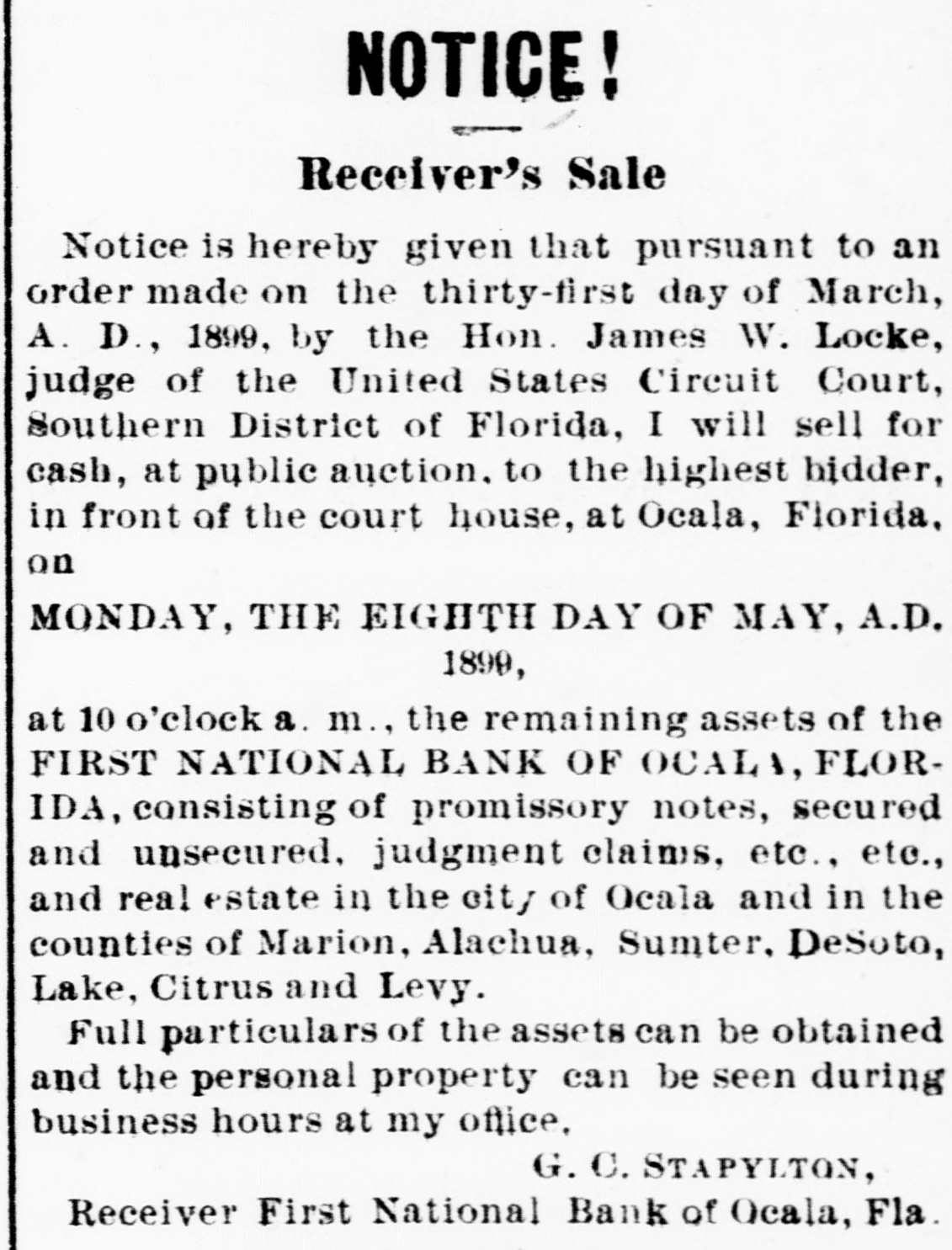
Controller Eckels to-day closed the First National Bank of Ocala, Fla., and placed it in charge of Bank Examiner McDonald. ... McDonald has arrived and is examining the bank. The bank suspended two months ago, and has since been in charge of National-Bank-Examiner McDonald. (reports April–June 1895). receiver of the First National bank, returned... (June 26, 1895).The comptroller of the currency has appointed ... Granville C. Stapelton receiver of the First National bank of Ocala, Fla. (1895-08-03).Notice ... I will sell ... the remaining assets of the FIRST NATIONAL BANK OF OCALA, FLORIDA ... May 8, 1899. (1899).
Source
newspapers
3. April 20, 1895 Run
Cause
Bank Specific Adverse Info
Cause Details
Capital impaired by bad loans; reports of insolvency circulated and withdrawals accelerated (state treasurer withdrew state funds; correspondent refused aid).
Measures
No successful emergency recapitalization; offers of aid arrived (e.g., $50,000 tendered) but were too late.
Newspaper Excerpt
At 8 o'clock the following was posted on the doors: This bank is forced into temporary suspension... ... within the last seven days $17,000 in currency was paid out over the counter.'
Source
newspapers
4. April 20, 1895 Suspension
Cause
Government Action
Cause Details
Comptroller of the Currency closed the bank and placed it in charge of a bank examiner after capital was found impaired and heavy withdrawals occurred.
Newspaper Excerpt
Controller Eckels to-day closed the First National Bank of Ocala, Fla., and placed it in charge of Bank Examiner McDonald. ... This bank is forced into temporary suspension...
Source
newspapers
5. April 22, 1895 Receivership
Source
historical_nic
6. August 3, 1895 Receivership
Newspaper Excerpt
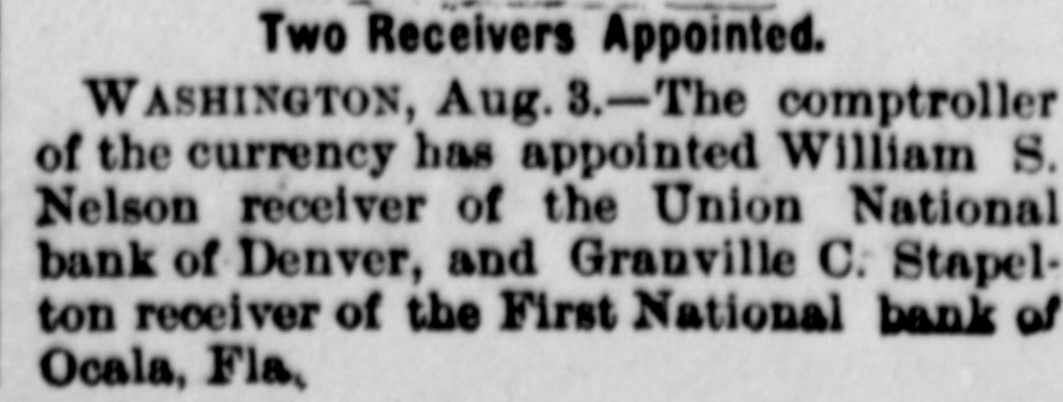
The comptroller of the currency has appointed ... Granville C. Stapelton receiver of the First National bank of Ocala, Fla. (Pawtucket Tribune, 1895-08-03).
Source
newspapers
7. January 14, 1896 Other
Newspaper Excerpt
E. W. Agnew, president of the First National Bank of Ocala, was to-day indicted by the grand jury of the United States court on charges of embezzlement, abstraction and misapplication of the funds of the bank ... The bank suspended two months ago ... It is doubtful if the depositors will get 10 per cent. of their money. (reports of indictments, trial and later conviction).
Source
newspapers

Newspaper Articles (21)

Article from The Morning News, April 21, 1895

Click image to open full size in new tab

Article Text

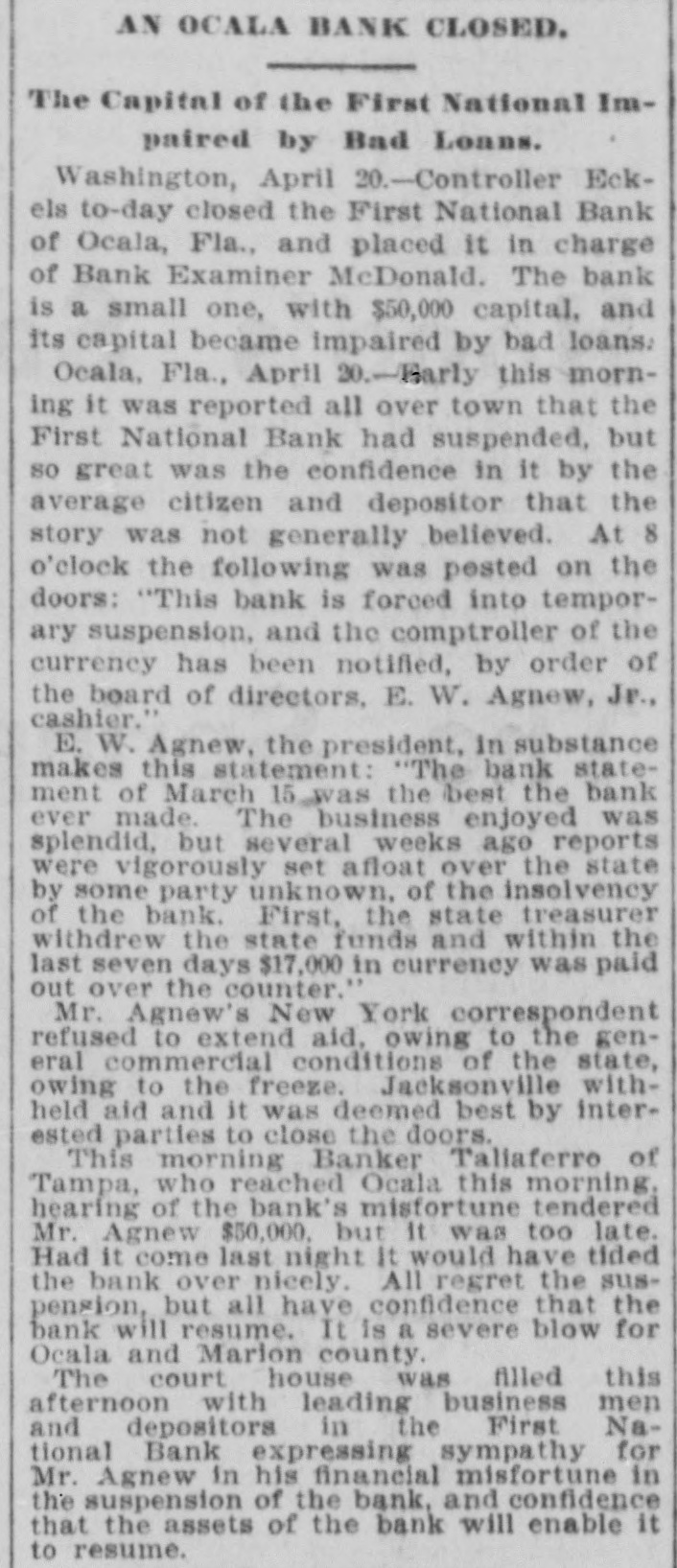
AN OCALA BANK CLOSED. The Capital of the First National Impaired by Bad Loans. Washington, April 20.-Controller Eckels to-day closed the First National Bank of Ocala, Fla., and placed it in charge of Bank Examiner McDonald. The bank is a small one, with $50,000 capital, and its capital became impaired by bad loans: Ocala, Fla., April 20.-Harly this morning it was reported all over town that the First National Bank had suspended, but so great was the confidence in it by the average citizen and depositor that the story was not generally believed. At 8 o'clock the following was pested on the doors: "This bank is forced into temporary suspension, and the comptroller of the currency has been notified, by order of the board of directors, E. W. Agnew, Jr., cashier. E. W. Agnew, the president, in substance makes this statement: "The bank statement of March 15 was the best the bank ever made. The business enjoyed was splendid, but several weeks ago reports were vigorously set afloat over the state by some party unknown, of the insolvency of the bank. First, the state treasurer withdrew the state funds and within the last seven days $17,000 in currency was paid out over the counter.' Mr. Agnew's New York correspondent refused to extend aid, owing to the general commercial conditions of the state, owing to the freeze. Jacksonville withheld aid and it was deemed best by interested parties to close the doors. This morning Banker Taliaferro of Tampa, who reached Ocala this morning, hearing of the bank's misfortune tendered Mr. Agnew $50,000. but It was too late. Had it come last night It would have tided the bank over nicely. All regret the suspension, but all have confidence that the bank will resume. It is a severe blow for Ocala and Marion county. The court house was filled this afternoon with leading business men and depositors in the First National Bank expressing sympathy for Mr. Agnew in his financial misfortune in the suspension of the bank, and confidence that the assets of the bank will enable it to resume.


Article from The Morning News, April 23, 1895

Click image to open full size in new tab

Article Text

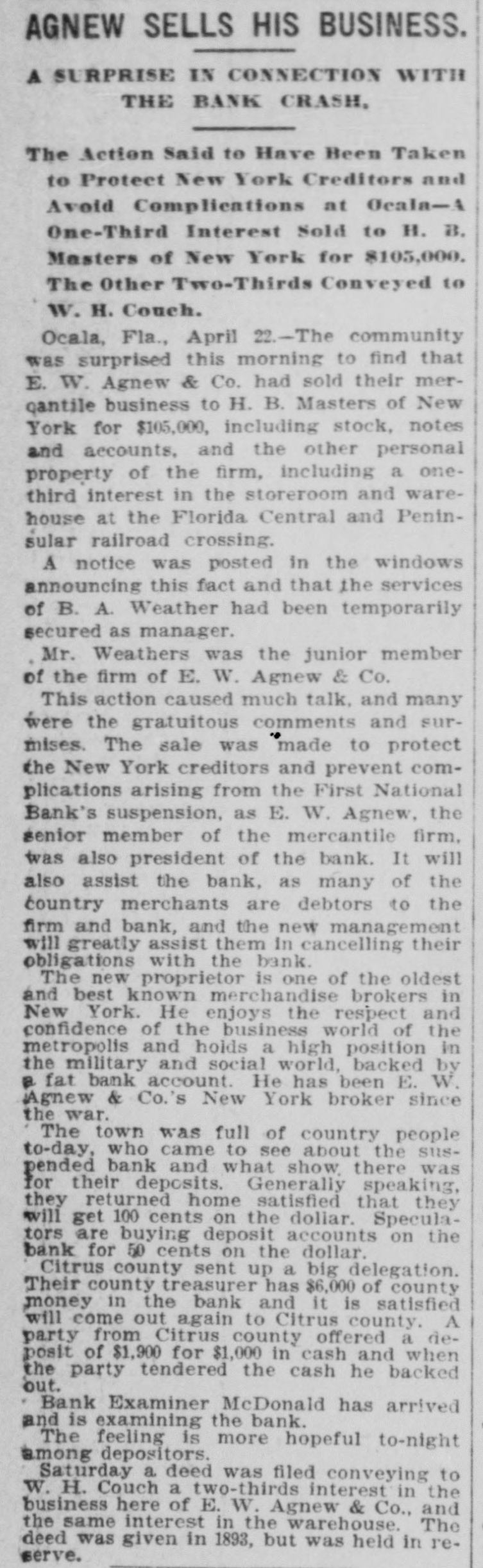
AGNEW SELLS HIS BUSINESS. A SURPRISE IN CONNECTION WITH THE BANK CRASH, The Action Said to Have Been Taken to Protect New York Creditors and Avoid Complications at Ocala-A One-Third Interest Sold to H. B. Masters of New York for $105,000. The Other Two-Thirds Conveyed to W. H. Couch. Ocala, Fla., April 22.-The community was surprised this morning to find that E. W. Agnew & Co. had sold their merqantile business to H. B. Masters of New York for $105,000, including stock, notes and accounts, and the other personal property of the firm, including a onethird interest in the storeroom and warehouse at the Florida Central and Peninsular railroad crossing. A notice was posted in the windows announcing this fact and that the services of B. A. Weather had been temporarily secured as manager. Mr. Weathers was the junior member of the firm of E. W. Agnew & Co. This action caused much talk, and many were the gratuitous comments and surmises. The sale was made to protect the New York creditors and prevent complications arising from the First National Bank's suspension, as E. W. Agnew, the senior member of the mercantile firm, was also president of the bank. It will also assist the bank, as many of the country merchants are debtors to the firm and bank, and the new management will greatly assist them in cancelling their obligations with the bank. The new proprietor is one of the oldest and best known merchandise brokers in New York. He enjoys the respect and confidence of the business world of the metropolis and holds a high position in the military and social world, backed by @ fat bank account. He has been E. W. Agnew & Co.'s New York broker since the war. The town was full of country people to-day, who came to see about the suspended bank and what show there was for their deposits. Generally speaking, they returned home satisfied that they will get 100 cents on the dollar. Speculators are buying deposit accounts on the bank for 50 cents on the dollar. Citrus county sent up a big delegation. Their county treasurer has $6,000 of county money in the bank and it is satisfied will come out again to Citrus county. A party from Citrus county offered a deposit of $1,900 for $1,000 in cash and when the party tendered the cash he backed out. Bank Examiner McDonald has arrived and is examining the bank. The feeling is more hopeful to-night among depositors. Saturday a deed was filed conveying to W. H. Couch a two-thirds interest in the business here of E. W. Agnew & Co., and the same interest in the warehouse. The deed was given in 1893, but was held in reserve.


Article from Morris Tribune, April 24, 1895

Click image to open full size in new tab

Article Text

the agreest previous week. The increase, compared with the corresponding week in 1894. was 1.3. WILLIAM CRAMER, about 30 years of age, shot and fatally wounded his divorced wife at Decatur, Ill., and then killed himself. SIR BELIVERE, the champion St. Bernard and one of the most famous dogs in the world, owned by Capt. S. A. Pratt, and valued at $20,000, died at Little Rock, Ark. THROUGH undervaluation of imported goods at the port of New York it was said the government would lose over $100,000. SIXTY business houses at Ardmore, I. T., were destroyed by fire, the total loss being $600,000. THERE were' 241 businessfailures in the United States in the seven days ended on the 19th, against 207 the week previous and 219 in the corresponding time in 1894. A CYCLONE sweptaway twenty houses at Matties Landing, Ala., and killed three persons. FIRE in the building in Philadelphia occupied by the New York Biscuit company caused a loss of $300,000. BALDWIN BROS. & Co., brokers at Boston, with branch offices in over fifty New England cities and in New York, suspended with liabilities of over $500,000. PATRIOTS' day, the anniversary of the battle of Lexington, was generally observed throughout New England. THORNTON PARKER (colored) was hanged at Westchester, Va., for assault on Mrs. Melton, and Frank Fuller (also colored) was hanged at New Orleans, La., for murdering Henrietta Gardner. FIVE HUNDRED garmentworkers went on a strike at St. Louis against the sweating system. THE Furnas county bank at Beaver City, Neb., closed its doors with liabilities of $27,000. JOHN B. THOMAS, late editor of the Mount Vernon (Ind.) Republican and a cripple, left Evansville to go round the world in a wheel chair in two years without a cent of money except what he earns on his way. MRS. DELIA T. S. PARNELL, 80 years of age, mother of the late Charles Stuart Parnell, was murderously assaulted by highwaymen near Bordentown, '[ N HARRY BLAKE, Patrick Harvey and William Hardpke were killed and John Conly and J. J. Hand were fatally injured by the collapse of hoisting machinery in the Chicago Ship Building company's yards at South Chicago. JUDGE EVERETT, of the superior court at Lafayette, Ind., in the case of Helen M. Gougar, decided that women were not entitled to the right of suffrage in Indiana. THE National Union of Heavy Hardware Dealers began its annual meeting in Louisville, Ky. THE percentages of the baseball clubs in the National league for the week ended on the 20th were: Boston, 1.000; Cincinnati, 1.000; Pittsburgh, .667; Chicago, .667; New York .500; Brookyn, .500; Baltimore, .500; Philadelphia, 500; St. Louis, .333; Louisville, .333; '000' :000* A TRAIN on the Philadelphia & Readng railroad struck a wagon containng Mr. and Mrs. Henry Frank, aged 2 and 65 respectively, near Richland, Pa., and both were instantly killed. THE Chicago Times-Herald and the Chicago Evening Post were purchased Rohnsant "H "H "W Aq THE forty-second regular session of the Wisconsin legislature adjourned sine die. THE First national bank of Ocala, Fla., closed it doors. LAKESIDE, a summer resort on Pewaukee lake, about twenty miles east of Milwaukee, was destroyed by fire. DURING a storm at Fort Worth, Tex., a portion of the roof of the tabernacle rave way and fell on part of an audince of 10,000 listening to Evangelist Dwight Moody, fifty persons being inured. MATTHEW CALLOWAY, a negro who nurdered Jim Walters (colored) at Santa Fe in July last, was executed at Columbia, Tenn. JULIUS and Ernst Haefelin and John Miller were drowned in the Delaware river at Philadelphia by the upsetting f a boat. HENRY A. SHIRLEY and James S. Amerton, English capitalists, were irowned south of San Antonio, Tex. HENRY WILLIAMS, of Hillsboro, Tex., killed his wife because she refused to ret up and make breakfast and then oisoned himself. ALL persons using profane or vulgar anguage on the streetsof McKeesport, 'a., will be arrested by order of the nayor. AFTER serving continuously in the ervice of the United States for period f forty-three years, Maj. Gen. Alexnder McDowell McCook retires from he army, the age of 64 years having een reached.


Article from The Diamond Drill, April 27, 1895

Click image to open full size in new tab

Article Text

The News Condensed. Important Intelligence From All Parts. DOMESTIC. THE North Dakota Milling association of Grand Forks, owning and operating twelve flouring mills in North Dakota and northern Minnesota, made an assignment with liabilities of $400,000 and assets of $700,000. THE Universal Peace union in session at Philadelphia adopted resolutions that the 18th day of April be regarded as an annual Peace day for Americans. THE remains of James W. Scott, late proprietor of the Chicago Times-Herald, were buried in Graceland cemetery. By the failure of the Eureka Land company at Selma, Ind., many farmers will lose everything they have. THE National Manufacturing and Jewelry Importing company of Chicago failed for $100,000. THE government mint at Carson City, Nev., has been abandoned. THE American Mutual Fire Insurance association of Denver made an assignment with risks outstanding amounting to $216,000 and assets of $2,999. THE exchanges at the leading clearing houses in the United States during the week ended on the 19th aggregated $918,274,551, against $953,741,379 the previous week. The increase, compared with the corresponding week in 1894, was 1.3. WILLIAM CRAMER, about 30 years of age, shot and fatally wounded his divorced wife at Decatur, Ill., and then killed himself. THROUGH undervaluation of imported goods at the port of New York it was said the government would lose over $100,000. SIR BELIVERE, the champion St. Bernard and one of the most famous dogs in the world, owned by Capt. S. A. Pratt, and valued at $20,000, died at Little Rock, Ark. SIXTY business houses at Ardmore, I. T., were destroyed by fire, the total loss being $600,000. THERE were 241 business failures in the United States in the seven days ended on the 19th, against 207 the week previous and 219 in the corresponding time in 1894. A CYCLONE swept away twenty houses at Matties Landing, Ala., and killed three persons. FIRE in the building in Philadelphia occupied by the New York Biscuit company caused a loss of $300,000. BALDWIN BROS. & Co., brokers at Boston, with branch offices in over fifty New England cities and in New York, suspended with liabilities of over $500,000. PATRIOTS' day, the anniversary of the battle of Lexington, was generally observed throughout New England. THORNTON PARKER (colored) was hanged at Westchester, Va., for assault on Mrs. Melton, and Frank Fuller (also colored) was hanged at New Orleans, La., for murdering Henrietta Gardner. FIVE HUNDRED garmentworkers went on a strike at St. Louis against the sweating system. JOHN B. THOMAS, late editor of the Mount Vernon (Ind.) Republican and a cripple, left Evansville to go round the world in a wheel chair in two years without a cent of money except what he earns on his way. HARRY BLAKE, Patrick Harvey and William Hardpke were killed and John Conly and J. J. Hand were fatally injured by the collapse of hoisting machinery in the Chicago Ship Building company's yards at South Chicago. THE Furnas county bank at Beaver City, Neb., closed its doors with liabilities of $27,000. MRS. DELIA T. S. PARNELL, 80 years of age, mother of the late Charles Stuart Parnell, was murderously assaulted by highwaymen near Bordentown, N. J. JUDGE EVERETT, of the superior court at Lafayette, Ind., in the case of Helen M. Gougar, decided that women were not entitled to the right of suffrage in Indiana. THE National Union of Heavy Hardware Dealers began its annual meeting in Louisville, Ky. THE percentages of the baseball clubs in the National league for the week ended on the 20th were: Boston, 1.000; Cincinnati, 1.090; Pittsburgh, .667; Chicago, .667; New York .500; Brooklyn, .500; Baltimore, .500; Philadelphia, .500; St. Louis, .333; Louisville, .333; Washington, .000; Cleveland, .000. A TRAIN on the Philadelphia & Reading railroad, struck a wagon containing Mr. and Mrs. Henry Frank, aged 62 and 65 respectively, near Richland, Pa., and both were instantly killed. THE Chicago Times-Herald and the Chicago Evening Post were purchased by Mr. H. H. Kohlsaat. THE forty-second regular session of the Wisconsin legislature adjourned sine die. THE First national bank of Ocala, Fla., closed it doors. LAKESIDE, a summer resort on Pewaukee lake, about twenty miles east of Milwaukee, was destroyed by fire. DURING a storm at Fort Worth, Tex., a portion of the roof of the tabernacle gave way and fell on part of an audience of 10,000 listening to Evangelist Dwight Moody, fifty persons being injured MATTHEW CALLOWAY, a negro who

Article from The Morning News, May 15, 1895

Click image to open full size in new tab

Article Text

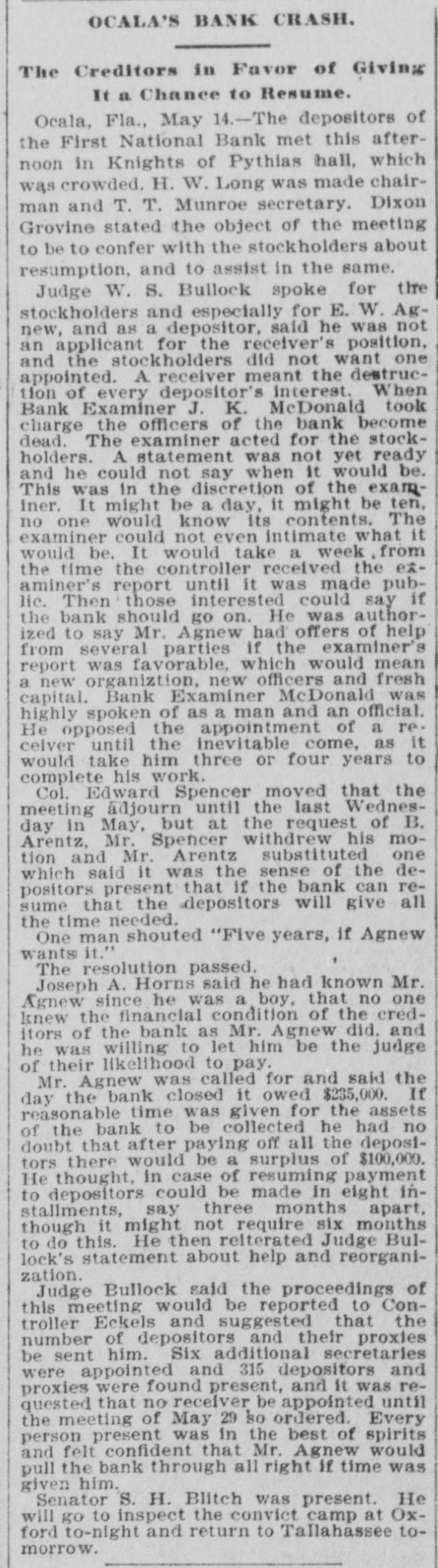
OCALA'S BANK CRASH. The Creditors in Favor of Giving It a Chance to Resume. Ocala, Fla., May 14.-The depositors of the First National Bank met this afternoon in Knights of Pythias hall, which was crowded. H. W. Long was made chairman and T. T. Munroe secretary. Dixon Grovine stated the object of the meeting to be to confer with the stockholders about resumption, and to assist in the same. Judge W. S. Bullock spoke for the stockholders and especially for E. W. Agnew, and as a depositor, said he was not an applicant for the receiver's position, and the stockholders did not want one appointed. A. receiver meant the destruction of every depositor's interest. When Bank Examiner J. K. McDonald took charge the officers of the bank become dead. The examiner acted for the stockholders. A statement was not yet ready and he could not say when it would be. This was in the discretion of the examiner. It might be a day, it might be ten, no one would know its contents. The examiner could not even intimate what it would be. It would take a week from the time the controller received the examiner's report until it was made public. Then those interested could say if the bank should go on. He was authorized to say Mr. Agnew had offers of help from several parties if the examiner's report was favorable, which would mean a new organiztion, new officers and fresh capital. Bank Examiner McDonald was highly spoken of as a man and an official. He opposed the appointment of a receiver until the inevitable come, as it would take him three or four years to complete his work. Col. Edward Spencer moved that the meeting adjourn until the last Wednesday in May, but at the request of B. Arentz, Mr. Spencer withdrew his motion and Mr. Arentz substituted one which said it was the sense of the depositors present that if the bank can resume that the depositors will give all the time needed. One man shouted "Five years, if Agnew wants it." The resolution passed. Joseph A. Horns said he had known Mr. Agnew since he was a boy, that no one knew the financial condition of the creditors of the bank as Mr. Agnew did. and he was willing to let him be the judge of their likelihood to pay. Mr. Agnew was called for and said the day the bank closed it owed $235,000. If reasonable time was given for the assets of the bank to be collected he had no doubt that after paying off all the depositors there would be a surplus of $100,000. He thought, in case of resuming payment to depositors could be made in eight installments, say three months apart, though it might not require six months to do this. He then reiterated Judge Bullock's statement about help and reorganization. Judge Bullock said the proceedings of this meeting would be reported to Controller Eckels and suggested that the number of depositors and their proxies be sent him. Six additional secretaries were appointed and 315 depositors and proxies were found present, and it was requested that no receiver be appointed until the meeting of May 29 so ordered. Every person present was in the best of spirits and felt confident that Mr. Agnew would pull the bank through all right if time was given him. Senator S. H. Blitch was present. He will go to inspect the convict camp at Oxford to-night and return to Tallahassee tomorrow.


Article from The Morning News, June 15, 1895

Click image to open full size in new tab

Article Text

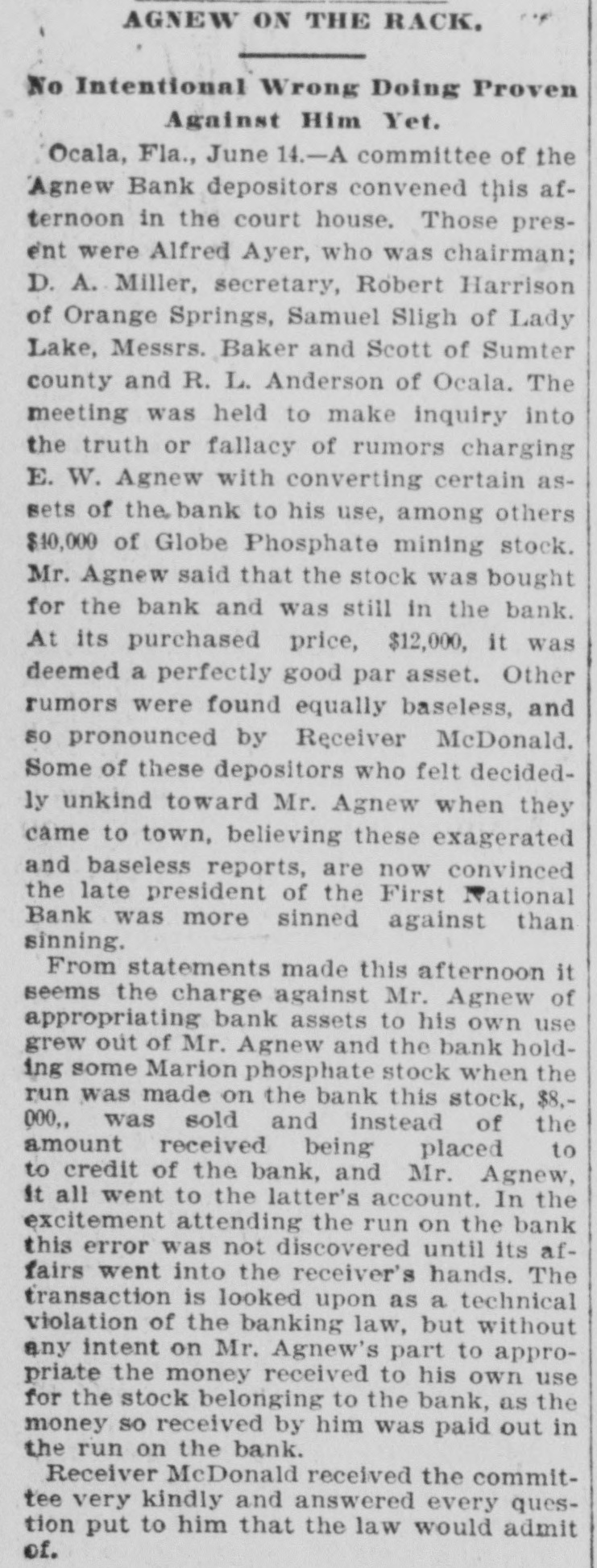
AGNEW ON THE RACK. No Intentional Wrong Doing Proven Against Him Yet. Ocala, Fla., June 14.-A committee of the Agnew Bank depositors convened this afternoon in the court house. Those present were Alfred Ayer, who was chairman; D. A. Miller, secretary, Robert Harrison of Orange Springs, Samuel Sligh of Lady Lake, Messrs. Baker and Scott of Sumter county and R. L. Anderson of Ocala. The meeting was held to make inquiry into the truth or fallacy of rumors charging E. W. Agnew with converting certain assets of the, bank to his use, among others $40,000 of Globe Phosphate mining stock. Mr. Agnew said that the stock was bought for the bank and was still in the bank. At its purchased price, $12,000, it was deemed a perfectly good par asset. Other rumors were found equally baseless, and S0 pronounced by Receiver McDonald. Some of these depositors who felt decidedly unkind toward Mr. Agnew when they came to town, believing these exagerated and baseless reports, are now convinced the late president of the First National Bank was more sinned against than sinning. From statements made this afternoon it seems the charge against Mr. Agnew of appropriating bank assets to his own use grew out of Mr. Agnew and the bank holding some Marion phosphate stock when the run was made on the bank this stock, $8,000,, was sold and instead of the amount received being placed to to credit of the bank, and Mr. Agnew, It all went to the latter's account. In the excitement attending the run on the bank this error was not discovered until its affairs went into the receiver's hands. The transaction is looked upon as a technical violation of the banking law, but without any intent on Mr. Agnew's part to appropriate the money received to his own use for the stock belonging to the bank, as the money so received by him was paid out in the run on the bank. Receiver McDonald received the committee very kindly and answered every question put to him that the law would admit of.


Article from Richmond Dispatch, June 23, 1895

Click image to open full size in new tab

Article Text

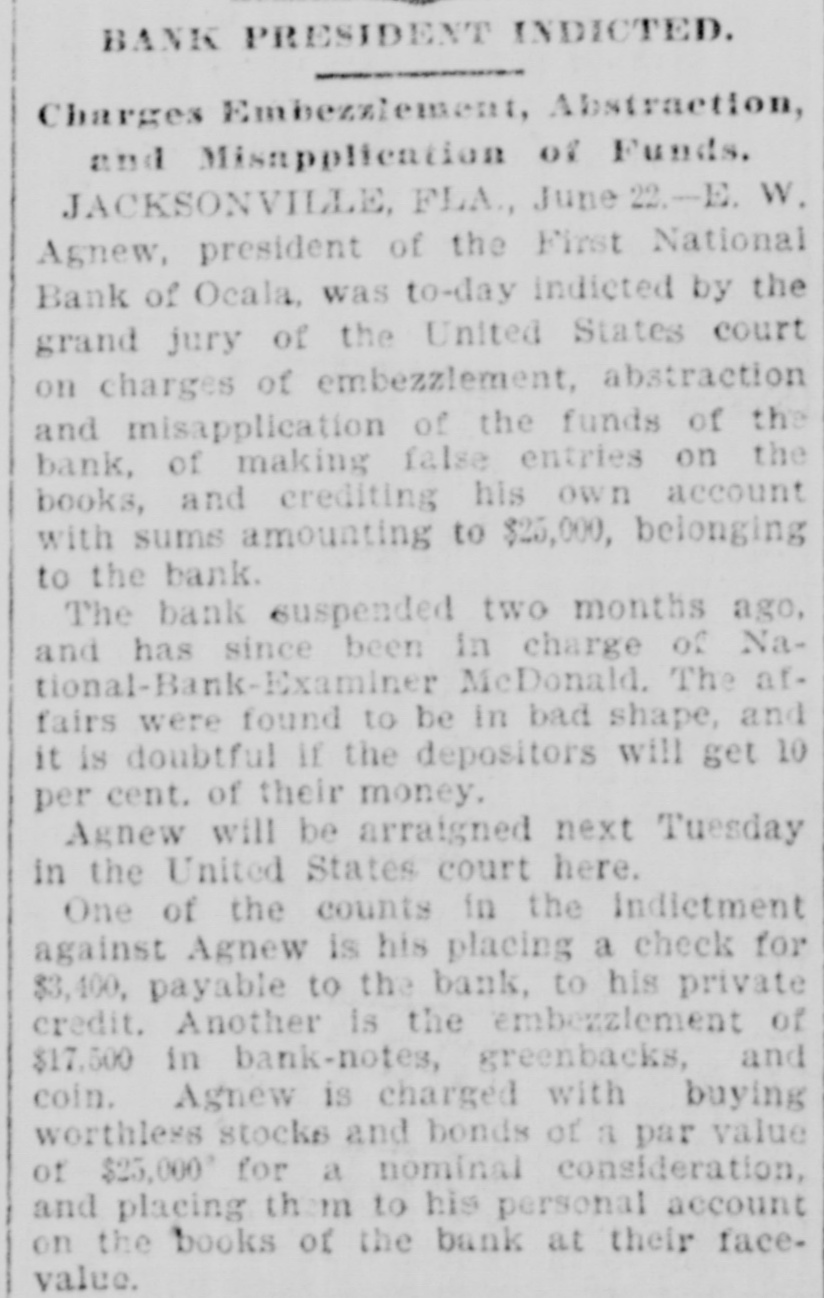
BANK PRESIDENT INDICTED. Charges Embezzlement, Abstraction, and Misapplication of Funds. JACKSONVILLE, FLA., June 22.-E. W. Agnew, president of the First National Bank of Ocala, was to-day indicted by the grand jury of the United States court on charges of embezzlement, abstraction and misapplication of the funds of the bank, of making false entries on the books, and crediting his own account with sums amounting to $25,000, belonging to the bank. The bank suspended two months ago, and has since been in charge of National-Bank-Examiner McDonald. The affairs were found to be in bad shape, and it is doubtful If the depositors will get 10 per cent. of their money. Agnew will be arraigned next Tuesday in the United States court here. One of the counts in the indictment against Agnew is his placing a check for $3,400, payable to the bank, to his private credit. Another is the embezzlement of $17,500 in bank-notes, greenbacks, and coin. Agnew is charged with buying worthless stocks and bonds of a par value of $25,000° for a nominal consideration, and placing them to his personal account on the books of the bank at their facevalue.


Article from Birmingham Age-Herald, June 23, 1895

Click image to open full size in new tab

Article Text

The U. S. Gov't Reports show Royal Baking Powder superior to all others. Baby caps at cost at HIRSCH'S. Ice cold lager at Beer Pavil6-23-tt ion, Lakeview. BANK PRESIDENT AGNEW Of the Ocala First National Bank Gets Into Trouble. Jacksonville, Fla., June 22.-E. W. Agnew, president of the First National bank of Ocala, was today indicted by the grand jury of the United States court on charges of embezzlement and misapplication of funds of the bank and of making false entries on the books of the bank by crediting his personal accounts with sums of money aggregating $25,000. The bank suspended two months ago and has since been in charge of National Bank Examiner J. R| McDonald. The affairs were found to be in bad shape, and it is doubtful if the depositors will get 10 per cent of their money. Agnew is under bond for appearance for trial and will be arraigned next Tuesday in the United States court here. One of the counts in the indictment is placing a check for $3400 payable to the bank to his private credit. Another is the embezzlement of $17,500 in bank notes, greenbacks and coin. He is charged with 'buying worthless stocks and bonds of a par value of $25,000 for a nominal consideration and placing them to his personal account on the books of the bank at the face value.


Article from The Morning News, June 23, 1895

Click image to open full size in new tab

Article Text

BANKER AGNEW IN A BAD BOX. HE IS CHARGED WITH WHOLESALE CROOKEDNESS. Embeszlement of His Bank's Funds, Falsification of the Books and Other Offenses Alleged-One of the Counts Recites That He Bought Very Low-Priced Securities and Turned Them Into the Bank at Par. Jacksonville, Fla., June 22.-E. W. Agnew, president of the First National Bank of Ocala, was to-day indicted by the grand jury of the United States court on charges of embezzlement, abstraction and misapplication of funds of the bank, and of making false entries on the books of the bank by crediting his personal acwith sums of money aggregating bahk suspended $25,000. count The charge two months of Naago and has since been in tional Bank Examiner J. R. McDonald. Its affairs were found to be in bad shape and it is doubtful If the depositors will get 10 per cent. of their money. Mr. Agnew is under bond for appearance for trial and will be arraigned next Tuesday in the United States court here. One of the counts in the indictment is placing a check for $3,400 payable to the bank to his private credit. Another is the embezzlement of $17,500 in bank notes, greenbacks and coin. He is charged with buyworthless stocks and bonds of a par value of $25,000 for a nominal consideration and placing them to his personal account on the books of the bank at the face value. The first indictment had eight counts, the first of which charges that knowing his personal accounts to be overdrawn, and that he was largely indebted to the bank, he caused a check for $3,400 to be entered to his credit. The check was drawn by J. Rauers, on the Merchants National Bank of Savannah, and was made payable to the First National Bank of Ocala, as payment in full for 1,700 shares of the Union Phosphate Company's stock. The second count charges that he caused a certain deposit slip to be made showing by entries thereon credit to his private account of $9,350, and that he had placed to his credit the said amount on the individual ledger of the bank. It further charges that this entry is false. The third account charges that on Jan. 1894, he did embezzle $2,500 in bank notes, 12, greenbacks, silver certificates, gold and silver coin. In the fourth count Mr. Agnew is charged with having purchased from John A. Bishop, president of the Globe Phosphate Company, bonds of the said company of the face value of $5,000 and placed the bonds in the bank as part of the credits and assets of the bank, and did credit and cause to be credited to his personal account the sum of $5,000, knowing the bonds to be worthless. The embezzlement of $7,500 on Feb. 12, 1894, is charged in the fifth count. The sixth count charges that he bought from John A. Bishop, president of the Globe Phosphate Company. bonds of the company of the face farue of $10,000 and paid therefor $2,500, and had the same credited to his account as $10,000, although he knew the bonds were worthless and of no value. In a seventh count he is charged with the embezzlement of $7,500 in cash and checks. The eighth count is identical with the sixth. The second indictment contains two counts, the first to the effect that on Dec. 14 Mr. Agnew, who was president of the bank, did there unlawfully and wilfully misapply the moneys, funds and credits of the bank with intent to convert the same to his own use, and with intent to defraud said bank. The specific charge is that Mr. Agnew, as president of the bank, did solicit and procure from George W. Martin, who was not in anywise indebted to Mr. Agnew or the bank, a promissory note for $4,200 payable four months after date. Mr. Martin 'received no benefits therefrom and no considerations therefore, but Mr. Agnew is charged with having placed said worthless note among the credits and assets of the bank and caused the personal account of himself to be credited on the books with the sum of $4,200 for his own benefit and use, with intent to defraud the bank. It is also charged in this indictment that on Aug. 5, 1893, the firm of Barretto, Luis & Co. was credited on the individual ledger with the sum of $8,245 and that the money was not received and the entry was false. It is set forth that at the time this entry was made the firm was insolvent and indebted to the bank in the sum of $13,381.86. It is charged that the amount of the false entry was made up by notes given by H. L. Anderson for $2,425, J. W. Pearson for $2,910 and R. L. Anderson for $2,910, aggregating $8,245, and that the notes were procured by Mr. Agnew on an understanding that the makers would never be called upon to pay the amounts or any part thereof. On be next as to libarraigned his these guilt various or innocence. charges Tuesday Mr. He to Agnew is plead still will at erty under bonds in the sum of $5,000.


Article from The Ocala Evening Star, June 26, 1895

Click image to open full size in new tab

Article Text

Flower Pots at Cost. BAZAR STORE. Maurice Strauss of Dunnellon is in the city. A fine lot of young fat chickens just received at Gray's. Joseph Connell of Orlando was in Ocala yesterday. Fire Crackers and Roman Candles for 4th of July at Bazar Store. Mrs. J. H. Benjamin is visiting friends at Stanton. Fame, Florida's Favorite Melon, on ice at P. Dukes's green grocery. The youngest son of F. . E. Harris is on the sick list. Apply to Dr. R. D. Fuller for a neat cottage for rent. Capt. J. Cribbet of Cotton Plant was in town yesterday. Miss Mamie Harrison is home from her visit to Lake Weir. A. nice lot of chickens just right to broil, received this morning at P. Dukes's Green Grocery. Attend the performance at the opera house tonight. It is worth your while. Just received, a large shipment of Cuban mangos at Charles Constans'. President James A. Graham of the First National Bank of Gainesville is in Ocala. See our Hardtime Glass and Crockery Counter. Prices about Half, and we make you happy. THE BAZAR STORE. Mrs. Gus Hanley, who has been very sick for three weeks, is, we are glad to learn, able to leave her room. The stockholders of the Covenant Building and Loan association will please pay June dues to W. T. Frierson, at H. B. Masters'. M. M. LITTLE, Local Secretary. The reform government of New York City doesn't reform very rapC' idly. tenths Tammany of the offices yet and holds rrup- nine tion is still rampant. Misses Nevada Moring, Hattie Curry, and Lillie Williams, and her mother, Mrs. R. M. Williams, who will act as chaperone for the party, left today for Palm Beach. J. K. McDonald, receiver of the First National bank, returned from his home in Montgomery, Ala, on the 3 o'clock train this morning. Mrs. McDonald and child accompanied him. Mr. McDonald has been on a week or ten days' visit to his family. They will make their home in Ocala while the business of the bank keeps them here, which will in all probability be for some time yet. By his sterling business qualities Mr. McDonald has made a great many friends since his coming to Ocala. This office was presented with some samp es of cigars by W. E. Thomas that were as fine as any we have ever smo ed. They were made entirely of F orida tobacco, grown by Adam Eiche berger on his pace near this city. The cigars were as fine flavored as the genuine Havana grown eaf. We see no reason why, with the proper attention and cu tivation, we can not grow just as good tobacco in Marian county Cuban


Article from The Ocala Evening Star, June 26, 1895

Click image to open full size in new tab

Article Text

# AGNEW AGAIN INDICTED. Three Charges Made Against Him in the U. S. Court. We clip the following from the Tuesday evening's Jacksonville Metropolis: "The grand jury came into the U. S. court this afternoon and presented another indictment against E. W. Agnew, president of the suspended First National bank of Ocala, making now three against him. The one found today charges further wrongdoing in banking affairs, fraudulently issuing and honoring notes for his own benefit etc. When court opened this morning Agnew was arraigned upon the indictments found Saturday, and his attorney moved for a continuance, and owing to there being no funds to pay jurors or witnesses with, the motion was granted, and Judge Locke required bail in the sum of $10,000 for his appearance for trial on the 2d of December next. He was allowed to file special pleas on that date. Mr. Agnew said he could give the bail in Ocala. Whether additional bail will be required since the last indictment was found was not known by the marshal.


Article from Birmingham Age-Herald, July 10, 1895

Click image to open full size in new tab

Article Text

FROM THE STATE CAPITAL Montgomerians Elated at the Result of That Election. STATE BAR ASSOCIATION Is Called to Order Today-The Full Programme of the Session. FOUR DEPUTY U. S. MARSHALS RESIGN Montgomery and Greenville in a Tennis Tournament-Mlitary Matters-Miss Hunter Wins Her Suit-An Aged Carpenter's Fall. Age-Herald Bureau, Exchange Hotel, Montgomery, July 9. Montgomerians are very much elated over the outcome of the election of officers of the Elyton companies in Birmingham yesterday. Dr. B. J. Baldwin, who was elected as president of the Elyton Land company, is one of the most substantjal business men of this city, being president of the large banking house of Josiah Morris & Co. J. K. McDonald, who was elected president of the Elyton company, is also numbered among Montgomery's most successful financiers. He is at present national bank examiner for the southern circuit and was recently appointed receiver of the First National bank of Ocala, Fla.


Article from Birmingham Age-Herald, July 21, 1895

Click image to open full size in new tab

Article Text

President McDonald. The newly elected president of the Elyton Land company, Mr. J. K. McDonald, is in the city for a few days' stay. Mr. McDonald says that he will soon take charge of the affairs of the company and after August 1 will give it his entire. attention. He will continue his duties as receiver of the First National bank of Ocala, Fla. His resignation as bank examiner has not yet been accepted by Comptroller Echols.


Article from The Ocala Evening Star, July 26, 1895

Click image to open full size in new tab

Article Text

THE RECEIVER TALKS FREELY WITH THE STAR MAN. Will Soon Leave Ocala-A Dividend Not Likely to Be Declared on the First, THE NEW RECEIVERSHIP. The STAR reporter repaired to the First National bank early this morning to interview Mr. McDonald as to the result of his Washington trip. When asked if he accomplished the purpose for which he took the trip Mr. McDonald said : "Yes,I did. The comptroller of the currency, J. H. Eckles, did not officially accept my resignation, but said he would do so just as soon as he could appoint my successor, which would be about August I. There are several applications on file for the receivership-two or more being from Ocala. "Mr. Eckles paid me the compliment of saying he wanted me to retain my commission as United States bank inspector, as there were occasionally complicated cases coming up in the south that he wished to assign to me, as my success heretofore in winding up these knotty cases has made my services appreciated by the government." When asked his opinion on the matter of the bank's declaring a dividend in the near future, Mr. McDonald said : "This is a question that I hardly like to discuss freely, but I will say that before my trip to Washington I thought we would have been in a position by the first of August to declare a dividend of IO per cent, as we have about enough money in Washington to pay off that amount, or possibly a little more. "It depends a great deal upon the depositors when this dividend will be declared, as Mr. Eckles told me he would take no action until virtually all of the claims were proven. It is astonishing how slow the depositors are to come forward with their claims. I began advertising for them to do so early in June, and up to date there are only about 30 per cent of claims proven. Five hundred is the number of proofs filed. I think there are something over fifteen hundred claims, but Mr. Massey says there are nearer two thousand all told, and he ought to know. "As soon as the bulk of these claims are in, Mr. Eckles will give the people their money, as far as it will go, and the percentage paid will depend aitogether upon the collections made between now and that time." "What about your position as president of the Elyton company, of Birmingham, Ala.?" asked the reporter. "Oh, I accepted that, and as soon as my successor is appointed and he and I have time to go over the business here together and get all in proper shape, I will go up


Article from The Ocala Evening Star, July 27, 1895

Click image to open full size in new tab

Article Text

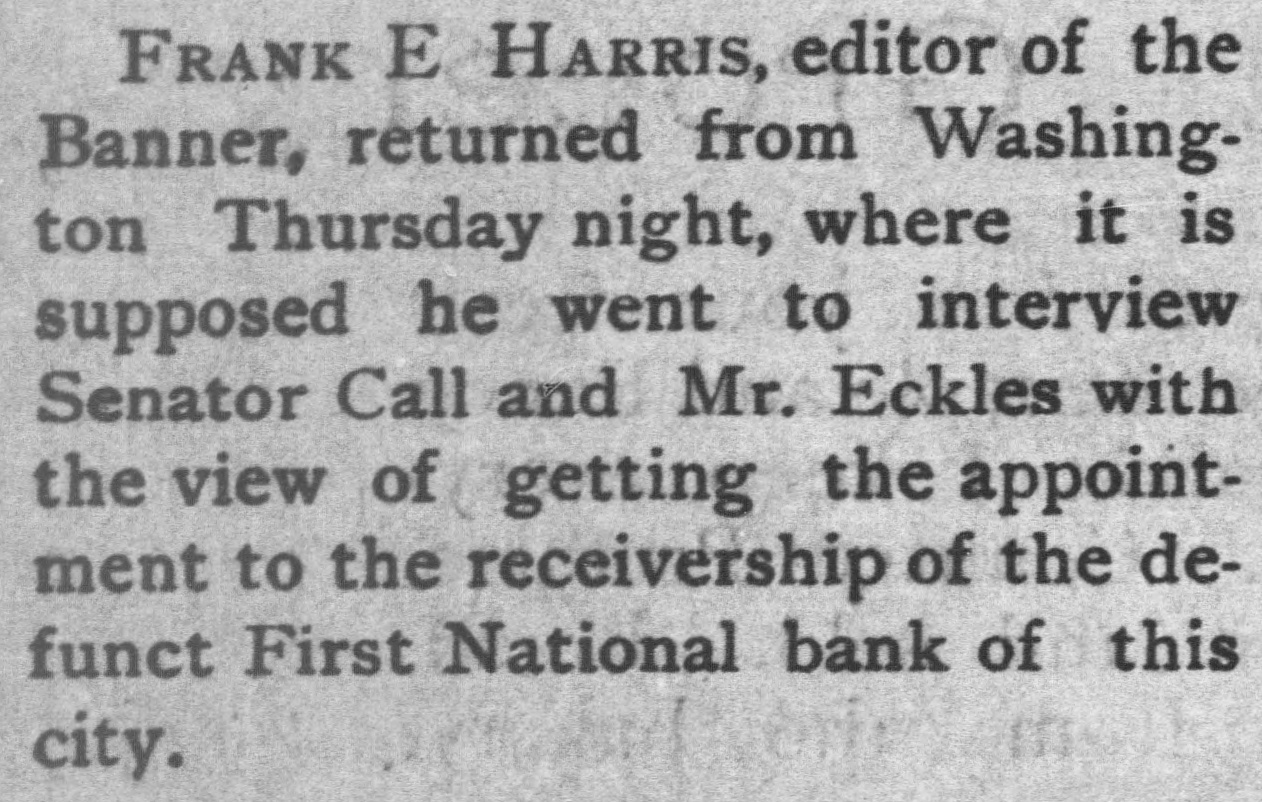
FRANK E HARRIS, editor of the Banner, returned from Washing- ton Thursday night, where it is supposed he went to interview Senator Call and Mr. Eckles with the view of getting the appoint- ment to the receivership of the de- funct First National bank of this city.


Article from Pawtucket Tribune, August 3, 1895

Click image to open full size in new tab

Article Text

Two Receivers Appointed. W ASHINGTON, Aug. 3.-The comptroller of the currency has appointed William S. Nelson receiver of the Union National bank of Denver, and Granville C. Stapelton receiver of the First National bank of Ocala, Fla,


Article from The Morning News, January 5, 1896

Click image to open full size in new tab

Article Text

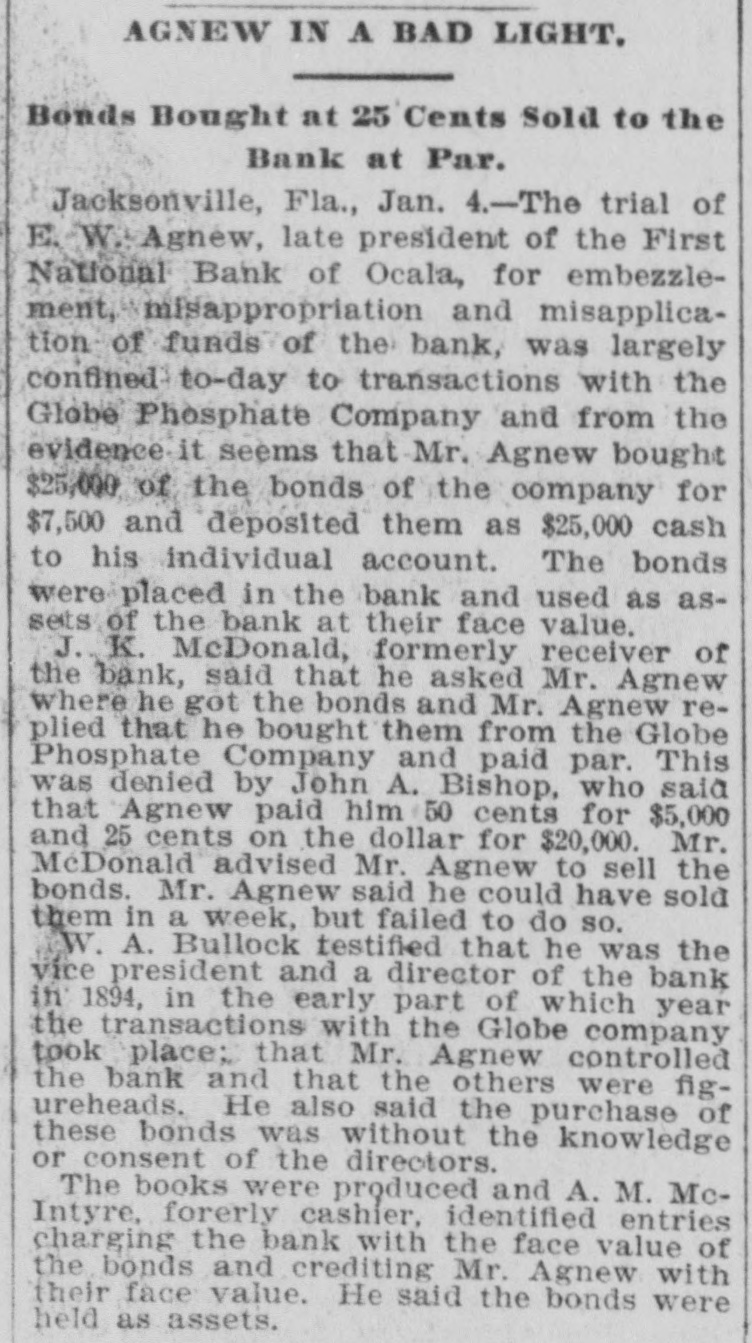
# AGNEW IN A BAD LIGHT, Bonds Bought at 25 Cents Sold to the Bank at Par. Jacksonville, Fla., Jan. 4.-The trial of E. W. Agnew, late president of the First National Bank of Ocala, for embezzlement, misappropriation and misapplication of funds of the bank, was largely confined to-day to transactions with the Globe Phosphate Company and from the evidence it seems that Mr. Agnew bought $25,000 of the bonds of the company for $7,500 and deposited them as $25,000 cash to his individual account. The bonds were placed in the bank and used as assets of the bank at their face value. J. K. McDonald, formerly receiver of the bank, said that he asked Mr. Agnew where he got the bonds and Mr. Agnew replied that he bought them from the Globe Phosphate Company and paid par. This was denied by John A. Bishop, who said that Agnew paid him 50 cents for $5,000 and 25 cents on the dollar for $20,000. Mr. McDonald advised Mr. Agnew to sell the bonds. Mr. Agnew said he could have sold them in a week, but failed to do so. W. A. Bullock testified that he was the vice president and a director of the bank in 1894, in the early part of which year the transactions with the Globe company took place; that Mr. Agnew controlled the bank and that the others were figureheads. He also said the purchase of these bonds was without the knowledge or consent of the directors. The books were produced and A. M. McIntyre, forerly cashier, identified entries charging the bank with the face value of the bonds and crediting Mr. Agnew with their face value. He said the bonds were held as assets.


Article from The Morning News, January 15, 1896

Click image to open full size in new tab

Article Text

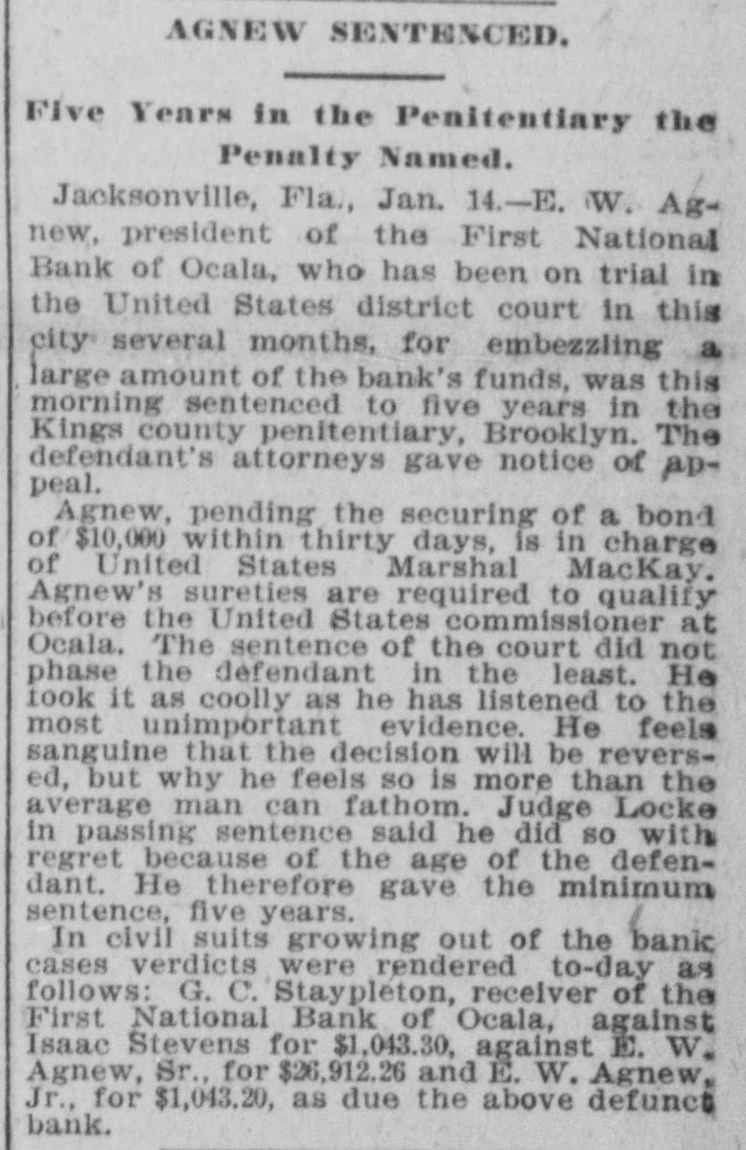
AGNEW SENTENCED. Five Years in the Penitentlary the Penalty Named. Jacksonville, Fla., Jan. 14.-E. W. Agnew, president of the First National Bank of Ocala, who has been on trial in the United States district court in this city several months, for embezzling a large amount of the bank's funds, was this morning sentenced to five years in the Kings county penitentiary, Brooklyn. The defendant's attorneys gave notice of appeal. Agnew, pending the securing of a bond of $10,000 within thirty days, is in charge of United States Marshal MacKay. Agnew's sureties are required to qualify before the United States commissioner at Ocala. The sentence of the court did not phase the defendant in the least. He took it as coolly as he has listened to the most unimportant evidence. He feels sanguine that the decision will be reversed, but why he feels so is more than the average man can fathom. Judge Locke in passing sentence said he did so with regret because of the age of the defendant. He therefore gave the minimum sentence, five years. In civil suits growing out of the bank cases verdicts were rendered to-day as follows: G. C. Staypleton, receiver of the First National Bank of Ocala, against Isaac Stevens for $1,043.30, against E. W. Agnew, Sr., for $26,912.26 and E. W. Agnew, Jr., for $1,043.20, as due the above defunct bank.


Article from The Morning News, January 1, 1897

Click image to open full size in new tab

Article Text

FLORIDA. The Baptists of the state will meet at St. Augustine next Monday in annual convention. The convention will be in session three or four days. The next movement in the way of rapid transit will probably be a bicycle path from Orlando to Apopka, about twelve miles. The cost will be about $50. Jack Bird, a farmer living three miles west of Orlando, has just finished making up his sugar cane crop. He has made 300 gallons of syrup from a small patch of cane covering only one acre of ground. Longwood's Masonic lodge has been compelled to surrender its charter, owing to stringency of the times and removal of members to other points. The membership had fallen below a point that warranted continuance. John E. Stetson has announced his determination to proceed at once to erect the wings of Elizabeth Hall of Stetson University, at DeLand. These additions are each to be 90x45 feet, and together will occupy considerably more space than the present structure. They will be three stories high, built of brick, and elegantly finished. The people of Oviedo raised $1,000 by private contributions, to be expended in road improvements in their vicinity. This will entitle them to receive another $1,000 from the county. From present indications, at least fifty miles of the most prominent highways of Orange county will be rendered permanently good within the next year. J. H. Mooney has been notified by Manager Ford of the South Florida division of the Plant system railroad that that line will transport free of charge thirteen cars of Bartow clay from Bartow to Orlando, with which to make some needed repairs to the bicycle course. The Bartow clay is said to be the best material found in the state thus far for such a purpose. The proposition will be accepted and the work done at once. The man who was found on the Plant system bridge at Tampa, Monday night, so horribly mangled has been identified as E. Cranden, who lived at Frazier's Beach, on Old Tampa Bay. The remains were kept at Come's undertaking establishment until they were identified, and his wife was sent for. As soon as she entered the undertaking rooms she recognized the head of her husband, and the scene that followed was a most touching one. Cranden leaves a family of four children and his wife. Tampa Times: During the recent visit of Rice's Evangeline Company to Tampa two of the chorus girls indulged in a spree and were discharged by the manager. One of the women who was the leader of the chorus-was robbed in a Fort Brooke dive of jewelry and money to the amount of $200, and she remained here and made an attempt to recover the stuff. But she continued to drink heavily, and now she is demented. About 5 o'clock Wednesday morning she went into the home of a Cuban family in Ybor City and took possession, frightening the inmates of the house so that they did not attempt to put her out. They reported the matter, to the police. Sheriff Spencer was notified and went to the house and took the woman in his buggy to the country jail, where she is now confined. Excessive drinking has unbalanced her mind, but it is thought that she will be all right again in a few days. Several of the suits brought by George C. Stapylton, receiver of the First National Bank of Ocala, against stockholders who failed to pay the receiver's assessment on the stock of the defunct bank held by them, and against persons who failed to pay back money due the bank, borrowed by them, came up for argument in the United States court at Jacksonville Wednesday. The cases against R. L. Anderson, S. W. Teague and G. H. Carmichael were the first taken up, and were argued on demurrer to pleas. J. C. Cooper represented the plaintiff, and R. L. Anderson represented the defendant. In the case of the Florida Land and Mortgage Company vs. Finlayson, argument was heard on a demurrer to the bill of complaint and the matter was submitted. In the case of Carl Thalheim vs. H. L. Anderson, argument was heard on the motion to dissolve the injunction. In this case the court ordered that the papers be sent to Judge Bullock of Ocala, special master, for examination, and that a report be made in fifteen days.


Article from The Ocala Banner, April 9, 1897

Click image to open full size in new tab

Article Text

t in the appearance of the reat. So far as we can tell cursory examination made, poor " St R unty Treasurer.-We find that ten ns the former treasurer of y, is behind in his accou nts as follows: County am pun 8, $4588.21, or a total of $12,698. most of these funds, it in the Merchants' National e date of its suspension. The si stand in two accounts, one of tevens, county treasurer, and in the name of the board of struction of Marion county. unt of the treasurer, deducti unds to his credit in the defun , show a discrepancy of $213.1 h he seems to not be able to explanation of, claiming that epancy between his account ccount charged him by the as been running for a year , yet no effort has been made to it. el facts presented to us show Stevens could not, or did not, to the duties of his office perso but that he farmed the treasu o the Merchants' National e officers manipulated matters scrupulous way tosuit themselve of his accounts being in the , school board, for which there thority, and which fact Mr. laims he knew nothing of. e item of $15,000 borrowed ate treasurer and placed to 1 of the school board, seems to have been used by this hanner never contemplated au ps should be taken to collect age from the treasurer and men, so that the county may in the amount of its loss. imend that not more than be given in which the treasure adjust this account, and if then suit be instituted for ery. The loss of these funds ly attributable to the negligeno : treasurer, the county commis S and the school board. have examined the books of iffin, the present treasurer, hem neatly kept. There ace provided for the safe keepin county's money, we recommen he commissioners at once , fire proof safe or vault, place court house and require to be kept therein. This the treasurer responsible, shoul counts be short, without the cuse that some one else had in custody. : Collector The auditor's that the collector is due a assessed the uo j( He claims to have a certificat osit in the defunct First Nation nk of Ocala for this amoun ng that the funds were deposite when that bank suspended. laims to have had a deposit for tax at the same time, and that lying to the legislature for its next session. This en allowed to drag along ily, and should have been close some way before this. If at is going to be allowed r, it should have been done ; if not, the funds should collected, and the county had the money. find that the books show a lue on the taxes of 1895 of , and that the books were close tober, 1896, the sales for delin taxes having been made in is of November and Decembe yet no settlement has been he account closed up. Agains pporent discrepancy the entitled to various credits, g sales to state, double , railroad tax, insolvencies, ment should have been made a 1 u! that am puu 'siq the business of his office will lited, and settlements made


Article from The Ocala Evening Star, April 27, 1899

Click image to open full size in new tab

Article Text

NOTICE Receiver's Sale Notice is hereby given that pursuant to an order made on the thirty-first day of March, A. D., 1899, by the Hon. James W. Locke, judge of the United States Circuit Court, Southern District of Florida, I will sell for cash, at public auction. to the highest hidder, in front of the court house, at Ocala, Florida. on MONDAY, THE EIGHTH DAY OF MAY, A.D. 1899, at 10 o'clock a. m., the remaining assets of the FIRST NATIONAL BANK OF OCALA, FLORIDA, consisting of promissory notes, secured and unsecured, judgment claims, etc., etc., and real estate in the city of Ocala and in the counties of Marion, Alachua, Sumter, DeSoto, Lake, Citrus and Levy. Full particulars of the assets can be obtained and the personal property can be seen during business hours at my office. G. C. STAPYLTON, Receiver First National Bank of Ocala, Fla.