Fisk & Hatch (New York, NY)

Episode Information

Episode UID
2460487790885
Episode Type
Run β†’ Suspension β†’ Reopening
Bank Type
private
Bank ID
246048779 hash
Start Date
September 19, 1873
Location
New York, New York (40.714, -74.006)

Metadata

Model
gpt-5-mini (chosen from majority vote of a three-model LLM ensemble)
Short Digest
6a2081bff73c8685

Response Measures

None

Description

Suspension tied to panic after Jay Cooke failure and heavy railroad-bond advances; later resumed December 24, 1873.

Events (3)

1. September 19, 1873 Run
Cause
Local Banks
Cause Details
Sudden panic and heavy withdrawals triggered by failures in Wall Street (notably Jay Cooke & Co.) causing large call loans presented to Fisk & Hatch.
Measures
Issued public card announcing suspension and requested creditors' forbearance while preparing a full statement.
Newspaper Excerpt
When we opened our office this morning we did not suppose that we would be called upon for the immense heavy payments of loans which subsequently came in...As soon as this announcement was made on the street the run commenced.
Source
newspapers
2. September 19, 1873 Suspension
Cause
Bank Specific Adverse Info
Cause Details
Inability to liquidate large advances/holdings in railroad (Chesapeake & Ohio, Central Pacific) securities amid a liquidity panic; heavy immediate demands forced suspension.
Newspaper Excerpt
We regret to be compelled to announce the suspension of our firm... occasioned by our inability to meet at once the heavy demands made upon us for loans and deposits, on account of the existing financial disturbances and the widespread distrust.
Source
newspapers
3. December 24, 1873 Reopening
Newspaper Excerpt
the well-known house of Fisk & Hatch, which was compelled by unfortunate circumstances to suspend early in the days of the late panic, resumed business to-day...we have to-day resumed business, after an interval of a little over three months.
Source
newspapers

Newspaper Articles (24)

Article from Gold Hill Daily News, September 19, 1873

Click image to open full size in new tab

Article Text

EASTERN DISPATCHES. [SPECIAL TO THE GOLD HILL DAILY NEWS.] DOMESTIC INTELLIGENCE More Bank Failures. NEW YORK, Sept. 19.-Fisk & Hatch have failed, while Defreias & Rablion are announced suspended. Northern Pacific Railroad Affairs. Samuel Wilkerson, Secretary of the Northern Pacitio Railroad Company, speaking of the suspension of Jay Cooke & Co.. its financial agents, said he had no doubt of the future of the road but that it would be constructed that there were those supporting it who would not allow the work to be abandoned. The Board of Directors alone. represented Williams. The company had not a dollar of unpaid paper up to the present time; not a note of theirs was ever seen in Wall Street; not a bond was hypothecated by the company; and consequently the company had no liabilities hanging over It that might descend without warning. The interest on the company's bonds was not due until the 1st of January next, and that then it would undoubtedly be met. That portion of the road already built was earning more than was anticipated. That portion running to the Red river country had already developed a fine carrying trade. He believed the road would be hindered more by hostile Sioux than by a financial revolution. Another force, however, could prevent the successful completion of the road. Two of the members of the firm were directors oj the Northern Pacific Railroad Company. The result will be that the work of construction will be somewhat retarded. It is more than probable that Congress will be asked to grant an extension of years to the company beyond that already granted. to enable it to complete the road. No such enterprise was ever before attempted by private capitalists as that of constructing a railroad, 2,200 miles in length, across a continent. Congress should have come to their aid by extending the credit of the Government to the undertaking. It would have done so, but for the charge generally, that corporations were grasping the entire domain and overriding the people.


Article from Evening Star, September 20, 1873

Click image to open full size in new tab

Article Text

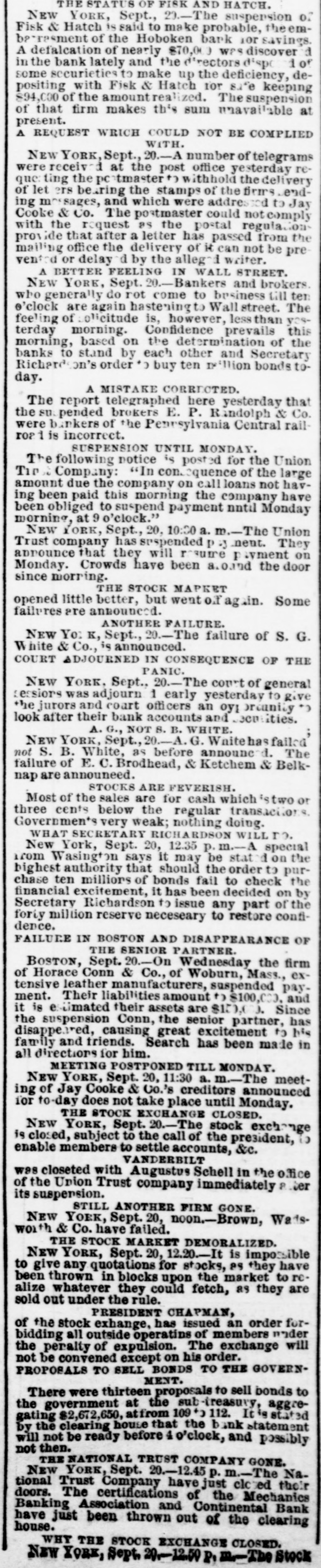
THE STATUS OF FISK AND HATCH. NEW YORK, Sept., 29.-The suspension or Fisk & Hatch is said to make probable, theem be resment of the Hoboken bark or savings. A defalcation of nearly $70.00 , was discover in the bank lately and the d'rectors d'spc of some securieties to make up the deficiency, depositing with Fisk & Hatch for keeping $94,000 of the amount realized. The suspension of that firm makes this sum unavailable at present. A REQUEST WRICH COULD NOT BE COMPLIED WITH. NEW YORK, Sept., 20.-A number of telegrams were receiv 1 at the post office yesterday reque: ting the pc +tmaster+1 withhold the delivery of let ers bearing the stamps of the firms. endJay ing sages, and which were addres cod to Cooke Co. The postmaster could not comply with the request as the postal regula Com provide that after a letter has passed from the mailing office the delivery of it can not be pre ven d or delay d by the alleg i writer. A BETTER FEELING IN WALL STREET. NEW YORK, Sept. Bankers and brokers who generally do rot come to business till ten e'clock are again hastening to Wall street. The feeling of olicitude is, however, less than yesterday morning. Confidence prevails this morning, based on the determination of the banks to stand by each other and Secretary Richard on's order buy ten IN Illion bonds today. A MISTAKE CORRECTED. The report telegraphed here yesterday that the su. pended brokers E. P. R indolph & Co. were binkers of the Pennsylvania Central rail rosi is incorrect. SUSPENSION UNTIL MONDAY. The following notice is posted for the Union Tip Company: "In con. equence of the large amount due the company on call loans not having been paid this morning the company have been obliged to suspend payment nntil Monday morning, at 9'olcck. NEW YORK, Sept., 20. 10:00 a. -The Union Trust company has suspended P-J .nent. They announce that they will r sure evement on Monday. Crowds have been a.o.ind the door since morring. THE STOCK MAPKET opened little better, but went of again. Some failpres are announced. ANOTHER FAILURE. NEW Yo: K, Sept., The failure of S. G. White & Co., is announced. COURT ADJOURNED IN CONSEQUENCE OF THE PANIC. NEW YORK. Sept., 20.-The court of general tessiors was adjourn 1 early yesterday to give the jurors and court officers an orcanity ities. look after their bank accounts and 3CD A. G., NOT B. WHITE. NEW YORK, Sept., 20. A. Waite has failed not S. B. White, as before announce d. The failure of E. C. Brodhead, & Ketchem & Belknapare announeed. STOCKS ARE FEVERISH. Most of the sales are for cash which 'stwo or three cents below the regular transaction Governments very weak; nothing doing. WHAT SECRETARY RICHARDSON WILL DO. New York, Sept. 20, 12.35 special from Wasington says it may be stat don the highest authority that should the order to purchase ten milliors of bonds fail to check the financial excitement, it has been decided on by Secretary Richardson to issue any part of the forty million reserve neceseary to restore confidence. FAILURE IN BOSTON AND DISAPPEARANCE OF THE SENIOR PARTNER. BOSTON, Sept. On Wednesday the firm of Horace Conn & Co., of Woburn, Mass., extensive leather manufacturers, suspended payment. Their liabilities amount $100,0 and it is Smated their assets are $150,0 J. Since the suspension Conn, the senior partner, has disappeared, causing great excitement to his family and friends. Search has been made in all directions for him. MEETING POSTPONED TILL MONDAY. NEW YORK, Sept. 20,11:30 a. --The meeting of Jay Cooke & Co.'s creditors announced ior to-day does not take place until Monday. THE STOCK EXCHANGE CLOSED. NEW YORK, Sept. -The stock exch nge is closed, subject to the call of the president, is enable members to settle accounts, &c. VANDERBILT was closeted with Augustus Schell in the office of the Union Trust company immediately 8 er its suspension. STILL ANOTHER FIRM GONE. NEW YORK, Sept. 20, noon.-Brown, Wais worth & Co. have failed. THE STOCK MARKET DEMORALIZED. NEW YORK, Sept. 20, 12.20.-It is impossible to give any quotations for stocks, as they have been thrown in blocks upon the market to realize whatever they could fetch, as they are sold out under the rule. PRESIDENT CHAPMAN, of the stock exhange, has issued an order forbidding all outside operatins of members under the peralty of expulsion. The exchange will not be convened except on his order. PROPOSALS TO SELL BONDS TO THE GOVERNMENT. There were thirteen proposals to sell bonds to the government at the b-treasury, aggregating $2,672,650, atfrom 109 + 5 112. tis stated by the clearing house that the bank statement will not be ready before 4 o'clock, and possibly not then. THE NATIONAL TRUST COMPANY GONE NEW YORK, Sept. 20.-12.45p.m.-The Na. tional Trust Company have just clc ed their doors. The certifications of the Mechanics Banking Association and Continental Bank have just been thrown out of the clearing house. WHY THE STOCK EXCHANGE CLOSED. NEW YORK, Sept, 20,12.50 Stock


Article from The Superior Times, September 20, 1873

Click image to open full size in new tab

Article Text

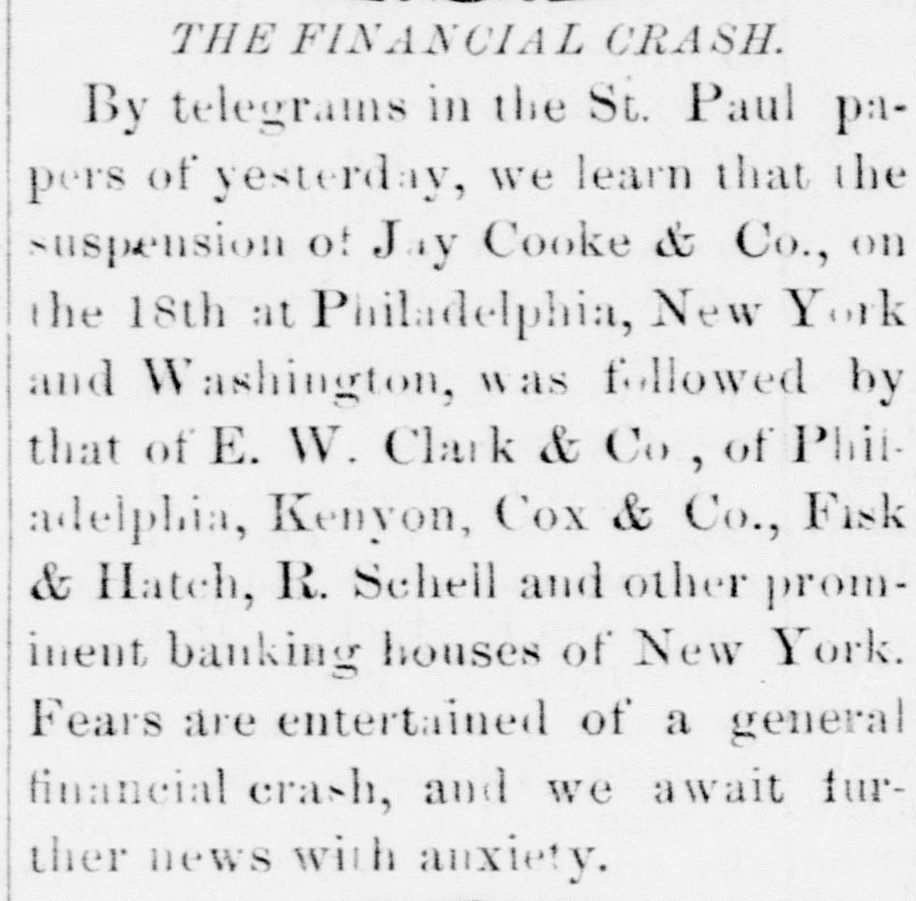
THE FINANCIAL CRASH. By telegrains in the St. Paul p:1pers of yesterday, we learn that the suspension of Jay Cooke & Co., on the 18th at Philadelphia, New York and Washington, was followed by that of E. W. Clark & Co, of Phil adelphia, Kenyon, Cox & Co., Fisk & Hatch, R. Schell and other prominent banking houses of New York. Fears are entertained of a general financial crash, and we await further news with anxiety.


Article from The New York Herald, September 20, 1873

Click image to open full size in new tab

Article Text

effects. That part of Wall street at the corner of Broad was the chief centre of attraction. Men stood all around the quadrangle formed by the junction of the streets, and talked nervously or quickly, as temperament or interest commanded, They LINED THE CURBSTONES up and down this vicinity, and, to a stranger, would give the impression of an assemblage anxiously awaiting the appearance of some public spectacle on the streets. So large and singular a multitude-for the most part shielded by umbrellas-must have possessed certain striking outlines to the eye; for, high up on the stone balustrades of the Sub-Treasury were numerous spectators, in the midst of the pelting rain, gazing down upon the scene below with as much rapt curiosity as if they were seated in the gallery of a theatre watching a series of transformation performances. The building containing the bank of Jay Cooke & Co. was scrutinized with as keep an interest as if it had been the theatre of some absorbing tragedy. Nobody passed without bestowing a look upon it. of course it was closed, and save that the face of a clerk occasionally appeared at one of the windows with a look of supreme self-satisfaction, as If the public euriosity were centred in him alone, all was quiescent and forlorn within. There are stout iron railings extending along the front of some of the basement brokers' offices in Wall street, and these railings were made yesterday to serve as perches for those habituΓ©s of the street who are always disposed to give gratuitous information on financial matters to the inexperienced. Essays on stocks, &c., were furnished to little GROUPS OF GAPING STRANGERS along by the iron railings, and this, as one of the features of the street, was not the least interesting. The broken down operators of long ago, with no money in their pockets, like to live their days over again in periods of such excitement, by spluning yarns about past speculations and uttering ponderous predictions to those who are willing to listen. The entrances of the Stock Exchange on Broad and on Wall streets were never so eagerly surrounded. Policemen were engaged to keep order and prevent an indiscriminate rush to the public gallery. THE EXCITEMENT AT NOON. At noon, when the news of the failure of Fisk & Hatch went abroad and spread all over like a prairie fire in August, the street was exceedingly full, locomotion was slow and made awkward by the multitude of umbrellas. A mob disposed to revolution might have been dispersed by the steadysoaking rain that fell in the afternoon; but this mob. affected where most vulnerable-in the pocket-cared not a row of beans for As rain, nor thunder and lightning. a rule, the financial upheavais in Wall street attract a crowd to the main front of the Gold or Stock Exchange; but the great nurry of yesterday magnetized people to very remote places. As far away as the Post Office were hundreds engaged in discussing the situation, and out on Broadway, along the line of the big insurance offices, moneyed men fingered their watch chains and talked incessantly of the impending panic. All the restaurants and drinking saloons were well patronized. Especially so was Delmonico's haven of refreshment, Champagne was not particularly conspicuous, but whiskey played. a prominent part in making the talk over the cause and effect of the day's disaster clear as mud. THE FISK & HATCH COLLAPSE. When Fisk & Hatch were known to have caved in men looked up at every well-known sign along the streets, and speculated whether such and such a one of even high and tried credit would weather the storm and come out right side up. There was great talk about Henry Clews & Co. Now you heard that he was "bu'sted," and again that he was as solid as the Rocky Mountains, dreading nothing, and with means to tide him over the collapse of the Treasury itself. Rumors came thick and fast upon the wind of this house and that tottering to a fall. "If not to-day, to-morrow or the day after," seemed to be the tenor of much cold-blooded speculation. To say there was one universal appearance of bewilderment in the ranks of all that great mass of moneyed men who went down to Wall street yesterday, and might be said to represent the financial brains of the country, would be exactly correct. It was not A FEELING OF PANIC, such as overcomes an army and passes beyond human control. This was more a sense of temporary stupefaction and amazement, banishing for a moment the faculty of calm reflection and distorting the reality out of proportions. Men were overcome with astonishment at a series of failures so large and unexpected, bearing in mind how great the country's wealth and how exhaustless its resources. But a little reasoning showed how plainly inevitable the crash that occurred, yet the natural 1mpulse to alarm and anxiety was too strong for the time being to be restrained, and the uninitiated many who came to see Wall street in its agony went away full of the dread phantom of panic and troubled with the fancy of a universal crash like that of '57.


Article from The New York Herald, September 20, 1873

Click image to open full size in new tab

Article Text

AMONG THE INSOLVENT FIRMS. Reporters were sent to the various offices of the brokers and bankers who yesterday suspended to give a correct estimate of the general feeling of those who were in this unfortunate position. The feeling among these gentlemen seems to be much more buoyant and hopeful than could have been expected under such disastrous circumstances. Men seemed to feel that there was a better time coming, and all the people seen by our reporters said that they thought the present trouble would pass over and leave in a few days few traces behind it. Brokers, when they converse cn the subject, tell their side of the story, and very possibly give it rose tint which subsequent developments may destroy; therefore their statements must be taken with the necessary grain of salt. That underneath all this there is the most widespread terror, that the panic may continue and make durable what in some cases is now only temporary ruin, can hardly be denied by the most sanguine. Almost all those who failed yesterday went down to their offices confident that no trouble would happen them. But the crash was too great for them, nevertheless, and the same story may be repeated to-day, and probably will be. Interview with Fisk & Hatch. A reporter who called upon this firm was very kindly received. Mr. Fisk very kindly offered to give the particulars of his firm's suspension. He substantially made the following statement:"When we opened our office this morning we did not suppose that we would be called upon for the immense heavy payments of loans which subsequently came in. Panic reigned supreme on the street. The financial standing of many houses was impugned. A sudden rush was made upon us. Call loans of one and a half millions were presented which could not be honored at the moment, owing to the scarcity of money, and we were compelled, in self-defence and for the benefit of our creditors, to suspend payment for the time. As soon as this announcement was made on the street the run commenced. It is impossible to obtain money on any kind of collaterals, and we could not afford to sacrifice our securities. Several bank officers well informed on the existing panic, who called on us, were consulted in regard to the probability of obtaining funds to meet payments, and it was impossible to obtain any encouragement from this source: hence our suspension. "The report on the street is that your house was heavily involved with the bonds and stock of the Chesapeake and Ohio Railroad Company, as also with those of the Central Pacific." "We transacted a very large business in the bonds of both corporations named. We have bought and sold extensively; in fact, of the latter we disposed of about $40,000,000." "The panic precipitated by yesterday's failures completely unsettled the market for all securities. All kinds of collaterals were thrown on the market: in fact, public confidence was shaken completely in financial matters, and the tempest that followed could no more be stayed than a heavy tide stemmed by a frail craft. We are too much hurried now with explanations to callers to make any detailed statement. In a day or two, or as soon as we can get at the bottom of our affairs, we will make a full and complete statement to the public. All we want is time, so as not to be compelled to sacrifice our securities, and we hope that we shall be enabled to pay 100 cents on the dollar. Thus far the kindliest feelings have been expressed to us by our friends and creditors, and customers who have dealt here and whom we did not personally know came in and offered us not only their sympathy, but also all the time necessary to straighten out our affairs." Mesars. Fisk & Hatch, on having determined to suspend payment, issued the following card, a copy of which was transmitted to all their creditors OFFICE OF FISK & HATCH, No. 5 NASSAU STREET, NEW YORK, Sept. 19, 1873. We regret to be compelled to announce the suspension of our firm, oceasioned by our inability to meet at once the heavy demands made upon us for loans and deposits, on account of the existing financial disturbances and the widespread distrust occasioned by the occurrences of the past few days. We shall prepare, as soon as possible, a full statement of our affairs, which will be submitted to our crunitors without unnecessary delay In the meantime we ask your kind forbearance. and express the hope that we may be able to make such an


Article from The Daily Phoenix, September 20, 1873

Click image to open full size in new tab

Article Text

NEW YORK, September 19.-Fisk & Hatch say their suspension is temporary. Their advances are upon Chesapeake and Ohio Road and Central Pacifio. They expect to resume as soon as the panic ceases. Fitch & Co. have suspended. The office of Fisk & Hatch is strongly guarded by police. A prominent Wall street banker says if the movement now making, to get the Secretary of the Treasury to come to their relief, with $10,000,000, should fail, there will be a general suspension of banks and others. A meeting of bank presidents is now being held at the clearing house. Vernon & Hoy have suspended. The police prevent any but members to enter the Stock Exchange. E. D. Randolph & Co., bankers of the Pennsylvania Central Railroad, and Wm. H. Anner, announce their suspension. The clearing house appointed a committee of five for the purpose of adopting a plan to relieve the present difficulties. At 2 o'clock, there was a better feeling. Western Union stock at 72. The run on the Union Trust Company is subsiding. There is more or less of a crowd around every paying teller's desk. Geo. B. Alley, whose suspension is already announced, is widely known in connection with fast horses, having raised Dexter. He says his suspension is caused by the general decline in stocks; especially Vanderbilt stocks. His liabilities are not large, and he expects to resume soon. Greenleaf, Norris & Co. is an old and wealthy stock firm. President Calhoun, of the Fourth National Bank, says: "We have no reason to fear anything." President Tappan, of the Gallatin National Bank, says he believes the better banking institutions will weather the storm. Secretary Carlton, of the Union Trust Company, says the company is perfectly solvent, and will meet all demands. It is reported that the company had $700,000 on deposit last night. Mr. Fahnestock, of Jay Cooke & Co., said, in an interview, this afternoon, that the firm hoped to pay all liabilities. Mr. Garland, another member of the firm, says the London house will have a large surplus after payment of all its debts, unless there is a great shrinking in the value of their securities. The latest rumor on the street is, that the Government will come to the rescue to-morrow, by buying $5,000,000 of bonds. The grain and provision markets are all unsettled by the Wall street panic. State and railroad bonds and city bank shares have been practically neglected, while dealings in railroad stocks continued on au enormous scale. This afternoon, the principal transactions have been Pacific Mail, Central and Hudson, Western Union, Rock Island, Wabash and St. Paul, Western Lake Shore, and Erie. Outside purchasers continue in considerable numbers on the declining market, for investment, which aided in strengthening the market this afternoon. Assistant Treasurer Hillhouse says it is in the power of the national banks to avert further disaster, and they will undoubtedly do so. The Evening Post is informed that Secretary Richardson will offer to buy from $5,000,000 to $10,000,000 of five-twenties to-morrow. This will throw into the banks legal tender notes, for the large currency balance in the Treasury is nearly all composed of legal tenders. With the panic thus checked, a calm, with low rates for money, will soon follow. Jacobs, Little & Co. have failed. PHILADELPHIA, September 19.-The following have suspended: H. H. Douglass, Bayard, J. H. Yerkes, John Lloyd, Gilbaugh & Co., and Bond; all smali, except Gilbaugh. WASHINGTON, September 19.-The Committee of the Bar Association of the District of Columbia, appointed at the request of R. T. Merrick, Esq., to investigate certain charges made against him, by Ben. E. Green, son of General Duff Green, and formerly of this city, made their report to-day. The report contains copious extracts from the evidence, and sets forth that the charges have been shown to be without the slightest foundation, and that Green knew them to be false when he published them; and that the committee are forced to this conclusion by Green's own testimony, taken under oath, before the committee. A series of resolutions were unanimously adopted by the association, endorsing the views of the report, condemning Green in dignified but severe language, and declaring that the conduct of Mr. Merrick, in the transactions referred to, was not only irreproachable, but was highly honorable, efficient, faithful and magnanimous.
Article from The Democratic Press, September 25, 1873

Click image to open full size in new tab

Article Text

Every here the terrible financial crash of the day previous was discusse l,and the stoutest hearted of these men of the street were unnerved and apprehensive of what another day might bring forth. Broad and Wall streets were gloomy at 9 o'clock. It was raining, and many said This will surely be another Black Friday.' Few people were in the streets in that neighborhood at that time, but many were in their offices buried deep in their own affairs and waiting for the commencement of active operations in the Stock Exchange and Gold Room. As early as half past nine a crowd of brokers had already assem bled infront of the Stock Exchange. Few carried umbrellas, preferring to pp= 01 spavy their 10 esn the bave emphasis to their words. Some wore rubber overcoats and looked like thin peq Ollers reads 8 uo milk coats and old hats, and were without shirt collars, giving them the appearance of parties who had neglected oqm puu own emos JOJ business lieir dreaded their employers' wrath if they returned to work. Occasionally a diamond sparkled from the shirt bosom or finger of some one in the corners of the entrance to the building and a white necktie was seen. All were nervous and figety, and manifested their impatience to know the worst. The quick-footed messenger boys seemed to share the feeling, and lounged around in listless way. The rain poured down, but this did not move the throng which waited the opening of the great doors. At length the doors were swung open and the crowd surged in. The wide-a-wake doorkeepers kepta sharp lookout that none but those who had a right to be there entered. The drenched men were soon on the floor where 80 many fortunes have been made and lost, yelling at the top of their voices, and frightening the fashionably dressed ladies and gentlemen who looked down on them from the gallery The brokers ran against each other in their madness and seemed about to come to blows but they ways held tight to their mempus penclis, pus shood ΡˆΠΏΡ€ΠΈΠ²Π»ΠΎ dashed on, seemingly looking for something or somebody they could not find Hardlv had the presiding officer taken his seat before the gavel parool brokers on Ρ€ΠΈΠ² pepunos towards the rostrum and saw the troubled countenance of their Chair man and a letter which he held before him. Their screams ceased for a moment and then they heard that White, Defreits & Rathburne had suspended Ρ€ΠΈΠ² 40n persuojo.id 8 S.B.M. the JO, center the 01 scramble 8, the pownser SSM Telling the Ahter usSeq they Π¦Π’Π¨Π… up Subsides Aurui before inq 'UICE 110s pus Anq 07 moments had elapsed they were sum moned once more to listen to their Chairman, and this time to hear read Mr. George Opdyke's Denial of the rumored suspension of his firm The room rang with cheers. Hats were thrown in the air and general good feeling prevailed. In all kinds of stocks at the opening there was a decline. Shortly afterwords prices ral рэхСм am pus 1011 then ptre per hot and fierce. Early inquiries were made with regard to the London market, as it was thought that this would afford key to the course of affairs here. Cable despatches reportedAmerican securities extremely active, and the new five twenties fluctuating wildly. Rumors of all kinds were afloat and "everybody was shaky Many pus spuoq Anq 01 own the SEM 11 pres pack them away in trunks until some future time, W hen a fortune might be realized out of them. But the major used MART eM" pies 111 HPH '02 spuoq the Π΄Π° HIM pusSunoA few V 0.18 spros brokers outside the railing tried to JOJ Asp peq 8 8,11,, PIES pus stille readh 'siq) III you usy Dig God Transactions under the rule were the order of the morning. At eleven o'clock Pacific Mail sold at 32% Lake Shore, 80: Northwestern, 47 Rock Island, 92 Western 6912 St. Paul, 35 Union Pacific, 18 M 1/867 Oillo -06 "0 I pus Q o bash, 44 Harlem, 114; Panama, 100; Central Erie, 53 Hannibal and St. Joseph, 38. Brokers wondered whether stocks would cease going down and seemed to feel in duty bound to make more noise than ever About eleven clock they werecheck10 047 4q their III pe the gavel, and with cov. ered with perspieation they moved rapidly towards the rostrum saying "Here's another, ANNOUNCEMENT OF FAILURES. Vice-President Mitchell read a note from Eugene J. Jackson, of the late -ap oqu 28 Polherms go may clared-his inabillity to meet his obligations With woebegone looks the brokers turned to start the din anew, but scarcely had one yell. escaped them beforet gavel fellugain/and the announcement of the failure of Fisk & Hatch was made. This fell like a thunderbolt among the brokers, many of whom made baste to into the street and astonish the idlers there pension Confision SMOU supreme on the floor. Some threw off their hats and ran bareheaded around the room, yelling like Comanche Indians. The messeh shouted in vain for brokers whom they wished the up ladies the JO euros pus '008 01 gallery put their fingers in their ears. One terribly excited small-sized man with a big bank book in one hand and his hat in the other ran in and began to: scream something that sounded very much like "Help me, Smith,"but on inquiry it was learned that he was put calling for L. P. Smith. About this time the announcements of failures were made 80 rapidly that the brokers had littletimeto snarl and shake their fists at each other. Whittemore & Anderson, Beers & Ed ward, Thomas Reed & Co., W H. Warren & Co., Geo B. Alley, and Greenleaf, Shows su Do page 100 & SILION the departed, and the excitement was intense. Brokers were at a loss what to do, when the Vice- President, Moses U JO eq1 4114 beeelock M H Chesterfield, bowed to them and calmly taking his seat began to read


Article from The Anderson Intelligencer, September 25, 1873

Click image to open full size in new tab

Article Text

The Financial Crash in New York. The great commercial centre of the United States has experienced a terrible convulsion during the past week, owing to the failure of leading bankers and brokers, beginning with the famous house of Jay Cooke & Co., whose liabilities are estimated at twenty millions. The failure of this firm was in consequence of heavy speculations in the bonds of the Northern Pacific Railroad, and their suspension was followed by a general crash in Wall street, involving the failure of Fisk & Hatch, and many other leading bankers and brokers. The Stock Exchange and the Gold Exchange were compelled to suspend operations, because of the wild excitement created among the speculators in stocks and gold. The effect upon the gold market, however, has been inconsiderable, as the latest quotations are scarcely higher than before the crash. The cotton market has been more seriously affected, and prices have had a downward tendency, with the market dull and nominal. The depositors in banks, and especially the savings' institutions, were clamorous for a few days, but a better state of feeling existed at the latest accounts, and it was confidently expected that the worst effects of the storm had been experienced already. Of course, the monetary panic has spread throughout the the country, but it is hoped the financial troubles will speedily end, and business will again assume a placid appearance. The depression of the cotton market affects our people most seriously, but we hope that a re-action in financial circles will stimulate the price of cotton, SO that our farmers will be enabled to meet their obligations promptly, and without sacrificing the product of the year's labor.


Article from The Jackson Standard, September 25, 1873

Click image to open full size in new tab

Article Text

THE BEGINNING OF THE END. For some time we have believed that the Grange foolery, seized upon by such demagogues as 1. T: Monahan, would result in serious and terrible calamities to the country. The insane and wicked war upon the railroad interests of the country, can only result in evil. Every demagogue, whether he be Democrat, Prohibitionist or Republican, has had the word "monopoly" in his mouth for months. The beginning of the end has commenced. The great banking houses of Jay Cooke & Co. failed last week. Then went the bank of Fisk & Hatch, and a general panic ensued, and now universal financial ruin overspreads the entire country. Jay Cooke & Co. undertook to build the great Northern Pacific Railroad, and the war upon this, and other roads, did the businessThe Democratic party never could forgive Jay Cooke & Co. for furnishing the money to put down the rebellion, and this war upon them has been mostly a partisan spite. The New York Tribune says: "But nothing can wipe out the debt the country owes the patriotic and marvelously energetic bankers who in the darkest hours of our civil war popularized the great loans, and furnished the money to pay our soldiers --nothing can obscure the fact that the very enterprise which has finally dragged them down was of national concern. Whatever may be the result of the crisis in Wall Street, we shall regard the disaster to Jay Cooke & Co. as nothing less than a public calamity." The United States Government has been appealed to in order to see if aid could be extended to save the business of the country from ruin, but President Grant and Secretary Richardson have decided that they have no constitutional power to interfere, further than to purchase bonds.


Article from Mineral Point Tribune, September 25, 1873

Click image to open full size in new tab

Article Text

THE most important matter of the past week is the failure of about 20 prominent bankers and brokers in New York, among them Jay Cooke & Co., Fisk & Hatch, and other houses of the highest standing. A general panic in the financial affairs of the country was at first thought to be inevitable, but by the Government promptly coming to the rescue and buying several millions of bonds, such a calamity was happily averted, and the indications now are that there will be no serious disarrangement of the monetary end commercial affairs of the country.


Article from The Portland Daily Press, September 26, 1873

Click image to open full size in new tab

Article Text

The Folly of "Runs." The human race has always greatly derided the custom prevailing among sheep, of following a leader blindly, even though he should leap over a precipice. Let one sheep of a flock in motion dart off in any direction, and the rest are likely to follow, however absurd the movement may be and into whatever danger they may go. This fact has been put in allegory, fable, moral essay and jest, in all sorts of forms, by persons proudly conscious of superiority to any such folly. And yet t ese same people, when opportunity offers, will often be guilty of this same absurdity which they so loftily deride in the sheep, who, from circumstances beyond their ovn control, are unable to say "You're another." We have had a most vivid illustration of this human idiosyncrasy during the financial panic of the past week, in which people, otherwise apparently reasonable, have joined in fierce and continuous runs upon banking es tablishments of high character, when it was absolutely certain that such a course would precipitate the very calamity which they dreaded. The theory of banking implies that of individuals, and loans or invests a considerable proportion of such deposits in order to produce the income which sustains the business. A small reserve only of cash is kept on hand to meet the ordinary call which generally does not exceed the deposits of any given day. The Bank of England, the synonym for safety and caution,hold only 11.2 per cent. of its liabilities in cash on hand. The London and Westminister Bank-"th first of the joint stock banks in public estimation" according to Mr. Bagehot, - reserves in cash only 13 per cent. of its liabilities. These institutions represent the extreme of conservatism in banking. In America the cash reserve probably averages somewhat less than this. It is evident, therefore, that if twenty-five per cent. of its liabilities be presented at once to any bank in Christendom, it mustsuspend, however strong and solvent it may really be, unless its securities can be turned instantly into cash, whica is impossible in time of panic. With these facts in view, runs have been made in New York upon several banking houses of the highest respectability and undoubted solveney. resulting, of course, in their temporary suspension-notably the houses of Fisk & Hatch and Henry Clews & Co. In the latter case, the firm stood up pluckily, meeting the assault for three or four days, paying out a million and a quarter of dollars and finally succumbing on account of the failure of the Fourth National Bank to honor their checks. Clews & Co. had deposited that morning $800,000 worth of securities, with the understanding that they could be drawn against up to their value; but suddenly at half past two in the afternoun the bank refused to pay checks, after less than $300,000 had been drawn. The doors of Clews & Co. were closed at once, and although many capitalists promptly offered assistance, it was tro late. as suspension had occurred. Of course it will be temporary and this house as well as many others in similar condition will lose bnt little in char acter and prestige; they only serve as illustrations of the capacity for collective folly in men who may be severally sensible. Had the depositors in any of the good houses but kept their head, and gone on in the ordinary course of their business much of the calamity might have been averted. If everybody who has a bank balance insists upon withdrawing and locking up his fragment of currency, business of all kinds must stop and we must return to first principles and barter one com modity for another. Eugland was reduced nearly to this condition in her great panic early in this century and the history of her experience is not sufficiently agreeable to make the prospect of a repetition alluring. Our own seasons of financial distress in 1837 and 1857, though not SO bad, were unpleasant enough for examples. the history of Contain Jack and


Article from New-York Tribune, September 26, 1873

Click image to open full size in new tab

Article Text

LETHARGY AFTER THE FEVER. WALL-ST. MORBIDLY INACTIVE-PAINFUL UNCERTAINTY IN REGARD TO THE TREASURY RESERVED FUND AND GEN. HILLHOUSE'S INSTRUCTIONS-EFFECTS OF THE PANIC UPON COMMERCE. Yesterday was one of uncertainty rather than of excitement. The crowd in Wall-et. was almost entirely composed of "bears" in stocks, who eagerly demanded that the Exchange be opened, and a still larger number of investors who were anxious to pur- The chase stocks outright, in order to lay them away. excited groups which have lined the sidewalks, ornamented the Sub-Treasury steps, and distracted the confused street, were missing yesterday. The great event of the morning, and the one which on excited most public attention was the announcement the doors of the Sub-Treasury building that the pur- On chases of bonds had been discontinued. Wednesday Gen. Hillhouse had been very busy in circulating the information that about $13,000,000 in greenbacks had been paid out from the Treasury. Yesterday the astounding fact became known to many that over $24,000,000 had been paid out. discovered that Gen. Hillhouse was not to bonds to an renight. He was when a certain contingency was ported authorized chasing It has also on Sunday been buy unlimited instructed extent, reached. to stop as It pur- is now known that this contingency was the expenditure of $25,000,000 greenbacks. Very nearly the whole of this amount had been absorbed by the street by 3 o'clock on Wednesday, and hence the announcement that the Treasury had stopped buying. Strenuous efforts were made yesterday to learn whether this amount was part of the $44,000,000 reserved fund in the Treasury. Gen. Hillhouse deelines to answer inquiries, and a natural inference was that it was a part of the Treasury reserve. The result of this uncertainty was much speculation and grave doubt. Few incidents served to indicate the gloom of the day. Further than the well settled fact that the Treasury had declined to take,further purchases of bonds there was nothing calculated to depress. The street was encouraged from time to time by unofficial announcements that purchases would be resumed. But these favorable stories did not serve to dispel the depression which has settled upon all. Happily, there was not even a whisper that the Stock Exchange would open. The wise Governing(Committee, backed by|the universal sentiment of the influential part of the press, kept its doors closed. The Clearing-house banks refused positively to do more than certify large checks. Small amounts could, be easily drawn, but if a man wanted a few thousands and could not give satisfactory assurance that he needed it for legitimate business purposes, be had to be contented with a certification of the bank's indebtedness. Remorseless, the banks needed no individual pleas; determined, they set their faces against the individual for the general good. This served to encourage. At the same time the announcement of Secretary Richardson, that the Government would not anticipate the payment of the interest on the bonds of 1874, created depression and discontent. On this announcement presidents of banks freely expressed the opinion that they must combine still further to protect themselves, and croakers asserted that such a decision must necessarily force the private bankers into temporary suspension. This decision of the Secretary has rendered the measure of relief adopted by the Clearing-house Committee, yesterday, by the collection and sale of bonds, practically inoperative. While they might have collected bonds from among themselves, there was no purchaser for them. The Treasury gold sale, too, was postponed, and this, with news from other cities, helped to render the street morbid but inactive. This inaction is a necessity. Every movement thus far for relief by the Clearing-house Association, Stock Board, or the Government decreases business, and the consequence has been that there 18 no fuel for the flame of panic to feed upon. After the day had worn itself out, and no further failures had been announced the feeling became appreciably improved. They was not rumor about a banking-house or broker, and the panicmakers retired disgusted. The final result of the day and panic is that the whole matter has been taken out of the hands of those superficial people who are readily excited. and the control of events 80 far as they are controllable, is remanded to the hands of the more able and serious class, who are the head and front of the most substantial banks. These have left private bankers to shift for themselves. Two or three like Jay Cooke & Co., Henry Clews & Co., and Fisk & Hatch, overloaded with doubtful railway securities, have succumbed. Howes & Macy strong still, and retaining the confidence of their depositors, have made a wise suspension which will enable them to resume a has now extended commercial The probably uneasiness within to week. circles, especially the shippers of grain and other prodnee, who are compelled to accept bills of exchange. These they cannot exchange into greenbacks, and hence there is danger that the immense volume of breadstuffs which 18 pouring into this city from the West, and the betton and sugar from the South, will be detained here for want of available funds to send them abroad where a ready market and good prices await them. This phase the financial revulsion 18 just beginning to be felt. Unless relief is 8000 obtained, orders for consignments It from the West and South will soon cease altogether. is hoped and believed that within a few days the needed relief will be obtained. either by the shipment here of


Article from Shepherdstown Register, September 27, 1873

Click image to open full size in new tab

Article Text

eitement in financial failure of quite followed by the York and number of good many speedily a places. firms There in aroin New the cause of the suspension, other explanations and afloat many as to opinions as to the Co.-New consequence. CARD FROM 18.-Jay JAY COOKE Cooke & & "The Co. YORK, Sept. following statement make cause of the large & Co. immediate the was the suspension Philadelphia draw- of them ings Jay Cooke upon their own by their depositors houses during have house and Both depossuffered the last fortnight. a large drain of the upon uneasy their and feeling which its which in consequence has recently prevailed all houses closehas affected more or new less railroad interests. ly identified The Philadelphia with weakened by house large had Rail- cash preto advances which viously been the Northern Pacific are the they road Company. of The business of Jay is financial McCullock agents. & Co., house London, is distinct, it will meet all its entirely Cooke, solvent. SO and that that of credit perfeetly drafts and letters travelers and outstanding inconvenience to to the have without a large cash surplus to apply American house. The New York cause Sun of Jay says Cooke's Northern fail"The is the chief attempt to build enormous the and ure Pacific ill-considered Railroad. undertaking That resources. was sufficient Its to exhaust we the fear, strongest will involve confiding thousands people downfall, widows,orphans and and of of limited means in lasting poverty embarrassment." & HATCH. FAILURE OF FISK fiTHE York, September 2.-...The more failnancial panic Among & New reported continues, to-day. and of F isk the announcements ures are is the failure temporary, Hatch, Fish extensive and Hatch brokers. state that the and suspen- was sion can only loans be called in on government realized caused by could not be securities. upon at the which present which crisis. they have They made say the securities on two railroads, Chesadvances are Ohio ON and Central Pacific, They apeake of and which are completed. resume business to ceases. expect both soon be able as the to panic experienced again as street has never on Black Wall storm, and the panic exceeded by it. stock market such Friday a in 1869 is by as far the first failure was In the announced little the in entire the list interim dropped, failure but recovering falling lower a as each successive s'ates was announced. Hatch, of Fisk & Hatch, failure great that Mr. owing to yesterday's suddenly and could unexdemands came their so house that they time peetedly on met. There was no assets not b readily to obtain money on due the the firm, or to made heavy left of firm. in which The house Pacific collect which, money however, advances to the Central of their suspension. Ohio is not the to cause the Chesapeake and advances having brought them down. HENRY CLEWS & CO. re13.-In York, September Clews to the that during gard New firm suspension states of Henry out the & Co., days they have paid and a half efforts to day to impast four the utmost millions in money. it They raise one to made the securities, but finding compelled money on to They do so regard were their suspension no further as only temporary. save that to advisable. statement suspend. possible make and have National they deemed suspension Fourth The cashier of the Clews & Co.'s Bank, which amount of $200,000 their checks to so simply was the bank There did the threw good. out because says the no was not have been had account over draft but would The firm paid until no bank allowed it. remained on hand,and as of they greenbacks could negotiate large no amount,nothing securities, which they had a Clews Co. in remained but $800,000 suspension. in securities against say that Fourth had National amount Bank, of $300,000 the which checks to drawn. the The firm paid deonly had been in legal tenders few days, to and out positors was $1,250,000 the during general the impression past that they would it pull through made known Company,the also a defalThere was Union Trust the cation in the C. Carlton, son of defaulter being Carlton of the Methodist the Concern, Rev. Dr. and secretary of caused which Book Union Trust Company, He had been secretary great surprise. Trust Company since to of the had grown 1860, and Union the financial concern institution under be immeuse The additional an The pensions are as the Bank his management. Company, follows: Trust of the Compa- Union Com- susTrust the National Association, monwealth, Mechanics Banking E. C. Broadhead White & & Belknap & Co., ny,the C.G. Co., Ketchum Co., Taussig & Brown, Fisher, Walsh, Wadsworth & Co., Miller & P. M. Myers & Fearing & Dellinger, & Laurens, Joseph, & Bostwick, W. E. G. Haight MooreWilliams Sexton & Rogers, and Squires


Article from New-York Tribune, September 29, 1873

Click image to open full size in new tab

Article Text

THE SUSPENDED BANKERS. Nothing of special interest is noticeable in the offices of the suspended bankers. Jay Cooke & Co. feel satisfied with the financial showing they are able to make, and now propose to issue a circular to their correspondents and customers proposing several plans of liquidation and settlement. Messrs. Fisk & Hatch are opposed to the adoption of any plan by which they will be obliged to take any new accounts or enter into any fresh obligations before having completely settled up their old business. They propose to get entirely out of debt. and then, after having liquidated everything, start fresh at the old stand. They will issue no circular and make no propositions to their creditors. Henry Clews & Co. now hope to be able to resume business before their statement, which is now making, shall have been finished. Ho wes & Macy announce that they are constantly receiving letters from their correspondents and customers 10 all parts of the country commending the method of gradual liquidation proposed by them, and heartily approving of their course in the matter.


Article from The Democrat, September 29, 1873

Click image to open full size in new tab

Article Text

The Crash in New York. The last fourteen days have been the most eventful that have been known in the Empire City for many years past. A monetary crash. such as has only e occurred but once before in the history of our country, has shaken financial circles from centre to circumference; and scores of the leading banking houses in the eastern cities have utterly failed to inect their obligations. and have been declared insolvent. Among the many firms that are gazetted, we may name Jay Cooke & Co., Fisk & Hatch, and Henry Clews & Co.,-the liabilities of these three houses, in ex. cess of their assets, aggregating probably One Hundred Millions of Dollars. Thousands of depositors in these and other institutions were ruined; gold took a sudden rise to 113; business of all kinds was prostrated, and gloom still prevails. In the midst of the calamity President Grant and the Secretary of the Treasury hurried to New York. By their orders Ten Millions of the Government funds wereimmediately placed upon the market, and that afforded a temporary relief. It was then ordered that the Forty-Four Million Dollars of the Government Reserve Fund be placed "where it would do the most good," in case the panic continued. Our latest advices are to the effect that confidence is again partially restored: but that thousands who ten days ago were immensely rich. are now tasting the bitter dregs of the direst poverty - A singular episode of the crash is the fact that Ex-President Andrew Johnson, who bad deposited 800,000, (his entire wealth) in the First Na. tional Bank of Washington. lost every cent by the bankruptcy of that concern : while President Grant, who had $100,000 in the Fame institution, did not lose n dime. Mr. Graut was ina I. formed by the officers of the bank that 18 the institution was about to suspend payment, and immediately drew out bis money. while poor Andy Johnson was allowed to suffer the loss of all he had de in the world. Comment is unnecessaa ry.


Article from The Newberry Herald, October 1, 1873

Click image to open full size in new tab

Article Text

The Lesson of the Crash. THE BUSINESS INTERESTS OF THE COUNTRY UNAFFECTED. The New York Herald of Saturday has an able editorial article on the financial troubles, from which we extract the following: The crash in Wall street, though it involves 2 few of the best known banking houses in the city and has destroyed more than a dozen of the smaller operators, cannot have the effect of previous panics, notably that of 1857, upon the business interests of the Jay Cooke & Co. failed conbecause they were feesedly country. carrying the bonds of a railroad which was paying little or nothing upon the capital already invested, and which promised SO little in the future that these bonds could not be negotiated. Fisk & Hatch, who also failed yesterday, were dealing in the same kind of insecurities. The smaller houses were to some extent dependent on the large ones. and, course, were operating in the same class of stocks. It is because of this fact that we think the general business interests of the country will not suffer. Most of the railroads whose stock is now embarrassing the speculators are wild-cat affairs, built, as Commodore Vanderbilt phrases it, from nowwhere, and it was impossible that they should long continue to withstand the shocks of speculation, based as they were on mythical capital and being without business and without profits. A reputable house which conducted the negotiation of their bonds was doing a wrong to all the legitimate commercialiaterests of the country. When Jay Cooke & Co. undertook to carry the*bonds of the Northern Pacific Railroad they were laying the foundation of their destruction, and the destruction of all similiar dealers in similarly baseless enterprises. The downfall of this house. owing to their relations with this road, was impending for a long time but now that the erash has it is to be hoped that the will clear, specuatmosphere come aud that dilation will no longer be allowed to vert sound and legitimate commercial enterprises from the regular channels into the devious way of the gamblers of the street. It is to be hoped the lesson of the crash in Wall street will not be disregarded by our business men. Never has the failure of reputable brokers done SO little real harm or taught SO wholesome a lesson. The great business interests of the country are unaffected, and trade moves on as if nothing had happened. A healthier tone is sure to pervade business circles when these wrecks are swept away. The reckless spirit of speculation will be restrained. It will be more apparent than before that the legitimate businessof the country is sound landsafe, A week ago general prostration would have been predicted on the hypothesis that Jay Cooke & Co., Fisk & Hatch and a dozen other leading bankers should fail. They have failed, and yet no serious consequences have resuited, or are likely to result from the disasters which have overtaken them. They were found to be only a few men making haste to be rich by dealing in unsound securities and attempting to do a larger business than their capital allowed. While we regret their failure we rejoice that the crash has had no more evil consequences than to clear the atmosphere, and show the world that the true representatives of American business and credit are unaffected It has let us like a American been, hope, thunder storm in midsummer. The storm is over, the sky is clearer, and the air purer.


Article from The Wheeling Daily Register, October 3, 1873

Click image to open full size in new tab

Article Text

THE OUTLOOK. FINANCIAL Symptoms of Returning Confidence. THEFLOW OF CURRENCY. Before the opening of business the firm had served on them an order issued S. District Court in bankrupt- to returnable on the adshow by the U. 11th inst, be cy, cause why they should not The judged involuntary bankrupts. of order was issued on the complaint a creditor named Henry Meyers, residing who in Dutchees county, this State, complains that the firm refused to them pay him the balance to his credit with and they were bankrupt. Accompany ing the order was an injunction re- of straining the firm from disposing their of the their property and also in any creditors from selling or disposing any way any kind of securities pledged as collaterals. The effect of this legal proceeding is the to tie for the time being, or contracts until up otherwise orders, all Ex. court which the firm have at the Stock This change and on the street. bankruptcy proceeding will raise the an infinite number of questions as to It is liability of brokers on contracts. that at least 41,000 shares of said Lake Shore are locked up by these feelpreceedings. There is considerable at the Stock Exchange at the turn ing which the affairs of the firm have taken. Co. The reputed contarcts of Grinnell & the discussed this afternoon by were Governing Committee of the Stock were Exchange and members of the firm When called before the committee. questioned regarding their contracts the members of the firm refused to answer adquestions, whereupon, before journing. any the Governing Committee adopted the following WHEREAS, G. B. Grinnell and J. with C. Williams have refused to comply Ex the laws of the New York Stock change, therefore, Resolved, That they be declared no longer members of the association. of the Governing Commitafternoon that he A member said this would believed be tee the bankruptcy proceedings favorable, as the stocks of Grinnell the & Co. could not be precipitated on for market at present, so thator cause a depression was removed. In regard that to the stock market he considered and the feverish feeling this morning the general falling off in prices was caused by the lack of banking facilities, the banks re fusing to certify checks less money is actually on deposit. Gene. rally he thought the aspect affairs was the favorable. Mr. Grinnell says with cause of suspension s precisely as under other houses which have gone estiHe says they cannot yet give the mate of assets or liabilities, but is confident the firm will pay every dollar owes. It is not ascertaind whether they will resume or not. After the excitement of the announcethe suspension of Grinnell had there was a in the prices of stocks quorally Co. ment of subsided, and the gradual ruled higher. Towards close the market tations of and business almost became recovering firm buoyant, nearly It is from the decline of the morning rumored that a combination has been the strong honees to the market at present a brokers generally sustain formed Among among there in figures. the is fugreater degree of confidence be exthan was supposed would hibired ture after the decline this morning They say thatifto morrow and Saturday stock the same record in the show market as to-day the relief that will be experienced on the street will be more will perceptible and that next week open much more cheerfully. The flow of currency from New York aid the country banks, has materials sdto ly dropped, and in some instances vices received, State that currency of is this way. The President National Bank, double the amount curflowing the more First than declares of that has been received in this city rency the interior, within the past day from than has been sent out of it, and funds now begin to accumulate in the banks. Fisk & Hatch are engaged in per of fecting a plan for the resumption business at an early day. At the Produce Exchange there than was considerable less activity to-day looks yesterday, although the market are a healthy condition. Holders disposed in to insist upon full prices. the Despite the less active movement of Exchange everything is now moving with considerable freedom, and contract along buyers take stuff without delault, still there is an unnecessary tone callo and disposition to move with great tion.


Article from Wilmington Daily Commercial, October 25, 1873

Click image to open full size in new tab

Article Text

A Better Look, A bend. The news, now, is not of suspensione, but resumptions. Fisk & Hatch, in New York : E. W. Clark & Co., Philadelphia ; a National Bank, at Salt Lake City, are announced to-day. In the Philadelphia market, to-day's Ledger reports "a better and more confident feeling,' more money, and lower rates for its use. Our correspondent in that city reports the retail trade good. Throughout New England, though many indus trial establishments are discharging men, many others are in full operation, and pressed with orders.


Article from The Portland Daily Press, October 25, 1873

Click image to open full size in new tab

Article Text

ALAW e and money March NEW YORK. Oct. 24-Morning.-Money at 7 per cent. Gold at 108g. Sterling Exchange at 1062 @ 1081. NEW YORK. Oct. 24-Evening.- Wall street opened with a heavy feeling of depression owing to unfavorable reports current relative to the Union Trust and Lake Shore companies. This was followed by rumors that the largest dry goods house in the city had failed, but a close investigation revealed the fact that the arm was actually up to its paper with certified checks. At the same time that this rumor was floating in Wall street there was then another rumar that one or more of the national banks was embarrassed, but this was settled by manager Camp of the Clearing House, who states that all banks are meeting their liabilities promptly, and that the situation in bank circles gave evidence of a further improvement to-day. Currency is still flowing this way, and many of the banks now settle at the Clearing House with legal tender notes, and the same are also paid out more freely over the counter. This rumor in regard to a bank probably arose from the report of the governing committee of the Stock Exchange in regard to Edward Haight & Co., which report mentioned the name of Mr. Wheelock, president of the Central National Bank, as one of the principal customers of the firm. The Lake Shore and Union Trust companies affairs were finally settled up satisfactorily by Vanderbilt giving his notes for $1,950,000 at three. six and nine months with Harlem stock at 90 as collateral. These notes were immediately negotiated and cashed on Wall street by the Trust Company. which latter will now resume basiness.It is generally considered that the recent panic which was mainly caused by the suspension of the company has learned Its directors and managers a severe lesson which will be largely profited by in its future business management. Carleton, the defaulting cashier, has not been arrested yet, though the belief is curreut that his whereabouts are not many miles from this metropolis. The other rumors were all set at rest during the day, and the cheerful aspect of monetary affairs was much increased by the announcement of great progress among the suspended banking firms. At a large meeting of the creditors of Kenyon, Cox & Co. to day a proposition was submitted, which was accepted by all present, and it looks as if this matter would soon be arranged. Late in the dav a m are important announcement was made that Fisk & Hatch had effected a settlement with their largest.cereditors, the banks, and the firm was in a fair way to resume at an early day. Money loaned at 7 per cent. to 1-32 on governments and stock collaterals. The legal tender circulation to-day shows an increase of $810,000. The steamship Rhein brought Β£295,000 gold to-day. Most of the railways which have interest to pay on November 1st will make payments, which will tend to ease the money market. The following is the Clearing House statement Currency exchanges, $45,391,737; currency balances $1,878,042; gold exchanges. $3,830,663; gold balances, $634,619. Foreign Exchange was dull for long sterling, and firmer for short sight, the closing quotations being at 1061 @ 1061 for bankers sixty days sterling, and 108 for sight. The custom receipts to-day were $329,000. Gold ruled steady at 1081 @ 108g. The rates paid for carrying to-day were 2, 1, 4, 5 @ 6 per cent. and for borrowing flat, 1-64 and 2 per cent.; the final rate was 6 per cent. for carrying. The day's business at the Gold Exchange Bank was as follows:-Gold balances, $961.765; currency balances. $1,060,605; gross clearances $24,849,000. The Asst. Treasurer to-day paid out $35,000 on account of interest and $113,000 in redemption of 20 bonds. State bonds ruled dull and heavy. There was a sharp advance in governments to-day and higher prices were current than for some time past.There was a brisk demand for all the issues, but partienlarly for 6's of 1881, and 5-20s of 1857 and 1868.The market closed at the highest point of the day.The stock market opened weak at a decline of from 1@25 per cent. as compared with the quotations current last evening. There was a further decline of & @4 per cent. throughout the list in the early dealings, but a recovery of @24 per cent. ensued shortly bef re and at the first board,after which the market was alternately weak and firm, continuing irregular till about 2 a'clock under influence or the depressing and destructive rumors relative to Lake Shore and of the failures, but these having been dispelled. the whole list became stronger and advanced steadily to the close. The recovery was heaviest in Lake Shore, which went down to 62 and reacted to 051, closing at 63 @ 651. The other fluctuations were as follows:-Western Union opened at 56}, fell off to 543. and closed at 56g @ 57; New York Central sold at 89,88,89}; Pacific Mail at 17}, 162, 17. "Ne following wore the Common


Article from The New York Herald, October 26, 1873

Click image to open full size in new tab

Article Text

THE HOBOKEN SAVINGS BANK. The managers of the institution above named have prepared a report which is to be sent in pamphlet form to the depositors in a few days. It gives a history of the action taken by the managers from the day of Klenen's flight to the present; justifies the secrecy observed in endeavoring to have the thief arrested, and shows the excess of liabilities over resources to be $54,020. The suspension of Fisk & Hatch, with $94,000 of the funds of the savings bank in their possession, is declared to be the chief cause of the managers' inability to resume payment. Messrs. Ship pen & Kimbali, in a conference with Fisk & Hatch, learned that in all probability the $94,000 would be returned with interest after Ave or six months. Subscriptions to make good the deficit have been proffered to the extent of $32,285. The only courses open to the depositors are said to be: First, to wait patiently until Fisk & Hatch resume, and second, to obtain their money by legal procedure, and thus throw the concern into bankruptcy. Hence it will be seen that the managers themselves must have confidence in that which they wish to impress upon the minds of the depositors-viz., the prospective resumption or payment by Fisk & Hatch. If the directors be. lieve this it is very easy for them to perform a heroic work of charity by promising to hold themselves responsible for the resumption of Fisk & Hatch, and thus relieve an amount of distress and misery without parallel. Hundreds of poor laborers out of employment, with wives and helpless children, are lamishing in bleak hovels upon the meadows, and some persons are known to have died heart-broken in consequence of the failure of the bank. Other impoverished depositors are parting with their pass-books at, ruinous sacrifices. This could be remedied by the wealthy managers without ultimate loss to themselves. Some of them have accumulated princely fortunes, a small portion of which they can well afford to risk, now that they have seen the best periods of their lives. Such a work of magnanimous labor might not be accounted a "business" transaction, but it certainly could not fail to find yet some suitable return, and it would inscribe their names forever upon the hearts of the suffering poor.


Article from New-York Tribune, December 25, 1873

Click image to open full size in new tab

Article Text

As a hopeful sign of the times, the well-known house of Fisk & Hatch, which was compelled by unfortunate circumstances to suspend early in the days of the late panic, resumed business to-day. We understand the firm are prepared to pay, on demand, all deposit claims for $5,000 and under, while from their larger creditors they have asked and obtained an extension of time, but propose to pay to them 100 cents on the dollar and interest. These gentlemen have had the public sympathy with them ever since the commencement of their embarrassment, and we are quite sure that we are justified in ,saying that Messrs. Fisk & Hatch are heartily welcomed back among the fraternity of bankers. They have issued the following circular. which explains itself: BANKING HOUSE OF FISK & HATCH, No. 5 NASSAU-ST.. NEW-YORK, Dee. 24, 1873. s We take very great satisfaction in announcing that we, have to-day resumed business, after an interval of & little over three months. Since our suspension, on the 19th of September last/ we have been successful in effecting such an adjustment of our affairs as to insure the payment of all of all our liabilities in full, and the continuance of our business upon & firm basis, with our facilities, as we trust, substantially unimpaired. We take pleasure in making public acknowledgment of cthe fact, that the accomplishment of this result isdue, m great measure, to the generous forbearance of our creditors, and the confidence and consideration which they have extended to us throughout the very difficult and trying ordeal through which we have passed. Although our liabilities were large, and our creditors numerous and scattered throughout the country, and although the period of our suspension has been prolonged considerably beyond what we "at first anticipated, or our creditors and the public may have had reason to expect, we have been subjected to no embarrassment from legal proceedings, have been foreed to no ruinous sacrifices, and have been enabled to preserve our resources, to a large extent, intact for the payment of our liabilities and the future prosecution of our business. We desire to express our grateful sense of the considerate action of the great body of our creditors toward us, of the patience with which they have awaited our resumption, and of the universal sympathy and kindneas which we have experienced. In resuming our business we venture to hope for a renewal of our business relations with our former customers and correspondents, and for a continuance of the confidence with which they have honored us hitherto. FISK & HATCH. Respectfully yours, The following securities were sold at auction today: $98,000 New-York City 7 per cent bonds, due 1885, (hyp'd)-four certificates, $20,000 each: one certificate of $10,000, and one certificate of $8,000. 99; $22,000 Alabama Central Railroad Company first mortgage 8 per cent bonds (hyp'd), 352 ; $54,000 Mobile City 8 per cent bonds, issued to the Mobile and Alabama Grand Trunk Railway Company. 50 $2,160 Mobile City past due coupons. July, 1873, 54 coupons, $40 each, 584 $44,000 Mobile and Alabama Grand Trunk Railway Company 8 per cent mortgage bonds, indorsed by the State of Alabama, 50. The Phenix National Bank has declared the usual semi-annual dividend of 31 per cent, payable Jan. 2. The Philadelphia stock market is steady: Pennsylvania Sixes, 109: Philadelphia and Erie Railroad, 24; Reading Railroad. 551; Pennsylvania Railroad, 46% Gold. 1901.


Article from The Daily Dispatch, December 27, 1873

Click image to open full size in new tab

Article Text

NEW YORK. New York Workingmen's Meeting. NEW YORK, December 26.-The commissioners appointed at the so-called workingmen's meeting at the Cooper Institute waited on Commissioner Van Norte to-day and presented a letter demanding work or pay for those who are in enforced idleness which was brought about by the Government sanctioping speculation in our circulating medium. They also demanded that the work should be furnished direct to them, abrogating all contracts; and they further demanded a speedy answer in writing. The Commissioner, in reply, said he would send them an answer. Another delegation of real workingmen waited on Major Havemeyer and requested him to sign certain ordinances which have passed the Board of Aldermen for the improvement of streets and avenues, so that they may obtain work. The Mayor intimated that he would sign them. Brutal Assault-Attempted Suicide. NEW YORK, December 26.-James Gallagher, of No. 30 Pearl street, Brooklyn, returned home drunk early this' morning, assaulted his wife, dragged her from her bed, and threw her down the second flight of stairs. Supposing he had killed her, he returned to bis room, took an Enfield rifle and shot himself in the stomach, inflicting a fatal wound. Fatal Accident in Buffalo-Result of a Panic. BUFFALO, December 26.-The second floor of a house of ill-fame in this city gave way last night, precipitating the inmates to the basement. One girl named Jennie Griffin was killed, and several others injured. A false alarm of fire last night caused a panic among a crowd of persons engaged in a dance at Keller's Hall, and in the rush to escape from the building several persons jumped from the windows of the second story and were seriously injured. New York Items. NEW YORK, December 26.-Messrs. Fisk & Hatch sent a communication to the Stock Exchange to-day officially announcing that tbey have resumed business. There were a number of fights and stabbing affrays here yesterday, but no one was killed, although one or two persons are thought to be dangerously burt. During an attempt to rescue three roughs in Jersey City yesterday the father of one of them was struck on the head by a policeman and will die. To-morrow's papers will publish a letter from Wm. Orton, President of the Western Union Telegraph Company to the Postmaster-General, reviewing the recommendations of the latter in his annual report in favor of a postal telegraph. To-day Judge Woodruff affirmed the decision of Judge Blatchford that the British steamer Queen must forfeit to the United States $24,000 penalty for knowingly bringing into this port articles liable to duty and which were not entered upon the manifest of the vessel. The Bank of British North America, the Bank of Montreal, and the Canadian Bank of Commerce having declined to pay the State tax, Judge Barrett to-day rendered a decision that they having all the protection of the laws of the State are liable to taxation, and directs the commissioners to collect it.


Article from The Vinton Record, January 22, 1874

Click image to open full size in new tab

Article Text

The Calm After The Storm. A New York correspondent of the Cincinnati Gazette thus describes the present financial situation: "Never has so great a crisis been 60 speedily and satisfac torily passed. Barely three months have gone, and the prominent bankers who suspended are again in operation. The National Trust, the Union Trust, Kenyon, Cox & Co., Geo. B. Grinnell & Co., Fisk & Hatch, and others are once more sailing on unruffled and prosperous seas."


Article from New-York Tribune, May 16, 1884

Click image to open full size in new tab

Article Text

HISTORY OF THE FIRM. STARTING ON A SMALL CAPITAL-ITS FAILURE IN 1873-MR. HATCH'S HOSPITALITY. The firm of Fisk and Hatch first became prominent in the early days of the war. Before they started in basiness for themselves in March, 1862, they had both occupied positions of trust. Mr. Fisk was a teller in the Bank of the Commonwealth, while Mr. Hatch was cashier in a similar institution. On the date mentioned they entered into partnership, with the firm name of Fisk & Hatch, which has ever since remained unaltered. Their capital, at first, was limited, being only, it is said, about $15.000, of which each contributed one-half. They began their operations naturally on a small scale, but they exhibited such caution and sagacity that before long they were doing an exceedingly lucrative business. When the Government made application for loans the young firm received large orders, which they executed to the satisfaction of their customers. From that time till the present day the major portion of their business has consisted in transactions in Governm ent bonds. They handled railway bonds, however, in the ordinary course of their business. and their success in the introduction of the Union Pacific bonds led to their acceptance of the position of financial agents of the Chesapeake and Ohio Railroad bonds. They were also early interested in the Central Pacific Railroad, with the construction and development of which they became identified. Their large dealings in Chesapeake and Ohio contributed chiefly to their suspension in 1873. The stringency of the money market which prevailed during the fall of that year rendered it :difficult for them to negotiate the bonds and repay themselves for their advances to the company. The failure of Jay Cooke on Thursday, September 18, of that year precipitated the crisis, and Messrs. Fisk & Hatch were forced to suspend next day. Their failure was attributed simply to the sudden calls made upon them by their depositors. Taey had upward of 1,000 depositors, whose deposits amounted to over $1,000,000, while their total indebtedness was about $5,000,000. So high was their reputation that they found no dificulty 111 resuming operations in December of the same year. All creditors whose claims were less than $5,000 were paid 111 full, while the others gave extensions of time varying from one to four years according to circumstances. During the last ten years the firm has regained its former position in the popular estimation. Their transaction ns have been still chiefly confined to dealings in Governments," They have dealt largely, however, in railroad bonds. and their connection with Central Pacific and Chesapeake and Oho has continued, it is thought, to their own disadvantage. Taey have also done a large business with country banks from which they have received deposits without giving any security. Besides their transactions on the Stock Exchange they did an extensive counter business, as it IS termed, buying and selling Government bonds over the counter for a commission of 1-16 either way. Personally few men are more popular in business and other circles. Mr. Fisk is a stout man, of about medium height, with a round, good-humored face. His partner is rather taller and of slighter build, with dark, piercing eyes and closely cropped whiskers. Mr. Hatch is, perhaps, the more widely known of the two. The unswerving rectitude of his private life is well known, while his simple, unaffected manner and the absence of any parade of his deepseated religious and moral convictions has endeared him to all his friends and acquaintances. For many years he has been an entausiastic yachtsman, and nothing pleased him better than to form a yachting party and carry off some of his friends on a short cruise. Rarely were his invitations refused, although lie was always careful to tell his guests that, in accordance with his wellknown principles, nothing stronger than water would be found on board. Mr. Hatch was the originator of a well-known down-town mission house, a branch of which was subsequently opened uptown. Here he often speaks, and in plain. simple language commends an honest life to his hearers. When Brayton Ives retired from the presidency of the Stock Exchange last year, Mr. Hatch was elected in his place, and he was re-elected at the last meeting of the Board. No man, it was at that time said, could more fitly fill that high position. WHAT THE FIRM'S COUNSEL SAY. Lucius E. Chittenden and his son, Horace H. Chittenden, are the counsel for Fisk & Hatch. The Continued on Second Page. ,