Penn Bank (Pittsburg, PA)

Episode Information

Episode Type
Run → Suspension → Closure
Start Date
May 21, 1884
Location
Pittsburg, Pennsylvania (40.441, -79.996)
Bank Type
trust

Metadata

Notes

Newspaper spells city as 'Pittsburg' (period spelling); multiple reopenings preceded final closure/receivership.

Events (6)

1. May 21, 1884 Run
Cause
Rumor Or Misinformation
Cause Details
Malicious rumors circulated that led to heavy withdrawals ($70,000 in five days).
Measures
Bank closed its doors / 'call a halt' to stem withdrawals.
Newspaper Excerpt
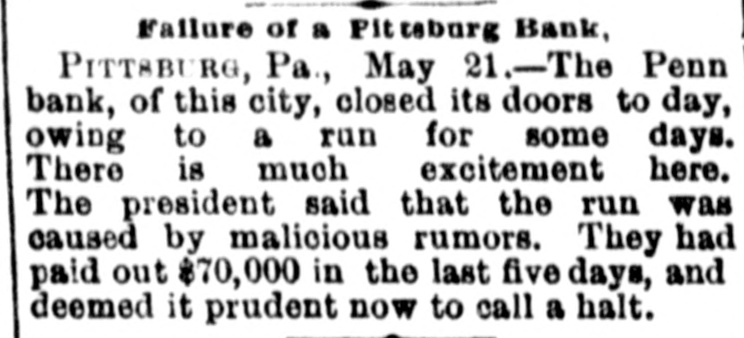
The Penn bank, of this city, closed its doors to day, owing to a run for some days. ... The president said that the run was caused by malicious rumors.
Source
newspapers
2. May 21, 1884 Suspension
Cause
Rumor Or Misinformation
Cause Details
Precautionary suspension after multi-day run attributed to malicious rumors and heavy payouts.
Newspaper Excerpt
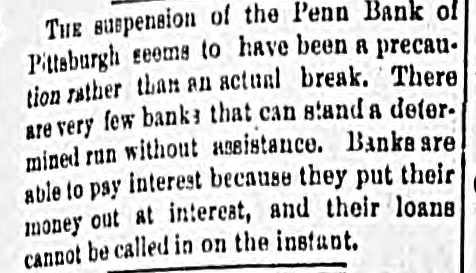
The suspension of the Penn Bank of Pittaburgh seems to have been a precaution rather than an actual break.
Source
newspapers
3. May 23, 1884 Reopening
Newspaper Excerpt
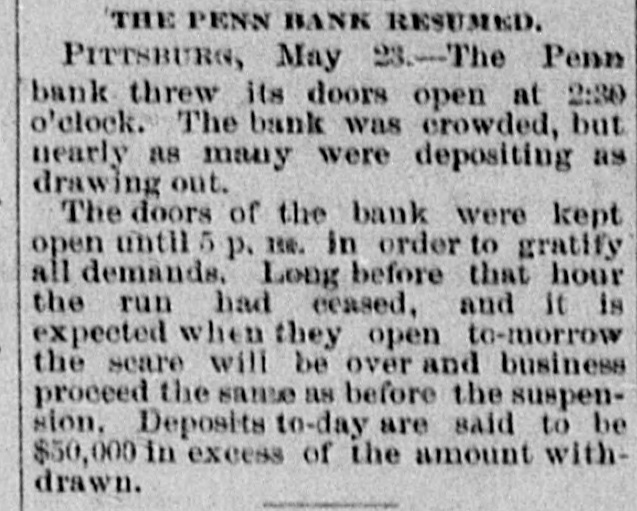
The Penn bank threw its doors open at 2:30 o'clock. ... Long before that hour the run had ceased, and ... deposits to-day are said to be $50,000 in excess of the amount withdrawn.
Source
newspapers
4. May 26, 1884 Suspension
Cause
Bank Specific Adverse Info
Cause Details
Subsequent suspension followed discovery/allegations of large deficits, fictitious accounts and embezzlement related to oil speculation.
Newspaper Excerpt
THE Penn Bank at Pittsburgh, after having resumed payment on Saturday, again suspended Monday, causing great excitement.
Source
newspapers
5. May 31, 1884 Receivership
Newspaper Excerpt
Civil suits were entered to-day to recover from the sureties the amount of the bonds of President Riddle and Cashier Reiber of the Penn bank. ... The swindle and robbery ... the amount of deficit being over $1,000,000. There is little left of the bank.
Source
newspapers
6. June 1, 1884* Other
Newspaper Excerpt
The swindle and robbery in the Penn Bank, of Pittsburg, is assuming astounding proportions, the amount of deficit being over $1,000,000. There is little left of the bank.
Source
newspapers

Newspaper Articles (24)

Article from Lancaster Daily Intelligencer, May 21, 1884

Click image to open full size in new tab

Article Text

Failure of a Pittsburg Bank, PITTSBURG, Pa., May 21.-The Penn bank, of this city, closed its doors to day, owing to a run for some days. There is much excitement here. The president said that the run was caused by malicious rumors. They had paid out $70,000 in the last five days, and deemed it prudent now to call a halt.


Article from The Wheeling Daily Intelligencer, May 22, 1884

Click image to open full size in new tab

Article Text

THE suspension of the Penn Bank of Pittaburgh seems to have been 8 precaution rather than an actual break. There are very few bank that can stand a deter. mined run without assistance. Banke are able to pay interest because they put their money out at interest, and their loans cannot be called in on the instant.


Article from Fort Worth Daily Gazette, May 24, 1884

Click image to open full size in new tab

Article Text

THE PENN BANK RESUMED

PITTSBURS, May 23.-The Penn bank threw its doors open at 2:30 o'clock. The bank was crowded, but nearly as many were depositing as drawing out. The doors of the bank were kept open until 5 P. Ite. in order to gratify all demands. Long before that hour the run had ceased, and it is expected when they open to-morrow the scare will be over and business proceed the same as before the suspension. Deposits to-day are said to be $50,000 in excess of the amount withdrawn.


Article from The Indianapolis Journal, May 24, 1884

Click image to open full size in new tab

Article Text

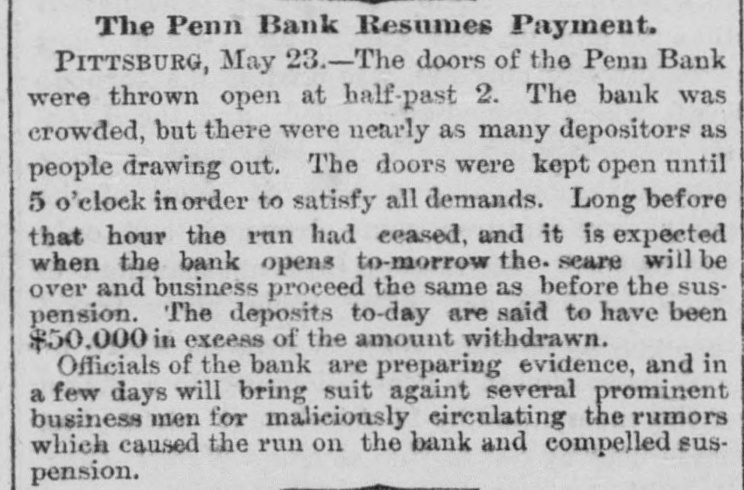
The Penn Bank Resumes Payment

PITTSBURG, May 23.-The doors of the Penn Bank were thrown open at half-past 2. The bank was crowded, but there were nearly as many depositors as people drawing out. The doors were kept open until 5 o'clock inorder to satisfy all demands. Long before that hour the run had ceased, and it is expected when the bank opens to-morrow the. scare will be over and business proceed the same as before the suspension. The deposits to-day are said to have been $50,000 in excess of the amount withdrawn. Officials of the bank are preparing evidence, and in a few days will bring suit againt several prominent business men for maliciously circulating the rumors which caused the run on the bank and compelled suspension.


Article from The Daily Cairo Bulletin, May 25, 1884

Click image to open full size in new tab

Article Text

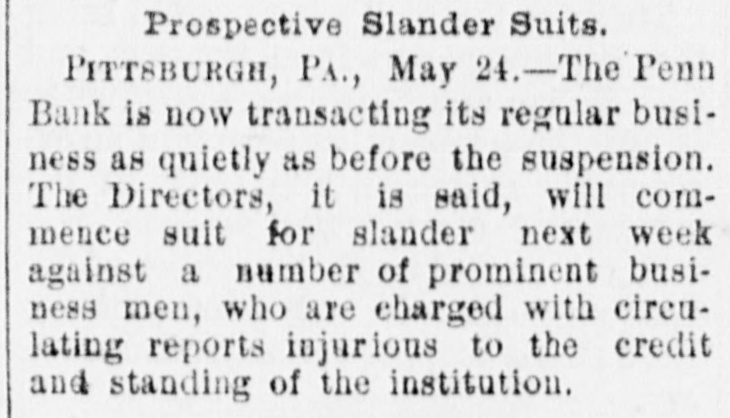
Prospective Slander Suits

PITTSBURGH, PA., May 24.-The Penn Bank is now transacting its regular business as quietly as before the suspension. The Directors, it is said, will commence suit for slander next week against a number of prominent business men, who are charged with circulating reports injurious to the credit and standing of the institution.


Article from Fort Worth Daily Gazette, May 25, 1884

Click image to open full size in new tab

Article Text

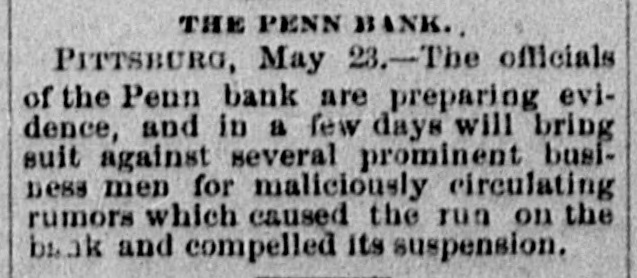
THE PENN BANK

, PITTSBURG, May 23.-The officials of the Penn bank are preparing evidence, and in a few days will bring suit against several prominent business men for maliciously circulating rumors which caused the run on the bank and compelled its suspension.


Article from Smyrna Times, May 28, 1884

Click image to open full size in new tab

Article Text

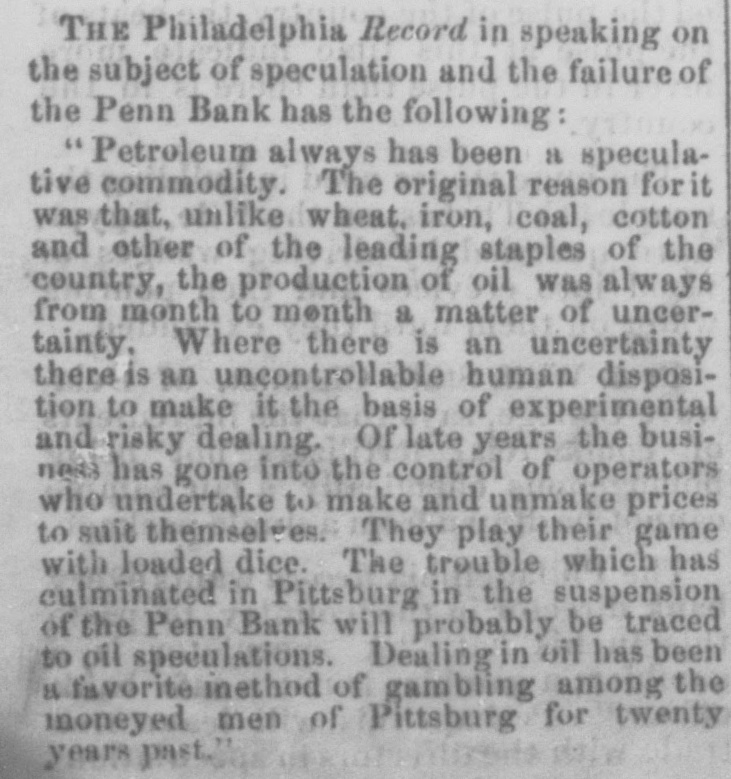
THE Philadelphia Record in speaking on the subject of speculation and the failure of the Penn Bank has the following: "Petroleum always has been a speculative commodity. The original reason for it was that, unlike wheat. iron, coal, cotton and other of the leading staples of the country, the production of oil was always from month to month a matter of uncertainty, Where there is an uncertainty there is an uncontrollable human disposition to make it the basis of experimental and risky dealing. Of late years the busineis has gone into the control of operators who undertake to make and unmake prices to suit themselves. They play their game with loaded dice. The trouble which has culminated in Pittsburg in the suspension of the Penn Bank will probably be traced to oil speculations. Dealing in oil has been a favorite method of gambling among the moneyed men of Pittsburg for twenty years past."


Article from The Bolivar Bulletin, May 29, 1884

Click image to open full size in new tab

Article Text

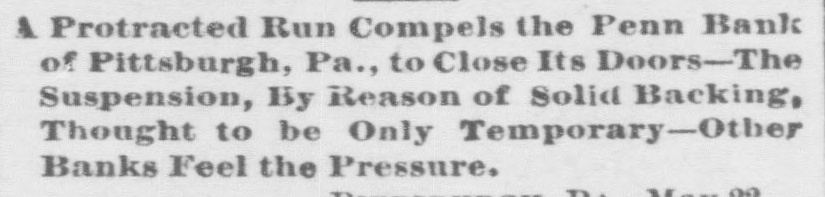
A Protracted Run Compels the Penn Bank of Pittsburgh, Pa., to Close Its Doors-The Suspension, By Reason of Solid Backing, Thought to be Only Temporary-Other Banks Feel the Pressure. You 00


Article from The Eaton Democrat, May 29, 1884

Click image to open full size in new tab

Article Text

The Penn Bank of Pittsburg

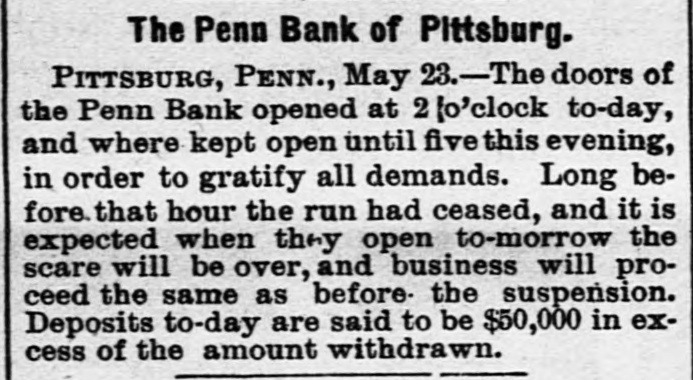
PITTSBURG, PENN., May 23.-The doors of the Penn Bank opened at 2 (o'clock to-day, and where kept open until five this evening, in order to gratify all demands. Long before. that hour the run had ceased, and it is expected when they open to-morrow the scare will be over, and business will proceed the same as before- the suspension. Deposits to-day are said to be $50,000 in excess of the amount withdrawn.


Article from Mineral Point Tribune, May 29, 1884

Click image to open full size in new tab

Article Text

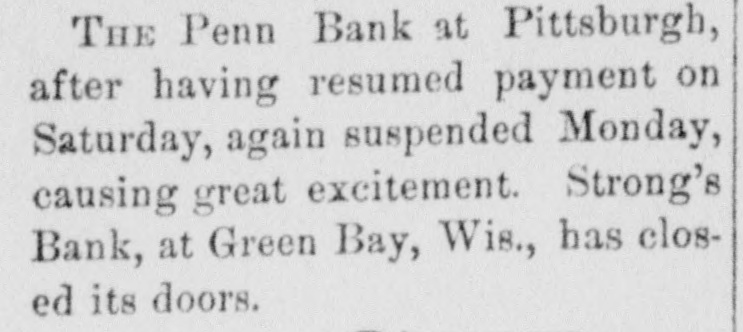
THE Penn Bank at Pittsburgh, after having resumed payment on Saturday, again suspended Monday, causing great excitement. Strong's Bank, at Green Bay, Wis., has closed its doors.


Article from The Middlebury Register and Addison County Journal, May 30, 1884

Click image to open full size in new tab

Article Text

NEWS OF THE WEEK.

Eastern and Middle States.

GENERAL BUTLER has sent a reply to the committee appointed to apprise him of his nomination for President by the Anti-Monopoly convention at Chicago. In his letter he says: "Concurring in each measure of public policy set forth in the resolutions of the convention, I need only add that if the votes of the electors shall intrust me with the executive power of that high office, every one of them shall be fully, justly and energetically used to make every measure of relief to the people and reform in government pointed out by your platform of principles, realities of administration."

FERDINAND WARD was ordered to appear before the New York grand jury, which proposed to investigate the affairs of Grant & Ward, and of President Fish, of the suspended Marine bank.

ONE man was instantly killed, and six more were injured by a collision between two trains at Wheeling Junction, forty miles from Pittsburg, Penn.

FERDINAND WARD, of the suspended firm of Grant & Ward, was arrested on complaint of J. Nelson Tappan, chamberlain of New York city, who charged him with obtaining $320,000 on false pretenses.

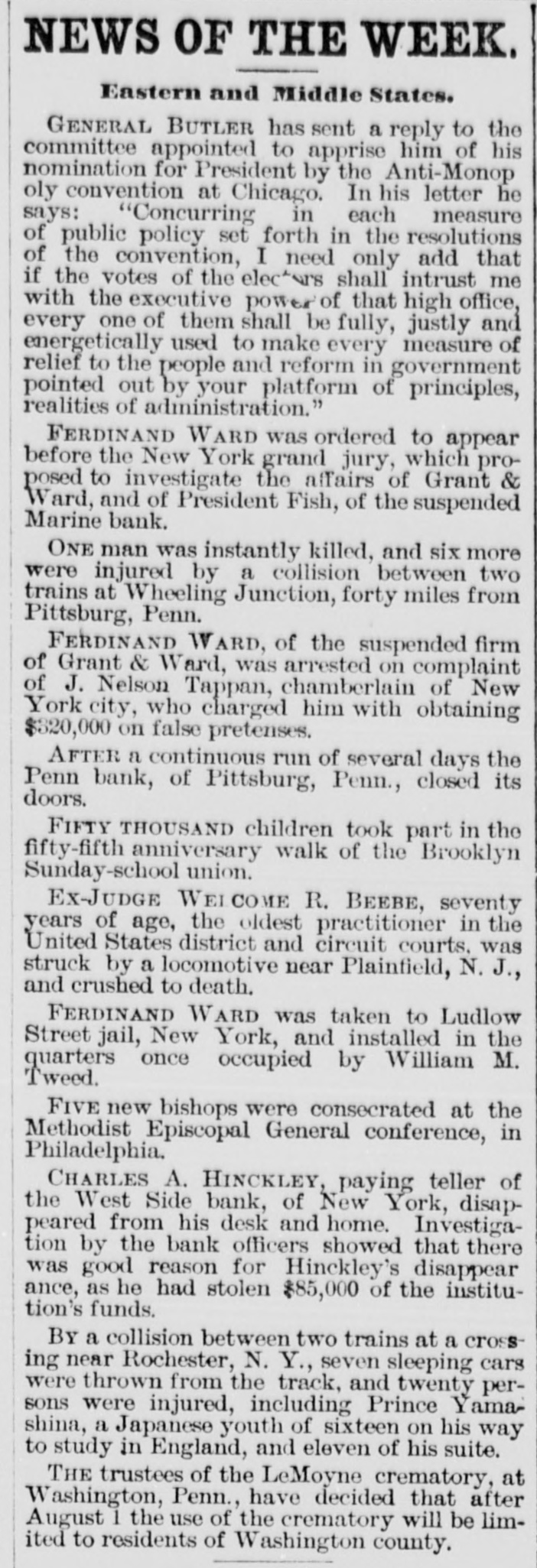
AFTER a continuous run of several days the Penn bank, of Pittsburg, Penn., closed its doors.

FIFTY THOUSAND children took part in the fifty-fifth anniversary walk of the Brooklyn Sunday-school union.

EX-JUDGE WELCOME R. BEEBE, seventy years of age, the oldest practitioner in the United States district and circuit courts, was struck by a locomotive near Plainfield, N. J., and crushed to death.

FERDINAND WARD was taken to Ludlow Street jail, New York, and installed in the quarters once occupied by William M. Tweed.

FIVE new bishops were consecrated at the Methodist Episcopal General conference, in Philadelphia.

CHARLES A. HINCKLEY, paying teller of the West Side bank, of New York, disappeared from his desk and home. Investigation by the bank officers showed that there was good reason for Hinckley's disappearance, as he had stolen $85,000 of the institution's funds.

By a collision between two trains at a crossing near Rochester, N. Y., seven sleeping cars were thrown from the track, and twenty persons were injured, including Prince Yamashina, a Japanese youth of sixteen on his way to study in England, and eleven of his suite.

THE trustees of the LeMoyne crematory, at Washington, Penn., have decided that after August 1 the use of the crematory will be limited to residents of Washington county.


Article from Connecticut Western News, June 4, 1884

Click image to open full size in new tab

Article Text

The New York Panic

A warrant for the arrest of John C. Eno, the former president of the Second National Bank, was issued by United States Commissioner Shields Saturday morning at the request of District-Attorney Root Mr. James D. Fish, President of the Marine National Bank, was arrested Saturday evening in his rooms in the Mystic flats. The warrant was issued by United States Commissioner Shields on an affidavit sworn to by Bank Examiner Seriba. The warrant charges Mr. Fish with "unlawfully misapplying certain sums of money to the amount of $1,400,000 of the moneys and funds of the Marine National Banking Association to his own use, benefit, and advantage, with intent to injure and defraud such association." Hinckley, the cashier of the West Side Bank, who absconded wtih over $90,000 of the bank's funds, has not yet been arrested. The official examination of the bank's condition shows that it is solvent, although it was forced to close by the refusal of banks to clear its paper. It will soon resume. The Hot Springs National Bank of Hot Springs, Ark., has suspended, the Presid nt having decamped with the available funds. Strong's bank at Green Bay, Wis., has suspended, caused by the failure of other banks with which it did business. The depositors will not meet with much loss. The liabilities are about $340,000. The available assets amount to about $350,000. General Grant has, as yet, made no explanation of the letters he wrote Mr. Fi-h. One of the latter's lawyers says there are other letters from General Graut among Mr. Fish's papers. The expert accountant who is examining into the affairs of Grant & Ward, think< it will be impossible to make a correct statement of the firm's condition from its accounts, which are badly mixed. A receiver was appointed for the individual property of Ferdinand Ward. Marshals and detectives watch Mr. Eno's house day and night. but have failed to arrest him. The New York Heraid says there is a growing impression that the authorities are not very anxious to apprehend him. The swindle and robbery in the Penn Bank, of Pittsburg, is assuming astounding proportions, the amount of deficit being over $1,000,000. There is little left of the bank. The fugitive bank president from Hot Springs, Ark., ias been arrested, together with a woman, on a train.


Article from Burlington Weekly Free Press, June 6, 1884

Click image to open full size in new tab

Article Text

BROKEN BANKS

The Penn Bank Failure at Pittsburg. e PITTSBURG, May 31.-Civil suits were entered to-day to recover from the sureties the amount of the bonds of President Riddle and Cashier Reiber of the Penn bank. Frank Laughlin, R. M. Kennedy and Marshall Hall are on Riddle's bond for $80,000 and Henry Kleber and George Snyder on Reiber's for $50,000. Criminal proceedings will probably be brought this afternoon agains Rtiddle. Riddle had two hemorrhages last night. Thomas J. Watson, absconding oil broker, has been arrested at Jersey City. Judgment for $80,000 has been obtained against him. A Statement by President Riddle. PITTSBURG, June 2.-President Riddle of the Penn bank made a statement this morning to the effect that he organized a blind pool to put up the prices of oil and that the overdrawn accounts at the bank might be made good. He had no personal interest in the pool. The fictitious accounts were made during his absence. Riddle asserts that the directors were acquainted with his plans and he bought oil for some of them. He asserts that he left money and securities of his own in the bank to the amount of $400,000 and intimates that the directors levied on them without leave or license while he was sick. Two directors came to his bed when he was unfit to sign papers and had him sign a judgment note to secure then for $90,000, transferring his collateral to the directors, while he intended it should go to the depositors. Riddle says he wrecked himself physically and financially in trying to keep up the bank and while he is willing to take his share of the blame there are others who should bear the blame with him. Failure at Washington. WASHINGTON, May 31.-The banking house of D. W. Middleton & Co. has suspended. The proprietors have made assignments. There are a number of excited persons around the bank. Liabilities unknown. The bank had a capital of $40,000. The suspension was caused by heavy and immediate demands for cash. The failure affects not only the bank depositors, but the customers of the firm who dealt in stocks. One customer had in the hands of the firm $10,000 of accrued profits. An intimate friend of Middleton's says he does not believe the creditors will get one cent on the dollar. It is supposed that D. W. Middleton speculated with the funds. The cash deposits of the bank amounted to about $250,000. The firm held the securities of customers amounting to $250,000.


Article from Savannah Morning News, June 8, 1884

Click image to open full size in new tab

Article Text

BRIGHT BITS

A GREAT many fashionable ladies are going to wear nothing this summer but black silk dresses and white dresses made with a good deal of lace and embroidery.-Päladelphia Times. "FERDINAND WARD'S father's greatest mistake was in not giving him a trade," observes a Boston paper. It is probable thatthe State will remedy this defect in his education.Daily Graphic. IF you will sit down and wait. yung man, at least one haff ov the good things ov life will at some time eddy around near yu, while the more yu chase them the more they will break into a run.-Josh Billings. THE Pittsburg Chronicle summarizes the Penn Bank failure in this fashion: "What the reporter asked, '-?-?-?-?' What the bank director answered, '-!-!-!-!-!' What the public learned, '-0-0-0-0.'' "WHAT 18 a liberal education?" asks Prof. Eliot of Harvard in the June Century. The average student seems to think that it consists entirely in having a liberal father and living next door to a boat house.-Burlington Free Press. THE father of five marriageable daughters was in town a few days ago trying to buy some four-leaf clover seed to plant in his back yard. He said he had read that when a young girl finds a four-leaf clover it is a sign that she will be married within a year.-Norristoron Herald. "You remind me of Barnum since he secured his white elephant," said a Brooklyn man to his wife, who never tired of talking. "Because he holds as sacred a priceless and peerless beauty?" she timidly and blushingly suggested. "Not quite," replied the wretch: "it's because he owns a Toung Toulong." That heartless husband no longer carries a night-key.-New York Morning Journal. MAN that is married to a woman is of many days and full of trouble. In the morning he draws his salary, and in the evening Behold, it is gone! It is a tale that is told; It is vanished, and no man knows whither it goeth. He riseth up clothed in the chilly garments Of the night And seeketh the somnolent paregoric Wherewith to soothe his infant posterity. He cometh as a horse or OX And draweth the chariot of his offspring. He spendeth his shekels in the purchase of fine linen To cover the bosom of his Family; Yet himself 18 seen at the gates of the city With one suspender. Yea, he is altogether wretched. -Philadelphia News.


Article from The True Northerner, June 12, 1884

Click image to open full size in new tab

Article Text

NEWS CONDENSED

Concise Record of the Week. EASTERN. Mr. Riddle, who was President of the wrecked Penn Bank, of Pittsburgh, is in a critical condition of health. He states that the directors were interested in the oil pool which caused the collapse of the bank; that the fictitious accounts were opened two years ago; and that the directors have recently appropriated $400,000 in stock and deposits which he left for depositors. The Directors of the Reading Road, after numerous meetings, announced that the coupons on the consolidated bonds will be cashed at par. They then applied to the Cirouit Court for a set of receivers, and H. C. Kelsey, Stephen N. Caldwell, Edwin M. Lewis, and George De B. Keim were appointed in bonds of $500,000 each. Jesse Carter (colored) was hanged at Pittsburgh for being accessory to a murder He prayed and sung on the scaffold, and asserted his innocence. Near Miss Nivison's Children's Sanitarium, at Hammonton, N.J., was found buried the remains of twenty-one children, incased in rude pine boxes. Recently the death-rate in the institution, which is a purely charitable one, has been excessive, the manageress ascribing it to the use of Irish mose as food. The discovery caused much excitement, and the positions of the bodies showed that but a hasty interment was given the little victims. Mr. Austin Corbin, who acts as Treasurer for the institution, says he knows little of its management.


Article from Wessington Springs Herald, June 13, 1884

Click image to open full size in new tab

Article Text

DOMESTIC.

THE Penn State Bank of Pittsburgh, Pa., closed its doors on the 21st, a steady "run" baving largely diminished the funds. The President, Mr. Riddle, said the bank was able to pay dollar for dollar. The liabilities were said to be about $1,500,000, with assets greatly in excess of these figures.

LLOYD L. MAJORS, one of the trio who murdered Archibald McIntyre and W. P. Renowden in Santa Clara County, Cal., was executed on the 21st.

THE annual convention of the brewers of the United States was held at Buffalo on the 21st. The attendance was large.

THE Sunday-school scholars of Brooklyn, N. Y., observed children's day on the 21st. In the grand line of march there were 66,383 children from 162 schools.

THE suspension bridge across the Scioto River at Portsmouth, O., was crushed by a drove of cattle on the 21st, and two children of the name of Fullweiler were drowned.

ANOTHER heavy rainfall occurred in Northeastern Texas on the 21st, making the fourth since May 1. Immense tracts of country were flooded, and great damage 'to crops had resulted. In some sections crops had been planted twice, and would have to be planted again. At Hempstead a house was blown over and a child was killed.

THE steamer Faraday landed the shore end of the Bennett-Mackey cable at Rockport, Mass., on 22d, and sailed away to make a splice at a buoy 250 miles to the northeast. She would next pay out 1,000 miles in the deep-sea section.

HENRY HAYS, a farmer of Davies County, Ky., was found dead near his residence a few days ago with three pistol-shots in his body. Hays was a despernte man, and had engaged in several shooting affrays.

TNE street-car stables and eight horses were burned at Portland, Me., the other night. Engineer Skilling was fatally injured.

It was announced on the 22d that there was fully twenty thousand people between Natchez and Vicksburg who were destitute, and had no prospects that they (could raise a decent crop until next year.

SECRETARY FOLGER on the 22d issued a call for the redemption of $10,000,000 of three per cent. bonds maturing the 30th of June.

JAY GOULD cabled Vanderbilt at London on the 22d that a better feeling prevailed on the stock-market, that no further failures were expected, that the crops were in lan excellent condition, and that the new trunk-line pools had been completed and signed. Vanderbilt replied that his views were in accordance with those held by Mr. Gould.

A WELL of natural gas, of eight thousand horse-power, was struck in Pittsburgh recently at a depth of fifteen hundred feet.

IN Elk Township, Pa., the other night Mr. and Mrs. Greist lay quietly sleeping, when a man ontered at the window, and struck the woman on the head with an ax, killing ber. The husband followed, but the assassin escaped.

BURGLARS penetrated the twenty-inch brick wall of the vault in the City Clerk's office at East St. Louis the other night, and carried off about $2,000 in money and pearly $20,000 in city scrip.

THE wholesale dry-goods firm of Elliott, Dewey & Co., of Richmond, Va., has made an assignment, with liabilities of $200,000.

A FREIGHT train on the Parker & Karns City Railroal went through a trestle near Karns City, Pa., a few days ago, and was badly wrecked. Two men, named Thompson and Cook, were killed.

THE house of Samuel Ackerman, near Portsmouth, O., was destroyed by fire a few nights ago, and Mr. Ackerman, his wife and a daughter aged sixteen years perished in the flames. The other six children were saved.

A CATTLE-RAISER of Texas, who had just made a tour of the stock region, estimated on the 22d that the drive for the season would be half a million head.

THE following executions for murder took place on the 23d: Loban Stevens, at Waverly, O.; Lloyd L. Majors, at Oakland, Cal.; Leonidas Johnson, at McDonough, Ga.; John McKiethen, at Way Cross, Ga., and Charles B. Clark, at Little Valley, N. Y.

NICHOLAS PAULEY'S house in Clyde, Mich., was destroyed by fire on the 23d, and two children, aged eleven and eight years, perished in the flames.

THERE were 203 failures in the United States and Canada during the seven days onded on the 23d, against 222 the previous seven days, distributed as follows: Mid-
Article from Delaware Gazette and State Journal, June 19, 1884

Click image to open full size in new tab

Article Text

Marrero, the alleged Cuban dynamiter, arrested on Thursday, Was Friday taken before Commissioner Locke at Key West. Florida. and held in 1.000 for his appearance at the next term of the United States district court. B. F. Stone of Baltimore, about 60 years old attempted "suicide Friday by cutting big throat. He was ejected from the house where the attempt was made. when he went to Druid Hill Park and drowned himself in the reservotr. He had been drinking heavily. The total value of the exports of domestic breadstuffs from the United States during May WAH $11,902,044. against 911,686,551 during May, 1883. The total value for the live months which ended May 31st. 1884, W&H 956,980,736. against $73,602,999 during the first five months of last year. The Easten. Pa. Argus states that Mesars. duPont have paid the Vulcan Powder Company, whose works are located near CataHauqua,$75,000 to suspend operations for one year. The members of the Vulcan company are E. 8. Wertz, Oscar Meyer and William B. Schaffer, who receive €25,000 each for the suspension. The vacancy in the office of solicitor of the treasury, which has existed since Kenneth Rayner's death on the 5th of March, seriously affects the business of the office. It is understood that the Preeident finds considerable difficulty in filling this office, owing to the fact that the appointment would only last a few months. James D. Fish, late president of the Marine National Bank, was Friday indicted in New York by the United States grand jury for the violation of section 5,028 of the Banking law which refers to the misappropriation of the funds of a national bank by a bank official. He will be arraigned at the next term of the United States circuit court. At Pittsburg Friday morning a hearing was given in the cases of Thomas J. Watson oil broker, and Reiber, the cashier of the Penn Bank, charged with conspiracy to defraud the bank. The president, Riddle, had been indicted, but waived a hearing and gave bail. The testimony tended to show that Riddle, Watson and Reiber were associated in oil speculations and overdraftson fictitious firms I representing their transactions in oil. One of the fictitious accounts opened with an overdraft of $125,000. At the closing of the 1 bank there were over $400,000 overdrawn. Thomas J. Wateon's individual account was $97,000 overdrawn. The charges against the 8 overdrawn accounts were made by the direc. tion of President Riddle, and Reiber was cognizant of the condition of the accounts. The defense will be heard next Friday. The assignee of the Penn Bank said yesterday that he thought he would be able to pay 25 cents on the do lar.


Article from Savannah Morning News, June 21, 1884

Click image to open full size in new tab

Article Text

THE PENN BANK PIRATES

Reiber and Watsen Held for Trial in $30,000 Bail Each. PITTSBURG, June 20.-The hearing in the conspiracy case of Charles Hier Reiber, of the Penn Bank, and T. J. Watson, a broker, was concluded before Alderman Burke this morning. The testimony adduced showed that two notes of Watson and Riddle for $10,000 each had never been discounted by the bank, but were taken out of President Riddle's private box by the attorney for the bank, after the second suspension. The prosecution put the notes in evidence to show conspiracy, but the defense contended that they were never négotiated and were not assets of the bank. The Alderman held the defendants, Watson and Reiber, for the court, demanding $30,000 bail each. President Riddle had previously waived hearing and given bail for his appearance in court.


Article from Savannah Morning News, September 3, 1884

Click image to open full size in new tab

Article Text

The Penn Bank's Affairs

PITTSBURG, Sept. 2.-R. M. Kennedy to-day filed an affidavit of defense to the suit of State Treasurer Baily against the directors ot the defunct Penn Bank to recover on the bonds given by the directors as security for the deposit of State funds amounting to $10,000. Kennedy disclaims liability as a signer of the bond, and disputes the commonwealth's right to a receiver. In the suit of the Penn Bank against him to recover $66,000 overdrafts, Kennedy also makes a detense, claiming that he never received overdrafts and had no knowledge of them until after the close of the bank.


Article from Savannah Morning News, October 14, 1884

Click image to open full size in new tab

Article Text

FAILURES IN BUSINESS

Private Bankers of Cincinnati Assign Owing Many Benevolent Societies. CINCINNATI, Oct. 13.-S. S. Davis & Co., private bankers, made an assignment to T. C. Campbell to-day. Their liabilities are estimated at $60,000, and the assets at $15,000. Among the liabilities are a number of trusts of benevolent and secret society organizations. ASSIGNED TO SECURE AN EXTENSION. CHATTANOOGA, TENN.. Oct. 13.-Eugene Hammel, dealer in ladies' and gentlemen's furnishing goods, has made an assignment. His liabilities are $12,000, and his assets $10,000. The assignment was made to obtain an extension of time, and he will reopen. INDICTMENTS IN THE PENN BANK CASES. PITTSBURG, PA., Oct. 13.-The grand jury to-day found a true bill against President Riddle and Cashier Reiber, of the defunct Penn Bank, for conspiracy and the embezzlement of $1,200,000, and against L. J. Watson, the oil broker, for conspiracy to defraud the Penn Bank depositors. A BATCH OF ASSIGNMENTS. CHICAGO, Oct. 13. -Morgan Roth & Co., dealers in gentlemen's furnishing goods, were closed by the Sheriff to-day. Their liabilities are $35,000 and the assets about $23,000. Zimmerman & Co., cloak manufacturers, to-day made an assignment. Their liabilities are $80,000 and the assets $55,000. Wardell & Hinckley, dealers in machinery and engines, were closed to-day by the Sheriff. Their liabilities amount to $25,000 and assets to $18,000.


Article from The Indianapolis Sentinel, March 1, 1885

Click image to open full size in new tab

Article Text

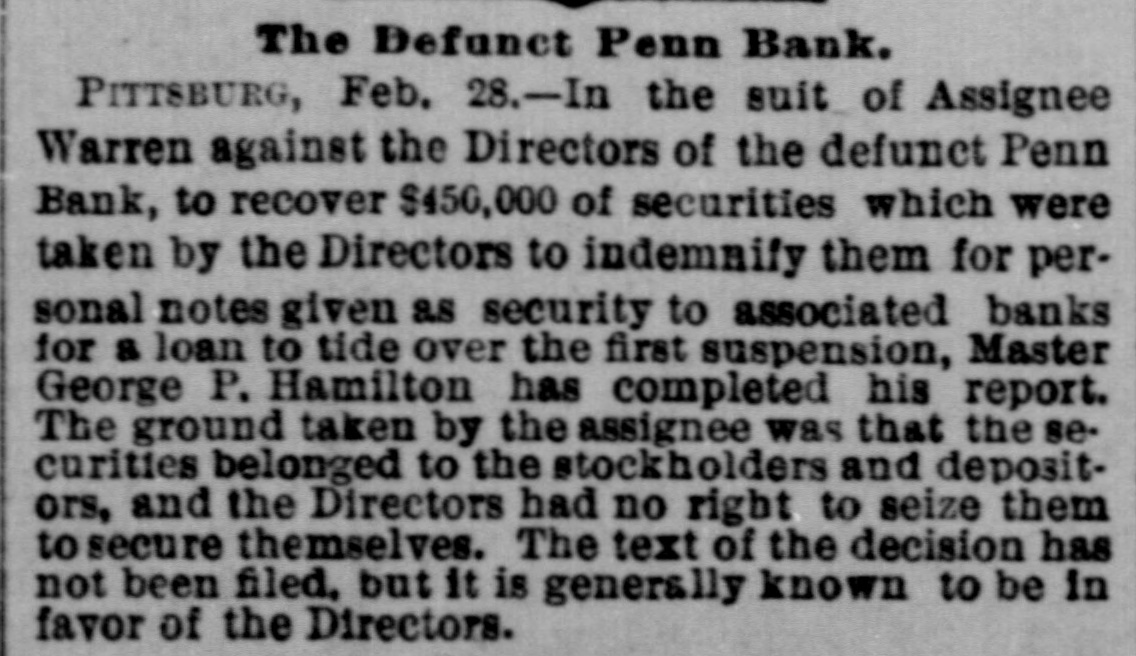
The Defunct Penn Bank

PITTSBURG, Feb. 28.-In the suit of Assignee Warren against the Directors of the defunct Penn Bank, to recover $450,000 of securities which were taken by the Directors to indemnify them for personal notes given as security to associated banks for a loan to tide over the first suspension, Master George P. Hamilton has completed his report. The ground taken by the assignee was that the securities belonged to the stockholders and depositors, and the Directors had no right to seize them to secure themselves. The text of the decision has not been filed. but it is generally known to be in favor of the Directors.


Article from The Indianapolis Sentinel, March 2, 1885

Click image to open full size in new tab

Article Text

The Defunct Penn Bank

PITTSBURG, Feb. 28.-In the suit of Assignee Warren against the Directors of the defunct Penn Bank, to recover $450,000 of securities which were taken by the Directors to indemnify them for personal notes given as security to associated banks for a loan to tide over the first suspension, Master George P. Hamilton has completed his report. The ground taken by the assignee was that the securities belonged to the stockholders and depositors, and the Directors had no right to seize them to secure themselves. The text of the decision has not been filed. but it is generally known to be in favor of the Directors.


Article from Savannah Morning News, December 9, 1886

Click image to open full size in new tab

Article Text

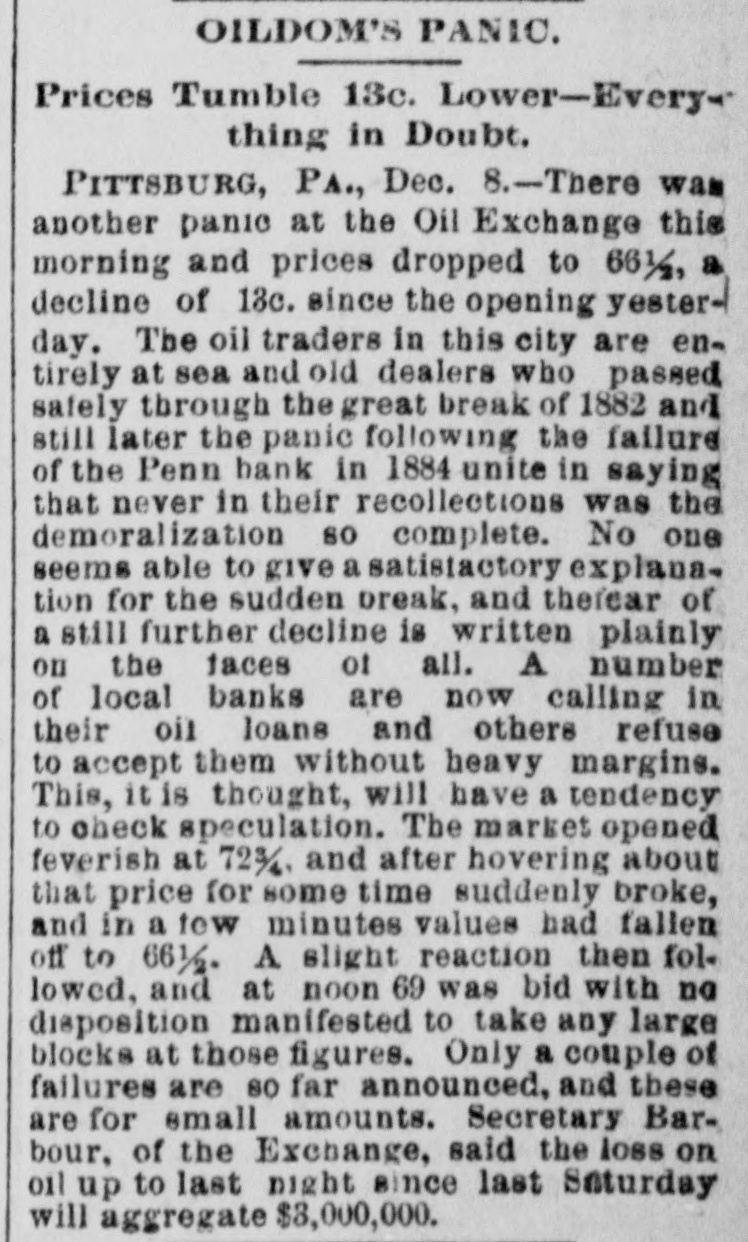
OILDOM'S PANIC

Prices Tumble 13c. Lower-Everything in Doubt. PITTSBURG, PA., Dec. 8.-There was another panic at the Oil Exchange this morning and prices dropped to 661/4, a decline of 13c. since the opening yesterday. The oil traders in this city are entirely at sea and old dealers who passed safely through the great break of 1882 and still later the panic following the failure of the Penn bank in 1884 unite in saying that never in their recollections was the demoralization so complete. No one seems able to give a satisfactory explana. tion for the sudden break, and therear of a still further decline is written plainly on the faces of all. A number of local banks are now calling in their oil loans and others refuse to accept them without heavy margins. This, it is thought, will have a tendency to check speculation. The market opened feverish at 723, and after hovering about that price for some time suddenly broke, and in a few minutes values had fallen off to 661/2. A slight reaction then followed, and at noon 69 was bid with no disposition manifested to take any large blocks at those figures. Only a couple of failures are so far announced, and these are for email amounts. Secretary Barbour, of the Exchange, said the loss on oil up to last night since last Saturday will aggregate $3,000,000.


Article from The Memphis Appeal, September 11, 1887

Click image to open full size in new tab

Article Text

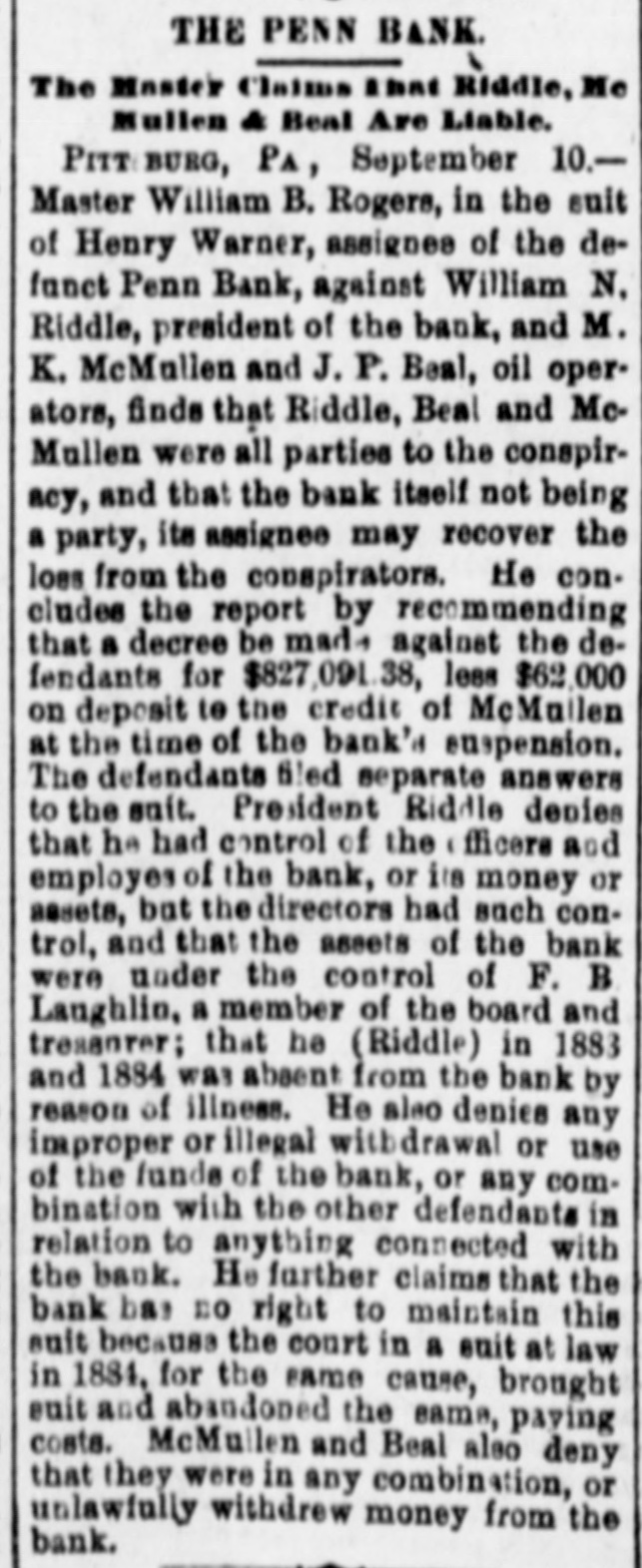
THE PENN BANK.

The Master Claims that Riddle, McMullen & Beal Are Liable.

PITT BURG, PA, September 10.- Master William B. Rogers, in the suit of Henry Warner, assignee of the defunct Penn Bank, against William N. Riddle, president of the bank, and M. K. McMullen and J. P. Beal, oil operators, finds that Riddle, Beal and McMullen were all parties to the conspiracy, and that the bank itself not being a party, its assignee may recover the loss from the conspirators. He concludes the report by recommending that a decree be mad against the defendants for $827,091.38, less $62.000 on deposit to the credit of McMullen at the time of the bank's suspension.

The defendants filed separate answers to the suit. President Riddle denies that he had control of the officers and employes of the bank, or its money or assets, but the directors had such control, and that the assets of the bank were under the control of F. B Laughlin, a member of the board and treasurer; that he (Riddle) in 1883 and 1884 was absent from the bank by reason of illness. He also denies any improper or illegal withdrawal or use of the funds of the bank, or any combination with the other defendants in relation to anything connected with the bank. He further claims that the bank has no right to maintain this suit because the court in a suit at law in 1884, for the same cause, brought suit and abandoned the same, paying costs. McMullen and Beal also deny that they were in any combination, or unlawfully withdrew money from the bank.