Gate City National Bank (Atlanta, GA)

Episode Information

Episode UID
242401118
Episode Type
Suspension โ†’ Reopening
Bank Type
national
Bank ID
24240 national
Charter Number
2424
Start Date
February 23, 1893
Location
Atlanta, Georgia (33.749, -84.388)

Metadata

Model
gemini-3-flash-preview (chosen from majority vote of a three-model LLM ensemble)
Short Digest
ca91822ba9a3e6f4

Response Measures

None

Description

The bank suspended due to internal fraud (defalcation) rather than a run; it eventually liquidated its affairs and paid depositors in full, which the Comptroller of the Currency classified as a resumption/reopening for the purpose of paying out.

Events (5)

1. May 3, 1879 Chartered
Source
historical_nic
2. February 23, 1893 Suspension
Cause
Bank Specific Adverse Info
Cause Details
Defalcation (embezzlement) by Assistant Cashier Redwine totaling approximately $70,000 to $95,000.
Newspaper Excerpt
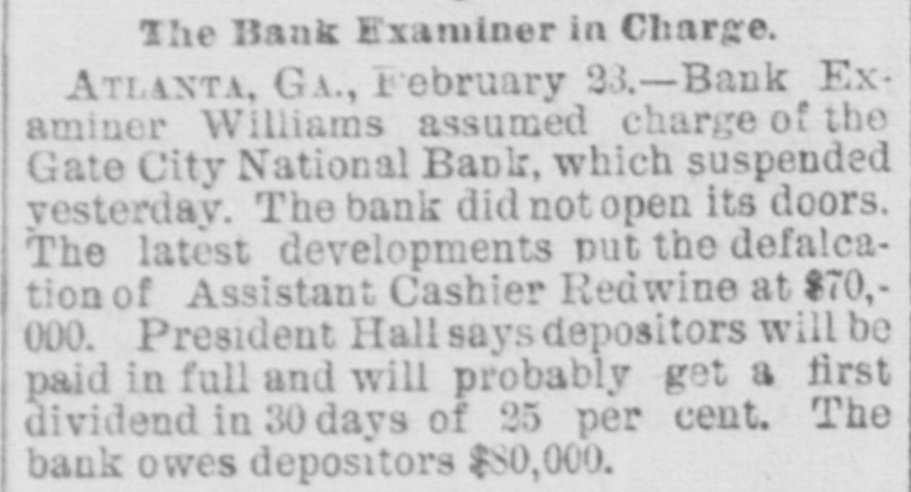
Bank Examiner Williams assumed charge of the Gate City National bank today. The latest developments put the amount of the defalcation of Assistant Cashier Redwine at $70,000.
Source
newspapers
3. April 7, 1893 Other
Newspaper Excerpt
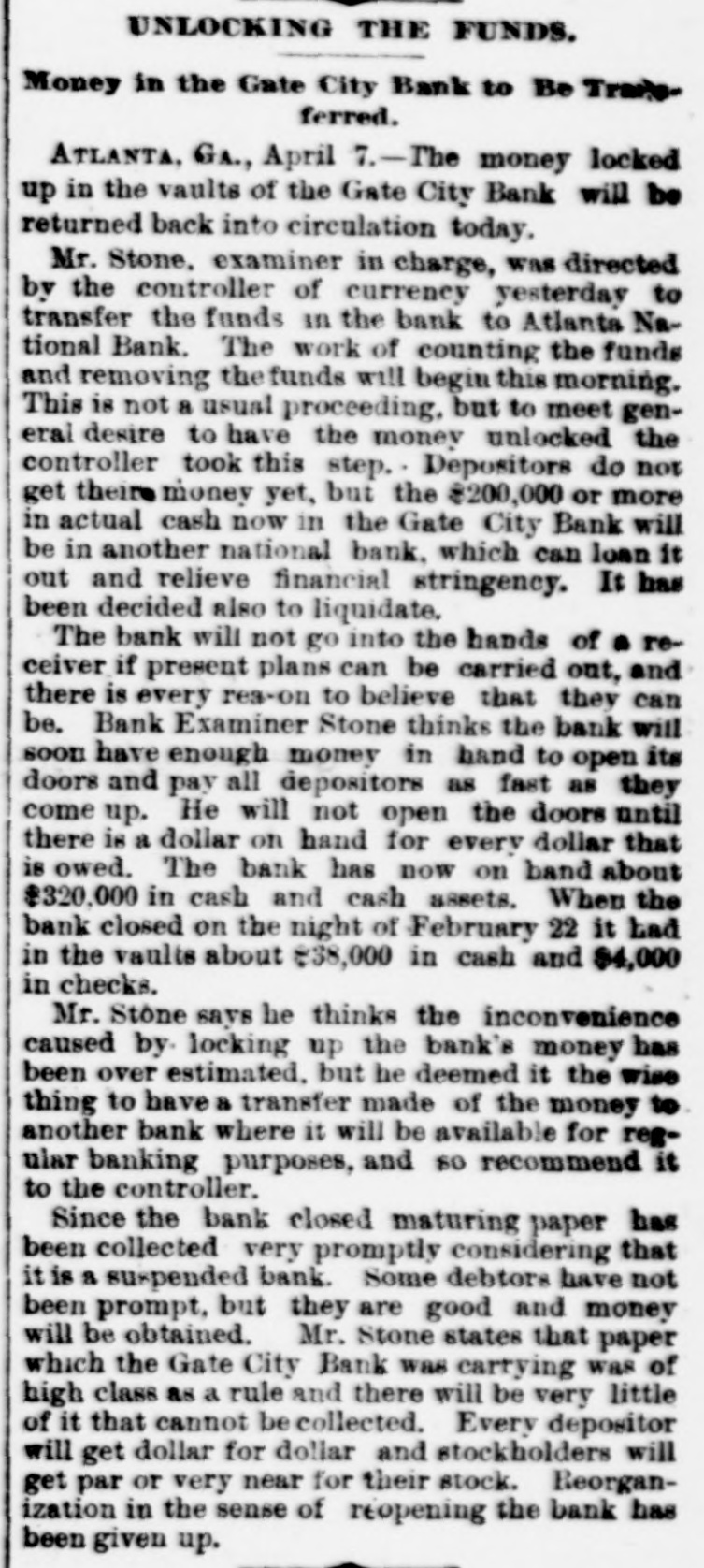
It has been decided also to liquidate. The bank will not go into the hands of a receiver if present plans can be carried out... Reorganization in the sense of reopening the bank has been given up. Every depositor will get dollar for dollar and stockholders will get par or very near for their stock. Reorganization in the sense of reopening the bank has been given up. The money locked up in the vaults of the Gate City Bank will be returned back into circulation today... transfer the funds in the bank to Atlanta National Bank. The work of counting the funds and removing the funds will begin this morning. This is not a usual proceeding, but to meet general desire to have the money unlocked the controller took this step. Depositors do not get their money yet, but the $200,000 or more in actual cash now in the Gate City Bank will be in another national bank. which can loan it out and relieve financial stringency. It has been decided also to liquidate. The bank will not go into the hands of a receiver if present plans can be carried out, and there is every rea-on to believe that they can be. Bank Examiner Stone thinks the bank will soon have enough money in hand to open its doors and pay all depositors as fast as they come up. He will not open the doors until there is a dollar on hand for every dollar that is owed. The bank has now on band about $320.000 in cash and cash assets. When the bank closed on the night of February 22 it had in the vaults about e38,000 in cash and $4,000 in checks. Mr. Stone says he thinks the inconvenience caused by. locking up the bank's money has been over estimated. but he deemed it the wise thing to have a transfer made of the money to another bank where it will be available for regular banking purposes, and so recommend it to the controller. Since the bank closed maturing paper has been collected very promptly considering that it is a suspended bank. Some debtors have not been prompt, but they are good and money will be obtained. Mr. Stone states that paper which the Gate City Bank was carrying was of high class as a rule and there will be very little of it that cannot be collected. Every depositor will get dollar for dollar and stockholders will get par or very near for their stock. Reorganization in the sense of reopening the bank has been given up.
Source
newspapers
4. June 29, 1893 Reopening
Newspaper Excerpt
At 9 o'clock this morning the Gate City National Bank began paying off its depositors. There was a steady stream of depositors all day. and about $160,000 was paid out.
Source
newspapers
5. July 25, 1893 Voluntary Liquidation
Source
historical_nic

Newspaper Articles (23)

Article from The Wichita Daily Eagle, February 24, 1893

Click image to open full size in new tab

Article Text

FAILURES. LOUISIANA, Mo., Feb. 23.-John W. Fritz failed today. His liabilities are $35,000 and his assets $32,000. He gave a deed of trust on all his property to Taylor Frier, trustee, for the benefit of his creditors. Too much wheat speculation is the cause. ATLANTA. Ga., Feb. 23. - Bank Examiner Williams assumed charge of the Gate City National bank today. The latest developments put the amount of the defalcation of Assistant Cashier Redwine at $70,000. President Hall says that the depositors will be paid in full. The bank owes depositors $800,000. LINCOLN, Neb., Feb. - -The state banking board has taken charge of the Farmers and Merchants bank at Elk Creek, whose affairs are in a bad shape. The true condition of the concern cannot be learned now. The deposits are not large. Cashier Holmes is under arrest. ST. PAUL, Minw., Feb. 23.-An assignment deed of the Baupre Mercantile company to Theodore Borup was filed in the district court this afternoon. The firm, which is old and prominent, at last succumbed to adverse circumstances which have been gathering around it for a long time. The members will make no state. ment, but from outside sources it is learned that the failure is a general one; that there are nopreferences, and that no releases from creditors would be req uested. The assets foot up about $200,000, while the liabilities approximate $400,000. LINCOLN, Neb., Feb. 23.-Another lot of forged paper, aggregating $200,000, has been brought to light in the Capital National bank case. One batch of the notes, now in the hands of attorneys for collection for eastern banks, amounting to $175,000, is signed by an employer of Mosher's, named Hurlbuti and indorsed by Mosher as president of the bank. They were floated by Mosher and the money sequestered by him. Mosher admits that he got the cash, but refuses to say where any of it went. It is now stated by conservative men who are intimate with the affairs of the institution that the bank's liabilities exceed $1,200,000, with the assets practically nothing. It is not expected that the bank will pay 10 cents on the dollar. The Lincoln business men who have had faith in the statement that a full settlement would be made, are greatly excited tonight. It has also come out that the amount of county and city funds on deposit is- greatly in excess of what was at first given out. NEW YORK, Feb. 23.-It is rumored that a receiver will be appointed tomorrow for the United States and Brazil Steamship company, of which C. P. Huntington is one of the directors.


Article from Middlebury Register, February 24, 1893

Click image to open full size in new tab

Article Text

Mr. Cleveland announces that he has completed his cabinet by the selection of Richard Olney of Boston for attorney general and Hillary A. Herbert of Alabama for secretary of the navy. The second trial of Dr. Thatcher Graves for the alleged murder of Mrs. Barnaby has been set now for May 22, at Denver, Col.: meanwhile the prisoner will remain in jail, having refused all offers of bail. The Chicago & Northwestern railroad will elevate all its tracks within the city limits of Chicago at an expense of $24,000,000. The plans provide for the elevation of 27 miles of main and second track and 143 miles of side track. Henry Joy, express messenger on a New Hampshire road, was blown off while going from one car to another between Durham and Madbury Monday night. He had to walk to Durham, two miles. His face, nose, ears, hand and toes were frozen. He was thrown down three times by the terrific wind on the way. J.C. Eno, who wrecked a bank in New York and has been a fugitive from justice for nine years, has returned and surrendered himself to the authorities. He says that he was guilty of indiscretions, and expects to be acquitted. He was charged with making way with about $4,000,000 of the bank's money. His home has been at Quebec since he fled the country. A.L.8. 46 A sensation was caused in business eircles at Youngstown, O., Friday, by the failure of Robert L. Walker, a prominent banker and capitalist. The failure will be widespread in its effects, involving Gov. McKinley, and the indications are now that every dollar of property owned by the governor will be swept away. During the past ten years Mr. Walker has been rated as a very wealthy man. Five boys from 12 to 14 years old discovered a large bundle of bank bills the other afternoon in the cellar of a large brick house in Hartford, Conn. The boys were mending their double-ripper and one of their discovered the package, which they shared among them. The police have not obtained all the money, which is estimated at $500. No clue to the owner has been found. The Reading system of railway lines has again passed into the hands of receivers. The downfall of the company caused almost a panic on the New York stock exchange on Monday. The failure of the company is believed to have been the outcome of its attempt to control the anthracite coal trade of the country, a venture for the accomplishment of which it had too little capital. The disappearance and defalcation of Assistant Cashier Redwine of the Gate City national bank is the biggest financial sensation Atlanta, Ga., has known in years. The officers of the clearing house association report his defalcation is about $65,000. They declare that the Gate City national bank can pay up every cent and can pay up stockholders in full. Redwine evidently lived beyond his means for years. An important offshoot of the annexaion of the Hawaiian islands by the United States is the large number of vessels which may then be available for the American coasting trade. There are known to be some 30 or 40 large vessels owned by Americans, but sailing unler the Hawaiian colors, which may then un up the stars and stripes and be entitled all the protection and privileges of the national flag. Two Mormon preachers who had miles been Lewis county, Tenn., 25 from in Pulaski, preaching Mormonism, after being repeatedly warned to leave a he country, were, while preaching to crowd, assassinated by a band of masked men. The men road up to a side vindow of the house in which the Morwere holding their meeting, both and, nons iring through the window, killed instantly. No one else was injured. Mrs. J. Gilman Adams. who was badburned at a tenement house fire a Anna few weeks y ago, has since been at the Mass. James hospital in Newburyport. The Friday skin grafting was tried. On yound was so large that it was impossi- for le to obtain human skin enough and purpose, so frogs were used, from he them the skin was taken and graftthe hand. Nearly 300 grafts were d on The frogs were chloroformed them. before ut on. the skin was taken from 'he operation is likely to prove successui. The coroner's jury which has been inrestigating the destruction of the county find asylum near Dover. N. H., usane the evidence leads to the conclusion Lahat fire was started by Mrs. who, in soure way, and ignited her tesIt also appears Countaine, hat match the from bed or obtained the chair been ushion. that the commissioner has of andicapped mony by the limited sum Whatever money for annual repairs. been the lay it appears that every one withHowed tire, have immediate all cause con- of with the institution did the be eeted his extinguish and or her power to they I and save the inmates, cause, ames the next, or proximate with a nd as of things not in age or in un 11 duties to the poor condition enlightened unfortunates harmony keeping with who re our voluntary wards. FOREIGN


Article from New-York Tribune, February 28, 1893

Click image to open full size in new tab

Article Text

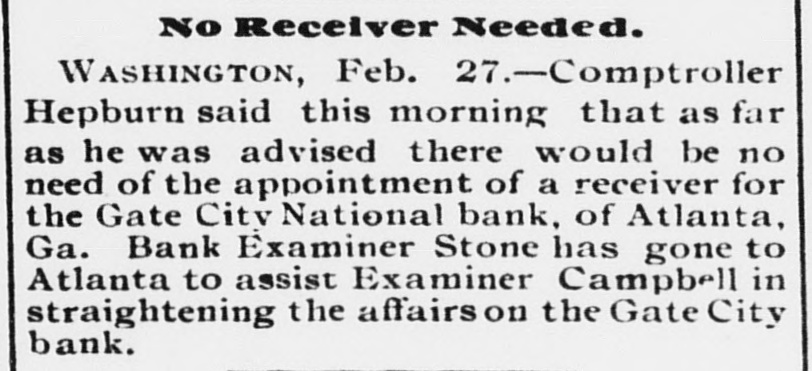
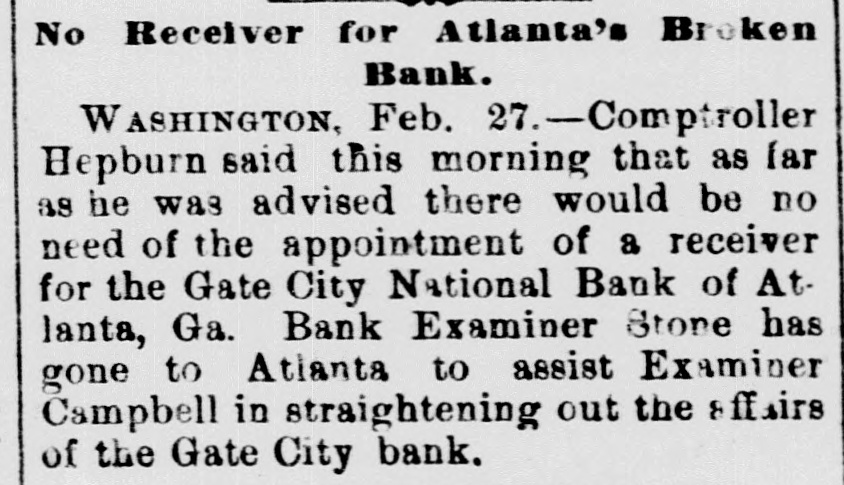
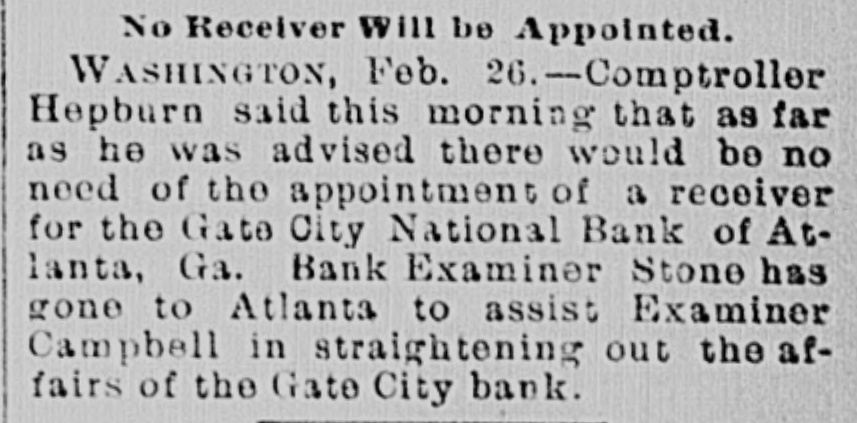
NO NEED OF RECEIVERS FOR THE BANKS. Washington, Feb. 27.-Controller Hepburn said this morning that as far as he was advised. there would be no need of the appointment of receivers for the Gate City National Bank, of Atlanta, Ga., or for the First National Bank, of Wilmington. Del., both of which recently suffered losses through employes. Bank Examiner Stone has gone to Atlanta to assist Examiner Campbell In straightening the affairs of the Gate City Bank.


Article from The Times, March 2, 1893

Click image to open full size in new tab

Article Text

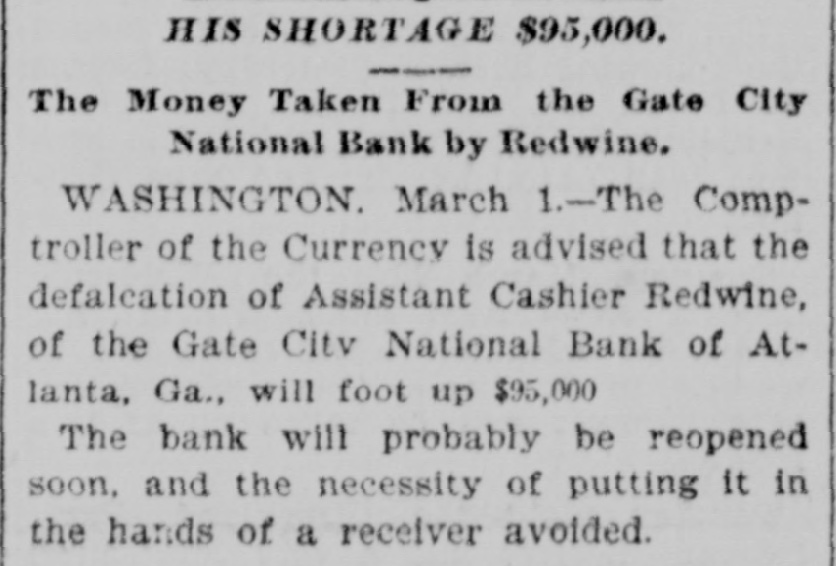
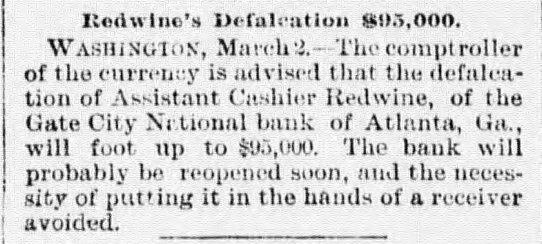
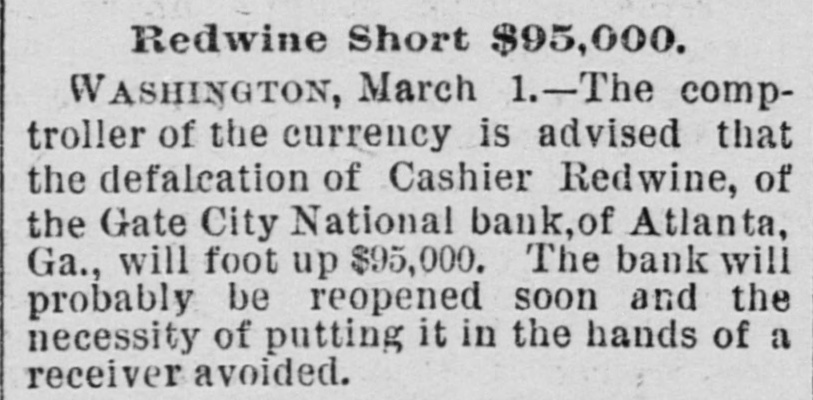
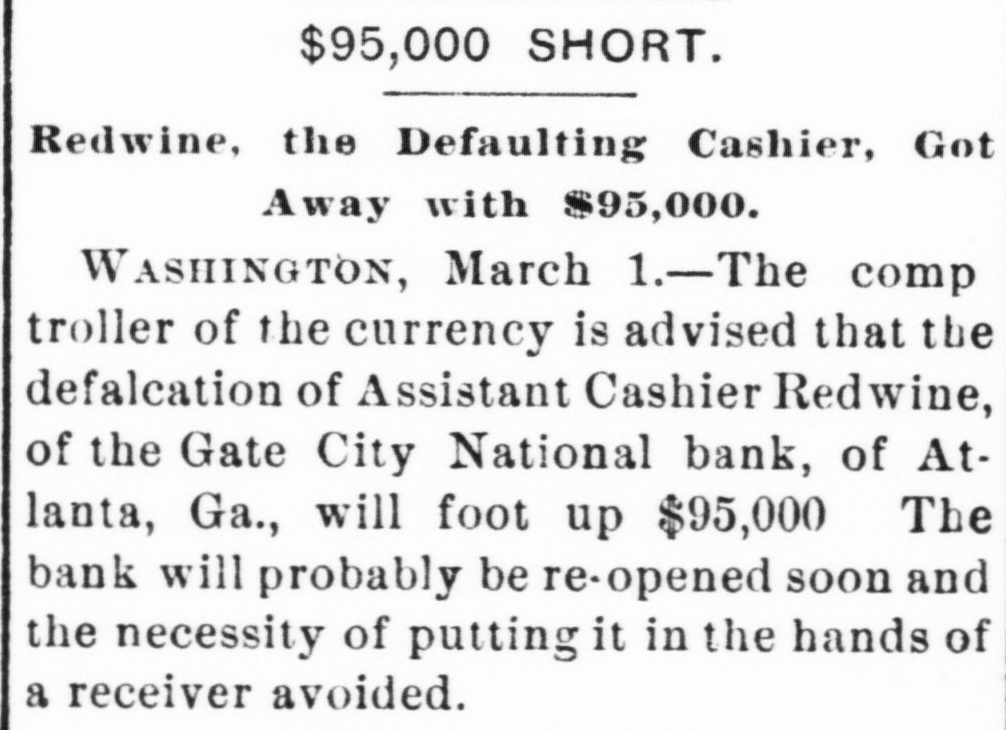
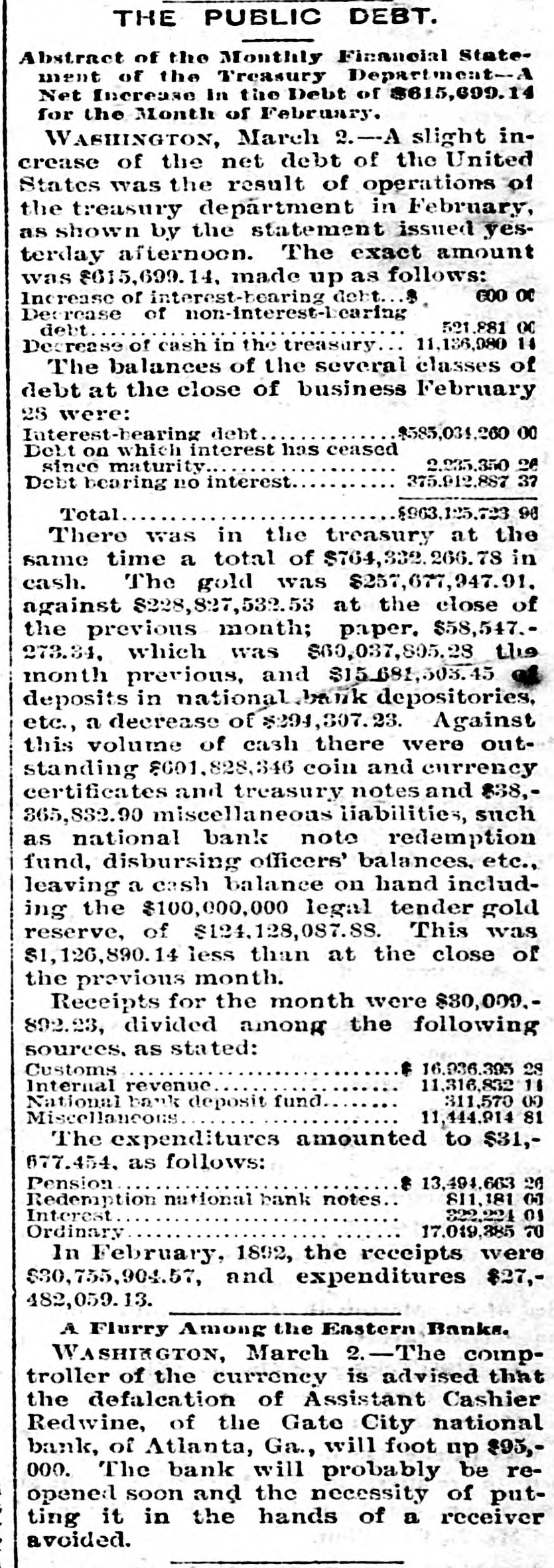
HIS SHORTAGE $93,000. The Money Taken From the Gate City National Bank by Redwine. WASHINGTON March 1.-The Comptroller of the Currency is advised that the defalcation of Assistant Cashier Redwine, of the Gate City National Bank of Atlanta, Ga., will foot up $95,000 The bank will probably be reopened soon. and the necessity of putting it in the hands of a receiver avoided.

Article from The Roanoke Times, March 2, 1893

Click image to open full size in new tab

Article Text

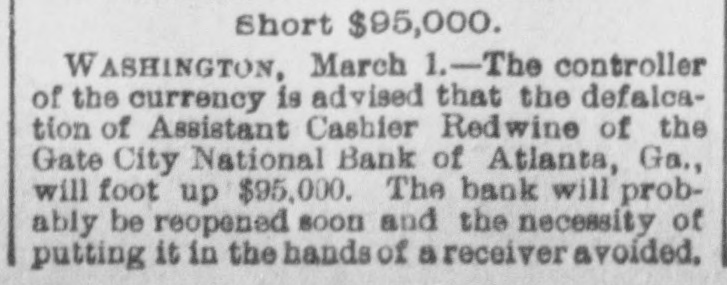
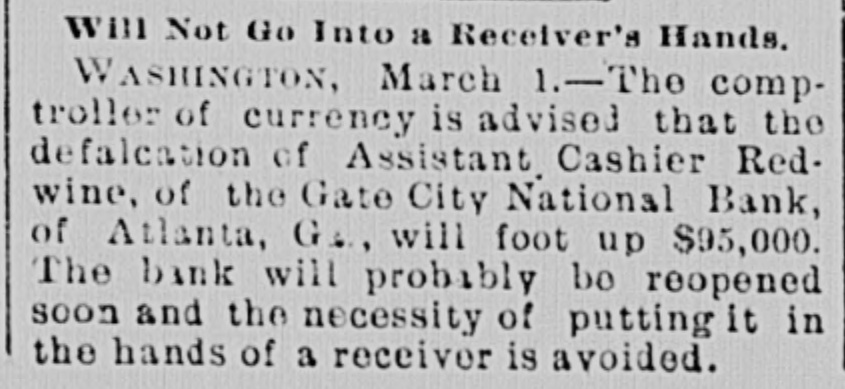
will Not Go Into a Receiver's Hands. WASHINGTON, March 1.-The - comptroller of currency is advised that the defalcation of Assistant Cashier Redwine, of the Gate City National Bank, of Atlanta, Gt, will foot up $95,000. The bank will probably be reopened soon and the necessity of putting it in the hands of a receiver is avoided.


Article from New-York Tribune, March 2, 1893

Click image to open full size in new tab

Article Text

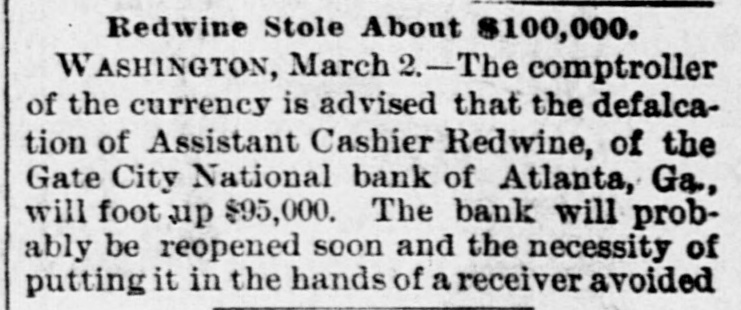
THE GATE CITY BANK DEFALCATION $93,000. Washington, March 1. - The Controller of the Currency is advised that the defalcation of Assistant Cashier Redwine, of the Gate City National Bank, of Atlanta, Ga., will foot up $95,000. The bank will probably be reopened soon. and the necessity of putting It in the hands of a receiver avoided.

Article from Hot Springs Weekly Star, March 3, 1893

Click image to open full size in new tab

Article Text

hand of Columbus, Ind., is the only heir to this vast estate. three-cornered fight at West resulted in of Liberty, A Ky., all three the combatants being killed. The coal dealers of Boston and vicinity have reduced the price of anthracite coal fifty cents a ton. The Manhattan Athleticclub house has been closed by a receiver, the debts aggregating nearly $1,000,000. The supreme court of Kansas, it is declared by the populist senate, has no jurisdiction in the house muddle. Two Mormon proselyters, who have among Tennessee peowere assassinated been ple, working by masked men. Rev. David Keene, for nearly half a century, rector of St. John's Episcopal church, Milwaukee, is dead. The Kansas populist passed house of resolution the legislature a in favor of removing the state capital to Kanapolis. John Hughes, a theological student of Moberly, Mo.. insulted a white girl on the street and was shot full of holes by her brothers. Gen. Beauregard, the ex-confederate and one of the principal members of the Louisiana Lottery company, died at New Orleans. Governor McKinley has assigned all his property for the benefit of creditors of the Walker failure, and is thus rendered penniless. John G. Eno, the defaulting bank president, who has been missing for many years, has surrendered himself in the United States court, at New York. The wholesale grocery firm of Beaupre. Keogh & Davis of St. Paul has assigned. The liabilities will approximate $400,000: the assets $288,000. Mrs. Thos. Schlicher, wife of a motorman, of Allentown, Pa. was delivered of four children, one boy and three girls. All died shortly after birth. Charles M. Jackson. ex-treasurer of Crawford county, Mich. has been arrested on the complaint of the supervisors charged with the embezzlement of county funds during his term of office. It is said the shortage will amount to over $13,000. The jury in the murdercase against Hugh )'Donnell brought in a verdict of not guilty. He was accused of being an active participant in the Homestead riot. during which T. .1. Connors, a Pinkerton detective received the wound which cost him his life. A party of body-snatchers, among them Dr. J. W. Overton. dean of the Drake University medical department, and John W. Shaffer of the United States signal office were caught in the act of robbing a grave at Des Moines. The affair caused a great sensation. The Chicago Times is agitating the return to the United States government of the $2,500,000 advanced to the Columbian Exposition coilmission on condition of Sunday closing, and thereby release the commission from the pledges given on accepting gift. Winona has a ghost. A week ago the watchman in the railway tower became insane and was killed by an engine. Since then three different watchman have been employod and each has quit on account, as they allege, of an unearthly figure that visits the tower each night. Allan Manvel. pres dent of the Sante Fe railroad, died last week at San Diego, Cal., where accompanied by his wife, he arrived three weeks ago from St. Paul for the benefit of his failing health. It is believed the cause of his death was Bright's disease. The disappearance and defalcation of Assistant Cashier Redwine, of the Gate City National bank. of Atlanta, is the biggest financial sensation Atlanta has known for years. This morning a thorough examination of the bank's affairs wasmade by officers of the clearing house association, and they reported the defalcation was about $65,000.


Article from Wheeling Register, March 31, 1893

Click image to open full size in new tab

Article Text

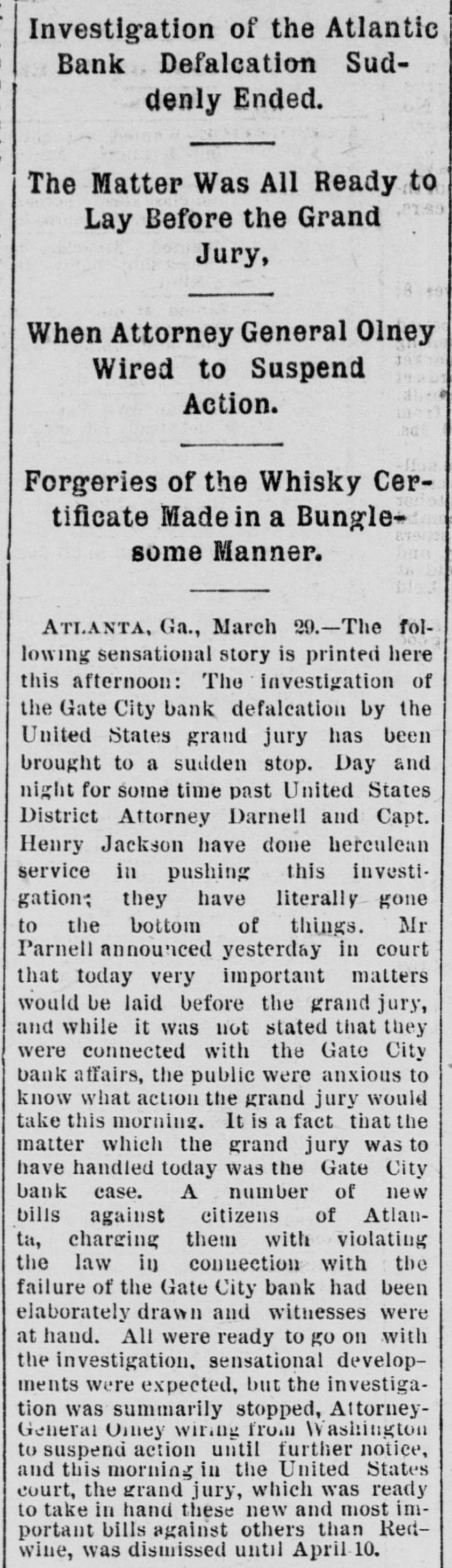
Attorney Jackson Not Removed. WASHINGTON, D. C., March 30.-It is authoritatively learned at the Department of Justice that Special Counsel Henry W. Jackson, employed in the Gate City Bank case, Atlanta, Ga., has not been releived, but any further action on his part in the case has been suspended until Attorney General Olney and Secretary Carlisle of the Treasury department agree upon a course to be pursued. The Gate City Bank, as far as information reaches here, has assumed a peculiar phase. The bank today, in the opinion of Treasury officials, is in a position to open its doors and pay off every dollar of its indebtedness caused by the defalcation of Redwine the cashier but there is said to be some disagreement as td who shall constitute the board of directors and for that reason principally the bank has not be reopened. On the other hand it is intimated that several of the old directors are open to the charge of having wrongfully taken money from the bank. This view is said to be held by special counsel Jackson who was formerly attorney for the bank. Gen. Jackson's son it will be recalled, committed suicide shortly after Redwine's defalcation and in some way not clearly indicated the suicide of young Jackson was connected with Redwine's defalcation. Gen. Jackson, the special counsel in this case, was naturally very much grieved at the suicide of his son, and intimation officially thrown out here is that Gen. Jackson has become overwhelmed with grief and has made very wild statements and insinuations against some of the old Board of Directors so grave in character that the government has felt called upon to stop further action on his part in the case until a most thorough and searching investigation of the bank's condition can be made. Attorney General Olney has no further information on the subject of Gen. Jackson's contemplated visit to Washington than that contained in the newspapers.


Article from The Morning News, April 2, 1893

Click image to open full size in new tab

Article Text

MACON MENTION. Receiver Comer in Town-Rosenfeld Defends Himself. MACON, GA., April 1.-Receiver Comer was here to-day and spent an hour and & half in consultation with Judge Speer. What the purport of it was could not be ascertained. Mr. Comer, however, declared that his visit was not connected with the controversy with the engineers. "This," said he, "is already In the hands of the court and beyond my jurisdiction." Mr. Rosenseld, the reporter denounced by McCandless, cashier of the defunct Gate City Bank of Atlanta, makes a reply, in which he states that he, in the pursuit of his duty, secured the information published from the United States officials and wired it to his paper as a matter of news. Sentiment here is with Rosenfeld.


Article from Evening Star, April 7, 1893

Click image to open full size in new tab

Article Text

UNLOCKING THE FUNDS. Money in the Gate City Bank to Be Train ferred. ATLANTA. GA., April - The money locked up in the vaults of the Gate City Bank will be returned back into circulation today. Mr. Stone. examiner in charge, was directed by the controller of currency yesterday to transfer the funds in the bank to Atlanta National Bank. The work of counting the funds and removing the funds will begin this morning. This is not a usual proceeding. but to meet general desire to have the money unlocked the controller took this step. Depositors do not get their money yet, but the $200,000 or more in actual cash now in the Gate City Bank will be in another national bank. which can loan it out and relieve financial stringency. It has been decided also to liquidate. The bank will not go into the hands of a receiver if present plans can be carried out, and there is every rea-on to believe that they can be. Bank Examiner Stone thinks the bank will soon have enough money in hand to open its doors and pay all depositors as fast as they come up. He will not open the doors until there is a dollar on hand for every dollar that is owed. The bank has now on band about $320.000 in cash and cash assets. When the bank closed on the night of February 22 it had in the vaults about e38,000 in cash and $4,000 in checks. Mr. Stone says he thinks the inconvenience caused by. locking up the bank's money has been over estimated. but he deemed it the wise thing to have a transfer made of the money to another bank where it will be available for regular banking purposes, and so recommend it to the controller. Since the bank closed maturing paper has been collected very promptly considering that it is a suspended bank. Some debtors have not been prompt, but they are good and money will be obtained. Mr. Stone states that paper which the Gate City Bank was carrying was of high class as a rule and there will be very little of it that cannot be collected. Every depositor will get dollar for dollar and stockholders will get par or very near for their stock. Reorganization in the sense of reopening the bank has been given up.


Article from The Weekly Union Times, April 7, 1893

Click image to open full size in new tab

Article Text

THE ATLANTA SENSATION. -Some Gate City Bank Directors in Very Ugly Position. WASHINGTON, D. C.-It is authorita tive'y larned at the department of justic that special counsel Henry W Jackson, employed in the Gate City Na tional Bank case of Atlanta, Ga., has not been r moved, but any further action on his I art in the case has been suspended store! almon and Sec The Gate City National Bank case, far as information reaches here goes, has assumed if very peculiar phase. The bank Thursday, in the opinion of th. treasury officials, is in a position to open its doors and pay off every dollar of its indebtedness caused by the defalcation of Redwine. its cashier, but there is said to Fome d'sagreemen+ as to who shall constitu'e the board of directors, and for that raaon principally the bank has not b en reopened. On the other hand, it intimated that everal of the old directors are open to the charge of having wrongfully taken money from the bank. This view is s.id to be held by Special Counsel Jack son, who was formerly attorney for the bank. Gon. Jackson's son, it will be recalled, committed suicide shortly after Redwine's defalcation, and in some way not clearly indicated the suicide of young Jacks n was connected with Redwine's defalcation. Gen. Jackson, special counsel in this case, was naturally very much grieved at the suicide of his son, and tl.e intimation unofficially thrown out here is that Gen. Jackson has become overwhelmed with grief and has made very wild statements and insinuations against some of the old board of directors, so gave in character that the Government has been called upon to stop further ac tion on his part in the case, until a most thorough and searching investigation of the bank's condition can be made.


Article from The Roanoke Times, April 8, 1893

Click image to open full size in new tab

Article Text

THE GATE CITY BANK. The Money of This Institution Put Into Circulation Yesterday. ATLANTA, Ga., April 7.-The meney locked up in the vaults of the Gata City Bank will be turned back into circulalion today. Mr. Stone, the examiner in charge, was directed by the comptroller of the currency yesterday to transfer the funds in the bank to the Atlanta National Bank. The work of counting and removing the funds began this morning. This is not the usual proceeding, but to meet a general desire to have the money unlocked the comptroller took this step. Depositors do not get their money as yet, but $300,000 or more in actual cash now in the Gate City Bank will be in another national bank which can loan it out and relieve the financial stringency. It has been decided also to liquidate the bank It will not go into the hands of a receiver if the present plans can be carried out, and there is every reason to believe that they e10 be. Bank Examiner Stone thinks the bank will soon have enough money in hand to open its doors and pay all depositors, as he will not open doors until there is a dollar on hand for every dollar that is owed. The bank has now on hand about $320,000 in cash and cash assets


Article from The Morning News, April 8, 1893

Click image to open full size in new tab

Article Text

GATE CITY BANK FUNDS. The Money Deposited in Another Bank to Get It Into Circulation. ATLANTA, GA., April 7.-The money locked up in the vaults of the Gate City Bank was turned back into circulation today. Mr. Stone, the examiner in charge, was directed by the controller of currency yesterday to transfer the funds in the bank to the Atlanta National Bank. The work of counting the funds and removing the funds began: this morning. This is not & usual proceeding, but to meet the general desire to have the money unlocked the controller took this step. Depositors do not get their money yet, but the $200,000 or more in actual cash in the Gate City Bank will be in another National bank, which can loan it out and relieve the financial stringency. It has been decided also to liquidate. The bank will not go into the hands of a receiver if the present plans can be carried out, and there is every reason to believe they can be. WILL SOON BE READY TO PAY. Bank Examiner Stone thinks the bank will soon have enough money in hand to open its doors and pay all depositors as fast as they come up. He will not open the doors until there is 8 dollar on hand for every dollar that is owed. The bank has now on hand about $320,000 in cash and cash assets. When the bank closed on the night of Feb. 22 it had in its vaults about $38,000 in cash and $4,000 in checks. Mr. Stone says he thinks the inconvenience caused by locking up the bank's money has been overestimated, but he deemed it a wise thing to have a transfer made of the money to another bank, where it will be available for regular bankIng purposes, and 60 recommended to the controller. COLLECTING THE DEBTS. Since the bank closed maturing paper has been collected very promptly. considering that it is B suspended bank. Some debtors have not been prompt. but they are good and the money will be obtained. Mr. Stone stated that the paper which the Gate City Bank was carrying was of & high class as a rule and there will be very little of it that cannot be collected. Every depositor will get dollar for dollar and the stockholders will get par, or very near for their stock. Reorganization in the sense of reopening the bank has been given up.


Article from The Times, April 8, 1893

Click image to open full size in new tab

Article Text

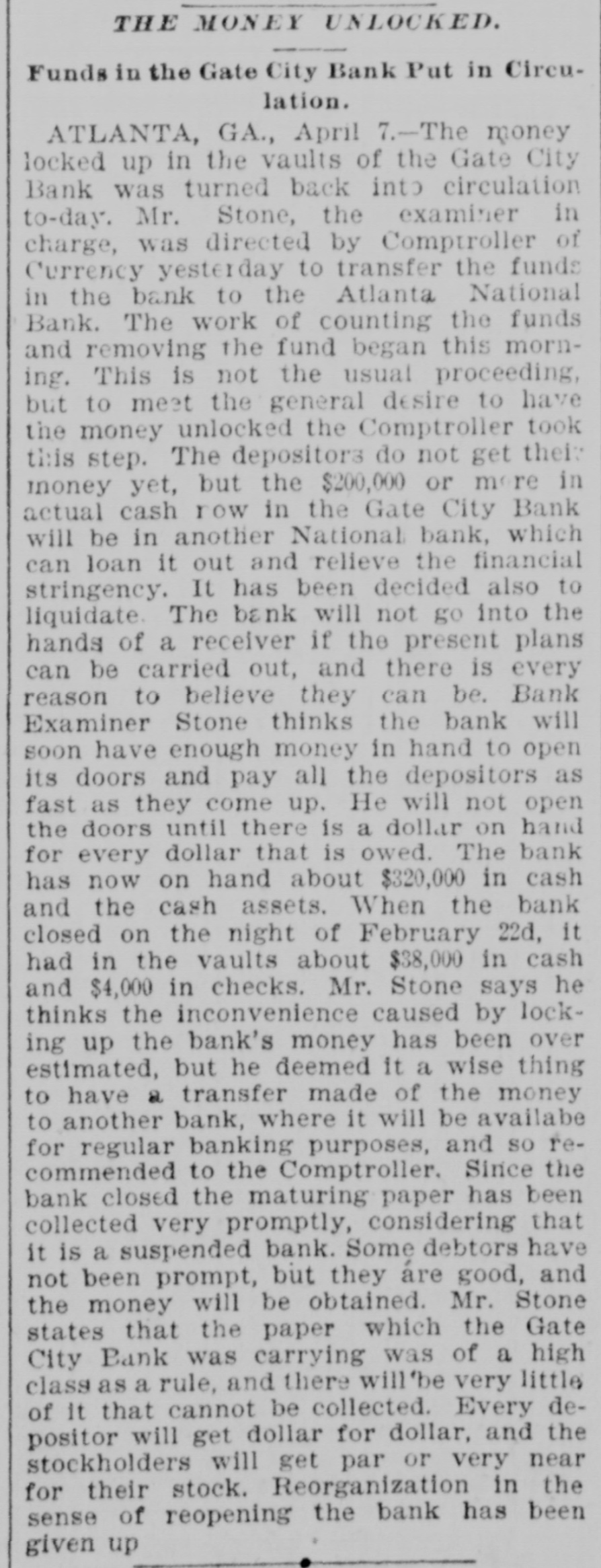
THE MONEY UNLOCKED. Funds in the Gate City Bank Put in Circulation. ATLANTA, GA., April 7.-The money locked up in the vaults of the Gate City Bank was turned back into circulation to-day. Mr. Stone, the examiner in charge, was directed by Comptroller of Currency yesterday to transfer the funds in the bank to the Atlanta National Bank. The work of counting the funds and removing the fund began this morning. This is not the usual proceeding, but to meet the general desire to have the money unlocked the Comptroller took this step. The depositors do not get their money yet, but the $200,000 or more in actual cash row in the Gate City Bank will be in another National bank, which can loan it out and relieve the financial stringency. It has been decided also to liquidate. The bank will not go into the hands of a receiver if the present plans can be carried out, and there is every reason to believe they can be. Bank Examiner Stone thinks the bank will soon have enough money in hand to open its doors and pay all the depositors as fast as they come up. He will not open the doors until there is a dollar on hand for every dollar that is owed. The bank has now on hand about $320,000 in cash and the cash assets, When the bank closed on the night of February 22d, it had in the vaults about $38,000 in cash and $4,000 in checks. Mr. Stone says he thinks the inconvenience caused by locking up the bank's money has been over estimated, but he deemed it a wise thing to have a transfer made of the money to another bank, where it will be availabe for regular banking purposes, and so recommended to the Comptroller. Since the bank closed the maturing paper has been collected very promptly, considering that it is a suspended bank. Some debtors have not been prompt, but they are good, and the money will be obtained. Mr. Stone states that the paper which the Gate City Bank was carrying was of a high class as a rule, and there will 'be very little of it that cannot be collected. Every depositor will get dollar for dollar, and the stockholders will get par or very near for their stock. Reorganization in the sense of reopening the bank has been given up


Article from Richmond Dispatch, June 30, 1893

Click image to open full size in new tab

Article Text

Depositors Being Paid. (By telegraph to the Dispatch. ATLANTA. GA., June 29.-At 9 o'clock this morning the Gate City National Bank began paying off its depositors. There was a stoady stream of depositors all day. and about $160,000 was paid out. The deposits withdrawn were all small ones. the larger depositors holding off until after the rush. The payment of this money IS having au excellent effect on business.


Article from The Morning News, June 30, 1893

Click image to open full size in new tab

Article Text

Paying Gate City Bank Depositors. Atlanta, Ga., June 29.-At 9 o'clock this morning the Gate City natioal bank began paying off its depositors. There was a steady stream of depositors all day and about $160,000 paid out. The deposits withdrawn were all small ones, the larger depositors holding off until after the rush. The payment of this money is having an excellent effect on business.


Article from The Times, June 30, 1893

Click image to open full size in new tab

Article Text

Paying Off Depositors. ATLANTA, GA., June 29.-At 9 o'clock this morning the Gate City National Bank began paying off its depositors. Ther was a steady stream of depositors all day, and about one hundred and sixty thousand dollars was paid out. The deposits withdrawn were all small ones, larger dpositors holding off until after the rush. The payment of this money is having an excellent effect on business.


Article from The Gold Leaf, July 13, 1893

Click image to open full size in new tab

Article Text

THE SILVER QUESTION AND THE SOUTH. The Baltimore Manufacturer's Record, of June 30th, speaking of the stringency in the money market and its effect upon the South financially, says this: The siver question has increased the feeling of financial distrust throughout the country. Every section reports greater stringency in money matters. The action of India in declaring against silver as a monetary standard has had an unfavorable effect, but this may be only temporary. The South is passing through the time of trial with credit, which will prove a great benefit to it when the feeling of confidence in investments is fully restored. According to Bradstreet's, fifty-four concerns suspended in the South during the week ending June 22, against 369 in the United States, of which 142 were in the West and Northwest and fifty-three on the Pacific coast. Of the Southern failures but nine were over $5,000. Dividends are being declared by banks and corporations from Maryland to Texas. The State of Tennessee will meet its July interest promptly. Many dividends have been paid in advance to relieve any pressing demands of investors. Thus far no banks have applied for clearing-house certificates in Baltimore or New Orleans, though nearly $6,000,000 in certificates have been drawn from the New York clearing-house. The inability to realize on paper good at any other period is the reason given for most of the Sohthern failures of the week. The local trouble at Wilmington, N. C., and Brunswick, Ga., seems to be over. The Bank of the Carolinas has resumed business and is paying dollar for dollar. The Gate City Bank creditors have been paid in full, which relieves the situation at Atlanta considerably. The Georgia Central decision will settle the uncertainty about that system. Chicago passenger business is increasing Southern railway earnings, and their stocks have not been affected beyond the general range of the market, except in the case of the Chesapeake & Ohio. The suspension of iron works in Pennsylvania and the West may counterbalance the effect on Southern furnaces made by the recent advance in Northern freights. The dividend declared by the Tennessee Coal, Iron & Railroad Co. was a feature of the situation during the week.


Article from The Herald, July 23, 1893

Click image to open full size in new tab

Article Text

NATIONAL BANK FAILURES, Two Hundred Since the First of January. Five of Them Were United States Depositories. The National Bank of Kentucky Closes Its Doors. Several More Collapses in Mllwaukee. Business Failures Throughont the Country-Financlal Gossip. By the Associated Press. WASHINGTON, July 22.-Since the 1st of January 200 national banks have closed their doors, against less than 50 for the same period last year. Of the failures this year, five have been United States depositories, as follows: First National bank of Little Rock, Ark. ; Gate City National bank of Atlanta, Ga. ; People'a National bank of Denver, Colo. German National bank of Denver, Colo. Kentucky National bank of Louieville, Ky. This latter bank, which closed its doors today, had by the last report received $330,000 of United States funds. The government, however, will not lose anything by these failures, as each national bank that is a government depository has to deposit United States bonds to the amount of the government money it is allowed to carry. In addition to the heavy failure of the government depository at Louisville, three other failures of national banks were reported to Comptroller Eckels this morning-the State and First National banks of Kernon, Texas, capital $100,000 and $80,000 respectively, and the State National bank of Knoxville, Tenn., capital $100,000, all email institutions. The deposits in each are in the neighborhood of $100,000. The comptroller has appointed William A. Rice receiver of the Puget Sound National bank of Everett, Wash., and George Hoffman receiver of the Bozeman National bank of Bozeman, Mont.


Article from The Morning Call, July 23, 1893

Click image to open full size in new tab

Article Text

LONDON FIGURES. Carlisle Says They Must Rule. HE SUSTAINS MR. PRESTON. Over Two Hundred National Banks Have Failed Since the Beginning of the Year. Special to THE MORNING CALL. WASHINGTON, July 22.-Secretary Carlisle this morning authorized the Associated Press to state that he fully approves of the policy pursued in his absence by acting Mint Director Preston in purchasing silver, and that the same poitey will govern silver purchases in the immediate future. This statement will set at rest rumors that the Secretary would on his return reverse the policy of the treasury in purchasing silver. Preston was intrusted by Secretary Carlisle with rentirediscretion in purchasing silver when he left on his vacation. This morning with the approval of Secretary Carlisle he refused to purchase 100,000 ounces of silver at 70 cents, the London price being about 691/2 cents. This lot was part of a lot offered yesterday at 73 cents and was declined and counter offer made of 71 1/2 cents, which the holder refused to accept. This morning he offered as stated 100.000 ounces at 70 cents, but Preston informed the offerer that he only purchased silver on silver days-Mondays, Wednesdays and Fridays. The total silver purchased 80 far this month is about 1,800,000 ounces, besides some local purchases which may bring the total up to 2,000,000 ounces. It is not expected the total of 4,500,000 ounces will be purchased this month, but this does not worry the treasury officials, as Secretary Carlisle holds with Preston that the law does not require the treasury to purchase that amount in case it is not offered within the market price. Since the 1st of January nearly 200 national banks have closed their doors against less than 50 during the same period last year: five have been United States depositories, as follows: First National Bank of Little Rock, Ark.: Gate City National Bank of Atlanta, Ga.; People's National bank of Denver, Colo.: German National Bank of Denver, Colo.; Kentucky National Bank of Louisville, Ky. This latter bank, which closed its doors to-day, had, by the last report, received $320,000 of United States funds. The Government, however, will not lose anything by these failures, as each national bank that Is a Government depository has to deposit United States bonds to the amount of Government money it is allowed to carry. In addition to the heavy failure of the Government Depositors' Bank at Louisville, three other failures of national banks were reported to Comptroller Eckels this morning. The failed banks are: The State and First National banks of Vernon, Tex., capital.$100,000 and $80,000. respectively. and the State National Bank of Knoxville, Tenn.. capital $100,000. All are small institutions, the deposits in each being in the neighborhood of $100,000. The Comptroller appointed William A. Rice receiver of the Puget Sound National Bank at Everett, Wash., and George Hoffman receiver of the Bozeman National Bank at Bozeman, Mont.


Article from The Portland Daily Press, July 24, 1893

Click image to open full size in new tab

Article Text

Bank Troubles Since January 1. 1 WASHINGTON, July 22.-Since Jan. nearly 200 national banks have closed their doors, against less than 50 during the same period last year. Of the failures this year five have been United States depositories, as follows: The First national bank of Little Rock, the Gate City national 1 ank of Atlanta, the People's national bank of Denver, the German national bank of Denver, the Kentucky national bank of Louisville. The latter bank which closed its doors today had by the last report received $330,000 of United States funds. The government, however, will not lose anything by these failures, as each national bank that is a government depository has to deposit United States bonds to the amount of government money it is allowed to carry. These bonds, in case of failure, are sold for the account the government and as United States bonds are at a premium in the financial market there is never any difficulty in realizing. Saturday's Bank Failures. LOUISVILLE, July 22. - -The Kentucky National Bank of this city closed its doors this morning. The capital stock is $1,000,000 paid up. This bank is a government depository, and its last statement showed $190,000 to the credit of the government. The loans and discounts outstanding amounted to $1,719,966 and the surplus was $108,500. KNOXVILLE, July 22.-The - State National bank closed this morning. The notice posted on the door says: "This bank has closed for liquidation. Depositors will be paid in full." Liabilities and assets are not known. MILWAUKEE, July 22.-The Milwaukee National bank and South Side Savings bank failed to open their doors this morning. Runs were made on all the leading banks in the city. Cleveland Counts Up. NEW YORK, July 25.-The - Bond Buyer today prints the following: "Just as we go to press we learn that President Cleveland has had made by one of the most


Article from New-York Tribune, July 29, 1893

Click image to open full size in new tab

Article Text

It is to be observed that in twenty-one States and Territories there have been no !ailures of National banks, viz: In Alaska, Arizona. Arkansas, Connecticut. Delaware, District of Columbia, Idabo, Indian Territory, Louisiana, Maine, Maryland, Massachusetts, Minnesota, Nevada, New-Jersey, Pennsylvania. Rhode Island, South Carolina, Vermont, Virginia and West Virginia. It is further worthy of note that no National banks have failed in Boston, Brooklyn, Philadelphia, Pittsburg, Baltimore, Washington, Buffalo, Cincinnati. St. Louis, New-Orleans, San Francisco, Minneapolis, St. Pan! and numbers of other great commercial centres: and that but one has closed in New-York, two in Chicago. and one In Milwankee. The cause of the failures in NewYork and Chicago was due largely to mismanagement, as were numbers of others. Local scares have caused many of late to suspend. Nine of the banks failed were robbed by officials who are now under arrest. The following National banks have been authorIzed by the Controller of the Currency to resume business: Gate City National Bank, Atlanta, Ga.: First National Bank. Los Angeles, Cal.: First National Bank, San Diego, Cal.: First National Bank, Santa Ana, Cal.: First National Bank, San Bernardino, Cal.: Southern California National Bank, Los Angeles, Cal.: Merchants' National Bank. Fort Worth, Tex.: Second National Bank, Ashland, Ky.: Capital National Bank, Indianapolis.: First National Bank, Palouse City, Wash.: Washington National Bank, Spokane Falls, Wash.: National Bank of Commerce. Provo City, Utab: First National Bank. Cisco, Texas: Missouri National Bank, Kansas City, Mo. Many more will reopen, as the majority of those recently failed are absolutely solvent, and only closed through an unwarranted lack of confidence in them, causing disastrous runs. Resume: Number now in operation, 3,785: number failed since January 1, 1893. 105; number reopened, 14: number In hands of receivers, 33: number In hands of Bank Examiners, with application to Controller for resumption, 58.


Article from The Evening World, November 2, 1893

Click image to open full size in new tab

Article Text

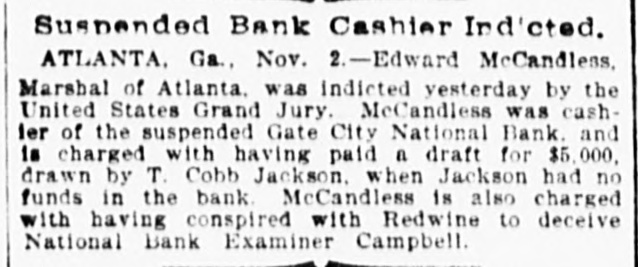
# Suspended Bank Cashier Indicted. ATLANTA, Ga., Nov. 2.-Edward McCandless, Marshal of Atlanta, was indicted yesterday by the United States Grand Jury. McCandless was cashier of the suspended Gate City National Bank, and is charged with having paid a draft for $5,000, drawn by T. Cobb Jackson, when Jackson had no funds in the bank. McCandless is also charged with having conspired with Redwine to deceive National Bank Examiner Campbell.