2391. First National Bank (Cordele, GA)

Bank Information

Episode Type
Suspension โ†’ Closure
Bank Type
national
Bank ID
4554
Charter Number
4554
Start Date
March 4, 1899
Location
Cordele, Georgia (31.964, -83.782)

Metadata

Model
gpt-5-mini
Short Digest
a3979059b38499b8

Response Measures

None

Receivership Details

Depositor recovery rate
70.0%
Date receivership started
1899-03-04
Date receivership terminated
1909-11-30
OCC cause of failure
Excessive lending
Share of assets assessed as good
34.9%
Share of assets assessed as doubtful
32.7%
Share of assets assessed as worthless
32.3%

Description

The First National Bank of Cordele had been in voluntary liquidation by management for months; the Comptroller (controller) appointed a receiver in early March 1899 and the court's receiver was discharged in favor of the controller's appointee. No newspaper account describes a depositor run before suspension โ€” this is a suspension leading to receivership (closure).

Events (4)

1. April 16, 1891 Chartered
Source
historical_nic
2. March 4, 1899 Receivership
Source
historical_nic
3. March 4, 1899 Suspension
Cause
Voluntary Liquidation
Cause Details
Bank had been in liquidation by its management for months; directors requested appointment of a receiver following death of president and desire to liquidate affairs.
Newspaper Excerpt
The First National Bank of Cordele, having been in liquidation by its management for some months, the controller of the currency appointed a receiver upon the request of the directors.
Source
newspapers
4. March 21, 1899 Receivership
Newspaper Excerpt
Judge Speer ... discharged the receiver he appointed for the First National Bank of Cordele, Ga., and appointed the receiver named by Mr. Dawes. ... the effects of the bank have been turned over to the receiver appointed by Mr. Dawes ('Mr. Burgwin, national bank examiner, was appointed temporary receiver'). (Mar 21, 1899 articles.)
Source
newspapers

Newspaper Articles (10)

Article from The Morning News, March 5, 1899

Click image to open full size in new tab

Article Text

FIRST NATIONAL OF CORDELE. Receiver Appointed for Proceedings in Liquidation. Cordele, Ga., March 4.-The First National Bank of Cordele, having been in liquidation by its management for some months, the controller of the currency appointed a receiver upon the request of the directors. Mr. Burgwin, national bank examiner, was appointed temporary receiver. The receiver is expected soon next week. The bank has done a large business in Cordele, and on account of the death of its late president, Mr. Joseph E. Bivins, the present management desires to liquidate its affairs. The liabilities of the bank are about $10,000 on money borrowed. The deposits are about $3,000. The assets are about $70,000.


Article from The Topeka State Journal, March 15, 1899

Click image to open full size in new tab

Article Text

WIDOW'S STRANGE WHIM. Wife Had Husband's Body In Glass Case In Parlor. Cordelle, Ga., March 15.-A petition filed here yesterday for a receiver for the First National bank ends a peculiar story. The bank was established by Dr. George W. Marvin. A few months after organizing it he married a Mrs. Cunningham, a widow, who brought to him a large amount of property, which was added to the capital of the bank. A few months after the marriage Mrs. Marvin died and Dr. Marvin soon married Miss Trammell, a typewriter. They were married at midnight, and much mystery surrounded the affair. In 1892 Marvin died and Mrs. Marvin married Joseph E. Bivins, who succeeded to Marvin's fortune and became president of the bank. Mrs. Bivins died in 1896, leaving all of her property to Bivins. The most uncanny feature of the story was Mrs. Bivins' treatment of her first husband's (Marvin's) body. She had it perfectly embalmed by an expert and placed in a glass case in her parlor. The coffin was so arranged that whenever she entered the room an electric motor forced it up to an upright position. After her marriage to Bivins this ghastly spectacle was relegated to the graveyard.


Article from Evening Star, March 21, 1899

Click image to open full size in new tab

Article Text

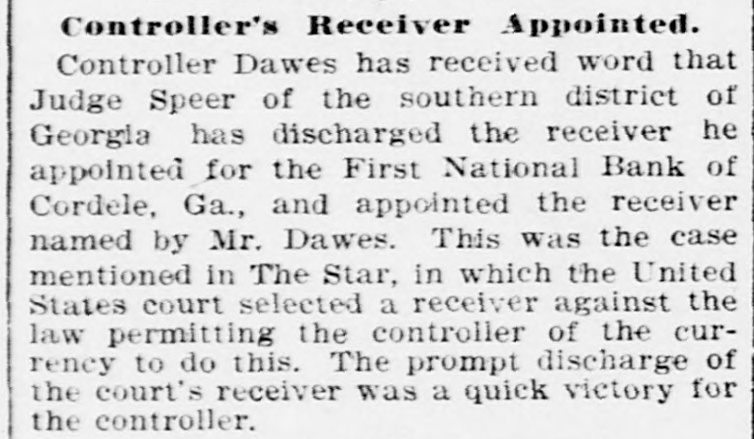
Controller's Receiver Appointed. Controller Dawes has received word that Judge Speer of the southern district of Georgia has discharged the receiver he appointed for the First National Bank of Cordele, Ga., and appointed the receiver named by Mr. Dawes. This was the case mentioned in The Star, in which the United States court selected a receiver against the law permitting the controller of the currency to do this. The prompt discharge of the court's receiver was a quick victory for the controller.


Article from The Morning News, March 22, 1899

Click image to open full size in new tab

Article Text

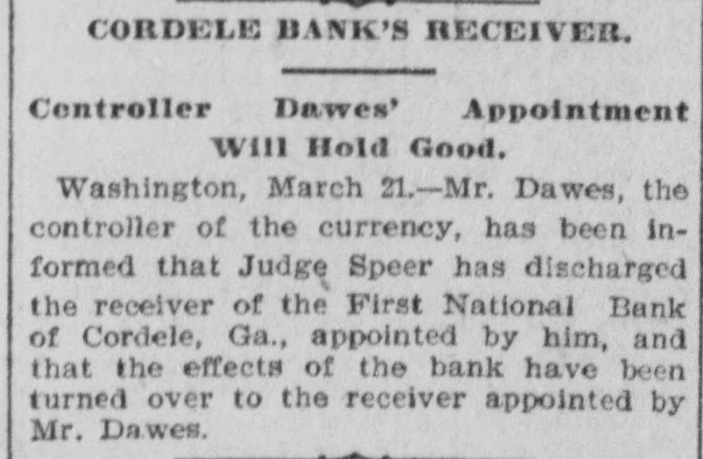
CORDELE BANK'S RECEIVER. Dawes' Centroller Appointment Will Hold Good. Washington, March 21.-Mr. Dawes, the controller of the currency, has been informed that Judge Speer has discharged the receiver of the First National Bank of Cordele, Ga., appointed by him, and that the effects of the bank have been turned over to the receiver appointed by Mr. Dawes.


Article from The Age-Herald, March 22, 1899

Click image to open full size in new tab

Article Text

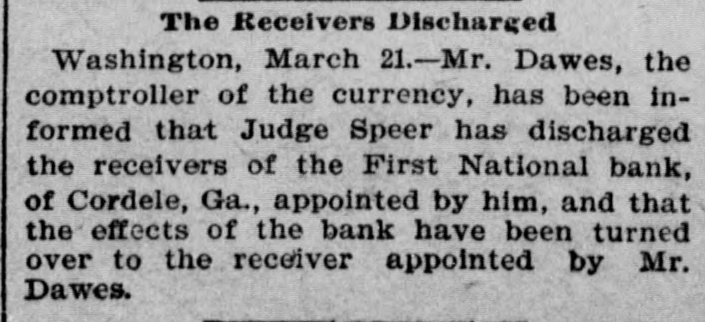
The Receivers Discharged Washington, March 21.-Mr. - Dawes, the comptroller of the currency, has been informed that Judge Speer has discharged the receivers of the First National bank, of Cordele, Ga., appointed by him, and that the effects of the bank have been turned over to the receiver appointed by Mr. Dawes.


Article from Virginian-Pilot, March 22, 1899

Click image to open full size in new tab

Article Text

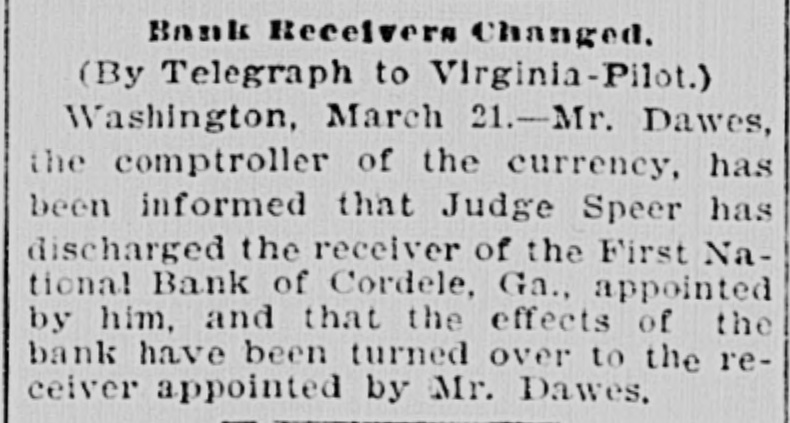
Bank Receivers Changed. (By Telegraph to Virginia-Pilot.) Washington, March 21.-Mr. Dawes, the comptroller of the currency, has been informed that Judge Speer has discharged the receiver of the First National Bank of Cordele, Ga., appointed by him, and that the effects of the bank have been turned over to the receiver appointed by Mr. Dawes.


Article from Arizona Republican, March 23, 1899

Click image to open full size in new tab

Article Text

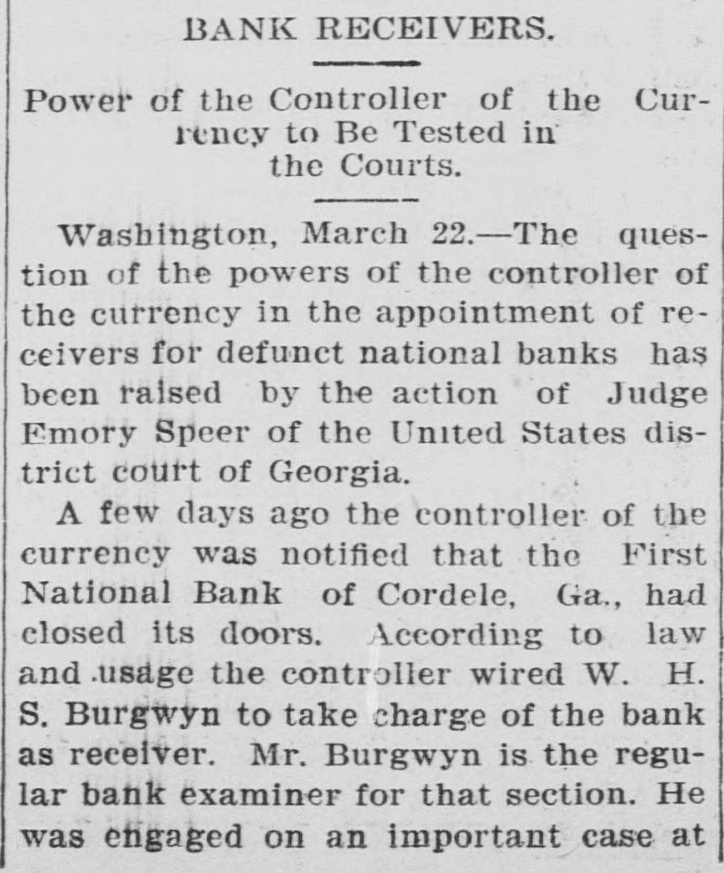
BANK RECEIVERS. Power of the Controller of the Currency to Be Tested in the Courts. Washington, March 22.-The question of the powers of the controller of the currency in the appointment of receivers for defunct national banks has been raised by the action of Judge Emory Speer of the United States district court of Georgia. A few days ago the controller of the currency was notified that the First National Bank of Cordele, Ga., had closed its doors. According to law and usage the controller wired W. H. S. Burgwyn to take charge of the bank as receiver. Mr. Burgwyn is the regular bank examiner for that section. He was engaged on an important case at


Article from Brookings Weekly Register, March 30, 1899

Click image to open full size in new tab

Article Text

General. A new mineral has been discovered at the University of Wisconsin. A crusade against fire-trap hotels is begun in New York. Porto Ricans are forming a Republican party. The members of the Porto Rican cabinet will visit Washington next month. The federal court in New Orleans decides against the interstate commerce commission. The lake carriers' association has decided to advance wages of boat crews $5 per month. Digby Bell, the actor, filed a petition in bankruptcy at Chicago, in which he asks to be relieved of liabilities aggregating $27,000. Henry A. Casperfield, who was formerly in the jewelry business at New York, has filed a petition in bankruptcy. Normal liabilities, $706,386. The remains of Lieut. George Elliott, U. S. A., whose death occurred Aug. 11 last at Santiago, were interred with military honors at Arlington. The old monitor Comanche, which has been bought from the government by an Oakland, Cal., firm, is to be converted into a freight ferry boat to run in San Francisco bay. The Illinois house passed the senate bill to prevent the introduction and spread in Illinois of the San Jose scale and other fruit-destroying insects. The Woodmen's circle at Memphis, Tenn., has formed the International Association of Deputy Organizers of the Woodmen of the World as an adjunct of the sovereign camp. The employes of the Belleaire (Ohio) Steel company's two blast furnaces were agreeably surprised when notified by the company of a 15 per cent increase in wages all around. An erecting gang, from the Pencoyd Iron works, will leave in a few days for Africa, for the purpose of building a bridge across the Atabara river, in the Soudan, near Khartoum. The battleship Iowa will at once be taken to the Union iron works, where she will remain about six weeks while being repaired. Her boilers will be retubed and her cylinders overhauled. The Pacific Express company has made arrangements for a through route to California and the points along the coast line and another through route to New York city and the whole Atlantic coast. Arrangements are being made for a reunion to be held at Guthrie, Okla., in June next for the rough riders who fought in the battles about Santiago. A letter has been received from Gov. Roosevelt of New York accepting an invitation to attend. President Simon Burns, of the Window Glass Workers' association at Pittsbarg. was informed that all the shove boys and lehr-tenders at the South Side factories have given notice that on Wednesday they will demand erage of $75 gold per ton. Mr. Dawes, the controller of the currency, has been informed that Judge Speer has discharged the receiver of the First National Bank of Cordele, Ga., appointed by him, and that the effects of the bank have been turned over to the receiver appointed by Mr. Dawes. Passengers who arrived at Seattle, Wash., from Copper River, Alaska, on the


Article from The Washburn Leader, April 1, 1899

Click image to open full size in new tab

Article Text

General. A new mineral has been discovered at the University of Wisconsin. A crusade against fire-trap hotels is begun'in New York. Porto Ricans are forming a Republican party. The members of the Porto Rican cabinet will visit Washington next month. 'The federal court in New Orleans decides against the interstate commerce commission. The lake carriers' association has decided to advance wages of boat crews $5 per month. Digby Bell, the actor, filed a petition in bankruptcy at Chicago, in which he asks to be relieved of liabilities aggregating $27,000. Henry A. Casperfield, who was formerly in the jewelry business at New York, has filed a petition in bankruptcy. Normal liabilities, $706,386. The remains of Lieut. George Elliott, U. S. A., whose death occurred Aug. 11 last at Santiago, were interred with military honors at Arlington. The old monitor Comanche, which has been bought from the government by an Oakland, Cal., firm, is to be converted into a freight ferry boat to run in San Francisco bay. The Illinois house passed the senate bill to prevent the introduction and spread in Illinois of the San Jose scale and other fruit-destroying insects. The Woodmen's circle at Memphis, Tenn., has formed the International Association of Deputy Organizers of the Woodmen of the World as an adjunct of the sovereign camp. The employes of the Belleaire (Ohio) Steel company's two blast furnaces were agreeably surprised when notified by the company of a 15 per cent increase in wages all around. An erecting gang, from the Pencoyd Iron works, will leave in a few days for Africa, for the purpose of building a bridge across the Atabara river, in the Soudan, near Khartoum. The battleship Iowa will at once be taken to the Union iron works, where she will remain about six weeks while being repaired. Her bollers will be retubed and her cylinders overhauled. The Pacific Express company has made arrangements for a through route to California and the points along the coast line and another through route to New York city and the whole Atlantic coast. Arrangements are being made for a reunion to be held at Guthrie, Okla., in June next for the rough riders who fought in the battles about Santiago. A letter has been received from Gov. Roosevelt of New York accepting an invitation to attend. President Simon Burns, of the Window Glass Workers' association at Pittsburg, was informed that all the shove boys and lehr-tenders at the South Side factories have given notice that on Wednesday they will demand erage of $75 gold per ton. Mr. 'Dawes, the controller of the currency, has been informed that Judge Speer has discharged the receiver of the First National Bank of Cordele, Ga., appointed by him, and that the effects of the bank have been turned over to the receiver appointed by Mr. Dawes. Passengers who arrived at Seattle, Wash., from Copper River, Alaska, on the steamer Excelsior, say that scurvy is reported in all the camps in the interior, and many miners are coming to the coast, either to escape it or to recover from its effects.
Article from The Morning News, April 13, 1899

Click image to open full size in new tab

Article Text

GEORGIA AND FLORIDA. IN ITEMS OF THE TWO STATES TOLD IN PARAGRAPHS. GEORGIA. Mr. Benjamin J. Conyers of Atlanta will deliver the literary address at the closing exercises of the Tallapoosa High School, May 19. Rev. C. H. Hyde of Cordele has accepted a call to the pastorate of the Presbyterian Church of Cuthbert and will be installed some time in May. The small-pox scare at Abbeville is getting better. The doctors report it chicken pox. No one has left the town on account of the report. All is quiet now. The school is progressing finely, with about 300 pupils. Thomasville Times-Enterprise: There was quite a heavy frost Monday morning and those who have vegetable gardens are a little apprehensive lest their truck was all killed. A frost this late in April is very unusual in these parts. Gen. John B. Gordon will be introduced upon the occasion of the delivery of his lecture in Atlanta next Thursday night, by Gov. Candler. An invitation to do this was extended the state's chief executive by Chairman Martin, and was cordially accepted. Judge Lumpkin, in a decision handed down Monday, sustained the charter incorporating the town of Edgewood, near Atlanta. which has been attacked by a number of citizens of that municipality, who claimed the town was illegally constituted. James McDowell of Washington, D. C., permanent receiver for the First National Bank, has arrived at Cordele and taken charge of affairs, George R. DeSausere, the temporary receiver appointed by the controller of the currency having returned to Atlanta. Cordele Hornet: The City Council of Lyons has placed a tax of $500 on champagne cider, which is nothing less than a cheap quality of beer. It is the same stuff that Cordele banished last year, and its sale was for quite a while the most flourishing industry here. The Sparta Ishmaelite announces that Andrew Carnegie has given $100 to the fund for a library for the schools of Hancock county. The same amount had been raised by the schools. Commissioner Duggan wrote the wealthy Scot of his plans and he forwarded his check for the above sum. Senoia has two enterprises that she can boast of, and that no other town in Georgia can boast of either kind. One is the Langrod collar manufactory, and the other is the Georgia Railroad and Telegraph School. These two institutions bring into the town over $20,000 from labor, tuition and board. Robert Gibbs Barnwell, at one time the famous pro-slavery advocate, editor and diplomat, died the other day at Tallulah Falls. Though Barnwell's name is but little known to the present generation, fifty-five years ago his writings on the slavery question and union or disunion of states are well known and his eloquence and ability became a recognized factor in the South. Barnwell was born at Beaufort, S. C., 81 years ago. Tuesday morning fire was discovered in an old barn In the rear of the carriage and wagon shop belonging to S. W. Thornton & Son, at Talbotton. In a short time the entire building and the shop of Thornton & Son was also destroyed by the flames. In addition to this, a large corn shed was destroyed and a large quantity of fodder and grain belonging to Thornton & Son; also the blacksmith shop belonging to E. H. Spivey. Only by the hardest work was the entire eastern side of the public square saved. The origin of the fire is as yet unknown. and the loss is estimated at about $3,000, with no insurance. Waycross Herald: W. E. Suggs, who shot the Dutchman at his still in Charlton county, was brought back to Waycross from Homerville this morning by Sheriff Mattox. He will remain here until Monday, when Judge Bennett will hear the evidence and decide the matter of bond. There seems to be little doubt that Mr. Suggs was compelled to shoot the man or get off of his own place. He had followed Mr. Suggs to his house with a pistol, abusing him in the foulest language and abusing Mrs. Suggs. From what can be learned of the man who was shot he was very quarelsome and had had difficulties all over the country. He had recently beaten hoy at point the Bruns-