Denver Savings Bank (Denver, CO)

Episode Information

Episode UID
2387798491268
Episode Type
Run β†’ Suspension β†’ Closure
Bank Type
savings
Bank ID
238779849 hash
Start Date
August 8, 1905
Location
Denver, Colorado (39.739, -104.985)

Metadata

Model
gpt-5-mini (chosen from majority vote of a three-model LLM ensemble)
Short Digest
aaa24e29c21d689f

Response Measures

None

Description

Receiver appointed Aug 21; subsequent indictments and prosecution of officers for embezzlement.

Events (3)

1. August 8, 1905 Run
Cause
Rumor Or Misinformation
Cause Details
Persistent rumors and dissensions among stockholders prompted depositors to withdraw funds.
Measures
Enforced 30 days' notice and paid only 10% of deposits immediately.
Newspaper Excerpt
The run followed persistent rumors regarding the bank's stability.
Source
newspapers
2. August 8, 1905 Suspension
Cause
Rumor Or Misinformation
Cause Details
Bank closed doors midday during the run triggered by rumors and stockholder dissensions.
Newspaper Excerpt
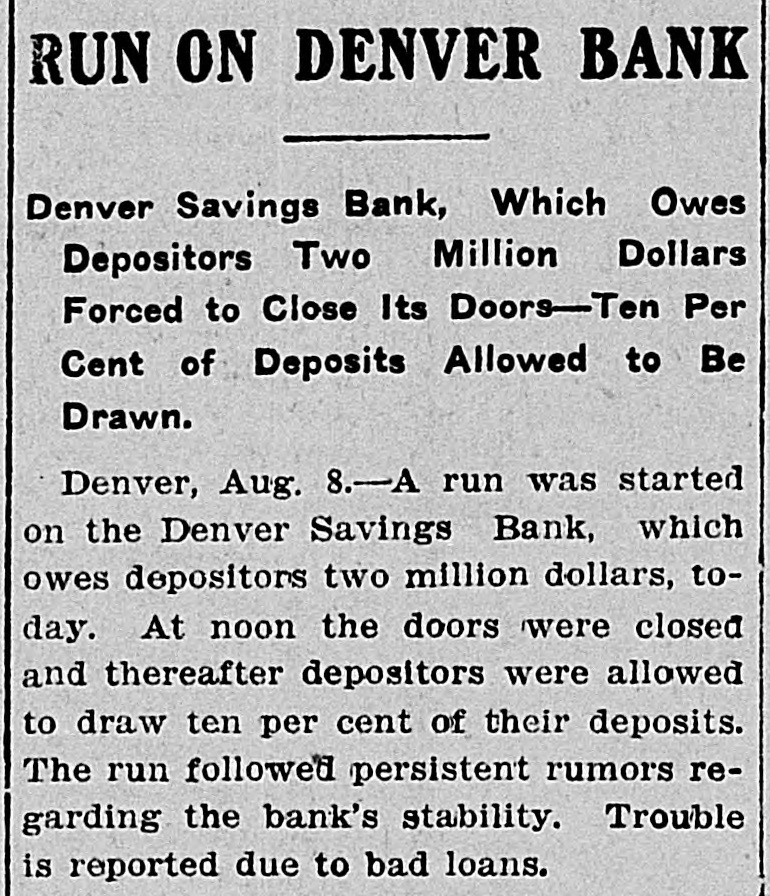
At noon the doors were closed and thereafter depositors were allowed to enter one at a time and draw ten per cent. of their deposits.
Source
newspapers
3. August 21, 1905 Receivership
Newspaper Excerpt
Judge John I. Mullins ... appointed Guy Le Roy Stevick receiver for the Denver savings bank and the bank was closed. Depositors ... petitioned the court to take charge of the institution. Petition charges more than $500,000 loaned to Leonard B. Imboden on securities of doubtful value.
Source
newspapers

Newspaper Articles (24)

Article from The Topeka State Journal, August 8, 1905

Click image to open full size in new tab

Article Text

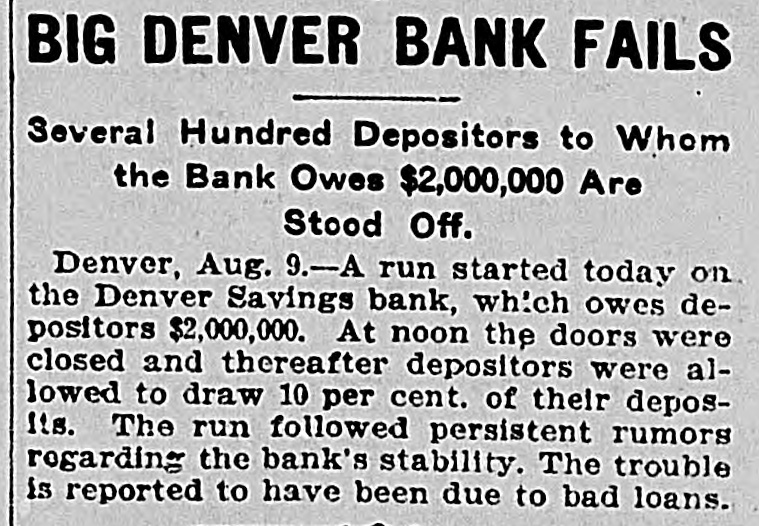
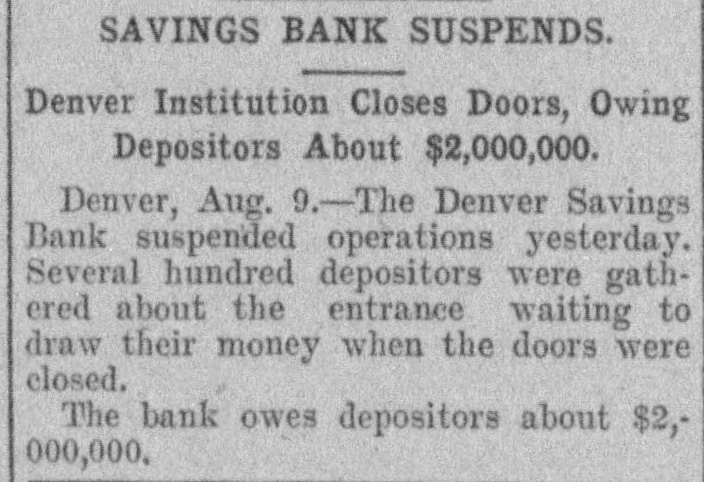
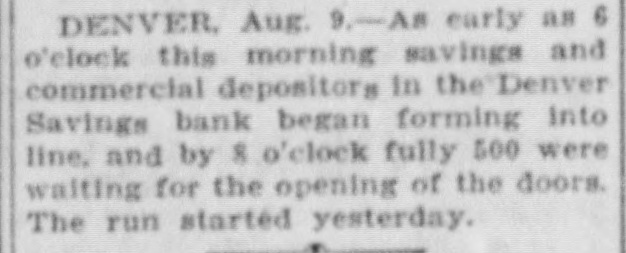
OWES $2,000, 000. Denver Savings Bank Closes Down in Depositors' Faces. Denver, Aug. 8.-The Denver Savings bank closed its doors about noon today. Several hundred depositors were gathered about the doors waiting to draw their money when the doors were closed. The bank owes depositors about $2,000,000. Fearing their funds were in jeopardy, the depositors started a run on the bank this morning. For two hours depositors were paid ten per cent of their deposits. Then the doors were closed. The run followed persistent rumors regarding the bank's stability, which have been current for a week or ten days past. The trouble is reported to be due to bad loans. The bank's last published statement made on July 3, was as follows: RESOURCES. Loans, $1,185,000; fixtures, $9,505; real estate, $37,974; bonds and stocks, $320,232; demand loans, $199,554; due from other banks, $586,334. Total, $2,379,296. LIABILITIES. Capital stock $250,000; surplus $15,000; undivided profits $19,338; due depositors $2,094,958. J. A. Hill is president and Carlos Wood, cashier of the bank. Vice President F. A. Jones said the run came without any intimation when the doors opened this morning. "In what condition is the bank?" was asked. "Very good, but there is no telling where a thing of this kind will stop. I thought it wise to enforce the 10 per cent rule and the depositors and the bank will be protected to the full extent of our power." After the doors were closed depositors were allowed to enter one at a time and draw 10 per cent of their deposits.


Article from East Oregonian : E.O, August 8, 1905

Click image to open full size in new tab

Article Text

RUN ON DENVER BANK. Management Declares it Is Without Cause. Denver, Aug. 8.-Because of wild rumors stated last night, a run began on the Denver Savings bank this morning. The management promptly announced the enforcement of the rule of 30 days' notice and 10 per cent payments, whereupon many left the line, but noon found many waiting to get a portion of their money. Vice-President Jones declares there is no valid reason for the run. The institution is a sound bank, organized in 1890, and re-organized four years ago. It claims deposits of $2,000,000. The management declines to give details.


Article from The San Francisco Call, August 9, 1905

Click image to open full size in new tab

Article Text

DEPOSITORS START "RUN UPON BANK Denver Institution Refuses to Pay Out More Than Ten Per Cent. DENVER, Aug. 8.-Following dissensions among the stockholders and rumors arising therefrom, a "run" was made on the Denver Savings Bank today by depositors, who hoped to withdraw their money. After the first fifteen minutes of business, Vice President F. P. Jones, who was in charge of the bank, announced that the depositors could withdraw at once only 10 per cent of their deposits, this rule being permitted by the law. Jones said the bank was in good condition and the 10 per cent rule was put into force for the protection of the public. J. A. Hill, president of the bank, and L. A. Imboden, the heaviest stockholder, were said to be in Kansas City today. Four times in the last year changes have been made in the official staff of the bank and it is believed that the depositors' loss of confidence in the institution is partly due to these frequent changes. The last statement of the condition of the bank. made on July 3, showed deposits of $2,094,958, cash on hand and in other banks $586,344, time loans and discounts $1,185,695, bonds and stocks $320,232, and demand loans $199,554.


Article from Albuquerque Evening Citizen, August 9, 1905

Click image to open full size in new tab

Article Text

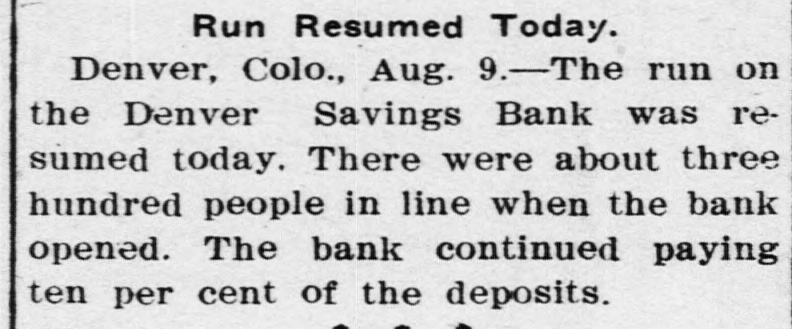
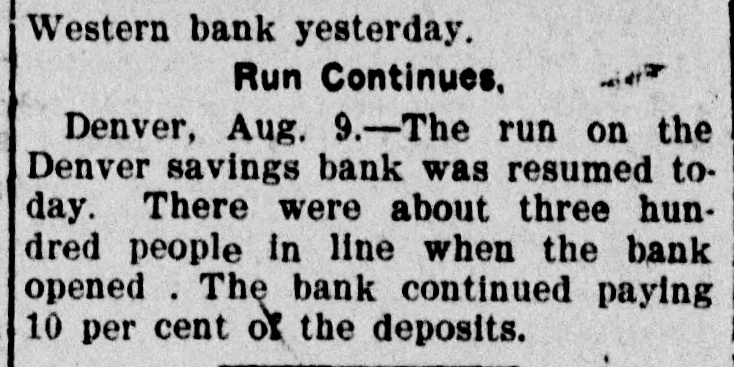
were $642,658. The bank's capital is $100,000 and its surplus $10,000. L. A. Imboden, one of the principal stockholders in the Denver Savings bank, on which a run is being made, recently acquired an interest in the Western bank. The Denver Clearing house association refused assistance to the Western bank yesterday. Still Paying Ten Per Cent. Denver, Aug. 9.-The run on the Denver Savings bank was resumed today. There were about 300 people in line when the bank optiked this morning. The bank contin red paying depositors 10 per cent.


Article from The Fairmont West Virginian, August 9, 1905

Click image to open full size in new tab

Article Text

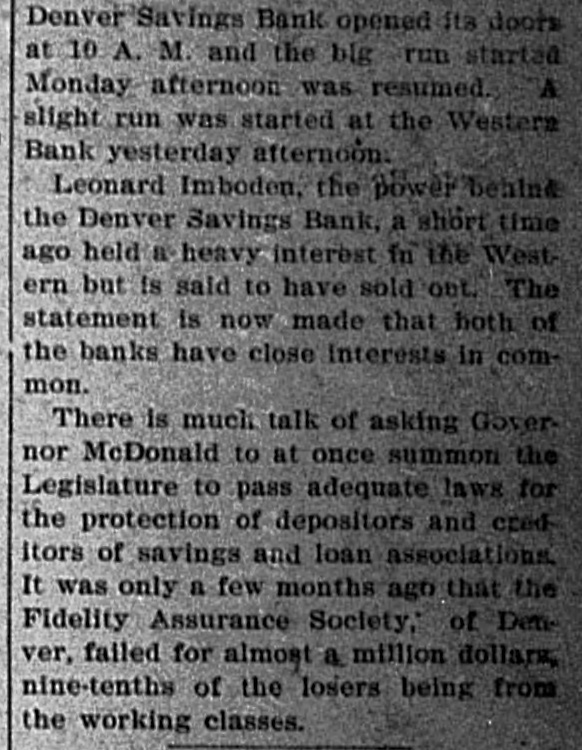
Denver Savings Bank opened its doors at 10 A. M. and the blg run started Monday afternoon was resumed. A slight run was started at the Western Bank yesterday afternoon: Leonard Imboden, the power behind the Denver Savings Bank, a short time ago held a heavy interest in the Western but is said to have sold out. The statement is now made that both of the banks have close Interests in common. There is much talk of asking Governor McDonald to at once summon the Legislature to pass adequate laws for the protection of depositors and cred itors of savings and loan associations, It was only a few months ago that the Fidelity Assurance Society; of Detiver, failed for almost a million dollars, nine-tenths of the losers being from the working classes.


Article from The Times Dispatch, August 9, 1905

Click image to open full size in new tab

Article Text

RUN ON DENVER SAVINGS BANK (Bv Associated Press.) DENVER, COL., August 8.-Following dissensions among the stockholders and rumors arising therfrom, a run was made on the Denver Savings Bank to-day. After the first fifteen minutes of business, Vice-President F. P. Jones announced that depositors could withdraw at once only ten per cent. of their deposits, this rule being permitted by law. Mr. Jones said the bank was in good condition, and the ten per cent. rule was put in for the protection of the public. The last statement of the condition of the bank, made on July 3d, showed deposits of $2,094,958.


Article from Abilene Weekly Reflector, August 10, 1905

Click image to open full size in new tab

Article Text

Bun on Denver Savings Bank. Denver, Col., Aug. 9.-A run was started Tuesday on the Denver Savings bank which owes depositors about $2,000,000. At noon the doors were closed and thereafter depositors were allowed to enter one at a time and draw ta per-cent, of their deposits. The draw ten per cent. of their deposits The run followed persistent rumors regarding the bank's stability, which have been current for a week or ten days past, The trouble is reported to be due to bad loans.


Article from Fergus County Argus, August 11, 1905

Click image to open full size in new tab

Article Text

Run on Denver Bank. Denver, Aug. 9.-Following dissensions among the stockholders and rumors arising therefrom, a run was made on the Denver Savings bank today by depositors who wished to withdraw their money. First Vice President F. P. Jones, who was in charge of the bank, announced that depositors could withdraw at once only ten per cent of their deposits, this rule being permitted by the law. Mr. Jones said the bank was in good condition and the ten per cent rule was put in force for the protection of the public. J. A. Hill, president of the bank, and L. A. Imboden, the heaviest stockholders, were said to be in Kansas City today. Four times in the last year there have been changes made in the official staff of the bank and it is believtd that the depositors' loss of confidence in the institution is partly due to these frequent changes. The last statement of the condition of the bank, made only July 3, showed deposits of $2,094,958; cash on hand and in other banks, $586,334; time loans and discounts, $1,185,965; bonds and stocks $320,232, and demand loans, $199,554.


Article from Twice-A-Week Plain Dealer, August 11, 1905

Click image to open full size in new tab

Article Text

BIG RUN ON DENVER BANK Institution Owing Depositors $2,000,000 Closes Doors and Restricts Withdrawals. Denver, Col,. Aug. 9.-A run was started Tuesday on the Denver savings bank, which owes depositors about $2,000,000. At noon the doors were closed, and thereafter depositors were allowed to enter one at a time and draw ten per cent. of their deposits. The run followed persistent rumors regarding the bank's stability, which have been current for a week or ten days past. The trouble is reported to be due to bad loans. J. A. Hill is president and Carlos Wood, cashier of the bank. Vice President F. P. Jones said the run came without any-intimation when the doors opened Tuesday morning. "In what condition is the bank?" was asked, "Very good, but there is no telling where a thing of this kind will stop. I thought it wise to enforce the ten per cent. rule, and the depositors and the bank will be protected to the full extent of our power."


Article from River Falls Journal, August 17, 1905

Click image to open full size in new tab

Article Text

west. Terrific wind and electrical storms in several sections of Wisconsin caused much damage to growing crops and property. Orrin W. Potter, steel trust millionaire of Chicago, we 1 Mrs. Bell, a former hairdresser of New York city, and sailed for Europe. Gov. Robert M. La Follette, of Wisconsin, in an interview at St. Paul, Minn., stated that the report that he would resign the governorship in September and go to Washington as United States senator in October was without his authorization. One man was killed and 14 reported injured in a head-on collision of trolley cars near Norwalk, Va. A run was started on the Denver savings bank, which owes depositors about $2,000,000. The doors were closed, and thereafter depositors were allowed to enter one at a time and draw ten per cent. of their deposits. Alexander Melville Bell, father of Prof. Alexander Graham Bell, died at the home of the latter at Washington, aged 86, from pneumonia, following an operation for diabetes. Capt. William E. English, commander-in-chief of the United Spanish War Veterans' association, has issued a general order for the second national encampment and reunion of the association, to open at Milwaukee September 7. Mrs. Annie J. Taylor, aged 59, a seamstress, and her granddaughter, nine years of age, were burned to death in a fire in a tenement house at Dallas, Tex


Article from Eagle River Review, August 18, 1905

Click image to open full size in new tab

Article Text

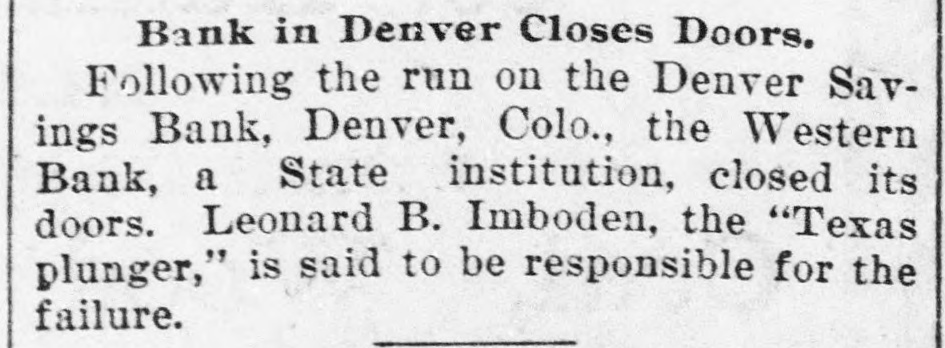
Bank in Denver Closes Doors. Following the run on the Denver Savings Bank, Denver, Colo., the Western Bank, a State institution, closed its doors. Leonard B. Imboden, the "Texas plunger," is said to be responsible for the failure.


Article from Twice-A-Week Plain Dealer, August 22, 1905

Click image to open full size in new tab

Article Text

DENVER BANK CLOSES DOORS A RECEIVER APPOINTED FOR SHAKY INSTITUTION. Half Million Dollar Loan on Fictitious Securities the Alleged Cause. Denver, Col., Aug. 21.-Judge John I. Mullins, in the district court Saturday, appointed Guy Le Roy Stevick receiver for the Denver savings bank and the bank was closed. Depositors of savings who had been permitted to draw only ten per cent. of their funds since August 8, when a run on the bank began, petitioned the court to take charge of the institution, and the officers in charge consented Saturday to have a receiver appointed, The bank had more than 8,000 depositors, whose savings deposits aggregated $1,400,000, and there were also checking accounts aggregating several hundred thousand dollars before the run, In the petition for a receivership it is charged that more than $500,000 had been loaned to Leonard B. Im$ boden and associates on securities of t doubtful value. The officers of the d bank Saturday filed an answer to the β‚« petition, denying that the loans comst plained of were made on fictitious securities. The Bank of North AmerS ica, of New York, holds 400 shares, a $ majority, of the. bank's stock, as Se3 curity for a loan of $90,000. These 4 shares stand on the bank's books in the name of C, B. Wilfley, but in reality, it is said, were controlled by Imboden, Mr. Wilfley has stated that he 1never purchased or had any legal title ct to this stock, J, A, Hill, president of athe bank, who is said to have repreesented the Imboden interests, is abBY sent in the east.


Article from The San Francisco Call, August 29, 1905

Click image to open full size in new tab

Article Text

DENVER BANKERS ARE IN THE LAW'S GRASP Accused Officials of Suspended Concerns Appear in Criminal Court. DENVER, Colo., AΓΊg. 28.-Officials of the suspended Western National Bank and the Denver Savings Bank, awaiting trial on the charge of bankers' larcenyreceiving deposits knowing the bank to be insclvent-were in the Criminal Court to-day, the latter to plead and the former to ask a continuance. The motion for a continuance will be heard on Wednesday. Carlos Wood, cashier, and Robert Brown, paying teller, of the Denver Savings Bank, pleade not guilty to the charge of bankers' arceny and trial was set for September 12. James A. Hill. president of the savings bank, arrested at McAlester, I. T., on the same charge, reached Denver late to-day in the custody of a deputy sheriff from this county. He was hurried to the Criminal Court, where bonds in the sum of $5000 were provided and he was then released.


Article from The River Press, August 30, 1905

Click image to open full size in new tab

Article Text

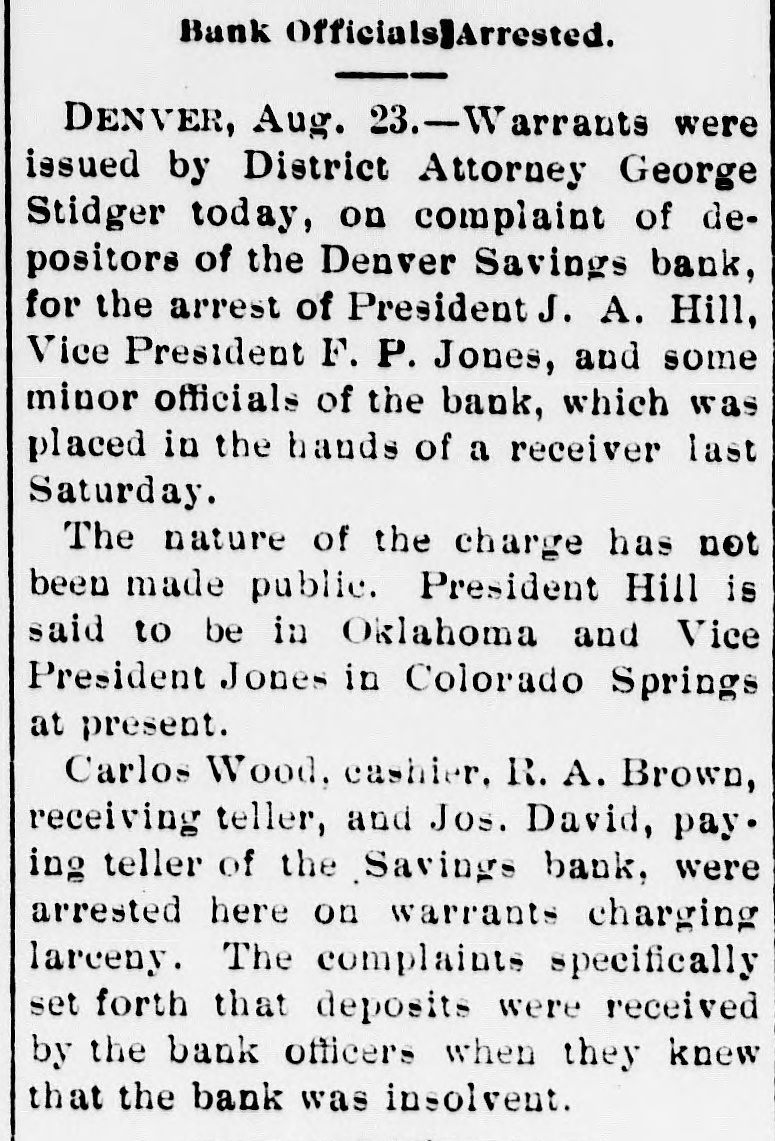
Bank Officials]Arrested. DENVER, Aug. 23.-Warrants were issued by District Attorney George Stidger today, on complaint of depositors of the Denver Savings bank, for the arrest of President J. A. Hill, Vice President F. P. Jones, and some minor officials of the bank, which was placed in the hands of a receiver last Saturday. The nature of the charge has not been made public. President Hill is said to be in Oklahoma and Vice President Jones in Colorado Springs at present. Carlos Wood, cashier, R. A. Brown, receiving teller, and Jos. David, pay. ing teller of the Savings bank, were arrested here on warrants charging larceny. The complaints specifically set forth that deposits were received by the bank officers when they knew that the bank was insolvent.


Article from The Topeka State Journal, September 2, 1905

Click image to open full size in new tab

Article Text

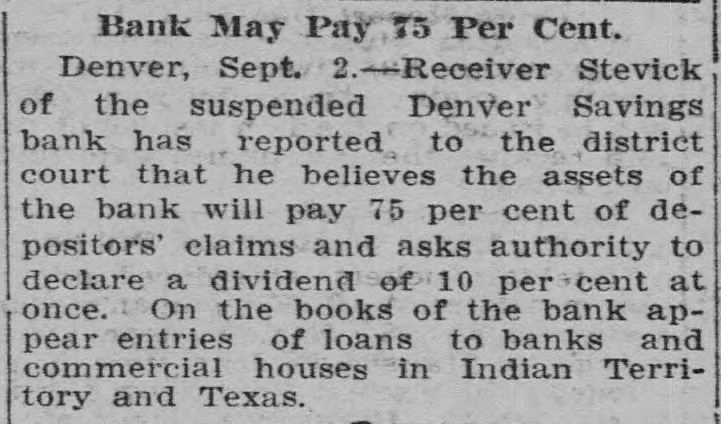
Bank May Pay 75 Per Cent. Denver, Sept. 2.-Receiver Stevick of the suspended Denver Savings bank has reported to the district court that he believes the assets of the bank will pay 75 per cent of depositors' claims and asks authority to declare a dividend of 10 per cent at once. On the books of the bank appear entries of loans to banks and commercial houses in Indian Territory and Texas.


Article from The Diamond Drill, October 21, 1905

Click image to open full size in new tab

Article Text

# WORLD'S NEWS -TOLD IN- # PARAGRAPHIS Prince hall, a Masonic home built at Rock Island, Ill., for widows and orphans of colored Masons, was dedicated Tuesday. F. B. Gray, cashier of the Commercial National bank of Houston, Texas, shot himself, dying almost instantly. He ranked Ligh in Texas banking circles. Luther Billings, a negro, was hanged by a mob at Brunswick, Tenn. He had attempted to assault a white woman. Billings was forcibly taken from the officers. The twenty-second great sun session of the great council of Iowa Improved Order of Red Men is meeting at Marshalltown, Iowa. The second annual joint conference of the embalmers' examining boards and the representatives of state boards of health closed a session at Niagara Falls. The association will meet in Chicago next year. A delegation of business men of St. Paul was entertained by the Commercial club of Omaha. Following a breakfast the delegation was taken to the Auditorium, where they gained ideas for a similar building in St. Paul. Attorney Fitts of Vermont entered a motion in the supreme court of the United States for the advancement on the docket of the case of Mrs. Mary M. Rogers, under conviction by the Vermont courts on the charge of killing her husband at Bennington in 1902, and sentenced to be hanged by the state courts. Gebbard Wilrich of Wisconsin has been appointed American consul at St. John, N. B. Judge W. J. Calhoun of Illinois, special commissioner to Venezuela, discussed Venezuelan affairs with the President and Secretary Root at the Wnite House. The judge will go to Chicago to prepare a report of his investigations. The thirty-first convention of the Mississippi Valley Medical association opened at Indianapolis. Dr. Bronsford Lewis of St. Louis is president. The convention will be addressed by Dr. Arthur R. Edwards of Chicago and Dr. W. D. Haggard of Nashville, Tenn. John Hill, an aged white man, was hanged at Covington, Tenn., for wife murder. Vice President Frank P. Jones of the failed Denver Savings bank has turned state's evidence against former President C. W. Wifley and accused him of embezzling between $73,000 and $100,000. A gift of $50,000 for the Creek Seminole Industrial college at Boley, 1. T., was asked of John D. Rockefeller at Cleveland by J. C. Leftwich, a negro, president of the college. Mr. Rockefeller said he would consider the matter. An order was issued at the war department relieving Major General Weston from the office of commissary general. It is expected that he will be ordered to command the northern division, with headquarters at St. Louis. The dead body of an unknown infant was found on Edwards creek, between Kewanee and Cambridge, III. Philip Koltinsky, aged 47, a business man, was killed and his wife severely injured in a runaway at Vincennes, Ind. August Moritz, a fruit dealer and restaurateur, despondent over ill health, shot himself in the head in Swiney park, Fort Wayne, Ind. In an explosion in a coal mine near Gratiot, O., Charles Smith was killed. Lyman Chapin fatally injured and Fred Headley badly hurt. Ruth, the 3-year-old daughter of Jacob Hesh, walked backward into a bucket of scalding water and received injuries from which she died at Macomb, 111. N. G. Little, a telephone lineman, fell forty feet at Terre Haute, Ind., after touching a live wire, the third death from the same cause in the same gang in three days. Charles Ashmore at Mansfield, III., committed suicide by driving a large butcher knife through his brain from temple to temple. He was insane over loss of property by fire. Brigadier General Constant Williams, commanding the department of Columbia, in his annual report, declared that the W. C. T. U. and the saloon interests are working hand in hand against the best interests of the soldier in their opposition to the army canteen Judge W. J. Calhoun, who went to Venezuela several months ago as a special commissioner representing the United States government, returned to New York. The civil service commission at Washington is preparing a circular letter warning government employes against making campaign contributions as in violation of law. Carl Evans and Charles Fall were seriously injured in a fiercely contested football game at Michigan City, Ind. After making a spectacular run of fifty yards in a game of football at


Article from The Star, October 25, 1905

Click image to open full size in new tab

Article Text

# TEN BANKERS INDICTED Charged With Conspiracy to Steal from Denver Bank. Leonard. Imboden, James A. Hill, C. B. Wifley, E. E. Hull, H. L. Hull, C. C. Robert, W. T. Camp, D. M. Car- ey, A. B. Davis and J. H. Edmond- son were indicted by the Grand Jury on the charge of conspiring to steal $1,712,587 from the Denver, (Col.) Savings bank. Wilfley and Edmond- son were formerly presidents of the bank, and Hill was president of the bank when a receiver was appointed. H. L. Hull is president of the Mount Vernon National bank of Boston. Roberts and Carey are officers of the Cherokee State bank, of Enid, Okla. In addition to the general con- spiracy indictments were found against Edmondson. He is charged specifically with the robbery of $105,- 000. Four indictments were returned against Wilfley charging him with lending certain funds belonging to the bank and securing heavy com- mission for his own use. One in- dictment was returned against Hill charging him with the embezzlement of $10,000. Warrants were immedi- ately issued for the arrest of the men.


Article from The Elbert County Tribune, December 21, 1905

Click image to open full size in new tab

Article Text

CRAZED BANKING FRENZIED FINANCIER'S MANIA FOR STARTING BANKS. WANTED THEM EVERYWHERE Eighteen or Twenty Banks and Trust Companies-Certificates Cashed of Institutions That Never Opened Their Doors. Denver.-C. B. Wilfley, former president of the Denver Savings Bank, continued his testimony Friday. In commenting on it the Republican says: From the mania which urged Leonard Imboden to create banks, an obsession as binding on him apparently as is the instinct of cell life to reproduce and hold to life, the bank creator could not save himself. It came out yesterday that while he was maintaining his race to keep up with Oklahoma and Indian Territory in their sweeping developments of the last two years, his determination being to have an Imboden bank in every town and city and as many trust companies as possible, he formed banks that never even opened their doors. But notwithstanding, they are creditors to the defunct Denver Savings Bank. In justice to this king among bank kiters, it should be said that this was merely an oversight on his part, whatever it might have been with his comrades in the bank building business. He would have ordered the doors thrown open and invited business, had he thought of it; whereas, his partners, the missing H. L. Hull in particular, were willing to have the flatteringly engraved certificates on hand, and satisfied to have near by the expensive linen glazed letter heads and envelopes, which did not contain the name of Imboden, however. Of all the banks and trust companies formed through the insatiable desire of the man with the American Bankers' Association brand upon him, some eight een or twenty in all, not one had his name emblazoned on windows, doors or stationery. The evidence of yesterday went to show that Imboden and Hill and the Hulls drew as high as $60,000 from the Denver Savings Bank, depositing therefor the gaudy certificates of the bank stock of banks and trust, companies that were never in actual existence. The defenadants must have put the money in their pockets. But Imboden did so simply because he could not keep track of his many ventures in trust companies, railroads, elevators, gas well, coal companies and what not. It would have been more profitable to have allowed the banks to accept deposits, although this procedure was not all essential in the Imboden-Hill-Hull enterprises. Charles B. Wilfley, one of the principal witnesses for the prosecution, a former president of the Denver Savings Bank under the Imboden regime, made confession of guilt yesterday. As discovered by the receiver of the Denver bank, and as given to the grand jury called to investigate the affairs of the bank, Wilfley made loans on commissions, which he pocketed and bought bonds and charged the bank higher prices than they cost him and such like. But Wilfley gave damning evidence against Hill and Imboden, before they had opportunity to boast of his own discomfiture. Wilfley was shown a draft and a certificate of deposit for the benefit of Imboden institutions, which contained a forgery of his name and of E. E. Hull's name, he declared.


Article from The Roswell Daily Record, February 15, 1906

Click image to open full size in new tab

Article Text

The meeting of the City Council scheduled for 6:30 last night did not occur until 8:20, the delay being caused by the absence of the Committee on Franchises, which was discussing the various applications and preparing a report to the Council, in the offices of City Attorney Scott. When convened, however, the following members were present: Kinsinger, Whiteman, Wyllys, Burns, Johnson, Church, Ogle, Brooks, and Mayor Hinkle. The first matter taken up was the report of the committee which was considering the various franchises, and which was composed of Aldermen Ogle, Johnson and Brooks. The report of the committee as presented by Mr. Ogle was substantially as follows: The committee had received a telegram from Guy Leroy Stevick, receiver of the defunct Denver Savings Bank, which has charge of the local partially built gas plant, stating that he had mailed a check for one thousand dollars as a forfeit as required by the Council as evidence of good faith. He made the conditions, however, that the Council give him 90 days in which to begin work and one year in which to finish* the plant, and also bind itself to give no other gas franchise. The telegram stated that he had an order of the court allowing him to begin work. The Committee stated to the Council that it was adverse to accepting the offer of Mr. Stevick, and would refer the matter back to the Council. The prevailing opinion after some discussion was, that the franchise had been in existence for more than two years, and that there had been plenty of time to finish the plant, and considering everything, that the franchise asked for by Mr. Farnsworth and his associates should be granted. At this point, Attorney Scott presented a telegram just received from Receiver Stevick, saying that the conditions in his other telegram had been imposed by the court, and that he had nΓ³ power to change, and further that he would ask for a short delay in the matter. In response to a call from the Council, Mr. H. S. Farnsworth assur. ed the Council that he and his assoclates were ready to comply with the *conditions of the Council. They were home people, and numbered among them some of the leading citizens of the community. The matter was up to the Council. Sheriff Woodruff was one of the parties interested with Mr. Farnsworth stated. that some few days ago a meeting of some eight or ten citizens had been held and after discussing the situation they had agreed to put the gas plant proposition through


Article from The Colorado Statesman, February 9, 1907

Click image to open full size in new tab

Article Text

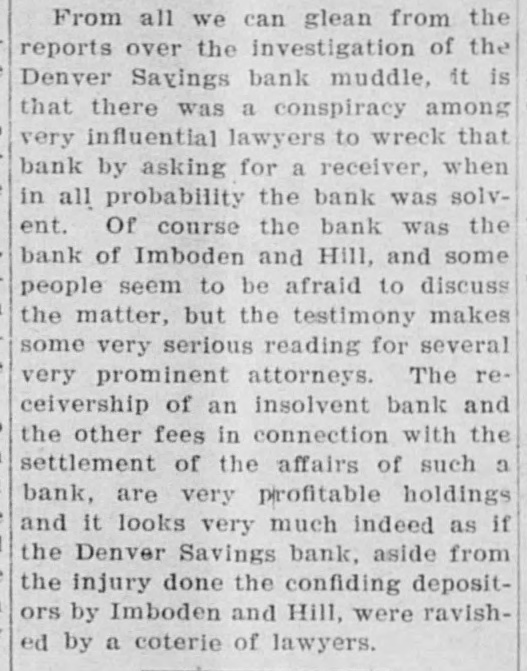
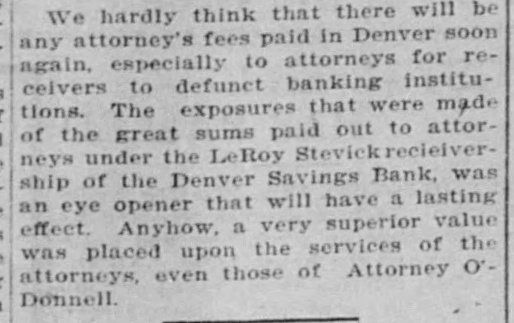
Misplaced Confidence. The efforts of the Bardwell investigation commission in ferreting out the facts connected with the fraudulent and excessive expenditure of money in the receivership of the Denver Savings Bank, deserves the hearty support of the Legislature and the community at large. The lesson drawn from the facts are wholesome and practical. Mr. Stevick, who was appointed receiver by District Judge John I. Mullins, was supposed to be a capable, worthy man; a man whose ability was not overestimated, and a man who would nourish the interest and guard the right of the hundreds of working people who had their "all" in the Denver bank when he was appointed receiver. Being a lawyer himself, his acts were within the bounds of the law, but beyond the bounds of reason. His few favorite friends, together with himself, fattened their bank accounts and the poor working people are the sufferers-victims of misplaced confidence. Many colored citizens were among the unfortunate depositors. At one time Mr. Stevick enjoyed a good reputation. To-day, under the scouraging and scrutinizing eyes of those who once looked to him as the exponent of firmness and their leader, he flinches, flounders and groans, and is morally a dead one. Never were genuine, worthy men, as leaders, in such demand. As a race we realize this fact. Men who can fill the measure, who have honest, intelligent intentions, no selfish, petty motives, who have no ax to grind, who have no desire to victimize any one. Unfortunately, the illiterate element in most instances are the victims. The loss of money, the loss of confidence, the over-estimation of ability, are daily occurences. To many they are painful. The lesson is wholesome. Look and learn. When you are in a place of trust be considerate. Make your promises in good faith. If you are prone to be a misleader instead of a leader, have the courage to shape ends so you alone will be the victim.


Article from The Daily Sentinel, February 21, 1907

Click image to open full size in new tab

Article Text

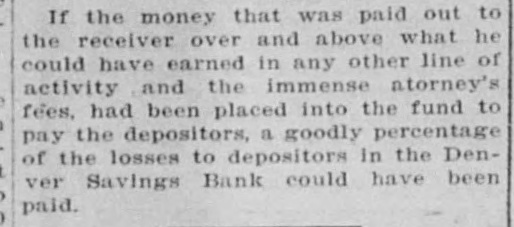
If the money that was paid out to the receiver over and above what he could have earned in any other line of activity and the immense atorney's fees, had been placed into the fund to pay the depositors, a goodly percentage of the losses to depositors in the Denver Savings Bank could have been paid.


Article from Durango Semi-Weekly Herald, July 11, 1907

Click image to open full size in new tab

Article Text

TELEGRAPH NEWS New York, July 10.-The government filed today in United States circult court in this city a petition against the American Tobacco company, Imperial Tobacco company the British Tobacco company, American Snuff company, American Cigar company, United Cigar Stores company, American Stogie company, MacAndrews and Forbes company, Conley Fail company and fifty-six other corporations and twenty-nine individuals connected with the above named companies. These corporations and individuals constitute what is generally known as the tobacCO trust, and the information directed against them sets forth the purpose of the government to dissolve this trust by breaking up the agreements under which the consolidated concerns ate working. Denver, Colo... July -Judge Riddle will on July 29 decide the matter of the proposed reopening of the receivership of the Denver Savings bank. The former receiver, Guy Leroy Stevick, demurred to the petition asking for reopening and upon this demurrer the arguments are based. The claim of the depositors is that Stevick received about $24,000 more in fees than he should have had. Golden, Colo., July 10.-A Wall of water that swept everything in its path came down Clear Creek valley last night and caused incalculable damage to the railroad, ranches and farms along the stream. A cloudburst in the mountains near Black Hawk was the beginning of the flood and as the torrent hurled down the valley it was augmented at Roscoe by another flood pouring out of the gulch at the head of the old placer works. Today the receding waters leave enormous wreck and ruin. Seventeen miles of track were washed away. Omaha, Neb., July 10.-Assistant General Passenger Agent Buckingham of the Burlington railroal today announced that within ten days the Burlington would put in operation a 2 cent fare schedule between all points on that system regardless of whether different states have passed a 2 cent fare bill. The Burlington traverses Wyoming, Montana, Colorado, Nebraska, Kansas, Missouri, Iowa, Illinois, Wisconsin, Minnesota and South Da kota. The action of the Burlington will undoubtedly cause other roads in the same territory to follow It. Washington, July 10.-President t Roosevelt has now the substance of the report of the interstate commerce 8 commission on the Hariman case and I Special Attorney Kellogg is at Oyster e Bay endeavoring to persuade the prese ident that the case against Harriman L should be prosecuted. Kellogg, with to some members of the interstate comn merce commission, believes successful II prosecution can be brought against C. Harriman but President Roosevelt is e convinced that the government cannot win its case. 3. Pittsburg, Pa., July 10.-Flames are t sweeping the residence district of Al1. legheny. Ten houses have already y been destroyed and the big wire plant e has also been destroyed. The flames it are shooting 260 feet in the air and d huge embers are being scattered in 1. every direction. A general alarm has 1. been sounded and Pittsburg is sending assistance.


Article from CaΓ±on City Record, February 10, 1910

Click image to open full size in new tab

Article Text

PARDONS MAY BE SECURED FOR IMBODEN AND HILL Denver, Feb. 7.-Within the next few days another effort will be made by friends of Imboden and Hill to have the state board of pardons, which will meet to consider the plea of the Denver bank wreckers for an unconditional pardon or to shorten their terms of imprisonment at Canon City Just what the result will be is, of course, not known at this time, as the members of the board of pardons have given no intimation of what their action will be. During the past few months, however, some of the most powerful influences in Colorado have been at work on the case in the interest of the men who, it is alleged, wrecked not only one of Denver's large banks, but were also instrumental in wrecking banks in Oklahoma and elsewhere. Imboden and Hill are now at Canon City serving long sentences for the alleged looting of the Denver Savings bank. They have not thrived much since being under the watchful care of Warden Tynan, yet they say they cannot complain of their treatment The cases of Imboden and Hill will occupy the attention of the pardon board for the first hour of its sitting next Friday afternoon. Attorney Hersey for Mr. Imboden has promised that he will not occupy more than one hour and it is expected that he will state the cases of the bank defaulters in such a way that the case can be ended at that session. Mr. Hersey will no doubt go into the matter of the receivership and will tell some of the things that occurred as noticed from the view point of the owners of the bank.


Article from The Ordway New Era, February 18, 1910

Click image to open full size in new tab

Article Text

ATTORNEY HERSEY FIERCELY SCORES MEN WHO OBTAINED BANK RECEIVERSHIP. BEFORE PARDON BOARD MATTER TO BE TAKEN UP AGAIN AT ANOTHER BOARD MEETING. Denver-Speaking in behalf of Leonard Imboden and James A. Hill, whose application for pardon was under consideration, Attorney Henry J. Hersey Friday appeared before the state board of pardons in the office of Gov. John F. Shafroth and denounced in scorching terms all the men whom he believed to have been instrumental in procuring the appointment of a receiver for the Denser Savings bank, the institution which Imboden and Hill were convicted of having conspired to wreck. Guy LeRoy Stevick, the receiver of the bank; L. Ward Bannister, his partner; Harry Silverstein, the deputy district attorney, and T. J. O'Donnell, attorney for the receiver, were all accused of opposing the pardon of Imboden and Hill because they were afraid of what the convicts might disclose if they were released. All the men accused were present, save O'Donnell, and for nearly an hour and a half they listened to as scathing an arraignment of their motives and acts as Mr. Hersey knew how to put into words. The board reached no decision in the Imboden-Hill matter and the meeting was adjourned shortly after 6 o'clock, subject to the call of the governor. The date of the next meeting depends on the ability of J. Fred Farrar, of Fort Collins, to put certain business affairs in such shape as will permit him to come to Denver again for a final consideration and disposition of the matter. It was evident that Mr. Hersey's speech made an impression on certain members of the board but what the decision of the majority will be still remains problematical. Speaking almost entirely from the records in the case, Mr. Hersey pointed out facts which he thought were sufficient to show that Mr. Stevick and his associates were the real wreckers of the bank, and not the men who are serving time for it. "So astounding was this procedure," he said, referring to the methods by which the receivership had been created, "that the Legislature has since made it a felony to procure a receiver ship of any institution in that way." Mr. Hersey scoffed at the claim that the bank was insolvent when the receiver was appointed and in support of his position in that respect he pointed out the fact that Receiver Stevick had collected $1,167,000 out of a possible $1,288,000 within seventeen months from the time he took charge of the bank, and that, too after charging off $400,000 of the bank's assets as worthless. He characterized the expenses of the receivership, which he placed at $133,000, as a dead loss to the depositors of the bank, and when Mr. Stevick protested that disbursements for repairs, taxes, and like charges could not be considered as expenses of the receivership, Mr. Hersey turned on him and shouted: "If you had kept your hands off, instead of wrecking this institution yourself, the interest on the bank's loans would have offset the disbursements."