Pacific National Bank (Boston, MA)

Episode Information

Episode Type
Run → Suspension → Reopening
Start Date
November 18, 1881
Location
Boston, Massachusetts (42.358, -71.060)
Bank Type
national
Charter Number
2373

Metadata

Response Measures

Accommodated withdrawals, Capital injected, Full suspension, Books examined

Other: Directors held meetings and sought to raise capital (assessments on stockholders); private parties agreed to advance funds ($200,000) to enable resumption; receiver and Comptroller involvement followed as examinations progressed.

Receivership Details

Depositor recovery rate
65.3%
Date receivership started
1882-05-22
Date receivership terminated
1893-06-30
OCC cause of failure
Fraud
Share of assets assessed as good
18.7%
Share of assets assessed as doubtful
40.9%
Share of assets assessed as worthless
40.4%

Notes

Bank later went into receivership (known date 1882-05-22) after its 1882 resumption; articles cover the run, suspension, rescue efforts, and resumption.

Events (7)

1. November 9, 1877 Chartered
Source
historical_nic
2. November 18, 1881 Run
Cause
Bank Specific Adverse Info
Cause Details
Large overdrafts by speculator Theodore C. Weeks and revelations about worthless collateral prompted withdrawals and loss of confidence.
Measures
Payments limited to small checks then stopped; directors met and arranged examination by bank examiner; promises to pay some checks before close
Newspaper Excerpt
a small run began...the amount paid out was $1,000, mostly small checks, up to 1:10 p.m., when payment was stopped altogether.
Source
newspapers
3. November 18, 1881 Suspension
Cause
Bank Specific Adverse Info
Cause Details
Failure/overdrawn accounts tied to Weeks's speculations and attendant failures caused the directors to suspend payment.
Newspaper Excerpt
the doors of the Pacific National Bank...were closed, and the following note posted... 'payment is temporarily suspended.'
Source
newspapers
4. November 26, 1881 Other
Newspaper Excerpt
the United States comptroller yesterday requested the associated banks to nominate a receiver and wind up its affairs (report of examiner unfavorable).
Source
newspapers
5. March 18, 1882 Reopening
Newspaper Excerpt
The Pacific National Bank of Boston will resume business on Saturday. (reports mid-March 1882); resumed business on Saturday, after a suspension of three months (Mar 20, 1882).
Source
newspapers
6. May 22, 1882 Receivership
Newspaper Excerpt
Known receivership date (bank information).
Source
newspapers
7. May 22, 1882 Receivership
Source
historical_nic

Newspaper Articles (22)

Article from New-York Tribune, November 19, 1881

Click image to open full size in new tab

Article Text

BANK FAILURE IN BOSTON

CARRIED DOWN BY A SPECULATOR. THE PACIFIC NATIONAL BANK COMPELLED TO CLOSE ITS DOORS YESTERDAY-THEODORE C. WEEKS ALLOWED TO OVERDRAW HIS ACCOUNTS LARGELY -COMMENTS OF BOSTON BANKERS AND BROKERS. BOSTON, Nov. 18.-At 1:30 o'clock this afternoon the doors of the Pacific National Bank, on Devonshire-st., were closed, and the following note posted there: "Owing to failures in which the bank is involved, payment is temporarily suspended." This was read by some 200 or 300 men, who had been standing in and about the banking rooms for an hour or more awaiting the decision of the directors, which came in the form of the notice above quoted. The Pacific National Bank has from its inception labored under disadvantages. It has never been a member of the Clearing House. A. J. Benyou, its president, was unfortunate, when connected with the Exchange National Bank, in his transactions with the Rev. E. D. Winslow. As a consequence it is said of those transactions the bank, when organized, was not admitted to the Clearing House. For that reason it has been accustomed to meet drafts, etc., through the Eliot National Bank, which 18 a member of the Clearing House. On Thursday, the Merchants' Bank received from a country correspondent for collection a draft on the Pacific National Bank for $2,300. The check was presented at the Eliot Bank for payment as usual, but payment was refused on the ground that the bank drawn upon had no funds there. The check was then taken to the Pacific Bank, where it was stated that it could not be paid there, but would be paid before the close of anking hours. This promise was fulfilled. This morning, however, other drafts coming in under similar circumstances, a similar promise was made, but, unlike that of yesterday, the promise was not kept. The immediate cause of the suspension was the failure of Theodore C. Weeks, who had been allowed to overdraw his account. After the trouble of yesterday a meeting of the directors was called. It was held last evening, and arrangements were made which, it is thought, would tide the bank over its difficulties. The occurrences of the morning overthrew all the arrangements. It is stated that a large number of checks was given out this morning on the Eliot Bank, which merchants, instead of depositing, went immediately to the bank to draw; but the president of that institution stopped payment on such checks. He said that he took the course he did because the Pacific Bank had no funds there, and he was satisfied that it would be unwise to cash the checks. Concerning the general standing and the stability of the Pacific Bank, he did not wish to express an opinion. The payment of the checks having been refused at the Eliot Bank, those holding them presented them at the Pacific, and thereupon a small run began. As nearly as can be estimated, the amount paid out was $1,000, mostly small checks, up to 1:10 m., when payment was stopped altogether. Just previous to that hour a gentleman walked up and, expressing the belief that everything was right, deposited checks to the amount of $15,000, and his example was followed by others with smaller amounts. This morning Prescott & Hersey placed an attachment for $4,000 on the funds of the Pacific Bank, whatever they might be, in the hands of the Eliot. The capital of the bank is $1,000,000, and the following is the statement of its condition made on October 1: RESOURCES
Article from Wheeling Register, November 19, 1881

Click image to open full size in new tab

Article Text

BUSINESS FAILURES

At Montgomery, Ala. MONTGOMERY, ALA, November 18.Felix L. Marks, merchant, has assigned. Liabilities, $70,000. Rumors at Boston. NEW YORK, November 18.-There is a well authenticated rumor of difficulties in two Boston banks, the names of which have not yet transpired. One of them, it is thought, will go under, and other be supported by the Clearing House. No important mercantile failures are anticipated. Closed Doors. WASHINGTON, November 18.-A private dispatch states that the Pacific National Bank of Boston was in trouble, but has overcome its embarrassment and continues business.


Article from The Rock Island Argus, November 19, 1881

Click image to open full size in new tab

Article Text

MONEY MATTERS

NEW YORK, Nov. 19.-The suspended Boston bank was the Pacific National, capital $1,000.000. About $800,000 was paid in. This bank kept open to pay small checks until after 1 o'clock and then closed in suspension. It cleared through the Elliot Bank. The Boston Central National was the other bank in trouble but it was carried through by the Clearing House Association of which it was a member. It was involved by reason of advances on mining stock, the siver Islet being the principal one, and the low price of railroad shares which were being car ried by a speculator named Weeks The tendency of this disturbance in Boston will draw money from here. Already large amounts of stock owned in Boston, but having a market here, have been thrown on this market, and the result was seen in the declining prices in the last half hour. NEWARK, Nov. 19.-The depositors in the Mechanics' Bank are understood to have determined to prosecute the directors and employ Benj. F, Butler and Roger A. Pryor as counsel. BOSTON, Nov. 18.-There is the best authority for believing that the failure of the Pacific Bank to-day will effect no other city banks seriously, Should the mining stock collaterals or deposits with other banks depreciate in value, the banks will probably realize a sufficient sum to meet the major part of its obligations. There was a considerable run on the bank to-day, owing partially to the expressed opinions of prominent bankers and business men that it was shaky, and to the known facts about its worthless collaterals. The bank's capital stock has recently been increased from $500,000 to $1,000,000. Upon the announcement of the failure the eastern railroad stock dropped from 48 to 88. The directors of the Pacific National have been in consultation with Bank Examiner Needham through the evening and have come to no positive conclusion. Another meeting will be held in the morning. The bank will not go on to-morrow morning, but it is reasonable to suppose, as it is within the range of possibility and probability, that means may be furnished to enable the bank to start again. That will be determined to-morrow when the directors will decide whether to surrender the bank or raise the money necessary to carry it through its difficulty. From the present standpoint it would seem impossible for depositors to lose a cent. Week hopes to recoup, and if he does the bank may continue business.


Article from New-York Tribune, November 20, 1881

Click image to open full size in new tab

Article Text

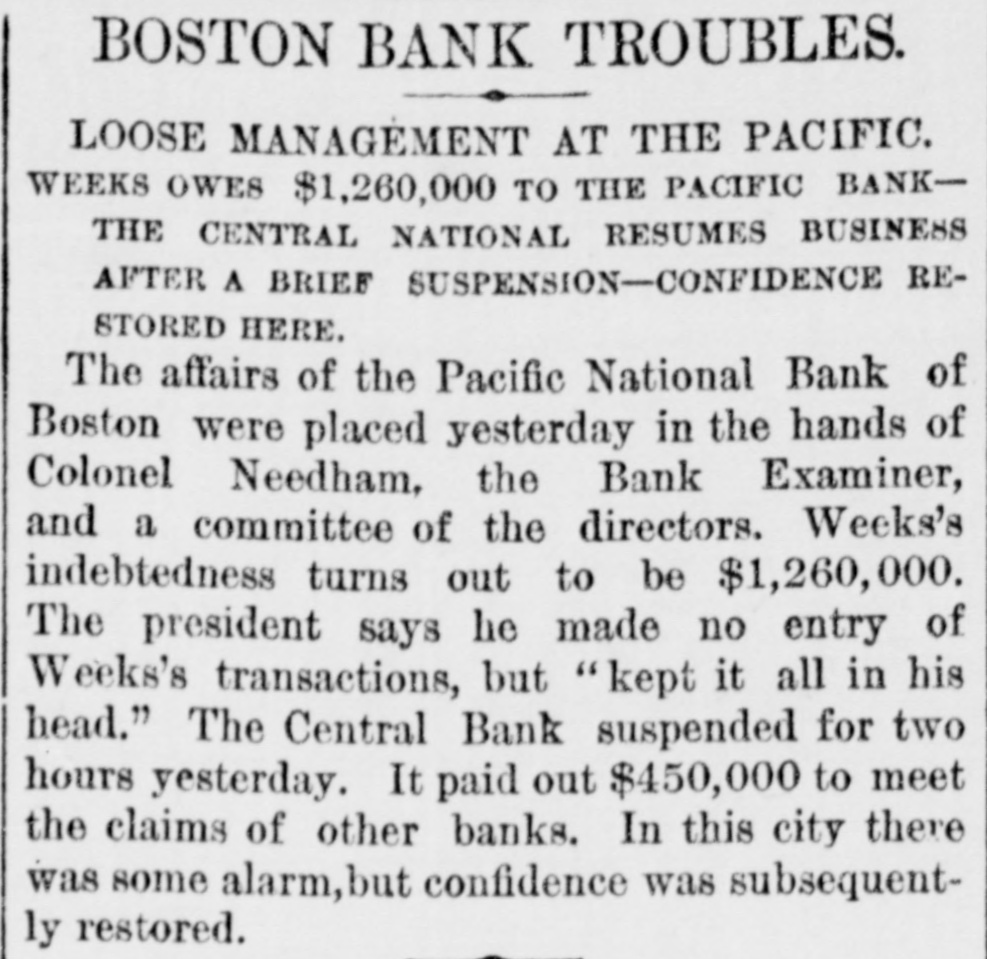
BOSTON BANK TROUBLES

LOOSE MANAGEMENT AT THE PACIFIC. WEEKS OWES $1,260,000 TO THE PACIFIC BANKTHE CENTRAL NATIONAL RESUMES BUSINESS AFTER A BRIEF SUSPENSION-CONFIDENCE RESTORED HERE. The affairs of the Pacific National Bank of Boston were placed yesterday in the hands of Colonel Needham, the Bank Examiner, and a committee of the directors. Weeks's indebtedness turns out to be $1,260,000. The president says he made no entry of Weeks's transactions, but "kept it all in his head." The Central Bank suspended for two hours yesterday. It paid out $450,000 to meet the claims of other banks. In this city there was some alarm, but confidence was subsequently restored.


Article from The Portland Daily Press, November 22, 1881

Click image to open full size in new tab

Article Text

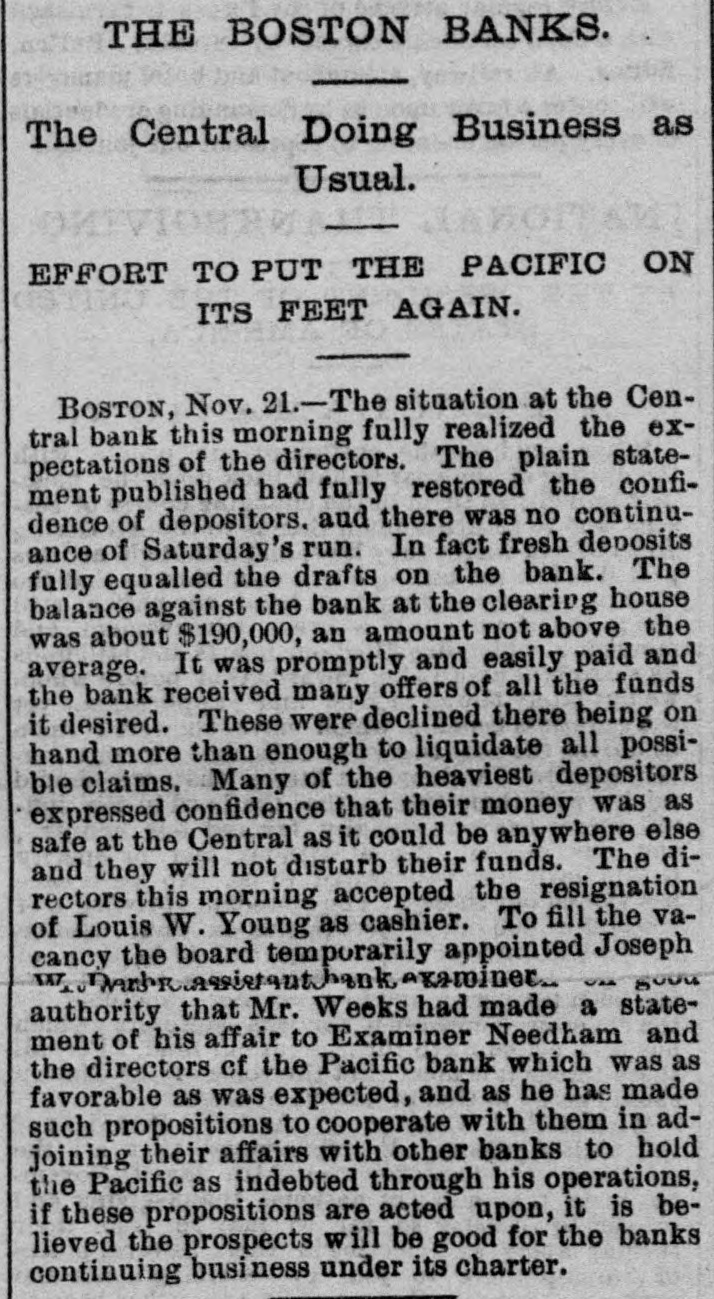
THE BOSTON BANKS

The Central Doing Business as Usual. EFFORT TO PUT THE PACIFIC ON ITS FEET AGAIN. BOSTON, Nov. The situation at the Central bank this morning fully realized the expectations of the directors. The plain statement published had fully restored the confidence of depositors. and there was no continuance of Saturday's run. In fact fresh deposits fully equalled the drafts on the bank. The balance against the bank at the clearing house was about $190,000, an amount not above the average. It was promptly and easily paid and the bank received many offers of all the funds it desired. These were declined there being on hand more than enough to liquidate all possible claims. Many of the heaviest depositors expressed confidence that their money was as safe at the Central as it could be anywhere else and they will not distarb their funds. The directors this morning accepted the resignation of Louis W. Young as cashier. To fill the vacancy the board temporarily appointed Joseph goou authority that Mr. Weeks had made a statement of his affair to Examiner Needham and the directors of the Pacific bank which was as favorable as was expected, and as he has made such propositions to cooperate with them in adjoining their affairs with other banks to hold the Pacific as indebted through his operations, if these propositions are acted upon, it is believed the prospects will be good for the banks continuing business under its charter.


Article from The Rock Island Argus, November 26, 1881

Click image to open full size in new tab

Article Text

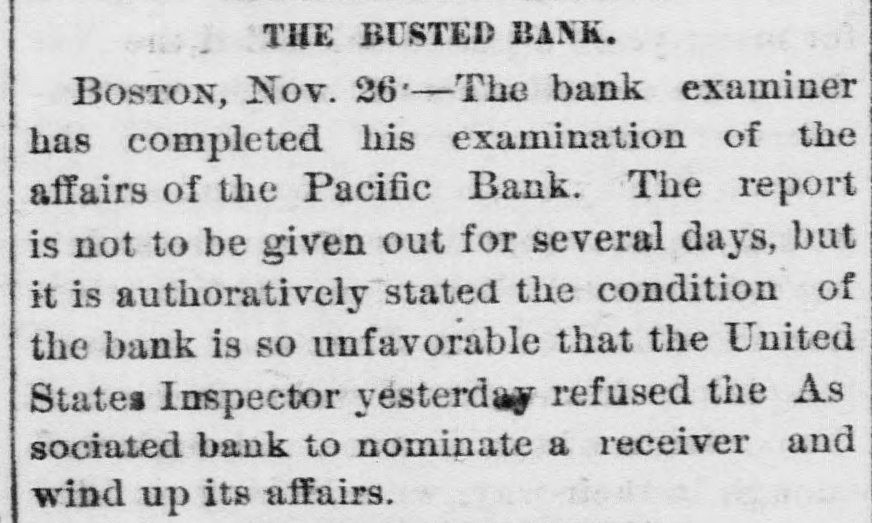
THE BUSTED BANK

BOSTON, Nov. 26-The bank examiner has completed his examination of the affairs of the Pacific Bank. The report is not to be given out for several days, but it is authoratively stated the condition of the bank is SO unfavorable that the United States Inspector yesterday refused the As sociated bank to nominate a receiver and wind up its affairs.


Article from The Salt Lake Herald, November 27, 1881

Click image to open full size in new tab

Article Text

POSTAL SAVINGS

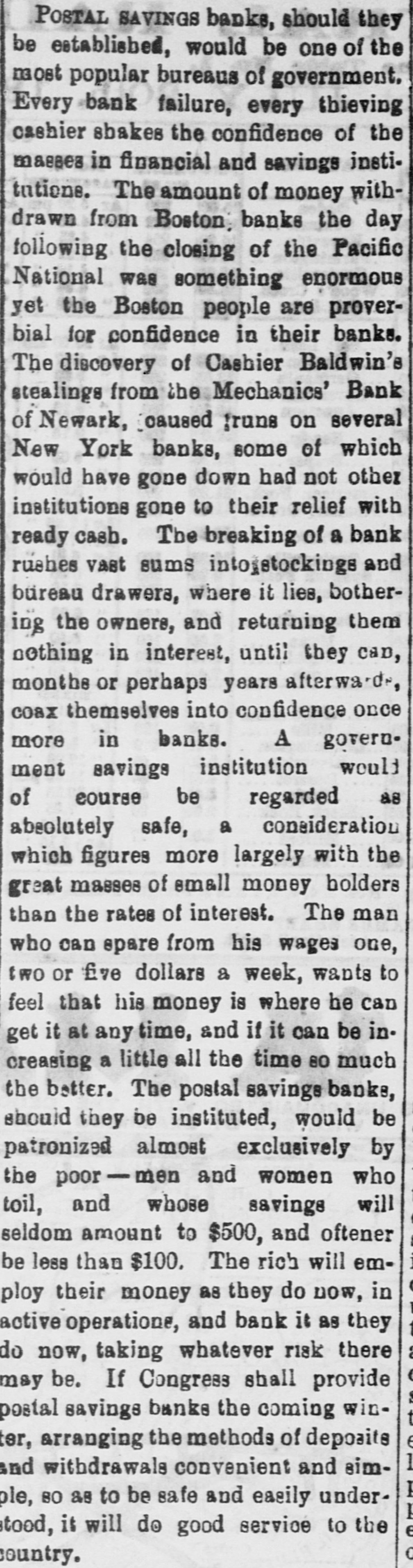
POSTAL SAVINGS banks, should they be established, would be one of the most popular bureaus of government. Every bank failure, every thieving cashier shakes the confidence of the masses in financial and savings institutions. The amount of money withdrawn from Boston banks the day following the closing of the Pacific National was something enormous yet the Boston people are proverbial for confidence in their banks. The discovery of Cashier Baldwin's stealings from the Mechanics' Bank of Newark, caused runs on several New York banks, some of which would have gone down had not other institutions gone to their relief with ready cash. The breaking of a bank rushes vast sums into stockings and bureau drawers, where it lies, bothering the owners, and returning them nothing in interest, until they can, months or perhaps years afterwards, coax themselves into confidence once more in banks.

A government savings institution would of course be regarded as absolutely safe, a consideration which figures more largely with the great masses of small money holders than the rates of interest. The man who can spare from his wages one, two or five dollars a week, wants to feel that his money is where he can get it at any time, and if it can be increasing a little all the time so much the better. The postal savings banks, should they be instituted, would be patronized almost exclusively by the poor-men and women who toil, and whose savings will seldom amount to $500, and oftener be less than $100. The rich will employ their money as they do now, in active operations, and bank it as they do now, taking whatever risk there may be. If Congress shall provide postal savings banks the coming winter, arranging the methods of deposits and withdrawals convenient and simple, so as to be safe and easily understood, it will do good service to the country.


Article from The Daily Gazette, November 28, 1881

Click image to open full size in new tab

Article Text

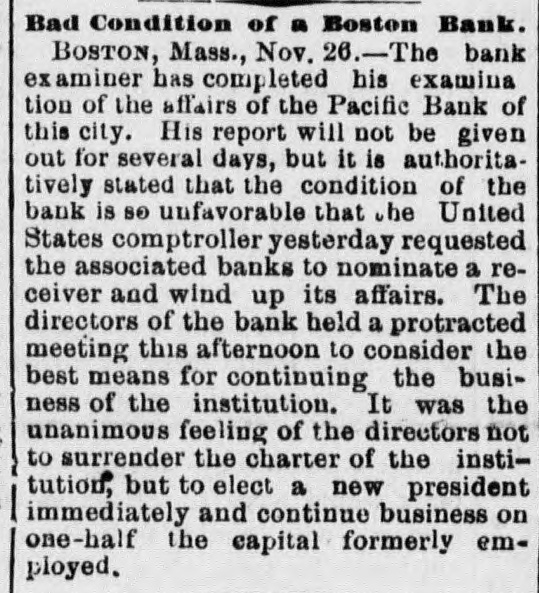
Bad Condition of a Boston Bank. BOSTON, Mass., Nov. 26.-The bank ex aminer has completed his examina tion of the affairs of the Pacific Bank of this city. His report will not be given out for several days, but it is authoritatively stated that the condition of the bank is so unfavorable that he United States comptroller yesterday requested the associated banks to nominate a receiver and wind up its affairs. The directors of the bank held a protracted meeting this afternoon to consider the best means for continuing the business of the institution. It was the unanimous feeling of the directors not to surrender the charter of the institution, but to elect a new president immediately and continue business on one-half the capital formerly employed.


Article from Wheeling Register, November 28, 1881

Click image to open full size in new tab

Article Text

To be Closed

BOSTON November 26.-The bank examiners completed the examination of the affairs of the Pacific banks The report will not be given out for several days, but itisauthoritatively stated that the condition of the banks is so unfavorable that the United States Comptroller to-day requested the associated banks to nominate 2 receiver and wind up their affairs.


Article from New-York Tribune, December 3, 1881

Click image to open full size in new tab

Article Text

in the hands of the receiver on November 2 last. It had a capital of $500,000, a surplus of $400,000, and deposits of over $2,500,000. The capital and surplus are lost through the criminal conduct of the cashier, and the stockholders are personally liable for an amount equal to the capital stock. The depositors will, it is estimated, receive at the outcome from 60 to 80 per cent of their claims, depending upon the amount collected from the stockholders and that received from the estate for whose benefit the funds of the bank are alleged to have been abstracted, which estate is also now in the hands of a receiver appointed by the court. This bank was many times examined by skilled accountants of great experience. Either of these examinations would have disclosed the robbery of the cashier, if the examiners had not been deceived by forgeries which would have been likely to mislead the most thorough experts. Such disasters do not exhibit the weakness of the banking system, bat rather the weakness and wickedness of human nature. The system is strong, and carefully and elaborately guarded. Private companies and individuals are continuously suffering from embezzlements and forgeries. The Pacific National Bank of Boston suspended on November 18 ultimo. The last report of the examination of this bank gave what seemed to be a thorough exhibit of its affairs. A long communication was addressed by the Controller to the directors of the bank on February 19 last, informing them of such irregularities as then existed in the conduct of is business. They were specially informed that the irregular and illegal practice of loaning the credit of the back by the issue of certificates must be discontinued. The directors thus had full information in reference to the irregular and illegal methods of the bank which have since caused its ruin. Such a letter, in any properly conducted bank, addressed by the Controller to a board of directors composed, as was the case in this instance, of prominent merchants and business men, should have been sufficient to correct the abuse and save the bank from the disaster which has occurred. The law should certainly LC 30 amended as to make it a criminal offence for an officer of a bank clandestinely to make loans either by the use of certificates, as in this case, or otherwise. The first Information ever given upon the subject of the proportion of bank checks used in this country was complied in 1871 by the late President Garfie d, who was well known as % careful investigator of economic subjeets. This inquiry embraces the operations of fifty-two carefully selected banks. The total receipts were $157,000,000, 01 which it was found that 12 per cent was in casa and 88 per cent in checks and drafts." The receipts of all the National Banks, 2,132 in number, on September 17 were $295,233,779. Of this sum $4,078,044 consisted of gold coin, $500,301 of silver coin. and $13,026,570 of paper money. The remainder, amounting to $277,623,862. consisted of checks and drafts, and$6,592,337 of Clearing House certificates. The gold coin equalled 1.38 per cent of the total receipts: the silver coin. 0.17 of one per cent; the paper money, 4.36 per cent, and the checks and drafts 1.85 per cent, walle the checks, drafts and Clearing House certificates together were equal to 94 09 per cent of tue whole. On September 17, tuerefore, the total per centage of cash was 5.91 per cent only. The checks received by the banks in New-York City, including both State and National, on the 30th of June, 1881, and which were cleared on the following day, amounted to $141,000,000. Of this amount, $113,000,000 were creared oy 23 banks, all of watch wave relations to a greater or less extent with brokers. From an examination 01 the clearings or each or these 23 banks, it was found that the total of certified checks on that day amounted to about $80,000,0000, of which it 18 procable that at least 90 per cenc, or $72,000,000, represented stock transactions. About 10 per cent of this amount should be allowed for the daily payment and reborrowing of loans by brokers, which is accomplished by means of certified checks. It is therefore estimated by those who are conversant with these subjects that of the $141,000,000 of exchanges about $05,000,000 represent stock exchange transactions.


Article from Edgefield Advertiser, December 8, 1881

Click image to open full size in new tab

Article Text

Even the North is becoming unfortunate in failures and defaulters. Within a few weeks two National Banks have closed their doors, caused by the dishonesty and unfortunate speculations of their principal officers. And now another blow is struck at the people's confidence in these moneyed institutions by the suspension of the Pacific National Bank of Boston. Of course these financial disasters produce a momentary flutter in business circles, but it will soon blow over, and give place to another and perhaps a more startling nine day's wonder.


Article from Edgefield Advertiser, December 8, 1881

Click image to open full size in new tab

Article Text

Even the North is becoming unfortunate in failures and defaulters.

Within a few weeks two National Banks have closed their doors, caused by the dishonesty and unfortunate speculations of their principal officers. And now another blow is struck at the people's confidence in these moneyed institutions by the suspension of the Pacific National Bank of Boston. Of course these financial disasters produce a momentary flutter in business circles, but it will soon blow over, and give place to another and perhaps a more startling nine day's wonder.


Article from Daily Globe, February 17, 1882

Click image to open full size in new tab

Article Text

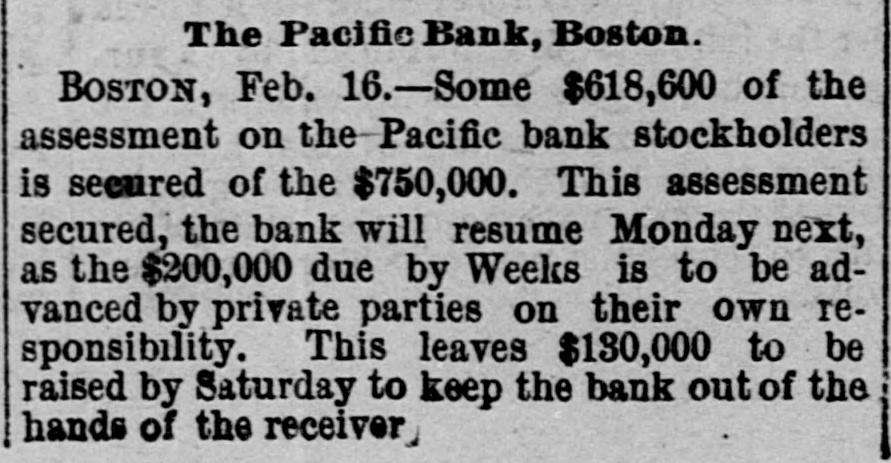
The Pacific Bank, Boston. BOSTON, Feb. 16.-Some $618,600 of the assessment on the Pacific bank stockholders is secured of the $750,000. This assessment secured, the bank will resume Monday next, as the $200,000 due by Weeks is to be advanced by private parties on their own responsibility. This leaves $130,000 to be raised by Saturday to keep the bank out of the hands of the receiver


Article from New-York Tribune, March 17, 1882

Click image to open full size in new tab

Article Text

THE NEWS THIS MORNING.

FOREIGN.-The report that the Montenegrin Army has been mobilized is denied. The returns of the French exports and imports for January and February show a large increase over those of the same months last year. The Czar, it is said, has received proof that the Nihilists intend to abandon their policy of assassination. Dr. Lamson's friends are endeavoring to secure a respite for him, asserting that his mind is unsound. No loss of life was caused by the earthquake in Costa Rica. Edouard Foussier, the French dramatic author, is dead.

CONGRESS.-In the Senate yesterday Mr. Logan explained his Educational bill. On motion of Mr. Edmunds the Senate, by a vote of 40 to 15, passed an amendment to the Post Office Appropriation bill restoring the franking privilege to Senators and Representatives. In the House, Mr. Taylor, of Ohio, spoke at length against the Chinese bill. A resolution was adopted directing the Committee on Foreign Relations to call for copies of all of Shipherd's correspondence relating to the Peruvian Company between himself and the officers of the Government.

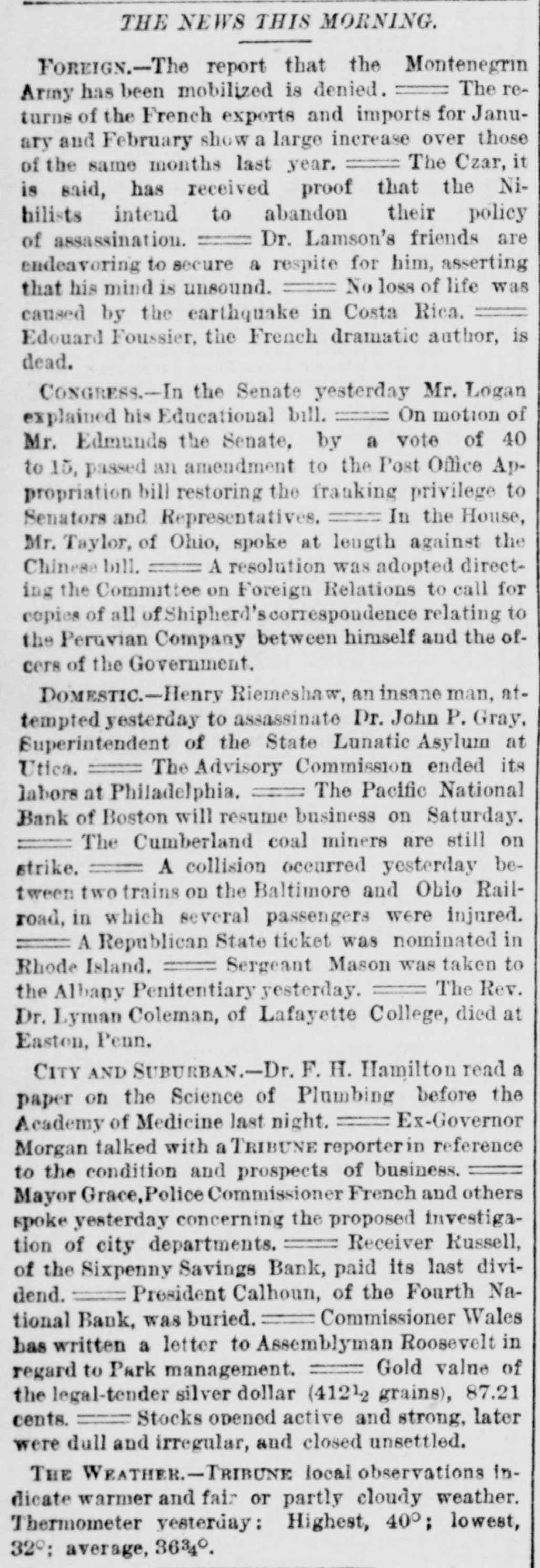
DOMESTIC.-Henry Riemeshaw, an insane man, attempted yesterday to assassinate Dr. John P. Gray, Superintendent of the State Lunatic Asylum at Utica. The Advisory Commission ended its labors at Philadelphia. The Pacific National Bank of Boston will resume business on Saturday. The Cumberland coal miners are still on strike. A collision occurred yesterday between two trains on the Baltimore and Ohio Railroad, in which several passengers were injured. A Republican State ticket was nominated in Rhode Island. Sergeant Mason was taken to the Albany Penitentiary yesterday. The Rev. Dr. Lyman Coleman, of Lafayette College, died at Easton, Penn.

CITY AND SUBURBAN.-Dr. F. H. Hamilton read a paper on the Science of Plumbing before the Academy of Medicine last night. Ex-Governor Morgan talked with a TRIBUNE reporter in reference to the condition and prospects of business. Mayor Grace, Police Commissioner French and others spoke yesterday concerning the proposed investigation of city departments. Receiver Russell, of the Sixpenny Savings Bank, paid its last dividend. President Calhoun, of the Fourth National Bank, was buried. Commissioner Wales has written a letter to Assemblyman Roosevelt in regard to Park management. Gold value of the legal-tender silver dollar (412½ grains), 87.21 cents. Stocks opened active and strong, later were dull and irregular, and closed unsettled.

THE WEATHER. TRIBUNE local observations indicate warmer and fair or partly cloudy weather. Thermometer yesterday: Highest, 40°; lowest, 32°; average, 36¾°.


Article from Wheeling Register, March 20, 1882

Click image to open full size in new tab

Article Text

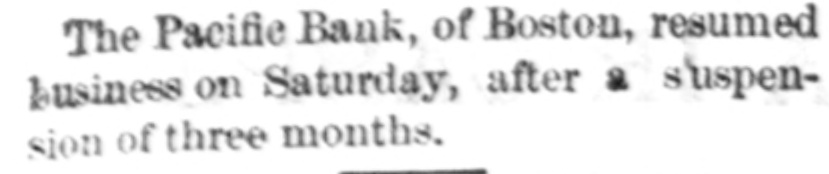
The Pacific Bank, of Boston, resumed business on Saturday, after 2 s'uspension of three months.


Article from Seattle Daily Post-Intelligencer, May 23, 1882

Click image to open full size in new tab

Article Text

EASTE RN

ASSOCIATED PRESS DISPATCHES A Good Rule. Cancago, May 22.-By viva voce Trade today with scarcely Board of voice adopted the follow which is preon contracts for corners designed higher future grade to de the tender of a of Harry; kind kind of grain than the one coninvoted for shall be deemed sufficient, contracts for future delivery of on and after specially otherwise what made anda agreed June understood by 1882, the parties, shall be of and tender of Minr No.2 wheat contracting or winter variety, either sufficient the tender spring No. ml shall be deemed a infulfilment of such contract. This merale proposed about ten days ago. Cause of Bank's Failure. Borrow, May 22.-The immediate - the suspension of the Pacific Bank was the maturing of $500,000 Saturday, which the bank was unable It and which went to protest. understood to pay, that all deposits will be in full, but the original stock williers will gold have their investment of $2,000,000 washed out. Wretched Children. MUSCATINE, May 22.-There are new and startling developments in the Manormon fratricide, twelve miles west where. The girl, Mary, who on Satur day declared she shot her father in self defense, has been found to have lied. Her brother and her elder sister are here in jail. The Daily Journal has full confession from the two girls, showing the murder was committed by their brother in order that the children might have things their own way at home, and that it was arranged that the youngest sister should acknowledge the abooting with the idea of a plea of self-defense, and her extreme youth and her from punishment, and thus her sister and brother escape punishmont also. There is much excitement over the case here. A Good Crop Report. Sr. LOUIS, May -From over two hundred reports received by one of the beding and most reputable grain commission houses of this city, from all nations of this State, respecting crops, the following condensation is made With three or four exceptions the reports indicate that neyer before were the wheat prospects so promising at this meason of the year. The late cool weather has checked the rank growth and at the same time put a stop to the progress of chinch bugs, of which there quite a number, but they have thus tar done no injury. The army worms have been feared in the southeastern counties, but have done no damage yet At one point the Hessian flies have shown theuselves, but in too small numbers cause any damage. Rust has done no injury, the wheat not heading out,and the generally expressed opinion in that wheat is too far advanced to suffor by insects of any kind, even if the young chinch bugs should appear, which seems very improbable. After the recent calm weather the acreage of what sown was much larger than was harvested last year. Harvesting begins early in June, if the weather is favorabla. Corn is about all planted, and the southern and central counties show very good standing for the time of year In some sections it has received two plowings. The oool weather kept it backward somewhat, but on the whole it looks very well. The acreage larger than in 1881. No fears of dam age by chinch bugs are anticipated, un less the weather during June should be hot and dry. The oats acreage is large, and the crop looks exceedingly well. With good weather harvesting will be gin June 1st. The farmers are happy From Kansas reports are numerous and universally good, and while the area sown is probably 15 to per cent. less than sownlast season. a larger yield per acro is expected. Chinch bage have decreased considerably since the cold weather set in, but they are still numer ous. The damage occasioned by them in the northern counties, if hot kdry weather occurs, may be serious, and wheat may suffer by their work. Har vesting will begin in the southwestern counties from May 25th to June 1st, the weather remains favorable. Pleadings Filed. May 22.-Hallet Kilbecome's amended pleadings, in the case against ex-Sergeant-at-Arms Thomp mater false imprisonment, have been Sind, in which he claims $35,000 dam. - Thompson has employed Judge McSweeny, of Wooster, Ohio, and Sensal 8. Shellabarger as additional Horse Thieves Lynched. Larras Rock, April 22.-A band of vigiliates have been chasing eight horse Missouri for over two weeks Three have been captured near Kirby and lynched. The other five as caped, but one has been since killed One was mortally shot, the third eap fared and in jail, and the other two www.hamnied in on White river, and and lynched. Trespassers on Indian Lands CHECAGO, May 22.-In a letter dated Agell 29th the Secretary of the Interior by Mr. of Parsons, Kansas, that a settle made being made in the Oklahama district by the followers of Captain Payme, and he requests the Secretary Werto take steps for their removal Hambly places the number of these w Capt. Carroll made an in malligation, and finds Mr. Hambly's Mailment incorrect. The Oklahama


Article from Daily Globe, June 3, 1882

Click image to open full size in new tab

Article Text

Schemes of Stockholders

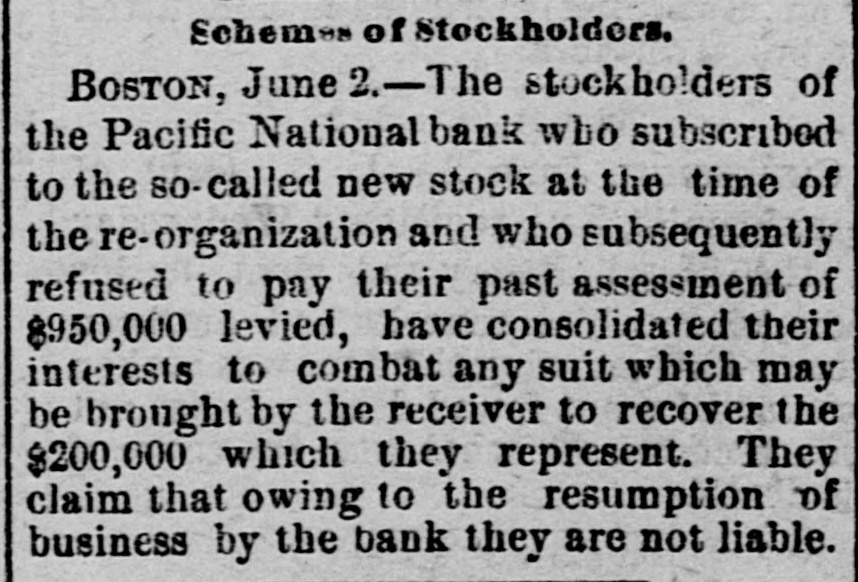
BOSTON, June 2.- - The stockholders of the Pacific National bank who subscribed to the so-called new stock at the time of the re-organization and who subsequently refused to pay their past assessment of $950,000 levied, have consolidated their interests to combat any suit which may be brought by the receiver to recover the $200,000 which they represent. They claim that owing to the resumption of business by the bank they are not liable.


Article from New-York Tribune, December 6, 1882

Click image to open full size in new tab

Article Text

ANOTHER ASSESSMENT LEVIED

!BY TELEGRAPH TO THE TRIBUNE.] BOSTON, Dec. 5.-The unfortunate stock. holders of the Pacific National Bank, which suspended for the second time several weeks ago, are again called upon to pay 100 per cent on their stock. When the bank first failed a like assessment was levied and many of the stockholders paid it. A few, preferring to incur the expense of a law suit, declined to pay. After its reestablishment the law recognizes the bank as a new institution and the unpleasant process of assessment must be again submitted to.


Article from The Panola Weekly Star, December 9, 1882

Click image to open full size in new tab

Article Text

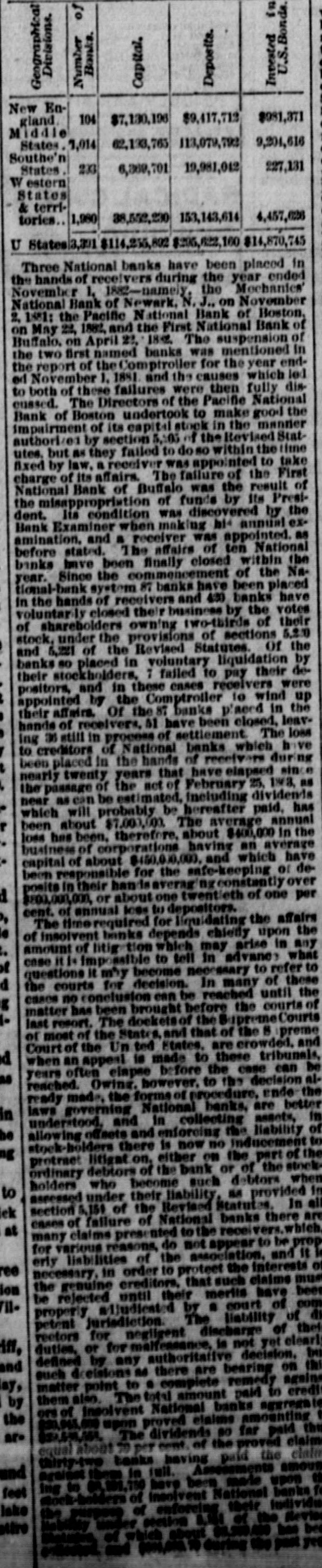
o F is New En104 $981,371 gland $9,417,712 $7,130,196 Middle 9,201,616 7,014 113,079,792 States. 62,133,763 Southe'n 2x 227,131 19,981,012 6,389,701 States. estern States & terri1,960 153,143,614 torics. 38,552,250 U Three States National 3,301 $114,215,802 $215,822,160 $14,870,745 4,457,026 the November hands of 1, receivers banks during have the been placed in National 101: Bank of INC-namely Newark. the year Mochanics' ended on May the of Pacific National N. Bank on November Buffalo, the two on 1882, April and 21, the 18th First National of Bank Boston, of ed the November report first of named the 1. 1881 Comptroller banks The was for suspension mentioned the of In cussed. to both of The these failures and the were causes year which end- led Bank of Boston Directors undertook of the Pacific then fully National disimpairment authorized by of section its capital stock to make in the good manner the utes. fixed but by law. as they a failed 5.00 to doso the Revised StatNational the charge of Bank Its affairs. receiver of Buffalo The was failure appointed within of the the to First take time dent. inappropriation Its condition of funds was the by Its result of amination. before Bank Examiner and a when receiver making was discovered his annual by Presi- the exbanks have stated. The affairs was of appointed. as year. Since the been finally closed ten National tonal-bank In 87 of within the the voluntarly of the shareholders hands closed of receivers their banks business and have 430 banks been placed have Na. stock, and 5,221 under of the the provisions owning two-thirds of the of votes their banks so placed Revised Statutes. sections 5.2.0 their stockholders. in 7 voluntary liquidation or the appointed positors, and by in the these failed cases to receivers pay their de- by hands their affairs. of Of the omptroller 87 to wind were up to Ing as still receivers, in process MI of have banks been closed, in leav- the creditors of settlement nearly been placed twenty In years the National hands of banks receiv which The have loss hear which the passage as will can of be the estimated. act that of including February have elapsed 25, IN a dur sin ng as r been about probably be hereafter dividends business loss has been, $7,003,00 therefore The average paid, annual has been capital responsible of of about corporations $160,000,000. about having and $400,000 an average In the d posits in their han for the keeping which or have deP. cent. $100,000,000 The of time annual or about one less averag to depositors. twent nz constantly eth of one over per e amount of Insolvent of required banks depends for Liquidating the affairs of d case the questions Imp It litig mhy sabble tion become to which tell may In chieny advance arise upon in what any the & cases matter courts no conclusion for decision. can In essary many to of refer these to 1. last resort. has been The brought be before reached until the or most of the dockets of the the courts of d Court when an of the Un States ted States. and that of prome Courts the 8 preme as years often appeal elapae is made to are these crowded. and ready laws reached. made, Owins. the forms however. of fore to the the case decision tribunale. can be in understood Giverning and National banks. Endo the al. he ng allowing stock-holders offsets there and In enforcing collecting the are assets, better in protest litignt on. is now no nducement liability of to assessed ordinary holders under debtors who become of the either bank such on or the of part the of stock the ck 5.150 of the as at many claims failure of National Statutes In section cases of their Reviand liability banks btors provided when all In for various presented the there are ree erly liabilities reasons, of the do not appear receivers.whieh to be ion necessary. the Renuine in order to protect association. the and prop ⑉ 11. be rejected creditors, until that such Interests of properly petent Jurisdiction aujudicated their by merits a court claims have mus beed rectors for The of iff, and ay, defined duties, or by any negligent liability not yet of clearl of that such matter them alen dreist point to authoritative there are bearing decision. on the by neurogate banks the amounting Incolvent The total National amount paid in again credi claims the paid far are and feet lake the


Article from The Indianapolis Journal, January 13, 1883

Click image to open full size in new tab

Article Text

All but one of the shareholders of the defunct Pacific Bank of Boston have entered into a combination, which is formed for defense against the suits of the receiver for aggressive action against the directors.


Article from Evening Star, January 30, 1883

Click image to open full size in new tab

Article Text

PERSONAL

Mr. Robert R. Bishop, who ran against Ben Butler for governor of Massachusetts, arrived in town this morning, and is at the Riggs.

Mr. J. F. Secor, jr., of Vallejo, Cal., is at the Metropolitan.

Commodore Wells, commandant of the Portsmouth navy yard, is at the Ebbitt.

Mr. Linus W. Price, receiver of the Pacific National Bank of Boston, is in the city.

Senator Butler, Representatives Pound and Walter A. Wood, and Gen. Williamson, of Washington, were registered in New York last night.


Article from Daily Globe, February 10, 1883

Click image to open full size in new tab

Article Text

Wrecking a Boston Bank.

The Boston Journal has learned that Benyon, the fugitive ex-president of the Pacific bank, is hiding near Montreal. He first learned that steps were to be taken to indict him in September last, when he left Boston for New York. He remained at the Park hotel until just before a warrant for his arrest was actually issued, and then he fled to Canada. For some weeks he lived at the Clifton house, Niagara, where his wife visited him. He was also seen at St. Catherines by Bostonians in October. Soon afterward he made a trip to Mexico, and spent some weeks in a little village a few miles from the capital. About the middle of December he returned to the Dominion.

Not long ago several stockholders, who are collecting evidence against directors and others whom they allege conspired with Benyon to wreck the bank, desired to communicate with the fugitive president about a disputed point. They employed as counsel the Hon. Steven K. Phillips, ex-attorney general. Gov. Butler was retained as Benyon's counsel some months ago, and through him the desired result was accomplished. In order that anything Benyon might furnish should not criminate him, Mr. Phillips was made associate counsel, and in that capacity he visited Benyon in his hiding place which is now near Montreal. In his interview with Mr. Phillips, Benyon discribed himself as the cat's-paw and persecuted party. He believed that he would soon be able to vindicate himself. and he even ventured to assert that he could return and start another bank. He was very bitter against some of his wicked partners, and in response to Mr. Phillip's request he furnished documentary evidence against certain of them which will be used in the criminal courts. It implicates men of wealth and of the highest standing in the community. Several New Yorkers are accused of using him to bleed the bank of sums aggregating over a million. The collateral back of these loans is of the flimsiest sort. For instance, Receiver Price has a claim against Edward Crane of New York for $190,000 on collateral which Mr. Price says has no market value The receiver says that he has begun suit against Mr. Crane for that amount. The facts as they slowly develop are fast showing the collapse of this institution to have been the result of the greatest financial crime of modern times. A conservative apprisal of the assets amounting nominally to over $3,500,000, shows them to be worth not more than fifteen cents on the dollar. Benyon trusts to inadequate provisions in the extradition treaty to render him safe in his Canadian retreat.