Third National Bank (Chicago, IL)

Episode Information

Episode UID
23600935
Episode Type
Run โ†’ Suspension โ†’ Closure
Bank Type
national
Bank ID
2360 national
Charter Number
236
Start Date
November 21, 1877
Location
Chicago, Illinois (41.850, -87.650)

Metadata

Model
gpt-5-mini (chosen from majority vote of a three-model LLM ensemble)
Short Digest
8247f657baa33c68

Response Measures

Accommodated withdrawals, Borrowed from banks or large institutions, Fed/other loan, Public signal of financial health, Full suspension, Books examined

Clearinghouse involved: Yes (loan, examination, or other measures)

Receivership Details

Depositor recovery rate
100.0%
Date receivership started
1877-11-24
Date receivership terminated
1907-12-31
OCC cause of failure
Losses
Share of assets assessed as good
58.0%
Share of assets assessed as doubtful
27.6%
Share of assets assessed as worthless
14.4%

Description

Bank was suspended by the Clearing-House and put into liquidation with a receiver appointed; later dividends were paid during receivership.

Events (5)

1. February 5, 1864 Chartered
Source
historical_nic
2. November 21, 1877 Run
Cause
Bank Specific Adverse Info
Cause Details
Protracted withdrawals from public and country correspondents driven by loss of confidence, rumors, and bad loans/real-estate losses impairing capital.
Measures
Directors decided not to open for further business; collections and mail turned over to Commercial National Bank; steps taken to liquidate.
Newspaper Excerpt
a heavy drain has been in progress...Within a few weeks nearly three-quarters of a million dollars of public deposits have been withdrawn.
Source
newspapers
3. November 21, 1877 Suspension
Cause
Bank Specific Adverse Info
Cause Details
Clearing-House examination found impairment of capital and means, leading to suspension and cessation of payments.
Newspaper Excerpt
Resolved, That the Third National Bank be and is hereby suspended from the Clearing-House Association...directed not to open the bank for further business.
Source
newspapers
4. November 24, 1877 Receivership
Source
historical_nic
5. November 27, 1877 Receivership
Newspaper Excerpt
Comptroller Knox has selected Mr. Huntingdon W. Jackson as Receiver for the Third National.
Source
newspapers

Newspaper Articles (22)

Article from New-York Tribune, August 30, 1877

Click image to open full size in new tab

Article Text

EFFECT UPON BUSINESS IN THIS CITY. The failure of the State Savings Bank of Chicago had no perceptible effect here, and bankers generally regarded it as a temporary matter, not likely to create a panic or disturb the standing of other Chicago banking institutions. A private dispatch received yesterday afternoon stated that the run on the banks was not heavy, that the larger institutions were promptly meeting all demands, and that savings banks were insisting on the rule that for the withdrawal of larger amounts than $10, thirty days notice must be given. It is not believed by the officers of the leading banks in this city that there is any immediate danger of a serious time with the Chicago Banks, and in no case could it much affect banks 111 this city. The State Savings Bank of Chicago is reported to have total resources of $2,724,000, with liabilities of $2,988,339. This is believed to be a low estimate of the deficiency, which, it is thought, will be increased somewhat on account of the shrinkage in values of real estate, of which the bank holds $1,435,315. A Wall-st. banker stated that the financial embarrassment of the State Savings Bank has been a matter of discussion for a long time, and gross mismanagement has been charged against its executive officers. He stated further that D. D. Spencer, the president, was reported to have been a heavy operator in grain, and had by the decline lost the money of the depositors with which he had been operating. Mr. Spencer 18 reported as having left Chicagoon Saturday for this city, but up to last night he had not been seen or heard of, and the presumption among bankers is that he laid over in Canada, or went in a westerly direction. The members of the Produce Exchange were somewhat anxious yesterday morning to obtain full intelligence. Advices were received throughout the day, and they all tended to show that the market, as yet, had not been affected to any extent in Chicago, and there were, therefore, no fears to be entertained of trouble here. A prominent member of the Exchange stated to a TRIBUNE reporter that unless there was a very heavy run on the Chicago banks, causing a money panic, there would be no trouble 111 the produce market here. The Exchange in this city was governed almost entirely by the news from London, and not by the Chicago market, which was too speculative. If, he said, there were any heavy failures there, it would then probably have a disastrous effect on New-York merchants.


Article from Clearfield Republican, September 12, 1877

Click image to open full size in new tab

Article Text

AN AWFUL "BUST Up."-The State Saving Institution, at Chicago, closed its doors on Friday. The concern is a million of dollars short. The assetts foot up at their face $2,337,496.23 while the true value is only $869,000. The amount due depositors is $3,050,017.17. All the available cash to be found in the Bank was about $24,000 out of the millions deposited by the 15,000 depositors. The Cashier, David D. Spencer, is in Europe. His own individual note for $500,000 was found among the assets. A general run is being made on all the Chicago banks and some more of them may close their doors before the panic is over. But, then Chicago can stand almost anything.


Article from The Sun, November 22, 1877

Click image to open full size in new tab

Article Text

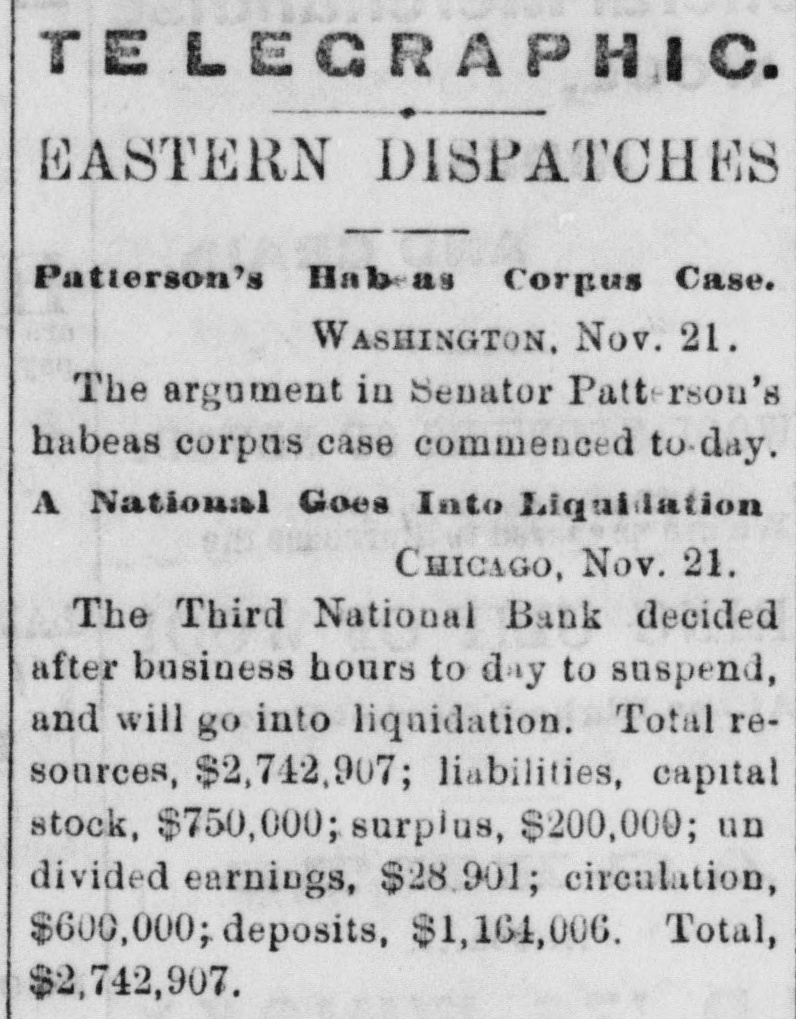
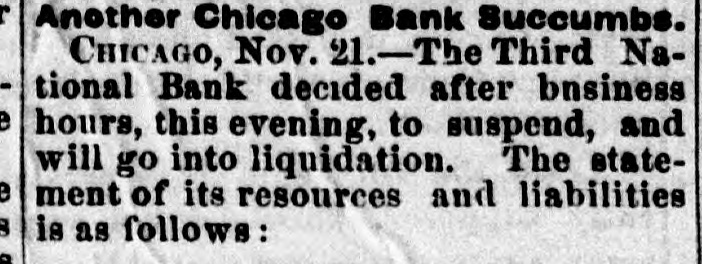
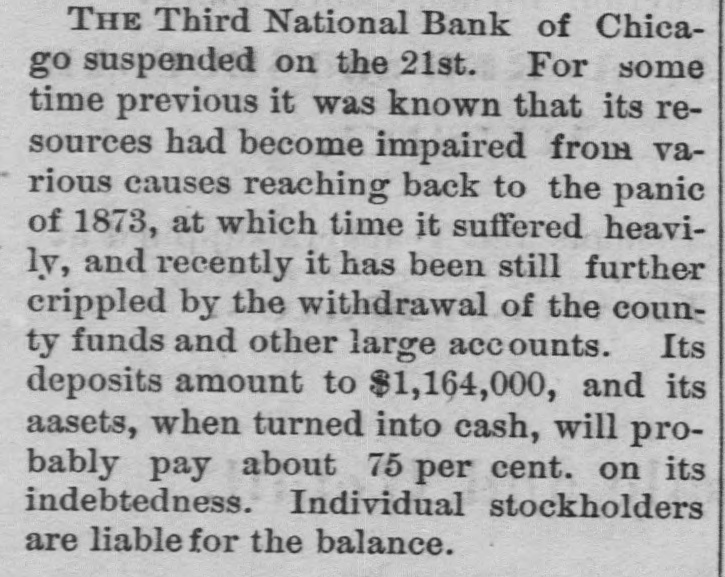
Failure of a Chiengo Bank. CHICAGO, Nov. 21.-One of the directors of the Third National Bank of Chicago requested that the Clet ing House make an examination of the affairs of the stitution, and it being done, the Clearing House foun such an Impairment of its capital and means to make it necessary to suspend said bank The rectors. at a meeting this alternoon, decided that it WA note expedient for the bank to continue payments, and was decaled not to open for further business and that steps be taken at once w put the bank into liquidation, All Elections are to be turned over to the Commercial Note Bank The deposits aggregate $1,164,005.64 The resources are Insured at $2,742 N17 of which $1,560,020.50 is on bitte discounted, leas $127,000 rediscount in New York I'me overdraits are $161,415 real ORIGIN. $105,802. and cas and exchange $283,300


Article from The Daily Gazette, November 22, 1877

Click image to open full size in new tab

Article Text

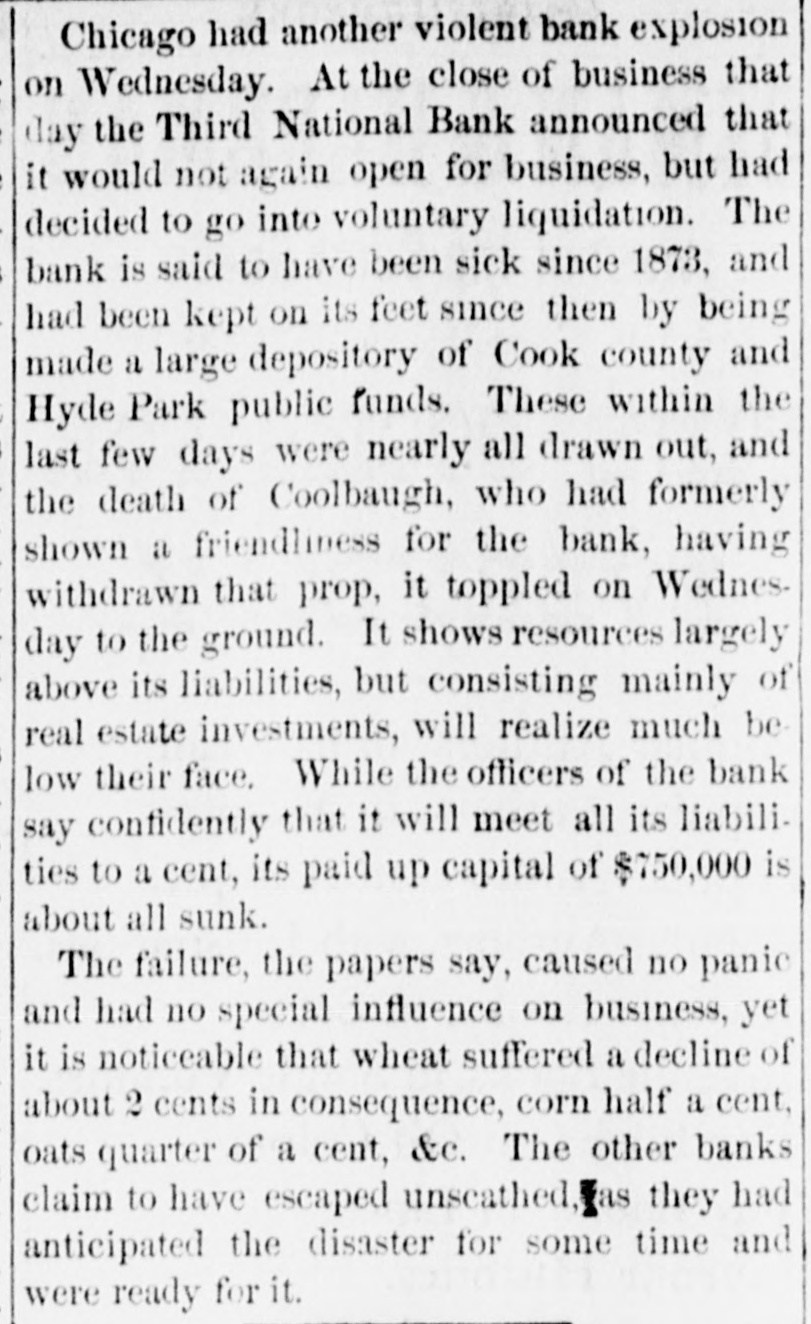
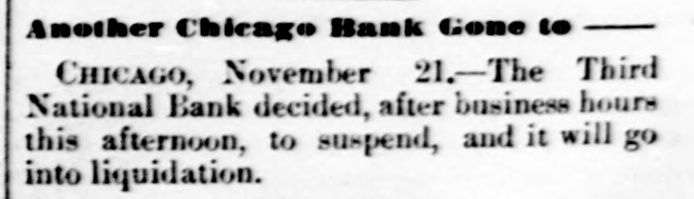
THE RESULT OF THE CENTENNIAL.It is stated that a Belgian gentleman, who was the commissioner from that country to the centennial exhibition, is organizing a company of European capitalists for the purpose of making plate glass in America, and that he proposes to return to this country in a short time to select a location. The company's works are to be situated in the neighborhood af Pittsburg, where the firm also contems plate the purchase of coal fields. NED BUNTLINE.-Col. E. Z. Judson (Ned Buntline) passed through York, Pa., on Monday, on his way to Georgia, where he will spend the winter for the benefit of his health. He is accompanied by his family and travels on his own conveyance, having a comfortable carriage and a pair of thorough-bred horses. He has with him a Sharp's rifle, seventy-five pounds of ammunition, and a full assortment of fishing-tackle. It was in his capacity of the working man's friend that the Hon. S. .S. Cox asked the House yesterday to appropriate an indefinite sum as extra compensation for an unspecified number of Government employees alleged to be compelled to work more than the eight hours per diem prescribed by the law. Obtaining only twenty votes-besides his own-for the amendment, Mr. Cox took an appeal to the galleries. CONVICTION OF YOUNG OULD.Robt. C. Ould, son of Judge Robert Ould, of Richmond, Va., who shot a young man named Saunders, in Buckingham county, several months ago, was tried and convicted in the County Court of that county last week. The verdict of the jury was twelve months confinement in the county jail and a fine of $300. CHILD CHOKED TO DEATH.-On Friday evening two small children of Daniel Witman, living about six miles from York, Pa., were playing about the house, when one of them, a little girl between seven and eight years old, got a piece of apple in her throat, It was strangled to death before any assistance to relieve it could be rendered. The Third National Bank of Chicago has decided to suspend and go into liquidation.


Article from Chicago Daily Tribune, November 22, 1877

Click image to open full size in new tab

Article Text

OFFICIAL. THE DOCUMENTS IN THE CASE. The following reports and statements were furnished yesterday evening by the officers of the bank: The officers and Directors of the Third National Bank yesterday afternoon received the following communication: At the request of one of the Directors thereof. an examination of the Third National Bank has been made by members of the Clearing-House Committee. resulting in finding such an Impairment of the capital and means of said bank as to make It necessary to take action by this Commitmittee; therefore. Resolved, That the Third National Bank be and is hereby suspended from the Clearing-House Association, and that the officers of said bank be notified that such action has been had. to take OnsoN SMITH. effect Immediately. Chairman of Committee. Upon receiving notice of this summary action, a meeting of the Directors was called to consider what should be done. A brief conalderation led, on motion of Mr. Steele, seeonded by Mr. Curtis, to the adoption of the following: Resolted, That, in view of the action of the Clearing-House Committee. it is not expedient for this bank to attempt to continue payment. Resolved, That the officers of this bank be and they are hereby directed not to open the bank for further business. but that proper steps be timmediately taken for the purpose of putting the bank into liquidation. On motion of Mr. Pullman, seconded by Mr. Thompson, it was Resolved, That all mail matter. after this date. and all collections now on hand, be turned over to the Commercial National Bank for the account of the respective owners thereof. The action of the Clearing-House Committee, which has thus culminated tu closing the Third National Bank, It is understood, Was the result of investigations by members of the ClearingHouse Committee and other bankers. made at the request of a Director of the bank in question. It has been for some time known in commercial and financial circles that the bank was a large depository of public funds. The County Treasurer and the Treasurer of the South Park both kept large balances, and the withdrawal of these funds is DO doubt a prominent cause of the failure. For some months past there have been many rumors affecting the solvency of the bank, which have operated to Impair public confident c and destroy its business. The effect of this is seen In the gradual decline of their deposit line from a total of over $1,000,000 In 1873; to a total of $1,101,000.84 at the close of business last night. These causes led the Director referred to to Invite au examination Into the affairs of the bank, with the view of obtaining from other banks such nasistance as might he needful to the further liquidation of Its Habilities. Such an examination was made, four or five of our must responsible bankers joining in the examination. The result of this examination, while It Fatisfied the parties thereto that the assets of the bank were sufficient to fully liquidate Its Habilities and leave a percentage, more or less, to be distributed to the stockholders, did not eventuate in the much-needed assistance. It did result, bowever, In prompt nction by the ClearingHouse Committee, which adds another to the long list of broken and suspended banks in the financial listory of Chicago. The following Is a statement of the resources and liabilities of the bank at the close last even. log: RESOURCES. .-


Article from Chicago Daily Tribune, November 22, 1877

Click image to open full size in new tab

Article Text

Causes of the Suspension of the Third National Bank. The Loan Market Dull--New York Ex change Weak---Clearings, $3,500,000. The Produce Markets IrregularHogs and Provisions Quiet and Ensier. Barley Strong--Wheat and Corn Active and Firmer, but Closed Weak. FINANCIAL. The enspension of the Third National Bank is the effect of canees that have been in operation siz years. Every Chicago institution suffered In the great fire. and the Third National Incurred more than an average proportion of loss. The panic that followed in 1873 found the Third National suffer ing to such an extent from the unrepaired damage of the fire that It was compelied to suspend. AIthough the bank resumed In A fortnight, seriousand. as the requel shows, irreparable Injury had heer done to 11. It was compelled to take in paymen of indebtedness due It a large quantity of real ed tate in the various quarters of the city, and the greater proportion of this was unimproved. In this way the bank was loaded up with several hun dred thousand dollars' worth of real estate. I has been unable to realize on this, and has beer compelled to pay heavy taxes and assessments or it. Each succeeding year elace the panic has FEET n deterioration In the business of the bank. This was RD gradual as to he almost imperceptible when viewed in short periods, but was plainly visible at the cluse of each year's transactions. Times have been hard, collections elow, opportunities for the employment of bank funds unsatisfactory, and failures leaving the bank with bad debts frequent. This state of affairs the Third with proper manage ment might have survived. but, unfortunately, a the time of the savings-bank failures. the statemen was telegraphed throughout the country that one o two of the National Banks were unsound. One of the dispatches mentioned the Third by name Its country correspondents became alarmed and many of them drew their balances down. 1 similar want of confidence spread among its city customers. For several months a heavy drain has been in progress. Within a few weeks nearly three-quarters of a million dollars of public de posits have been withdrawn. The attention of the Executive Committee of the Clearing-House hav ing been called to this state of affairs, they have suspended the bank from the privileges of the Clearing-House, and given it notice that ILA asso clate banks will no longer honor its checks. This made it necessary for the bank to go into liquidation. Its capital, surplus, and andivided earnings amount to about $1,000,000. The reant of the liquidation, it is estimated by the mos sanguine of the stockbolders. will leave them par on their stock: the extreme view on the other eide is that one-half the stock will be wiped out. Is any event, the assets of the bank and the responsi billty of its stockholders will protect the deposit ora from loss, The bank has virinally been Is


Article from The Cincinnati Daily Star, November 23, 1877

Click image to open full size in new tab

Article Text

Changed Hands. The Evening Mail was sold at Sheriff's sale yesterday morning, and was bought by Clark and Bell and Dr. William H. White for $8.710 The Mail will be coneucted under the same editorial management as heretofore. Vanderbilt's Will. It is reported that the contest of Mrs. Labau of Vanderbill's will has been discontinued. SHAKY CHICAGO. Another Bank Failure This Morning. National Associated Press to the Star. CHICAGO, Nov. 23 -The Central National Bank, of this city, closed its doors at 10:30 to-day. The suspension of the Central Nation. al Bank causes considerable excite. ment, as it is a disappointment to those who hoped that no further failures would follow that of the Third National on Wednesday. The two banks which have gone, and the one which still holds out, have been mentioned as snaky for a month past. When the first tailed, the knowing ones feared the other two would follow, but everything has been done to prevent a panicky feeling from aiding in causing this. It is probable that one more may fall, the one which has been mentioned in connection with these two as shaky, but all other banks are sound beyond question.


Article from The Iola Register, November 24, 1877

Click image to open full size in new tab

Article Text

THE Third National Bank of Chicago suspended payment this week, and will go into liquidation. 36


Article from Chicago Daily Tribune, November 24, 1877

Click image to open full size in new tab

Article Text

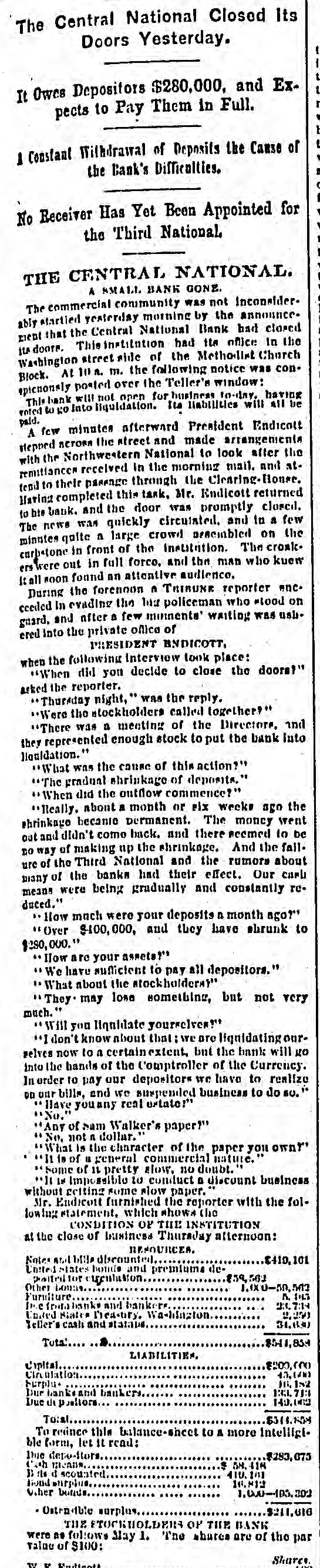
The Central National Closed Its Doors Yesterday. It Owes Depositors $280,000, and Expects to Pay Them in Full. 1 Constant Withdrawal of Deposits the Cause of the Bank's Difficulties. No Receiver Has Yet Been Appointed for the Third National. THE CENTRAL NATIONAL. A SMALL BANK GONE. The commercial community was not Inconsiderably startied yesterday morning by the announcegent that the Central National Bank had closed ILA doors. This institution had the office In the Washington street side of the Methodist Church Block. At 10 n. m. the following notice was con. epicionaly posted over the Teller's window: This bank will not open for business to-day. having reted to go Into liquidation. Its liabilities will all be paid. A few minutes afterward President Endicott stepped ACTORA the street and made arrangements with the Northwestern National to look after the remittance received In the morning mail. and attend to their passage through the Clearing-House. Having completed this tank. Mr. Endicott returned to bis bank. and the door was promptly closed. The news was quickly circulated. and In a few minutes quite a large crowd assembled on the curpotone in front of the institution. The croskerswere out in full force. and the man who knew Itall moon found an attentive audience. During the forenoon n TRIBUNE reporter anc. ceeded in evading the but policeman who *tood on guard. and after a few minnents' waiting was ush. ered into the private office of PRESIDENT BNDICOTT. when the following Interview took place: "When did you decide to close the doors?" asked the reporter. Thursday night,' was the reply. 'Were the stockholders called together!" 'There was a meeting of the Directors, and they represented enough stock to put the bank into liquidation." What was the cause of this action?" "The gradual shrinkage of deposits." When did the outflow commence?" "Really. about a month or six weeks ago the shrinkage because permanent. The money went out and didn't como back. and there seemed to be no way of making up the shrinkage. And the fail. ure of the Third National and the rumors about many of the banks had their effect. Our carb means were being gradually and constantly reduced." How much were your deposits n month ago?" Over $400,000, and they have shrunk to $280,000." How are your assets?" We have sufficient to pay all depositors." What about the stockholders?" They. may lose something, but not very much." Will you liquidate yourselves!" "I don't know about that we are liquidating ourselves now to a certain extent, but the bank will go into the hands of the Comptroller of the Currency. In order to pay our depositors we have to realize DD our bills, and we suspended business to do so. Have youany real estate!" No." Any of Sam Walker's paper!" No. not n dollar. What is the character of the paper you own!" is of a general commercial nature. Some of 11. pretty slow, no doubt. **It IN Impossible to conduct 0 discount business without criting some slow paper. Mr. Endicott furnished the reporter with the following statement. which shows the CONDITION OF THE INSTITUTION at the close of business Thursday alternoon: RESOURCES. Notes and MILA discounted $410,101 United states bonds and premiums de$59,563 postedior circulation Other bonns 1.000-50,563 5.193 Furulture 23.734 Inc from banks and bankers United Minter reasury. Washington 2,000 Teller's cash and stateme 31,630 Total $541,859 LIABILITIES. L'ipital $200,000 Circulation 40,000 Surplus 16,152 Due banksand bankers 133.713 140,000 Due de positors To:sl $311.558 To reince this balance-sheet to A more Intelligible form, let It read: Due depo-itors $283,075 Cab means 58,418 B the d scounted 410.101 Bond surplus, 10,812 Viher builds 1.000-103.302 Ostra-tble surplus $211,010 THE STOCKHOLDERS OF THE BANK were as follows May 1. The shares are of the par value of $100: Shares. W & Exclisett


Article from Chicago Daily Tribune, November 27, 1877

Click image to open full size in new tab

Article Text

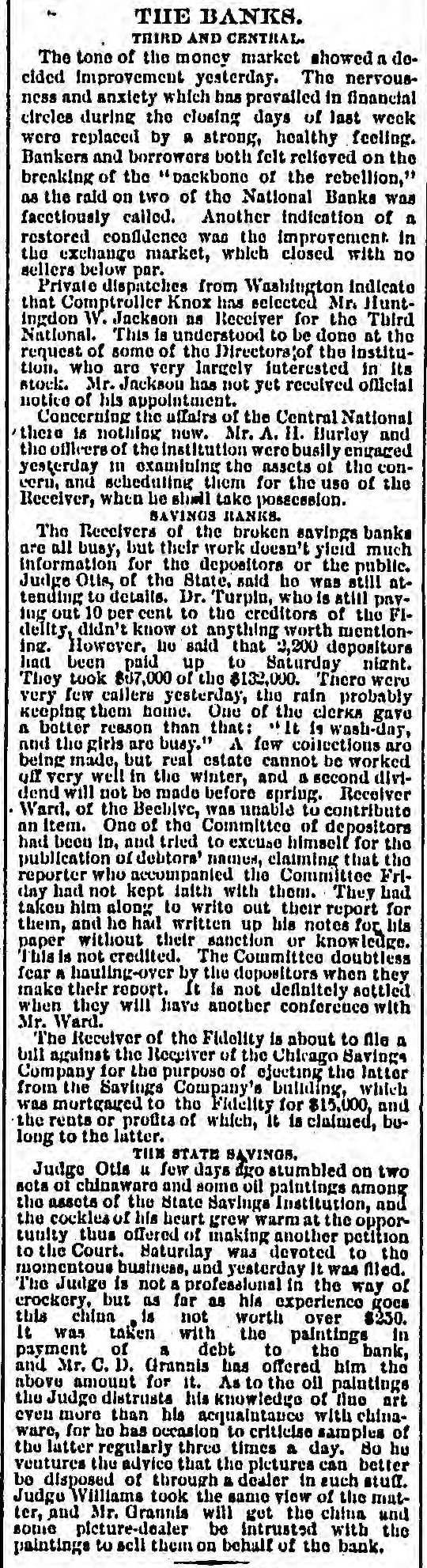
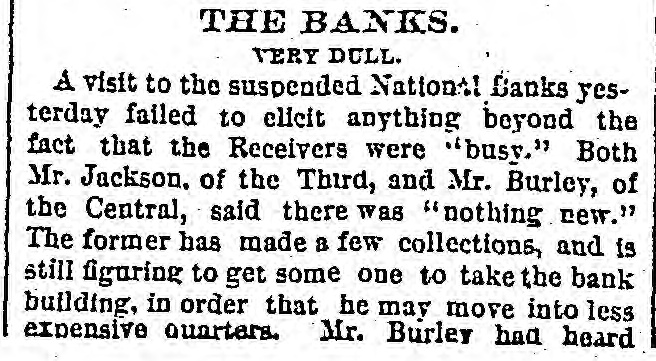
THE BANKS. THIRD AND CENTRAL. The tone of the money market showed a deelded Improvement yesterday. The nervousness and anxiety which has provailed in financial circles during the closing days of last week were replaced by a strong, healthy feeling. Bankers and borrowers both felt relieved on the breaking of the "packbone of the rebellion," as the raid on two of the National Banks was facetiously called. Another indication of a restored confldence was the improvement In the exchange market, which closed with no sellers below par. Private dispatches from Washington indicate that Comptroller Knox has selected Mr. Huntingdon W. Jackson as Receiver for the Third National. This la understood to be done at the request of some of the Directors;of the Institution. who are very largely interested in its stock. Mr. Jackson has not yet received official notice of his appointment. Concerning the ullairs of the Central National there is nothing new. Mr. A. H. Burley and the officers of the institution were busily engaged yesterday in examining the assets of the concero, and scheduling them for the use of the Receiver, when be shall take possession. SAVINGS RANKS. The Receivers of the broken savings banks are all busy, but their work doesn't yleid much information for the depositors or the public. Judge Othe, of the State, said he was still attending to details. Dr. Turpin, who is still paytug out 10 per cent to the creditors of the FIdelity, didn't know of anything worth mentioning. However. no said that 2,200 depositors had been paid up to Saturday night. They took $67,000 of the $132,000. There were very few callers yesterday, the rain probably keeping them home. One of the clerks gave a botter reason than that: It is wash-day, and the girls are busy." A few collections are being made, but real estate cannot be worked off very well in the winter, and a second dividend will not be made before spring. Receiver Ward. of the Bechive, was unable to contribute an Item. One of the Committee of depositors had been In, and tried to excuse himself for the publication of debtors' names, claiming that the reporter who accompanied the Committee Frlday had not kept inith with them. They had taken him along to write out their report for them, and he had written up his notes for his paper without their sanction or knowledge. This is not credited. The Committee doubtless fear A hauling-over by the depositors when they make their report. It is not definitely sottled when they will have another conference with Mr. Ward. The Receiver of the Fidelity is about to file A bill against the Receiver of the Chicago Savings Company for the purpose of ejecting the Intter from the Savings Company's building, which was mortgaged to the Fidelity for $15,000, and the rents or profits of which, It is claimed, belong to the latter. THE STATE SAVINGS. Judge Otis # few days ago stumbled on two acts of chinaware and some oil paintings among the assets of the State Savings Institution, and the cockles of his heart grew warm at the opportunity thus offered of making another petition to the Court. Saturday was devoted to the momentous business, and yesterday It was filed. The Judge is not & professional in the way of crockery, but as for as his experience goes this china is not worth over $250. It was taken with the paintings In payment of a debt to the bank, and Mr. C. D. Grannis has offered him the above amount for it. As to the oil paintings the Judge distrusts his knowledge of flue art even more than his acquaintance with chinaware, for he has occasion to criticlse samples of the latter regularly three times a day. Bo he ventures the advice that the pictures can better be disposed of through a dealer in such stuff. Judge Williams took the same view of the matter, and Mr. Grannis will get the china and some picture-dealer be intrusted with the paintings to sell them on behalf of the bank.


Article from Chicago Daily Tribune, December 7, 1877

Click image to open full size in new tab

Article Text

THE FINANCIAL DEPRESSION. The closing of the German National Bank, After a desperate fight to maintain its position among the financial institutions of the city, is to be regarded rather as a natural incident of a long ern of financial depression than 88 a disaster or cause for alarm. The bank suspensions of the last few weeks are not of the same character as those of the corresponding period four years ago they are not the warnings of a now panic, but the results of the old panic. The general shrinkage of values has compressed all the confidence out of the community, and suspicion once contered upon a financial institution in these timos, recovery scoms to be impossiblc. The condition of the German National Bank, as shown by the statement of its affairs at the close, would have warranted a continuation of business, and commanded public confidence, in a season of ordinary business prosperity. There are assets of nearly $1,000,000 to moet liabilities of less than $180,000 in deposits, $90,000 in bills payable, and $63,000 of circulation. The capital of $500,000, with A surplus of earnings amounting to $125,000, and undivided profitsof $10,000'more, are represented in the investments, and would ordinarily provide abundant protection. Even the frightful shrinkage in many of the securities (and especially in the real estate which this bank, along with others, has been compelled to take in settlement of loans) is not enough to create an apprehension that the capital and surplus will be wiped out, or that the depositors will lose anything. Yet the German National was forced to yield to nu implacable depression. HENRY GREENEDAUM, the President and Manager, fought his way through with the grit and tenacity of a little bull-dog. The bank went through the fire with flying colors, and came out of the panio with credit and vigor. But the lines were all the time drawing closer. The panic among savings-bank depositors instituted a run on the German Savings Bank, which reflected on the German National. Both institutions were in the same building, and the public identified them. It was enough to start a persistent drain upon the resources of the German National. Between $200,000 and $300,000 of deposits were withdrawn in the two or three days' flurry caused by the suspension of the Third National. Nearly $1,000,000 of deposits have been drawn out since July. A bank that was able to pay out 85 per cent of its liabilities to depositors in cash during four months ought to have won its way back into public confidence, but the public mind is in no frame to listen to logic; no financial institution now brought under suspicion, however unjustly, is given the benefit of a donbt, a hope, or even demonstrated solvever. How long, o Lord, how long is the wall of the community at every new evi. Vence thus offered that we have not yet outlived the effects of the long era of extravagance, inflation, speculation, and intoxication preceding the panic of 1873. How many settlements remain to be made before the commercial community and the capitalists can venture with confidence upon the usual basis of business relations? It is a problem that can only be solved now by such national legislation as will afford reliof to institutions and men who are tottering and fainting from mero inanition. There have been promises of improvement for a year and more. There have been evidences of a revival of business and confidence that need only proper oncouragement to develop into facts and realities. There has been a substantial basis for building 'up now prosperity in the rare abundance of the crops and the exceptional foreign demand therefor. These hopes have been smothered by the money-sharps of the East in their blind and obstinate determination to enforce a resumption of speciepayments in a year from now on an exclusive gold basis. This necessity has been held over the heads of the people for two years. " You must submit to our time and our terms," say the Shylocks and the sharps. The people protested and elected a Congress from which obedience to the popular will, and not subservience to the Shylocks, was expected. The extra session afforded an opportunity for the measures of relief that are demanded, but Congress preferred a partisan squabble to the interests of the county. The partisan struggle over, the people breathed again, and turned their eyes to the regular session for some response to the popular wall. At this juncture the President avails himself of the privilege of his annual message to blast the popular hope by casting his influence, and in effect threatening his veto, in behalf of the bloodsuckers, who insist upon receiving from 15 to 23 per cent more than they loaned, in addition to their interest. This Presidential utterance has deepened the general desponden. cy of the country pending the uncertainty as to its influence on Congress. The people


Article from The Carbon Advocate, December 8, 1877

Click image to open full size in new tab

Article Text

underhis wife applying for a divorce- and a pistol. to separate soul and body,with sadly took he could not have been so very to his But earnest because he gave fair notice the matin and they, after thinking took his ter neighbors, over, decided to interfere, and away. weapon the most serious result of Coolbaugh's National But was the failure of the Third once death old institution which was the Bank, prosperous, an but was badly hit decided by very and the panic. Its directors fire weeks ago to settle up affairs, trusting their some that time that they would get back Mr. at capital and lose only the surplus. to take Coolbaugh had made arrangements but his of the bank and liquidate it, and sudden charge death put an end to that scheme banks found impossibte to get other $1, it was give any help. So it shut up, owing worth 000,000 to and with assets nominally two$1,800,000 but really worth only about is the thirds of that. But back of all this personal responsibility of the stockholders but one of whom are good,amounting the million all and a half. It is possible that better bank might have lived if it had had unmanagement, but the President had an estate happy mania for dabbling in real speculations, and by persisting in holding to dirt which had ceased to have any the on brought himself and the bank to stuff value, ground. He has turned over a lot of kind secure his indebtedness, but it is that of of to property which may not be disposed difor Among the stockholders and the rectors years. are Mr. George M. Pullman of Sleeping Car Company, and Mr. Tribune. Joseph Medill editor and proprietor of the It had been SO long expected that this the bank would go up that there was not failure consternation which an unexpected would have had, but nevertheless the smash had its results. The Central National Bank, comparatively small concern with a capital a of $200,000 gave up the ghost Friday morning. It had been carried by the Third months and fell when the support its It will doubtless pay was for some removed. that all it depositors, the chief trouble being did not do enough business to make it profitable to keep the institution alive. One or two is other National Banks are shaky but it hoped that they will manage to pull through. A suit on a life-insurance policy, ,in volving some interesting points, has just been begun Milagainst the Northwestern Montreal, of waukee. A year and a half ago a wealthy resident of this city took out a policy for $15,000 in the Company, paying the first At the end of he was called on and year's months, premium. asked the twelve for failed the premium for the next year. This he he to pay. Nearly two months elapsed and be= was taken very ill. About half an hour his clerk called office, and tendered premCompany's fore he died around the at The the ium. The agent declined to accept it. weeping heirs and wife, though feeling intensely over the death of their beloved father and husband, yet did not feel inclined to lose $15,000 and checked their lamentations long enough to send the book-keeper of the deceased-he had been dead half hour then-on another trip to the officers of the Company, to again offer the premium, again make an effort to revive that lapsed policy. But the agent knew something concerning Mr. Store's condition and peremptorily refused to take the money and hence the suit. The deceased was a sharp business man, and it is possible that he would have so with the business-like conof his children as to duct been pleased have pardoned them for their apparent absence of all-abover his loss. sorbing grief Possibly the Company will presently propose to compromise for a few thousands, and that will be the end of the suit. A marriage of rather a romantic nature took place here a couple of weeks ago. western man was in town for the purpose disposing of a lot of mining property which he owns in the Black Hills. While here he into his head to get a wife. He had once before, in took been it married Denver. He had seen a pretty girl running a sewing in a shop, had and machine marched She in asked her if she would have him. consented they were wedded, and in six months she got a Utah divorce. But he was not discouraged by this, and went to a clairvoyant, and asked her to tell him where to find the woman whom Providence had selected as his wife. If she put him on the right track, he would give her $10,000. So she advised him to go to: certain large shirt and among the manufactory, girls He employed t there, there he would find his fate. and asked the proprietors, to let him look through their establishment. They consented, and he went into the sewing room,where a dozen or more girls were employed. he Presently one of them struck his eye went up to her and said, "I did not come here to look at the place, I came to find you. I want to be my wife. I can give you I have been once, good references. you married but have been divorced, and have a copy of the decree, so that is all right." She looked ( at him, saw that he was not badly dressed, and was reasonably good-looking, and said, "Yes, will marry you." They were wed-


Article from Chicago Daily Tribune, December 15, 1877

Click image to open full size in new tab

Article Text

BROKEN BANKS. Yesterday's Developments. Yesterday was only another In the list of dall days among the banks. Receiver Jackson. of the Third National, was in the midst of his correspondence with country banks, and buay with the proofs of 'claims which are being filed. These amount to about $170.000 up to date. and the rest are coming In with beautiful regularity. Mr. Jackson could say nothing an to dividends, except that It was the Comptrolier's desire to declare one as soon as things were in shape to do 20. Receiver (llover, of the Central National, will complete his Inventory in a few days. and send It to the Comptroller, with the recommendation that A 25 per cent dividend be declared. It " possible that each a construction may be placed on the ninety-day notice rule as will insure the depositors a dividend before that time shall have clapsed. Mr. Glover has heard nothing from Mr. Endicott. The latter's brother stated Thursday that the ex-President of the bank had gone East to real. According to Mr. (lover, the brother doesn't know nie address. The Receiver wants information in regard to certain details, but can neither see the m3b who can give them not learn where a letter will reach him. The motion for Receiver in the case of Beris YR. The German-American Savings Bank, came up before Judge Moore again yesterday. The bill was filed Tuesday, and an application for Receiver made. but postponed two days to enable the parties interested to agree on some person. They did so, and vesterday Col. Inessen and Mr. Blanke, the attorneys for the bank and the complainant, respectively. appeared in court. The latter remarked that the stockholders and depositors had agreed that Mr. Justus Killan, the President of the bank, should be appointed Receiver. Stockholders to the amount of $104. 100, and depositors representing $30,630, had signed a paper to that effect. Judge Moore sold It was not the policy of the courte to allow Interested partice to act as ReceivCTP, though It was sometimes done. in which case toey generally acted without compensation. In the present Instance, however, as all consented to it, he did not fee) like refusing. Mr. Justus Killan was therefore appointed Receiver, his bond being fixed at $50,000, which was filed. Receiver Hurton, of the German Savings, 10 pre. paring bis first report, which will be submitted during the coming week. The liquidation of the German National is progressing by slow and cary stages, but the routine work in connection with its closing up shuts out any possibility of news. The private firm of Henry Greenebaum is doing very little business. A few drafts come in and are promptly met, but no European drafts are 19. sued. As Mr. Greenebaum himself expressed It yestorday. be has not recovered from the stunning effect of the failure of his other two institutions. He has as vet made little or no endeavor to get outside aid, because be hopes to pull through with. out It. In this laudable endeavor be will no doubt have the sympathy of a large mass of citizens who look upon him as the victim of misfortune and the vindictiveness of his enemies, and who admire the pluck under itall. and hope he will succeed. There was nothing but the usual routine business at the other banks. Receiver Ward, In a burst of triumph. produceds draft for $549.20. which he had just received froms country debtor, and expressed n wish that others would follow the said debtor's praiseworthy example. The balance of that Fidelity dividend, about $15,000, is being slowly worn down. Dr. Turpin thinks It will all be paid out but about 000, which will be formed into a first dividend fund, and kept for those who do not care to draw Just at present.


Article from Chicago Daily Tribune, December 23, 1877

Click image to open full size in new tab

Article Text

THE BANKS. ELIAS GREENEBAUM filed his schedule in the United States District Court in the bankruptcy proceedings against'the firm of llenry Greenebaum & Co. and Greenebaum Bros. & Co., thus consenting to the proceedings. He has no preferred nor secured debts, and no unsecured liabilities except on accommodation paper. In this way, however, he is heavily indebted, as the following shows: He is liable to the amount of $30, to the First National Bank as guarantor of the German National Bank, the claim being secured by collaterals pledged by the German National; to the Commercial National Bank $30, also as guarantor for the German National Bank, similarly secured; to the Corn Exchange National. same amount in a similar way; to Field, Leiter & Co., guarantor as above, $25,000, and to Solomon A. Smith $10,000 in the same way as above, making a total liability of $125. us guarantor of the German National Bank. Ilis assets consist of a lot on Raudolph street, $7,000; other land-some of it "held under Master's deeds-valued at $11, 800; and the homestead, No. 583 Michigan avenue, valued at $12, 000. Pocket-money foots up $9, which is put in the schedule of *cash on hand. Mr. Greenebaum then devotes eighteen closely-printed pages to scheduling promissory notes and securities therefor belonging to the late tirm of Greenebaum & Foreman. The same were, by agreement between said Greenebaum and Foreman. left with eaid Foreman to liquidate and collect. Sald securities are in course of liquidation, and upon them suit has been brought in the Circuit Court. Greenebaum owns a half interest in these recuritie after deducting the expenses of collection. The face-value of the notes is about $150,000. Mr. Greenebaum has also a half-interest in about $40.000 of notes by various parties, many of which are worthless. He likewise holds a note for $53, 500 given him by David S. and Henry Greenebaum, dated Jan. 1, 1876, and due three years after date. The Walker notes are secured by divers trust deeds and collaterals, some of which appear to be valuable. while others are apparently worthless. The other notes, including those of lienry and David S. Greenebaum, are all unsecured: Ilis other assets consist of two horses and a cow, $225; carriages, etc., $500; 290 shares of stock in the German National "Bank, par value, $29, 000; five shares in the German Savings Bank, $500; onehalf a share in the Merchants' Savings Loan & Trust Company, $100; and a half-share in the Exposition Building stock, S100; four life-insurance policles of $15,000. payable to his wife; and $10, 000 insurance on his property. THE OTHERS. Up to the close of business yesterday 324 claims had been proved up against the Third National Bank, representing in amount $616,000. The routine work is progressing with unusual rapidity, compared with the slow-going course pursued III certain other defunct institutions not many miles distant, and the prospect of a handsome dividend in January is daily growing mere certain. Mr. Glover, Receiver of the Central National, was not down vesterday, but sent word to his assistants that he would be at the bank Monday. His report is about ready for transmission to the Comptroller. Mr. Kilian. Receiver of the German-American, is still busy with his first report, which he expects to file early in the week. Beyond that, nothing is doing at this institution. Mr. Mark Kimball, Provisional Assignee of Henry Greenebaum to Co., Chicago, and Greenebaum Bros. & Co., New York, left the city for New York Inst evening, under an order of court directing him to proceed thither, schedule the assets, sell what he could, Ile rest. the and return ,with expects to be away one or two weeks. The schedule of assets or llenry Greenebaum & Co. has been checked off and found to be correct, and the only thing to do now is to realize on them as fast as possible. Mr. Greenebaum will personally assist Mr. Horton, Receiver of the German Savings this week in his efforts to convert assets into cash and get the institution into a proper condition to pay a dividend. The paying out of the Fidelity's first dividend still goes on, but the cash on hand is being depleted by mere driblets. A lady who joined in the suits against the stockholders presented her claim for $50 worth of that dividend yesterday. The Receiver has had some doubts whether he ought to give these people a share in the dividend, since it was possible and even probable that their suits against the stockbolders would be successful. But the lady in question, who is said to have been of decidedly comely appearance, was seen walking out of that bank yesterday afternoon, and carefully depositing certain monies in her pocket-book. It is supposed that the Receiver now looks at the question in a different light.


Article from New-York Tribune, January 23, 1878

Click image to open full size in new tab

Article Text

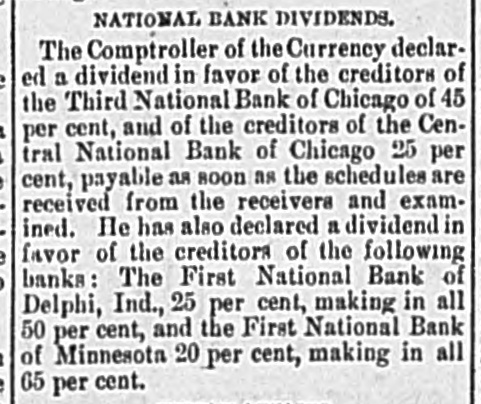
CURRENT TOPICS AT THE CAPITAL. LOYALTY PROMOTED BY VEGETABLES. WASHINGTON, Tuesday, Jan. 22, 1878. Yesterday General Sherman received from Major Brisbin, commanding the post at Fort Ellis, Montana, reports of the company gardeners for the year just ended. They state that the troops have for two years been constantly in the field during all the Summer, or growing months; yet both seasons they have had excellent gardens. The amount of perishable stuff produced was enormous. There have been no desertions from Fort Ellis for a long time, and the commander attributes this in a large measure to the manner in which the soldiers are fed and cared for. The vegetables raised were potatoes, onions, turnips, carrots, beets, parsnins, salsify, and cabbages. They were cultivated in twenty-six and a half acres, by companies F. G, H, and L, of the 2d, and company G of the 7th Cavalry. DRIBLETS FOR CREDITORS. The Controller of the Currency has declared a dividend of 45 per cent in favor of the creditors of the Third National Bank of Chicago, and 25 per cent in favor of the creditors of the Central National Bank of Chicago, payable as soon as the schedules are received from the receivers and examined. He has also declared dividends in favor of the creditors of the following banks: First National Bank of Norfolk, Va., 10 per cent, making in all 45 per cent; First National Bank of Delphi, Ind., 25 per cent, making in all 50 per cent; First National Bank of Duluth, Miun., 20 per cent, making in all 65 per cent, and 7 per cent in favor of the creditors of the First National Bank of Selma, Ala., in all 42 per cent. A SWEDE LEARNING FROM AMERICANS. Lieutenant Smolenski, of the Swedish Artillery, is passing a few days in Washington as the guest of Mr. Thomas P. Morgan, president of the Board of Fire Commissioners. Lieutenant Smolenski was one of the Commissioners from his country to the Centennial Exhibition, and while in Philadelphia became much interested in the American plan of dealing with fires in large cities. On returning to his home he obtained leave from his Government to come back and make a tour of American cities 110 order to give our Are systems a more complete examination. He is an enthusiast on this subject, spending much time in the engine houses and riding on the engines with the firemen when they are called out by an alarm. He will leave for Chicago in a few days.


Article from Daily Press and Dakotaian, January 24, 1878

Click image to open full size in new tab

Article Text

LATEST BY MAIL. A Simnitza dispatch says the Danube is now completely frozen over, and transport wagons are now crossing freely on the ice. The British government has decided to send another regiment to South Africa in consequence of the unsatisfactory state of affairs there. The tailor's strike in Chicago is substantially ended. All the manufacturers are doing business as usual, the men having gone back to work in most cases. A Berlin special says that all the old soldiers on furlough in Russian-Poland have been called in. This new levy consists exclusively of men over forty years of age. Roumanians occupy Florentin, thus completing the investment of Widin. The bombardment of the Roumanians set fire to Fort Belgradschick, in Widin. A special from Shumla says small pox has broken out there and in the surrounding villages. A number of refugees are arriving there from Belroya and Osman Bazar. Many die on the road from cold and hunger. The attorney general addressed a letter Tuesday to the district attorney at Chicago, instructing him to proceed at once in the prosecution of the whisky cases. Wm. H. Vanderbilt appeared at the coroner's house Thursday morning and was placed under $2,000 bonds to appear at the inquest in the case of Matthew Rieley, who died of injuries received by being run over in November by Mr. Vanderbilt. The comptroller of the currency has declared a dividend in favor of the creditors of the Third national bank of Chicago of 45 per cent, and the Central national bank of Chicago of 25 per cent., payable as soon as the schedules are received from the receiver and examined.


Article from Daily Globe, June 8, 1878

Click image to open full size in new tab

Article Text

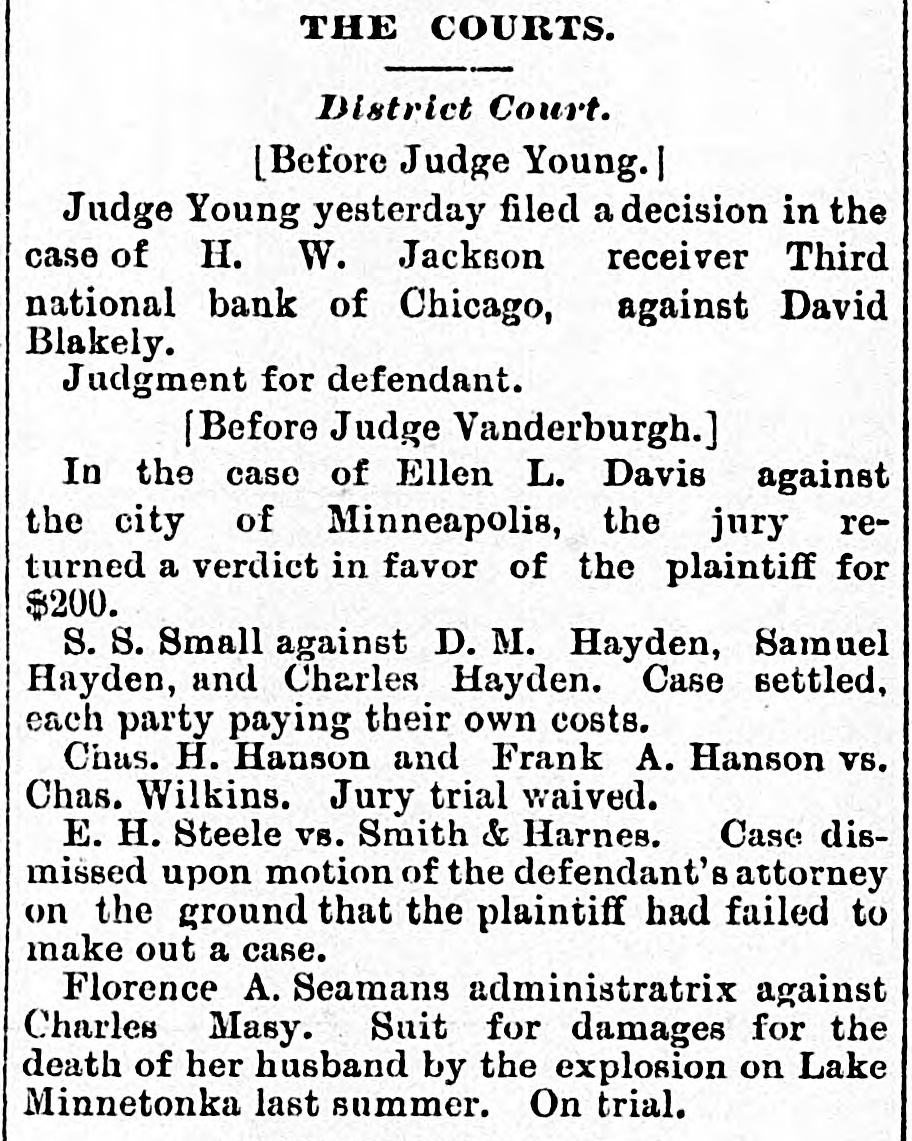
# THE COURTS. District Court. [Before Judge Young.] Judge Young yesterday filed a decision in the case of H. W. Jackson receiver Third national bank of Chicago, against David Blakely. Judgment for defendant. [Before Judge Vanderburgh.] In the case of Ellen L. Davis against the city of Minneapolis, the jury returned a verdict in favor of the plaintiff for $200. S. S. Small against D. M. Hayden, Samuel Hayden, and Charles Hayden. Case settled, each party paying their own costs. Chas. H. Hanson and Frank A. Hanson vs. Chas. Wilkins. Jury trial waived. E. H. Steele vs. Smith & Harnes. Case dismissed upon motion of the defendant's attorney on the ground that the plaintiff had failed to make out a case. Florence A. Seamans administratrix against Charles Masy. Suit for damages for the death of her husband by the explosion on Lake Minnetonka last summer. On trial.


Article from Evening Star, July 15, 1899

Click image to open full size in new tab

Article Text

ROMANCE OF A BANK A Chicago Institution Which Has Had a Curious History. IN THE HANDS OF RECEIVER A Pays Dividends on Stock Worth More Than Face Value. SPLENDID FINANCIERING Written for The Evening Star by Ray Stannard Baker. More than twenty years ago the Third National Bank of Chicago formally closed its doors and a receiver was appointed to satisfy the clamoring depositors. Some of the stockholders feared an immediate assessment for the payment of Habilities, and offered to give their stock to any one who would assume its obligations. Today this stock is held at nearly double its par value; and it is regarded as "gilt-edged" security. Within five years, although the bank has received no deposits, made no loans, issued no currency, sold no drafts, it has paid two substantial dividends to its stockholders and promises many more. The very name of the bank has been forgotten except by a few gray-headed men who are personally interested in its affairs, but It is even yet an important financial institution with its regular stockholders' meetings, its taxes, its law suits, its reports and its bookkeeping. Moreover, It is unique in being a corporation having large assets and no liabilities-beyond the obligation to its stockholders. All of the entries, except driblets of expense, appear on the credit side of the ledger. The circumstances which led up to these peculiar, even unprecedented conditions, make a story probably without parallel in the annals of national banking. Prior to the panic of 1873 the Third National Bank ranked as one of the stanchest financial institutions in the west. It had a capital of $750,000 and its directory included some of the most prominent names in Chicago-such men as George M. Pullman, J. Irving Pearce. Joseph Medill, C. H. Curtis, C. M. Henderson, C. R. Steele, John H. Thompson, William T. Allen and S. S. Benjamin. Only one bank in its home city exceeded It in the extent and importance of its business. A Fall From Grace. When the financial crisis of 1873 was at its height the Third National Bank suspended payment for a single week as a precaution against a threatened run. Then it opened again and prepared to resume its old place in the business world. But a bank is like a man. It is trusted implicitly until it reveals some inherent weakness. After that its business friends watch it keenly and approve its methods with an "if" and its business enemies await the strain which again shall test its strength. The Third National Bank had the finest offices in Chicage, the largest force of clerks, the longest list of country correspondents, but it also had the single slip from the path of financial rectitude to live away. Some of its officers, knowing the need of unusual efforts to maintain its business supremacy, signed the bonds of the treasurer of Cook county, thereby receiving large deposits of the public money to swell the quarterly reports. The bank also appeared as the main depository of a board of park commissioners of which its president had become the treasurer. Other bankers, looking on, saw the signs and understood them. In 1873 the deposits exceeded $4,000,000. but in spite of all the bank could do they kept creeping down and down until late in 1877 they were only $1,164,000. During most of this time the bank officers were firmly optimistic; they believed in the solidity and business worth of their bank. Felt the Shock. In September, 1877, an extensive hotel property owned by President Pearce and one of the other directors was destroyed by fire. It had no connection with the bank and yet the bank felt the shock. A few weeks later President Pearce called on the New York correspondent of his bank and asked for a temporary loan to be used in case the heavy deposits of public money should be withdrawn suddenly. The New York bank hesitated and hedged. If it were not for the large demands now being made as an incident to the hard times, and the uncertainty of the money market-and other circumstances that assist a bank president who does not wish to loan money -they might possibly spare a few hundred thousands. On President Pearce's return to Chicago he found that some of the directors of the bank had been touched with the growing distrust. They were losing confidence in the ability of their own bank to meet the demands which might be made upon it. They had kept the feeling to themselves, and yet, after the manner of such things, it was all down the street in a single day, traveling by such secret ways as only an evil rumor knows. In spite of the loss of confidence there was no regular run on the bank. Its business was conducted by the usual number of clerks and its mall had not diminished. It was buoyed up and supported by the reputation of substantial prosperity and dignity which it had known in the past, and yet it was suffering from a wasting disease known to financiers as a "vest pocket run." Depositors came smilingly and drew out their money. and it was not replaced. A St. Louis paper printed a brief telegram hinting at the condition of the bank, and the country correspondents, always ready with their suspicions, began to fear of their balances, and every mail brought drafts that helped to drain the bank's reserve. A Quiet Run. A bank can fortify itself against the excitement of a regular run and fall, struggling, with some of the honors of war, but it has no protection against the creeping misery of these quiet, friendly withdrawals, continuing day after day for weeks, and each of them an insidious thrust at the bank's stability. One day the county treasurer gave notice that he would want a half million dollars.
Article from The Salt Lake Herald, July 17, 1899

Click image to open full size in new tab

Article Text

# Romance In Banking. Strange Story of a Bank That Failed and Yet, Though Twenty Years Defunct, Paid All Its Debts as Well as Dividends on All Its Stock. More than twenty years ago the Third National bank of Chicago for- mally closed its doors and a receiver was appointed to satisfy the clamoring depositors. Some of the stockholders feared an immediate assessment for the payment of liabilities and offered to give their stock to anyone who would assume its obligations. Today this stock is held at nearly double its par value; and it is regarded as "gilt-edged" security. Within five years, although the bank has received no deposits, made no loans, issued no cur- rency, sold no drafts, it has paid two substantial dividends to its stockhold- ers and promises many more. The very name of the bank has been forgotten, except by a few gray-haired men who had heard the rumors and he must protect himself. A half a million dollars is a very large sum of money to ask instantly from any bank's reserve cash. The officers of the Third National bank ran here and there for help, thereby spreading the odium of their distress. The First National bank, fearing a general financial disaster, agreed to lend a helping hand if the Union National bank would do the same. The Union National bank, after questioning and delaying and questioning again, agreed by its president, W. F. Coolbaugh, to advance $300,000 in cash of emergency. Confidence came back again. With this money and other promised assistance, President Pearce was sure that he could make his bank stand any strain. And this rumor, too, given a vigorous


Article from The Salt Lake Herald, July 17, 1899

Click image to open full size in new tab

Article Text

it is even yet an important finaninstitution, with its regular stockers' meetings, its taxes, its lawS, its reports and its bookkeeping. eover, it is unique in being a cortion having large assets and no lities-beyond the obligation to its kholders. All the entries, except lets of expense, appear on the it side of the ledger. e circumstances which led up to el peculiar, even unprecedented litions, make a story probably out parallel in the annals of naquantity I ior to the panic of 1873 the Third onal bank ranked as one of the chest financial institutions in the :. It had a capitalization of $750,and its directory included some of most prominent names in Chicago ch men as George M. Pullman, J. ig Pearce, Joseph Medill, C. H. is, C. M. Henderson, C. R. Steele, 1 H. Thompson, William T. Allen S. S. Benjamin. Only one bank is home city exceeded it in the exand importance of its business. hen the financial crisis of 1873 was S height the Third National bank ended payment for a single week L precaution against a threatene 1 Then it opened again and pred to resume its old place in the ness world. But a bank is like a It is trusted implicitly until it als some inherent weakness. After its business friends watch it keenand approve its methods with an and its business enemies await strain which again shall test its igth. e Third National bank had the t offices in Chicago, the largest e of clerks, the longest list of councorrespondents, but it also had the le slip from the path of financial tude to live away. Some of its ers, knowing the need of unusual ts to maintain its business suhacy, signed the bonds of the surer of Cook county, thereby 1โ‚ฌng large deposits of the public ey to swell the quarterly reports. bank also appeared as the main sitory of a board of park commisers, of which its president had bee the treasurer. Other bankers, ing on, saw the signs and underthem. 1873 the deposits exceeded $4,000.but in spite of all the bank could hey kept creeping down and down late in 1877 they were only $1,164.During most of this time the bank ers were firmly optimistic; they ved in the solidity and business h of their bank. September, 1877, an extensive horoperty/owned by President Pearce one of the other directors was deed by fire. It had no connection the bank, and yet the bank felt shock: A few weeks later PresiPearce called on the New York espondent of his bank and asked L temporary loan to be used in case heavy deposits of public money Id be withdrawn suddenly. The York bank hesitated and hedged. were not for the large demands being made as an incident to the times, and the uncertainty of the ey market-and other circumstanthat assist a bank president who not wish to loan money-they t possibly spare a few hundred sands. President Pearce's return to Chihe found that some of the direcof the bank had been touched the growing distrust. They were g confidence in the ability of their bank to meet the demands which t be made upon it. They had the feeling to themselves and yet, the manner of such things, it all down the street in a single day, eling by such secret ways as only vil rumor knows. spite of the loss of confidence ) was no regular run on the bank. business was conducted by the 1 number of clerks and its mail not diminished. It was buoyed up supported by the reputation of tantial prosperity and dignity h it had known in the past, and it was suffering from a wasting se known to financiers as a "vest et run." Depositors came smilingnd drew out their money, and It not replaced. A St. Louis paper ed a brief telegram hinting at the ition of the bank, and the country spondents, always ready with suspicions, began to fear for balances, and every mail brought S that helped to drain the bank's bank can fortify itself against the


Article from The Salt Lake Herald, July 17, 1899

Click image to open full size in new tab

Article Text

start, ran its way up and down the street, and some of those who had contemplated withdrawing their deposits, put their check books away and waited. Even the faint-hearted directors revived and the bank paid each of the county treasurer's checks as it was presented with all of the dignity of independence. The First National bank was ready to do anything in its power -it only awaited a formal request. Other banks also expressed their friendlness. One hundred and fifty thousand dollars of the borrowed money was to be delievered on Nov. 14. That morning President Coolbaugh was found dead at the foot of the Douglas monument with a bullet hole in his temple. His bank, fearing for its own safety, refused to advance the promised money. The First National bank followed its example. New York long since had refused a friendly hand-and the Third National bank found itself deeper than ever in the meshes of misfortune. About this time the park commissioners discovered suddenly that there was a large block of bonds not yet due which they could pay. Of course they wished to save interest-and they withdrew more than $200,000 all in a day. On Oct. 1 the bank had cash resources amounting to $966,530, with total assets of $3,910,891. By Nov. 21 the cash had shriveled away to $283,903, and the total resources to $2,742,907-and the big bank with its thousands of assets was as helpless as a child. On Nov. 21 a committee of bankers from the clearing house association came in soberly by a side door, like physicians to a sick bed. They nosed through the ledgers, peered into the vaults and asked questions. Then they went away and decided that inasmuch as the old bank was soon to die, it better be put quietly out of its misery. The clearing house association wrote its death warrant, refusing to have any further transactions with it and resolving in formally worded resolutions that it be "suspended." The next morning this epitaph appeared on the bank door: THIS BANK IS CLOSED. Wheat fell 2 cents, pork 10 cents, and the market in the board of trade closed weak. Some of the stockholders of the defunct bank offered in affright to quit their claims to their holdings to any one who would assume the liability of assessment. They were the same ones who had disclosed an alarming symptom of the bank's condition on the week before by offering their high-priced stock as far below par as 90. They had no takers. The earliest report on the condition of the bank, made by the receiver, Colonel Huntington W. Jackson, showed that the nominal assets were about $1,800,000, and the debts were about $1,000,000, leaving a nominal $800,000 to pay the stock liability of $750,000. On paper this looked most encouraging, but a close examination showed that many of the loans of the bank, made in flush times, were secured by collaterals of uncertain value, and real estate scheduled at boom prices and taken as the only available payment for money loaned. There was too much "slow" paper and not enough "short" paper. Of the real estate, one tract of 100 acres lay on a barren sand ridge near the lake shore, and nearly ten miles southeast of the city hall, in a wholly unsettled part of a suburb. Another tract of forty-five acres was nearly as far to the west of the city on the bare flat prairie, where there was little prospect of its ever being anything more than a cabbage patch. Still another piece of property lay far out in the southwestern portion of the city, in a region as yet almost wholly undeveloped and promising little immediate growth except in taxes and special assessments. There was a score of other lots and parcels of land, some in New York City, and a great quantity of paper, much of it more or less doubtful, or wholly worthless-the "cats and dogs" of a defunct bank. In fact, it seemed to some of the ninety stockholders that it would hardly pay the bank to retain its property and meet the expenses of management. But the receiver was a man of wide resources and abounding faith. No one could foresee the growth of Chicago, especially in the gloomy panic days of the middle '70's, and yet there were many men in Chicago who had supreme confidence in the city and its future. The receiver was one of these. A little more than three months after the closing of the bank-on Jan. 31, 1878-the depositors received a dividend of 45 per cent. A month later 10 per cent more was paid, all from the ready assets and cash of the bank. Before the close of 1879 35 per cent more had been distributed, and then the receiver began to reach the property that had been marked "doubtful." By the process known as "squeezing" and the sacrifice of some of the choicer pieces of be


Article from The Wisconsin Tobacco Reporter, August 11, 1899

Click image to open full size in new tab

Article Text

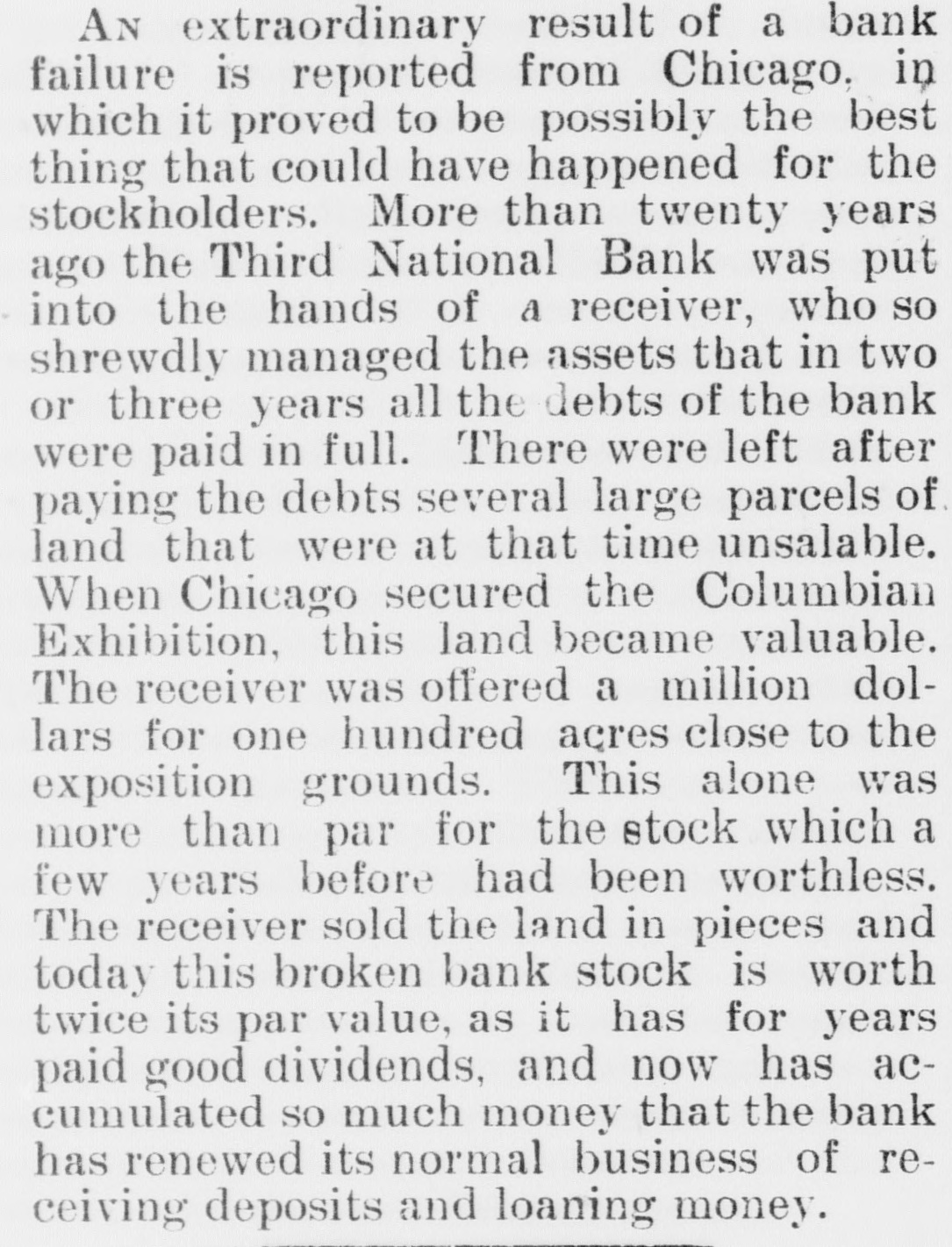
AN extraordinary result of a bank failure is reported from Chicago, in which it proved to be possibly the best thing that could have happened for the stockholders. More than twenty years ago the Third National Bank was put into the hands of a receiver, who so shrewdly managed the assets that in two or three years all the debts of the bank were paid in full. There were left after paying the debts several large parcels of land that were at that time unsalable. When Chicago secured the Columbian Exhibition, this land became valuable. The receiver was offered a million dollars for one hundred acres close to the exposition grounds. This alone was more than par for the stock which a few years before had been worthless. The receiver sold the land in pieces and today this broken bank stock is worth twice its par value, as it has for years paid good dividends, and now has accumulated SO much money that the bank has renewed its normal business of receiving deposits and loaning money.