Third National Bank (Chicago, IL)

Episode Information

Episode UID
23600885
Episode Type
Run β†’ Suspension β†’ Reopening
Bank Type
national
Bank ID
2360 national
Charter Number
236
Start Date
September 22, 1873
Location
Chicago, Illinois (41.850, -87.650)

Metadata

Model
gpt-5-mini (chosen from majority vote of a three-model LLM ensemble)
Short Digest
684c31b2f44eeab0

Response Measures

Accommodated withdrawals, Clearinghouse loan, Partial suspension, Full suspension, Books examined

Clearinghouse involved: Yes (loan, examination, or other measures)

Receivership Details

Depositor recovery rate
100.0%
Date receivership started
1877-11-24
Date receivership terminated
1907-12-31
OCC cause of failure
Losses
Share of assets assessed as good
58.0%
Share of assets assessed as doubtful
27.6%
Share of assets assessed as worthless
14.4%

Description

Later (1902) articles claim a long-running receivership beginning 1872, which conflicts with 1873 reopening reports; additional records could resolve this.

Events (5)

1. February 5, 1864 Chartered
Source
historical_nic
2. September 22, 1873 Run
Cause
Macro News
Cause Details
Nationwide financial panic following failures and news from New York (Jay Cooke, market distress) sparked runs on Chicago banks.
Measures
Banks fell back on thirty- and sixty-day rule and limited cash payments (only small sums paid, e.g., under $100).
Newspaper Excerpt
There is considerable of a run upon some of the banks here to-day
Source
newspapers
3. September 27, 1873 Suspension
Cause
Macro News
Cause Details
Coordinated suspension by Chicago banks/clearing house in response to the nationwide panic and heavy withdrawals.
Newspaper Excerpt
The Third National, in Chicago, has suspended.
Source
newspapers
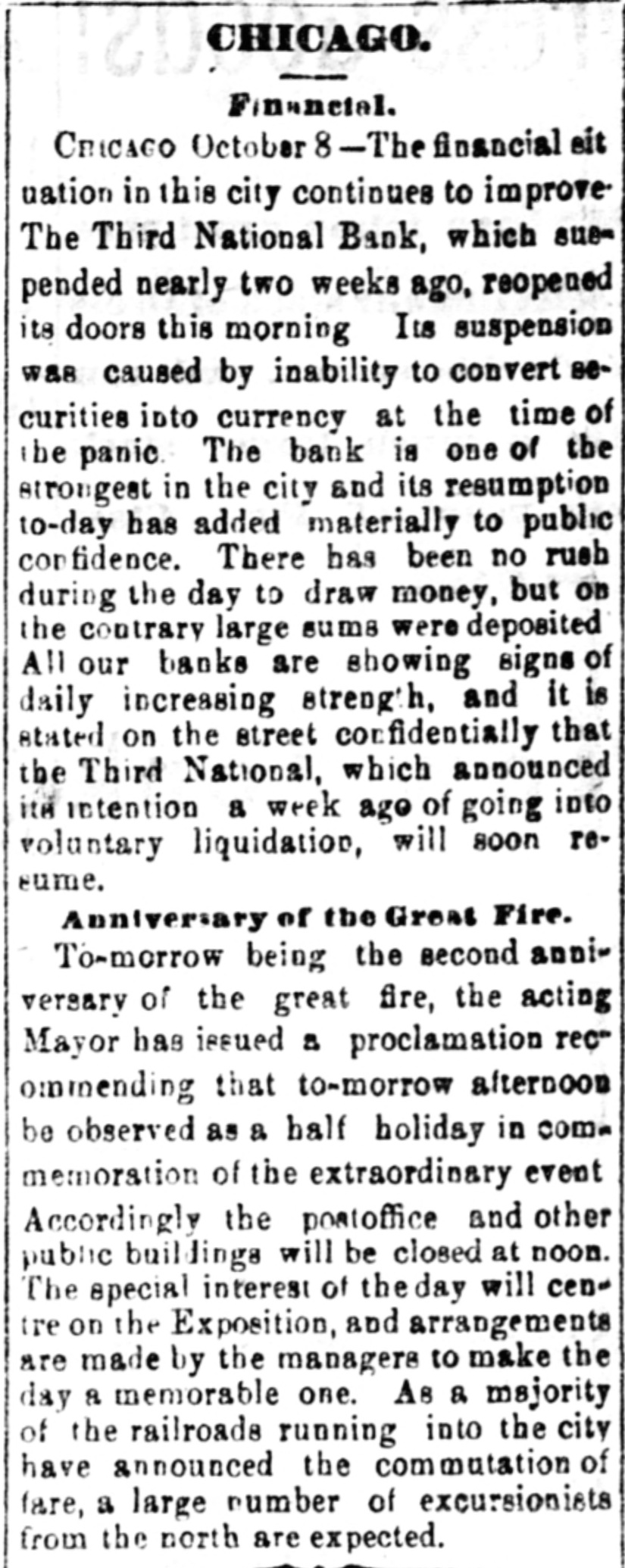
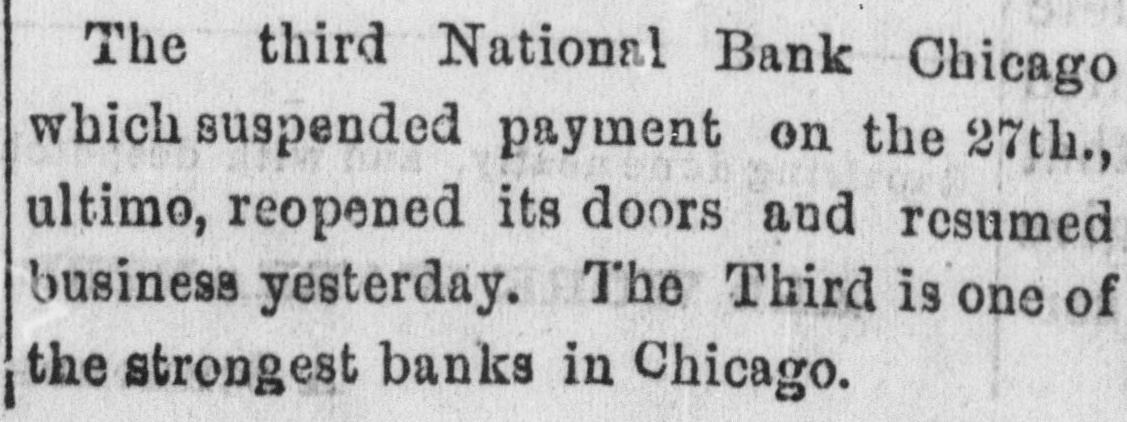
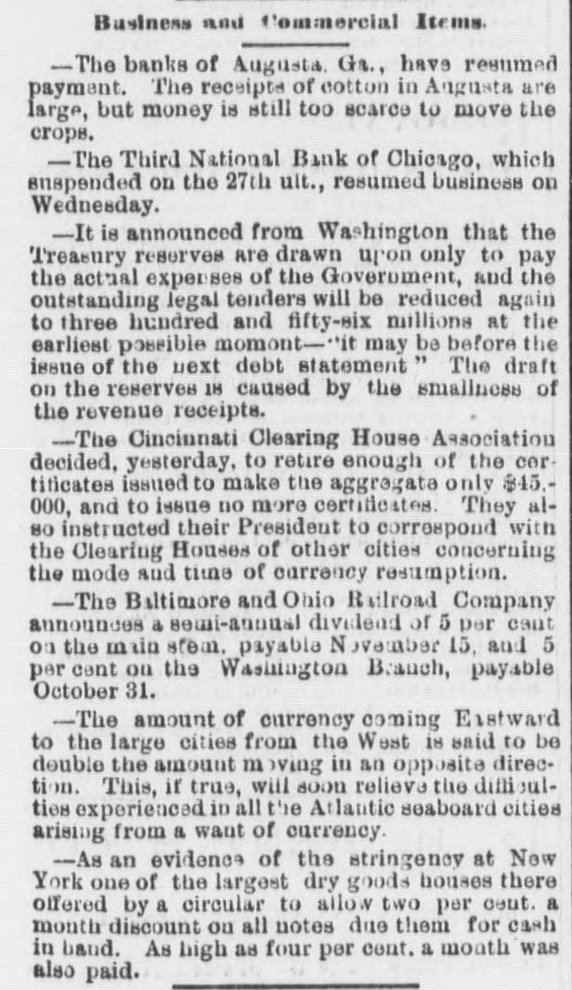
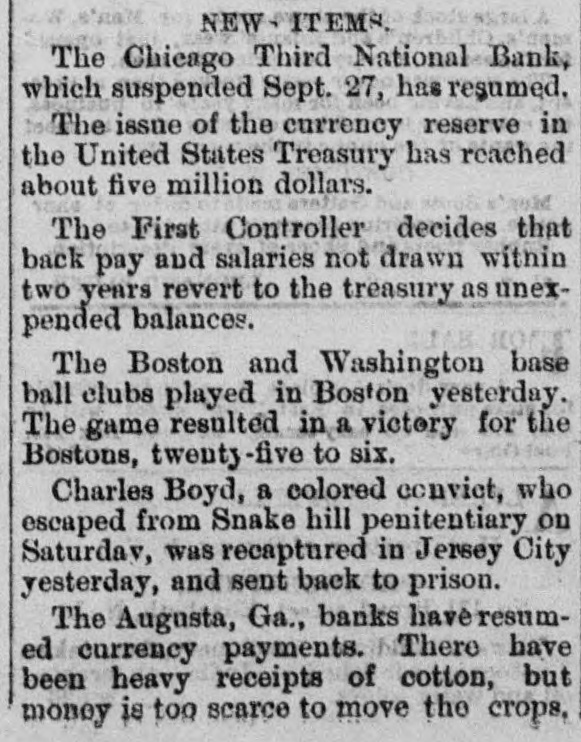
4. October 8, 1873 Reopening
Newspaper Excerpt
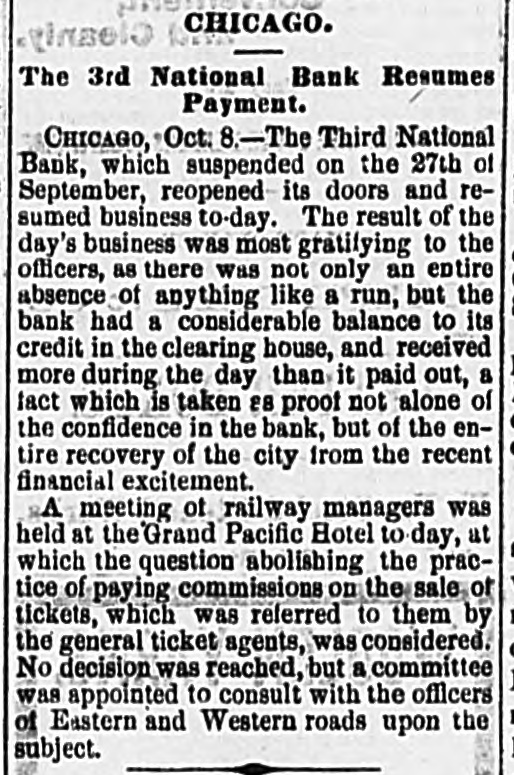
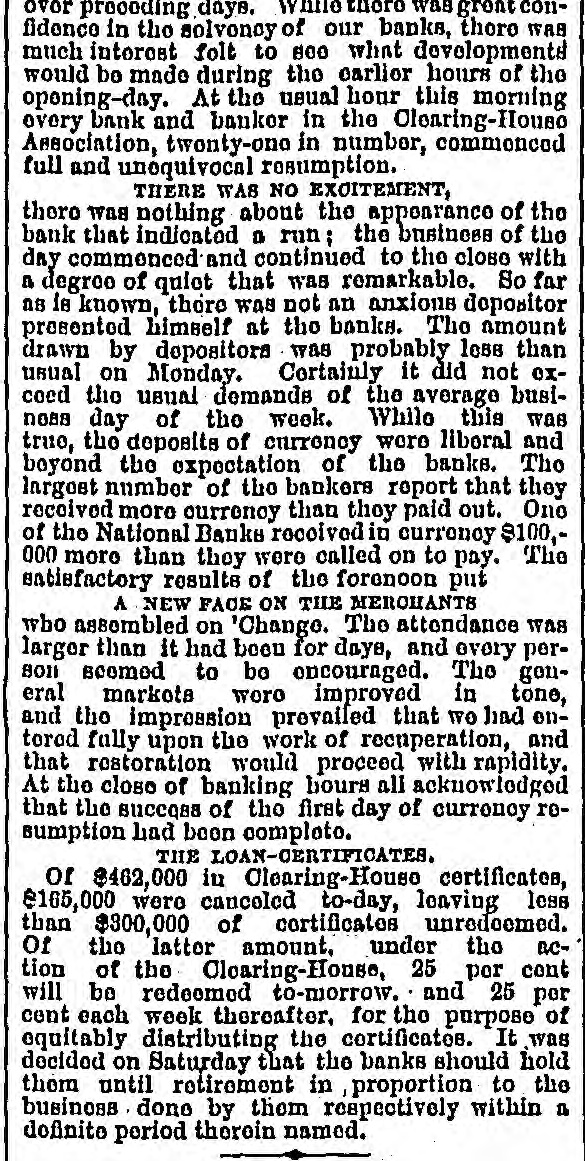
The Third National Bank, which suspended on the 27th ult., reopered its doors and resumed business to-day.
Source
newspapers
5. November 24, 1877 Receivership
Source
historical_nic

Newspaper Articles (24)

Article from The Wheeling Daily Intelligencer, October 18, 1871

Click image to open full size in new tab

Article Text

CHICAGO. by Lumber Attempted The Resumption.org Rebuilding the on Banks--The Work of attempt was Oct. 17.-An lumber dealers, lummade by a up the price but this yesterday, CHICAGO, to number carry per of thousand, larger of and at from $3 to $4 of the the was ber, was resisted respectable by many dealers, deteated. and Lumis selling at the old and filty millions tempted more ber extortion hundred prices. There the Italian sup- are of fully feet in two the continue yards in to this be abundant. city, and the will captured police have Peteri, who on keeper, week, in a Monday night stabbed two saloon ply The of Gregorio last saloon men on of to Buren street, at the Van He was found west of village this city. on death. about five miles dead bodies total held up inquests Of course Austin, which The number have been of when removed, to last the night, is ninety-two. burnt dietrict is debris in the be disovered. more will been made to-day the special removal of by many Aarrangements for the agent have of avenue the the Postoffice Church, PostDepartment the Wabash and Harrison office avenue for corner to Wabash will be occupied build that streets, and it the government Church can edifice purpose until building. This burned district, suitable the south line of the was considerably scorched, south is on division. but suffered It little or no of Trade injury inside. The directors this of morning, the Board for of the location. purhad a meeting settling the question it was deAfter to appoint a near the old cided a suitable lot, the Chamber pose to select of considerable and committee discussion on a rooms, Board tem- of of Trade rooms, and to erect thereon transaction of business. Sheridan to-day the porory their Commerce, General building, he for announces the issued contin- an There ad dress, peace in which and quiet violence of the city. since the disaster has uous been of Sunday no case night of and Monday morn- reing. The banks, national to-day. and The savings, calls settle- from sumed business were light for immediate to ascertain ment, as many what extent they depositors and to sought Many deposits could their or draw was no safely balance made. There hereafter. drafts on excitement the Savings were whatever. The and in many rush Bank were very light, made. There deposits were at the considerable many checks were confidence stances and excitement the thrown closing out. was the in- to hour, illustration of banks, we refer placed in Third public to-day's As an work: checked At the the out, and National, bank $72,000 pre$45,000 State dedeposited were rush, The but only Savings money, some forty the aghave gregate pared positors for of called a which for was their greatly exceeded been by deposits. contracts for building those who Many to-day. Among are William F. Wheeler, propose consummated to rebuild H. G. Powers, at once Armour, C.T. John Pot- B. Coolbaugh, George Walker, Mathew K. Drake, Boin Bros., of Drake Block, Laflin, J.C. C. H. Tuttle, Beck une ter Gregstin with, Palmer, Company, Edwin & Mackin, Hunt, &c. House Frederick Jas. The square H. entire Reese, from block Trib the on Court from Randolph streets, will Dr. Fowler, J. C. and John Drs. Union Depot land and street is to be east, by fronting Washington E. Goodell, Messrs. and others. of running Lake Charles Walker, The great be rebuilt scale. at at Quin- once once R. rebuilt at the toot and on a greatly were enlarged issued to-day thousand for A persons number leaving of passes the city. The number was The one action the of postoffice the postoflice on one-third authorities the South of the Side, in locating population where there surprise of the is less city and than and a good no gas, to deal have has of indignation, created great for the less accommodation regard seeming should of a mahad of the citizens than to-day, In number of of been jority lected. been. Brooklyn A various small $1,200 parts contributions was have New col- at from Committee State. telegraphed that in money ought to give Various New Chicago York are reported The $1,000,000 Boston England Massachusetts towns and for supplies. are reported $10,000 as a portion The registration for this the morning; election to-day Michigan. commenced registered 23,200. Germans November total was number of the leading for the purA meeting Hall to-night, element one pose held at of uniting the A German committee, was ap. organization. Apollo prominent Germans, Democ- includ. into ing many with the reform pointed racy for to the conter purpose of an alliance against


Article from The Daily State Journal, October 18, 1871

Click image to open full size in new tab

Article Text

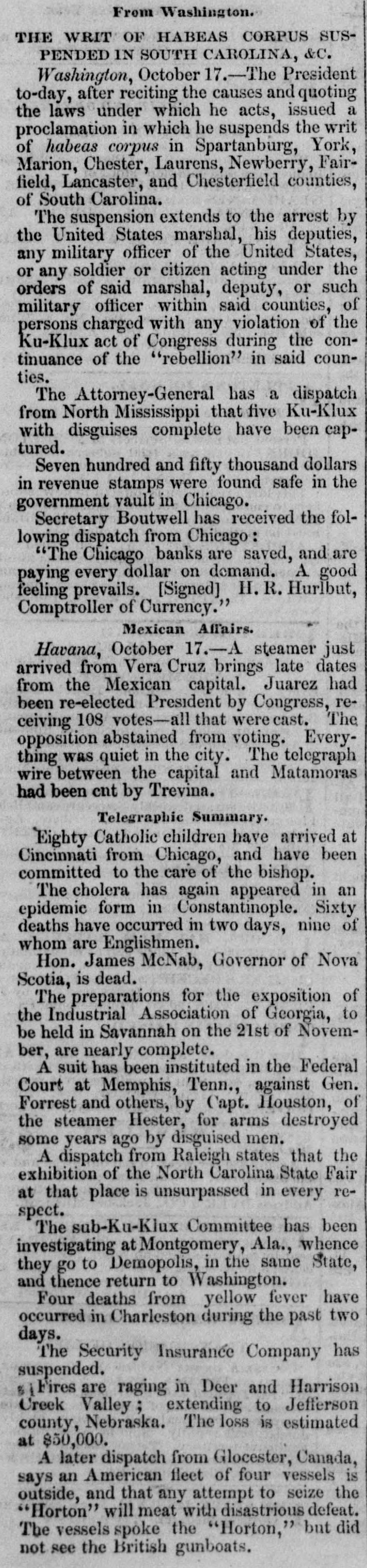
# THE WRIT OF HABEAS CORPUS SUSPENDED IN SOUTH CAROLINA, &C. Washington, October 17.--The President to-day, after reciting the causes and quoting the laws under which he acts, issued a proclamation in which he suspends the writ of habeas corpus in Spartanburg, York, Marion, Chester, Laurens, Newberry, Fairfield, Lancaster, and Chesterfield counties, of South Carolina. The suspension extends to the arrest by the United States marshal, his deputies, any military officer of the United States, or any soldier or citizen acting under the orders of said marshal, deputy, or such military officer within said counties, of persons charged with any violation of the Ku-Klux act of Congress during the continuance of the "rebellion" in said counties. The Attorney-General has a dispatch from North Mississippi that five Ku-Klux with disguises complete have been captured. Seven hundred and fifty thousand dollars in revenue stamps were found safe in the government vault in Chicago. Secretary Boutwell has received the following dispatch from Chicago: "The Chicago banks are saved, and are paying every dollar on demand. A good feeling prevails. [Signed] H. R. Hurlbut, Comptroller of Currency." Mexican Affairs. Havana, October 17.-A steamer just arrived from Vera Cruz brings late dates from the Mexican capital. Juarez had been re-elected President by Congress, receiving 108 votes-all that were cast. The opposition abstained from voting. Everything was quiet in the city. The telegraph wire between the capital and Matamoras had been cut by Trevina. Telegraphic Summary. Eighty Catholic children have arrived at Cincinnati from Chicago, and have been committed to the care of the bishop. The cholera has again appeared in an epidemie form in Constantinople. Sixty deaths have occurred in two days, nine of whom are Englishmen. Hon. James McNab, Governor of Nova Scotia, is dead. The preparations for the exposition of the Industrial Association of Georgia, to be held in Savannah on the 21st of November, are nearly complete. A suit has been instituted in the Federal Court at Memphis, Tenn., against Gen. Forrest and others, by Capt. Houston, of the steamer Hester, for arms destroyed some years ago by disguised men. A dispatch from Raleigh states that the exhibition of the North Carolina State Fair at that place is unsurpassed in every respect. The sub-Ku-Klux Committee has been investigating at Montgomery, Ala., whence they go to Demopolis, in the same State, and thence return to Washington. Four deaths from yellow fever have occurred in Charleston during the past two days. The Security Insurance Company has suspended. Fires are raging in Deer and Harrison Creek Valley; extending to Jefferson county, Nebraska. The loss is estimated at $50,000. A later dispatch from Glocester, Canada, says an American fleet of four vessels is outside, and that any attempt to seize the "Horton" will meat with disastrious defeat. The vessels spoke the "Horton," but did not see the British gunboats.


Article from The Tipton Advertiser, October 19, 1871

Click image to open full size in new tab

Article Text

# THE CHICAGO FIRE considered a sufficiently large figure to cover all the losses. The number of acres actually burned over is about 2,500-comprising the most compact and thickly inhabited part of the city, and the great bulk of its business and substance. About 20,000 buildings were burned, one-fourth of which were of stone or brick. The actual loss of life was undoubtedly over 300. Concerning the situation and prospects, on Friday, the Journal said: "Chicago is not hopelessly down. Her capitalists and merchants are 'up and doing'-preparing for reorganization and reconstruction upon the old foundations -and it is very apparent to all intelligent observers, that all will soon be well, and that Chicago will, before long, be in rapid process of rebuilding, and that before many years she will in all respects be herself again. The fact, now positively stated, that the heaviest insurance companies at the East will promptly adjust and pay in full their losses by our Great Conflagration, is the most cheering news we have yet received since the Calamity. This will go far towards helping many of our people out of their troubles and setting them on their feet again." On Monday, it speaks yet more cheerfully, speaking of the announcement that the banks would resume business on the 17th, which is strengthened by a certificate from the United States Comptroller of Currency that the National banks of Chicago are solvent institutions, as follows: "The decision of the banks to abandon their fifteen per cent. installment policy, and resume business as usual to-morrow, has restored confidence in Chicago. The universal opinion now is that the grain business will soon be running as usual. At present the derangement in insurance is a hindrance to shipments. There is no speculative business attempted. It is believed that the permanent increase in the price of grain will be slight. We hear of scores of cases where merchants or capitalists are already fully determined to rebuild in the most substantial style on the old sites, and it is already very evident that the South Side will before many months be 'reconstructed' even more substantially than is was built originally." The peace of the city has been restored and is maintained. The papers deprecate the statements which are finding place in newspapers signifying a different state of things, and say that General Sheridan and the city authorities report no cases of outrage or serious disturbance.


Article from The Emporia News, October 20, 1871

Click image to open full size in new tab

Article Text

ITEMS FROM CHICAGO. An attempt was made on Tuesday by a number of Chicago lumber dealers to carry up the price of lumber from three to four dollars per thousand feet, but this was resisted by a number of the and more and larger the attempted respectable extortion defeated. dealera, Lumber is selling at the old prices. There are fully two hundred and fitty million feet in the yards in the city, and the supply will be abundant. -The total number of bodies upon inquests have been held up to Tuesday was ninety-two. denight. in the district When has been the bris burnt removed, it 18 thought many more will be discovered. -Robbert Bonner, of the New York Ledger, has given ten thousand dollars to the needy editors, reporters and printers of Chicago. -Subscriptions to the Chicago relief fund are still progressing in England. The subscriptions received at the Mansion House,London, already amount to $138,000. -The Caledonia club, of New York, has sent $3,000 each to the Chicago and Michigan sufferers. -Baltimore su bscriptions to date are $187,000, liberal provisions being made for Michigan and Wisconsin; Boston $403,000; Birmingham, N. Y., $5,000: officers and employees of the Boston navy yards gave $3,608. The executive committee of the chamber of commerce relief asked the general committee for power to use a portion of the donation for sufferers in Michigan and Wisconsin. -Arrangements have been made by a special agent of the post office department for the removal of the postoffice to the Wabash avenue church, corner of avenue street, and it will be purpose Wabash occupied and builds Harrison for that and until the government a new suitable building. -The banks, national and savings, resumed business Tuesday. Call from depositors were for immediate use. Many sought to ascertain their balances, and to what extent they could safely draw hereafter. Many deposits were made. There was no excitement or rush whatever. The drafts in savings banks were very light, and in many instances deposits were made. There was considerable excitement at the clearing" house, and many checks were thrown out. In the Third National bank $45,000 were checked out and $72,000 deposited. The State Saving's bank prepared for a rush, but only some forty depositors called for money, the aggregate of which was greatly exceeded by deposits. -Many contracts for rebuilding were consummated Tuesday. Among those who propose to rebuild at once, are Win. F. Coolbaugh, H. G. Power, C.T. Wheeler, Brown Bros., Geo. Armour, John Drake, of Drake block, J. C. Potter & Palmer, Matthew C. H. Brekwith, Lafflin, Walker, Edward Hunt, & Tribune Company, Reese, Fred Tuttle, Gregstein Mackin, etc. The J.H. enon house from the east, and tire quare block fronting running court streets, from will to Washington at once. The be Randolph rebuilt Union to Depot be at at the foot of Lake street, is once rebuilt, and on a greatly enlarged scale. The number of passes issued Wednesday for person leaving the city was one thousand. The action of the postal authorities in locating the post office on the South side, where there are than one third less gas, bas of the popula- created tion of the city, and DO and a good great surprise seeming deal to of have indignation, less regard been had for the accommodation of a majority of the citizens than there should have been. -A furious gale prevailed in Chicalast, the They alarmed go on Sunday city. night which thought greatly down the eneire city would either be blown or destroyed by fire. Fortunately, # had rained in the twenty.four hours


Article from New-York Tribune, December 2, 1872

Click image to open full size in new tab

Article Text

THE CURRENCY. We complete to-day our extracts from the annual report of the Controller of the Currency, of which we printed a portion on Saturday. The limit of the National Bank issues in each State and Territory is fixed on the basis of population. resources, businees, and bank capital, as ascertained by the census. The last census required a new apportionment, as it showed a total increase in the population of the Union of more than 7,000,000 persons, and in wealth of nearly $14,000,000,000. An act was accordingly passed providing for an additional issue of $54,000,000. Of this the largest sum, $8,400,000, apportioned to any State, went to Illinois; Ohio and Kentucky each got over $5,000,000; Indiana, $4,000,000; Michigan and Louisiana each over $3,000,000; the distribution being made one-half on the population and one-half on the wealth of the country. It will be noticed that the increase all goes to the South and West, and more is yet needed to give those sections their due apportionment; to accomplish this, $25,000,000 is to be withdrawn and redeemed from the circulation of banks in New-York and New-England, and a corresponding amount authorized to banks in States that have not now their quota. It is a commonly received but somewhat erroneous opinon that the amount of currency in the hands of each individual member of the community has been on the average largely increased by the National Bank system; but this report only gives it now as, for the whole United States, $9 18 per capita, against $7 59 before National Banks existed: but the circulation of U. S. Treasury notes should be added before any conclusion is reached from these figures. The State of Rhode Island has the largest per capita circulation: $61 56; Mississippi the least:-one centexcept Florida and California, which have none. New-York has but $14 08. The National Banks have paid in the last eight years some $40,000,000 taxes to the United States; their State and national taxes for four specified years together amount to $71,000,000. The bank dividends are not so large on the average as is generally supposed: they do not exceed in the aggregate those of the old State banks; for the whole Union they but slightly exceed five per cent on invested capital. The great question of the proper reserve to be held by the National Banks is discussed in this report, and the conclusion reached that it is only the smaller and weaker banks that want to go below the present limit. Their necessities arise from putting out their funds at interest on deposit with Eastern banks-a condition which has more than once given riso to the most serious financial convulsions, as in 1857 - and a remedy proposed by the Controller is the issue of a new security by Government which will afford these banks the needful investment at interest. Not the least interesting feature of this report is the announcement that the Chicago banks, 80 far from being crippled as was anticipated after the fire by losses on discounted paper and the withdrawal of their balances, in point of fact steadily increased in business and profit, after resuming without embarrassment as soon as their safes were cool. There is a similar prospect in Boston, where the aggregate losses since the fire on bills receivable are estimated at less than three millions of dollars, which the bank surpluses will cover without touching capital or reserve. The question of usury is discussed. It appears that the penalty for its practice by National Banks is not clearly defined, and the Controller therefore declines to institute proceedings concerning it. A general law for the establishment of Savings Banks in the District of Columbia seems desirable. Locking up greenbacks is reprehended, and the New-York Stock Board and Clearing House are asked to discourage it. A table of the specie kept on hand by the banks shows it as less in October last than in many years before; as $10,000,000 against a usual average of $25,000,000. In the few cases of failure among the National Banks, the unfortunate institutions seem to be wound up with less ruinous loss to depositors and stockholders than has ever been re-


Article from Daily Kennebec Journal, December 4, 1872

Click image to open full size in new tab

Article Text

# THE CURRENCY. The Report of the Comptroller of the Currency is an elaborate document. The topic of most interest referred to is that of a proposed increase of the national bank notes. The Comptroller recommends the repeal of the act of Congress which calls for the redistribution of twenty-five millions of national bank currency, by withdrawing that amount from the Middle and Eastern States and giving it to the South and West, and in lieu thereof to issue five millions a year additional circulation for the next five years, to meet the wants of those States which have not had their full proportion. It is a commonly received but somewhat erroneous opinion that the amount of currency in the hands of each individual member of the community has been on the average largely increased by the National Bank system; but this report only gives it now as, for the whole United States, $9,18 per capita, against $7,59 before National Banks existed; but the circulation of United States Treasury notes should be added before any conclusion is reached from these figures. The State of Rhode Island has the largest per capita circulation: $61,56; Missippi the least: one centβ€”except Florida and California, which have none. New York has but $14,08. The National banks have paid in the last eight years some $40,000,000 taxes to the United States; their State and national taxes for four specified years together amount to $71,000,000. The bank dividends are not so large on the average as is generally supposed; they do not exceed in the aggregate those of the old State banks; for the whole Union they but slightly exceed five per cent on invested capital. The great question of the proper reserve to be held by the National Banks is discussed in this report, and the conclusion reached that it is only the smaller and weaker banks that want to go below the present limit. Their necessities arise from putting out their funds at interest on deposit with Eastern banksβ€”a condition which has more than once given rise to the most serious financial convulsions, as in 1857β€”and a remedy proposed by the Controller is the issue of a new security by a Government which will afford these banks the needful investment at interest. Not the least interesting feature of this report is the announcement that the Chicago banks, so far from being crippled as was anticipated after the fire by losses on discounted paper and the withdrawal of their balances, in point of fact steadily increased in business and profit, after resuming without embarrassment as soon as their safes were cool. There is a similar prospect in Boston, where the aggregate losses since the fire on bills receivable are estimated at less than three millions of dollars, which the bank surpluses will cover without touching capital or reserve. The question of usury is discussed. It appears that the penalty for its practice by National Banks is not clearly defined, and the


Article from Chicago Daily Tribune, September 16, 1873

Click image to open full size in new tab

Article Text

MONETARY. MONDAY EVENING, Sept. 15. Local finances word n little more quiet to-day than during last week. The country orders for burrency were considerably lighter, but the supply of currency in this markot in BO extremely scanty that the banks find it very difficult to moot oven the diminished domanda of their country customors. No considerable amounts of currency coino back from the country yet, and though the Chicago banks keep bringing currenby hore from Now York, all thoy get la in $100, 0500, and $1,000 bills, which are of but little uso In the country. Money is evidently becoming scarcer in this market AB the grain accumulates horo. It le estimated that the aggregate deposits of the Chicago banks havo fallen off between $2,000,000 and $3,000,000 in the last ten days. Now York exchange was much depressed again 10-day, owing to the pressure for currency, and was freely offored at $1.25 por $1,000 discount, with no buyers at that. EMBABRABSMENTS OF THE CANADA SOUTHERN. It is surmised in some quarters that the financial difficultion of the Canada Southorn Railroad, which were the cause of the susponsion of Kenyon, Cox & Co., of Now York, will intorforo with the construction of the Chicago oxtonlon of the road called the Chicago & Canada Bouthern." boing the line from Amherstburg, Canada (Detroit Rivor) to Chicago, in which case the main line and branches of the Canada Southorn already completed would have to dopend on the Michigan Southern and Tolodo, Wabash & Wostern for any connection with the great grain region of the West, instead of connecting at Chicago with the Rook Island and the Northwestern, as was intended by the projectors of the Canada Southern. It is oven not impossiblo that the confliot of intercete between the Michigan Southern and the Tolodo & Wabash on the one hand, and of the Rock Island and the Northwestern on the other, may have exercised wome influence to bring about the present financial difficulties. By Oct. 1 it is expected that the Canada Sonthorn will be operating 405 milos of road, viz. : The main lino and St. Thomas Branch in Canada, 292 miles; the Toledo, Canada Southorn & Detroit, which makes the connection with the Michigan Southorn, and also with the Tolodo, Wabash & Westorn, the Dayton & Michigan, the Pennsylvania Railroad branch leading to Pittsburgh, as well as with roads centering at Detroit, 58 miles; the Erie & Niagara, 31 miles: and the Michigan Midland and Canada, 14 miles. The Chicago & Canada Southern is finished 70 milos of the distance from opposite Amboratburg (Dotroit Rivor) toward this city. The noncompletion of this latter road would leave the main lino, Canada Southorn, with us principal Western connections at Tolodo instead of Chlcago. The opening of the Canada Southorn was delayed for some time by the non-completion of the International Bridgo over the Niagara River, a work over which tho Canada Southern had no control. In the menutime, arrangements have been made for the use of the Suspension Bridge, 15 miles bolow the International, and reached by the Erio & Niagara Railway, which is owned by the Canada Southorn. This routo has been, and will bo, used for freight business, but no through passenger trains will be put on until tho International Bridge is done. THE GAUGE OF THE GRAND TRUNK Railway will be changed to 4 foot 81/4 inches botween Toronto and Montreal, on Saturday, 4th of October next. IMPORTS AT NEW YORK AND BOSTON continuo light compared to previous years. At New York the imports for the wook ending Sept. 12 were: For the week. 1871. 1872. 1873, Entered at port $ 3,467,827 $ 3,492,058 $ 2,503,718 Thrown on market. 3,670,665 3,814,767 2,853,374 Since Jan. 1. 1871. 1873. 1873. Entered At port $101,134,535 $110,425,322 $90,487,529 Thrownon market. 99,070,410 104,345,101 92,910,729 At Boston, for the week ending Sept. 5, they were: 1873, 1872. $ 1,617,897 For the week ending Sept. 5 $ 1,288,197 Previously reported 43,867,776 50,456,133 845 156 079 Total


Article from Memphis Daily Appeal, September 22, 1873

Click image to open full size in new tab

Article Text

NEWS OF THE DAY. The Wisconsin State fair begins at Milwaukee to-day. The Texas editorial excursionists left Cincinnati last night for Louisville. The financial panic is reported to have seriously affected the narrow-gauge interests in Utah. The Chicago banks have taken advantage of the sixty-day privilege on their depositors. McClure's military academy, at Oakland, California, was entirely destroyed by fire Saturday night. Immediately after the cortes adjourns the Spanish government at Madrid will declare Spain in a state of seige. Thomas Tarwater, a brakeman, was run over and killed by a freight-train at Columbia, Tennessee, on the nineteenth instant. Pat Garnley, an insane man, set fire to a building in Jeffersonville, Indiana, yesterday, remained in it and was burned to death. Business generally will be suspended in Cincinnati to-day. it being proclaimed by the mayor. a holiday in the interest of the exposition. A strange and fatal disease at Kelter, in Utah, is very prevalent, producing great consternation. The patients die in a few hours. It resembles fever. Satisfactory arrangements have bee n perfected with the Ute and other tribes of Indians, hitherto in discontent, so that they will be settled upon their reservations. A Milwaukee dispatch says the financial panic of New York produces no disturbance there as yet, but the banks are preparing for any emergency that may occur the coming week. At Carbondale, Illinois, yesterday two negroes, Bill Smith and Frank Collins, remembered the Sabbath by playing cards, "fell out," resulting in the latter shooting the former through the heart. He's dead.


Article from The Daily Dispatch, September 23, 1873

Click image to open full size in new tab

Article Text

senior partner, has disappeared, causing great anxiety to his famile and friends. Search has been made in fall directions. CHICAGO. CHICAGO, September 20.-The Franklin Bank, a private banking institution, closed its doors to-day, being unable to settle at the clearing-house. The amount short was only $9,000. The vice-president of the concern says the embarros-ment is only temporary. CHICAGO, September - There is considerable of a run upon some of the banks here to-day, but they are adhering to the resolution adopted yesterday to fall back on the thirty and sixty-day rule, and are only paying sums of less than 8100. The latest reports, public and private, from New York appear to have had the effect to lessen the anxiety. BALTIMORE. BALTIMORE, September 21.-While the excitement in the New York market is watched with interest, and the brokers' offices have been visited by crowds to observe the sway and wreck of stock prices, everything has gone on calmly, and business is done at our banks in the usual way. Money continues at 10 to 12 per cent. for best paper on the street, though negotiations are limited, and are for strictly business en. gagements. IOWA. BURLINGTON, IOWA, September 20.-The Orchard City Savings Bank suspended at 12:20. PITTSBURGH. PITTSBURGH, PA., September James T. Brady & Co., bankers, and the Security Trust Company. of this city, suspended today. THE FEELING IN ENGLAND. The London Times says: " In view of the extraordinary prosperity of the United States and the high price of Government bonds the present must be regarded as a simple effort of the financial system to get rid of its dishonest element." The Daily Telegraph says stick local trouble as suspensions in New York seems to be merely the rank outgrowth of exuberant prosperity, ond accessories to progress which does not for a moment halt. LONDON, September 22.-5 P. M.-Much anxiety is manifested on all sides to hear further news from New York. Jay Cooke and McCultoch & Co. continue to pay cash in the usual manner over their counter. Among the rumors current in the Stock Exchange is one that the Bank of England holds $300,000 of Jay Cooke & Co.'s acceptances, and that the Roth-childs have $1,000,000 of. the same paper. LONDON, September 22.-4:30 P.M.10-40's are quoted at 904; new 58,911; Eries, 45. 5:30 P. M.-A dispatch announcing the closing of the New York Gold Exchange has just been bulletined. The news is accepted as an indiction of the gravity of the financial situation. and the market for American securities is again depressed.


Article from The New York Herald, September 23, 1873

Click image to open full size in new tab

Article Text

Run on the Chicago Banks. CHICAGO, Sept. 22, 1873. There is considerable of a run upon some of the banks here to-day, but they are adhering to the resolution adopted yesterday to fall back upon the thirty and sixty day rule, and are only paying on sums of less than $100. The largest assemblage appears to be gathered at the States Savings Institution, but so far the crowd has been very quiet and orderly. The latest reports, public and private, from New York, appear to have had the effect to lessen the anxiety which was manifested this morning among many bankers and business men.


Article from Knoxville Weekly Chronicle, September 24, 1873

Click image to open full size in new tab

Article Text

Georgia, to Hopkins, Dwight & Trowbridge; Deposit Savings Institution, Mobile, to Metropolitan National Bank The Brooklyn Banks. The Brooklyu bank presidents to resolved te sell $1,000,000 of U. S. securities in case of emergency. The majority were, however, of the opinion that there would be no run upon them. The Evening Post says: The day closed with an established improvement in general feeling; one day more with the Stock Exchange closed, will, it is thought, put everybody in such a condition, SO far as the exercise of reason is concerned, that it will be prudent for the brokers to again resume business. This afternoon money lent on the streets at : per cent., that rate having been paid by distressed brokers. President Rail, of the Bank of Commerce, said this afternoon that confidence had been very greatly improved and he Thought the action of the Government in buying 5-20s had been highly beneficial in loosening greenbacks. NEW York, Sept. 22.-When the doors of the Irving Savings Bank, 96 Warren street, were opened this morning, a crowd of depositors rushed in, clamoring for their money. The paying teller immediately set to work to satisfy their demands. When the majority, however, saw how willingly money was being paid out, they became quieted and left. Up to 2 o' clock the bank had paid out above $10,000, and had received a considerale amount in deposits. Feeling of Relief in New York. NEW YORK, Sept. 20.-The feeling among all classes is one of great relief. No runs on any of the national or state banks and the crowds on Wall street are mainly curious spectators. There are considerable inquirry for stocks on Wall street. Investors with greenbacks in hand are seeking to purchase, but the prohibition of Stock Ex: change drohibits transactions. The Chicago Banks. CHICAGO, Sept. 22.-There was a considerable run upon some of the banks here today, but they areadhering to the resolution adopted yesterday to fall back upon thirty and sixty days notice, and only paying sums of less than one hundred dollars. The largest assemblage appears to be gathered at the Statee Savings Institution, but so far the crowd has been very quiet and orderly. The latest reports, public and private from New York appear to have had the effect to lessen the anxiety. Chicago Savings Bank. CHICAGO, Sept. 22.-The Savings Banks give notice of the enforcement of thesixty days' notice. MEMPHIS, Sept. 22.-There were eight cases of yellow fever on Sunday. Philadelphia Banks. PHILADELPHIA, Sept. 22.-The run on the Savings] Banks has subsided. PHILADELPHIA, Sept. 2.-There is a much better feeling on the street to-day. The Stock Board is firmer. Pennsylvanias are holding ground at 40 to 50. A bank statement wili be out as usual to-day and will show a gratifying exhibit. The Situation in London. LONDON, Sept. 22-5 P. M.-Much excitement is manifested on all sides to hear further news from New York. Jay Cooke, McCulloch & Co. continue to pay cash in the usual manner over their counter. Among the rumors current in Stock Exchange is one that the Bank of England holds $400,000 of Jay Cooke Co.'s acceptances and that Rothschilds have $100,000 of the same paper. LONDON, Sept. 22-6:30 P. M. - dispatch announcing the closing of the New York Gold Exchanged has just been bulletined. This news is aceepted as an indication of the gravity of the financial situation and the market for American securities is again depressed.


Article from The Rock Island Daily Argus, September 25, 1873

Click image to open full size in new tab

Article Text

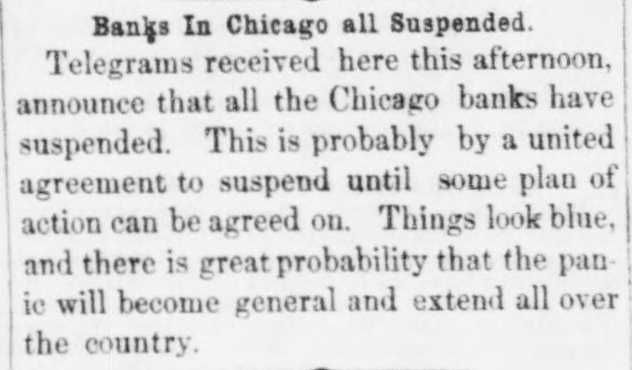
# Banks In Chicago all Suspended. Telegrams received here this afternoon, announce that all the Chicago banks have suspended. This is probably by a united agreement to suspend until some plan of action can be agreed on. Things look blue, and there is great probability that the panic will become general and extend all over the country.


Article from The True Northerner, September 26, 1873

Click image to open full size in new tab

Article Text

# True Northerner. PAW PAW, MICHIGAN, Sept. 26, 1873. # Local Department. Hon. Wilder D. Foster, Representative in Congress from the Fifth District of Michigan, died in Grand Rapids Sept. 20. H. P. McFarlin will hold an Auction Sale at the residence of Fdward Stowman, two miles north-west of Glendale P. O., Oct. 11. We advise every young man or lady who wish to qualify for business to attend the Kalamazoo Business College. The Ann Arbor Courier says the seating capactity of the new University Hall is 3,000, and by the use of temporary seats 4,000 can be accommodated. Charles Smolk has removed his Sewing Machine Depot to the new building on the corner of Main and Niles streets, adjoining the residence of T. A. Granger. The Fair of the Paw Paw Valley Agricultural Society commenced last Wednesday and closed to-day. We will give a more extended notice of it in our next issue. REV. R. C. WELCH, who has been assigned by the Michigan Conference to the charge of the M. E. Church in this place for the ensuing year. preached his first sermon on Sunday morning last. All the Banks of Chicago entered into an arrangement by which they closed their doors yesterday morning, and take thirty days in which to pay depositors. A genral derangement of business must be the result. The South Haven Sentinel says: "The condition of religion is good." That is just as we had supposed, and we are right glad to see that fact verified in so public a manner, for the past season has been unusually sickly. The Government Printing office in the City of Washington, in the Territory of Columbia, is one of the largest printing offices in the world. Six colored compositors are employed at the case in that concern. The Lapeer Clarion wants the fat men to stand back in future and give the lean men of the State a chance to hold a convention and get a good, square meal out of East Saginaw or some other philanthropic city. At a public gathering lately one of the gentlemen present was called upon for a speech, and this is how he responded: "Gentlemen and women, I ain't no speecher. More'n 20 years ago I came here a poor idiot boy, and now what are I?" On Saturday last, Miss Emma Pugsley left for Ann Arbor to enter the State University. She is a graduate of the school here, and is an excellent scholar. There are now two young ladies attending the University from this village, the other being Mies Emma Andrews. who has been there for the past two years. The Circuit Court has been in session during the past week. On Monday the Matteson case came up on a motion for change of venue, which motion, after a hearing and the reading of affidavits in support of the motion and counter affidavits opposed to it, was denied. The time for the trial will probably be set down for the next term of the Court. The most important other matter before the Court was a case between A. M. Merrifield and Philo Reed. LAWRENCE, Sept. 16, 1873. TRUE NORTHERNER: DEAR. SIR, I have been away all summer, and have but just returned. The first newspaper I saw after getting home was yourself going "Up in a Balloon." If a little money will save you, the enclosed Two Dollars will help. Keep the thing flying till they all respond, and keep the paper coming. Can't keep house without it. Yours Truly, The State Fair, held at Grand Rapids last week, was a success as regards the magnitude of the exhibition in all its departmentst-he Lumber of people who attended and financially. We learn that the receipts exceeded thirty thousand dollars. Our own Van Buren County maintained the ascendency she had heretofore attained. She bore off the highest prize for her County Collection of Fruit; the township of South Haven took the first prize for her Township collection of Fruit; and the Williams' process for evaporating fruit was pronounced superior to the Alden process. Mr. Williams. the inventor, is a resident and fruit grower of South Haven, in this countv. Our worthy and honored friend. Judge Monroe. met with a very serious mishap on Saturday night last, by which he is now lying in a critical condition. He had arrived here on the nine o'clock train on his way home from Grand Rapids, where he had been attending the State Fair. He started for his home, aboat eight miles from town, on foot and leading a ball by a cord attached to a ring in his nose. When about one-half mile from town the bull became somewhat refractory and refused to go. the Judge meanwhile pulling him along by the cord, when the animal suddenly attacked nim, throwing him to the ground and trampling him under his feet, bruising and lacerating him very seriously about the chest, side and bowels. fter becoming released the Judge crawled to the house of Mr. Clancy and aroused the inmates. who took him in and cared for him until he was taken home, Sunday morning. Ir not unfrequently happens that a party political convention is moved to deliberately falsify history in their platforms, declarations and resolves, as was the case of the Ohio in ther recant numatform adopted by


Article from Chicago Daily Tribune, September 28, 1873

Click image to open full size in new tab

Article Text

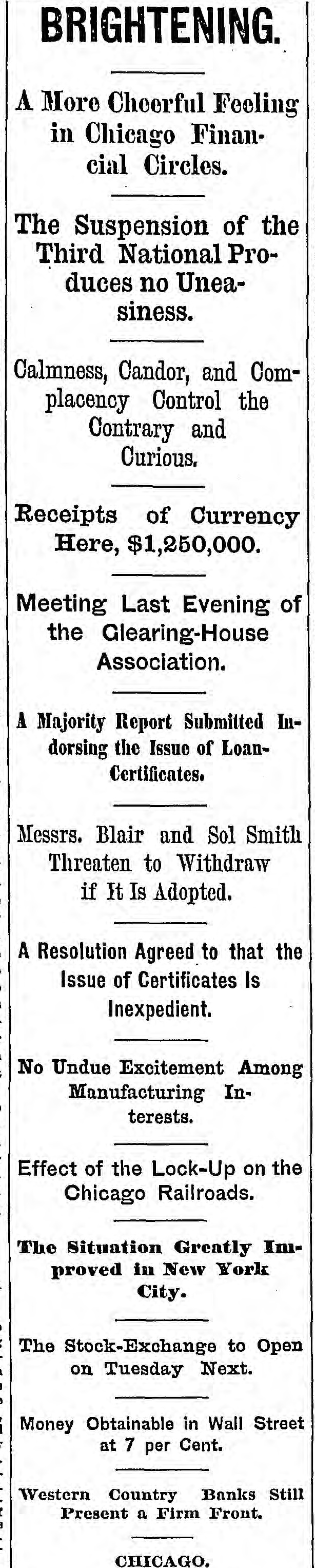
BRIGHTENING. A More Cheerful Feeling in Chicago Financial Circles. The Suspension of the Third National Produces no Uneasiness. Calmness, Candor, and Complacency Control the Contrary and Curious. Receipts of Currency Here, $1,250,000. Meeting Last Evening of the Glearing-House Association. A Majority Report Submitted Indorsing the Issue of LoanCertificates. Messrs. Blair and Sol Smith Threaten to Withdraw if It Is Adopted. A Resolution Agreed to that the Issue of Certificates Is Inexpedient. No Undue Excitement Among Manufacturing Interests. Effect of the Lock-Up on the Chicago Railroads. The Situation Greatly Improved in New York City. The Stock-Exchange to Open on Tuesday Next. Money Obtainable in Wall Street at 7 per Cent. Western Country Banks Still Present a Firm Front. CHICAGO.


Article from The Rutland Daily Globe, September 29, 1873

Click image to open full size in new tab

Article Text

two hundred dollars is a mistake. No such action has been taken. The banks are doing business as usual, except that they have stopped advances on the produce until the eastern banks shall be ready to respond. ### THE CLEVELAND BANKS. CLEVELAND, Sept. 27. There is but little excitement among business men in financial circles in this city over the monetary troubles. A feeling of confidence prevails, and there is scarcely a doubt but what the Cleveland banks will get through all right. The savings banks have adopted the sixty days' notice plan, merely as a precautionary measure. A RESUMPTION. DETROIT, Sept. 27. David Preston & Co, bankers of this city, resumed business to-day after a suspension of two days. ### THE TOLEDO BANKS. TOLEDO, Sept. 27. The banks of this city passed over yesterday in good condition. Several of them are stronger than at any time since the beginning of the run. The single failure of a banking house, Kraus & Smith, has had less effect than was apprehended. IN PHILADELPHIA. PHILADELPHIA, Sept. 27. Matters are quiet on Third street, the scarcity of currency being the only trouble experienced from the panic. Many large manufacturing concerns have, with great exertions, raised a sufficient amount of currency to pay full wages to their employes, while other firms have been able to pay only fifty per cent. of the wages due. CLEARING HOUSE OPERATIONS, CHICAGO, Sept. 27. At a meeting of the clearing house association a committee was appointed to draft a plan for the issue of loan certificates to be used in the clearing house in settlement of balances. ### THE STOCK EXCHANGE TO BE OPENED TUESDAY. NEW YORK, Sept. 27, 2.45 p. m. The stock exchange will open for business at the usual hour on Tuesday morning. This announcement indicates improved feeling on the street this afternoon, which has been brought about by a generally believed report that Com. Vanderbilt's brokers have to-day effected a general settlement in their heavy stock transactions. Very few transactions this afternoon. The following are the latest street cash quotations: New York Central 86; Lake Shore 64; Western Union 54; Pacific Mail 29; Rock Island 83; C. C. and I. C. 20; Union Pacific 18; Wabash 41. The details of business for opening the stock exchange will be arranged at the meeting of the governing committee Monday morning BANK COMMITTEE REPORT. At a meeting of the bank committee to-day a report was received from the committee to whom was referred the proposition of the committee of the stock exchange. The first suggestion of the latter had been anticipated by the action of the banks and the suggestion that the associate bank should guarantee payment of certified checks to the extent of their associated capital appears to the bank committee impracticable. In answer to another suggestion of the stock exchange committee the banking committee say the proposed modes of relief seem to look exclusively to the convenience and safety of the stock exchange, without comprehending danger and inconvenience involved to the bank. The clearing house committee have decided hereafter not to make public the amount of loan certificates issued. A special from Louisville says the German Insurance, Masonic savings, German Central savings, and Western banks have temporarily suspended. There is no run on other banks. The Louisville banking company has also suspended. AFFAIRS IN CHICAGO. A Chicago special says the Third National bank is reported closed and nothing doing on change. RECEIVER'S REPORT. WASHINGTON, Sept. 27. The report of the receiver of the first national bank shows that one hundred thousand dollarsβ€”the amount of surplusβ€”will cover its losses from realizing on its loans and discounts. If the indebtedness of Jay Cooke & Co. is paid in full its capital stock will be unimpaired. MORE HARD CASH. LONDON, Sept. 27. The steamship Java, which sailed from this port for New York to-day, took Β£500,000 in bullion.


Article from The Rock Island Daily Argus, September 29, 1873

Click image to open full size in new tab

Article Text

A Better Look There seems to be a more hopeful financial feeling in New York and Chicago. The Union National and the Cook County National resumed this morning. The Union National is the bank with which the First National in this city does business and of course that releases their balances SO they can be used. Mitchell & Lynde do business with the First National, in Chicago, and that bank did not suspend at all. The Third National, in Chicago, has suspended. That is the bank with which the Rock Island National does business-but it is believed to be a perfectly sound institution, and the suspension is thought to be merely temporary. The question is being raised as to the effect of these suspensions. It is held by some that it vitiates their organization and will compel them to wind up, if prosecuted. But we presume no one will be technical if they resume very soon. The Moline National (Wheelock's bank) has got the "age" of all of them in this county, for that institution never suspended at all.


Article from Chicago Daily Tribune, September 30, 1873

Click image to open full size in new tab

Article Text

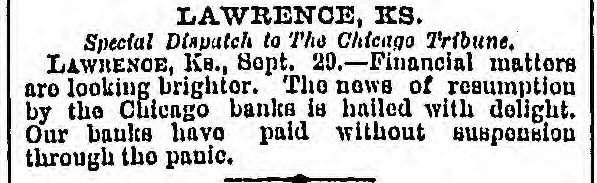
LAWRENCE, KS. Special Dispatch to The Chicago Tribune. LAWRENCE, Ks., Sept. 20.-Financial matters are looking brighter. The news of resumption by the Chicago banks is hailed with delight. Our banks have paid without suspension through the panic.


Article from Chicago Daily Tribune, September 30, 1873

Click image to open full size in new tab

Article Text

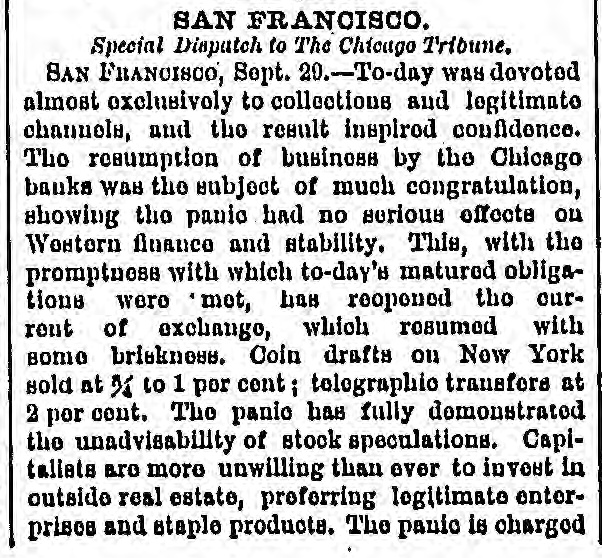
SAN FRANCISCO. Special Dispatch to The Chicago Tribune. SAN FRANCISCO, Sept. 20.-To-day was devoted almost exclusively to collections and legitimate channels, and the result inspirod confidence. Tho resumption of business by the Chicago banks was the subject of much congratulation, showing the panic had no serious effects on Western finance and stability. This, with the promptness with which to-day's matured obliga- tions were mot, has reopened the current of exchange, which resumed with some briskness. Coin drafts on New York sold at ΒΎ to 1 por cent; telegraphic transfers at 2 por cent. The panic has fully demonstrated the unadvisability of stock speculations. Capitalists are more unwilling than ever to invest in outside real estate, preferring legitimate enter- prises and staple products. The panic is charged


Article from Ottumwa Weekly Courier, October 2, 1873

Click image to open full size in new tab

Article Text

On Monday evening last the following action was had by Chicago bankers : The Chicago Clearing House association of banks and bankers resolve that until further action, and in view of the disturbed condition of affairs in New York and other cities, and the difficulty of converting balances into currency, its members be recommended and authorized to suspend currency payments on any large demands made upon them, either from country banks or over their counters. Dispatches of last night show that this action of the Chicago bankers is commended in Keokuk and Des Moines, Iowa,"also by those of Quincy and Peoria, III. The excitement throughout the whole country is great, and yet everybody expresses the utmost confidence in the banks, except such as have been dealing in railroad stock. The opinion prevails that banks generally must suspend until the people settle quietly down. Our produce which had commenced moving, is about totally checked. Eastern banks refuse to send currency west, and as a consequence no produce can be bought. This certainly cannot last long, for the starving must have bread and the currency depot must be unlocked in the East.


Article from Burlington Weekly Free Press, October 3, 1873

Click image to open full size in new tab

Article Text

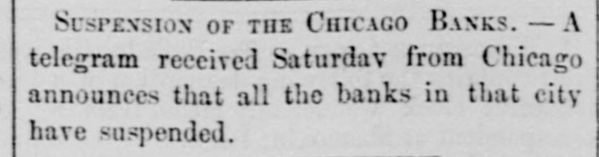
SUSPENSION OF THE CHICAGO BANKS. - A A telegram received Saturday from Chicago announces that all the banks in that city have suspended.


Article from Nashville Union and American, October 9, 1873

Click image to open full size in new tab

Article Text

FINANCIAL Cameron in Conference With Grant Opposition to Richardson's Policy In Drawing on the Reserves. NEW YORK, Oct. 8.-A Washington dispatch says Senator Cameron had a long interview with the President yesterday, and reports the latter, s well as himself strongly opposed to drawing on the forty four millton greenback reserves. The outstanding legal tenders are $358, 966,488. Special to the Louisville Courier-Journal WASHINGTON, Oct. 7.-The report of Mattingly, the receiver appointed for the Washington City Savings Bank, is generally considered as more rose-colored than the facts warrant. There is an effort make more out of very questionable assets than their true value. It seems to be thought that a favorable, or t least a mild report, will be made by the examiner appointed for the National Metropolitan Bank; but for reasons already stated, this report will not carry much weight. Resumed. CHICAGO Oct. 8.-The Third National Bank, which suspended on the 27th ult., reopered its doors and resumed business to-day. The result of the day's business was most gratifying to the officers as there was not only an entire absence of anything like a run, but the bank had a considerable sum to its credit in the clearing house, and received more than it paid out during the day, a fact which is taken as proof not alone of confidence in the bank, but of the entire recovery of the city from the late financial excitement. Gone into Liquidation. The Directors of the National Bank of this city decided to-day to go into liquidation. The assets are said largely to exceed the liabilities, and nobody will lose any thing. Cause, stringency of currency. New Orleans. NEW ORLEANS, Oct. -Gold 112@ 112g; currency 4@5 premium. Sterling 118 sight 1@11 premium and very scarce. Bankrupt Delos E. Colver, of Jersey City, one of the wealthiest capitalists in New Jersey, has been adjudged bankrupt. He was Vice President of the New York and Oswego Midland Railroad Company His abilities are said to be $8,000,000. Te the Associated Press. St. Louis Anxious to Resume. ST. Louis, Oct. 8.-At a meeting of the Clearing House Association last evening the question of resuming currency payments was considered and the general opinion expressed was in favor of doing so as soon as the New York banks lead off. A proposition to gradually cancel the Clearing House certificates and in this way resume without reference to New York was discussed, but no action taken. Special to the Cincinnati Commercial. Effect of the Panic on Government. WASHINGTON, Oct. 6.-Including to day's receipts from internal revenue the collections from that source thus far this month amount to $1,216,737, being at the ratio of only about $6,000,000 for the whole month. This is a great falling off. During the dulness of the past summer the receipts from internal revenue exceeded $8, 000,000 per month, and but for the effect of the financial panic upon general business the collections this month would have amounted to over $9,000,000, and would probably have reached $10,000,000. No Immediate Improvement Anticipated. Not much improvement in the condition of affairs will likely be noticsable for some days, even if financial matters and the general money market were to settle down at once to their former quietness and steadiness, although, as previ usly stated in these dispa ches, the present decrease or smallness of collections will not, in the belief of the commissioner of internal revenue, cause a loss to the government, for the resson that distillers, from whose products is obtained the greatest portion of the revenue DOW collected from internal sources, will go ahead with their business as usual, storing their goods in warehouses, and only withdrawing them in quantities sufficient to meet actual demands. In the meantime the Tressury Department will, in order to meet the expenses of the government, continue to draw upon the legal tender reserves to make up the deficiency resulting from the diminution in the receipts of currency from the principal, in fact the only source upon which the government now relies. Two million six hundred and forty nine thousand dollars of the forty-four million legal tender reserves have, according to the treasury financial exhibit this afternoon, f been paid out. Customs Receipts. The falling off in the receipts from customs duties is considerable, though not near as large as the reduction of internal revenue collections. of Settling Jay Cooke's Hash. il t Among the plans is one proposing that in e one of the pending proceedings in banl k. ruptcy, remembering that the government is largely interested in the Northern Pacific y Railroad, which promises to be the most valuable of the assets of the firm, Jay Cooke e & Co. shall nominate one trustee, the gove ernment another, and the creditors of each of the houses of the firm one each, making e five in all. This, it is claimed, would inof h clude and be obligatory upon all the creditors of the firm to prevent any unreasonable y and dissatisfied creditor from instituting proceedings hereafter to annul the act of any private trustee, and would slow magnanimous creditors, if the calamity prove to be greater than now believed, to give Cooke 8; & Co. a discharge which may become nec D essary and proper. BIRDS


Article from Dodgeville Chronicle, October 17, 1873

Click image to open full size in new tab

Article Text

the on work Canada Southern in had been Indiana, Northern the counties Sheriffs of taking through Railroad stopped which Itruns, Chicago of that city Journal of had the Bank According National opened says that in had finances 8th, the its Third doors dispatch again. of not the worked 8th The as Union satisfactorily had A St. Louis that city and that on day Bank decided to into go 8th the the says the for had Rock Island, erection military as of A. Ill., Miles, follows: Colonel the Wm. Colonel Fifth Infantry; of the Major Second Artillery; Rev. Judge E.C. Advocate of of the Wines, National of Prison Detroit. of City, Jersey Delos Culver, Thos. H. French, F. Barr, New York, R. Brockway, according of had the just He Strice-Presiof Raildent Midland Raw road liabilities aggregated $8,000,000. of 8th that says A New of for Fisk Stokes murder on day. of 9th that says rehis Treasure completed and the the transacport of of the the for tions fiscal Treasury National The 30, net 1873. year receipts of and by the repayments 669,221; of net same items, dis$524, were as cus981,0173 tributed toms, $113,revenue, $29, decreased 037,055. $28 since 250,00 and The 200,000. was about The of the net War Deand the Navy the for War $55,000,000, for the 000,000 Department for Navy diplomatic about $500,000, and have those fudiciary increased on the acabout the 945, count public of $345,555, last decrease against the The balance Treasury $131, June which 1873, differs the and from Register Secretary the fiscal fund, $161. of the during back year, king the pay, total receipts In from addition to on acfund this, this the count During $196,513. the year States United of The holds $114,307. from Banks, Treasurytation, $309,4 in of the first deposits a and deyear, item of The crease business of the National was Banks, A the of 9th, from of the the had been .bone says backof Rev. broken. Father Leasont of the had died, Bishop making of had the the who fifth been The number stricken of 9th the had been deaths had ten. The shown on the 9th little very OrNew from been of that city leans. had died of the that 9th New says and that by the NaThe to tional resume decided as 13th. low 108% of for The CazenGibson, T. ova who Irving, tive detects of Nathat than, the 9th, city that Bro., to had over to A 9th the the Associa of serves extent of the $3,000,000 T with The the been had New 10th, York of the was sold which gold, for the lowest the of 10th dispatch had theared appeared La., 10th. of the Iowa 10th on ed At over of hay, stock, cases, houses and A of the 11th tion was the by Martin Pomeroy as, F. on of of one The Kanlowing along walking and this New when Conway he him. When drew latter in sucquick but away, to was whom he "He that children, him. and Pomeroy, had was who assisted to when home, noned. chesicians to was ball On have mediatele and vest but shirt, passed its after penetrat it off ing by was triking of the Shooting that


Article from The Minneapolis Journal, August 5, 1902

Click image to open full size in new tab

Article Text

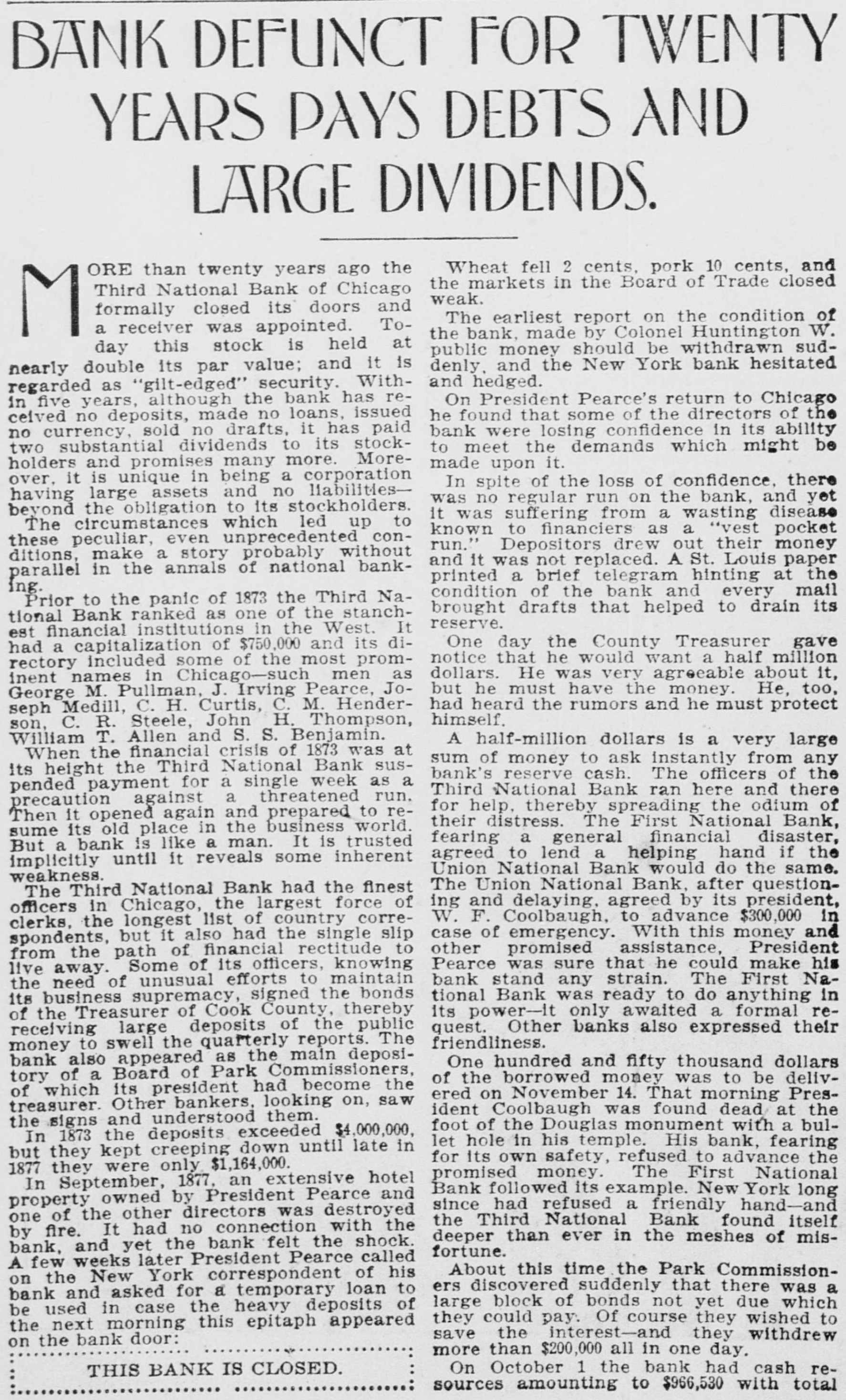
RUN BY THE GOVERNMENT BANK A CHICAGO OF STORY The Stockholders Pleased to Have Uncle Sam in Charge for Thirty Years. From The Journal Bureau, Room 45. Post Building, Washington, Washington, Aug. 5. - The Third National bank of Chicago has been in the hands of a receiver since 1872. For thirty years the government has been running concern. the The creditors were paid ages ago, but the stockholders were so well pleased with the management of the controller of the currency that they refused to let him surrender. For years Huntington W. Jackson was receiver and managed the business; on his death his partner, Colonel Henry Lyman was appointed. The main Impediment to winding up the receivership was a refusal to sell a lot of real estate on the south side, bordering on Jackson Park. J. Irving Pierce, of Sherman House fame, never would give his consent. During world's fair times an offer of a million dollars was made for the property, but Pierce wanted more. Now that the veteran hotel proprietor is dead, the controller has hopes that the trust can be wound up. -W. W. Jermane.


Article from The Billings Gazette, August 8, 1902

Click image to open full size in new tab

Article Text

RUN BY THE GOVERNMENT. Uncle Sam in Charge of a Chicago Bank for Thirty Years. Washington, Aug. 5.-The Third National bank of Chicago has been in the hands of a receiver since 1872. For 30 years the government has been running the concern. The creditors were paid ages ago, but the stockholders were so well pleased with the management of the controller of the currency that they refused to let him surrender. For years Huntington W. Jackson was receiver and managed the business; on his death his partner, Colonel Henry Lyman was appointed. The main impediment tc winding up the receivership was a refusal to sell a lot of real estate on the south side, bordering on Jackson park. J. Irving Pierce, of herman house fame, never would give his consent. During world's fair times an offer of a million dollars was made for the property, but Pierce wanted more. Now that the veteran hotel proprietor is dead, the controller has hopes that the trust can be wound up.