Third National Bank (Philadelphia, PA)

Episode Information

Episode UID
23401097
Episode Type
Run Only
Bank Type
national
Bank ID
2340 national
Charter Number
234
Start Date
May 9, 1891
Location
Philadelphia, Pennsylvania (39.952, -75.164)

Metadata

Model
gpt-5-mini (chosen from majority vote of a three-model LLM ensemble)
Short Digest
7101d284152886e7

Response Measures

Accommodated withdrawals, Capital injected, Books examined

Description

Runs were triggered by Treasurer Bardsley's misfortunes and related local bank failures; bank stayed open.

Events (3)

1. February 4, 1864 Chartered
Source
historical_nic
2. May 9, 1891 Run
Cause
Local Banks
Cause Details
Depositors alarmed by City Treasurer Bardsley's misfortunes and failures/suspension of Keystone and Spring Garden banks.
Measures
Doors kept closed briefly; examiner Drew in charge; friends and directors pledged support.
Newspaper Excerpt
A run was made this morning by depositors on the Third National Bank.
Source
newspapers
3. May 23, 1891 Run
Cause
Local Banks
Cause Details
Continued withdrawals tied to publicity from Keystone and Spring Garden failures and Bardsley's embezzlement revelations, causing further large outflows and loss of deposits.
Measures
Directors agreed not to attempt immediate withdrawal of city funds; stockholders called to reorganize; resignations of president and vice-president.
Newspaper Excerpt
The Third national bank... will be able after a settlement to pay the depositors; it is said the bank will collapse to-day. The bank has paid out $1,400,000 of private deposits out of $1,500,000 since the storm first broke.
Source
newspapers

Newspaper Articles (15)

Article from The Evening World, May 9, 1891

Click image to open full size in new tab

Article Text

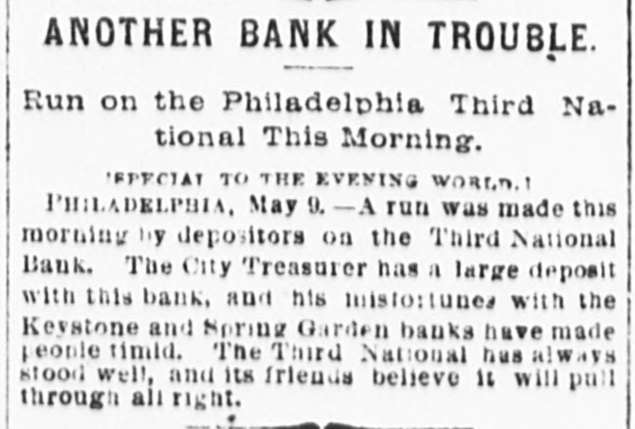
ANOTHER BANK IN TROUBLE. Run on the Philadelphia Third National This Morning. EPECIAL TO THE EVENING WORLD.1 Philadelphia, May 9. -A run was made this morning by depositors on the Third National Bank. The City Treasurer has a large deposit with this bank, and his misfortunes with the Keystone and Spring Garden banks have made people timid. The Third National hus always stood well, and its friends believe it will pull through all right.


Article from The Evening World, May 9, 1891

Click image to open full size in new tab

Article Text

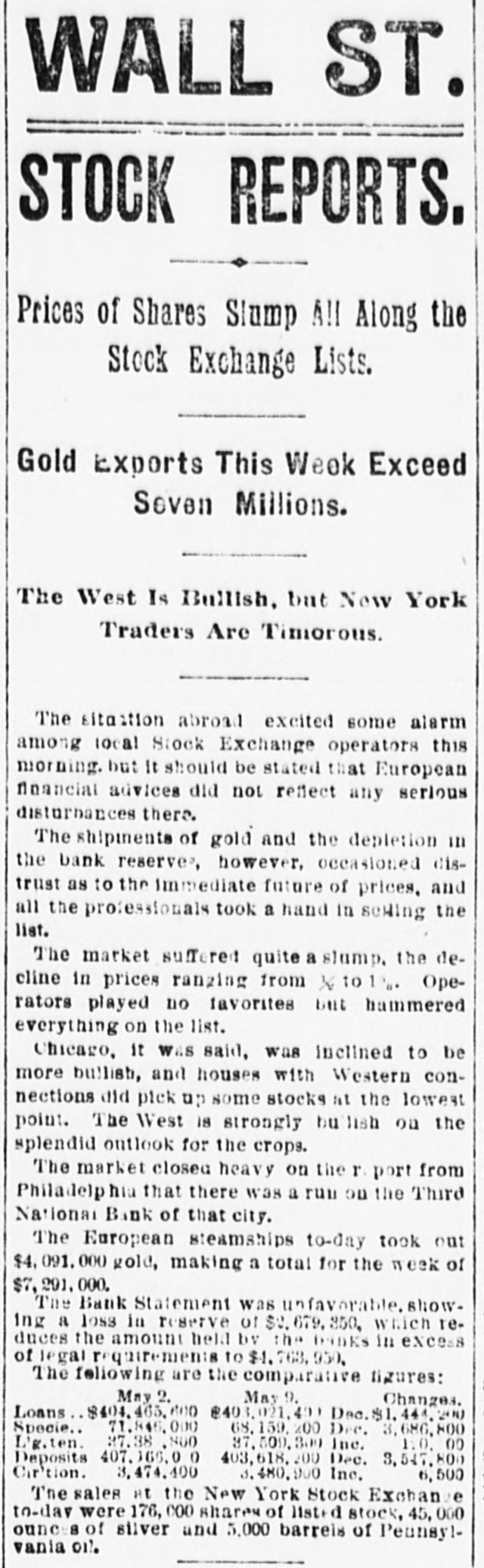
WALL ST. STOCK REPORTS. Prices of Shares Slump All Along the Stock Exchange Lists. Gold Exports This Week Exceed Seven Millions. The West Is Bullish, but New York Traders Are Timorous. The situation abroad excited some alarm among local Stock Exchange operators this morning. but it should be stated that European financial advices did not reflect any serious disturbances there. The shipments of gold and the depletion in the bank reserve, however, occasioned distrust as to the immediate future of prices, and all the professionals took a hand in sewing the list. The market suffered quite a slump, the decline in prices ranging from Β½ to 1%. Operators played no favorites but hammered everything on the list. Chicago, it was said, was inclined to be more bullish, and houses with Western connections did pick up some stocks at the lowest point. The West is strongly bu lish on the splendid outlook for the crops. The market closed heavy on the r. port from Philadelphi that there was a run on the Third National Bank of that city. The European steamships to-day took out $4,091.000 gold, making a total for the week of $7,291,000. The Bank Statement was unfavorable. showing a loss in reserve of $2,679,350, which reduces the amount held by the DADKS in excess of legal requirements to $4,763,950, The feliowing are the comparative figures: May 2. May 9. Changes. Loans $404,465,600 $403,021.400 Dec. $1,444,200 71.845,000 Specie.. 68,159,200 Dec. 3,686,800 37.38.800 L'g.ten. 37,509,300 Inc. 1.0.00 Deposits 407,166.0 0 403,618,200 Dec. 3,547,800 Cir'tion. 3,474,400 3,480,900 Inc. 6,500 The sales at the New York Stock Exchange to-day were 176,000 shares of listed stock, 45,000 ounces of silver and 5,000 barrels of Pennsylvania 01.
Article from Evening Star, May 9, 1891

Click image to open full size in new tab

Article Text

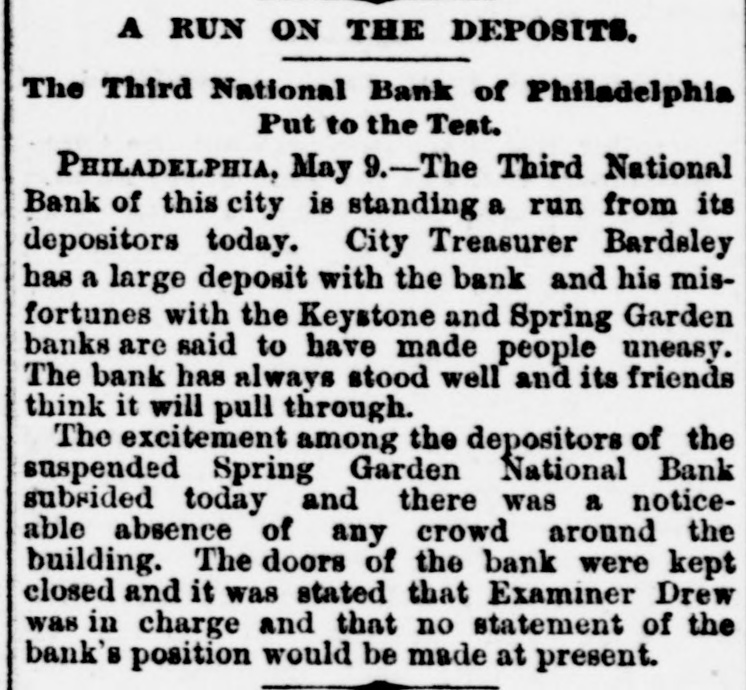
A RUN ON THE DEPOSITS. The Third National Bank of Philadelphia Put to the Test. PHILADELPHIA, May 9.-The Third National Bank of this city is standing a run from its depositors today. City Treasurer Bardsley has a large deposit with the bank and his misfortunes with the Keystone and Spring Garden banks are said to have made people uneasy. The bank has always stood well and its friends think it will pull through. The excitement among the depositors of the suspended Spring Garden National Bank subsided today and there was a noticeable absence of any crowd around the building. The doors of the bank were kept closed and it was stated that Examiner Drew was in charge and that no statement of the bank's position would be made at present.


Article from The L'anse Sentinel, May 16, 1891

Click image to open full size in new tab

Article Text

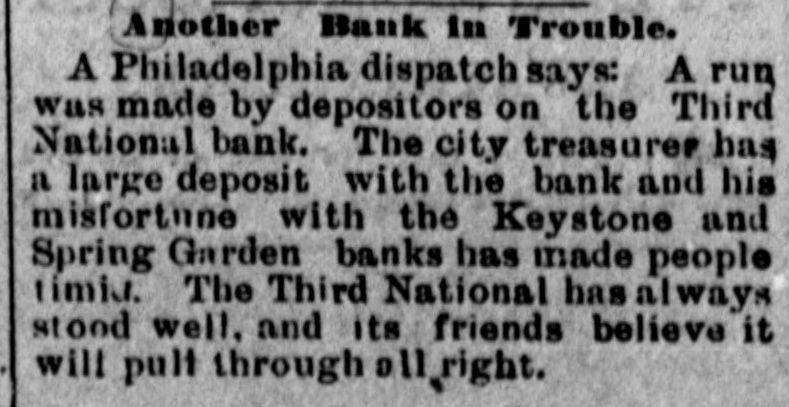
Another Bank in Trouble. A Philadelphia dispatch says: A run was made by depositors on the Third National bank. The city treasurer has a large deposit with the bank and his misfortune with the Keystone and Spring Garden banks has made people timid. The Third National has always stood well, and its friends believe it will pull through all right.


Article from Telegram-Herald, May 24, 1891

Click image to open full size in new tab

Article Text

JUST A LITTLE T00 LATE Pennsylvania's Guard Against Further Loss of Funds. BARDSLEY'S MUCH MIXED AFFAIRS Parplex the Philadelphians Whose Prospects of Recovering Much of Their Missing Wealth Are Very Discouraging. Harrisburg, Pa., May 23.-Both houses of the legislature have concurred in the following: "Resolved, That all borough, city, county or state officers authorized to collect end receive taxes or license fees for the commonwealth shall make returns of the same on the first of every month. and within ten days thereafter pay the amount mentioned in said return in to the state treasury. "And further, it shall be the duty of the state treasurer to immediately notify the at. torney general of any failure on the part of any officer to account as aforesaid." Philadelphia, May 23.-Friday after. noon Mayor Stuart, tired of seeing the city's money float off in $100,000 pieces, decided to demand of the Third national bank that it return to the city at once $885,000 of deposits. The bank cannot stand this drain, as there have been runs upon it since the present scare, and it is feared the institution will collapse to-day. The bank, it is said, will be able after a settlement to pay the depositors all the money it owes. Thus three banks will have failed within one month owing the city $966,000. Nobody knows how much of this sum can be saved. The sureties of the city treasurer are released from paying all but $11,000. John Bardsley, the treasurer, will go to jail. Although he has not yet been arrested there is no doubt that he has perverted state and perhaps city money to his own use. William H. Wanamaker, a brother of the postmaster general, will have to pay $20,000 on account of Marsh's flight. He has the city posted with descriptions of Marsh offering $1,000 reward for him. The state treasurer and the auditor general will come in for a share of the blame in not making Bardsley hand over the state funds in his care. They knew of the money being retained, but made no effort to get it. An attachment was taken out Friday morning against the Bradford mills, of which City Treasurer Bardsley is owner, by John and James Dobson, his sureties on his bond. Friday morning Mr. Bardsley made an assignment of all his property for the benefit of the city to Edwin W. Magill. At the office of the United States marshal it was said that the rumor that the absconding president of the Keystone bank had been arrested in Montreal was without foundation. As the matter is further probed the chances of the state recovering any money at all from the Keystone bank, into which Bardsley dumped $930,000 of state funds, is growing beautifully less. He gave all this money to President Marsh and accepted in lieu there. of the bank's due bills on the clearing house. These are not worth a penny, but they are held to be receipts for money loaned. They do not even give or state the claim of a depositor to participate in the pro rata distribution among the depositors. Auditor General McCamant says that if the money is not paid into the state treasury by the 28th inst. suit will be entered against Mr. Bardsley and his bondsmen His bonds to the state


Article from The Seattle Post-Intelligencer, May 29, 1891

Click image to open full size in new tab

Article Text

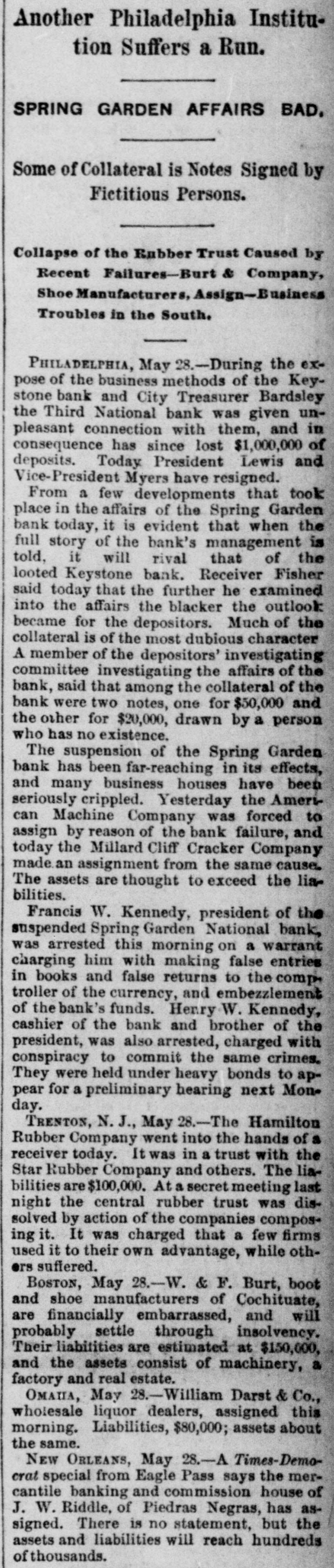
Another Philadelphia Institution Suffers a Run. SPRING GARDEN AFFAIRS BAD, Some of Collateral is Notes Signed by Fictitious Persons. Collapse of the Rubber Trust Caused by Recent Failures-Burt & Company, Shoe Manufacturers, Assign-Business Troubles in the South. PHILADELPHIA, May 28.-During the expose of the business methods of the Keystone bank and City Treasurer Bardsley the Third National bank was given unpleasant connection with them, and in consequence has since lost $1,000,000 of deposits. Today President Lewis and Vice-President Myers have resigned. From a few developments that took place in the affairs of the Spring Garden bank today, it is evident that when the full story of the bank's management is told, it will rival that of the looted Keystone bank. Receiver Fisher said today that the further he examined into the affairs the blacker the outlook became for the depositors. Much of the collateral is of the most dubious character A member of the depositors' investigating committee investigating the affairs of the bank, said that among the collateral of the bank were two notes, one for $50,000 and the other for $20,000, drawn by a person who has no existence. The suspension of the Spring Garden bank has been far-reaching in its effects, and many business houses have been seriously crippled. Yesterday the American Machine Company was forced to assign by reason of the bank failure, and today the Millard Cliff Cracker Company made an assignment from the same cause. The assets are thought to exceed the liabilities. Francis W. Kennedy, president of the suspended Spring Garden National bank, was arrested this morning on a warrant charging him with making false entries in books and false returns to the comp troller of the currency, and embezzlement of the bank's funds. Herry W. Kennedy, cashier of the bank and brother of the president, was also arrested, charged with conspiracy to commit the same crimes. They were held under heavy bonds to appear for a preliminary hearing next Monday. TRENTON, N. J., May 28.-The Hamilton Rubber Company went into the hands of a receiver today. It was in a trust with the Star Rubber Company and others. The liabilities are $100,000. At a secret meeting last night the central rubber trust was dissolved by action of the companies composing it. It was charged that a few firms used it to their own advantage, while others suffered. BOSTON, May 28.-W. & F. Burt, boot and shoe manufacturers of Cochituate, are financially embarrassed, and will probably settle through insolvency. Their liabilities are estimated at $150,000, and the assets consist of machinery, a factory and real estate. OMAIIA, May 28.-William Darst & Co., wholesale liquor dealers, assigned this morning. Liabilities, $80,000; assets about the same. NEW ORLEANS, May 28.-A Times-Democrat special from Eagle Pass says the mercantile banking and commission house of J. W. Riddle, of Piedras Negras, has assigned. There is no statement, but the assets and liabilities will reach hundreds of thousands.


Article from Deseret Evening News, May 29, 1891

Click image to open full size in new tab

Article Text

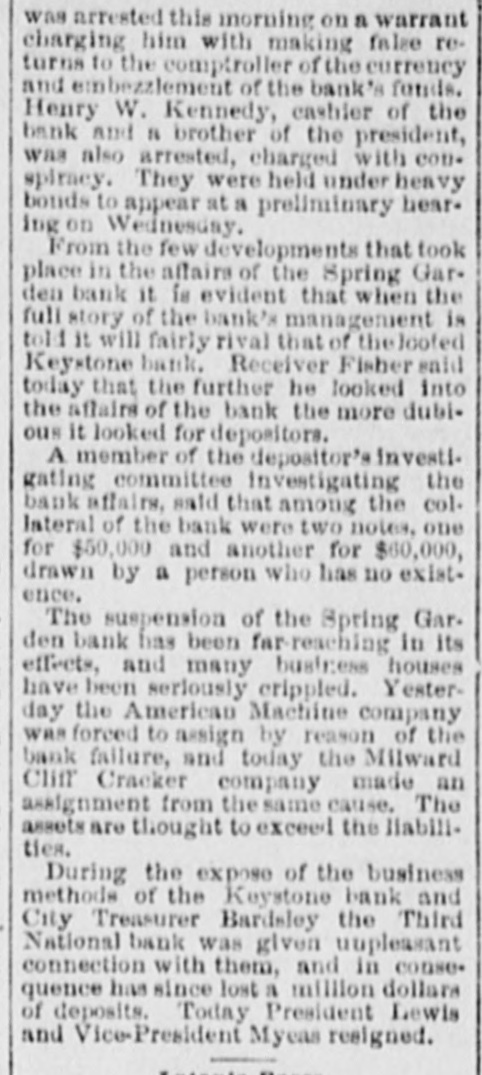
was arrested this morning on a warrant charging him with making false re- turns to the comptroller of the currency and embezzlement of the bank's fonds. Henry W. Kennedy, cashier of the bank and a brother of the president, was also arrested, charged with conspiracy. They were held under heavy bonds to appear at a preliminary hearing on Wednesday. From the few developments that took place in the affairs of the Spring Garden bank it is evident that when the full story of the bank's management is told it will fairly rival that of the looted Keystone bank. Receiver Fisher said today that the further he looked into the affairs of the bank the more dubious it looked for depositors. A member of the depositor's investigating committee investigating the bank affairs, said that among the collateral of the bank were two notes, one for $50,000 and another for $60,000, drawn by a person who has no existence. The suspension of the Spring Garden bank has been far-reaching in its effects, and many business houses have been seriously crippled. Yesterday the American Machine company was forced to assign by reason of the bank failure, and today the Milward Cliff Cracker company made an assignment from the same cause. The assets are thought to exceed the liabilities. During the expose of the business methods of the Keystone bank and City Treasurer Bardsley the Third National bank was given unpleasant connection with them, and in consequence has since lost a million dollars of deposits. Today President Lewis and Vice-President Myeas resigned.


Article from The Iowa Plain Dealer, June 4, 1891

Click image to open full size in new tab

Article Text

HELD FOR EMBEZZLEMENT. The President and Cashier of the Spring Garden Bank of Philadelphia Arrested. PHILADELPHIA, May Francis W. Kennedy, president, and H.H. Kennedy, cashier, of the Spring Garden bank, recently closed by order of the comptroller of the currency, have been arrested on warrants sworn out by Bank Examiner Drew, charging Francis W. Kennedy with embezzlement and aiding and abetting the officers of the bank in making false entries in the books. H. H. Kennedy is charged with making false entries in the books and aiding and abetting others, with the intention to defraud the bank. The amount of embezzlement is placed at $100,000. United States Commissioner Bell gave the prisoners a preliminary hearing and held Francis W. Kennedy in $20,000, and H. H. Kennedy in $15,000 bail for further hearing Monday. The suspension of the Spring Garden bank has been far-reaching in its effects, and many business houses have been seriously crippled by it. Thursday the Millward-Cliff Cracker Company made an assignment. It is a stock company, and in an investigation of its affairs it was discovered that Frank Benton, the treasurer. had given accommodation notes to the extent of $50,000 to Francis W. Kennedy, president of the Spring Garden bank. When this was discovered the officers of the company decided to make an assignment to protect their creditors pending a thorough investigation. During the recent exposure of the business methods of the Keystone bank and City Treasurer Bardsley the Third national bank was given an unpleasant publicity through its business connections with the institution and with Bardsley, and in consequence lost within two weeks $1,000,000 of deposits. Thursday President Percy M. Lewis and Vice President George Myers sent in their resignations to the board of directors, stating that they thought the best interests of the bank would be best served by their so doing.


Article from The Valley Virginian, July 16, 1891

Click image to open full size in new tab

Article Text

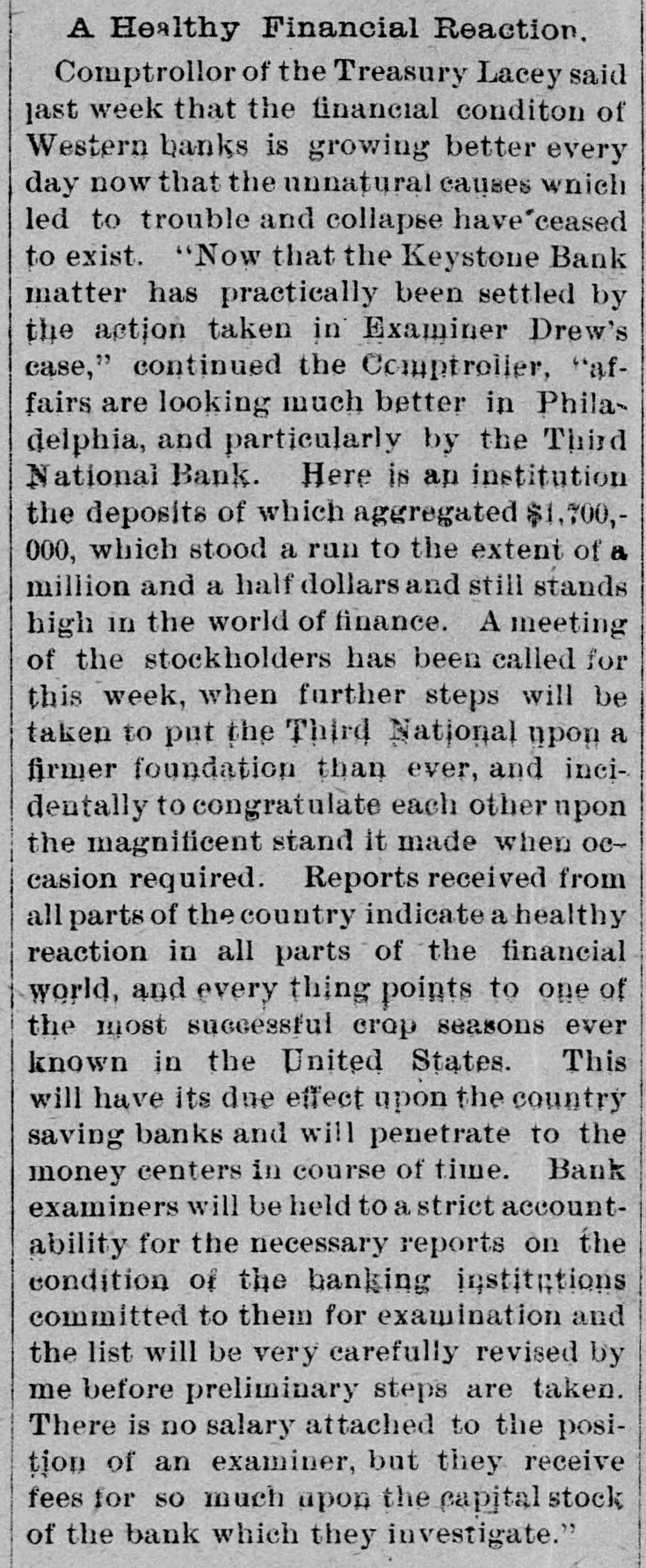
# A Healthy Financial Reaction. Comptrollor of the Treasury Lacey said last week that the financial conditon of Western banks is growing better every day now that the unnatural causes which led to trouble and collapse have ceased to exist. "Now that the Keystone Bank matter has practically been settled by the action taken in Examiner Drew's case," continued the Comptroller, "affairs are looking much better in Philadelphia, and particularly by the Third National Bank. Here is an institution the deposits of which aggregated $1,700,000, which stood a run to the extent of a million and a half dollars and still stands high in the world of finance. A meeting of the stockholders has been called for this week, when further steps will be taken to put the Third National upon a firmer foundation than ever, and incidentally to congratulate each other upon the magnificent stand it made when occasion required. Reports received from all parts of the country indicate a healthy reaction in all parts of the financial world, and every thing points to one of the most successful crop seasons ever known in the United States. This will have its due effect upon the country saving banks and will penetrate to the money centers in course of time. Bank examiners will be held to a strict accountability for the necessary reports on the condition of the banking institutions committed to them for examination and the list will be very carefully revised by me before preliminary steps are taken. There is no salary attached to the position of an examiner, but they receive fees for so much upon the capital stock of the bank which they investigate."


Article from The Democratic Advocate, July 18, 1891

Click image to open full size in new tab

Article Text

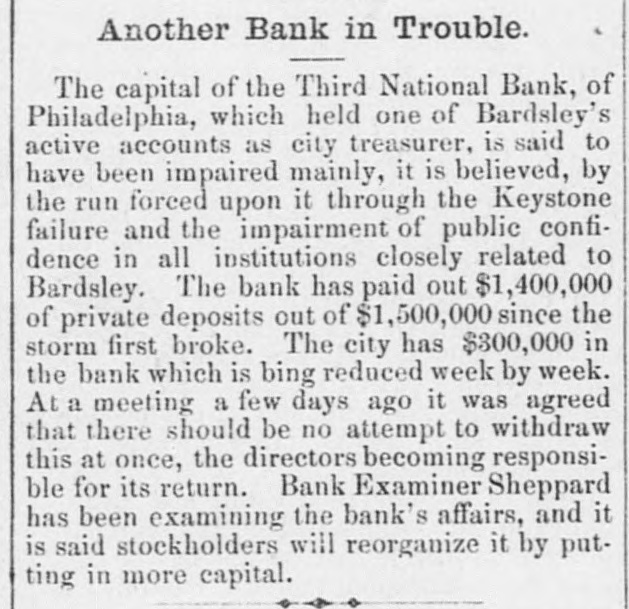
Another Bank in Trouble. The capital of the Third National Bank, of Philadelphia, which held one of Bardsley's active accounts as city treasurer, is said to have been impaired mainly, it is believed, by the run forced upon it through the Keystone failure and the impairment of public confidence in all institutions closely related to Bardsley. The bank has paid out $1,400,000 of private deposits out of $1,500,000 since the storm first broke. The city has $300,000 in the bank which is bing reduced week by week. At a meeting a few days ago it was agreed that there should be no attempt to withdraw this at once, the directors becoming responsible for its return. Bank Examiner Sheppard has been examining the bank's affairs, and it is said stockholders will reorganize it by putting in more capital.


Article from The Sun, August 17, 1893

Click image to open full size in new tab

Article Text

Suspended Banks Reopen Their Doors. KANSAS CITY. Aug. 16. - The Armourdale Bank at Armourdale. which suspended business in the financial crash in the two Kansas cities one month ago yesterday. has reopened its doors and resumed business. FORT SCOTT, Kan., Aug. 16-The First National Bank of this city. which suspended on July 18, resumed business this morning. Bank Examiner Latimer of Sedalia. who has been in charge since it closed. has issued a notice to depositors saying that the institution is in good financial condition. WASHINGTON. Aug. 16.-The First National Bank of Rico, Col., which suspended payment June 30. 1893. having complied with the conditions imposed by the Comptroller of the Currency. and its capital stock being unimpaired. has been permitted to-day to reopen its doors for business. CLEVELAND. Aug. 16.-The Cardington Banking Company. at Cardington. O., closed its doors this afternoon. Theassets approximate $100. 000 and are said to be sufficient to meet the demands of the creditors. The President of the bank. Major W. G. Beatty. was obliged to make an assignment. and the bank could not weather the trouble brought on by his embarrassment. CARROLLTON. Pa.. Aug. 16.-The banks of Johnston. Bucks county. at Ebensburg. Carrollton. and Hastings. which suspended payments until they could get more money. will open again on Monday morning.


Article from Phillipsburg Herald, August 24, 1893

Click image to open full size in new tab

Article Text

make the fight for gold monometallism Knowing that Cleveland was heartily with them, they desired to create such public sentiment as would make his triumph with congress easy. First they were to press the west for a settlement of indebtedness, and next they were to start the scare over the export of gold. The movement of gold abroad began early in the year. It was undoubtedly accelerated by New York financiers, and every effort made to magnify its importance. The telegraph wires were daily loaded, not merely with the various amounts that were going abroad, but with interviews with New York men as to what was the cause, etc. There was apparently a systematic effort to press upon the people of the whole country that other nations were frightened on account of our silver legislation, and were determined to secure all their indebtedness at once in gold. The strongest influences were brought to bear on President Harrison and Secretary of the Treasury Foster to get them to issue bonds for the purpose of calling gold back. It is said that the treasurer, Foster, succumbed to their influence and was willing to issue the bonds, which SO greatly encouraged the New Yorkers that they formed a syndΔ±cate for the purpose of handling them. A gentleman of this city assures the Inter Ocean that he knows some of the members of said syndicate. President Harrison's firmness, however, thwarted their efforts, and when President Cleveland was inaugurated he refused to do what his predecessor had so firmly and positively declined. When it was found that President Cleveland would neither issue the bonds nor call an immediate session of congress to wipe out silver legislation the export of gold continued to increase rather than decrease, and the wise financiers of the east began to see that the movement they had started was one they could not control. The fuliillment of their prophecies of evil began to look them full in the face they became worse frightened than those whom in the beginning they had intended to frighten. They could not conΓ§eal their apprehension, and though they were much more demure than they were when they were trying to frighten the rest of the nation, their influence was 80 chilling to enterprise and prosperity that the panic spread all over the country. A general distrust of banks and financial institutions siezed the whole people and an unexampled hoarding of currency began in all parts of the country. The result is that the nation is now undergoing a financial stringency such as was never seen here before and, like retributive justice, the severest sufferers of all are the financiers of the Atlantic who inaugurated and created the panic. The great banks of New York, Boston and Philadelphia have practically suspended and the work of furnishing currency to those who have workman to pay is relegated to brokers, who sell at premium, The New York city banks have now some $37,000,000 of clearing house certificates, which is a species of currency|that is good between the banks themselves. Checks and drafts on Boston, New York and Philade'phia, are selling in Chicago at from $15 to $30 per $1,000 discount and go begging at that. Over $25,000,000 of gold have been imported since July 1, but still these great banks are not able to resume their old relation with the banks of the country. They undertook to teach the west a lesson and require them to pay up, but they have found that the west is the great source of the wealth of the country, and that from the west come the exports to foreign countries, and that the money of foreign countries must come west in order to secure these exports. Ther have found that


Article from The Ketchum Keystone, September 2, 1893

Click image to open full size in new tab

Article Text

ity that the panic spread all over the country. WALL STREET CHEATED THE PANIC. A general distrust of bank and financial institutions seized the whole people and an unexampled hoarding of currency began in all parts of the country. The result is that the nation is now undergoing a financial stringency such as was never seen here before, and like retributive justice, the severest sufferers of all are the financiers of the Atlantic cities who inaugurated and created the panic. The great banks of New York, Boston and Philadelphia have practically suspended. and the work of furnishing currency to those who have workmen to pay is relegated to brokers, who sell at premium. NEW YORK BANKS SOLVENT. The New York City banks have now some $37,000,000 of Clearing House certificates, which is a species of currency that is good between the banks themselves. Checks and drafts on Boston, New York and Philadelphia are selling in Chicago at from $15 to $30 per $1,000 discount, and go begging at that. Over $25,000,000 of gold has been imported since July 1st, but still these great banks are not able to resume their old relations with the banks of the country. They undertook to teach the West a lesson and require them to pay up, but they found that the West is the great source of the wealth of the country, and that from the West come the exports of foreign countries, and that the money of foreign countries must come West in order to secure those exports. They have found, too, that the West is full of able and independent business men, S who do not find it necessary to 1 simply imitate their brothers of the East. EASTERN BANKERS' CRIMINALITY. These great financiers of the East undertook to teach the nation a lesson, showing the folly of bimetallism+ and have simply demonstrated their own inefficiency as business men and worked irrepara ble injury to the whole country The gold that they aided to get away to Europe is returning, but it f comes to pay for the exports of the West. The same men and their allies undertook to make things easy for Mr. Cleveland, but have only succeeded in rousing animosities that will make the success of his administration more difficult and 7 S make monometallism more hated h than ever. Whatever the actual result of present contentions, there is a lesson in the present situation to all those who would have the whole t country pay them tribute.-Chicago Inter-Ocean, August 20th.


Article from The Great West, September 8, 1893

Click image to open full size in new tab

Article Text

of the nation, their influence was so depressing to enterprise and prosperity that the panic spread all over the country. A general distrust of banks and financial institutions seized the whole people, and an unexampled hoarding of currency of all kinds began in all parts of the country. The result is that the nation is now undergoing a financial stringency such as was never seen here before, and, as if ordered by retributive justice, the severest sufferers of all are the financiers of the Atlantic cities who inaugurated and created the panic. The great banks of New York, Boston and Philadelphia have practically suspended, and the work of furnishing currency to those who have workmen to pay relegated to brokers who sell it at a premium. Chicago is the only great city of the nation where the banks honor all checks, and pay every depositor currency as asked for. The New York city banks have now some $38,000,000 of clearing house certificates, which are a species of currency, unknown to the law, that is good between the banks themselves. Checks and drafts on Boston, New York, and Philadelphia are selling in Chicago at from $15 to $30 per $1,000 discount, and go begging at that. Over $25,000,000 of gold has been imported since the first of July, but still these great banks are not able to resume their old relation with the banks of the country. They undertook to teach the west Γ  lesson and require them to pay up, but they have found that the west is the great source of wealth of the country, and that from the west come the exports to foreign countries and that the money of the foreign countries must come west in order to secure these exports. They have found, too, that the west is full of able and independent business men, who do not find it necessary simply to imitate their brothers of the east. These great financiers of the east undertook to teach the nation a lesson, showing the folly of bimetallism, and have simply demonstrated their own inefficiency as business men, and worked irreparable injury to the whole country. The gold that they aided, to get away to Europe is returning, but it comes to pay for the exports of the west. The same men and their allies undertook to make things easy for Mr. Cleveland, but have only succeeded in rousing animosities that will make the success of his administration more difficult and make mono-metalism more hated than ever. Whatever the actual result of present contentions, there is a lesson in the present situation to all those who would have the whole country pay them tribute."


Article from Idaho Semi-Weekly World, September 12, 1893

Click image to open full size in new tab

Article Text

of Congress to wipe out silver legis. lation, the export of gold began to increase rather than decrease, and the wise financiers of the East began to see that the movement they had started was one they could not control. The fulfillment of their prophesy of evil began to look them full in the face, and they became worse frightened than those whom, in the beginning, they had intended to frighten. They could not conceal their apprehension, and though they were much more demure than they were when they were trying to frighten the rest of the nation, their influence was so chilling to enterprise and prosperity that the panic spread all over the country. WALL STREET CREATED THE PANIC. A general distrust of bank and financial institutions seized the whole people, and an unexampled boarding of currency began in all parts of the country. The result is that the nation is undergoing a financial stringency such as was never seen here before, and, like retributive justice, the severest sufferers of all are the financiers of the Atlantic cities who inaugurated and created the panic. The great banks of New York, Boston and Pbiladelphia have practically suspended, and the work of furnishing currency to those who have workmen to pay is relegated to brokers, who sell at a premium. NEW YORK BANKS INSOLVENT. The New York city banks have now some $37,000,000 of Clearing House certificates, which is a species of currency that is good between the banks themselves. Checks and drafts on Boston are selling in Chicago at from $15 to $30 per $1,000 discount, and go begging at that. Over $25,000,000 of gold has been imported since July 1st, but still these great banks are not able to rosume their old relations with the banks of the country. They undertook to teach the West a lessen and require them to pay up, but they found that the West is the great source of wealth of the country, and that from the West come the exports to foreign countries, and that the money of foreigh countries must come West in order to secure those exports. They t have found, too, that the West is full of independent business men, who do s not find it necessary to simply imin tate their brothers of the East. EASTERN BANKERS' CRIMINALITY. , These great financiers of the East undertook to teach the nation, showe ing the folly of bimetallism, and have simply demonstrated their own ineffi3, ciency as business men and worked y irreparable injury to the whole country. The gold that they aided to get d away to Europe is returning, but d comes to pay for the exports of the West. The same men and their alis lies undertook to make things easy for Mr. Cleveland, but have only succeeded in rousing animosities that st will make the success of his administration more difficult and make moncd metallism more hated than ever. r Whatever the actual result of present t contentions, there is a lesson in the le present situation to all those who would have the country pay them tribute. d