23011. Fidelity Banking & Trust Company (Bluefield, WV)

Bank Information

Episode Type
Suspension → Closure
Bank Type
trust company
Start Date
September 15, 1911
Location
Bluefield, West Virginia (37.270, -81.222)

Metadata

Model
gpt-5-mini
Short Digest
f7b5f008

Response Measures

None

Description

The bank closed its doors in mid-September 1911 (articles cite Sept 15, 1911). A federal receiver (C. L. Williams) was appointed and the institution is described as defunct/insolvent; prosecutions and embezzlement/worthless security findings are reported. There is no contemporaneous description of a depositor run in the provided articles—events point to suspension/closure and receivership due to insolvency and alleged embezzlement/bad loans.

Events (2)

1. September 15, 1911 Suspension
Cause
Bank Specific Adverse Info
Cause Details
Bank closed due to insolvency: large loans/worthless security, alleged embezzlement and inadequate collateral; state deposits lost (~$85,000).
Newspaper Excerpt
On September 15, 1911, the Fidelity Banking and Trust Company of Bluefield closed its doors and was placed in the hands of a receiver.
Source
newspapers
2. September 25, 1911 Receivership
Newspaper Excerpt
C. L. Williams ... appointed receiver of the defunct Fidelity Banking and Trust Company, of Bluefield, W. Va.; preliminary examination ... three men owe the bank $126,000 on what is believed to be worthless security.
Source
newspapers

Newspaper Articles (16)

Article from The Washington Times, September 19, 1911

Click image to open full size in new tab

Article Text

E. W. Mollohan, well and favorably known in financial circles, makes positive statement that he is not a director of the Fidelity Banking and Trust Company, of Bluefields, W. Va., which closed its doors on Saturday last. He is connected with banks at Sutton, W. Va., and Roanoke, Va. Business around town is but fair at best. The banks seem to have plenty of cash on hand, but are not overanxious to expand their loans, save where customers are discounting bills or on call loans with collateral. Collections are Just fair. The clearings are running close to the normal, about a million a day, having increased materially 80 far this month over the totals of July and August. Conditions everywhere are such that conservatism is being encouraged.


Article from The Washington Times, September 25, 1911

Click image to open full size in new tab

Article Text

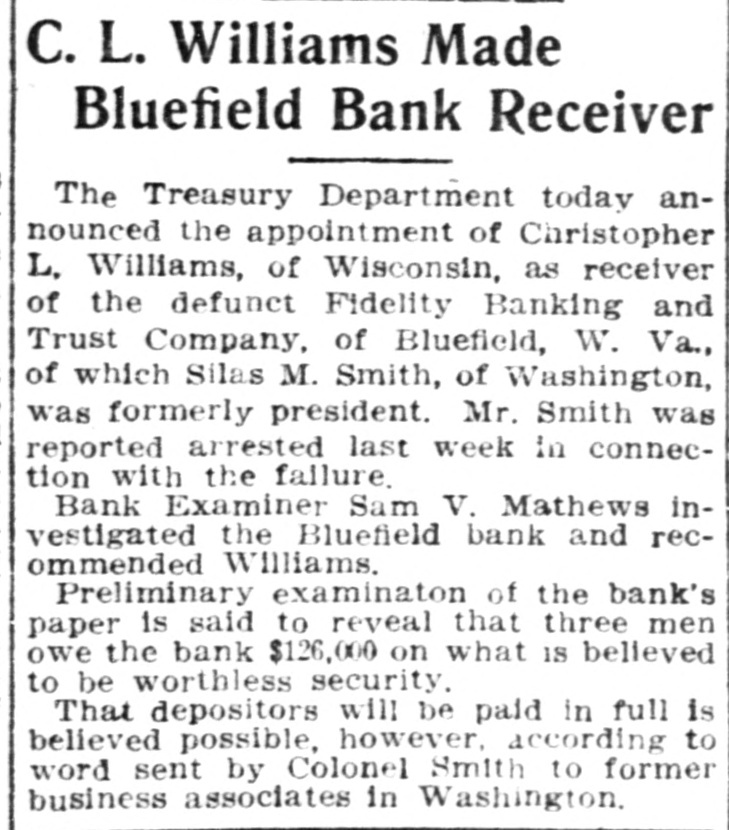
C. L. Williams Made Bluefield Bank Receiver The Treasury Department today announced the appointment of Christopher L. Williams, of Wisconsin, as receiver of the defunct Fidelity Banking and Trust Company, of Bluefield, W. Va., of which Silas M. Smith, of Washington, was formerly president. Mr. Smith was reported arrested last week in connection with the failure. Bank Examiner Sam V. Mathews investigated the Bluefield bank and recommended Williams. Preliminary examinaton of the bank's paper is said to reveal that three men owe the bank $126,000 on what IS believed to be worthless security. That depositors will be paid in full is believed possible, however, according to word sent by Colonel Smith to former business associates in Washington.


Article from The Washington Herald, September 26, 1911

Click image to open full size in new tab

Article Text

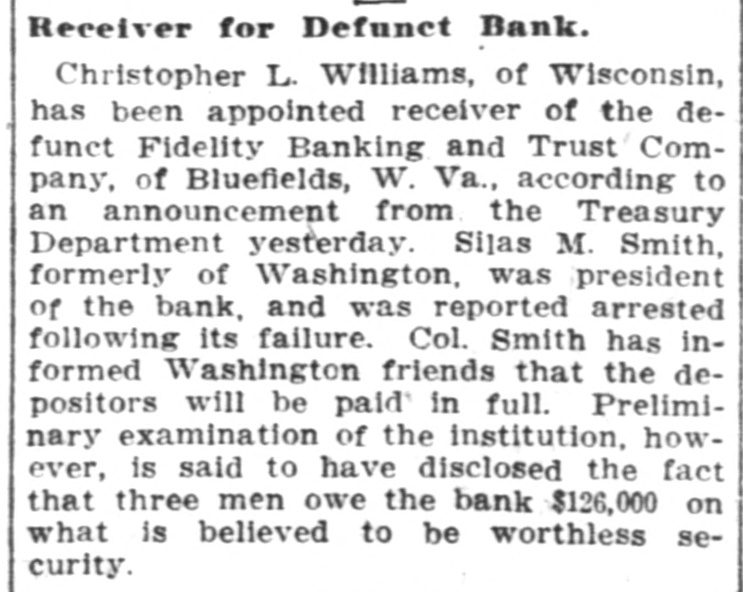
Receiver for Defunct Bank. Christopher L. Williams, of Wisconsin, has been appointed receiver of the defunct Fidelity Banking and Trust Company, of Bluefields, W. Va., according to an announcement from the Treasury Department yesterday. Sijas M. Smith, formerly of Washington, was president of the bank, and was reported arrested following its failure. Col. Smith has informed Washington friends that the depositors will be paid in full. Preliminary examination of the institution, however, is said to have disclosed the fact that three men owe the bank $126,000 on what is believed to be worthless security.


Article from The Clarksburg Telegram, September 28, 1911

Click image to open full size in new tab

Article Text

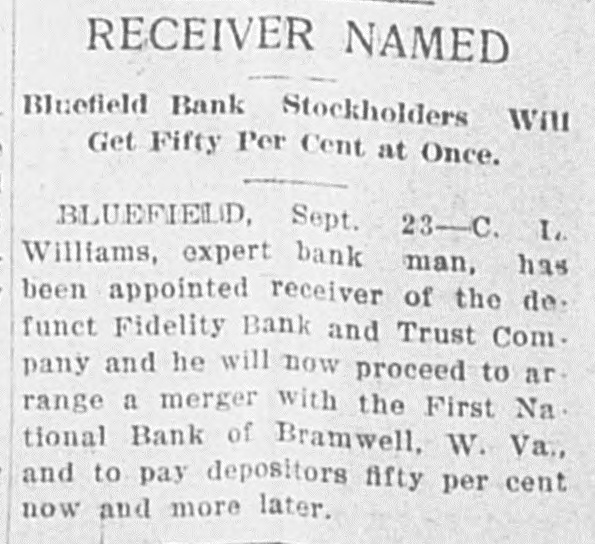
RECEIVER NAMED Bluefield Bank Stockholders Will Get Fifty Per Cent at Once. BLUEFIELD, Sept. 23-C. L. Williams, expert bank man, has been appointed receiver of the de. funct Fidelity Bank and Trust Company and he will now proceed to ar. range a merger with the First Na. tional Bank of Bramwell, W. Va., and to pay depositors fifty per cent now and more later.


Article from Virginia Free Press, September 28, 1911

Click image to open full size in new tab

Article Text

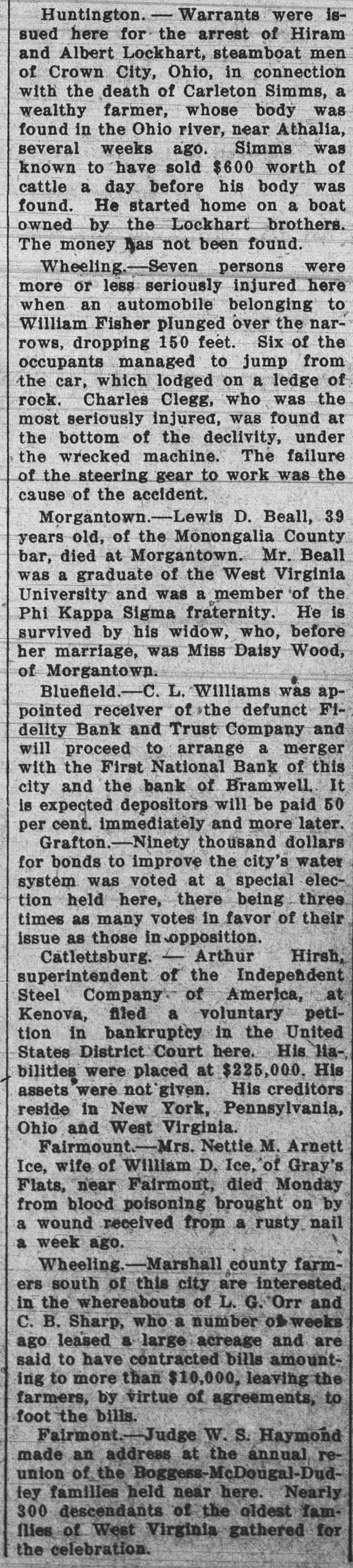
Huntington.- Warrants were issued here for the arrest of Hiram and Albert Lockhart, steamboat men of Crown City, Ohio, in connection with the death of Carleton Simms, a wealthy farmer, whose body was found in the Ohio river, near Athalia, several weeks ago. Simms was known to have sold $600 worth of cattle a day before his body was found. He started home on a boat owned by the Lockhart brothers. The money has not been found. Wheeling.-Seven persons were more or less seriously injured here when an automobile belonging to William Fisher plunged over the narrows, dropping 150 feet. Six of the occupants managed to jump from the car, which lodged on a ledge of rock. Charles Clegg, who was the most seriously injured, was found at the bottom of the declivity, under the wrecked machine. The failure of the steering gear to work was the cause of the accident. Morgantown.-Lewis D. Beall, 39 years old, of the Monongalia County bar, died at Morgantown. Mr. Beall was a graduate of the West Virginia University and was a member of the Phi Kappa Sigma fraternity. He is survived by his widow, who, before her marriage, was Miss Daisy Wood, of Morgantown. Bluefield.-C. L. Williams was appointed receiver of the defunct Fidelity Bank and Trust Company and will proceed to arrange a merger with the First National Bank of this city and the bank of Bramwell. It is expected depositors will be paid 50 per cent. immediately and more later. Grafton.-Ninety thousand dollars for bonds to improve the city's water system was voted at a special election held here, there being three times as many votes in favor of their issue as those in opposition. Catlettsburg. - Arthur Hirsh, superintendent of the Independent Steel Company of America, at Kenova, filed a voluntary petition in bankruptcy in the United States District Court here. His liabilities were placed at $225,000. His assets were not given. His creditors reside in New York, Pennsylvania, Ohio and West Virginia. Fairmount.-Mrs. Nettie M. Arnett Ice, wife of William D. Ice, of Gray's Flats, near Fairmont, died Monday from blood poisoning brought on by a wound received from a rusty nail a week ago. Wheeling.-Marshall county farmers south of this city are interested, in the whereabouts of L. G. Orr and C. B. Sharp, who a number of weeks ago leased a large acreage and are said to have contracted bills amounting to more than $10,000, leaving the farmers, by virtue of agreements, to foot the bills. Fairmont.-Judge W. S. Haymond made an address at the annual reunion of the Boggess-McDougal-Dudley families held near here. Nearly 300 descendants of the oldest famflies of West Virginia gathered for the celebration.


Article from The Progressive West Virginian, September 26, 1912

Click image to open full size in new tab

Article Text

# THOMPSON ON THE HUSTINGS Lays Bare the Corruption of the Old Republican Machine. William R. Thompson, Democratic nominee for Governor, and Thomas A. Bledsoe, Democratic nominee for attorney-general, started the week's work at Pennboro Monday, speaking there at a night meeting. during last week they spoke at Summersville, Webster Springs. Sutton, Glenville, Grantsville and Elizabeth. They thraveled by rail, on steamboats, in automobiles, on horseback and even part of the way on foot to fulfill their engagements and everywhere the greatest interest was manifested in what they had to say to their audiences. At Elizabeth Saturday the beautiful new court house of Wirt county was well filled, fully one half of those present being members of either the Progressive or the Republican party. These men listened with interest to the speakers and after the speaking assurances were given by many Republicans and Pragressives that they would vote the Democratic ticket straight in November. In their speeches last week Mr. Thompson and Mr. Bledsoe discussed the extravagance of Republican administration in West Virginia, contrasting the cost of running the State government under Democratic and Republican administrations and showing that while the population has only increased about 40 per cent since the last Democratic administration in the State, the expense of running the State government has increased nearly 200 per cent while the expenses for clerk hire at the capitol has increased about 400 per cent. They discussed the entreaties of the present Governor for more money with which to still further increase the expenditures; the building up of a big political machine through the creation of appointive offices responsive to the appointive power. They discussed the negligence of the State officials who are seeking re-election, as shown by their having $85,000 on deposit with worthless security when the Fidelity bank failed at Bluefield. They discussed the manner in which the Virgisia debt case had been handled by the Republican administration and the hundreds of thousands of dollars the case has cost the State for extra-lawyers, including W. M. O. Dawson at $5,000 a year, with the result that a verdict has been given against West Virginia, which may reach $28,000,000. They quoted the unanimous report of Republicans and Democrats alike on the elections committee of Congress to the effect that there was strong presumption that the election in McDawell county two years ago in the management of which Dr. Hatfield was very active, "was not intended to be either fair or honest." They deplored the bringing of the State Board of Control into politics by the selection of James S. Lakin for Republican State Chairman. They called the attention of the voters to the statement of Mr. Roosevelt that the new party was made necessary by the corruption and bossism which dominated the old Republican party and inquired how the Progressives were getting away from that with Dawson running their party and handing them over to the Republicans again, leaving the same old crowd of bosses in control of both parties. This week Mr. Thompson and Mr.


Article from The Daily Telegram, October 16, 1912

Click image to open full size in new tab

Article Text

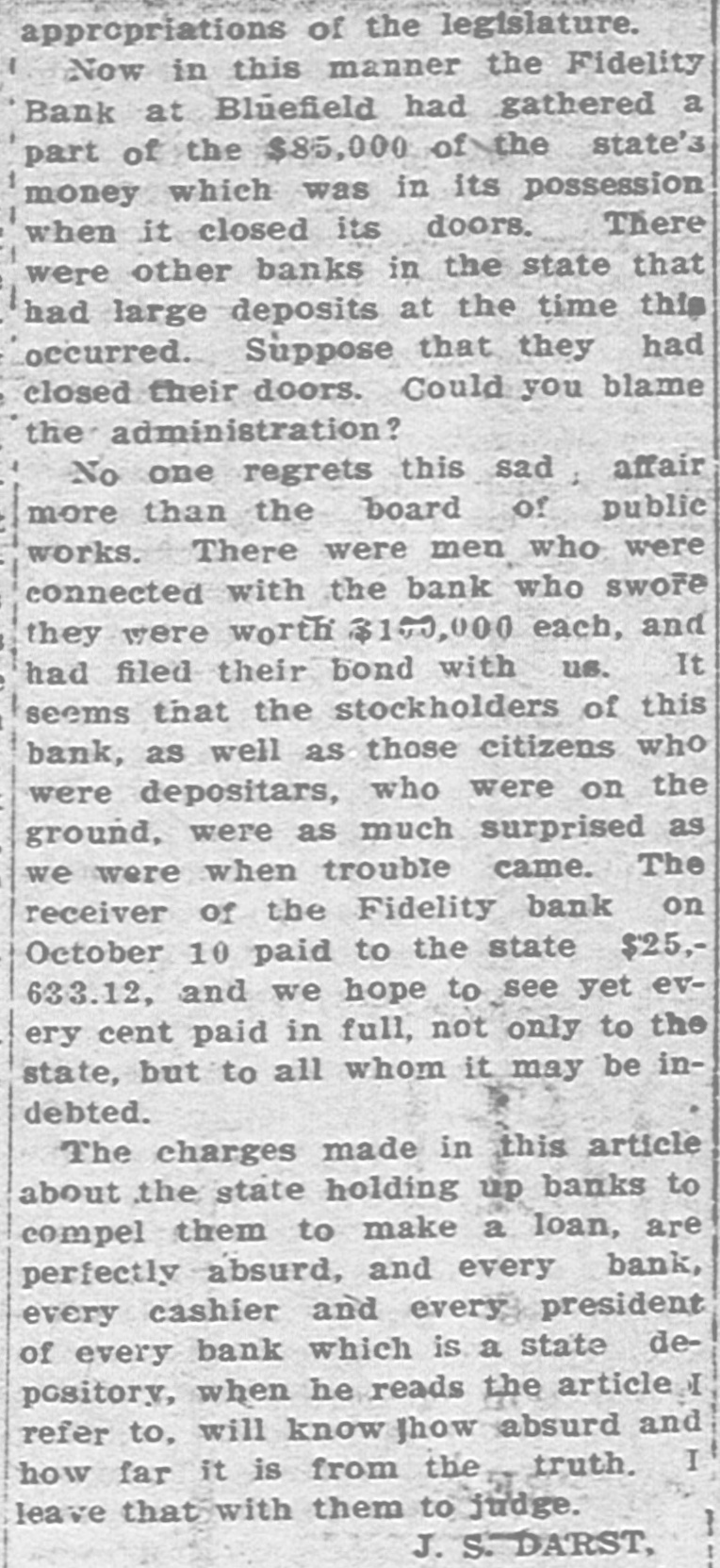
appropriations of the legislature. Now in this manner the Fidelity Bank at Bluefield had gathered a part of the $85,000 of the state's money which was in its possession when it closed its doors. There were other banks in the state that had large deposits at the time this occurred. Suppose that they had closed their doors. Could you blame the administration? No one regrets this sad affair more than the board of public works. There were men who were connected with the bank who swore they were worth $100,000 each, and had filed their bond with us. It seems that the stockholders of this bank, as well as those citizens who were depositars, who were on the ground, were as much surprised as we were when trouble came. The receiver of the Fidelity bank on October 10 paid to the state $25,633.12, and we hope to see yet every cent paid in full, not only to the state, but to all whom it may be indebted. The charges made in this article about the state holding up banks to compel them to make a loan, are perfectly absurd, and every bank, every cashier and every president of every bank which is a state depository, when he reads the article I refer to, will know Jhow absurd and how far it is from the truth. I leave that with them to judge. J. S. DARST,


Article from Spirit of Jefferson, October 29, 1912

Click image to open full size in new tab

Article Text

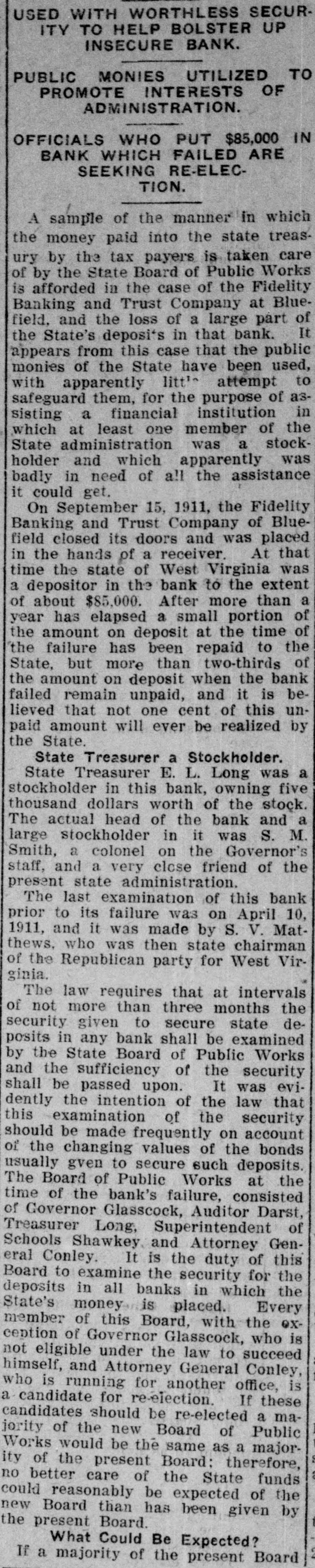
USED WITH WORTHLESS ITY TO HELP BOLSTER UP INSECURE BANK. PUBLIC MONIES UTILIZED TO PROMOTE INTERESTS OF ADMINISTRATION. OFFICIALS WHO PUT $85,000 IN BANK WHICH FAILED ARE SEEKING RE-ELECTION. A sample of the manner in which the money paid into the state treasury by the tax payers is taken care of by the State Board of Public Works is afforded in the case of the Fidelity Banking and Trust Company at Bluefield, and the loss of a large part of the State's deposits in that bank. It appears from this case that the public monies of the State have been used, with apparently litt'' attempt to safeguard them, for the purpose of assisting a financial institution in which at least one member of the State administration was a stockholder and which apparently was badly in need of all the assistance it could get. On September 15, 1911, the Fidelity Banking and Trust Company of Bluefield closed its doors and was placed in the hands of a receiver. At that time the state of West Virginia was a depositor in the bank to the extent of about $85,000. After more than a year has elapsed a small portion of the amount on deposit at the time of the failure has been repaid to the State, but more than two-thirds of the amount on deposit when the bank failed remain unpaid, and it is believed that not one cent of this unpaid amount will ever be realized by the State. State Treasurer a Stockholder. State Treasurer E. L. Long was a stockholder in this bank, owning five thousand dollars worth of the stock. The actual head of the bank and a large stockholder in it was S. M. Smith, a colonel on the Governor's staff, and a very close friend of the present state administration. The last examination of this bank prior to its failure was on April 10, 1911, and it was made by S. V. Matthews. who was then state chairman of the Republican party for West Virginia. The law requires that at intervals of not more than three months the security given to secure state deposits in any bank shall be examined by the State Board of Public Works and the sufficiency of the security shall be passed upon. It was evidently the intention of the law that this examination of the security should be made frequently on account of the changing values of the bonds usually gven to secure such deposits. The Board of Public Works at the time of the bank's failure, consisted of Governor Glasscock, Auditor Darst, Treasurer Long, Superintendent of Schools Shawkey and Attorney General Conley. It is the duty of this Board to examine the security for the deposits in all banks in which the State's money is placed. Every member of this Board, with the QXception of Governor Glasscock, who is not eligible under the law to succeed himself, and Attorney General Conley, who is running for another office, is a candidate for re-election. If these candidates should be re-elected a majority of the new Board of Public Works would be the same as a majority of the present Board: therefore.


Article from The Progressive West Virginian, October 31, 1912

Click image to open full size in new tab

Article Text

PUBLIC MONIES UTILIZED TO PROMOTE INTERESTS OF ADMINISTRATION. OFFICIALS WHO PUT $85,000 IN BANK WHICH FAILED ARE SEEKING RE-ELECTION. A sample of the manner in which the money paid into the state treasury by the tax payers is taken care of by the State Board of Public Works is afforded in the case of the Fidelity Banking and Trust Company at Bluefield, and the loss of a large part of the State's deposits in that bank. It appears from this case that the public monies of the State have been used, with apparently litt's attempt to safeguard them, for the purpose of assisting a financial institution in which at least one member of the State administration was a stockholder and which apparently was badly in need of a.l the assistance it could get. On September 15, 1911, the Fidelity Banking and Trust Company of Bluefield closed its doors and was placed in the hands of a receiver. At that time the state of West Virginia was a depositor in th bank to the extent of about $85,000. After more than a year has elapsed a small portion of th amount on deposit at the time of the failure has been repaid to the State, but more than two-thirds of the amount on deposit when the bank failed remain unpaid, and it is believed that not one cent of this unpaid amount will ever be realized by the State. State Treasurer a Stockholder State Treasurer E. L. Long was a stockholder in this bank, owning five thousand dollars worth of the stock. The actual head of the bank and a large stockholder in it was S. M. Smith, a colonel on the Governor's staff, and a very. close friend of the present state administration. The last examination of this bank prior to its failure was on April 10, 1911, and it was made by S. V. Matthews, who was then state chairman of the Republican party for West Virginia. The law requires that at intervals of not more than three months the security given to secure state deposits in any bank shall be examined by the State Board of Public Works and the sufficiency of the security shall be passed upon. It was evidently the intention of the law that this examination of the security should be made frequently on account of the changing values of the bonds usually gven to secure such deposits. The Board of Public Works at the time of the bank's failure, consisted of Governor Glasscock, Auditor Darst, Treasurer Long, Superintendent of Schools Shawkey and Attorney General Conley. It is the duty of this Board to examine the security for the deposits in all banks in which the State's money is placed. Every member of this Board, with the exception of Governor Glasscock, who is not eligible under the law to succeed himself, and Attorney General Conley, who is running for another office, is a candidate for election. If these candidates should be re-elected a majority of the new Board of Public Works would be the same as a majority of the present Board; therefore, no better care of the State funds could reasonably be expected of the new Board than has been given by the present Board. What Could Be Expected? T.C.


Article from Martinsburg Statesman-Democrat, November 1, 1912

Click image to open full size in new tab

Article Text

USED WITH WORTHLESS SECURITY TO HELP BOL^TER UP INSECURE BANK. PUBLIC MONIES UTILIZED TO PROMOTE INTERESTS OF ADMINISTRATION. OFFICIALS WHO PUT $85,000 IN BANK WHICH FAILED ARE SEEKING RE-ELECTION. A sample of the manner in which the money paid into the state treasury by the tax payers is taken care of by the State Board of Public Works is afforded in the case of the Fidelity Banking and Trust Company at Bluefield, and the loss of a large part of the State's deposits in that bank. It appears from this case that the public monies of the State have been used, with apparently litt'* attempt to safeguard them, for the purpose of assisting a financial institution in which at least one member of the State administration was a stockholder and which apparently was badly in need of a.l the assistance it could get. On September 15, 1911, the Fidelity Banking and Trust Company of Bluefield closed its doors and was placed in the hands of a receiver. At that time the state of West Virginia was a depositor in the bank to the extent of about $85,000. After more than a year has elapsed a small portion of th amount on deposit at the time of the failure has been repaid to the State, but more than two-thirds of the amount on deposit when the bank failed remain unpaid, and it is believed that not one cent of this unpaid amount will ever be realized by the State. State Treasurer a Stockholder. State Treasurer E. L. Long was a stockholder in this bank, owning five thousand dollars worth of the stock. The actual head of the bank and a large stockholder in it was S. M. Smith, a colonel on the Governor's staff, and a very close friend of the present state administration. The last examination of this bank prior to its failure was on April 10, 1911, and it was made by S. V. Matthews, who was then state chairman of the Republican party. for West Virginia. The law requires that at intervals of not more than three months the security given to secure state deposits in any bank shall be examined by the State Board of Public Works and the sufficiency of the security shall be passed upon. It was evidently the intention of the law that this examination of the security should be made frequently on account of the changing values of the bonds usually gven to secure such deposits. The Board of Public Works at the time of the bank's failure, consisted of Governor Glasscock, Auditor Darst, Treasurer Long, Superintendent of Schools Shawkey and Attorney General Conley. It is the duty of this Board to examine the security for the deposits in all banks in which the State's money is placed. Every


Article from The Daily Telegram, November 13, 1912

Click image to open full size in new tab

Article Text

BANKERS Of Bluefield Are Not to Be Tried until the Next Term of Court. BLUEFIELD, Nov. 13.-In criminal court at Princeton the case of the State vs. S. M. Smith former president of the Fidelity Banking and Trust Company which failed a year ago last September has again been postponed until the January term of court on account of the absence of material witnesses for the defense. Also the case against J. Lee Harne, former cashier of the bank, was postponed for similar reasons until the January term. This is the fifth time the cases have been postponed which have caused much unfavorable comment. Smith is blamed for aiding in the wreck of the bank in which hundreds of poor people lost their savings, and he is charged with embezzlement of $82,000 while Harne, the former cashier, got about $15,000 on worthless security, and then took bankruptcy. The state had $85,000 on deposit. A short time ago C.L. Williams, federal receiver, after the sale of real estate and bonds held by the bank declared a 30 per cent dívidend to depositors. Many were indicted for their connection with the failure.


Article from The Fairmont West Virginian, July 23, 1913

Click image to open full size in new tab

Article Text

State Board Stands Pat $82,000 TIED UP IN DEFUNCT F1. DELITY BANK MAY BE SAVED. The State Board of Public Works stood pat on its action to make the state a preferred creditor of the de funct Fidelity bank, of Bluefield, in spite of efforts to induce the board to order the attorney general to withdraw his proceedings in the circuit court of Mercer county and allow the state to remain a common creditor. At'a special meeting held yesterday afternoon, at which Governor Hatfield was present. Judge Saunders, of Blue. field, and others appeared and made earnest argument to induce the board to recede from the position taken by the state in the matter and abandon the proceedings. A long discussion ensued, at the close of which the board decided not to interfere with the attorney general's suit in the matter. Not all the members were present. but there was a quorum, and that was enough. General Lilly had previously sug. gested to the board of public works that the state should be a preferred creditor as to $82,000 of the state's funds that were on deposit in the Bluefield bank when it suspended. The board then authorized General Lilly to institute the proper legal pro ceedings, which he did If success. ful. the state will recover probably the full amount of its deposit.


Article from West Virginia Argus, March 19, 1914

Click image to open full size in new tab

Article Text

WASHINGTON LETTER andpatters Endeavoring to Assimilate the Progressives-State Funds Placed In a Defunct Bank-Many Postmasters Recommended GEO. W. SUMMERS Washington, March 10.-The general ncensus of opinion reaching Washingfrom different parts of the state is the Republican meeting at Charleslast week was purely and simply a thering of office holders, with a few spirits, engaged in an effort to the severance of their names the public payrolls. The willingto abandon their principles and to the plotform of the Progressive and endorse its presidential candiin order to get the offices shows how sperate the situation is regarded by the Holders. If the Republican party to adopt the Progressive platform as proposed at the Charleston meeting, would find itself declaring that the publican party has become a tool of interests which use it to serve selfish purposes. It would find declaring that behind the ostensible vernment, (that of President Taft) sat enthroned an invisible governowing no allegiance and acknowlno responsibility to the people. It flnd itself declaring that to desthis invisible government, to disolve unholy alliance between corrupt busiand corrupt politics is the first task the statemanship of theday. It would itself declaring that the Republican ganization is in the hands of those who broken and can not again be trusted keep the promise of necessary downrevision of the tarriff. All this, wever, the Office Holders are willing do if only the payroll isleft unchanged. are willing to admit, as has been arged by the Progressives, that the publican party has become the tool of rrupt interests and that the party is anipulated for these interests and not the good of the whole people; that is an unholy alliance between corbusiness and the Republican party; that its leaders have violated a pledge to the people and can no be trusted. They will admit all and other charges, provided the are retained and the salaries conas they have in the past and to the people. -They are even willing to Theodore Roosevelt as their Presicandidate, although he was iblicly denounced by the Republican of the State 'the most monumenliar, the most dangerous demagogue the most consummate hypocrite of day or age." When the State comof a once great political partv, the advice of the Governor of a State, sees fit to publicly admit that charges of corrupt leadership of alwith corrupt business and general ntrustworthiness, which have made the harges and to accept as a candidate for office of President a man whom it has enounced as a "har", a "demagogue" a "hypocrite" if it can only get the it considers necessary to the retention the offices and the salaries, then the esperateness of the situation begins to apparent. The Office Holders are to admit the general unworthiness their party and the corruption of its provided those leaders may be ermitted to continue their leadership provided they shall be permitted to the offices and the salaries that go them. "Amalgamation" is asked, so far as can be seen from the Charlesa m algamation means the right Progressiyes to vote the Republican and write anything they please in platform so long as the Republican are not displaced and the offices salaries are kept within the family. Considerable testimony as to the conof the Fidelity Banking and Trust ompany, of Bluefield, at a time when Republican State officials of West irginia were swelling its deposits with funds with no security was brought in Washington within the last few in connection with the trial of dward W. Molloban, formerly a direcin that institution, which is now efunet. At one time the State, carried


Article from The Wheeling Intelligencer, July 1, 1914

Click image to open full size in new tab

Article Text

MANY OPINIONS Handed Down by Supreme Court, Bluefield Bank Case and Ohio County Cases Most Important. Special Dispatch to the Intelligencer. CHARLESTON, W. Va., June 30.Despite the extreme hot weather of the past week. the Supreme Court today showed that it had been busy during the hot days by handing down seventeen opinions. Some of these are long and involve vital questions. The cases of the Fidelity Banking & Trust Company of Bluefield, in which three suits were pending, the court disposed of the three suits in two opinions, and in effect holds that the bank will have to return to Scott the money he paid for stock in the bank, because the bank was insolvent when the bank sold the stock to Scott. The cases decided to-day are: Robrecht vs. Hubbard, Ohio county. Writ of error granted. Zolsman vs. Totz, from McDowell county. Decree reversed and injunction reinstated and cause remanded. Keller vs. Roetting. from Cabell county. Judgment affairmed. Smith, administrator. vs. Sunday Creek company, from Kanawha county. Reversed, verdict set aside, new trial awarded. Dunn vs. Bank, from Monroe county. Reversed and remanded. Williams vs. Burgess, from Mercer county. Reversed and remanded. State vs. Michael, from Greenbrier county. Reversed, verdict set aside and remanded. Martin VS. White, from Wetzel county. Reversed and judgment denying writ entered here. Atkinson VS. Chesapeake & Ohio Railway Co., from Logan county. Atfirmed. Lowther vs. Oil & Coal company, from Wetzel county. Reversed in part, affirmed in part, remanded. Griffith vs. Adair, from Monroe county. Affirmed. Griffith vs. Runnion, from Roane county. Reversed, verdict set aside, new trial. Abbott vs. Williams, from Boone county. Reversed and remanded. Rowan vs. Tracy, from Monroe county. Reversed and remanded. State vs. Davis, from Raleigh county. Affirmed. Scott vs. Williams, Receiver, from Mercer county. Affirmed. Morrisey et al vs. Williams, Receiver, and Williams, Receiver vs. Fidelity Banking & Trust company, et al., from Mercer county. Reversed, decrees here.
Article from The Daily Telegram, July 1, 1914

Click image to open full size in new tab

Article Text

SEVENTEEN Appeal Cases Are Passed on by the Supreme Court of Appeals of the State. (SPECIAL TO THE TELEGRAM) CHARLESTON, July 1-Despite the extreme hot weather of the last week the supreme court showed that it had been busy during the hot days by handing down seventeen opinions. Some of these are long and involve vital question. The case of the Fidelity Banking and Trust Company. of Bluefield, in which three suits were pending the court disposed of the three suits in two opinions, and in effect holds that the bank will have to return to Scott the money he paid for stock in the bank because tur bank was insolvent when it sold the stock to Scott. The cases decided are: Zolsman vs. Tots, from McDowell county. Decree reversed and injunction reistated and cause remanded. Keller vs. Roetting, from Cabell county. Judgment affirmed. Smith, administrator, vs. Sunday Creek Company, from Kanawha county. Reversed, verdict set aside and new trial awarded. Dunn vs. Bank, from Monroe county. Reversed and remanded. Williams vs. Burgess, from Mercer county. 'Reversed and remanded. State vs. Michael, from Greenbrier county. Reversed, verdict set aside and remanded. Martin vs. White, from Wetzel county. Reversed and judgment denying writ entered here. State vs. Michael, from Greenbrier county. Reversed, verdict set aside and remanded. Atkinson vs. Chesapeake and Ohio Pailway Company, from Logan county. Affirmed. Lowther vs. Oil and Coal Company, from Wetzel county. Reversed in part, affirmed in part, remanded. Griffith vs. Adair, from Monroe county. Affirmed. Griffith vs. Runion, from Roane county. Reversed, verdict set aside, new trial ordered. Abbott vs. Williams, from Boone county. Reversed and remanded. Rowan vs, Tracy, from Monroe county. Reversed and remanded. State vs. Davis, from Raleigh county. Affirmed. State vs. Williams, receiver, from Mercer county. Affirmed. Morrissey et al vs. Williams, receiver, and Williams, receiver, vs. Fldelity Banking and Trust Company et al, from Mercer county. Reversed. Decree here.


Article from The Wheeling Intelligencer, September 20, 1915

Click image to open full size in new tab

Article Text

BLAMES LONG State Treasurer Held Responsible by Casualty Company For Loss of State Funds in Defunct Bank. Special Dispatch to the Intelligencer. CHARLESTON, W. Va., Sept. 19.Sensational disclosures involving State Treasurer E. L. Long, it is said, will be made in the hearing of a suit filed in Kanawha county common pleas court by the state against the Citizen's Dollar Savings Bank of Fairmont and the Maryland Casualty Co., of Baltimore, to recover $19,000, which the state had on deposit at the time the bank went into the hands of a receiver. The casualty company was on the bank's bond to indemnify the state against loss and suit was instituted by Assistant Attorney General Frank Lively to compel it to make immediate settlement. It is said the surety company will base its defense on the grounds that it had repeatedly warned the state treasurer that the bank was in a precarious condition and warned him to withdraw the state's funds. The same warnings were given the officers of the bank. Defendant claims that in spite of its many warnings. Long would not withdraw or reduce the deposits and therefore it cannot be held responsible. This suit recalls similar litigation in which Long was involved by the failure, September 5. 1911, of the Fidelity Banking and Trust company. of Bluefield. Long had more than $90,000 of the state's money on deposit in that bank when it closed its doors and most of the amount has never been recovered The loss of this great amount of the state's money aroused strong feeling against Long when it became known he was a stockholder in the defunct institution and that the bank held $4,500 of his notes without security or endorsements Suit was instituted and judgement secured