Click image to open full size in new tab
Article Text
# Some Historic Facts and Timely Words of Caution Given by Robert E. Park, State Treasurer.
ATLANTA, GA., May 28, 1908.
To the People of Georgia:
Certain Georgia bankers have recently stated that my opponent has made promises in the event of his election to "distribute the State's money among the smaller depositories throughout the State," and I note that almost this exact language is used in his recent card of errors. These bankers expressed the opinion that this was intended as a tempting bait or bribe to them to withdraw their allegiance from myself. If Mr. Speer was connected with the State Treasury as Clerk and Assistant Bank Examiner so many years, as he claims, and was posted about the duties, he ought to know that tax-collectors and others who deposit taxes are required by the depository law to place the money of certain counties assigned to them in the banks selected for that purpose by the Governor, who alone has the right to designate such banks. To do otherwise, he should know, would violate the law. I am a stickler for obeying the law (perhaps I am old-fashioned in this respect), but I believe in a strict observance of the Code of Georgia and of the Acts of the Legislature relating to the State Treasury and State Banking Departments.
Pardon a recital of some historic facts connected with State Treasurers of several Southern States who have held office during the past thirty years, and who, by violating the letter and the spirit of the law, have caused financial loss to their States, and have suffered personal and official disgrace: A treasurer of Kentucky was a defaulter to his State; a treasurer of Tennessee was punished for abstracting the State, funds; a treasurer of Alabama was convicted of making way with more than $3,000.00 of that State's funds; a treasurer of Mississippi spent four years in the penitentiary for similar conduct; a treasurer of Louisiana is now a refugee from justice in South America; a treasurer of Arkansas was convicted of misappropriation of the State's funds. this is a mortifying exhibit. Let us hope that Georgia will never entrust the management of her finances to any but men of high ideals, who are of iron integrity, and of stainless reputation in social and political life. With such men all shame in the history of our State will be avoided.
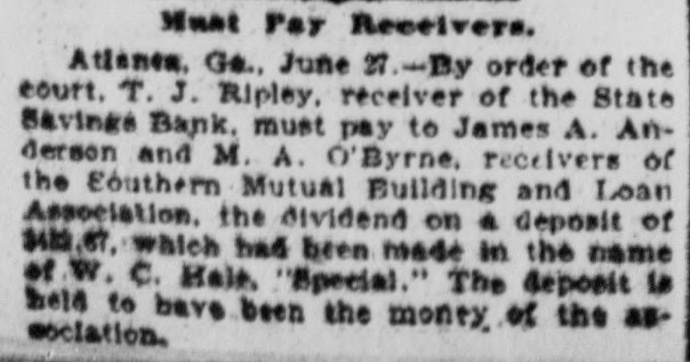
My opponent brazenly stated that no depositor during his long connection with the State Treasury ever lost a dollar. This can not be a truthful statement in view of the fact that W. C. Hale, President of the State Savings Bank and Union Trust Company of Atlanta, failed utterly to meet the obligations to depositors and creditors of those two institutions, and incontinently fled the State and is now a refugee from justice. This event occurred during Mr. Speer's connection with the Treasury Department. His poor memory has also made him forget the Home Bank and the Merchants Bank of Atlanta, and I might also mention others, notably, the failure in Athens which caused the disappearance of its most trusted officer. I have painful memories myself of my inheritance from Mr. Speer of certain banks which I might mention, the condition of which, to quote his classic language, was "rotten." He has the effrontery to charge my administration with having permitted the Neal Bank to fail. Yet, in the opinion of Attorney-General Hart, and by the decision of Judge Ellis, as well as the freely-expressed views of many of our most intelligent bankers, and of numerous fair-minded people throughout the State, the official acts of myself and assistant in connection with this bank have been approved, and we have been fully absolved from any blame in this affair, now being revamped and rehashed for purely personal and political reasons by this desperate candidate. The high-minded and noble bankers and other citizens of Georgia will resent the suggestions and statements made by W. J. Speer.
I repeat, that no treasurer has a right under the law to "distribute the State's money among the smaller depositories throughout the State." At one time, in 1906, there was only $3,500.00 of the State's money in all the depositories, very little to "distribute." I shall continue to be fair to all banks and persons of Georgia. The Governor designates the depositories and the law does not permit the Treasurer to discontinue them or to move deposits from one bank to another except, possibly, under order of the governor. The State of Georgia and its officers can not be directors of the conduct of the financial operations of the 465 State banks. The law directs, and it has been my pleasure to warn, to caution, to guide and to save banks and bankers that are in trouble. Only two chartered banks in Georgia have suspended during the present year, and those two, I am happy to say, have been restored to their former position as active banks. So I am still able to repeat what I stated in my annual report, that only five banks have failed during the past eight years. No other State in the Union can show a better record.
I respectfully ask consideration of the above historic facts and these words of well-meant caution, believing that a generous patriotic and thoughtful people, realizing the important trust and responsibilities of the office of State Treasurer, are amply satisfied with my record, and the security of the State's funds while committed to my care.